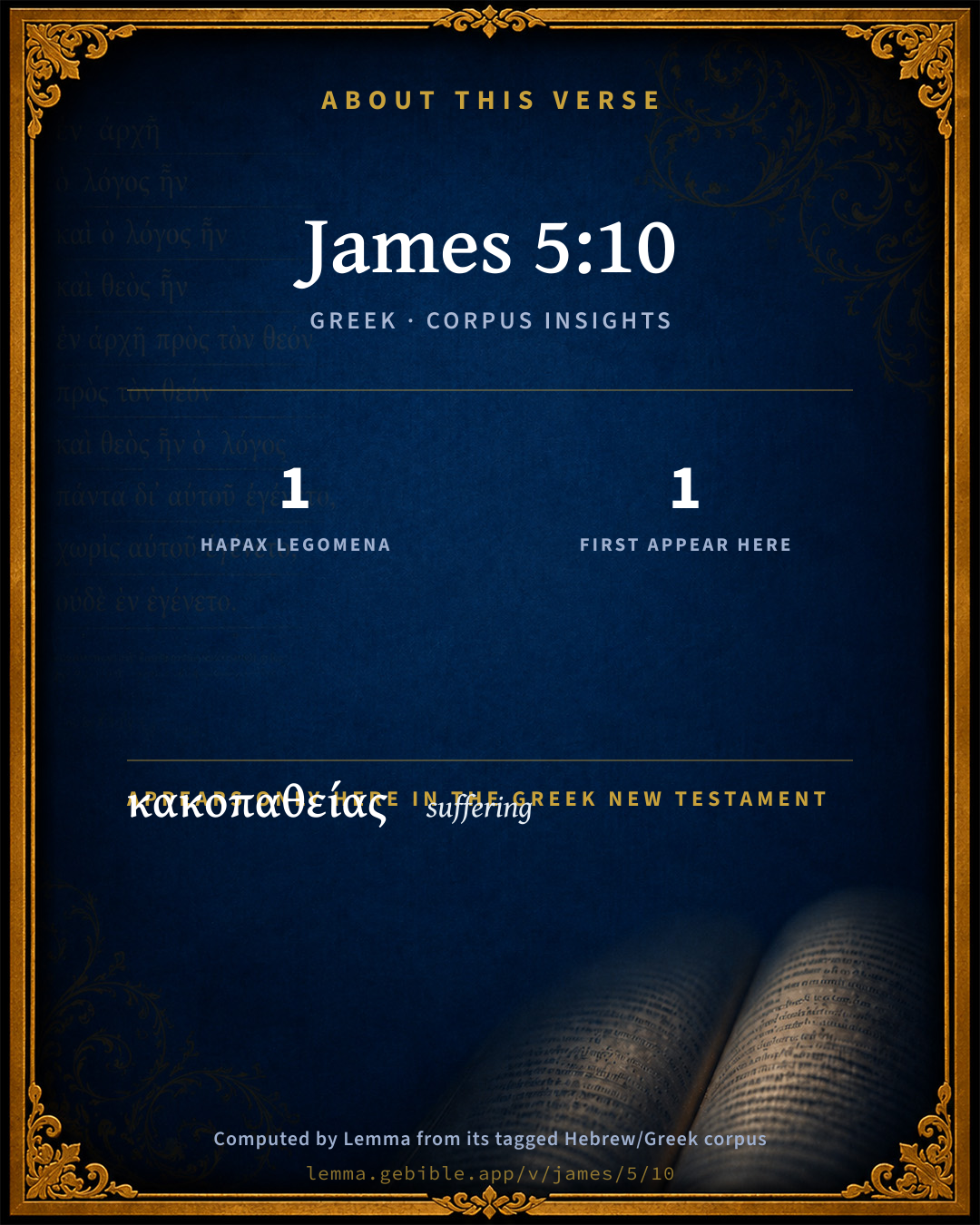
James 5:10

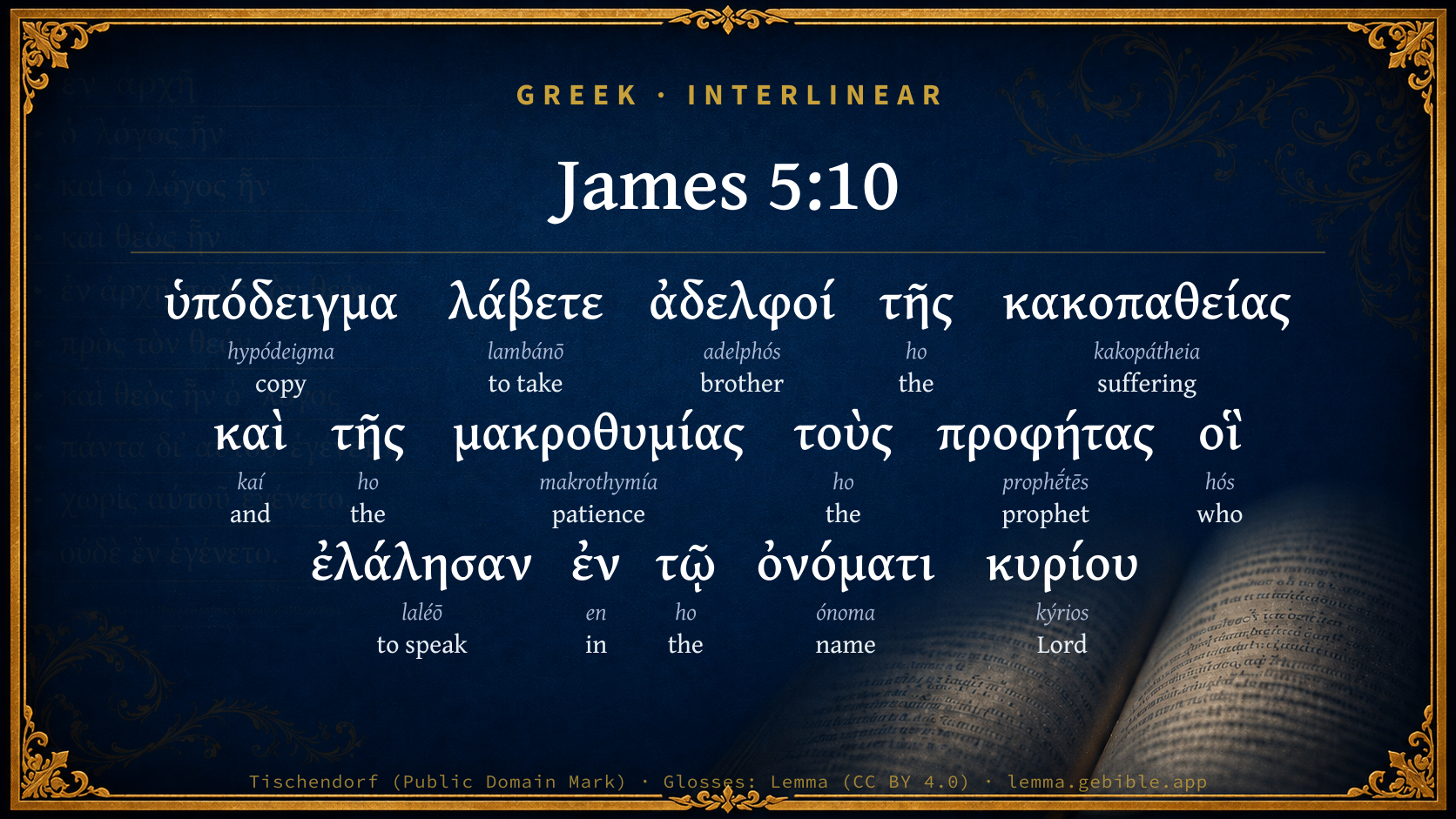
Greek (Tischendorf 8th ed.) James 5:10 appears in the Greek New Testament. The text above is from the Tischendorf 8th edition. Each word links to its Strong’s number and a concise gloss. Click any word for its full Thayer’s Greek Lexicon entry.
Download image
Cite this verse

James 5:10 (World English Bible). Public Domain. Lemma interlinear Bible study tool, https://lemma.gebible.app/v/james/5/10.

Show BibTeX & RIS
BibTeX
RIS
English Translation
Take, brothers, for an example of suffering and of patience, the prophets who spoke in the name of the Lord.
World English Bible · Public Domain
Highlights
  • 1 hapax legomenon — only here in the Greek New Testament
  • 1 first appearance in the Greek New Testament
Full analysis ↓
Download a study sheet

One document with this verse’s original text, its word-by-word gloss line, the meaning frame, cross-references with their text, attributed commentary, and full source and license credits — printable, and it pastes into notes with its structure intact.

This verse Autodidact and up

Study sheet (.html) Plain text (.txt)

A passage Seminary Student

Up to 50 verses in one chapter. A passage sheet keeps up to 6 commentary sources and 12 cross-references per verse, in the order this page ranks them, and says so on the sheet whenever that leaves anything out. Ask for a single verse and you get the Autodidact verse sheet above.

Everything on this page stays free to read, with no account — the sheet is a download of what is already on screen, not access to it.

Want to remove ads? Support Godless Engineer
Compare translations 3

The same verse in 3 English versions, stacked beneath the original-language interlinear above. Click any original word for its lexicon entry.

Each is an independent rendering of the whole verse — the interlinear is not word-aligned to these translations.

Highlighted words mark where these versions differ — a whole-verse word diff, not a word-by-word alignment.

  • World English Bible Public Domain
    Take, brothers, for an example of suffering and of patience, the prophets who spoke in the name of the Lord.
  • King James Version Public Domain
    Take, my brethren, the prophets, who have spoken in the name of the Lord, for an example of suffering affliction, and of patience.
  • unfoldingWord Literal Text CC BY-SA 4.0
    Take an example, brothers, of the suffering and the patience of the prophets, who spoke in the name of the Lord.

unfoldingWord Literal Text — © unfoldingWord, licensed CC BY-SA 4.0. Word-aligned USFM3 via Door43 (git.door43.org/unfoldingWord/en_ult).

Versions to compare (up to 4)

3 of 4 selected

Show all 19 translations

Every available English version of this verse, each an independent rendering of the whole verse.

  • World English Bible Public Domain
    Take, brothers, for an example of suffering and of patience, the prophets who spoke in the name of the Lord.
  • Berean Standard Bible Public Domain
    Brothers, as an example of patience in affliction, take the prophets who spoke in the name of the Lord.
  • Majority Standard Bible Public Domain
    My brothers, as an example of patience in affliction, take the prophets who spoke in the name of the Lord.
  • King James Version Public Domain
    Take, my brethren, the prophets, who have spoken in the name of the Lord, for an example of suffering affliction, and of patience.
  • American Standard Version (1901) Public Domain
    Take, brethren, for an example of suffering and of patience, the prophets who spake in the name of the Lord.
  • Revised Version (1885) Public Domain
    Take, brethren, for an example of suffering and of patience, the prophets who spake in the name of the Lord.
  • Geneva Bible (1599) Public Domain
    Take, my brethren, the Prophets for an ensample of suffering aduersitie, and of long patience, which haue spoken in the Name of the Lord.
  • Douay-Rheims (1899) Public Domain
    Take, my brethren, for an example of suffering evil, of labour and patience, the prophets, who spoke in the name of the Lord.
  • Young's Literal Translation Public Domain
    An example take ye of the suffering of evil, my brethren, and of the patience, the prophets who did speak in the name of the Lord;
  • Literal Standard Version CC BY-SA 4.0
    Brothers, [as] an example of the suffering of evil and of patience, take the prophets who spoke in the Name of the LORD;
  • Unlocked Literal Bible CC BY-SA 4.0
    Take an example, brothers, from the suffering and patience of the prophets, those who spoke in the name of the Lord.
  • unfoldingWord Literal Text CC BY-SA 4.0
    Take an example, brothers, of the suffering and the patience of the prophets, who spoke in the name of the Lord.
  • Darby Bible Public Domain
    Take [as] an example, brethren, of suffering and having patience, the prophets, who have spoken in the name of [the] Lord.
  • World Messianic Bible Public Domain
    Take, brothers, for an example of suffering and of perseverance, the prophets who spoke in the name of the Lord.
  • Webster's Bible Public Domain
    Take, my brethren, the prophets, who have spoken in the name of the Lord, for an example of suffering affliction, and of patience.
  • Free Bible Version CC BY-SA 4.0
    Take the prophets as an example, my friends—see how they spoke in the Lord's name as they suffered and waited patiently.
  • Bible in Basic English Public Domain
    Take as an example of pain nobly undergone and of strength in trouble, the prophets who gave to men the words of the Lord.
  • Text-Critical English NT CC BY 4.0
    As an example of suffering and patience, my brothers, take the prophets, who spoke in the name of the Lord.
  • Tyndale New Testament (1534) Public Domain
    Take (my brethren) the prophettes for an ensample of sufferynge adversitie and of longe pacience which spake in the name of the lorde.

Literal Standard Version (2020), Covenant Press — licensed CC BY-SA 4.0. Text via the HelloAO Bible API (eBible.org). Unlocked Literal Bible (unfoldingWord) — licensed CC BY-SA 4.0. Text via the HelloAO Bible API (eBible.org). unfoldingWord Literal Text — © unfoldingWord, licensed CC BY-SA 4.0. Word-aligned USFM3 via Door43 (git.door43.org/unfoldingWord/en_ult). Free Bible Version, Dr. Jonathan Gallagher — licensed CC BY-SA 4.0. Text via the HelloAO Bible API (eBible.org).

Word by word

More ways to search: Search by grammar → Find every occurrence → Compare this word →

Practice this passage: Drill this verse → Learn its vocabulary →

κακοπαθείας
kakopátheia
G2552
“suffering”
Noun, Genitive, Singular, Feminine
Part of Speech
Noun
Case
Genitive
Number
Singular
Gender
Feminine
Full Thayer's Definition

Origin: from a compound of G2556 and G3806

TDNT: 20:36,8

1. the suffering of evil, i.e. trouble, distress, afflicted
  1. ὑπόδειγμα hypódeigma G5262 “copy” Noun, Accusative, Singular, Neuter
  2. λάβετε lambánō G2983 “to take” Verb, Aorist, Active, Imperative, 2nd person, Plural
  3. ἀδελφοί adelphós G80 “brother” Noun, Vocative, Plural, Masculine
  4. τῆς ho G3588 “the” Article, Genitive, Singular, Feminine
  5. καὶ kaí G2532 “and” Conjunction
  6. τῆς ho G3588 “the” Article, Genitive, Singular, Feminine
  7. μακροθυμίας makrothymía G3115 “patience” Noun, Genitive, Singular, Feminine
  8. τοὺς ho G3588 “the” Article, Accusative, Plural, Masculine
  9. προφήτας prophḗtēs G4396 “prophet” Noun, Accusative, Plural, Masculine
  10. οἳ hós G3739 “who” Relative pronoun, Nominative, Plural, Masculine
  11. ἐλάλησαν laléō G2980 “to speak” Verb, Aorist, Active, Indicative, 3rd person, Plural
  12. ἐν en G1722 “in” Preposition
  13. τῷ ho G3588 “the” Article, Dative, Singular, Neuter
  14. ὀνόματι ónoma G3686 “name” Noun, Dative, Singular, Neuter
  15. κυρίου kýrios G2962 “Lord” Noun, Genitive, Singular, Masculine

About this verse

These counts appear in no published source. They are computed here, from the morphology-tagged text and Lemma’s own curated glosses. What Lemma adds →

16
words
13
distinct lemmas
General Epistles
section

Notable vocabulary

1 hapax legomenon — a word that appears only here in the entire Greek New Testament:

  • κακοπαθείας suffering G2552

First appearance in Scripture

This word makes its first canonical appearance in the Greek New Testament here:

  • κακοπαθείας suffering G2552

Shared distinctive vocabulary

ὑπόδειγμα copy G5262 occurs in 6 verses of the Greek New Testament. Also found in:

Repetition

A word recurs within this verse:

Cross-references

15

Topical passages linked to James 5:10 in the Treasury of Scripture Knowledge — connected by theme and wording, ordered by reader-vote popularity; previews shown in the World English Bible.

  • Hebrews 11:32–38 What more shall I say? For the time would fail me if I told of Gideon, Barak, Samson, Jephthah, David, Samuel, and the prophets;
  • Matthew 5:11–12 "Blessed are you when people reproach you, persecute you, and say all kinds of evil against you falsely, for my sake.
  • Hebrews 13:7 Remember your leaders, men who spoke to you the word of God, and considering the results of their conduct, imitate their faith.
  • Acts 7:52 Which of the prophets didn't your fathers persecute? They killed those who foretold the coming of the Righteous One, of whom you have now become betrayers and murderers.
  • Acts 3:21 whom heaven must receive until the times of restoration of all things, which God spoke long ago by the mouth of his holy prophets.
  • 1 Thessalonians 2:14–15 For you, brothers, became imitators of the assemblies of God which are in Judea in Christ Jesus; for you also suffered the same things from your own countrymen, even as they did from the Jews;
  • Luke 6:23 Rejoice in that day, and leap for joy, for behold, your reward is great in heaven, for their fathers did the same thing to the prophets.
  • 2 Chronicles 36:16 but they mocked the messengers of God, and despised his words, and scoffed at his prophets, until the wrath of Yahweh arose against his people, until there was no remedy.
  • Isaiah 39:8 Then said Hezekiah to Isaiah, Good is the word of Yahweh which you have spoken. He said moreover, For there shall be peace and truth in my days.
  • Jeremiah 2:30 In vain have I struck your children; they received no correction: your own sword has devoured your prophets, like a destroying lion.
  • Jeremiah 26:16 Then said the princes and all the people to the priests and to the prophets: This man is not worthy of death; for he has spoken to us in the name of Yahweh our God.
  • Matthew 21:34–39 When the season for the fruit drew near, he sent his servants to the farmers, to receive his fruit.
  • Matthew 23:34–37 Therefore, behold, I send to you prophets, wise men, and scribes. Some of them you will kill and crucify; and some of them you will scourge in your synagogues, and persecute from city to city;
  • Luke 13:34 "Jerusalem, Jerusalem, that kills the prophets, and stones those who are sent to her! How often I wanted to gather your children together, like a hen gathers her own brood under her wings, and you refused!
  • Jeremiah 23:22 But if they had stood in my council, then had they caused my people to hear my words, and had turned them from their evil way, and from the evil of their doings.

Cross-references courtesy of OpenBible.info (CC BY 4.0).

Where the printed editions differ

1 variant

Places in this verse where the major printed Greek editions disagree on the wording in a way that affects the translation — a comparison of editions, not a manuscript-by-manuscript collation. The editions are the modern critical texts (Nestlé-Aland 28/27, SBL, Westcott-Hort, Tregelles, Tyndale House) and the traditional texts behind the KJV (the Textus Receptus and the Byzantine/Majority text). It is not a claim about which reading is original.

  1. Extra text
    μου,

    “of mine”

    In TRByz Not in NA28NA27TynSBLWHTreg

    μου, (mou) 'of mine' is only in traditional manuscripts (TR+Byz)

Textual data: Translators Amalgamated Greek New Testament (STEPBible TAGNT) · CC BY 4.0.

Commentary

Notes on James 5:10 from classic Christian and Jewish commentators (each source and its license shown beneath its notes). The classic Christian expositions comment on the surrounding passage and are grouped to its opening verse, so a note may address several verses; the Jewish commentaries on the Tanakh (Rashi and others) are per-verse, so they appear only where the commentator wrote on this verse.

Lemma curates 59 commentaries, every one of them public domain or Creative Commons licensed, each selected and text-cleaned for this edition rather than reprinted as found. About our sources →

The Biblical Illustrator

Joseph S. Exell

Jam_5:10

An example of suffering affliction--

Good examples

Man is so formed by nature that examples, whether good or bad, have a great influence upon him.

The bad, indeed, have more power to corrupt than the good to reform the world: nevertheless, upon all who are well disposed, good examples are not without a considerable effect. Good examples in general tend to establish us in the belief of the infinite advantages of true religion, which appears with most convincing evidence when, in the lives and actions of those who profess it, we behold a lovely counterpart of its Divine doctrines and admirable precepts. The cause is known by its effects, the fountain by its streams. Good examples are further advantageous as they are corrective: they strongly operate upon the principles of an ingenuous shame, and therefore contribute to reform the vicious and to improve the virtuous. We may also observe that such good and amiable models are powerfully attractive. Their lustre is truly bright, their beauty truly alluring: they seize on our esteem, steal our affections, and so insinuate themselves into the soul as by insensible degrees to transform it into their own likeness. When the sincere follower of Christ contemplates the illustrious patterns held up to him in Scripture, he will naturally be led to reflect that he is not single in the difficulties of the human race. Through the Divine blessing and assistance he will determine to tread the same path, and, like them, despise the allurements and terrors of the world. It is highly useful to attend not only to the patterns proposed in Scripture, but also to all those good examples which through any other means fall within the sphere of our knowledge; more particularly of such persons as have been persecuted for righteousness sake, and have with heroic fortitude borne witness to the truth in the face of sufferings and death. If we have borne any particular relation to persons eminent for piety and virtue, their examples ought to be peculiarly beneficial to us. It may be presumed that, by our greater affection for such endeared friends, we shall be better prepared to receive the influence of their good examples. If we have had the benefit of their instructions and reproofs, of their admonitions, prayers and counsels, we shall be the more inexcusable if we are not disposed to resemble them. Eminent examples of piety and virtue, whether near or more remote, are like lights set up in the world for the direction of mankind in general, and for the comfort of the good: some of these, like the luminaries of heaven, extend their influence to all nations and times. In order to induce us to imitate those excellent examples which are held forth to us in Scripture, or which by any other means come within the circle of our knowledge, let us attend to the following encouraging considerations.

1. We serve the same God and Father. He is as deserving of the zeal and fidelity of His servants now as ever, has the same blessings treasured up in Himself, the same power in heaven, and the same care of His people here on earth. If we cultivate repentance and faith, piety and virtue, we have the same hopes of acquiring His favour, for He is no respecter of persons.

2. Another encouraging circumstance is that we profess the same doctrine in general even with those who lived before the time of Christ.

3. Again, we are blessed with the same assistance, we are favoured with the same outward means and institutions, we are blessed with the public worship of God, the benefit of prayer, of the preaching His Word, and of the administration of the sacraments; we have moral and religious treatises in abundance, doctrinal, practical and devotional. Nor is there any want of internal assistance and consolation that either our own weakness, the irregularity of our passions, or the temptations with which we are encompassed, may render necessary to encourage us in our Christian course.

4. To conclude all, let it be considered that we have the promise and expectation of the same reward with them. Attentively, therefore, let us eye all the good examples with which we are acquainted that we may catch a portion of that heavenly ardour which animated them. (B. C. Sowden.)

What is affliction?

Affliction is the dark soil in which is deposited the heavenly seed, that germinates, and brings forth fruit to the glory of God. Affliction is a furnace, in whose ardent flame the Refiner of souls is consuming our human imperfections. Affliction is a rod, under whose kindly chastisement the Father of Spirits is educating us for immortality. Affliction is a baptism, from whose cleansing wave the saints of the Most High come forth fit for the marriage-supper of the Lamb. Affliction is a cup, whose bitter draught is administered by the good Physician to purify our spiritual natures. Affliction is a dark cloud, on which the God of covenant has painted the rainbow of hope, and which He has irradiated with the halo of celestial glory. Would you, then, bring forth much fruit? would you be purified of remaining imperfections? would you be trained for immortality? would you be fitted for the marriage-supper? would you be sanctified in your spiritual nature? would you be encircled in the bow of promise or adorned with the halo of glory? You must needs suffer affliction; for it is through much tribulation we must enter the kingdom.

The uses of affliction

1. God visits with sickness to cause careless sinners to bethink themselves concerning their souls estate, who, perhaps, never had a serious thought about it before.

2. God visits us with sickness in order to instruct and teach us things we know not (Psa_90:12). The path of the cross is the path of light.

3. God sends such trials and distresses in order to mortify and kill sin in us.

4. God sends sickness to awaken in us the spirit of prayer and supplication, and make us more earnest and importunate in our addresses to the throne of grace.

5. Another end is to loosen our hearts from the things of the world, and cause us to look and long for heaven.

6. God designs to make the world bitter, and Christ sweet to us.

7. God visits with sickness and distress in order both to prove and improve His peoples graces (Deu_8:2; Rev_2:10). Grace is hereby both tried and strengthened.

8. Gods aim is to awaken us to redeem time, to prepare for flitting, and clear up our evidence for heaven. (The Study.)

And of patience

Patience aids every virtue

Patience to the soul is as bread to the body, the staff of either the natural or spiritual life; we eat bread with all our meats, both for health and relish; bread with flesh, bread with fish, bread with broths and fruits. Such is patience to every virtue; we must hope with patience, and pray in patience, and love with patience, and whatsoever good thing we do, let it be done in patience.

Patience reduces pain

As the lid is made to open and shut, to save the eye; so patience is set to keep the soul, and save the heart whole to cheer the body again. Therefore, if you mark when you can go by an offence and take a little wrong, and suffer trouble quietly, you have a kind of peace and joy in your heart, as if you had gotten a victory; and the more your patience is, still the less your pain is. For as a light burden, borne at the arms end, weigheth heavier by much than a burden of treble weight if it be borne upon the shoulders, which are made to bear; so if a man set impatience to bear a cross, which is not fit to bear, it will grumble and murmur, and start and shrink, and let the burden fall upon his head; like a broken staff which promiseth to help him over the water, and leaveth him in the ditch. But if you put it to patience, and set her to bear it which is appointed to bear, she is like the hearty spies that came from Canaan, and said, It is nothing to overcome them; so patience saith, It is nothing to bear, it is nothing to fast, it is nothing to watch, it is nothing to labour, it is nothing to be envied, it is nothing to be backbited, it is nothing to be imprisoned; In all these things we are more than conquerors. (Henry Smith.)

The Biblical Illustrator, edited by Joseph S. Exell (c. 1880s–1900s) — public domain. Text from a community e-Sword module.

Joseph Benson's Commentary

Jas 5:10-11. Take the prophets — Once persecuted like you, even for speaking in the name of the Lord — The very men that gloried in having the prophets, yet could not bear their message. Nor did either the holiness or the high commission of these messengers of God screen them from suffering; for an example of suffering affliction — Or persecution from the persons to whom they brought divine revelations; and of patience — In suffering. Behold, we count them happy — We commend them, and believe them to be the beloved children of God; who endure — Bear their sufferings with patience, meekness, and a contented mind. The apostle’s mentioning this immediately after he had proposed the prophets as an example of patience in suffering, shows that he herein alludes to Christ’s words, (Mat 5:11,) Blessed are ye when men shall revile you, &c., for so persecuted they the prophets that were before you. Ye have heard of the patience of Job — Under his peculiarly heavy sufferings; and have seen the end of the Lord — Ye have seen, in the history of that good man, what a happy issue the Lord gave to his sufferings; or how much to his honour and comfort his various and heavy afflictions concluded; that the Lord is very pitiful, &c. — And that it is with the bowels of an affectionate father that he corrects his beloved children, and not for his own gratification, but with a view to their eternal advantage.

Joseph Benson's Commentary on the Old and New Testaments (1811–1818) — public domain. Text from a community e-Sword module.

Tyndale Open Study Notes

Tyndale Open Resources

5:10 This verse reflects on Matt 5:11 and Luke 6:23 (see study note on Jas 1:22-23).

Tyndale Open Study Notes — © Tyndale Open Resources, licensed CC BY-SA 4.0. Text via the HelloAO Bible API.

Bengel's Gnomon

Johann Albrecht Bengel

Jas 5:10. Ἀδελφοί μου, τῆς κακοπαθείας) The vindication of this reading is to be found, App. Crit. Ed. ii. on this passage.[72]—Τῆς ΚΑΚΟΠΑΘΕΊΑς, the enduring of evils) lest you should think that any strange thing has happened to you. The word κακοπαθεῖ occurs, Jas 5:13.—ΤΟῪς ΠΡΟΦΉΤΑς, the prophets) who were singularly persecuted in their time, and therefore blessed: Mat 5:12.—ἐλάλησαν, have spoken) How great was the violence of the world, and the patient endurance of the prophets, is here intimated.—τῷ ὀνόματι, in the name) The obedience of the prophets in praising the name of the Lord is intended: ἐν is understood, as at Mat 7:22; Lev 19:12, Septuagint.

[72] AB Vulg. omit μον. Rec. Text omits it, with Syr. and Memph. Also AB and most Versions put ἀδελφοὶ before κακοπαθείας. Rec. Text puts it after κακοπ, without good authority.—E.

Bengel's Gnomon of the New Testament — English translation (T&T Clark, Edinburgh, 1860) — public domain. Text from a community e-Sword module.

Meyer's Critical & Exegetical Commentary

Heinrich August Wilhelm Meyer

Jam_5:10-11. Old Testament examples adduced for the sake of strengthening the exhortation to patience.

ὑπόδειγμα λάβετε] ὑπόδειγμα (instead of the classical παράδειγμα) here, as frequently in the N. T. and LXX., an example, a pattern; in sense equivalent to ὑπόγραμμον, 1Pe_2:21; τύπος, 2Th_3:9 (εἰς τὸ μιμεῖσθαι).

τῆς κακοπαθείας καὶ τῆς μακροθυμίας] κακοπάθεια, in the N. T. ἅπ. λεγ., is not synonymous with μακροθυμία = vexationum patientia (Hottinger), but denotes suffering, affliction, synonymous with ξυμφοραί, Thue. vii. 77; in 2Ma_2:26-27, it is used in a somewhat attenuated sense. Schneckenburger arbitrarily combines it with the following words into one idea = τῆς ἐν κακοπαθείᾳ μακροθυμίας; by this combination the point of κακοπάθεια is weakened. On the sentiment, see Mat_5:12.

By the relative clause οἳ ἐλάλησαν (ἐν) τῷ ὀνόματι κυρίου, belonging to τοὺς προφήτας, is indicated that the prophets, as servants of God, stand opposed to the world, even as believing Christians do. The dative τῷ ὀνόματι (see critical remark) is not to be explained, with Meyer (see on Mat_7:22), by means of the name, i.e. that the name of the Lord satisfied their religious consciousness and was the object of their confession; but, as is commonly understood = ἐν τῷ ὀνόματι κυρίου (Wiesinger: jussu et autoritate; de Wette: by virtue of the name); this is evident from the fact that the Hebrew דִּבֵּר בְּשֵׁם יְהֹוָה is translated in the LXX. not only by ἐν (τᾷ) ὀν. κυρίου (Dan_9:6) or by ἐπὶ τῷ ὀν. (Jer_20:9), but also by λαλεῖν τῷ ὀνόματι κυρίου (Jer_44:16).[233]

[233] Also in union with other verbs the LXX. translate בְּשֵׁם sometimes by the simple dative; thus Exo_33:19; Exo_34:5 : καλεῖν τῷ ὀνόματι; Jer_12:16 : ὀμνύειν τῷ ὀν. μου; see also Isa_41:25; Isa_43:7; Isa_45:4.Though this usage were not decisive, yet it would be most natural to explain the dative τῷ ἐνόματι = through the name, by which the name of the Lord would be conceived as the objective power by which the prophets were induced to speak.

Meyer — Critical and Exegetical Commentary on the New Testament — English translation by Peter Christie, edited by Frederick Crombie (T&T Clark, 1880) — public domain. Text from a community e-Sword module.

Expositor's Greek Testament

ed. W. Robertson Nicoll

Jas 5:10 . ὑπόδειγμα : Cf. Sir 44:16 and especially Joh 13:15 , ὑπόδ . ἔδωκα ὑμῖν … of our Lord. τῆς κακοπαθείας : ἅπ . λεγ . in N.T. cf. 4Ma 9:8 . It means “endurance” rather than the R.V. “suffering”; this goes better with μακροθυμίας , “patience”. The rendering “endurance” has support from the papyri, see Deissmann, Neue Bibelst. , pp. 91 f. ἐν τῷ ὀνόματι : although this use of the phrase is paralleled by its use in the papyri (see Deissmann, Bibelst. , pp. 143 5: Neue Bibelst. , pp. 25, 26), it is more probable that in this case it comes through the Septuagint from the Hebrew בשׁם ; cf. above Jas 2:7 .

The Expositor's Greek Testament, edited by W. Robertson Nicoll (1897–1910) — public domain. Text from a community e-Sword module.

Geneva Bible (1599)

Geneva Bible translators

Because most men are wont to object, that it is good to repel injuries by what means soever, he setteth against that, the examples of the Fathers, whose patience had a most happy end, because God as a most bountiful Father, never forsaketh his.

Geneva Bible (1599) marginal notes — public domain. Text via Bolls.life.

Jamieson, Fausset & Brown

Robert Jamieson, A. R. Fausset & David Brown

the prophets--who were especially persecuted, and therefore were especially "blessed."

example of suffering affliction--rather, simply, "of affliction," literally, "evil treatment."

Jamieson, Fausset & Brown — Commentary Critical and Explanatory on the Whole Bible (1871) — public domain (CC PDM 1.0). Text via the HelloAO Bible API.

Adam Clarke's Commentary

Verse 10. Take - the prophets] The prophets who had spoken to their forefathers by the authority of God, were persecuted by the very people to whom they delivered the Divine message; but they suffered affliction and persecution with patience, commending their cause to him who judgeth righteously; therefore, imitate their example.

Adam Clarke's Commentary on the Bible (1810–1826) — public domain. Text from a community e-Sword/MySword module.

John Calvin's Commentaries

10 Take, my brethren, the prophets. The comfort which he brings is not that which is according to the common proverb, that the miserable hope for like companions in evils. That they set before them associates, in whose number it was desirable to be classed; and to have the same condition with them, was no misery. For as we must necessarily feel extreme grief, when any evil happens to us which the children of God have never experienced, so it is a singular consolation when we know that we suffer nothing different from them; nay, when we know that we have to sustain the same yoke with them.

When Job heard from his friends,

“Turn to the saints, can you find any like to thee?” (Job 5:1,)

it was the voice of Satan, because he wished to drive him to despair. When, on the other hand, the Spirit by the mouth of James designs to raise us up to a good hope, he shews to us all the fore-going saints, who as it were stretch out their hand to us, and by their example encourage us to undergo and to conquer afflictions.

The life of men is indeed indiscriminately subject to troubles and adversities; but James did not bring forward any kind of men for examples, for it would have availed nothing to perish with the multitude; but he chose the prophets, a fellowship with whom is blessed. Nothing so breaks us down and disheartens us as the feeling of misery; it is therefore a real consolation to know that those things commonly deemed evils are aids and helps to our salvation. This is, indeed, what is far from being understood by the flesh; yet the faithful ought to be convinced of this, that they are happy when by various troubles they are proved by the Lord. To convince us of this, James reminds us to consider the end or design of the afflictions endured by the prophets; for as our own evils we are without judgment, being influenced by grief, sorrow, or some other immoderate feelings, as we see nothing under a foggy sky and in the midst of storms, and being tossed here and there as it were by a tempest, it is therefore necessary for us to cast our eyes to another quarter, where the sky is in a manner serene and bright. When the afflictions of the saints are related to us, there is no one who will allow that they were miserable, but, on the contrary, that they were happy.

Then James has done well for us; for he has laid before our eyes a pattern, that we may learn to look at it whenever we are tempted to impatience or to despair: and he takes this principle as granted, that the prophets were blessed in their afflictions, for they courageously sustained them. Since it was so, he concludes that the same judgment ought to be formed of us when afflicted.

And he says, the prophets who have spoken in the name of the Lord; by which he intimates that they were accepted and approved by God. If, then, it had been useful for them to have been free from miseries, doubtless God would have kept them free. But it was otherwise. It hence follows that afflictions are salutary to the faithful. He, therefore, bids them to be taken as an example of suffering affliction. But patience also must be added, which is a real evidence of our obedience. Hence he has joined them both together.

John Calvin's Commentaries (1540-1563) — public domain. Text from the Calvin Translation Society English edition (1840s-50s) via the Christian Classics Ethereal Library (ccel.org). Calvin's coverage is partial (roughly two-thirds of the Bible); uncommented books and verses are honest gaps, never fabricated. The 19th-century editor's footnotes and remarks are omitted so the notes are faithfully Calvin's own voice.

Ellicott's Commentary for English Readers

(10) For an example.—Another reason for endurance, an example of affliction and patience, the prophets who spoke in the name of the Lord. These are the bright ones in the cloud of witnesses, of whom the Epistle to the Hebrews (Heb_12:1) speaks, who, like Daniel, “stopped the mouths of lions”; like Jeremiah and Elijah, “escaped the edge of the sword;” “out of weakness were made strong”; who “were stoned,” like Zachariah; “sawn asunder,” like Isaiah; “slain with the sword,” like Urijah and John; “of whom the world was not worthy.” Thus the saints of the Old Covenant are held up for honour and imitation to those of the New. James was not advocating a religion alien to that of Moses, but building again more widely “the ruins of the tabernacle which had fallen down,” that “all the Gentiles might seek after the Lord.” (Comp. his speech in the synod, Act_15:13-21.)

A Bible Commentary for English Readers, edited by Charles John Ellicott (1878–1897) — public domain. Text from a community e-Sword module.

The Cambridge Bible for Schools and Colleges

gen. ed. J. J. S. Perowne

10. Take, my brethren, the prophets …] Better, as representing the emphatic order of the Greek, As an example of affliction and long-suffering take, my brethren, the prophets … The first of the nouns expresses simply the objective affliction, not the manner of enduring it.

the prophets who have spoken …] Better, who spake. The words point, perhaps, chiefly to the prophets of the Old Testament, as having, with scarcely an exception, suffered persecution (Mat_5:12). But we must not forget that there were prophets also in the Christian Church (1Co_12:10; 1Co_14:24; 1Co_14:29; Eph_2:20; Eph_4:11; Rev_22:9), and that these were exposed to the same trials as their predecessors. It is to their sufferings that St Paul probably referred in 1Th_2:15, and St James may well have included them in his general reference. Stephen and his own namesake, the son of Zebedee, may have been specially present to his thoughts.

The Cambridge Bible for Schools and Colleges (gen. ed. J. J. S. Perowne; Cambridge University Press, 1878–1918) — public domain. Text from a community e-Sword module.

John Gill's Exposition

Take, my brethren, the prophets, who have spoken in the name of the Lord,.... Men who have been highly honoured of God, with a gift of prophesying, or foretelling things to come; to whom God revealed his secrets, doing nothing without acquainting them with it; and who were sent forth by him, and prophesied in his name what were made known unto them; and yet, though these were his favourites, they suffered much; as cruel mockings, scourgings, imprisonment, famine, nakedness, and death in various shapes; some being stoned, others sawn asunder, and others killed by the sword; all which they endured with incredible patience. And therefore the apostle proposes them to be taken,

for an example suffering affliction, and of patience; their afflictions were many and great, and yet they were very patient under them; and through faith and patience they went through them, and now inherit the promises; and so are a very proper example and pattern for New Testament saints to follow and copy after.

John Gill's Exposition of the Whole Bible (1746–1763) — public domain (CC PDM 1.0). Text via the HelloAO Bible API.

Trapp's Complete Commentary

John Trapp

10 Take, my brethren, the prophets, who have spoken in the name of the Lord, for an example of suffering affliction, and of patience.

Ver. 10. For an example of suffering] Examples very much affect us, as they did many of the martyrs. {See Trapp on "Mat 5:12"}

" A bove maiori discit arare minor."

John Trapp, A Commentary or Exposition upon All the Books of the Old and New Testament (1647–1656) — public domain. Text from a community e-Sword module.

Albert Barnes' Notes on the Bible

Take, my brethren, the prophets - That is, in your trials and persecutions. To encourage them to the exercise of patience, he points them to the example of those who had trod the same thorny path before them. The prophets were in general a much persecuted race of men; and the argument on which the apostle relies from their example is this:

(1)That if the prophets were persecuted and tried, it may be expected that other good men will be;

(2)That they showed such patience in their trials as to be a model for us.

An example of suffering affliction - That is, they showed us how evils are to be borne.

Albert Barnes' Notes on the Bible (1834–1885) — public domain. Text from a community e-Sword/MySword module.

Haydock's Catholic Bible Commentary

===============================

[BIBLIOGRAPHY]

Exemplum accipite, exitus mali, et laboris, et patientiæ, Greek: kakopatheias kai makrothumias. There is nothing in the Greek for laboris, which the Latin interpreter may have added to express the full sense.

George Leo Haydock (1774–1849), Haydock's Catholic Family Bible and Commentary, 1859 edition — public domain. Excludes Psalms (Douay-Rheims chapter numbering differs from Protestant) and Deuterocanonical books (Catholic canon only).

Matthew Poole's English Annotations

Take, my brethren, the prophets; as being most eminent among God’s people, and leaders of them; he intimates that it is an honour to suffer among the best.

Who have spoken in the name of the Lord; by his command and authority, and so were employed in the highest services in the church, and thereby appeared to be approved of God, and most dear to him.

For an example of suffering affliction: as much as God honoured and loved them, yet they were not exempted from afflictions, but were maligned, traduced, and persecuted by men, 1Ki 18:13; 19:14; 2Ki 6:31; Amo 7:10; Heb 11:1-40; and therefore when they suffered such hard things, it is no shame for you to suffer the like, Mat 5:12.

And of patience; as the example of their sufferings should prevent your discouragement, so the example of their patience should provoke your imitation; God having set them forth as examples of both, that if you suffer the same things, you may suffer with the same minds.

Matthew Poole's English Annotations on the Holy Bible (1683–1685) — public domain. Text from a community e-Sword/MySword module.

Whedon's Commentary on the Bible

Daniel D. Whedon

10. The prophets—In St. James’ view the Christian has a full right to the Old Testament, and he is in his day as the prophets of old. Both suffer on earth in solemn hope of a better life.

In the name—Using the name as representatives of him.

Daniel D. Whedon (gen. ed.), Commentary on the Old and New Testaments (1874–1909) — public domain. Text from a community e-Sword module.

The Pulpit Commentary

The injunction is further strengthened by an appeal to the example of the prophets of the old covenant, an "example of suffering and of patience." Read ejn tw ojnomati, with a, B, and observe the anarthrous Kuriou. (cf. on Jam_4:10) Suffering affliction. Thv kakopaqeiav.: here only in the LXX, Mal_1:13 RAPC 2Macc 2:26.

The Pulpit Commentary (1880–1919), ed. H.D.M. Spence-Jones & Joseph S. Exell — public domain. Text from a community e-Sword module.

John Wesley's Explanatory Notes

Take the prophets for an example - Once persecuted like you, even for speaking in the name of the Lord. The very men that gloried in having prophets yet could not bear their message: nor did either their holiness or their high commission screen them from suffering.

John Wesley, Explanatory Notes Upon the Whole Bible (1754–1765) — public domain. Text via the GEBible commentary corpus.

Burkitt's Expository Notes on the New Testament

William Burkitt

Here the apostle exhorts suffering Christians to patience, by the example of the Old Testament saints, who were exceeding dear to God, employed in special services for God, yet exercised with long and sharp afflictions for him. Now, their nature was as tender and as frail as ours, and we have the same blessed Spirit to comfort and assist us with them.

Note thence, 1. That the examples of excellent persons who have gone in the thorny path of affliction before us, and beaten it for us, are of excellent use to suppress our fears, to support our spirits under all our conflicts, and to rouse our courage in all our encounters.

Note, 2. That it is our great duty to eye the encouraging examples of those that have trod the path of sufferings before us, and strive to imitate and follow such worthy patterns. The first sufferers had the hardest task; strange and untried torments are most terrible; they knew not the strength of their enemy which they were to engage, but we fight with an enemy which has been often beaten and triumphed over by our brethren that went before us; certainly we that live in these last times have the best helps that ever any had to subdue our fears; Take we then the prophets, and primitive saints, for an example both of grievous sufferings and of great patience.

William Burkitt's Expository Notes on the New Testament (1700–1703) — public domain. Text from a community e-Sword module.

The People's New Testament

B. W. Johnson

10, 11. Take, my brethren, the prophets. They suffered, were patient, endured to the end and secured the blessing.

B. W. Johnson's The People's New Testament with Notes (1889–1891) — public domain. Electronic text from the Christian Classics Ethereal Library (CCEL) ThML edition.

Cambridge Greek Testament for Schools and Colleges

10. κακοπαθείας, here only in N.T. Comp. infra Jas 5:13 κακοπαθεῖν, ‘to endure hardship’; and 2Ti 2:3; 2Ti 2:9; 2Ti 4:5.

μακροθυμίας, longsuffering, a late Greek word found in Plutarch, elsewhere only in LXX. and N.T., 10 times in St Paul’s epistles, in Heb 6:12, and of divine longsuffering, 1Pe 3:20 and 2Pe 3:15. Trench defines it as a “long holding out of the mind before it gives room to action or passion—generally passion.” The μακρόθυμος is βραδὺς εἰς ὀργήν. Here it is endurance under persecution, a noble self-restraint which refuses to take vengeance, Mat 5:22-24; Mat 5:39-41. In 1Ma 8:4 it is used of the Roman patience which conquered the world, κατεκράτησαν τοῦ τόπου παντὸς τῇ βουλῇ αὐτῶν καὶ μακροθυμίᾳ. For a description of the divine μακροθυμία (though the word itself does not occur in the passage) Trench refers to Wis 12:20-21.

οἳ ἐλάλησαν ἐν τῷ ὀνόματι Κυρίου, added to indicate a parallel between the prophets and the suffering Christians to whom St James writes, comp. Mat 5:12. Like the prophets they are on the side of God against the world. Comp. Isa 1:10 πεποίθατε ἐπὶ τῷ ὀνόματι Κυρίου, Jer 23:25 προφητεύουσιν ἐπὶ τῷ ὀνόματί μου, Eze 16:14 ἐξῆλθέν σου ὄνομα ἐν τοῖς ἔθνεσι. By ὄνομα Κυρίου is meant that by which the Lord is known, every manifestation of Him, that which formed the basis and substance of the prophetic teaching.

Cambridge Greek Testament for Schools and Colleges (Cambridge University Press, 1896; 21 vols, various authors incl. Carr, Maclear, Plummer, Farrar, Lumby, Moule, M. R. James, Simcox) — public domain. Text from a community e-Sword module.

International Critical Commentary

10. ὑπόδειγμα λάβετε, “take as an example.” Cf. Ecclus. 44:16,, 2 Macc. 6:28, 31, 4 Macc. 17:23, Joh 13:15; 1Pe 2:21, ὑπόγραμμον.

τῆς κακοπαθίας καὶ τῆς μακροθυμίας, “of hardship coupled with patience,” i. e. “of patience in hardship,” easily understood as a form of hendiadys.

Cf. 4 Macc. 9:8 διὰ τῆσδε τῆς κακοπαθίας καὶ ὑπομονῆς, “through this patient endurance of hardship.”

κακοπαθία and κακοπαθέω are somewhat rare words; they correspond well to English “hardship.” Cf. Mal 1:13, Jon 4:10, Jon 4:2 Macc. 2:26 f., Ep. Arist. 49:26, also Sym. in Gen 3:17, Psa 12:5, Psa 16:4, Psa 127:2.

τοὺς προφήτας. Cf. Mat 5:12, Mat 5:23:34, Mat 5:37, Act 7:52, Heb 11:33, 1Th 2:15, Luk 11:49, 2Ch 36:16.

It is noteworthy that the example of Christ’s endurance of suffering is not here referred to, as it is in 1Pe 2:21 ff.

οἳ ἐλάλησαν ἐν τῷ͂ ὀνόματι κυρίου. Cf. Dan 9:6 (Theod.) οἳ ἐλάλουν ἐν τῷ ὀνόματί σου, Jer 20:9, Jer 44:16. οἳ ἐλάλησαν κτλ. is added in order to point out that even the most eminent servants of God have been exposed to suffering and hardship, cf. Mat 5:12.

ἐν τῷ ὀνόματι] BP minnmulti.

ἐν ὀνόματι] א.

ἐπὶ τῷ ὀνόματι] min.

τῷ ὀνόματι] AKL 048 minnpler.

Difficult to decide; external authority is here against lectio brevior.

International Critical Commentary — older volumes (1896–1929), various authors — public domain. Text from a community e-Sword module.

Vincent's Word Studies in the New Testament

Marvin R. Vincent

Example [υποδειγμα] . See on 2Pe 2:6.

Of suffering affliction [κακοπαθειας] . Only here in New Testament. The word does not mean the endurance of affliction, but affliction itself. Hence, Rev., rightly, suffering.

The prophets. Compare Mt 5:12.

Marvin R. Vincent, Word Studies in the New Testament (1887–1900) — public domain. Text from a community e-Sword/MySword module.

Lesson kit

Teaching starters — assembled from the data on this page, not authored interpretation. Every prompt links to the verse data it draws on. Edit before teaching.

James, in the General Epistles, opens this verse with 16 words (13 distinct Greek lemmas). Its most distinctive word is kakopátheia (“suffering”). A historical commentator’s framing appears above. Read the whole chapter for the surrounding context.

Discussion questions

  1. How does “suffering” (kakopátheia) shape what this verse is saying?
  2. This verse holds 1 word here found nowhere else in the Greek New Testament. What might the rare word draw attention to?
  3. The word “suffering” first appears here in Scripture. What is being introduced at this debut?
  4. John 13:15 shares the word «copy» with this verse. How do the two illuminate each other?
  5. “the” occurs 4× in this one verse. What is the effect of the repetition?
  6. The translations on this page render this verse differently — a whole-verse word diff, not a word-by-word alignment. What might account for the different wordings?
  7. Reading how The Biblical Illustrator and Joseph Benson's Commentary read this verse, where do the two commentators agree and where do they part?

Things to notice

  • 1 word in this verse appears nowhere else in the Greek New Testament.
  • 1 word makes its first canonical appearance in Scripture here.
  • These translations choose different wording for 6 words in this verse.
  • “the” occurs 4× in this single verse.
  • 13 distinct Greek lemmas span 16 words in this verse.

Reading settings

Reading text

Shown beneath each verse's original-language words.

Old Testament
Old Testament edition

Read the OT as the Masoretic Hebrew (MT) or the Greek Septuagint (LXX).

English shown for the Greek Septuagint (in the Hebrew ↔ Greek comparison).

Comparing translations? Open the Compare panel on any verse page to stack up to four side by side.