

Revelation 3:1
Greek (Tischendorf 8th ed.) Revelation 3:1 appears in the Greek New Testament. The text above is from the Tischendorf 8th edition. Each word links to its Strong’s number and a concise gloss. Click any word for its full Thayer’s Greek Lexicon entry.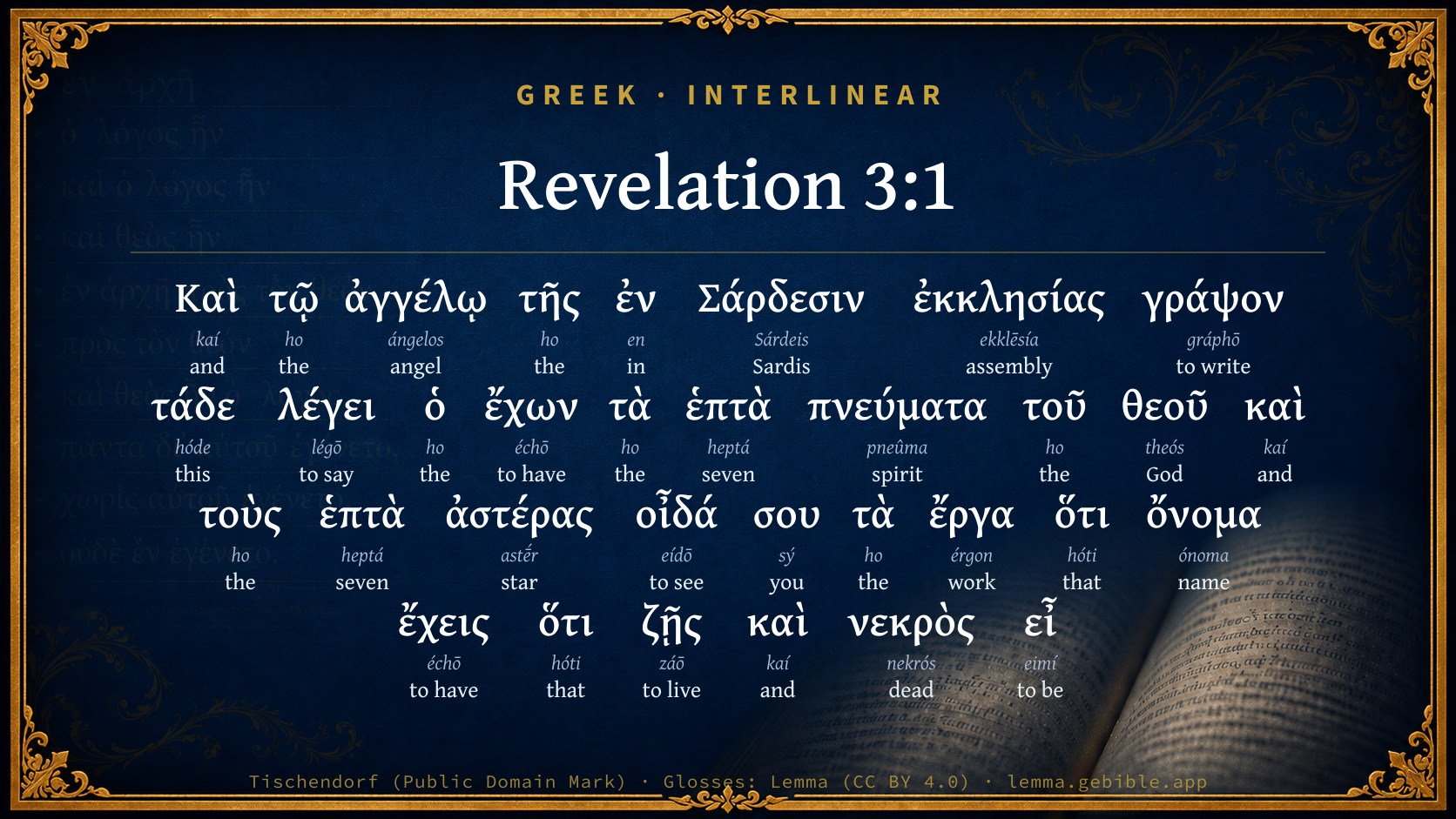
"And to the angel of the assembly in Sardis write: He who has the seven Spirits of God, and the seven stars says these things: "I know your works, that you have a reputation of being alive, but you are dead.
Download a study sheet
One document with this verse’s original text, its word-by-word gloss line, the meaning frame, cross-references with their text, attributed commentary, and full source and license credits — printable, and it pastes into notes with its structure intact.
This verse Autodidact and up
A passage Seminary Student
Up to 50 verses in one chapter. A passage sheet keeps up to 6 commentary sources and 12 cross-references per verse, in the order this page ranks them, and says so on the sheet whenever that leaves anything out. Ask for a single verse and you get the Autodidact verse sheet above.
Everything on this page stays free to read, with no account — the sheet is a download of what is already on screen, not access to it.
Compare translations 3
The same verse in 3 English versions, stacked beneath the original-language interlinear above. Click any original word for its lexicon entry.
Each is an independent rendering of the whole verse — the interlinear is not word-aligned to these translations.
Highlighted words mark where these versions differ — a whole-verse word diff, not a word-by-word alignment.
-
World English Bible Public Domain
"And to the angel of the assembly in Sardis write: He who has the seven Spirits of God, and the seven stars says these things: "I know your works, that you have a reputation of being alive, but you are dead.
-
King James Version Public Domain
And unto the angel of the church in Sardis write; These things saith he that hath the seven Spirits of God, and the seven stars; I know thy works, that thou hast a name that thou livest, and art dead.
-
unfoldingWord Literal Text CC BY-SA 4.0
And to the angel of the church in Sardis write: ‘The one having the seven spirits of God and the seven stars says these things: “I know your works, that you have a name that you are alive, but you are dead.
unfoldingWord Literal Text — © unfoldingWord, licensed CC BY-SA 4.0. Word-aligned USFM3 via Door43 (git.door43.org/unfoldingWord/en_ult).
Show all 19 translations
Every available English version of this verse, each an independent rendering of the whole verse.
-
World English Bible Public Domain
"And to the angel of the assembly in Sardis write: He who has the seven Spirits of God, and the seven stars says these things: "I know your works, that you have a reputation of being alive, but you are dead.
-
Berean Standard Bible Public Domain
“To the angel of the church in Sardis write: These are the words of the One who holds the seven Spirits of God and the seven stars. I know your deeds; you have a reputation for being alive, yet you are dead.
-
Majority Standard Bible Public Domain
“To the angel of the church in Sardis write: These are the words of the One who holds the seven spirits of God and the seven stars. I know your deeds; you have a reputation for being alive, yet you are dead.
-
King James Version Public Domain
And unto the angel of the church in Sardis write; These things saith he that hath the seven Spirits of God, and the seven stars; I know thy works, that thou hast a name that thou livest, and art dead.
-
American Standard Version (1901) Public Domain
And to the angel of the church in Sardis write: These things saith he that hath the seven Spirits of God, and the seven stars: I know thy works, that thou hast a name that thou livest, and thou art dead.
-
Revised Version (1885) Public Domain
And to the angel of the church in Sardis write; These things saith he that hath the seven Spirits of God, and the seven stars: I know thy works, that thou hast a name that thou livest, and thou art dead.
-
Geneva Bible (1599) Public Domain
ANd write vnto the Angel of the Church which is at Sardis, These things saith he that hath the seuen Spirits of God, and the seuen starres, I knowe thy workes: for thou hast a name that thou liuest, but thou art dead.
-
Douay-Rheims (1899) Public Domain
And to the angel of the church of Sardis, write: These things saith he, that hath the seven spirits of God, and the seven stars: I know thy works, that thou hast the name of being alive: and thou art dead.
-
Young's Literal Translation Public Domain
And to the messenger of the assembly in Sardis write: These things saith he who is having the Seven Spirits of God, and the seven stars: I have known thy works, and that thou hast the name that thou dost live, and thou art dead;
-
Literal Standard Version CC BY-SA 4.0
“And to the messenger of the assembly in Sardis write: These things says He who is having the Seven Spirits of God, and the seven stars: I have known your works, and that you have the name that you live, and you are dead;
-
Unlocked Literal Bible CC BY-SA 4.0
“To the angel of the church in Sardis write: 'The words of the one who holds the seven spirits of God and the seven stars. “I know what you have done. You have a reputation that you are alive, but you are dead.
-
unfoldingWord Literal Text CC BY-SA 4.0
And to the angel of the church in Sardis write: ‘The one having the seven spirits of God and the seven stars says these things: “I know your works, that you have a name that you are alive, but you are dead.
-
Darby Bible Public Domain
And to the angel of the assembly in Sardis write: These things saith he that has the seven Spirits of God, and the seven stars: I know thy works, that thou hast a name that thou livest, and art dead.
-
World Messianic Bible Public Domain
“And to the angel of the assembly in Sardis write: “He who has the seven Spirits of God and the seven stars says these things: “I know your works, that you have a reputation of being alive, but you are dead.
-
Webster's Bible Public Domain
And to the angel of the church in Sardis write; These things saith he that hath the seven Spirits of God, and the seven stars; I know thy works, that thou hast a name, that thou livest, and art dead.
-
Free Bible Version CC BY-SA 4.0
“Write this to the angel of the Sardis church: This is what the one who has the seven Spirits of God and the seven stars says: I know what you have accomplished, and that you give the appearance of being alive—but in reality you are dead.
-
Bible in Basic English Public Domain
And to the angel of the church in Sardis say: These things says he who has the seven Spirits of God and the seven stars: I have knowledge of your works, that you seem to be living but are dead.
-
Text-Critical English NT CC BY 4.0
“To the angel of the church in Sardis write: ‘These are the words of him who has the seven spirits of God and the seven stars: I know yoʋr works; yoʋ have made a name for yoʋrself and yoʋ are alive, but actually yoʋ are dead.
-
Tyndale New Testament (1534) Public Domain
And wryte vnto the messenger of the congregacion of Sardis: this sayth he that hath the sprete of god and the vii. starres. I knowe thy workes thou haste a name that thou lvyest and thou art deed.
Literal Standard Version (2020), Covenant Press — licensed CC BY-SA 4.0. Text via the HelloAO Bible API (eBible.org). Unlocked Literal Bible (unfoldingWord) — licensed CC BY-SA 4.0. Text via the HelloAO Bible API (eBible.org). unfoldingWord Literal Text — © unfoldingWord, licensed CC BY-SA 4.0. Word-aligned USFM3 via Door43 (git.door43.org/unfoldingWord/en_ult). Free Bible Version, Dr. Jonathan Gallagher — licensed CC BY-SA 4.0. Text via the HelloAO Bible API (eBible.org).
Word by word
More ways to search: Search by grammar → Find every occurrence → Compare this word →
Practice this passage: Drill this verse → Learn its vocabulary →
- Appears 3× in the Greek New Testament
- First appears at Revelation 1:11
- Part of Speech
- Noun
- Case
- Dative
- Number
- Plural
- Gender
- Feminine
Full Thayer's Definition
- Καὶ kaí G2532 “and” Conjunction
- τῷ ho G3588 “the” Article, Dative, Singular, Masculine
- ἀγγέλῳ ángelos G32 “angel” Noun, Dative, Singular, Masculine
- τῆς ho G3588 “the” Article, Genitive, Singular, Feminine
- ἐν en G1722 “in” Preposition
- Σάρδεσιν Sárdeis G4554 “Sardis” Noun, Dative, Plural, Feminine
- ἐκκλησίας ekklēsía G1577 “assembly” Noun, Genitive, Singular, Feminine
- γράψον gráphō G1125 “to write” Verb, Aorist, Active, Imperative, 2nd person, Singular
- τάδε hóde G3592 “this” Demonstrative pronoun, Accusative, Plural, Neuter
- λέγει légō G3004 “to say” Verb, Present, Active, Indicative, 3rd person, Singular
- ὁ ho G3588 “the” Article, Nominative, Singular, Masculine
- ἔχων échō G2192 “to have” Verb, Present, Active, Participle, Nominative, Singular, Masculine
- τὰ ho G3588 “the” Article, Accusative, Plural, Neuter
- ἑπτὰ heptá G2033 “seven” Adjective, Numeral (indeclinable)
- πνεύματα pneûma G4151 “spirit” Noun, Accusative, Plural, Neuter
- τοῦ ho G3588 “the” Article, Genitive, Singular, Masculine
- θεοῦ theós G2316 “God” Noun, Genitive, Singular, Masculine
- καὶ kaí G2532 “and” Conjunction
- τοὺς ho G3588 “the” Article, Accusative, Plural, Masculine
- ἑπτὰ heptá G2033 “seven” Adjective, Numeral (indeclinable)
- ἀστέρας astḗr G792 “star” Noun, Accusative, Plural, Masculine
- οἶδά eídō G1492 “to see” Verb, Perfect, Active, Indicative, 1st person, Singular
- σου sý G4771 “you” Personal pronoun, 2nd person, Genitive, Singular
- τὰ ho G3588 “the” Article, Accusative, Plural, Neuter
- ἔργα érgon G2041 “work” Noun, Accusative, Plural, Neuter
- ὅτι hóti G3754 “that” Conjunction
- ὄνομα ónoma G3686 “name” Noun, Accusative, Singular, Neuter
- ἔχεις échō G2192 “to have” Verb, Present, Active, Indicative, 2nd person, Singular
- ὅτι hóti G3754 “that” Conjunction
- ζῇς záō G2198 “to live” Verb, Present, Active, Indicative, 2nd person, Singular
- καὶ kaí G2532 “and” Conjunction
- νεκρὸς nekrós G3498 “dead” Adjective, Nominative, Singular, Masculine
- εἶ eimí G1510 “to be” Verb, Present, Active, Indicative, 2nd person, Singular
About this verse
These counts appear in no published source. They are computed here, from the morphology-tagged text and Lemma’s own curated glosses. What Lemma adds →
- 33
- words
- 22
- distinct lemmas
- Revelation
- section
Cross-references
25Topical passages linked to Revelation 3:1 in the Treasury of Scripture Knowledge — connected by theme and wording, ordered by reader-vote popularity; previews shown in the World English Bible.
- 1 Timothy 5:6 But she who gives herself to pleasure is dead while she lives.
- James 2:26 For as the body apart from the spirit is dead, even so faith apart from works is dead.
- Revelation 1:4 John, to the seven assemblies that are in Asia: Grace to you and peace, from God, who is and who was and who is to come; and from the seven Spirits who are before his throne;
- Colossians 2:13 You were dead through your trespasses and the uncircumcision of your flesh. He made you alive together with him, having forgiven us all our trespasses,
- Jude 1:12 These are hidden rocky reefs in your love feasts when they feast with you, shepherds who without fear feed themselves; clouds without water, carried along by winds; autumn leaves without fruit, twice dead, plucked up by the roots;
- Luke 15:24 for this, my son, was dead, and is alive again. He was lost, and is found.' They began to celebrate.
- Revelation 2:19 I know your works, your love, faith, service, patient endurance, and that your last works are more than the first.
- Ephesians 2:5 even when we were dead through our trespasses, made us alive together with Christ (by grace you have been saved),
- Luke 15:32 But it was appropriate to celebrate and be glad, for this, your brother, was dead, and is alive again. He was lost, and is found.'"
- Revelation 1:16 He had seven stars in his right hand. Out of his mouth proceeded a sharp two-edged sword. His face was like the sun shining at its brightest.
- Ephesians 2:1 You were made alive when you were dead in transgressions and sins,
- Revelation 1:20–2:2 the mystery of the seven stars which you saw in my right hand, and the seven golden lampstands. The seven stars are the angels of the seven assemblies. The seven lampstands are seven assemblies.
- Revelation 2:13 "I know your works and where you dwell, where Satan's throne is. You hold firmly to my name, and didn't deny my faith in the days of Antipas my witness, my faithful one, who was killed among you, where Satan dwells.
- John 1:16 From his fullness we all received grace upon grace.
- John 1:33 I didn't recognize him, but he who sent me to baptize in water, he said to me, 'On whomever you will see the Spirit descending, and remaining on him, the same is he who baptizes in the Holy Spirit.'
- Revelation 1:11 saying, "What you see, write in a book and send to the seven assemblies: to Ephesus, Smyrna, Pergamum, Thyatira, Sardis, Philadelphia, and to Laodicea."
- Revelation 4:5 Out of the throne proceed lightnings, sounds, and thunders. There were seven lamps of fire burning before his throne, which are the seven Spirits of God.
- John 3:34 For he whom God has sent speaks the words of God; for God gives the Spirit without measure.
- John 7:37–39 Now on the last and greatest day of the feast, Jesus stood and cried out, "If anyone is thirsty, let him come to me and drink!
- John 20:22 When he had said this, he breathed on them, and said to them, "Receive the Holy Spirit!
- Acts 2:33 Being therefore exalted by the right hand of God, and having received from the Father the promise of the Holy Spirit, he has poured out this, which you now see and hear.
- 1 Peter 1:11 searching for who or what kind of time the Spirit of Christ, which was in them, pointed to, when he predicted the sufferings of Christ, and the glories that would follow them.
- Revelation 5:6 I saw in the midst of the throne and of the four living creatures, and in the midst of the elders, a Lamb standing, as though it had been slain, having seven horns, and seven eyes, which are the seven Spirits of God, sent out into all the earth.
- John 15:26–27 "When the Counselor has come, whom I will send to you from the Father, the Spirit of truth, who proceeds from the Father, he will testify about me.
- Revelation 2:9 "I know your works, oppression, and your poverty (but you are rich), and the blasphemy of those who say they are Jews, and they are not, but are a synagogue of Satan.
Cross-references courtesy of OpenBible.info (CC BY 4.0).
Lesson kit
Teaching starters — assembled from the data on this page, not authored interpretation. Every prompt links to the verse data it draws on. Edit before teaching.
Revelation, in the Revelation, opens this verse with 33 words (22 distinct Greek lemmas). Its most distinctive word is Sárdeis (“Sardis”). A historical commentator’s framing appears above. Read the whole chapter for the surrounding context.
Discussion questions
- What does “Sardis” (Sárdeis) contribute to the verse as a whole?
- How does Revelation 1:11, which shares the word «Sardis», read alongside this verse?
- What does the repetition of “to have” (2× in this one verse) do in this verse?
- These translations render this verse differently. What is at stake in choosing one wording over another?
- Compare how The Cambridge Bible for Schools and Colleges and Albert Barnes' Notes on the Bible read this verse. Where do they agree or differ?
Things to notice
- These translations choose different wording for 14 words in this verse.
- “to have” occurs 2× in this single verse.
- 22 distinct Greek lemmas span 33 words in this verse.
Commentary
Notes on Revelation 3:1 from classic Christian and Jewish commentators (each source and its license shown beneath its notes). The classic Christian expositions comment on the surrounding passage and are grouped to its opening verse, so a note may address several verses; the Jewish commentaries on the Tanakh (Rashi and others) are per-verse, so they appear only where the commentator wrote on this verse.
Lemma curates 59 commentaries, every one of them public domain or Creative Commons licensed, each selected and text-cleaned for this edition rather than reprinted as found. About our sources →
The Cambridge Bible for Schools and Colleges
gen. ed. J. J. S. Perowne
The Cambridge Bible for Schools and Colleges (gen. ed. J. J. S. Perowne; Cambridge University Press, 1878–1918) — public domain. Text from a community e-Sword module.
Albert Barnes' Notes on the Bible
Albert Barnes' Notes on the Bible (1834–1885) — public domain. Text from a community e-Sword/MySword module.
The Biblical Illustrator
Joseph S. Exell
The Biblical Illustrator, edited by Joseph S. Exell (c. 1880s–1900s) — public domain. Text from a community e-Sword module.
Joseph Benson's Commentary
Joseph Benson's Commentary on the Old and New Testaments (1811–1818) — public domain. Text from a community e-Sword module.
Dummelow's Commentary on the Holy Bible
J. R. Dummelow
J. R. Dummelow, A Commentary on the Holy Bible (Macmillan, 1909) — public domain. Text from a community e-Sword module.
Whedon's Commentary on the Bible
Daniel D. Whedon
Daniel D. Whedon (gen. ed.), Commentary on the Old and New Testaments (1874–1909) — public domain. Text from a community e-Sword module.
The Preacher's Complete Homiletical Commentary
Joseph S. Exell (gen. ed.)
The Preacher's Complete Homiletical Commentary (gen. ed. Joseph S. Exell; Funk & Wagnalls, c. 1892) — public domain (pre-1929). A full-Bible homiletical/sermon-outline anthology covering 65 of 66 books (2 John is absent from the source module). Text from a community e-Sword module.
Lange's Commentary on the Holy Scriptures
Lange's Commentary on the Holy Scriptures (Critical, Doctrinal, and Homiletical), ed. John Peter Lange, English translation edited by Philip Schaff (1864–1880) — public domain. Text from a community e-Sword module.
MacLaren's Expositions of Holy Scripture
Alexander MacLaren
Alexander MacLaren, Expositions of Holy Scripture (1904–1910) — public domain. Text from a community e-Sword module.
The Annotated Bible
Arno C. Gaebelein
Arno C. Gaebelein, The Annotated Bible (1913–1922) — public domain. Text from a community e-Sword module.
F. W. Grant's Numerical Bible
F. W. Grant, The Numerical Bible (4th ed., 1903) — public domain. Text from a community e-Sword module.
Darby's Synopsis of the New Testament
John Nelson Darby
John Nelson Darby — Synopsis of the Books of the Bible: the New Testament (c. 1857–1862) — public domain. Text from a community e-Sword module.
Tyndale Open Study Notes
Tyndale Open Resources
Tyndale Open Study Notes — © Tyndale Open Resources, licensed CC BY-SA 4.0. Text via the HelloAO Bible API.
Meyer's Critical & Exegetical Commentary
Heinrich August Wilhelm Meyer
Meyer — Critical and Exegetical Commentary on the New Testament — English translation by Peter Christie, edited by Frederick Crombie (T&T Clark, 1880) — public domain. Text from a community e-Sword module.
Expositor's Greek Testament
ed. W. Robertson Nicoll
The Expositor's Greek Testament, edited by W. Robertson Nicoll (1897–1910) — public domain. Text from a community e-Sword module.
Cambridge Greek Testament for Schools and Colleges
Cambridge Greek Testament for Schools and Colleges (Cambridge University Press, 1896; 21 vols, various authors incl. Carr, Maclear, Plummer, Farrar, Lumby, Moule, M. R. James, Simcox) — public domain. Text from a community e-Sword module.
Alford’s Greek Testament
Henry Alford
Henry Alford, The Greek Testament (1849–1861) — public domain. Text from a community e-Sword module.
Geneva Bible (1599)
Geneva Bible translators
Geneva Bible (1599) marginal notes — public domain. Text via Bolls.life.
Matthew Henry's Commentary
Matthew Henry's Commentary on the Whole Bible (1708–1710) — public domain (CC PDM 1.0). Text via the HelloAO Bible API.
Adam Clarke's Commentary
Adam Clarke's Commentary on the Bible (1810–1826) — public domain. Text from a community e-Sword/MySword module.
Ellicott's Commentary for English Readers
A Bible Commentary for English Readers, edited by Charles John Ellicott (1878–1897) — public domain. Text from a community e-Sword module.
John Gill's Exposition
John Gill's Exposition of the Whole Bible (1746–1763) — public domain (CC PDM 1.0). Text via the HelloAO Bible API.
Trapp's Complete Commentary
John Trapp
John Trapp, A Commentary or Exposition upon All the Books of the Old and New Testament (1647–1656) — public domain. Text from a community e-Sword module.
Haydock's Catholic Bible Commentary
George Leo Haydock (1774–1849), Haydock's Catholic Family Bible and Commentary, 1859 edition — public domain. Excludes Psalms (Douay-Rheims chapter numbering differs from Protestant) and Deuterocanonical books (Catholic canon only).
Matthew Poole's English Annotations
Matthew Poole's English Annotations on the Holy Bible (1683–1685) — public domain. Text from a community e-Sword/MySword module.
The Pulpit Commentary
The Pulpit Commentary (1880–1919), ed. H.D.M. Spence-Jones & Joseph S. Exell — public domain. Text from a community e-Sword module.
John Wesley's Explanatory Notes
John Wesley, Explanatory Notes Upon the Whole Bible (1754–1765) — public domain. Text via the GEBible commentary corpus.
Scofield Reference Notes
C. I. Scofield
The Scofield Reference Bible (1917 edition), notes by C. I. Scofield — public domain. Text from a community e-Sword module.
Kretzmann's Popular Commentary
Paul E. Kretzmann
Paul E. Kretzmann, Popular Commentary of the Bible (1921–1924) — public domain. Text from a community e-Sword module.
The Sermon Bible
William Robertson Nicoll (ed.)
The Sermon Bible, ed. William Robertson Nicoll (1888–1900) — public domain. Text from a community e-Sword module.
Burkitt's Expository Notes on the New Testament
William Burkitt
William Burkitt's Expository Notes on the New Testament (1700–1703) — public domain. Text from a community e-Sword module.
The People's New Testament
B. W. Johnson
B. W. Johnson's The People's New Testament with Notes (1889–1891) — public domain. Electronic text from the Christian Classics Ethereal Library (CCEL) ThML edition.
unfoldingWord translationNotes
Door43 World Missions Community
unfoldingWord translationNotes — © Distant Shores Media and the Door43 World Missions Community, licensed CC BY-SA 4.0. Source: git.door43.org/Door43/en_tn.
Vincent's Word Studies in the New Testament
Marvin R. Vincent
Marvin R. Vincent, Word Studies in the New Testament (1887–1900) — public domain. Text from a community e-Sword/MySword module.