

Acts 16:1
Greek (Tischendorf 8th ed.) Acts 16:1 appears in the Greek New Testament. The text above is from the Tischendorf 8th edition. Each word links to its Strong’s number and a concise gloss. Click any word for its full Thayer’s Greek Lexicon entry.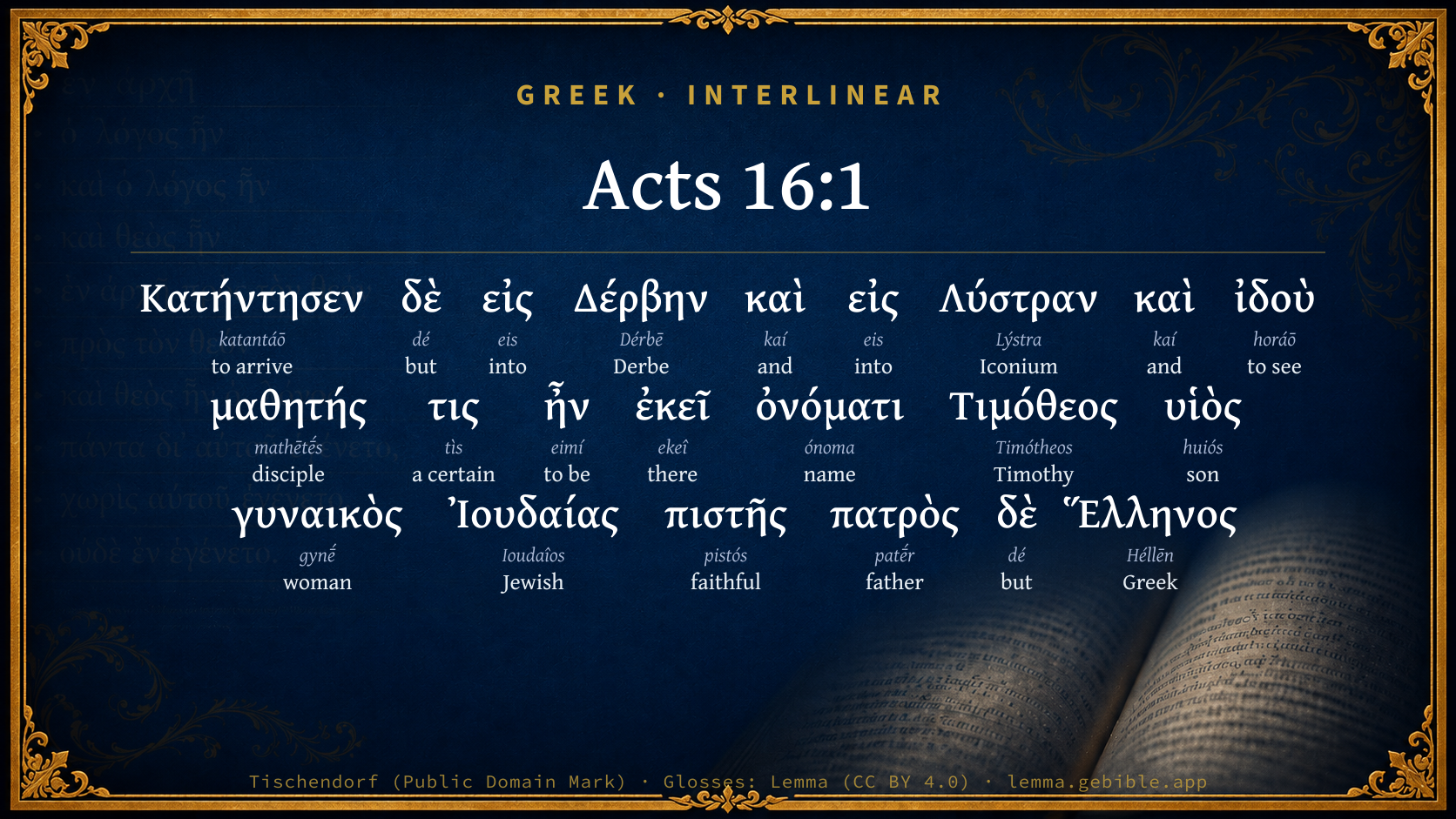
He came to Derbe and Lystra: and behold, a certain disciple was there, named Timothy, the son of a Jewess who believed; but his father was a Greek.
Download a study sheet
One document with this verse’s original text, its word-by-word gloss line, the meaning frame, cross-references with their text, attributed commentary, and full source and license credits — printable, and it pastes into notes with its structure intact.
This verse Autodidact and up
A passage Seminary Student
Up to 50 verses in one chapter. A passage sheet keeps up to 6 commentary sources and 12 cross-references per verse, in the order this page ranks them, and says so on the sheet whenever that leaves anything out. Ask for a single verse and you get the Autodidact verse sheet above.
Everything on this page stays free to read, with no account — the sheet is a download of what is already on screen, not access to it.
Compare translations 3
The same verse in 3 English versions, stacked beneath the original-language interlinear above. Click any original word for its lexicon entry.
Each is an independent rendering of the whole verse — the interlinear is not word-aligned to these translations.
Highlighted words mark where these versions differ — a whole-verse word diff, not a word-by-word alignment.
-
World English Bible Public Domain
He came to Derbe and Lystra: and behold, a certain disciple was there, named Timothy, the son of a Jewess who believed; but his father was a Greek.
-
King James Version Public Domain
Then came he to Derbe and Lystra: and, behold, a certain disciple was there, named Timotheus, the son of a certain woman, which was a Jewess, and believed; but his father was a Greek:
-
unfoldingWord Literal Text CC BY-SA 4.0
And he also came down to Derbe and to Lystra, and behold, a certain disciple was there, Timothy by name, the son of a believing Jewish woman but of a father, a Greek,
unfoldingWord Literal Text — © unfoldingWord, licensed CC BY-SA 4.0. Word-aligned USFM3 via Door43 (git.door43.org/unfoldingWord/en_ult).
Show all 19 translations
Every available English version of this verse, each an independent rendering of the whole verse.
-
World English Bible Public Domain
He came to Derbe and Lystra: and behold, a certain disciple was there, named Timothy, the son of a Jewess who believed; but his father was a Greek.
-
Berean Standard Bible Public Domain
Paul came to Derbe and then to Lystra, where he found a disciple named Timothy, the son of a believing Jewish woman and a Greek father.
-
Majority Standard Bible Public Domain
Paul came to Derbe and then to Lystra, where he found a disciple named Timothy, the son of a believing Jewish woman and a Greek father.
-
King James Version Public Domain
Then came he to Derbe and Lystra: and, behold, a certain disciple was there, named Timotheus, the son of a certain woman, which was a Jewess, and believed; but his father was a Greek:
-
American Standard Version (1901) Public Domain
And he came also to Derbe and to Lystra: and behold, a certain disciple was there, named Timothy, the son of a Jewess that believed; but his father was a Greek.
-
Revised Version (1885) Public Domain
And he came also to Derbe and to Lystra: and behold, a certain disciple was there, named Timothy, the son of a Jewess which believed; but his father was a Greek.
-
Geneva Bible (1599) Public Domain
Then came he to Derbe and to Lystra: and beholde, a certaine disciple was there named Timotheus, a womans sonne, which was a Iewesse and beleeued, but his father was a Grecian,
-
Douay-Rheims (1899) Public Domain
And he came to Derbe and Lystra. And behold, there was a certain disciple there named Timothy, the son of a Jewish woman that believed; but his father was a Gentile.
-
Young's Literal Translation Public Domain
And he came to Derbe and Lystra, and lo, a certain disciple was there, by name Timotheus son of a certain woman, a believing Jewess, but of a father, a Greek,
-
Literal Standard Version CC BY-SA 4.0
And he came to Derbe and Lystra, and behold, a certain disciple was there, by name Timotheus, son of a certain woman, a believing Jewess, but of a father, a Greek,
-
Unlocked Literal Bible CC BY-SA 4.0
Paul also came to Derbe and to Lystra; and behold, a certain disciple named Timothy was there, the son of a Jewish woman who believed; his father was a Greek.
-
unfoldingWord Literal Text CC BY-SA 4.0
And he also came down to Derbe and to Lystra, and behold, a certain disciple was there, Timothy by name, the son of a believing Jewish woman but of a father, a Greek,
-
Darby Bible Public Domain
And he came to Derbe and Lystra: and behold, a certain disciple was there, by name Timotheus, son of a Jewish believing woman, but [the] father a Greek,
-
World Messianic Bible Public Domain
He came to Derbe and Lystra; and behold, a certain disciple was there, named Timothy, the son of a Jewess who believed, but his father was a Greek.
-
Webster's Bible Public Domain
Then he came to Derbe and Lystra: and behold, a certain disciple was there, named Timothy, the son of a certain woman who was a Jewess, and believed, but his father was a Greek.
-
Free Bible Version CC BY-SA 4.0
Paul went first to Derbe, and then on to Lystra, where he met a believer by the name of Timothy. He was the son of a Jewish Christian mother, and his father was Greek.
-
Bible in Basic English Public Domain
And he came to Derbe and Lystra: and there was a certain disciple there named Timothy, whose mother was one of the Jews of the faith, but his father was a Greek;
-
Text-Critical English NT CC BY 4.0
Paul went on to Derbe and Lystra, and behold, a disciple named Timothy was there. He was the son of a Jewish woman who was a believer, but his father was a Greek.
-
Tyndale New Testament (1534) Public Domain
Then came he to Derba and to Lystra. And beholde a certayne disciple was there named Timotheus a womans sonne which was a Iewas and beleved: but his father was a Greke.
Literal Standard Version (2020), Covenant Press — licensed CC BY-SA 4.0. Text via the HelloAO Bible API (eBible.org). Unlocked Literal Bible (unfoldingWord) — licensed CC BY-SA 4.0. Text via the HelloAO Bible API (eBible.org). unfoldingWord Literal Text — © unfoldingWord, licensed CC BY-SA 4.0. Word-aligned USFM3 via Door43 (git.door43.org/unfoldingWord/en_ult). Free Bible Version, Dr. Jonathan Gallagher — licensed CC BY-SA 4.0. Text via the HelloAO Bible API (eBible.org).
Word by word
More ways to search: Search by grammar → Find every occurrence → Compare this word →
Practice this passage: Drill this verse → Learn its vocabulary →
- Appears 3× in the Greek New Testament
- First appears at Acts 14:6
- Part of Speech
- Noun
- Case
- Accusative
- Number
- Singular
- Gender
- Feminine
Full Thayer's Definition
- Κατήντησεν katantáō G2658 “to arrive” Verb, Aorist, Active, Indicative, 3rd person, Singular
- δὲ dé G1161 “but” Conjunction
- εἰς eis G1519 “into” Preposition
- Δέρβην Dérbē G1191 “Derbe” Noun, Accusative, Singular, Feminine
- καὶ kaí G2532 “and” Conjunction
- εἰς eis G1519 “into” Preposition
- Λύστραν Lýstra G3082 “Iconium” Noun, Accusative, Singular, Feminine
- καὶ kaí G2532 “and” Conjunction
- ἰδοὺ horáō G3708 “to see” Verb, Aorist, Middle, Imperative, 2nd person, Singular
- μαθητής mathētḗs G3101 “disciple” Noun, Nominative, Singular, Masculine
- τις tìs G5100 “a certain” Indefinite pronoun, Nominative, Singular, Masculine
- ἦν eimí G1510 “to be” Verb, Imperfect, Active, Indicative, 3rd person, Singular
- ἐκεῖ ekeî G1563 “there” Adverb
- ὀνόματι ónoma G3686 “name” Noun, Dative, Singular, Neuter
- Τιμόθεος Timótheos G5095 “Timothy” Noun, Nominative, Singular, Masculine
- υἱὸς huiós G5207 “son” Noun, Nominative, Singular, Masculine
- γυναικὸς gynḗ G1135 “woman” Noun, Genitive, Singular, Feminine
- Ἰουδαίας Ioudaîos G2453 “Jewish” Adjective, Genitive, Singular, Feminine
- πιστῆς pistós G4103 “faithful” Adjective, Genitive, Singular, Feminine
- πατρὸς patḗr G3962 “father” Noun, Genitive, Singular, Masculine
- δὲ dé G1161 “but” Conjunction
- Ἕλληνος Héllēn G1672 “Greek” Noun, Genitive, Singular, Masculine
About this verse
These counts appear in no published source. They are computed here, from the morphology-tagged text and Lemma’s own curated glosses. What Lemma adds →
- 22
- words
- 19
- distinct lemmas
- Acts
- section
Notable vocabulary
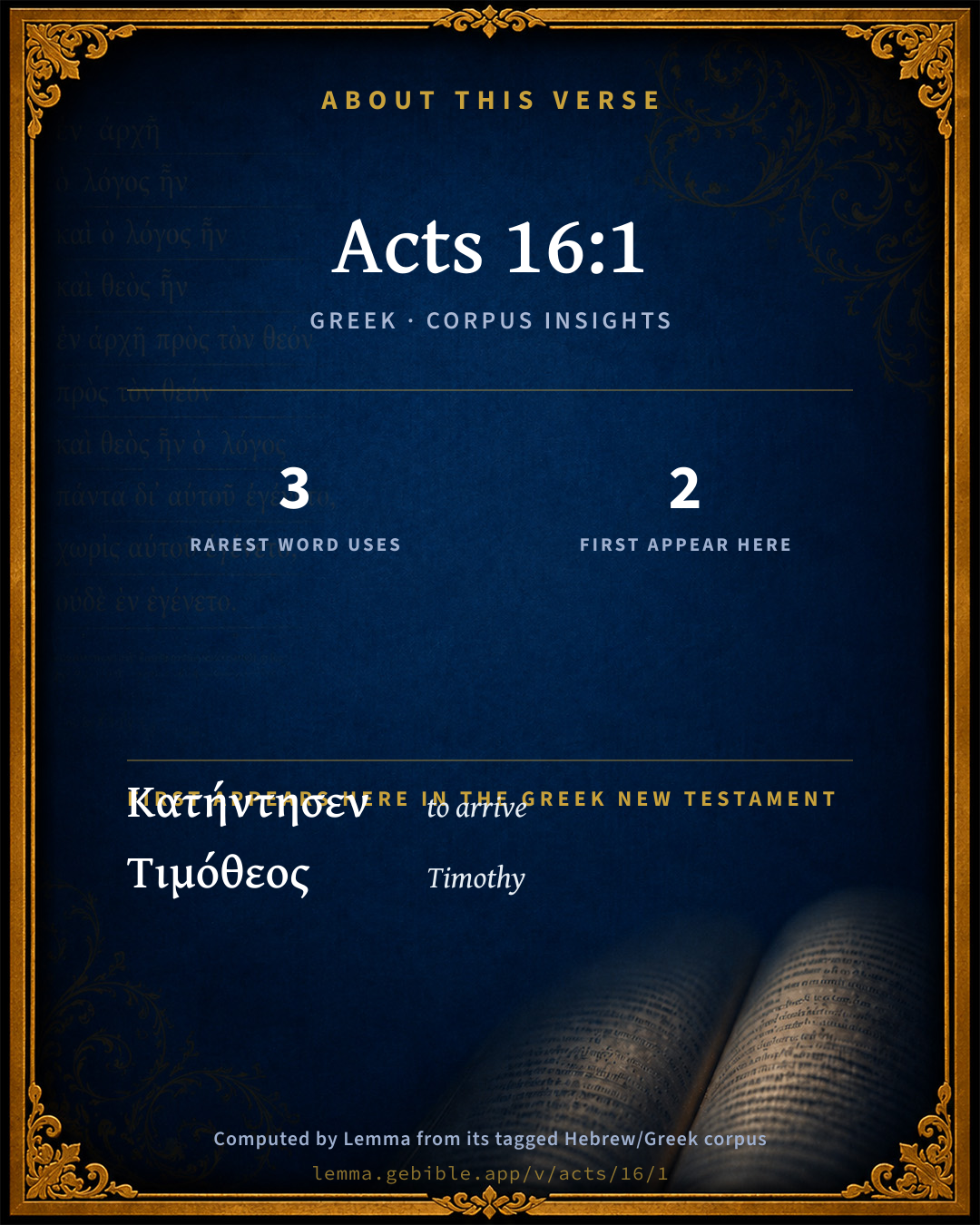
The rarest word here is Δέρβην Derbe G1191 — appearing just 3 times in the whole Greek New Testament.
First appearance in Scripture
These words make their first canonical appearance in the Greek New Testament here:
Shared distinctive vocabulary
Δέρβην Derbe G1191 occurs in 3 verses of the Greek New Testament. Also found in:
Cross-references
27Topical passages linked to Acts 16:1 in the Treasury of Scripture Knowledge — connected by theme and wording, ordered by reader-vote popularity; previews shown in the World English Bible.
- 2 Timothy 1:5 having been reminded of the unfeigned faith that is in you; which lived first in your grandmother Lois, and your mother Eunice, and, I am persuaded, in you also.
- Acts 17:14 Then the brothers immediately sent out Paul to go as far as to the sea, and Silas and Timothy still stayed there.
- Acts 18:5 But when Silas and Timothy came down from Macedonia, Paul was compelled by the Spirit, testifying to the Jews that Jesus was the Christ.
- 1 Corinthians 4:17 Because of this I have sent Timothy to you, who is my beloved and faithful child in the Lord, who will remind you of my ways which are in Christ, even as I teach everywhere in every assembly.
- 1 Thessalonians 3:2 and sent Timothy, our brother and God's servant in the Gospel of Christ, to establish you, and to comfort you concerning your faith;
- 1 Timothy 1:2 to Timothy, my true child in faith: Grace, mercy, and peace, from God our Father and Christ Jesus our Lord.
- 2 Timothy 1:2 to Timothy, my beloved child: Grace, mercy, and peace, from God the Father and Christ Jesus our Lord.
- Acts 14:6 they became aware of it, and fled to the cities of Lycaonia, Lystra, Derbe, and the surrounding region.
- Romans 16:21 Timothy, my fellow worker, greets you, as do Lucius, Jason, and Sosipater, my relatives.
- Philippians 2:19 But I hope in the Lord Jesus to send Timothy to you soon, that I also may be cheered up when I know how you are doing.
- Colossians 1:1 Paul, an apostle of Christ Jesus through the will of God, and Timothy our brother,
- 2 Thessalonians 1:1 Paul, Silvanus, and Timothy, to the assembly of the Thessalonians in God our Father, and the Lord Jesus Christ:
- Acts 19:22 Having sent into Macedonia two of those who ministered to him, Timothy and Erastus, he himself stayed in Asia for a while.
- Philippians 1:1 Paul and Timothy, servants of Jesus Christ; To all the saints in Christ Jesus who are at Philippi, with the overseers and deacons:
- 1 Thessalonians 1:1 Paul, Silvanus, and Timothy, to the assembly of the Thessalonians in God the Father and the Lord Jesus Christ: Grace to you and peace from God our Father and the Lord Jesus Christ.
- 1 Timothy 1:18 This charge I commit to you, my child Timothy, according to the prophecies which led the way to you, that by them you may wage the good warfare;
- Hebrews 13:23 Know that our brother Timothy has been freed, with whom, if he comes shortly, I will see you.
- Acts 20:4–5 These accompanied him as far as Asia: Sopater of Beroea; Aristarchus and Secundus of the Thessalonians; Gaius of Derbe; Timothy; and Tychicus and Trophimus of Asia.
- 2 Corinthians 1:1 Paul, an apostle of Christ Jesus through the will of God, and Timothy our brother, to the assembly of God which is at Corinth, with all the saints who are in the whole of Achaia:
- 2 Corinthians 1:19 For the Son of God, Jesus Christ, who was preached among you by us, by me, Silvanus, and Timothy, was not "Yes and no," but in him is "Yes."
- 1 Thessalonians 3:6 But when Timothy came just now to us from you, and brought us glad news of your faith and love, and that you have good memories of us always, longing to see us, even as we also long to see you;
- 2 Timothy 3:11 persecutions, and sufferings: those things that happened to me at Antioch, Iconium, and Lystra. I endured those persecutions. Out of them all the Lord delivered me.
- 2 Timothy 3:15–16 From infancy, you have known the sacred writings which are able to make you wise for salvation through faith, which is in Christ Jesus.
- Ezra 9:2 For they have taken of their daughters for themselves and for their sons, so that the holy seed have mixed themselves with the peoples of the lands: yes, the hand of the princes and rulers has been chief in this trespass.
- Acts 14:1 It happened in Iconium that they entered together into the synagogue of the Jews, and so spoke that a great multitude both of Jews and of Greeks believed.
- Acts 14:21 When they had preached the Gospel to that city, and had made many disciples, they returned to Lystra, Iconium, and Antioch,
- 1 Corinthians 7:14 For the unbelieving husband is sanctified in the wife, and the unbelieving wife is sanctified in the husband. Otherwise your children would be unclean, but now are they holy.
Cross-references courtesy of OpenBible.info (CC BY 4.0).
Lesson kit
Teaching starters — assembled from the data on this page, not authored interpretation. Every prompt links to the verse data it draws on. Edit before teaching.
Acts, in the Acts, opens this verse with 22 words (19 distinct Greek lemmas). Its most distinctive word is Dérbē (“Derbe”). A historical commentator’s framing appears above. Read the whole chapter for the surrounding context.
Discussion questions
- The word Dérbē carries the sense “Derbe.” How does it shape the verse?
- 2 words make their first appearance in Scripture here. What does this debut establish?
- How does Acts 14:6, which shares the word «Derbe», read alongside this verse?
- What does the repetition of “into” (2× in this one verse) do in this verse?
- These translations render this verse differently; the difference is in the English rendering, not the original. What questions does that raise?
- Compare how The Cambridge Bible for Schools and Colleges and The Biblical Illustrator read this verse. Where do they agree or differ?
Things to notice
- 2 words make their first canonical appearance in Scripture here.
- These translations choose different wording for 13 words in this verse.
- “into” occurs 2× in this single verse.
- 19 distinct Greek lemmas span 22 words in this verse.
Commentary
Notes on Acts 16:1 from classic Christian and Jewish commentators (each source and its license shown beneath its notes). The classic Christian expositions comment on the surrounding passage and are grouped to its opening verse, so a note may address several verses; the Jewish commentaries on the Tanakh (Rashi and others) are per-verse, so they appear only where the commentator wrote on this verse.
Lemma curates 59 commentaries, every one of them public domain or Creative Commons licensed, each selected and text-cleaned for this edition rather than reprinted as found. About our sources →
The Cambridge Bible for Schools and Colleges
gen. ed. J. J. S. Perowne
The Cambridge Bible for Schools and Colleges (gen. ed. J. J. S. Perowne; Cambridge University Press, 1878–1918) — public domain. Text from a community e-Sword module.
The Biblical Illustrator
Joseph S. Exell
The Biblical Illustrator, edited by Joseph S. Exell (c. 1880s–1900s) — public domain. Text from a community e-Sword module.
Joseph Benson's Commentary
Joseph Benson's Commentary on the Old and New Testaments (1811–1818) — public domain. Text from a community e-Sword module.
Whedon's Commentary on the Bible
Daniel D. Whedon
Daniel D. Whedon (gen. ed.), Commentary on the Old and New Testaments (1874–1909) — public domain. Text from a community e-Sword module.
The Preacher's Complete Homiletical Commentary
Joseph S. Exell (gen. ed.)
The Preacher's Complete Homiletical Commentary (gen. ed. Joseph S. Exell; Funk & Wagnalls, c. 1892) — public domain (pre-1929). A full-Bible homiletical/sermon-outline anthology covering 65 of 66 books (2 John is absent from the source module). Text from a community e-Sword module.
Lange's Commentary on the Holy Scriptures
Lange's Commentary on the Holy Scriptures (Critical, Doctrinal, and Homiletical), ed. John Peter Lange, English translation edited by Philip Schaff (1864–1880) — public domain. Text from a community e-Sword module.
The Annotated Bible
Arno C. Gaebelein
Arno C. Gaebelein, The Annotated Bible (1913–1922) — public domain. Text from a community e-Sword module.
Kretzmann's Popular Commentary
Paul E. Kretzmann
Paul E. Kretzmann, Popular Commentary of the Bible (1921–1924) — public domain. Text from a community e-Sword module.
Tyndale Open Study Notes
Tyndale Open Resources
Tyndale Open Study Notes — © Tyndale Open Resources, licensed CC BY-SA 4.0. Text via the HelloAO Bible API.
Bengel's Gnomon
Johann Albrecht Bengel
Bengel's Gnomon of the New Testament — English translation (T&T Clark, Edinburgh, 1860) — public domain. Text from a community e-Sword module.
Meyer's Critical & Exegetical Commentary
Heinrich August Wilhelm Meyer
Meyer — Critical and Exegetical Commentary on the New Testament — English translation by Peter Christie, edited by Frederick Crombie (T&T Clark, 1880) — public domain. Text from a community e-Sword module.
Expositor's Greek Testament
ed. W. Robertson Nicoll
The Expositor's Greek Testament, edited by W. Robertson Nicoll (1897–1910) — public domain. Text from a community e-Sword module.
Cambridge Greek Testament for Schools and Colleges
Cambridge Greek Testament for Schools and Colleges (Cambridge University Press, 1896; 21 vols, various authors incl. Carr, Maclear, Plummer, Farrar, Lumby, Moule, M. R. James, Simcox) — public domain. Text from a community e-Sword module.
Alford’s Greek Testament
Henry Alford
Henry Alford, The Greek Testament (1849–1861) — public domain. Text from a community e-Sword module.
Geneva Bible (1599)
Geneva Bible translators
Geneva Bible (1599) marginal notes — public domain. Text via Bolls.life.
Matthew Henry's Commentary
Matthew Henry's Commentary on the Whole Bible (1708–1710) — public domain (CC PDM 1.0). Text via the HelloAO Bible API.
Adam Clarke's Commentary
Adam Clarke's Commentary on the Bible (1810–1826) — public domain. Text from a community e-Sword/MySword module.
John Calvin's Commentaries
John Calvin's Commentaries (1540-1563) — public domain. Text from the Calvin Translation Society English edition (1840s-50s) via the Christian Classics Ethereal Library (ccel.org). Calvin's coverage is partial (roughly two-thirds of the Bible); uncommented books and verses are honest gaps, never fabricated. The 19th-century editor's footnotes and remarks are omitted so the notes are faithfully Calvin's own voice.
Ellicott's Commentary for English Readers
A Bible Commentary for English Readers, edited by Charles John Ellicott (1878–1897) — public domain. Text from a community e-Sword module.
Trapp's Complete Commentary
John Trapp
John Trapp, A Commentary or Exposition upon All the Books of the Old and New Testament (1647–1656) — public domain. Text from a community e-Sword module.
Albert Barnes' Notes on the Bible
Albert Barnes' Notes on the Bible (1834–1885) — public domain. Text from a community e-Sword/MySword module.
Matthew Poole's English Annotations
Matthew Poole's English Annotations on the Holy Bible (1683–1685) — public domain. Text from a community e-Sword/MySword module.
Dummelow's Commentary on the Holy Bible
J. R. Dummelow
J. R. Dummelow, A Commentary on the Holy Bible (Macmillan, 1909) — public domain. Text from a community e-Sword module.
The Pulpit Commentary
The Pulpit Commentary (1880–1919), ed. H.D.M. Spence-Jones & Joseph S. Exell — public domain. Text from a community e-Sword module.
The Sermon Bible
William Robertson Nicoll (ed.)
The Sermon Bible, ed. William Robertson Nicoll (1888–1900) — public domain. Text from a community e-Sword module.
Burkitt's Expository Notes on the New Testament
William Burkitt
William Burkitt's Expository Notes on the New Testament (1700–1703) — public domain. Text from a community e-Sword module.
Godbey's Commentary on the New Testament
William B. Godbey
William B. Godbey, Commentary on the New Testament (1896–1900) — public domain. Text from a community e-Sword module.
McGarvey & Pendleton's Commentaries
J. W. McGarvey
J. W. McGarvey (with Philip Y. Pendleton), Commentaries on the New Testament (The Fourfold Gospel, 1914; Acts; and the epistles) — public domain. Text from a community e-Sword/MySword module.
Darby's Synopsis of the New Testament
John Nelson Darby
John Nelson Darby — Synopsis of the Books of the Bible: the New Testament (c. 1857–1862) — public domain. Text from a community e-Sword module.
The People's New Testament
B. W. Johnson
B. W. Johnson's The People's New Testament with Notes (1889–1891) — public domain. Electronic text from the Christian Classics Ethereal Library (CCEL) ThML edition.
unfoldingWord translationNotes
Door43 World Missions Community
unfoldingWord translationNotes — © Distant Shores Media and the Door43 World Missions Community, licensed CC BY-SA 4.0. Source: git.door43.org/Door43/en_tn.