
Acts 5:28

Greek (Tischendorf 8th ed.) Acts 5:28 appears in the Greek New Testament. The text above is from the Tischendorf 8th edition. Each word links to its Strong’s number and a concise gloss. Click any word for its full Thayer’s Greek Lexicon entry.
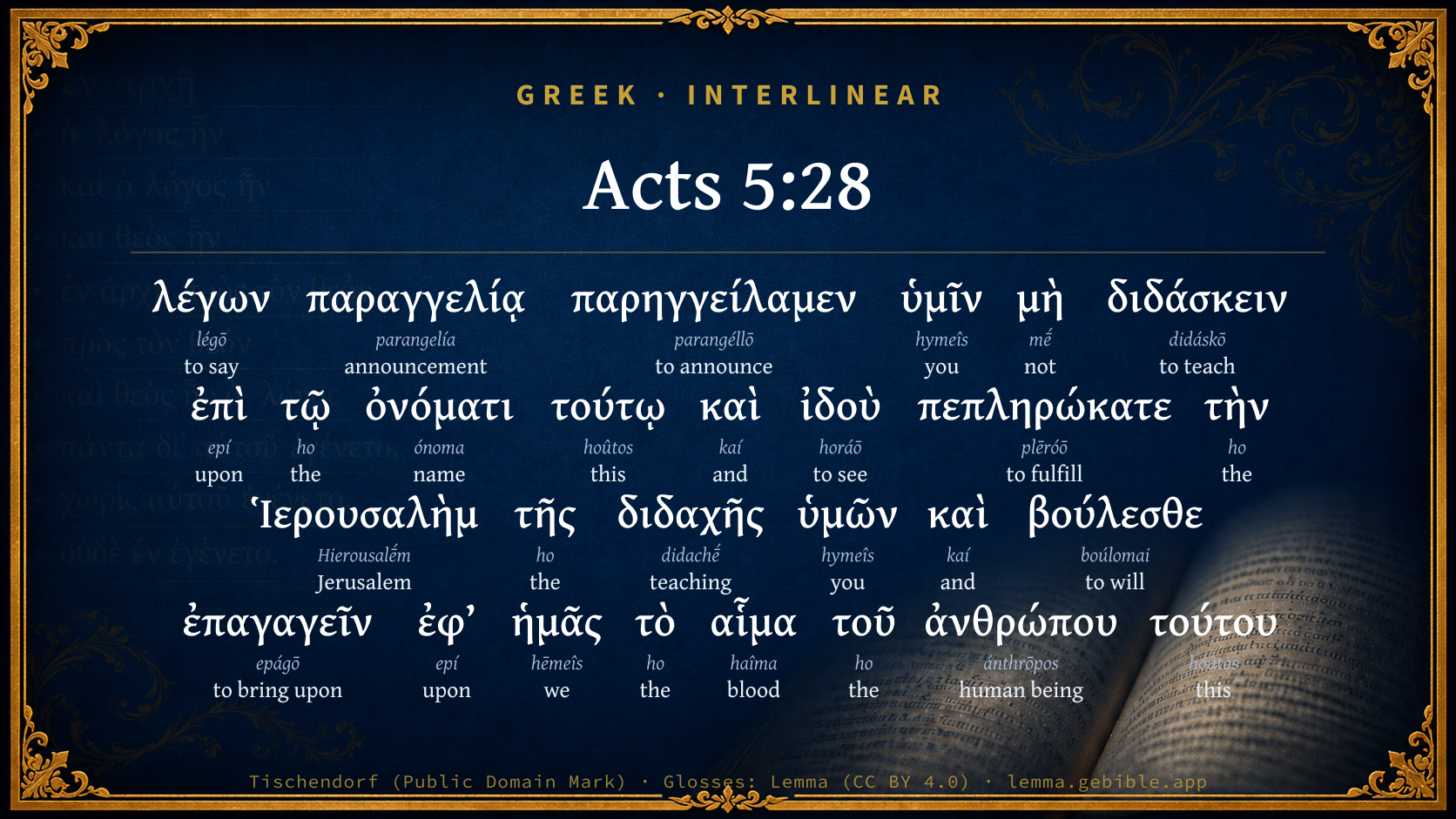
Download image
Cite this verse

Acts 5:28 (World English Bible). Public Domain. Lemma interlinear Bible study tool, https://lemma.gebible.app/v/acts/5/28.

Show BibTeX & RIS
BibTeX
RIS
English Translation
saying, "Didn't we strictly charge you not to teach in this name? Behold, you have filled Jerusalem with your teaching, and intend to bring this man's blood on us."
World English Bible · Public Domain
Highlights
  • 2 first appearances in the Greek New Testament
Full analysis ↓
Download a study sheet

One document with this verse’s original text, its word-by-word gloss line, the meaning frame, cross-references with their text, attributed commentary, and full source and license credits — printable, and it pastes into notes with its structure intact.

This verse Autodidact and up

Study sheet (.html) Plain text (.txt)

A passage Seminary Student

Up to 50 verses in one chapter. A passage sheet keeps up to 6 commentary sources and 12 cross-references per verse, in the order this page ranks them, and says so on the sheet whenever that leaves anything out. Ask for a single verse and you get the Autodidact verse sheet above.

Everything on this page stays free to read, with no account — the sheet is a download of what is already on screen, not access to it.

Want to remove ads? Support Godless Engineer
Compare translations 3

The same verse in 3 English versions, stacked beneath the original-language interlinear above. Click any original word for its lexicon entry.

Each is an independent rendering of the whole verse — the interlinear is not word-aligned to these translations.

Highlighted words mark where these versions differ — a whole-verse word diff, not a word-by-word alignment.

  • World English Bible Public Domain
    saying, "Didn't we strictly charge you not to teach in this name? Behold, you have filled Jerusalem with your teaching, and intend to bring this man's blood on us."
  • King James Version Public Domain
    Saying, Did not we straitly command you that ye should not teach in this name? and, behold, ye have filled Jerusalem with your doctrine, and intend to bring this man's blood upon us.
  • unfoldingWord Literal Text CC BY-SA 4.0
    saying, “We commanded you with a command not to teach in this name, and behold, you have filled Jerusalem with your teaching, and you desire to bring upon us the blood of this man.”

unfoldingWord Literal Text — © unfoldingWord, licensed CC BY-SA 4.0. Word-aligned USFM3 via Door43 (git.door43.org/unfoldingWord/en_ult).

Versions to compare (up to 4)

3 of 4 selected

Show all 19 translations

Every available English version of this verse, each an independent rendering of the whole verse.

  • World English Bible Public Domain
    saying, "Didn't we strictly charge you not to teach in this name? Behold, you have filled Jerusalem with your teaching, and intend to bring this man's blood on us."
  • Berean Standard Bible Public Domain
    “We gave you strict orders not to teach in this name,” he said. “Yet you have filled Jerusalem with your teaching and are determined to make us responsible for this man’s blood.”
  • Majority Standard Bible Public Domain
    “Did we not give you strict orders not to teach in this name?” he asked. “Yet you have filled Jerusalem with your teaching and are determined to make us responsible for this man’s blood.”
  • King James Version Public Domain
    Saying, Did not we straitly command you that ye should not teach in this name? and, behold, ye have filled Jerusalem with your doctrine, and intend to bring this man's blood upon us.
  • American Standard Version (1901) Public Domain
    saying, We strictly charged you not to teach in this name: and behold, ye have filled Jerusalem with your teaching, and intend to bring this man's blood upon us.
  • Revised Version (1885) Public Domain
    saying, We straitly charged you not to teach in this name: and behold, ye have filled Jerusalem with your teaching, and intend to bring this man’s blood upon us.
  • Geneva Bible (1599) Public Domain
    Saying, Did not we straightly commaund you, that ye should not teach in this Name? and behold, ye haue filled Hierusale with your doctrine, and ye would bring this mans blood vpon vs.
  • Douay-Rheims (1899) Public Domain
    Saying: Commanding we commanded you, that you should not teach in this name; and behold, you have filled Jerusalem with your doctrine, and you have a mind to bring the blood of this man upon us.
  • Young's Literal Translation Public Domain
    saying, `Did not we strictly command you not to teach in this name? and lo, ye have filled Jerusalem with your teaching, and ye intend to bring upon us the blood of this man.'
  • Literal Standard Version CC BY-SA 4.0
    saying, “Did we not strictly command you not to teach in this Name? And behold, you have filled Jerusalem with your teaching, and you intend to bring on us the blood of this Man.”
  • Unlocked Literal Bible CC BY-SA 4.0
    saying, “We strictly charged you not to teach in this name, and yet, you have filled Jerusalem with your teaching, and desire to bring this man's blood upon us.”
  • unfoldingWord Literal Text CC BY-SA 4.0
    saying, “We commanded you with a command not to teach in this name, and behold, you have filled Jerusalem with your teaching, and you desire to bring upon us the blood of this man.”
  • Darby Bible Public Domain
    saying, We strictly enjoined you not to teach in this name: and lo, ye have filled Jerusalem with your doctrine, and purpose to bring upon us the blood of this man.
  • World Messianic Bible Public Domain
    saying, “Didn’t we strictly command you not to teach in this name? Behold, you have filled Jerusalem with your teaching, and intend to bring this man’s blood on us.”
  • Webster's Bible Public Domain
    Saying, Did we not strictly command you, that ye should not teach in this name? and behold, ye have filled Jerusalem with your doctrine, and intend to bring this man's blood upon us.
  • Free Bible Version CC BY-SA 4.0
    “Didn't we order you not to teach in this name?” the high priest demanded to know. “Now look—you've filled the whole of Jerusalem with your teaching, and you're trying to blame us for his death!”
  • Bible in Basic English Public Domain
    We gave you very clear orders not to give teaching in this name: and now Jerusalem is full of your teaching, and you are attempting to make us responsible for this man's death.
  • Text-Critical English NT CC BY 4.0
    “Did we not strictly command you not to teach in this name? Yet behold, you have filled Jerusalem with your teaching, and you are determined to bring the blood of this man upon us.”
  • Tyndale New Testament (1534) Public Domain
    sayinge: dyd not we straytely commaunde you that ye shuld not teache in this name? And beholde ye have filled Ierusalem with youre doctrine and ye intende to brynge this mans bloud vpon vs.

Literal Standard Version (2020), Covenant Press — licensed CC BY-SA 4.0. Text via the HelloAO Bible API (eBible.org). Unlocked Literal Bible (unfoldingWord) — licensed CC BY-SA 4.0. Text via the HelloAO Bible API (eBible.org). unfoldingWord Literal Text — © unfoldingWord, licensed CC BY-SA 4.0. Word-aligned USFM3 via Door43 (git.door43.org/unfoldingWord/en_ult). Free Bible Version, Dr. Jonathan Gallagher — licensed CC BY-SA 4.0. Text via the HelloAO Bible API (eBible.org).

Word by word

More ways to search: Search by grammar → Find every occurrence → Compare this word →

Practice this passage: Drill this verse → Learn its vocabulary →

ἐπαγαγεῖν
epágō
G1863
“to bring upon”
Verb, Aorist, Active, Infinitive
Part of Speech
Verb
Tense
Aorist
Voice
Active
Mood
Infinitive
Full Thayer's Definition

Origin: from G1909 and G71

TDNT: None

1. to lead or bring upon 2. to bring a thing on one a. to cause something to befall one, usually something evil
  1. λέγων légō G3004 “to say” Verb, Present, Active, Participle, Nominative, Singular, Masculine
  2. παραγγελίᾳ parangelía G3852 “announcement” Noun, Dative, Singular, Feminine
  3. παρηγγείλαμεν parangéllō G3853 “to announce” Verb, Aorist, Active, Indicative, 1st person, Plural
  4. ὑμῖν hymeîs G5210 “you” Personal pronoun, 2nd person, Dative, Plural
  5. μὴ mḗ G3361 “not” Particle, Negative
  6. διδάσκειν didáskō G1321 “to teach” Verb, Present, Active, Infinitive
  7. ἐπὶ epí G1909 “upon” Preposition
  8. τῷ ho G3588 “the” Article, Dative, Singular, Neuter
  9. ὀνόματι ónoma G3686 “name” Noun, Dative, Singular, Neuter
  10. τούτῳ hoûtos G3778 “this” Demonstrative pronoun, Dative, Singular, Neuter
  11. καὶ kaí G2532 “and” Conjunction
  12. ἰδοὺ horáō G3708 “to see” Verb, Aorist, Middle, Imperative, 2nd person, Singular
  13. πεπληρώκατε plēróō G4137 “to fulfill” Verb, Perfect, Active, Indicative, 2nd person, Plural
  14. τὴν ho G3588 “the” Article, Accusative, Singular, Feminine
  15. Ἱερουσαλὴμ Hierousalḗm G2419 “Jerusalem” Noun, Proper, indeclinable
  16. τῆς ho G3588 “the” Article, Genitive, Singular, Feminine
  17. διδαχῆς didachḗ G1322 “teaching” Noun, Genitive, Singular, Feminine
  18. ὑμῶν hymeîs G5210 “you” Personal pronoun, 2nd person, Genitive, Plural
  19. καὶ kaí G2532 “and” Conjunction
  20. βούλεσθε boúlomai G1014 “to will” Verb, Present, Middle or Passive deponent, Indicative, 2nd person, Plural
  21. ἐφ’ epí G1909 “upon” Preposition
  22. ἡμᾶς hēmeîs G2249 “we” Personal pronoun, 1st person, Accusative, Plural
  23. τὸ ho G3588 “the” Article, Accusative, Singular, Neuter
  24. αἷμα haîma G129 “blood” Noun, Accusative, Singular, Neuter
  25. τοῦ ho G3588 “the” Article, Genitive, Singular, Masculine
  26. ἀνθρώπου ánthrōpos G444 “human being” Noun, Genitive, Singular, Masculine
  27. τούτου hoûtos G3778 “this” Demonstrative pronoun, Genitive, Singular, Masculine

About this verse

These counts appear in no published source. They are computed here, from the morphology-tagged text and Lemma’s own curated glosses. What Lemma adds →

28
words
20
distinct lemmas
Acts
section

Notable vocabulary

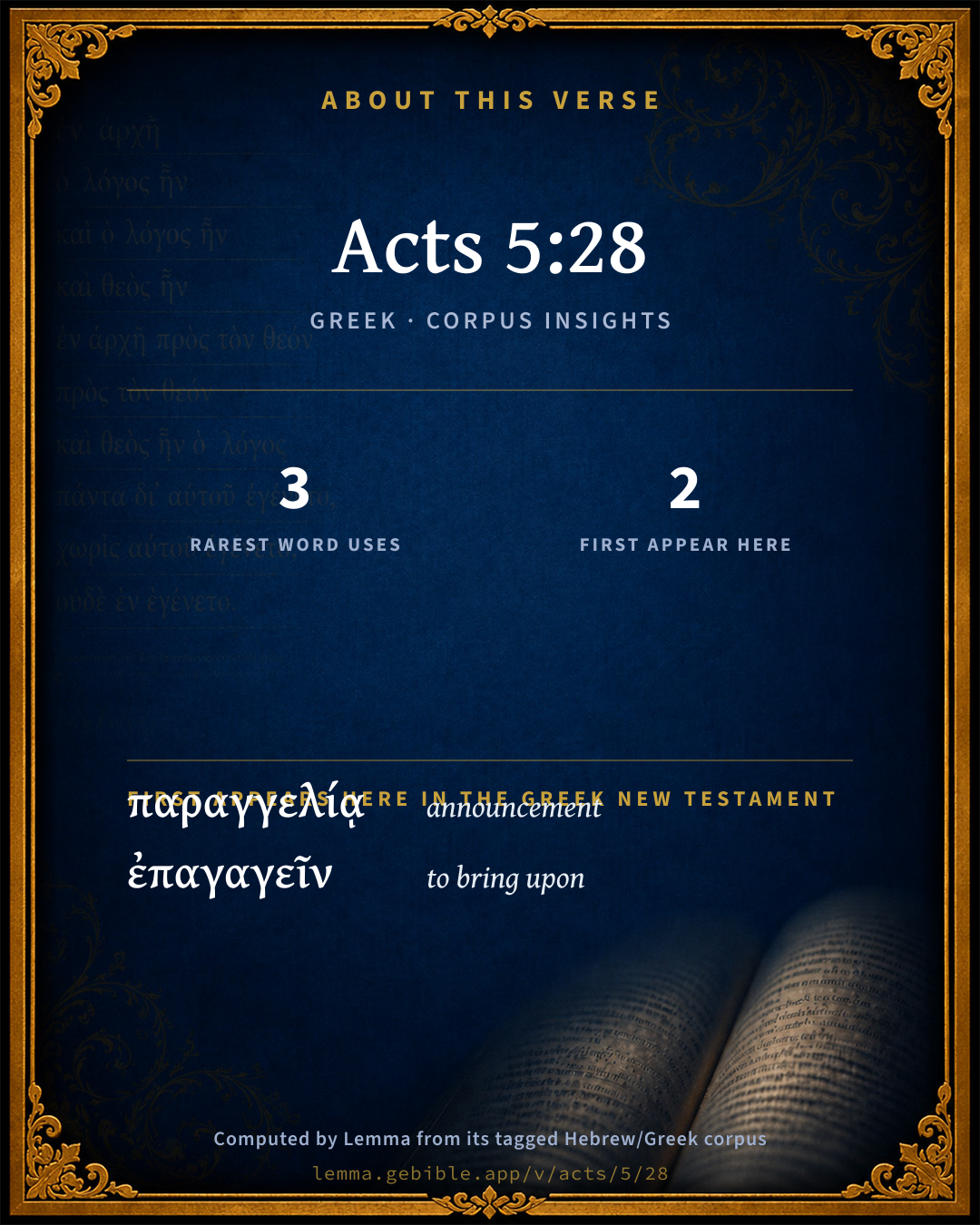
The rarest word here is ἐπαγαγεῖν to bring upon G1863 — appearing just 3 times in the whole Greek New Testament.

First appearance in Scripture

These words make their first canonical appearance in the Greek New Testament here:

  • παραγγελίᾳ announcement G3852
  • ἐπαγαγεῖν to bring upon G1863

Shared distinctive vocabulary

ἐπαγαγεῖν to bring upon G1863 occurs in 3 verses of the Greek New Testament. Also found in:
Repetition

Words recur within this verse:

Cross-references

16

Topical passages linked to Acts 5:28 in the Treasury of Scripture Knowledge — connected by theme and wording, ordered by reader-vote popularity; previews shown in the World English Bible.

  • Matthew 27:25 All the people answered, "May his blood be on us, and on our children!"
  • Acts 4:18–21 They called them, and charged them not to speak at all nor teach in the name of Jesus.
  • Acts 7:52 Which of the prophets didn't your fathers persecute? They killed those who foretold the coming of the Righteous One, of whom you have now become betrayers and murderers.
  • Acts 4:10–11 be it known to you all, and to all the people of Israel, that in the name of Jesus Christ of Nazareth, whom you crucified, whom God raised from the dead, in him does this man stand here before you whole.
  • Jeremiah 26:15 Only know for certain that, if you put me to death, you will bring innocent blood on yourselves, and on this city, and on the inhabitants of it; for of a truth Yahweh has sent me to you to speak all these words in your ears.
  • Matthew 21:44 He who falls on this stone will be broken to pieces, but on whoever it will fall, it will scatter him as dust."
  • 1 Thessalonians 2:15–16 who killed both the Lord Jesus and their own prophets, and drove us out, and didn't please God, and are contrary to all men;
  • 1 Kings 18:17–18 It happened, when Ahab saw Elijah, that Ahab said to him, Is it you, you troubler of Israel?
  • 1 Kings 21:20 Ahab said to Elijah, Have you found me, my enemy? He answered, I have found you, because you have sold yourself to do that which is evil in the sight of Yahweh.
  • 1 Kings 22:8 The king of Israel said to Jehoshaphat, there is yet one man by whom we may inquire of Yahweh, Micaiah the son of Imlah: but I hate him; for he does not prophesy good concerning me, but evil. Jehoshaphat said, "Don't let the king say so."
  • Jeremiah 38:4 Then the princes said to the king, Let this man, we pray you, be put to death; because he weakens the hands of the men of war who remain in this city, and the hands of all the people, in speaking such words to them: for this man doesn't seek the welfare of this people, but the hurt.
  • Amos 7:10 Then Amaziah the priest of Beth El sent to Jeroboam king of Israel, saying, "Amos has conspired against you in the midst of the house of Israel. The land is not able to bear all his words.
  • Matthew 23:35–36 that on you may come all the righteous blood shed on the earth, from the blood of righteous Abel to the blood of Zachariah son of Barachiah, whom you killed between the sanctuary and the altar.
  • Acts 2:23–36 him, being delivered up by the determined counsel and foreknowledge of God, you have taken by the hand of lawless men, crucified and killed;
  • Acts 3:14–15 But you denied the Holy and Righteous One, and asked for a murderer to be granted to you,
  • Acts 5:40 They agreed with him. Summoning the apostles, they beat them and charged them not to speak in the name of Jesus, and let them go.

Cross-references courtesy of OpenBible.info (CC BY 4.0).

Where the printed editions differ

1 variant

Places in this verse where the major printed Greek editions disagree on the wording in a way that affects the translation — a comparison of editions, not a manuscript-by-manuscript collation. The editions are the modern critical texts (Nestlé-Aland 28/27, SBL, Westcott-Hort, Tregelles, Tyndale House) and the traditional texts behind the KJV (the Textus Receptus and the Byzantine/Majority text). It is not a claim about which reading is original.

  1. Editions differ
    οὐ

    “Surely”

    In NA28NA27TRByz Not in TynSBLWHTreg

Textual data: Translators Amalgamated Greek New Testament (STEPBible TAGNT) · CC BY 4.0.

Commentary

Notes on Acts 5:28 from classic Christian and Jewish commentators (each source and its license shown beneath its notes). The classic Christian expositions comment on the surrounding passage and are grouped to its opening verse, so a note may address several verses; the Jewish commentaries on the Tanakh (Rashi and others) are per-verse, so they appear only where the commentator wrote on this verse.

Lemma curates 59 commentaries, every one of them public domain or Creative Commons licensed, each selected and text-cleaned for this edition rather than reprinted as found. About our sources →

Bengel's Gnomon

Johann Albrecht Bengel

Act 5:28. Παραγγελίᾳ, with injunction) He is ashamed to say, with threatening: with which comp. ch. Act 4:17; for they were not able to punish them (Act 4:16).—παρηγγείλαμεν, we enjoined) See the coarse cunning of the enemies of the Gospel! They, according to their own pleasure, both make and wrest aside and invent edicts, laws, and prohibitions, which cannot but be broken by the witnesses who obey the GOD of truth, in order that the innocent may be punished as if they were guilty. O the injustice of such men!—τούτῳ—τούτου, in this name—of this man) He avoids using the name Jesus. Peter uses the name, and does it honour; Act 5:30-31.—τὴν Ἱερουσαλὴμ, Jerusalem) in which, say they, we keep watch.—βούλεσθε, ye wish) An invidious word. The apostles did not wish that; but they taught according to the truth, that Jesus was impiously murdered by the Jews, and at the same time they showed a way whereby the latter might experience the power (virtue) of Jesus’ blood in imparting grace and salvation.—ἐπαγαγεῖν) So Jdg 9:24, ἐπαγαγεῖν τὴν ἀδικίαν—καὶ τὸ αἷμα αὐτῶν ἐπιθεῖναι ἐπὶ Ἀβιμέλεκ.—ἐφʼ ἡμᾶς, upon us) They themselves had a little before taken upon themselves the blood of the Just One in words, Mat 27:25; and in actual deed, presently after, Act 5:30, “they took the reed and smote Him on the head.” [This is the custom of adversaries. Having obtained their opportunity, they show themselves fierce, mad, and unrelenting: then, when the victory inclines to the opposite side, they are unwilling to admit that they have sinned either in deed or intention.]

Bengel's Gnomon of the New Testament — English translation (T&T Clark, Edinburgh, 1860) — public domain. Text from a community e-Sword module.

Expositor's Greek Testament

ed. W. Robertson Nicoll

Act 5:28 . παραγγελίᾳ παρηγγείλαμεν : for the Hebraism cf. Act 4:17 , “we straitly,” etc., R.V. (and A.V.), expressing intensity “commanding, we commanded you,” Wycliffe. The T.R. makes the clause a question, commencing with οὐ , but the evidence is too strong against it, evidently it was occasioned by the ἐπηρώτησεν , but St. Chrysostom adopts it, see Hom. , xiii., 1. Bengel remarks on παραγγελίᾳ , “pudet dicere minando , Act 4:17 , nam non poterant punire” But St. Chrysostom rightly notes that they ought to have asked πῶς ἐξήλθετε , i.e. , from the prison, but they ask as if nothing had happened. ἐπὶ τῷ ὀνόματι τούτῳ , Act 4:17 , here as there the Council do not mention the name of Jesus, perhaps because they disdained it; in sharp contrast stands not only St. Peter’s mention of the name, but his glorying in it, Act 5:30-31 . τὴν Ἱερουσαλὴμ : fem. here and elsewhere, cf. Gal 4:25 , Rev 3:12 , so in Mat 2:3 , Blass, Grammatik des N. G. , p. 32; Winer-Schmiedel, p. 153. διδαχῆς , “teaching,” R.V., cf. Mat 7:28 . βούλεσθε : the charge was untrue the wish was their own, not that of the Apostles, cf. Mat 27:25 . St. Peter’s earnest desire was that they should be saved. ἐπαγαγεῖν , Act 18:6 , Act 22:20 , and 2Sa 1:16 , cf. 2Pe 2:1 ; 2Pe 2:5 ; nowhere else in N.T. ἐφʼ ἡμᾶς : to bring His blood upon us, i.e. , the vengeance of the people for His murder, αἷμα pro φόνον , Hebraistic no thought of divine punishment from their point of view; cf. LXX. Gen 20:9 , Exo 32:34 , Jdg 9:24 , and cf. Jos 23:15 (in N.T., Mat 23:35 , Rev 18:24 ).

The Expositor's Greek Testament, edited by W. Robertson Nicoll (1897–1910) — public domain. Text from a community e-Sword module.

Geneva Bible (1599)

Geneva Bible translators

It is the property of tyrants to set out their own commandments as right and reason, be they never so wicked.

Make us guilty of murdering, that man whom yet they will not vouchsafe to name.

Geneva Bible (1599) marginal notes — public domain. Text via Bolls.life.

Jamieson, Fausset & Brown

Robert Jamieson, A. R. Fausset & David Brown

intend to bring this man's blood upon us--They avoid naming Him whom Peter gloried in holding up [BENGEL]. In speaking thus, they seem to betray a disagreeable recollection of their own recent imprecation, His blood be upon us," &c. (Mat 27:25), and of the traitor's words as he threw down the money, "I have sinned in that I have betrayed innocent blood" (Mat 27:4).

Jamieson, Fausset & Brown — Commentary Critical and Explanatory on the Whole Bible (1871) — public domain (CC PDM 1.0). Text via the HelloAO Bible API.

Adam Clarke's Commentary

Verse 28. Did not we straitly command you] ου παραγγελια παρηγγειλαμεν, With commanding did we not command you; a Hebraism-another proof of the accuracy and fidelity of St. Luke, who seems always to give every man's speech as he delivered it; not the substance, but the very words. See Ac 4:17.

Not teach in this name?] That is, of JESUS as the Christ or Messiah. His saving name, and the doctrines connected with it, were the only theme and substance of their discourses.

Intend to bring this men's blood upon us.] You speak in such a way of him to the people as to persuade them that we have crucified an innocent man; and that we must on that account fall victims to the Divine vengeance, or to the fury of the people, whom, by your teaching, you are exciting to sedition against us.

Adam Clarke's Commentary on the Bible (1810–1826) — public domain. Text from a community e-Sword/MySword module.

John Calvin's Commentaries

28. The chief priest layeth two crimes to the charge of the apostles, for he accuseth them of contumacy or stubbornness, because they obeyed not the decree of the council. In the second member he betrayeth an evil conscience, or, at least, he showeth that he handled rather a private business than any public cause, for he complaineth that the apostles will cause the priests and the scribes to be hated for the death of Christ. Behold, therefore, what that is which nettleth them, because they fear the revenge and punishment of wicked murder. He pretendeth, at the first, doctrine; but we may gather out of the end that he was not so careful for doctrine. In the mean season, he accuseth the apostles of sedition; for he taketh that for a thing which all men, for the most part, did grant, that Christ was put to death justly. Notwithstanding this is the principal point of the accusation, that they did not obey the commandment of the priests. It was an heinous offense not to obey the chief priest; how much more heinous was it, then, to despise the whole order? But the chief priest doth not consider what is his duty towards God and the Church; he abuseth his authority tyrannously, as if the same were not under any laws, as the Pope dealeth with us at this day; for seeing that he taketh to himself an unbridled authority and government, he feareth not to condemn us for schismatics, so soon as he seeth us refuse his decrees; for he catcheth at these sentences: “He which despiseth you despiseth me,” (Luke 10:16;) and thereupon he concludeth that we will rebel against God. But if he will be heard as the ambassador of Christ, he must speak out of the mouth of Christ.

Now, forasmuch as he doth manifestly play the minister of Satan, he borroweth authority, without shame and color, of the name of Christ; yea, the very form of speech which the chief priest useth doth prove how carelessly spiritual tyrants who usurp such authority and lordship as is not subject to the word of God, dare grant liberty to themselves to attempt whatsoever pleaseth them. With a commandment (saith he) have we commanded. Whence cometh such strait rigor, save only because they think that all that must be received without exception which they shall command?

John Calvin's Commentaries (1540-1563) — public domain. Text from the Calvin Translation Society English edition (1840s-50s) via the Christian Classics Ethereal Library (ccel.org). Calvin's coverage is partial (roughly two-thirds of the Bible); uncommented books and verses are honest gaps, never fabricated. The 19th-century editor's footnotes and remarks are omitted so the notes are faithfully Calvin's own voice.

Ellicott's Commentary for English Readers

(28) Did not we straitly command you . . .?—The Greek presents the same Hebrew idiom as in Act_4:17, and suggests again that it is a translation of the Aramaic actually spoken.

Ye have filled Jerusalem with your doctrine.—Better, with your teaching, both to keep up the connection with the previous clause, and because the word is taken, as in Mat_7:28, in its wider sense, and not in the modern sense which attaches to “doctrine” as meaning a formulated opinion.

To bring this man’s blood upon us.—There seems a touch, partly of scorn, partly, it may be, of fear, in the careful avoidance (as before, in “this name”) of the name of Jesus. The words that Peter had uttered, in Act_2:36; Act_3:13-14; Act_4:10, gave some colour to the conscience-stricken priests for this charge; but it was a strange complaint to come from those who had at least stirred up the people to cry, “His blood be on us and on our children” (Mat_27:25).

A Bible Commentary for English Readers, edited by Charles John Ellicott (1878–1897) — public domain. Text from a community e-Sword module.

The Cambridge Bible for Schools and Colleges

gen. ed. J. J. S. Perowne

28. Did not we straitly command you] The best authorities have here an affirmative sentence, We straitly charged you. The charge had been given only to Peter and John, but the council assume that it would have been by them conveyed to the rest of the twelve.

that you should not teach in this name] They go at once to that which is the great offence in their eyes. The name of Jesus of Nazareth, whom they knew to have been crucified, but who was proclaimed to be alive again, and whose followers manifested such mighty works, was the object against which their power was directed.

and behold, ye have filled Jerusalem with your doctrine] A testimony from the mouth of enemies that the Apostles had laboured diligently and successfully to fulfil the first portion of Christ’s command, that their preaching begin at Jerusalem.

and intend to bring this man’s blood upon us] Better, and ye wish to brings &c. It is a marvellous spectacle to see the judges take the place of culprits, and deprecate accusation where they would naturally be dealing out penalties. But the invocation of the people before Christ’s crucifixion, “His blood be upon us and upon our children” (Mat_27:25), was felt by the council to be likely to be brought to fulfilment.

The Cambridge Bible for Schools and Colleges (gen. ed. J. J. S. Perowne; Cambridge University Press, 1878–1918) — public domain. Text from a community e-Sword module.

John Gill's Exposition

Then Peter, and the other apostles, answered and said,.... Peter began, as the mouth of the apostles, being the eldest man, and very bold and zealous; and the rest followed, or joined, with him in what he said:

we ought to obey God rather than men; this is said in answer to the charge of disobedience to the orders and commands of the council: men, civil magistrates, and ecclesiastical rulers, are to be obeyed in things which are not repugnant to the will of God; but in things that are, God is to be obeyed, and not men. God had commanded by an angel, that the apostles should go to the temple, and there preach the doctrines of the Gospel; the sanhedrim had forbid them to speak and teach in the name of Christ; who were now to be obeyed? God, and not men: from whence it appears that the apostles were to be justified in disregarding the council, and neglecting its orders; and which is no ways contrary to that obedience and submission, that is to be yielded to those that are in authority, in things civil and lawful.

John Gill's Exposition of the Whole Bible (1746–1763) — public domain (CC PDM 1.0). Text via the HelloAO Bible API.

Trapp's Complete Commentary

John Trapp

28 Saying, Did not we straitly command you that ye should not teach in this name? and, behold, ye have filled Jerusalem with your doctrine, and intend to bring this man’s blood upon us.

Ver. 28. And intend to bring this man’s blood upon us] They pretend the doctrine, but this was the thing that most troubled them; they should be counted kill-Christs. It is but just that οι πραξοντες τα μη καλα, τλησωσι τα μη φιλα: they that do things not honest, should both hear and bear things not delightful. (Eurip.) But wicked men love not to be told their own; neither accept they of the punishment of their iniquity, Deu 28:43. They report me to suck blood (said Bonner in open court) and call me Bloody Bonner! whereas, God knows, I never sought any man’s blood in all my life. The very same day wherein he had burned good Mr Philpot, being drunk with blood, and not well knowing what he did, he delivered Richard Woodman with four more (whom but two days before he had threatened to condemn, and the very morrow after he sought for again, yea, and that earnestly), requiring of them but to be honest men, members of the Church Catholic (which they promised), and to speak good of him; and no doubt (saith Woodman) he was worthy to be praised, because he had done the devil his master such doughty service. A certain unknown good woman in a letter to him did him right. Indeed, said she, you are called the common cutthroat, and general slaughter slave to all the bishops of England, &c.

John Trapp, A Commentary or Exposition upon All the Books of the Old and New Testament (1647–1656) — public domain. Text from a community e-Sword module.

Albert Barnes' Notes on the Bible

Straitly command you - Did we not command you with a “threat?” Act 4:17-18, Act 4:21.

In this name - In the name of Jesus.

Ye have filled Jerusalem - This, though not so desired, was an honorable tribute to the zeal and fidelity of the apostles. When Chastens are arraigned or persecuted, it is well if the only charge which their enemies can bring against them is that they have been distinguished for zeal and success in propagating their religion. See 1Pe 4:16, “If any man suffer as a Christian, let him not be ashamed, but let him glory God on this behalf”; also Act 5:13-15.

Intend to bring this man’s blood upon us - To bring “one’s blood” upon another is a phrase signifying to hold or to prove him guilty of murdering the innocent. The expression here charges them with desiring to prove that they had put Jesus to death when he was innocent; to convince “the people” of this, and thus to enrage them against the Sanhedrin; and also to prove that they were guilty, and were exposed to the divine vengeance for having put the Messiah to death. Compare Act 2:23, Act 2:36; Act 3:15; Act 7:52. That the apostles “did” intend to charge them with being guilty of murder is clear; but it is observable that on “this occasion” they had said no thing of this, and it is further observable that they did not charge it on them “except in their presence.” See the places just referred to. They took no pains to spread this among the people, “except as the people were accessory to the crime of the rulers,” Act 2:23, Act 2:36. Their consciences were not at ease, and the remembrance of the death of Jesus would occur to them at once at the sight of the apostles.

Albert Barnes' Notes on the Bible (1834–1885) — public domain. Text from a community e-Sword/MySword module.

Haydock's Catholic Bible Commentary

Commanding, we commanded you. That is, charged you severely. --- You have a mind to bring the blood of this man upon us. You will make us pass for guilty of the murder of the Messias. (Witham)

George Leo Haydock (1774–1849), Haydock's Catholic Family Bible and Commentary, 1859 edition — public domain. Excludes Psalms (Douay-Rheims chapter numbering differs from Protestant) and Deuterocanonical books (Catholic canon only).

Matthew Poole's English Annotations

Did not we straitly command you? As indeed they had, Act 4:18; hence they aggravated the apostles’ crime, as done out of malice, and not out of ignorance.

This name, and this man’s blood, are odious reflections, full of contumely against our blessed Saviour, as if he had not been worthy the naming by them.

To bring this man’s blood upon us; they shunned not the sin of murder, but are afraid or ashamed of the imputation of it: as many scruple not to commit that wickedness which they would be loth to be thought guilty of, Blood; the punishment of his bloodshedding.

Matthew Poole's English Annotations on the Holy Bible (1683–1685) — public domain. Text from a community e-Sword/MySword module.

Whedon's Commentary on the Bible

Daniel D. Whedon

28. Saying—The high priest institutes not first inquiry into miracle, though that may afterward come up. He takes high ground upon charge of disobedience to the sacred magistracy. And here the sceptic asks, How did this court dare attempt to arraign men of miraculous powers? Could not beings who had set dungeon bars and bolts at naught bring down the roof of the council house upon their heads? And how happens it that not the slightest reference is made to the wonderful miracle by which they had nullified the power of the court? No old English court, we reply, ever hesitated to try a sorcerer however mighty his supernatural powers. The Sanhedrin doubtless believed itself possessed of divine authority by the Mosaic law to try the genuineness of a miracle. No prophet or wonder-worker of the Old Testament, whether supernal or infernal, was supposed to be empowered arbitrarily to work miracles at his will so as to endanger the court divinely authorized to try him.

This name… this man’s blood—Phrases that show a dread to mention the solemn name of Jesus.

Straitly—Strictly.

Filled Jerusalem with your doctrine—With the cowardice of guilt, these men imagine that all Jerusalem is about to turn up Nazarene.

Bring this man’s blood upon us—The adherents of this high priest did at the crucifixion utter the awful imprecation, His blood be upon us and our children; and it is no wonder that he fears its awful fulfilment.

He dreads lest the rising of the people, becoming Christian, should inflict the punishment due to his crime, or even, perhaps, that, being divinely empowered, these apostles may bring a divine judgment upon his head.

Daniel D. Whedon (gen. ed.), Commentary on the Old and New Testaments (1874–1909) — public domain. Text from a community e-Sword module.

The Pulpit Commentary

We straitly charged for did not we straitly command? A.V. and T.R.; not to for that ye should not, A.V.; teaching for doctrine, A.V. We straitly charged, etc.; ejperwtaw seems to require a question to follow. Your teaching. (for the command, see Act_4:18) Intend to bring, etc. Here the secret of the persecution comes out, The guilty conscience winced at every word which spake of Jesus Christ as living. The high priest, too, would not so much as name the name of Jesus. It was "this name," "this man;" as in the Talmud, Jesus is most frequently spoken of as Teloni, i.e. "such a one," in Spanish and Portuguese Fulano, or still more contemptuously as "that man" (Farrar, "Life of St. Paul," vol. 1. p. 108). This terror of blood-guiltiness is a striking comment on the saying recorded Mat_27:25.

The Pulpit Commentary (1880–1919), ed. H.D.M. Spence-Jones & Joseph S. Exell — public domain. Text from a community e-Sword module.

John Wesley's Explanatory Notes

Did not we strictly command you, not to teach? - See the poor cunning of the enemies of the Gospel. They make laws and interdicts at their pleasure, which those who obey God cannot but break; and then take occasion thereby to censure and punish the innocent, as guilty. Ye would bring the blood of this man upon us - An artful and invidious word. The apostles did not desire to accuse any man. They simply declared the naked truth.

John Wesley, Explanatory Notes Upon the Whole Bible (1754–1765) — public domain. Text via the GEBible commentary corpus.

McGarvey & Pendleton's Commentaries

J. W. McGarvey

See notes on verse 27

J. W. McGarvey (with Philip Y. Pendleton), Commentaries on the New Testament (The Fourfold Gospel, 1914; Acts; and the epistles) — public domain. Text from a community e-Sword/MySword module.

Cambridge Greek Testament for Schools and Colleges

28. οὐ omitted with אAB, also unrepresented in Vulg.

28. παραγγελίᾳ κ.τ.λ., we strictly charged you. The charge had been given (Act 4:18) only to Peter and John, but the magistrates assume that it has been conveyed by them to their companions.

For this manner of expressing intensity, by the dative case of a cognate noun joined to the verb, cf. Luk 22:15 ἐπιθυμίᾳ ἐπεθύμησα = ‘I have earnestly desired.’ Other examples are in Joh 3:29; Act 23:14.

ἐπὶ τῷ ὀνόματι τούτῳ, i.e. resting all your teaching upon this name. They go at once to that which is the great offence in their eyes. The name of Jesus of Nazareth, whom they knew to have been crucified, but who was proclaimed to be alive again, and whose followers manifested such mighty works, was the object against which their power was directed.

πεπληρώκατε τὴν Ἱερουσαλήμ, ye have filled Jerusalem. The best of evidence, coming from the mouths of adversaries, that the Apostles had actively fulfilled the first part of Christ’s directions (Act 1:8).

καὶ βούλεσθε κ.τ.λ., and ye wish to bring this man’s blood upon us. It is a marvellous spectacle to see judges take the place of culprits, and deprecate accusation where they would naturally be dealing out penalties. But the invocation of the people before Christ’s crucifixion, ‘His blood be upon us and upon our children’ (Mat 27:25), was felt by the council to be likely to be brought to fulfilment.

Cambridge Greek Testament for Schools and Colleges (Cambridge University Press, 1896; 21 vols, various authors incl. Carr, Maclear, Plummer, Farrar, Lumby, Moule, M. R. James, Simcox) — public domain. Text from a community e-Sword module.

Alford’s Greek Testament

Henry Alford

28.] δέον ἐρωτῆσαι πρῶτον, πῶς ἐξήλθετε; ὡς οὐδενὸς γενομένου, ἐρωτῶσι λέγοντες· κ.τ.λ. Chrys. The same shyness of open allusion to the names or facts connected with Jesus and the spread of his doctrine may be traced in the ὀνόματι τούτῳ, and the ἀνθρώπου τούτου, and is a strong mark of truth and circumstantiality. ‘Fugit appellare Jesum: Petrus appellat et celebrat, vv. 30, 31.’ Bengel.

ἐπαγ. ἐφʼ ἡμᾶς] not meaning, that divine vengeance would come on them for the murder of Jesus: but with a stress on ἡμᾶς—that the people would be incited to take vengeance on them, the Sanhedrim, for that murder. The preceding clause (πεπληρ. κ.τ.λ.) shews this to be their thought. Compare the pointed address of Peter to the Sanhedrim, ch. 4:8-12, and the distinction between them and the people in 4:21. This being so, the resemblance between this expression and the imprecation of the people in Mat 27:25 must not be too closely pressed, though the coincidence is too striking to escape notice.

Henry Alford, The Greek Testament (1849–1861) — public domain. Text from a community e-Sword module.

Vincent's Word Studies in the New Testament

Marvin R. Vincent

Did not. The best texts omit ouj, not, and the question.

We straitly charged. So Rev. [παραγγελια πατηγγειλαμεν] . Lit., we charged you with a charge. See on Luk 22:15, with desire I have desired. Intend [βουλεσθε] . Or ye want. See on willing, Mt 1:19.

This man's. The phrase is remarkable as furnishing the first instance of that avoidance of the name of Christ which makes the Talmud, in the very same terms, refer to him most frequently as Peloni, "so and so."

Marvin R. Vincent, Word Studies in the New Testament (1887–1900) — public domain. Text from a community e-Sword/MySword module.

Lesson kit

Teaching starters — assembled from the data on this page, not authored interpretation. Every prompt links to the verse data it draws on. Edit before teaching.

Acts, in the Acts, opens this verse with 28 words (20 distinct Greek lemmas). Its most distinctive word is epágō (“to bring upon”). A historical commentator’s framing appears above. Read the whole chapter for the surrounding context.

Discussion questions

  1. What does “to bring upon” (epágō) contribute to the verse as a whole?
  2. 2 words here appear for the first time in Scripture. What is being introduced at this debut?
  3. 2 Peter 2:1 shares the word «to bring upon» with this verse. How do the two illuminate each other?
  4. “upon” occurs 2× in this one verse. What is the effect of the repetition?
  5. The translations on this page render this verse differently — a whole-verse word diff, not a word-by-word alignment. What might account for the different wordings?
  6. Reading how Bengel's Gnomon and Expositor's Greek Testament read this verse, where do the two commentators agree and where do they part?

Things to notice

  • 2 words make their first canonical appearance in Scripture here.
  • These translations choose different wording for 15 words in this verse.
  • “upon” occurs 2× in this single verse.
  • 20 distinct Greek lemmas span 28 words in this verse.

Reading settings

Reading text

Shown beneath each verse's original-language words.

Old Testament
Old Testament edition

Read the OT as the Masoretic Hebrew (MT) or the Greek Septuagint (LXX).

English shown for the Greek Septuagint (in the Hebrew ↔ Greek comparison).

Comparing translations? Open the Compare panel on any verse page to stack up to four side by side.