

Revelation 3:8
Greek (Tischendorf 8th ed.) Revelation 3:8 appears in the Greek New Testament. The text above is from the Tischendorf 8th edition. Each word links to its Strong’s number and a concise gloss. Click any word for its full Thayer’s Greek Lexicon entry.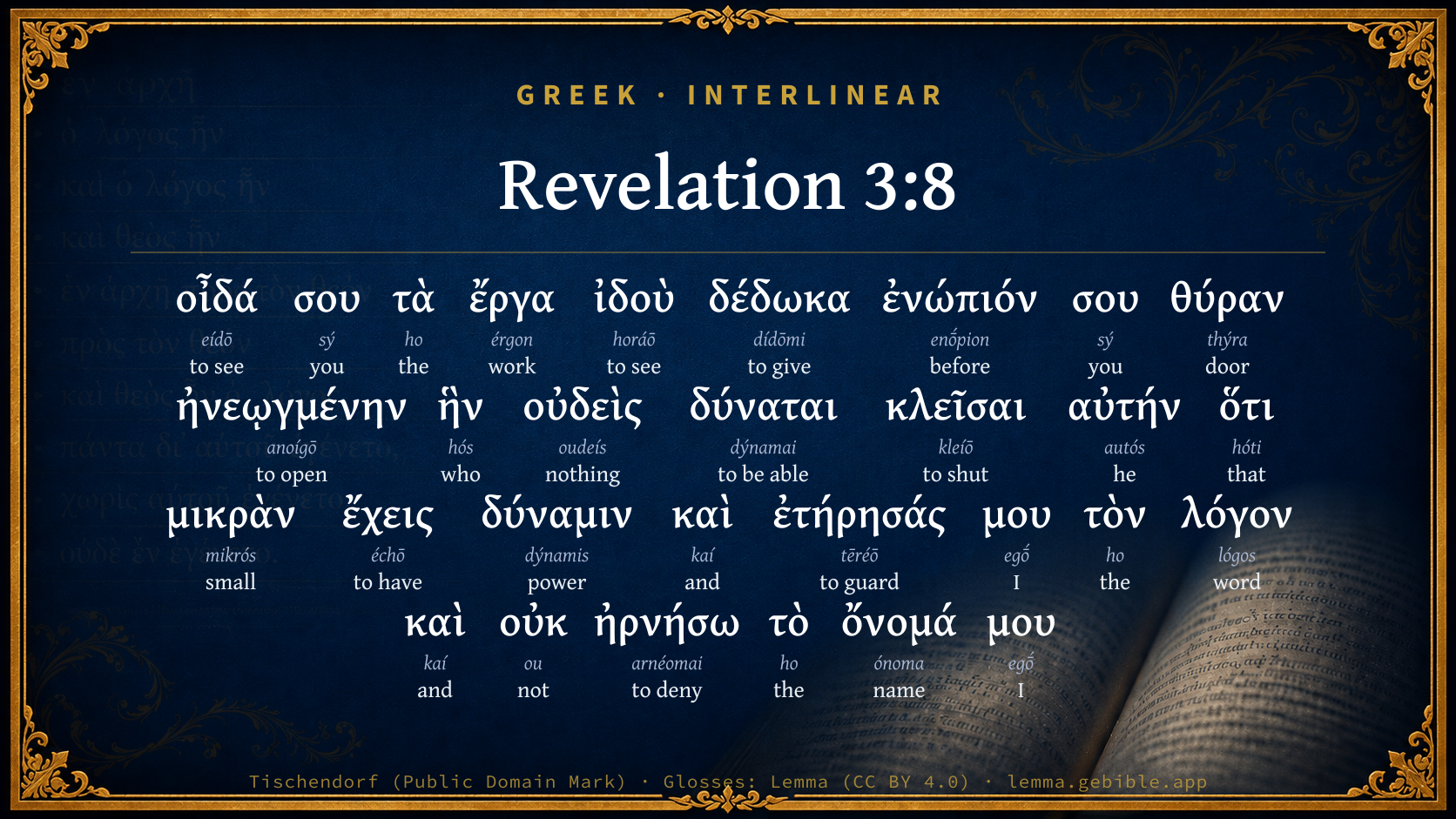
"I know your works (behold, I have set before you an open door, which no one can shut), that you have a little power, and kept my word, and didn't deny my name.
Download a study sheet
One document with this verse’s original text, its word-by-word gloss line, the meaning frame, cross-references with their text, attributed commentary, and full source and license credits — printable, and it pastes into notes with its structure intact.
This verse Autodidact and up
A passage Seminary Student
Up to 50 verses in one chapter. A passage sheet keeps up to 6 commentary sources and 12 cross-references per verse, in the order this page ranks them, and says so on the sheet whenever that leaves anything out. Ask for a single verse and you get the Autodidact verse sheet above.
Everything on this page stays free to read, with no account — the sheet is a download of what is already on screen, not access to it.
Compare translations 3
The same verse in 3 English versions, stacked beneath the original-language interlinear above. Click any original word for its lexicon entry.
Each is an independent rendering of the whole verse — the interlinear is not word-aligned to these translations.
Highlighted words mark where these versions differ — a whole-verse word diff, not a word-by-word alignment.
-
World English Bible Public Domain
"I know your works (behold, I have set before you an open door, which no one can shut), that you have a little power, and kept my word, and didn't deny my name.
-
King James Version Public Domain
I know thy works: behold, I have set before thee an open door, and no man can shut it: for thou hast a little strength, and hast kept my word, and hast not denied my name.
-
unfoldingWord Literal Text CC BY-SA 4.0
“I know your works (behold, I have put before you an opened door that no one is able to shut it), that you have little power, yet you have kept my word and you have not denied my name.
unfoldingWord Literal Text — © unfoldingWord, licensed CC BY-SA 4.0. Word-aligned USFM3 via Door43 (git.door43.org/unfoldingWord/en_ult).
Show all 19 translations
Every available English version of this verse, each an independent rendering of the whole verse.
-
World English Bible Public Domain
"I know your works (behold, I have set before you an open door, which no one can shut), that you have a little power, and kept my word, and didn't deny my name.
-
Berean Standard Bible Public Domain
I know your deeds. See, I have placed before you an open door, which no one can shut. For you have only a little strength, yet you have kept My word and have not denied My name.
-
Majority Standard Bible Public Domain
I know your deeds. Behold, I have placed before you an open door, which no one can shut. I know that you have only a little strength, yet you have kept My word and have not denied My name.
-
King James Version Public Domain
I know thy works: behold, I have set before thee an open door, and no man can shut it: for thou hast a little strength, and hast kept my word, and hast not denied my name.
-
American Standard Version (1901) Public Domain
I know thy works (behold, I have set before thee a door opened, which none can shut), that thou hast a little power, and didst keep my word, and didst not deny my name.
-
Revised Version (1885) Public Domain
I know thy works (behold, I have set before thee a door opened, which none can shut), that thou hast a little power, and didst keep my word, and didst not deny my name.
-
Geneva Bible (1599) Public Domain
I knowe thy workes: beholde, I haue set before thee an open doore, and no man can shut it: for thou hast a litle strength and hast kept my worde, and hast not denied my Name.
-
Douay-Rheims (1899) Public Domain
I know thy works. Behold, I have given before thee a door opened, which no man can shut: because thou hast a little strength, and hast kept my word, and hast not denied my name.
-
Young's Literal Translation Public Domain
I have known thy works; lo, I have set before thee a door -- opened, and no one is able to shut it, because thou hast a little power, and didst keep my word, and didst not deny my name;
-
Literal Standard Version CC BY-SA 4.0
I have known your works; behold, I have set before you a door having been opened, which no one is able to shut it, because you have little power, and yet have kept My word, and have not denied My Name;
-
Unlocked Literal Bible CC BY-SA 4.0
“I know what you have done. Look, I have put before you an open door that no one can shut. I know that you have little strength, yet you have obeyed my word and have not denied my name.
-
unfoldingWord Literal Text CC BY-SA 4.0
“I know your works (behold, I have put before you an opened door that no one is able to shut it), that you have little power, yet you have kept my word and you have not denied my name.
-
Darby Bible Public Domain
I know thy works: behold, I have set before thee an opened door, which no one can shut, because thou hast a little power, and hast kept my word, and hast not denied my name.
-
World Messianic Bible Public Domain
“I know your works (behold, I have set before you an open door, which no one can shut), that you have a little power, and kept my word, and didn’t deny my name.
-
Webster's Bible Public Domain
I know thy works: behold, I have set before thee an open door, and no man can shut it: for thou hast a little strength, and hast kept my word, and hast not denied my name.
-
Free Bible Version CC BY-SA 4.0
I know what you have accomplished—look, I've opened a door for you that no one can shut. I know that you only have a little strength, but you did what I told you, and you did not deny me.
-
Bible in Basic English Public Domain
I have knowledge of your works (see, I have put before you an open door which may be shut by no one), and that you have a little strength, and have kept my word, and have been true to my name.
-
Text-Critical English NT CC BY 4.0
I know yoʋr works. Behold, I have set before yoʋ an open door that no one can shut. I know that yoʋ have little strength, but yoʋ have kept my word and have not denied my name.
-
Tyndale New Testament (1534) Public Domain
I knowe thy workes. Beholde I have set before the an open doore and no man can shut it for thou haste a lyttell strengthe and haste kept my sayinges: and haste not denyed my name.
Literal Standard Version (2020), Covenant Press — licensed CC BY-SA 4.0. Text via the HelloAO Bible API (eBible.org). Unlocked Literal Bible (unfoldingWord) — licensed CC BY-SA 4.0. Text via the HelloAO Bible API (eBible.org). unfoldingWord Literal Text — © unfoldingWord, licensed CC BY-SA 4.0. Word-aligned USFM3 via Door43 (git.door43.org/unfoldingWord/en_ult). Free Bible Version, Dr. Jonathan Gallagher — licensed CC BY-SA 4.0. Text via the HelloAO Bible API (eBible.org).
Word by word
More ways to search: Search by grammar → Find every occurrence → Compare this word →
Practice this passage: Drill this verse → Learn its vocabulary →
- Appears 16× in the Greek New Testament
- First appears at Matthew 6:6
- Part of Speech
- Verb
- Tense
- Aorist
- Voice
- Active
- Mood
- Infinitive
Full Thayer's Definition
- οἶδά eídō G1492 “to see” Verb, Perfect, Active, Indicative, 1st person, Singular
- σου sý G4771 “you” Personal pronoun, 2nd person, Genitive, Singular
- τὰ ho G3588 “the” Article, Accusative, Plural, Neuter
- ἔργα érgon G2041 “work” Noun, Accusative, Plural, Neuter
- ἰδοὺ horáō G3708 “to see” Verb, Aorist, Middle, Imperative, 2nd person, Singular
- δέδωκα dídōmi G1325 “to give” Verb, Perfect, Active, Indicative, 1st person, Singular
- ἐνώπιόν enṓpion G1799 “before” Adverb
- σου sý G4771 “you” Personal pronoun, 2nd person, Genitive, Singular
- θύραν thýra G2374 “door” Noun, Accusative, Singular, Feminine
- ἠνεῳγμένην anoígō G455 “to open” Verb, Perfect, Passive, Participle, Accusative, Singular, Feminine
- ἣν hós G3739 “who” Relative pronoun, Accusative, Singular, Feminine
- οὐδεὶς oudeís G3762 “nothing” Adjective, Nominative, Singular, Masculine, Negative
- δύναται dýnamai G1410 “to be able” Verb, Present, Middle or Passive deponent, Indicative, 3rd person, Singular
- κλεῖσαι kleíō G2808 “to shut” Verb, Aorist, Active, Infinitive
- αὐτήν autós G846 “he” Personal pronoun, Accusative, Singular, Feminine
- ὅτι hóti G3754 “that” Conjunction
- μικρὰν mikrós G3398 “small” Adjective, Accusative, Singular, Feminine
- ἔχεις échō G2192 “to have” Verb, Present, Active, Indicative, 2nd person, Singular
- δύναμιν dýnamis G1411 “power” Noun, Accusative, Singular, Feminine
- καὶ kaí G2532 “and” Conjunction
- ἐτήρησάς tēréō G5083 “to guard” Verb, Aorist, Active, Indicative, 2nd person, Singular
- μου egṓ G1473 “I” Personal pronoun, 1st person, Genitive, Singular
- τὸν ho G3588 “the” Article, Accusative, Singular, Masculine
- λόγον lógos G3056 “word” Noun, Accusative, Singular, Masculine
- καὶ kaí G2532 “and” Conjunction
- οὐκ ou G3756 “not” Particle, Negative
- ἠρνήσω arnéomai G720 “to deny” Verb, Aorist, Middle deponent, Indicative, 2nd person, Singular
- τὸ ho G3588 “the” Article, Accusative, Singular, Neuter
- ὄνομά ónoma G3686 “name” Noun, Accusative, Singular, Neuter
- μου egṓ G1473 “I” Personal pronoun, 1st person, Genitive, Singular
About this verse
These counts appear in no published source. They are computed here, from the morphology-tagged text and Lemma’s own curated glosses. What Lemma adds →
- 30
- words
- 25
- distinct lemmas
- Revelation
- section
Cross-references
25Topical passages linked to Revelation 3:8 in the Treasury of Scripture Knowledge — connected by theme and wording, ordered by reader-vote popularity; previews shown in the World English Bible.
- 1 Corinthians 16:9 for a great and effective door has opened to me, and there are many adversaries.
- Colossians 4:3 praying together for us also, that God may open to us a door for the word, to speak the mystery of Christ, for which I am also in bonds;
- Revelation 3:7 "To the angel of the assembly in Philadelphia write: "He who is holy, he who is true, he who has the key of David, he who opens and no one can shut, and who shuts and no one opens, says these things:
- 2 Corinthians 2:12 Now when I came to Troas for the Gospel of Christ, and when a door was opened to me in the Lord,
- Philippians 4:13 I can do all things through Christ, who strengthens me.
- Acts 14:27 When they had arrived, and had gathered the assembly together, they reported all the things that God had done with them, and that he had opened a door of faith to the Gentiles.
- Luke 12:9 but he who denies me in the presence of men will be denied in the presence of the angels of God.
- Revelation 2:13 "I know your works and where you dwell, where Satan's throne is. You hold firmly to my name, and didn't deny my faith in the days of Antipas my witness, my faithful one, who was killed among you, where Satan dwells.
- John 17:6 I revealed your name to the people whom you have given me out of the world. They were yours, and you have given them to me. They have kept your word.
- Revelation 3:15 "I know your works, that you are neither cold nor hot. I wish you were cold or hot.
- 1 John 2:22–23 Who is the liar but he who denies that Jesus is the Christ? This is the Antichrist, he who denies the Father and the Son.
- Revelation 22:7 "Behold, I come quickly. Blessed is he who keeps the words of the prophecy of this book."
- 1 Timothy 5:8 But if anyone doesn't provide for his own, and especially his own household, he has denied the faith, and is worse than an unbeliever.
- 2 Timothy 4:7 I have fought the good fight. I have finished the course. I have kept the faith.
- Revelation 3:10 Because you kept my command to endure, I also will keep you from the hour of testing, which is to come on the whole world, to test those who dwell on the earth.
- Matthew 26:70–72 But he denied it before them all, saying, "I don't know what you are talking about."
- Revelation 2:2 "I know your works, and your toil and perseverance, and that you can't tolerate evil men, and have tested those who call themselves apostles, and they are not, and found them false.
- Revelation 3:1 "And to the angel of the assembly in Sardis write: He who has the seven Spirits of God, and the seven stars says these things: "I know your works, that you have a reputation of being alive, but you are dead.
- John 14:21–24 One who has my commandments, and keeps them, that person is one who loves me. One who loves me will be loved by my Father, and I will love him, and will reveal myself to him."
- Proverbs 30:9 Lest I be full, deny you, and say, 'Who is Yahweh?' Or lest I be poor, and steal, And so dishonor the name of my God.
- John 15:20 Remember the word that I said to you: 'A servant is not greater than his lord.' If they persecuted me, they will also persecute you. If they kept my word, they will keep yours also.
- 2 Corinthians 12:8–10 Concerning this thing, I begged the Lord three times that it might depart from me.
- Jude 1:4 For there are certain men who crept in secretly, even those who were long ago written about for this condemnation: ungodly men, turning the grace of our God into lasciviousness, and denying our only Master, God, and Lord, Jesus Christ.
- Daniel 11:34 Now when they shall fall, they shall be helped with a little help; but many shall join themselves to them with flatteries.
- Acts 3:13–14 The God of Abraham, Isaac, and Jacob, the God of our fathers, has glorified his Servant Jesus, whom you delivered up, and denied in the presence of Pilate, when he had determined to release him.
Cross-references courtesy of OpenBible.info (CC BY 4.0).
Where the printed editions differ
1 variantPlaces in this verse where the major printed Greek editions disagree on the wording in a way that affects the translation — a comparison of editions, not a manuscript-by-manuscript collation. The editions are the modern critical texts (Nestlé-Aland 28/27, SBL, Westcott-Hort, Tregelles, Tyndale House) and the traditional texts behind the KJV (the Textus Receptus and the Byzantine/Majority text). It is not a claim about which reading is original.
-
Different wording
ἣν
“which”
In NA28NA27TynSBLWHTregByz Not in TRκαὶ (kai) 'and' occurs in traditional manuscripts (TR) instead of ἣν (hēn) 'which' in older manuscripts (NA28+NA27+Tyn+SBL+WH+Treg+Byz)
Textual data: Translators Amalgamated Greek New Testament (STEPBible TAGNT) · CC BY 4.0.
Lesson kit
Teaching starters — assembled from the data on this page, not authored interpretation. Every prompt links to the verse data it draws on. Edit before teaching.
Revelation, in the Revelation, opens this verse with 30 words (25 distinct Greek lemmas). Its most distinctive word is kleíō (“to shut”). A historical commentator’s framing appears above. Read the whole chapter for the surrounding context.
Discussion questions
- The word kleíō carries the sense “to shut.” How does it shape the verse?
- Matthew 6:6 shares the word «to shut» with this verse. How do the two illuminate each other?
- “the” occurs 3× in this one verse. What is the effect of the repetition?
- The translations on this page render this verse differently — a whole-verse word diff, not a word-by-word alignment. What might account for the different wordings?
- Reading how Tyndale Open Study Notes and Meyer's Critical & Exegetical Commentary read this verse, where do the two commentators agree and where do they part?
Things to notice
- These translations choose different wording for 15 words in this verse.
- “the” occurs 3× in this single verse.
- 25 distinct Greek lemmas span 30 words in this verse.
Commentary
Notes on Revelation 3:8 from classic Christian and Jewish commentators (each source and its license shown beneath its notes). The classic Christian expositions comment on the surrounding passage and are grouped to its opening verse, so a note may address several verses; the Jewish commentaries on the Tanakh (Rashi and others) are per-verse, so they appear only where the commentator wrote on this verse.
Lemma curates 59 commentaries, every one of them public domain or Creative Commons licensed, each selected and text-cleaned for this edition rather than reprinted as found. About our sources →
Tyndale Open Study Notes
Tyndale Open Resources
Tyndale Open Study Notes — © Tyndale Open Resources, licensed CC BY-SA 4.0. Text via the HelloAO Bible API.
Meyer's Critical & Exegetical Commentary
Heinrich August Wilhelm Meyer
Meyer — Critical and Exegetical Commentary on the New Testament — English translation by Peter Christie, edited by Frederick Crombie (T&T Clark, 1880) — public domain. Text from a community e-Sword module.
Expositor's Greek Testament
ed. W. Robertson Nicoll
The Expositor's Greek Testament, edited by W. Robertson Nicoll (1897–1910) — public domain. Text from a community e-Sword module.
Geneva Bible (1599)
Geneva Bible translators
Geneva Bible (1599) marginal notes — public domain. Text via Bolls.life.
Jamieson, Fausset & Brown
Robert Jamieson, A. R. Fausset & David Brown
Jamieson, Fausset & Brown — Commentary Critical and Explanatory on the Whole Bible (1871) — public domain (CC PDM 1.0). Text via the HelloAO Bible API.
Adam Clarke's Commentary
Adam Clarke's Commentary on the Bible (1810–1826) — public domain. Text from a community e-Sword/MySword module.
Ellicott's Commentary for English Readers
A Bible Commentary for English Readers, edited by Charles John Ellicott (1878–1897) — public domain. Text from a community e-Sword module.
The Cambridge Bible for Schools and Colleges
gen. ed. J. J. S. Perowne
The Cambridge Bible for Schools and Colleges (gen. ed. J. J. S. Perowne; Cambridge University Press, 1878–1918) — public domain. Text from a community e-Sword module.
John Gill's Exposition
John Gill's Exposition of the Whole Bible (1746–1763) — public domain (CC PDM 1.0). Text via the HelloAO Bible API.
Trapp's Complete Commentary
John Trapp
John Trapp, A Commentary or Exposition upon All the Books of the Old and New Testament (1647–1656) — public domain. Text from a community e-Sword module.
Albert Barnes' Notes on the Bible
Albert Barnes' Notes on the Bible (1834–1885) — public domain. Text from a community e-Sword/MySword module.
Haydock's Catholic Bible Commentary
George Leo Haydock (1774–1849), Haydock's Catholic Family Bible and Commentary, 1859 edition — public domain. Excludes Psalms (Douay-Rheims chapter numbering differs from Protestant) and Deuterocanonical books (Catholic canon only).
Matthew Poole's English Annotations
Matthew Poole's English Annotations on the Holy Bible (1683–1685) — public domain. Text from a community e-Sword/MySword module.
Whedon's Commentary on the Bible
Daniel D. Whedon
Daniel D. Whedon (gen. ed.), Commentary on the Old and New Testaments (1874–1909) — public domain. Text from a community e-Sword module.
The Pulpit Commentary
The Pulpit Commentary (1880–1919), ed. H.D.M. Spence-Jones & Joseph S. Exell — public domain. Text from a community e-Sword module.
John Wesley's Explanatory Notes
John Wesley, Explanatory Notes Upon the Whole Bible (1754–1765) — public domain. Text via the GEBible commentary corpus.
The People's New Testament
B. W. Johnson
B. W. Johnson's The People's New Testament with Notes (1889–1891) — public domain. Electronic text from the Christian Classics Ethereal Library (CCEL) ThML edition.
Cambridge Greek Testament for Schools and Colleges
Cambridge Greek Testament for Schools and Colleges (Cambridge University Press, 1896; 21 vols, various authors incl. Carr, Maclear, Plummer, Farrar, Lumby, Moule, M. R. James, Simcox) — public domain. Text from a community e-Sword module.
Vincent's Word Studies in the New Testament
Marvin R. Vincent
Marvin R. Vincent, Word Studies in the New Testament (1887–1900) — public domain. Text from a community e-Sword/MySword module.