
Ephesians 1:21

Greek (Tischendorf 8th ed.) Ephesians 1:21 appears in the Greek New Testament. The text above is from the Tischendorf 8th edition. Each word links to its Strong’s number and a concise gloss. Click any word for its full Thayer’s Greek Lexicon entry.
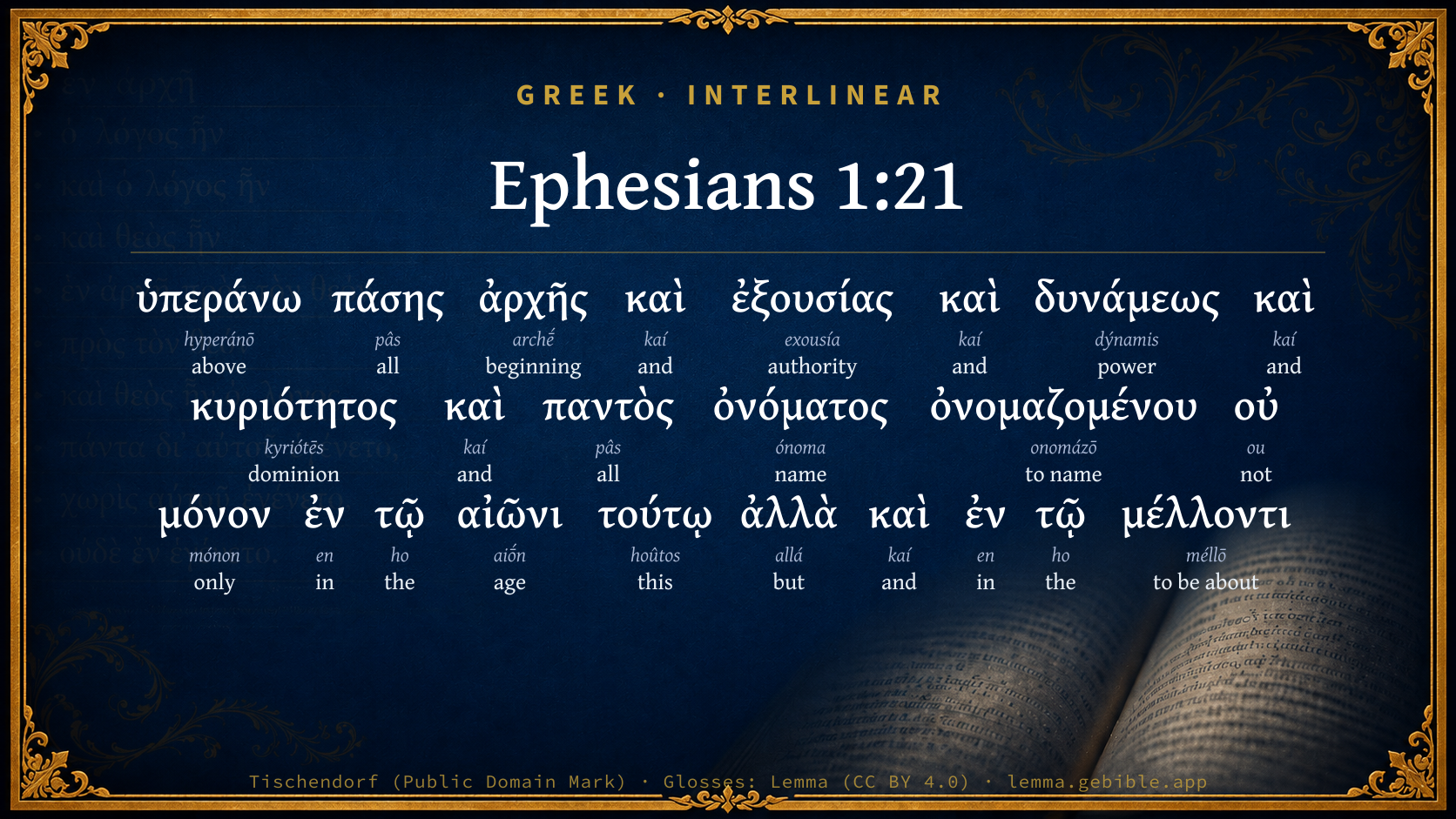
Download image
Cite this verse

Ephesians 1:21 (World English Bible). Public Domain. Lemma interlinear Bible study tool, https://lemma.gebible.app/v/ephesians/1/21.

Show BibTeX & RIS
BibTeX
RIS
English Translation
far above all rule, and authority, and power, and dominion, and every name that is named, not only in this age, but also in that which is to come.
World English Bible · Public Domain
Highlights
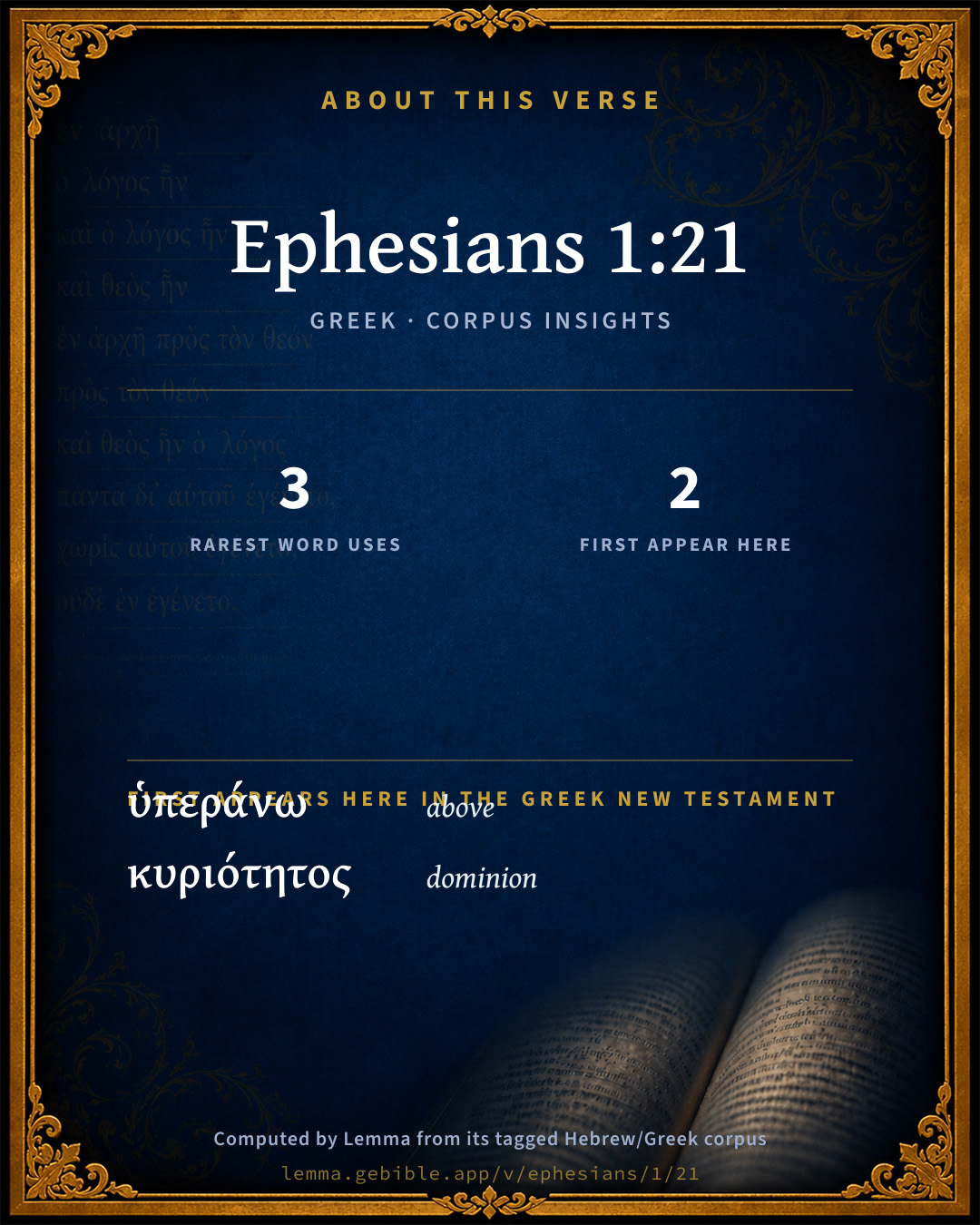
  • 2 first appearances in the Greek New Testament
Full analysis ↓
Download a study sheet

One document with this verse’s original text, its word-by-word gloss line, the meaning frame, cross-references with their text, attributed commentary, and full source and license credits — printable, and it pastes into notes with its structure intact.

This verse Autodidact and up

Study sheet (.html) Plain text (.txt)

A passage Seminary Student

Up to 50 verses in one chapter. A passage sheet keeps up to 6 commentary sources and 12 cross-references per verse, in the order this page ranks them, and says so on the sheet whenever that leaves anything out. Ask for a single verse and you get the Autodidact verse sheet above.

Everything on this page stays free to read, with no account — the sheet is a download of what is already on screen, not access to it.

Want to remove ads? Support Godless Engineer
Compare translations 3

The same verse in 3 English versions, stacked beneath the original-language interlinear above. Click any original word for its lexicon entry.

Each is an independent rendering of the whole verse — the interlinear is not word-aligned to these translations.

Highlighted words mark where these versions differ — a whole-verse word diff, not a word-by-word alignment.

  • World English Bible Public Domain
    far above all rule, and authority, and power, and dominion, and every name that is named, not only in this age, but also in that which is to come.
  • King James Version Public Domain
    Far above all principality, and power, and might, and dominion, and every name that is named, not only in this world, but also in that which is to come:
  • unfoldingWord Literal Text CC BY-SA 4.0
    far above all rule and authority and power and dominion and every name being named, not only in this age, but also in the one coming.

unfoldingWord Literal Text — © unfoldingWord, licensed CC BY-SA 4.0. Word-aligned USFM3 via Door43 (git.door43.org/unfoldingWord/en_ult).

Versions to compare (up to 4)

3 of 4 selected

Show all 19 translations

Every available English version of this verse, each an independent rendering of the whole verse.

  • World English Bible Public Domain
    far above all rule, and authority, and power, and dominion, and every name that is named, not only in this age, but also in that which is to come.
  • Berean Standard Bible Public Domain
    far above all rule and authority, power and dominion, and every name that is named, not only in the present age but also in the one to come.
  • Majority Standard Bible Public Domain
    far above all rule and authority, power and dominion, and every name that is named, not only in the present age but also in the one to come.
  • King James Version Public Domain
    Far above all principality, and power, and might, and dominion, and every name that is named, not only in this world, but also in that which is to come:
  • American Standard Version (1901) Public Domain
    far above all rule, and authority, and power, and dominion, and every name that is named, not only in this world, but also in that which is to come:
  • Revised Version (1885) Public Domain
    far above all rule, and authority, and power, and dominion, and every name that is named, not only in this world, but also in that which is to come:
  • Geneva Bible (1599) Public Domain
    Farre aboue al principalitie, and power, and might, and domination, and euery Name, that is named, not in this world only, but also in that that is to come,
  • Douay-Rheims (1899) Public Domain
    Above all principality, and power, and virtue, and dominion, and every name that is named, not only in this world, but also in that which is to come.
  • Young's Literal Translation Public Domain
    far above all principality, and authority, and might, and lordship, and every name named, not only in this age, but also in the coming one;
  • Literal Standard Version CC BY-SA 4.0
    far above all principality, and authority, and might, and lordship, and every name named, not only in this age, but also in the coming one;
  • Unlocked Literal Bible CC BY-SA 4.0
    He seated Christ far above all rule and authority and power and dominion, and every name that is named. Christ will rule, not only in this age, but also in the age to come.
  • unfoldingWord Literal Text CC BY-SA 4.0
    far above all rule and authority and power and dominion and every name being named, not only in this age, but also in the one coming.
  • Darby Bible Public Domain
    above every principality, and authority, and power, and dominion, and every name named, not only in this age, but also in that to come;
  • World Messianic Bible Public Domain
    far above all rule, authority, power, dominion, and every name that is named, not only in this age, but also in that which is to come.
  • Webster's Bible Public Domain
    Far above all principality, and power, and might, and dominion, and every name that is named, not only in this world, but also in that which is to come:
  • Free Bible Version CC BY-SA 4.0
    far above any other ruler, authority, power, or lord, or any leader with all their titles—not only in this world, but also in the coming world too.
  • Bible in Basic English Public Domain
    Far over all rule and authority and power and every name which is named, not only in the present order, but in that which is to come:
  • Text-Critical English NT CC BY 4.0
    far above every ruler and authority, power and dominion, and every name that is named, not only in this age but also in the age to come.
  • Tyndale New Testament (1534) Public Domain
    above all rule power and myght and dominacion and above all names that are named not in this worlde only but also in the worlde to come:

Literal Standard Version (2020), Covenant Press — licensed CC BY-SA 4.0. Text via the HelloAO Bible API (eBible.org). Unlocked Literal Bible (unfoldingWord) — licensed CC BY-SA 4.0. Text via the HelloAO Bible API (eBible.org). unfoldingWord Literal Text — © unfoldingWord, licensed CC BY-SA 4.0. Word-aligned USFM3 via Door43 (git.door43.org/unfoldingWord/en_ult). Free Bible Version, Dr. Jonathan Gallagher — licensed CC BY-SA 4.0. Text via the HelloAO Bible API (eBible.org).

Word by word

More ways to search: Search by grammar → Find every occurrence → Compare this word →

Practice this passage: Drill this verse → Learn its vocabulary →

ὑπεράνω
hyperánō
G5231
“above”
Adverb
Part of Speech
Adverb
Full Thayer's Definition

Origin: from G5228 and G507

TDNT: None

1. above a. above a thing b. of a place c. of rank or power
  1. πάσης pâs G3956 “all” Adjective, Genitive, Singular, Feminine
  2. ἀρχῆς archḗ G746 “beginning” Noun, Genitive, Singular, Feminine
  3. καὶ kaí G2532 “and” Conjunction
  4. ἐξουσίας exousía G1849 “authority” Noun, Genitive, Singular, Feminine
  5. καὶ kaí G2532 “and” Conjunction
  6. δυνάμεως dýnamis G1411 “power” Noun, Genitive, Singular, Feminine
  7. καὶ kaí G2532 “and” Conjunction
  8. κυριότητος kyriótēs G2963 “dominion” Noun, Genitive, Singular, Feminine
  9. καὶ kaí G2532 “and” Conjunction
  10. παντὸς pâs G3956 “all” Adjective, Genitive, Singular, Neuter
  11. ὀνόματος ónoma G3686 “name” Noun, Genitive, Singular, Neuter
  12. ὀνομαζομένου onomázō G3687 “to name” Verb, Present, Passive, Participle, Genitive, Singular, Neuter
  13. οὐ ou G3756 “not” Particle, Negative
  14. μόνον mónon G3440 “only” Adverb
  15. ἐν en G1722 “in” Preposition
  16. τῷ ho G3588 “the” Article, Dative, Singular, Masculine
  17. αἰῶνι aiṓn G165 “age” Noun, Dative, Singular, Masculine
  18. τούτῳ hoûtos G3778 “this” Demonstrative pronoun, Dative, Singular, Masculine
  19. ἀλλὰ allá G235 “but” Conjunction
  20. καὶ kaí G2532 “and” Conjunction
  21. ἐν en G1722 “in” Preposition
  22. τῷ ho G3588 “the” Article, Dative, Singular, Masculine
  23. μέλλοντι méllō G3195 “to be about” Verb, Present, Active, Participle, Dative, Singular, Masculine

About this verse

These counts appear in no published source. They are computed here, from the morphology-tagged text and Lemma’s own curated glosses. What Lemma adds →

24
words
17
distinct lemmas
Pauline Epistles
section

Notable vocabulary

The rarest word here is ὑπεράνω above G5231 — appearing just 3 times in the whole Greek New Testament.

First appearance in Scripture

These words make their first canonical appearance in the Greek New Testament here:

  • ὑπεράνω above G5231
  • κυριότητος dominion G2963

Shared distinctive vocabulary

ὑπεράνω above G5231 occurs in 3 verses of the Greek New Testament. Also found in:
Repetition

Words recur within this verse:

Cross-references

19

Topical passages linked to Ephesians 1:21 in the Treasury of Scripture Knowledge — connected by theme and wording, ordered by reader-vote popularity; previews shown in the World English Bible.

  • Philippians 2:9–11 Therefore God also highly exalted him, and gave to him the name which is above every name;
  • Colossians 2:10 and in him you are made full, who is the head of all principality and power;
  • Colossians 1:15–16 who is the image of the invisible God, the firstborn of all creation.
  • 1 Peter 3:22 who is at the right hand of God, having gone into heaven, angels and authorities and powers being made subject to him.
  • Hebrews 1:4 having become so much better than the angels, as he has inherited a more excellent name than they have.
  • Daniel 7:27 The kingdom and the dominion, and the greatness of the kingdoms under the whole the sky, shall be given to the people of the saints of the Most High: his kingdom is an everlasting kingdom, and all dominions shall serve and obey him.
  • Acts 4:12 There is salvation in none other, for neither is there any other name under heaven, that is given among men, by which we must be saved!"
  • Colossians 2:15 having stripped the principalities and the powers, he made a show of them openly, triumphing over them in it.
  • Matthew 28:18–19 Jesus came to them and spoke to them, saying, "All authority has been given to me in heaven and on earth.
  • Ephesians 3:10 to the intent that now through the assembly the manifold wisdom of God might be made known to the principalities and the powers in the heavenly places,
  • Revelation 20:10–15 The devil who deceived them was thrown into the lake of fire and sulfur, where the beast and the false prophet are also. They will be tormented day and night forever and ever.
  • Ephesians 6:12 For our wrestling is not against flesh and blood, but against the principalities, against the powers, against the world's rulers of the darkness of this age, and against the spiritual hosts of wickedness in the heavenly places.
  • John 5:25–29 Most assuredly, I tell you, the hour comes, and now is, when the dead will hear the Son of God's voice; and those who hear will live.
  • Hebrews 4:14 Having then a great high priest, who has passed through the heavens, Jesus, the Son of God, let us hold tightly to our confession.
  • Revelation 19:12–13 His eyes are a flame of fire, and on his head are many crowns. He has names written and a name written which no one knows but he himself.
  • Matthew 25:31–36 "But when the Son of Man comes in his glory, and all the holy angels with him, then he will sit on the throne of his glory.
  • Romans 8:38–39 For I am persuaded, that neither death, nor life, nor angels, nor principalities, nor things present, nor things to come, nor powers,
  • Matthew 12:32 Whoever speaks a word against the Son of Man, it will be forgiven him; but whoever speaks against the Holy Spirit, it will not be forgiven him, neither in this age, nor in that which is to come.
  • Hebrews 2:5 For he didn't subject the world to come, of which we speak, to angels.

Cross-references courtesy of OpenBible.info (CC BY 4.0).

Commentary

Notes on Ephesians 1:21 from classic Christian and Jewish commentators (each source and its license shown beneath its notes). The classic Christian expositions comment on the surrounding passage and are grouped to its opening verse, so a note may address several verses; the Jewish commentaries on the Tanakh (Rashi and others) are per-verse, so they appear only where the commentator wrote on this verse.

Lemma curates 59 commentaries, every one of them public domain or Creative Commons licensed, each selected and text-cleaned for this edition rather than reprinted as found. About our sources →

Tyndale Open Study Notes

Tyndale Open Resources

1:21 he is far above: Jesus’ power and authority transcend all rival powers, whether human or spiritual, in this age and the coming age (see 3:10; 6:12; John 12:31; Rom 8:38-39; 1 Cor 15:24; Col 1:13; 2:10, 15; 1 Pet 3:22; Rev 12:7-9).

Tyndale Open Study Notes — © Tyndale Open Resources, licensed CC BY-SA 4.0. Text via the HelloAO Bible API.

Bengel's Gnomon

Johann Albrecht Bengel

Eph 1:21. Ὑπεράνω) A compound word. Christ not only takes the precedency, but is ruler above all.—ἀρχῆς καὶ ἐξουσίας καὶ δυνάμεως) 1Co 15:24, note.—καὶ κυριότητος) Col 1:16.—καὶ παντὸς ὀνόματος, and every name) We know that the Emperor goes before all, although we cannot enumerate all the ministers of his court; so we know that Christ is placed above all, although we cannot name them all.—ἐν τῷ μέλλοντι) Αἰὼν, age, or the world [order of things], denotes here not time, but a system of things and operations revealed at its own proper time, and permanent. It is called future, not that it does not yet exist, but because it is not yet seen. Authorities, powers, etc., are in the future [αἰὼν]; but yet they are named also in this world [αἰὼν]; but even those things also, which are not even named at the present time, but both in the name and in reality will be at length laid open to us in the future, are subject to Christ.

Bengel's Gnomon of the New Testament — English translation (T&T Clark, Edinburgh, 1860) — public domain. Text from a community e-Sword module.

Meyer's Critical & Exegetical Commentary

Heinrich August Wilhelm Meyer

Eph_1:21 is no parenthesis, since neither the construction nor the logical progress of the thought is interrupted.

ὑπεράνω expresses not the infinite exaltedness (the Greek Fathers, Beza, Estius), nor yet the dominion over (Bengel), although the latter is implied in the nature of the case, but simply: up above (Heb_9:5; Eze_1:26; Eze_8:2; Deu_28:1; Cant. tr. puer. 37; Tob_1:3; Ael. V. H. ix. 7; Polyb. xii. 24. 1). The opposite is ὑποκάτω, Mar_6:11; Heb_2:8.

πάσης ἀρχῆς … κυριότητος is neither to be understood, with Schoettgen, of the Jewish hierarchs, nor, with van Til (in Wolf), of the various grades of Gentile rulers, nor, with Morus, of human powers in general, nor, with Erasmus, Vorstius, Wolf, Zachariae, Eosenmüller, Flatt, Olshausen, and others, of quodcumque gloriae et dignitatis genus (comp. 1Co_15:24); but, as is shown by the immediate context (ἐκάθισεν … ἐν τοῖς ἐπουραν.) and the analogous passages, Eph_3:10, Col_1:16, Rom_8:38 (comp. also 1Pe_3:22), of the angels, who are designated according to their classes of rank (abstracta pro concretis), and, in fact, of the good angels, since the apostle is not here speaking (as in 1Co_15:24) of the victory of Christ over opposing powers, but of His exaltation above the existing powers in heaven. See, moreover, on Rom_8:38. In opposition to Hofmann, who (Schriftbew. I. p. 347) would find in the different designations not any order of rank, but only various relations to God and the world, see Hahn, Theol. d. N.T. I. p. 291 ff. Comp. also Kahnis, Dogm. I. p. 558 f. Christ Himself already, Mat_18:10, assumes a diversity of rank among the angels; it is thus the more arbitrary, that expressions evidently in stated use, which in the case of two apostles and then in the Test. XII. Patr. correspond to this idea (even apart from the Jewish doctrine of classes of angels) should not be referred to it. More precise information, however, as to the relations and functions of the different grades of angels[116] is not to be given, since Paul does not himself enter into particulars on the point, and the Rabbinical theory of classes of angels, elaborated under the influence of Platonism, yet dissimilar (see Eisenmenger, Entdeckt. Judenth. II. p. 374; Bartolocci, Bibl. Rabb. I. p. 267 ff.; Gfrörer, Jahrh. d. Heils, I. p. 357 ff.), is not in keeping with the designations of the apostle (see Harless in loc.; Fritzsche, ad Rom. II. p. 226), and has evidently been elaborated at a later date. It is nevertheless probable that the order of succession is here arranged according to a descending climax; for (1) the apostle, in looking at the matter, proceeds most naturally from above downward, from the right hand of God to the heavenly beings which hold the next place beneath Him, and so on; (2) the ἀρχαί, ἐξουσίαι, and δυνάμεις are always mentioned in the same order (Eph_3:10; Col_1:16; Col_2:10; 1Pe_3:22); the ἐξουσίαι, however, with the θρόνοι (Col_1:16) are, Test. XII. Patr. p. 548, placed in the seventh heaven, and the δυνάμεις only in the third (p. 547), as, indeed, in Jamblichus, v. 21, p. 136, the δυνάμεις are placed far below the ἀρχαί. According to this, the θρόνοι and κυριότητες, Col_1:16, would be placed in juxtaposition as the two extremes of the angelic series. Another view is taken by Hahn, Theol. d. N.T. I. p. 297 f.

That Paul, moreover, sets forth Christ as exalted above the angel-world, with a polemic purpose in opposition to the θρησκεία ἀγγέλων of the Gnosis of Asia Minor (comp. Col_2:18) (Bucer, Estius, Hug, and others), is not to be assumed, since the form of the representation maintains purely a positive character, and the thing itself was so natural to the Christian consciousness generally (comp. Heb_1:4), and to the connection in the case of our passage in particular, as to need no polemic occasion in order to its being expressed, and expressed with such solemnity. Even a purpose of guarding against possible infection on the part of such a Gnosis (Schneckenburger, Olshausen) is at least not expressed or more specially-indicated; it may, however, have still been partially present to the mind of the apostle from the sphere of thought of the previously composed Epistle to the Colossians. Comp. Introd. § 4.

καὶ παντὸς ὀνόματος κ.τ.λ.] and, i.e. and generally (see Fritzsche, ad Matth. pp. 786, 870), above every name, which is named. Let any name be uttered, whatever it is, Christ is above it, is more exalted than that which the name so uttered affirms. Comp. Php_2:9. That ὄνομα is here dignitatis potentiaeve nomen (Erasmus, Calvin, Grotius, and others), as Hom. Od. xxiv. 93; Strabo, vi. p. 245 (ἐν ὀνόματι εἶναι), and the like (see Wolf, ad Dem. Lept. p. 346; Jacobs, ad Anthol. IX. p. 226), is not to be supposed on account of ὀνομαζομένου, since this makes the simple literal meaning name the only possible one (comp. Plato, Soph. p. 262 B); and, if Morus and Harless (comp. also Michaelis and Rückert) have supplied the notion underlying the preceding abstract nouns: above every name, namely, of such character, they have done so arbitrarily, as παντός stands without restrictive addition. πᾶν ὄνομα is quite general: any name whatever; from the heavenly powers, above which Christ is placed, the glance of the apostle stretches to every (created) thing generally, which may anyhow be named. Comp. πάντα, Eph_1:22.

οὐ μόνον κ.τ.λ.] cannot belong to ἐκάθισεν κ.τ.λ. (Morus, Koppe; comp. already Beza and Zanchius), since ἐκάθισεν is an act, which has taken place in the αἰὼν αὗτος, but it belongs to ὀνομαζομ.: which is named in the present world-period, before the Parousia, and in the future one, after the Parousia. As to αἰὼν οὗτος and αἰὼν μέλλων, see on Mat_12:32. Natural and supernatural order of the world (Schenkel), and similar conceptions, are not to be substituted for the historical idea.

[116] Ignatius, Trall. 5, calls them τὰς τοποθεσίας τὰς ἀγγελικάς. Comp. also Hermas, Past. i. 3, 4. But if the ἀρχαὶ κ.τ.λ. are angels, they are also conceived of as personal, not as principles and potencies, powers, forces, ordinances, and laws (Beyschlag, Christol. d. N.T. p. 244), consequently in an abstract sense. The abstract designation has its basis in the fact that classes or categories of personal beings are expressed, just as, e.g., ἐξουσία is said of human authorities, which consist of persons.

Meyer — Critical and Exegetical Commentary on the New Testament — English translation by Peter Christie, edited by Frederick Crombie (T&T Clark, 1880) — public domain. Text from a community e-Sword module.

Expositor's Greek Testament

ed. W. Robertson Nicoll

Eph 1:21 . ὑπεράνω πάσης ἀρχῆς καὶ ἐξουσίας καὶ δυνάμεως καὶ κυριότητος : over above all rule, and authority, and power, and lordship . The intensive force “ far above” is given to the ὑπεράνω by Chrys., Theoph., Stier, the AV, the RV, etc. But it can scarcely be sustained in face of the actual use of the word in Heb 9:5 ( cf. Eze 43:15 ); the tendency of late Greek to substitute compound for simple forms without substantial change of sense; the non-intensive use of the cognate form ὑποκάτω (Mar 6:11 ; Luk 8:16 ; Joh 1:51 ); and the testimony of the Syriac and other ancient Versions, which render it simply “above” ( e.g. , Vulg., supra ). “Over above,” therefore, is to be preferred to “far above”. The πάσης is “all” in the sense of “every,” every particular kind of ἀρχή that can be named. The terms are given in the abstract form, not as if only principles and forces were in view, and not personal powers, but because “ classes or categories of personal beings are expressed, just as, e.g. , ἐξουσία is said of human authorities , which consist of persons ” (Mey.). The use of the abstract ἀρχαί , etc., instead of the concrete ἄγγελοι , etc., enhances the conception of the absolute, all-embracing dominion of Christ. But what manner of powers or authorities do these terms designate? The fact that the immediate subject here is the heavenlies and Christ’s position in them at once excludes such interpretations as identify these ἀρχαί , etc. with earthly powers (Morus); with every kind of dignity wheresoever found (Erasm., Olsh., etc.); with the Jewish hierarchy (Schoett.); or with the various orders of Gentile powers (van Til). The leading idea of the section and the apparent purport of similar statements (Eph 3:10 ; Col 1:16 ; Rom 8:38 ; 1Pe 3:22 ) point to the angelic world as meant. The fact that nothing is said here of Christ’s triumph over Satanic powers suggests further that only angels of good, heavenly intelligences, are in view. Can any definite distinction then be made out between the terms? And can it be said that the enumeration means that the world of good angels has its distinct orders and grades of angelic dignity and power? The passage must be read in connection with the analogous enumerations in Eph 3:10 ; Rom 8:38 ; 1Pe 3:22 , and especially Col 1:16 . Differences in the enumerations then at once appear. In Eph 3:10 we have only the ἀρχαί and ἐξουσίαι ; in Rom 8:38 , ἄγγελοι , ἀρχαί , δυνάμεις ; in 1Pe 3:22 , ἄγγελοι , ἐξουσίαι , δυνάμεις . And in the most direct parallel (Col 1:16 ) we find θρόνοι , κυριότητες , ἀρχαί , ἐξουσίαι . The Pauline passages themselves, therefore, show no such identity either in the number or in the succession of authorities as would be consistent with a determinate doctrine of graduated orders. Nor can it be inferred from the words in Mat 18:10 (as Meyer thinks) that such gradations are recognised by our Lord Himself. It is true that in the non-canonical writings of the Jews ( e.g., Test. XII. Patr. , etc.) the idea of variety of ranks among the angels appears, and that in the later Rabbinical literature it took strange and elaborate forms. But between these and the simple statements of the NT there is no real likeness, and there is nothing here to point certainly either to an ascending scale or to a descending . It is held by some indeed ( e.g. , Meyer) that the angelic authorities are named here according to the latter scale, beginning with the highest and proceeding to the lower and the lowest. For this two reasons are offered, viz., first that it would be natural for the writer, who has led the reader up to the right hand of God as the position possessed by Christ, to give his enumeration of the powers subject to Christ in the succession of first, second and third in rank; and second , that in the various references made to them, the ἀρχαί , ἐξουσίαι , δυνάμεις are given in the same order. But the former is a very precarious reason; and the latter is not valid, inasmuch as in none of the passages appealed to do we get all these three terms together (Eph 3:10 ; Col 1:16 ; Col 2:10 ; 1Pe 3:22 ). Nor is it possible to establish any clear distinction of sense and application between the four terms introduced here, such as that attempted, e.g. , by Alford who, including in the list earthly as well as heavenly powers and evil as well as good spirits, regards ἀρχή as the supreme expression of dignity, ἐξπισία as official power in all its forms, primary or delegated, δύναμις as might or the “raw material” of power, and κυριότης , as the pre-eminence of lordship. We must take the terms, therefore, not as dogmatic terms either teaching or implying any doctrine of graduated ranks, differentiated functions, or organised order in the world of angels, but as rhetorical terms brought together in order to express the unique supremacy and absolute sovereignty proper to Christ, and meaning simply that whatever powers or dignities existed and by whatever names they might be designated, Christ’s dominion was above them all. This is suggested also by the further generalisation that follows. καὶ παντὸς ὀνόματος ὀνομαζομένου : and every name that is named . The ὄνομα here is not to be taken as a title of dignity, but (as the ὀνομαζομένου shows) has the simple sense of name . There is an advance in the statement of Christ’s supreme rank, but it is simply from the idea of a supremacy over all heavenly intelligences to that of a supremacy over all created objects by whatsoever name called. οὐμόνον ἐν τῷ αἰῶνι τούτῳ , ἀλλὰ καὶ ἐν τῷ μέλλοντι : not only in this world (or age ), but also in that which is to come . The statement of Christ’s absolute and unmatched supremacy is brought to its height by this last generalisation, which embraces within its sweep the totality of created objects not only as they now are, but as they may hereafter be in any possible future. The word αἰών here as elsewhere, has the idea of duration at its foundation. It means “age,” “ aeon ,” and as used of the world presents it, in distinction from κόσμος , in its temporal aspect, “this present state of things”. The Jews spoke of the period before Messiah’s Advent as הָצוֹלָם הַוֶּה , “this age,” and of the period introduced by that event as הָצוֹלָם הַבָּא , “the coming age”. So the NT writers designate the period preceding the final Return or Parousia of Christ ὁ αἰὼν οὗτος (also ὁ νῦν αἰών , 1Ti 6:17 ; ὁ ἐνεστὼς αἰών , Gal 1:4 ; or simply ὁ αἰών , Mat 14:22 ), and the period beginning with the Parousia ὁ αἰὼν ὁ μέλλων (also ὁ αἰὼν ἐκεῖνος , Luk 20:35 ; ὁ αἰὼν ὁ ἐρχόμενος , Mar 10:30 ; Luk 18:30 ; cf. οἱ αἰῶνες οἱ ἐπερχόμενοι , Eph 2:7 ).

This paragraph gives simply a positive statement of the exaltation of Christ, His sovereign and unshared supremacy over all. It makes no reference to Jewish or Gnostic speculations inconsistent with this. It is different with the great section in the sister Epistle to the Colossians. There we see that such speculations were rife in at least one of the Churches of the Lycus valley. The statements in that Epistle have an unmistakable reference to theosophic notions akin to the Gnostic ideas of emanations notions of angelic intermediaries between God and the world; against which the Apostle has to assert the exclusive relation of Christ to the whole system of things, seen and unseen, earthly and celestial, as the Creator of all, the Upholder of all, the One Being in whom resided all the forces pertaining to the maintenance and administration of things. The literature of Judaism makes it also clear that by Paul’s time the Jews had constructed a somewhat elaborate system of Angelology, with theories of graduated positions and distinctive functions. The Book of Enoch (lxi. 10) speaks of “angels of power and angels of principality”. The Book of the Secrets of Enoch (xx. 1, 3) describes the heavenly host as consisting of ten troops lordships, principalities, powers, cherubim, seraphim, thrones, etc. In the Testaments of the Twelve Patriarchs (Lev 3 ) six orders are named, of which the highest are the θρόνοι , ἐξουσίαι , occupying the seventh heaven, while the δυνάμεις are the fifth in order and are assigned to the third heaven. The same general doctrine appears also in Ephraem Syrus (i., p. 270), who gives three great divisions of the celestial world, viz. (1) θεοί , θρόνοι , κυριότητες ; (2) ἀρχάλλελοι , ἀρχαί , ἐξουσίαι ; (3) ἄγγελοι , δυνάμεις , χερουβίμ , σεραφίμ . In the De Princip. of Origen (i., 5, 3, etc.) five orders are named, rising from the τάξις ἀγγελική , to ἀρχαί , ἐξουσίαι , θρόνοι , and finally κυριότητες . But the conception of a great, graduated angelic hierarchy was elaborated most fully by the author of the remarkable book, De Coelesti Hierarchia , the so-called Dionysius the Areopagite. There we find a scheme of orders in three sets of three, descending from the highest to the lowest: Seraphim, Cherubim, Thrones; Dominations, Virtues, Powers (or Authorities); Principalities, Archangels, Angels. Hence the sublime description in Dante ( Paradiso , canto xxxviii.) and Milton’s “Thrones, Dominations, Princedoms, Virtues, Powers” ( Paradise Lost , v., 601).

The Expositor's Greek Testament, edited by W. Robertson Nicoll (1897–1910) — public domain. Text from a community e-Sword module.

Hodge's Commentary on Romans, Ephesians & First Corinthians

Charles Hodge

Eph_1:21

The immediate subject of discourse in this chapter is the blessings of redemption conferred on believers. The resurrection and exaltation of Christ are introduced incidentally by way of illustration. The apostle dwells for a moment on the nature of this exaltation, and on the relation of Christ, at the right hand of God, to his church, and then, at the beginning of the following chapter, reverts to his main topic.

The subject of the exaltation here spoken of is not the Logos, but Christ; the Theanthropos, or God-man. The possession of divine perfections was the necessary condition of this exaltation because, as just remarked, the nature and extent of the dominion granted to him, demand such perfections. It is a dominion not only absolutely universal, but it extends over the heart and conscience, and requires the obedience not only of the outward conduct but of the inward life, which is due to God alone. We therefore find the divine nature of Christ presented in the Scriptures as the reason of his being invested with this peculiar dominion. Thus in the second Psalm, it is said, Thou art my Son; ask of me, I will give thee the heathen for thine inheritance, etc. That is because thou art my son, ask and I will give thee this dominion. And in the first chapter of the epistle to the Hebrews, it is said, The Son, being the brightness of the Fathers glory, and the express image of his person, and upholding all things by the word of his power, is set down at the right hand of the majesty on high. That is, because he is of the same nature with the Father and possesses the same almighty power, he is associated with him in his dominion. While the divine nature of Christ is the necessary condition of his exaltation, his mediatorial work is the immediate ground of the Theanthropos, God manifested in the flesh, being invested with this universal dominion. This is expressly asserted, as in Phi_2:9. Though equal with God, he humbled himself to become obedient unto death, wherefore also God hath highly exalted him.

In illustration of the exaltation of Christ mentioned in Eph_1:20, the apostle here says, He is seated ὑπὲρ ἄνω, up above, high above all principality, and power, and might, and dominion. That these terms refer to angels is plain from the context, and from such passages as Rom_8:38; Col_1:16; Eph_3:10; Eph_6:12. Where angels are either expressly named, or the powers spoken of are said to be in heaven, or they are opposed to flesh and blood, i.e. man, as a different order of beings. The origin of the application of these terms to angels cannot be historically traced. The names themselves suggest the reason of their use. Angels are called principalities, powers and dominions, either because of their exalted nature; or because through them God exercises his power and dominion; or because of their relation to each other. It is possible indeed that Paul had a polemic object in the use of these terms. This epistle and especially that to the Colossians, contain many intimations that the emanation theory, which afterwards assumed the form of Gnosticism, had already made its appearance in Asia Minor. And as the advocates of that theory used these terms to designate the different effluxes from the central Being, Paul may have borrowed their phraseology in order to refute their doctrine. Be this as it may, the obvious meaning of the passage is that Christ is exalted above all created beings.

And every name, i.e., as the connection shows, every name of excellence or honor, that is named. That is, above every creature bearing such name as prince, potentate, ruler, or whatever other title there may be.

Not only in this world, but also in that which is to come, ἐν τῷ αἰῶνι τούτῳ, ἀλλὰ καὶ ἐν τῷ μέλλοντι. That is, not only in this age, but in the age to come. The words may have the general sense of, here or hereafter; as in Mat_12:32. According to Jewish usage, they designate the period before and the period after the advent of the Messiah. To this, however, there is no reference in the context. As in Matthew these words are used to express in the strongest terms that the sin against the Holy Ghost can never be forgiven; so here they are intended to add universality to the preceding negation. There is no name here or hereafter, in this world or in the next, over which Christ is not highly exalted.

Charles Hodge — Commentary on Romans (1835), First Corinthians (1857), and Ephesians (1856) — public domain. Text from a community e-Sword module.

Geneva Bible (1599)

Geneva Bible translators

Everything whatsoever it be, or above all things be they of never such power or excellency.

Geneva Bible (1599) marginal notes — public domain. Text via Bolls.life.

Jamieson, Fausset & Brown

Robert Jamieson, A. R. Fausset & David Brown

Greek, "Far (or high) above all (Eph 4:10) principality (or rule, Co1 15:24), and authority, and power (Mat 28:18), and dominion (or lordship)." Compare Phi 2:9; Col 1:16; Heb 7:26; Pe1 3:22. Evil spirits (who are similarly divided into various ranks, Eph 6:12), as well as angels of light, and earthly potentates, are included (compare Rom 8:38). Jesus is "King of kings, and Lord of lords" (Rev 19:16). The higher is His honor, the greater is that of His people, who are His members joined to Him, the Head. Some philosophizing teachers of the school of Simon Magus, in Western Asia Minor, had, according to IRENÆUS and EPIPHANIUS, taught their hearers these names of various ranks of angels. Paul shows that the truest wisdom is to know Christ as reigning above them all.

every name--every being whatever. "Any other creature" (Rom 8:39).

in this world--Greek, "age," that is, the present order of things. "Things present . . . things to come" (Rom 8:38).

that . . . to come--"Names which now we know not, but shall know hereafter in heaven. We know that the emperor goes before all, though we cannot enumerate all the satraps and ministers of his court; so we know that Christ is set above all, although we cannot name them all" [BENGEL].

Jamieson, Fausset & Brown — Commentary Critical and Explanatory on the Whole Bible (1871) — public domain (CC PDM 1.0). Text via the HelloAO Bible API.

Adam Clarke's Commentary

Verse 21. Far above all principality] The difficulty in this verse does not arise from the words themselves, the meaning of each being easily understood, but from the sense in which the apostle uses them. Some think he has reference here to the different orders among good and evil angels; he is superior to all the former, and rules all the latter. Others think he refers to earthly governments; and as απχη, principality, the first word, signifies the most sovereign and extensive kind of dominion; and κυριοτης, lordship, the last word, signifies the lowest degree of authority; hence we are to understand that to our Lord, in his human nature, are subjected the highest, the intermediate, and the lowest orders of beings in the universe.-Chandler. Others imagine that the apostle has in view, by whatsoever is named in this world, all the dignitaries of the Jewish Church; and by what is named in the world to come, all the dignities that should be found in the Christian Church.

Schoettgen supposes that the "apostle's αρχη (for αρχοντες, the abstract for the concrete) means the same as the נשיאים Nesiim among the Jews, whose chief business it was to clear and decide all contentions which arose concerning traditions and legal controversies.

"That εξουσια, power, is the same as צורבא tsorba, he who possesses authority to propound, expound, persuade, convince, and refute.

"That δυναμις, might, answers to רבנות rabbanoth, signifying all the class of rabbins, whose office it was to expound the law, and teach the people generally.

"And that κυριοτης, dominion, answers to מר mar, which signifies a person above the lower orders of men. And he observes that Jesus Christ, after his resurrection, called fishermen, publicans, and men from the lowest orders of the people, to the work of the ministry; and made them instruments of confounding and overturning all the Jewish rulers, rabbins, and doctors. And that in the world which is to come-the successive ages of Christianity, he should ever be exalted above all those powers and authorities which Antichrist might bring into the Christian Church; such as popes, cardinals, wicked archbishops, bishops, deans, and canons; and all those who among the schoolmen were termed seraphic doctors, angelic doctors, most illuminated, most perfect, and irrefragable doctors. And although Wiclif, Huss, Luther, Melancthon, and the rest of the reformers, were men of little or no note when compared with the rulers of the popish Church, so eminently did the power of Christ work in and by them, that the pope and all his adjutants were every where confounded, and their power and authority annihilated in several entire regions."

It is certain that the apostle means that all created power, glory, and influence, are under Christ; and hence it is added:

Adam Clarke's Commentary on the Bible (1810–1826) — public domain. Text from a community e-Sword/MySword module.

John Calvin's Commentaries

21. Far above all principality, and power, and might, and dominion. All these names, there can be no doubt, are applied to angels, who are so denominated, because, by means of them, God exercises his power, and might, and dominion. He permits them to share, as far as is competent to creatures, what belongs to himself, and even gives to them his own name; for we find that they are called אלהים, (elohim,) gods. From the diversity of names we conclude that there are various orders of angels; but to attempt to settle these with exactness, to fix their number, or determine their ranks, would not merely discover foolish curiosity, but would be rash, wicked, and dangerous.

But why did he not simply call them Angels? I answer, it was to convey exalted views of the glory of Christ that Paul employed those lofty titles. As if he had said, “There is nothing so elevated or excellent, by whatever name it may be named, that is not subject to the majesty of Christ.” There was an ancient superstition, prevalent both among Jews and Gentiles, falsely attributing to angels many things, in order to draw away their minds from God himself, and from the true Mediator. Paul constantly labors to prevent this imaginary lustre of angels from dazzling the eyes of men, or obscuring the brightness of Christ; and yet his utmost exertions could not prevent “the wiles of the devil”(Ephesians 6:11) from succeeding in this matter. Thus we see how the world, through a superstitious dread of angels, departed from Christ. It was indeed the unavoidable consequence of the false opinions entertained respecting angels, that the pure knowledge of Christ disappeared.

Above every name that is named. Name is here taken for largeness, or excellence; and to be named means to enjoy celebrity and praise. The age that is to come is expressly mentioned, to point out that the exalted rank of Christ is not temporal, but eternal; and that it is not limited to this world, but shines illustriously in the kingdom of God. For this reason, too, Isaiah calls him, (Isaiah 9:6,) The Father of the future age. In short, the glories of men and angels are made to hold an inferior place, that the glory of Christ, unequalled and unapproached, may shine above them all.

John Calvin's Commentaries (1540-1563) — public domain. Text from the Calvin Translation Society English edition (1840s-50s) via the Christian Classics Ethereal Library (ccel.org). Calvin's coverage is partial (roughly two-thirds of the Bible); uncommented books and verses are honest gaps, never fabricated. The 19th-century editor's footnotes and remarks are omitted so the notes are faithfully Calvin's own voice.

Ellicott's Commentary for English Readers

(21) Far above all principality, and power, and might, and dominion.—The words here used are intended to include all possible forms of power, corresponding to the exhaustive enumeration in Php_2:10, “of things in heaven, and things in earth, and things under the earth.” The words rendered “principality and power” (more properly signifying “government and the authority committed to it”) are used in Luk_12:11; Luk_20:20; Tit_3:1, distinctively for earthly-powers; in 1Co_15:24, generally for all created powers whatever. But St. Paul mostly employs this whole group of words, especially in the Epistles of the Captivity, with a manifest reference to angelic powers of good or evil. Thus in Rom_8:38 we read, of “angels, and principalities, and powers” (as in 1Pe_3:22, “angels, and authorities, and powers”); in Eph_3:10 of this Epistle, of “principalities and powers in the heavenly places;” and in Eph_6:12, of “wrestling not against flesh and blood, but against principalities and powers,” &c.; and in Col_1:16, of “things in heaven and earth, visible and invisible, whether they be thrones, or dominions, or principalities, or powers.” It is likely that he was induced so to do by the half-Gnostic speculation on the nature and worship of angels, prevalent in the later Judaism, of which we have a specimen at Colossæ (Col_2:18)—in the same spirit which leads the author of the Epistle to the Hebrews to dwell so emphatically (in Ephesians 1, 2) on the infinite superiority of the Son of God to all angels. We observe that his references to these orders or aspects of the angelic hierarchy vary both in fulness and in order. (Comp., for instance, this passage with Col_1:16.) Hence we gain no encouragement for the elaborate speculation in which men have indulged as to the right succession and relation of the hosts of heaven. In this passage the names rather point to different aspects, than to different orders, of superhuman power. The first two words signify appointed government and the authority which is committed to it; the last two the actual force and the moral force of dignity or lordship in which it is clothed. In the Colossian passage the words here placed first come last, though in the same mutual connection, and the words “dignities or lordships” is connected with the word “thrones,” not here found. His purpose is, indeed, better served by this comparative vagueness: for that purpose is to exalt the majesty of our Lord over all other, whatever it may be, and whatever name it may wear.

Not only in this world, but also in that which is to come.—The word “world” is here age, and the antithesis is exactly that of our Lord’s words in Mat_12:32 (see Note there). Manifestly, however, it here signifies “this life” (or dispensation) and “the future life,” that is, the life on this side, and on the other side, of the Second Coming of Christ.

A Bible Commentary for English Readers, edited by Charles John Ellicott (1878–1897) — public domain. Text from a community e-Sword module.

John Gill's Exposition

Far above all principality and power,.... Good angels and bad angels, and civil magistrates, who also may be intended by the following words:

and might and dominion; good angels may be so called, because of their employment under God in the affairs of Providence, and the government of this world; and Christ is not only above them, as he is God, being their Creator, who has made them, and on whom they depend, and is the Lord whom they serve, and is the object of their worship and adoration, and as he is Mediator, to whom they minister, and so is above them in nature, name, and office; but also as he is man, in union with the Son of God; and chiefly he here is said to be above them on account of place, being at the right hand of God, where they are not, Heb 1:13. And evil angels may be so called, because of the government which subsists among themselves, and the power and influence they have over mankind; Christ was above them when here on earth, as appears by his resisting the temptations of Satan, and defeating him in them; by his dispossessing devils from the bodies of men; by his spoiling and destroying them and their works at his death; and by his leading them captive, and triumphing over them at his ascension; and by delivering souls out of his hands at conversion, through his power attending the ministration of his Gospel; and his being above them will still be more manifest, in the binding of Satan a thousand years, and in the final condemnation of him, and of all his angels under him: civil magistrates are sometimes called by these names, and Christ is above them; they receive their governments from him, they rule by him, and are accountable to him, and are set up and put down at his pleasure; all these senses may be taken in; but the first seems chiefly designed: it is added,

and every name that is named, not only in this world, but also in that which is to come; persons of authority and dignity, of fame and renown, whether in earth or heaven; as emperors, kings, princes, nobles, generals of armies &c. in this world, and cherubim, seraphim, &c. in the other world: this phrase denotes both the extensiveness of Christ's kingdom, and the eternity of it; as reaching to both worlds, and being over everything in them, and as lasting to the end of this, and unto that which is to come.

John Gill's Exposition of the Whole Bible (1746–1763) — public domain (CC PDM 1.0). Text via the HelloAO Bible API.

Trapp's Complete Commentary

John Trapp

21 Far above all principality, and power, and might, and dominion, and every name that is named, not only in this world, but also in that which is to come:

Ver. 21. Far above all principality] Quantum inter stellas luna minores. Oh, do but think with thyself (saith oue), though it far pass the reach of any mortal thought, what an infinite, inexplicable happiness it will be to look for ever upon the glorious body of Jesus Christ, shining with incomprehensible beauty; and to consider that even every vein of that blessed body bled to bring thee to heaven; and that it being with such excess of glory hypostatically united to the second person in Trinity, hath honoured and advanced thy nature above the brightest cherub.

To be the head over all things] That is, all persons, all the elect, as Gal 3:22. Christ is head over angels too, but in another sense than over the Church: viz. 1. As God, he giveth them whatsoever they are or have. 2. As Mediator also, he maketh use of their service for the safety and salvation of the Church. The holy angels are great friends to the Church, but not members of it; "For Christ took not on him the nature of angels, but the seed of Abraham," Heb 2:16. Besides "he sanctified his Church, and washed it with his blood," Eph 5:26. But this he did not for the angels, &c. {See Trapp on "Eph 1:10"}

John Trapp, A Commentary or Exposition upon All the Books of the Old and New Testament (1647–1656) — public domain. Text from a community e-Sword module.

Albert Barnes' Notes on the Bible

Far above all principality - The general sense in this verse is, that the Lord Jesus was exalted to the highest conceivable dignity and honor; compare Phi 2:9; Col 2:10. In this beautiful and most important passage, the apostle labors for words to convey the greatness of his conceptions, and uses those which denote the highest conceivable dignity and glory. The “main” idea is, that God had manifested great “power” in thus exalting the Lord Jesus, and that similar power was exhibited in raising up the sinner from the death of sin to the life and honor of believing. The work of religion throughout was a work of power; a work of exalting and honoring “the dead,” whether dead in sin or in the grave; and Christians ought to know the extent and glory of the power thus put forth in their salvation. The word rendered “far above” - ὑπεράνω huperanō - is a compound word, meaning “high above,” or greatly exalted. He was not merely “above” the ranks of the heavenly beings, as the head; he was not one of their own rank, placed by office a little above them, but he was infinitely exalted over them, as of different rank and dignity. How could this be if he were a mere man; or if he were an angel? The word rendered “principality” - ἀρχή archē - means properly, “the beginning;” and then the first, the first place, power, dominion, pre-eminence, rulers. magistrates, etc. It may refer here to any rank and power, whether among people or angels, and the sense is, that Christ is exalted above all.

And power - It is not easy to distinguish between the exact meaning of the words which the apostle here uses. The general idea is, that Christ is elevated above all ranks of creatures, however exalted. and by whatever name they may be known. As in this he refers to the “world that is to come,” as well as this world, it is clear that there is a reference here to the ranks of the angels, and probably he means to allude to the prevailing opinion among the Jews, that the angels are of different orders. Some of the Jewish rabbies reckon four, others ten orders of angels, and they presume to give them names according to their different ranks and power. But all this is evidently the result of mere fancy. The Scriptures hint in several places at a difference of rank among the angels, but the sacred writers do not go into detail. It may be added that there is no improbability in such a subordination, but it is rather to be presumed to be true. The creatures of God are not made alike; and difference of degree and rank, as far as our observation extends everywhere prevails. On this verse compare the notes at Rom 8:38.

Dominion - Greek “Lordship.”

And every name that is named - Every creature of every rank.

Not only in this world - Not only above all kings, and princes, and rulers of every grade and rank on earth.

But also in that which is to come - This refers undoubtedly to heaven. The meaning is, that he is Supreme over all.

Albert Barnes' Notes on the Bible (1834–1885) — public domain. Text from a community e-Sword/MySword module.

Haydock's Catholic Bible Commentary

All principality. The Fathers agree that there are nine orders of blessed spirits, of which some are specified here, in the Epistle to the Colossians we have the order of thrones, to which if we add the cherubim, seraphim, Angels, and Archangels, we shall have nine. Calvin and other heretics strive to bring into doubt, and to corrupt may points of Catholic doctrine, sufficiently clear in holy writ, and sanctified by the general belief of the Universal or Catholic Church.

George Leo Haydock (1774–1849), Haydock's Catholic Family Bible and Commentary, 1859 edition — public domain. Excludes Psalms (Douay-Rheims chapter numbering differs from Protestant) and Deuterocanonical books (Catholic canon only).

Matthew Poole's English Annotations

Principality, and power, and might, and dominion: these terms are sometimes applied to magistrates and men in authority here in the world, Tit 3:1; Jud 1:8 sometimes to angels; to good ones, Col 1:16; to evil ones, Eph 6:12; Col 2:15; though with allusion to powers in the world, or because by them God puts forth and exerciseth his power and dominion. By these, then, the apostle understands good angels, as Eph 3:10; or, comprehensively, all sorts of powers, both visible and invisible, as Col 1:16; 1Pe 3:22.

And every name that is named; lest any might think he had not named all above whom Christ is exalted, he adds this, to take all in.

Every name, that is, every person, and every thing which hath a name; whatever hath any dignity or excellency.

Not only in this world, but also in that which is to come; because, though it hath a being at present, yet it is future to us who are not yet possessed of it. Either this clause relates to Christ’s sitting at his Father’s right hand, and then it notes the perpetuity of his reign, that his kingdom is an everlasting kingdom, Luk 1:33; or rather, to the words immediately going before: q.d. If there be any name, any dignity, or excellency, not known in this life, and which shall be known in the other; yet, be they what they may, Christ is above them all.

Matthew Poole's English Annotations on the Holy Bible (1683–1685) — public domain. Text from a community e-Sword/MySword module.

Whedon's Commentary on the Bible

Daniel D. Whedon

21. All principality, and power—See our note on Rom_8:38. The entities named by the apostle as those over whom Christ is exalted are abstract dignities, not real personal beings. His person is over all other personal beings, because his rank is above all other ranks. Personal natures are often mentioned in Scripture, as cherubim, seraphim, angels, and archangels. And in all scenic or apocalyptic representations these personal beings appear. No commentator has given any clear distinction between the entities of this verse. The apostle mentions these entities simply as indicating that such varied supernal dignities do exist, but that in what they consist he does not claim to personally know, or find it in his inspiration to reveal.

Every name—Whatever name you utter, the name of Christ is its superior.

This world—This time-world. So that through all future aeons, or time-worlds, Jesus is the supreme name.

Daniel D. Whedon (gen. ed.), Commentary on the Old and New Testaments (1874–1909) — public domain. Text from a community e-Sword module.

The Pulpit Commentary

Far above all rule, and power, and might, and dominion. Separate shades of meaning may doubtless be found for these expressions, but the main effect of the accumulation is to expand and deepen the idea of Christ"s universal lordship. Hardly anything is revealed to us on the various orders of the spiritual powers, unfallen and fallen; and the speculations on them in which the Fathers used to indulge are of no value; but whatever may be true of them, Christ is exalted far above them all far above every creature in earth, heaven, or hell (comp. Ps 2 Ps 72 Ps 110; Dan_7:13, Dan_7:14, etc.) And every name that is named, not only in this world, but also in that which is to come. The pro-eminence of his Name is to be eternal. It shall never be eclipsed by any other name, nor shall there ever be a name worthy to be coupled with his Name. In human history we find no name that can be fitly coupled with Christ"s. In the world to come, it shall ever shine forth with an unapproached effulgence. All this is said to exalt our sense of the Divine power that so raised up and exalted the God-Man, Christ Jesus the same power that still works in believers.

The Pulpit Commentary (1880–1919), ed. H.D.M. Spence-Jones & Joseph S. Exell — public domain. Text from a community e-Sword module.

John Wesley's Explanatory Notes

Far above all principality, and power, and might, and dominion - That is, God hath invested him with uncontrollable authority over all demons in hell, all angels in heaven, and all the princes and potentates on earth. And every name that is named - We know the king is above all, though we cannot name all the officers of his court. So we know that Christ is above all, though we are not able to name all his subjects. Not only in this world, but also in that which is to come - The world to come is so styled, not because it does not yet exist, but because it is not yet visible. Principalities and powers are named now; but those also who are not even named in this world, but shall be revealed in the world to come, are all subject to Christ.

John Wesley, Explanatory Notes Upon the Whole Bible (1754–1765) — public domain. Text via the GEBible commentary corpus.

Burkitt's Expository Notes on the New Testament

William Burkitt

The apostle expresses more plainly what he has said in the former verse figuratively; God hath exalted Christ far above all principalities and powers, might and dominion, and every name that is named; and hath put all things under his feet.

Where note,

1. The eminency,

2. The universality, of our Lord’s exaltation.

Its eminency appears in the height of his exaltation; he is not only above, but far above, all principalities, and powers, and might, and dominion; and in the lowness of the subjection of all things to him, having put all things under his feet. And the universality of Christ’s exaltation appears, by instancing in principalities and powers, might and dominion; under which he comprehends all things that are excellent in heaven and earth, angels and men, & c. all creatures whatsoever being placed in a degree of inferiority beneath him, and in the lowest state of subjection under him.

Whence we learn, 1. That the human nature of Christ, and his glorified body, by virtue of that unspeakable union between the two natures of Christ, his Godhead and manhood, is so highly dignified and exalted in heaven, that all the glory of heaven and earth, of kings and emperors, of sun, moon, and stars, of the souls of just men made perfect, yea, and of the spotless, glorious angels themselves, is nothing to it, nor may be compared with it. Christ now sits in heaven, in our glorified humanity united to his glorious deity; that body which hung on an ignominious cross in blood and gore, now shines brighter than ten thousand suns in the kingdom of his Father. All this honour and homage, glory and praise, dominion and power, is due to our Lord and Redeemer, as the reward of his sufferings; God hath set him at his own right hand, far above all principalities and powers.

Learn, 2. That although the mediatorial kingdom of Christ shall cease at the last day, (and be delivered up by Christ unto his Father,) as to the way wherein he now administers it, by ruling in the midst of his enemies, whom he shall then have finally subdued and destroyed: yet his natural kingdom, as God, shall never cease, but continue in the world to come, without end.

Those words here, not only in this world, but in the world to come, do show the duration of Christ’s kingly government, and that he is king for ever and ever, that his kingdom is an everlasting kingdom, and his dominion endureth through eternal ages.

William Burkitt's Expository Notes on the New Testament (1700–1703) — public domain. Text from a community e-Sword module.

The People's New Testament

B. W. Johnson

21. Far above all principality, and power, and might, and dominion. Above all the angelic hierarchy. See Rom. 8:38; 1 Peter 3:22; also Eph. 3:10. The same terms are applied to evil spirits in 6:12. Christ is above all angels, good or evil. Above every name. Every person, office and dignity, whether in this present state, or in that to come.

B. W. Johnson's The People's New Testament with Notes (1889–1891) — public domain. Electronic text from the Christian Classics Ethereal Library (CCEL) ThML edition.

Cambridge Greek Testament for Schools and Colleges

21. ὑπεράνω πάσης ἀρχῆς κ.τ.λ. Cf. Eph 3:10; Col 1:16; 1Pe 3:22. St Paul is using names that were current in Rabbinic speculation with regard to different orders of Angels. See esp. Enoch lxi. 10; the Slavonic Enoch 20; Test. XII. Patr., Levi 3, quoted by Thackeray St Paul and Jewish Thought, pp. 147 f. See also Prof. Peake on ‘Angelology,’ Intr. to Epistle to Colossians, Expositor’s Greek Test. p. 478. The worship of Angels advocated by some at Colossae gives a polemic term to the references in Colossians. In this Epistle they appear because they formed an integral part of the universe as St Paul conceived it. Here the thought of their subordination is brought in to enhance the glory and the power of the Ascended Christ (cf. Col 2:10). In Eph 3:10 (cf. 1Pe 1:12; see Hort’s note) they are regarded as interested students of the revelation of the eternal purpose of God given through the Church. From Eph 6:12 (cf. Eph 2:2, Col 2:15) we learn that our hardest spiritual battles have to be fought against antagonists drawn from among them.

ὀνόματος. Cf. Php 2:9 τὸ ὄνομα τὸ ὑπὲρ τᾶν ὅνομα.

οὐ μόνον ἐν τῷ αἰῶνι τούτῳ ἀλλὰ καὶ ἐν τῷ μέλλοντι. The forces of ‘this age’ include, according to St Paul’s view, not only human but also angelic forces. See 1Co 2:6; 1Co 2:8 (possibly); 2Co 4:4; cf. Eph 2:2. They are the forces which we have to reckon with so far as we are οἱ υἱοὶ τοῦ αἰῶνος τούτου Luk 16:8; Luk 20:34. As ‘children of light’ who have tasted (Heb 6:5) δυνάμεις μέλλοντος αἰῶνος we belong also even now to a new ‘age’ distinct from the visible present, which is to be more fully manifested in the future, but of which we can say already that it contains no power over which the Ascended Christ is not sovereign.

Cambridge Greek Testament for Schools and Colleges (Cambridge University Press, 1896; 21 vols, various authors incl. Carr, Maclear, Plummer, Farrar, Lumby, Moule, M. R. James, Simcox) — public domain. Text from a community e-Sword module.

Vincent's Word Studies in the New Testament

Marvin R. Vincent

Far above [υπερανω] . Lit., over above. See on ver. 19. Connect with made Him to sit.

Principality, power, etc. These words usually refer to angelic powers; either good, as ch. 3 10; Col 1:16; Col 2:10; or bad, as ch. 6 12; 1Co 14:24; Col 2:15; or both, as Rom 8:38. See on Col 1:16; Col 2:15. Here probably good, since the passage relates to Christ 's exaltation to glory rather than to His victory over evil powers. And every name that is named. And has a collective and summary force - and in a word. Every name, etc. Whatever a name can be given to. "Let any name be uttered, whatever it is, Christ is above it; is more exalted than that which the name so uttered affirms" (Meyer). Compare Phi 2:9. "We know that the emperor precedes all, though we cannot enumerate all the ministers of his court : so we know that Christ is placed above all, although we cannot name all" (Bengel).

Not only in this world, etc. Connect with which is named. For world [αιωνι] , see on Joh 1:9.

Marvin R. Vincent, Word Studies in the New Testament (1887–1900) — public domain. Text from a community e-Sword/MySword module.

Lesson kit

Teaching starters — assembled from the data on this page, not authored interpretation. Every prompt links to the verse data it draws on. Edit before teaching.

Ephesians, in the Pauline Epistles, opens this verse with 24 words (17 distinct Greek lemmas). Its most distinctive word is hyperánō (“above”). A historical commentator’s framing appears above. Read the whole chapter for the surrounding context.

Discussion questions

  1. The word hyperánō carries the sense “above.” How does it shape the verse?
  2. 2 words here appear for the first time in Scripture. What is being introduced at this debut?
  3. Ephesians 4:10 shares the word «above» with this verse. How do the two illuminate each other?
  4. “all” occurs 2× in this one verse. What is the effect of the repetition?
  5. These translations render this verse differently. What is at stake in choosing one wording over another?
  6. Reading how Tyndale Open Study Notes and Bengel's Gnomon read this verse, where do the two commentators agree and where do they part?

Things to notice

  • 2 words make their first canonical appearance in Scripture here.
  • These translations choose different wording for 11 words in this verse.
  • “all” occurs 2× in this single verse.
  • 17 distinct Greek lemmas span 24 words in this verse.

Reading settings

Reading text

Shown beneath each verse's original-language words.

Old Testament
Old Testament edition

Read the OT as the Masoretic Hebrew (MT) or the Greek Septuagint (LXX).

English shown for the Greek Septuagint (in the Hebrew ↔ Greek comparison).

Comparing translations? Open the Compare panel on any verse page to stack up to four side by side.