
Luke 19:2

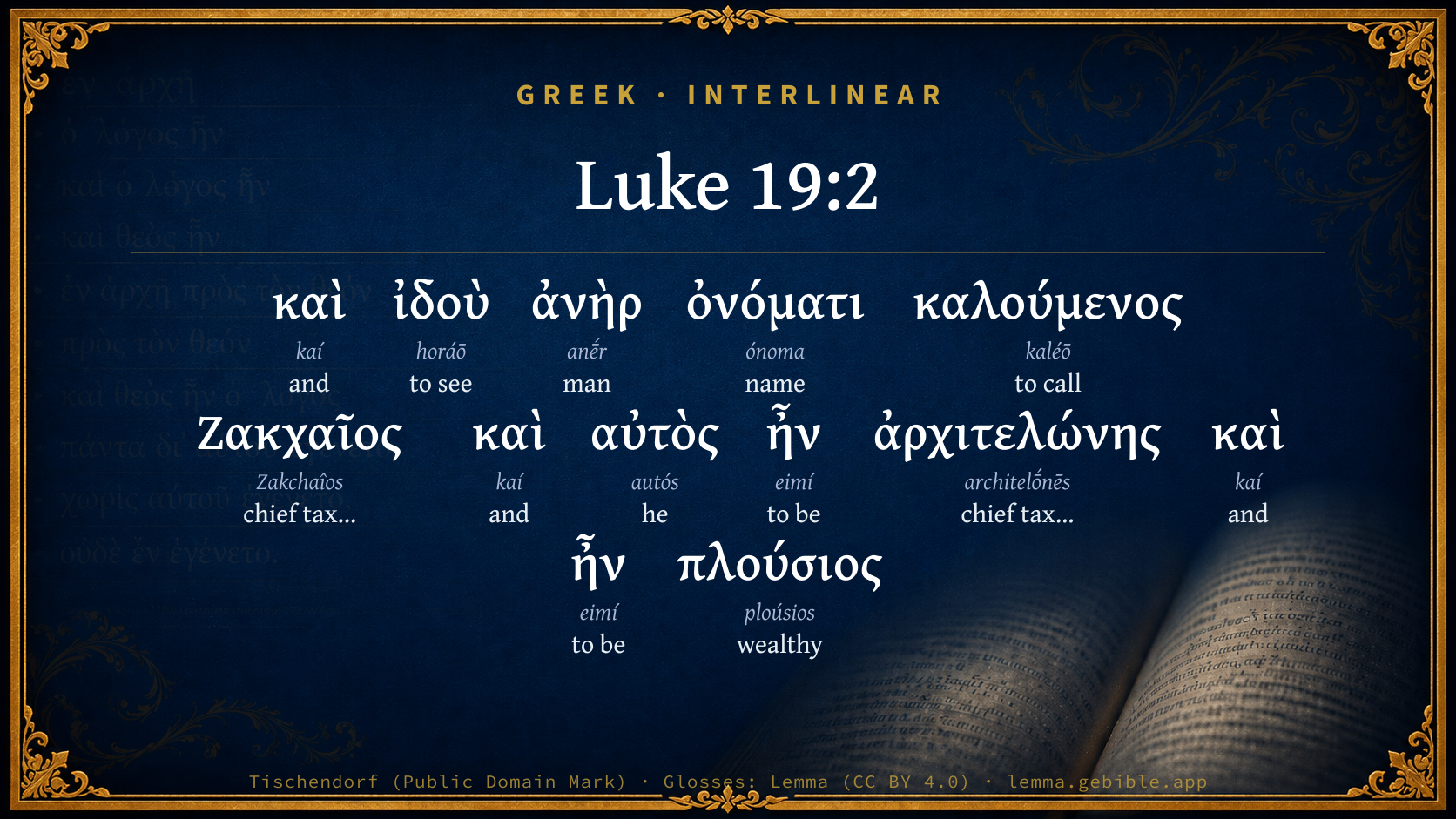
Greek (Tischendorf 8th ed.) Luke 19:2 appears in the Greek New Testament. The text above is from the Tischendorf 8th edition. Each word links to its Strong’s number and a concise gloss. Click any word for its full Thayer’s Greek Lexicon entry.
Download image
Cite this verse

Luke 19:2 (World English Bible). Public Domain. Lemma interlinear Bible study tool, https://lemma.gebible.app/v/luke/19/2.

Show BibTeX & RIS
BibTeX
RIS
English Translation
There was a man named Zacchaeus. He was a chief tax collector, and he was rich.
World English Bible · Public Domain
Highlights
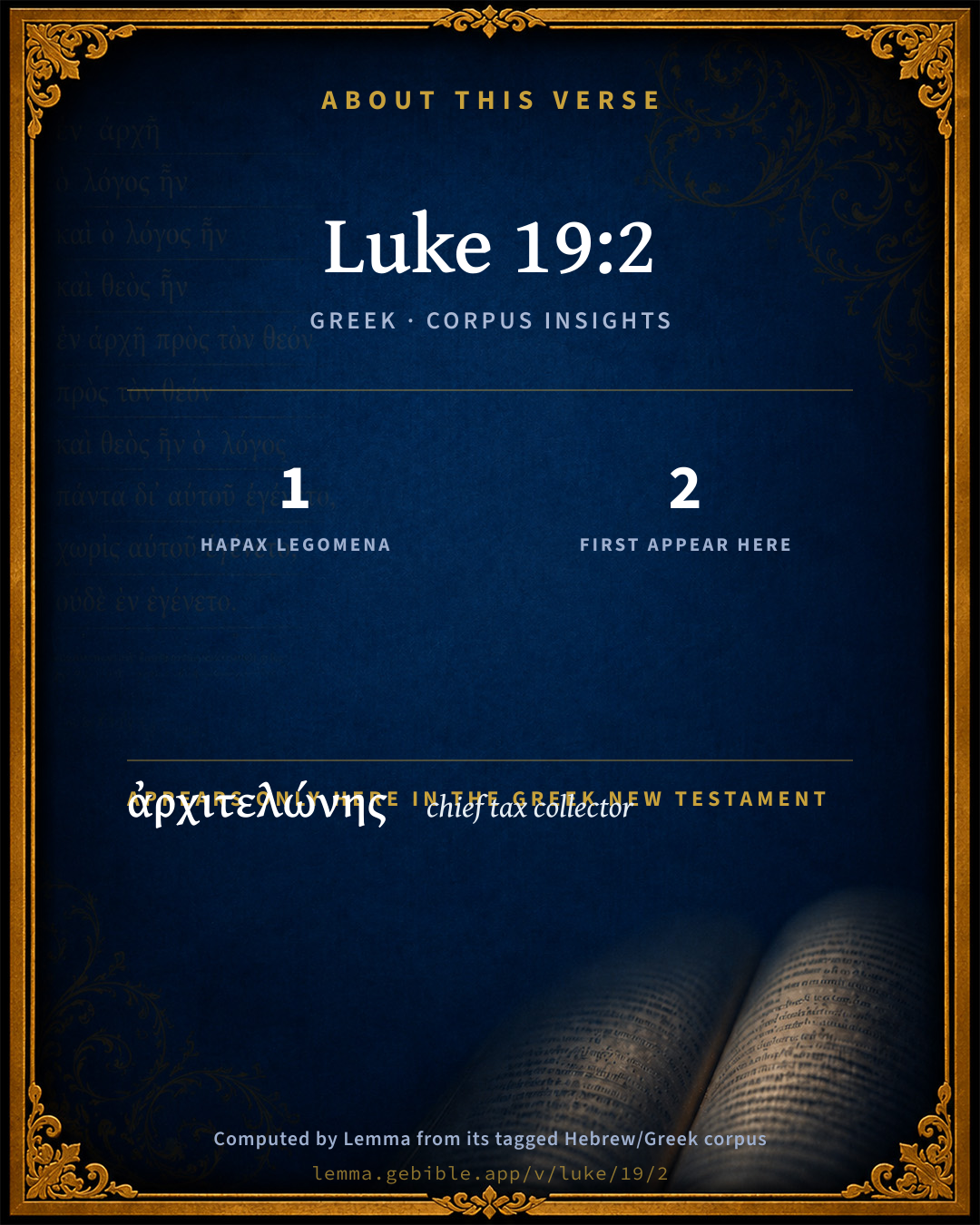
  • 1 hapax legomenon — only here in the Greek New Testament
  • 2 first appearances in the Greek New Testament
Full analysis ↓
Download a study sheet

One document with this verse’s original text, its word-by-word gloss line, the meaning frame, cross-references with their text, attributed commentary, and full source and license credits — printable, and it pastes into notes with its structure intact.

This verse Autodidact and up

Study sheet (.html) Plain text (.txt)

A passage Seminary Student

Up to 50 verses in one chapter. A passage sheet keeps up to 6 commentary sources and 12 cross-references per verse, in the order this page ranks them, and says so on the sheet whenever that leaves anything out. Ask for a single verse and you get the Autodidact verse sheet above.

Everything on this page stays free to read, with no account — the sheet is a download of what is already on screen, not access to it.

Want to remove ads? Support Godless Engineer
Compare translations 3

The same verse in 3 English versions, stacked beneath the original-language interlinear above. Click any original word for its lexicon entry.

Each is an independent rendering of the whole verse — the interlinear is not word-aligned to these translations.

Highlighted words mark where these versions differ — a whole-verse word diff, not a word-by-word alignment.

  • World English Bible Public Domain
    There was a man named Zacchaeus. He was a chief tax collector, and he was rich.
  • King James Version Public Domain
    And, behold, there was a man named Zacchaeus, which was the chief among the publicans, and he was rich.
  • unfoldingWord Literal Text CC BY-SA 4.0
    And behold a man, called Zacchaeus by name, and he was a chief tax collector, and he rich.

unfoldingWord Literal Text — © unfoldingWord, licensed CC BY-SA 4.0. Word-aligned USFM3 via Door43 (git.door43.org/unfoldingWord/en_ult).

Versions to compare (up to 4)

3 of 4 selected

Show all 19 translations

Every available English version of this verse, each an independent rendering of the whole verse.

  • World English Bible Public Domain
    There was a man named Zacchaeus. He was a chief tax collector, and he was rich.
  • Berean Standard Bible Public Domain
    And there was a man named Zacchaeus, a chief tax collector, who was very wealthy.
  • Majority Standard Bible Public Domain
    And there was a man named Zacchaeus, a chief tax collector, who was very wealthy.
  • King James Version Public Domain
    And, behold, there was a man named Zacchaeus, which was the chief among the publicans, and he was rich.
  • American Standard Version (1901) Public Domain
    And behold, a man called by name Zacchaeus; and he was a chief publican, and he was rich.
  • Revised Version (1885) Public Domain
    And behold, a man called by name Zacchaeus; and he was a chief publican, and he was rich.
  • Geneva Bible (1599) Public Domain
    Beholde, there was a man named Zaccheus, which was the chiefe receiuer of the tribute, and he was riche.
  • Douay-Rheims (1899) Public Domain
    And behold, there was a man named Zacheus, who was the chief of the publicans, and he was rich.
  • Young's Literal Translation Public Domain
    and lo, a man, by name called Zaccheus, and he was a chief tax-gatherer, and he was rich,
  • Literal Standard Version CC BY-SA 4.0
    and behold, a man, by name called Zaccheus, and he was a chief tax collector, and he was rich,
  • Unlocked Literal Bible CC BY-SA 4.0
    Behold, there was a man there named Zacchaeus. He was a chief tax collector and was rich.
  • unfoldingWord Literal Text CC BY-SA 4.0
    And behold a man, called Zacchaeus by name, and he was a chief tax collector, and he rich.
  • Darby Bible Public Domain
    And behold, [there was] a man by name called Zacchaeus, and he was chief tax-gatherer, and he was rich.
  • World Messianic Bible Public Domain
    There was a man named Zacchaeus. He was a chief tax collector, and he was rich.
  • Webster's Bible Public Domain
    And behold, there was a man named Zaccheus, who was the chief among the publicans, and he was rich.
  • Free Bible Version CC BY-SA 4.0
    A man was there named Zacchaeus, a chief tax collector. He was very rich.
  • Bible in Basic English Public Domain
    A man, named Zacchaeus, who was the chief tax-farmer, and a man of wealth,
  • Text-Critical English NT CC BY 4.0
    And behold, there was a man named Zacchaeus. He was a chief tax collector and was rich.
  • Tyndale New Testament (1534) Public Domain
    And beholde ther was a man named Zacheus which was a ruler amonge the Publicans and was riche also.

Literal Standard Version (2020), Covenant Press — licensed CC BY-SA 4.0. Text via the HelloAO Bible API (eBible.org). Unlocked Literal Bible (unfoldingWord) — licensed CC BY-SA 4.0. Text via the HelloAO Bible API (eBible.org). unfoldingWord Literal Text — © unfoldingWord, licensed CC BY-SA 4.0. Word-aligned USFM3 via Door43 (git.door43.org/unfoldingWord/en_ult). Free Bible Version, Dr. Jonathan Gallagher — licensed CC BY-SA 4.0. Text via the HelloAO Bible API (eBible.org).

Word by word

More ways to search: Search by grammar → Find every occurrence → Compare this word →

Practice this passage: Drill this verse → Learn its vocabulary →

ἀρχιτελώνης
architelṓnēs
G754
“chief tax collector”
Noun, Nominative, Singular, Masculine
Part of Speech
Noun
Case
Nominative
Number
Singular
Gender
Masculine
Full Thayer's Definition

Origin: from G746 and G5057

TDNT: None

1. a chief of tax collectors, chief publican
  1. καὶ kaí G2532 “and” Conjunction
  2. ἰδοὺ horáō G3708 “to see” Verb, Aorist, Middle, Imperative, 2nd person, Singular
  3. ἀνὴρ anḗr G435 “man” Noun, Nominative, Singular, Masculine
  4. ὀνόματι ónoma G3686 “name” Noun, Dative, Singular, Neuter
  5. καλούμενος kaléō G2564 “to call” Verb, Present, Passive, Participle, Nominative, Singular, Masculine
  6. Ζακχαῖος Zakchaîos G2195 “chief tax collector” Noun, Nominative, Singular, Masculine
  7. καὶ kaí G2532 “and” Conjunction
  8. αὐτὸς autós G846 “he” Personal pronoun, Nominative, Singular, Masculine
  9. ἦν eimí G1510 “to be” Verb, Imperfect, Active, Indicative, 3rd person, Singular
  10. καὶ kaí G2532 “and” Conjunction
  11. ἦν eimí G1510 “to be” Verb, Imperfect, Active, Indicative, 3rd person, Singular
  12. πλούσιος ploúsios G4145 “wealthy” Adjective, Nominative, Singular, Masculine

About this verse

These counts appear in no published source. They are computed here, from the morphology-tagged text and Lemma’s own curated glosses. What Lemma adds →

13
words
10
distinct lemmas
Gospels
section

Notable vocabulary

1 hapax legomenon — a word that appears only here in the entire Greek New Testament:

  • ἀρχιτελώνης chief tax collector G754

First appearance in Scripture

These words make their first canonical appearance in the Greek New Testament here:

  • Ζακχαῖος chief tax collector G2195
  • ἀρχιτελώνης chief tax collector G754

Shared distinctive vocabulary

Ζακχαῖος chief tax collector G2195 occurs in 3 verses of the Greek New Testament. Also found in:
Repetition

Words recur within this verse:

Cross-references

1

Topical passages linked to Luke 19:2 in the Treasury of Scripture Knowledge — connected by theme and wording, ordered by reader-vote popularity; previews shown in the World English Bible.

  • Luke 18:24–27 Jesus, seeing that he became very sad, said, "How hard it is for those who have riches to enter into the Kingdom of God!

Cross-references courtesy of OpenBible.info (CC BY 4.0).

Commentary

Notes on Luke 19:2 from classic Christian and Jewish commentators (each source and its license shown beneath its notes). The classic Christian expositions comment on the surrounding passage and are grouped to its opening verse, so a note may address several verses; the Jewish commentaries on the Tanakh (Rashi and others) are per-verse, so they appear only where the commentator wrote on this verse.

Lemma curates 59 commentaries, every one of them public domain or Creative Commons licensed, each selected and text-cleaned for this edition rather than reprinted as found. About our sources →

Tyndale Open Study Notes

Tyndale Open Resources

19:2 The chief tax collector for a particular region leased from the Romans the right to collect taxes, and then oversaw subordinate tax collectors from whom he collected a commission. This situation allowed Zacchaeus to get very rich, and chief tax collectors were hated even more than their subordinates (see study note on 3:12).

Tyndale Open Study Notes — © Tyndale Open Resources, licensed CC BY-SA 4.0. Text via the HelloAO Bible API.

Bengel's Gnomon

Johann Albrecht Bengel

Luk 19:2. Ἀρχιτελώνης, a chief among the publicans) A person very high in position among people of his own class; and one whose example, in being converted, it is probable that many followed.—πλούσιος, rich) Through this rich man’s example the evil[204] is remedied, which another rich man had caused by his example: ch. Luk 18:23.

[204] The confusion of ideas, whereby many might think riches presented an insuperable barrier to entrance into heaven: see ch. Luk 18:26-27. Therefore Beng. uses the expression turbârat in the following clause: “Quod exemplum suo turbârat dives alius.”—E. and T.

Bengel's Gnomon of the New Testament — English translation (T&T Clark, Edinburgh, 1860) — public domain. Text from a community e-Sword module.

Geneva Bible (1599)

Geneva Bible translators

The overseer and head of the Publicans which were there together: for the Publicans were divided into companies: as we may gather by many places of Cicero his orations.

Geneva Bible (1599) marginal notes — public domain. Text via Bolls.life.

Adam Clarke's Commentary

Verse 2. Zaccheus] It is not unlikely that this person was a Jew by birth, see Lu 19:9; but because he had engaged in a business so infamous, in the eyes of the Jews, he was considered as a mere heathen, Lu 19:7.

Chief among the publicans] Either a farmer-general of the taxes, who had subordinate collectors under him: or else the most respectable and honourable man among that class at Jericho.

He was rich.] And therefore the more unlikely to pay attention to an impoverished Messiah, preaching a doctrine of universal mortification and self-denial.

Adam Clarke's Commentary on the Bible (1810–1826) — public domain. Text from a community e-Sword/MySword module.

Ellicott's Commentary for English Readers

(2) There was a man named Zacchæus, . . .—The name appears in the Old Testament in the form Zaccai (Ezr_2:9; Neh_7:14), and meant “pure” or “innocent.” Rabbinic writers mention a Zacchæus as living at Jericho about this time, the father of a famous Rabbi, Jochanan or John.

The chief among the publicans.—The position of Jericho near the fords of the Jordan made it a natural trade-centre for the imports from the Gilead country—myrrh and balsam. Under the government of Herod and Archelaus it had become once more a city of palm-trees (Jdg_1:16), and their dates and palm-honey were probably liable to an octroi duty. The “farming” system adopted in the Roman revenue probably gave Zacchæus the status of a middle-man or sub-contractor between the great capitalists of the equestrian order at Rome, the real publicani, and the “publicans” commonly so called, who were the actual collectors. As such he had as abundant opportunities for enriching himself as a Turkish pacha, and, as we may infer from his own words, had probably not altogether escaped the temptations of his calling.

A Bible Commentary for English Readers, edited by Charles John Ellicott (1878–1897) — public domain. Text from a community e-Sword module.

The Cambridge Bible for Schools and Colleges

gen. ed. J. J. S. Perowne

2. behold] The style of this chapter shews that St Luke is using a document of Aramaic origin.

a man named Zaccheus] Zakkai means ‘pure.’ Ezr_2:9; Neh_7:14; Jos. Vit. 46. There is a Zakkai in the Talmud, father of the famous Rabbi Jochanan, and he also lived at Jericho.

the chief among the publicans] Rather, a chief tax-gatherer. He may even have risen as some Jews did, from the subordinate rank of the portitores to that of publicanus (Jos. B. J. ii. 14, § 9). Priests (see on Luk_10:31) and publicans—the latter employed to regulate the balsam- duties, and the exports and imports between the domains of the Romans and of Antipas—were the chief classes at Jericho (Jos. Antt. xiv. 4, § 1, xv. 4, § 2; Justin Hist. vi. 3).

The Cambridge Bible for Schools and Colleges (gen. ed. J. J. S. Perowne; Cambridge University Press, 1878–1918) — public domain. Text from a community e-Sword module.

John Gill's Exposition

And he sought to see Jesus who he was,.... What sort of a person he was for complexion, stature, and age: having heard much of him, he was very desirous of indulging his curiosity with a sight of him; having, as yet, nothing else that induced him to desire to see him: his desire to see Jesus was not of the same kind with the kings and prophets, Mat 13:16 but rather like that of Herod, Luk 23:8

and could not for the press; the multitude of people that were flocking to meet Jesus, or who came before him, or were about him; for one part of the multitude went before him, and the other followed after him; so that he was in the crowd, and therefore could not easily be seen;

because he was little of stature. The Syriac and Persic versions read, "because Zacchaeus was little of stature", lest it should be thought that this is said of Jesus; for the reason why Zacchaeus could not see him for the crowd, was not because Christ was little of stature, and was hid among them, but because Zacchaeus was little of stature, and could not see over their heads.

John Gill's Exposition of the Whole Bible (1746–1763) — public domain (CC PDM 1.0). Text via the HelloAO Bible API.

Trapp's Complete Commentary

John Trapp

2 And, behold, there was a man named Zacchaeus, which was the chief among the publicans, and he was rich.

Ver. 2. And behold] This "behold" one compareth to a hand in the margin of a book, pointing to some notable matter. Another, to me sounding of a trumpet before some proclamation.

There was a man named Zacchaeus] He should by his name have been a puritan (in the best sense), but, he was an arch-publican, a public sinner, not simple, but subtle, a griping extortioner, a rich but wretched sycophant. {a}

{a} An informer, tale-bearer, malicious accuser; a calumniator, traducer, slanderer. Obs. ŒD

John Trapp, A Commentary or Exposition upon All the Books of the Old and New Testament (1647–1656) — public domain. Text from a community e-Sword module.

Albert Barnes' Notes on the Bible

A man named Zacchaeus - The name Zacchaeus is Hebrew, and shows that this man was a “Jew.” The Hebrew name properly means “pure,” and is the same as Zacchai in Ezr 2:9; Neh 7:14. The publicans, therefore, were not all foreigners.

Chief among the publicans - Who presided over other tax-gatherers, or who “received” their collections and transmitted them to the Roman government.

He was rich - Though this class of people was despised and often infamous, yet it seems that they were sometimes wealthy. They sustained, however, the general character of “sinners,” because they were particularly odious in the eyes of the Jews. See Luk 19:7. The evangelist has thought it worthy of record that he was rich, perhaps, because it was so unlikely that a “rich man” should follow so poor and despised a personage as Jesus of Nazareth, and because it was so unusual a thing during his personal ministry. Not many rich were called, but God chiefly chose the poor of this world Compare 1Co 1:26-29.

Albert Barnes' Notes on the Bible (1834–1885) — public domain. Text from a community e-Sword/MySword module.

Haydock's Catholic Bible Commentary

What sinner can despair when he sees the Saviour of mankind seeking to save him; when he beholds even a publican and a rich man, at the same time, who, as our Saviour informs us in another place, are so seldom truly converted, brought to the light of faith, and the grace of a true conversion! (St. Ambrose) --- Zacheus (who as a farmer of the customs, not a collector, as some falsely imagine) immediately hearkened to the interior voice of the Almighty, calling him to repentance; he made no delay, and therefore deserved immediately not only to see, but to eat, drink, and converse with Jesus. (St. Cyril) --- Behold here the three steps of his conversion: 1. an ardent desire of seeing Jesus; 2. the honourable reception he gave him in his house; 3. the complete restitution of all ill-acquired property.

George Leo Haydock (1774–1849), Haydock's Catholic Family Bible and Commentary, 1859 edition — public domain. Excludes Psalms (Douay-Rheims chapter numbering differs from Protestant) and Deuterocanonical books (Catholic canon only).

Matthew Poole's English Annotations

We have had frequent occasions to hint, that the publicans were the gatherers of the public revenue for the Romans. Amongst them there was an order of superior and inferior officers: Zacchaeus was the chief of them that were in that commission.

And he was rich; which is not to be wondered at, considering his employment; and is particularly mentioned doubtless to magnify the grace of God towards him, of which we shall by and by hear more; as well as to let us know, that though it be a hard thing for a rich man to be saved, yet with God it is possible, as we heard before, as, that though publicans were most of them rapacious and exceedingly given to extortion, and the love of money commonly increaseth with the increase of men’s estate, yet Christ can change the heart of such a man, and work it into a contempt of riches, and into a freedom to part with them at the command of Christ, or where they hinder the embraces of him.

Matthew Poole's English Annotations on the Holy Bible (1683–1685) — public domain. Text from a community e-Sword/MySword module.

Whedon's Commentary on the Bible

Daniel D. Whedon

2. A man named Zaccheus—His name signifies pure; and being Hebrew, indicates that he was not, as some suppose, a heathen, but a Jew. The name in the Apocrypha belongs to one of the soldiers of Maccabaeus. Macc.

Luk_10:19.

Chief among the publicans—The office of tax collector for extensive provinces was by the Romans generally conferred upon a person of the order of the knighthood. It was therefore a high dignity, and generally confined to Romans alone. But as in some cases, according to Josephus, Jews received the appointment, that may have been the rank of Zaccheus. Otherwise he was an agent for the receiver general; collecting the taxes and transmitting them to him, over a large district, with inferior tax gatherers under him.

He was rich—Yet how unlike the rich man in Luk_16:19 he proved to be.

Daniel D. Whedon (gen. ed.), Commentary on the Old and New Testaments (1874–1909) — public domain. Text from a community e-Sword module.

John Wesley's Explanatory Notes

The chief of the publicans - What we would term, commissioner of the customs. A very honourable as well as profitable place.

John Wesley, Explanatory Notes Upon the Whole Bible (1754–1765) — public domain. Text via the GEBible commentary corpus.

The People's New Testament

B. W. Johnson

2. Zacchæus, … chief among the publicans. The importance of Jericho and its situation would make it an important center for the collection of the Roman tribute. At the head of the publicans engaged in this business was Zacchæus. He seems to have had supervision of the district. He was rich. A very suspicious fact in a member of a class noted for their extortion.

B. W. Johnson's The People's New Testament with Notes (1889–1891) — public domain. Electronic text from the Christian Classics Ethereal Library (CCEL) ThML edition.

Cambridge Greek Testament for Schools and Colleges

2. καὶ ἰδού. The style of this chapter shews that St Luke is using a document of Aramaic origin.

ὀνόματι καλούμενος. The more classic phrase would have been ὄνομα καλ.

Ζακχαῖος. Zakkai means ‘pure.’ Ezr 2:9; Neh 7:14; Jos. Vit. 46. There is a Zakkai in the Talmud, father of the famous Rabbi Jochanan, and he also lived at Jericho. The name shews that he was a Jew, and not as some have fancied a Gentile. Nothing is known of him, though the Clementines make him bishop of Caesarea (Hom. III. 63, Recogn. III. 65, Meyer).

αὐτὸς ἦν ἀρχιτελώνης. He was by position a chief tax-gatherer. For this use of αὐτὸς comp. Luk 8:41. He may even have risen as some Jews did, from the subordinate rank of the portitores to that of publicanus (Jos. B. J. II. 14, § 9). Priests (see on Luk 10:31) and publicans—the latter employed to regulate the balsam-duties, and the exports and imports between the domains of the Romans and of Antipas—were the chief classes at Jericho (Jos. Antt. XIV. 4, § 1, XV. 4, § 2; Justin Hist. VI. 3).

Cambridge Greek Testament for Schools and Colleges (Cambridge University Press, 1896; 21 vols, various authors incl. Carr, Maclear, Plummer, Farrar, Lumby, Moule, M. R. James, Simcox) — public domain. Text from a community e-Sword module.

Alford’s Greek Testament

Henry Alford

2.] Ζακχαῖος = זַכַּי, ‘pure,’ Ezr 2:9: Neh 7:14; also found in the Rabbinical writings, see Lightfoot. He was not a Gentile, as Tertullian supposed, (contr. Marc. iv. 37, vol. ii. p. 451,) but a Jew, see ver. 9.

ἀρχιτ.] Probably an administrator of the revenue derived from balsam, which was produced in abundance in the neighbourhood.

Henry Alford, The Greek Testament (1849–1861) — public domain. Text from a community e-Sword module.

International Critical Commentary

2. ὀνόματι καλούμενος Ζακχαῖος. For the dat. comp. 1:61. The name, which means “pure,” shows him to have been a Jew: Ezr 2:9; Neh 7:14. Tertullian says, Zacchæus, etsi allophylus, fortasse tamen aliqua notitia scripturarum ex commercio Judaico afflatus (Adv. Marcion. 4:37, 1). But the Jews murmured because Jesus lodged with a man that was a sinner. They would have said a heathen, if it had been true. See below on ver. 9. The Clementines make Zacchæus a companion of Peter, who appoints him, much against his wish, to be bishop of Cæsarea (Hom. 3:63; Recog. 3:66); and be Apost. Const. say that he was succeeded by Cornelius (7:46). Clem. Alex. says he was identified with Matthias (Strom. 4:6. p. 579). The Talmud mentions a Zacchæus who lived at Jericho and was father of the celebrated Rabbi Jochanan. He might be of the same family as this Zacchæus. The use of ἀνήρ here (comp. 1:27, 8:41, 23:50) rather than ἄνθρωπος (comp. 2:25, 6:6) perhaps is no mark of dignity: see ver. 7.

καὶ αὐτὸς ἧν ἀρχιτελώνης καὶ αὐτὸς πλούσιος. Note the double καὶ αὐτός, and see on 5:14 and 6:20.

The second καὶ αὐτός (B K U Π, Vulg.) is doubtful: om. D, d e; καὶ οὗτος ἧν (A Q R); καὶ ἦν (א L, Boh. Goth.). The last may be right.

ἀρχιτελώνης. This is evidently an official title, and means more than that Zacchæus was a very rich tax-collector (Didon). Had that been the meaning, we should have ὅτι or γάρ instead of καί. Perhaps we may render, “Commissioner of Taxes.” The word occurs nowhere else, and the precise nature of the office not be ascertained. Probably he was intermediate between the portitores and the publicani, and by the Romans would have been called magister. Jericho, as a large frontier city, through which much of the carrying trade passed, and which had a large local trade in costly balsams, would be a likely place for a commissioner of taxes. This is the sixth notice of the tax-collectors, all favourable, in this Gospel (3:12, 5:27, 7:29, 15:1, 18:10).

International Critical Commentary — older volumes (1896–1929), various authors — public domain. Text from a community e-Sword module.

Vincent's Word Studies in the New Testament

Marvin R. Vincent

Named [ονοματι καλουμενος] . Lit., called by name. Compare ch. 1 61.

Zacchaeus. Saccai, "the just."

Marvin R. Vincent, Word Studies in the New Testament (1887–1900) — public domain. Text from a community e-Sword/MySword module.

Lesson kit

Teaching starters — assembled from the data on this page, not authored interpretation. Every prompt links to the verse data it draws on. Edit before teaching.

Luke, in the Gospels, opens this verse with 13 words (10 distinct Greek lemmas). Its most distinctive word is architelṓnēs (“chief tax collector”). A historical commentator’s framing appears above. Read the whole chapter for the surrounding context.

Discussion questions

  1. How does “chief tax collector” (architelṓnēs) shape what this verse is saying?
  2. 1 word here appears nowhere else in the Greek New Testament. Why might the author reach for such rare wording?
  3. 2 words make their first appearance in Scripture here. What does this debut establish?
  4. How does Luke 19:5, which shares the word «chief tax collector», read alongside this verse?
  5. What does the repetition of “to be” (2× in this one verse) do in this verse?
  6. These translations render this verse differently; the difference is in the English rendering, not the original. What questions does that raise?
  7. Compare how Tyndale Open Study Notes and Bengel's Gnomon read this verse. Where do they agree or differ?

Things to notice

  • 1 word in this verse appears nowhere else in the Greek New Testament.
  • 2 words make their first canonical appearance in Scripture here.
  • These translations choose different wording for 10 words in this verse.
  • “to be” occurs 2× in this single verse.
  • 10 distinct Greek lemmas span 13 words in this verse.

Reading settings

Reading text

Shown beneath each verse's original-language words.

Old Testament
Old Testament edition

Read the OT as the Masoretic Hebrew (MT) or the Greek Septuagint (LXX).

English shown for the Greek Septuagint (in the Hebrew ↔ Greek comparison).

Comparing translations? Open the Compare panel on any verse page to stack up to four side by side.