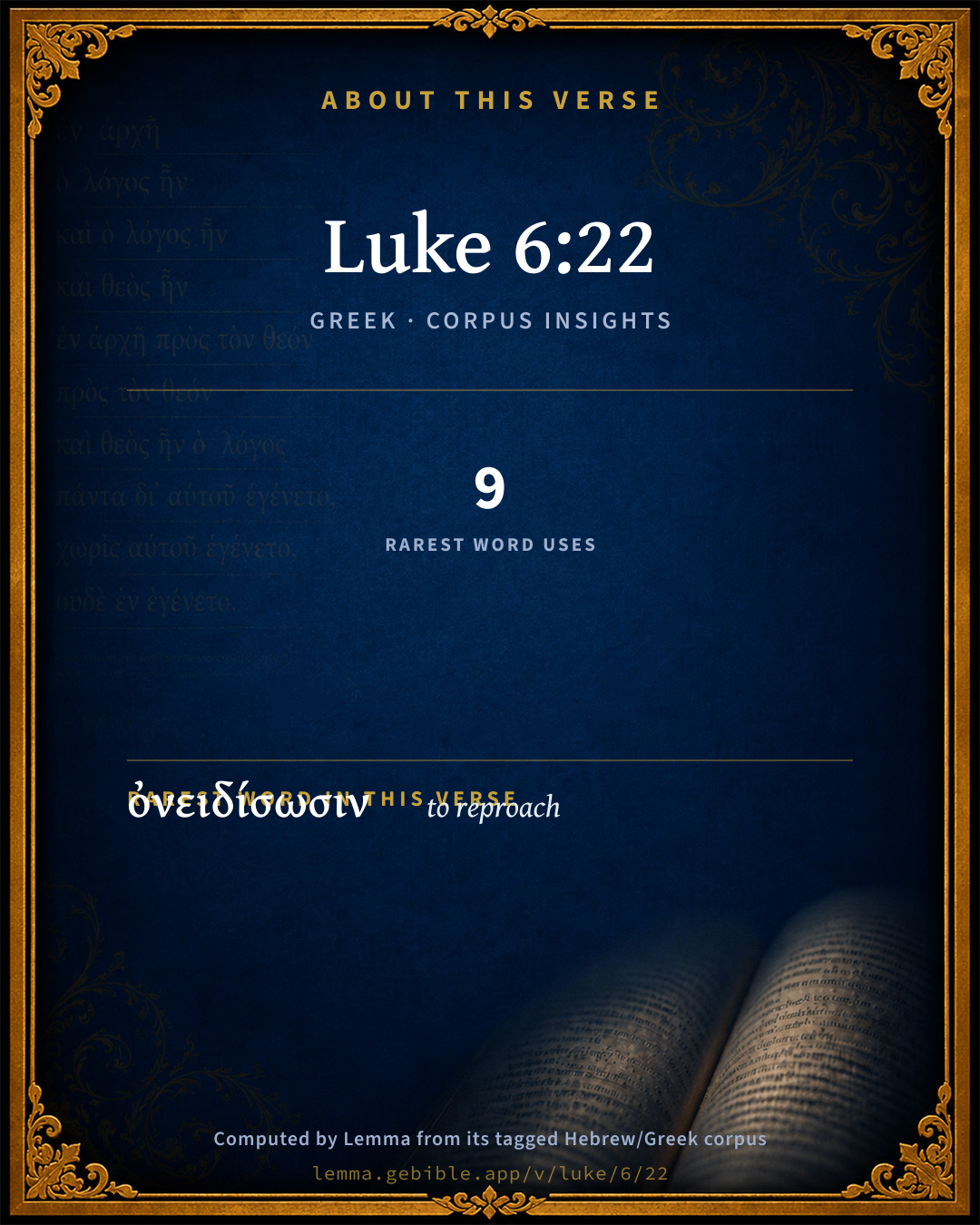
Luke 6:22

Greek (Tischendorf 8th ed.) Luke 6:22 appears in the Greek New Testament. The text above is from the Tischendorf 8th edition. Each word links to its Strong’s number and a concise gloss. Click any word for its full Thayer’s Greek Lexicon entry.
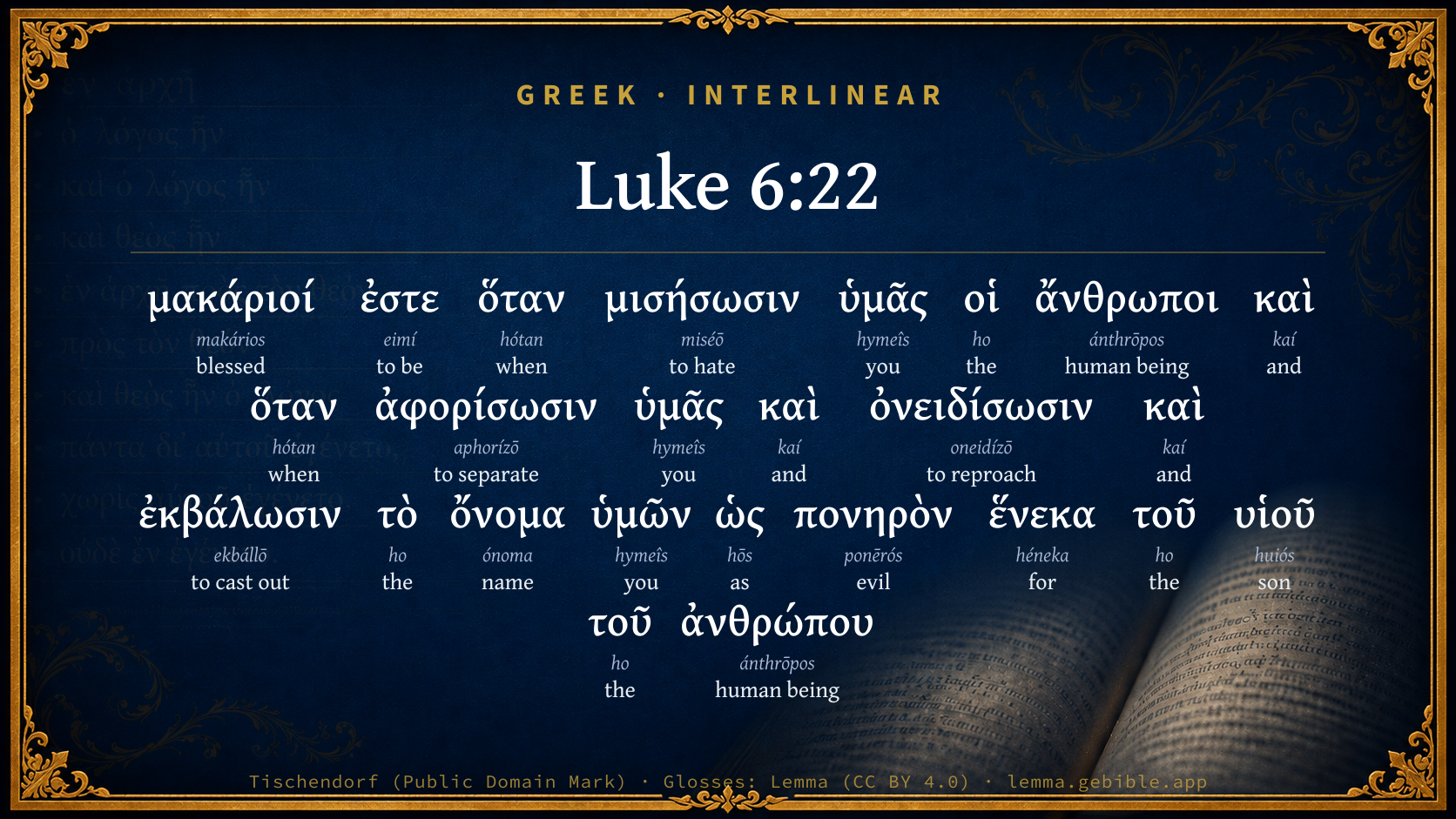
Download image
Cite this verse

Luke 6:22 (World English Bible). Public Domain. Lemma interlinear Bible study tool, https://lemma.gebible.app/v/luke/6/22.

Show BibTeX & RIS
BibTeX
RIS
English Translation
Blessed are you when men shall hate you, and when they shall exclude and mock you, and throw out your name as evil, for the Son of Man's sake.
World English Bible · Public Domain
Download a study sheet

One document with this verse’s original text, its word-by-word gloss line, the meaning frame, cross-references with their text, attributed commentary, and full source and license credits — printable, and it pastes into notes with its structure intact.

This verse Autodidact and up

Study sheet (.html) Plain text (.txt)

A passage Seminary Student

Up to 50 verses in one chapter. A passage sheet keeps up to 6 commentary sources and 12 cross-references per verse, in the order this page ranks them, and says so on the sheet whenever that leaves anything out. Ask for a single verse and you get the Autodidact verse sheet above.

Everything on this page stays free to read, with no account — the sheet is a download of what is already on screen, not access to it.

Want to remove ads? Support Godless Engineer
Compare translations 3

The same verse in 3 English versions, stacked beneath the original-language interlinear above. Click any original word for its lexicon entry.

Each is an independent rendering of the whole verse — the interlinear is not word-aligned to these translations.

Highlighted words mark where these versions differ — a whole-verse word diff, not a word-by-word alignment.

  • World English Bible Public Domain
    Blessed are you when men shall hate you, and when they shall exclude and mock you, and throw out your name as evil, for the Son of Man's sake.
  • King James Version Public Domain
    Blessed are ye, when men shall hate you, and when they shall separate you from their company, and shall reproach you, and cast out your name as evil, for the Son of man's sake.
  • unfoldingWord Literal Text CC BY-SA 4.0
    Blessed are you when men hate you, and when they exclude you and insult you and reject your name as evil because of the Son of Man.

unfoldingWord Literal Text — © unfoldingWord, licensed CC BY-SA 4.0. Word-aligned USFM3 via Door43 (git.door43.org/unfoldingWord/en_ult).

Versions to compare (up to 4)

3 of 4 selected

Show all 19 translations

Every available English version of this verse, each an independent rendering of the whole verse.

  • World English Bible Public Domain
    Blessed are you when men shall hate you, and when they shall exclude and mock you, and throw out your name as evil, for the Son of Man's sake.
  • Berean Standard Bible Public Domain
    Blessed are you when people hate you, and when they exclude you and insult you and reject your name as evil because of the Son of Man.
  • Majority Standard Bible Public Domain
    Blessed are you when people hate you, and when they exclude you and insult you and reject your name as evil because of the Son of Man.
  • King James Version Public Domain
    Blessed are ye, when men shall hate you, and when they shall separate you from their company, and shall reproach you, and cast out your name as evil, for the Son of man's sake.
  • American Standard Version (1901) Public Domain
    Blessed are ye, when men shall hate you, and when they shall separate you `from their company', and reproach you, and cast out your name as evil, for the Son of man's sake.
  • Revised Version (1885) Public Domain
    Blessed are ye, when men shall hate you, and when they shall separate you from their company, and reproach you, and cast out your name as evil, for the Son of man’s sake.
  • Geneva Bible (1599) Public Domain
    Blessed are ye when men hate you, and when they separate you, and reuile you, and put out your name as euill, for the Sonne of mans sake.
  • Douay-Rheims (1899) Public Domain
    Blessed shall you be when men shall hate you, and when they shall separate you, and shall reproach you, and cast out your name as evil, for the Son of man's sake.
  • Young's Literal Translation Public Domain
    `Happy are ye when men shall hate you, and when they shall separate you, and shall reproach, and shall cast forth your name as evil, for the Son of Man's sake --
  • Literal Standard Version CC BY-SA 4.0
    Blessed are you when men will hate you, and when they will separate you, and will reproach, and will cast forth your name as evil, for the Son of Man’s sake—
  • Unlocked Literal Bible CC BY-SA 4.0
    Blessed are you when people hate you, and when they exclude you and insult you and reject your name as evil, because of the Son of Man.
  • unfoldingWord Literal Text CC BY-SA 4.0
    Blessed are you when men hate you, and when they exclude you and insult you and reject your name as evil because of the Son of Man.
  • Darby Bible Public Domain
    Blessed are ye when men shall hate you, and when they shall separate you [from them], and shall reproach [you], and cast out your name as wicked, for the Son of man's sake:
  • World Messianic Bible Public Domain
    Blessed are you when men hate you, and when they exclude and mock you, and throw out your name as evil, for the Son of Man’s sake.
  • Webster's Bible Public Domain
    Blessed are ye when men shall hate you, and when they shall separate you from their company, and shall reproach you, and cast out your name as evil, on account of the son of man.
  • Free Bible Version CC BY-SA 4.0
    How happy are you when people hate you, exclude you, insult you, and curse your name as evil because of me, the Son of man.
  • Bible in Basic English Public Domain
    Happy are you, when men have hate for you, and put you away from among them and say angry words to you, turning away in disgust at your name, because of the Son of man.
  • Text-Critical English NT CC BY 4.0
    Blessed are you when others hate you, when they exclude you, reproach you, and spurn your name as evil on account of the Son of Man.
  • Tyndale New Testament (1534) Public Domain
    Blessed are ye that wepe now: for ye shall laugh. Blessed are ye when men hate you and thrust you oute of their companye and rayle and abhorre youre name as an evyll thinge for the sonne of manes sake.

Literal Standard Version (2020), Covenant Press — licensed CC BY-SA 4.0. Text via the HelloAO Bible API (eBible.org). Unlocked Literal Bible (unfoldingWord) — licensed CC BY-SA 4.0. Text via the HelloAO Bible API (eBible.org). unfoldingWord Literal Text — © unfoldingWord, licensed CC BY-SA 4.0. Word-aligned USFM3 via Door43 (git.door43.org/unfoldingWord/en_ult). Free Bible Version, Dr. Jonathan Gallagher — licensed CC BY-SA 4.0. Text via the HelloAO Bible API (eBible.org).

Word by word

More ways to search: Search by grammar → Find every occurrence → Compare this word →

Practice this passage: Drill this verse → Learn its vocabulary →

ὀνειδίσωσιν
oneidízō
G3679
“to reproach”
Verb, Aorist, Active, Subjunctive, 3rd person, Plural
Part of Speech
Verb
Tense
Aorist
Voice
Active
Mood
Subjunctive
Person
3rd person
Number
Plural
Full Thayer's Definition

Origin: from G3681

TDNT: 08:59,7

1. to reproach, upbraid, revile a. of deserved reproach b. of undeserved reproach, to revile c. to upbraid, cast (favours received) in one's teeth
  1. μακάριοί makários G3107 “blessed” Adjective, Nominative, Plural, Masculine
  2. ἐστε eimí G1510 “to be” Verb, Present, Active, Indicative, 2nd person, Plural
  3. ὅταν hótan G3752 “when” Conjunction
  4. μισήσωσιν miséō G3404 “to hate” Verb, Aorist, Active, Subjunctive, 3rd person, Plural
  5. ὑμᾶς hymeîs G5210 “you” Personal pronoun, 2nd person, Accusative, Plural
  6. οἱ ho G3588 “the” Article, Nominative, Plural, Masculine
  7. ἄνθρωποι ánthrōpos G444 “human being” Noun, Nominative, Plural, Masculine
  8. καὶ kaí G2532 “and” Conjunction
  9. ὅταν hótan G3752 “when” Conjunction
  10. ἀφορίσωσιν aphorízō G873 “to separate” Verb, Aorist, Active, Subjunctive, 3rd person, Plural
  11. ὑμᾶς hymeîs G5210 “you” Personal pronoun, 2nd person, Accusative, Plural
  12. καὶ kaí G2532 “and” Conjunction
  13. καὶ kaí G2532 “and” Conjunction
  14. ἐκβάλωσιν ekbállō G1544 “to cast out” Verb, Aorist, Active, Subjunctive, 3rd person, Plural
  15. τὸ ho G3588 “the” Article, Accusative, Singular, Neuter
  16. ὄνομα ónoma G3686 “name” Noun, Accusative, Singular, Neuter
  17. ὑμῶν hymeîs G5210 “you” Personal pronoun, 2nd person, Genitive, Plural
  18. ὡς hōs G5613 “as” Adverb
  19. πονηρὸν ponērós G4190 “evil” Adjective, Accusative, Singular, Neuter
  20. ἕνεκα héneka G1752 “for” Preposition
  21. τοῦ ho G3588 “the” Article, Genitive, Singular, Masculine
  22. υἱοῦ huiós G5207 “son” Noun, Genitive, Singular, Masculine
  23. τοῦ ho G3588 “the” Article, Genitive, Singular, Masculine
  24. ἀνθρώπου ánthrōpos G444 “human being” Noun, Genitive, Singular, Masculine

About this verse

These counts appear in no published source. They are computed here, from the morphology-tagged text and Lemma’s own curated glosses. What Lemma adds →

25
words
16
distinct lemmas
Gospels
section

Notable vocabulary

The rarest word here is ὀνειδίσωσιν to reproach G3679 — appearing just 9 times in the whole Greek New Testament.

Shared distinctive vocabulary

ὀνειδίσωσιν to reproach G3679 occurs in 9 verses of the Greek New Testament. Also found in:

Repetition

Words recur within this verse:

  • ὅταν when G3752 ×2
  • ἄνθρωποι human being G444 ×2
  • οἱ the G3588 ×4
  • ὑμᾶς you G5210 ×3
  • καὶ and G2532 ×3

Cross-references

27

Topical passages linked to Luke 6:22 in the Treasury of Scripture Knowledge — connected by theme and wording, ordered by reader-vote popularity; previews shown in the World English Bible.

  • Matthew 5:10–12 Blessed are those who have been persecuted for righteousness' sake, For theirs is the Kingdom of Heaven.
  • Matthew 10:22 You will be hated by all men for my name's sake, but he who endures to the end will be saved.
  • 1 Peter 4:12–16 Beloved, don't be astonished at the fiery trial which has come upon you, to test you, as though a strange thing happened to you.
  • 1 Peter 3:14 But even if you should suffer for righteousness' sake, you are blessed. "Don't fear what they fear, neither be troubled."
  • John 16:2 They will put you out of the synagogues. Yes, the time comes that whoever kills you will think that he offers service to God.
  • 1 Thessalonians 2:14–15 For you, brothers, became imitators of the assemblies of God which are in Judea in Christ Jesus; for you also suffered the same things from your own countrymen, even as they did from the Jews;
  • Isaiah 66:5 Hear the word of Yahweh, you who tremble at his word: Your brothers who hate you, who cast you out for my name's sake, have said, Let Yahweh be glorified, that we may see your joy; but it is those who shall be disappointed.
  • John 7:7 The world can't hate you, but it hates me, because I testify about it, that its works are evil.
  • Philippians 1:28–30 and in nothing frightened by the adversaries, which is for them a proof of destruction, but to you of salvation, and that from God.
  • 2 Timothy 3:11–12 persecutions, and sufferings: those things that happened to me at Antioch, Iconium, and Lystra. I endured those persecutions. Out of them all the Lord delivered me.
  • John 12:42 Nevertheless even of the rulers many believed in him, but because of the Pharisees they didn't confess it, so that they wouldn't be put out of the synagogue,
  • Isaiah 65:5 who say, Stand by yourself, don't come near to me, for I am holier than you. These are a smoke in my nose, a fire that burns all the day.
  • Matthew 10:39 He who finds his life will lose it; and he who loses his life for my sake will find it.
  • Mark 13:9–13 But watch yourselves, for they will deliver you up to councils. You will be beaten in synagogues. You will stand before rulers and kings for my sake, for a testimony to them.
  • John 17:14 I have given them your word. The world hated them, because they are not of the world, even as I am not of the world.
  • Acts 9:16 For I will show him how many things he must suffer for my name's sake."
  • Acts 24:5 For we have found this man to be a plague, an instigator of insurrections among all the Jews throughout the world, and a ringleader of the sect of the Nazarenes.
  • 1 Corinthians 4:10–11 We are fools for Christ's sake, but you are wise in Christ. We are weak, but you are strong. You have honor, but we have dishonor.
  • 1 Peter 2:19–20 For it is commendable if someone endures pain, suffering unjustly, because of conscience toward God.
  • Luke 20:15 They threw him out of the vineyard, and killed him. What therefore will the lord of the vineyard do to them?
  • Luke 21:17 You will be hated by all men for my name's sake.
  • John 9:22–28 His parents said these things because they feared the Jews; for the Jews had already agreed that if any man would confess him as Christ, he would be put out of the synagogue.
  • John 9:34 They answered him, "You were altogether born in sins, and do you teach us?" They threw him out.
  • John 15:18–21 If the world hates you, you know that it has hated me before it hated you.
  • Acts 22:22 They listened to him until he said that; then they lifted up their voice, and said, "Rid the earth of this fellow, for he isn't fit to live!"
  • 2 Corinthians 11:23–26 Are they servants of Christ? (I speak as one beside himself) I am more so; in labors more abundantly, in prisons more abundantly, in stripes above measure, in deaths often.
  • Matthew 10:18 Yes, and you will be brought before governors and kings for my sake, for a testimony to them and to the Gentiles.

Cross-references courtesy of OpenBible.info (CC BY 4.0).

Commentary

Notes on Luke 6:22 from classic Christian and Jewish commentators (each source and its license shown beneath its notes). The classic Christian expositions comment on the surrounding passage and are grouped to its opening verse, so a note may address several verses; the Jewish commentaries on the Tanakh (Rashi and others) are per-verse, so they appear only where the commentator wrote on this verse.

Lemma curates 59 commentaries, every one of them public domain or Creative Commons licensed, each selected and text-cleaned for this edition rather than reprinted as found. About our sources →

The Biblical Illustrator

Joseph S. Exell

Luk_6:22-23

Blessed are ye, when men shall hate you, and when they shall separate you from their company, and shall reproach you, and cast out your name as evil

The necessity of persecution

Persecution is no accident in Christian life.

It is simply inevitable from the collision with evil of Christian righteousness when it becomes positive, especially when it becomes aggressive in the cause of peacemaking. It is the activity of Christian life which lays its own faggots, prepares for itself its own martyrdom. It is when the disciple follows in the wake of the first great Peacemaker, and from the side of God approaches the worlds evil with implied rebukes and an open summons to it to repent, submit, and be at peace, that it is most certain to encounter the worlds missiles. A very holy or unworldly life may be itself so telling a rebuke, even though a silent one, as to draw on some meek, pare souls dislike, and calumny, and malice. But it is the active, witness-bearing, and missionary type of Christian character which provokes the chief resistance. The Christianity of the wholly unpersecuted must be a Christianity defectively aggressive, which has not advanced sufficiently to the last stage, the stage of peacemaking. Nor is this all. Persecution is not simply inevitable as soon as the development of active Christian life leads it into collision with evil; it is an indispensable factor in the very development and perfecting of Christian life. Persecution is not indeed a grace; but persecution is the creator of a grace (Jam_1:3-4). (J. C.Dykes, D. D.)

Bitterness of social and domestic persecution

I cannot but think that this has been, on the whole, not less trying than outward and violent persecutions, for persons assailed by it have to bear their troubles mostly in secret. They have little sympathy from others; nor any of the rising of the spirit of passive (passing into active) heroism which, when mens eyes are on it, is naturally roused into energetic resistance. For, indeed, there are several things which tend to hold a man up in his visible endurance of visible persecution. He is as a champion of a cause; his personal bravery and earnestness, as well as his conscience, are on trial. He knows that even among those who hound on the cry of persecution against him, there are those who admire his firmness in bearing it. He believes that though overpowered himself, and put to death perhaps, yet suffering and death bravely borne leave a seed behind them which germinates and grows in spite of persecution, and is wont to outlive it. All these things and such as these mingle themselves up with the convictions of conscience, and strengthen it, when the persecution for righteousness sake takes place in the sight of men. But it is otherwise with all the secret and, if I may so call it, unpicturesque suffering of social or domestic life--the chill, and the estrangement, and the unkindness, and the evil report, and the misrepresentation, the thwarting and jealousy, all the details of inward and unseen misery which goes to make up the real persecution which has visited, and no doubt visits still, thousands of people whose hearts desire it is to serve God faithfully, and who are content to bear with evil for Christs sake. And so I can hardly doubt that when that last account twixt heaven and earth shall be made up, it will be found that the persecution of private and social life has been in total amount greater, and maybe its actual bitterness not less, and so its ultimate title of blessedness in Christ as great, as that of those who have been persecuted unto blood for Christs sake. (Bishop Moberly.)

Why persecution is to be accounted a blessing

1. It tests and proves the worth of our religion. It tells us whether our Christianity is positive and aggressive, or whether it is only negative.

2. It forms character, it purifies the life, it develops graces--the great end of religion.

3. A necessary factor in the spiritual life. No cross, no crown. (C. J.Ridgeway, M. A.)

Principles for suffering

1. Wherefore the first principle to enable Christians to suffer for righteousness is, that we should look on ourselves as sent into the world for this end, especially to bear witness to the truth.

2. The second suffering principle is this--It is better to lose for God than to enjoy for ourselves.

3. Whosoever suffers anything for God, in the midst of all their sufferings they are in a better case than their persecutors.

4. That it is a great deal better to suffer for Christ than to suffer for sin.

5. That God may make me suffer in spite of my heart. If I find a reluctancy in me to come off to suffer for Christ, I may be forced in spite of my heart to do it; and what comfort shall I then have in it? How much better is it to suffer freely and willingly for Jesus Christ than to be forced to suffer? and then there will be no exercise of grace in it, but I shall be merely passive. Christ can lay afflictions upon you, and diseases upon you.

6. No creature hath any good in it any farther than it is enjoyed in God, and improved for God.

7. The seventh suffering principle is this: There are no sufferings of any of the saints that they are called unto at any time, but they are ordered by God, for the time of the suffering, for the kind of the suffering, the continuance of the suffering, the instruments of the suffering.

8. That whenever we suffer for Christ, Christ suffers with us; we are partakers of His sufferings, and He is partaker of our sufferings (Isa_63:9).

9. There is more evil in sufferings before they come, in imagination, than when they are come.

10. That there is more evil in the least sin than in the greatest afflictions. It is an ill choice to choose the least sin rather than the greatest affliction.

Now for the blessedness that there is in suffering, many things might be said, but I shall but present before you some short view of what blessedness there is in suffering persecution.

1. If God gives thee a heart to suffer for Him, thou hast in this a full evidence of the truth of thy graces, yea, and of the strength and the eminency of thy graces.

2. There is a great deal of honour in suffering. It is a speech of Ignatius, I had rather be a martyr than a monarch; and so you know Moses chose rather to suffer with the people of God, than to enjoy all the pleasures and riches of Egypt.

3. It is a blessed thing to suffer for righteousness sake, for it is the highest and greatest improvement of mens abilities, graces, comforts, whatsoever they enjoy. It is the highest improvement that can be for them to suffer. Never are mens graces so improved as in times of suffering. As the spices have a more fragrant smell when they are beaten to powder that when they are whole; and so the saints graces are more fragrant in the nostrils of God, and do grow up more in the time of suffering than ever.

4. It is blessed, for those that suffer are under many blessed promises. Why, If you suffer with Him, you shall be glorified with Him. Read 2Ti_2:12, and in Rom_8:1-39., there you have divers excellent expressions wherein there are most excellent promises to such as suffer in the cause of Christ (Mat_19:29). (J. Burroughs.)

Some arguments for the helping of saints to suffer

First, to show the history how all the prophets, disciples, and the saints that have gone before have suffered great and hard things. Secondly, wherein the argument lies of rejoicing under persecution. Thirdly, what use we are to make of the persecution of the prophets. I could handle but the first. To proceed to the second: wherein lies the power of this argument? There is a fivefold strength in this argument, or rather five arguments in it.

1. The same spirit of wickedness that opposed them doth still prevail, and it is the same spirit of truth that is opposed.

2. Hence you may see that those that are dear and precious to God, that they may suffer hard things.

3. If so be God should deal with you otherwise than He did formerly with others, then it might discourage you; but they are no other things than His servants heretofore have suffered.

4. It is the way that God hath brought all His servants into heaven by. Why should you think that God will bring you in a better way than He did others?

5. That though the prophets have suffered such things, yet the truth of God prevails. (J. Burroughs.)

Suffering for the truths sake

I. WE CANNOT BE SERVANTS OF JESUS WITHOUT SUFFERING. The contrast between the natural heart and the ideal Christian is not less marked to-day than it was eighteen hundred years ago. Nothing kindles so much hatred as evangelical love.

II. According to the Saviours declaration, SUFFERING IS A SOURCE OF HAPPINESS.

1. It is a happiness to suffer for a noble cause.

2. The fact that suffering for truth brings with it its own reward is also a reason for joy, as it ensures the triumph of our cause.

3. Your reward is great in heaven, said the Master, thus adding the consolation of a glorious hope to those which flow from duty performed.

4. This triumph of truth in heaven is not enough. It must have its glorious revenge on the very theatre of its humiliations and conflicts. The world must see how mistaken it was in rejecting it, and one day it will be forced to exclaim, O Galilean, Thou hast overcome. (E. de Pressense, D. D.)

The reward of the pious in heaven

I. THE FELICITY WHICH AWAITS THOSE WHO PERSEVERE, THROUGH GOOD REPORT AND EVIL REPORT, IN A STEDFAST ADHERENCE TO CHRIST, IS FREQUENTLY EXPRESSED IN THE SCRIPTURES BY THE NAME OF REWARD.

1. It is inseparably joined to obedience, and promised as a motive to encourage and sustain 2:2. It will be bestowed as a mark of approbation, and acceptance of the obedience to which it is annexed.

3. It will be proportionate to the degree of religious improvement, to the work of faith and labour of love.

II. THE SUPERIORITY OF HEAVENLY TO EARTHLY REWARDS.

1. The rewards of heaven are certain.

2. They are satisfying.

3. They are eternal. (R. Hall, A. M.)

Joy in persecution

Somebody pushed good Mr. Kilpin into the gutter and slapped him on the face at the same time, and said, Take that, John Bunyan; whereupon the good man took off his hat and said, I would take fifty times as much as that to have the honour to be called John Bunyan. Learn to look upon insults for Christ in the same light, and when they call you by an ill name do you reply, I could bear a thousand times as much as that for the pleasure of being associated with Christ in the worlds derision. (C. H. Spurgeon.)

Doing right

When the storm [concerning the slave trade] was at its highest, one of Mr. Buxtons friends asked him, What shall I say when I hear people abusing you? Say! he replied, snapping his fingers, say that. You good folk think too much of your good name. Do right, and right will be done. (Life of Fowell Buxton.)

The failure of persecution

And so when bad men are not hardened in wickedness they can be won over by the good, but when they are they hate and persecute the good, whose mere silent lives rebuke them. It was thus that Sodom hated Lot; it was thus that the Ephesians expelled Hermodorus because he was virtuous; it was thus that the Athenians ostracised Aristides because he was just. The honourable and religious gentleman, said a slave-holding member of Parliament, speaking of William Wilberforce, in the House of Commons. He was properly scathed in reply with the lightnings of the great mans eloquence, but the epithet spoke volumes with the silent, unconscious, inevitable rebuke of vice and protest for holiness by every true and righteous man. And mark, that when the bad, hating the good, sneer them out of court, repress them by violence, madden the blind multitude by lies against them, poison them as Socrates was poisoned, banish them as Epictetus was banished, burn them as Savonarola was burnt, execrate them as Whitfield was execrated, do not think that then the good have failed. Even in their ashes live their wonted fires, their voices even from the grave sound in the thunders mouth, their dead hands pull down the stronghold of their enemies, and tyrants tremble at their ghosts. What was the nature of Jesus? Between two murderers He hung in agony upon the cross, amid the howlings alike of secular and religious hatred. Before three centuries were over that gibbet of torture and infamy sat upon the sceptres and shone upon the crowns of kings. (Archdeacon Farrar.)

Sustained in persecution

The annals of the Church furnish terrible illustrations of persecution, and how Christians have been sustained in trial. A youth who had manifested extraordinary patience under the greatest torture, said afterwards, that at the time of his agony an angel seemed to stand beside him, and pointing him to heaven, enabled him to rise in spirit superior to his pain. Pastor Homel, of the French Protestant Church, had his bones all so broken on the wheel that he survived but forty hours. But then, in his dying agony, he said, Though my bones are broken to shivers, my soul is filled with inexpressible joy. (H. Burton.)

On persecution

I have a large field to go over, an Aceldama, a field of blood, a Golgotha, a place of dead mens skulls, where you shall see some stoned, some sawn asunder, some slain with the sword, others having trial of cruel mockings and scourgings, of bonds and imprisonment Heb_11:36-37); but withal (what the eye of flesh cannot discover) blessedness waiting upon them, and shadowing them in the midst of horror. Here is a fair inscription upon a bitter roll, a pleasing preface to a tragical theme, a promise of pleasure in misery, of honour in dishonour, of life in death, of heaven in hell. Here we may see persecution making us strong by making us weak, making us rich by making us poor, making us happy by making us miserable, and driving us through this field of blood into Paradise. The parts of the text are manifestly but two: a blessing pronounced-- Blessed are they that suffer persecution, and a reason given--For theirs is the kingdom of heaven. But we may, by a plain and natural deduction, make them three--

I. That they who begin in the other virtues and beatitudes must end in this; or, in the apostles words, They that will live godly in Christ Jesus shall suffer persecution (2Ti_3:12).

II. That persecution bringeth no blessing but to those who suffer for righteousness sake.

III. That to those it doth: which comprehendeth the inscription, Blessedness; and the reason of the inscription, For theirs is the kingdom of heaven.

I. We find here persecution and blessedness joined together, wrought by the same hand, a hand of mercy, and like sweet and bitter water flow ing from the same fountain, a fountain of love. For it is Gods love and mercy to give us a kingdom; and it is His love and mercy to bring us to it by sufferings, to bring us, as the apostle speaketh, through much tribulation, through the noise and tumults of this world, to a place of rest (Act_14:22). And the reason is as plain, even written with the sunbeams.

1. For, in this, God dealeth with them as a loving father; He doeth it for the trial, or rather the demonstration, of their faith; to make it appear that they do not make a profession of their love, when they hate Him in their heart; depend upon Him for their salvation and happiness, and, when persecution cometh, leave Him and exchange Him for the world, rather yield, and fall under the burden, than stand fast in the faith, and retain Him as their God. There must some occasion and opportunity be offered, some danger, some cross, that may fright me; and when I withstand all, and cleave fast unto Christ, then it will appear that I am His friend and servant. A mariner is best seen in a tempest, and a Christian is best known when persecution rageth.

2. Therefore, in the second place, this is the reason why God suffereth this mixture of good and evil, why He suffereth tyrants and blood-thirsty men to go on and prosper in their ways.

3. Therefore, in the third place, if we consider the Church, which is at her best nothing else but a collection and a body of righteous men, we shall find that, whilst she is on the earth, she is militant; and no other title doth so fully express her.

4. For, in the last place, it cometh not by chance that the righteous are persecuted. What hath chance to do in the school of Providence? No; persecution is brought towards the righteous by the providence and wisdom of a loving Father. I have now brought you into this Aceldama, this field of blood, where you may behold the ungodly for their own lust persecuting the poor (Psa_10:2), where you may behold hypocrites and deceitful men bending their bow, and shooting at the righteous in secret (Psa_64:4), and mighty men drawing their swords and drenching them in their blood. A sad sight, to see righteousness under the whip and harrow! But withal you may discover not only an angel going before them, as before the children of Israel in the wilderness, but Christ Himself leading them through these terrors and amazements to a place of refreshing, to a city not made with hands, to the kingdom of heaven. Oportet, They must suffer; but there remaineth a sabbath for the children of God (Heb_4:9). Persecution is the lot, the inheritance of the righteous: that was our first part.

II. and

III. We will now present you with the second: That every man that suffereth hath not title to this blessedness in the text, but only those who are persecuted for righteousness sake, which comprehendeth all those duties which the gospel requireth at their hands who have given up their names unto Christ. For it is possible that a man may suffer for one virtue, and neglect the rest; may suffer to preserve his chastity, and yet be covetous. He can suffer for the law, and yet break it.

1. And, first, the cause; it must be the love of righteousness. For we see, as I told you, men will suffer for their lusts, suffer for their profit, suffer for fear, suffer for disdain. Be sure your cause be good, or else to venture goods or life upon it is the worst kind of prodigality in the world.

2. In the next place, as a good cause, so a good life, doth fit and qualify us to suffer for righteousness sake. Augustine--He dieth not the death of a martyr who liveth not the life of a Christian. An unclean beast is not fit to make a sacrifice. The persecuted and persecutor imply and suppose one another, and are never asunder.

1. But let them that suffer have the first place.

(1) And, first, knowing these terrors, as the apostle speaketh (2Co_5:11), seeing persecution is, as it were, entailed upon the righteous person, seeing there is a kind of providence and necessity it should be so, let us learn, first, as St. Peter speaketh, not to think it strange concerning this fiery trial (1Pe_4:12); not to dote too much upon this outward gilded peace and perpetuity in public profession; or, when we see these things, think some strange thing is come unto us. For what strange thing is it that wicked men should persecute the righteous? that a serpent should bite, or a lion roar? that the world should be the world, and the Church the Church?

(2) And, that we may not think it strange, let us not frame and fashion to ourselves a Church by the world.

(3) And, therefore, in the third place, let us cast down these imaginations, these bubbles of wind blown and raised up by the flesh, the worse part, which doth soonest bring on a persecution, and soonest fear one; and let us, in the place of these, build up a royal fort, build up ourselves in our most holy faith (Jud_1:20), and so fit and prepare our selves against this fiery trial.

2. And now, as we have brought the righteous person into this field of blood, and prepared and strengthened him against the horror of it; so must we bring the persecutor also, that he may behold what desolation he hath made. Why boasteth thou thyself in thy mischief, O mighty man? Psa_51:1), that thou hast sped, that thou hast divided the prey? Jdg_5:30). (A. Farindon, D. D.)

Protestants separated for Christs names sake

I. FROM WHOM CHRISTS DISCIPLES SUFFER.

II. WHAT IT IS WHICH THE DISCIPLES OF CHRIST SUFFER.

1. Hatred.

2. Separation.

3. Reproach.

4. The casting out of their names.

III. THE CAUSE OF THE SUFFERING OF CHRISTS DISCIPLES. And here we meet--

1. The pretended cause. They shall cast out your name as evil; they shall fasten, as much as in them lies, all manner of calumnies upon you; and report of you, not as indeed you are, but as they who hate you would have you thought to be. But as to others, the supposed evil in the matter that Christs followers are charged with, is but a pretended cause of their being so evilly dealt withal.

2. The real cause for which they suffer. This is that which is at the bottom of all--it is for Christs sake, for their respect unto Him and His institutions, His truths and ordinances, that His disciples suffer. And this we may deduce from the following scheme.

I. It is for the truths of Christ, the doctrine owned, preached, and recommended by Him, that they thus deal with us.

II. It is for the purity of His worship, because we would serve God according to His own will, and not according to their will-worship, that they thus abhor us.

III. It is for His authoritys sake, because we dare not take the government from off His shoulders (Isa_9:6), nor pay that respect to any frail man which is only due unto Him who is God blessed for evermore (Rom_9:5)--or, if you will, it is because we dare not worship the beast--that they serve us thus. To sum up all in one--it is for the vindication of Christ in all His offices that we endure these indignities at their hands. Three consolatory inferences.

1. In that it is but from men--When men shall hate you (Mat_10:28).

2. It is for the Son of Mans sake that we thus suffer. And if He had required greater matters of us, would we not have done them?

3. Christ has pronounced such sufferers blessed--Blessed are ye

(1) It is Christs judgment on our case and condition. And He, we may truly say then, sees not as man sees.

(2) It is not a bare opinion (though His could not be erroneous) that we are blessed, but it is Christs effective sentence. His dicere is facere. Christ doth make them blessed whom He pronounces to be so; and He can make a blessed persecution. If He bless, who can curse? (Num_23:8). Lord, let them curse, but bless Thou (Psa_109:28). (P. Finke, D. D.)

The Biblical Illustrator, edited by Joseph S. Exell (c. 1880s–1900s) — public domain. Text from a community e-Sword module.

Bengel's Gnomon

Johann Albrecht Bengel

Luk 6:22. Ἐκβάλωσι, cast out) defaming you in the way of contumelies in public and private. This is more than ὀνειδίζειν. The same phrase occurs, Deu 22:19.—[τὸ ὄνομα ὑμῶν, your name) viz. the designation whereby they were called, the DISCIPLES OF JESUS CHRIST.—V. g.]—ἕνεκα, for the sake) viz. for this reason, because ye believe in the Christ, whom ye see.

Bengel's Gnomon of the New Testament — English translation (T&T Clark, Edinburgh, 1860) — public domain. Text from a community e-Sword module.

Meyer's Critical & Exegetical Commentary

Heinrich August Wilhelm Meyer

Luk_6:22. Comp. Mat_5:11 f.

ἀφορίσωσιν] from the congregation of the synagogue and the intercourse of common life. This is the excommunication נִדּוּי (Buxtorf, Lex. Talm. s.v.). Comp. Joh_9:22. But that at that time there were already beside this simple excommunication one (חֵרֶם) or two (חרם and שַׁלַּתָא) still higher degrees (see, in general, Grotius on this passage; Winer, Realw.) is improbable (Gildemeister, Blendwerke d. vulgär. Ration. p. 10 ff.), and, moreover, is not to be inferred from what follows, wherein is depicted the hostility which is associated with the excommunication.

καὶ ἐκβάλωσι τ. ὄν. ὑμ. ὡς πονηρ.] ἐκβάλλειν is just the German wegwerfen, in the sense of contemptuous rejection, Plato, Pol. ii. p. 377 C, Crit. p. 46 B; Soph. O. C. 637, 642; Ael. H. A. xi. 10; Kypke, I. p. 236; but τὸ ὄνομα is not auctoritas (Kypke), nor a designation of the character or the faith (de Wette), nor the name of Christian (Ewald), which idea (comp. Mat_10:42; Mar_9:41) occurs in this place for the first time by means of the following ἕνεκα τοῦ υἱοῦ τ. ἀνθρ.; but the actual personal name, which designates the individual in question. Hence: when they shall have rejected your name (e.g. John, Peter, etc.) as evil, i.e. as being of evil meaning, because it represents an evil man in your person,on account of the Son of man,ye know yourselves as His disciples. The singular ὄνομα is distributive. Comp. Ael. H. A. 5. 4; Polyb. xviii. 28. 4; Krüger, § 44. 1. 7; Winer, p. 157 [E. T. 218], Others interpret wrongly: When they shall have exiled you (Kuinoel), to express which would have required ὑμᾶς ὡς πονηρούς; or: when they shall have struck out your names from the register of names (Beza and others quoted by Wolf, Michaelis also), which even in form would amount to an unusual tautology with ἀφορίσ.; or: when they shall have spread your name abroad as evil (defamed you) (Grotius, Bengel, Rosenmüller, Schegg), which is ungrammatical, and not to be established by Deu_22:19; or: when they declare it as evil (Bleek), which, nevertheless, would be very different from the classical ἔπη ἐκβάλλειν, to cast up words, verba proferre (Hom. Il. vi. 324; Pind. Pyth. ii. 148); and, withal, how feeble and inexpressive!

Meyer — Critical and Exegetical Commentary on the New Testament — English translation by Peter Christie, edited by Frederick Crombie (T&T Clark, 1880) — public domain. Text from a community e-Sword module.

Expositor's Greek Testament

ed. W. Robertson Nicoll

Luk 6:22-23 . In the corresponding passage in Mt. there is first an objective didactic statement about the persecuted. then an expansion in the second person. Here all is in the second person, and the terms employed are such as suited the experience of the early Christians, especially those belonging to the Jewish Church, suffering, at the hands of their unbelieving countrymen, wrong in the various forms indicated hatred, separation, calumny, ejection. ἀφορίσωσιν may point either to separation in daily life (Keil, Hahn) or to excommunication from the synagogue (so most commentaries) = the Talmudic נִדָּה . In the former case one naturally finds the culminating evil of excommunication in the last clause ἐκβάλωσιν τὸ ὄ . ὑ . = erasing the name from the membership of the synagogue. In the latter case this clause will rather point to the vile calumnies afterwards heaped upon the excommunicated. “Absentium nomen, ut improborum hominum, differre rumoribus,” Grotius.

The Expositor's Greek Testament, edited by W. Robertson Nicoll (1897–1910) — public domain. Text from a community e-Sword module.

International Critical Commentary

22, 23. 11, 12. 41, 42. 3-5.

22. ἀφορίσωσιν ὑμᾶς. “Mark you off from (ἀπό) by a boundary (ὅρος).” It is used both in a good sense (Act 13:2; Rom 1:1; Gal 1:15) and also in a bad, as here. Comp. καί μʼ ἀπὸ γᾶς ὥρισε (Eur. Hec. 940). Excommunication from the congregation as well as from social intercourse is here meant. The usual sentence was for thirty days, during which the excommunicated might not come within four cubits of any one. Comp. Joh 9:22, Joh 12:42, Joh 16:2. Whether there was at this time a more severe form of excommunication is uncertain. Herzog, Pro_2 art. Bann bei den Hebräern; Grotius on Luk 6:22; Lightfoot, Hor. Heb. on Joh 9:22.

ὀνειδίσωσιν. The object to be supplied may be either the preceding ὑμᾶς (so most English Versions) or the following τὸ ὄνομα ὑμῶν (Bede, Weiss). Vulg. supplies nothing; and Tyn. and Gen. have simply “and rayle” without an object Neither AV., nor RV. has “you” in italics.

ἐκβάλωσιν τὸ ὄνομα ὑμῶν ὡς πονηρόν. “Throw your name contemptuously away, reject it with ignominy, as an evil thing.” There is no idea of striking a name off the list as a mark of disgrace, ex albo expungere, a meaning which ἐκβάλλειν never has. It is used of hissing an actor off the stage and otherwise dismissing with contempt (Aristoph. Eq. 525; Nub. 1477; Soph. O. C. 631, 636; O. T. 849; Plato, Crito, 46 B). “Your name” means “the name by which you are known as My disciples,” as Christians. “Christian” or “Nazarene” was a name of bad repute, which it was disgraceful, and even unlawful, to bear, for Christianity was not a religio lictia. For πονηρόν as an epithet of ὄνομα comp. Deu 22:19.

ἕνεκα τοῦ υἱοῦ τοῦ ἀνθρώπου. A vital qualification. The hatred and contempt must be undeserved, and be endured for Christ’s sake; not merited by one’s own misconduct.

International Critical Commentary — older volumes (1896–1929), various authors — public domain. Text from a community e-Sword module.

Geneva Bible (1599)

Geneva Bible translators

Cast you out of their Synagogues, as John expoundeth it, John 16:2, which is the sharpest punishment the Church hath, if so be the Elders judge rightfully, and by the word of God.

Geneva Bible (1599) marginal notes — public domain. Text via Bolls.life.

Jamieson, Fausset & Brown

Robert Jamieson, A. R. Fausset & David Brown

separate you--whether from their Church, by excommunication, or from their society; both hard to flesh and blood.

for the Son of man's sake--Compare Mat 5:11, "for MY SAKE"; and immediately before, "for righteousness' sake" (Luk 6:10). Christ thus binds up the cause of righteousness in the world with the reception of Himself.

Jamieson, Fausset & Brown — Commentary Critical and Explanatory on the Whole Bible (1871) — public domain (CC PDM 1.0). Text via the HelloAO Bible API.

Adam Clarke's Commentary

Verse 22. They shall separate you] Meaning, They will excommunicate you, αφορισωσινυμας, or separate you from their communion. Luke having spoken of their separating or excommunicating them, continues the same idea, in saying that they would cast out their name likewise, as a thing evil in itself. By your name is meant their name as his disciples. As such, they were sometimes called Nazarenes, and sometimes Christians; and both these names were matter of reproach in the mouths of their enemies. So James (Jas 2:7) says to the converts, Do they not blaspheme that worthy name by which ye are called? So when St. Paul (in Ac 24:5) is called a ringleader of the sect of the Nazarenes, the character of a pestilent fellow, and, that of a mover of sedition, is joined to it; and, in Ac 28:22, the Jews say to Paul, As concerning this sect, we know that every where it is spoken against; and this is implied in 1Pe 4:14, when he says, If ye be reproached for the NAME of Christ, i.e. as Christians; agreeably to what follows there in 1Pe 4:16, If any man suffer as a Christian, &c. In after times we find Pliny, Epist. x. 97, consulting the Emperor Trajan, whether or no he should PUNISH the NAME ITSELF, (of Christian,) though no evil should be found in it. NOMEN IPSUM, etiam si flagitiis careat, PUNIATUR. See PEARCE.

Adam Clarke's Commentary on the Bible (1810–1826) — public domain. Text from a community e-Sword/MySword module.

Ellicott's Commentary for English Readers

(22) Blessed are ye.—See Notes on Mat_5:10-12. The clause “when they shall separate you from their company” is peculiar to St. Luke, and refers to the excommunication or exclusion from the synagogue, and therefore from social fellowship, of which we read in Joh_16:2.

A Bible Commentary for English Readers, edited by Charles John Ellicott (1878–1897) — public domain. Text from a community e-Sword module.

The Cambridge Bible for Schools and Colleges

gen. ed. J. J. S. Perowne

22. hate you...separate you...reproach...cast out your name as evil] We have here four steps of persecution increasing in virulence:

(1) General hatred, (2) Exclusion from the synagogue, a lesser excommunication, viz. the Neziphah or exclusion for 30 days, or Niddoui for 90 days (Gfrorer, Jahrh. d. Heils, 1. 183; Joh_9:34. Hence aphorismos means ‘excommunication’), (3) Violent slander, (4) The Cherem, Shammata, or greater excommunication,—permanent expulsion from the Synagogue and Temple (Joh_16:2). The Jews pretended that our Lord was thus excommunicated to the blast of 400 ram’s horns by Joshua Ben Perachiah (Wagenseil, Sota, p. 1057), and was only crucified forty days after because no witness came forward in His favour.

as evil] ‘Malefic’ or ‘execrable superstition’ was the favourite description of Christianity among Pagans (Tac. Ann. xv. 44; Suet. Nero, 16), and Christians were charged with incendiarism, cannibalism, and every infamy. (The student will find such heathen views of Christianity collected in my Life of St Paul, Exc. 15: Vol. 1.)

for the Son of man’s sake] The hatred of men is not in itself a beatitude, because there is a general conscience which condemns certain forms of wickedness, and a man may justly incur universal execration. But the world also hates those who run counter to its pleasures and prejudices, and in that case hatred may be the tribute which vice pays to holiness; 1Pe_2:19; 1Pe_3:14. “The world hath hated them, because they are not of the world, even as I am not of the world;” Joh_17:14. Still a man may well tremble when he is enjoying throughout life a beatitude of benediction. And ‘the world’ by no means excludes the so-called ‘religious world,’ which has hated with a still fiercer hatred, and exposed to a yet deadlier martyrdom, some of its greatest prophets and teachers. Not a few of the great and holy men enumerated in the next note fell a victim to the fury of priests. Our Lord was handed over to crucifixion by the unanimous hatred of the highest religious authorities of His day.

On the title Son of Man, which occurs in all the four Gospels, see p. 119. In using it Christ “chooses for Himself that title which definitely presents His work in relation to humanity in itself, and not primarily in relation to God or to the chosen people, or even to humanity as fallen.” Canon Westcott (on Joh_1:51) considers that it was not distinctively a Messianic title, and doubts its having been derived from Dan_7:13. “The Son of God was made a Son of Man that you who were sons of men might be made sons of God.” Aug. Serm. 121. As the “Second Adam” Christ is the representative of the race (1Co_15:45) in its highest ideal; as “the Lord from Heaven” He is the Promise of its future exaltation.

The Cambridge Bible for Schools and Colleges (gen. ed. J. J. S. Perowne; Cambridge University Press, 1878–1918) — public domain. Text from a community e-Sword module.

John Gill's Exposition

Rejoice ye in that day,.... When they should be hated, discarded, reproached, and anathematized: and leap for joy; as if the greatest honour and happiness imaginable had been conferred on them; and as persons do, when in the greatest rapture:

for behold, your reward is great in heaven, for in the like manner did their fathers unto the prophets; See Gill on Mat 5:12.

John Gill's Exposition of the Whole Bible (1746–1763) — public domain (CC PDM 1.0). Text via the HelloAO Bible API.

Trapp's Complete Commentary

John Trapp

22 Blessed are ye, when men shall hate you, and when they shall separate you from their company, and shall reproach you, and cast out your name as evil, for the Son of man’s sake.

Ver. 22. And cast out your name] Ubicunque invenitur nomen Calvini, deleatur, saith the Index Expurgatorius. Persecutors proscribe true professors, tanquam nequissiraos et lucis huius usura indignos. After John Huss was burnt, his adversaries got his heart, which was left untouched by the fire, and beat it with their staves. A friar preaching to the people at Antwerp, wished that Luther were there, that he might bite out his throat with his teeth, as Erasmus testifieth. (Ep. xvi. ad obtrectat.)

John Trapp, A Commentary or Exposition upon All the Books of the Old and New Testament (1647–1656) — public domain. Text from a community e-Sword module.

The Pulpit Commentary

Blessed are ye, when men shall hate you, and when they shall separate you from their company, and shall reproach you, and cast out your name as evil, for the Son of man"s sake. An onlook into the yet distant future. These words would be repeated by many a brave confessor in the days when persecution, at the hands of a far stronger and more far-reaching government than that of Jerusalem, should be the general lot of his followers. We find from pagan writers of the next age that Christians were charged with plotting every vile and detestable crime that could be conceived against man-. kind (see, for instance, the historian Tacitus, "Annal.," 15:44; Suetonius, "Nero.," 16).

Vers. 22, 23. The blessedness of martyrdom.

Using the word "martyrdom" in its broader sense, we have to consider the Lord"s saying respecting it. It certainly is paradoxical enough. Yet his meaning is to be found for the looking. It is, indeed, true

I THAT THE ENMITY OF OTHERS IS A SORE TRIAL TO OUR SPIRIT. Other things bruise us beside bludgeons, and other things cut us beside whipcord. The manifest hatred of other hearts, the cruel reproaches of unsparing lips, banishment from the society of our fellow-men as being unworthy to remain, blighting a fair fame with unjust aspersions, these things cut deep into the human soul, they bruise almost to breaking tender and sensitive spirits. Some, indeed, are so constituted that the roughest treatment on the part of others will not hurt them; they can throw it off, can cast it aside with indifference; it is to them "as the idle wind which they regard not." But these are the exception, and not the rule among men. God meant us to be affected by the judgment of our brethren and sisters, to be encouraged and sustained by their approval, to be discouraged and checked by their censure. It is a part of our humanity that, upon the whole, works for righteousness. But only too often its effect is evil; only too often the pure are.pelted with reproaches, the faithful are condemned for their fidelity, the holy are exposed to the hatred and ribaldry of the profane.

Then there is suffering which God never intended his children to endure, that of the faithful witness to the truth, that of the brave, unyielding martyr to the cause of Jesus Christ. And many are they who would more readily welcome and more easily endure blows or imprisonment than bitter malignity of heart and cold severity of speech. But then it is also true

II THAT CHRISTIAN CONSIDERATIONS TRIUMPH OVER ALL. Our Master and Teacher would have our hearts to be so filled with the other and opposite aspect of the case, that our natural inclination to be saddened and stricken in spirit will be completely overborne, and that, instead of sorrow, there will be joy. "Our reward is great in heaven;" so great that we who are reproached for Christ"s sake are "blessed; " we are, indeed, to "leap for joy." What, then, are these balancing, these overbalancing considerations?

1. That we are taking rank with the very noblest men: "In like manner...unto the prophets." We stand, then, on the same level with Moses, with Samuel, with Elijah, with Isaiah, with Jeremiah; with a noble company of men and women who, long since their day and their dispensation, have "gone without the camp, bearing his reproach;" men and women were these "of whom the world was not worthy," to be classed with whom is the highest honour we can enjoy.

2. That we take rank with One who was nobler than all; for did not he, our Lord himself, bear shame and obloquy? was not he crowned with the crown of thorns, because he was here "bearing witness unto the truth"? (Joh_18:37)

3. That we are serving our self-sacrificing Saviour. A modern missionary relates that when he and another were assaulted by a Chinese crowd, and when, putting his hand to his head where he had been hit, he found it moist with his blood, he felt a strange thrill of exceeding joy as he realized that he had been permitted to shed his blood for that Divine Saviour who had poured out his life for him.

4. That we are truly serving our race; for the truth to which we bear a rejected testimony to-day will, and partly as the result of our suffering witness, be accepted further on, and become the nourishment of the people.

5. That we are on our way to the highest heavenly honour. They who suffer shame "for the Son of man"s sake" now shall one day be exalted in the presence of the holy angels. Great will be their reward in the heavenly kingdom. C.

The Pulpit Commentary (1880–1919), ed. H.D.M. Spence-Jones & Joseph S. Exell — public domain. Text from a community e-Sword module.

Burkitt's Expository Notes on the New Testament

William Burkitt

Observe here, the sufferers described, the disciples; and their sufferings foretold; ye shall be hated, separated and reproached.

Hatred of Christ’s disciples is the bitter root from which persecution grows. Where there is hatred in the heart, no wonder that reviling is in the lips. And as the disciples of Christ were then for his sake hated, reproached, and cast out of the Jewish church; so now such disciples as will cordially embrace, and steadfastly hold fast, the faith delivered by our Saviour, must expect and prepare for hatred and persecution; to be separated from civil society, excommunicated for church fellowship, and all this by them who shall call themselves the guides and governors of an infallible church.

William Burkitt's Expository Notes on the New Testament (1700–1703) — public domain. Text from a community e-Sword module.

unfoldingWord translationNotes

Door43 World Missions Community

Blessed are you

"You receive God's favor" or "You benefit" or "How good it is for you"

exclude you

"reject you"

because of the Son of Man

"because you associate with the Son of Man" or "because they reject the Son of Man"

in that day

"when they do those things" or "when that happens"

leap for joy

This idiom means "be extremely joyful" (See: Idiom)

a great reward

"a large payment" or "good gifts"

translationWords

bless

evil

Son of Man

joy

joy

heaven

prophet

unfoldingWord translationNotes — © Distant Shores Media and the Door43 World Missions Community, licensed CC BY-SA 4.0. Source: git.door43.org/Door43/en_tn.

Cambridge Greek Testament for Schools and Colleges

22. μισήσωσιν … ἀφορίσωσιν … ὀνειδίσωσιν … ἐκβάλωσιν. We have here four steps of persecution increasing in virulence: (1) General hatred; (2) Exclusion from the synagogue, a lesser excommunication, viz. the Nezîphah or exclusion for 30 days, or Niddouî for 90 days (Gfrörer, Jahrh. d. Heils, I. 183; Joh 9:34,—hence ἀφορισμὸς means ‘excommunication’); (3) Violent slander; (4) The Cherem, Shammatta, or greater excommunication,—permanent expulsion from the Synagogue and Temple (Joh 16:2). The Jews pretended that our Lord was thus excommunicated with the blast of 400 rams’ horns by Joshua Ben Perachiah (Wagenseil, Sota, p. 1057), and was only crucified forty days after because no witness came forward in His favour.

ὡς πονηρόν. ‘Malefic’ or ‘execrable superstition’ was the favourite description of Christianity among Pagans (Tac. Ann. XV. 44; Suet. Nero, 16), and Christians were charged with incendiarism, cannibalism, and every infamy. (The student will find such heathen views of Christianity collected in my Life of St Paul, Exc. XV. Vol. I.)

ἕνεκα τοῦ υἱοῦ τοῦ ἀνθρώπου. The hatred of men is not in itself a beatitude, because there is a general conscience which condemns certain forms of wickedness, and a man may justly incur universal execration. But the world also hates those who run counter to its pleasures and prejudices, and in that case hatred may be the tribute which vice pays to holiness; 1Pe 2:19; 1Pe 3:14. “The world hath hated them, because they are not of the world, even as I am not of the world;” Joh 17:14. Still a man may well tremble when he is enjoying throughout life a beatitude of benediction. And ‘the world’ by no means excludes the so-called ‘religious world,’ which has hated with a still fiercer hatred, and exposed to a yet deadlier martyrdom, some of its greatest prophets and teachers. Not a few of the great and holy men enumerated in the note on Luk 6:23 fell a victim to the fury of priests. Our Lord was handed over to crucifixion by the unanimous hatred of the highest religious authorities of His day.

On the title Son of Man, which occurs in all the four Gospels, see p. 168. In using it Christ “chooses for Himself that title which definitely presents His work in relation to humanity in itself, and not primarily in relation to God or to the chosen people, or even to humanity as fallen.” Canon Westcott (on Joh 1:51) considers that it was not distinctively a Messianic title, and doubts its having been derived from Dan 7:13. “The Son of God was made a Son of Man that you who were sons of men might be made sons of God.” Aug. Serm. 121. As the “Second Adam” Christ is the representative of the race (1Co 15:45) in its highest ideal; as “the Lord from Heaven” He is the Promise of its future exaltation.

Cambridge Greek Testament for Schools and Colleges (Cambridge University Press, 1896; 21 vols, various authors incl. Carr, Maclear, Plummer, Farrar, Lumby, Moule, M. R. James, Simcox) — public domain. Text from a community e-Sword module.

Alford’s Greek Testament

Henry Alford

22.] ἀφορίσωσιν and ἐκβάλ, must not be understood of Jewish excommunication only, but of all kinds of expulsion from society.

τὸ ὄν. ὑμ., literal: your name:—either your collective name as Christians,—to which Peter seems to refer, 1Pe 4:14-16;—or, your individual name.

Henry Alford, The Greek Testament (1849–1861) — public domain. Text from a community e-Sword module.

Vincent's Word Studies in the New Testament

Marvin R. Vincent

Compare Mt 5:11.

Son of Man. The phrase is employed in the Old Testament as a circumlocution for man, with special reference to his frailty as contrasted with God (Num 23:19; Psa 8:4; Job 25:6; Job 35:8; and eighty nine times in Ezekiel). It had also a Messianic meaning (Dan 7:13 sq.), to which our Lord referred in Mt 24:30; Mt 26:64. It was the title which Christ most frequently applied to himself; and there are but two instances in which it is applied to him by another, viz., by Stephen (Act 7:56) and by John (Rev 1:13; Rev 14:14); and when acquiescing in the title "Son of God," addressed to himself, he sometimes immediately after substitutes "Son of Man" (Joh 1:50, 52; Mt 26:63, 64).

The title asserts Christ 's humanity - his absolute identification with our race : "his having a genuine humanity which could deem nothing human strange, and could be touched with a feeling of the infirmities of the race which he was to judge" (Liddon, "Our Lord 's Divinity "). It also exalts him as the representative ideal man." All human history tends to him and radiates from him; he is the point in which humanity finds its unity; as St. Irenaeus says, 'He recapitulates it.. ' He closes the earlier history of our race; he inaugurates its future. Nothing local, transient, individualizing, national, sectarian dwarfs the proportions of his world embracing character. He rises above the parentage, the blood, the narrow horizon which bounded, as it seemed, his human life. He is the archetypal man, in whose presence distinction of race, intervals of ages, types of civilization, degrees of mental culture are as nothing " (Liddon).

But the title means more. As Son of Man he asserts the authority of judgment over all flesh. By virtue of what he is as Son of Man, he must be more. "The absolute relation to the world which he attributes to himself demands an absolute relation to God.... He is the Son of Man, the Lord of the world, the Judge, only because he is the Son of God" [λυτηαρδτ] .

Christ 's humanity can be explained only by his divinity. A humanity so unique demands a solution. Divested of all that is popularly called miraculous, viewed simply as a man, under the historical conditions of his life, he is a greater miracle than all his miracles combined. The solution is expressed in Hebrews 1.

Marvin R. Vincent, Word Studies in the New Testament (1887–1900) — public domain. Text from a community e-Sword/MySword module.

Godet's Commentaries

Frédéric Louis Godet

Vers. 22 and 23.—“Blessed are ye when men shall hate you, and when they shall separate you from their company, and shall reproach you, and cast out your name as evil, for the Son of man’s sake. 23. Rejoice ye in that day, and leap for joy; for, behold, your reward is great in heaven: for in like manner did their fathers unto the prophets.”

This fourth beatitude is completely accounted for, in Luke, by the scenes of violent hostility which had already taken place. It is not so well accounted for in Matthew, who places the Sermon on the Mount at the opening of the ministry of Jesus.

In Matthew, this saying, like the preceding, has the abstract form of a moral maxim: “Blessed are they which are persecuted for righteousness’ sake; for theirs is the kingdom of heaven.” But Jesus was certainly not giving utterance here to abstract principles of Christian morality; He spoke as a living man to living men. Besides, Matthew himself passes, in the next verse, to the form of address adopted by Luke from the commencement.

The explanatory adjunct, for righteousness’ sake, in Matthew, is to be ascribed to the same cause as the similar qualifications in the preceding beatitudes.

By the pres. ἔστε, “happy are ye,” Jesus transports His hearers directly into this immediate future.

The term ἀφορίζειν, to separate, refers to exclusion from the synagogue (Joh 9:22).

The strange expression, cast out your name, is explained in very jejune fashion, both by Bleek, to pronounce the name with disgust, and by De Wette and Meyer, to refuse altogether to pronounce it. It refers rather to the expunging of the name from the synagogue roll of membership. There is not, on this account, any tautology of the preceding idea. To separate, to insult, indicated acts of unpremeditated violence; to erase the name is a permanent measure taken with deliberation and coolness.—Πονηρόν, evil, as an epitome of every kind of wickedness. In their accounts of this saying, this is the only word left which Matthew and Luke have in common.

Instead of for the Son of man’s sake, Matthew says for my sake. The latter expression denotes attachment to the person of Jesus; the former faith in His Messianic character, as the perfect representative of humanity. On this point also Luke appears to me to have preserved the true text of this saying; it is with His work that Jesus here wishes to connect the idea of persecution. This idea of submission to persecution along with, and for the sake of, the Messiah, was so foreign to the Jewish point of view, that Jesus feels He must justify it. The sufferings of the adherents of Jesus will only be a continuation of the sufferings of the prophets of Jehovah. This is the great matter of consolation that He offers them. They will be, by their very sufferings, raised to the rank of the old prophets; the recompense of the Elijahs and Isaiahs will become theirs.

The reading κατὰ τὰ αὐτά, in the same manner, appears preferable to the received reading κατὰ ταῦτα, in this manner. Τά and αὐτά have probably been made into one word. The imperf. ἐποίουν (treated) indicates habit.

The pronoun αὐτῶν, their fathers, is dictated by the idea that the disciples belong already to a new order of things. The word their serves as a transition to the woes which follow, addressed to the heads of the existing order of things.

Frédéric Louis Godet — Commentaries on Luke, John, Romans, and 1 Corinthians — English translation (T&T Clark, Edinburgh, 1870s–1890s) — public domain. Text from a community e-Sword module.

Lesson kit

Teaching starters — assembled from the data on this page, not authored interpretation. Every prompt links to the verse data it draws on. Edit before teaching.

Luke, in the Gospels, opens this verse with 25 words (16 distinct Greek lemmas). Its most distinctive word is oneidízō (“to reproach”). A historical commentator’s framing appears above. Read the whole chapter for the surrounding context.

Discussion questions

  1. The word oneidízō carries the sense “to reproach.” How does it shape the verse?
  2. How does Matthew 5:11, which shares the word «to reproach», read alongside this verse?
  3. What does the repetition of “when” (2× in this one verse) do in this verse?
  4. These translations render this verse differently. What is at stake in choosing one wording over another?
  5. Compare how The Biblical Illustrator and Bengel's Gnomon read this verse. Where do they agree or differ?

Things to notice

Reading settings

Reading text

Shown beneath each verse's original-language words.

Old Testament
Old Testament edition

Read the OT as the Masoretic Hebrew (MT) or the Greek Septuagint (LXX).

English shown for the Greek Septuagint (in the Hebrew ↔ Greek comparison).

Comparing translations? Open the Compare panel on any verse page to stack up to four side by side.