
Genesis 25:13

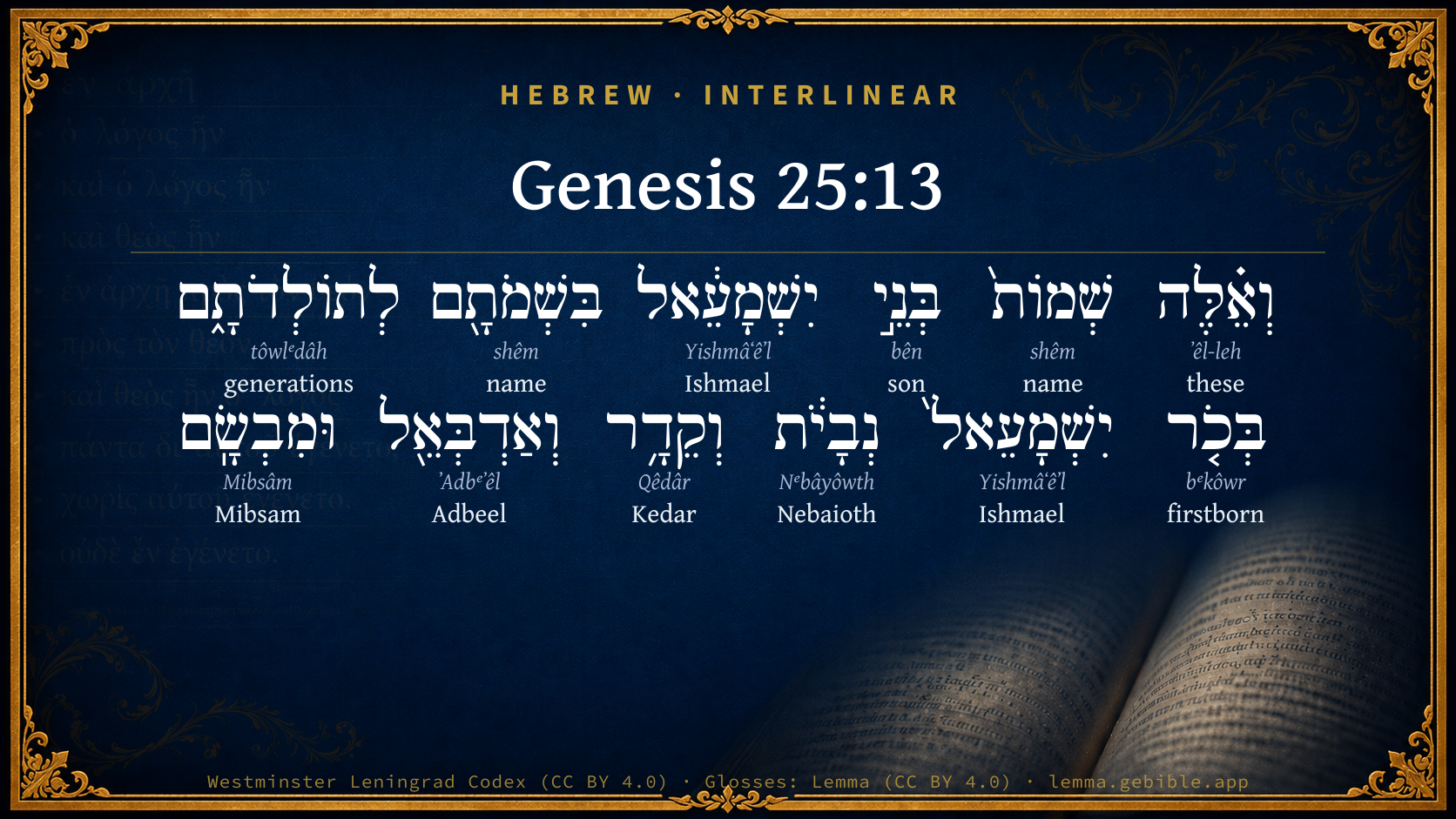
Hebrew (Westminster Leningrad Codex) Genesis 25:13 appears in the Hebrew Old Testament. The text above is from the Westminster Leningrad Codex. Each word links to its Strong’s number, a concise gloss, and parsing drawn from the Open Scriptures Hebrew Bible morphology. Click any word for its full Brown-Driver-Briggs (BDB) entry.
Download image
Cite this verse

Genesis 25:13 (World English Bible). Public Domain. Lemma interlinear Bible study tool, https://lemma.gebible.app/v/genesis/25/13.

Show BibTeX & RIS
BibTeX
RIS
English Translation
These are the names of the sons of Ishmael, by their names, according to the order of their birth: the firstborn of Ishmael, Nebaioth, then Kedar, Adbeel, Mibsam,
World English Bible · Public Domain
Highlights
  • 4 first appearances in the Hebrew Bible
Full analysis ↓
Download a study sheet

One document with this verse’s original text, its word-by-word gloss line, the meaning frame, cross-references with their text, attributed commentary, and full source and license credits — printable, and it pastes into notes with its structure intact.

This verse Autodidact and up

Study sheet (.html) Plain text (.txt)

A passage Seminary Student

Up to 50 verses in one chapter. A passage sheet keeps up to 6 commentary sources and 12 cross-references per verse, in the order this page ranks them, and says so on the sheet whenever that leaves anything out. Ask for a single verse and you get the Autodidact verse sheet above.

Everything on this page stays free to read, with no account — the sheet is a download of what is already on screen, not access to it.

Want to remove ads? Support Godless Engineer
Compare translations 3

The same verse in 3 English versions, stacked beneath the original-language interlinear above. Click any original word for its lexicon entry.

Each is an independent rendering of the whole verse — the interlinear is not word-aligned to these translations.

Highlighted words mark where these versions differ — a whole-verse word diff, not a word-by-word alignment.

  • World English Bible Public Domain
    These are the names of the sons of Ishmael, by their names, according to the order of their birth: the firstborn of Ishmael, Nebaioth, then Kedar, Adbeel, Mibsam,
  • King James Version Public Domain
    And these are the names of the sons of Ishmael, by their names, according to their generations: the firstborn of Ishmael, Nebajoth; and Kedar, and Adbeel, and Mibsam,
  • unfoldingWord Literal Text CC BY-SA 4.0
    And these the names of the sons of Ishmael, by their names according to their births: the firstborn of Ishmael Nebaioth, then Kedar and Adbeel and Mibsam

unfoldingWord Literal Text — © unfoldingWord, licensed CC BY-SA 4.0. Word-aligned USFM3 via Door43 (git.door43.org/unfoldingWord/en_ult).

Versions to compare (up to 4)

3 of 4 selected

Show all 18 translations

Every available English version of this verse, each an independent rendering of the whole verse.

  • World English Bible Public Domain
    These are the names of the sons of Ishmael, by their names, according to the order of their birth: the firstborn of Ishmael, Nebaioth, then Kedar, Adbeel, Mibsam,
  • Berean Standard Bible Public Domain
    These are the names of the sons of Ishmael in the order of their birth: Nebaioth the firstborn of Ishmael, then Kedar, Adbeel, Mibsam,
  • Majority Standard Bible Public Domain
    These are the names of the sons of Ishmael in the order of their birth: Nebaioth the firstborn of Ishmael, then Kedar, Adbeel, Mibsam,
  • King James Version Public Domain
    And these are the names of the sons of Ishmael, by their names, according to their generations: the firstborn of Ishmael, Nebajoth; and Kedar, and Adbeel, and Mibsam,
  • American Standard Version (1901) Public Domain
    And these are the names of the sons of Ishmael, by their names, according to their generations: the first-born of Ishmael, Nebaioth, and Kedar, and Adbeel, and Mibsam,
  • Revised Version (1885) Public Domain
    and these are the names of the sons of Ishmael, by their names, according to their generations: the firstborn of Ishmael, Nebaioth; and Kedar, and Adbeel, and Mibsam,
  • Geneva Bible (1599) Public Domain
    And these are the names of the sonnes of Ishmael, name by name, according to their kinreds; the eldest sonne of Ishmael was Nebaioth, then Kedar, and Adbeel, and Mibsam,
  • Douay-Rheims (1899) Public Domain
    And these are the names of his children according to their calling and generations. The firstborn of Ismael was Nabajoth, then Cedar, and Adbeel, and Mabsam.
  • Young's Literal Translation Public Domain
    and these `are' the names of the sons of Ishmael, by their names, according to their births: first-born of Ishmael, Nebajoth; and Kedar, and Adbeel, and Mibsam,
  • Literal Standard Version CC BY-SA 4.0
    and these [are] the names of the sons of Ishmael, by their names, according to their births: firstborn of Ishmael, Nebajoth; and Kedar, and Adbeel, and Mibsam,
  • Unlocked Literal Bible CC BY-SA 4.0
    These were the names of Ishmael's sons, according to their birth order: Nebaioth—the firstborn of Ishmael, Kedar, Adbeel, Mibsam,
  • unfoldingWord Literal Text CC BY-SA 4.0
    And these the names of the sons of Ishmael, by their names according to their births: the firstborn of Ishmael Nebaioth, then Kedar and Adbeel and Mibsam
  • Darby Bible Public Domain
    And these are the names of the sons of Ishmael by their names according to their generations: Nebaioth, the firstborn of Ishmael; and Kedar, and Adbeel, and Mibsam,
  • World Messianic Bible Public Domain
    These are the names of the sons of Ishmael, by their names, according to the order of their birth: the firstborn of Ishmael, Nebaioth, then Kedar, Adbeel, Mibsam,
  • Webster's Bible Public Domain
    And these are the names of the sons of Ishmael, by their names, according to their generations: The first-born of Ishmael, Nebajoth; and Kedar, and Adbeel, and Mibsam,
  • Free Bible Version CC BY-SA 4.0
    These were the names of the sons of Ishmael according to their family genealogy: Nebaioth (firstborn), Kedar, Adbeel, Mibsam,
  • Bible in Basic English Public Domain
    These are the names of the sons of Ishmael by their generations: Ishmael's first son was Nebaioth; then Kedar and Adbeel and Mibsam
  • JPS Tanakh (1917) Public Domain
    And these are the names of the sons of Ishmael, by their names, according to their generations: the first-born of Ishmael, Nebaioth; and Kedar, and Adbeel, and Mibsam,

Literal Standard Version (2020), Covenant Press — licensed CC BY-SA 4.0. Text via the HelloAO Bible API (eBible.org). Unlocked Literal Bible (unfoldingWord) — licensed CC BY-SA 4.0. Text via the HelloAO Bible API (eBible.org). unfoldingWord Literal Text — © unfoldingWord, licensed CC BY-SA 4.0. Word-aligned USFM3 via Door43 (git.door43.org/unfoldingWord/en_ult). Free Bible Version, Dr. Jonathan Gallagher — licensed CC BY-SA 4.0. Text via the HelloAO Bible API (eBible.org).

Word by word

More ways to search: Search by grammar → Find every occurrence → Compare this word →

Practice this passage: Drill this verse → Learn its vocabulary →

וְאַדְבְּאֵ֖ל
ʼAdbᵉʼêl
H110
“and · Adbeel”
Conjunction + Noun, Proper
Part of Speech
Conjunction + Noun
Type
Proper
Full BDB Definition

Origin: probably from H109 (in the sense of chastisement) and H410

TWOT: None

Adbeel = "chastened of God" - third son of Ishmael and grandson of Abraham
  1. וְאֵ֗לֶּה ʼêl-leh H428 “and · these” Conjunction + Pronoun, Demonstrative, Common, Plural
  2. שְׁמוֹת֙ shêm H8034 “names of” Noun, Common, Masculine, Plural, Construct
  3. בְּנֵ֣י bên H1121 “sons of” Noun, Common, Masculine, Plural, Construct
  4. יִשְׁמָעֵ֔אל Yishmâʻêʼl H3458 “Ishmael” Noun, Proper
  5. בִּשְׁמֹתָ֖ם shêm H8034 “in/at · names · their” Preposition + Noun, Common, Masculine, Plural, Construct + Suffix, Personal, 3rd Person, Masculine, Plural
  6. לְתוֹלְדֹתָ֑ם tôwlᵉdâh H8435 “to/for · generations · their” Preposition + Noun, Common, Feminine, Plural, Construct + Suffix, Personal, 3rd Person, Masculine, Plural
  7. בְּכֹ֤ר bᵉkôwr H1060 “firstborn of” Noun, Common, Masculine, Singular, Construct
  8. יִשְׁמָעֵאל֙ Yishmâʻêʼl H3458 “Ishmael” Noun, Proper
  9. נְבָיֹ֔ת Nᵉbâyôwth H5032 “Nebaioth” Noun, Proper
  10. וְקֵדָ֥ר Qêdâr H6938 “and · Kedar” Conjunction + Noun, Proper
  11. וּמִבְשָֽׂם Mibsâm H4017 “and · Mibsam” Conjunction + Noun, Proper

About this verse

These counts appear in no published source. They are computed here, from the morphology-tagged text and Lemma’s own curated glosses. What Lemma adds →

12
words
10
distinct lemmas
Pentateuch
section

Notable vocabulary

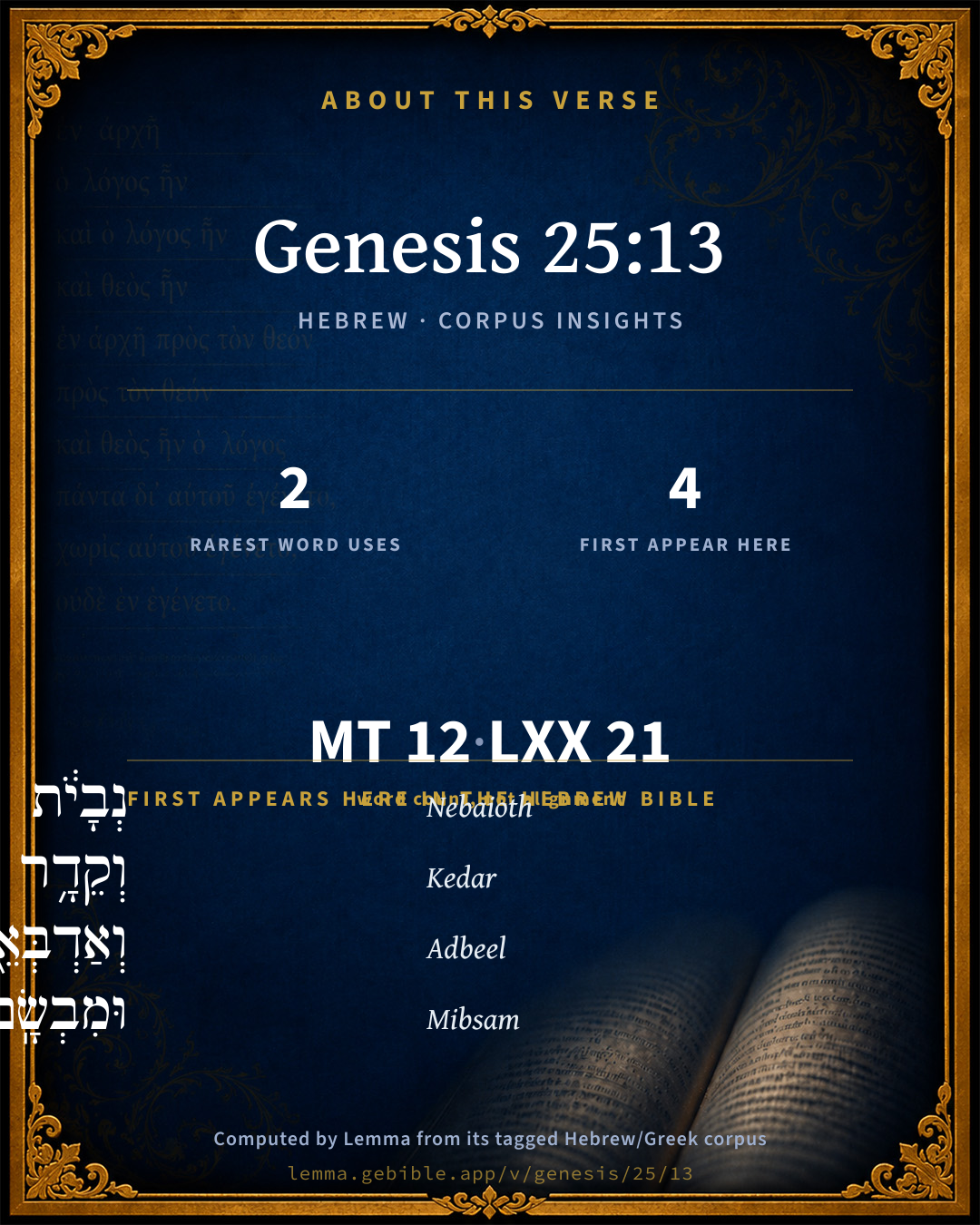
The rarest word here is וְאַדְבְּאֵ֖ל Adbeel H110 — appearing just 2 times in the whole Hebrew Bible.

First appearance in Scripture

These words make their first canonical appearance in the Hebrew Bible here:

  • נְבָיֹ֔ת Nebaioth H5032
  • וְקֵדָ֥ר Kedar H6938
  • וְאַדְבְּאֵ֖ל Adbeel H110
  • וּמִבְשָֽׂם Mibsam H4017

Shared distinctive vocabulary

וְאַדְבְּאֵ֖ל Adbeel H110 occurs in 2 verses of the Hebrew Bible. Also found in:

Grammatical profile

  • 11 nouns
  • 1 pronoun

Repetition

Words recur within this verse — often emphatic in Hebrew:

  • שְׁמוֹת֙ name H8034 ×2
  • יִשְׁמָעֵ֔אל Ishmael H3458 ×2

Hebrew & Septuagint length

In English translation the verse runs 28 words from the Hebrew and 28 from the Septuagint (LXX English) — the same length.

A rough comparison of the two English renderings, which tokenize alike — not a word-level alignment.

Word counts can differ between the Hebrew and the Greek without any difference in meaning — e.g. the Hebrew direct-object marker אֵת has no separate Greek word, and Greek often adds the article ὁ.

In the original languages it is 12 Hebrew tokens and 21 Greek tokens — but the two are counted differently (Hebrew bundles its prefixes and suffixes into one token; the Greek is in lemma form), so that isn’t a like-for-like length.

Cross-references

7

Topical passages linked to Genesis 25:13 in the Treasury of Scripture Knowledge — connected by theme and wording, ordered by reader-vote popularity; previews shown in the World English Bible.

  • 1 Chronicles 1:29–31 These are their generations: the firstborn of Ishmael, Nebaioth; then Kedar, and Adbeel, and Mibsam,
  • Isaiah 60:7 All the flocks of Kedar shall be gathered together to you, the rams of Nebaioth shall minister to you; they shall come up with acceptance on my altar; and I will glorify the house of my glory.
  • Psalms 120:5 Woe is me, that I live in Meshech, That I dwell among the tents of Kedar!
  • Song of Solomon 1:5 I am dark, but lovely, You daughters of Jerusalem, Like Kedar's tents, Like Solomon's curtains.
  • Isaiah 42:11 Let the wilderness and the cities of it lift up [their voice], the villages that Kedar does inhabit; let the inhabitants of Sela sing, let them shout from the top of the mountains.
  • Genesis 36:3 and Basemath, Ishmael's daughter, sister of Nebaioth.
  • Isaiah 21:16–17 For thus has the Lord said to me, Within a year, according to the years of a hireling, all the glory of Kedar shall fail;

Cross-references courtesy of OpenBible.info (CC BY 4.0).

Hebrew and Greek witnesses Masoretic Hebrew ↔ Greek Septuagint

The same verse in the two great witnesses to the Old Testament, shown verse-for-verse.

These are two independent witnesses, not word-aligned to each other, and the Septuagint is shown in lemma (dictionary) form.

Hebrew Genesis 25:13 Masoretic · Westminster Leningrad Codex

וְאֵ֗לֶּה שְׁמוֹת֙ בְּנֵ֣י יִשְׁמָעֵ֔אל בִּשְׁמֹתָ֖ם לְתוֹלְדֹתָ֑ם בְּכֹ֤ר יִשְׁמָעֵאל֙ נְבָיֹ֔ת וְקֵדָ֥ר וְאַדְבְּאֵ֖ל וּמִבְשָֽׂם

These are the names of the sons of Ishmael, by their names, according to the order of their birth: the firstborn of Ishmael, Nebaioth, then Kedar, Adbeel, Mibsam,

World English Bible · Public Domain

Greek LXX Genesis 25:13 Septuagint · lemma form

καί οὗτος ὁ ὄνομα ὁ υἱός ισμαηλ κατά ὄνομα ὁ γενεά αὐτός πρωτότοκος ισμαηλ ναβαιωθ καί κηδαρ καί ναβδεηλ καί μασσαμ

And these are the names of the sons of Ismael, according to the names of their generations. The firstborn of Ismael, Nabaioth, and Kedar, and Nabdeel, and Massam,

LXX2012 (modern English Septuagint) · Public Domain

Hebrew: Westminster Leningrad Codex (CC BY 4.0). Greek: Septuagint (public domain); English from LXX2012 (modern English Septuagint) (Public Domain). How the Septuagint differs from the Hebrew →

Targum (Aramaic paraphrase)

2

The Targum is the ancient Jewish Aramaic paraphrase of the Hebrew Scriptures — an interpretive translation, not the Hebrew text itself. Onkelos (literal) and Pseudo-Jonathan (expansive) render the Torah, and Jonathan the Prophets. Coverage is partial: where no permissively-licensed English translation exists for a verse, only the Aramaic is shown. This is verse-level text, not a word-by-word alignment to the Hebrew.

  1. Targum Onkelos Torah (Genesis–Deuteronomy)
    וְאִלֵּין שְׁמָהַת בְּנֵי יִשְׁמָעֵאל בִּשְׁמָהַתְהוֹן לְתוּלְדַתְהוֹן בּוּכְרָא דְיִשְׁמָעֵאל נְבָיוֹת וְקֵדָר וְאַדְבְּאֵל וּמִבְשָׂם

    (no public-domain English translation for this verse)

    Targum Onkelos — Aramaic: “Onkelos Genesis” (public domain); “Onkelos Exodus” (public domain); “Onkelos Leviticus” (public domain); “Onkelos Numbers” (public domain); “Onkelos Deuteronomy” (public domain). English: “Sefaria Community Translation” (CC0 1.0 (public-domain dedication)); “J.W. Etheridge. The Targums of Onkelos and Jonathan Ben Uzziel on the Pentateuch. London: Longmans, Green, 1862” (public domain). Text via Sefaria.

  2. Targum Pseudo-Jonathan Torah (Genesis–Deuteronomy)
    וְאִלֵין שְׁמָהַת בְּנֵי יִשְׁמָעֵאל בְּשׁוּמְהוֹן לְתוּלְדַתְהוֹן בּוּכְרָא דְיִשְׁמָעֵאל נְבוֹי וַעֲרַב וְאַדְבְּאֵל וּמִבְשָם

    And these are the names of the sons of Ishmael by their names, according to their generations. The firstborn of Ishmael, Neboi, and Arab, and Abdeel, and Mibsham,

    Targum Pseudo-Jonathan — Aramaic: “Targum Jonathan on Genesis” (public domain); “Targum Jonathan on Exodus” (public domain); “Targum Jonathan on Leviticus” (public domain); “Targum Jonathan on Numbers” (public domain); “Targum Jonathan on Deuteronomy” (public domain). English: “The Targum of Jonathan ben Uzziel, trans. J. W. Etheridge, London, 1862” (public domain). Text via Sefaria.

Commentary

Notes on Genesis 25:13 from classic Christian and Jewish commentators (each source and its license shown beneath its notes). The classic Christian expositions comment on the surrounding passage and are grouped to its opening verse, so a note may address several verses; the Jewish commentaries on the Tanakh (Rashi and others) are per-verse, so they appear only where the commentator wrote on this verse.

Lemma curates 59 commentaries, every one of them public domain or Creative Commons licensed, each selected and text-cleaned for this edition rather than reprinted as found. About our sources →

Trapp's Complete Commentary

John Trapp

Gen 25:13 And these [are] the names of the sons of Ishmael, by their names, according to their generations: the firstborn of Ishmael, Nebajoth; and Kedar, and Adbeel, and Mibsam,

Ver. 13. These are the names of the sons of Ishmael.] When Isaac was twenty years married, and had no child; and afterwards, no so many as Ishmael, nor so great in the world. This is God’s usual way of dealing forth his favours: saints suffer; wicked prosper. This made Pompey deny Divine Providence; Brutus cry out, W τλημων αρετν: Oh miserable virtue, slave of fortune, &c. {a} The Athenians, in Thucydides, {b} when they had lost Nicias their good general, who, together with his whole army perished in Sicily, were at a great stand, and much offended; seeing so pious a person fare nothing better than those that were far worse. And what wonder, when Jeremiah and David stumbled at the same stone, ran upon the same rock, and were well-nigh shipwrecked? {Jer 12:1 Psa 73:3-4} Neither they only, but many other of God’s dear servants, as it is in the same Psalm {Psa 73:10}, "Therefore his people return hither"; that is, are every whit as wise (or rather, as foolish) as I have been, to miscensure and misconstrue God’s dealings on this manner; to repent me of my repentance, and to condemn the generation of the just, "because waters of a full cup are wrung out to the wicked." When David went into God’s sanctuary, and there consulted his Word, he was better resolved: then he saw that the sunshine of prosperity doth but ripen the sin of the wicked, and so fits them for destruction: {Hos 14:9} as fatted ware are but fitted for the slaughter. What good is there in having a fine suit with the plague in it? Poison in wine works more seriously than in water. Had Haman known the danger of Esther’s banquet, he would not have been so brag of it. The prosperity of the wicked hath ever plus deceptionis, quam delectortonis, saith one; more deceit than delight; able to entice, and ready to kill the entangled. As cunning to do that, as the spirit that seduced Ahab; and as willing to do the other, as the ghost that met Brutus at the battle of Philippi. In which respect, David having spoken of these "men of God’s hand, that have their portion in this life," {Psa 17:14} &c., wishes them make them merry with it, and subjoins, "As for me, I will behold thy face in righteousness; I shall be satisfied, when I awake, with thy likeness." {Psa 17:15} As who should say, I neither envy nor covet their happiness, but long after a glorious resurrection, and have, in the meanwhile, that which is sufficient to sustain me; "I shall behold thy face in righteousness," that is, Beshechinah, in Christ, as Rabbi Menachem {c} expounds it. And one good look of God is worth all the world. It is better to feel his favour one hour, than to sit whole ages, as these Ishmaelites did, under the world’s warmest sunshine.

{a} Dογος ορ ησθα αλλως εγω δε σε ως εργον ησκουν ου δ απ εδουλευες τυχη. - Dio Cassius.

{b} Aνδρα ορωντες θεοφιλη, ουδενος επεικεστερα τυχη χρησθαι των κακιστως. - Thucyd.

{c} Menach. on Levit. x.

John Trapp, A Commentary or Exposition upon All the Books of the Old and New Testament (1647–1656) — public domain. Text from a community e-Sword module.

Geneva Bible (1599)

Geneva Bible translators

Hebrew, firstborn.

Geneva Bible (1599) marginal notes — public domain. Text via Bolls.life.

Adam Clarke's Commentary

Verse 13. Nebajoth] From whom came the Nabatheans, whose capital was Petra, or, according to Strabo, Nabathea. They dwelt in Arabia Petraea, and extended themselves on the east towards Arabia Deserta.

Kedar] The founder of the Cedreans, who dwelt near to the Nabatheans. The descendants of Kedar form a part of the Saracens.

Adbeel, and Mibsam] Where these were situated is not known.

Adam Clarke's Commentary on the Bible (1810–1826) — public domain. Text from a community e-Sword/MySword module.

The Cambridge Bible for Schools and Colleges

gen. ed. J. J. S. Perowne

13. and these are the names] Cf. the genealogy in 1Ch_1:29-31.

Nebaioth] Mentioned also in Gen_28:9, Gen_36:3, and in Isa_60:7, where the name is associated also with Kedar. Probably Nebaioth is to be identified with the Nabajâti of the inscriptions of Assurbanipal. The identification with the Nabataeans, of the Christian era, is now generally abandoned.

Kedar] Cf. Isa_60:7. Probably the Assyrian Ḳidri, a region on the Syro-Arabian frontier, mentioned as a hostile people in Psa_120:5, dwelling in black tents (Son_1:5) and in open villages (Isa_42:11; Jer_49:28-31).

Possibly the Cedraei mentioned together with Nabataei by Pliny are to be identified with these tribes.

Dumah] Possibly the same as in Isa_21:11.

The Cambridge Bible for Schools and Colleges (gen. ed. J. J. S. Perowne; Cambridge University Press, 1878–1918) — public domain. Text from a community e-Sword module.

John Gill's Exposition

And these are the names of the sons of Ishmael,.... After mentioned: by their names, according to their generations; which were imposed upon them at their birth, and are recited according to the order in which they were born, as follows:

the firstborn of Ishmael, Nebajoth: mentioned in Isa 60:7; and from whence a people of the Arabs are called Nabathaeans, and their country Nabathaea. Josephus (i) says, that all the country from Euphrates to the Red sea is called the Nabatene country. The posterity of this man inhabited part of Arabia Deserta and of Arabia Petraea, even to the entrance of Arabia Felix. Strabo (k) reckons the Nabataeans among the Arabians, and calls Petra the metropolis of Arabia Petraea, Petra Nabataea, and Petra of the Arabian Nabataeans, who he says dwelt about Syria, and often made excursions into it; and observes, that their country is populous and abounds with pastures; hence the rams of Nebaioth, mentioned in Isa 60:7; Pliny also (l) places them in Arabia, and says they inhabit the town called Petra, and that they border upon Syria.

And Kedar is the second son of Ishmael; and the posterity of this man and their country are reckoned in Arabia by Isaiah, Isa 21:13; and they are so well known to be Arabians, that the Arabic language is most frequently, in Jewish writings, called the language of Kedar. These are the people whom Pliny (m) names Cedrei, and mentions them along with the Nabathaeans, as near unto them, and indeed they dwelt in the same country, Arabia Petraea, and in tents, living by pasturage, hence they are sometimes called Scenites; and mention is made of the tents of Kedar in Sol 1:5; these are the Scenite Arabs, called Saracens by Ammianus Marcellinus (n). Two other sons of Ishmael follow:

and Adbeel and Mibsam; of whom no mention is made elsewhere, nor are there any traces of their names, unless the Agubeni, placed by Ptolemy (o) near Arabia Felix.

(i) Antiqu. l. 1. c. 12. sect. 4. (k) Geograph. l. 16. p. 528, 534, 536. (l) Nat. Hist. l. 5. c. 11. & l. 6. c. 28. & l. 12. c. 17. (m) lbid. l. 5. c. 11. (n) L. 22. p. 228. l. 23. p. 250. Ed. Vales. (o) Geograph. l. 5. c. 19.

John Gill's Exposition of the Whole Bible (1746–1763) — public domain (CC PDM 1.0). Text via the HelloAO Bible API.

Matthew Poole's English Annotations

Nebajoth; of whom see Isa 60:7. From whom part of Arabia was called Nabathaea.

Of

Kedar, see Psa 120:5; Isa 21:16; Jer 49:28; the father of those called Cedraei, or Cedareni, in Arabia.

Matthew Poole's English Annotations on the Holy Bible (1683–1685) — public domain. Text from a community e-Sword/MySword module.

Whedon's Commentary on the Bible

Daniel D. Whedon

13-15.

The names — We find scattered notices of these names in later books. Thus, Nebajoth in Isa_60:7, probably the Nabataeans of later history; Kedar in Isa_21:17; Isa_42:11; Isa_60:7; Jer_2:10; Jer_49:28; Eze_27:21; Psa_120:5; Son_1:5; Dumah in Isa_21:11; Tema in Job_6:19; Isa_21:14; Jer_25:23; Jetur and Naphish in 1Ch_5:19. From Jetur probably sprung the Ituraeans of later history. Many of these, no doubt, became intermingled with the sons of Keturah. See on Gen_25:2-4.

Daniel D. Whedon (gen. ed.), Commentary on the Old and New Testaments (1874–1909) — public domain. Text from a community e-Sword module.

The Pulpit Commentary

And these are the names of the sons of Ishmael, by their names, according to their generations: the firstborn of Ishmael, Nebajoth; Heights;" the Nabathaeans, a people of Northern Arabia, possessed of abundant flocks, (Isa_9:7) and, according to Diodorus, living by merchandise and rapine (Gesenius). From Petraea they subsequently extended as far as Babylon (Keil)and Kedar, Skin;" the Cedrei of Pliny (Gesenius, Keil, Rosen-mailer); characterized as good bowmen, (Isa_21:17) and dwelling between Arabia Petraea and Babylonand Adbeel, of God" (Gesenius); of whom nothing is knownand Mibsam, Odor" (Gesenius); equally uncertain.

The Pulpit Commentary (1880–1919), ed. H.D.M. Spence-Jones & Joseph S. Exell — public domain. Text from a community e-Sword module.

unfoldingWord translationNotes

Door43 World Missions Community

General Information:

See How to Translate Names.

These were Ishmael's sons, and these were their names, by their villages, and by their encampments; twelve princes according to their tribes

This can be stated as two sentences. "These were the names of Ishmael's twelve sons. They led tribes that were named after them, and they each had their own villages and campsites"

twelve

"12" (See: Numbers)

princes

Here the word "princes" means that the men were leaders or rules of the tribes; it does not mean that they were the sons of a king.

translationWords

Ishmael

prince

tribe

unfoldingWord translationNotes — © Distant Shores Media and the Door43 World Missions Community, licensed CC BY-SA 4.0. Source: git.door43.org/Door43/en_tn.

Rashi

Rabbi Shlomo Yitzchaki (Rashi)

בשמתם לתולדתם BY THEIR NAMES ACCORDING TO THEIR PROGENY — by the order in which they were born one after the other.

Rashi on the Tanakh — English translations: “The Judaica Press complete Tanach with Rashi, translated by A. J. Rosenberg” (CC BY 4.0); “Pentateuch with Rashi's commentary by M. Rosenbaum and A.M. Silbermann, 1929-1934” (public domain); “The Metsudah Tanach series, Lakewood, N.J” (CC BY 4.0); and “The Book of Joshua, Metsudah Publications, 1997” (CC BY 4.0). Text via Sefaria.

Radak

Rabbi David Kimhi (Radak)

ואלה...לתולדותם, in the chronological order of their birth. The firstborn of them all was Nevayot.

Radak on the Tanakh — English translations: “Sefaria Community Translation” (CC0 1.0 (public-domain dedication)); “Eliyahu Munk, HaChut Hameshulash” (CC BY 4.0); “Rabbi Mike Feuer, Jerusalem Anthology” (CC BY 4.0); and “R. David Kimhi on the first book of Psalms, Translated by R.G. Finch, London, 1919” (public domain). Text via Sefaria.

Lesson kit

Teaching starters — assembled from the data on this page, not authored interpretation. Every prompt links to the verse data it draws on. Edit before teaching.

Genesis, in the Pentateuch, opens this verse with 12 words (10 distinct Hebrew lemmas). Its most distinctive word is ʼAdbᵉʼêl (“Adbeel”). A historical commentator’s framing appears above. Read the whole chapter for the surrounding context.

Discussion questions

  1. How does “Adbeel” (ʼAdbᵉʼêl) shape what this verse is saying?
  2. 4 words make their first appearance in Scripture here. What does this debut establish?
  3. How does 1 Chronicles 1:29, which shares the word «Adbeel», read alongside this verse?
  4. What does the repetition of “name” (2× in this one verse) do in this verse?
  5. These translations render this verse differently. What is at stake in choosing one wording over another?
  6. Compare how Trapp's Complete Commentary and Geneva Bible (1599) read this verse. Where do they agree or differ?

Things to notice

Reading settings

Reading text

Shown beneath each verse's original-language words.

Old Testament
Old Testament edition

Read the OT as the Masoretic Hebrew (MT) or the Greek Septuagint (LXX).

English shown for the Greek Septuagint (in the Hebrew ↔ Greek comparison).

Comparing translations? Open the Compare panel on any verse page to stack up to four side by side.