1 John 3:23

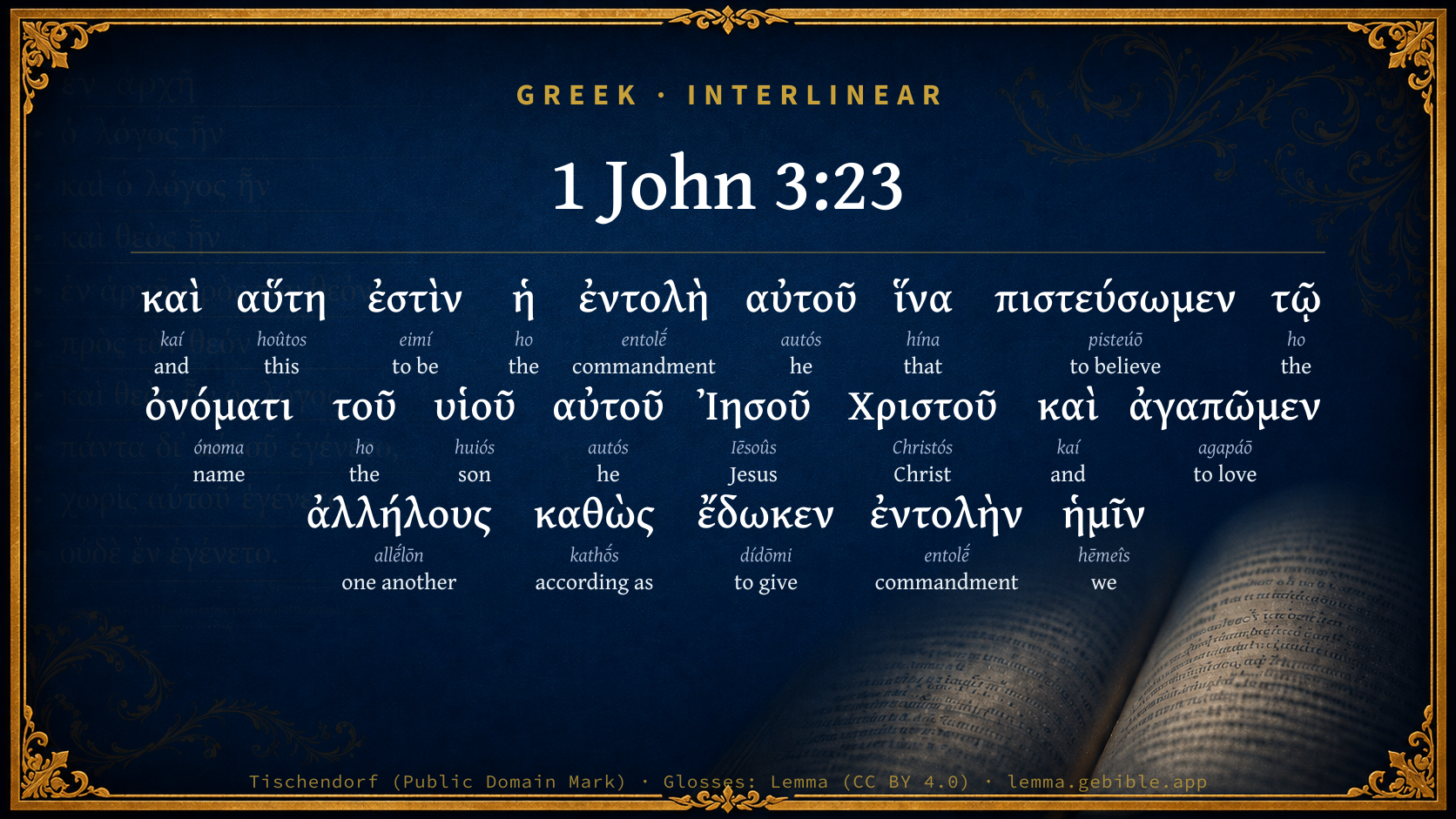
Greek (Tischendorf 8th ed.) 1 John 3:23 appears in the Greek New Testament. The text above is from the Tischendorf 8th edition. Each word links to its Strong’s number and a concise gloss. Click any word for its full Thayer’s Greek Lexicon entry.
Download image
Cite this verse

1 John 3:23 (World English Bible). Public Domain. Lemma interlinear Bible study tool, https://lemma.gebible.app/v/1-john/3/23.

Show BibTeX & RIS
BibTeX
RIS
English Translation
This is his commandment, that we should believe in the name of his Son, Jesus Christ, and love one another, even as he commanded.
World English Bible · Public Domain
Download a study sheet

One document with this verse’s original text, its word-by-word gloss line, the meaning frame, cross-references with their text, attributed commentary, and full source and license credits — printable, and it pastes into notes with its structure intact.

This verse Autodidact and up

Study sheet (.html) Plain text (.txt)

A passage Seminary Student

Up to 50 verses in one chapter. A passage sheet keeps up to 6 commentary sources and 12 cross-references per verse, in the order this page ranks them, and says so on the sheet whenever that leaves anything out. Ask for a single verse and you get the Autodidact verse sheet above.

Everything on this page stays free to read, with no account — the sheet is a download of what is already on screen, not access to it.

Want to remove ads? Support Godless Engineer
Compare translations 3

The same verse in 3 English versions, stacked beneath the original-language interlinear above. Click any original word for its lexicon entry.

Each is an independent rendering of the whole verse — the interlinear is not word-aligned to these translations.

Highlighted words mark where these versions differ — a whole-verse word diff, not a word-by-word alignment.

  • World English Bible Public Domain
    This is his commandment, that we should believe in the name of his Son, Jesus Christ, and love one another, even as he commanded.
  • King James Version Public Domain
    And this is his commandment, That we should believe on the name of his Son Jesus Christ, and love one another, as he gave us commandment.
  • unfoldingWord Literal Text CC BY-SA 4.0
    And this is his commandment: that we should believe in the name of his Son Jesus Christ and love one another just as he gave us a commandment.

unfoldingWord Literal Text — © unfoldingWord, licensed CC BY-SA 4.0. Word-aligned USFM3 via Door43 (git.door43.org/unfoldingWord/en_ult).

Versions to compare (up to 4)

3 of 4 selected

Show all 19 translations

Every available English version of this verse, each an independent rendering of the whole verse.

  • World English Bible Public Domain
    This is his commandment, that we should believe in the name of his Son, Jesus Christ, and love one another, even as he commanded.
  • Berean Standard Bible Public Domain
    And this is His commandment: that we should believe in the name of His Son, Jesus Christ, and we should love one another just as He commanded us.
  • Majority Standard Bible Public Domain
    And this is His commandment: that we should believe in the name of His Son, Jesus Christ, and we should love one another just as He commanded.
  • King James Version Public Domain
    And this is his commandment, That we should believe on the name of his Son Jesus Christ, and love one another, as he gave us commandment.
  • American Standard Version (1901) Public Domain
    And this is his commandment, that we should believe in the name of his Son Jesus Christ, and love one another, even as he gave us commandment.
  • Revised Version (1885) Public Domain
    And this is his commandment, that we should believe in the name of his Son Jesus Christ, and love one another, even as he gave us commandment.
  • Geneva Bible (1599) Public Domain
    This is then his commandement, That we beleeue in the Name of his Sonne Iesus Christ, and loue one another as hee gaue commandement.
  • Douay-Rheims (1899) Public Domain
    And this is his commandment, that we should believe in the name of his Son Jesus Christ: and love one another, as he hath given commandment unto us.
  • Young's Literal Translation Public Domain
    and this is His command, that we may believe in the name of His Son Jesus Christ, and may love one another, even as He did give command to us,
  • Literal Standard Version CC BY-SA 4.0
    and this is His command, that we may believe in the Name of His Son Jesus Christ, and may love one another, even as He gave command to us,
  • Unlocked Literal Bible CC BY-SA 4.0
    This is his commandment: that we should believe in the name of his Son Jesus Christ and love one another, just as he gave us this commandment.
  • unfoldingWord Literal Text CC BY-SA 4.0
    And this is his commandment: that we should believe in the name of his Son Jesus Christ and love one another just as he gave us a commandment.
  • Darby Bible Public Domain
    And this is his commandment, that we believe on the name of his Son Jesus Christ, and that we love one another, even as he has given us commandment.
  • World Messianic Bible Public Domain
    This is his commandment, that we should believe in the name of his Son, Yeshua the Messiah, and love one another, even as he commanded.
  • Webster's Bible Public Domain
    And this is his commandment; That we should believe on the name of his Son Jesus Christ, and love one another, as he gave us commandment.
  • Free Bible Version CC BY-SA 4.0
    This is what he commands: we should trust in the name of his Son Jesus Christ, and love one another, just as he commanded us to do.
  • Bible in Basic English Public Domain
    And this is his law, that we have faith in the name of his Son Jesus Christ, and love for one another, even as he said to us.
  • Text-Critical English NT CC BY 4.0
    And this is his commandment, that we believe in the name of his Son Jesus Christ and love one another, just as he commanded.
  • Tyndale New Testament (1534) Public Domain
    And this is his commaundement that we beleve on the name of his sonne Iesus Christ and love one another as he gave commaundement.

Literal Standard Version (2020), Covenant Press — licensed CC BY-SA 4.0. Text via the HelloAO Bible API (eBible.org). Unlocked Literal Bible (unfoldingWord) — licensed CC BY-SA 4.0. Text via the HelloAO Bible API (eBible.org). unfoldingWord Literal Text — © unfoldingWord, licensed CC BY-SA 4.0. Word-aligned USFM3 via Door43 (git.door43.org/unfoldingWord/en_ult). Free Bible Version, Dr. Jonathan Gallagher — licensed CC BY-SA 4.0. Text via the HelloAO Bible API (eBible.org).

Word by word

More ways to search: Search by grammar → Find every occurrence → Compare this word →

Practice this passage: Drill this verse → Learn its vocabulary →

ἐντολὴ
entolḗ
G1785
“commandment”
Noun, Nominative, Singular, Feminine
Part of Speech
Noun
Case
Nominative
Number
Singular
Gender
Feminine
Full Thayer's Definition

Origin: from G1781

TDNT: 11:05,2

1. an order, command, charge, precept, injunction a. that which is prescribed to one by reason of his office 2. a commandment a. a prescribed rule in accordance with which a thing is done 1. a precept relating to lineage, of the Mosaic precept concerning the priesthood 2. ethically used of the commandments in the Mosaic law or Jewish tradition
  1. καὶ kaí G2532 “and” Conjunction
  2. αὕτη hoûtos G3778 “this” Demonstrative pronoun, Nominative, Singular, Feminine
  3. ἐστὶν eimí G1510 “to be” Verb, Present, Active, Indicative, 3rd person, Singular
  4. ἡ ho G3588 “the” Article, Nominative, Singular, Feminine
  5. αὐτοῦ autós G846 “he” Personal pronoun, Genitive, Singular, Masculine
  6. ἵνα hína G2443 “that” Conjunction
  7. πιστεύσωμεν pisteúō G4100 “to believe” Verb, Aorist, Active, Subjunctive, 1st person, Plural
  8. τῷ ho G3588 “the” Article, Dative, Singular, Neuter
  9. ὀνόματι ónoma G3686 “name” Noun, Dative, Singular, Neuter
  10. τοῦ ho G3588 “the” Article, Genitive, Singular, Masculine
  11. υἱοῦ huiós G5207 “son” Noun, Genitive, Singular, Masculine
  12. αὐτοῦ autós G846 “he” Personal pronoun, Genitive, Singular, Masculine
  13. Ἰησοῦ Iēsoûs G2424 “Jesus” Noun, Genitive, Singular, Masculine
  14. Χριστοῦ Christós G5547 “Christ” Noun, Genitive, Singular, Masculine
  15. καὶ kaí G2532 “and” Conjunction
  16. ἀγαπῶμεν agapáō G25 “to love” Verb, Present, Active, Subjunctive, 1st person, Plural
  17. ἀλλήλους allḗlōn G240 “one another” Reciprocal pronoun, Accusative, Plural, Masculine
  18. καθὼς kathṓs G2531 “according as” Adverb
  19. ἔδωκεν dídōmi G1325 “to give” Verb, Aorist, Active, Indicative, 3rd person, Singular
  20. ἐντολὴν entolḗ G1785 “commandment” Noun, Accusative, Singular, Feminine
  21. ἡμῖν hēmeîs G2249 “we” Personal pronoun, 1st person, Dative, Plural

About this verse

These counts appear in no published source. They are computed here, from the morphology-tagged text and Lemma’s own curated glosses. What Lemma adds →

22
words
17
distinct lemmas
General Epistles
section

Repetition

Words recur within this verse:

  • ἐντολὴ commandment G1785 ×2
  • ἡ the G3588 ×3
  • καὶ and G2532 ×2
  • αὐτοῦ he G846 ×2

Cross-references

18

Topical passages linked to 1 John 3:23 in the Treasury of Scripture Knowledge — connected by theme and wording, ordered by reader-vote popularity; previews shown in the World English Bible.

  • John 6:29 Jesus answered them, "This is the work of God, that you believe in him whom he has sent."
  • John 13:34 A new commandment I give to you, that you love one another, just like I have loved you; that you also love one another.
  • 1 Peter 1:22 Seeing you have purified your souls in your obedience to the truth through the Spirit in sincere brotherly affection, love one another from the heart fervently:
  • John 15:12 "This is my commandment, that you love one another, even as I have loved you.
  • 1 Peter 4:8 And above all things be earnest in your love among yourselves, for love covers a multitude of sins.
  • 1 John 3:11 For this is the message which you heard from the beginning, that we should love one another;
  • Mark 9:7 A cloud came, overshadowing them, and a voice came out of the cloud, "This is my beloved Son. Listen to him."
  • 1 Thessalonians 4:9 But concerning brotherly love, you have no need that one write to you. For you yourselves are taught by God to love one another,
  • 1 John 4:21 This commandment we have from him, that he who loves God should also love his brother.
  • Matthew 22:39 A second likewise is this, 'You shall love your neighbor as yourself.'
  • Ephesians 5:2 Walk in love, even as Christ also loved you, and gave himself up for us, an offering and a sacrifice to God for a sweet-smelling fragrance.
  • 1 John 2:8–10 Again, I write a new commandment to you, which is true in him and in you; because the darkness is passing away, and the true light already shines.
  • Acts 16:31 They said, "Believe in the Lord Jesus Christ, and you will be saved, you and your household."
  • Deuteronomy 18:15–19 Yahweh your God will raise up to you a prophet from the midst of you, of your brothers, like me; to him you shall listen;
  • Psalms 2:12 Kiss the son, lest he be angry, and you perish in the way, For his wrath will soon be kindled. Blessed are all those who take refuge in him.
  • John 17:3 This is eternal life, that they should know you, the only true God, and him whom you sent, Jesus Christ.
  • John 14:1 "Don't let your heart be troubled. Believe in God. Believe also in me.
  • 1 Timothy 1:15 The saying is faithful and worthy of all acceptance, that Christ Jesus came into the world to save sinners; of whom I am chief.

Cross-references courtesy of OpenBible.info (CC BY 4.0).

Commentary

Notes on 1 John 3:23 from classic Christian and Jewish commentators (each source and its license shown beneath its notes). The classic Christian expositions comment on the surrounding passage and are grouped to its opening verse, so a note may address several verses; the Jewish commentaries on the Tanakh (Rashi and others) are per-verse, so they appear only where the commentator wrote on this verse.

Lemma curates 59 commentaries, every one of them public domain or Creative Commons licensed, each selected and text-cleaned for this edition rather than reprinted as found. About our sources →

Matthew Henry's Commentary

The apostle, having mentioned keeping the commandments, and pleasing God, as the qualification of effectual petitioners in and with Heaven, here suitably proceeds,

I. To represent to us what those commandments primarily and summarily are; they are comprehended in this double one: And this is his commandment, That we should believe on the name of his Son Jesus Christ, and love one another, as he gave us commandment, Jo1 3:23. To believe on the name of his Son Jesus Christ is, 1. To discern what he is, according to his name, to have an intellectual view of his person and office, as the Son of God, and the anointed Saviour of the world. That every one that seeth the Son, and believeth on him, may have everlasting life, Joh 6:40. 2. To approve him in judgment and conscience, in conviction and consciousness of our case, as one wisely and wonderfully prepared and adapted for the whole work of eternal salvation. 3. To consent to him, and acquiesce in him, as our Redeemer and recoverer unto God. 4. To trust to him, and rely upon him, for the full and final discharge of his saving office. Those that know thy name will put their trust in thee, Psa 9:10. I know whom I have believed, and I am persuaded that he is able to keep that which I have committed unto him against that day, Ti2 1:12. This faith is a needful requisite to those who would be prevalent petitioners with God, because it is by the Son that we must come to the Father; through his grace and righteousness our persons must be accepted or ingratiated with the Father (Eph 1:6), through his purchase all our desired blessings must come, and through his intercession our prayers must be heard and answered. This is the first part of the commandment that must be observed by acceptable worshippers; the second is that we love one another, as he gave us commandment, Jo1 3:23. The command of Christ should be continually before our eyes. Christian love must possess our soul when we go to God in prayer. To this end we must remember that our Lord obliges us, (1.) To forgive those who offend us (Mat 6:14), and, (2.) To reconcile ourselves to those whom we have offended, Mat 5:23, Mat 5:24. As good-will to men was proclaimed from heaven, so good-will to men, and particularly to the brethren, must be carried in the hearts of those who go to God and heaven.

II. To represent to us the blessedness of obedience to these commands. The obedient enjoy communion with God: And he that keepeth his commandments, and particularly those of faith and love, dwelleth in him, and he in him, Jo1 3:24. We dwell in God by a happy relation to him, and spiritual union with him, through his Son, and by a holy converse with him; and God dwells in us by his word, and our faith fixed on him, and by the operations of his Spirit. Then there occurs the trial of his divine inhabitation: And hereby we know that he abideth in us, by the Spirit which he hath given us (Jo1 3:24), by the sacred disposition and frame of soul that he hath conferred upon us, which being a spirit of faith in God and Christ, and of love to God and man, appears to be of God.

Matthew Henry's Commentary on the Whole Bible (1708–1710) — public domain (CC PDM 1.0). Text via the HelloAO Bible API.

Joseph Benson's Commentary

1Jn 3:23-24. And this is his commandment, That we should believe, &c. — Namely, all his commandments: in one word, That we should believe and love — In the manner and degree which he hath taught. This is the greatest and most important command that ever issued from the throne of glory. If this be neglected, no other can be kept; if this be observed, all others are easy. And he that keepeth his commandments — That thus believes and loves; dwelleth, or abideth in him — In Christ Jesus, or in God the Father; and he — Christ, or the Father; in him — This seems to be an allusion to our Lord’s words, Joh 14:23; If a man love me, he will keep my words, and my Father will love him, and we will come unto him, and make our abode with him. That is, in this way we obtain fellowship with the Father, as well as with the Son; yea, the most intimate acquaintance, friendship, and communion, and are thereby made unspeakably happy; and hereby we know that he abideth in us — That we have this intimate union and communion with him; by the Spirit which he hath given us — The Spirit of adoption and regeneration, witnessing with our spirits that we are his children, and producing in us love, joy, and peace, holiness and happiness.

Joseph Benson's Commentary on the Old and New Testaments (1811–1818) — public domain. Text from a community e-Sword module.

Tyndale Open Study Notes

Tyndale Open Resources

3:23-24 John here gives a new criterion for discerning who has the Spirit. The Spirit is not the possession of an elite who are enlightened without their lives being changed. Instead, the Spirit comes to all believers and stimulates obedient discipleship (Gal 5:22-23).

Tyndale Open Study Notes — © Tyndale Open Resources, licensed CC BY-SA 4.0. Text via the HelloAO Bible API.

Bengel's Gnomon

Johann Albrecht Bengel

1Jn 3:23. Τῷ ὀνόματι) on the name. Comp. Heb 6:10.—καθὼς, as) This particle belongs to the verbs, we should believe and love.[12]

[12] ἡμῖν, to us) This pronoun, though expressed in the Germ. Vers., is regarded by the margin of both Greek Editions as spurious.—E. B.

ABC Vulg. Memph. Lucif. Add ἡμῖν: so Lachm. Tisch. omits it, with inferior authorities.—E.

Bengel's Gnomon of the New Testament — English translation (T&T Clark, Edinburgh, 1860) — public domain. Text from a community e-Sword module.

Meyer's Critical & Exegetical Commentary

Heinrich August Wilhelm Meyer

1Jn_3:23. With this verse, whichas the statement of the substance of Gods commandmentsis most closely connected with the preceding, begins a new leading section, indeed the last in the Epistle, inasmuch as in ἵνα πιστεύσωμεν τῷ ὀνόματι κ.τ.λ. a new element of the development of ideas appears, by which the sequel is not merely prepared for (Ebrard), but is dominated.

καί is not explicative, but simply copulative.

αὕτη refers to the following ἵνα, which here also does not merely state the purpose (Braune), but the substance.

ἡ ἐντολὴ αὐτοῦ] The singular is used, because the manifold commandments in their inner nature form one unity: this is especially true of the two commandments of faith and love, here mentioned. From the fact that faith is described as an ἐντολή, it must not be inferred that it is not a work of God in man, but it certainly follows that neither can it be accomplished without the self-activity of man.

The phrase πιστεύειν τῷ ὀνόματι τοῦ υἱοῦ κ.τ.λ. only appears here; in chap. 1Jn_5:13 the preposition εἰς is used instead of the dative; so also in Joh_1:12; Joh_2:23; Joh_3:18, etc.; by the dative the ὄνομα of Christ is indicated as the object of devoted, believing trust;[249] to believe on the name of Christ is, however, identical with to believe on Christ, inasmuch as in the name the nature of Him who is spoken of is expressed; comp. Meyer on Joh_1:12. Grotius quite erroneously: propter Christum sive Christo auctore Deo credere.

While faith is the fundamental condition of the Christian life, brotherly love is the active proof of the living character of the faith; the two things cannot be separated from one another; hence it follows here: ΚΑῚ ἈΓΑΠῶΜΕΝ ἈΛΛΉΛΟΥς,[250] which as the effect is distinguished from πιστεύειν as the cause; ΚΑΊ is therefore copulative and not epexegetical (as Frommann thinks, p. 591).

The subordinate clause: ΚΑΘῺς ἜΔΩΚΕΝ ἘΝΤΟΛῊΝ ἩΜῖΝ, is best referred to ἈΓΑΠῶΜΕΝ ἈΛΛΉΛΟΥς, inasmuch as it is not God (Estius, Bengel, Sander) but Christ that is to be regarded as the subject; by καθώς (in proportion as) the quality of love is indicated: it must correspond to the commandment of Christ; Myrberg: Non modo amandum est, sed etiam vere et recte amandum.

[249] Weiss has been at pains to show that πιστεύειν in John does not include the clement of trust; in this, however, he is wrong, because even where the element of conviction prevails in the use of the word, this must not be identified with the theoretical belief, which is a mere act of the understanding, but it includes as an essential element the immediate trust of the words or of the person to which the πιστεύειν refers; in the phrase: πιστεύειν τῷ ὀνόματι Ἰ. Χρ., the ethical meaning of the verb is so much the more to be recognised, as the denial of it necessitates also a weakening of the idea ὄνομα.

[250] Frommann (p. 200) wrongly concludes from this passage and 1Jn_4:7; 1Jn_4:19, in which the obligation to love is expressed, that being born of God is conditioned by love, as the free act of man, by which He keeps His independent personality and freedom towards God (!), nay, even is produced by it (p. 205).

Meyer — Critical and Exegetical Commentary on the New Testament — English translation by Peter Christie, edited by Frederick Crombie (T&T Clark, 1880) — public domain. Text from a community e-Sword module.

Expositor's Greek Testament

ed. W. Robertson Nicoll

1Jn 3:23 . Cf. our Lord’s summary of the commandments in Mat 22:34-40 = Mar 12:28-31 , and observe the apostolic narrowing of τὸν πλησίον σου ( cf. Luk 10:29-37 ) to ἀλλήλους , i.e. τούς ἀδελφούς (see note on 1Jn 2:9 ). τῷ ὀνόματι , see note on 1Jn 2:12 .

The Expositor's Greek Testament, edited by W. Robertson Nicoll (1897–1910) — public domain. Text from a community e-Sword module.

Jamieson, Fausset & Brown

Robert Jamieson, A. R. Fausset & David Brown

Summing up of God's commandments under the Gospel dispensation in one commandment.

this is his commandment--singular: for faith and love are not separate commandments, but are indissolubly united. We cannot truly love one another without faith in Christ, nor can we truly believe in Him without love.

believe--once for all; Greek aorist.

on the name of his Son--on all that is revealed in the Gospel concerning Him, and on Himself in respect to His person, offices, and atoning work.

as he--as Jesus gave us commandment.

Jamieson, Fausset & Brown — Commentary Critical and Explanatory on the Whole Bible (1871) — public domain (CC PDM 1.0). Text via the HelloAO Bible API.

Adam Clarke's Commentary

Verse 23. That we should believe on the name of his Son] We are commanded to believe on Christ, that for the sake of his passion and death we may be justified from all things from which we could not be justified by the law of Moses; and being through him redeemed from the guilt of sin, restored to the Divine favour, and made partakers of the Holy Ghost, we are enabled to love one another as he gave us commandment; for without a renewal of the heart, love to God and man is impossible, and this renewal comes by Christ Jesus.

Adam Clarke's Commentary on the Bible (1810–1826) — public domain. Text from a community e-Sword/MySword module.

John Calvin's Commentaries

23 And this is his commandment He again accommodates a general truth to his own purpose. The meaning is, that such is the discord between us and God, that we are kept off from an access to him, except we are united by love to one another. At the same time he does not here commend love alone, as before, but joins it as the companion and attendant of faith.

The Sophists by their glosses distort these words, as though liberty to pray were obtained by us, partly by faith and partly by works. As John requires us to keep God’s commandments that we may pray aright, and afterwards teaches us that this keeping refers to faith and love, they conclude, that from these two things ought we to derive confidence in prayer. But I have already several times reminded you, that the subject here is not how or by what means men may prepare themselves so that they may have confidence to pray to God, for he speaks not here of the cause of ills or of any worthiness. John only shews, that God favors none with the honor and privilege of intercourse with himself but his own children, even those who have been regenerated by his Spirit. The import, then, of what is said is, Where the fear and love of God do not prevail, it cannot be that God will hear prayer.

But if it be our purpose to obey his commandments, let us see what he commands. He does not, however, separate faith from love; but he requires both together from us. And this is the reason why he uses the word commandment in the singular number.

But this is a remarkable passage; for he defines briefly as well as lucidly in what the whole perfection of a holy life consists. There is then no reason that we should allege any difficulty, since God does by no means lead us about through long labyrinths, but simply and shortly sets before us what is right and what he approves. Besides, in this brevity there is no obscurity, for he shews to us clearly the beginning and the end of a life rightly formed. But that a mention is here only made of brotherly love, while the love of God is omitted, the reason is, as we have elsewhere said, that as brotherly love flows from the love of God, so it is a sure and real evidence of it.

On the name of his Son The name refers to preaching; and this connection deserves to be noticed, for few understand what it is to believe on Christ; but from this mode of speaking, we may easily conclude that the only right faith is that which embraces Christ as he is set forth in the Gospel. Hence also it is, that there is no faith without teaching, as Paul also shews to us in Romans 10:14. We must at the same time observe, that the Apostle includes faith in the knowledge of Christ; for he is the living image of the Father, and in him are laid up all the treasures of wisdom and knowledge. As soon, then, as we turn aside from him, we cannot do anything else but wander in error.

John Calvin's Commentaries (1540-1563) — public domain. Text from the Calvin Translation Society English edition (1840s-50s) via the Christian Classics Ethereal Library (ccel.org). Calvin's coverage is partial (roughly two-thirds of the Bible); uncommented books and verses are honest gaps, never fabricated. The 19th-century editor's footnotes and remarks are omitted so the notes are faithfully Calvin's own voice.

The Cambridge Bible for Schools and Colleges

gen. ed. J. J. S. Perowne

23. And this is his commandment] Or, And His commandment is this; see on 1Jn_1:5. Here the singular is right: the various commandments, especially the two here named, faith and love, are summed up as one whole. This verse is the answer to those who would argue from the preceding verses that all that is required of us is to do what is right; it does not much matter what we believe. Not so says the Apostle. In order to do what is right it is necessary to believe: this is the first step in our obedience to God’s commands.

that we should believe] For ‘that’ (ἵνα) see on 1Jn_1:9 : here perhaps it merely “gives the nature and contents of the commandment, not the aim” (Jelf).

believe on the name of his son Jesus Christ] More accurately, believe the Name of &c. It is not the precise phrase used 1Jn_5:13, Joh_1:12; Joh_2:23; Joh_3:18 (πιστεύειν εἰς τὸ ὄνομα), a construction of which S. John is very fond, but a phrase which occurs nowhere else in N. T. (πιστεύειν τῷ ὀνόματι), a construction similar to that in 1Jn_4:1, 1Jn_5:10. The former is the stronger expression, marking the more permanent trust and repose; but in such a phrase as this there cannot be much difference between ‘believing’ and ‘believing on’. ‘To believe His Name’ means to believe all that His Name (here given with solemn fulness) signifies and implies; His Divinity, His Sonship, and His office as Mediator, Advocate and Saviour.

and love one another] ‘Faith if it have not works is dead’ (Jas_2:17): hence the necessity for adding ‘and love one another’, which of course means love ‘in deed and truth’ (1Jn_3:18). ‘And’ here is not epexegetic: it adds something fresh, giving active love as the necessary effect of living faith. ‘Love’ is in the present tense of what must be continual.

as he gave us commandment] Or even as (to mark the difference between καθώς and ὡς). ‘He gave’ refers to Christ, just mentioned; and this limits ‘commandment’ to ‘love one another’ (Joh_13:34; Joh_15:12; Joh_15:17): moreover love rather than faith is the subject of this portion of the Epistle. ‘To give commandment’ is a phrase which in N. T. is peculiar to S. John (Joh_11:57, Joh_12:49, Joh_13:34): it occurs in Demosthenes.

The Cambridge Bible for Schools and Colleges (gen. ed. J. J. S. Perowne; Cambridge University Press, 1878–1918) — public domain. Text from a community e-Sword module.

John Gill's Exposition

And he that keepeth his commandments,.... Attends to those instructions and declarations concerning faith in Christ, and love to the brethren, and acts according to them:

dwelleth in him, and he in them; that is, he dwells in Christ, and Christ dwells in him; the same is said of believing in Christ under the figurative expressions of eating his flesh, and drinking his blood; see Gill on Joh 6:56;

and hereby we know that he abideth in us; or dwelleth in us, as before,

by the Spirit which he hath given us; which if understood of private Christians, as the preceding verses incline to, the sense is, that union to Christ, and the continuance of it, or his indwelling as a fruit of union, and the permanency of that, are evidenced by the Spirit of God; who is given in consequence of union and relation to Christ, as a spirit of regeneration and sanctification, of faith and love, of adoption, and as the earnest of the heavenly inheritance; but if of the apostles and ministers of the word, it may regard the gifts of the Holy Spirit bestowed on them, fitting them for their work and office, and who is a spirit of truth, and not of error; and by having and enjoying these, they knew that Christ abode in them, and had reason to believe, according to his promise, that he would be with them, and with his ministering: servants in succession, to the end of the world; and this sense seems to be encouraged by the former part of the following chapter.

Next: 1 John Chapter 4

John Gill's Exposition of the Whole Bible (1746–1763) — public domain (CC PDM 1.0). Text via the HelloAO Bible API.

Trapp's Complete Commentary

John Trapp

23 And this is his commandment, That we should believe on the name of his Son Jesus Christ, and love one another, as he gave us commandment.

Ver. 23. And this is his commandment] This is the sum and substance of the gospel, that we believe and love; and the more we believe God’s love to us, the more love shall we bear one to another; for our love is but a reflex of his.

And love one another, as he gave us commandment] Lo, love is a commandment; we should therefore not only submit, but embrace it joyfully as a gift.

John Trapp, A Commentary or Exposition upon All the Books of the Old and New Testament (1647–1656) — public domain. Text from a community e-Sword module.

Albert Barnes' Notes on the Bible

And this is his commandment - His commandment, by way of eminence; the leading, principal thing which he enjoins on us; the commandment which lies at the foundation of all true obedience.

That we should believe on the name of his Son Jesus Christ - See the notes at Mar 16:16. Compare Joh 16:1; Act 16:31.

And love one another ... - This follows from the other, and hence they are mentioned as together constituting his commandment. Notes, Joh 13:35.

Albert Barnes' Notes on the Bible (1834–1885) — public domain. Text from a community e-Sword/MySword module.

Matthew Poole's English Annotations

Thus briefly is comprehended the whole of our duty towards God in Christ, and one another, in a like summary as that, Ecc 12:13.

Matthew Poole's English Annotations on the Holy Bible (1683–1685) — public domain. Text from a community e-Sword/MySword module.

Whedon's Commentary on the Bible

Daniel D. Whedon

23. And this—Is the true test of all emotionalism. A true believe and a true love, verified by actual performance, negative and positive, of the commandment; that is, of all duty.

Daniel D. Whedon (gen. ed.), Commentary on the Old and New Testaments (1874–1909) — public domain. Text from a community e-Sword module.

The Pulpit Commentary

And his commandment is this (comp. verse 11), that we should believe the Name, etc. "Do not forget," St. John would say, "what the full scope of his commandment is. It is not exhausted by loving the brethren; we must also believe in his Son: and the one implies the other." What is the meaning of "believing the Name pisteuein tw ojnomati"? We can believe a document, (Joh_2:22 Joh 5:47) or a statement, (Joh_5:47 Joh_12:38) or a person; (Joh_10:37, Joh_10:38) but how can we believe a name? By believing those truths which the name implies: in the present case by believing that Jesus is the Saviour, is the Messiah, is the Son of God. To produce this belief and its consequence, eternal life, is the purpose of St. John"s Gospel; (Joh_20:31) it is also the will of God, (Joh_6:40) and the command of his Son. (Joh_14:1) This belief will inevitably produce as its fruit that we "love one another present tense of what is habitual, even as Christ gave us commandment". (Joh_13:34 Joh_15:12, Joh_15:17) Throughout the Epistle, and especially in this passage (verses 22-24), the references to Christ"s farewell discourses in the Gospel are frequent. Here the main ideas of those discourses are represented obedience to the Divine commands, particularly as to faith and love; promised answer to prayer, abiding in God; the gift of the Spirit. (see on 1Jn_4:5)

Vers. 23, 24.

Outward precept and inward life.

Connecting link: The word ejntolh which marked the preceding verse, is caught up in this, and the life of obedience thereto, which had been shown to be the condition of freedom in fellowship with God and of success in prayer, is here declared to be the seal and fruit of the living Spirit, creating and sustaining an inward life corresponding to the outward rule. Topic

The life enjoined by the command of Christ a seal of the indwelling of the Spirit of Christ. The following order of thought is suggested.

I THE PRECEPTS OF OUR LORD MAY RE SUMMED UP IN TWO.

1. That we should believe in the Name of his Son Jesus Christ. The title here given to Christ is "a compressed creed" (Westcott); comp. John

1:12. The man who believes in Christ is one to which the privilege ofbecoming a child of God belongs, as the apostle had taught in his Gospel. (see also Joh_6:28, Joh_6:29) This faith in Christ is here regarded as the basis on which the second duty rests.

2. That we should love one another. The first includes the sum of religion Godward; the latter, the whole of practical Christianity manward. The second is in every way so obviously admirable that many contend for it who yet ignore the first. But it will be found, practically, that the two cannot be disjoined. Such love to men as Christ commands never has been, will be, or can be sustained apart from faith in Christ. No building can be put up without a foundation, however admirably its outline may be drawn on paper. The cross is love"s inspiration as well as its model.

II WHERE THERE IS HABITUAL OBEDIENCE TO BOTH COMMANDS, THERE IS A LIVING UNION BETWEEN THE SOUL AND GOD. (Verse 24.)

1. Man abides in God by faith and fellowship.

2. God abides in man by the indwelling of the Holy Ghost (1Co_3:16; Eph_2:22)

III THIS FRUITFUL INDWELLING OF THE SPIRIT IS THE SEAL OF GOD"S LIFE IN THE SOUL. When by an inspiration net of man nor by man we are led to a life which is above and beyond nature, "we know that be abides in us." The Spirit which he gave us when we believed (Eph_1:13) is the seal to us of God"s own life. His command used to be an outside letter, bidding us to live a life that was high above us. Now we have an inward force, inspiring a life that conforms to the letter! In a word, God"s Spirit in the soul brings about, in actual life, what the precept enjoins. By the Word we were taught that such a life was the right one to lead. By the Spirit we are so inspired that we cannot lead any other! Note:

1. The Law without is a great gift. The Spirit within is a greater. It is ablessing to be shown the right way. It is a greater blessing to be disposed to walk therein.

2. As we all have the blessing of the Word, since we know there is agreater one obtainable, ought we not to seek for it? For observe:

3. The gift of the Holy Ghost, albeit it is the greatest possible blessing, isprecisely that of which we may make most sure, when sought by fervent prayer.

4. Let those who have the Spirit of God seek for a richer fullness of hisindwelling power. The more of the Holy Ghost we have, the easier will it be to obey; and just as it is the penitent"s duty to receive pardon from Christ by faith, even so it is the believer"s duty to receive the Spirit from him by faith.

The Pulpit Commentary (1880–1919), ed. H.D.M. Spence-Jones & Joseph S. Exell — public domain. Text from a community e-Sword module.

John Wesley's Explanatory Notes

And this is his commandment - All his commandments in one word. That we should believe and love - in the manner and degree which he hath taught. This is the greatest and most important command that ever issued from the throne of glory. If this be neglected, no other can be kept: if this be observed, all others are easy.

John Wesley, Explanatory Notes Upon the Whole Bible (1754–1765) — public domain. Text via the GEBible commentary corpus.

Burkitt's Expository Notes on the New Testament

William Burkitt

Observe here, 1. What is the sum of the Christian’s duty, faith and love, to believe on the name of Jesus Christ; that is, to rely upon him as our Redeemer, our Teacher, our King, our Intercessor, and to obey his great command of loving one another with a pure heart fervently.

Observe, 2. What a mighty encouragement it is to faith, that believing on Christ is constituted a duty by a plain gospel-precept, This is his commandment, for this command cuts off that vain pretence and plea of presumption. What! such a vile wretch as thou presume to believe on Christ? says Satan. Yes, says the Christian, here is a command to me so to do, yea, a command from the highest sovereignty, the contempt whereof I must answer at my utmost peril.

Observe, 3. How the command of faith, and the command of love, are linked and knit together, as if the weight of our salvation hung equally and alike upon both; as without faith it is impossible to please God, so without love it is impossible to please him also. Will no duty profit without faith? In like manner can we neither profit ourselves nor others without love: As whatever is not of faith is sin, so whatever duty we perform towards our brother, if we do it not out of love, we miss our reward. If I give all my goods to feed the poor, and have not love, I am nothing. 1Co 13:1 Lord! can we ever think this command of love small and inconsiderable, when thou hast joined the love of thine image with faith in thy dear Son? This is his commandment, that we should believe on the name of his Son, and love one another.

William Burkitt's Expository Notes on the New Testament (1700–1703) — public domain. Text from a community e-Sword module.

The People's New Testament

B. W. Johnson

23, 24. And this is his commandment. The commandments may be summed up in one, with two parts, viz.: Faith in Jesus Christ, and love of the brethren.

B. W. Johnson's The People's New Testament with Notes (1889–1891) — public domain. Electronic text from the Christian Classics Ethereal Library (CCEL) ThML edition.

unfoldingWord translationNotes

Door43 World Missions Community

This is his commandment: that we should believe ... just as he gave us this commandment

The abstract noun "commandment" can be stated as "command." AT: "This is what God commands us to do: Believe ... just as he commanded us to do" (See: Abstract Nouns)

Son

This is an important title for Jesus, the Son of God. (See: Translating Son and Father)

remains in him, and God remains in him

The close union of believers is expressed by the terms "remains in him." See how "remains in God" was translated in 1 John 2:5-6. (See: Metaphor)

translationWords

command

believe

Son of God

Jesus

love

Holy Spirit

unfoldingWord translationNotes — © Distant Shores Media and the Door43 World Missions Community, licensed CC BY-SA 4.0. Source: git.door43.org/Door43/en_tn.

Cambridge Greek Testament for Schools and Colleges

23. For πιστεύσωμεν ([684][685][686]) we should perhaps read πιστεύωμεν ([687][688][689]).

[684] 4th century. Brought to Rome about 1460. It is entered in the earliest catalogue of the Vatican Library, 1475. All three Epistles.

[685] 9th century. All three Epistles.

[686] 9th century. All three Epistles.

[687] 4th century. Discovered by Tischendorf in 1859 at the monastery of S. Catherine on Mount Sinai, and now at Petersburg. All three Epistles.

[688] 5th century. Brought by Cyril Lucar, Patriarch of Constantinople, from Alexandria, and afterwards presented by him to Charles I. in 1628. In the British Museum. All three Epistles.

[689] 5th century. A palimpsest: the original writing has been partially rubbed out and the works of Ephraem the Syrian have been written over it. In the National Library at Paris. Part of the First and Third Epistles; 1Jn 1:1 to 1Jn 4:2; 3Jn 1:3-14. Of the whole N.T. the only Books entirely missing are 2 John and 2 Thessalonians.

Once more [690] almost invariably has the true text: in no case has it a reading which is certainly wrong.

[690] 4th century. Brought to Rome about 1460. It is entered in the earliest catalogue of the Vatican Library, 1475. All three Epistles.

In 1Jn 3:1-3 the Apostle states the present and future condition of the children of God. For the present they have both in name and fact a parentage that is Divine: but the world, which has not recognised their Parent, does not recognise them. Their future is not yet fully revealed: but they are to be like Him; and this thought inspires their strivings after holiness.

23. καὶ αὕτη … αὐτοῦ. And His commandment is this: see on 1Jn 1:5. For ἵνα after ἐντολή comp. Joh 13:34; Joh 15:12: after ἐντέλλομαι, Joh 15:17. In such cases ἵνα perhaps merely “gives the nature and contents of the commandment, not the aim” (Jelf): but see on 1Jn 1:9. This verse is the answer to those who would argue from the preceding verses that all that is required of us is to do what is right; it does not much matter what we believe. Not so says the Apostle. In order to do what is right it is necessary to believe: this is the first step in our obedience to God’s commands.

πιστεύωμεν τῷ ὀνόματι. Believe the Name. Beza rightly substitutes credamus nomini for the Vulgate’s credamus in nomine. A.V. has ‘believe on’: R.V. has ‘believe in’; which would be πιστ. εἰς or ἐπί or ἐν. ‘To believe the Name’ means to believe all that His Name implies; His Divinity, His Sonship, and His office as Mediator, Advocate, and Saviour. Hence the solemn fulness with which the Name is given, His Son Jesus Christ. The reading τῷ υἱῷ αὐτοῦ Ἰ. Χριστῷ is an obvious correction of an unusual phrase. A copyist would argue, ‘One can believe a person (Joh 4:21; Joh 5:24; Joh 5:38; Joh 5:46), and one can believe a statement (Joh 4:50; Joh 5:47), but how can one believe a name?’ The phrase πιστεύειν εἰς τὸ ὄνομα is frequent in S. John’s writings (1Jn 5:13; Joh 1:12; Joh 2:23; Joh 3:18).

καὶ ἀγαπῶμεν ἀλλ. Here καί is not epexegetic: it adds something fresh, giving active love as the necessary effect of living faith. ‘Faith if it have not works is dead’ (Jas 2:17). καθώς. Even as Christ (just mentioned) gave us commandment; in reference to the ἐντολὴ καινή (Joh 13:34; Joh 15:12; Joh 15:17). There must be exact correspondence (καθώς) between His command and our love: i.e. we must love one another ‘in deed and truth.’ In N.T. the phrase ἐντολὴν δίδοναι is peculiar to S. John (Joh 11:57; Joh 12:49; Joh 13:34): it occurs in Demosthenes (250, 14).

Cambridge Greek Testament for Schools and Colleges (Cambridge University Press, 1896; 21 vols, various authors incl. Carr, Maclear, Plummer, Farrar, Lumby, Moule, M. R. James, Simcox) — public domain. Text from a community e-Sword module.

Alford’s Greek Testament

Henry Alford

23.] Summing up of all these commandments in one: faith in Christ, and brotherly love according to Christ’s command. And (see καί similarly used, ch. 1:5, 2:17, ver. 3) His commandment (“singulari numero mandatum præmisit, et duo subsequentia adjungit mandata, fidem scilicet et dilectionem, quia nimirum hæc ab invicem separari nequeunt. Neque enim sine fide Christi recte nos alterutrum diligere, neque vere in nomine Jesu Christi sine dilectione possumus credere,” Bede: and Œc., ἔχοντες ἐντολήν, ἵνα τῇ πίστει τῇ ἐν τῷ ὀνόματι τοῦ υἱοῦ αὐτοῦ Ἰης. χρ. ἀγαπῶμεν ἀλλήλους) is this, that (see on ἵνα, ver. 11) we should believe (the aor. imports one act of receptive faith: the present, a continuing habit) the name (this unusual expression, πιστεύειν τῷ ὀνόματι (reff.), is well explained by Calvin and Beza,—“nomen ad prædicationem respicit;” so that, as Seb.-Schmidt, it is “credere merito, satisfactioni, omnibusque promissionibus Christi et de Christo:” to believe the Gospel message concerning Him, and Him as living in it, in all His fulness. We have similar expressions, πιστεύειν τῇ γραφῇ, Joh 2:22; τοῖς ῥήμασι, 5:47; τῇ ἀκοῇ, 12:38) of His Son Jesus Christ, and love one another (pres., of a continued habit), even as He gave us commandment (some Commentators have referred these words to both πιστεύσωμεν and ἀγαπῶμεν, and understood ὁ θεός as the subject of ἔδωκεν. So Estius, Hunnius, Bengel, Sander. But this would seem to introduce too much of a tautology: “God’s commandment is, that we should, &c.… as He gave us commandment.” It seems more natural, with the generality of Commentators, to understand Christ as the subject to ἔδωκεν, and by the commandment, Joh 13:34, Joh 13:15:12, Joh 13:17).

Henry Alford, The Greek Testament (1849–1861) — public domain. Text from a community e-Sword module.

International Critical Commentary

23, 24. Transition to the other command (of right belief), the fulfilment of which is also a sign that our religious standing is right. These two verses are clearly transitional, and serve to emphasize what is essential in the matter of obedience to His commands, and so to lead the way to the second statement of the Christological thesis, the necessity of a true confession and right belief. The commandments are summed up in the One Command, of belief and love. The following of the Christ, shown most clearly and characteristically in active love of men, is the essential condition of fellowship. And this fellowship is mutual. We abide in Him. He abides in us. The human side and the Divine are both essential parts of the Christian standing. Real fellowship issues in obedience. He who abides in Him keeps His commandments, not as a series of literal precepts, but as a life-giving principle (τηρεῖν, as contrasted with φυλάσσειν). And we are assured of the reality of the fellowship by the presence of the Spirit which He has given us. In these transitional verses three new points are introduced: (1) The mention of πιστεύειν, here for the first time used in the Epistle. (2) The emphasis on the Divine side of the fellowship, αὐτὸς ἐν ἡμῖν. (3) The mention of the Spirit.(1) The introduction of the idea of “believing” is as abrupt here as it is in the partly parallel passage in the Gospel, 6:29, τοῦτό ἐστι τὸ ἔργον τοῦ θεοῦ ἵνα πιστεύητε εἰς ὃν ἀπέστειλεν ἐκεῖνος, where the emphasis is on personal trust and devotion (πιστεύειν εἰς), rather than on conviction as to the truth of certain facts about the object of πιστεύειν (πιστ. c. dat.). The reason of this difference of stress is clear. Thus far in the Epistle, emphasis has been laid on the necessity of obedience to the commands of the Christ, especially to the law of love. The following of the Christ has been shown to be the necessary expression of Christian life, without which it is a “lie” to claim that the life is that of a Christian. But He must be followed because of what He is. Conviction, therefore, as to what He is must necessarily precede obedience to what He commands. No other peasant of Galilee has the right to command the allegiance of men. The writer is anxious to remind his readers of this, since the preceding meditations, which deal rather with practical issues, might tend to obscure its importance.

(2) The transitional verses, which helped to introduce the section of the Epistle here brought to its close, emphasized the human side of the fellowship of Christians with God (2:28, μένετε ἐν αὐτῷ). But the Divine side is essential, and on this the writer proceeds to lay stress in the following chapter. In the second part of ver. 24 this is made clear, γινώσκομεν ὅτι μένει ἐν ἡμῖν. “Fellowship with God, and consciousness of it, rest upon the acknowledgment and appropriation of a divine act and of the divine nature of love” (Haupt).

(3) Christians are conscious that God “abides in them” because they are conscious of the presence of the Spirit which God has given them. The repetition of this statement in 4:13 shows that the words must be taken in this sense here. The thought is developed in the next section of the Epistle. God has really given His Spirit to men, though all spiritual influences to which men feel themselves to be subject are not the work of God’s Spirit. Men must distinguish between the true and the false.

23. αὕτη] points forward according to the writer’s usual custom. Cf. note on 1:5.

ἵνα πιστεύσωμεν] The ἵνα is definitive, as elsewhere in the Epistles and Gospel where it is preceded by αὕτη. The aorist is probably the true text. As contrasted with the present πιστεύωμεν, which was not unnaturally substituted for it, it lays stress, not on the initial act of faith (this is only one of the uses of the aorist, and not the most frequent), but on the whole process conceived as an unity. The conviction is regarded as one fact, not as a continuous process continuously exercising its influence on men. The aorist emphasizes the single fact, without in any way suggesting the length of time occupied in its manifestation. It can quite naturally sum up the action, or actions, of a period or of a lifetime, which it regards as “one act at once.”τῷ ὀνόματι] The construction (c. dat.) expresses conviction of the truth of a statement rather than devotion to a person (εἰς c. acc.). The expression, therefore, denotes conviction that Christ really is that which His name implies Him to be. It would, of course, be a serious misstatement of the facts to state that this is all, or the chief part, of what the writer means by πιστεύειν. Cf. Scott, The Fourth Gospel, p. 267, “It is evident, even to a superficial reader, that the ‘believing’ so constantly insisted on by John is something much narrower and poorer than the Pauline ‘faith.’ It implies not so much an inward disposition of trust and obedience, as the acceptance of a given dogma. To ‘believe’ is to grant the hypothesis that Jesus was indeed the Christ, the Son of God,”—a very misleading statement, somewhat modified, however, by the succeeding paragraphs. But by using this particular construction (c. dat.) the writer does in certain cases emphasize this particular meaning. When he defines the “work of God” in Joh 6:29, he is careful to use a different expression (ἵνα πιστεύητε εἰς ὃν ἀπέστειλεν).

τοῦ υἱοῦ αὐτοῦ Ἰησοῦ Χριστοῦ] “A compressed creed,” the complete revelation of the Father, the man who lived on earth a true human life, the promised Messiah who fulfilled the expectations of Jews and of all men. Cf. Joh 20:31. It is only in living out the commands of such an one that men can realize the fulness of their nature.

καὶ ἀγαπῶμεν] All His commands are summed up in the one command to love, obedience to which must begin with those closest to hand.

καθὼς ἔδωκεν] The new command was to love according to a new standard, καθὼς ἠγάπησα ὑμᾶς, Joh 13:34. The references to the discourses of the Upper Chamber are very obvious throughout these verses.

πιστευσωμεν B K L al. pler. cat. Oec.] πιστευωμεν א A C al. 25 fere. (-σομεν 99. 100) Thphyl.

τω … Χριστου א B C K L al. pler. vg. etc.] τω ον. αυτου ιῡ χω̄ A 43 (uid.): τω υιω αυτου ιῡ χω̄ 3. 13. 15. 18. 26. 37. 67. 81 dscr al. pauc. aeth.

τω ονοματι] εις το ονομα 5. 58lect.

ιησου] pr. του κῡ Isa_65 (317).

εδωκεν] post εντοληνIa 70f (505) Ib 472 (312).

εντολην] post ημιν Ia 170, 254 (303) Ib δ 206(242) Ic 174 (252).

ημιν א A B C al. mu. cat. vg. etc. Thphyl. Oec-cod. Lcif.] om. K L h. al. fere. 60 Oec. ed.

International Critical Commentary — older volumes (1896–1929), various authors — public domain. Text from a community e-Sword module.

Vincent's Word Studies in the New Testament

Marvin R. Vincent

Believe on the name [πιστευσωμεν τω ονοματι] . See on Joh 1:12; 1Jo 1:7.

Marvin R. Vincent, Word Studies in the New Testament (1887–1900) — public domain. Text from a community e-Sword/MySword module.

Westcott on Hebrews & the Epistles of John

Brooke Foss Westcott

23. καὶ αὕτη ἐ. ἡ évr. αὐ.) And this is his commandment. The ‘things that are pleasing, the many ‘commandments’ are summed up in one commandment, which includes faith and practice, the power of action and the form of action, faith and love. Comp. ii. 4 f.; 2 John 6.

ἡ €vroAy...wa...| Comp. John xiii. 34, XV. 12, 17.

wa πιστεύσωμεν... that we believe ...Faith also is a work, John vi. 29, and therefore the proper object of command; and it may be regarded either as unceasingly continuous and

progressive (πιστεύωμεν) OF a8 exercised at a critical moment when the

know, perceive... The love which the Christian feels, and which is the spring of his obedience, assures him of God’s fellowship with him. In other words,

God has given him of His Spirit. The use of the two prepositions ‘in (ἐν) this,’ ‘from (éx) the Spirit,’ shows that the two clauses are not in apposition. Tiwocxouey is repeated in thought before ἐκ τοῦ πν. 6. iv. 6.

ἐκ τοῦ πνεύματος) This is the first mention of the Spirit in the Epistle. Afterwards the references are not unfrequent. It is remarkable that the Name never occurs with the epithet ‘Holy’ in the Epistles or Apocalypse of St John.

ov...edaxev|] which he gave when we became Christians. Comp. ¢ iv. 13; John xiv. 16; Acts v. 32, viii. 18, xv. 8; 2 Cor. i. 21 ἢ

Augustine draws a striking conclusion from the truth that the Spirit of God is the source of man’s life: Contemne te cum laudaris. Ille in te laudetur qui per te operatur.

Brooke Foss Westcott (1825–1901), The Epistle to the Hebrews (1889) and The Epistles of St John (1883) — public domain (pre-1929). Text recovered from Internet Archive / Google Books OCR scans. Westcott’s Gospel of John commentary is not included (its OCR lost the chapter running-heads required for reliable verse-keying). Some Greek quoted in the Hebrews volume is imperfectly rendered by the OCR.

Lesson kit

Teaching starters — assembled from the data on this page, not authored interpretation. Every prompt links to the verse data it draws on. Edit before teaching.

1 John, in the General Epistles, opens this verse with 22 words (17 distinct Greek lemmas). Its most distinctive word is entolḗ (“commandment”). A historical commentator’s framing appears above. Read the whole chapter for the surrounding context.

Discussion questions

  1. How does “commandment” (entolḗ) shape what this verse is saying?
  2. John 6:29 shares this passage’s theme. How do the two illuminate each other?
  3. “commandment” occurs 2× in this one verse. What is the effect of the repetition?
  4. These translations render this verse differently; the difference is in the English rendering, not the original. What questions does that raise?
  5. Reading how Matthew Henry's Commentary and Joseph Benson's Commentary read this verse, where do the two commentators agree and where do they part?

Things to notice

  • These translations choose different wording for 5 words in this verse.
  • “commandment” occurs 2× in this single verse.
  • 17 distinct Greek lemmas span 22 words in this verse.

Reading settings

Reading text

Shown beneath each verse's original-language words.

Old Testament
Old Testament edition

Read the OT as the Masoretic Hebrew (MT) or the Greek Septuagint (LXX).

English shown for the Greek Septuagint (in the Hebrew ↔ Greek comparison).

Comparing translations? Open the Compare panel on any verse page to stack up to four side by side.