1 Peter 4:14

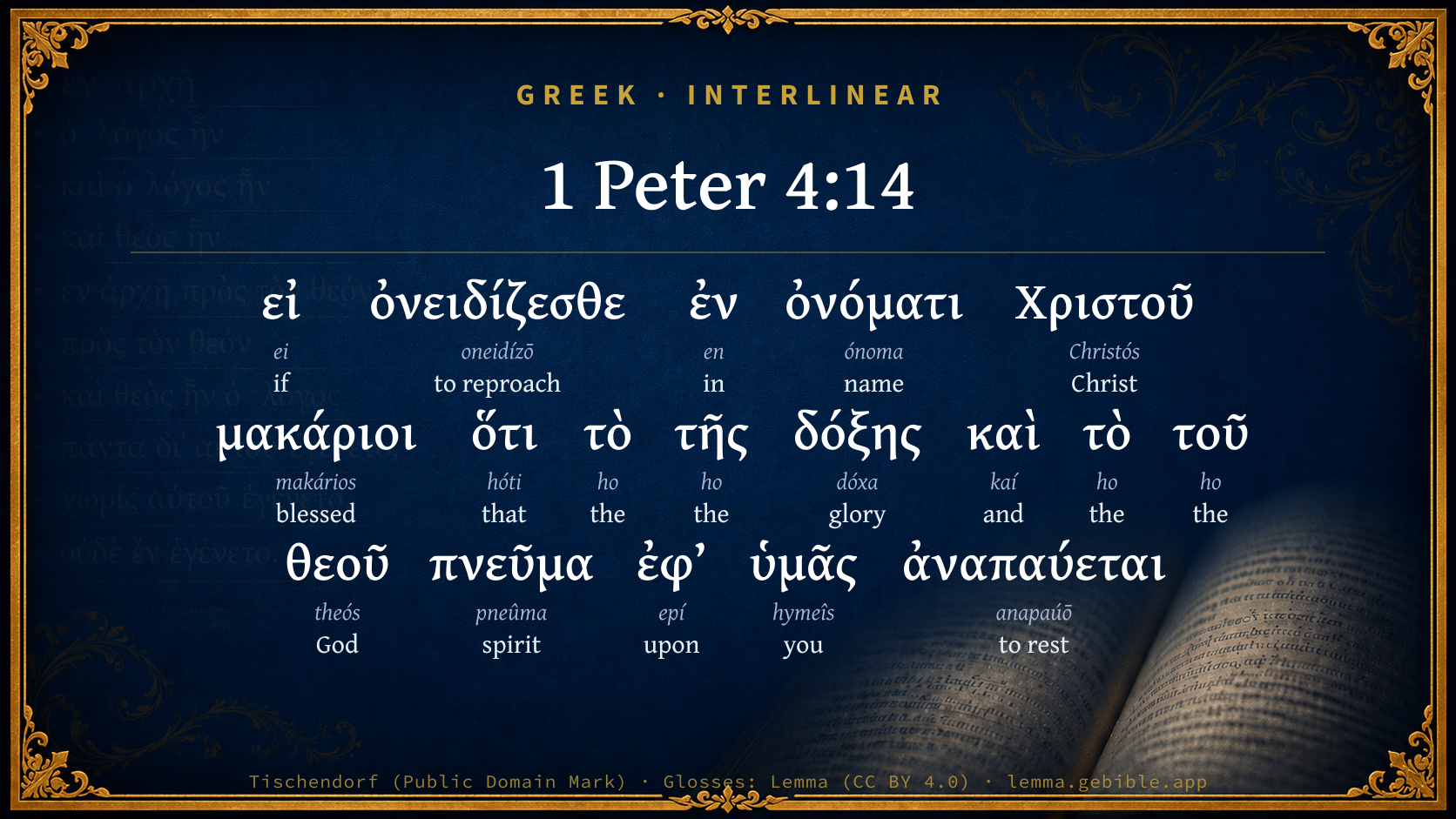
Greek (Tischendorf 8th ed.) 1 Peter 4:14 appears in the Greek New Testament. The text above is from the Tischendorf 8th edition. Each word links to its Strong’s number and a concise gloss. Click any word for its full Thayer’s Greek Lexicon entry.
Download image
Cite this verse

1 Peter 4:14 (World English Bible). Public Domain. Lemma interlinear Bible study tool, https://lemma.gebible.app/v/1-peter/4/14.

Show BibTeX & RIS
BibTeX
RIS
English Translation
If you are insulted for the name of Christ, blessed are you; because the Spirit of glory and of God rests on you. On their part he is blasphemed, but on your part he is glorified.
World English Bible · Public Domain
Download a study sheet

One document with this verse’s original text, its word-by-word gloss line, the meaning frame, cross-references with their text, attributed commentary, and full source and license credits — printable, and it pastes into notes with its structure intact.

This verse Autodidact and up

Study sheet (.html) Plain text (.txt)

A passage Seminary Student

Up to 50 verses in one chapter. A passage sheet keeps up to 6 commentary sources and 12 cross-references per verse, in the order this page ranks them, and says so on the sheet whenever that leaves anything out. Ask for a single verse and you get the Autodidact verse sheet above.

Everything on this page stays free to read, with no account — the sheet is a download of what is already on screen, not access to it.

Want to remove ads? Support Godless Engineer
Compare translations 3

The same verse in 3 English versions, stacked beneath the original-language interlinear above. Click any original word for its lexicon entry.

Each is an independent rendering of the whole verse — the interlinear is not word-aligned to these translations.

Highlighted words mark where these versions differ — a whole-verse word diff, not a word-by-word alignment.

  • World English Bible Public Domain
    If you are insulted for the name of Christ, blessed are you; because the Spirit of glory and of God rests on you. On their part he is blasphemed, but on your part he is glorified.
  • King James Version Public Domain
    If ye be reproached for the name of Christ, happy are ye; for the spirit of glory and of God resteth upon you: on their part he is evil spoken of, but on your part he is glorified.
  • unfoldingWord Literal Text CC BY-SA 4.0
    If you are reviled for the name of Christ, blessed ones because the Spirit of glory and of God rests on you.

unfoldingWord Literal Text — © unfoldingWord, licensed CC BY-SA 4.0. Word-aligned USFM3 via Door43 (git.door43.org/unfoldingWord/en_ult).

Versions to compare (up to 4)

3 of 4 selected

Show all 19 translations

Every available English version of this verse, each an independent rendering of the whole verse.

  • World English Bible Public Domain
    If you are insulted for the name of Christ, blessed are you; because the Spirit of glory and of God rests on you. On their part he is blasphemed, but on your part he is glorified.
  • Berean Standard Bible Public Domain
    If you are insulted for the name of Christ, you are blessed, because the Spirit of glory and of God rests on you.
  • Majority Standard Bible Public Domain
    If you are insulted for the name of Christ, you are blessed, because the Spirit of glory and of God rests on you. Indeed, on their part He is blasphemed, but on your part He is glorified.
  • King James Version Public Domain
    If ye be reproached for the name of Christ, happy are ye; for the spirit of glory and of God resteth upon you: on their part he is evil spoken of, but on your part he is glorified.
  • American Standard Version (1901) Public Domain
    If ye are reproached for the name of Christ, blessed `are ye'; because the `Spirit' of glory and the Spirit of God resteth upon you.
  • Revised Version (1885) Public Domain
    If ye are reproached for the name of Christ, blessed are ye; because the Spirit of glory and the Spirit of God resteth upon you.
  • Geneva Bible (1599) Public Domain
    If yee be railed vpon for the Name of Christ, blessed are ye: for the spirit of glory, and of God resteth vpon you: which on their part is euill spoken of: but on your part is glorified.
  • Douay-Rheims (1899) Public Domain
    If you be reproached for the name of Christ, you shall be blessed: for that which is of the honour, glory, and power of God, and that which is his Spirit, resteth upon you.
  • Young's Literal Translation Public Domain
    if ye be reproached in the name of Christ -- happy `are ye', because the Spirit of glory and of God upon you doth rest; in regard, indeed, to them, he is evil-spoken of, and in regard to you, he is glorified;
  • Literal Standard Version CC BY-SA 4.0
    if you are reproached in the Name of Christ—[you are] blessed, because the Spirit of glory and of God rests on you; in regard, indeed, to them, is evil spoken of Him, and in regard to you, He is glorified;
  • Unlocked Literal Bible CC BY-SA 4.0
    If you are insulted for Christ's name, you are blessed, because the Spirit of glory and the Spirit of God is resting on you.
  • unfoldingWord Literal Text CC BY-SA 4.0
    If you are reviled for the name of Christ, blessed ones because the Spirit of glory and of God rests on you.
  • Darby Bible Public Domain
    If ye are reproached in [the] name of Christ, blessed [are ye]; for the [Spirit] of glory and the Spirit of God rests upon you: [on their part he is blasphemed, but on your part he is glorified.]
  • World Messianic Bible Public Domain
    If you are insulted for the name of Messiah, you are blessed, because the Spirit of glory and of God rests on you. On their part he is blasphemed, but on your part he is glorified.
  • Webster's Bible Public Domain
    If ye are reproached for the name of Christ, happy are ye; for the spirit of glory and of God resteth upon you. On their part he is evil spoken of, but on your part he is glorified.
  • Free Bible Version CC BY-SA 4.0
    If you are cursed in Christ's name, you're blessed, for God's glorious Spirit rests on you.
  • Bible in Basic English Public Domain
    If men say evil things of you because of the name of Christ, happy are you; for the Spirit of glory and of God is resting on you.
  • Text-Critical English NT CC BY 4.0
    If you are reproached for the name of Christ, you are blessed, because the Spirit of glory and of God rests upon you. On their part he is blasphemed, but on your part he is glorified.
  • Tyndale New Testament (1534) Public Domain
    If ye be rayled vpon for the name of Christ happie are ye. For the sprete of glory and the sprete of god resteth apon you. On their parte he is evyll spoken of: but on youre parte he is glorified.

Literal Standard Version (2020), Covenant Press — licensed CC BY-SA 4.0. Text via the HelloAO Bible API (eBible.org). Unlocked Literal Bible (unfoldingWord) — licensed CC BY-SA 4.0. Text via the HelloAO Bible API (eBible.org). unfoldingWord Literal Text — © unfoldingWord, licensed CC BY-SA 4.0. Word-aligned USFM3 via Door43 (git.door43.org/unfoldingWord/en_ult). Free Bible Version, Dr. Jonathan Gallagher — licensed CC BY-SA 4.0. Text via the HelloAO Bible API (eBible.org).

Word by word

More ways to search: Search by grammar → Find every occurrence → Compare this word →

Practice this passage: Drill this verse → Learn its vocabulary →

ὀνειδίζεσθε
oneidízō
G3679
“to reproach”
Verb, Present, Passive, Indicative, 2nd person, Plural
Part of Speech
Verb
Tense
Present
Voice
Passive
Mood
Indicative
Person
2nd person
Number
Plural
Full Thayer's Definition

Origin: from G3681

TDNT: 08:59,7

1. to reproach, upbraid, revile a. of deserved reproach b. of undeserved reproach, to revile c. to upbraid, cast (favours received) in one's teeth
  1. εἰ ei G1487 “if” Conditional
  2. ἐν en G1722 “in” Preposition
  3. ὀνόματι ónoma G3686 “name” Noun, Dative, Singular, Neuter
  4. Χριστοῦ Christós G5547 “Christ” Noun, Genitive, Singular, Masculine
  5. μακάριοι makários G3107 “blessed” Adjective, Nominative, Plural, Masculine
  6. ὅτι hóti G3754 “that” Conjunction
  7. τὸ ho G3588 “the” Article, Nominative, Singular, Neuter
  8. τῆς ho G3588 “the” Article, Genitive, Singular, Feminine
  9. δόξης dóxa G1391 “glory” Noun, Genitive, Singular, Feminine
  10. καὶ kaí G2532 “and” Conjunction
  11. τὸ ho G3588 “the” Article, Nominative, Singular, Neuter
  12. τοῦ ho G3588 “the” Article, Genitive, Singular, Masculine
  13. θεοῦ theós G2316 “God” Noun, Genitive, Singular, Masculine
  14. πνεῦμα pneûma G4151 “spirit” Noun, Nominative, Singular, Neuter
  15. ἐφ’ epí G1909 “upon” Preposition
  16. ὑμᾶς hymeîs G5210 “you” Personal pronoun, 2nd person, Accusative, Plural
  17. ἀναπαύεται anapaúō G373 “to rest” Verb, Present, Middle, Indicative, 3rd person, Singular

About this verse

These counts appear in no published source. They are computed here, from the morphology-tagged text and Lemma’s own curated glosses. What Lemma adds →

18
words
15
distinct lemmas
General Epistles
section

Notable vocabulary

The rarest word here is ὀνειδίζεσθε to reproach G3679 — appearing just 9 times in the whole Greek New Testament.

Shared distinctive vocabulary

ὀνειδίζεσθε to reproach G3679 occurs in 9 verses of the Greek New Testament. Also found in:

Repetition

A word recurs within this verse:

Cross-references

31

Topical passages linked to 1 Peter 4:14 in the Treasury of Scripture Knowledge — connected by theme and wording, ordered by reader-vote popularity; previews shown in the World English Bible.

  • 1 Peter 3:14 But even if you should suffer for righteousness' sake, you are blessed. "Don't fear what they fear, neither be troubled."
  • Luke 6:22 Blessed are you when men shall hate you, and when they shall exclude and mock you, and throw out your name as evil, for the Son of Man's sake.
  • Matthew 5:11 "Blessed are you when people reproach you, persecute you, and say all kinds of evil against you falsely, for my sake.
  • James 1:12 Blessed is the man who endures temptation, for when he has been approved, he will receive the crown of life, which the Lord promised to those who love him.
  • 1 Peter 3:16 having a good conscience; that, while you are spoken against as evildoers, they may be disappointed who curse your good manner of life in Christ.
  • Psalms 146:5 Happy is he who has the God of Jacob for his help, Whose hope is in Yahweh, his God:
  • 2 Corinthians 12:10 Therefore I take pleasure in weaknesses, in injuries, in necessities, in persecutions, in distresses, for Christ's sake. For when I am weak, then am I strong.
  • 1 Peter 2:19–20 For it is commendable if someone endures pain, suffering unjustly, because of conscience toward God.
  • 2 Kings 2:15 When the sons of the prophets who were at Jericho over against him saw him, they said, The spirit of Elijah does rest on Elisha. They came to meet him, and bowed themselves to the ground before him.
  • Psalms 89:51 With which your enemies have mocked, Yahweh, With which they have mocked the footsteps of your anointed one.
  • Isaiah 51:7 Listen to me, you who know righteousness, the people in whose heart is my law; don't you fear the reproach of men, neither be you dismayed at their insults.
  • John 15:21 But all these things will they do to you for my name's sake, because they don't know him who sent me.
  • Matthew 5:16 Even so, let your light shine before men; that they may see your good works, and glorify your Father who is in heaven.
  • John 7:47–52 The Pharisees therefore answered them, "You aren't also led astray, are you?
  • John 9:34 They answered him, "You were altogether born in sins, and do you teach us?" They threw him out.
  • Acts 13:45 But when the Jews saw the multitudes, they were filled with jealousy, and contradicted the things which were spoken by Paul, and blasphemed.
  • 2 Thessalonians 1:10–12 when he comes to be glorified in his saints, and to be admired among all those who have believed (because our testimony to you was believed) in that day.
  • Hebrews 11:26 accounting the reproach of Christ greater riches than the treasures of Egypt; for he looked to the reward.
  • James 5:11 Behold, we call them blessed who endured. You have heard of the patience of Job, and have seen the Lord in the outcome, and how the Lord is full of compassion and mercy.
  • 1 Peter 2:12 having good behavior among the nations, so in that which they speak against you as evil-doers, they may by your good works, which they see, glorify God in the day of visitation.
  • Numbers 11:25–26 Yahweh came down in the cloud, and spoke to him, and took of the Spirit that was on him, and put it on the seventy elders: and it happened that when the Spirit rested on them, they prophesied, but they did so no more.
  • John 8:48 Then the Jews answered him, "Don't we say well that you are a Samaritan, and have a demon?"
  • John 9:28 They insulted him and said, "You are his disciple, but we are disciples of Moses.
  • Galatians 1:24 And they glorified God in me.
  • 1 Kings 10:8 Happy are your men, happy are these your servants, who stand continually before you, [and] who hear your wisdom.
  • Psalms 32:1–2 Blessed is he whose disobedience is forgiven, Whose sin is covered.
  • Psalms 49:9 That he should live on forever, That he should not see corruption.
  • Acts 18:6 When they opposed him and blasphemed, he shook out his clothing and said to them, "Your blood be on your own heads! I am clean. From now on, I will go to the Gentiles!"
  • 2 Peter 2:2 Many will follow their immoral ways, and as a result, the way of the truth will be maligned.
  • Isaiah 11:2 The Spirit of Yahweh shall rest on him, the spirit of wisdom and understanding, the spirit of counsel and might, the spirit of knowledge and of the fear of Yahweh.
  • 1 Peter 4:4–5 They think it is strange that you don't run with them into the same excess of riot, blaspheming:

Cross-references courtesy of OpenBible.info (CC BY 4.0).

Where the printed editions differ

1 variant

Places in this verse where the major printed Greek editions disagree on the wording in a way that affects the translation — a comparison of editions, not a manuscript-by-manuscript collation. The editions are the modern critical texts (Nestlé-Aland 28/27, SBL, Westcott-Hort, Tregelles, Tyndale House) and the traditional texts behind the KJV (the Textus Receptus and the Byzantine/Majority text). It is not a claim about which reading is original.

  1. Extra text
    κατὰ μὲν αὐτοὺς βλασφημεῖται κατὰ δὲ ὑμᾶς δοξάζεται.¶

    “according to indeed them he is blasphemed according to however you he is honored.”

    In TRByz Not in NA28NA27TynSBLWHTreg

    κατὰ μὲν αὐτοὺς βλασφημεῖται κατὰ δὲ ὑμᾶς δοξάζεται.¶ (kata men autous blasphēmeitai kata de humas doxazetai) 'according to indeed them he is blasphemed according to however you he is honored.' is only in traditional manuscripts (TR+Byz)

Textual data: Translators Amalgamated Greek New Testament (STEPBible TAGNT) · CC BY 4.0.

Commentary

Notes on 1 Peter 4:14 from classic Christian and Jewish commentators (each source and its license shown beneath its notes). The classic Christian expositions comment on the surrounding passage and are grouped to its opening verse, so a note may address several verses; the Jewish commentaries on the Tanakh (Rashi and others) are per-verse, so they appear only where the commentator wrote on this verse.

Lemma curates 59 commentaries, every one of them public domain or Creative Commons licensed, each selected and text-cleaned for this edition rather than reprinted as found. About our sources →

Joseph Benson's Commentary

1Pe 4:14-16. If ye be reproached for Christ — Reproaches and cruel mockings were always one part of their sufferings, and to an ingenuous mind, reproach is often worse than the spoiling of goods, or even than bodily pain; happy are you — The apostle alludes to Christ’s words, Mat 5:11, Blessed are ye when men shall revile you, &c. For the Spirit of glory and of God resteth upon you — Conquering all reproach, and spreading a lustre around you, while he supports and comforts you in a glorious manner under all your trials. The apostle alludes to Isa 11:2. “The Spirit of glory, which rested on the persecuted disciples of Christ in the first age, was a Spirit of fortitude, enabling them to suffer the greatest evils without shrinking, a virtue which the heathen greatly admired. For which reason, when they put the first Christians to death for refusing to worship idols, they were so struck with the constancy, patience, meekness, and benevolence wherewith they suffered, that it led many of them to think well, both of a religion which inspired its votaries with such admirable virtues, and of those votaries themselves. And as this constancy in suffering, from which the Christians derived so much glory, proceeded from the aid of the Spirit of God, the apostle justly termed it, both the Spirit of glory, and the Spirit of God.” — Macknight. But let none of you — Who have the honour to bear the Christian name; suffer — By your own fault; suppose as a murderer, or as a thief &c. — At the time St. Peter wrote this epistle, the unbelieving Jews in Judea were extremely addicted to murder and robbery, and every kind of wickedness, as we learn from Josephus; for they robbed and killed, not only the heathen, but their own brethren, who would not join them in their opposition to the Romans. Hence the apostle judged it proper to caution the Christians, especially the Jewish Christians, in this manner, lest, being corrupted by such bad examples, they should be led to the commission of any such crimes. As the apostle is here cautioning them against those sins which, if they committed them, would expose them to punishment from the civil magistrate, by αλλοτριοεπισκοπος, here rendered a busy-body in other men’s matters, he cannot well be supposed to mean merely one who pries into the concerns of private families, as such a one could not properly be ranked with such criminals as are here mentioned. But he might mean one that affected to inspect and direct the behaviour of persons in public offices, from a factious disposition to find fault with their conduct, and thereby to raise commotions in the state; which Lardner hath shown was the practice of the Jews in Alexandria, Cesarea, and other places. Or we may, with L’Enfant. understand the word in the more general sense of meddling with other people’s affairs, from avarice, anger, revenge, malice, or other bad passions. Yet if any man suffer as a Christian — That is, because he is a Christian; and if he suffer in a Christian spirit, let him not be ashamed — Of his sufferings; but let him glorify, or praise, God on this behalf — That is, for having judged him worthy to suffer in so good a cause; and for enabling him to do it with fortitude and patience. It may be proper to observe that this, with Act 11:26; Act 26:28, are the only passages of Scripture in which the disciples are called Christians, after their Master.

Joseph Benson's Commentary on the Old and New Testaments (1811–1818) — public domain. Text from a community e-Sword module.

Tyndale Open Study Notes

Tyndale Open Resources

4:14 If you are insulted because you bear the name of Christ, you will be blessed (literally you are blessed when you are reproached): This verse reflects Jesus’ teaching in Matt 5:11-12.

Tyndale Open Study Notes — © Tyndale Open Resources, licensed CC BY-SA 4.0. Text via the HelloAO Bible API.

Bengel's Gnomon

Johann Albrecht Bengel

1Pe 4:14. Εἰ ὀνειὸίζεσθε ἐν ὁνόματι Χριστοῦ, if ye are reproached in the name of Christ) The Gentiles thought it a reproach if they called any one a Christian: 1Pe 4:16.—τὸ τῆς δόξης καὶ τὸ τοῦ Θεοῦ Πνεῦμα, the Spirit of glory and of God) The same Spirit which was on Christ: Luk 4:18. He is here called the Spirit of glory, overcoming all the reproaches of the world, and the Spirit of God, whose Son is Jesus Christ. The abstract, glory, is put for the concrete; as 2Pe 1:17; 2Pe 1:3-4. The article τὸ is with great force put twice, as Apocalypse, Rev 21:6. And glory may be taken so as to be ἕν διὰ δυοῖν, Glory and God, that is, the God of glory, or as an appellation of Christ (comp. 1Pe 4:16, as a Christian, and 1Pe 4:13; Jas 2:1, note); and it may be implied that the Spirit of Christ is also the Spirit of God the Father. The faithful, deeply feeling joy, experience the same Spirit sometimes as the Spirit of Glory and sometimes as the Spirit of God, in a different sense, the difference of which the Spirit itself reveals.—ἐφʼ ὑμᾶς ἀναπαύεται, rests upon you) That spirit is upon the righteous even before they suffer reproaches; but then they are more confirmed on this very account, and receive more abundant consolations of the Spirit: Num 11:25-26, ἐπανεπαύσατο ἐπʼ αὐτοὺς τὸ πνεῦμα, the spirit rested upon them.—βλασφημεῖται, He is evil spoken of) namely, Christ.—δοξάζεται, He is glorified) in the midst of your reproaches, 1Pe 4:16. He writes from his own experience. Comp. Act 5:41.

Bengel's Gnomon of the New Testament — English translation (T&T Clark, Edinburgh, 1860) — public domain. Text from a community e-Sword module.

Meyer's Critical & Exegetical Commentary

Heinrich August Wilhelm Meyer

1Pe_4:14. In order to strengthen the exhortation: μὴ ξενίζεσθε … ἀλλὰ χαίρετε, Peter adds the assurance: εἰ ὀνειδίζεσθε κ.τ.λ.; cf. chap. 1Pe_3:14 and Mat_5:11.

Pott, without any reason, explains εἰ by καίπερ.

ἐν ὀνόματι Χριστοῦ] The explanation: propter confessionem Christi (de Wette), is inaccurate, for ὄνομα is not: confessio; the meaning is the same as that in Mar_9:41 : ἐν ὀνόματι, ὅτι Χριστοῦ ἐστέ, thus: because ye bear the name of Christ, and therefore belong to Him. Schott: for the sake of your Christian name and Christian profession; Steiger: as servants of Christ.

μακάριοι] sc. ἐστε.

ὅτι τὸ τῆς δόξης [καὶ δυνάμεως] καὶ τὸ τοῦ Θεοῦ πνεῦμα] δόξα: glory in its highest sense, heavenly, divine glory.[255] According to Greek usage, τὸ τῆς δόξης may be a circumlocution for ἡ δόξα; see Matth. ausf. Gr. Gram. 2d ed. § 284; but this form of expression does not occur elsewhere in the N. T. (Winer, p. 104 [E. T. 135]); nor is it easy to understand why the apostle should not simply have written ἡ δόξα. Accordingly, it is preferable to take τό with the subsequent πνεῦμα, and to assume an additional πνεῦμα (as is done by the greater number of commentators, de Wette, also Brückner, Wiesinger, Schott); the Spirit of Glory is, then, the same as that which is also the Spirit of God (καὶ τὸ τοῦ Θεοῦ πν. subjoined epexegetically). But in consideration of ὀνειδίζεσθε, He is styled the Spirit of δόξα, i.e. to whom δόξα belongs (Calvin: qui gloriam secum perpetuo conjunctam habet; cf. Eph_1:17), and who therefore also bestows it. τὸ τοῦ Θεοῦ is added in order to show that this Spirit of δόξα is none other than the Spirit of God Himself. It must be allowed that, on this interpretation, there is an inexactness of expression, καί being evidently out of place; cf. Plato, Rep. viii. 565: περὶ τὸ ἐν Ἀρκαδίᾳ τὸ τοῦ Διὸς ἱερόν; cf. Winer, p. 125 [E. T. 165].

Hofmann proposes, therefore, to supply to τό not πνεῦμα, but ὄνομα, from what precedes. But if Peter had had this thought in his mind, he would certainly have given definite expression to it; and it is self-evident, too, that on him who is reproached ἐν ὀνόματι Χριστοῦ, as a bearer of it, that name rests.

ἐφʼ ὑμᾶς ἀναπαύεται] after Isa_11:2, where the same expression is used of the πνεῦμα τ. Θεοῦ (in like manner ἐπαναπαύεσθαι, Num_11:25; 2Ki_2:15, LXX.; of εἰρήνη, Luk_10:6). The accus. ἐφʼ ὑμᾶς is to be explained as with ἔμεινεν, Joh_1:32; Wahl: demissus in vos requiescit in vobis; it points to the living operation of the Spirit on those upon whom He rests. The thought contained in these words gives the reason (ὅτι) of what has been said: not, however, the logical reason (Aretius: crux, quam bonus fert pro Christo, indicat, quod Spir. Dei in illo quiescat; similarly, too, Hofmann: they should consider themselves happy, that they are reproached for bearing the name of Christ; every such reproach reminds them of what, by bearing it, they are); but the actual reason, that is, inasmuch as this resting of the Spirit of δόξα, on those who are reproached ἐν ὀνόμ. Χριστοῦ, is a sealing of their eternal δόξα. It is inappropriate to insert, with Calvin, a nihilominus, so that the sense would be: in spite of that reproach, the Spirit of God still dwells in you; the more so that the reproach of unbelievers was called forth by the very fact, that the life of the Christians was determined by the Spirit which rested upon them.

In the additional clause found in the Rec., and connected with what goes before: κατὰ μὲν αὐτοὺς βλασφημεῖται, κατὰ δὲ ὑμᾶς δοξάζεται, the subject can hardly be πνεῦμα Θεοῦ taken from the explanatory clause immediately preceding, but is more probably ὄνομα Χριστοῦ from the previous clause, and on which the principal stress is laid. Schott wrongly thinks that this addition interrupts the connection of thought; but Hofmann is equally in error in holding the opposite opinion, that it is of necessity demanded by the γάρ, 1Pe_4:15; for γάρ may be equally well applied to the idea that the Spirit of God rests on those who are reproached ἐν ὀνόματι Χριστοῦ, as to this, that the name of Christ is glorified καθʼ ὑμᾶς. Since the rendering of κατά by with (as formerly in this comment.), or by on the part of (Hofmann), cannot be supported,[256] the meaning with regard to (de Wette) must be maintained. The interpretation will then be: by their … your conduct or according to their … your opinion.

[255] Bengel erroneously understands δόξα pro concrete, and that, ita ut sit appellatio Christi, adding: innuitur, Spiritum Christi eundem esse Spiritum Dei Patris.

[256] Although Hofmann appeals for this signification to chap. 1Pe_4:6, still, in interpreting that passage, he himself takes κατά in a sense other than it is supposed to have here.Pott uses the circumlocution κατὰ τὴν γνώμην αὐτῶν for κατὰ αὐτούς; whilst he explains κατὰ δὲ ὑμᾶς by quod autem ad vos attinet, i.e. vestra autem agendi ratione, although κατά must have the same meaning in both clauses.

Meyer — Critical and Exegetical Commentary on the New Testament — English translation by Peter Christie, edited by Frederick Crombie (T&T Clark, 1880) — public domain. Text from a community e-Sword module.

Expositor's Greek Testament

ed. W. Robertson Nicoll

1Pe 4:14 . The Beautitude, μακάριοι … ὅταν ὀνειδίσωσιν ὑμᾶς ἕνεκεν ἐμοῦ is supported by prophecy which referred originally to the root of Jesse. Both are partially paraphrased for sake of clearness. For ἐν ὀνόματι ; cf. Mar 9:41 , ἐν ὀνόματι ὅτι Χριστοῦ ἔστε . For the reproach cf. Heb 13:13 , let us come out to him bearing His reproach , with Psa 89 , so remember Lord the reproaches ( ὀνειδισμῶν LXX) of thy servants . ὅτι … ἀναπαύεται , quoted from a current Targum of Isa 11:1 f., a branch ( נצר : LXX, ἄνθος : Targ. Messiah ) from his roots shall grow and there shall rest upon him the spirit of Jehovah . An elaborate description of this spirit follows, which Peter summarises by τὸ τῆς δόξης . The Glory is a name of God in the Targums (so Joh 12:41 = Isa 6:5 ; Onkelos has יקרא די׳ for י׳ ) and its use here is probably due to the juxtaposition of Isa 11:10 , his rest shall be glorious . It is not impossible that καὶ τοῦ θεοῦ is an insertion by first or later scribes for the benefit of Greek readers.

The Expositor's Greek Testament, edited by W. Robertson Nicoll (1897–1910) — public domain. Text from a community e-Sword module.

Cambridge Greek Testament for Schools and Colleges

14. εἰ ὀνειδίζεσθε ἐν ὀνόματι Χριστοῦ, cf. Psa 89:50-51 “Remember, O Lord, the reproach of thy servants … wherewith they have reproached (ὠνείδισαν) the footsteps of thine anointed” (τοῦ χριστοῦ σου), cf. also Heb 11:26 τὸν ὀνειδισμὸν τοῦ χριστοῦ as preferred by Moses to all the treasures of Egypt, and Heb 13:13 “bearing His reproach,” also Psa 69:9 “the reproaches of them that reproached thee are fallen upon me.” This verse is an unmistakable echo of the beatitude in Mat 5:11. This is the only passage where the actual phrase ὄνομα Χριστοῦ occurs, and it is probably employed because it is as χριστιανοί that they are likely to suffer, but cf. Mar 9:41 ἐν ὀνόματι ὅτι Χριστοῦ ἐστε and see note on 1Pe 4:16.

τὸ τῆς δόξης καὶ τὸ τοῦ θεοῦ πνεῦμα ἐφʼ ὑμᾶς ἀναπαύεται. So BKL very many cursives, lat. vg. Syr. vg. Clem. Al. Cyr. Al. Tert. Fulg., but the lat. vg. and Sy. vg. omit καὶ.

But אAP many good cursives, Ath. Did. Cyp. (twice) add καὶ δυνάμεως after δόξης and have various modifications, e.g. good cursives, many versions and Cyprian omit καὶ τὸ and the best cursives Syr. hl. and Cyr. have ὄνομα either instead of or combined with πνεῦμα.

Syrp. reads quia nomen et spiritus gloriae et virtutis (= δυνάμεως) dei. Sah.: spiritus gloriae et virtutis dei. Vged.: quoniam quod est honoris gloriae et virtutis dei et qui est ejus spiritus, where quod may agree with nomen understood, or τὸ τῆς δόξης was taken in the sense “that which appertains to the glory.”

At the end of the verse the T.R. with KLP Vulg. Syr. hl. * Theb. and Cyp. (twice) adds κατὰ μὲν αὐτοὺς βλασφημεῖται κατὰ δὲ ὑμᾶς δοξάζεται, and in lat. codd. and Cyp. this is introduced with quod evidently agreeing with nomen. This addition (not found in אAB some cursives Vulg. some codd. Syr. vg. hl. txt. Memph. Arm. Ephr. Tert.) was evidently intended as an explanation of ὀνειδίζεσθε ἐν ὀνόματι Χρίστου. ὅτι τὸ (ὄνομα) τῆς δόξης ἐφʼ ὑμᾶς ἀναπαύεται. Its phraseology is borrowed from Rom 2:24 (from Isa 52:5) (cf. Jas 2:7; Rev 13:6; Rev 16:9), coupled with 1Pe 4:16 of this chapter δοξαζέτω τὸν θεὸν ἐν τῷ ὀνόματι τούτῳ.

It is possible that some of the numerous various readings in this passage were liturgical insertions borrowed from early forms of the Lord’s Prayer. In Luk 11:2 D reads ἁγιασθήτω τὸ ὄνομά σου ἐφʼ ἡμᾶς (d super nos). This addition of ἐφʼ ἡμᾶς Dr Hort (following Sanday) suggests may be a trace of a clause sometimes used in the Lord’s Prayer, probably when the prayer was used at “the laying on of hands,” ἐλθέτω τὸ πνεῦμά σου (τὸ ἅγιον) ἐφʼ ἡμᾶς (καὶ καθαρισάτω ἡμᾶς). This addition is found in Cod. Ev. 604 = 700 Gregory, and the first part of it seems certainly to have been known to Tertullian (adv. Marcion. iv. 26 where the argument implies that Marcion used this form) and Gregory Nyss. (de Orat. Dom.), also Maximus (VII cent.).

Dr Chase, however (Texts and Studies, The Lord’s Prayer in the Early Church), argues that there were two separate developments of petitions in the Lord’s Prayer, (a) a clause asking that the Holy Spirit may come upon us, used at the laying on of hands, and thence passing into a liturgical form used in eucharistic prayers (e.g. in the Didache), (b) at Baptism the clause Hallowed be Thy Name was expounded as being the Name τὸ ἐπικληθὲν ἐφʼ ἡμᾶς or ὃ κατεσκήνωσας ἐν ταῖς καρδίαις ἡμῶν (see the Eucharistic thanksgiving, Didache X.) cf. Jer 7:12; Neh 1:9.

The preceding liturgical doxology in 1Pe 4:11 might not unnaturally suggest reminiscences of the Lord’s Prayer and account for such insertions as καὶ δυνάμεως (lat. virtutis), δόξα καὶ δύναμις being one of the earliest forms of doxology added to the Lord’s Prayer (e.g. in the Didache).

The absence of πνεῦμα or its equivalent in some texts and the substitution or addition of ὄνομα may suggest that the original reading was merely τὸ τῆς δόξης τοῦ θεοῦ or τὸ τῆς δόξης τοῦ θεοῦ ὄνομα. If no substantive was expressed ὄνομα would be supplied from the preceding verse while πνεῦμα would be a natural insertion from Isa 11:2 ἀναπαύσεται ἐπʼ αὐτὸν πνεῦμα Κυρίου, and such an insertion might further be facilitated by liturgical forms of the Lord’s Prayer. If the original reading was θεουονομα it might easily be altered into θεουπνευμα θεουπνα, the letters ον being omitted from their similarity to the preceding ου.

τὸ τῆς δόξης. The A.V. and R.V. supply πνεῦμα. There is no parallel for the phrase τὸ πνεῦμα τῆς δόξης (but cf. ὁ θεὸς τῆς δόξης, Act 7:2; τὸν Κύριον τῆς δόξης, 1Co 2:8). The Holy Spirit is however described as τὸ πνεῦμα τῆς ἀληθείας, and as His work is to “glorify” Christ by revealing Him (Joh 16:14) He might in that sense be described as τὸ πνεῦμα τῆς δόξης. Or τῆς δόξης may be taken as a title of Christ. So Mayor on Jas 2:1 adopts a suggestion of Bengel that τῆς δόξης means that Jesus Christ is the true Shekinah or visible manifestation of God, just as He is the Λόγος or Word of God. In support of this view Bengel quotes this passage in 1 Pet. and Eph 1:17, ὁ θεὸς τοῦ Κ. ἡμῶν Ἰ. Χ. ὁ πατὴρ τῆς δόξης, and Luk 2:32, to which Mayor adds Joh 1:14; Heb 1:3, etc. According to this view τὸ πνεῦμα τῆς δόξης would mean “the Spirit of Christ who is the visible manifestation of God,” and the passage might thus be quoted in support of the clause in the Creed, “who proceedeth from the Father and the Son.” But if πνεῦμα governs τῆς δόξης, καί should be translated “even,” otherwise the second τό would strictly imply that the Spirit of God is another Spirit.

It is therefore better to take τὸ τῆς δόξης as a substantival expression meaning “the mark or characteristic of the glory.” For the neuter article thus used with a genitive, cf. Mat 21:21, τὸ τῆς σύκης; Jas 4:14, τὸ τῆς αὔριον; 2Pe 2:22, τὸ τῆς παροιμίας; cf. τὰ τῆς σαρκός, Rom 8:5; τὰ τῆς εἰρήνης, Rom 14:19. St Peter regards suffering as the necessary mark or characteristic of glory under present conditions. As members of Christ Christians will ultimately share in the revelation of His glory, i.e. manhood perfected and summed up in Christ. Here and now they participate in the preliminary stages of that glory by personal fellowship in His sufferings. To be reproached in the name of Christ is an indication that the glory is already resting upon them. So it was of His approaching sufferings that the Incarnate Christ said “now is the Son of Man glorified and God is glorified in Him” (Joh 13:31), cf. Col 1:24; Col 1:27; 2Co 4:17; Eph 3:13.

The above idea of suffering as a characteristic of glory would be equally intended if St Peter was referring to the Shekinah as the glory which was resting upon his readers. St Paul uses ἡ δόξα in that sense in Rom 9:4 (? cf. Heb 1:3; Heb 9:5; 2Pe 1:17). It is possible also that Jas 2:1 may mean that Jesus Christ is present as the true Shekinah among those who are gathered together in His name (Mat 18:20), cf. Pirke Aboth, iii. 3: Whenever two men sit together and are occupied with the words of the Torah, the Shekinah is with them.

There are also probable allusions to the Shekinah in passages where σκηνὴ and σκηνοῦν are used apparently as a transliteration of the Hebrew word שׁכן, שְׁכִינָה e.g. Joh 1:14, ὁ λόγος ἐσκήνωσεν ἐν ἡμῖν καὶ ἐθεασάμεθα τὴν δόξαν αὐτοῦ. Rev 21:3, ἰδοὺ ἡ σκηνὴ τοῦ θεοῦ μετὰ τῶν ἀνθρώπων καὶ σκηνώσει μετʼ αὐτῶν.

So in this passage St Peter goes on to describe the sufferings of Christians as a judgment which begins with the House of God, apparently meaning the temple and referring to Eze 9:6 “begin at my sanctuary.” Similarly in speaking of their sufferings as a πύρωσις or “trial by fire” he may be alluding to Mal 3:1-5 where the Lord is described as visiting His temple like a refiner’s fire. St Peter has already described His readers as being built up as a πνευματικὸς οἶκος, 1Pe 2:5, and the reference to “the House of God” in 1Pe 4:17 would be more intelligible if he had just described Christians as the resting-place of the Shekinah. This interpretation might give some support to the view that ὄνομα should be understood with τὸ τῆς δόξης. In the O.T. “The Name of God” (see Westcott, Epp. S. Jn, 232) denotes the manifestation of Himself which God has been pleased to give, and “the Name” and “the glory” are closely allied.

Thus 1Ki 8:20, Solomon’s Temple is built for “the Name of the Lord,” and 1Pe 4:11, “the glory of the Lord filled the House.” So St Peter may mean that in bearing “the Name of Christ” Christ as the Shekinah is resting upon them, and the present manifestation of “Christ in them” is their fellowship in His sufferings.

It may be of interest to compare Rev 13:6 where the Beast who makes war against the Saints is described as “blaspheming the Name of God and His tabernacle” (σκηνή), which Andreas explains thus σκηνὴ δὲ τοῦ θεοῦ καὶ ἡ ἐν σαρκὶ τοῦ λόγου σκήνωσις καὶ ἡ ἐν τοῖς ἁγίοις ἀνάπαυσις (cf. Rev 7:15).

Cambridge Greek Testament for Schools and Colleges (Cambridge University Press, 1896; 21 vols, various authors incl. Carr, Maclear, Plummer, Farrar, Lumby, Moule, M. R. James, Simcox) — public domain. Text from a community e-Sword module.

Geneva Bible (1599)

Geneva Bible translators

By Spirit he meaneth the gifts of the Spirit.

Secondly, because that although the infidels think far otherwise, who in afflicting the godly, blaspheme God, yet the godly in that they are so railed upon, are honored of God with the true spiritual glory, and their adoption sealed in them by the Spirit of God.

Geneva Bible (1599) marginal notes — public domain. Text via Bolls.life.

Jamieson, Fausset & Brown

Robert Jamieson, A. R. Fausset & David Brown

for--Greek, "IN the name of Christ," namely, as Christians (Pe1 4:16; Pe1 3:14, above); "in My name, because ye belong to Christ." The emphasis lies on this: Pe1 4:15, "as a murderer, thief," &c., stands in contrast. Let your suffering be on account of Christ, not on account of evil-doing (Pe1 2:20).

reproached--Reproach affects noble minds more than loss of goods, or even bodily sufferings.

the spirit . . . upon you--the same Spirit as rested on Christ (Luk 4:18). "The Spirit of glory" is His Spirit, for He is the "Lord of glory" (Jam 2:1). Believers may well overcome the "reproach" (compare Heb 11:26), seeing that "the Spirit of glory" rests upon them, as upon Him. It cannot prevent the happiness of the righteous, if they are reproached for Christ, because they retain before God their glory entire, as having the Spirit, with whom glory is inseparably joined [CALVIN].

and of God--Greek, "and the (Spirit) of God"; implying that the Spirit of glory (which is Christ's Spirit) is at the same time also the Spirit of God.

on their part he is evil spoken of, but on your part he is glorified--omitted in the two oldest Greek manuscripts and Syriac and Coptic versions, but supported by one very old manuscript, Vulgate, Sahidic, CYPRIAN, &c. "Evil spoken of," literally, "blasphemed"; not merely do they "speak against you," as in Pe1 3:16, but blasphemously mock Christ and Christianity itself.

Jamieson, Fausset & Brown — Commentary Critical and Explanatory on the Whole Bible (1871) — public domain (CC PDM 1.0). Text via the HelloAO Bible API.

Adam Clarke's Commentary

Verse 14. If ye be reproached for the name of Christ] To be reproached for the name of Christ is to be reproached for being a Christian, that is, for being like Christ. This is the highest honour to which any man can arrive in this world, and therefore the apostle says to such? Happy are ye.

The Spirit of glory and of God resteth upon you] As this Divine Spirit rested upon Jesus, so does it rest upon his persecuted followers. There is a various reading here, και δυναμεως, and of power, which is found in some of the chief MSS., (the Codex Alexandrinus, and above twenty others,) the later Syriac, all the Arabic, Coptic, AEthiopic, Armenian, Vulgate, some copies of the Itala, Athanasius, Theophylact, Cyprian, and Cassiodorus; and in them the whole verse reads thus: If ye be reproached for the name of Christ, happy are ye; for the Spirit of glory, AND OF POWER, and of God, resteth upon you. This is agreeable to our Lord's words, Mat 5:11-12. So that what constituted them unhappy in the sight of the world was their chief happiness in the sight of God; they carried Christ the fountain of blessedness in their heart, and therefore could not be unhappy.

On their part he is evil spoken of] καταμεναυτους Κατα μεν αυτους βλασφημειται, κατα δε ὑμας δοξαζεται· By them he is blasphemed, by you he is honoured.

Adam Clarke's Commentary on the Bible (1810–1826) — public domain. Text from a community e-Sword/MySword module.

John Calvin's Commentaries

14 If ye be reproached He mentions reproaches, because there is often more bitterness in them than in the loss of goods, or in the torments or agonies of the body; there is therefore nothing which is more grievous to ingenuous minds. For we see that many who are strong to bear want, courageous in torments, nay, bold to meet death, do yet succumb under reproach. To obviate this evil, Peter pronounces those blessed, according to what Christ says, (Mark 8:35,) who are reproached for the sake of the Gospel. This is very contrary to what men commonly think and feel; but he gives a reason, Because the Spirit of God, called also the Spirit of glory, rests on them. Some read the words separately, “that which belongs to glory,” as though the words were, “glory and the Spirit of God.” But the former reading is more suitable as to the sense, and, as to language, more simple. Then Peter shews, that it is no hindrance to the happiness of the godly, that they sustain reproach for the name of Christ, because they nevertheless retain a complete glory in the sight of God, while the Spirit, who has glory ever connected with him, dwells in them. So, what seems to the flesh a paradox, the Spirit of God makes consistent by a sure perception in their minds.

On their part This is a confirmation of the last sentence; for he intimates that it is enough for the godly, that the Spirit of God testifies that the reproaches endured for the sake of the Gospel, are blessed and full of glory. The wicked, however, attempted to effect a far different object; as though he had said, “Ye can boldly despise the insolence of the ungodly, because the testimony respecting your glory, which God’s Spirit gives you, remains fixed within.” And he says that the Spirit of God was reproached, because the unbelieving expose to ridicule whatever he suggests and dictates for our consolation. But this is by anticipation; for however the world in its blindness may see nothing but what is disgraceful in the reproaches of Christ, he would not have the eyes of the godly to be dazzled with this false opinion; but on the contrary they ought to look up to God. Thus he does not conceal what men commonly think; but he sets the hidden perception of faith, which God’s children possess in their own hearts, in opposition to their presumption and insolence. Thus Paul boasted that he had the marks of Christ, and he gloried in his bonds. (Galatians 6:17.) He had at the same time sufficiently found out what was the judgment formed of them by the world; and yet he intimates that it thought foolishly, and that those are blind together with the world, who esteem the slanders of the flesh glorious.

John Calvin's Commentaries (1540-1563) — public domain. Text from the Calvin Translation Society English edition (1840s-50s) via the Christian Classics Ethereal Library (ccel.org). Calvin's coverage is partial (roughly two-thirds of the Bible); uncommented books and verses are honest gaps, never fabricated. The 19th-century editor's footnotes and remarks are omitted so the notes are faithfully Calvin's own voice.

Ellicott's Commentary for English Readers

(14) If ye be reproached.—The form of speech denotes that they were so reproached.

For the name of Christ.—Literally, “in the name of Christ,” i.e., on the score of being Christians only. (Comp. 1Pe_4:16.) Again, see how St. Peter presses the Messianic title: surely they will not abandon the hopes of Israel!

The spirit of glory and of God resteth upon you.—He is called the “Spirit of glory” here in the same way as He is called the “Spirit of truth” Joh_14:17), the “Spirit of holiness” (Rom_1:4), the “Spirit of grace” (Heb_10:29), &c. It expresses that glory—i.e., the triumphant manifestation of perfections—is His gift and His distinguishing sign and the atmosphere in which He lives. “Glory” stands in contrast with “reproach.” And lest it should be doubted who was meant by the splendid phrase, the Apostle adds, “and of God.” All “glory” is His, and therefore the Spirit which is the “Spirit of glory” can be no other than the “Spirit of God;” but as God Himself is greater than His own glory, the words form a climax, and it means more to call Him the “Spirit of God” than to call Him the “Spirit of glory.” And this Spirit “resteth” upon the persecuted Christians. It means far more than “remaineth” or “abideth.” It expresses the complete repose and satisfaction with which the Spirit of glory abides on men who have the hearts of martyrs. “This shall be My rest for ever: here will I dwell, for I have a delight therein.” It is the word which is used of the quiet retreat which our Lord took after John’s death (Mar_6:31; of the calm relief which He offers to the weary souls who come to Him (Mat_11:28-29); of the repose of the blessed dead after the work of life is over (Rev_6:11; Rev_14:13). In the Old Testament it is used of the Spirit in Num_11:25, and 2Ki_2:15; but, above all, in Isa_11:2, which was probably in St. Peter’s mind. And the argument is, that reproach for the name of the Christ is a proof of glory in reserve, or rather, already belonging to the man. Perhaps St. Peter intentionally hints (in speaking of the “Spirit”) that all who make themselves partakers of Christ’s reproach are made partakers of His chrism.

On their part.—These words, to the end of the verse, are an undoubted interpolation, though of very early date, appearing even in St. Cyprian’s works. The clause would bring out the different view taken by believers and unbelievers of the martyr-spirit. Pliny says in his letter that, whatever Christianity itself may be, there can be no doubt such obstinacy ought to be punished. Marcus Aurelius speaks with contempt of the spirit in which Christians suffered themselves to be put to death as mere self-will, unlike the philosophical grace of the Stoics. Gibbon speaks of the “pious obstinacy” of St. Felix of Tibiura.

A Bible Commentary for English Readers, edited by Charles John Ellicott (1878–1897) — public domain. Text from a community e-Sword module.

The Cambridge Bible for Schools and Colleges

gen. ed. J. J. S. Perowne

14. If ye be reproached for the name of Christ] Literally, in the name of Christ. As in chap. 1Pe_3:14, “If ye suffer for righteousness’ sake,” we found an echo of one beatitude (Mat_5:10), so in this we have the counterpart of the more personal “for my sake” of Mat_5:11. It would be better, as indicating the reference to the beatitudes, to render the adjective by blessed rather than happy.

the Spirit of glory and of God resteth upon you] The English version is tenable, but the construction of the sentence is peculiar and admits of a different rendering, “the principle or element of glory, and the spirit of God, resteth on you.” In either case what is emphasized is the fact that the outward reviling to which the disciples were exposed brought glory and not dishonour. The Spirit of Glory was there—who has glory as His essential attribute—and that Spirit was none other than the very Spirit of God. Looking to the connexion between the “glory” of the Shechinah-cloud which was the witness of the Divine Presence, and that which dwelt in Christ as the only-begotten of the Father (Joh_1:14), it is possible that the words “the Spirit of Glory” may be equivalent to the “Spirit of Christ.” The use of the word for “rest” throws us back upon the occurrence of the same verb in the LXX. version of Num_11:25, 2Ki_2:15. The thought of the Apostle, in this respect true to his citation from Joel 2. in Act_2:16-18, is that the humblest sufferers for the name of Christ are as truly sharers in the gift of the Eternal Spirit as were the greatest prophets. It “rests” on them—not coming and going, in fitful movements, or extraordinary manifestations, but dwelling with them continually.

on their part he is evil spoken of] It is remarkable that the whole of this clause is omitted in many of the best MSS. and versions, including the Sinaitic. On the assumption to which this fact has led most recent Editors, that it was not part of the original text, we must think of it either as a marginal note that has found its way into the text, or, as an addition made in a second transcript of the Epistle by the writer himself. Here the word for “is evil spoken of” would rightly be rendered as blasphemed, and “Christ” or “the Spirit of God” must be taken as the subject of the sentence. In this case, that of suffering for the truth, the very blasphemies which men utter in their rage, are a witness to the effective work which has been done through the power of the Spirit, and in respect of those who suffer, are working for His glory. Appalling as is the contrast between the blasphemy of the persecutors and the doxologies of the sufferer, the one is almost the necessary complement of the other.

The Cambridge Bible for Schools and Colleges (gen. ed. J. J. S. Perowne; Cambridge University Press, 1878–1918) — public domain. Text from a community e-Sword module.

John Gill's Exposition

If ye be reproached for the name of Christ,.... For being called by his name; for bearing the name of Christians; for believing in him, and professing him; and for the sake of his Gospel, which is sometimes called his name, Act 9:15 not that the apostle makes any doubt of this, for nothing is more certain than that the saints shall be reproached, and all manner of evil spoken of them falsely for Christ's name sake; but he supposes it, and takes it for granted, that they are, and will be reproached, and yet pronounces them blessed persons:

happy are ye; some supply it, "shall ye be", as the Vulgate Latin version; that is, in the other world, because the kingdom of heaven, the crown of life and glory, belongs to such persons; they will be happy at death, in judgment, and to all eternity: others, with our translators, supply, "are ye", as the Syriac, Arabic, and Ethiopic versions; for such are happy now in themselves, being both comfortable in their frames, and honourable in their persons and characters, however uncomfortable, miserable, and dishonourable they may appear to the men of the world:

for the Spirit of glory, and of God, resteth upon you; alluding to Isa 11:2 that is, the glorious Spirit of God, as the Syriac version renders it; who is glorious in himself, in the perfections of his nature, being possessed of the same glorious divine essence with the Father and Son; and in his works both of nature, being equally concerned with the other Persons in the Godhead in the works of creation and providence, and also of grace, especially the latter; and in all his gifts and graces with which he adorns the saints, and makes them glorious: and his resting on them denotes his inhabitation in them, and his abiding with them, and remaining in them; and which appears by the comfort they enjoy in their souls amidst all the reproaches and revilings of men, and by the strength which they have to bear up under and endure shame and persecution for the sake of Christ; and which casts an honour upon them, and makes them both glorious and cheerful. The Jews have a saying (n), that the Holy Ghost does not dwell on any, but on him that has a cheerful heart:

on their part he is evil spoken of, but on your part he is glorified: on the part of the revilers, the person, office, work, and grace, the operations and influences of the Spirit are blasphemed and ridiculed; the power of the Spirit, with which the saints speak, the experiences of grace they express, the comforts of the Spirit they declare that they enjoy under suffering circumstances, as well as their courage, patience, and cheerfulness he gives them, are generally bantered by persecutors; and indeed all the reproaches they cast upon the people of God fall upon the Spirit of God, by whom they are animated and influenced: but on the part of the sufferers he is glorified; inasmuch as they continue to bear a testimony to his grace, depend upon his strength, and ascribe all their comfort and gracious experience unto him. This clause is wanting in the Vulgate Latin, Syriac, and Ethiopic versions, but is in all Beza's Greek copies, excepting one; and is also in the Arabic version.

(n) T. Hieros. Succa, fol. 55. 1.

John Gill's Exposition of the Whole Bible (1746–1763) — public domain (CC PDM 1.0). Text via the HelloAO Bible API.

Trapp's Complete Commentary

John Trapp

14 If ye be reproached for the name of Christ, happy are ye; for the spirit of glory and of God resteth upon you: on their part he is evil spoken of, but on your part he is glorified.

Ver. 14. Happy are ye] μακαριοι. {See Trapp on "Mat 5:11"} {See Trapp on "Mat 5:12"} The word signifies, ye are out of harm’s way; out of the reach of danger.

Resteth upon you] αναπεπαυται, with great delight and content. How strangely were the holy martyrs spiritualized and elevated, carried out of themselves and beyond themselves, as were easy to instance. We read of some godly men so overwhelmed with joy, that they have cried out, Hold, Lord; stay thine hand, I can bear no more! like weak eyes that cannot bear too great a light. "The Spirit of glory and of God" is by the Syriac interpreter rendered "the glorious Spirit of God."

Resteth upon you] sc. by divine abode or dwelling, which the Hebrews call Shechinah. The heart of a believer reproached for the name of Christ is no private place; but a place where God taketh pleasure. It is the house of God; and opposite it is the gate of heaven. He seems here to allude to Isa 4:5.

John Trapp, A Commentary or Exposition upon All the Books of the Old and New Testament (1647–1656) — public domain. Text from a community e-Sword module.

Albert Barnes' Notes on the Bible

If ye be reproached for the name of Christ, happy are ye - That is, in his cause, or on his account. See the notes at Mat 5:11. The sense of the word “happy” here is the same as “blessed” in Mat 5:3-5, etc. It means that they were to regard their condition or lot as a blessed one; not that they would find personal and positive enjoyment on being reproached and vilified. It would be a blessed condition, because it would be like that of their Saviour; would show that they were his friends; would be accompanied with rich spiritual influences in the present world; and would be followed by the rewards of heaven.

For the spirit of glory and of God resteth upon you - The glorious and Divine Spirit. There is no doubt that there is reference here to the Holy Spirit; and the meaning is, that they might expect that that Spirit would rest upon them, or abide with them, if they were persecuted for the cause of Christ. There may be some allusion here, in the language, to the fact that the Spirit of God descended and abode on the Saviour at his baptism Joh 1:33; and, in like manner, they might hope to have the same Spirit resting on them. The essential idea is, that, if they were called to suffer in the cause of the Redeemer, they would not be left or forsaken. They might hope that God would impart his Spirit to them in proportion to their sufferings in behalf of religion, and that they would have augmented joy and peace. This is doubtless the case with those who suffer persecution, and this is the secret reason why they are so sustained in their trials. Their persecutions are made the reason of a much more copious effusion of the Spirit on their souls. The same principle applies, doubtless, to all the forms of trial which the children of God pass through; and in sickness, bereavement, loss of property, disappointment in their worldly plans, and death itself, they may hope that larger measures of the Spirit’s influences will rest upon them. Hence, it is often gain to the believer to suffer.

On their part - So far as they are concerned; or by them.

He is evil spoken of - That is, the Holy Spirit. They only blaspheme him, (Greek;) they reproach his sacred influences by their treatment of you and your religion.

But on your part he is glorified - By your manner of speaking of him, and by the honor done to him in the patience evinced in your trials, and in your purity of life.

Albert Barnes' Notes on the Bible (1834–1885) — public domain. Text from a community e-Sword/MySword module.

Haydock's Catholic Bible Commentary

Which is of the honour, glory, &c. He gives them the reason why they must rejoice and look upon themselves happy to suffer for the name of Christ, because to suffer for God’s sake is glorious, is a mark that the glorious, the honourable, and the powerful spirit of God rests upon them: for as Paul said, (Hebrews xii. 6.) "For whom the Lord loveth, he chastiseth; and he scourgeth every son whom he receiveth." Nothing then is more honourable, nothing more advantageous, than to suffer for being a Christian. This word is only found here, and Acts xi. 26. (Witham)

George Leo Haydock (1774–1849), Haydock's Catholic Family Bible and Commentary, 1859 edition — public domain. Excludes Psalms (Douay-Rheims chapter numbering differs from Protestant) and Deuterocanonical books (Catholic canon only).

Matthew Poole's English Annotations

Happy are ye; viz. because of the Spirit’s dwelling in you, which is both the means and evidence of your happiness.

The spirit of glory and of God; i.e. the glorious Spirit of God, or that Spirit of God which is likewise a Spirit of glory, as being not only glorious in himself, but a glory to them in whom he dwells, and the cause of their future glorification. This he adds in counterbalance to the reproaches they suffered for the name of Christ; q.d. It is a greater glory to you to have the Spirit of Christ dwelling in you, (whereof your patient bearing reproaches and persecutions is an argument), than all the calumnies and obloquies wherewith your enemies load you can be a shame to you.

Resteth upon you: in allusion to Isa 11:2; dwells in you, and shall abide with you for ever, Joh 14:16, not leaving you in your sufferings.

On their part he; either Christ, or rather the Spirit.

Is evil spoken of; the reproaches your enemies cast upon you, reach that Spirit himself that dwells in you, when they revile that good confession into which the Spirit led you, deride the consolations he gives you, and speak evil of your persons, who are the temples in which he dwells.

But on your part he is glorified; viz. by your patience and constancy in your sufferings, which shows forth the power of that Spirit which resteth upon you, in that he works so mightily in you, as to enable you to bear what without the assistance of his grace were intolerable.

Matthew Poole's English Annotations on the Holy Bible (1683–1685) — public domain. Text from a community e-Sword/MySword module.

Whedon's Commentary on the Bible

Daniel D. Whedon

14. Reproached—Railed at and assailed with opprobrious epithets. The apostle doubtless alludes to our Lord’s words in Mat_5:11.

Happy—Blessed. See notes on 1Pe_3:14.

The Spirit—The Holy Spirit, who rested on Christ, resteth upon you, filling your souls with glory and the presence of God. A blessed compensation truly for the patient endurance of unmerited reproaches.

Evil spoken of—On the part of the persecutors Christ is blasphemed; on the part of the reviled Christians he is glorified.

Daniel D. Whedon (gen. ed.), Commentary on the Old and New Testaments (1874–1909) — public domain. Text from a community e-Sword module.

The Pulpit Commentary

If ye be reproached for the Name of Christ, happy are ye; rather, if ye are reviled in the -Name of Christ, blessed are ye. There is, again, a manifest quotation of our Lord"s words in Mat_5:11. The conjunction "if" does not imply any doubt: the words mean "when ye are reviled." For "in the Name of Christ," comp. Mar_9:41, "Whosoever shall give you a cup of water to drink in my Name, because ye belong to Christ." So here the meaning is, When ye are reviled because ye belong to Christ, because ye bear his Name, because ye are Christians". (comp. Act_5:41) For the Spirit of glory and of God resteth upon you. The form of the sentence in the Greek is unusual. Some regard the first clause, toxhv, as a periphrasis for doxa, and translate, "For glory and the Spirit of God resteth upon you." But there is no other instance of such a periphrasis in the New Testament (Winer, 3:18. 3); it is better to supply pneuma. M en revile them, but God glorifieth them. The Spirit of glory, the Spirit which hath the glorious attributes of God, the Spirit which proceedeth from the Father who dwelleth in the glory, in the Shechinah, that Spirit resteth upon them, and sheds on them the glory of holy suffering, the glory which hung around the cross of Christ. Two of the most ancient manuscripts, with some others, insert the words kaimewv, "the Spirit of glory, and of power, and of God." The Spirit is power from on high. (Luk_24:49) (For "resteth," comp. Isa_11:2) jEpi with the accusative suggests the thought of the Spirit descending upon them and resting there. (comp. Joh_1:32, Joh_1:33) The Spirit abides upon those who patiently suffer for Christ. On their part he is evil spoken of, but on your part he is glorified. These words are not found in the most ancient manuscripts, and are probably a gloss, lint a true one. Those who reviled the suffering Christians really blasphemed the Holy Spirit of God, by whom they were strengthened; the Holy Spirit was glorified by their patient endurance.

The Pulpit Commentary (1880–1919), ed. H.D.M. Spence-Jones & Joseph S. Exell — public domain. Text from a community e-Sword module.

John Wesley's Explanatory Notes

If ye are reproached for Christ - Reproaches and cruel mockings were always one part of their sufferings. The Spirit of glory and of God resteth upon you - The same Spirit which was upon Christ, Luke iv, 18. He is here termed, the Spirit of glory, conquering all reproach and shame, and the Spirit of God, whose Son, Jesus Christ is. On their part he is blasphemed, but on your part he is glorified - That is, while they are blaspheming Christ, you glorify him in the midst of your sufferings, chap. 16.

John Wesley, Explanatory Notes Upon the Whole Bible (1754–1765) — public domain. Text via the GEBible commentary corpus.

Burkitt's Expository Notes on the New Testament

William Burkitt

Another argument is here offered by our apostle for glorifying in sufferings and reproached for Christ, taken from the happiness of those that are so reproached, If ye be reproached for the name of Christ, happy are ye.

Note here, That the reproaches which the saints suffer for the sake of Christ, are reckoned persecutions, and yet at the same time are esteemed a part, as well as a prognostic, of their happiness: Happy are ye, if ye be approached for the name of Christ.

Observe, 2. The reason assigned why Christians, under reproach for the sake of Christ, are to be esteemed thus happy, namely, because the Spirit of glory and of God resteth upon them; that is, the glorious Spirit of God, which is both the mean and evidence of your happiness who is glorious in himself, and also a glory to you, upon whom he rests, and in whom he dwells.

Two things are implied by the Spirit resting upon a reproached Christian: 1. Complacency, that he is well pleased where he is; men do not rest where they do not like. 2. Permanency, He abides where he rests, and dwells there with delight.

Some take the expression to be an allusion to Noah’s dove, that hovered about, but could not rest till returned to the ark. Thus the Spirit of God, called here the Spirit of glory, from its effects and fruits, namely, from its cheering, sealing, and reviving influences, which make Christians glory in tribulations; this Spirit flies from place to place, and from person to person, hither and thither, but rests upon and takes up his residence and abode with such Christians as suffer for the name of Christ: If ye be reproached, &c. happy are ye, for the Spirit of glory and of God resteth upon you: it follows,--On their part he is evil spoken of, but on your part he is glorified; that is, by their reproaches cast upon you, they blaspheme the Holy Spirit, as the word signifies; but he is eminently glorified by your patience and constancy of mind under all your pressures; which shows the power of the Spirit resting upon you, and mightily working in you.

Learn hence, That in those reproaches which good men suffer for the sake of Christ, the Spirit of God in a special manner is blasphemed on the one side, and glorified on the other.

O sinner! know, that all the reproaches thou castest upon religion and religious persons, as such, reach the Holy Spirit that rests upon them, and resides in them as his temples: but, O Christian, remember thou, that, by thy patience and constancy under sufferings, thou glorifiest the Holy Spirit eminently, abundantly showing that by his help afflictions are not only tolerable but joyous.

William Burkitt's Expository Notes on the New Testament (1700–1703) — public domain. Text from a community e-Sword module.

The People's New Testament

B. W. Johnson

14. If ye be reproached for the name of Christ. Because you are a Christian. Because the spirit of glory. Spirit is not found in the Greek. The idea is, that the sufferer for Christ is happy because the glory of Christ awaits him, and God's spirit is with him.

B. W. Johnson's The People's New Testament with Notes (1889–1891) — public domain. Electronic text from the Christian Classics Ethereal Library (CCEL) ThML edition.

Alford’s Greek Testament

Henry Alford

14-16.] See the summary above, at ver. 12.

14.] If ye are reproached in [i. e. in the matter of, for] the name of Christ (see Mat 5:11, from which the words are adopted, as also ch. 3:14. The word there added, ψευδόμενοι, comes below, vv. 15, 16. On ὀνειδ. Bengel says, “probrum putabant gentes si quem appellarunt Christianum, ver. 16.” But probably the reference is more general, and Calv. is right, “probrorum meminit, quoniam plus sæpe acerbitatis in se habent quam bonorum jactura, vel etiam tormenta et cruciatus corporis: itaque nihil est quod ingenuos animos magis frangat.” And ἐν ὀνόματι χριστοῦ also must have a wider sense: on account of your confession of Christ in word and deed, as De Wette: cf. ἐν ὀνόματι ὅτι χριστοῦ ἐστέ, Mar 9:41), blessed are ye (cf. ch. 3:14: blessed, and that even now), because the Spirit of glory and that of God (the Apostle does not mean, by repeating the art., two different spirits, but identifies the same Spirit under two different denominations: the Spirit of glory, which is also the Spirit of God: “qui idem Spiritus Dei.” Winer, § 20. 1. c, compares Thuc. i. 126, ἐν τῇ τοῦ Διὸς τῇ μεγίστῃ ἑορτῇ: and Plato, Rep. viii. 565 d, περὶ τὸ ἐν Ἀρκαδίᾳ τὸ τοῦ Διὸς ἱερόν, both of which however want the καί. Huther strangely takes τὸ τῆς δόξης alone, independent of πνεῦμα, as a periphrasis of δόξα: Bengel takes τῆς δόξης as concrete, “ut sit appellatio Christi, Jac. ii. 1,” and remarks, “ut innuatur, Spiritum Christi eundem esse Spiritum Dei Patris”) resteth upon you (from ref. Isa.: on you, as on Him: cf. also Num 11:25, Num 11:26; Num_4 Kings 2:15. ἐφʼ ὑμᾶς, prægn., “demissus in vos requiescit in vobis,” as Wahl: not, as Huther, “the construction of the prep. with the acc. denotes the living operation of the Spirit on him upon whom He rests:” for no such idea as living operation, however true the fact may be, is contained in ἀναπαύεται).

It is of course possible that the clause which follows in the rec. (see var. readd.) may have fallen out by similarity of endings, ἀναπαύεται.… δοξάζεται: but in judging of this as a likelihood, we must remember that not only the three great mss. AB omit it, but so many of the ancient versions, as to make it very improbable that it has been thus overlooked: and its very glossematic appearance, to explain τῆς δόξης, is against it.

15,

Henry Alford, The Greek Testament (1849–1861) — public domain. Text from a community e-Sword module.

Vincent's Word Studies in the New Testament

Marvin R. Vincent

The spirit of glory and of God [το της δοξης και το του θεου πνευμα] . Lit., the spirit of glory and that of God. The repetition of the article identifies the spirit of God with the spirit of glory : the spirit of glory, and therefore the spirit of God : who is none other than the spirit of God himself. Hence Rev., better, the spirit of glory and the spirit of God. Resteth [αναπαυεται] . Compare Isa 11:2; Luk 10:6; Num 11:25, 26; Mr 6:31; Mt 26:45; Rev 14:13. Also, Mt 11:28, where the word is used in the active voice, to give rest or refreshment.

Marvin R. Vincent, Word Studies in the New Testament (1887–1900) — public domain. Text from a community e-Sword/MySword module.

Lesson kit

Teaching starters — assembled from the data on this page, not authored interpretation. Every prompt links to the verse data it draws on. Edit before teaching.

1 Peter, in the General Epistles, opens this verse with 18 words (15 distinct Greek lemmas). Its most distinctive word is oneidízō (“to reproach”). A historical commentator’s framing appears above. Read the whole chapter for the surrounding context.

Discussion questions

  1. What does “to reproach” (oneidízō) contribute to the verse as a whole?
  2. Matthew 5:11 shares the word «to reproach» with this verse. How do the two illuminate each other?
  3. “the” occurs 4× in this one verse. What is the effect of the repetition?
  4. The translations on this page render this verse differently — a whole-verse word diff, not a word-by-word alignment. What might account for the different wordings?
  5. Reading how Joseph Benson's Commentary and Tyndale Open Study Notes read this verse, where do the two commentators agree and where do they part?

Things to notice

Reading settings

Reading text

Shown beneath each verse's original-language words.

Old Testament
Old Testament edition

Read the OT as the Masoretic Hebrew (MT) or the Greek Septuagint (LXX).

English shown for the Greek Septuagint (in the Hebrew ↔ Greek comparison).

Comparing translations? Open the Compare panel on any verse page to stack up to four side by side.