Revelation 13:6

Greek (Tischendorf 8th ed.) Revelation 13:6 appears in the Greek New Testament. The text above is from the Tischendorf 8th edition. Each word links to its Strong’s number and a concise gloss. Click any word for its full Thayer’s Greek Lexicon entry.
Download image
Cite this verse

Revelation 13:6 (World English Bible). Public Domain. Lemma interlinear Bible study tool, https://lemma.gebible.app/v/revelation/13/6.

Show BibTeX & RIS
BibTeX
RIS
English Translation
He opened his mouth for blasphemy against God, to blaspheme his name, and his dwelling, those who dwell in heaven.
World English Bible · Public Domain
Download a study sheet

One document with this verse’s original text, its word-by-word gloss line, the meaning frame, cross-references with their text, attributed commentary, and full source and license credits — printable, and it pastes into notes with its structure intact.

This verse Autodidact and up

Study sheet (.html) Plain text (.txt)

A passage Seminary Student

Up to 50 verses in one chapter. A passage sheet keeps up to 6 commentary sources and 12 cross-references per verse, in the order this page ranks them, and says so on the sheet whenever that leaves anything out. Ask for a single verse and you get the Autodidact verse sheet above.

Everything on this page stays free to read, with no account — the sheet is a download of what is already on screen, not access to it.

Want to remove ads? Support Godless Engineer
Compare translations 3

The same verse in 3 English versions, stacked beneath the original-language interlinear above. Click any original word for its lexicon entry.

Each is an independent rendering of the whole verse — the interlinear is not word-aligned to these translations.

Highlighted words mark where these versions differ — a whole-verse word diff, not a word-by-word alignment.

  • World English Bible Public Domain
    He opened his mouth for blasphemy against God, to blaspheme his name, and his dwelling, those who dwell in heaven.
  • King James Version Public Domain
    And he opened his mouth in blasphemy against God, to blaspheme his name, and his tabernacle, and them that dwell in heaven.
  • unfoldingWord Literal Text CC BY-SA 4.0
    And it opened its mouth unto blasphemies against God, to blaspheme his name and his dwelling, the ones dwelling in heaven.

unfoldingWord Literal Text — © unfoldingWord, licensed CC BY-SA 4.0. Word-aligned USFM3 via Door43 (git.door43.org/unfoldingWord/en_ult).

Versions to compare (up to 4)

3 of 4 selected

Show all 19 translations

Every available English version of this verse, each an independent rendering of the whole verse.

  • World English Bible Public Domain
    He opened his mouth for blasphemy against God, to blaspheme his name, and his dwelling, those who dwell in heaven.
  • Berean Standard Bible Public Domain
    And the beast opened its mouth to speak blasphemies against God and to slander His name and His tabernacle—those who dwell in heaven.
  • Majority Standard Bible Public Domain
    And the beast opened its mouth to speak blasphemy against God and to slander His name and His tabernacle—those who dwell in heaven.
  • King James Version Public Domain
    And he opened his mouth in blasphemy against God, to blaspheme his name, and his tabernacle, and them that dwell in heaven.
  • American Standard Version (1901) Public Domain
    And he opened his mouth for blasphemies against God, to blaspheme his name, and his tabernacle, `even' them that dwell in the heaven.
  • Revised Version (1885) Public Domain
    And he opened his mouth for blasphemies against God, to blaspheme his name, and his tabernacle, even them that dwell in the heaven.
  • Geneva Bible (1599) Public Domain
    And he opened his mouth vnto blasphemie against God, to blaspheme his Name, and his tabernacle, and them that dwell in heauen.
  • Douay-Rheims (1899) Public Domain
    And he opened his mouth unto blasphemies against God, to blaspheme his name, and his tabernacle, and them that dwell in heaven.
  • Young's Literal Translation Public Domain
    and it did open its mouth for evil-speaking toward God, to speak evil of His name, and of His tabernacle, and of those who in the heaven tabernacle,
  • Literal Standard Version CC BY-SA 4.0
    and it opened its mouth for slander toward God, to slander His Name, and of His dwelling place, and of those who dwell in Heaven,
  • Unlocked Literal Bible CC BY-SA 4.0
    So the beast opened its mouth to speak blasphemies against God—blaspheming his name, the place where he lives, and those who live in heaven.
  • unfoldingWord Literal Text CC BY-SA 4.0
    And it opened its mouth unto blasphemies against God, to blaspheme his name and his dwelling, the ones dwelling in heaven.
  • Darby Bible Public Domain
    And it opened its mouth for blasphemies against God, to blaspheme his name and his tabernacle, and those who have their tabernacle in the heaven.
  • World Messianic Bible Public Domain
    He opened his mouth for blasphemy against God, to blaspheme his name, his dwelling, and those who dwell in heaven.
  • Webster's Bible Public Domain
    And he opened his mouth in blasphemy against God, to blaspheme his name, and his tabernacle, and them that dwell in heaven.
  • Free Bible Version CC BY-SA 4.0
    As soon as he opened his mouth he spoke blasphemies against God, insulting his character, his sanctuary, and those who live in heaven.
  • Bible in Basic English Public Domain
    And his mouth was open to say evil against God, and against his name and his Tent, even against those who are in heaven.
  • Text-Critical English NT CC BY 4.0
    And he opened his mouth to utter blasphemy against God and to slander his name and his tabernacle, that is, those who dwell in heaven.
  • Tyndale New Testament (1534) Public Domain
    And he opened his mowth vnto blasphemy agaynst God to blaspheme hys name and his tabernacle and them that dwell in heven.

Literal Standard Version (2020), Covenant Press — licensed CC BY-SA 4.0. Text via the HelloAO Bible API (eBible.org). Unlocked Literal Bible (unfoldingWord) — licensed CC BY-SA 4.0. Text via the HelloAO Bible API (eBible.org). unfoldingWord Literal Text — © unfoldingWord, licensed CC BY-SA 4.0. Word-aligned USFM3 via Door43 (git.door43.org/unfoldingWord/en_ult). Free Bible Version, Dr. Jonathan Gallagher — licensed CC BY-SA 4.0. Text via the HelloAO Bible API (eBible.org).

Word by word

More ways to search: Search by grammar → Find every occurrence → Compare this word →

Practice this passage: Drill this verse → Learn its vocabulary →

σκηνοῦντας
skēnóō
G4637
“to dwell”
Verb, Present, Active, Participle, Accusative, Plural, Masculine
Part of Speech
Verb
Tense
Present
Voice
Active
Mood
Participle
Case
Accusative
Number
Plural
Gender
Masculine
Full Thayer's Definition

Origin: from G4636

TDNT: 13:25,1

1. to fix one's tabernacle, have one's tabernacle, abide (or live) in a tabernacle (or tent), tabernacle 2. to dwell
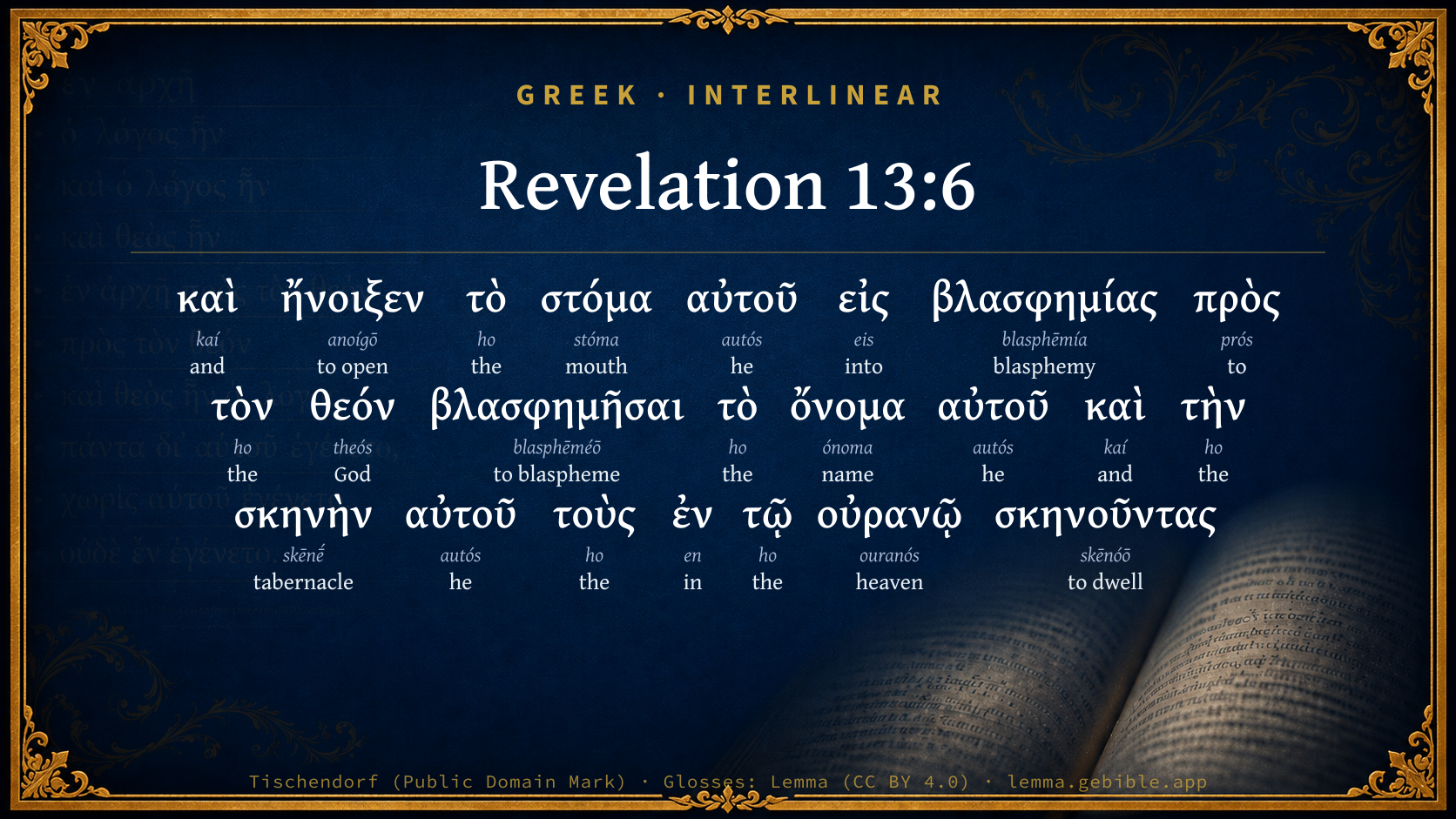
  1. καὶ kaí G2532 “and” Conjunction
  2. ἤνοιξεν anoígō G455 “to open” Verb, Aorist, Active, Indicative, 3rd person, Singular
  3. τὸ ho G3588 “the” Article, Accusative, Singular, Neuter
  4. στόμα stóma G4750 “mouth” Noun, Accusative, Singular, Neuter
  5. αὐτοῦ autós G846 “he” Personal pronoun, Genitive, Singular, Neuter
  6. εἰς eis G1519 “into” Preposition
  7. βλασφημίας blasphēmía G988 “blasphemy” Noun, Accusative, Plural, Feminine
  8. πρὸς prós G4314 “to” Preposition
  9. τὸν ho G3588 “the” Article, Accusative, Singular, Masculine
  10. θεόν theós G2316 “God” Noun, Accusative, Singular, Masculine
  11. βλασφημῆσαι blasphēméō G987 “to blaspheme” Verb, Aorist, Active, Infinitive
  12. τὸ ho G3588 “the” Article, Accusative, Singular, Neuter
  13. ὄνομα ónoma G3686 “name” Noun, Accusative, Singular, Neuter
  14. αὐτοῦ autós G846 “he” Personal pronoun, Genitive, Singular, Masculine
  15. καὶ kaí G2532 “and” Conjunction
  16. τὴν ho G3588 “the” Article, Accusative, Singular, Feminine
  17. σκηνὴν skēnḗ G4633 “tabernacle” Noun, Accusative, Singular, Feminine
  18. αὐτοῦ autós G846 “he” Personal pronoun, Genitive, Singular, Masculine
  19. τοὺς ho G3588 “the” Article, Accusative, Plural, Masculine
  20. ἐν en G1722 “in” Preposition
  21. τῷ ho G3588 “the” Article, Dative, Singular, Masculine
  22. οὐρανῷ ouranós G3772 “heaven” Noun, Dative, Singular, Masculine

About this verse

These counts appear in no published source. They are computed here, from the morphology-tagged text and Lemma’s own curated glosses. What Lemma adds →

23
words
15
distinct lemmas
Revelation
section

Notable vocabulary

The rarest word here is σκηνοῦντας to dwell G4637 — appearing just 5 times in the whole Greek New Testament.

Shared distinctive vocabulary

σκηνοῦντας to dwell G4637 occurs in 5 verses of the Greek New Testament. Also found in:

Repetition

Words recur within this verse:

Cross-references

20

Topical passages linked to Revelation 13:6 in the Treasury of Scripture Knowledge — connected by theme and wording, ordered by reader-vote popularity; previews shown in the World English Bible.

  • Matthew 12:34 You offspring of vipers, how can you, being evil, speak good things? For out of the abundance of the heart, the mouth speaks.
  • Matthew 15:19 For out of the heart come forth evil thoughts, murders, adulteries, sexual sins, thefts, false testimony, and blasphemies.
  • Hebrews 9:24 For Christ hasn't entered into holy places made with hands, which are representations of the true, but into heaven itself, now to appear in the presence of God for us;
  • Revelation 12:12 Therefore rejoice, heavens, and you who dwell in them. Woe to the earth and to the sea, because the devil has gone down to you, having great wrath, knowing that he has but a short time."
  • Romans 3:13 "Their throat is an open tomb. With their tongues they have used deceit." "The poison of vipers is under their lips;"
  • Hebrews 9:11–12 But Christ having come as a high priest of the coming good things, through the greater and more perfect tabernacle, not made with hands, that is to say, not of this creation,
  • Hebrews 12:22–23 But you have come to Mount Zion, and to the city of the living God, the heavenly Jerusalem, and to innumerable hosts of angels,
  • Revelation 4:1 After these things I looked and saw a door opened in heaven, and the first voice that I heard, like a trumpet speaking with me, was one saying, "Come up here, and I will show you the things which must happen after this."
  • Revelation 4:4 Around the throne were twenty-four thrones. On the thrones were twenty-four elders sitting, dressed in white garments, with crowns of gold on their heads.
  • Revelation 5:13 I heard every created thing which is in heaven, on the earth, under the earth, on the sea, and everything in them, saying, "To him who sits on the throne, and to the Lamb be the blessing, the honor, the glory, and the dominion, forever and ever! Amen!"
  • Revelation 7:9 After these things I looked, and behold, a great multitude, which no man could number, out of every nation and of all tribes, peoples, and languages, standing before the throne and before the Lamb, dressed in white robes, with palm branches in their hands.
  • Revelation 11:12 I heard a loud voice from heaven saying to them, "Come up here!" They went up into heaven in the cloud, and their enemies saw them.
  • Revelation 18:20 Rejoice over her, O heaven, you saints, apostles, and prophets; for God has judged your judgment on her."
  • Revelation 19:1–6 After these things I heard something like a loud voice of a great multitude in heaven, saying, "Hallelujah! Salvation, power, and glory belong to our God:
  • Revelation 21:3 I heard a loud voice out of heaven saying, "Behold, God's dwelling is with people, and he will dwell with them, and they will be his people, and God himself will be with them as their God.
  • Job 3:1 After this Job opened his mouth, and cursed the day of his birth.
  • John 1:14 The Word became flesh, and lived among us. We saw his glory, such glory as of the one and only Son of the Father, full of grace and truth.
  • Colossians 1:19 For all the fullness was pleased to dwell in him;
  • Colossians 2:9 For in him all the fullness of the Godhead dwells bodily,
  • Hebrews 9:2 For there was a tabernacle prepared. In the first part were the lampstand, the table, and the show bread; which is called the Holy Place.

Cross-references courtesy of OpenBible.info (CC BY 4.0).

Commentary

Notes on Revelation 13:6 from classic Christian and Jewish commentators (each source and its license shown beneath its notes). The classic Christian expositions comment on the surrounding passage and are grouped to its opening verse, so a note may address several verses; the Jewish commentaries on the Tanakh (Rashi and others) are per-verse, so they appear only where the commentator wrote on this verse.

Lemma curates 59 commentaries, every one of them public domain or Creative Commons licensed, each selected and text-cleaned for this edition rather than reprinted as found. About our sources →

Jamieson, Fausset & Brown

Robert Jamieson, A. R. Fausset & David Brown

opened . . . mouth--The usual formula in the case of a set speech, or series of speeches. Rev 13:6-7 expand Rev 13:5.

blasphemy--So B and ANDREAS. A and C read "blasphemies."

and them--So Vulgate, Coptic, ANDREAS, and PRIMASIUS read. A and C omit "and": "them that dwell (literally, 'tabernacle') in heaven," mean not only angels and the departed souls of the righteous, but believers on earth who have their citizenship in heaven, and whose true life is hidden from the Antichristian persecutor in the secret of God's tabernacle. See on Rev 12:12; Joh 3:7.

Jamieson, Fausset & Brown — Commentary Critical and Explanatory on the Whole Bible (1871) — public domain (CC PDM 1.0). Text via the HelloAO Bible API.

Bengel's Gnomon

Johann Albrecht Bengel

Rev 13:6. Τοὺς) Without a connecting particle, as Job 42:9.

Bengel's Gnomon of the New Testament — English translation (T&T Clark, Edinburgh, 1860) — public domain. Text from a community e-Sword module.

Expositor's Greek Testament

ed. W. Robertson Nicoll

Rev 13:6 . The days of Antiochus (Dan 8:10-12 ) have returned. On the claims of the emperor, see Introd. § 6, and Sib. Or. ver 33, 34 (Nero ἰσάζων θεῷ αὐτόν ), Asc. Isa. iv. 6 8, x. 13, etc. τοὺς … σκηνοῦντας , an exegetic gloss defining σκήνη ( cf. Rev 12:7 ; Rev 12:12 ). The temple in Jerusalem is no longer the scene and object of the beast’s blasphemy.

The Expositor's Greek Testament, edited by W. Robertson Nicoll (1897–1910) — public domain. Text from a community e-Sword module.

Geneva Bible (1599)

Geneva Bible translators

That is, the holy Church, the true house of the living God.

That is, the godly in several who hid themselves from his cruelty. For this bloody beast surcharged those holy souls most falsely with innumerable accusations for the Name of Christ, as we read in Justin Martyr, Tertullian, Arnobius, Minutius, Eusebius, Augustine, and others: which example the latter times followed most diligently in destroying the flock of Christ and we in our own memory have found by experience to our incredible grief. Concerning heaven, see the eleventh Chapter and twelfth verse.

Geneva Bible (1599) marginal notes — public domain. Text via Bolls.life.

Adam Clarke's Commentary

Verse 6. And he opened his mouth in blasphemy against God, to blaspheme his name] The Latin empire is here represented as a blasphemous power in three respects. First, he blasphemes the name of God. This has been most notoriously the case with the different popish princes, who continually blaspheme the sacred names of God by using them in their idolatrous worship. The mouth of blasphemy against God cannot be more evident than in the following impious words which form a part of the Golden Bull published by Charles IV. in January, 1356: "But thou, envy, how often hast thou attempted to ruin by division the Christian empire, which God hath founded upon the three cardinal virtues, faith, hope, and charity, as upon a holy and indivisible Trinity, vomiting the old venom of discord among the seven electors, who are the pillars and seven principal members of the holy empire; by the brightness of whom the holy empire ought to be illuminated as by seven torches, the light of which is reinforced by the seven gifts of the Holy Spirit!"

And his tabernacle] Tabernacle is any kind of dwelling place, and in an eminent sense among the Jews was a kind of tent to take up and down as occasion required, which was as it were the palace of the Most High, the dwelling of the God of Israel. It was divided into two partitions, one called the holy place, and the other the most holy place, in the latter of which, before the building of the temple, the ark of the covenant was kept, which was a symbol of God's gracious presence with the Jewish Church. All this the author of the Epistle to the Hebrews, in the eighth and ninth chapters, explains to prefigure the human nature of Christ. The beast's blasphemy of the tabernacle of God is, therefore, as Dr. More and others properly observe, his impious doctrine of transubstantiation, in which it is most blasphemously asserted that the substance of the bread and wine in the sacrament is literally converted by the consecration of the priest, into the very body and blood of Jesus Christ! This doctrine was first advanced among the Latins in the tenth century; and in 1215, fully received as an article of the Roman Catholic faith. It is for the pages of ecclesiastical history to record the incredible numbers which have been martyred by the papists for their non-reception of this most unscriptural and antichristian doctrine.

And them that dwell in heaven.] By heaven is here meant the throne of God, and not the throne of the beast, because it is against God the beast blasphemes. This must therefore allude to his impious adoration of the saints and angels, whose residence is in heaven. He blasphemes against God by paying that adoration to the celestial inhabitants which belongs to God alone. That this sort of worship has been and still is kept up among the Roman Catholics, their mass book is a sufficient evidence.

Adam Clarke's Commentary on the Bible (1810–1826) — public domain. Text from a community e-Sword/MySword module.

Ellicott's Commentary for English Readers

(6) And he opened his mouth . . .—Translate, And he opened his mouth unto blasphemies against God, to blaspheme His name, and His tabernacle, and them that tabernacle in the heaven. Much of the beauty of the thought is lost by the translation “them that dwell;” the word is tabernacle. The saints, to whom the name of the Lord is a strong tower, and who have a tabernacle of witness in this wilderness world, can yet tabernacle their spirits where their treasure is, in the heaven, according to that word:” our citizenship is even now in heaven” (Php_3:20). Against these the world-power blasphemes: who has not taken the Lord for his strength, God is not his might; his might is his god. (Comp. Hab_1:11 : “He passes over and is guilty, he whose might is his god.”)

A Bible Commentary for English Readers, edited by Charles John Ellicott (1878–1897) — public domain. Text from a community e-Sword module.

The Cambridge Bible for Schools and Colleges

gen. ed. J. J. S. Perowne

6. and them that dwell] “And” should apparently be omitted, so that “them that tabernacle in Heaven” is in apposition with the “tabernacle” of God itself.

The Cambridge Bible for Schools and Colleges (gen. ed. J. J. S. Perowne; Cambridge University Press, 1878–1918) — public domain. Text from a community e-Sword module.

John Gill's Exposition

And he opened his mouth in blasphemy against God,.... By sitting as God in the temple of God, showing himself that he is God; by suffering himself to be called by the name of God, God on earth, Lord God the pope, and to be worshipped as God; and by assuming infallibility, giving out that he cannot err, which only belongs to the God of truth; and by his idolatrous practices commanded by him, as the worshipping of idols of gold, silver, wood, and stone, which is in Scripture called blaspheming God, Isa 65:7; see Dan 11:36.

To blaspheme his name; his authority, by arrogating to himself all power in heaven, earth, and hell; by taking upon him to bind and loose the consciences of men, and to dispense with the laws of God, and make them void by his own traditions; and to dispose of the kingdoms of this world, by removing kings, and setting up kings at pleasure, which is the prerogative of the King of kings; and by pretending; to forgive sin, which none but God can do; and by granting indulgences, pardons, &c. Moreover, by the name of God may be meant the Scriptures, which are the means by which God reveals and makes known himself; and these the man of sin blasphemes, by making them a nose of wax, by imposing on them what senses he pleases; by assuming a right of being the sole interpreter of them, and the judge of all controversies; and by setting up his own unwritten traditions upon an equal foot with them, and above them, and by denying the common people the use of them, in their own language; and particularly the Gospel, which is sometimes called the name of the Lord, Act 9:15, may be intended, which is sadly blasphemed, and evil spoken of by antichrist; as the doctrines of justification by Christ's righteousness, of peace and pardon by his blood, and atonement by his sacrifice, through the antichristian notions of merit, works of supererogation, pardons, penance, purgatory, and the like:

and his tabernacle; meaning either the human nature of Christ, which God pitched, and not man, the temple of his body, in which the Godhead dwells bodily, and where the eternal Word dwelt, or tabernacled among men; this is blasphemed by pretending to transubstantiate, the bread and wine in the supper of the Lord into the very body and blood of Christ, and to offer him up again in the sacrifice of the Mass, every time that blasphemous piece of service is performed: or else the church of God, which is the temple of the living God, where he chooses, desires, and delights to dwell; this is blasphemed by antichrist, by sitting in it as if he was God; asserting himself to be the head of the church which solely belongs to Christ; taking upon him to coin new doctrines, and make new laws and orders, and impose them on it, and to change and alter the ordinances and discipline of it as he pleases; and by persecuting and destroying all such who will not submit to his decrees and prescripts: or else heaven itself, the habitation of God, and where his throne is, may be designed, which the pope blasphemously affirms to have the keys of; and that he can open and shut it, let persons into it, or exclude front it, at pleasure; and that he can dispose of it, and sell it for money, and make and canonize new saints in it, as often as he thinks fit.

And them that dwell in heaven; either saints below, members of a Gospel church, who are born from above, are partakers of the heavenly calling, and whose conversation is in heaven, who are by antichrist stigmatized and persecuted as schismatics and heretics; or rather angels and saints departed, who are in heaven, and dwell there, and who are worshipped and prayed to as Mediators and intercessors, whose names are used in a very ridiculous and blasphemous manner, to their great dishonour and reproach, as well as to the injury of Christ, the only Mediator between God and men.

John Gill's Exposition of the Whole Bible (1746–1763) — public domain (CC PDM 1.0). Text via the HelloAO Bible API.

Trapp's Complete Commentary

John Trapp

6 And he opened his mouth in blasphemy against God, to blaspheme his name, and his tabernacle, and them that dwell in heaven.

Ver. 6. In blasphemy against God] As when Pope Leo I and (after him) Nicholas III affirmed, that Peter their predecessor was taken into fellowship with the blessed Trinity, as one with them. See Rev 13:5.

And his tabernacle] Christ’s humanity, {Joh 1:14; Joh 2:19} this he blasphemeth, by transubstantiating a crust into Christ. Or, the Church of Christ, which he counteth and calleth the synagogue of Satan.

And them that dwelt in heaven] The glorified saints, whom either he despiteth with obtruded honours, such as they acknowledge not; or else barks and rails at incessantly as arch-devils, detestable heretics, common pests, &c., as Luther, Melancthon, Calvin, whose very name he hath commanded to be razed out of all books, wheresoever any man meets with it, Ubicunque invenitur nomen Calvini, deleatur. (Ind. Expur.)

John Trapp, A Commentary or Exposition upon All the Books of the Old and New Testament (1647–1656) — public domain. Text from a community e-Sword module.

Albert Barnes' Notes on the Bible

And he opened his mouth in blasphemy against God, to blaspheme his name - By his own arrogant claims; by his assumed authority in matters of conscience; by setting aside the divine authority; and by impious declarations in derogation of the divine claims. See the notes on Rev 13:1.

And his tabernacle - Literally, his “tent” - σκηνὴν skēnēn. This is the word which is commonly applied to the sacred tent or tabernacle among the Hebrews, in which the ark was kept, and which was the seat of the Jewish worship before the building of the temple. It is thus used to denote a place of worship, considered as the dwelling-place of God, and is in this sense applied to heaven, Heb 8:2; Heb 9:11; Rev 15:5. It seems to be used here in a general sense to denote the place where God was worshipped; and the meaning is, that there would be a course of conduct in regard to the true church - the dwelling-place of God on the earth - which could properly be regarded as blasphemy. Let anyone remember the anathemas and excommunications uttered against the Waldenses and Albigenses, and those of kindred spirit that appeared in the long period of the papal rule, and he will find no difficulty in perceiving a complete fulfillment of all that is here said.

And them that dwell in heaven - The true worshippers; the members of the true church, represented as dwelling in this holy tabernacle. No one acquainted with the reproaches cast on the devoted and sincere followers of the Saviour during the dark periods of the papal rule can fail to see that there was in that a complete fulfillment of all that is here predicted.

Albert Barnes' Notes on the Bible (1834–1885) — public domain. Text from a community e-Sword/MySword module.

Haydock's Catholic Bible Commentary

His tabernacle, &c. That is, his Church, and his saints. (Challoner)

George Leo Haydock (1774–1849), Haydock's Catholic Family Bible and Commentary, 1859 edition — public domain. Excludes Psalms (Douay-Rheims chapter numbering differs from Protestant) and Deuterocanonical books (Catholic canon only).

Matthew Poole's English Annotations

That is, antichrist opened his mouth to blaspheme God. Mr. Mede noteth well, that antichrist’s time must not be counted from his beginning to persecute, but from his beginning to blaspheme, either by maintaining pernicious doctrine, or setting up idolatrous worship; for till the year 1206, when the Inquisition was set up, (the doctrine of transubstantiation having been about that time decreed by Innocent the Third, and confirmed by the council of Lateran), the persecution was not great. It is also the observation of the same learned author, that the threefold idolatry of the Church of Rome is here described to us; their blaspheming the Lord’s name, by giving Divine adoration to images; their blaspheming the human nature of Christ, (which he thinks is here to be understood by the Lord’s tabernacle, ) by their doctrine of transubstantiation, giving every mass-priest power to make it of a piece of bread; and their putting the glorified saints in the place of the pagan demons, by their invocation of saints. The observation is very ingenious, but whether the sense of this text I doubt; for we are now about the period when antichrist began to reign, which we suppose to be soon after the year 600. The blasphemies here mentioned, were his first-fruits: but the doctrine of transubstantiation, though it might be broached one hundred years before, yet was made no doctrine of their church of six hundred years after the first beginning of the papacy; and therefore cannot well be reckoned amongst antichrist’s first blasphemies. But whoso is acquainted with the history of the church after the year 606, will find enough to justify this text, though we do not restrain their blasphemy to these three things.

Matthew Poole's English Annotations on the Holy Bible (1683–1685) — public domain. Text from a community e-Sword/MySword module.

Whedon's Commentary on the Bible

Daniel D. Whedon

6. Blasphemy against God—By assuming the divine attribute of infallibility; by appropriating the title of God; and by the worship of Mary and the wafer.

The idolatrous aspect of popery is remarkably visible in the inauguration of the pope, that of Pius IX. included. He is first arrayed in his pontifical apparel, five articles of which are scarlet; with a single vestment covered with pearls; and with his mitre adorned with gold and precious stones. He is led to the altar, before which he kneels and prays, as before the seat of God. He then rises, wearing his mitre, and is lifted up by the cardinals and seated on the very same altar. A bishop, kneeling, commences the Te Deum. The cardinals meantime kiss his feet and hands. This ceremony is regularly styled, both in conversation and authoritative writings, “the Adoration of the Pope.” “At Rome,” says Heideggar, (quoted by Wordsworth,) “this phrase, to adore the pope, is in daily use.” Says a French “History of the Clergy,” dedicated to Pope Clement XI., Amst., 1716, “When the election is finished the pope is conducted to the chapel, where he receives the adoration of the cardinals. Then he is carried, seated in the pontifical seat, to the Church of St. Peter, and placed upon the altar… where he receives again, publicly, the adoration.” “Various books,” says Wordsworth, “have been written by Romish divines, such as Mazaroni, Stevanus, and Diana, concerning the adoration of the pope.”

A specimen of this adoration, performed by Cardinal Colonna on his knees to Pope Innocent X., A.D. 1644, is authentically given by Wordsworth in the following words: “Most holy and blessed father, head of the Church, ruler of the world… to whom are committed the keys of the kingdom of heaven, whom angels in heaven revere, whom the gates of hell fear, and all the world adores, thee we solely venerate, worship, and adore, and we submit all things that are ours to thy paternal and more than divine disposition and care.”

His tabernacle—By creating a pantheon of saints to be adored.

Continue—Rather, to practice or perform, referring not to duration of existence but of successful action. This seems to cover the period of something more than a thousand years of nearly undisputed papal supremacy.

Daniel D. Whedon (gen. ed.), Commentary on the Old and New Testaments (1874–1909) — public domain. Text from a community e-Sword module.

The Pulpit Commentary

And he opened his mouth in blasphemy against God, to blaspheme his Name, and his tabernacle, and them that dwell in heaven; for blasphemies against God. The balance of authority is in favour of omitting "and" (before "them"), thus making (as in the Revised Version) the last clause in apposition with the preceding: his Name and his tabernacle, those tabernacled in heaven. The punishment for this sin among the Jews was death by stoning. (see Lev_24:16) God"s servants fear his Name. (Rev_11:18) God"s tabernacle, or temple, is the Church, in the midst of which he dwells, (cf. Rev_11:2) and which exists in the wilderness of the world for the forty and two months, and which yet exists also in heaven, honored of God. (cf. Php_3:20, "For our citizenship is in heaven," Revised Version)

The Pulpit Commentary (1880–1919), ed. H.D.M. Spence-Jones & Joseph S. Exell — public domain. Text from a community e-Sword module.

John Wesley's Explanatory Notes

To blaspheme his name - Which many of the Popes have done explicitly, and in the most dreadful manner. And his tabernacle, even them that dwell in heaven - (For God himself dwelleth in the inhabitance of heaven.) Digging up the bones of many of them, and cursing them with the deepest execrations.

John Wesley, Explanatory Notes Upon the Whole Bible (1754–1765) — public domain. Text via the GEBible commentary corpus.

The People's New Testament

B. W. Johnson

6. He opened his mouth in blasphemy. Three kinds of blasphemy are named: (1) against God; (2) against his tabernacle; (3) against those to whom God has opened his tabernacle. The first would be accomplished by usurping God's prerogatives; the second by maledictions upon the true Church, and the third by curses on the true worshipers.

B. W. Johnson's The People's New Testament with Notes (1889–1891) — public domain. Electronic text from the Christian Classics Ethereal Library (CCEL) ThML edition.

Cambridge Greek Testament for Schools and Colleges

6. τὸ ὄνομα αὐτοῦ. א* substitutes αὐτὸν.

καὶ τὴν σκηνὴν αὐτοῦ. C omits these words. Text. Rec[447] adds καὶ with אcB2*P 1.

[447] Rec. Textus Receptus as printed by Scrivener.

6. τοὺς ἐν τῷ οὐρανῷ σκηνοῦντας. The order as in Rev 12:12 is more like that of ordinary Greek than is usual in this book. The clause must be taken in apposition to τὴν σκ. αὐτοῦ. The host of angels are God’s Tabernacle, as elsewhere His Camp.

Cambridge Greek Testament for Schools and Colleges (Cambridge University Press, 1896; 21 vols, various authors incl. Carr, Maclear, Plummer, Farrar, Lumby, Moule, M. R. James, Simcox) — public domain. Text from a community e-Sword module.

Vincent's Word Studies in the New Testament

Marvin R. Vincent

In blasphemy [εις βλασφημιαν] . Read blasfhmiav blasphemies. Rev., giving the force of eijv more correctly, "for blasphemies." And them that dwell in heaven [και τους εν τω ουρανω σκηνουντας] . The best texts omit kai and, making the following words in apposition with onoma and skhnhn name and tabernacle. Thus the literal sense would be to blaspheme the name and tabernacle which dwell in heaven. "The meaning is to enhance the enormity of the blasphemy by bringing out the lofty nature of God 's holy name and dwelling - place" (Alford). The word dwell is, literally, tabernacle. See on ch. Rev 12:12.

Marvin R. Vincent, Word Studies in the New Testament (1887–1900) — public domain. Text from a community e-Sword/MySword module.

Lesson kit

Teaching starters — assembled from the data on this page, not authored interpretation. Every prompt links to the verse data it draws on. Edit before teaching.

Revelation, in the Revelation, opens this verse with 23 words (15 distinct Greek lemmas). Its most distinctive word is skēnóō (“to dwell”). A historical commentator’s framing appears above. Read the whole chapter for the surrounding context.

Discussion questions

  1. What does “to dwell” (skēnóō) contribute to the verse as a whole?
  2. How does John 1:14, which shares the word «to dwell», read alongside this verse?
  3. What does the repetition of “the” (6× in this one verse) do in this verse?
  4. These translations render this verse differently. What is at stake in choosing one wording over another?
  5. Compare how Jamieson, Fausset & Brown and Bengel's Gnomon read this verse. Where do they agree or differ?

Things to notice

Reading settings

Reading text

Shown beneath each verse's original-language words.

Old Testament
Old Testament edition

Read the OT as the Masoretic Hebrew (MT) or the Greek Septuagint (LXX).

English shown for the Greek Septuagint (in the Hebrew ↔ Greek comparison).

Comparing translations? Open the Compare panel on any verse page to stack up to four side by side.