
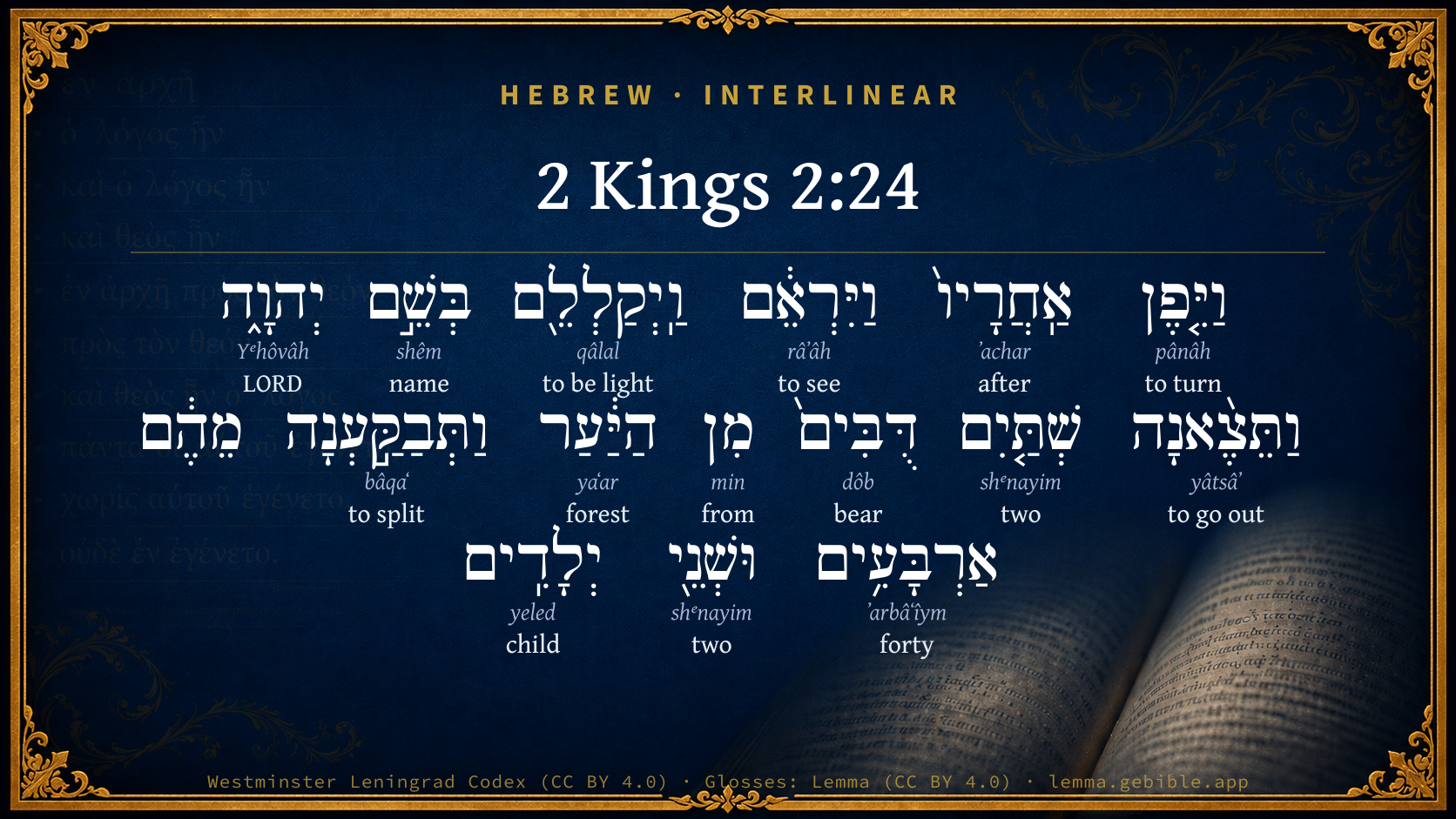
2 Kings 2:24

Hebrew (Westminster Leningrad Codex) 2 Kings 2:24 appears in the Hebrew Old Testament. The text above is from the Westminster Leningrad Codex. Each word links to its Strong’s number, a concise gloss, and parsing drawn from the Open Scriptures Hebrew Bible morphology. Click any word for its full Brown-Driver-Briggs (BDB) entry.
Download image
Cite this verse

2 Kings 2:24 (World English Bible). Public Domain. Lemma interlinear Bible study tool, https://lemma.gebible.app/v/2-kings/2/24.

Show BibTeX & RIS
BibTeX
RIS
English Translation
He looked behind him and saw them, and cursed them in the name of Yahweh. There came forth two she-bears out of the wood, and mauled forty-two lads of them.
World English Bible · Public Domain
Download a study sheet

One document with this verse’s original text, its word-by-word gloss line, the meaning frame, cross-references with their text, attributed commentary, and full source and license credits — printable, and it pastes into notes with its structure intact.

This verse Autodidact and up

Study sheet (.html) Plain text (.txt)

A passage Seminary Student

Up to 50 verses in one chapter. A passage sheet keeps up to 6 commentary sources and 12 cross-references per verse, in the order this page ranks them, and says so on the sheet whenever that leaves anything out. Ask for a single verse and you get the Autodidact verse sheet above.

Everything on this page stays free to read, with no account — the sheet is a download of what is already on screen, not access to it.

Want to remove ads? Support Godless Engineer
Compare translations 3

The same verse in 3 English versions, stacked beneath the original-language interlinear above. Click any original word for its lexicon entry.

Each is an independent rendering of the whole verse — the interlinear is not word-aligned to these translations.

Highlighted words mark where these versions differ — a whole-verse word diff, not a word-by-word alignment.

  • World English Bible Public Domain
    He looked behind him and saw them, and cursed them in the name of Yahweh. There came forth two she-bears out of the wood, and mauled forty-two lads of them.
  • King James Version Public Domain
    And he turned back, and looked on them, and cursed them in the name of the LORD. And there came forth two she bears out of the wood, and tare forty and two children of them.
  • unfoldingWord Literal Text CC BY-SA 4.0
    And he turned behind him, and he saw them, and he cursed them in the name of Yahweh. And two female bears came out from the forest, and they tore apart from them 42 of the boys.

unfoldingWord Literal Text — © unfoldingWord, licensed CC BY-SA 4.0. Word-aligned USFM3 via Door43 (git.door43.org/unfoldingWord/en_ult).

Versions to compare (up to 4)

3 of 4 selected

Show all 18 translations

Every available English version of this verse, each an independent rendering of the whole verse.

  • World English Bible Public Domain
    He looked behind him and saw them, and cursed them in the name of Yahweh. There came forth two she-bears out of the wood, and mauled forty-two lads of them.
  • Berean Standard Bible Public Domain
    Then he turned around, looked at them, and called down a curse on them in the name of the LORD. Suddenly two female bears came out of the woods and mauled forty-two of the boys.
  • Majority Standard Bible Public Domain
    Then he turned around, looked at them, and called down a curse on them in the name of the LORD. Suddenly two female bears came out of the woods and mauled forty-two of the boys.
  • King James Version Public Domain
    And he turned back, and looked on them, and cursed them in the name of the LORD. And there came forth two she bears out of the wood, and tare forty and two children of them.
  • American Standard Version (1901) Public Domain
    And he looked behind him and saw them, and cursed them in the name of Jehovah. And there came forth two she-bears out of the wood, and tare forty and two lads of them.
  • Revised Version (1885) Public Domain
    And he looked behind him and saw them, and cursed them in the name of the LORD. And there came forth two she-bears out of the wood, and tare forty and two children of them.
  • Geneva Bible (1599) Public Domain
    And he turned backe, and looked on them, and cursed them in the name of the Lord. And two beares came out of the forest, and tare in pieces two and fourtie children of them.
  • Douay-Rheims (1899) Public Domain
    And looking back, he saw them, and cursed them in the name of the Lord: and there came forth two bears out of the forest, and tore of them two and forty boys.
  • Young's Literal Translation Public Domain
    And he looketh behind him, and seeth them, and declareth them vile in the name of Jehovah, and two bears come out of the forest, and rend of them forty and two lads.
  • Literal Standard Version CC BY-SA 4.0
    And he looks behind him, and sees them, and declares them vile in the Name of YHWH, and two bears come out of the forest and ripped apart forty-two of the boys.
  • Unlocked Literal Bible CC BY-SA 4.0
    Elisha looked behind him and saw them; he called on Yahweh to curse them. Then two female bears came out of the woods and injured forty-two of the boys.
  • unfoldingWord Literal Text CC BY-SA 4.0
    And he turned behind him, and he saw them, and he cursed them in the name of Yahweh. And two female bears came out from the forest, and they tore apart from them 42 of the boys.
  • Darby Bible Public Domain
    And he turned back, and looked on them, and cursed them in the name of Jehovah. And there came forth two she-bears out of the wood, and tore forty-two children of them.
  • World Messianic Bible Public Domain
    He looked behind him and saw them, and cursed them in the LORD’s name. Then two female bears came out of the woods and mauled forty-two of those youths.
  • Webster's Bible Public Domain
    And he turned back, and looked on them, and cursed them in the name of the LORD. And there came forth two she bears out of the wood, and tore forty and two children of them.
  • Free Bible Version CC BY-SA 4.0
    Turning around, he looked at them and called down a curse on them in the Lord's name. Suddenly two female bears came out of the forest and mauled forty-two of them.
  • Bible in Basic English Public Domain
    And turning back, he saw them, and put a curse on them in the name of the Lord. And two she-bears came out of the wood and put forty-two of the children to death.
  • JPS Tanakh (1917) Public Domain
    And he looked behind him and saw them, and cursed them in the name of the LORD. And there came forth two she-bears out of the wood, and tore forty and two children of them.

Literal Standard Version (2020), Covenant Press — licensed CC BY-SA 4.0. Text via the HelloAO Bible API (eBible.org). Unlocked Literal Bible (unfoldingWord) — licensed CC BY-SA 4.0. Text via the HelloAO Bible API (eBible.org). unfoldingWord Literal Text — © unfoldingWord, licensed CC BY-SA 4.0. Word-aligned USFM3 via Door43 (git.door43.org/unfoldingWord/en_ult). Free Bible Version, Dr. Jonathan Gallagher — licensed CC BY-SA 4.0. Text via the HelloAO Bible API (eBible.org).

Word by word

More ways to search: Search by grammar → Find every occurrence → Compare this word →

Practice this passage: Drill this verse → Learn its vocabulary →

דֻּבִּים֙
dôb
H1677
“bears”
Noun, Common, Masculine, Plural, Absolute
Part of Speech
Noun
Type
Common
Gender
Masculine
Number
Plural
State
Absolute
Full BDB Definition

Origin: from H1680

TWOT: 396a

bear
  1. וַיִּ֤פֶן pânâh H6437 “and · to turn” Conjunction + Verb, Qal, Sequential Imperfect, 3rd Person, Masculine, Singular
  2. אַֽחֲרָיו֙ ʼachar H310 “after · him” Preposition + Suffix, Personal, 3rd Person, Masculine, Singular
  3. וַיִּרְאֵ֔ם râʼâh H7200 “and · to see · them” Conjunction + Verb, Qal, Sequential Imperfect, 3rd Person, Masculine, Singular + Suffix, Personal, 3rd Person, Masculine, Plural
  4. וַֽיְקַלְלֵ֖ם qâlal H7043 “and · to be light · them” Conjunction + Verb, Piel, Sequential Imperfect, 3rd Person, Masculine, Singular + Suffix, Personal, 3rd Person, Masculine, Plural
  5. בְּשֵׁ֣ם shêm H8034 “in/at · name of” Preposition + Noun, Common, Masculine, Singular, Construct
  6. יְהוָ֑ה Yᵉhôvâh H3068 “LORD” Noun, Proper
  7. וַתֵּצֶ֨אנָה yâtsâʼ H3318 “and · to go out” Conjunction + Verb, Qal, Sequential Imperfect, 3rd Person, Feminine, Plural
  8. שְׁתַּ֤יִם shᵉnayim H8147 “two” Adjective, Cardinal number, Feminine, Dual, Absolute
  9. מִן min H4480 “from” Preposition
  10. הַיַּ֔עַר yaʻar H3293 “the · forest” Particle, Definite Article + Noun, Common, Masculine, Singular, Absolute
  11. וַתְּבַקַּ֣עְנָה bâqaʻ H1234 “and · to split” Conjunction + Verb, Piel, Sequential Imperfect, 3rd Person, Feminine, Plural
  12. אַרְבָּעִ֥ים ʼarbâʻîym H705 “forty” Adjective, Cardinal number, Both, Plural, Absolute
  13. וּשְׁנֵ֖י shᵉnayim H8147 “and · two” Conjunction + Adjective, Cardinal number, Masculine, Dual, Construct
  14. יְלָדִֽים yeled H3206 “children” Noun, Common, Masculine, Plural, Absolute

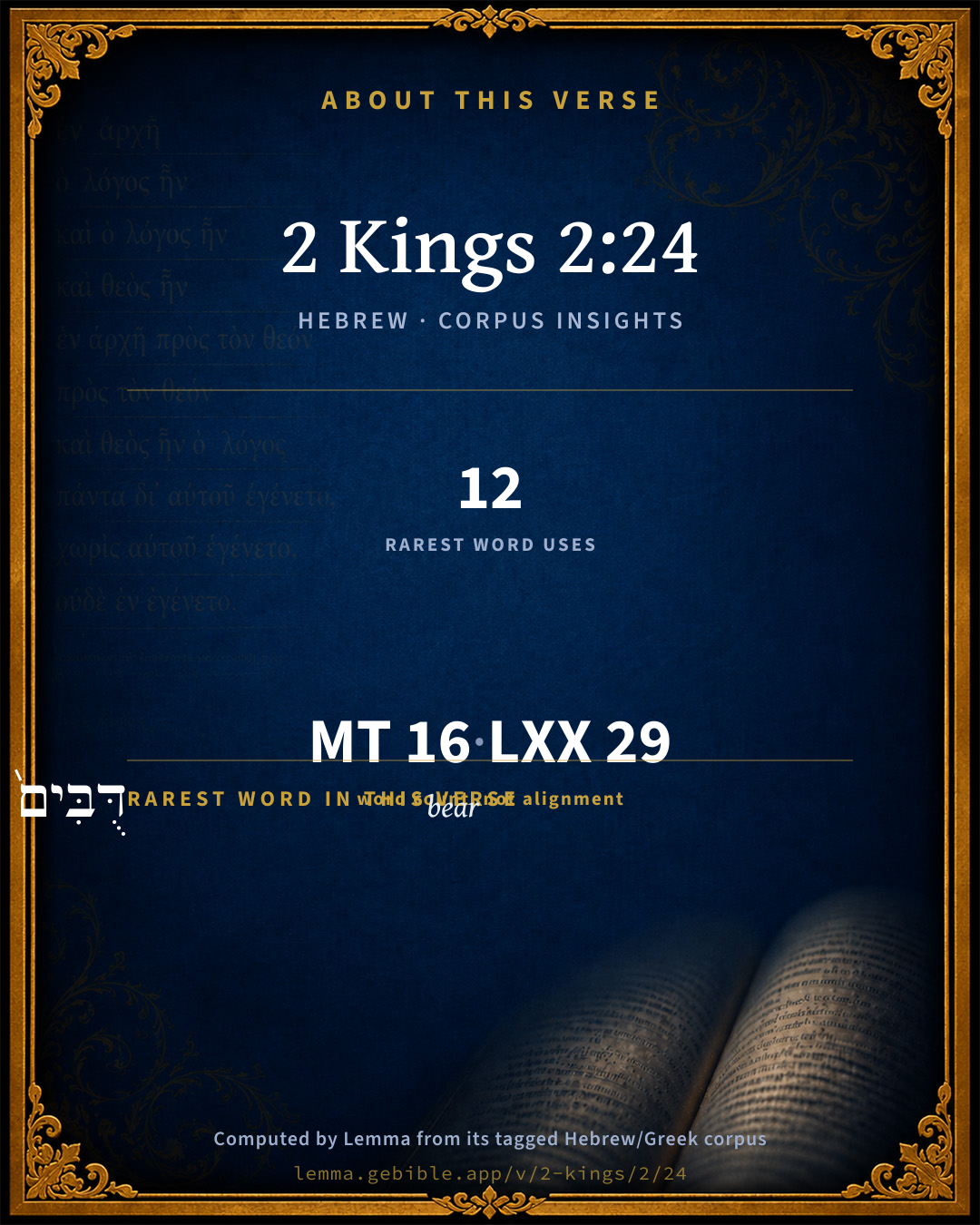
About this verse

These counts appear in no published source. They are computed here, from the morphology-tagged text and Lemma’s own curated glosses. What Lemma adds →

16
words
14
distinct lemmas
Historical
section

Notable vocabulary

The rarest word here is דֻּבִּים֙ bear H1677 — appearing just 12 times in the whole Hebrew Bible.

Shared distinctive vocabulary

דֻּבִּים֙ bear H1677 occurs in 12 verses of the Hebrew Bible. Also found in:

Grammatical profile

  • 5 verbs
  • 5 nouns
  • 3 adjectives
  • 3 prepositions

Verb forms

  • וַיִּ֤פֶן Qal · Sequential Imperfect
  • וַיִּרְאֵ֔ם Qal · Sequential Imperfect
  • וַֽיְקַלְלֵ֖ם Piel · Sequential Imperfect
  • וַתֵּצֶ֨אנָה Qal · Sequential Imperfect
  • וַתְּבַקַּ֣עְנָה Piel · Sequential Imperfect

Repetition

A word recurs within this verse — often emphatic in Hebrew:

  • שְׁתַּ֤יִם two H8147 ×2

Hebrew & Septuagint length

In English translation the verse runs 30 words from the Hebrew and 37 from the Septuagint (LXX English) — closely comparable.

A rough comparison of the two English renderings, which tokenize alike — not a word-level alignment.

Word counts can differ between the Hebrew and the Greek without any difference in meaning — e.g. the Hebrew direct-object marker אֵת has no separate Greek word, and Greek often adds the article ὁ.

In the original languages it is 16 Hebrew tokens and 29 Greek tokens — but the two are counted differently (Hebrew bundles its prefixes and suffixes into one token; the Greek is in lemma form), so that isn’t a like-for-like length.

Cross-references

25

Topical passages linked to 2 Kings 2:24 in the Treasury of Scripture Knowledge — connected by theme and wording, ordered by reader-vote popularity; previews shown in the World English Bible.

  • Acts 13:9–11 But Saul, who is also called Paul, filled with the Holy Spirit, fastened his eyes on him,
  • Hosea 13:8 I will meet them like a bear that is bereaved of her cubs, And will tear the covering of their heart. And there I will devour them like a lioness. The wild animal will tear them.
  • Amos 7:17 Therefore thus says Yahweh: 'Your wife shall be a prostitute in the city, and your sons and your daughters shall fall by the sword, and your land shall be divided by line; and you yourself shall die in a land that is unclean, and Israel shall surely be led away captive out of his land.'"
  • Acts 5:5 Ananias, hearing these words, fell down and died. Great fear came on all who heard these things.
  • Acts 5:9 But Peter asked her, "How is it that you have agreed together to tempt the Spirit of the Lord? Behold, the feet of those who have buried your husband are at the door, and they will carry you out."
  • Genesis 9:25 He said, "Cursed be Canaan; A servant of servants will he be to his brothers."
  • Exodus 20:5 you shall not bow yourself down to them, nor serve them, for I, Yahweh your God, am a jealous God, visiting the iniquity of the fathers on the children, on the third and on the fourth generation of those who hate me,
  • Deuteronomy 28:15–26 But it shall come to pass, if you will not listen to the voice of Yahweh your God, to observe to do all his commandments and his statutes which I command you this day, that all these curses shall come on you, and overtake you.
  • Judges 9:57 and all the wickedness of the men of Shechem did God requite on their heads: and on them came the curse of Jotham the son of Jerubbaal.
  • 2 Samuel 17:8 Hushai said moreover, You know your father and his men, that they are mighty men, and they are fierce in their minds, as a bear robbed of her cubs in the field; and your father is a man of war, and will not lodge with the people.
  • 1 Kings 13:24 When he was gone, a lion met him by the way, and killed him: and his body was cast in the way, and the donkey stood by it; the lion also stood by the body.
  • 1 Kings 19:17 It shall happen, that he who escapes from the sword of Hazael shall Jehu kill; and he who escapes from the sword of Jehu shall Elisha kill.
  • 1 Kings 20:36 Then said he to him, Because you have not obeyed the voice of Yahweh, behold, as soon as you are departed from me, a lion shall kill you. As soon as he was departed from him, a lion found him, and killed him.
  • 2 Kings 1:10–12 Elijah answered to the captain of fifty, If I be a man of God, let fire come down from the sky, and consume you and your fifty. Fire came down from the sky, and consumed him and his fifty.
  • Nehemiah 13:25–27 I contended with them, and cursed them, and struck certain of them, and plucked off their hair, and made them swear by God, [saying], You shall not give your daughters to their sons, nor take their daughters for your sons, or for yourselves.
  • Jeremiah 28:16 Therefore thus says Yahweh, Behold, I will send you away from off the surface of the earth: this year you shall die, because you have spoken rebellion against Yahweh.
  • Jeremiah 29:21–23 Thus says Yahweh of Hosts, the God of Israel, concerning Ahab the son of Kolaiah, and concerning Zedekiah the son of Maaseiah, who prophesy a lie to you in my name: Behold, I will deliver them into the hand of Nebuchadrezzar king of Babylon; and he shall kill them before your eyes;
  • Lamentations 3:65 You will give them hardness of heart, your curse to them.
  • Mark 11:14 Jesus told it, "May no one ever eat fruit from you again!" and his disciples heard it.
  • Mark 11:21 Peter, remembering, said to him, "Rabbi, look! The fig tree which you cursed has withered away."
  • Acts 8:20 But Peter said to him, "May your silver perish with you, because you thought you could obtain the gift of God with money!
  • Judges 9:20 but if not, let fire come out from Abimelech, and devour the men of Shechem, and the house of Millo; and let fire come out from the men of Shechem, and from the house of Millo, and devour Abimelech.
  • Proverbs 17:12 Let a bear robbed of her cubs meet a man, Rather than a fool in his folly.
  • Proverbs 28:15 As a roaring lion or a charging bear, So is a wicked ruler over helpless people.
  • 2 Corinthians 10:6 and being in readiness to avenge all disobedience, when your obedience will be made full.

Cross-references courtesy of OpenBible.info (CC BY 4.0).

Hebrew and Greek witnesses Masoretic Hebrew ↔ Greek Septuagint

The same verse in the two great witnesses to the Old Testament, shown verse-for-verse.

These are two independent witnesses, not word-aligned to each other, and the Septuagint is shown in lemma (dictionary) form.

Hebrew 2 Kings 2:24 Masoretic · Westminster Leningrad Codex

וַיִּ֤פֶן אַֽחֲרָיו֙ וַיִּרְאֵ֔ם וַֽיְקַלְלֵ֖ם בְּשֵׁ֣ם יְהוָ֑ה וַתֵּצֶ֨אנָה שְׁתַּ֤יִם דֻּבִּים֙ מִן הַיַּ֔עַר וַתְּבַקַּ֣עְנָה מֵהֶ֔ם אַרְבָּעִ֥ים וּשְׁנֵ֖י יְלָדִֽים

He looked behind him and saw them, and cursed them in the name of Yahweh. There came forth two she-bears out of the wood, and mauled forty-two lads of them.

World English Bible · Public Domain

Greek LXX 2 Kings 2:24 Septuagint · lemma form

καί ἐκνεύω ὀπίσω αὐτός καί ὁράω αὐτός καί καταἀράομαι αὐτός ἐν ὄνομα κύριος καί ἰδού ἐκἔρχομαι δύο ἄρκος ἐκ ὁ δρυμός καί ἀναῥήγνυμι ἐκ αὐτός τεσσαράκοντα καί δύο παῖς

And he turned after them, and saw them, and cursed them in the name of the Lord. And, behold, there came out two bears out of the wood, and they tore forty and two children of them.

LXX2012 (modern English Septuagint) · Public Domain

Hebrew: Westminster Leningrad Codex (CC BY 4.0). Greek: Septuagint (public domain); English from LXX2012 (modern English Septuagint) (Public Domain). How the Septuagint differs from the Hebrew →

Targum (Aramaic paraphrase)

1

The Targum is the ancient Jewish Aramaic paraphrase of the Hebrew Scriptures — an interpretive translation, not the Hebrew text itself. Onkelos (literal) and Pseudo-Jonathan (expansive) render the Torah, and Jonathan the Prophets. Coverage is partial: where no permissively-licensed English translation exists for a verse, only the Aramaic is shown. This is verse-level text, not a word-by-word alignment to the Hebrew.

  1. Targum Jonathan Prophets (Joshua–Malachi)
    וְאִתְפְּנֵי לַאֲחוֹרוֹהִי וַחֲזִינוּן וְלַטִינוּן בִּשְׁמָא דַייָ וּנְפַקוּ תַּרְתֵּין דוּבִין מִן חוּרְשָׁא וּבְזָעָא מִנְהוֹן אַרְבְּעִין וּתְרֵין יַנְקִין:

    (no public-domain English translation for this verse)

    Targum Jonathan — Aramaic: “Mikraot Gedolot” (public domain). English: “Sefaria Community Translation” (CC0 1.0 (public-domain dedication)); “London "Chaldee Paraphrase," 1871” (public domain). Text via Sefaria.

Commentary

Notes on 2 Kings 2:24 from classic Christian and Jewish commentators (each source and its license shown beneath its notes). The classic Christian expositions comment on the surrounding passage and are grouped to its opening verse, so a note may address several verses; the Jewish commentaries on the Tanakh (Rashi and others) are per-verse, so they appear only where the commentator wrote on this verse.

Lemma curates 59 commentaries, every one of them public domain or Creative Commons licensed, each selected and text-cleaned for this edition rather than reprinted as found. About our sources →

Trapp's Complete Commentary

John Trapp

2Ki 2:24 And he turned back, and looked on them, and cursed them in the name of the LORD. And there came forth two she bears out of the wood, and tare forty and two children of them.

Ver. 24. And cursed them.] By his spirit of prayer and prophecy: not out of private revenge.

And there came forth two she bears.] So Dr Whittington returning from martyring a good woman at Chipping Sadbury, was gored by a bull. {a} Dr Story, who vaunted that he had burnt so many earwigs - heretics he meant, - was hanged at Tyburn for treason. Hemingius telleth of a lewd fellow in Denmark, who showing great contempt against a preacher, as he passed out of the Church was brained with a tile. Luther {b} telleth of such another, who going into the fields to look to his sheep, after he had railed most bitterly against a godly minister, was found dead: his body being burnt as black as a coal. "Be not ye mockers, lest your bands be increased."

{a} Mr Clark’s Martyrol., fol. 58.

{b} Luth., in Coll.

John Trapp, A Commentary or Exposition upon All the Books of the Old and New Testament (1647–1656) — public domain. Text from a community e-Sword module.

Joseph Benson's Commentary

2Ki 2:24. He looked on them, and cursed them in the name of the Lord — “The word curse has in Scripture three different acceptations. It signifies, to inflict a curse; and in this sense God is said to have cursed the ground after the fall. It signifies, to wish a curse; and in this sense Shimei is said to have cursed David. Lastly, it signifies, to pronounce, or foretel, a curse or punishment; and in this sense Elisha is said to have cursed the children. The historian expressly asserts, that he cursed them in the name of the Lord. To speak in the name of the Lord, is to deliver what he commands; to prophesy in the name of the Lord, is to foretel what he reveals; and to curse in the name of the Lord, is to declare a curse which he is determined to inflict, and has authorized the prophet to denounce: so that in cursing these supposed children, Elisha acted as a minister of the Supreme Ruler of the world, and by his order foretold the punishment that was going to be inflicted upon these idolaters. His pronouncing this curse was not the cause of their catastrophe; but the certainty of their catastrophe, and the command of God, were the causes of his pronouncing this curse.” See Dr. Dodd, and Morris, vol. 1. ser. 7.

There came forth two she-bears out of the wood — Which probably had been robbed of their whelps, and thereby made more fierce and outrageous; and tare forty and two children of them — Here the word translated children is different from that used above, namely, ילדים, jeladim; but this also signifies, not only young children, but also those that are grown up to maturity, as Gen 32:22; Gen 34:4; Gen 37:30; Rth 1:5. In this extraordinary punishment, inflicted evidently by the hand of God on these young persons, we have demonstration, that the curse which the prophet denounced against them was not owing, as some have supposed, to the peevishness of his temper, or the ebullition of his anger: for though his rage had been ever so furious, it would not have supplied him with power to command these savage creatures to leave the woods at an instant, and to come to a place they did not frequent, as a public road must be supposed to be, in order to destroy these insolent youths. As his curse would have had no effect had it proceeded from a peevish temper, or from the violence of his passion, we have no just cause, from his cursing them, to suspect that he was actuated by any such principle. No: it was in the name of the Lord; not from any revengeful passion, but by the motion of God’s Spirit, and by God’s command and commission that he denounced the curse: and God caused the punishment to follow, partly to show his displeasure at such profaneness and malignity of mind against God, and his cause, and worship, as these youths were guilty of, for the terror and caution of all other ungodly persons, who abounded in that place; partly to vindicate the honour and maintain the authority of his prophets; and particularly of Elisha, now especially in the beginning of his sacred ministry; and partly to convince the people of the heinousness of idolatry, and to recover them to that purity of worship which the law was peculiarly intended to preserve.

Upon the whole, it appears that the persons who mocked Elijah were not infants, but arrived to years of maturity; that they did not insult him by chance, but by design; that they went out in great crowds on purpose; that they mocked him because he was the prophet of the true God, from whom they had apostatized; and that he did not wish their untimely end from a principle of revenge, but only predicted it as a prophet. The punishment will appear just, if we consider the time, place, persons, and all the circumstances of the case. These young persons might be guilty of many other heinous crimes, known to God and his prophet, besides that here recorded: they were at least guilty of idolatry, which by God’s law deserved death: add to this, that the idolatrous parents were punished in their children; and that if any of these children were more innocent, God might have mercy on their souls, and then the death they suffered was not a misery, but a real blessing to them, taking them away from that education which was very likely to expose them, not only to temporal, but eternal destruction.

Joseph Benson's Commentary on the Old and New Testaments (1811–1818) — public domain. Text from a community e-Sword module.

Geneva Bible (1599)

Geneva Bible translators

Perceiving their malicious heart against the Lord and his word, he desireth God to take vengeance of that injury done unto him.

Geneva Bible (1599) marginal notes — public domain. Text via Bolls.life.

Ellicott's Commentary for English Readers

(24) He turned back.—The boys were following him with their jeers. Thenius says, “The wanton young people, who had not courage to attack except in the rear, had stolen round him.”

Cursed them.—“To avenge the honour of Jehovah, violated in his person” (Keil). (Comp. Exo_16:8; Act_5:4.)

And there came forth.—Whether at once, and in the presence of Elisha, or not, is uncertain. Thenius supposes that on some occasion or other a terrible calamity had fallen on some person or persons after such a mockery of Elisha, or of some other prophet (!); and that in the desire to magnify the divinely maintained inviolability of the prophetic office, the author of the above narrative has overlooked the immoral character of cursing, especially in the case of wanton children. He then contrasts the behaviour of the “historical” David (2Sa_16:10). But (1) the curse of a prophet was an inspired prediction of punitive disaster; (2) Beth-el was a chief seat of idolatry (1Ki_12:29, seq.; Amo_4:4; Amo_5:5; Amo_7:10), and the mobbing of the new prophetic leader may have been premeditated; (3) at all events, the narrative is too brief to enable us to judge of the merits of the case; and (4) what is related belongs to that dispensation in which judgment was made more prominent than mercy, and directly fulfils the menace of Lev_26:21, seq.

Two she bears.—Hos_13:8; Pro_17:12; Amo_5:19. (Comp. 2Ki_17:25.) Wild beasts were common in Palestine in those days.

Forty and two.—This may be a definite for an indefinite number. It shows that the mob of young persons who beset the prophet was considerable.

A Bible Commentary for English Readers, edited by Charles John Ellicott (1878–1897) — public domain. Text from a community e-Sword module.

The Cambridge Bible for Schools and Colleges

gen. ed. J. J. S. Perowne

24. And he turned back, and looked on them] R.V. And he looked behind him and saw them. The young lads had come forth from the city, and Elisha had, as it seems, passed by them, before they began their mockery. The word translated ‘turned’ in A.V. is used specially of turning the face toward any object. It is so rendered by A.V. in Gen_18:22, ‘And the men turned their faces’. Elisha turned about and saw in them the malice and evil spirit of their parents and kindred.

and cursed them in the name of the Lord] It was not to avenge himself. Their insult to him was but a symptom of their hatred of all that was connected with the pure worship of Jehovah. It was as Jehovah’s servant and in vindication of Jehovah’s honour that Elisha invoked a curse upon the revilers. ‘God and His seer looked through these children at the parents, at all Israel. He would punish the parents’ misnurturing their children, with the death of those children which they had mistaught’ (Bp Hall).

two she bears] Of the prevalence of wild beasts in the immediate neighbourhood of cities we have indications in the history of David who slew a lion and a bear as he was keeping his father’s flock (1Sa_17:36), and in the story of the disobedient prophet who was torn by a lion near this very city of Bethel (1Ki_13:24).

tare forty and two] The punishment would touch the parents in a way which nothing else could have done.

The Cambridge Bible for Schools and Colleges (gen. ed. J. J. S. Perowne; Cambridge University Press, 1878–1918) — public domain. Text from a community e-Sword module.

John Gill's Exposition

And he went from thence to Mount Carmel,.... Where Elijah used to frequent, and where also there might be a school of the prophets; this, according to Bunting (a), was fifty six miles from Bethel:

and from thence he returned to Samaria; the capital of the kingdom of Israel; there to bear his testimony against idolatry, to reprove for it, and reclaim from it; this, as the same writer says (b), was thirty two miles from Carmel.

(a) Travels, &c. p. 206. (b) Ibid.

Next: 2 Kings Chapter 3

John Gill's Exposition of the Whole Bible (1746–1763) — public domain (CC PDM 1.0). Text via the HelloAO Bible API.

Albert Barnes' Notes on the Bible

On this occasion only do we find Elisha a minister of vengeance. Perhaps it was necessary to show, at the outset of his career as a prophet, that he too, so mild and peaceful could, like Elijah, wield the terrors of God’s judgments (1Ki 19:19 note). The persons really punished were, not so much the children, as the wicked parents 2Ki 2:23, whose mouth-pieces the children were, and who justly lost the gift of offspring of which they had shown themselves unworthy.

Albert Barnes' Notes on the Bible (1834–1885) — public domain. Text from a community e-Sword/MySword module.

Haydock's Catholic Bible Commentary

Cursed them. This curse, which was followed by so visible a judgment of God, was not the effect of passion, or of a desire of revenging himself; but of zeal for religion, which was insulted by these boys, in the person of the prophet, and of a divine inspiration; God being determined to punish in this manner the inhabitants of Bethel, (the chief seat of the calf-worship) who had trained up their children in a prejudice against the true religion and its ministers. (Challoner) --- The boys themselves were not so little as not to be aware of the insult they were offering to a minister of the God of Juda; and probably they acted thus out of hatred to him, at the instigation of their idolatrous parents. (Sanctius) (Calmet) --- Lord. He called on him (Menochius) to revenge his own cause, (Haydock) "that the people might learn to take care of their souls, by the fear of death." (St. Augustine) (Du Hamel)

George Leo Haydock (1774–1849), Haydock's Catholic Family Bible and Commentary, 1859 edition — public domain. Excludes Psalms (Douay-Rheims chapter numbering differs from Protestant) and Deuterocanonical books (Catholic canon only).

Matthew Poole's English Annotations

Cursed them; nor was this punishment too great for the offence, if it be considered that these children were grown up to some maturity; (See Poole "2Ki 2:23";) that their mocking proceeded from a great malignity of mind against God; that they mocked not only a man, and an ancient man, whose very age commanded reverence, and a prophet; but even God himself, and that most admirable and glorious work of God, the assumption of Elijah into heaven, which makes it in some degree resemble the sin against the Holy Ghost; that they might be guilty of many other heinous crimes, which God and the prophet knew; and were guilty of idolatry, which by God’s law deserved death; that the idolatrous parents were punished in their children; and that if any of these children were more innocent and ignorant of what they said, God might have mercy upon their souls, and then this death was not a misery, but a real blessing to them, that they were taken away from that wicked and idolatrous education, which was most likely to expose them not only to temporal, but to an eternal destruction.

In the name of the Lord; not from any carnal or revengeful passion, but by the motion of God’s Spirit, and by God’s command and commission, as appears by God’s concurrence with him; which God did, partly for the terror and caution of all other idolaters and profane persons, who abounded in that place; partly to vindicate the honour and maintain the authority of his prophets, and particularly of Elisha, now especially in the beginning of his sacred ministry. And this did beget such a confidence in Elisha, that he durst venture to go into Beth-el after this was done; and such a terror in the Beth-elites, that they durst not avenge themselves of him.

Two she-bears; possibly robbed of their whelps, and therefore more fierce, Pro 17:12; Hos 13:8; but certainly acted by an extraordinary fury, which God raised in them for this purpose.

Forty and two children: this Hebrew word signifies not only young children, but those also who are grown up to maturity, as Gen 32:22; 34:4; 37:30; Rth 1:5.

Matthew Poole's English Annotations on the Holy Bible (1683–1685) — public domain. Text from a community e-Sword/MySword module.

Whedon's Commentary on the Bible

Daniel D. Whedon

24. Cursed them in the name of the Lord — It would not do to let such malice and blasphemy go unnoticed before the people of Beth-el, and so the insulted prophet called down on those young blasphemers the vengeance of the Lord who was mocked and scorned in the person of his holy prophet. It then remained to be seen whether the Lord would hear a prayer for vengeance.

Tare forty and two children of them — The word for children here is different from that so rendered in 2Ki_2:23, and though the two words are nearly synonymous, “the change, with the dropping of the word little, is probably intended to mark a distinction. Wherever there is a mob of idle young men, there is sure to be a number of mischievous urchins, who shout and bawl, as they do, without knowing much of the matter. Although, therefore, there were, no doubt, little children among this rabble of young Beth-elites, there is every reason to suppose that the forty-two of them who were destroyed were the oldest ones, the ringleaders of the set, and who very well knew what they were about.” — Kitto.

Daniel D. Whedon (gen. ed.), Commentary on the Old and New Testaments (1874–1909) — public domain. Text from a community e-Sword module.

The Pulpit Commentary

And he turned back, and looked on them; rather, and he looked behind him, and saw them, as in the Revised Version. The boys, after the manner of boys, were following him, hanging upon him, not daring to draw too near, hooting him from behind, as ill-bred and ill-intentioned youths are apt to do. And cursed them in the name of the Lord. The action cannot be defended from a Christian point of view Christians have no right to curse any one. But we can well understand that, under the old covenant, a prophet newly installed in office, and commencing his ministry, might deem it right to vindicate the honor of his office by visiting such conduct as that of these misguided youths with a malediction. Under the Law God"s ministers were required to curse the disobedient. (Deu_27:14-26) Elisha could not tell what would be the effect of his curse. It could have no effect at all excepting through the will and by the action of God. And there came forth two she-bears out of the wood; or, the forest; i.e. the forest, which, as all knew, lay within a short distance of Bethel, and was the haunt of wild beasts. (see 1Ki_3:24) And tare forty and two children of them. It is not said how far the lads were injured, whether fatally or not. But the punishment, whatever its severity, came from God, not from the prophet, and we may be sure was just. For "shall not the Judge of all the earth do right?" A severe example may have been needed under the circumstances of the time, when a new generation was growing up in contempt of God and of religion; and the sin of the lads was not a small one, but indicated that determined bent of the will against good, and preference of evil, which is often developed early, and generally goes on from bad to worse.

The Pulpit Commentary (1880–1919), ed. H.D.M. Spence-Jones & Joseph S. Exell — public domain. Text from a community e-Sword module.

John Wesley's Explanatory Notes

Cursed them - Nor was this punishment too great for the offense, if it be considered, that their mocking proceeded from a great malignity of mind against God; that they mocked not only a man, and an ancient man, whose very age commanded reverence; and a prophet; but even God himself, and that glorious work of God, the assumption of Elijah into heaven; that they might be guilty of many other heinous crimes, which God and the prophet knew; and were guilty of idolatry, which by God's law deserved death; that the idolatrous parents were punished in their children; and that, if any of these children were more innocent, God might have mercy upon their souls, and then this death was not a misery, but a real blessing to them, that they were taken away from that education which was most likely to expose them not only to temporal, but eternal destruction. In the name - Not from any revengeful passion, but by the motion of God's Spirit, and by God's command and commission. God did this, partly, for the terror and caution of all other idolaters and prophane persons who abounded in that place; partly, to vindicate the honour, and maintain the authority of his prophets; and particularly, of Elisha, now especially, in the beginning of his sacred ministry. Children - This Hebrew word signifies not only young children, but also those who are grown up to maturity, as Gen. xxxii, 22, xxxiv, 4, xxxvii, 30, Ruth i, 5.

John Wesley, Explanatory Notes Upon the Whole Bible (1754–1765) — public domain. Text via the GEBible commentary corpus.

Rashi

Rabbi Shlomo Yitzchaki (Rashi)

And saw them. He saw that neither in them nor in their descendants would there be any sap of good deed.

Rashi on the Tanakh — English translations: “The Judaica Press complete Tanach with Rashi, translated by A. J. Rosenberg” (CC BY 4.0); “Pentateuch with Rashi's commentary by M. Rosenbaum and A.M. Silbermann, 1929-1934” (public domain); “The Metsudah Tanach series, Lakewood, N.J” (CC BY 4.0); and “The Book of Joshua, Metsudah Publications, 1997” (CC BY 4.0). Text via Sefaria.

Lesson kit

Teaching starters — assembled from the data on this page, not authored interpretation. Every prompt links to the verse data it draws on. Edit before teaching.

2 Kings, in the Historical, opens this verse with 16 words (14 distinct Hebrew lemmas). Its most distinctive word is dôb (“bear”). A historical commentator’s framing appears above. Read the whole chapter for the surrounding context.

Discussion questions

  1. How does “bear” (dôb) shape what this verse is saying?
  2. 1 Samuel 17:34 shares the word «bear» with this verse. How do the two illuminate each other?
  3. “two” occurs 2× in this one verse. What is the effect of the repetition?
  4. The translations on this page render this verse differently — a whole-verse word diff, not a word-by-word alignment. What might account for the different wordings?
  5. The verb «וַיִּ֤פֶן» is Qal Sequential Imperfect. How does its form color the action?
  6. Reading how Trapp's Complete Commentary and Joseph Benson's Commentary read this verse, where do the two commentators agree and where do they part?

Things to notice

Reading settings

Reading text

Shown beneath each verse's original-language words.

Old Testament
Old Testament edition

Read the OT as the Masoretic Hebrew (MT) or the Greek Septuagint (LXX).

English shown for the Greek Septuagint (in the Hebrew ↔ Greek comparison).

Comparing translations? Open the Compare panel on any verse page to stack up to four side by side.