Acts 18:15

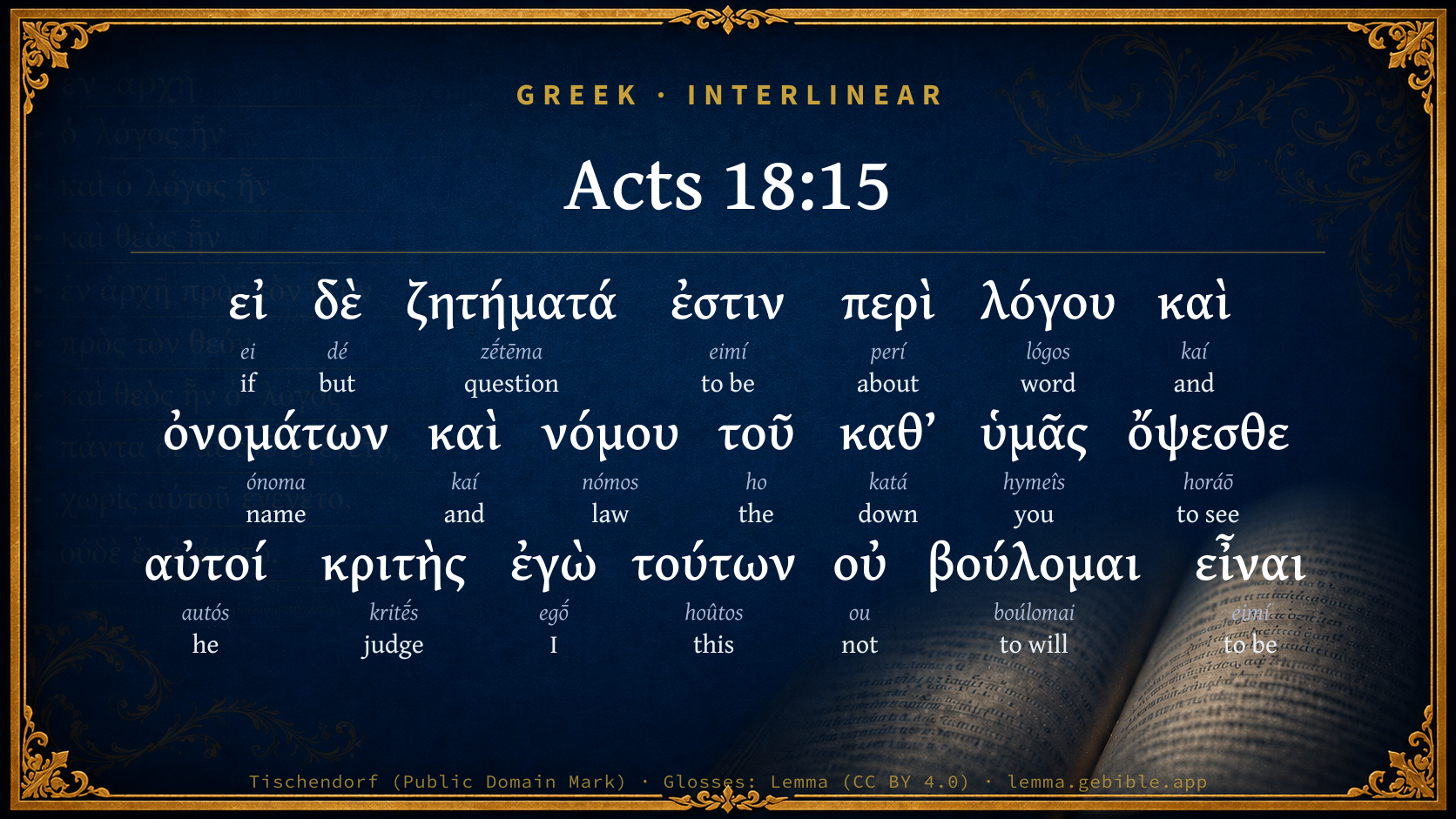
Greek (Tischendorf 8th ed.) Acts 18:15 appears in the Greek New Testament. The text above is from the Tischendorf 8th edition. Each word links to its Strong’s number and a concise gloss. Click any word for its full Thayer’s Greek Lexicon entry.
Download image
Cite this verse

Acts 18:15 (World English Bible). Public Domain. Lemma interlinear Bible study tool, https://lemma.gebible.app/v/acts/18/15.

Show BibTeX & RIS
BibTeX
RIS
English Translation
but if they are questions about words and names and your own law, look to it yourselves. For I don't want to be a judge of these matters."
World English Bible · Public Domain
Download a study sheet

One document with this verse’s original text, its word-by-word gloss line, the meaning frame, cross-references with their text, attributed commentary, and full source and license credits — printable, and it pastes into notes with its structure intact.

This verse Autodidact and up

Study sheet (.html) Plain text (.txt)

A passage Seminary Student

Up to 50 verses in one chapter. A passage sheet keeps up to 6 commentary sources and 12 cross-references per verse, in the order this page ranks them, and says so on the sheet whenever that leaves anything out. Ask for a single verse and you get the Autodidact verse sheet above.

Everything on this page stays free to read, with no account — the sheet is a download of what is already on screen, not access to it.

Want to remove ads? Support Godless Engineer
Compare translations 3

The same verse in 3 English versions, stacked beneath the original-language interlinear above. Click any original word for its lexicon entry.

Each is an independent rendering of the whole verse — the interlinear is not word-aligned to these translations.

Highlighted words mark where these versions differ — a whole-verse word diff, not a word-by-word alignment.

  • World English Bible Public Domain
    but if they are questions about words and names and your own law, look to it yourselves. For I don't want to be a judge of these matters."
  • King James Version Public Domain
    But if it be a question of words and names, and of your law, look ye to it; for I will be no judge of such matters.
  • unfoldingWord Literal Text CC BY-SA 4.0
    but if the questions about word and names and your law, you will see yourselves. I do not want to be a judge of these things.”

unfoldingWord Literal Text — © unfoldingWord, licensed CC BY-SA 4.0. Word-aligned USFM3 via Door43 (git.door43.org/unfoldingWord/en_ult).

Versions to compare (up to 4)

3 of 4 selected

Show all 19 translations

Every available English version of this verse, each an independent rendering of the whole verse.

  • World English Bible Public Domain
    but if they are questions about words and names and your own law, look to it yourselves. For I don't want to be a judge of these matters."
  • Berean Standard Bible Public Domain
    But since it is a dispute about words and names and your own law, settle it yourselves. I refuse to be a judge of such things.”
  • Majority Standard Bible Public Domain
    But since it is a dispute about words and names and your own law, settle it yourselves. For I refuse to be a judge of such things.”
  • King James Version Public Domain
    But if it be a question of words and names, and of your law, look ye to it; for I will be no judge of such matters.
  • American Standard Version (1901) Public Domain
    but if they are questions about words and names and your own law, look to it yourselves; I am not minded to be a judge of these matters.
  • Revised Version (1885) Public Domain
    but if they are questions about words and names and your own law, look to it yourselves; I am not minded to be a judge of these matters.
  • Geneva Bible (1599) Public Domain
    But if it bee a question of woordes, and names, and of your Lawe, looke yee to it your selues: for I will be no iudge of those things.
  • Douay-Rheims (1899) Public Domain
    But if they be questions of word and names, and of your law, look you to it: I will not be judge of such things.
  • Young's Literal Translation Public Domain
    but if it is a question concerning words and names, and of your law, look ye yourselves `to it', for a judge of these things I do not wish to be,'
  • Literal Standard Version CC BY-SA 4.0
    but if it is a question concerning words and names, and of your law, look [to it] yourselves, for I do not intend to be a judge of these things,”
  • Unlocked Literal Bible CC BY-SA 4.0
    But since these are questions about words and names and your own law, settle it yourselves. I do not wish to be a judge of these matters.”
  • unfoldingWord Literal Text CC BY-SA 4.0
    but if the questions about word and names and your law, you will see yourselves. I do not want to be a judge of these things.”
  • Darby Bible Public Domain
    but if it be questions about words, and names, and the law that ye have, see to it yourselves; [for] *I* do not intend to be judge of these things.
  • World Messianic Bible Public Domain
    but if they are questions about words and names and your own law, look to it yourselves. For I don’t want to be a judge of these matters.”
  • Webster's Bible Public Domain
    But if it is a question of words and names, and of your law, look ye to it: for I will be no judge of such matters.
  • Free Bible Version CC BY-SA 4.0
    But since you're only arguing over words and names and your own law, then you deal with it yourselves. I won't rule on such matters.”
  • Bible in Basic English Public Domain
    But if it is a question of words or names or of your law, see to it yourselves; I will not be a judge of such things.
  • Text-Critical English NT CC BY 4.0
    But since it is a question about words, names, and your own law, see to it yourselves, for I do not want to be a judge of such things.”
  • Tyndale New Testament (1534) Public Domain
    but yf it be a question of wordes or of names or of youre lawe loke ye to it youre selves. For I wilbe no iudge in soche maters

Literal Standard Version (2020), Covenant Press — licensed CC BY-SA 4.0. Text via the HelloAO Bible API (eBible.org). Unlocked Literal Bible (unfoldingWord) — licensed CC BY-SA 4.0. Text via the HelloAO Bible API (eBible.org). unfoldingWord Literal Text — © unfoldingWord, licensed CC BY-SA 4.0. Word-aligned USFM3 via Door43 (git.door43.org/unfoldingWord/en_ult). Free Bible Version, Dr. Jonathan Gallagher — licensed CC BY-SA 4.0. Text via the HelloAO Bible API (eBible.org).

Word by word

More ways to search: Search by grammar → Find every occurrence → Compare this word →

Practice this passage: Drill this verse → Learn its vocabulary →

ζητήματά
zḗtēma
G2213
“question”
Noun, Nominative, Plural, Neuter
Part of Speech
Noun
Case
Nominative
Number
Plural
Gender
Neuter
Full Thayer's Definition

Origin: from G2212

TDNT: None

1. a question, debate a. about the law
  1. εἰ ei G1487 “if” Conditional
  2. δὲ dé G1161 “but” Conjunction
  3. ἐστιν eimí G1510 “to be” Verb, Present, Active, Indicative, 3rd person, Singular
  4. περὶ perí G4012 “about” Preposition
  5. λόγου lógos G3056 “word” Noun, Genitive, Singular, Masculine
  6. καὶ kaí G2532 “and” Conjunction
  7. ὀνομάτων ónoma G3686 “name” Noun, Genitive, Plural, Neuter
  8. καὶ kaí G2532 “and” Conjunction
  9. νόμου nómos G3551 “law” Noun, Genitive, Singular, Masculine
  10. τοῦ ho G3588 “the” Article, Genitive, Singular, Masculine
  11. καθ’ katá G2596 “down” Preposition
  12. ὑμᾶς hymeîs G5210 “you” Personal pronoun, 2nd person, Accusative, Plural
  13. ὄψεσθε horáō G3708 “to see” Verb, Future, Middle deponent, Indicative, 2nd person, Plural
  14. αὐτοί autós G846 “he” Personal pronoun, Nominative, Plural, Masculine
  15. κριτὴς kritḗs G2923 “judge” Noun, Nominative, Singular, Masculine
  16. ἐγὼ egṓ G1473 “I” Personal pronoun, 1st person, Nominative, Singular
  17. τούτων hoûtos G3778 “this” Demonstrative pronoun, Genitive, Plural, Neuter
  18. οὐ ou G3756 “not” Particle, Negative
  19. βούλομαι boúlomai G1014 “to will” Verb, Present, Middle or Passive deponent, Indicative, 1st person, Singular
  20. εἶναι eimí G1510 “to be” Verb, Present, Active, Infinitive

About this verse

These counts appear in no published source. They are computed here, from the morphology-tagged text and Lemma’s own curated glosses. What Lemma adds →

21
words
19
distinct lemmas
Acts
section

Notable vocabulary

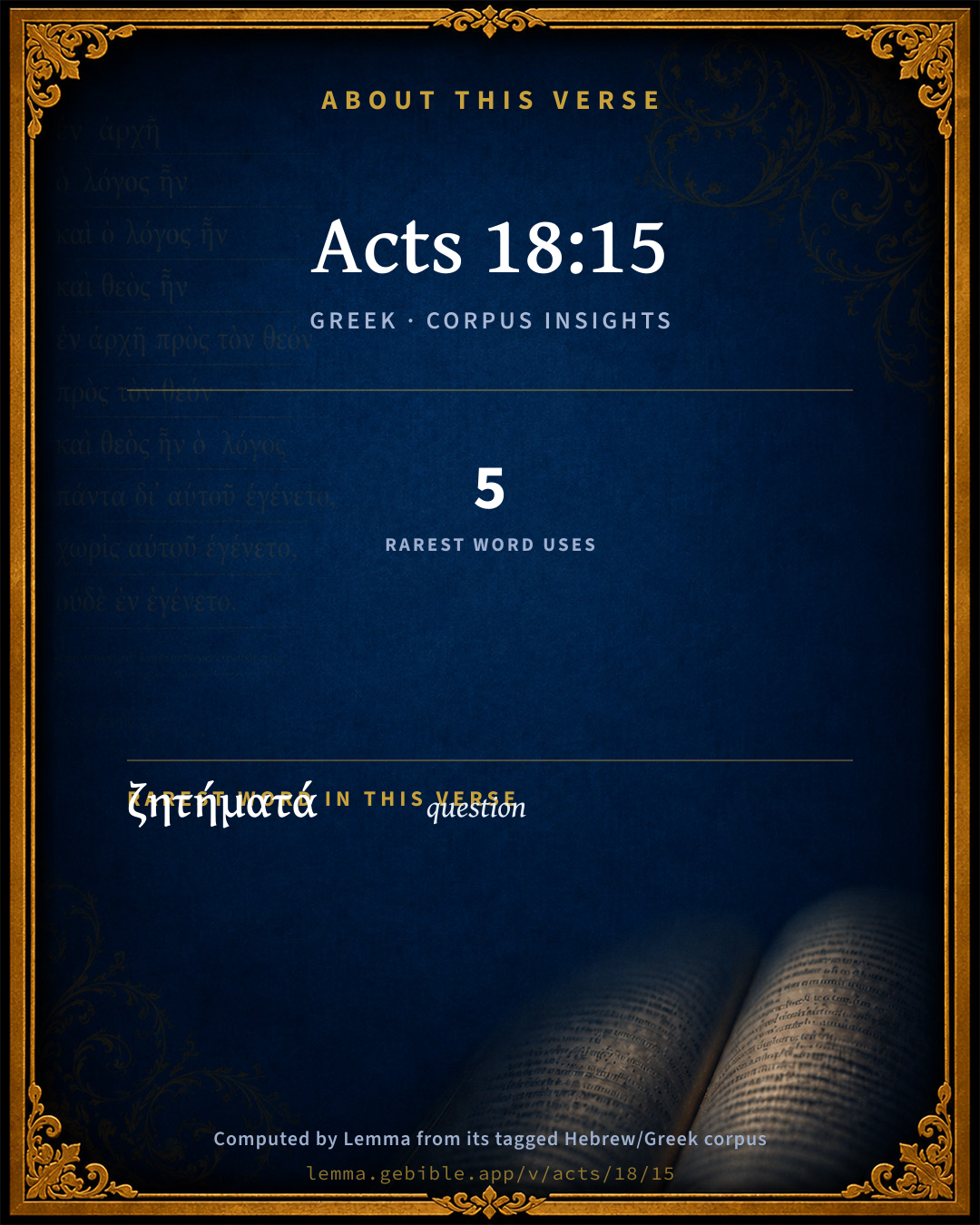
The rarest word here is ζητήματά question G2213 — appearing just 5 times in the whole Greek New Testament.

Shared distinctive vocabulary

ζητήματά question G2213 occurs in 5 verses of the Greek New Testament. Also found in:

Repetition

Words recur within this verse:

  • ἐστιν to be G1510 ×2
  • καὶ and G2532 ×2

Cross-references

12

Topical passages linked to Acts 18:15 in the Treasury of Scripture Knowledge — connected by theme and wording, ordered by reader-vote popularity; previews shown in the World English Bible.

  • Acts 23:29 I found him to be accused about questions of their law, but to have nothing laid to his charge worthy of death or of bonds.
  • Acts 25:19 but had certain questions against him about their own religion, and about one Jesus, who was dead, whom Paul affirmed to be alive.
  • 1 Timothy 6:4 he is conceited, knowing nothing, but obsessed with arguments, disputes, and word battles, from which come envy, strife, reviling, evil suspicions,
  • Matthew 27:24 So when Pilate saw that nothing was being gained, but rather that a disturbance was starting, he took water, and washed his hands before the multitude, saying, "I am innocent of the blood of this righteous person. You see to it."
  • Acts 25:11 For if I have done wrong, and have committed anything worthy of death, I don't refuse to die; but if none of those things is true that they accuse me of, no one can give me up to them. I appeal to Caesar!"
  • Acts 26:3 especially because you are expert in all customs and questions which are among the Jews. Therefore I beg you to hear me patiently.
  • 1 Timothy 1:4 neither to pay attention to myths and endless genealogies, which cause disputes, rather than God's stewardship, which is in faith--
  • 2 Timothy 2:23 But refuse foolish and ignorant questionings, knowing that they generate strife.
  • Titus 3:9 but shun foolish questionings, genealogies, strife, and disputes about the law; for they are unprofitable and vain.
  • Matthew 27:4 saying, "I have sinned in that I betrayed innocent blood." But they said, "What is that to us? You see to it."
  • John 18:31 Pilate therefore said to them, "Take him yourselves, and judge him according to your law." Therefore the Jews said to him, "It is not lawful for us to put anyone to death,"
  • Acts 24:6–8 He even tried to profane the temple, and we arrested him.

Cross-references courtesy of OpenBible.info (CC BY 4.0).

Where the printed editions differ

1 variant

Places in this verse where the major printed Greek editions disagree on the wording in a way that affects the translation — a comparison of editions, not a manuscript-by-manuscript collation. The editions are the modern critical texts (Nestlé-Aland 28/27, SBL, Westcott-Hort, Tregelles, Tyndale House) and the traditional texts behind the KJV (the Textus Receptus and the Byzantine/Majority text). It is not a claim about which reading is original.

  1. Different wording
    ζητήματά

    “questions”

    In NA28NA27TynSBLWHTreg Not in TRByz

    ζήτημά (zētēma) 'a question' occurs in traditional manuscripts (TR+Byz) instead of ζητήματά (zētēmata) 'questions' in older manuscripts (NA28+NA27+Tyn+SBL+WH+Treg)

Textual data: Translators Amalgamated Greek New Testament (STEPBible TAGNT) · CC BY 4.0.

Commentary

Notes on Acts 18:15 from classic Christian and Jewish commentators (each source and its license shown beneath its notes). The classic Christian expositions comment on the surrounding passage and are grouped to its opening verse, so a note may address several verses; the Jewish commentaries on the Tanakh (Rashi and others) are per-verse, so they appear only where the commentator wrote on this verse.

Lemma curates 59 commentaries, every one of them public domain or Creative Commons licensed, each selected and text-cleaned for this edition rather than reprinted as found. About our sources →

Bengel's Gnomon

Johann Albrecht Bengel

Act 18:15. Εἰ, if) Gallio speaks slightingly (contemptuously): as presently, in the word τούτων, of such matters.—ζήτημα) Such men do not like questions: ch. Act 23:29, CI. Lysias of Paul, “Whom I perceived to be accused of questions of their law, but—nothing,” etc.; Act 25:19-20, Festus of Paul, “They had certain questions against him of their own superstition.”—περὶ λόγου) concerning doctrine [Engl. Vers., words].—ὀνομάτων, names) But the question concerning the name Jesus is one of great moment. The names of the Gentiles were fables and shadows. The Christian religion has in it something peculiar; and therefore human reason, most curious as it is in respect to all other things, has an aversion from becoming acquainted with it.

Bengel's Gnomon of the New Testament — English translation (T&T Clark, Edinburgh, 1860) — public domain. Text from a community e-Sword module.

Expositor's Greek Testament

ed. W. Robertson Nicoll

Act 18:15 . If we read the plural ζητήματα we may regard it as expressing contempt: “a parcel of questions,” Alford; but if they are questions of word (teaching) not deed (opposite ἔργον , factum ) and of names not things, verba , opposite πράγματα (Blass); i.e. , the arguments as to whether Jesus could rightly or not claim the title of Messiah, see also Page’s note. νόμου τοῦ καθʼ ὑμᾶς : of your law not Roman law; with the phrase cf. Act 17:28 (Act 16:39 [321] ), Act 24:22 . It is used only once elsewhere in N.T., by St. Paul, Eph 1:15 ( cf. Act 26:3 ). ὄψεσθε αὐτοί , cf. Mat 27:4 ; Mat 27:24 ; pronoun emphatic, Act 13:18-19 ; so in LXX, Num 13:19 , Jdg 7:17 ; Jdg 21:21 , etc. Blass quotes two passages from Epictetus, ii., 5, 30, and iv., 6, 41. κριτὴς γὰρ ἐγὼ : omit γάρ ; pronoun more emphatic; they could determine their matters according to their own law; so Lysias, xxiii., 29, Festus, xxv., 19. οὐ βούλομαι : “I am not minded,” R.V.; the decision while it testifies to the strength of Gallio’s character, since unlike Pilate he would not allow himself to be influenced against his better judgment, expresses at the same time his sovereign contempt for the Jews and their religion; to him as to his brother Seneca the Jews were only sceleratissima gens (Aug [322] , De Civ. Dei , vi., 10). The decision shows no favourable inclination to Christianity itself, but this does not take away from its importance as proving that so far as the Roman authorities were concerned the freedom of speech thus granted would enable the religion of the Christ to make its way through the civilised, i.e. , the Roman world; cf. Ramsay, St. Paul , p. 260, who sees in his residence at Corinth an epoch in Paul’s life not only as regards his doctrine and his presentation of it but also as regards his aim that Christianity should be spread throughout the empire, an aim made more clear by the imperial policy of which Gallio was the exponent.

[321] R(omana), in Blass, a first rough copy of St. Luke.

[322] Augustine.

The Expositor's Greek Testament, edited by W. Robertson Nicoll (1897–1910) — public domain. Text from a community e-Sword module.

Geneva Bible (1599)

Geneva Bible translators

For this profane man thinketh that the controversy of religion, is but a brawl about words, and for no matter of substance.

As if a man have not spoken well, as the case of your religion standeth.

Geneva Bible (1599) marginal notes — public domain. Text via Bolls.life.

Jamieson, Fausset & Brown

Robert Jamieson, A. R. Fausset & David Brown

if it be a question of words and names, and of your law . . . I will be no judge, &c.--in this only laying down the proper limits of his office.

Jamieson, Fausset & Brown — Commentary Critical and Explanatory on the Whole Bible (1871) — public domain (CC PDM 1.0). Text via the HelloAO Bible API.

Adam Clarke's Commentary

Verse 15. But if it be a question of words] περι λογου, Concerning doctrine and names - whether the person called Jesus be the person you call the Messiah. And of your law - any particular nicety, concerning that law which is peculiar to yourselves: Look ye to it - settle the business among yourselves; the Roman government does not meddle with such matters, and I will not take upon me to - decide in a case that does not concern my office. As if he had said: "The Roman laws give religious liberty to Jews and Greeks; but, if controversies arise among you on these subjects, decide them among yourselves, or dispute about them as much as you please." A better answer could not be given by man; and it was highly becoming the acknowledged meekness, gentleness, and benevolence of this amiable man. He concluded that the state had no right to control any man's religious opinion; that was between the object of his worship and his own conscience; and therefore he was not authorized to intermeddle with subjects of this nature, which the law left to every man's private judgment. Had all the rulers of the people in every country acted as this sensible and benevolent Roman, laws against liberty of conscience, concerning religious persecution, would not be found to be, as they not are, blots and disgraces on the statute books of almost all the civilized nations of Europe.

Adam Clarke's Commentary on the Bible (1810–1826) — public domain. Text from a community e-Sword/MySword module.

John Calvin's Commentaries

15. Of words and names. These words are not well packed together. Yet Gallio speaketh thus of the law of God by way of contempt, as if the Jewish religion did consist only in words and superfluous questions. And surely (as the nation was much given to contention) it is not to be doubted but that many did trouble themselves and others with superfluous trifles. Yea, we hear with what Paul hitteth them in the teeth in many places, especially in the Epistle to Titus, (Titus 1:14, and Titus 3:9.) Yet Gallio is not worthy to be excused who doth mock the holy law of God together with their curiosity. For as it behooved him to cut off all occasion of vain contentions in words, so we must, on the other side, know that when the worship of God is in hand, the strife is not about words, but a matter of all other most serious is handled.

John Calvin's Commentaries (1540-1563) — public domain. Text from the Calvin Translation Society English edition (1840s-50s) via the Christian Classics Ethereal Library (ccel.org). Calvin's coverage is partial (roughly two-thirds of the Bible); uncommented books and verses are honest gaps, never fabricated. The 19th-century editor's footnotes and remarks are omitted so the notes are faithfully Calvin's own voice.

Ellicott's Commentary for English Readers

(15) But if it be a question of words and names, and of your law.—The second noun is in the singular number in the Greek. St. Paul was known as a speaker, one who preached the word of God, and with that, as distinct from acts, Gallio had nothing to do. The “names” were those which he had probably heard of at Rome, even before he came to Corinth. (See Note on Act_18:2.) Was a teacher whom both parties spoke of as Jesus the Nazarene entitled also to bear the name of Christos? In the emphasis laid on “your law” (literally, the law which affects you), the judge intimates that he sees through their appeal to law. It is Jewish, and not Roman law, which they are seeking to vindicate, and he will not make himself, as Pilate, after a weak protest (Joh_18:3), had done (Gallio may well have known the history), the executioner of an alien code. With a strong emphasis on the pronoun, he ends with, “I, for my part, have no wish to be a judge of these things.”

A Bible Commentary for English Readers, edited by Charles John Ellicott (1878–1897) — public domain. Text from a community e-Sword module.

The Cambridge Bible for Schools and Colleges

gen. ed. J. J. S. Perowne

15. But if they are questions about words and names] The oldest authorities give the plural “questions,” and there would no doubt have been many points brought forward from St Paul’s teaching to which the Jews would object. And whether Jesus was the Christ or not would seem to the Roman a matter entirely of definition, and on which the law had no bearing. If he had heard the name of “Christus” at Rome, it would make Gallio the more ready to imitate his royal master, and get rid of the disputants as fast and as far as possible.

and of your law] Better, and of your own law. The words are literally “the law among (or according to) you.” The accusers had without doubt been striving to make out that in teaching a different manner of worship (Act_18:13) Paul was bringing forward a religion not enjoying toleration by the Roman government. But Gallio sees through their intention, and counting them all for Jews, he will not be drawn into their questions.

look ye to it] Better, look to it yourselves (as R. V.). The pronoun is very emphatic in the Greek.

for I will be no judge of such matters] The oldest authorities omit “for,” and the Revised Version makes it plain that “will” is not here an auxiliary verb, as it often is in English. “I am not minded to be a judge of these matters.” Gallio knows his own business and will only mind that. It is not a case where his jurisdiction can interfere, and so he leaves the whole untouched. There is no question here about his own regard and disregard of enquiries about religion. He sits to administer Roman law, and this dispute among the Jews at Corinth lies outside his cognizance altogether.

The Cambridge Bible for Schools and Colleges (gen. ed. J. J. S. Perowne; Cambridge University Press, 1878–1918) — public domain. Text from a community e-Sword module.

John Gill's Exposition

And he drave them from the judgment seat. He would not hear, and try the cause; but dismissed them with threatening them, if ever they brought an affair of that kind to him any more.

And he drave them from the judgment seat. He would not hear, and try the cause; but dismissed them with threatening them, if ever they brought an affair of that kind to him any more.

Acts 18:17

act 18:17

act 18:17

act 18:17Then all the Greeks took Sosthenes,.... These were not the Greeks or Gentiles that were devout persons, or converted to Christianity, and were on the side of Paul, and fell foul on Sosthenes, as being his chief accuser; for this is not agreeably to the spirit and character of such persons, but the profane and unconverted Greeks, who observing that Gallio sent the Jews away, with some resentment and contempt, were encouraged to fall upon the principal of them, and use him in a very ill manner; it is very likely that this person was afterwards converted, and is the same that is mentioned in Co1 1:1. The name is Greek, and there is one of this name mentioned among the executors of Plato's will (w). This man was now

chief ruler of the synagogue; chosen in, very likely, upon Crispus becoming a Christian, and being baptized:

and beat him before the judgment seat; of Gallio; before he and his friends could get out of court:

and Gallio cared for none of these things; which might not be owing to any sluggishness in him, but to an ill opinion he had of the Jews, as being a turbulent and uneasy people, and therefore he connived at some of the insolencies of the people towards them; though it did not become him, as a magistrate, to act such a part, whose business it was to keep the public peace, to quell disorders, to protect men's persons, and property, and prevent abuse and mischief, and to correct and punish for it. The Arabic version renders it, "and no man made any account of Gallio"; they did not fear his resentment, he having drove the Jews from the judgment seat.

(w) Laert. l. 3. in Vita Platon.

John Gill's Exposition of the Whole Bible (1746–1763) — public domain (CC PDM 1.0). Text via the HelloAO Bible API.

Trapp's Complete Commentary

John Trapp

15 But if it be a question of words and names, and of your law, look ye to it; for I will be no judge of such matters.

Ver. 15. A question of words or names] Gallio esteemed no better of divine doctrine than vain words, and airy discourses. His brother Seneca jeereth the Jews for casting away a seventh part of their time upon a weekly sabbath. Profane persons hold it a madness to be so conscientious. Philosophandum, sed paucis. Religiosum esse oportet, sed non religantem, {a} A little religion serves turn well enough.

{a} Aug. de Civ. Dei.

John Trapp, A Commentary or Exposition upon All the Books of the Old and New Testament (1647–1656) — public domain. Text from a community e-Sword module.

Albert Barnes' Notes on the Bible

Of words - A dispute about words, for such he would regard all their controversies about religion to be.

And names - Probably he had heard something of the nature of the controversy, and understood it to be a dispute about names; that is, whether Jesus was to be called the Messiah or not. To him this would appear as a matter pertaining to the Jews alone, and to be ranked with their other disputes arising from the difference of sect and name.

Of your law - A question respecting the proper interpretation of the Law, or the rites and ceremonies which it commanded. The Jews had many such disputes, and Gallio did not regard them as coming under his cognizance as a magistrate.

Look ye to it - Judge this among yourselves; settle the difficulty as you can. Compare Joh 18:31.

For I will be no judge ... - I do not regard such questions as pertaining to my office, or deem myself called on to settle them.

Albert Barnes' Notes on the Bible (1834–1885) — public domain. Text from a community e-Sword/MySword module.

Matthew Poole's English Annotations

A question of words; which have been spoken about the controversies of religion.

And names; as, whether Jesus was to be called Christ or the Messiah; and whether his disciples might be called Christians.

And of your law; concerning circumcision, as whether none may be saved without it.

I will be no judge of such matters; he acknowledges his unfitness and unwillingness to determine such things as did not belong unto him, or he did not understand.

Matthew Poole's English Annotations on the Holy Bible (1683–1685) — public domain. Text from a community e-Sword/MySword module.

Whedon's Commentary on the Bible

Daniel D. Whedon

15. Words—So far as the doctrines were concerned, Gallio would consider them as so much worthless words.

Names—Of persons, as Moses and Jesus, which probably occurred in the statement of the prosecutors, and which Gallio would consider an mere names.

Daniel D. Whedon (gen. ed.), Commentary on the Old and New Testaments (1874–1909) — public domain. Text from a community e-Sword module.

The Pulpit Commentary

They are questions about for it be a question of, A.V. and T.R.; your own for of your, A.V., an unnecessary change; look to it yourselves for look ye to it, A.V.; I am not minded to be a for for I will be no, A.V. and T.R.; these for such, A.V.

The Pulpit Commentary (1880–1919), ed. H.D.M. Spence-Jones & Joseph S. Exell — public domain. Text from a community e-Sword module.

John Wesley's Explanatory Notes

But if it be - He speaks with the utmost coolness and contempt, a question of names - The names of the heathen gods were fables and shadows. But the question concerning the name of Jesus is of more importance than all things else under heaven. Yet there is this singularity (among a thousand others) in the Christian religion, that human reason, curious as it is in all other things, abhors to inquire into it.

John Wesley, Explanatory Notes Upon the Whole Bible (1754–1765) — public domain. Text via the GEBible commentary corpus.

McGarvey & Pendleton's Commentaries

J. W. McGarvey

See notes on verse 14

J. W. McGarvey (with Philip Y. Pendleton), Commentaries on the New Testament (The Fourfold Gospel, 1914; Acts; and the epistles) — public domain. Text from a community e-Sword/MySword module.

Cambridge Greek Testament for Schools and Colleges

15. ζητήματα with אABDE. Vulg. ‘quaestiones.’

γὰρ after κριτὴς omitted with אABD. Not represented in Vulg.

15. εἰ δὲ ζητήματά ἐστιν περὶ λόγου καὶ ὀσνομάτων, but if they are questions about words and names. The use of the indicative ἐστίν shews that Gallio considers this is what they are.

There would no doubt be many points brought forward from St Paul’s teaching to which the Jews would object. And whether Jesus was the Christ or not would seem to the Roman a matter entirely of definition, and on which the law had no bearing. If he had heard the name of ‘Christus’ at Rome (see on Act 18:2), it would make Gallio the more ready to imitate his royal master, and get rid of the disputants as fast and as far as possible.

καὶ νόμου τοῦ καθ’ ὑμᾶς, and of your own law. On this circumlocution see Act 17:28 note. The accusers had without doubt been striving to make out that in teaching a different manner of worship (Act 18:13) Paul was bringing forward a religion not enjoying toleration by the Roman government. But Gallio sees through their intention, and counting them all for Jews, he will not be drawn into their questions.

ὄψεσθε αὐτοί, look to it yourselves. The pronoun is very emphatic. For the form ὄψεσθε used as an imperative, cf. LXX. Num 13:19, καὶ ὄψεσθε τὴν γῆν τίς ἐστι, καὶ τὸν λαόν. Also Jdg 7:17; Jdg 21:21; 1Sa 6:9; &c.

κριτὴς ἐγὼ τούτων οὐ βούλομαι εἶναι, I am not minded to be a judge of these matters. Gallio knows his own business and will only look to that. It is not a case where his jurisdiction can interfere, and so he leaves the whole untouched. There is no question here about his own regard and disregard of enquiries about religion. He sits to administer Roman law, and this dispute among the Jews at Corinth lies outside his cognizance altogether.

Cambridge Greek Testament for Schools and Colleges (Cambridge University Press, 1896; 21 vols, various authors incl. Carr, Maclear, Plummer, Farrar, Lumby, Moule, M. R. James, Simcox) — public domain. Text from a community e-Sword module.

Alford’s Greek Testament

Henry Alford

15.] ζητήματα has apparently been alterèd to ζήτημα to suit the sense, there being but one question before Gallio. But the plural expresses contempt: If it is questions, &c.: as we should say, ‘a parcel of questions.’ See ch. 23:29.

ὀνομάτων] e.g. Paul asserted Jesus to be the Christ, which the Jews denied. This to a Roman would be a question of names.

τ. καθʼ ὑμᾶς, with emphasis: see reff. So Lysias (ch. 23:29) declined to decide Paul’s case; and Festus (ch. 25:20), though he did not altogether put the enquiry by, wished to judge it at Jerusalem, where he might have the counsel of those learned in the Jewish law.

Henry Alford, The Greek Testament (1849–1861) — public domain. Text from a community e-Sword module.

Vincent's Word Studies in the New Testament

Marvin R. Vincent

Question. The best texts read the plural, guests. See on ch. Act 14:2. Judge. In the Greek the position of the word is emphatic, at the beginning of the sentence : "Judge of these matters I am not minded to be."

Marvin R. Vincent, Word Studies in the New Testament (1887–1900) — public domain. Text from a community e-Sword/MySword module.

Lesson kit

Teaching starters — assembled from the data on this page, not authored interpretation. Every prompt links to the verse data it draws on. Edit before teaching.

Acts, in the Acts, opens this verse with 21 words (19 distinct Greek lemmas). Its most distinctive word is zḗtēma (“question”). A historical commentator’s framing appears above. Read the whole chapter for the surrounding context.

Discussion questions

  1. What does “question” (zḗtēma) contribute to the verse as a whole?
  2. Acts 15:2 shares the word «question» with this verse. How do the two illuminate each other?
  3. “to be” occurs 2× in this one verse. What is the effect of the repetition?
  4. These translations render this verse differently; the difference is in the English rendering, not the original. What questions does that raise?
  5. Reading how Bengel's Gnomon and Expositor's Greek Testament read this verse, where do the two commentators agree and where do they part?

Things to notice

Reading settings

Reading text

Shown beneath each verse's original-language words.

Old Testament
Old Testament edition

Read the OT as the Masoretic Hebrew (MT) or the Greek Septuagint (LXX).

English shown for the Greek Septuagint (in the Hebrew ↔ Greek comparison).

Comparing translations? Open the Compare panel on any verse page to stack up to four side by side.