
Philippians 4:3

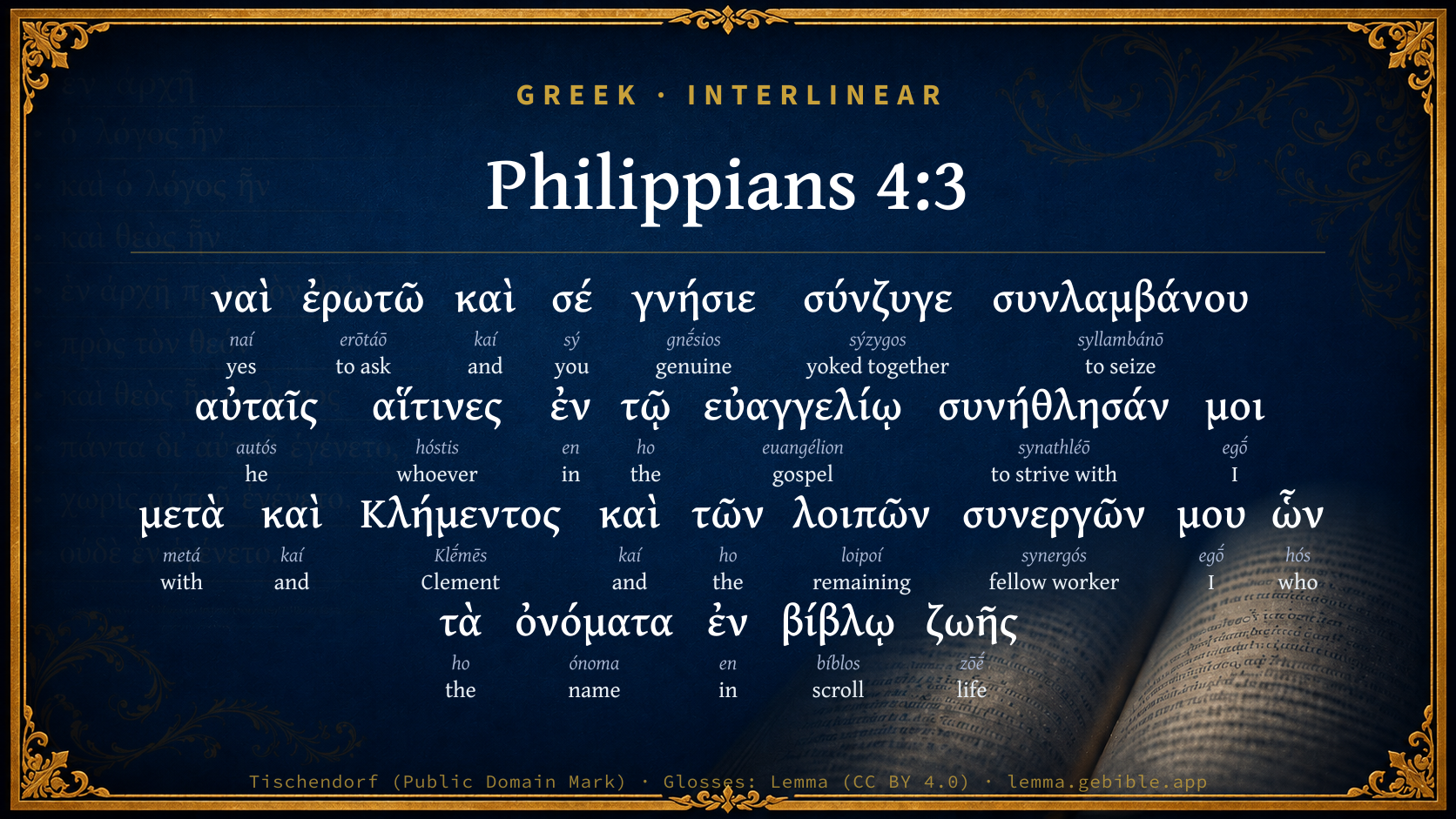
Greek (Tischendorf 8th ed.) Philippians 4:3 appears in the Greek New Testament. The text above is from the Tischendorf 8th edition. Each word links to its Strong’s number and a concise gloss. Click any word for its full Thayer’s Greek Lexicon entry.
Download image
Cite this verse

Philippians 4:3 (World English Bible). Public Domain. Lemma interlinear Bible study tool, https://lemma.gebible.app/v/philippians/4/3.

Show BibTeX & RIS
BibTeX
RIS
English Translation
Yes, I beg you also, true yoke-fellow, help these women, for they labored with me in the Gospel, with Clement also, and the rest of my fellow workers, whose names are in the book of life.
World English Bible · Public Domain
Highlights
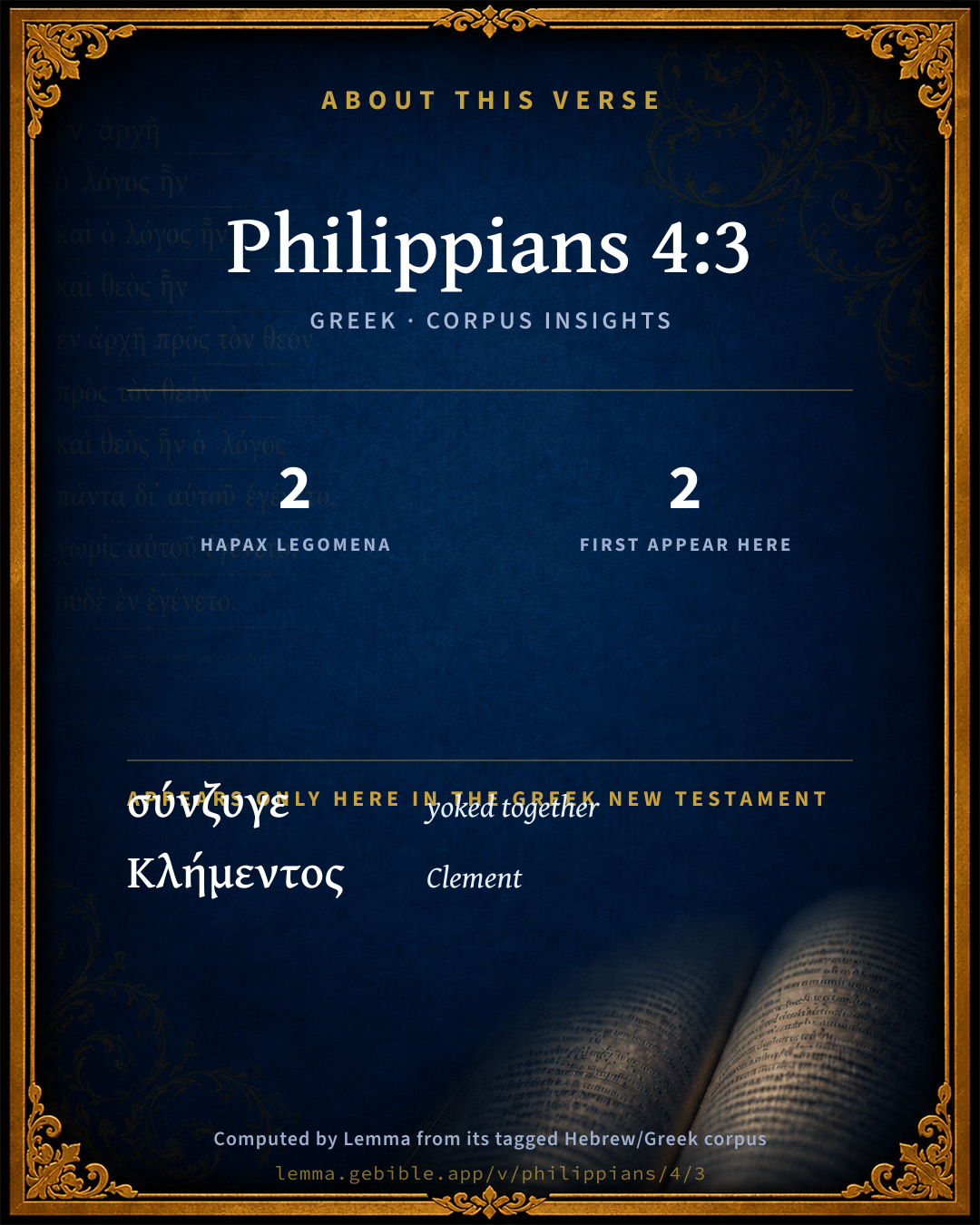
  • 2 hapax legomena — only here in the Greek New Testament
  • 2 first appearances in the Greek New Testament
Full analysis ↓
Download a study sheet

One document with this verse’s original text, its word-by-word gloss line, the meaning frame, cross-references with their text, attributed commentary, and full source and license credits — printable, and it pastes into notes with its structure intact.

This verse Autodidact and up

Study sheet (.html) Plain text (.txt)

A passage Seminary Student

Up to 50 verses in one chapter. A passage sheet keeps up to 6 commentary sources and 12 cross-references per verse, in the order this page ranks them, and says so on the sheet whenever that leaves anything out. Ask for a single verse and you get the Autodidact verse sheet above.

Everything on this page stays free to read, with no account — the sheet is a download of what is already on screen, not access to it.

Want to remove ads? Support Godless Engineer
Compare translations 3

The same verse in 3 English versions, stacked beneath the original-language interlinear above. Click any original word for its lexicon entry.

Each is an independent rendering of the whole verse — the interlinear is not word-aligned to these translations.

Highlighted words mark where these versions differ — a whole-verse word diff, not a word-by-word alignment.

  • World English Bible Public Domain
    Yes, I beg you also, true yoke-fellow, help these women, for they labored with me in the Gospel, with Clement also, and the rest of my fellow workers, whose names are in the book of life.
  • King James Version Public Domain
    And I intreat thee also, true yokefellow, help those women which laboured with me in the gospel, with Clement also, and with other my fellowlabourers, whose names are in the book of life.
  • unfoldingWord Literal Text CC BY-SA 4.0
    Yes, I also ask you, true companion, to help these who labored with me in the gospel, with also Clement and the rest of my fellow workers, whose names in the Book of Life.

unfoldingWord Literal Text — © unfoldingWord, licensed CC BY-SA 4.0. Word-aligned USFM3 via Door43 (git.door43.org/unfoldingWord/en_ult).

Versions to compare (up to 4)

3 of 4 selected

Show all 19 translations

Every available English version of this verse, each an independent rendering of the whole verse.

  • World English Bible Public Domain
    Yes, I beg you also, true yoke-fellow, help these women, for they labored with me in the Gospel, with Clement also, and the rest of my fellow workers, whose names are in the book of life.
  • Berean Standard Bible Public Domain
    Yes, and I ask you, my true yokefellow, to help these women who have labored with me for the gospel, along with Clement and the rest of my fellow workers, whose names are in the Book of Life.
  • Majority Standard Bible Public Domain
    Yes, and I ask you, my true yokefellow, to help these women who have contended side by side with me for the gospel, along with Clement and the rest of my fellow workers, whose names are in the Book of Life.
  • King James Version Public Domain
    And I intreat thee also, true yokefellow, help those women which laboured with me in the gospel, with Clement also, and with other my fellowlabourers, whose names are in the book of life.
  • American Standard Version (1901) Public Domain
    Yea, I beseech thee also, true yokefellow, help these women, for they labored with me in the gospel, with Clement also, and the rest of my fellow-workers, whose names are in the book of life.
  • Revised Version (1885) Public Domain
    Yea, I beseech thee also, true yokefellow, help these women, for they laboured with me in the gospel, with Clement also, and the rest of my fellow-workers, whose names are in the book of life.
  • Geneva Bible (1599) Public Domain
    Yea, and I beseech thee, faithfull yokefellow, helpe those women, which laboured with me in the Gospel, with Clement also, and with other my fellowe labourers, whose names are in the booke of life.
  • Douay-Rheims (1899) Public Domain
    And I entreat thee also, my sincere companion, help those women who have laboured with me in the gospel, with Clement and the rest of my fellow labourers, whose names are in the book of life.
  • Young's Literal Translation Public Domain
    and I ask also thee, genuine yoke-fellow, be assisting those women who in the good news did strive along with me, with Clement also, and the others, my fellow-workers, whose names `are' in the book of life.
  • Literal Standard Version CC BY-SA 4.0
    and I also ask you, genuine yoke-fellow, be assisting those women who strove along with me in the good news, with Clement also, and the others, my fellow-workers, whose names [are] in [the] Scroll of Life.
  • Unlocked Literal Bible CC BY-SA 4.0
    Yes, I ask you, my true companion, to help these women who labored with me in spreading the gospel, along with Clement and the rest of my fellow workers, whose names are in the Book of Life.
  • unfoldingWord Literal Text CC BY-SA 4.0
    Yes, I also ask you, true companion, to help these who labored with me in the gospel, with also Clement and the rest of my fellow workers, whose names in the Book of Life.
  • Darby Bible Public Domain
    yea, I ask thee also, true yokefellow, assist them, who have contended along with me in the glad tidings, with Clement also, and my other fellow-labourers, whose names [are] in [the] book of life.
  • World Messianic Bible Public Domain
    Yes, I beg you also, true partner, help these women, for they labored with me in the Good News with Clement also, and the rest of my fellow workers, whose names are in the book of life.
  • Webster's Bible Public Domain
    And I entreat thee also, true yoke-fellow, help those women who labored with me in the gospel, with Clement also, and with other my fellow-laborers, whose names are in the book of life.
  • Free Bible Version CC BY-SA 4.0
    In fact, my faithful fellow-worker, let me ask you to help these women, for they worked together with me to spread the good news—as well as Clement and my other co-workers, whose names are recorded in the book of life.
  • Bible in Basic English Public Domain
    And I make request to you, true helper in my work, to see to the needs of those women who took part with me in the good news, with Clement and the rest of my brother-workers whose names are in the book of life.
  • Text-Critical English NT CC BY 4.0
    Yes, I ask yoʋ also, my true companion, to assist these women, who have contended for the gospel at my side, along with Clement and the rest of my fellow workers, whose names are in the book of life.
  • Tyndale New Testament (1534) Public Domain
    Yee and I beseche the faythfull yockfelowe helpe the wemen which labored with me in the gospell and with Clement also and with other my labour felowes whose names are in the boke of lyfe.

Literal Standard Version (2020), Covenant Press — licensed CC BY-SA 4.0. Text via the HelloAO Bible API (eBible.org). Unlocked Literal Bible (unfoldingWord) — licensed CC BY-SA 4.0. Text via the HelloAO Bible API (eBible.org). unfoldingWord Literal Text — © unfoldingWord, licensed CC BY-SA 4.0. Word-aligned USFM3 via Door43 (git.door43.org/unfoldingWord/en_ult). Free Bible Version, Dr. Jonathan Gallagher — licensed CC BY-SA 4.0. Text via the HelloAO Bible API (eBible.org).

Word by word

More ways to search: Search by grammar → Find every occurrence → Compare this word →

Practice this passage: Drill this verse → Learn its vocabulary →

σύνζυγε
sýzygos
G4805
“yoked together”
Adjective, Vocative, Singular, Masculine
Part of Speech
Adjective
Case
Vocative
Number
Singular
Gender
Masculine
Full Thayer's Definition

Origin: from G4801

TDNT: 19:28,1

1. yoked together a. of those united by the bond of marriage, relationship, office, labour, study, business, or the like b. of a yoke fellow, consort, comrade, colleague, partner
  1. ναὶ naí G3483 “yes” Particle
  2. ἐρωτῶ erōtáō G2065 “to ask” Verb, Present, Active, Indicative, 1st person, Singular
  3. καὶ kaí G2532 “and” Conjunction
  4. σέ sý G4771 “you” Personal pronoun, 2nd person, Accusative, Singular
  5. γνήσιε gnḗsios G1103 “genuine” Adjective, Vocative, Singular, Masculine
  6. συνλαμβάνου syllambánō G4815 “to seize” Verb, Present, Middle, Imperative, 2nd person, Singular
  7. αὐταῖς autós G846 “he” Personal pronoun, Dative, Plural, Feminine
  8. αἵτινες hóstis G3748 “whoever” Relative pronoun, Nominative, Plural, Feminine
  9. ἐν en G1722 “in” Preposition
  10. τῷ ho G3588 “the” Article, Dative, Singular, Neuter
  11. εὐαγγελίῳ euangélion G2098 “gospel” Noun, Dative, Singular, Neuter
  12. συνήθλησάν synathléō G4866 “to strive with” Verb, Aorist, Active, Indicative, 3rd person, Plural
  13. μοι egṓ G1473 “I” Personal pronoun, 1st person, Dative, Singular
  14. μετὰ metá G3326 “with” Preposition
  15. καὶ kaí G2532 “and” Conjunction
  16. Κλήμεντος Klḗmēs G2815 “Clement” Noun, Genitive, Singular, Masculine
  17. καὶ kaí G2532 “and” Conjunction
  18. τῶν ho G3588 “the” Article, Genitive, Plural, Masculine
  19. λοιπῶν loipoí G3062 “remaining” Adjective, Genitive, Plural, Masculine
  20. συνεργῶν synergós G4904 “fellow worker” Adjective, Genitive, Plural, Masculine
  21. μου egṓ G1473 “I” Personal pronoun, 1st person, Genitive, Singular
  22. ὧν hós G3739 “who” Relative pronoun, Genitive, Plural, Masculine
  23. τὰ ho G3588 “the” Article, Nominative, Plural, Neuter
  24. ὀνόματα ónoma G3686 “name” Noun, Nominative, Plural, Neuter
  25. ἐν en G1722 “in” Preposition
  26. βίβλῳ bíblos G976 “scroll” Noun, Dative, Singular, Feminine
  27. ζωῆς zōḗ G2222 “life” Noun, Genitive, Singular, Feminine

About this verse

These counts appear in no published source. They are computed here, from the morphology-tagged text and Lemma’s own curated glosses. What Lemma adds →

28
words
22
distinct lemmas
Pauline Epistles
section

Notable vocabulary

2 hapax legomena — words that appear only here in the entire Greek New Testament:

  • σύνζυγε yoked together G4805
  • Κλήμεντος Clement G2815

First appearance in Scripture

These words make their first canonical appearance in the Greek New Testament here:

  • σύνζυγε yoked together G4805
  • Κλήμεντος Clement G2815

Shared distinctive vocabulary

συνήθλησάν to strive with G4866 occurs in 2 verses of the Greek New Testament. Also found in:
Repetition

Words recur within this verse:

Cross-references

24

Topical passages linked to Philippians 4:3 in the Treasury of Scripture Knowledge — connected by theme and wording, ordered by reader-vote popularity; previews shown in the World English Bible.

  • Revelation 3:5 He who overcomes will be arrayed in white garments, and I will in no way blot his name out of the book of life, and I will confess his name before my Father, and before his angels.
  • Luke 10:20 Nevertheless, don't rejoice in this, that the spirits are subject to you, but rejoice that your names are written in heaven."
  • Revelation 13:8 All who dwell on the earth will worship him, everyone whose name has not been written from the foundation of the world in the book of life of the Lamb who has been killed.
  • Philippians 1:27 Only let your manner of life be worthy of the Gospel of Christ, that, whether I come and see you or am absent, I may hear of your state, that you stand firm in one spirit, with one soul striving for the faith of the Gospel;
  • Revelation 21:27 There will in no way enter into it anything profane, or one who causes an abomination or a lie, but only those who are written in the Lamb's book of life.
  • Acts 16:14–18 A certain woman named Lydia, a seller of purple, of the city of Thyatira, one who worshiped God, heard us; whose heart the Lord opened to listen to the things which were spoken by Paul.
  • Revelation 17:8 The beast that you saw was, and is not; and is about to come up out of the abyss and to go into destruction. Those who dwell on the earth and whose names have not been written in the book of life from the foundation of the world will marvel when they see that the beast was, and is not, and shall be present.
  • Exodus 32:32 Yet now, if you will, forgive their sin-- and if not, please blot me out of your book which you have written."
  • Psalms 69:28 Let them be blotted out of the book of life, And not be written with the righteous.
  • Romans 12:1 Therefore I urge you, brothers, by the mercies of God, to present your bodies a living sacrifice, holy, acceptable to God, which is your spiritual service.
  • Romans 16:9 Greet Urbanus, our fellow worker in Christ, and Stachys, my beloved.
  • Romans 16:12 Greet Tryphaena and Tryphosa, who labor in the Lord. Greet Persis, the beloved, who labored much in the Lord.
  • Philippians 4:2 I exhort Euodia, and I exhort Syntyche, to think the same way in the Lord.
  • Philemon 1:8–9 Therefore, though I have all boldness in Christ to command you that which is appropriate,
  • Revelation 20:12 I saw the dead, the great and the small, standing before the throne, and they opened books. Another book was opened, which is the book of life. The dead were judged out of the things which were written in the books, according to their works.
  • Ezekiel 13:9 My hand shall be against the prophets who see false visions, and who divine lies: they shall not be in the council of my people, neither shall they be written in the writing of the house of Israel, neither shall they enter into the land of Israel; and you shall know that I am the Lord Yahweh.
  • Daniel 12:1 "At that time shall Michael stand up, the great prince who stands for the children of your people; and there shall be a time of trouble, such as never was since there was a nation even to that same time: and at that time your people shall be delivered, everyone who shall be found written in the book.
  • Colossians 1:7 even as you learned of Epaphras our beloved fellow servant, who is a faithful minister of Christ on our behalf,
  • Isaiah 4:3 It will happen, that he who is left in Zion, and he who remains in Jerusalem, shall be called holy, even everyone who is written among the living in Jerusalem;
  • Romans 16:2–4 that you receive her in the Lord, in a way worthy of the saints, and that you assist her in whatever matter she may need from you, for she herself also has been a helper of many, and of my own self.
  • Philippians 2:20–25 For I have no one else like-minded, who will truly care about you.
  • 1 Timothy 5:9–10 Let no one be enrolled as a widow under sixty years old, having been the wife of one man,
  • Revelation 20:15 If anyone was not found written in the book of life, he was cast into the lake of fire.
  • Acts 9:36–41 Now there was at Joppa a certain disciple named Tabitha, which when translated, means Dorcas. This woman was full of good works and acts of mercy which she did.

Cross-references courtesy of OpenBible.info (CC BY 4.0).

Where the printed editions differ

1 variant

Places in this verse where the major printed Greek editions disagree on the wording in a way that affects the translation — a comparison of editions, not a manuscript-by-manuscript collation. The editions are the modern critical texts (Nestlé-Aland 28/27, SBL, Westcott-Hort, Tregelles, Tyndale House) and the traditional texts behind the KJV (the Textus Receptus and the Byzantine/Majority text). It is not a claim about which reading is original.

  1. Different wording
    ναὶ

    “Yes”

    In NA28NA27TynSBLWHTregByz Not in TR

    καὶ (kai) 'and' occurs in traditional manuscripts (TR) instead of ναὶ (nai) 'Yes' in older manuscripts (NA28+NA27+Tyn+SBL+WH+Treg+Byz)

Textual data: Translators Amalgamated Greek New Testament (STEPBible TAGNT) · CC BY 4.0.

Commentary

Notes on Philippians 4:3 from classic Christian and Jewish commentators (each source and its license shown beneath its notes). The classic Christian expositions comment on the surrounding passage and are grouped to its opening verse, so a note may address several verses; the Jewish commentaries on the Tanakh (Rashi and others) are per-verse, so they appear only where the commentator wrote on this verse.

Lemma curates 59 commentaries, every one of them public domain or Creative Commons licensed, each selected and text-cleaned for this edition rather than reprinted as found. About our sources →

The Cambridge Bible for Schools and Colleges

gen. ed. J. J. S. Perowne

3. And I entreat] Better, Yea, I request, or beg (as in our polite use of that word).

also] Paul was doing what he could to “help” his two converts; his friend at Philippi must “help” too.

true yokefellow] This person can only be conjecturally identified. He may have been a leading episcopus (Php_1:1) at Philippi. He may have been Epaphroditus, as Bp Lightfoot well suggests; charged with this commission by St Paul not only orally, but thus in writing, as a sort of credential. One curious conjecture, as old as St Clement of Alexandria (cent. 2) is that it was St Paul’s wife[26]; and it is curious that the older Latin version has dilectissime conjux, “dearest partner.” But the word conjux, like “partner,” is elastic and ambiguous, and the adjective is masculine. Both the form of the Greek adjective here, and the plain statement in 1 Corinthians 7. of St Paul’s celibacy a few years before, not to speak of the unlikelihood, had he been married, of his wife’s residence at Philippi, are fatal to this explanation. Another guess is that the word rendered “yokefellow,” syzy̆gus, or synzygus is a proper name, and that we should render “Syzygus, truly so called.” But this, though possible, is unlikely; no such name is found in inscriptions or elsewhere.

[26] Renan translates the words here (Saint Paul, p. 148), ma chère êpouse. See Salmon, Introduction to N. T., p. 465, note.

Wyclif’s rendering, “the german felowe,” looks strange to modern eyes; it means “thee, germane (genuine) comrade.”

help those women] Lit., help them (feminine). “Them.” means Euodia and Syntyche. The help would come in the way of personal conference and exhortation, with prayer.

which] The Greek is well represented in R.V., for they.

laboured with me] Lit., “strove along with me.” The verb is the same as that Php_1:27, where see note. Euodia and Syntyche had aided devotedly in the missionary work in their town, perhaps as sharers of special “gifts” (see Act_21:9), or simply as exhorters and instructors of their female neighbours, probably also in loving labours of mercy for the temporal needs of poor converts. Like Phœbe of Cenchreæ (Rom_16:1) they were perhaps deaconesses. See Appendix C.

in the gospel] Cp. Php_1:5, Php_2:22; and below, on Php_4:15.

with Clement] Does this mean, “Help them, and let Clement and others help also,” or, “They strove along with me in the gospel, and Clement and others strove also”? The grammar is neutral in the question. On the whole, the first explanation seems best to suit the context, for it keeps the subject of the difference between Euodia and Syntyche still in view, which the second explanation scarcely does; and that difference was evidently an important and anxious fact, not to be lightly dismissed.

“Clement,” Greek, Clêmês:—we have no certain knowledge of his identity. The name was common. It is asserted by Origen (cent. 3) that he is the Clement who was at a later time bishop of Rome, and author of an Epistle to the Corinthians, probably the earliest of extant patristic writings. Eusebius (cent. 4) implies the same belief. There is nothing impossible in this, for a Philippian Christian, migrating to the all-receiving Capital, might very possibly become Chief Pastor there in course of time. But the chronology of the life and work of Clement of Rome is obscure in detail, and some evidence makes him survive till quite a.d. 120, more than half a century later than this: a length of labour likely to be noticed by church historians, if it were the fact. In his Epistle (c. 47) he makes special and reverent mention of St Paul; and this is perhaps the strongest point in favour of the identity; but certainly not decisive. See Lightfoot, Philippians, p. 168.

the book of life] Cp. Rev_3:5; Rev_13:8; Rev_17:8; Rev_20:12; Rev_20:15; Rev_21:27; and Luk_10:20. And see Exo_32:32-33; Psa_69:28; Psa_87:6; Isa_4:3; Eze_13:9; Dan_12:1. The result of comparison of these passages with this seems to be that St Paul here refers to the Lord’s “knowledge of them that are His” (2Ti_2:19; cp. Joh_10:27-28), for time and eternity. All the passages in the Revelation, save Rev_3:5, are clearly in favour of a reference of the phrase to the certainty of the ultimate salvation of true saints; particularly Rev_13:8, Rev_17:8; and so too Dan_12:1, and Luk_10:20. Rev_3:5 appears to point in another direction (see Trench on that passage). But in view of the other mentions of the “Book” in the Revelation, the language of Php_3:5 may well be only a vivid assertion that the name in question shall be found in an indelible register. Exodus 32. and Psalms 69 are of course definite witnesses for a possible blotting out from “a book written” by God. But it is at least uncertain whether the book there in view is not the register of life temporal, not eternal.—Practically, the Apostle here speaks of Clement and the rest as having given illustrious proof of their part and lot in that “life eternal” which is “to know the only true God, and Jesus Christ whom He hath sent” (Joh_17:3).—The word “names.” powerfully suggests the individuality and speciality of Divine love.

The Cambridge Bible for Schools and Colleges (gen. ed. J. J. S. Perowne; Cambridge University Press, 1878–1918) — public domain. Text from a community e-Sword module.

Albert Barnes' Notes on the Bible

And I entreat thee also, true yoke-fellow - It is not known to whom the apostle refers here. No name is mentioned, and conjecture is useless. All that is known is, that it was someone whom Paul regarded as associated with himself in labor, and one who was so prominent at Philippi that it would be understood who was referred to, without more particularly mentioning him. The presumption, therefore. is, that it was one of the ministers, or “bishops” (see the notes at Phi 1:1) of Philippi, who had been particularly associated with Paul when he was there. The Epistle was addressed to the “church with the bishops and deacons” Phi 1:1; and the fact that this one had been particularly associated with Paul, would serve to designate him with sufficient particularity. Whether he was related to the women referred to, is wholly unknown. Doddridge supposes that he might be the husband of one of these women; but of that there is no evidence. The term “yoke-fellow” - συζυγος suzugos - some have understood as a proper name (Syzygus); but the proper import of the word is yoke-fellow, and there is no reason to believe that it is used here to denote a proper name. If it had been, it is probable that some other word than that used here and rendered “true” - γνήσιος gnēsios - would have been employed. The word “true” - γνήσιος gnēsios - means that he was sincere, faithful, worthy of confidence. Paul had had evidence of his sincerity and fidelity; and he was a proper person, therefore, to whom to entrust a delicate and important business.

Help those women - The common opinion is, tidal the women here referred to were Euodias and Syntyche, and that the office which the friend of Paul was asked to perform was, to secure a reconciliation between them. There is, however, no certain evidence of this The reference seems rather to be to influential females who had rendered important assistance to Paul when he was there. The kind of “help” which was to be imparted was probably by counsel, and friendly cooperation in the duties which they were called to perform, There is no evidence that it refers to pecuniary aid; and, had it referred to a reconciliation of those who were at variance, it is probable that some other word would have been used than that rendered here as “help” - συλλαμβάνου sullambanou.

Which laboured with me in the gospel - As Paul did not permit women to preach (see 1Ti 2:12; compare the notes at 1Co 10:5), he must have referred here to some other services which they had rendered. There were deaconesses in the primitive churches (see the Rom 16:1 note; 1Ti 5:9., note), to whom was probably entrusted particularly the care of the female members of a church. In the custom which prevailed in the oriental world, of excluding females from the public gaze, and of confining them to their houses, it would not be practicable for the apostles to have access to them. The duties of instructing and exhorting them were then probably entrusted chiefly to pious females; and in this way important aid would be rendered in the gospel. Paul could regard such as “laboring with him,” though they were not engaged in preaching.

With Clement also - That is, they were associated with Clement, and with the other fellow-laborers of Paul, in aiding him in the gospel. Clement as doubtless someone who was well known among them; and the apostle felt that, by associating them with him, as having been real helpers in the gospel, their claim to respectful attention would be better appreciated. Who Clement was, is unknown. Most of the ancients say it was Clement of Rome, one of the primitive fathers. But there is no evidence of this. The name Clement was common, and there is no improbability in supposing that there might have been a preacher of this name in the church at Philippi.

Whose names are in the book of life - see the notes at Isa 4:3. The phrase, “the book of life,” which occurs here, and in Rev 3:5; Rev 13:8; Rev 20:12, Rev 20:15; Rev 21:27; Rev 22:19, is a Jewish phrase, and refers originally to a record or catalogue of names, as the roll of an army. It then means to be among the living, as the name of an individual would be erased from a catalog when he was deceased. The word “life” here refers to eternal life; and the whole phrase refers to those who were enrolled among the true friends of God, or who would certainly be saved. The use of this phrase here implies the belief of Paul that these persons were true Christians. Names that are written in the book of life will not be blotted out. If the hand of God records them there who can obliterate them?

Albert Barnes' Notes on the Bible (1834–1885) — public domain. Text from a community e-Sword/MySword module.

Matthew Poole's English Annotations

And I entreat thee also, true yoke-fellow; he subjoins his most importunate request to some eminent person who did faithfully and sincerely draw in the same yoke of Christ with him, even such another in that church at Philippi, (whom they well knew from the freedom he used when he planted the gospel amongst them, or might more distinctly know from Epaphroditus), as he had represented Timothy to be, Phi 2:20. Some, both ancient and modern, would have this to be Paul’s own wife, whom he left behind; but seeing it doth not appear that when he wrote this Epistle he had ever staid above two months at Philippi, he elsewhere reckons himself amongst the unmarried, 1Co 7:8, and wished those who had the gift of continency to continue so, under the sharp persecution of the church, for which he was frequent in journeying, labours, and prisons, 2Co 11:23, there is no cogent argument to evince that he was then married, however he had liberty to have had a wife, as well as Peter and others: see Mat 19:29; 22:28, with 1Co 9:5. Some conceive by

yoke-fellow here is meant the lawful husband of one of the forenamed honourable matrons: others, one called by that proper name in Greek; but the epithet annexed doth not so well suit. It may suffice to say it was an intimate colleague and sincere companion of Paul’s, who was alike affected with him, drawing in the same yoke, for the furtherance of the gospel, his genuine helper; whose special aid, by advice, prayer, and otherwise, he solicited on the behalf of those pious women, who aforetime (though not by public preaching in the church, which he elsewhere disallowed, 1Co 14:34,35; 1Ti 2:12, but privately) had not only wrought, but earnestly striven together with him, by teaching youth, and other women, good things, Tit 2:3,4 putting themselves in hazard with him, in that difficult work he had amongst them, and enduring troubles with him for the propagation of the gospel, Phi 1:27; Act 16:13; as Phebe, and Priscilla, and Mary, elsewhere, Act 18:2,3,26; Ro 16:1-3; 1Ti 5:10; 2Ti 4:19; in offices proper to their sex.

Clement, probably, was some church officer of Roman extract in that colony at Philippi; whether he, about whose order in the catalogue of Roman bishops historians dispute, there is no certainty.

And with other my fellow labourers; the rest, whom he doth not name, but only describe by the assistance they gave him in the holy work of the gospel, probably were other church officers.

Whose names are in the book of life; whose names he did in charity apprehend to be enrolled in heaven, as our Saviour speaks to the rejoicing of his seventy disciples, Luk 10:20. We are not to think there is any material book wherein their names were written, but that he useth it as a borrowed speech, intimating his persuasion of them, (as of the election of others, 1Th 1:4, with 1Pe 1:2), that their life was as certainly sealed up with God, as if their names had been written in a book for that purpose; looking upon them by their fruit as truly gracious persons, whom God had effectually called according to his purpose, Rom 8:28,29,33; which is a book written, Exo 32:32; Isa 4:3; Eze 13:9; Dan 12:1; Rev 3:5; 13:8; 20:12; 21:27; wherein the Lord knows who are his, 2Ti 2:19.

Matthew Poole's English Annotations on the Holy Bible (1683–1685) — public domain. Text from a community e-Sword/MySword module.

The Biblical Illustrator

Joseph S. Exell

Php_4:3

I intreat thee also, true yokefellow

The faithful colleague

I.

His character.

II. His work.

III. His reward. (J. Lyth, D. D.)

Lay help

We have here a lively picture of lay help as it was in apostolic times. Of all the actors in this busy scene there is no proof that anyone was ordained. Who St. Pauls yokefellow was we know not. If Epaphroditus, there is nothing to show that he was in the ministry as we understand the term. As apostle (Php_2:25) of the Philippians he was simply a messenger, and the other expressions in the same verse do not imply office. There is nothing to prove that Clement was the illustrious bishop of Rome. He is only mentioned as one of Pauls many fellow labourers, whom it is quite gratuitous to confound with the bishops and deacons.

2. But the clear words of the text carry us a step further. Women are among the fellow toilers. And here, too, it would be a narrowing idea to suppose that they were deaconesses. It is simply as fellow Christians that they are fellow labourers.

3. There the particular help invited has nothing clerical in its nature. The original bids these friends join in the reconciliation of Euodia and Syntyche. The persons addressed, the persons described, and the help asked for, enforce to one duty, that of laymen consecrating themselves to Divine service. The idea that all the offices of piety and charity are to be heaped upon the clergy; that it is unnecessary and presumptuous for an unordained man to put his hand to the plough of Christian labour, is so directly opposed to every principle of the gospel, that it would have received St. Pauls heaviest condemnation. Christ has called us to a corporate life, a body having many members, each with its office, and all equally helpful and essential (Rom_12:4-5).

I. Note the advantages of association in stimulating, directing, and economizing labor. Multitudes of men and women stand idle in the Churchs market place and give as their excuse, No man hath hired us. That excuse never, indeed, had any truth in it. Creation, Redemption, Conscience, the Gospel, the Spirit, are enough to silence the plea that God hath no call for us. But how many converted souls have asked themselves, a minister, or a friend, What shall I do? without meeting with a response. The principle of association meets this want, giving assurance of sympathy, direction, and help. Loneliness in feeling is melancholy, in working paralysis. United effort prevents superfluous labour upon a spot already cultivated, and directs it on neglected spheres.

II. The variety of agencies offered to the Christian workman. There is nothing too small to be reckoned, too secular to be consecrated when it has to do with Christs Church, whether instruction of the young in Sunday or night school, visiting the sick, joining the choir, or placing the worshippers in order and quietness, or bringing the Church by decorations into unison with the joys of Christmas, Easter, etc. All are not bidden to rush into one kind of service, but each is asked to do what is most suitable to his gifts heartily as unto Christ.

III. The reward of the worker (Pro_11:25). There is a reaction of good, not least, upon him. It is a great thing to see for ourselves things of which we have idly read in books; want and sorrow so light in the abstract, so heavy in the enduring; to be shamed out of our luxury, loitering, listless, dreamy, self-indulgent intellectualism; to be enabled to see that in our little part of our day we are decidedly on the side of good, which is the side of Christ. (Dean Vaughan.)

Women in the Church

I. Their ministers.

1. Prayer.

2. Sympathy.

3. Private effort.

4. Words of love.

II. Their claims.

1. To encouragement.

2. To protection.

3. To help. (J. Lyth, D. D.)

Help the women

The service of women to the cause of truth has been invaluable in all ages. The old Testament is full of it, and the Christian Church has always been blest with it. Women ministered to the wants of the Saviour, succoured the apostles, and contributed to the spread of the gospel in many ways.

I. Women nobly engaged. By both nature and position, woman has facilities and opportunities for work that men do not possess.

1. In the work of teaching. In the home, in the Sunday School, and in the mission hall, the services of pious women are conspicuous. Timothy was instructed in the Scriptures by his mother and his grandmother.

2. In works of benevolence. Charity is almost natural to woman. We read of Dorcas, who made garments for the poor.

3. In visiting the sick. Woman is the best visitor in the sick room. Her tenderness, and often her helpfulness, prove her fitness for the work. The life of Elizabeth Fry could not be written of any man. Nightingale, the songstress of mercy at the head of the ambulance corps, was another, whose ministry helped forward the gospel.

4. Mission work abroad. The missionarys wife is the mother of the tribe among whom she labours. In many parts of the world--for example, in India--the seclusion to which all women are banished precludes access to them except by woman.

II. Such work must be encouraged. Like all workers, they need the heart and hand of the Church to support them.

1. Help them by sympathy and tenderness. Let them see that they share our full confidence. A word of cheer is helpful to those toilers. St. Paul was careful to greet them, and to acknowledge their services.

2. Supply them with the means of doing good. They often want relief for the poor, which they cannot supply.

3. Pray for them.

4. Bear your share of their burden. Take upon you the heaviest end of the work. (Weekly Pulpit.)

Fellow labourers

1. Sympathy was a strong characteristic of St. Paul, an instance of which is his fondness for the word fellowship; Fellow heirs, citizens, prisoners, servants, soldiers, workers, labourers.

2. Fellowship was the first necessity of our creation. It is not good for man to be alone. It is a high part of our religion, a preparation for the society, unity, and choruses of heaven.

3. Fellowship of labour stands in immediate connection with the book of life. Are we then enrolled together as labourers? Will none be there who have not laboured? Is the communion of saints a communion of workers for God? Will it be so forever in heaven? What an argument for the united labours in the Church?

I. The whole genius of Christianity is work. Go work. Work while it is day. Let men see your good works. The end of all work is the extension of the Kingdom of God. Christianity, unlike other religions, is essentially propagating. It is, therefore, compared to that which emits and cannot but emit; leaven, light. The test of all at the last day will be what we have done.

II. This is a different conception of religion to that which is held by many religious people. There is a spiritual as well as a natural selfishness. It is not selfish to pray the prayers which are all for ourselves, to take an interest only in our own souls, to know the greatest of all happiness, and not impart it to others?

III. In this work ministers and people must cooperate. All the commands to extend the kingdom of Christ are binding on clergy and laity alike.

IV. The safety of anyone who is not a labourer in the vineyard is very doubtful. The condition of going into the vineyard was a wish to work. None are to simply go into the grounds, to pick flowers, to eat the fruit, but all to work. And the reckoning at the end was of the work done.

V. It is a wonderful arrangement that God has committed this work to sinners, not to the heavenly hosts. But our weakness is our strength; our sinfulness is our argument. For who can sympathize with sinners but a sinner?

VI. No one can undertake this work who has not a love for Christ and sinners. (J. Vaughan, M. A.)

The book of life

I. Its author.

II. Its publication; at the last day.

III. Its contents: the names of the faithful.

IV. Its effect: life. (J. Lyth, D. D.)

Names in the book

There is pathos in a human name, for it always represents a life, an experience, a history, a destiny. Sometimes in the Scriptures names mean souls (Act_1:15).

I. Some observations.

1. It is a great thing to have a name in the New Testament. Think of the roll call in the sixteenth of Romans and the eleventh of Hebrews!

2. It is a great thing now to have a name in the family Bible; for that generally signifies Christian training and parental prayers.

3. It is a great thing to have a name upon the pages of a Church register. How affecting are these old manuals, with their lists of pious men and women, many of whom have passed into the skies!

4. It is the greatest thing of all to have a name in the Lambs Book of Life. Beyond all fame (Mat_11:11). Beyond all power (Luk_10:20).

II. Some questions.

1. In how many books is your name written now?

2. How can a human name be written securely in the Lambs Book of Life?

3. To backsliders: Are you going to return to your name, or do you want it to come back to you?

4. To Christian workers: How many names have you helped to write in the Book of Life?

5. Is there any cheer in thinking how our names will sound when the books are opened in the white light of the throne? (C. S. Robinson, D. D.)

Names

I. Whose names are written there? Those of--

1. The faithful labourer.

2. The patient sufferer.

3. The victorious combatant.

4. The despised saint.

II. How they came to be written there?

1. Through grace.

2. By the blood of Jesus.

3. The Spirit of God.

III. Why are they written there? Because--

1. Citizens of heaven.

2. Heirs of the promises.

3. Precious in the sight of God. (J. Lyth, D. D.)

Christian cooperation

Union is power. The most attenuated thread when, sufficiently multiplied will form the strongest cable. A single drop of water is a powerless thing, but an infinite number of drops united by the force of attraction will form a stream, and many streams combined will form a river, till rivers pour their water into the mighty ocean, whose proud waves, defying the power of man, none can stay but He who formed them. And thus for us, which, acting singly, are utterly impotent, are, when acting in combination, resistless. (G. H. Slater.)

Womans work

A woman may labour with an apostle in the gospel, without departing one step from the propriety of her position, or the delicacy of her character; she can work a good work for Christ, and for the performance or neglect of it she must hereafter give account. By example, by influence, by meek endurance, by active sympathy, she can do all that a man cannot do, in the society of her equals, and in the homes of the suffering. (Dean Vaughan.)

Womans work

Women, you can give and serve and pray. You can give self-denyingly, serve lovingly, pray conqueringly. The best examples of self-denying liberality, of loving service, of conquering prayer are recorded of woman. It was no great gift, service, prayer. The gift was a widows mite. The service was the anointing of Jesus with a box of ointment. The prayer was a mothers prayer for a daughter possessed with a devil. But the gift and service and prayer were in self-denial and love and faith. And so in the sight of God they were of great price. (H. Johnson.)

Unknown workers

Who has not heard of John Wesley? Yet how few are acquainted with Peter Bohler, who brought him to Christ. (J. F. B. Tinling, B. A.)

One womans work

An American paper tells the story of a woman who, because tired of a life mainly employed in eating and dressing, resolved to devote herself and her money to a nobler purpose. At the close of the war she went to a sandy island off the Atlantic coast, where about two hundred persons were living in poverty and ignorance, and established her home there, with the intention of benefiting the inhabitants. She began with teaching, by example, how to cultivate the land lucratively, and was soon imitated. Next she established a school for the children, and afterwards a church. Now the island is a thriving region, with an industrious and moral population, the change being the work of one woman. (Christian Age.)

The early Christian women

What women these Christians have! exclaimed the heathen rhetorician Libanius, on learning about Anthusa, the mother of John Chrysostom, the famous golden-mouthed preacher of the gospel at Constantinople in the fourth century. Anthusa, at the early age of twenty, lost her husband, and thenceforward devoted herself wholly to the education of her son, refusing all offers of further marriage. Her intelligence and piety moulded the boys character, and shaped the destiny of the man, who, in his subsequent position of eminence, never forgot what he owed to maternal influence. Hence, it would be no overstrained assertion to say that we owe those rich homilies of Chrysostom, of which interpreters of Scripture still make great use, to the mind and heart of Anthusa. (W. Baxendale.)

The Biblical Illustrator, edited by Joseph S. Exell (c. 1880s–1900s) — public domain. Text from a community e-Sword module.

Joseph Benson's Commentary

Php 4:3. I entreat thee also, true yoke-fellow — St. Paul had many fellow- labourers, not many yoke-fellows. In this number was Barnabas first, and then Silas, whom he probably addresses here; for Silas had been his yoke- fellow at the very place, Act 16:19. Help those women who laboured together with me — Greek, συνηθλησαν μοι, literally, who wrestled, or contended together, with me — The word does not imply preaching, or any thing of that kind, but opposition, danger, and toil, endured for the sake of the gospel. With Clement also — Who endured the same things along with them; and with other my fellow-labourers — Here the word is συνεργων, fellow-workers, which may imply fellow-preachers; whose names are in the book of life — (Although not set down here,) as are those of all true believers. See the margin. The apostle alludes to the case of the wrestlers in the Olympic games, whose names were all enrolled in a book. Reader, is thy name in the book of life? Hast thou passed from death to life in consequence of being pardoned and accepted through faith in Christ? Then walk circumspectly, lest thou go back from life to death, and the Lord blot thee out of his book. It may not be improper to observe here, that according to some ancient Christian writers, the Clement mentioned in this verse is the person of the same name who afterward became bishop of the church at Rome, and who, to compose some dissensions which had arisen in the church at Corinth, about their spiritual guides, wrote an epistle to the Corinthians, which is still extant.

Joseph Benson's Commentary on the Old and New Testaments (1811–1818) — public domain. Text from a community e-Sword module.

MacLaren's Expositions of Holy Scripture

Alexander MacLaren

Philippians

NAMES IN THE BOOK OF LIFE

Php 4:3.

Paul was as gentle as he was strong. Winsome courtesy and delicate considerateness lay in his character, in beautiful union with fiery impetuosity and undaunted tenacity of conviction. We have here a remarkable instance of his quick apprehension of the possible effects of his words, and of his nervous anxiety not to wound even unreasonable susceptibilities.

He had had occasion to mention three of his fellow-workers, and he wishes to associate with them others whom he does not purpose to name. Lest any of these should be offended by the omission, he soothes them with this graceful, half-apologetic reminder that their names are inscribed on a better page than his. It is as if he had said, ‘Do not mind though I do not mention you individually. You can well afford to be anonymous in my letter since your names are inscribed in the Book of Life.’

There is a consolation for obscure good people, who need not expect to live except in two or three loving hearts; and whose names will only be preserved on mouldering tombstones that will convey no idea to the reader. We may well dispense with other commemoration if we have this.

Now, this figure of the Book of Life appears in Scripture at intervals, almost from the beginning to the very end. The first instance of its occurrence is in that self-sacrificing, intercessory prayer of Moses, when he expressed his willingness to be ‘blotted out of Thy book’ as an atonement for the sin of Israel. Its last appearance is when the Apocalyptic Seer is told that none enter into the City of God come down from Heaven ‘save those whose names are written in the Lamb’s Book of Life.’ Of course in plain English the expression is just equivalent to being a real disciple of Jesus Christ. But then it presents that general notion under a metaphor which, in its various aspects, has a very distinct and stringent bearing upon our duties as well as upon our blessings and our hopes. I, therefore, wish to work out, as well as I can, the various thoughts suggested by this emblem.

I. The first of them is Citizenship.

The figure is, of course, originally drawn from the registers of the tribes of Israel. In that use, though not without a glance at some higher meaning, it appears in the Old Testament, where we read of ‘those who are written among them living in Jerusalem’; or ‘are written in the writing of the house of Israel.’ The suggestion of being inscribed on the burgess-rolls of a city is the first idea connected with the word. In the New Testament, for instance, we find in the great passage in the Epistle to the Hebrews the two notions of the city and the census brought into immediate connection, where the writer says, ‘Ye are come unto the city of the living God . . . and to the church of the first-born whose names are written in heaven.’ In this very letter we have, only a verse or two before my text, the same idea of citizenship cropping up. ‘Our citizenship is in Heaven, from whence also we look for the Saviour.’ That, no doubt, helped to suggest to the Apostle the words of my text. And there is another verse in the same letter where the same idea comes out. ‘Only act the citizen as becometh the Gospel of Christ.’ Now, you will remember, possibly, that Philippi was, as the Acts of the Apostles tells us, a Roman colony. And the reference is exquisitely close-fitting to the circumstances of the people of that city. For a Roman colony was a bit of Rome in another land, and the citizens of Philippi had their names inscribed on the registers of the tribes of Rome. The writer himself was another illustration of the same thing, of living in a community to which he did not belong and of belonging to a community in which he did not live. For Paul was a native of Tarsus; and Paul, the native of the Asiatic Tarsus, was a Roman.

So, then, the first thought that comes out of this great metaphor is that all of us, if we are Christian people, belong to another polity, another order of things than that in which our outward lives are spent. And the plain, practical conclusion that comes from it is, cultivate the sense of belonging to another order. Just as it swelled the heart of a Macedonian Philippian with pride, when he thought that he did not belong to the semi-barbarous people round about him, but that his name was written in the books that lay in the Capitol of Rome, so should we cultivate that sense of belonging to another order. It will make our work here none the worse, but it will fill our lives with the sense of nobler affinities, and point our efforts to grander work than any that belongs to ‘the things that are seen and temporal.’ Just as the little groups of Englishmen in treaty-ports own no allegiance to the laws of the country in which they live, but are governed by English statutes, so we have to take our orders from headquarters to which we have to report. Men in our colonies get their instructions from Downing Street. The officials there, appointed by the Home Government, think more of what they will say about them at Westminster than of what they say about them at Melbourne. So we are citizens of another country, and have to obey the laws of our own kingdom, and not those of the soil on which we dwell. Never mind about the opinions of men, the babblements of the people in the land you live in. To us, the main thing is that we be acceptable, well-pleasing unto Him. Are you solitary? Cultivate the sense of, in your solitude, being a member of a great community that stretches through all the ages, and binds into one the inhabitants of eternity and of time.

Remember that this citizenship in the heavens is the highest honour that can be conferred upon a man. The patricians of Venice used to have their names inscribed upon what was called the ‘golden book’ that was kept in the Doge’s Palace. If our names are written in the book of gold in the heavens, then we have higher dignities than any that belong to the fleeting chronicles of this passing, vain world. So we can accept with equanimity evil report or good report, and can acquiesce in a wholesome obscurity, and be careless though our names appear on no human records, and fill no trumpet of fame blown by earthly cheeks. Intellectual power, wealth, gratified ambition, and all the other things that men set before them, are small indeed compared with the honour, with the blessedness, with the repose and satisfaction that attend the conscious possession of citizenship in the heavens. Let us lay to heart the great words of the Master which put a cooling hand on all the feverish ambitions of earth. ‘In this rejoice, not that the spirits are subject unto you, but rather rejoice that your names are written in heaven.’

II. Then the second idea suggested by these words is the possession of the life which is life indeed.

The ‘Book of Life,’ it is called in the New Testament. Its designation in the Old might as well be translated ‘the book of living’ as ‘the book of life.’ It is a register of the men who are truly alive.

Now, that is but an imaginative way of putting the commonplace of the New Testament, that anything which is worth calling life comes to us, not by creation or physical generation, but by being born again through faith in Jesus Christ, and by receiving into our else dead spirits the life which He bestows upon all them that trust Him.

In the New Testament ‘life’ is far more than ‘being’; far more than physical existence; removed by a whole world from these lower conceptions, and finding its complete explanation only in the fact that the soul which is knit to God by conscious surrender, love, aspiration, and obedience, is the only soul that really lives. All else is death--death! He ‘that liveth in pleasure is dead while he liveth.’ The ghastly imagination of one of our poets, of the dead man standing on the deck pulling at the ropes by the side of the living, is true in a very deep sense. In spite of all the feverish activities, the manifold vitalities of practical and intellectual life in the world, the deepest, truest, life of every man who is parted from God by alienation of will, by indifference, and neglect of love, lies sheeted and sepulchred in the depths of his own heart. Brethren, there is no life worth calling life, none to which that august name can without degradation be applied, except the complete life of body, soul, and spirit, in lowly obedience to God in Christ. The deepest meaning of the work of the Saviour is that He comes into a dead world, and breathes into the bones--very many and very dry--the breath of His own life. Christ has died for us; Christ will live in us if we will; and, unless He does, we are twice dead.

Do not put away that thought as if it were a mere pulpit metaphor. It is a metaphor, but yet in the metaphor there lies this deepest truth, which concerns us all, that only he is truly himself, and lives the highest, best, and noblest life that is possible for him, who is united to Jesus Christ, and drawing from Christ his own life. ‘He that hath the Son hath life; he that hath not the Son hath not life.’ Either my name and yours are written in the Book of Life, or they are written in the register of a cemetery. We have to make our choice which.

III. Another idea suggested by this emblem is experience of divine individualising knowledge and care.

In the Old Testament the book is called ‘Thy book,’ in the New it is called ‘the Lamb’s book.’ That is of a piece with the whole relation of the New to the Old, and of Jesus Christ, the Incarnate Word and Manifestor of God, to the Jehovah revealed in former ages. For, unconditionally, and without thought of irreverence or idolatry, the New Testament lifts over and confers upon Jesus Christ the attributes which the Old jealously preserved as belonging only to Jehovah. And thus Christ the Manifestor of God, and the Mediator to us of all divine powers and blessings, takes the Book and makes the entries in it. Each man of us, as in your ledgers, has a page to himself. His account is opened, and is not confused with other entries. There is individualising love and care, and as the basis of both, individualising knowledge. My name, the expression of my individual being, stands there. Christ does not deal with me as one of a crowd, nor fling out blessings broadcast, that I may grasp them in the midst of a multitude, if I choose to put out a hand, but He deals with each of us singly, as if there were not any beings in the world but He and I, our two selves, all alone.

It is hard to realise the essentially individualising and isolating character of our relation to Jesus Christ. But we shall never come to the heart of the blessedness and the power of His Gospel unless we translate all ‘us’-es and ‘every ones’ and ‘worlds’ in Scripture into ‘I’ and ‘me,’ and can say not only He gives Himself to be ‘the propitiation for the sins of the whole world,’ but ‘He loved me and gave Himself for me .’ The same individualising love which is manifested in that mighty universal Atonement, if we rightly understand it, is manifested in all His dealings with us. One by one we come under His notice; the Shepherd tells His sheep singly as they pass out through the gate or into the fold. He knows them all by name. ‘I have called thee by thy name; thou art Mine.’

Lift up your eyes and behold who made all these; the countless host of the nightly stars. What are nebulæ to our eyes are blazing suns to His. ‘He telleth the number of the stars; He calleth them all by name by the greatness of His power, for that He is strong in might not one faileth.’ So we may nestle in the protection of His hand, sure of a separate place in His knowledge and His heart.

Deliverance and security are the results of that individualising care. In one of the Old Testament instances of the use of this metaphor, we read that in the great day of calamity and sorrow ‘Thy people shall be delivered, even every one that is written in Thy Book.’ So we need not dread anything if our names are there. The sleepless King will read the Book, and will never forget, nor forget to help and succour His poor servants.

But there are two other variations of this thought in the Old Testament even more tenderly suggestive of that individualising care and strong sufficient love than the emblem of my text. We read that when, in the exercise of his official functions, the high priest passed into the Tabernacle he wore, upon his breast , near the seat of personality, and the home of love--the names of the tribes graven, and that the same names were written on his shoulders, as if guiding the exercise of his power. So we may think of ourselves as lying near the beatings of His heart, and as individually the objects of the work of His almighty arm. Nor is this all. For there is yet another, and still tenderer, application of the figure, when we read of the Divine voice as saying to Israel, ‘I have graven thee on the palms of My hands.’ The name of each who loves and trusts and serves is written there; printed deep in the flesh of the Sovereign Christ. We bear in our bodies the marks, the stigmata that tell whose slaves we are--’the marks of the Lord Jesus.’ And He bears in His body the marks that tell who His servants are.

IV. Lastly, there is suggested by this text the idea of future entrance into the land of the living.

The metaphor occurs three times in the final book of Scripture, the book which deals with the future and with the last things. And it occurs in all these instances in very remarkable connection. First we read, in the highly imaginative picture of the final judgment, that when the thrones are set two books are opened, one the Book of Life, the other the book in which are written the deeds of men, and that by these two books men are judged. There is a judgment by conduct. There is also a judgment by the Book of Life. That is to say, the question at last comes to be, ‘Is this man’s name written in that book?’ Is he a citizen of the kingdom, and therefore capable of entering into it? Has he the life from Christ in his heart? Or, in other words, the question is, first, has the man who stands at the bar faith in Jesus Christ; and, second, has he proved that his faith is genuine and real by the course of his earthly conduct? These are the books from which the judgment is made.

Further, we read, in that blessed vision which stands at the far-off end of all the knowledge of the future which is given to humanity, the vision of the City of God ‘that came down from heaven as a bride adorned for her husband,’ that only they enter in there who are ‘written in the Lamb’s Book of Life.’ Only citizens are capable of entrance into the city. Aliens are necessarily shut out. The Lord, when He writeth up His people, shall count that this man was born there, though he never trod its streets while on earth, and, therefore, can enter into his native home.

Further, in one of the letters to the seven churches our Lord gives as a promise to him that overcometh, ‘I will not blot his name out of the Book of Life, but I will confess his name.’

What need we care what other people may think about us, or whether the ‘hollow wraith of dying fame’ that comes like a nimbus round some men may fade wholly or no, so long as we may be sure of acknowledgment and praise from Him from whom acknowledgment and praise are precious indeed.

I have but one or two more words to add. Remember that Paul had no hesitation in taking upon himself to declare that the names of these anonymous saints in Philippi were written in the Book of Life. What business had he to do that? Had he looked over the pages, and marked the entries? He had simply the right of estimating their state by their conduct. He saw their works; he knew that these works were the fruit of their faith; and he knew that, therefore, their faith had united them to Jesus Christ. So, Christian men and women, two things: show your faith by your works, and make it impossible for anybody that looks at you to doubt what King you serve, and to what city you belong. Again, do not ask, ‘Is my name there?’ Ask, ‘Have I faith, and does my faith work the works that belong to the Kingdom of Heaven?’

Remember that names can be blotted out of the book. The metaphor has often been pressed into the service of a doctrine of unconditional and irreversible predestination. But rightly looked at, it points in the opposite direction. Remember Moses’s agonised cry, ‘Blot me out of Thy book’; and the Divine answer, ‘Him that sinneth against Me, his name will I blot out of My book.’ And remember that it is only to ‘him that overcometh’ that the promise is made, ‘I will not blot him out.’ We are made partakers of Christ if we ‘hold fast the beginning of our confidence firm unto the end.’

Remember that it depends upon ourselves whether our names are there or not. John Bunyan describes the armed man who came up to the table, where the man with the book and the inkhorn was seated, and said: ‘Set down my name.’ And you and I may do that. If we cast ourselves on Jesus Christ and yield our wills to be guided by Him, and give our lives for His service, then He will write our names in His book. If we trust Him we shall be citizens of the City of God; shall be filled with the life of Christ; shall be objects of an individualising love and care; shall be accepted in that Day; and shall enter in through the gates into the city. ‘They that forsake me shall be written on the earth’; and there wiped out as are the children’s scribbles on the sand when the ocean come up. They that trust in Jesus Christ shall have their names written in the Book of Life; graven on the High Priest’s breastplate, and inscribed on His mighty hand and His faithful heart.

Alexander MacLaren, Expositions of Holy Scripture (1904–1910) — public domain. Text from a community e-Sword module.

Tyndale Open Study Notes

Tyndale Open Resources

4:3 my true partner or loyal Syzygus: The Greek word suzuge is either a proper name or a description; this person is unknown. • Nothing more is known of Clement. • Those whose names are written in the Book of Life are true believers, destined to receive eternal life (see Luke 10:20; Rev 3:5; 13:8; 17:8; 20:12, 15; 21:27; cp. Exod 32:32; Ps 69:28; Dan 12:1).

Tyndale Open Study Notes — © Tyndale Open Resources, licensed CC BY-SA 4.0. Text via the HelloAO Bible API.

Bengel's Gnomon

Johann Albrecht Bengel

Php 4:3. Ναὶ, yea) an agreeable [conciliatory, affectionate] particle, Philem., Php 4:20; Heb. נא. It is put, as it were, into the mouth of the man who is being besought, so that, upon merely pronouncing it, he may give his assent.—σύζυγε γνήσιε, [genuine] okefellow, or without disguise) ὁ καὶ ἡ σύζυγος, persons together, properly in marriage, and then in other things; so, however, as that the word is applied to two, and denotes some degree of parity; γνήσιος also is of the common gender. Some say, that Paul had at one time wife, but we are convinced, on good grounds, that he is here addressing a man. He had many συνεργοὺς, workers; not many συζύγους, , first Barnabas, afterwards Silas; and he seems to address the latter in this passage; for Silas had been his among the Philippians themselves, Acts [Act 15:40] Act 16:19. [, as I am more inclined to think, Epaphroditus.—V. g.] He was also [like Paul] at all events a minister, whom Paul here entreats.—συλλαμβάνου αὐταῖς, those) that thou mayest maintain harmony among them, by removing impediments.—αἵτινες, ) It is proper to afford help to a person who once stood well, even when he is wavering.—συνήθλησάν μοι, with me) They seem to have been involved in that danger, which is described at Act 16:19.—μετὰ, ) This word depends on συνήθλησαν, have laboured together.—Κλήμεντος, ) They had imitated the great men, among whom was of distinguished excellence. The women were thus highly favoured and honoured.—τὰ ὀνόματα, names) though not here mentioned. The allusion is to the victorious competitors in the public games, whose were openly read and became famous.—ἐν βίβλῳ ζωῆς, the book of life) viz. , or, pray may be. The optative must be often supplied, Php 4:23. They seem to have been already by that time , for we generally follow such with earnest wishes[50] of that sort. Who would not help the surviving companions of these departed ones, ול?[51] Being associated with those who have died with honour, is to younger survivors a great recommendation to him who thus, as it were, stands in the middle place between those who are dead and those who are alive; for example, it formed a recommendation of Timothy to the Philippians, because he had been the intimate friend of Paul. [Those have also excellent materials for concord, of whom some have good reason to think others (who have good reason to think of one another that they are) partakers of eternal life, 1Pe 3:7.—V. g.]

[50] Wishes that they may be found among the saved, not prayers, which are contrary to Scripture.—ED.

[51] Buxtorf, de Abbrev. Hebr. p. 84, writes, “זִכְרו̇כל לִבְרָכָה = ו״ל memoria ejus sit in benedictione (may his memory be blessed). De pluribus זִכְרו̇נָם memoria ipsorum (their memory): nomini piorum virorum defunctorum subjici solet: aut in genere sapientum vel Rabbinorum commemorationi.” The ì and æ are the initials used as the abbreviation for the whole words.—ED.

Bengel's Gnomon of the New Testament — English translation (T&T Clark, Edinburgh, 1860) — public domain. Text from a community e-Sword module.

Meyer's Critical & Exegetical Commentary

Heinrich August Wilhelm Meyer

Php_4:3. Indeed, I entreat thee also, etc. This bringing in of a third party is a confirmation of the previous admonition as regards its necessity and urgency; hence the ναί; comp. Phm_1:20. See also on Mat_15:27.

σύζυγε is erroneously understood by Clemens Alexandrinus, Isidorus, Erasmus, Musculus, Cajetanus, Flacius, and others, as referring to the wife of the apostle; an idea which, according to 1Co_7:8, compared with 1Co_9:5, is at variance with history (see, already, Chrysostom, Theodoret, Oecumenius, Theophylact), and at the same time at variance with grammar, as the adjective must in that case have stood in the feminine (Test. XII. Patr. p. 526; Eur. Alc. 314, 342, 385). Others understand the husband of one of the two women (so, although with hesitation, Chrysostom, also Theophylact, according to whom, however, he might have been a brother, and Camerarius; not disapproved by Beza); but what a strangely artificial designation would genuine conjux be! Weiss prefers to leave undecided the nature of the bond which connected the individual in question with the two women. But if, in general, a relation to the women were intended, and that apart from the bond of matrimony, by the term σύζυγε Paul would have expressed himself very awkwardly; for the current use of the word σύζυγος, and also of συζυγής (3Ma_4:8) and σύζυξ (Eur. Alc. 924), in the sense of conjux (comp. συζευγνύναι, Xen. Oec. 7. 30; Herodian, iii. 10. 14), must have been well known to the reader. The usual mode of interpreting this passage (so Flatt, Rheinwald, Hoelemann, Matthies, de Wette, following Pelagius and Theodoret) has been to refer it to some distinguished fellow-labourer of the apostle, well known, as a matter of course, to the readers of the epistle, who had his abode in Philippi and deserved well of the church there by special services. Some have arbitrarily fixed on Silas (Bengel), and others quite unsuitably on Timothy (Estius), and even on Epaphroditus (Vatablus, Grotius, Calovius, Michaelis, van Hengel, and Baumgarten-Crusius), whom Hofmann also would have us understand as referred to, inasmuch as he regards him as the amanuensis of the epistle, who had therefore heard it dictated by the apostle, and then heard it again when it came to be read in the church, so that he knew himself to be the person addressed. What accumulated invention, in order to fasten upon Epaphroditus the, after all, unsuitable confession before the church that he was himself the person thus distinguished by the apostle! According to Luthers gloss, Paul means the most distinguished bishop in Philippi. Comp. also Ewald, who compares συμπρεσβύτερος, 1Pe_5:1. But how strange would such a nameless designation be in itself! How easily might the preferential designation by γνήσιος have seemed even to slight other fellow-labourers in Philippi! Besides, Paul, in describing his official colleagues, never makes use of this term, σύζυγος, which does not occur elsewhere in the N.T., and which would involve the assumption that the unknown individual stood in quite a special relation to the apostle corresponding to this purposely-chosen predicate. Laying aside arbitrariness, and seeing that this address is surrounded by proper names (Php_4:2-3), we can only find in σύζυγε a proper name, in which case the attribute γνήσιε corresponds in a delicate and winning way to the appellative sense of the name (comp. Phm_1:11); genuine Syzygus, that is, thou who art in reality and substantially that which thy name expresses: fellow-in-yoke, i.e. yoke-fellow, fellow-labourer. We may assume that Syzygus had rendered considerable services to Christianity in Philippi in joint labour with the apostle, and that Paul, in his appellative interpretation of the name, followed the figurative conception of animals in the yoke ploughing or thrashing (1Co_9:9; 1Ti_5:18), a conception which was suggested to him by the very name itself. The opposite of γνήσιος would be: οὐκ ὄντως ὤν (comp. Plat. Polit. p. 293 E), so that the man with his name Syzygus would not be ἐπώνυμος (Eur. Phoen. 1500; Soph. Aj. 430), Jacobs, ad Del. Epigr. p. 272 f. He bore this his name, however, as ὄνομα ἐτήτυμον (Del. Epigr. v. 42). This view of the word being a proper nameto which Wiesinger inclines, which Laurent decidedly defends[178] in his Neut. Stud. p. 134 ff. and Grimm approves of in his Lexicon, and which Hofmann, without reason, rejects [179] simply on account of the usus loquendi of γνήσιος not being provedwas already held by ΤΙΝΈς in Chrysostom; comp. Niceph. Call. ii. p. 212 D; Oecumenius permits a choice between it and the explanation in the sense of the husband of one of the two women. It is true that the name is not preserved elsewhere; but with how many names is that the case? Hence it was unwarranted to assume (Storr) a translation of the name Κολληγᾶς (Joseph. Bell. vii. 3. 4), in connection with which, moreover, it would be hard to see why Paul should have chosen the word σύζυγος elsewhere not used by him, and not ΣΥΝΕΡΓΌς, or the like.[180] To refer the word to Christ, who helps every one to bear his yoke (Wieseler), was a mistake.

συλλαμβ. αὐταῖς] lay hold along with them, that is, assist them (Luk_5:7; Herod, vi. 125; Xen. Ages. 2. 31; Wunder, ad Soph. Phil. 280; Lex. Plat. III. p. 294), namely, for their reconciliation and for restoring their harmonious action.

αἵτινες] utpote quae, giving the motive, comp. Php_1:28; see on Rom_1:25; Rom_2:15; Rom_6:2, et al.

ἐν τῷ εὐαγγ.] the domain, in which they, etc. Comp. Rom_1:9; 1Th_3:2. It was among women that the gospel had first struck root in Philippi (Act_16:13), and it is to be assumed that the two women named had rendered special service in the spread and confirmation of Christianity among their sex, and therein had shared the conflict of affliction and persecution with Paul (1Th_2:2). On συνήθλησαν, comp. Php_1:27.

ΜΕΤᾺ ΚΑῚ ΚΛΉΜΕΝΤΟς Κ.Τ.Λ.] and in what fellowship, so honourable to them, have they shared my conflict for Christs sake? in association also with Clement and, etc. The reference of the καί is to ΜΟΙ; their joint-striving with Paul had been a fellowship in striving also with Clement, etc.; they had therein stood side by side with these men also. On καὶ … καί, the first ΚΑῚ meaning also, comp. Ellendt, Lex. Soph. I. p. 891; on its rarer position, however, between preposition and noun, see Schaefer, Ind. ad Gregor. Cor. p. 1064; Hartung, Partikell. I. p. 143; Kühner, II. 1, p. 480 f. The connection of μετὰ κ. Κλ. κ.τ.λ. with ΣΥΛΛΑΜΒ. ΑὐΤΑῖς (Coccejus, Michaelis, Storr, Flatt, J. B. Lightfoot, Hofmann) is opposed by the facts, that Paul has committed the service of mediation to an individual, with which the general impress now given to this commission is not in keeping, and that the subsequent ὧν τὰ ὀνόματα κ.τ.λ., in the absence of any specification of the churches, would neither be based on any motive nor intelligible to the readers, and would be strangest of all in the event of Pauls having intended, as Hofmann thinks, to indicate here the presbyters and deacons mentioned in Php_1:1. The λοιποὶ συνεργοί, as well as generally the more special circumstances of which Paul here reminds his readers, wereif ΜΕΤᾺ ΚΑῚ Κ.Τ.Λ. be joined with ΣΥΝΉΘΛΗΣΆΝ ΜΟΙ, beside which it standshistorically known to these readers, although unknown to us.

That Clement was a teacher in Philippi (so most modern expositors; according to Grotius, a presbyter in Philippi, but Romanus aliquis in Macedonia negotians), must be maintained in accordance with the context, seeing that with him those two Philippian women laboured as sharing the conflict of the apostle; and of a travelling companion of this name, who had laboured with the apostle in Macedonia, there is no trace to be found; and seeing that the λοιποὶ συνεργοί also are to be regarded as Philippians, because thus only does the laudatory expression ὧν τὰ ὀνόματα κ.τ.λ. appear in its vivid and direct set purpose of bespeaking for the two women the esteem of the church. The more frequent, however, in general the name of Clement was, the more arbitrary is the old view, although not yet known to Irenaeus (3:3. 3), that Clement of Rome is the person meant.[181] So most Catholic expositors (not Döllinger), following Origen, ad Joh. i. 29; Eusebius, H. E. iii. 15; Epiphanius, Haer. xxvii. 6; Jerome, Pelagius, and others; so also Francke, in the Zeitschr. f. Luth. Theol. 1841, iii. p. 73 ff., and van Hengel, who conjectures Euodia and Syntyche to have been Roman women who had assisted the apostle in Rome, and had travelled with Epaphroditus to Philippi. See generally, besides Lünemann and Brückner, Lipsius, de Clem. Rom. ep. p. 167 ff.; J. B. Lightfoot, p. 166 ff.; and Hilgenfeld, Apost. Väter, p. 92 ff.

ὧν τὰ ὀνόμ. κ.τ.λ.] refers merely to τῶν λοιπῶν κ.τ.λ., whom Paul does not adduce by name, but instead of this affirms of their names something so great and honourable. God has recorded their names in His book, in which are written down the future partakers of the everlasting Messianic life; so surely and irrevocably is this life assigned to them. What Paul thus expresses by this solemn figure, he knew from their whole Christian character and action, in which he recognised by experience quasi electionis[182] absconditae sigilla (Calvin). See, moreover, on Luk_10:20, and Wetstein on our passage; it is different in Heb_12:23 (see Lünemann in loc). ἐστί must be supplied, not the optative, as Bengel thinks; and it must remain an open question, whether the persons referred to (among whom Ewald reckons Clement) are to be regarded as already dead (Bengel, Ewald), which is not to be inferred from ὧν τὰ ὀνόματα κ.τ.λ.; see Luk_10:20; Hermas, Pastor i. 1. 3. It is at all events certain that this predicate, which Paul nowhere else uses, is an especially honourable one, and does not simply convey what holds true of all Christians (so Hofmann in connection with his erroneous reference of μετὰ καὶ κ.τ.λ.). At Luk_10:20, and Rev_13:8 also, it is a mark of distinction.

[178] In doing so, Laurent takes the reference of σύν contained in the name as general: helper of all labour in the vineyard of the Lord. More thoughtful, however, is the reference to the apostle himself, whose true yoke-fellow is to supply his place with his former female fellow-strivers (συνήθλ. μοι); comp. also subsequently συνεργῶν μου.

[179] According to our view, γνήσιος is, in fact, taken in no other sense than that which is current in all Greek authors, viz. ἀληθινός, verus, as Hofmann himself takes it. Whether we refer it thus to σίζυγε as an appellative word, or as the appellative contents of a nameis a matter which leaves the linguistic use of γνήσιος altogether untouched. As is well known, νόθος has the same general linguistic usage in the opposite sense (see e.g. Plat. Rep. p. 536 A; Jacobs, ad Del. Epigr. i. 103. 3).

[180] This holds at the same time against the view of Pelagius: Germanus dictus est nomine, qui erat compar officii. He is followed by Lyra.

[181] Nevertheless, upon this hypothesis Baur builds up a whole fabric of combinations, which are intended to transfer the date of our epistle to the post-apostolic age, when the Flavius Clemens known in Roman history, who was a patruelis of Domitian (Suet. Dom. 15), and a Christian (Lami, de erud. apost. p. 104; Baur, II. p. 68), had already become the well-known Clement of Roman tradition. Comp. Volkmar in the Theolog. Jahrb. 1856, p. 309, according to whom the Roman Clement is to be here already assumed as a martyr. Indeed, according to Schwegler and Hitzig, z. Krit. paulin. Br. p. 13, a first attempt is made here to connect this Clement also with Peter (for no other in their view is the σύζυγος). Thus, no doubt, the way is readily prepared for bringing down our epistle to the days of Trajan. Round the welcome name of Clement all possible fictions crystallize.

[182] The detailed discussion of the question as to the ground of the divine electio here portrayed (the Reformed theologians, the decretum absolutum; the Lutherans, the praevisa fides; the Catholics, the praevisa opera) is out of place here. Flacius, Clav. s. v. liber, justly observes that it is not fatalis quaedam electio which is pointed to, but ob veram justitiam, qualis Christi est, credentes eo referri et inscribi.

Meyer — Critical and Exegetical Commentary on the New Testament — English translation by Peter Christie, edited by Frederick Crombie (T&T Clark, 1880) — public domain. Text from a community e-Sword module.

Expositor's Greek Testament

ed. W. Robertson Nicoll

Phi 4:3 . ναί must certainly be read with all trustworthy authorities. Exactly parallel is Phm 1:20 . Cf. Soph., Elect. , 1445, σὲ κρίνω , ναὶ σέ . ἐρωτῶ is common in N.T. = “beseech,” e.g. , Luk 14:18 . It is not so found in LXX, and this sense is very rare in late writers. γνήσιε ς . is to be read with the great mass of authorities. We believe that W.H. are right in their marginal reading of Σύνζυγε as a proper name. This would harmonise with the other names mentioned. And the epithet γν . increases the probability. He requests Syzygus (lit. = joiner together) to help Euodia and Syntyche to make up their differences. “I beseech thee, who art a genuine Syzygus (in deed as well as in name) to help,” etc. (so also Myr [21] . , Kl [22] . , Weizs.). See esp [23] . an excellent discussion by Laurent, N.T. Studien , pp. 134 137. The fact that this name has not been found in books, Inscrr [24] . , etc., is no argument against its existence. Zygos is found as a Jewish name (quoted by Zunz). Similar compounds such as Συμφέρων , Συμφέρουσα occur. Perhaps all the above names were given to them after Baptism. Lft [25] . and others refer σύνζ . to Epaphroditus. Chr [26] . thinks of the husband of one of the women addressed. Wieseler ( Chronol. , p. 458) actually refers it to Christ. συλλ . Paul’s friend is plainly a man of tact who can do much to bring the Christian women now at variance together again. Holst, thinks, and perhaps with some reason, that the use of συλλαμβ . implies that Euodia and Syntyche were already trying to lay aside their differences. αἵτινες . “Inasmuch as they laboured with me.” Their former services to the Gospel are a reason why they should receive every encouragement to a better state of mind. Cf. Act 16:13 . μετὰ καὶ Κλ . An unusual position for καὶ although found in Pindar, Dionys. Halicarn., Aelian, and, above all, in Josephus, who delights in this construction (see Schmidt, De Elocut. Jos. , p. 16; Schmid, Atticismus , iii., p. 337). These words must be taken with συνήθλ . He wishes to remind his Christian friend at Philippi of the noble company to which the women had belonged, a company held in the highest esteem in the Philippian Church. Κλήμης must have been some disciple at Philippi, unknown to Church history like the others mentioned here. It is nothing short of absurd (with Gw [27] . ) to make this Clement the celebrated bishop of Rome. See esp [28] . Salmon, Dict. of Chr [29] . Biog. , i., p. 555. The same form in - ης , - εντος is seen in Κρήσκης , Πούδης (2Ti 4:10 ; 2Ti 4:21 ). ὧν τὰ ὀν . ἐν βίβ . ζ . Perhaps the phrase implies that they had passed away. The Apostle almost seems to foresee the obscurity which will hang over many a devoted fellow-labourer of his. But their names have a glory greater than that of historical renown. They are in the βίβλος ζωῆς . The idea is common in O.T. Cf. Exo 32:32 , Psa 69:29 , Dan 12:1 . See also Apocal. of Bar ., xxiv., 1; Henoch , xlvii., 3; 4 Ezra 14:35 and, in N.T., Rev 3:5 . Good discussions of the subject will be found in Weber, Lehren d. Talmud , pp. 233, 276; Schürer, ii., 2, p. 182.

[21] Meyer.

[22] . Klöpper.

[23] especially.

[24] scrr. Inscriptions.

[25] Lightfoot.

[26] Chrysostom.

[27] . Gwynn.

[28] especially.

[29] Chrysostom.

The Expositor's Greek Testament, edited by W. Robertson Nicoll (1897–1910) — public domain. Text from a community e-Sword module.

Cambridge Greek Testament for Schools and Colleges

3. γνήσιε σύνζυγε (the MSS. are divided between συνζ- and συζ-). So אABD, 17 27 47 73 and some other cursives, vulg (germane compar) copt goth æth, Orig Victorin. KL, most cursives, syrr, Chr Thdt, read σύζυγε γνήσιε. WH print Σύνζυγε (as a proper name) in the margin.

3. ἐρωτῶ. “I beg”; as in our polite use of that word. In secular writers (and often in Biblical Greek) ἐρωτάω regularly means “to enquire,” “to question.” The meaning “to request” is very rare in secular Greek; occasional in LXX., and somewhat frequent in N.T., e.g. Luk 14:18, ἐρωτῶ σε, ἔχε με παρῃτημένον (the construction used here): Joh 14:16, ἐρωτήσω τὸν πατέρα: 1Th 5:12, ἐρωτῶμεν ὑμᾶς εἰδέναι κτλ.

καὶ σέ. “Thee also,” as co-operating with St Paul.

γνήσιε σύνζυγε. “True yoke-fellow.” Vulg., te, germane compar, which Wyclif renders, “the german felowe,” i.e. “thee, genuine (germane) comrade.”—For the metaphor (σύζυγος) cp. 2Co 6:14, μὴ γίνεσθε ἑτεροζυγοῦντες ἀπίστοις.—Who was this person? One curious explanation is, St Paul’s wife[6]. So Clem. Alex., Strom. iii. p. 535 (Potter): ὁ Παῦλος οὐκ ὀκνεῖ ἔν τινι ἐπιστολῇ τὴν αὐτοῦ προσαγορεύειν σύζυγον, ἥν οὐ περιεκόμιζε κτλ. This is not only unlikely in itself, but γνήσιε is against it; “the uncertain gender of σύνζ. would cause γνήσιος to revert to three terminations” (Ellicott). Another suggestion is that σύνζ. is in fact a proper name, Σύνζυγος, belonging to some Philippian leader, and that St Paul describes him as “true to his name” (γνήσιε). Such a play on Ὀνήσιμος occurs Phm 1:11. But Syzygus does not occur as a name in inscriptions. Chrysostom suggests a husband or brother of one of the women; others, Timothy. Lightfoot advocates Epaphroditus, who would thus have this friendly commission given him in writing as well as orally. This is at least probable.

[6] Renan translates the words here, ma chère épouse (Saint Paul, p. 148). See Salmon, Intr. to N.T., p. 465 note.

συνλαμβάνου αὐταῖς. “Help them”; obviously, the two Christian women. The word “help” happily suggests that they would themselves do their best for peace.—This open mention of a personal difficulty seems to indicate the modest and, so to speak, domestic scale of the Philippian community.

αἵτινες. Just more than αἵ: see above on ἅτινα, Php 3:7. R.V., well, “for they.”

συνήθλησάν μοι. So above, Php 1:27, συναθλοῦντες, where see the note. These two women had given earnest and energetic aid in St Paul’s work at Philippi; perhaps with special χαρίσματα (see Act 21:9; cp. 1Co 11:5), or simply as instructors of other women, or in practical labours of love.

ἐν τῷ εὐαγγελίῳ. Cp. Php 1:5, Php 2:22, and below on Php 4:15.

μετά καὶ Κλήμεντος, κτλ. I.e., probably, Clement &c. were associated with them in the special “wrestling” to which St Paul refers. The words may of course mean that Clement &c. are asked to join the “yokefellow” in “helping” the two women (a view preferred in the note here in the Camb. Bible for Schools); but it seems less likely that St Paul would thus call in help from many quarters in a personal matter than that he should (with happy tact) pass from his allusion to the disagreement to expand his allusion to past labours in which the two persons at variance had joined.

Κλήμης. We cannot be sure of his identity; the name was common. Origen (in Joann. i. 29) identifies him with St Clement of Rome, whom he names as ὁ πιοτός Κλ. ὑπὸ Παύλου μαρτυρούμενος, quoting this passage. So Eusebius (H. E. iii. 4), Κλήμης τῆς Ῥωμαίων … ἐκκλησίας τρίος ἐπίσκοπος … Παύλου … συναθλητὴς γεγονέναι πρὸς αὐτοῦ μαρτυρεῖται. So Jerome (Scriptt. Eccl.); not Chrysostom here. There is nothing impossible in this. But the dates of St Clement’s life and work are obscure in detail, and some evidence makes him survive till quite 120, more than half a century later than this. In his Ep. to the Corinthians (cp. 47) he makes most reverent mention of St Paul, but does not claim him as his personal chief.—See Lightfoot, Phil., p. 168.

τῶν λοιπῶν συνεργῶν μου. “The rest of my fellow workers,” at the time and in the circumstances here recalled.

ὧν τὰ ὀνόματα ἐν βίβλῳ ζωῆς. A βίβλος which God has written appears Exo 32:31; Exo 32:33; a βιβλος ζώντων, Psalms 68 (Heb., 69):33; ἡ βίβλος simply, Dan 9:12; ἡ β. τῆς ζωῆς, Rev 3:5; Rev 20:15; τὸ βιβλίον τῆς ζ., Rev 13:8; Rev 17:8; Rev 21:27. Cp. Isa 4:3; Eze 13:9; Dan 12:1. On the whole, in the light of these passages, St Paul seems here to refer to “the Lord’s knowledge of them that are His” (2Ti 2:19; cp. Joh 10:27-28), for time and eternity. All the passages in the Revelation, save Rev 3:5, connect the phrase with the ultimate preservation of the saints; especially Rev 13:8, Rev 17:8; cp. Dan 12:1 and Luk 10:20. Rev 3:5 (οὐ μὴ ἐξαλείψω τὸ ὄνομα, κτλ.) seems to point another way (see Trench there, Seven Epistles). But compared with other passages, that sentence may be only a vivid assurance that the name shall be found in the (indelible) register. Exodus 32. and Psalms 69. may well refer to a register of “the living” in respect of life temporal, not eternal.—Practically, Clement and “the rest” are referred to as having fully evidenced by their works their part in that “life eternal” which is to know God and Christ (Joh 17:3).—The word ὀνόματα powerfully suggests the individual incidence of Divine love. Cp. Luk 10:20, τὰ ὀνόματα ὑμῶν ἐγγέγραπται ἐν τοῖς οὐ ρανοῖς.

Cambridge Greek Testament for Schools and Colleges (Cambridge University Press, 1896; 21 vols, various authors incl. Carr, Maclear, Plummer, Farrar, Lumby, Moule, M. R. James, Simcox) — public domain. Text from a community e-Sword module.

International Critical Commentary

3. ναὶ: ‘yea.’ The reading καὶ has almost no support. (Comp. Mat 15:27; Rom 3:29; Phm 1:20.) The preceding exhortation is enforced by introducing a third party. ‘I have urged Euodia and Syntyche to live in harmony; yes, and I entreat you also,’ etc.

ἐρωτῶ καὶ σέ: ‘I beseech thee also.’ Ἐρωτᾷν originally ‘to question,’ as Luk 22:68; Joh 9:21. Only in that sense in class. The meaning ‘to entreat’ belongs to later Greek. Thus rendered, it usually signifies to ask a person; not to ask a thing of a person; and to ask a person to do; rarely to give. See Trench, Syn. xl.; but his distinction between ἐρωτᾷν and αἰτεῖν does not hold. (See Ezra Abbot, The Authorship of the Fourth Gospel and Other Critical Essays.)

γνήσιε Σύνζυγε: ‘Synzygus, who art rightly so named.’ The A.V. ‘yoke-fellow,’ gives the correct sense of the proper name, and γνήσιε marks the person addressed as one to whom the name is justly applied. (See on γνησίως, 2:20. Comp. ἑτεροζυγοῦντες, 2Co 6:14.) It is true that this proper name has no confirmation from inscriptions; but such descriptive or punning names are very common, as Onesimus, Chrestus, Chresimus, Onesiphorus, Symphorus, etc.

The attempts to identify the person referred to are numerous, and the best are only guesses. Clem. Alex., Paul’s own wife; Chr., the husband or brother of Euodia or Syntyche; Lightf., Epaphroditus. But it is improbable that Paul would have written thus in a letter of which Epaph. was the bearer. Others, Timothy or Silas; Ellic. and De W., the chief bishop at Philippi. Wiesel., Christ; ναὶ introducing a prayer.

συλλαμβάνου αὐταῖς: ‘help those (women).’ Lit. ‘take hold with.’ Assist them in reconciling their differences. (Comp. Luk 5:7.)

Lips., following Chr. and Theoph., explains the verb in a general sense: ‘interest yourself in them.’ Grot. refers it to their support as widows.

αἵτινες: ‘inasmuch as they.’ See on ἅτινα (3:7). Not as A.V. ‘who.’ The double relative classifies them among Paul’s helpers, and gives a reason why Synzygus should promote their reconciliation.

συνηθλησάν μοι: ‘they labored with me.’ The verb only here and 1:27, on which see note. It indicates an activity attended with danger and suffering. (Comp. 1Th 2:2.)

ἐν τῷ εὐαγγελίῳ: the sphere of their labors. (Comp. Rom 1:9; 1Th 3:2.)

μετὰ καὶ Κλήμεντος: Construe with συνηθ. ‘Who labored with me in the gospel along with Clement and others.’ The position of καὶ between the preposition and the noun is unusual, and shows that the force of the preposition extends over the whole clause.

Lightf. takes μετὰ Κλήμ. with συλλαμβ. According to this, Paul calls upon Clement and the rest whose names are in the book of life to help the women. But the relative clause ὧν τὰ ὀνόμ., etc., associates itself more naturally with συνηθ. Paul gives this confidential commission to one person, and not to an indefinite number.

Philippi was probably the scene of the labors referred to, since Paul speaks of them as familiarly known. Clement appears to have been a Philippian Christian who assisted in the foundation of the church at Philippi. This is suggested by τῶν λοιπῶν.

The attempt to identify him with Clement of Rome, which originated with Origen (In Joann. i. 29), is generally abandoned. (See Lightf. Comm. p. 168 ff.; Langen, Geschichte der Römischen Kirche, Bd. 1. S. 84; Möller, Kirchengeschichte, i. 89; Salmon’s art. “Clemens Romanus” in Smith and Wace, Dict. Chn. Biog.)

συνεργῶν: Comp. ii. 25. Only once in N.T. outside of Paul’s letters. (See 3Jn 1:8.)

ὧν τὰ ὀνόματα ἐν βίβλῳ ζωῆς: ‘whose names are in the book of life.’ Supply ἐστί, not εἴη, ‘may they be,’ as Beng., who says, “they seem to have been already dead, for we generally follow such with wishes of that sort.” The names are in the book of life, though not mentioned in the apostle’s letter. The expression βίβλος or βιβλίον τῆς ζωῆς in N.T. is peculiar to Apoc. This is the only exception, and the only case in which ζωῆς occurs without the article. (See Rev 3:5, Rev 3:13:8, Rev 3:17:8, Rev 3:20:12, Rev 3:15, Rev 3:21:7, Rev 3:22:19.) It is an O.T. metaphor, drawn from the civil list or register in which the names of citizens were entered. The earliest reference to it is Exo 32:32. (Comp. Isa 4:3; Eze 13:9; Dan 12:1.) To be enrolled in the book of life is to be divinely accredited as a member of God’s commonwealth (comp. Luk 10:20), so that the expression falls in with τὸ πολίτευμα ἐν οὐρανοῖς (3:20). To be blotted out from the book of life (Exo 32:32, Exo 32:33; Psa 69:28) is to be disfranchised, cut off from fellowship with the living God and with his kingdom. The phrase was also in use by Rabbinical writers. (See Wetst.) Thus in the Targum on Eze 13:9: “In the book of eternal life which has been written for the just of the house of Israel, they shall not be written.” Any reference to the doctrine of predestination is entirely out of place. Flacius, cit. by Mey., justly observes that it is not fatalis quaedam electio which is pointed to, but that they are described as written in the book of life because possessing the true righteousness which is of Christ.

Exhortations to the Church at Large

International Critical Commentary — older volumes (1896–1929), various authors — public domain. Text from a community e-Sword module.

Vincent's Word Studies in the New Testament

Marvin R. Vincent

True yoke - fellow [γνησιε συνζυγε] . For true, see on naturally, ch. 2 20. It is supposed by some that the word rendered yoke - fellow is a proper name, Synzygus, and that true is to be explained as rightly so called. This explanation would be favored by the play upon the name Onesimus in the Epistle to Philemon, and is not improbably correct. The name has not been found in inscriptions, as is the case with many of the names in these epistles, as, for instance, Euodia and Syntyche. Some suppose that the chief of the bishops or superintendents at Philippi is thus addressed; but, in that case, the word would probably appear elsewhere in the New Testament. Clement of Alexandria, assuming that Paul was married, thinks that he addresses his wife. Others suppose that Lydia is addressed. 183 Help [συλλαμβανου] . Lit., take hold with. Compare Luk 5:7. The verb is used of conception, Luk 1:24; arrest, Mt 26:55; Act 12:3; catching, as fish, Luk 5:9. Compare the compound sunantilambanomai help, Luk 10:40 (note); Rom 8:26.

Which labored with me [αιτινες συνηθλησαν μοι] . The double relative explains and classifies : for they belonged to the number of those who labored. Rev., for they labored. Labored, lit., strove as athletes, as ch. 1 27. Compare Sophocles : "These girls preserve me, these my nurses, these who are men, not women, in laboring with me" (" Oedipus at Colonus, " 1367 - 8).

Clement. Supposed by some to be Clement the Bishop of Rome. Origen identifies them, saying : "Clement to whom Paul bears Testimony in Phi 4:3." So also Eusebius, Epiphanius, and Jerome. Chrysostom speaks of Clement as the constant companion of Paul in all his travels. Irenaeus, on the contrary, who mentions him as the pupil of an apostle, says nothing of his connection with Paul, by name, and would not have been likely to pass over this identity in silence had he been aware of it. Clement was a member of the Roman church, and the name was a very common one. A Roman consul, Flavius Clemens, was sentenced to death by Domitian on account of atheism, which was the common pagan designation of Christianity. The Roman catacombs furnish evidence that Christianity had penetrated into the Flavian family, so that there may have been two prominent Christians in Rome of the same name. The identity of Clement of Rome with the Clement of this epistle has been very generally abandoned. The latter was probably a Philippian.

Other [των λοιπων] . Rev., correctly, the rest.

Book of life. The phrase occurs seven times in Revelation. Compare Luk 10:20; Heb 12:23, and see on Rev 3:5. The figure is founded on the register of the covenant people. Isa 4:3; Eze 13:9; Exo 32:32; Psa 69:28; Dan 12:1. The phrase was also used by the Rabbins. Thus in the Targum 184 on Eze 13:9 : "In the book of eternal life which has been written for the just of the house of Israel, they shall not be written." God is described as "the king, sitting upon the judgment - seat, with the books of the living and the books of the dead open before Him."

Marvin R. Vincent, Word Studies in the New Testament (1887–1900) — public domain. Text from a community e-Sword/MySword module.

Geneva Bible (1599)

Geneva Bible translators

God is said after the manner of men, to have a book, wherein the names of his elect are written, to whom he will give everlasting life. Ezekiel calleth it the writing of the house of Israel, and the secret of the Lord, Ezek. 13:9.

Geneva Bible (1599) marginal notes — public domain. Text via Bolls.life.

Jamieson, Fausset & Brown

Robert Jamieson, A. R. Fausset & David Brown

And--Greek, "Yea."

true yoke-fellow--yoked with me in the same Gospel yoke (Mat 11:29-30; compare Ti1 5:17-18). Either Timothy, Silas (Act 15:40; Act 16:19, at Philippi), or the chief bishop of Philippi. Or else the Greek, "Sunzugus," or "Synzygus," is a proper name: "Who art truly, as thy name means, a yoke-fellow." Certainly not Paul's wife, as Co1 9:5 implies he had none.

help those women--rather, as Greek, "help them," namely, Euodia and Syntyche. "Co-operate with them" [BIRKS]; or as ALFORD, "Help in the work of their reconciliation."

which laboured with me--"inasmuch as they labored with me." At Philippi, women were the first hearers of the Gospel, and Lydia the first convert. It is a coincidence which marks genuineness, that in this Epistle alone, special instructions are given to women who labored with Paul in the Gospel. In selecting the first teachers, those first converted would naturally be fixed on. Euodia and Syntyche were doubtless two of "the women who resorted to the riverside, where prayer was wont to be made" (Act 16:13), and being early converted, would naturally take an active part in teaching other women called at a later period; of course not in public preaching, but in a less prominent sphere (Ti1 2:11-12).

Clement--bishop of Rome shortly after the death of Peter and Paul. His Epistle from the Church of Rome to the Church of Corinth is extant. It makes no mention of the supremacy of the See of Peter. He was the most eminent of the apostolical fathers. ALFORD thinks that the Clement here was a Philippian, and not necessarily Clement, bishop of Rome. But ORIGEN [Commentary, Joh 1:29] identifies the Clement here with the bishop of Rome.

in the book of life--the register-book of those whose "citizenship is in heaven" (Luk 10:20; Phi 3:20). Anciently, free cities had a roll book containing the names of all those having the right of citizenship (compare Exo 32:32; Psa 69:28; Eze 13:9; Dan 12:1; Rev 20:12; Rev 21:27).

Jamieson, Fausset & Brown — Commentary Critical and Explanatory on the Whole Bible (1871) — public domain (CC PDM 1.0). Text via the HelloAO Bible API.

Adam Clarke's Commentary

Verse 3. Help those women which laboured with me] Both in the Grecian and Asiatic countries women were kept much secluded, and is was not likely that even the apostles had much opportunity of conversing with them; it was therefore necessary that they should have some experienced Christian women with them, who could have access to families, and preach Jesus to the female part of them. The apostle tells us that certain women laboured with him in the Gospel, and were assistants to others also who had assisted him.

Some think the women here were Euodias and Syntyche; but I rather incline to the opinion that Syntyche was a male, and Euodias his wife. EUODIAS signifies a pleasant scent; SYNTYCHE, fortunate. There have been a number of conjectures who these persons were, and who is meant by the true yokefellow; but as there is nothing certain known on the subject, it is useless to propagate conjecture.

With Clement also] Supposed to be the same who was afterwards bishop of Rome, and who wrote an epistle to the Corinthians, which is still extant.

Whose names are in the book of life.] Who are genuine Christians; who are enlisted or enrolled in the armies of the Lord, and have received a title to eternal glory. The reader is requested to refer to the note on Ex 32:32-33, and the concluding observations at the end of that chapter, "Ex 32:35" where the writing in and blotting out of the book of life are particularly considered, and the difficulties on the subject removed. See Clarke on Lu 10:20.

Adam Clarke's Commentary on the Bible (1810–1826) — public domain. Text from a community e-Sword/MySword module.

John Calvin's Commentaries

3 I entreat thee, also, true yokefellow I am not inclined to dispute as to the gender of the noun, and shall, accordingly, leave it undetermined , whether he addresses here a man or a woman. At the same time there is excessive weakness in the argument of Erasmus, who infers that it is a woman from the circumstance, that mention is made here of other women — as though he did not immediately subjoin the name of Clement in the same connection. I refrain, however, from that dispute: only I maintain that it is not Paul’s wife that is designated by this appellation. Those who maintain this, quote Clement and Ignatius as their authorities. If they quoted correctly, I would not certainly despise men of such eminence. But as writings are brought forward from Eusebius which are spurious, and were contrived by ignorant monks , they are not deserving of much credit among readers of sound judgment

Let us, therefore, inquire as to the thing itself, without taking any false impression from the opinions of men. When Paul wrote the First Epistle to the Corinthians, he was, as he mentions, at that time unmarried.

“To the unmarried,” says he, “and widows, I say it is good that they should continue even as I am” (1 Corinthians 7:8.)

He wrote that Epistle at Ephesus when he was prepared to leave it. Not long after, he proceeded to Jerusalem, where he was put in prison, and sent to Rome. Every one must perceive how unsuitable a period of time it would have been for marrying a wife, spent by him partly in journeying, and partly in prison. In addition to this, he was even at that time prepared to endure imprisonment and persecutions, as he himself testifies, according to Luke. (Acts 21:13.) I am, at the same time, well aware what objection is usually brought forward in opposition to this — that Paul, though married, refrained from conjugal intercourse. The words, however, convey another meaning, for he is desirous that unmarried persons may have it in their power to remain in the same condition with himself. Now, what is that condition but celibacy? As to their bringing forward that passage —

Is it not lawful for me to lead about a wife (I Corinthians 9:5,)

for the purpose of proving he had a wife, it is too silly to require any refutation . But granting that Paul was married, how came his wife to be at Philippi — a city which we do not read of his entering on more than two occasions, and in which it is probable he never remained so much as two whole months? In fine, nothing is more unlikely than that he speaks here of his wife; and to me it does not seem probable that he speaks of any female. I leave it, however, to the judgment of my readers. The word which Paul makes use of here (συλλάμβανεσθαι) means, to take hold of a thing and embrace it along with another person, with the view of giving help

Whose names are in the book of life The book of life is the roll of the righteous, who are predestinated to life, as in the writings of Moses. (Exodus 32:32.) God has this roll beside himself in safekeeping. Hence the book is nothing else than His eternal counsel, fixed in His own breast. In place of this term, Ezekiel employs this expression — the writing of the house of Israel. With the same view it is said in

Let them be blotted out of the book of the living, and let them not be written among the righteous; (Psalm 69:28)

that is, let them not be numbered among the elect of God, whom he receives within the limits of his Church and kingdom .

Should any one allege, that Paul therefore acts rashly in usurping to himself the right of pronouncing as to the secrets of God, I answer, that we may in some measure form a judgment from the token by which God manifests his election, but only in so far as our capacity admits. In all those, therefore, in whom we see the marks of adoption shine forth, let us in the mean time reckon those to be the sons of God until the books are opened, (Revelation 20:12,) which will thoroughly bring all things to view. It belongs, it is true, to God alone now to know them that are his, (2 Timothy 2:19,) and to separate at least the lambs from the kids; but it is our part to reckon in charity all to be lambs who, in a spirit of obedience, submit themselves to Christ as their Shepherd , who betake themselves to his fold, and remain there constantly. It is our part to set so high a value upon the gifts of the Holy Spirit, which he confers peculiarly on his elect, that they shall be to us the seals, as it were, of an election which is hid from us.

John Calvin's Commentaries (1540-1563) — public domain. Text from the Calvin Translation Society English edition (1840s-50s) via the Christian Classics Ethereal Library (ccel.org). Calvin's coverage is partial (roughly two-thirds of the Bible); uncommented books and verses are honest gaps, never fabricated. The 19th-century editor's footnotes and remarks are omitted so the notes are faithfully Calvin's own voice.

Ellicott's Commentary for English Readers

(3) I intreat.—This rendering is too strong. It is, I ask, or request. The word means properly, to ask a question; secondarily, to make a request on equal terms, as of right. Hence never used (except, perhaps, in 1Jn_5:16) of prayer from us to God.

True yokefellow,—This obscure phrase has greatly exercised conjecture. (1) It is curious historically to note the opinion, as old as Clement of Alexandria, that St. Paul referred to his own wife; but the opinion is clearly untenable in the face of 1Co_7:8; 1Co_9:5. (2) The word is never elsewhere applied by St. Paul to a fellow-Christian, and must denote some peculiar fellowship. Many guesses as to its meaning have been made. Some refer it to St. Luke, who seems to be in the history closely connected with Philippi; others to Lydia, the first-fruits of the gospel in that city. Perhaps the most likely supposition is that it may refer to Epaphroditus, the bearer, perhaps the amanuensis, of the Epistle, who had certainly come to help St. Paul to bear his yoke of suffering, and in whose case the sudden address in the second person would cause no ambiguity. (3) But a not improbable conjecture is that the word is a proper name—“Syzygus”—a’name, it is true, not actually known—and that the word “true” (properly, genuine) means “Syzygus, rightly so-called.” It is obvious to compare the play on the name “Onesimus,” in Phm_1:11.

Those women . . .—It should be, help them (Euodia and Syntyche), inasmuch as they laboured with me. The word “laboured” signifies “joined with me in my struggle,” and probably refers to something more than ordinary labour, in the critical times of suffering at Philippi.

Clement.—From the time of Origen downwards this Clement has been identified with the famous Clement, bishop of Rome, and author of the well-known Epistle to the Church at Corinth, of whom Irenæus expressly says that he had seen and been in company with “the blessed Apostles,” and who in his Epistle refers emphatically to the examples both of St. Peter and St. Paul, as belonging to the times “very near at hand;” but dwells especially on St. Paul, “as seven times a prisoner in chains, exiled, stoned,” “a herald of the gospel in the East and the West,” “a teacher of righteousness to the whole world,” and one who “penetrated to the farthest border of the West.” (See his Epistle, Php. 5)

The fact that he was at this time working at Philippi—considering that Philippi, as a Roman colony, was virtually a part of Rome—is no objection to this identification; nor is the chronology decisive against it, though it would make Clement an old man when he wrote his Epistle. The identification may stand as not improbable, while the commonness of the name Clemens makes it far from certain.

Whose names are in the book of life.—For “the Book of Life,” see Dan_12:1; Rev_3:5; Rev_13:8; Rev_17:8; Rev_20:12; Rev_21:27. From that Book the name may be blotted out now (Rev_3:5; comp. Exo_32:33) till the end fixes it for ever. There is (as has been always noticed) a peculiar beauty in the allusion here. The Apostle does not mention his fellow-labourers by name, but it matters not; the names are written before God in the Book of Life. If they continue in His service, those names shall shine out hereafter, when the great names of the earth fade into nothingness.

A Bible Commentary for English Readers, edited by Charles John Ellicott (1878–1897) — public domain. Text from a community e-Sword module.

John Gill's Exposition

And I entreat thee also, true yoke fellow,.... Not his wife, as some think (d), for he had none, as appears from Co1 7:7, at the writing of which epistle he was at Ephesus, where he stayed some little time, and then went to Jerusalem; where he was quickly apprehended, and sent a prisoner to Rome, and where he now was as such; and therefore it is not likely that he should marry a wife within this compass of time, and much less that he should have one at Philippi; besides, the word used is of the masculine gender, and designs a man and not a woman: some think it is the proper name of a man, who was called "Syzygus", and so the Arabic interpreter seems to understand it; and by the apostle, true "Syzygus", signifying that as was his name, so was he, really and in truth, a companion and fellow labourer, that drew in the same yoke with him; the Syriac version renders it, "the son of my yoke", and the Ethiopic version, "my brother and my companion": some think this person was the husband or brother of one of the above women; and therefore is entreated to use his interest, and compose the difference between them, or endeavour to reconcile them to the church; and others that it was the jailer, that was converted by the apostle: but it seems most likely to have been one that was under the same yoke of the Gospel, and who had been employed with him in preaching of it, a fellow labourer; such an one as Barnabas, Silas, and Timothy, and might be one of those; or rather Epaphroditus, who was minister in this church, and by whom the apostle sent this letter, and whom he might address and importune in this manner; the word may very well be thought to answer to the Hebrew word often used in Jewish writings, for an associate, a colleague, and a disciple of the wise men, to which the apostle may allude; see Phi 2:25,

help those women; Euodias and Syntyche. The Syriac and Ethiopic versions read "them", referring to the above women; and the Arabic version reads, "help both"; that is, both those women; not by relieving their temporal wants, which it does not appear they were in; but either by composing their differences, or by assisting them with good counsel and advice; and giving them proper instructions in the doctrines of the Gospel, that they might be brought to think the same things the church did: and the rather such pains should be taken with them, since they were such, says the apostle,

which laboured with me in the Gospel; not in preaching it, for he suffered not a woman to teach in the church, Ti1 2:12; but by professing it, and bearing reproach and persecution for it; and by supporting and encouraging, and spreading it with their worldly substance:

with Clement also; which some think is the same with Clemens Romanus, who was afterwards bishop of Rome, and whose epistle to the Corinthians is still extant; other writings are ascribed to him, but are spurious; however, by his name he seems to be a Roman; and from his being joined with the apostle, as one with whom these women also laboured in the Gospel, he appears to be a preacher of it at Philippi:

and with other my fellow labourers; in the work of the ministry, as Timothy, who was with him at Philippi, when he first preached the Gospel there, Act 16:1, and some others:

whose names are in the book of life; the book of God's eternal purposes and decrees, divine predestination to eternal life; and this being called a "book", and the names of persons being said to be in it, denote the love of God to his elect, his care of them, his value for them, his remembrance of them, and the exact knowledge which he has of them; as well as imply, that his eternal election of them is personal and particular, is well known to him, and is sure and unchangeable; being more so than the writing of Pilate on the cross, who said, what I have written, I have written, Joh 19:22; and is called the "book of life", because those whose names are written in it, have a spiritual life here, and an eternal one hereafter; to both which they are afore written in this book, or pre-ordained in God's counsels, and certainly and infallibly enjoy it: now the apostle's knowledge of these persons being written in this book, did not arise from any special revelation, as being shown the book of life, and the names of the elect in it, when he was caught up into the third heaven, Co2 12:2; nor was his knowledge of this matter peculiar and limited to these persons only, but common to all that he had reason to hope and believe had received the grace of God in truth, and walked worthy of the calling wherewith they were called, Eph 4:1; such persons in a judgment of charity, which hopes and believes all things, he concluded were in this book of life; and the same judgment, faith, and hope, ought all believers to form and entertain one of another, nothing appearing contrary to it, in their faith and conversation,

(d) Vid. Euseb. Eccl. Hist. l. 3. c. 30.

John Gill's Exposition of the Whole Bible (1746–1763) — public domain (CC PDM 1.0). Text via the HelloAO Bible API.

Trapp's Complete Commentary

John Trapp

3 And I intreat thee also, true yokefellow, help those women which laboured with me in the gospel, with Clement also, and with other my fellowlabourers, whose names are in the book of life.

Ver. 3. And I entreat thee also] All men should contribute their help to the composing of differences, and bring their buckets, as it were, to quench this unnatural fire, when once kindled.

True yokefellow] Not Paul’s wife (for he had none, 1Co 7:7), but either the husband of one of the afore mentioned women, or some special and principal pastor at Philippi.

Which laboured with me in the gospel] Not by preaching, but by partaking of the combats and difficulties that I there underwent, with masculine spirits. Significatur certamen, quale est athletarum, saith Estius. In these good women, besides their sex, there was nothing woman-like or weak.

John Trapp, A Commentary or Exposition upon All the Books of the Old and New Testament (1647–1656) — public domain. Text from a community e-Sword module.

Haydock's Catholic Bible Commentary

I entreat thee, my sincere [1] companion. St. John Chrysostom expounds it of his fellow labourer or fellow soldier, and says that some pretended that by it was meant St. Paul’s wife; but this he absolutely rejects, as do all the ancient interpreters, who teach us that St. Paul was never married, if we except the particular opinion of Clement of Alexandria, (lib. 3. strom. p. 448. Edit. Heinsii) who at the same time tells us, that St. Paul and those ministers of the gospel who had wives, lived with them as if they had been their sisters. The pretended reformers, who bring this place to shew that bishops and priests may marry, will they be for living after this manner? See 1 Corinthians vii. 7, 8. But even Calvin, Beza, and Dr. Hammond, expound this of some man that laboured with St. Paul. (Witham) --- It seems probable that St. Paul is here speaking to one of the persons mentioned in the previous verse. Others think that he is speaking to the gaoler [jailer] whom he converted at Philippi. It seems most probable, however, that St. Paul is here speaking to the bishop of the Church, at Philippi. As to the opinion that he is speaking to his wife, we have elsewhere refuted that sentiment. (Calmet) --- St. Paul says of himself that he had no wife, (1 Corinthians vii. 8.) and all the Greek Fathers are very positive on this point. --- With Clement. St. Jerome, Estius, and some others, believe that this Clement was the fourth pope that governed the Church, after Sts. Linus and Cletus: this at least is the common opinion. --- Those women who have laboured with me in the gospel, not by preaching, but by assisting other ways to promote the gospel. (Witham)

===============================

[BIBLIOGRAPHY]

Germane compar. Greek suzuge gnesie. St. John Chrysostom (Greek: log. ig. p. 76.) expounds it by Greek: sunergos and Greek: sustratiotes. He tells us some fancied it was St. Paul’s wife; but, says he, Greek: alla ouk estin, &c.

George Leo Haydock (1774–1849), Haydock's Catholic Family Bible and Commentary, 1859 edition — public domain. Excludes Psalms (Douay-Rheims chapter numbering differs from Protestant) and Deuterocanonical books (Catholic canon only).

Whedon's Commentary on the Bible

Daniel D. Whedon

3. Yokefellow—Probably the chief elder or bishop of the Church is meant, who is asked to help the women named in Php_4:2 to a reconciliation. The apostle’s heart was deeply stirred by the knowledge of the variance of two who had been so actively engaged with himself, Clement, and others, in labours to advance the gospel. It was both a sin and a scandal.

Clement— Resident at Philippi at the time referred to, and probably the Clemens Romanus who was afterward bishop of Rome.

Book of life—A more honourable memorial than a mention by name in this epistle. Note on Luk_10:20.

Daniel D. Whedon (gen. ed.), Commentary on the Old and New Testaments (1874–1909) — public domain. Text from a community e-Sword module.

The Pulpit Commentary

And I entreat thee also, true yokefellow; rather, yea, with R.V and the best manuscripts; kai is a particle of earnest appeal; (comp. Phm_1:20 and Rev_22:20) I ask or request. The Greek word erwtw is used in New Testament Greek (in classical Greek it means "to inquire") of requests addressed to an equal; aitw is used in addressing a superior (comp. Trench, "Synonyms of the New Testament," sect. 40.). Who was the "true yokefellow"? Some, following Clement of Alexandria, interpret the words of a supposed wife of St. Paul. But the Greek adjective has the masculine termination; and it is plain, from 1Co_7:8, that St. Paul was unmarried. Others take one of the Greek words as the proper name of the person addressed, Syzygus or Gnesius. On the first supposition, the play on the meaning of Syzygus, yokefellow, would resemble St. Paul"s reference to Onesimus in Phm_1:11. But neither of these words seems to occur as a proper name. Some again, as Chrysostom, interpret the word of the husband of Euodia or Syntyche: this does not seem likely. Others think that Lydia may be addressed here. The omission of her name is remarkable; but she may bare been dead or no longer resident at Philippi. Others understand the chief pastor of the Church at Philippi, who may very possibly have been Epaphroditus himself, the bearer of the letter. This, on the whole, seems the most probable conjecture. The omission of the name implies that the person addressed was in a conspicuous position, so that there was no danger of mistakes. An important duty is assigned to him. And it may be that the word "yokefellow," as distinguished from "fellow-laborer," denotes something more of equality with the apostle. Help those women which labored with me in the gospel; rather, as R.V, help those women, for they labored with me. Help Euodia and Syntyche towards a mutual reconciliation, and that, inasmuch as they labored in the gospel. With Clement also. Are these words to be connected with "help" or with labored"? Is Clement associated with the "true yokefellow" in the work of reconciliation, or with the women who labored with St. Paul? The balance of probability seems to be in favor of the first alternative; there appears to be no reason for mentioning Clement"s labors in this place; while, on the other hand, St. Paul"s anxiety for the reconciliation of Euodia and Syntyehe might naturally urge him to ask for the combined efforts of all his fellow-laborers. Whether this Clement is to be identified with St. Clement the Bishop of Rome is an open question; there are no sufficient data for deciding it (see Bishop Lightfoot"s detached note). And with other my fellow-laborers; rather, as R.V, and the rest of my fellow-workers. St. Paul appeals to them all. Whose names are in the book of life. St. Paul does not mention their names; there is no need that he should do so they are written in heaven. (Exo_32:32 Psa_69:28 Dan_12:1; and Revelation, passim) The book of life is the roll of the citizens of the heavenly kingdom. The passages quoted do not necessarily involve the doctrine of an unconditional, irreversible predestination, or the phrase, "to blot out of my hook," could not be used.

The Pulpit Commentary (1880–1919), ed. H.D.M. Spence-Jones & Joseph S. Exell — public domain. Text from a community e-Sword module.

John Wesley's Explanatory Notes

And I entreat thee also, true yokefellow - St. Paul had many fellowlabourers, but not many yokefellows. In this number was Barnabas first, and then Silas, whom he probably addresses here; for Silas had been his yokefellow at the very place, Acts xvi, 19. Help those women who laboured together with me - Literally, who wrestled. The Greek word doth not imply preaching, or anything of that kind; but danger and toil endured for the sake of the gospel, which was also endured at the same time, probably at Philippi, by Clement and my other fellowlabourers - This is a different word from the former, and does properly imply fellowpreachers. Whose names, although not set down here, are in the book of life - As are those of all believers. An allusion to the wrestlers in the Olympic games, whose names were all enrolled in a book. Reader, is thy name there? Then walk circumspectly, lest the Lord blot thee out of his book!

John Wesley, Explanatory Notes Upon the Whole Bible (1754–1765) — public domain. Text via the GEBible commentary corpus.

The People's New Testament

B. W. Johnson

3. I intreat thee, true yoke-fellow. Some very dear brother who had been a fellow-laborer of Paul. The term is applied to the relation of husbands and wives, and to that of very intimate friends. The one addressed must have been a companion of toils and sufferings. Some have thought that Silas, associated with him in suffering at Philippi (see Acts, chapter 16), is meant, and that he was at Philippi when this letter was sent, but this is not certain. Help those women. As Euodias and Syntyche have just been named, they are those meant. They had zealously aided his labors at Philippi. With Clement also. The Clement named is thought to be the same who was later a bishop at Rome, and the author of certain extant Epistles to the Corinthians. The name, however, was so common that this is uncertain. In the book of life. Compare Rev. 3:5; 13:8; 17:8; 20:12. Those are held to have their names in the book of life who are enrolled as the children of God.

B. W. Johnson's The People's New Testament with Notes (1889–1891) — public domain. Electronic text from the Christian Classics Ethereal Library (CCEL) ThML edition.

Alford’s Greek Testament

Henry Alford

3.] ναί assumes the granting of the request just made, and carries on farther the same matter, see Phm 1:20 and note; but does not conjure, as Grot., al.

γνήσιε σύνζυγε] true (‘genuine:’—true, as distinguished from counterfeit: lit. of legitimate worth (γενήσιος)) yoke-fellow. Who is intended, it is quite impossible to say. Various opinions have been, (1) that St. Paul addresses his own wife. So Clem. Alex. Strom. iii. 6 (53), p. 535 P, καὶ ὅ γε Παῦλος οὐκ ὀκνεῖ ἔν τινι ἐπιστολῇ τὴν αὐτοῦ προσαγορεύειν σύνζυγον, ἣν οὐ περιεκόμιζε διὰ τὸ τῆς ὑπηρεσίας εὐσταλές,—Eus. H. E. iii. 30, al. But this is evidently an error, and Thdrt. says rightly,—τὸν δὲ σύνζ. τινες ἀνοήτως ὑπέλαβον γυναῖκα εἶναι τοῦ ἀποστόλου, οὐ προσεσχηκότες τοῖς ἐν τῇ πρὸς Κορινθίους γεγραμμένοις (1Co 7:8), ὅτι τοῖς ἀγάμοις συνέταξεν ἑαυτόν. Besides which, the adjective in this case would be feminine,—cf. Eur. Alcest. 326, ποίας τυχοῦσα συνζύγου;—and 354, τοιᾶσδʼ ἁμαρτάνοντι συνζύγου: perhaps even if it were of two terminations (as adjectives in -ιος frequently in the N. T., e.g. οὐράνιος, Luk 2:13; Act 24:19: ὁσίους χεῖρας, 1Ti 2:8, &c. See Winer, § 11. 1), in which case Ellic. remarks, it would revert to three terminations; but authority for this statement seems wanting. (2) that he was the husband, or brother, of Euodia or Syntyche; so Chrys. doubtfully, and Thl., al. But then the epithet would hardly be wanted—nor would the expression be at all natural. (3) that he was some fellow-labourer of the Apostle. So Thdrt.,—σύνζυγον καλεῖ, ὡς τὸν αὐτὸν ἕλκοντα τῆς εὐσεβείας ζυγόν, Pelag., all., and De W.,—and of these some (Grot., Calov., al.) have understood Epaphroditus,—Estius, Timotheus,—Bengel (but afterwards he preferred Epaphroditus), Silas,—Luther, the chief bishop at Philippi. (4) Others have regarded Σύνζυγε as a proper name: so τινές in Chrys. and Œc., and so Meyer. In this case the γνήσιε would mean, ‘who art veritably, as thy name is,’ a yoke-fellow. And this might be said by the Apostle, who elsewhere compares the Christian minister to the βοῦς ἀλοῶν. It seems to me that we must choose between the two last hypotheses. The objections to each are about of equal weight: the Apostle no where else calls his fellow-labourers σύνζυγοι,—and the proper name Σύνζυγος is no where else found. But these are no reasons, respectively, against either hypothesis. We may safely say with Chrys., εἴτε τοῦτο, εἴτε ἐκεῖνο, οὐσφόδρα ἀκριβολογεῖσθαι δεῖ.

συνλαμβάνου αὐταῖς] help them (Euodia and Syntyche): but not, as Grot., ‘ut habeant, unde se suosque honeste sustentent:’ it is the work of their reconciliation which he clearly has in view, and in which they would need help.

αἵτινες] ‘utpote quæ’—seeing that they.… The E. V. here is in error, ‘help those women which …’ The Gospel at Philippi was first received by women, Act 16:13 ff., and these two must have been among those who, having believed, laboured among their own sex for its spread.

ἐν τῷ εὐαγ.] see reff.

μετὰ καὶ Κλήμεντος] These words belong to συνήθλησαν, not to συνλαμβάνου, and are rather an additional reminiscence, than a part of the exhortation ‘as did Clemens also &c.’ q. d. ‘not that I mean, by naming those women with distinction, to imply forgetfulness of those others &c., and especially of Clemens.’ The insertion of καί between the preposition and substantive is said to be a habit principally of Pindar,—e.g. ἐν καὶ θαλάσσᾳ, Ol. ii. 28; ἐν καὶ τελευτᾷ, Ol. vii. 26; ἐπὶ καὶ θανάτῳ, Pyth. iv. 330. See Hartung, i. 143.

It is not necessary to regard the καὶ—καί as bound together: so that these examples are in point (against Ellic.).

Clemens must have been a fellow-worker with the Apostle at Philippi, from the context here; and, from the non-occurrence of any such name among Paul’s fellow-travellers, and the fact that οἱ λοιποὶ συνεργοί must have been Philippians,—himself a native of Philippi. It is perhaps arbitrary, seeing that the name is so common, to assume his identity with Clemens afterwards Bishop of Rome, and author of the Epistles to the Corinthians. So Eus. H. E. iii. 4, ὁ Κλήμης, τῆς Ῥωμαίων κ. αὐτὸς ἐκκλησίας τρίτος ἐπίσκοπος καταστάς, Παύλου συνεργὸς κ. συναθλητὴς γεγονέναι πρὸς αὐτοῦ μαρτυρεῖται: see also H. E. v. 6: so Origen, Com. in Joan. t. vi. 36, vol. iv. p. 153: and Jer. Script. Eccl., 15, vol. ii. p. 854. Chrys. does not notice any such idea. See on the whole, Ellicott’s note.

ὧν τὰ ὀν. ἐν βίβλῳ ζωῆς] belongs to the λοιποί, whom he does not name: whose names are (not a wish, εἴη, as Bengel, nor are they to be regarded as dead when this was written) in the book of life (reff., and Luk 10:20).

Henry Alford, The Greek Testament (1849–1861) — public domain. Text from a community e-Sword module.

Lesson kit

Teaching starters — assembled from the data on this page, not authored interpretation. Every prompt links to the verse data it draws on. Edit before teaching.

Philippians, in the Pauline Epistles, opens this verse with 28 words (22 distinct Greek lemmas). Its most distinctive word is sýzygos (“yoked together”). A historical commentator’s framing appears above. Read the whole chapter for the surrounding context.

Discussion questions

  1. The word sýzygos carries the sense “yoked together.” How does it shape the verse?
  2. This verse holds 2 words here found nowhere else in the Greek New Testament. What might the rare words draw attention to?
  3. 2 words here appear for the first time in Scripture. What is being introduced at this debut?
  4. Philippians 1:27 shares the word «to strive with» with this verse. How do the two illuminate each other?
  5. “and” occurs 3× in this one verse. What is the effect of the repetition?
  6. The translations on this page render this verse differently — a whole-verse word diff, not a word-by-word alignment. What might account for the different wordings?
  7. Reading how The Cambridge Bible for Schools and Colleges and Albert Barnes' Notes on the Bible read this verse, where do the two commentators agree and where do they part?

Things to notice

  • 2 words in this verse appear nowhere else in the Greek New Testament.
  • 2 words make their first canonical appearance in Scripture here.
  • These translations choose different wording for 18 words in this verse.
  • “and” occurs 3× in this single verse.
  • 22 distinct Greek lemmas span 28 words in this verse.

Reading settings

Reading text

Shown beneath each verse's original-language words.

Old Testament
Old Testament edition

Read the OT as the Masoretic Hebrew (MT) or the Greek Septuagint (LXX).

English shown for the Greek Septuagint (in the Hebrew ↔ Greek comparison).

Comparing translations? Open the Compare panel on any verse page to stack up to four side by side.