
Revelation 2:13

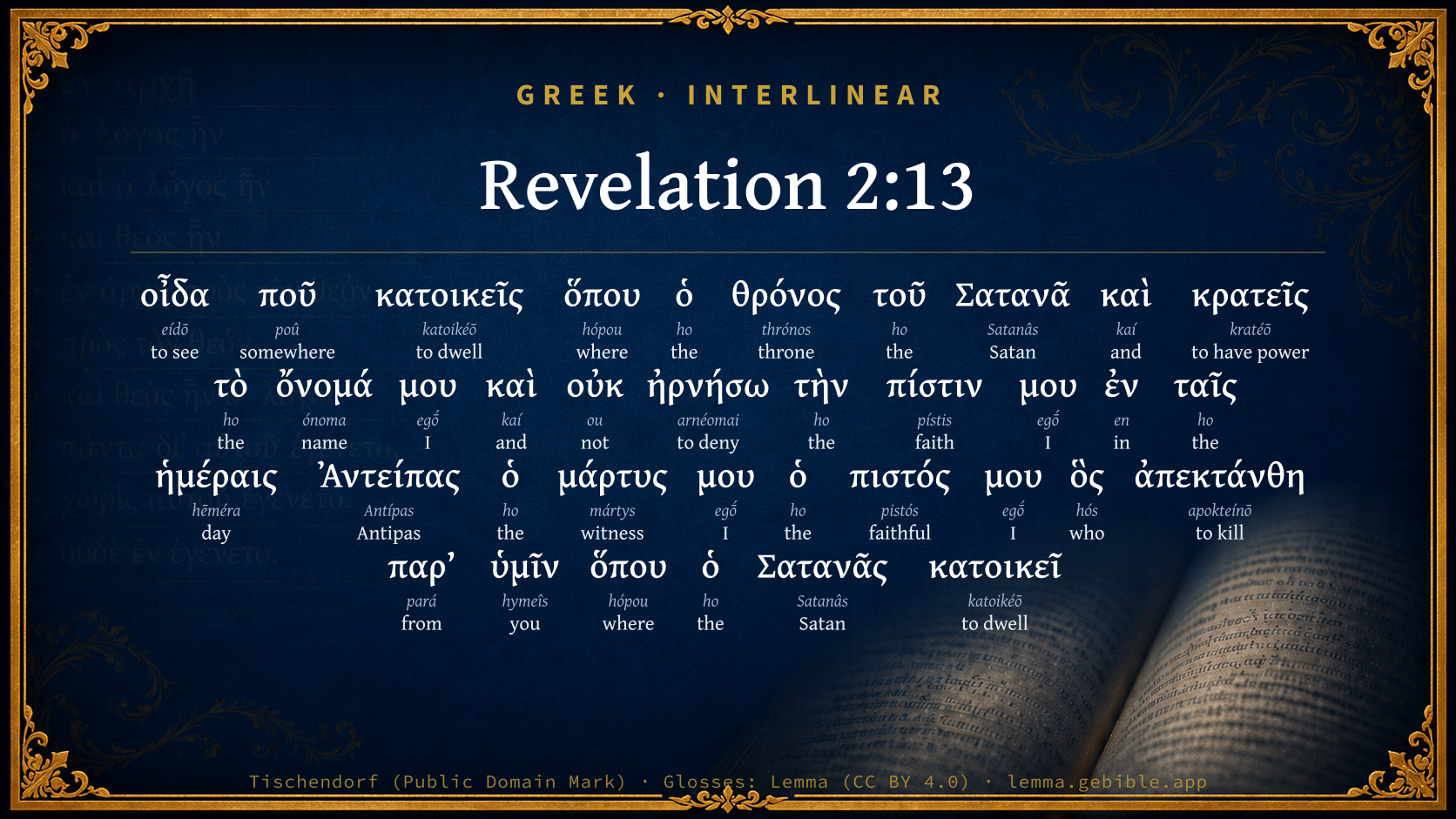
Greek (Tischendorf 8th ed.) Revelation 2:13 appears in the Greek New Testament. The text above is from the Tischendorf 8th edition. Each word links to its Strong’s number and a concise gloss. Click any word for its full Thayer’s Greek Lexicon entry.
Download image
Cite this verse

Revelation 2:13 (World English Bible). Public Domain. Lemma interlinear Bible study tool, https://lemma.gebible.app/v/revelation/2/13.

Show BibTeX & RIS
BibTeX
RIS
English Translation
"I know your works and where you dwell, where Satan's throne is. You hold firmly to my name, and didn't deny my faith in the days of Antipas my witness, my faithful one, who was killed among you, where Satan dwells.
World English Bible · Public Domain
Highlights
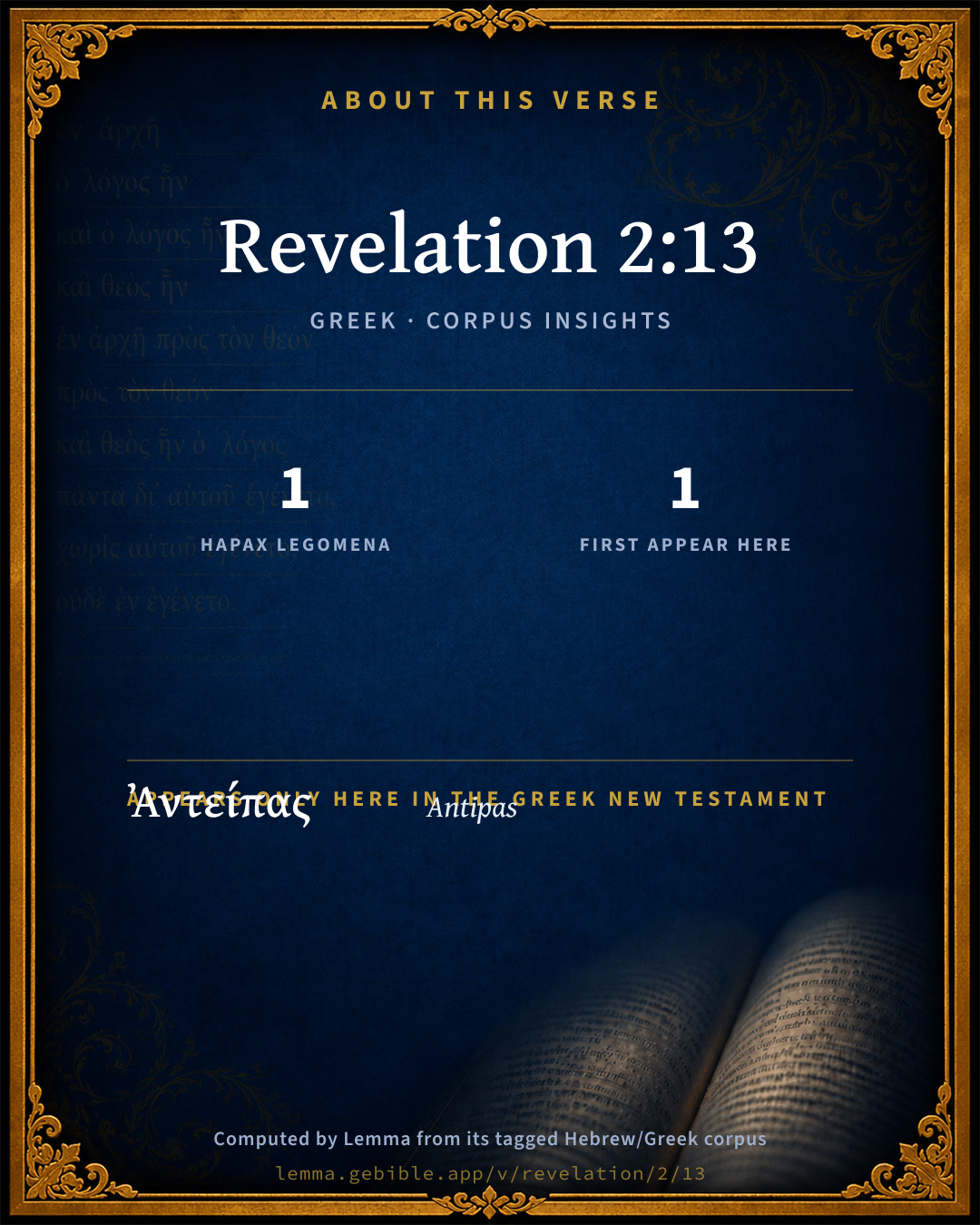
  • 1 hapax legomenon — only here in the Greek New Testament
  • 1 first appearance in the Greek New Testament
Full analysis ↓
Download a study sheet

One document with this verse’s original text, its word-by-word gloss line, the meaning frame, cross-references with their text, attributed commentary, and full source and license credits — printable, and it pastes into notes with its structure intact.

This verse Autodidact and up

Study sheet (.html) Plain text (.txt)

A passage Seminary Student

Up to 50 verses in one chapter. A passage sheet keeps up to 6 commentary sources and 12 cross-references per verse, in the order this page ranks them, and says so on the sheet whenever that leaves anything out. Ask for a single verse and you get the Autodidact verse sheet above.

Everything on this page stays free to read, with no account — the sheet is a download of what is already on screen, not access to it.

Want to remove ads? Support Godless Engineer
Compare translations 3

The same verse in 3 English versions, stacked beneath the original-language interlinear above. Click any original word for its lexicon entry.

Each is an independent rendering of the whole verse — the interlinear is not word-aligned to these translations.

Highlighted words mark where these versions differ — a whole-verse word diff, not a word-by-word alignment.

  • World English Bible Public Domain
    "I know your works and where you dwell, where Satan's throne is. You hold firmly to my name, and didn't deny my faith in the days of Antipas my witness, my faithful one, who was killed among you, where Satan dwells.
  • King James Version Public Domain
    I know thy works, and where thou dwellest, even where Satan's seat is: and thou holdest fast my name, and hast not denied my faith, even in those days wherein Antipas was my faithful martyr, who was slain among you, where Satan dwelleth.
  • unfoldingWord Literal Text CC BY-SA 4.0
    “I know where you live, where the throne of Satan, yet you hold my name and you did not deny my faith even in the days of Antipas my witness, my faithful one, who was killed among you, where Satan lives.

unfoldingWord Literal Text — © unfoldingWord, licensed CC BY-SA 4.0. Word-aligned USFM3 via Door43 (git.door43.org/unfoldingWord/en_ult).

Versions to compare (up to 4)

3 of 4 selected

Show all 19 translations

Every available English version of this verse, each an independent rendering of the whole verse.

  • World English Bible Public Domain
    "I know your works and where you dwell, where Satan's throne is. You hold firmly to my name, and didn't deny my faith in the days of Antipas my witness, my faithful one, who was killed among you, where Satan dwells.
  • Berean Standard Bible Public Domain
    I know where you live, where the throne of Satan sits. Yet you have held fast to My name and have not denied your faith in Me, even in the day when My faithful witness Antipas was killed among you, where Satan dwells.
  • Majority Standard Bible Public Domain
    I know your works and where you live, where the throne of Satan sits. Yet you hold to My name and did not deny your faith in Me in the days of My faithful witness Antipas, who was killed among you where Satan dwells.
  • King James Version Public Domain
    I know thy works, and where thou dwellest, even where Satan's seat is: and thou holdest fast my name, and hast not denied my faith, even in those days wherein Antipas was my faithful martyr, who was slain among you, where Satan dwelleth.
  • American Standard Version (1901) Public Domain
    I know where thou dwellest, `even' where Satan's throne is; and thou holdest fast my name, and didst not deny my faith, even in the days of Antipas my witness, my faithful one, who was killed among you, where Satan dwelleth.
  • Revised Version (1885) Public Domain
    I know where thou dwellest, even where Satan’s throne is: and thou holdest fast my name, and didst not deny my faith, even in the days of Antipas my witness, my faithful one, who was killed among you, where Satan dwelleth.
  • Geneva Bible (1599) Public Domain
    I knowe thy workes and where thou dwellest, euen where Satans throne is, and thou keepest my Name, and hast not denied my faith, euen in those dayes when Antipas my faithfull martyr was slaine among you, where Satan dwelleth.
  • Douay-Rheims (1899) Public Domain
    I know where thou dwellest, where the seat of Satan is: and thou holdest fast my name, and hast not denied my faith. Even in those days when Antipas was my faithful witness, who was slain among you, where Satan dwelleth.
  • Young's Literal Translation Public Domain
    I have known thy works, and where thou dost dwell -- where the throne of the Adversary `is' -- and thou dost hold fast my name, and thou didst not deny my faith, even in the days in which Antipas `was' my faithful witness, who was put to death beside you, where the Adversary doth dwell.
  • Literal Standard Version CC BY-SA 4.0
    I have known your works, and where you dwell—where the throne of Satan [is]—and you hold fast My Name, and you did not deny My faith, even in the days in which Antipas [was] My faithful witness, who was put to death beside you, where Satan dwells.
  • Unlocked Literal Bible CC BY-SA 4.0
    “I know where you live, there where Satan's throne is. Yet you hold on tightly to my name. I know that you did not deny your faith in me, even in the days of Antipas my witness, my faithful one, who was killed among you, there where Satan lives.
  • unfoldingWord Literal Text CC BY-SA 4.0
    “I know where you live, where the throne of Satan, yet you hold my name and you did not deny my faith even in the days of Antipas my witness, my faithful one, who was killed among you, where Satan lives.
  • Darby Bible Public Domain
    I know where thou dwellest, where the throne of Satan [is]; and thou holdest fast my name, and hast not denied my faith, even in the days in which Antipas my faithful witness [was], who was slain among you, where Satan dwells.
  • World Messianic Bible Public Domain
    “I know your works and where you dwell, where Satan’s throne is. You hold firmly to my name, and didn’t deny my faith in the days of Antipas my witness, my faithful one, who was killed among you, where Satan dwells.
  • Webster's Bible Public Domain
    I know thy works, and where thou dwellest, even where Satan's seat is: and thou holdest fast my name, and hast not denied my faith, even in those days wherein Antipas was my faithful martyr, who was slain among you, where Satan dwelleth.
  • Free Bible Version CC BY-SA 4.0
    I know you're living where Satan has his throne, and that you have stayed true to me. You have not denied your trust in me, even when my faithful witness Antipas was killed right among you there where Satan lives!
  • Bible in Basic English Public Domain
    I have knowledge that your living-place is where Satan has his seat: and you are true to my name, and were not turned away from your faith in me, even in the days of Antipas, my true witness, who was put to death among you, where Satan has his place.
  • Text-Critical English NT CC BY 4.0
    I know yoʋr works and where yoʋ dwell, where Satan's throne is. Yet yoʋ hold fast to my name, and yoʋ did not deny yoʋr faith in me in the days when Antipas was my faithful witness, who was killed among you, where Satan dwells.
  • Tyndale New Testament (1534) Public Domain
    I knowe thy workes and where thow dwellest evyn where Sathans seat ys and thou kepest my name and hast not denyed my fayth. And in my dayes Antipas was a faythfull witnes of myne which was slayne amonge you where sathan dwelleth.

Literal Standard Version (2020), Covenant Press — licensed CC BY-SA 4.0. Text via the HelloAO Bible API (eBible.org). Unlocked Literal Bible (unfoldingWord) — licensed CC BY-SA 4.0. Text via the HelloAO Bible API (eBible.org). unfoldingWord Literal Text — © unfoldingWord, licensed CC BY-SA 4.0. Word-aligned USFM3 via Door43 (git.door43.org/unfoldingWord/en_ult). Free Bible Version, Dr. Jonathan Gallagher — licensed CC BY-SA 4.0. Text via the HelloAO Bible API (eBible.org).

Word by word

More ways to search: Search by grammar → Find every occurrence → Compare this word →

Practice this passage: Drill this verse → Learn its vocabulary →

Ἀντείπας
Antípas
G493
“Antipas”
Noun, Nominative, Singular, Masculine
Part of Speech
Noun
Case
Nominative
Number
Singular
Gender
Masculine
Full Thayer's Definition

Origin: contracted for a compound of G473 and a derivative of G3962

TDNT: None

Antipas = "like the father" 1. a Christian of Pergamos who suffered martyrdom
  1. οἶδα eídō G1492 “to see” Verb, Perfect, Active, Indicative, 1st person, Singular
  2. ποῦ poû G4226 “somewhere” Particle, Interrogative
  3. κατοικεῖς katoikéō G2730 “to dwell” Verb, Present, Active, Indicative, 2nd person, Singular
  4. ὅπου hópou G3699 “where” Adverb
  5. ὁ ho G3588 “the” Article, Nominative, Singular, Masculine
  6. θρόνος thrónos G2362 “throne” Noun, Nominative, Singular, Masculine
  7. τοῦ ho G3588 “the” Article, Genitive, Singular, Masculine
  8. Σατανᾶ Satanâs G4567 “Satan” Noun, Genitive, Singular, Masculine
  9. καὶ kaí G2532 “and” Conjunction
  10. κρατεῖς kratéō G2902 “to have power” Verb, Present, Active, Indicative, 2nd person, Singular
  11. τὸ ho G3588 “the” Article, Accusative, Singular, Neuter
  12. ὄνομά ónoma G3686 “name” Noun, Accusative, Singular, Neuter
  13. μου egṓ G1473 “I” Personal pronoun, 1st person, Genitive, Singular
  14. καὶ kaí G2532 “and” Conjunction
  15. οὐκ ou G3756 “not” Particle, Negative
  16. ἠρνήσω arnéomai G720 “to deny” Verb, Aorist, Middle deponent, Indicative, 2nd person, Singular
  17. τὴν ho G3588 “the” Article, Accusative, Singular, Feminine
  18. πίστιν pístis G4102 “faith” Noun, Accusative, Singular, Feminine
  19. μου egṓ G1473 “I” Personal pronoun, 1st person, Genitive, Singular
  20. ἐν en G1722 “in” Preposition
  21. ταῖς ho G3588 “the” Article, Dative, Plural, Feminine
  22. ἡμέραις hēméra G2250 “day” Noun, Dative, Plural, Feminine
  23. ὁ ho G3588 “the” Article, Nominative, Singular, Masculine
  24. μάρτυς mártys G3144 “witness” Noun, Nominative, Singular, Masculine
  25. μου egṓ G1473 “I” Personal pronoun, 1st person, Genitive, Singular
  26. ὁ ho G3588 “the” Article, Nominative, Singular, Masculine
  27. πιστός pistós G4103 “faithful” Adjective, Nominative, Singular, Masculine
  28. μου egṓ G1473 “I” Personal pronoun, 1st person, Genitive, Singular
  29. ὃς hós G3739 “who” Relative pronoun, Nominative, Singular, Masculine
  30. ἀπεκτάνθη apokteínō G615 “to kill” Verb, Aorist, Passive, Indicative, 3rd person, Singular
  31. παρ’ pará G3844 “from” Preposition
  32. ὑμῖν hymeîs G5210 “you” Personal pronoun, 2nd person, Dative, Plural
  33. ὅπου hópou G3699 “where” Adverb
  34. ὁ ho G3588 “the” Article, Nominative, Singular, Masculine
  35. Σατανᾶς Satanâs G4567 “Satan” Noun, Nominative, Singular, Masculine
  36. κατοικεῖ katoikéō G2730 “to dwell” Verb, Present, Active, Indicative, 3rd person, Singular

About this verse

These counts appear in no published source. They are computed here, from the morphology-tagged text and Lemma’s own curated glosses. What Lemma adds →

37
words
23
distinct lemmas
Revelation
section

Notable vocabulary

1 hapax legomenon — a word that appears only here in the entire Greek New Testament:

  • Ἀντείπας Antipas G493

First appearance in Scripture

This word makes its first canonical appearance in the Greek New Testament here:

  • Ἀντείπας Antipas G493

Shared distinctive vocabulary

ἠρνήσω to deny G720 occurs in 30 verses of the Greek New Testament. Also found in:
Repetition

Words recur within this verse:

  • κατοικεῖς to dwell G2730 ×2
  • ὅπου where G3699 ×2
  • Σατανᾶ Satan G4567 ×2
  • ὁ the G3588 ×8
  • μου I G1473 ×4
  • καὶ and G2532 ×2

Cross-references

20

Topical passages linked to Revelation 2:13 in the Treasury of Scripture Knowledge — connected by theme and wording, ordered by reader-vote popularity; previews shown in the World English Bible.

  • Revelation 2:9–10 "I know your works, oppression, and your poverty (but you are rich), and the blasphemy of those who say they are Jews, and they are not, but are a synagogue of Satan.
  • 1 Timothy 5:8 But if anyone doesn't provide for his own, and especially his own household, he has denied the faith, and is worse than an unbeliever.
  • Revelation 3:8–9 "I know your works (behold, I have set before you an open door, which no one can shut), that you have a little power, and kept my word, and didn't deny my name.
  • Revelation 3:11 I am coming quickly! Hold firmly that which you have, so that no one takes your crown.
  • Acts 22:20 When the blood of Stephen, your witness, was shed, I also was standing by, and consenting to his death, and guarding the cloaks of those who killed him.'
  • 2 Timothy 2:12 If we endure, We will also reign with him. If we deny him, He also will deny us.
  • Matthew 24:9 Then they will deliver you up to oppression, and will kill you. You will be hated by all of the nations for my name's sake.
  • 2 Timothy 1:13 Hold the pattern of sound words which you have heard from me, in faith and love which is in Christ Jesus.
  • Hebrews 10:23 let us hold fast the confession of our hope unyieldingly. For he who promised is faithful.
  • Jude 1:3–4 Beloved, while I was very eager to write to you about our common salvation, I was constrained to write to you exhorting you to contend earnestly for the faith which was once for all delivered to the saints.
  • Revelation 2:2 "I know your works, and your toil and perseverance, and that you can't tolerate evil men, and have tested those who call themselves apostles, and they are not, and found them false.
  • Revelation 2:24–25 But to you I say, to the rest who are in Thyatira, as many as don't have this teaching, who don't know what some call 'the deep things of Satan,' to you I say, I am not putting any other burden on you.
  • Revelation 3:3 Remember therefore how you have received and heard. Keep it, and repent. If therefore you won't watch, I will come as a thief, and you won't know what hour I will come upon you.
  • Revelation 14:12 Here is the patience of the saints, those who keep the commandments of God, and the faith of Jesus."
  • Matthew 10:23 But when they persecute you in this city, flee into the next, for most assuredly I tell you, you will not have gone through the cities of Israel, until the Son of Man has come.
  • Luke 21:17 You will be hated by all men for my name's sake.
  • Acts 9:14 Here he has authority from the chief priests to bind all who call on your name."
  • 1 Thessalonians 5:21 Test all things, and hold firmly that which is good.
  • Hebrews 3:6 but Christ is faithful as a Son over his house; whose house we are, if we hold fast our confidence and the glorying of our hope firm to the end.
  • James 2:7 Don't they blaspheme the honorable name by which you are called?

Cross-references courtesy of OpenBible.info (CC BY 4.0).

Where the printed editions differ

1 variant

Places in this verse where the major printed Greek editions disagree on the wording in a way that affects the translation — a comparison of editions, not a manuscript-by-manuscript collation. The editions are the modern critical texts (Nestlé-Aland 28/27, SBL, Westcott-Hort, Tregelles, Tyndale House) and the traditional texts behind the KJV (the Textus Receptus and the Byzantine/Majority text). It is not a claim about which reading is original.

  1. Extra text
    τὰ ἔργα σου, καὶ

    “the works of you and”

    In TRByz Not in NA28NA27TynSBLWHTreg

    τὰ ἔργα σου, καὶ (ta erga sou kai) 'the works of you and' is only in traditional manuscripts (TR+Byz)

Textual data: Translators Amalgamated Greek New Testament (STEPBible TAGNT) · CC BY 4.0.

Commentary

Notes on Revelation 2:13 from classic Christian and Jewish commentators (each source and its license shown beneath its notes). The classic Christian expositions comment on the surrounding passage and are grouped to its opening verse, so a note may address several verses; the Jewish commentaries on the Tanakh (Rashi and others) are per-verse, so they appear only where the commentator wrote on this verse.

Lemma curates 59 commentaries, every one of them public domain or Creative Commons licensed, each selected and text-cleaned for this edition rather than reprinted as found. About our sources →

Tyndale Open Study Notes

Tyndale Open Resources

2:13 The throne of Satan might refer to the altar of Zeus on the mountain above the city or to emperor worship at the temple of Augustus. For many years, the Roman proconsul had his throne there, and the great temple of Athena and other shrines were also located in Pergamum. Its description as Satan’s city might also refer to the temple of Asclepius, whose symbol was coiled snakes. The city was dedicated to the Roman pantheon and emperor worship. • Antipas is otherwise unknown.

Tyndale Open Study Notes — © Tyndale Open Resources, licensed CC BY-SA 4.0. Text via the HelloAO Bible API.

Bengel's Gnomon

Johann Albrecht Bengel

Rev 2:13. Πίστιν) To this the cognate word πιστὸς presently afterwards answers.—ἐν ταῖς ἠμέραις) See App. on this passage.[32]—αἷς Ἀντίπας) that is, οὐκ ἠρνήσατο. The Menologia say, that Antipas was slain under Domitian: the Martyrologia, that he was cast into a heated brazen bull.

[32] AC Vulg. Memph. prefixes και before εν. B Syr. omit it.—E.

Bengel's Gnomon of the New Testament — English translation (T&T Clark, Edinburgh, 1860) — public domain. Text from a community e-Sword module.

Meyer's Critical & Exegetical Commentary

Heinrich August Wilhelm Meyer

Rev_2:13. The ποῦ κατοικ. is immediately afterwards described more accurately: ὅπου ὁ θρ. τ. σατ. This in itself does not contain a commendation, but serves as a commendation only as the church remains faithful although dwelling where Satans seat is, which is communicated by the more emphatic and explicit repetition at the close of ὅπου ὁ σατ. κατοικεῖ.[1113] It is a matter of importance, however, that the Lord first of all simply testifies, for its consolation, to his knowledge of the nature of his churchs abode: ὍΠΟΥ Ὁ ΘΡΌΝΟς ΤΟῦ ΣΑΤΑΝᾶ. At all events, this[1114] points to the city of Pergamos as the place of the church; and hence the explanation is incorrect, according to which the godless enemies of Christ and his believers are represented[1115] as Satans throne.[1116] There is nothing to support the opinion[1117] that Satans throne was in Pergamos as the chief abode of the worship of Aesculapius, whose symbol was the serpent; for if, on account of his serpent, John would have desired to designate Aesculapius directly as the Devil[1118] (which would have been inappropriate, as, according to 1Co_10:20, that particular ἜΙΔΩΛΟΝ can be only one ΔΑΙΜΌΝΙΟΝ among many), he would at least have indicated it by Ὁ ΘΡ. ΤΟῦ ΔΡΆΚΟΝΤΟς. We must first, with Andreas,[1119] think of a remarkable flourishing of idol-worship in general, if the remark of And. that Perg. was ΚΑΤΕΊΔΩΛΟς ὙΠῈΡ ΤῊΝ ʼΑΣΊΑΝ ΠᾶΣΑΝ (given to idolatry above all Asia) would have an historical foundation. That Perg. is called the seat of Satan as the abode of heathen and Nicolaitans,[1120] is partly too general, and partly contrary to the meaning of Rev_2:14. The only correct view is the reference, understood already by N. de Lyra, to the persecution of the church, ascribed also in Rev_2:10 to the Devil;[1121] decidedly in favor of this explanation is the ὍΠΟΥ Ὁ ΣΑΤ. ΚΑΤΟΙΚΕῖ in its connection with ἈΠΕΚΤΆΝΘΗ ΠΑΡʼ ὙΜῖΝ. Only in Perg. had Satan been able to proceed so far as to shed the blood of martyrs. Whether this was caused by the adherence of the heathen with special fanaticism to their Aesculapius;[1122] or the fact that Perg., as the seat of supreme jurisdiction,[1123] most readily offered a theatre for persecutions;[1124] or, finally, that only particularly hostile individuals[1125] to be sought among the heathen, because not further designated,[1126] were present in Perg.,it is not possible to decide.

καὶ κρατεῖς, κ.τ.λ. The holding fast[1127] of Christs name, which continues still to the present (κρατεῖς, pres.), has already approved itself on some special opportunity (καὶ οὐκ ἠρνήσω, aor.). As the κρατεῖς corresponds to the contrasted ἠρνῆσω, so τὸ ὄνομα μου is parallel with τὴν πίστιν μου. The former is the objective, and the latter the subjective nature. Christs ὄνομα which is held fast by believers is not the profession of doctrine delivered by Christ[1128] or the confession of his name,[1129] but the name of Christ appears as something in itself objective, so that one may have, hold, and lose, confess and deny it, yea, even, it may work,[1130] as the name of Christ comprises the true objective person of Christ together with his riches and glory. The κρατεῖν τὸ ὄνομα occurs in the sense of this passage, of course, only by faithful, frank confession, but not simply in life and faith.[1131] The corresponding inner item (Rom_10:10) is faith in the Lord: τ. πίστ. μου, objective genitive.[1132]

καὶ ἐν ταῖς ἡμέραις ʼΑντίπας, κ.τ.λ. The correct text, with which the Vulg. in the critical recension agrees,[1133] i.e., in which before ʼΑντίπας neither αἱς nor ἐν αἰς nor ἐμαῖς is to be read, but on the contrary before ἀπεκτ. there is a ὃς,[1134] is not explicable by the conjecture that the gen. ʼΑντίπα may have stood originally in the text,[1135] nor by the idea that ʼΑντίπας is used as indeclinable, and the form here is intended as genitive;[1136] for both conjectures, in themselves having little probability, are made doubly difficult by the nominative appos. ὁ μαρτ. ό πιστ., since here it is hard to accept the explanation which is in place in Rev_1:5, where what is said, is of Christ himself. Grotius assumes an ellipsis and a transposition by thus analyzing the sentence: ἐν τ. ἡμ. ʼΑντίπα, ὃς ʼΑντίπας

ἀπεκτάνθη. Ebrard, who, however, reads αἰς before ʼΑντ., explains the anacoluthon in the sentence by the supposition that the originally intended construction αἰς ʼΑντίπας

ἀπεκτάνθη was abandoned, because the chief verb ἀπεκτ. is added as an explanation of the words ό μαρτ. μ. ό πιστ., and thus a relative sentence originated which contains the verb properly belonging to ʼΑντίπας. But even the latter explanation does not naturally appear in the simple members of which the entire sentence consists. Primas, N. de Lyra, C. a Lap., and other catholic expositors,[1137] have correctly hit the sense by following the explanatory reading of the Vulg. in diebus illis, for if also the mere article cannot have directly the force of a demonstrative, yet it marks the precise days in which the church did not deny the faith: and in the day Antipas (namely: was) my faithful witness who, etc. It is designedly that the commendation of the church is still further enhanced by the circumstance especially added (καί), that one witness, in the days when the whole church faithfully gave its testimony, was faithful even unto death. The reference to the οὐκ ἠρνήσω. τ. πίστιν μου is indicated also by the expression ὁ μαρτ. μου ὁ πίστος,[1138] as then also the παρʼ ὑμῖν and the repeated ὅπου ὁ σατ. κατοικεῖ in this connection are significant.

Of the martyr Antipas, nothing historical is known. Whether his martyrdom, noticed by Andreas, were related already perhaps from the account, contained in the later martyrologies and menologies, viz., that Antipas as bishop of Pergamos under Domitian was put to death in a glowing brazen ox, we do not know. The interpretations of the name as Ἀντι-πᾶς, i.e., Against all, therefore, child of God, and hence enemy of the whole world,[1139] or Anti-papa,[1140] are wrecked by grammar, which teaches that Ἀντίπας is similar to Ἀντίπατρος.[1141] Coccejus, for this reason, wants to find in Antipas the confessor of Athanasianism, since Ἀντίπατρος resembles ἰσόπατρος, and this again ὁμοούσιος. Vitringa adds, yet, that the mystical Pergamos where this mystical Antipas was slain, viz., again mystically, by banishment, or, in general, by hinderance of confession, is Alexandria, the residence of Athanasius.

[1113] Thus with regard to κατοικεῖς.

[1114] Cf. the ποῦ κατοικεῖς and ὅπου ὁ σαταν. κατοικεῖ.

[1115] Primas, Zeger.

[1116] The opinion of P. Zornius (in Wolf) is a curiosity; viz., that John had in view the Pergamean museum, and the empty speeches of the sophists.

[1117] Grot., Wetst., M. Rossal and Ph. Hasäus in the Bibl. Brem., iii. pp. 94, 104. Cf. also Eichh., Heinr.

[1118] Rev_12:3; Rev_12:9.

[1119] Aret., Pric., Beng., etc.

[1120] C. a Lap., Calov.

[1121] Ew., De Wette, Hengstenb., Ebrard.

[1122] In connection with which, we must remember that the idol, because of its epithet σωτήρ, formed a manifest opposition to the Saviour; we may also think of miraculous cures in the temple of Aesc., and the interests connected therewith. Cf. Act_19:24 sqq., Rev_16:19 sqq.

[1123] Kliefoth.

[1124] In connection with which, relations acknowledged in Plin., Ep. 97, and the apologists, and even indicated in Acts, may be recalled.

[1125] Hengstenb.

[1126] Ewald.

[1127] Cf. Rev_2:1; Rev_3:11.

[1128] Grot.

[1129] De Wette.

[1130] Cf. Act_2:21; Act_3:16; Act_9:14; Joh_1:12.

[1131] N. de Lyra.

[1132] Rev_14:12; Rom_3:22; Eph_3:12. Winer, p. 175.

[1133] Et in diebus Antipas, testis meus fidelis, qui occisus est, etc. Lach., Tisch.

[1134] See Critical Remarks.

[1135] Ewald.

[1136] Bleek.

[1137] Cf. also Treg.

[1138] Beng.

[1139] Aretius, Hengstenb., who understand thereby Timothy.

[1140] Ed. Schmidt.

[1141] Winer, p. 97.

Meyer — Critical and Exegetical Commentary on the New Testament — English translation by Peter Christie, edited by Frederick Crombie (T&T Clark, 1880) — public domain. Text from a community e-Sword module.

Expositor's Greek Testament

ed. W. Robertson Nicoll

Rev 2:13 . Two features in the local situation menaced Christianity. Pergamos, besides forming a legal centre for the district (ad earn conueniunt Thyatireni aliaeque inhonorae ciuitates, Plin. ver 33), was an old centre of emperor-worship in Asia Minor; in 29 B.C. a temple had been erected to the divine Augustus and the goddess Roma, and a special priesthood had been formed ( ὑμνῳδοὶ θεοῦ Σεβαστοῦ καὶ θεᾶς Ῥώμης ). Another feature, shocking to early Christian feeling, was the local cult of Aesculapius ( cf. Zahn, § 73, note 2), whose favourite symbol ( e.g. , on coins) was a serpent (“the god of Pergamos, Mart. Rev 9:17 ); so Pausan. Cor. 27, (3:402), κάθηται δὲ ἐπὶ θρόνου βακτηρίαν κρατῶν , τὴν δὲ ἑτέραν τῶν χειρῶν ὑπὲρ κεφαλῆ ἔχει τοῦ δράκοντος . In addition to these fashionable cults, a magnificent throne-like altar to Zeus Soter towered on the Acropolis (Paus. ii. 73, 75, iii. 556, 557) commemorating the defeat of the barbarian Gauls by Attalus two centuries earlier, and decorated by a famous frieze of the gods warring against the giants (the latter, a brood of vigorous opponents, having often human bodies and serpentine tails, cf. below, Rev 9:19 ). No wonder Pergamos was called “a throne of Satan” by early Christians who revolted against the splendid and insidious paganism of a place where politics and religion were firm allies. Least of all at this cathedral centre of the Imperial cultus could dissent be tolerated. The Asiarch, e.g. , who condemns Polykarp is the local high priest of the altar, and the animus against Cæsar-adoration which pervades the Apocalypse easily accounts for the last phrase ὁ θ . τ . σ ., particularly as the symbol of the serpent in the Aesculapius cult would come vividly home to pious Jewish Christians in the church, as a reminder of Satan ( e.g. , Rev 12:9 and passim ). The priesthood of this cult, “a vast college, believed to be in possession of certain precious medical secrets,” came “nearest, perhaps, of all the institutions of the pagan world, to the Christian priesthood,” its rites being “administered in a full conviction of the religiousness, the refined and sacred happiness, of a life spent in the relieving of pain” (Pater, Marius the Epicurean , i. 30; see Usener’s Götternamen , 1896, pp. 147 f., 350, and Dill’s Roman Soc. from Nero to M. Aur. 459 f.). κρατεῖς , κ . τ . λ ., “And the magistrate pressed him hard, saying, ‘Swear the oath [by the genius of Cæsar] and I will release thee; curse the Christ.’ But Polykarp replied, ‘For eighty-six years I have served him, and he has never injured me. How then can I blaspheme my King, who has saved me?’ ” ( Mart. Polyc. ix. Jewish analogies in 2Ma 8:4 , Ass. Mos. viii. etc.). Some definite outburst of persecution at Pergamos is in the writer’s mind ( ἠρνήσω ). To disown or abjure faith in Jesus, saying Κύριος Καῖσαρ , implies here as in the gospels the moral fault of cowardice, elsewhere ( e.g. 1 John, Jud 1:4 , 2Pe 2:1 ) erroneous doctrine. The circumstances and surroundings of the local church are taken into account, as usual, in the prophet’s estimate; they either claim some allowance to be made, or reflect additional credit and lustre on the particular community. ὁ μάρτυς , κ . τ . λ . He is faithful who retains his faith. Antipas (= Ἀντίπατρος , Jos. Ant. xiv. 1, 3; the name occurs in a third century inscription of Pergamos, Deissm. 187), is mentioned by Tertullian ( adv. Gnost. scorp. 12); otherwise he is unknown. His Acts appear to have been read by Andreas and Arethas, and, according to Simon Metaphrastes, he was an old, intrepid bishop of Pergamos whose prestige drew upon him the honour of being burned to death in a brazen bull during Domitian’s reign. The sober truth is probably that he formed the first prominent victim in the local church, possibly in Asia Minor, to the demands of the Imperial cultus. Carpus, Papylus, and Agathonikê, the other martyrs of Pergamos named by Eusebius ( H. E. , iv. 15, 48), died at a later period. On the whole verse see Ep. Lugd., “then did the holy martyrs endure indescribable torture, Satan eagerly striving to make them utter τι τῶν βλασφήμων ”. The textual variants arose from a failure to to see that Αντίπας (or - α ) was a genitive and that μάρτυς was in characteristic irregular apposition to it. The name is neither a personification nor typical.

The Expositor's Greek Testament, edited by W. Robertson Nicoll (1897–1910) — public domain. Text from a community e-Sword module.

Geneva Bible (1599)

Geneva Bible translators

The proposition of praise is in this verse, of reprehension in the two following, and of exhortation joined with a conditional threat, verse 16. Now this Antipas was the Angel or minister of the Church of Pergamos, as Aretas writeth.

The faith of them of Pergamos is so much the more highly commended because they remained constant even in the very heat of persecution.

Geneva Bible (1599) marginal notes — public domain. Text via Bolls.life.

Jamieson, Fausset & Brown

Robert Jamieson, A. R. Fausset & David Brown

I know thy works--Two oldest manuscripts omit this clause; one oldest manuscript retains it.

Satan's seat--rather as the Greek is translated all through Revelation, "throne." Satan, in impious mimicry of God's heavenly throne, sets up his earthly throne (Rev 4:2). Æsculapius was worshipped there under the serpent form; and Satan, the old serpent, as the instigator (compare Rev 2:10) of fanatical devotees of Æsculapius, and, through them, of the supreme magistracy at Pergamos, persecuted one of the Lord's people (Antipas) even to death. Thus, this address is an anticipatory preface to Rev. 12:1-17; Note: "throne . . . the dragon, Satan . . . war with her seed," Rev 12:5, Rev 12:9, Rev 12:17.

even in those days--Two oldest manuscripts omit "even"; two retain it.

wherein--Two oldest manuscripts omit this (then translate, "in the days of Antipas, My faithful witness," or "martyr"); two retain it. Two oldest manuscripts read, "My witness, MY faithful one"; two read as English Version. Antipas is another form for Antipater. SIMEON METAPHRASTES has a palpably legendary story, unknown to the early Fathers, that Antipas, in Domitian's reign, was shut up in a red-hot brazen bull, and ended his life in thanksgivings and prayers. HENGSTENBERG makes the name, like other apocalyptic names, symbolical, meaning one standing out "against all" for Christ's sake.

Jamieson, Fausset & Brown — Commentary Critical and Explanatory on the Whole Bible (1871) — public domain (CC PDM 1.0). Text via the HelloAO Bible API.

Adam Clarke's Commentary

Verse 13. Where Satan's seat is] Ὁπου ὁ θρονος του Σατανα· Where Satan has his throne-where he reigns as king, and is universally obeyed. It was a maxim among the Jews, that where the law of God was not studied, there Satan dwelt; but he was obliged to leave the place where a synagogue or academy was established.

Thou holdest fast my name] Notwithstanding that the profession of Christianity exposed this Church to the bitterest persecution, they held fast the name of Christian, which they had received from Jesus Christ, and did not deny his faith; for when brought to the trial they openly professed themselves disciples and followers of their Lord and Master.

Antipas was my faithful martyr] Who this Antipas was we cannot tell. We only know that he was a Christian, and probably bore some office in the Church, and became illustrious by his martyrdom in the cause of Christ. There is a work extant called The Acts of Antipas, which makes him bishop of Pergamos, and states that he was put to death by being enclosed in a burning brazen bull. But this story confutes itself, as the Romans, under whose government Pergamos then was, never put any person to death in this way. It is supposed that he was murdered by some mob, who chose this way to vindicate the honour of their god AEsculapius, in opposition to the claims of our Lord Jesus.

Adam Clarke's Commentary on the Bible (1810–1826) — public domain. Text from a community e-Sword/MySword module.

Ellicott's Commentary for English Readers

(13) I know thy works.—Here, as in Rev_2:9, some MSS. omit “thy works,” and read, “I know where thou dwellest—even where Satan’s seat is.” The word is translated elsewhere “throne,” and should be here, “Where the throne of Satan is.” But why should this pre-eminence in evil be assigned to Pergamos? The answer is difficult. Some leave it unsolved, saying that in the absence of any historical notice, it must remain one of the unsolved riddles of these epistles. Prof. Plumptre suggests that the general character of the city, its worship and customs, in addition to the persecutions which the Christians had encountered, may well account for the description. Æsculapius was worshipped as the “Preserver,” or “Saviour.” The symbol of the serpent must have been conspicuous among the objects of adoration in his temple. Curious arts were practised; lying wonders were claimed; persecution had extended to death. Such evil in such a city may have led to its being regarded as the very head-quarters of the enemy.

Hast not denied.—Better, Thou didst not deny My faith in the days in which Antipas My faithful witness, was slain, &c.

Antipas.—Short for Antipater. (Comp. Lucas and Silas, short for Lucanus and Silvanus.) Nothing is known of Antipas. There are later traditions respecting him, but these are probably fancy-drawn.

A Bible Commentary for English Readers, edited by Charles John Ellicott (1878–1897) — public domain. Text from a community e-Sword module.

The Cambridge Bible for Schools and Colleges

gen. ed. J. J. S. Perowne

13. Satan’s seat] Better, throne—the word being the one so naturalised in English, and so translated in this book wherever used of the throne of God, Rev_3:21 &c. Why Satan’s throne and dwelling-place is localised at Pergamum is uncertain; two explanations have been given: that it was a seat of the worship of Asclepius or Aesculapius, whose traditional image held a serpent, and who in some of his shrines (but apparently not at Pergamum) was actually worshipped under the form of a serpent: and since recent excavations it has been suggested that the phrase was intended to refer to the great altar of Zeus Soter, carved with the wars of gods and giants, which Attalus set up to commemorate his victory over the Gauls—the last great triumph of Hellenism over barbarism. No doubt, to a pious Jew or Christian the worship of the serpent might naturally and excusably seem more direct and avowed devil-worship than other idolatry, while the fame of the great altar might cause it to be treated as the chosen throne of the God of this world; but we may question whether an inspired Apostle, or rather the Lord Himself, would thus “look upon the outward appearance”—both the worship of Asclepius and the thank-offering of Attalus belonged to the better side of heathenism. Perhaps therefore the meaning is only, that Pergamum was in a special sense a home of the Satanic spirit of persecution (cf. Rev_2:10).

even in those days wherein Antipas was] Read simply in the days of Antipas, My martyr, (or “witness”) My faithful one. According to what seems the best text, the construction is not quite grammatically regular, but it is in accordance with the usage of this Book. A legend is given of the martyrdom under Domitian of Antipas Bishop of Pergamum: it can probably be traced up to the fifth or sixth century. But by that time the fashion had set in of the “invention” (half fraudulent, half imaginative) of relics and legends of martyrs: and it is more than doubtful whether anything authentic is known of Antipas except from this passage. Perhaps it is presumable that he was a Jew by birth: the name is a shortened form of Antipater. The latter, like Philip and other Macedonian names, had become common all over the Levant: but perhaps especially common among Jews, from its being borne by the father of Herod and (in this shortened form) by his son, the tetrarch of Galilee.

martyr] The word “witness” is already used in its technical ecclesiastical sense of one who bears witness to the Faith with his life: cf. Rev_6:9, Rev_12:11 (“testimony”). So Rev_17:6; Act_22:20.

The Cambridge Bible for Schools and Colleges (gen. ed. J. J. S. Perowne; Cambridge University Press, 1878–1918) — public domain. Text from a community e-Sword module.

John Gill's Exposition

I know thy works,.... Both good and bad, and which in that pure part of this church, which opposed the growing corruptions of antichrist, were for the most part good,

And where thou dwellest, even where Satan's seat is. Pergamos was a city very much given to idolatry, here Satan reigned while it was Pagan, and so was a fit emblem of the idolatrous church of Rome. Pausanias says (a), the country the Pergamenes inhabited was sacred to the Cabiri, the chief gods of the Heathens. And the same writer (b) observes, that Aesculapius particularly was worshipped at Pergamos; and hence he is called by Martial (c) the Pergamean god; to his temple here, men used to go from different parts of the world for cure of diseases; hither Antoninus the emperor went for such a purpose, as Herodian (d) relates; and this being a common thing, hence Lucian (e) scoffingly says, that Aesculapius had an apothecary's shop at Pergamos. As Rome, and its dominions, were the principal seat of the church in this period of time, it may well be called Satan's seat or throne; not only because it had been the seat of the Roman emperors, the ten horned and seven headed beast, Rev 13:2; but because it was the seat of antichrist, which the great dragon Satan gave him, whose coming was after the working of Satan, and he was influenced by him; and who, like Satan, exalted himself above all that is called God; yea, placed himself in the temple of God, the church, as God, showing himself to be God, assuming that power to himself which only belonged to God. Moreover, he may be called so for his enmity and malice against the saints, and for his art and subtlety, and insidious methods to ensnare and destroy them. Now to dwell where such an one has his seat, his throne, has a kingdom, power, and authority, must be very uncomfortable, as well as dangerous; and required great care, circumspection, and prudence how to behave: and yet to the commendation of this church it is said,

and thou holdest fast my name, and hast not denied my faith: the pure members of this church are the two witnesses, which rose up at the beginning of the apostasy of Rome, and bore their testimony against it, and for the truth; and continued to do so amidst all the corruptions and persecutions of that state: these are the two olive trees, that, through the golden pipes of the word and ordinances, emptied the golden oil of Gospel truths out, of themselves, pure and incorrupt, and the two candlesticks that held forth the light of the Gospel in the darkest times of Popery; these held fast the name of Christ, or the Gospel, and denied not, but confessed the doctrine of faith in the worst of times. They had the truths of the Gospel in their possession, which were dear and valuable to them; and whereas there was danger of losing them, they held them fast, with great courage, magnanimity, and strength, though the greater number was against them, and they were attended with reproach and persecution:

even in those days wherein Antipas was my faithful martyr, who was slain among you, where Satan dwelleth. Antipas is the proper name of a man; so a son of Herod was called (f), even he that beheaded John, and mocked Christ: and there might be a man of this name at Pergamos, that might suffer martyrdom for the Gospel of Christ; and who was an emblem of the confessors, witnesses, and martyrs, that suffered for Christ, in this period of time, through their opposition to the popes of Rome; for Antipas is the contraction of Antipater, and is the same with Antipapas, or Antipappas, which signifies one that is against the pope, an opposer of that holy father; and so intends all those that made head against him, upon his rising and revelation, and when he assumed the power he did to himself; such as the Waldenses and Albigenses particularly, who set themselves against him, openly declared that the pope was antichrist, and that his government was tyrannical, and his doctrines the doctrines of devils, abominable and fabulous. They bore a faithful testimony against all his corruptions and innovations, and became martyrs in the cause of Christ, many thousands of them being slain for his sake within the dominions of this firstborn of Satan. The Alexandrian copy reads "Anteipas"; and his name is left out in the Syriac and Arabic versions,

(a) L. 1. sive Attica, p. 8. (b) L. 3. sive Laconica, p. 215. (c) L. 9. Epig. 14. (d) Hist. l. 4. c. 14. (e) In Icaro Menippo. (f) Joseph. Antiqu. l. 17. c. 1. sect. 3. De Bello Jud. l. 1. c. 28. sect. 4.

John Gill's Exposition of the Whole Bible (1746–1763) — public domain (CC PDM 1.0). Text via the HelloAO Bible API.

Trapp's Complete Commentary

John Trapp

13 I know thy works, and where thou dwellest, even where Satan’s seat is: and thou holdest fast my name, and hast not denied my faith, even in those days wherein Antipas was my faithful martyr, who was slain among you, where Satan dwelleth.

Ver. 13. Even where Satan’s seat is] There was the court of King Attalus ( discedat ab aula Qui velit esse pius; " flee thee away, O thou seer, for this is the king’s court," Amo 7:13), and there was afterwards the seat of the Roman persecuting proconsuls, Qui ab ascensore suo Satana perurgebantur, as Bernard hath it. Such a seat of Satan is both old and new Rome. At Constantinople (which was called new Rome) Arius, that arch-heretic, sedens in latrina effudit intestina, voided his entrails at the stool, and left Mahometism there behind him as his excrement. Yet, as at Pergamos also God had a Church, so hath he still even at Constantinople; the patriarch whereof, Cyril, hath lately set forth a confession of the faith of those Eastern Churches, agreeable in all points almost to the Protestant religion, but diametrically opposite to Popery.

Thou holdest fast] κρατεις, as with tooth and nail, or by main strength.

Who was slain] An honour not granted to the angels of heaven, as Latimer was wont to say.

John Trapp, A Commentary or Exposition upon All the Books of the Old and New Testament (1647–1656) — public domain. Text from a community e-Sword module.

Albert Barnes' Notes on the Bible

I know thy works - The uniform mode of addressing the seven churches in these epistles. See the notes on Rev 2:2.

And where thou dwellest - That is, I know all the temptations to which you are exposed; all the allurements to sin by which you are surrounded; all the apologies which might be made for what has occurred arising from those circumstances; and all that could be said in commendation of you for having been as faithful as you have been. The sense of the passage is, that it does much to enable us to judge of character to know where people live. It is much more easy to be virtuous and pious in some circumstances than in others; and in order to determine how much credit is due to a man for his virtues, it is necessary to understand how much he has been called to resist, how many temptations he has encountered, what easily-besetting sins he may have, or what allurements may have been presented to his mind to draw him from the path of virtue and religion. In like manner, in order to judge correctly of those who have embraced error, or have been led into sin, it is necessary to understand what there may have been in their circumstances that gave to error what was plausible, and to sin what was attractive; what there was in their situation in life that exposed them to these influences, and what arguments may have been employed by the learned, the talented, and the plausible advocates of error, to lead them astray. We often judge harshly where the Saviour would be far less severe in his judgments; we often commend much where in fact there has been little to commend. It is possible to conceive that in the strugglings against evil of those who have ultimately fallen, there may be more to commend than in cases where the path of virtue has been pursued as the mere result of circumstances, and where there never has been a conflict with temptation. The adjudications of the great day will do much to reverse the judgments of mankind.

Even where Satan’s seat is - A place of special wickedness, as if Satan dwelt there. Satan is, as it were, enthroned there. The influence of Satan in producing persecution is what is particularly alluded to, as is apparent from the reference which is immediately made to the case of Antipas, the “faithful martyr.”

And thou holdest fast my name - They had professed the name of Christ; that is, they had professed to be his followers, and they had steadfastly adhered to him and his cause in all the opposition made to him. The name Cristian, given in honor of Christ, and indicating that they were his disciples, they had not been ashamed of or denied. It was this name that subjected the early Christians to reproach. See 1Pe 4:14.

And hast not denied my faith - That is, hast not denied my religion. The great essential element in the Christian religion is faith, and this, since it is so important, is often put for the whole of religion.

Even in those days wherein Antipas was my faithful martyr - Of Antipas we know nothing more than is here stated. “In the Acta Sanctorum (2, pp. 3, 4) is a martyrology of Antipas from a Greek ms.; but it is full of fable and fiction, which a later age had added to the original story” (Prof. Stuart, in loco).

Who was slain among you - It would seem from this that, though the persecution had raged there, but one person had been put to death. It would appear also that the persecution was of a local character, since Pergamos is described as “Satan’s seat”; and the death of Antipas is mentioned in immediate connection with that fact. All the circumstances referred to would lead us to suppose that this was a popular outbreak, and not a persecution carried on under the authority of government, and that Antipas was put to death in a popular excitement. So Stephen Acts 7 was put to death, and so Paul at Lystra was stoned until it was supposed he was dead, Act 14:19.

Where Satan dwelleth - The repetition of this idea - very much in the manner of John - showed how intensely the mind was fixed on the thought, and how much alive the feelings were to the malice of Satan as exhibited at Pergamos.

Albert Barnes' Notes on the Bible (1834–1885) — public domain. Text from a community e-Sword/MySword module.

Matthew Poole's English Annotations

I know thy works, and where thou dwellest; God knows all his people’s circumstances, where they dwell, as well as what they do, and how they behave themselves in their habitations.

Even where Satan’s seat is; where the devil rules by his pagan deputies and antichrist’s officers.

And thou holdest fast my name; the word of my truth, by which I am known, as a man by his name.

And hast not denied my faith; neither by the words of thy mouth, nor by any apostacy from this profession, notwithstanding the temptations thou hast had from suducers and from persecutors, and the sight of those who have been put to death for their profession.

Even in those days wherein Antipas was my faithful martyr: it is much no ecclesiastical history makes mention of this martyr Antipas, which argueth him to have been a person but of an obscure note in the world; but Christ seeth and taketh notice of those little ones who belong to him, though the world overlooks them. Our being able from no history to give an account of this martyr, hath inclined some to think this epistle wholly prophetical, and that Antipas signifieth not any particular person, but all those that have opposed the pope, as if it were Antipapa. But certainly there was such a martyr as Antipas belonging to the church at Smyrna at that time, who suffered for the truth, though we do not allow this church to have been typical of all the gospel churches for many years.

Matthew Poole's English Annotations on the Holy Bible (1683–1685) — public domain. Text from a community e-Sword/MySword module.

Whedon's Commentary on the Bible

Daniel D. Whedon

13. And where thou dwellest—A touch of sympathy and palliation for shortcomings.

Satan’s seat is—No contemporary history exists to tell us what rendered Pergamos the home of the Satanic throne; for throne the word seat should have been rendered. Wordsworth notes, that the emblem of Esculapius was the serpent, who is represented on the Pergamene medals as “Pergameus Deus,” the Pergamene god; and this temple may have been the seat of Satan. Great numbers resorted to the Esculapian shrine for cures; and the cures were supposed to be effected by the miraculous power of the god. Hence it appears quite a probability that this temple, like that of Diana at Ephesus, was the source of violent persecution to the Church, rendering the city the stronghold of a violent pagan fanaticism.

The terms holdest fast, hast not denied, are delightful endorsements of the patience of the Church in that trying hour.

Even—What heightens the firmness.

Antipas—Is said by Eusebius to have been slain, in a tumult, by the Esculapian priests. He is supposed to have been bishop of Pergamos, and to have been martyred in the time of Domitian. The Greek Church dedicates April 11 as his day. Hengstenberg, by a preposterous etymology, makes Antipas mean “against all,” giving the last syllable its Greek meaning of all. This meaning of the whole name he likens to antichrist, against Christ, and anticosmos, against the world. To this Alford objects, that Antipas is a contraction of Antipater, and so cannot bear such a meaning. (See our biography of Luke, prefixed to his Gospel.) Trench, however, as absurd as Hengstenberg, while not accepting his meaning of Antipas, condemns Alford’s objection, averting that Antipas has all the rights of a word however formed. But surely if Antipas is merely a shortened form of Antipater, (meaning, instead of a father, pro-father,) the last syllable cannot mean all. When it is maintained by some that Antipas is an allegorical. and not a real character, because Balaam and Jezebel are here used allegorically, we reply that neither designates an unreal person in this book.

Daniel D. Whedon (gen. ed.), Commentary on the Old and New Testaments (1874–1909) — public domain. Text from a community e-Sword module.

The Pulpit Commentary

I know where thou dwellest. The words, "thy works and," are certainly an insertion here both external and internal evidence are against them. Even where Satan"s throne is. We must translate yronov "throne" here, as in Rev_1:4 Rev_3:21 Rev_4:2, Rev_4:3, Rev_4:5, Rev_4:6, Rev_4:9, Rev_4:10, etc. Throughout the Apocalypse heaven and hell are set over against one another; and as God has his throne, so also has Satan. The Authorized Version inconsistently alternates between "seat" (Rev_11:16 Rev_13:2 Rev_16:10 Luk_1:52) and "throne," even in the same verse. (Rev_4:4) "The throne of Satan" has perplexed commentators. It probably refers to the infamous idolatry practised at Pergamum, which had a cluster of temples to Zeus, Apollo, Athene, Dionysus, Aphrodite, and Aesculapius. These all lay together in a beautiful grove called the Nicephorium, the pride of Pergamum, as the temple of Artemis was the pride of Ephesus. Some have thought that the mention of Satan points to the serpent, which is so prominent in the cultus of Aesculapius. But the context leads us rather to understand the abominations connected with the worship of Dionysus and Aphrodite. Others, again, think that "the throne of Satan" indicates the persecuting judgments pronounced against Christians; for Pergamum was a great judicial centre. We must be content to leave the question open. Thou holdest fast my Name. We have the same expression (kratein with the accusative) three times in this epistle and again in ver. 25 and Rev_3:11. Just as in the literal sense kratein , with the accusative means "to seize" a man, i.e. his whole person, (Mat_14:3 Mat_18:29 Rev_7:1 Rev_20:2) as distinct from laying hold of a part, (Mat_9:25 Mar_5:41) so in the figurative sense kratein with the accusative is "to hold fast" the whole of, (Mar_7:3, 2Th_2:15) as distinct from keeping a share in a possession common to many. (Heb_4:14 Heb_6:18) On the emphatic repetition obtained by denying the opposite, "holdest fast and didst not deny," see notes on Rev_3:8. The Greek text in what follows is a good deal confused, and cannot be determined with certainty; but the general sense is clear. In any case, "my witness, my faithful one" (Revised Version), is more accurate than "my faithful martyr" (Authorized Version). The reduplication of the article is frequent in St. John"s writings, but in some cases it produces clumsiness to reproduce it in English: o martuv o pistov occurs here of Antipas, and in Rev_1:5 of Christ; compare h agaph h prwth , (Rev_2:4) o yanatov o deuterov , (Rev_2:11 Rev_20:14 Rev_21:8) h romfaia h distomov , (Rev_2:12) to manna to kekrummenon , (Rev_2:17) o despothv o agiov , (Rev_6:10) with Joh_4:9, 11 5:30 6:38, 42, 44, 50, 51, 58 6:38 7:6-8 8:16 12:26 14:15, 27 15:9, 11 17:13, 24 18:36 1Jn_2:7 2Jn_1:13. Of Antipas nothing is known. The name is a shortened form of Antipater, as Nicomas of Nicomedes, Artemas of Artemidorus, Hermes of Hermodorus, Zenas of Zenodorus, Menas of Menodorus, Lucas of Lucanus, Domas of Demetrius; and therefore is not derived from anti and pav . Much mystical trifling has been expended over the name Antipas, which no doubt is the actual name of a once well-known sufferer for the truth. Probably of the Pergamene confessors, Antipas was the only one who was called upon to suffer death. The silence of Church history respecting a martyr thus honoured in Scripture is strange. Attalus, one of the chief martyrs of Lyons, was of Pergamum (Eusebius, "Hist. Ec:," 5:1:17; comp. IV 15:48). The repetition of "where Satan dwelleth" emphasizes this point, like the repetition of "repent in ver. 5. It rather confirms the view that by "Satan"s throne" is meant the judgment throne where the martyrs were condemned.

The Pulpit Commentary (1880–1919), ed. H.D.M. Spence-Jones & Joseph S. Exell — public domain. Text from a community e-Sword module.

John Wesley's Explanatory Notes

Where the throne of Satan is - Pergamos was above measure given to idolatry: so Satan had his throne and full residence there. Thou holdest fast my name - Openly and resolutely confessing me before men. Even in the days wherein Antipas - Martyred under Domitian. Was my faithful witness - Happy is he to whom Jesus, the faithful and true witness, giveth such a testimony!

John Wesley, Explanatory Notes Upon the Whole Bible (1754–1765) — public domain. Text via the GEBible commentary corpus.

The People's New Testament

B. W. Johnson

13. Where thou dwellest, even where Satan's seat is. In a center of heathen idolatry. Pergamos was a notorious center of idolatry. Thou holdest fast my name. Honor and trust in the name of Christ. Hast not denied my faith. Still continue firm in the profession of Christ though persecuted. Wherein Antipas was my faithful martyr. Some fanciful saint who had suffered martyrdom among them because he was a faithful witness of Christ.

B. W. Johnson's The People's New Testament with Notes (1889–1891) — public domain. Electronic text from the Christian Classics Ethereal Library (CCEL) ThML edition.

Cambridge Greek Testament for Schools and Colleges

13. οἶδα ποῦ κατοικεῖς. B2 and almost all cursives arm[89] syr[90] and Text. Rec[91] read οἶδα τὰ ἔργα σου καὶ ποῦ κατοικεῖς.

[89] Armenian.

[90] Syriac.

[91] Rec. Textus Receptus as printed by Scrivener.

[καὶ] ἐν ταῖς ἡμέραις Ἀντίπας. With AC Vg[92] Cop[93] Bed. Harym.; אB2P 1 Primas[94] omit καὶ; אccA read Ἀντειπας; א* reads ἑν ταῖς ἡμέραις ἐν ταῖς Ἀντίπας; B2 reads ἐν ταῖς ἡμέραις αἷς Ἀντίπας, and so Weiss; אcP 1 Text. Rec[95] ἐν ταῖς ἡμ. ἐν αἶς Ἀντ.

[92] Vulgate.

[93] Coptic.

[94] Primasius, edited by Haussleiter.

[95] Rec. Textus Receptus as printed by Scrivener.

ὁ πιστός μου. With AC; אB2P Prim. Vg[96] Text. Rec[97] omit μου.

[96] Vulgate.

[97] Rec. Textus Receptus as printed by Scrivener.

13. θρόνος. A high seat, in post-Homeric Greek, always a seat of special dignity: the word, which was imperfectly naturalised in Latin, was fully naturalised in English as a seat royal. The Latin translations tend, though not consistently, to distinguish the “throne” of God from the “seats” of those who reign with Him. The Old or African Latin (as attested by Cyprian, Primas[112] and cod. flo[113]. and for Rev 20:1 … Rev 21:5 in a later modified form by Augustin) invariably employs thronus for God’s seat, with the single exception of Rev 22:1. Satan’s seat in this sense is also rendered thronus and similarly the seat of the Beast in Rev 13:2, but in Rev 16:10 sedes. On the other hand sedilia or sedes are used of the elders or the saints (Rev 4:7, Rev 11:16, Rev 20:4). But in an European form of text (represented by St Ambrose and cod. gigas (g) θρόνος seems to be translated by sedes even when it is God’s throne. St Jerome who aimed at a classical vocabulary seems to have intended to follow this type, but he falls back on the African rendering at Rev 3:21 sedere in throno, and uses thronus in all similar phrases, still he uses sedes not infrequently of God’s throne Rev 4:2 bis, 3, 4, 6 ter, Rev 14:3, Rev 22:1; Rev 22:3, while he never uses thronus of Satan or of the Beast. A. V[114] reserves “throne” consistently for God’s seat, extending the Latin distinction between His seat and His saints’ seat to the distinction between His seat and Satan’s. R. V[115] rightly has “throne” everywhere, Luther everywhere has “Stuhl.” Why Satan’s throne and dwelling-place is localised at Pergamum is not clear. The old explanation was, that it was a great seat of the worship of Asclepius or Aesculapius, whose traditional image held a serpent, and who in many of his shrines (though not so far as we know at Pergamum) was worshipped under the form of a serpent. Recent excavations have suggested that the throne of Satan was the great altar of Zeus Soter, which Attalus set up to commemorate his victory over the Gauls—the last great triumph of Hellenism over barbarism. The altar was certainly very like a throne: it was approached by a flight of steps enclosed by a raised platform, supporting colonnades, forming three sides of a hollow square; the faces of the platform were carved with the Wars of the Gods and the Giants. To a pious Jew or Christian it might seem the chosen throne of the god of this world, as the worship of the serpent might naturally and excusably seem more direct and avowed devil-worship than any other idolatry. Neither in those days would reflect of himself that both the worship of Asclepius and the thank-offering of Attalus belonged to the better side of heathenism: nor if he had reflected would he have renounced his first judgement: even the better side of heathenism would have only proved to him that Satan could transform himself as an angel of light. As Antipas is the only Asiatic martyr mentioned, it is possible that Pergamum may have been a special seat of the Satanic spirit of persecution, if so this, so far as it goes, might be the safest explanation.

[112] Primasius, edited by Haussleiter.

[113] flor Codex Toletanus 10th century at Madrid.

[114] Authorised Version.

[115] Revised Version.

ἐν ταῖς ἡμέραις Ἀντίπας. If this reading be right Ἀντίπας is treated as indeclinable: it is equally likely that the final C arises from an accidental duplication of the following O, the rather that Ἀντίπα would be an unfamiliar genitive. A legend is given of the martyrdom under Domitian of Antipas, bishop of Pergamum: it can probably be traced up to the fifth or sixth century. But by that time the fashion had set in of the “invention” (half fraudulent, half imaginative) of relics and legends of martyrs: and it is more than doubtful whether anything authentic is known of Antipas except from this passage. Perhaps it is presumable that he was a Jew by birth; the name is a shortened form of Antipater. The latter, like Philip and other Macedonian names, had become common all over the Levant: but perhaps especially common among Jews, from its being borne by the father of Herod and (in this shortened form) by his son, the tetrarch of Galilee.

ὁ μάρτυς. Here, as often in this book, we seem to have a nominative in apposition to other cases, for Ἀντίπας does duty for a genitive. The word “witness” is perhaps used in its technical ecclesiastical sense of one who bears witness to the Faith with his life: cf. Rev 6:9, Rev 12:11 (“testimony”). So Rev 17:6; Act 22:20.

Cambridge Greek Testament for Schools and Colleges (Cambridge University Press, 1896; 21 vols, various authors incl. Carr, Maclear, Plummer, Farrar, Lumby, Moule, M. R. James, Simcox) — public domain. Text from a community e-Sword module.

Vincent's Word Studies in the New Testament

Marvin R. Vincent

Dwellest [κατοικεις] . See on Luk 11:26; Act 2:5.

Seat [θρονος] . Rev., rightly, throne, which is a transcript of the Greek word. Better than seat, because it is intended to represent Satan as exercising dominion there. The word is used in the New Testament of a kingly throne (Luk 1:32, 52; Act 2:30) : of the judicial tribunal or bench (Mt 29:28; Luk 22:30) : of the seats of the elders (Rev 4:4; Rev 11:16). Also, by metonymy, of one who exercises authority, so, in the plural, of angels (Col 1:16), thrones belonging to the highest grade of angelic beings whose place is in the immediate presence of God.

Holdest fast [κρατεις] . See on Mt 7:3; Act 3:11.

My name. See on 1Jo 1:7.

My faith. See on Act 6:7.

Antipas. There is no other record of this martyr.

Marvin R. Vincent, Word Studies in the New Testament (1887–1900) — public domain. Text from a community e-Sword/MySword module.

Lesson kit

Teaching starters — assembled from the data on this page, not authored interpretation. Every prompt links to the verse data it draws on. Edit before teaching.

Revelation, in the Revelation, opens this verse with 37 words (23 distinct Greek lemmas). Its most distinctive word is Antípas (“Antipas”). A historical commentator’s framing appears above. Read the whole chapter for the surrounding context.

Discussion questions

  1. What does “Antipas” (Antípas) contribute to the verse as a whole?
  2. 1 word here appears nowhere else in the Greek New Testament. Why might the author reach for such rare wording?
  3. This is the first place “Antipas” appears in Scripture (first appears here). What does its debut here establish?
  4. How does Matthew 10:33, which shares the word «to deny», read alongside this verse?
  5. What does the repetition of “to dwell” (2× in this one verse) do in this verse?
  6. The translations on this page render this verse differently — a whole-verse word diff, not a word-by-word alignment. What might account for the different wordings?
  7. Compare how Tyndale Open Study Notes and Bengel's Gnomon read this verse. Where do they agree or differ?

Things to notice

  • 1 word in this verse appears nowhere else in the Greek New Testament.
  • 1 word makes its first canonical appearance in Scripture here.
  • These translations choose different wording for 25 words in this verse.
  • “to dwell” occurs 2× in this single verse.
  • 23 distinct Greek lemmas span 37 words in this verse.

Reading settings

Reading text

Shown beneath each verse's original-language words.

Old Testament
Old Testament edition

Read the OT as the Masoretic Hebrew (MT) or the Greek Septuagint (LXX).

English shown for the Greek Septuagint (in the Hebrew ↔ Greek comparison).

Comparing translations? Open the Compare panel on any verse page to stack up to four side by side.