
Acts 22:16

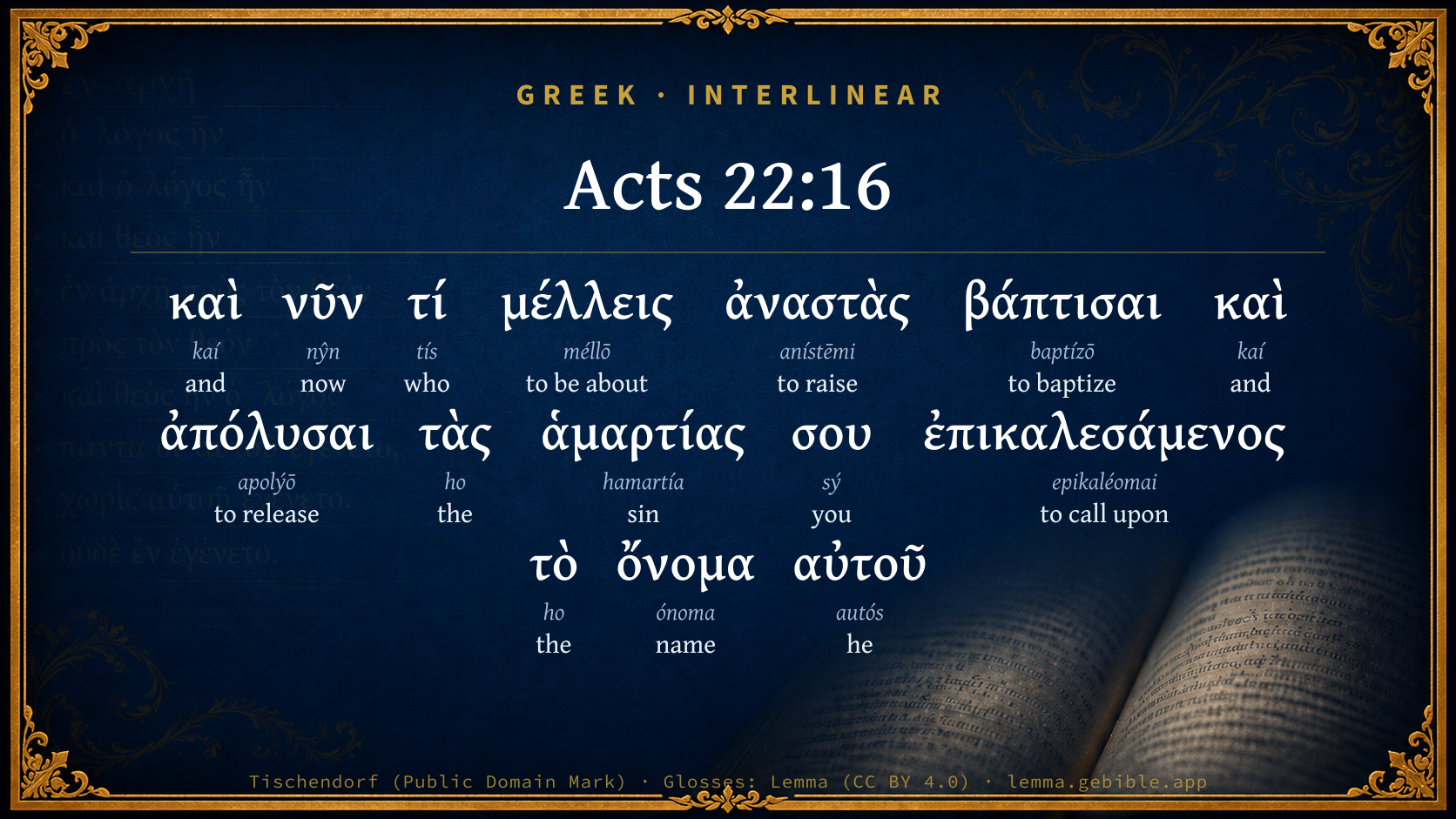
Greek (Tischendorf 8th ed.) Acts 22:16 appears in the Greek New Testament. The text above is from the Tischendorf 8th edition. Each word links to its Strong’s number and a concise gloss. Click any word for its full Thayer’s Greek Lexicon entry.
Download image
Cite this verse

Acts 22:16 (World English Bible). Public Domain. Lemma interlinear Bible study tool, https://lemma.gebible.app/v/acts/22/16.

Show BibTeX & RIS
BibTeX
RIS
English Translation
Now why do you wait? Arise, be baptized, and wash away your sins, calling on the name of the Lord.'
World English Bible · Public Domain
Download a study sheet

One document with this verse’s original text, its word-by-word gloss line, the meaning frame, cross-references with their text, attributed commentary, and full source and license credits — printable, and it pastes into notes with its structure intact.

This verse Autodidact and up

Study sheet (.html) Plain text (.txt)

A passage Seminary Student

Up to 50 verses in one chapter. A passage sheet keeps up to 6 commentary sources and 12 cross-references per verse, in the order this page ranks them, and says so on the sheet whenever that leaves anything out. Ask for a single verse and you get the Autodidact verse sheet above.

Everything on this page stays free to read, with no account — the sheet is a download of what is already on screen, not access to it.

Want to remove ads? Support Godless Engineer
Compare translations 3

The same verse in 3 English versions, stacked beneath the original-language interlinear above. Click any original word for its lexicon entry.

Each is an independent rendering of the whole verse — the interlinear is not word-aligned to these translations.

Highlighted words mark where these versions differ — a whole-verse word diff, not a word-by-word alignment.

  • World English Bible Public Domain
    Now why do you wait? Arise, be baptized, and wash away your sins, calling on the name of the Lord.'
  • King James Version Public Domain
    And now why tarriest thou? arise, and be baptized, and wash away thy sins, calling on the name of the Lord.
  • unfoldingWord Literal Text CC BY-SA 4.0
    And now, why are you delaying? Arising, be baptized and wash away your sins, calling on his name.’

unfoldingWord Literal Text — © unfoldingWord, licensed CC BY-SA 4.0. Word-aligned USFM3 via Door43 (git.door43.org/unfoldingWord/en_ult).

Versions to compare (up to 4)

3 of 4 selected

Show all 19 translations

Every available English version of this verse, each an independent rendering of the whole verse.

  • World English Bible Public Domain
    Now why do you wait? Arise, be baptized, and wash away your sins, calling on the name of the Lord.'
  • Berean Standard Bible Public Domain
    And now what are you waiting for? Get up, be baptized, and wash your sins away, calling on His name.’
  • Majority Standard Bible Public Domain
    And now what are you waiting for? Get up, be baptized, and wash your sins away, calling on the name of the Lord.’
  • King James Version Public Domain
    And now why tarriest thou? arise, and be baptized, and wash away thy sins, calling on the name of the Lord.
  • American Standard Version (1901) Public Domain
    And now why tarriest thou? arise, and be baptized, and wash away thy sins, calling on his name.
  • Revised Version (1885) Public Domain
    And now why tarriest thou? arise, and be baptized, and wash away thy sins, calling on his name.
  • Geneva Bible (1599) Public Domain
    Now therefore why tariest thou? Arise, and be baptized, and wash away thy sinnes, in calling on the Name of the Lord.
  • Douay-Rheims (1899) Public Domain
    And now why tarriest thou? Rise up, and be baptized, and wash away thy sins, invoking his name.
  • Young's Literal Translation Public Domain
    and now, why tarriest thou? having risen, baptize thyself, and wash away thy sins, calling upon the name of the Lord.
  • Literal Standard Version CC BY-SA 4.0
    and now, why do you linger? Having risen, immerse yourself, and wash away your sins, calling on the Name of the LORD.
  • Unlocked Literal Bible CC BY-SA 4.0
    Now why are you waiting? Arise, be baptized, and wash away your sins, calling on his name.'
  • unfoldingWord Literal Text CC BY-SA 4.0
    And now, why are you delaying? Arising, be baptized and wash away your sins, calling on his name.’
  • Darby Bible Public Domain
    And now why lingerest thou? Arise and get baptised, and have thy sins washed away, calling on his name.
  • World Messianic Bible Public Domain
    Now why do you wait? Arise, be immersed, and wash away your sins, calling on the name of the Lord.’
  • Webster's Bible Public Domain
    And now why tarriest thou? arise, and be baptized, and wash away thy sins, calling on the name of the Lord.
  • Free Bible Version CC BY-SA 4.0
    Get up, be baptized, and wash away your sins as you call on his name.’
  • Bible in Basic English Public Domain
    And now, why are you waiting? get up, and have baptism, for the washing away of your sins, giving worship to his name.
  • Text-Critical English NT CC BY 4.0
    And now why do yoʋ delay? Rise and be baptized, and wash away yoʋr sins, calling upon the name of the Lord.’
  • Tyndale New Testament (1534) Public Domain
    And now: why tariest thou? Aryse and be baptised and wesshe awaye thy synnes in callinge on the name of the Lorde.

Literal Standard Version (2020), Covenant Press — licensed CC BY-SA 4.0. Text via the HelloAO Bible API (eBible.org). Unlocked Literal Bible (unfoldingWord) — licensed CC BY-SA 4.0. Text via the HelloAO Bible API (eBible.org). unfoldingWord Literal Text — © unfoldingWord, licensed CC BY-SA 4.0. Word-aligned USFM3 via Door43 (git.door43.org/unfoldingWord/en_ult). Free Bible Version, Dr. Jonathan Gallagher — licensed CC BY-SA 4.0. Text via the HelloAO Bible API (eBible.org).

Word by word

More ways to search: Search by grammar → Find every occurrence → Compare this word →

Practice this passage: Drill this verse → Learn its vocabulary →

ἐπικαλεσάμενος
epikaléomai
G1941
“to call upon”
Verb, Aorist, Middle, Participle, Nominative, Singular, Masculine
Part of Speech
Verb
Tense
Aorist
Voice
Middle
Mood
Participle
Case
Nominative
Number
Singular
Gender
Masculine
Full Thayer's Definition

Origin: middle voice from G1909 and G2564

TDNT: 3:496,*

1. to put a name upon, to surname a. to permit one's self to be surnamed 2. to be named after someone 3. to call something to one a. to cry out upon or against one b. to charge something to one as a crime or reproach c. to summon one on any charge, prosecute one for a crime d. to blame one for, accuse one of 4. to invoke a. to call upon for one's self, in one's behalf 1. any one as a helper 2. as my witness 3. as my judge 4. to appeal unto 5. to call upon by pronouncing the name of Jehovah a. an expression finding its explanation in the fact that prayers addressed to God ordinarily began with an invocation of the divine name
  1. καὶ kaí G2532 “and” Conjunction
  2. νῦν nŷn G3568 “now” Adverb
  3. τί tís G5101 “who” Interrogative pronoun, Accusative, Singular, Neuter
  4. μέλλεις méllō G3195 “to be about” Verb, Present, Active, Indicative, 2nd person, Singular
  5. ἀναστὰς anístēmi G450 “to raise” Verb, Aorist, Active, Participle, Nominative, Singular, Masculine
  6. βάπτισαι baptízō G907 “to baptize” Verb, Aorist, Middle, Imperative, 2nd person, Singular
  7. καὶ kaí G2532 “and” Conjunction
  8. ἀπόλυσαι apolýō G630 “to release” Verb, Aorist, Active, Infinitive
  9. τὰς ho G3588 “the” Article, Accusative, Plural, Feminine
  10. ἁμαρτίας hamartía G266 “sin” Noun, Accusative, Plural, Feminine
  11. σου sý G4771 “you” Personal pronoun, 2nd person, Genitive, Singular
  12. τὸ ho G3588 “the” Article, Accusative, Singular, Neuter
  13. ὄνομα ónoma G3686 “name” Noun, Accusative, Singular, Neuter
  14. αὐτοῦ autós G846 “he” Personal pronoun, Genitive, Singular, Masculine

About this verse

These counts appear in no published source. They are computed here, from the morphology-tagged text and Lemma’s own curated glosses. What Lemma adds →

15
words
13
distinct lemmas
Acts
section

Shared distinctive vocabulary

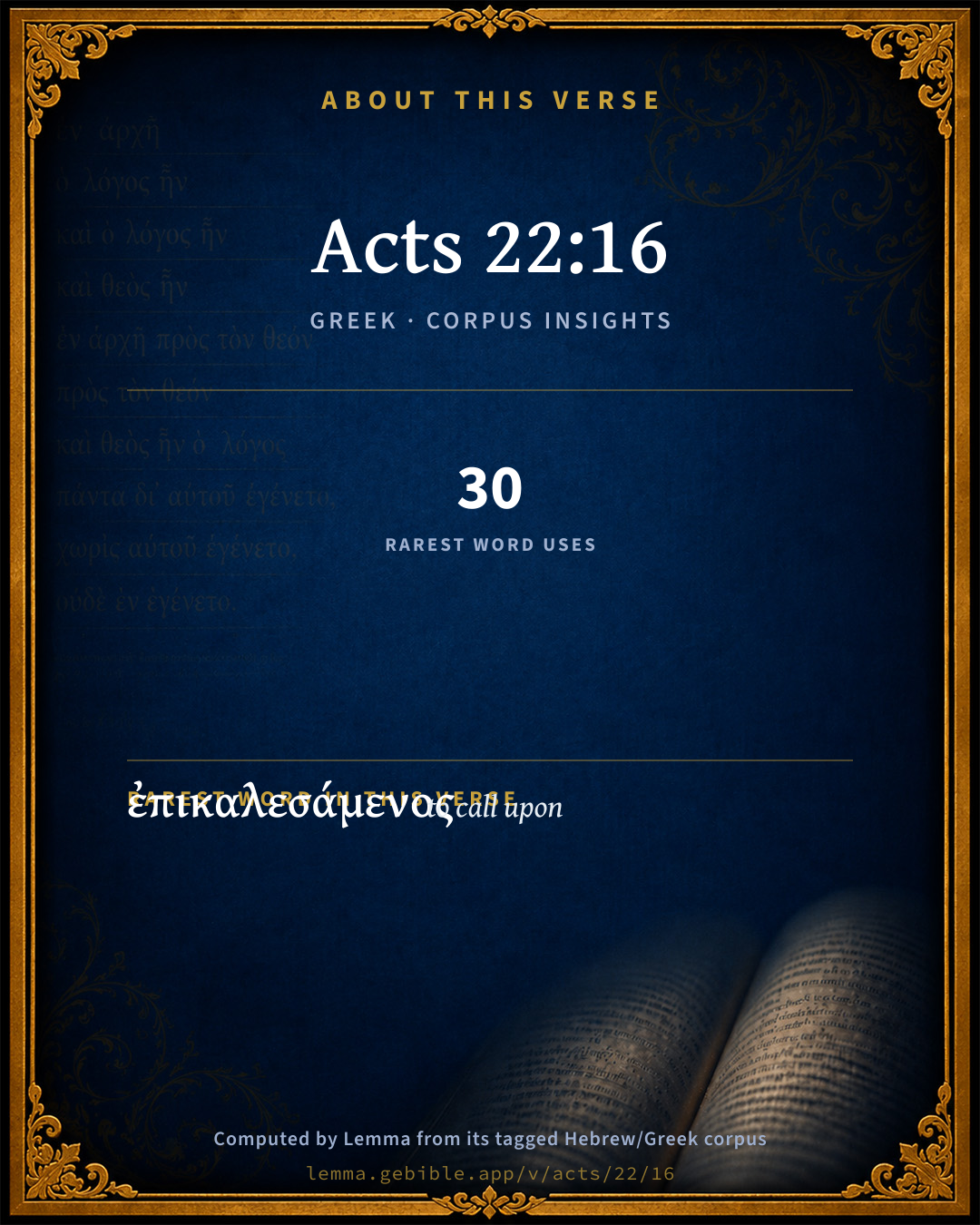
ἐπικαλεσάμενος to call upon G1941 occurs in 30 verses of the Greek New Testament. Also found in:
Repetition

Words recur within this verse:

Cross-references

15

Topical passages linked to Acts 22:16 in the Treasury of Scripture Knowledge — connected by theme and wording, ordered by reader-vote popularity; previews shown in the World English Bible.

  • Acts 2:38 Peter said to them, "Repent, and be baptized, everyone of you, in the name of Jesus Christ for the forgiveness of sins, and you will receive the gift of the Holy Spirit.
  • Acts 2:21 It will be, that whoever will call on the name of the Lord will be saved.'
  • 1 Corinthians 6:11 Such were some of you, but you were washed. But you were sanctified. But you were justified in the name of the Lord Jesus, and in the Spirit of our God.
  • Titus 3:5 not by works of righteousness, which we did ourselves, but according to his mercy, he saved us, through the washing of regeneration and renewing by the Holy Spirit,
  • Hebrews 10:22 let's draw near with a true heart in fullness of faith, having our hearts sprinkled from an evil conscience, and having our body washed with pure water,
  • 1 Peter 3:21 This is a symbol of baptism, which now saves you-- not the putting away of the filth of the flesh, but the answer of a good conscience toward God, through the resurrection of Jesus Christ,
  • Psalms 119:60 I will hurry, and not delay, To obey your commandments.
  • 1 Corinthians 12:13 For in one Spirit we were all baptized into one body, whether Jews or Greeks, whether bond or free; and were all given to drink into one Spirit.
  • Galatians 3:27 For as many of you as were baptized into Christ have put on Christ.
  • Acts 9:14 Here he has authority from the chief priests to bind all who call on your name."
  • Romans 6:3–4 Or don't you know that all we who were baptized into Christ Jesus were baptized into his death?
  • Romans 10:12–14 For there is no distinction between Jew and Greek; for the same Lord is Lord of all, and is rich to all who call on him.
  • Acts 9:18 Immediately something like scales fell from his eyes, and he received his sight. He arose and was baptized.
  • 1 Corinthians 1:2 to the assembly of God which is at Corinth; those who are sanctified in Christ Jesus, called to be saints, with all who call on the name of our Lord Jesus Christ in every place, both theirs and ours:
  • Jeremiah 8:14 Why do we sit still? assemble yourselves, and let us enter into the fortified cities, and let us be silent there; for Yahweh our God has put us to silence, and given us water of gall to drink, because we have sinned against Yahweh.

Cross-references courtesy of OpenBible.info (CC BY 4.0).

Where the printed editions differ

1 variant

Places in this verse where the major printed Greek editions disagree on the wording in a way that affects the translation — a comparison of editions, not a manuscript-by-manuscript collation. The editions are the modern critical texts (Nestlé-Aland 28/27, SBL, Westcott-Hort, Tregelles, Tyndale House) and the traditional texts behind the KJV (the Textus Receptus and the Byzantine/Majority text). It is not a claim about which reading is original.

  1. Different wording
    αὐτοῦ.

    “of Him.”

    In NA28NA27TynSBLWHTreg Not in TRByz

    τοῦ κυρίου (tou kuriou) 'of the Lord' occurs in traditional manuscripts (TR+Byz) instead of αὐτοῦ.¶ (autou) 'of Him.' in older manuscripts (NA28+NA27+Tyn+SBL+WH+Treg)

Textual data: Translators Amalgamated Greek New Testament (STEPBible TAGNT) · CC BY 4.0.

Commentary

Notes on Acts 22:16 from classic Christian and Jewish commentators (each source and its license shown beneath its notes). The classic Christian expositions comment on the surrounding passage and are grouped to its opening verse, so a note may address several verses; the Jewish commentaries on the Tanakh (Rashi and others) are per-verse, so they appear only where the commentator wrote on this verse.

Lemma curates 59 commentaries, every one of them public domain or Creative Commons licensed, each selected and text-cleaned for this edition rather than reprinted as found. About our sources →

Tyndale Open Study Notes

Tyndale Open Resources

22:16 be baptized. Have your sins washed away: See “Baptism” Theme Note.

Tyndale Open Study Notes — © Tyndale Open Resources, licensed CC BY-SA 4.0. Text via the HelloAO Bible API.

Bengel's Gnomon

Johann Albrecht Bengel

Act 22:16. Τί μέλλεις, why tarriest thou?) Quickly, saith he, strive to pass from a state of grief to a state of peace.—ἀπόλουσαι, wash away) receiving baptism.

Bengel's Gnomon of the New Testament — English translation (T&T Clark, Edinburgh, 1860) — public domain. Text from a community e-Sword module.

Meyer's Critical & Exegetical Commentary

Heinrich August Wilhelm Meyer

Act_22:16. Τί μέλλεις;] Why tarriest thou? μέλλειν so used only here in the N.T.; frequent in the classics. The question is not one of reproach, but of excitement and encouragement.

ἀπόλουσαι τὰς ἁμαρτ. σου] let thyself be baptized and (thereby) wash away thy sins. Here, too, baptism is that by means of which the forgiveness of the sins committed in the pre-Christian life takes place.[136] Comp. Act_2:38; Eph_5:26; and see on 1Co_6:11. Calvin inserts saving clauses, in order not to allow the grace to be bound to the sacrament. As to the purposely-chosen middle forms, comp. on 1Co_10:2.

ἐπικαλ. τὸ ὄνομα αὐτοῦ] Wolf appropriately explains: postquam invocaveris atque ita professus fueris nomen Domini (as the Messiah). Id scilicet antecedere olim debebat initiationem per baptismum faciendam.

[136] Comp. the Homeric ἀπολυμαίνεσθαι, Il. i. 113 f., and Nägelsbach in loc.

Meyer — Critical and Exegetical Commentary on the New Testament — English translation by Peter Christie, edited by Frederick Crombie (T&T Clark, 1880) — public domain. Text from a community e-Sword module.

Expositor's Greek Testament

ed. W. Robertson Nicoll

Act 22:16 . καὶ νῦν : so by St. Paul in Act 20:22 ; Act 20:25 , Act 26:6 , Act 16:37 , Act 13:11 ; also found in Act 3:17 , Act 10:5 , but no instances in Luke’s Gospel of καὶ νῦν beginning a sentence, Hawkins, Horæ Synopticæ , p. 145. τί μέλλεις : only here in this sense in N.T., cf. 4Ma 6:23 ; 4Ma 9:1 , and so often in classical Greek, Aesch., Prom. , 36, etc. ἀναστὰς , see Act 5:17 . βάπτισαι : middle voice (so perhaps in 1Co 10:2 , W.H [368] text, but passive in margin, as Blass), as a rule naturally in the passive, “to be baptised,” cf. Act 9:18 , but the convert in “getting baptised” was conceived as doing something for himself, not merely as receiving something (Simcox, Language of the N.T. , pp. 97, 98), so apparently Blass, Gram. , p. 182, or the middle may mean that he submitted himself to Christian Baptism, Bethge, p. 197, and Alford. ἀπόλουσαι : also middle, cf. Act 2:38 , and 1Co 6:11 , the result of the submission to Baptism, Tit 3:5 , Eph 5:26 . ἐπικαλ ., cf. p. 81, on the significance of the phrase. This calling upon the name of Christ, thus closely connected with Baptism and preceding it, necessarily involved belief in Him, Rom 10:14 . There is no contradiction in the fact that the commission to the Apostleship here and in 9 comes from Ananias, whilst in 26 he is not mentioned at all, and the commission comes directly from the mouth of the Lord. It might be sufficient simply to say “quod quis per alium facit id ipse fecisse putatur,” but before the Roman governor it was likely enough that the Apostle should omit the name of Ananias and combine with the revelation at his conversion and with that made by Ananias other and subsequent revelations, cf. Act 26:16-18 . Festus might have treated the vision to Ananias with ridicule, Agrippa would not have been influenced by the name of a Jew living in obscurity at Damascus ( Speaker’s Commentary ).

[368] Westcott and Hort’s The New Testament in Greek: Critical Text and Notes.

The Expositor's Greek Testament, edited by W. Robertson Nicoll (1897–1910) — public domain. Text from a community e-Sword module.

Jamieson, Fausset & Brown

Robert Jamieson, A. R. Fausset & David Brown

be baptized and wash away thy sins--This way of speaking arises from baptism being the visible seal of remission.

calling on the name of the Lord--rather, "having called," that is, after having done so; referring to the confession of Christ which preceded baptism, as Act 8:37.

Jamieson, Fausset & Brown — Commentary Critical and Explanatory on the Whole Bible (1871) — public domain (CC PDM 1.0). Text via the HelloAO Bible API.

Adam Clarke's Commentary

Verse 16. Arise, and be baptized] Take now the profession of Christ's faith most solemnly upon thee, by being baptized in the name of Father, Son, and Holy Spirit.

Wash away thy sins, &c.] Let this washing of thy body represent to thee the washing away of thy sins: and know that this washing away of sin can be received only by invoking the name of the Lord.

Adam Clarke's Commentary on the Bible (1810–1826) — public domain. Text from a community e-Sword/MySword module.

John Calvin's Commentaries

16. And now, why tarriest thou? It is not to be doubted but that Ananias did faithfully instruct Paul in the principles of godliness; for he would not have baptized him if he had been void of true faith. But Luke passeth over many things, and doth briefly gather the sum. Therefore, seeing Paul doth understand that the promised redemption is now given in Christ, Ananias saith, for good causes, that nothing ought to stay him from being baptized. But when he saith, Why tarriest thou? he doth not chide Paul, neither doth he accuse him of slackness, but he doth rather amplify the grace of God by adding baptism. The like sentence had we in the tenth chapter, (Acts 10:47)

“Can any man let [hinder] those from being baptized with water who have the Holy Ghost given them even as we?”

But when he saith, Wash away thy sins, by this speech he expresseth the force and fruit of baptism, as if he had said, Wash away thy sins by baptism. But because it may seem that by this means more is attributed to the outward and corruptible element than is meet, the question is, whether baptism be the cause of our purging. Surely, forasmuch as the blood of Christ is the only means whereby our sins are washed away, and as it was once shed to this end, so the Holy Ghost, by the sprinkling thereof through faith, doth make us clean continually. This honor cannot be translated unto the sign of water, without doing open injury to Christ and the Holy Ghost; and experience doth teach how earnestly men be bent upon this superstition. Therefore, many godly men, lest they put confidence in the outward sign, do overmuch extenuate the force of baptism. But they must keep a measure, that the sacraments may be kept within their bounds, lest they darken the glory of Christ; and yet they may not want their force and use.

Wherefore, we must hold this, first, that it is God alone who washeth us from our sins by the blood of his Son; and to the end this washing may be effectual in us, he worketh by the hidden power of his Spirit. Therefore, when the question is concerning remission of sins, we must seek no other author thereof but the heavenly Father, we must imagine no other material cause but the blood of Christ; and when we be come to the formal cause, the Holy Ghost is the chief. But there is an inferior instrument, and that is the preaching of the word and baptism itself. But though God alone doth work by the inward power of his Spirit, yet that doth not hinder but that he may use, at his pleasure, such instruments and means as he knoweth to be convenient; not that he includeth in the element anything which he taketh either from his Spirit or from the blood of Christ, but because he will have the sign itself to be an help for our infirmity.

Therefore, forasmuch as baptism doth help our faith, that it may reap forgiveness of sins by the blood of Christ alone, it is called the washing of the soul. So that the washing, spoken of by Luke, doth not note out the cause; but is referred unto the understanding of Paul, who, having received the sign, knew better that his sins were done away. Though we must also note this, that there is no bare figure set before us in baptism, but that the giving of the thing is thereto annexed; because God promised nothing deceitfully, but doth, indeed, fulfill that which under the signs he doth signify. Notwithstanding, we must again beware that we tie not the grace of God to the sacraments; for the external administration of baptism profiteth nothing, save only where it pleaseth God it shall. By this there is also another question answered which may be moved. For seeing Paul had the testimony of the grace of God, his sins were already forgiven him. Therefore, he was not washed only by baptism, but he received a new confirmation of the grace which he had gotten.

In calling upon the name of the Lord. It is out of question that he meaneth Christ, not because the name of Christ alone is called upon in baptism, but because the Father commandeth us to ask of him whatsoever is figured in baptism; neither doth the operation of the Spirit tend to any other end, saving that it may make us partakers of his death and resurrection. Therefore, Christ is appointed to excel in baptism, yet inasmuch as he is given us of the Father, and inasmuch as he poureth out his graces upon us by the Holy Ghost. Whereby it cometh to pass that the calling upon the name of Christ containeth both the Father and the Son.

Wherefore, Ananias doth not mean, that the name of Christ must only be named, but he speaketh of prayer, whereby the faithful do testify, that the effect of the outward sign is in the power of Christ alone. For the sacraments have neither any power of salvation included in them, neither are they anything worth of themselves. Wherefore, this member is, as it were, a correction of the former saying, because Ananias doth, in plain words, send Paul from reposing confidence in the external sign unto Christ.

It is well known how much the Papists differ from this rule, who tie the cause of grace to their exorcisms and enchantments; and they are so far from studying to direct the miserable people unto Christ, that they rather drown Christ in baptism, and pollute his sacred name by their enchantments.

John Calvin's Commentaries (1540-1563) — public domain. Text from the Calvin Translation Society English edition (1840s-50s) via the Christian Classics Ethereal Library (ccel.org). Calvin's coverage is partial (roughly two-thirds of the Bible); uncommented books and verses are honest gaps, never fabricated. The 19th-century editor's footnotes and remarks are omitted so the notes are faithfully Calvin's own voice.

Ellicott's Commentary for English Readers

(16) Arise, and be baptized, and wash away thy sins.—Here, again, we have words which are not in the narrative of Acts 9. They show that for the Apostle that baptism was no formal or ceremonial act, but was joined with repentance, and, faith being presupposed, brought with it the assurance of a real forgiveness. In St. Paul’s language as to the “washing” (or, bath) of regeneration (Tit_3:5) we may trace his continued adherence to the idea which he had thus been taught to embrace on his first admission to the Church of Christ.

Calling on the name of the Lord.—The better MSS. give simply, “calling upon His name,” i.e., the name of the Just One whom St. Paul had seen. The reading in the Received text probably arose from a wish to adapt the phrase to the language of Act_2:21.

A Bible Commentary for English Readers, edited by Charles John Ellicott (1878–1897) — public domain. Text from a community e-Sword module.

The Cambridge Bible for Schools and Colleges

gen. ed. J. J. S. Perowne

16. why tarriest thou?] According to the narrative in Act_9:15 the message of Ananias had already proclaimed the gift of the Holy Ghost to Saul, and the favour of God had been shewn in the recovery of his sight. So the question of Ananias becomes parallel to that of St Peter in the house of Cornelius: “Can any man forbid water that these should not be baptized, which have received the Holy Ghost as well as we?”

arise, and be baptized] Though the gift of the Spirit was announced, yet God directs that the means of grace, the sacrament of baptism, which the Apostle must offer to others, should also be received by himself.

and wash away thy sins] The close connexion of the sacramental sign with renewing grace is spoken of in like terms by the Apostle in his Epistle to Titus (Act_3:5) “according to His mercy He saved us, by the washing of regeneration, and the renewing of the Holy Ghost.”

calling on the name of the Lord] The oldest authorities give “calling on His name,” which refers back to “the Just One.” Probably the Textus Receptus is due to a desire to make the phrase accordant with Act_2:21.

The Cambridge Bible for Schools and Colleges (gen. ed. J. J. S. Perowne; Cambridge University Press, 1878–1918) — public domain. Text from a community e-Sword module.

John Gill's Exposition

And I saw him saying unto me,.... That is, the Lord Jesus Christ, that just One, whom he had seen in his way to Damascus, and whose voice he had heard, and whose name he had called upon at his baptism:

make haste, and get thee quickly out of Jerusalem: not because his life was in danger, but because Christ had work for him to do elsewhere, which required haste; and that he might not continue here useless and unprofitable, as he would have been, had he staid;

for they will not receive thy testimony concerning me; Christ the omniscient God, and the searcher of the hearts, knew the hardness and unbelief of the Jews; and that they would continue therein, notwithstanding the ministry of the apostle; and that they would give no credit to any testimony of his, that he saw him, as he went to Damascus, and heard words from his mouth. The Ethiopic version renders it without the negative, "for they will receive thee, my witness concerning me"; as if Christ sent the apostle away in all haste from Jerusalem, lest he preaching there, the Jews should believe and be healed; compare with this Mat 13:14. Very likely this interpreter might be induced to leave out the negative, as thinking that the apostle's reasoning in the following words required such a sense and reading.

John Gill's Exposition of the Whole Bible (1746–1763) — public domain (CC PDM 1.0). Text via the HelloAO Bible API.

Trapp's Complete Commentary

John Trapp

16 And now why tarriest thou? arise, and be baptized, and wash away thy sins, calling on the name of the Lord.

Ver. 16. Wash away thy sins] By being inwardly baptized in the blood of Christ, by his merit and spirit. For there is baptismus flaminis et baptismus fluminis, a baptism of fire and water, Mat 3:11; hence we read of baptisms, Heb 6:2, and of the washing of regeneration, and renewing of the Holy Ghost Tit 3:5. {See Trapp on "Act 2:38"}

John Trapp, A Commentary or Exposition upon All the Books of the Old and New Testament (1647–1656) — public domain. Text from a community e-Sword module.

Albert Barnes' Notes on the Bible

And now why tarriest thou? - Why dost thou delay, or wait any longer? These words are not recorded by Luke in Acts 9, where he has given an account of the conversion of Paul; but there is nothing here contradictory to his statement.

And wash away thy sins - Receive baptism as emblematic of the washing away of sins. It cannot be intended that the external rite of baptism was sufficient to make the soul pure, but that it was an ordinance divinely appointed as expressive of the washing away of sins, or of purifying the heart. Compare Heb 10:22. Sinners are represented in the Scriptures as defiled or polluted by sin. “To wash away the sins” denotes “the purifying of the soul from this polluted influence,” 1Co 6:11; Rev 1:5; Rev 7:14; Isa 1:16; Psa 51:2, Psa 51:7.

Calling on the name of the Lord - For pardon and sanctification, Rom 10:13, “Whosoever shall call upon the name of the Lord shall be saved.” It was proper that this calling on the name of the Lord should be connected with the ordinance of baptism. That ordinance was emblematic of a purifying which the Lord only could produce. It is proper that the rite of baptism should be attended with extraordinary prayer; that he who is to be baptized should make it the occasion of special and very solemn religious exercises. The external rite will avail nothing without the pardoning mercy of God.

Albert Barnes' Notes on the Bible (1834–1885) — public domain. Text from a community e-Sword/MySword module.

Haydock's Catholic Bible Commentary

Wash, &c. The contrition and charity of St. Paul had, no doubt, merited for him the remission of his sins at the moment of his conversion. Still were these effects to be attributed to the desire of the sacrament of baptism, without which the council of Trent defines that the forgiveness of sins, and the punishment due to them, are not obtained. It likewise added a new degree of lustre to his innocence and purity. (Tirinus) --- Calling upon his name. In such manner, says St. John Chrysostom, (hom. xlvii.) as we invoke the only true God; and as we invoke the saints, and pray to them, that they may pray for us. (Witham)

George Leo Haydock (1774–1849), Haydock's Catholic Family Bible and Commentary, 1859 edition — public domain. Excludes Psalms (Douay-Rheims chapter numbering differs from Protestant) and Deuterocanonical books (Catholic canon only).

Matthew Poole's English Annotations

Wash away thy sins; as washing causeth the spots to disappear, and to be as if they had not been, Isa 1:18; so does pardoning mercy, or remission of sins, which accompanieth baptism, as in the due receiver, Mat 3:11; 1Pe 3:21,22. Where true faith is, together with the profession of it by baptism, there is salvation promised, Mar 16:16. In the mean while it is not the water, (for that only signifies), but it is the blood of Christ, which is thereby signified, that cleanseth us from our sins, as 1Jo 1:7. Yet sacraments are not empty and deceitful signs; but God accompanieth his own ordinances with his power from on high, and makes them effectual for those great things for which he instituted and appointed them.

Calling on the name of the Lord; Christ, to whom by baptism he was to be dedicated.

Matthew Poole's English Annotations on the Holy Bible (1683–1685) — public domain. Text from a community e-Sword/MySword module.

Whedon's Commentary on the Bible

Daniel D. Whedon

16. Be baptized—Literally, baptize thyself. The work being supposed to be done by himself through another’s hands.

Wash away thy sins—By the external symbol, just as the Holy Spirit has already done the work in the internal reality. (See note on Joh_3:5.) So 1Pe_3:21, says, “Baptism doth save us;” but it is carefully explained: “not the putting away of the filthiness of the flesh, but the answer of a good conscience toward God.” Baptism is the external and symbolical salvation, while regeneration is the internal and real.

The Lord—The same Lord as named in Act_22:8; Act_22:10; Act_22:19; the Lord into whose name he was to be baptized. The phrase here is the same as in Gen_4:26. Paul here adds a narrative not elsewhere given, yet most important to his present defence.

Daniel D. Whedon (gen. ed.), Commentary on the Old and New Testaments (1874–1909) — public domain. Text from a community e-Sword module.

The Pulpit Commentary

His Name for the Name of the Lord, A.V. and T.R. Wash away thy sins; ajpolousai, only here and in 1Co_6:11, where it is found in exactly the same sense of "washing away sins" (see vers. 9, 10) in holy baptism. Hence the loutroav, "the washing of regeneration". (Tit_3:5; comp. Eph_5:26; and Act_2:38, note) Calling on his Name (ejpikalesamenov); see Act_2:21 Act_7:59, note; 9:14, 21; Rom_10:12, Rom_10:13, Rom_10:14; 1Co_1:2; 2Ti_2:22; 1Pe_1:17, all texts distinctly justifying prayer to the Lord Jesus.

The Pulpit Commentary (1880–1919), ed. H.D.M. Spence-Jones & Joseph S. Exell — public domain. Text from a community e-Sword module.

John Wesley's Explanatory Notes

Be baptized, and wash away thy sins - Baptism administered to real penitents, is both a means and seal of pardon. Nor did God ordinarily in the primitive Church bestow this on any, unless through this means.

John Wesley, Explanatory Notes Upon the Whole Bible (1754–1765) — public domain. Text via the GEBible commentary corpus.

Scofield Reference Notes

C. I. Scofield

sins

Sin. (See Scofield "Rom 3:23").

The Scofield Reference Bible (1917 edition), notes by C. I. Scofield — public domain. Text from a community e-Sword module.

McGarvey & Pendleton's Commentaries

J. W. McGarvey

See notes on verse 3

J. W. McGarvey (with Philip Y. Pendleton), Commentaries on the New Testament (The Fourfold Gospel, 1914; Acts; and the epistles) — public domain. Text from a community e-Sword/MySword module.

Cambridge Greek Testament for Schools and Colleges

16. αὐτοῦ for τοῦ κυρίου with אABE. Vulg. ‘ipsius.’

16. καὶ νῦν τί μέλλεις; and now why tarriest thou? According to the narrative in Act 9:15, the message of Ananias had already proclaimed the gift of the Holy Ghost to Saul, and the favour of God had been shewn in the recovery of his sight. So the question of Ananias becomes parallel to that of St Peter in the house of Cornelius: ‘Can any man forbid water that these should not be baptized, which have received the Holy Ghost as well as we?’

ἀναστὰς βάπτισαι, arise and be baptized. Though the gift of the Spirit was announced yet God directs that the means of grace, the sacrament of baptism, which the Apostle must offer to others, should also be received by himself.

καὶ ἀπόλουσαι τὰς ἁμαρτίας σου, and wash away thy sins. The close connexion of the sacramental sign with renewing grace is spoken of in like terms by the Apostle in his Epistle to Titus (Act 3:5), ‘according to His mercy He saved us, by the washing of regeneration, and the renewing of the Holy Ghost.’

ἐπικαλεσάμενος τό ὄνομα αὐτοῦ, calling on His name, i.e. τοῦ δικαίου, the name of the righteous One, Jesus, mentioned in Act 22:14.

Cambridge Greek Testament for Schools and Colleges (Cambridge University Press, 1896; 21 vols, various authors incl. Carr, Maclear, Plummer, Farrar, Lumby, Moule, M. R. James, Simcox) — public domain. Text from a community e-Sword module.

Alford’s Greek Testament

Henry Alford

16. ἀπόλουσαι …] This was the Jewish as well as the Christian doctrine of baptism.

See ref. 1 Cor. and note.

αὐτοῦ] of Jesus, τοῦ δικαίου.

Paul carefully avoids mentioning to the Jews this Name, except where it is unavoidable, in ver. 8: so αὐτόν again, ver. 18.

Henry Alford, The Greek Testament (1849–1861) — public domain. Text from a community e-Sword module.

Vincent's Word Studies in the New Testament

Marvin R. Vincent

Wash away [απολουσαι] . See on ch. Act 16:33.

Marvin R. Vincent, Word Studies in the New Testament (1887–1900) — public domain. Text from a community e-Sword/MySword module.

Lesson kit

Teaching starters — assembled from the data on this page, not authored interpretation. Every prompt links to the verse data it draws on. Edit before teaching.

Acts, in the Acts, opens this verse with 15 words (13 distinct Greek lemmas). Its most distinctive word is epikaléomai (“to call upon”). A historical commentator’s framing appears above. Read the whole chapter for the surrounding context.

Discussion questions

  1. What does “to call upon” (epikaléomai) contribute to the verse as a whole?
  2. Matthew 10:25 shares the word «to call upon» with this verse. How do the two illuminate each other?
  3. “and” occurs 2× in this one verse. What is the effect of the repetition?
  4. These translations render this verse differently. What is at stake in choosing one wording over another?
  5. Reading how Tyndale Open Study Notes and Bengel's Gnomon read this verse, where do the two commentators agree and where do they part?

Things to notice

Reading settings

Reading text

Shown beneath each verse's original-language words.

Old Testament
Old Testament edition

Read the OT as the Masoretic Hebrew (MT) or the Greek Septuagint (LXX).

English shown for the Greek Septuagint (in the Hebrew ↔ Greek comparison).

Comparing translations? Open the Compare panel on any verse page to stack up to four side by side.