

Mark 6:14
Greek (Tischendorf 8th ed.) Mark 6:14 appears in the Greek New Testament. The text above is from the Tischendorf 8th edition. Each word links to its Strong’s number and a concise gloss. Click any word for its full Thayer’s Greek Lexicon entry.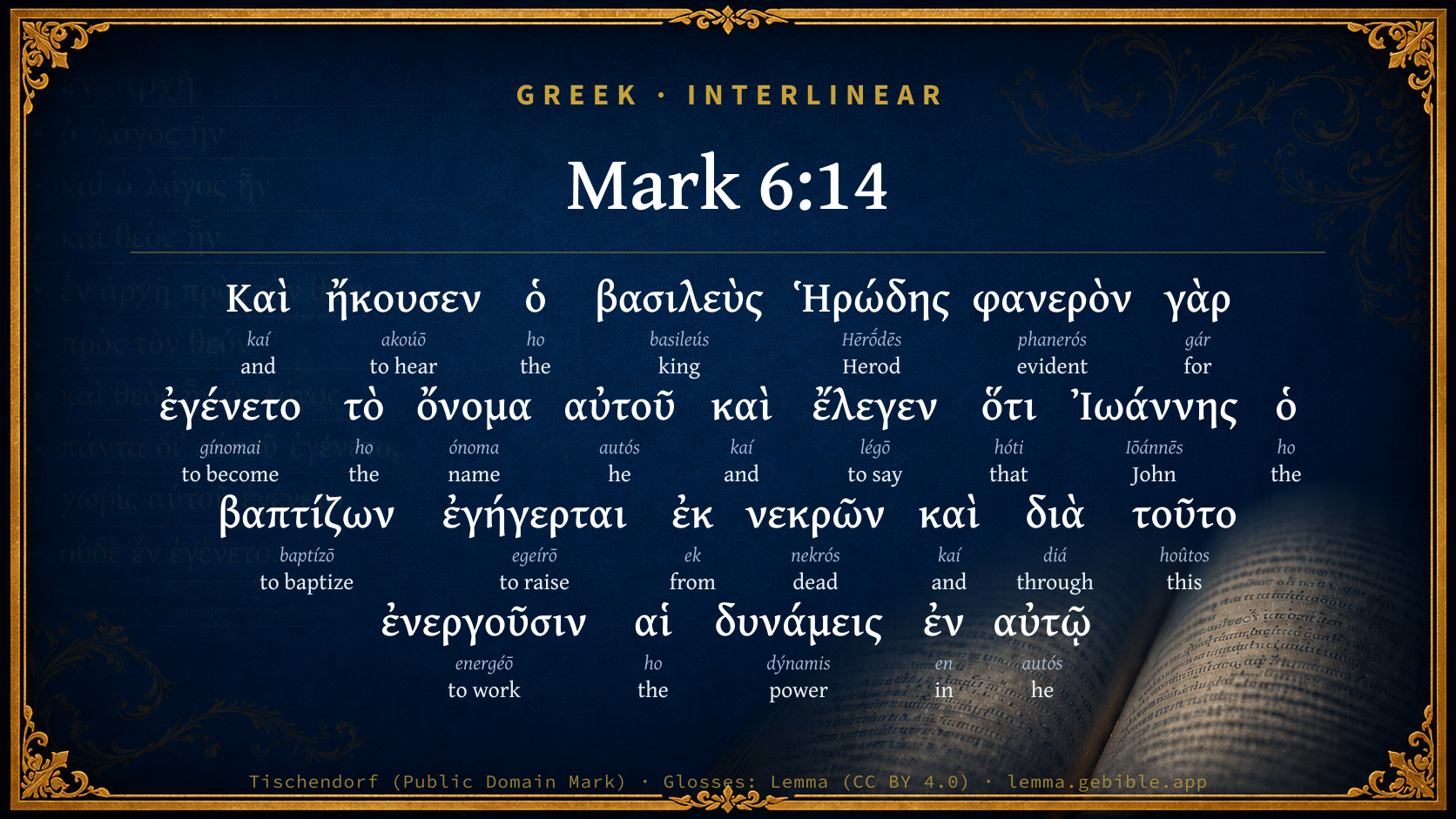
King Herod heard this, for his name had become known, and he said, "John the Baptizer has risen from the dead, and therefore these powers are at work in him."
Download a study sheet
One document with this verse’s original text, its word-by-word gloss line, the meaning frame, cross-references with their text, attributed commentary, and full source and license credits — printable, and it pastes into notes with its structure intact.
This verse Autodidact and up
A passage Seminary Student
Up to 50 verses in one chapter. A passage sheet keeps up to 6 commentary sources and 12 cross-references per verse, in the order this page ranks them, and says so on the sheet whenever that leaves anything out. Ask for a single verse and you get the Autodidact verse sheet above.
Everything on this page stays free to read, with no account — the sheet is a download of what is already on screen, not access to it.
Compare translations 3
The same verse in 3 English versions, stacked beneath the original-language interlinear above. Click any original word for its lexicon entry.
Each is an independent rendering of the whole verse — the interlinear is not word-aligned to these translations.
Highlighted words mark where these versions differ — a whole-verse word diff, not a word-by-word alignment.
-
World English Bible Public Domain
King Herod heard this, for his name had become known, and he said, "John the Baptizer has risen from the dead, and therefore these powers are at work in him."
-
King James Version Public Domain
And king Herod heard of him; (for his name was spread abroad:) and he said, That John the Baptist was risen from the dead, and therefore mighty works do shew forth themselves in him.
-
unfoldingWord Literal Text CC BY-SA 4.0
And King Herod heard, for his name became known, and they were saying, “John the Baptist has been raised from the dead, and because of this the powers work in him.”
unfoldingWord Literal Text — © unfoldingWord, licensed CC BY-SA 4.0. Word-aligned USFM3 via Door43 (git.door43.org/unfoldingWord/en_ult).
Show all 19 translations
Every available English version of this verse, each an independent rendering of the whole verse.
-
World English Bible Public Domain
King Herod heard this, for his name had become known, and he said, "John the Baptizer has risen from the dead, and therefore these powers are at work in him."
-
Berean Standard Bible Public Domain
Now King Herod heard about this, for Jesus’ name had become well known, and people were saying, “John the Baptist has risen from the dead! That is why miraculous powers are at work in him.”
-
Majority Standard Bible Public Domain
Now King Herod heard about this (for Jesus’ name had become well known) and he said, “John the Baptist has risen from the dead! That is why miraculous powers are at work in him.”
-
King James Version Public Domain
And king Herod heard of him; (for his name was spread abroad:) and he said, That John the Baptist was risen from the dead, and therefore mighty works do shew forth themselves in him.
-
American Standard Version (1901) Public Domain
And king Herod heard `thereof'; for his name had become known: and he said, John the Baptizer is risen from the dead, and therefore do these powers work in him.
-
Revised Version (1885) Public Domain
And king Herod heard thereof; for his name had become known: and he said, John the Baptist is risen from the dead, and therefore do these powers work in him.
-
Geneva Bible (1599) Public Domain
Then King Herod heard of him (for his name was made manifest) and sayd, Iohn Baptist is risen againe from the dead, and therefore great workes are wrought by him.
-
Douay-Rheims (1899) Public Domain
And king Herod heard, (for his name was made manifest,) and he said: John the Baptist is risen again from the dead, and therefore mighty works shew forth themselves in him.
-
Young's Literal Translation Public Domain
And the king Herod heard, (for his name became public,) and he said -- `John the Baptist out of the dead was raised, and because of this the mighty powers are working in him.'
-
Literal Standard Version CC BY-SA 4.0
And King Herod heard (for His Name became public), and he said, “John the Immerser was raised out of the dead, and because of this the mighty powers are working in him.”
-
Unlocked Literal Bible CC BY-SA 4.0
King Herod heard this, for Jesus' name had become well known. Some were saying, “John the Baptist has been raised from the dead, and that is why these miraculous powers are at work in him.”
-
unfoldingWord Literal Text CC BY-SA 4.0
And King Herod heard, for his name became known, and they were saying, “John the Baptist has been raised from the dead, and because of this the powers work in him.”
-
Darby Bible Public Domain
And Herod the king heard [of him] (for his name had become public), and said, John the baptist is risen from among [the] dead, and on this account works of power are wrought by him.
-
World Messianic Bible Public Domain
King Herod heard this, for his name had become known, and he said, “Yochanan the Immerser has risen from the dead, and therefore these powers are at work in him.”
-
Webster's Bible Public Domain
And king Herod heard of him (for his name was spread abroad:) and he said, That John the Baptist had risen from the dead, and therefore mighty works do show forth themselves in him.
-
Free Bible Version CC BY-SA 4.0
King Herod got to hear about Jesus since he had become well-known. Some said, “This is John the Baptist risen from the dead. That's why he has such miraculous powers.”
-
Bible in Basic English Public Domain
And king Herod had news of him, because his name was on the lips of all; and he said, John the Baptist has come back from the dead, and for this reason these powers are working in him.
-
Text-Critical English NT CC BY 4.0
Now King Herod heard about this, for Jesus' name had become known, and he said, “John the Baptist has been raised from the dead, and that is why these mighty powers are at work in him.”
-
Tyndale New Testament (1534) Public Domain
And kynge Herode herde of him (for his name was spreed abroade) and sayd: Iohn Baptiste is rysen agayne from deeth and therfore miracles are wrought by him.
Literal Standard Version (2020), Covenant Press — licensed CC BY-SA 4.0. Text via the HelloAO Bible API (eBible.org). Unlocked Literal Bible (unfoldingWord) — licensed CC BY-SA 4.0. Text via the HelloAO Bible API (eBible.org). unfoldingWord Literal Text — © unfoldingWord, licensed CC BY-SA 4.0. Word-aligned USFM3 via Door43 (git.door43.org/unfoldingWord/en_ult). Free Bible Version, Dr. Jonathan Gallagher — licensed CC BY-SA 4.0. Text via the HelloAO Bible API (eBible.org).
Word by word
More ways to search: Search by grammar → Find every occurrence → Compare this word →
Practice this passage: Drill this verse → Learn its vocabulary →
- Appears 18× in the Greek New Testament
- First appears at Matthew 12:16
- Part of Speech
- Adjective
- Case
- Nominative
- Number
- Singular
- Gender
- Neuter
Full Thayer's Definition
- Καὶ kaí G2532 “and” Conjunction
- ἤκουσεν akoúō G191 “to hear” Verb, Aorist, Active, Indicative, 3rd person, Singular
- ὁ ho G3588 “the” Article, Nominative, Singular, Masculine
- βασιλεὺς basileús G935 “king” Noun, Nominative, Singular, Masculine
- Ἡρώδης Hērṓdēs G2264 “Herod” Noun, Nominative, Singular, Masculine
- φανερὸν phanerós G5318 “evident” Adjective, Nominative, Singular, Neuter
- γὰρ gár G1063 “for” Conjunction
- ἐγένετο gínomai G1096 “to become” Verb, Aorist, Middle deponent, Indicative, 3rd person, Singular
- τὸ ho G3588 “the” Article, Nominative, Singular, Neuter
- ὄνομα ónoma G3686 “name” Noun, Nominative, Singular, Neuter
- αὐτοῦ autós G846 “he” Personal pronoun, Genitive, Singular, Masculine
- καὶ kaí G2532 “and” Conjunction
- ἔλεγεν légō G3004 “to say” Verb, Imperfect, Active, Indicative, 3rd person, Singular
- ὅτι hóti G3754 “that” Conjunction
- Ἰωάννης Iōánnēs G2491 “John” Noun, Nominative, Singular, Masculine
- ὁ ho G3588 “the” Article, Nominative, Singular, Masculine
- βαπτίζων baptízō G907 “to baptize” Verb, Present, Active, Participle, Nominative, Singular, Masculine
- ἐγήγερται egeírō G1453 “to raise” Verb, Perfect, Passive, Indicative, 3rd person, Singular
- ἐκ ek G1537 “from” Preposition
- νεκρῶν nekrós G3498 “dead” Adjective, Genitive, Plural, Masculine
- καὶ kaí G2532 “and” Conjunction
- διὰ diá G1223 “through” Preposition
- τοῦτο hoûtos G3778 “this” Demonstrative pronoun, Accusative, Singular, Neuter
- ἐνεργοῦσιν energéō G1754 “to work” Verb, Present, Active, Indicative, 3rd person, Plural
- αἱ ho G3588 “the” Article, Nominative, Plural, Feminine
- δυνάμεις dýnamis G1411 “power” Noun, Nominative, Plural, Feminine
- ἐν en G1722 “in” Preposition
- αὐτῷ autós G846 “he” Personal pronoun, Dative, Singular, Masculine
About this verse
These counts appear in no published source. They are computed here, from the morphology-tagged text and Lemma’s own curated glosses. What Lemma adds →
- 28
- words
- 22
- distinct lemmas
- Gospels
- section
Cross-references
13Topical passages linked to Mark 6:14 in the Treasury of Scripture Knowledge — connected by theme and wording, ordered by reader-vote popularity; previews shown in the World English Bible.
- Luke 9:7–9 Now Herod the tetrarch heard of all that was done by him; and he was very perplexed, because it was said by some that John had risen from the dead,
- Mark 6:14–29 King Herod heard this, for his name had become known, and he said, "John the Baptizer has risen from the dead, and therefore these powers are at work in him."
- 2 Chronicles 26:15 He made in Jerusalem engines, invented by skillful men, to be on the towers and on the battlements, with which to shoot arrows and great stones. His name spread far abroad; for he was marvelously helped, until he was strong.
- Matthew 9:31 But they went out and spread abroad his fame in all that land.
- Matthew 14:1–12 At that time, Herod the tetrarch heard the report concerning Jesus,
- Mark 1:28 The report of him went out immediately everywhere into all the region of Galilee and its surrounding area.
- Mark 1:45 But he went out, and began to proclaim it much, and to spread about the matter, so that Jesus could no more openly enter into a city, but was outside in desert places: and they came to him from everywhere.
- Mark 8:28 They told him, "John the Baptizer, and others say Elijah, but others: one of the prophets."
- Luke 3:1 Now in the fifteenth year of the reign of Tiberius Caesar, Pontius Pilate being governor of Judea, and Herod being tetrarch of Galilee, and his brother Philip tetrarch of the region of Ituraea and Trachonitis, and Lysanias tetrarch of Abilene,
- Luke 13:31 On that same day, some Pharisees came, saying to him, "Get out of here, and go away, for Herod wants to kill you."
- Luke 23:7–12 When he found out that he was in Herod's jurisdiction, he sent him to Herod, who was also in Jerusalem during those days.
- 1 Thessalonians 1:8 For from you has sounded forth the word of the Lord, not only in Macedonia and Achaia, but also in every place your faith toward God has gone forth; so that we need not to say anything.
- 2 Chronicles 26:8 The Ammonites gave tribute to Uzziah: and his name spread abroad even to the entrance of Egypt; for he grew exceeding strong.
Cross-references courtesy of OpenBible.info (CC BY 4.0).
Lesson kit
Teaching starters — assembled from the data on this page, not authored interpretation. Every prompt links to the verse data it draws on. Edit before teaching.
Mark, in the Gospels, opens this verse with 28 words (22 distinct Greek lemmas). Its most distinctive word is phanerós (“evident”). A historical commentator’s framing appears above. Read the whole chapter for the surrounding context.
Discussion questions
- How does “evident” (phanerós) shape what this verse is saying?
- Matthew 12:16 shares the word «evident» with this verse. How do the two illuminate each other?
- “the” occurs 4× in this one verse. What is the effect of the repetition?
- These translations render this verse differently; the difference is in the English rendering, not the original. What questions does that raise?
- Reading how Matthew Henry's Commentary and The Biblical Illustrator read this verse, where do the two commentators agree and where do they part?
Things to notice
- These translations choose different wording for 24 words in this verse.
- “the” occurs 4× in this single verse.
- 22 distinct Greek lemmas span 28 words in this verse.
Commentary
Notes on Mark 6:14 from classic Christian and Jewish commentators (each source and its license shown beneath its notes). The classic Christian expositions comment on the surrounding passage and are grouped to its opening verse, so a note may address several verses; the Jewish commentaries on the Tanakh (Rashi and others) are per-verse, so they appear only where the commentator wrote on this verse.
Lemma curates 59 commentaries, every one of them public domain or Creative Commons licensed, each selected and text-cleaned for this edition rather than reprinted as found. About our sources →
Matthew Henry's Commentary
Matthew Henry's Commentary on the Whole Bible (1708–1710) — public domain (CC PDM 1.0). Text via the HelloAO Bible API.
The Biblical Illustrator
Joseph S. Exell
The Biblical Illustrator, edited by Joseph S. Exell (c. 1880s–1900s) — public domain. Text from a community e-Sword module.
Joseph Benson's Commentary
Joseph Benson's Commentary on the Old and New Testaments (1811–1818) — public domain. Text from a community e-Sword module.
Whedon's Commentary on the Bible
Daniel D. Whedon
Daniel D. Whedon (gen. ed.), Commentary on the Old and New Testaments (1874–1909) — public domain. Text from a community e-Sword module.
The Preacher's Complete Homiletical Commentary
Joseph S. Exell (gen. ed.)
The Preacher's Complete Homiletical Commentary (gen. ed. Joseph S. Exell; Funk & Wagnalls, c. 1892) — public domain (pre-1929). A full-Bible homiletical/sermon-outline anthology covering 65 of 66 books (2 John is absent from the source module). Text from a community e-Sword module.
Lange's Commentary on the Holy Scriptures
Lange's Commentary on the Holy Scriptures (Critical, Doctrinal, and Homiletical), ed. John Peter Lange, English translation edited by Philip Schaff (1864–1880) — public domain. Text from a community e-Sword module.
The Expositor's Bible
William Robertson Nicoll, ed., The Expositor's Bible (London: Hodder & Stoughton, 1887–1910) — public domain. 65 of 66 books (1 Corinthians is not separately keyed, as that volume carries no machine-parseable verse references); section-level commentary keyed to the opening verse. Introductory and overview sections not keyed to a specific passage are excluded.
Tyndale Open Study Notes
Tyndale Open Resources
Tyndale Open Study Notes — © Tyndale Open Resources, licensed CC BY-SA 4.0. Text via the HelloAO Bible API.
Bengel's Gnomon
Johann Albrecht Bengel
Bengel's Gnomon of the New Testament — English translation (T&T Clark, Edinburgh, 1860) — public domain. Text from a community e-Sword module.
Meyer's Critical & Exegetical Commentary
Heinrich August Wilhelm Meyer
Meyer — Critical and Exegetical Commentary on the New Testament — English translation by Peter Christie, edited by Frederick Crombie (T&T Clark, 1880) — public domain. Text from a community e-Sword module.
Expositor's Greek Testament
ed. W. Robertson Nicoll
The Expositor's Greek Testament, edited by W. Robertson Nicoll (1897–1910) — public domain. Text from a community e-Sword module.
Geneva Bible (1599)
Geneva Bible translators
Geneva Bible (1599) marginal notes — public domain. Text via Bolls.life.
Adam Clarke's Commentary
Adam Clarke's Commentary on the Bible (1810–1826) — public domain. Text from a community e-Sword/MySword module.
Ellicott's Commentary for English Readers
A Bible Commentary for English Readers, edited by Charles John Ellicott (1878–1897) — public domain. Text from a community e-Sword module.
The Cambridge Bible for Schools and Colleges
gen. ed. J. J. S. Perowne
The Cambridge Bible for Schools and Colleges (gen. ed. J. J. S. Perowne; Cambridge University Press, 1878–1918) — public domain. Text from a community e-Sword module.
John Gill's Exposition
John Gill's Exposition of the Whole Bible (1746–1763) — public domain (CC PDM 1.0). Text via the HelloAO Bible API.
Trapp's Complete Commentary
John Trapp
John Trapp, A Commentary or Exposition upon All the Books of the Old and New Testament (1647–1656) — public domain. Text from a community e-Sword module.
Albert Barnes' Notes on the Bible
Albert Barnes' Notes on the Bible (1834–1885) — public domain. Text from a community e-Sword/MySword module.
Haydock's Catholic Bible Commentary
George Leo Haydock (1774–1849), Haydock's Catholic Family Bible and Commentary, 1859 edition — public domain. Excludes Psalms (Douay-Rheims chapter numbering differs from Protestant) and Deuterocanonical books (Catholic canon only).
Matthew Poole's English Annotations
Matthew Poole's English Annotations on the Holy Bible (1683–1685) — public domain. Text from a community e-Sword/MySword module.
The Pulpit Commentary
The Pulpit Commentary (1880–1919), ed. H.D.M. Spence-Jones & Joseph S. Exell — public domain. Text from a community e-Sword module.
John Wesley's Explanatory Notes
John Wesley, Explanatory Notes Upon the Whole Bible (1754–1765) — public domain. Text via the GEBible commentary corpus.
Scofield Reference Notes
C. I. Scofield
The Scofield Reference Bible (1917 edition), notes by C. I. Scofield — public domain. Text from a community e-Sword module.
Kretzmann's Popular Commentary
Paul E. Kretzmann
Paul E. Kretzmann, Popular Commentary of the Bible (1921–1924) — public domain. Text from a community e-Sword module.
Burkitt's Expository Notes on the New Testament
William Burkitt
William Burkitt's Expository Notes on the New Testament (1700–1703) — public domain. Text from a community e-Sword module.
McGarvey & Pendleton's Commentaries
J. W. McGarvey
J. W. McGarvey (with Philip Y. Pendleton), Commentaries on the New Testament (The Fourfold Gospel, 1914; Acts; and the epistles) — public domain. Text from a community e-Sword/MySword module.
The People's New Testament
B. W. Johnson
B. W. Johnson's The People's New Testament with Notes (1889–1891) — public domain. Electronic text from the Christian Classics Ethereal Library (CCEL) ThML edition.
unfoldingWord translationNotes
Door43 World Missions Community
unfoldingWord translationNotes — © Distant Shores Media and the Door43 World Missions Community, licensed CC BY-SA 4.0. Source: git.door43.org/Door43/en_tn.
Cambridge Greek Testament for Schools and Colleges
Cambridge Greek Testament for Schools and Colleges (Cambridge University Press, 1896; 21 vols, various authors incl. Carr, Maclear, Plummer, Farrar, Lumby, Moule, M. R. James, Simcox) — public domain. Text from a community e-Sword module.
Alford’s Greek Testament
Henry Alford
Henry Alford, The Greek Testament (1849–1861) — public domain. Text from a community e-Sword module.
International Critical Commentary
International Critical Commentary — older volumes (1896–1929), various authors — public domain. Text from a community e-Sword module.
Vincent's Word Studies in the New Testament
Marvin R. Vincent
Marvin R. Vincent, Word Studies in the New Testament (1887–1900) — public domain. Text from a community e-Sword/MySword module.