Genesis 26:20

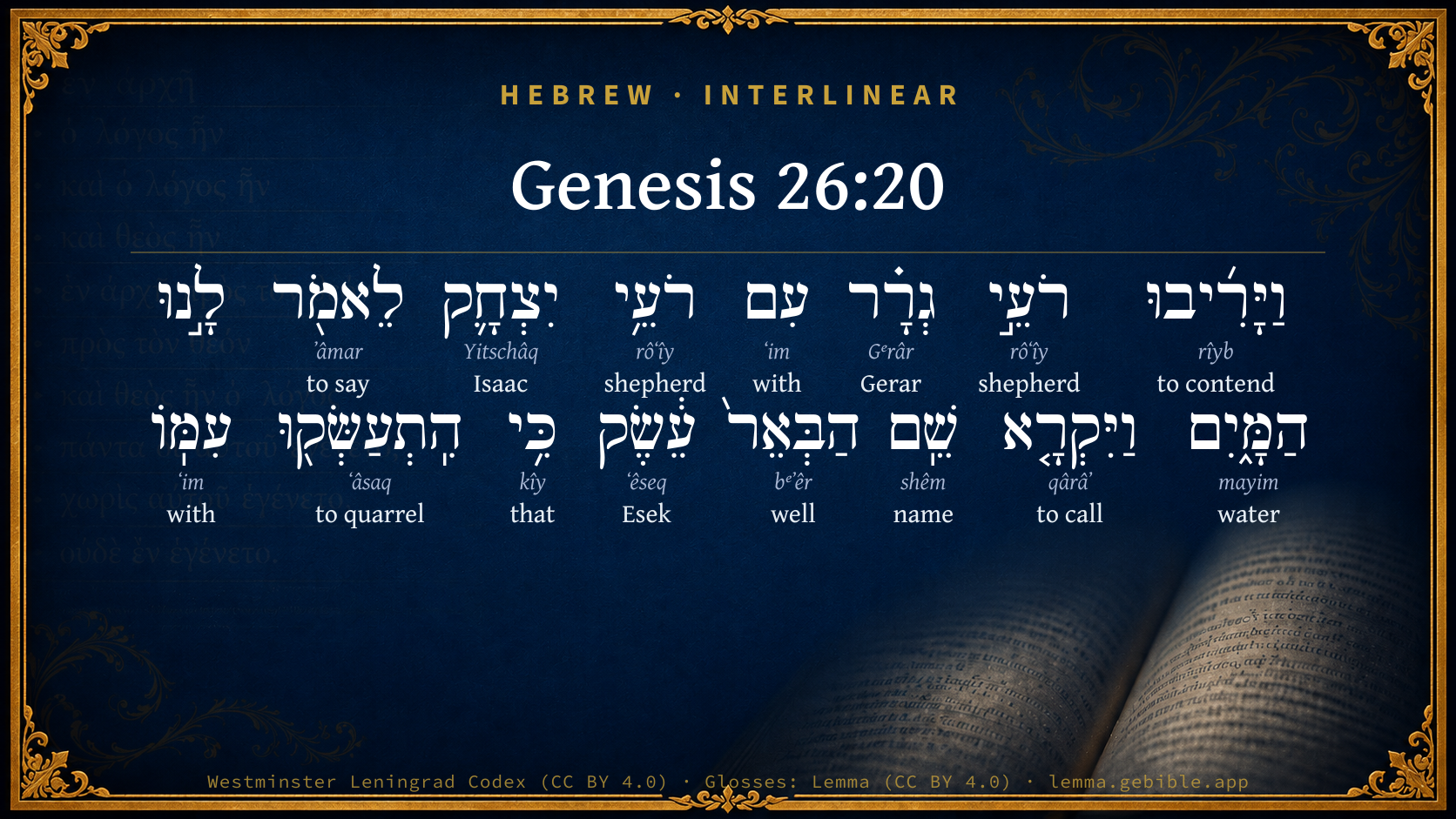
Hebrew (Westminster Leningrad Codex) Genesis 26:20 appears in the Hebrew Old Testament. The text above is from the Westminster Leningrad Codex. Each word links to its Strong’s number, a concise gloss, and parsing drawn from the Open Scriptures Hebrew Bible morphology. Click any word for its full Brown-Driver-Briggs (BDB) entry.
Download image
Cite this verse

Genesis 26:20 (World English Bible). Public Domain. Lemma interlinear Bible study tool, https://lemma.gebible.app/v/genesis/26/20.

Show BibTeX & RIS
BibTeX
RIS
English Translation
The herdsmen of Gerar argued with Isaac's herdsmen, saying, "The water is ours." He called the name of the well Esek, because they contended with him.
World English Bible · Public Domain
Highlights
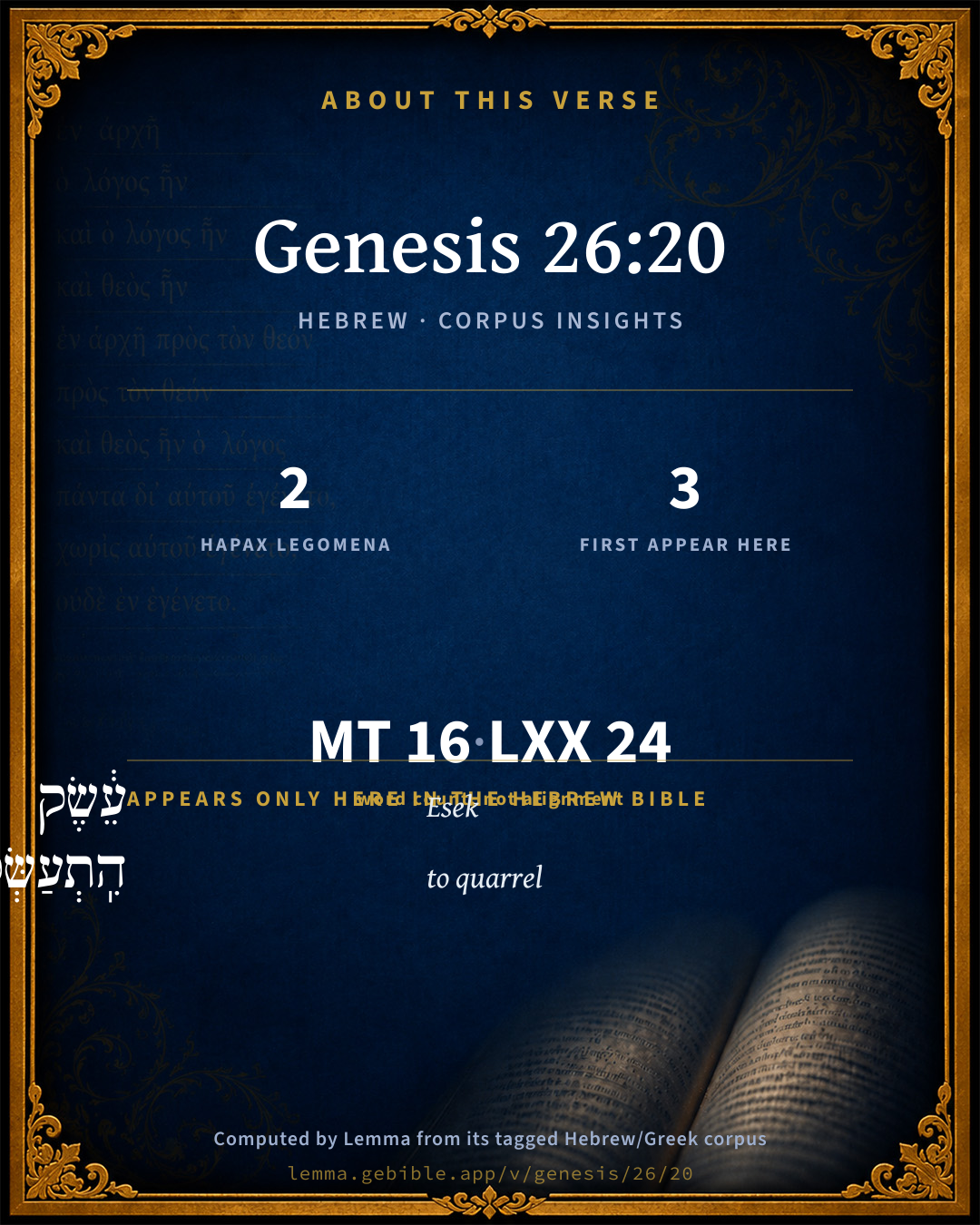
  • 2 hapax legomena — only here in the Hebrew Bible
  • 3 first appearances in the Hebrew Bible
Full analysis ↓
Download a study sheet

One document with this verse’s original text, its word-by-word gloss line, the meaning frame, cross-references with their text, attributed commentary, and full source and license credits — printable, and it pastes into notes with its structure intact.

This verse Autodidact and up

Study sheet (.html) Plain text (.txt)

A passage Seminary Student

Up to 50 verses in one chapter. A passage sheet keeps up to 6 commentary sources and 12 cross-references per verse, in the order this page ranks them, and says so on the sheet whenever that leaves anything out. Ask for a single verse and you get the Autodidact verse sheet above.

Everything on this page stays free to read, with no account — the sheet is a download of what is already on screen, not access to it.

Want to remove ads? Support Godless Engineer
Compare translations 3

The same verse in 3 English versions, stacked beneath the original-language interlinear above. Click any original word for its lexicon entry.

Each is an independent rendering of the whole verse — the interlinear is not word-aligned to these translations.

Highlighted words mark where these versions differ — a whole-verse word diff, not a word-by-word alignment.

  • World English Bible Public Domain
    The herdsmen of Gerar argued with Isaac's herdsmen, saying, "The water is ours." He called the name of the well Esek, because they contended with him.
  • King James Version Public Domain
    And the herdmen of Gerar did strive with Isaac's herdmen, saying, The water is ours: and he called the name of the well Esek; because they strove with him.
  • unfoldingWord Literal Text CC BY-SA 4.0
    But the herdsmen of Gerar quarreled with the herdsmen of Isaac, saying, “The water to us!” So he called the name of the well Esek, because they disputed with him.

unfoldingWord Literal Text — © unfoldingWord, licensed CC BY-SA 4.0. Word-aligned USFM3 via Door43 (git.door43.org/unfoldingWord/en_ult).

Versions to compare (up to 4)

3 of 4 selected

Show all 18 translations

Every available English version of this verse, each an independent rendering of the whole verse.

  • World English Bible Public Domain
    The herdsmen of Gerar argued with Isaac's herdsmen, saying, "The water is ours." He called the name of the well Esek, because they contended with him.
  • Berean Standard Bible Public Domain
    But the herdsmen of Gerar quarreled with Isaac’s herdsmen and said, “The water is ours!” So he named the well Esek, because they contended with him.
  • Majority Standard Bible Public Domain
    But the herdsmen of Gerar quarreled with Isaac’s herdsmen and said, “The water is ours!” So he named the well Esek, because they contended with him.
  • King James Version Public Domain
    And the herdmen of Gerar did strive with Isaac's herdmen, saying, The water is ours: and he called the name of the well Esek; because they strove with him.
  • American Standard Version (1901) Public Domain
    And the herdsmen of Gerar strove with Isaac's herdsmen, saying, The water is ours. And he called the name of the well Esek, because they contended with him.
  • Revised Version (1885) Public Domain
    And the herdmen of Gerar strove with Isaac’s herdmen, saying, The water is ours: and he called the name of the well Esek; because they contended with him.
  • Geneva Bible (1599) Public Domain
    But the herdmen of Gerar did striue with Izhaks herdmen, saying, The water is ours: therefore called he the name of the well Esek, because they were at strife with him.
  • Douay-Rheims (1899) Public Domain
    But there also the herdsmen of Gerara strove against the herdsmen of Isaac, saying: It is our water. Wherefore he called the name of the well, on occasion of that which had happened, Calumny.
  • Young's Literal Translation Public Domain
    and shepherds of Gerar strive with shepherds of Isaac, saying, `The water `is' ours;' and he calleth the name of the well `Strife,' because they have striven habitually with him;
  • Literal Standard Version CC BY-SA 4.0
    and shepherds of Gerar strive with shepherds of Isaac, saying, “The water [is] ours”; and he calls the name of the well “Strife,” because they have striven habitually with him;
  • Unlocked Literal Bible CC BY-SA 4.0
    The herdsmen of Gerar quarreled with Isaac's herdsmen, and said, “This water is ours.” So Isaac called that well “Esek,” because they had quarreled with him.
  • unfoldingWord Literal Text CC BY-SA 4.0
    But the herdsmen of Gerar quarreled with the herdsmen of Isaac, saying, “The water to us!” So he called the name of the well Esek, because they disputed with him.
  • Darby Bible Public Domain
    But the shepherds of Gerar strove with Isaac's shepherds, saying, The water is ours. And he called the name of the well Esek, because they had quarrelled with him.
  • World Messianic Bible Public Domain
    The herdsmen of Gerar argued with Isaac’s herdsmen, saying, “The water is ours.” So he called the name of the well Esek, because they contended with him.
  • Webster's Bible Public Domain
    And the herdmen of Gerar contended with Isaac's herdmen, saying, The water is ours: and he called the name of the well Esek; because they strove with him.
  • Free Bible Version CC BY-SA 4.0
    But the herdsmen from Gerar argued with Isaac's herdsmen, claiming, “That's our water!” So Isaac named the well, “Argument,” because they argued with him.
  • Bible in Basic English Public Domain
    But the herdmen of Gerar had a fight with Isaac's herdmen, for they said, The spring is ours: so he gave the spring the name of Esek, because there was a fight about it.
  • JPS Tanakh (1917) Public Domain
    And the herdmen of Gerar strove with Isaac's herdmen, saying: 'The water is ours.' And he called the name of the well Esek; because they contended with him.

Literal Standard Version (2020), Covenant Press — licensed CC BY-SA 4.0. Text via the HelloAO Bible API (eBible.org). Unlocked Literal Bible (unfoldingWord) — licensed CC BY-SA 4.0. Text via the HelloAO Bible API (eBible.org). unfoldingWord Literal Text — © unfoldingWord, licensed CC BY-SA 4.0. Word-aligned USFM3 via Door43 (git.door43.org/unfoldingWord/en_ult). Free Bible Version, Dr. Jonathan Gallagher — licensed CC BY-SA 4.0. Text via the HelloAO Bible API (eBible.org).

Word by word

More ways to search: Search by grammar → Find every occurrence → Compare this word →

Practice this passage: Drill this verse → Learn its vocabulary →

עֵ֔שֶׂק
ʻêseq
H6230
“Esek”
Noun, Proper
Part of Speech
Noun
Type
Proper
Full BDB Definition

Origin: from H6229

TWOT: None

Esek = "contention" - a well which the herdsmen of Isaac dug in the valley of Gerar
  1. וַיָּרִ֜יבוּ rîyb H7378 “and · to contend” Conjunction + Verb, Qal, Sequential Imperfect, 3rd Person, Masculine, Plural
  2. רֹעֵ֣י rôʻîy H7473 “shepherd” Verb, Qal, Participle Active, Masculine, Plural, Construct
  3. גְרָ֗ר Gᵉrâr H1642 “Gerar” Noun, Proper
  4. עִם ʻim H5973 “with” Preposition
  5. רֹעֵ֥י rôʻîy H7473 “shepherd” Verb, Qal, Participle Active, Masculine, Plural, Construct
  6. יִצְחָ֛ק Yitschâq H3327 “Isaac” Noun, Proper
  7. לֵאמֹ֖ר ʼâmar H559 “to say” Preposition + Verb, Qal, Infinitive Construct
  8. הַמָּ֑יִם mayim H4325 “the · water(s)” Particle, Definite Article + Noun, Common, Masculine, Plural, Absolute
  9. וַיִּקְרָ֤א qârâʼ H7121 “and · to call” Conjunction + Verb, Qal, Sequential Imperfect, 3rd Person, Masculine, Singular
  10. שֵֽׁם shêm H8034 “name of” Noun, Common, Masculine, Singular, Construct
  11. הַבְּאֵר֙ bᵉʼêr H875 “the · well” Particle, Definite Article + Noun, Common, Feminine, Singular, Absolute
  12. כִּ֥י kîy H3588 “that” Conjunction
  13. הִֽתְעַשְּׂק֖וּ ʻâsaq H6229 “to quarrel” Verb, Hithpael, Perfect, 3rd Person, Common, Plural
  14. עִמּֽוֹ ʻim H5973 “with · him” Preposition + Suffix, Personal, 3rd Person, Masculine, Singular

About this verse

These counts appear in no published source. They are computed here, from the morphology-tagged text and Lemma’s own curated glosses. What Lemma adds →

16
words
13
distinct lemmas
Pentateuch
section

Notable vocabulary

2 hapax legomena — words that appear only here in the entire Hebrew Bible:

  • עֵ֔שֶׂק Esek H6230
  • הִֽתְעַשְּׂק֖וּ to quarrel H6229

First appearance in Scripture

These words make their first canonical appearance in the Hebrew Bible here:

  • וַיָּרִ֜יבוּ to contend H7378
  • עֵ֔שֶׂק Esek H6230
  • הִֽתְעַשְּׂק֖וּ to quarrel H6229

Shared distinctive vocabulary

גְרָ֗ר Gerar H1642 occurs in 10 verses of the Hebrew Bible. Also found in:

Grammatical profile

  • 6 verbs
  • 6 nouns
  • 3 prepositions
  • 1 conjunction

Verb forms

  • וַיָּרִ֜יבוּ Qal · Sequential Imperfect
  • רֹעֵ֣י Qal · Participle Active
  • רֹעֵ֥י Qal · Participle Active
  • לֵאמֹ֖ר Qal · Infinitive Construct
  • וַיִּקְרָ֤א Qal · Sequential Imperfect
  • הִֽתְעַשְּׂק֖וּ Hithpael · Perfect

Repetition

Words recur within this verse — often emphatic in Hebrew:

  • רֹעֵ֣י shepherd H7473 ×2
  • עִם with H5973 ×2

Hebrew & Septuagint length

In English translation the verse runs 26 words from the Hebrew and 30 from the Septuagint (LXX English) — closely comparable.

A rough comparison of the two English renderings, which tokenize alike — not a word-level alignment.

Word counts can differ between the Hebrew and the Greek without any difference in meaning — e.g. the Hebrew direct-object marker אֵת has no separate Greek word, and Greek often adds the article ὁ.

In the original languages it is 16 Hebrew tokens and 24 Greek tokens — but the two are counted differently (Hebrew bundles its prefixes and suffixes into one token; the Greek is in lemma form), so that isn’t a like-for-like length.

Cross-references

1

Topical passages linked to Genesis 26:20 in the Treasury of Scripture Knowledge — connected by theme and wording, ordered by reader-vote popularity; previews shown in the World English Bible.

  • Genesis 21:25 Abraham complained to Abimelech because of a water well, which Abimelech's servants had violently taken away.

Cross-references courtesy of OpenBible.info (CC BY 4.0).

Hebrew and Greek witnesses Masoretic Hebrew ↔ Greek Septuagint

The same verse in the two great witnesses to the Old Testament, shown verse-for-verse.

These are two independent witnesses, not word-aligned to each other, and the Septuagint is shown in lemma (dictionary) form.

Hebrew Genesis 26:20 Masoretic · Westminster Leningrad Codex

וַיָּרִ֜יבוּ רֹעֵ֣י גְרָ֗ר עִם רֹעֵ֥י יִצְחָ֛ק לֵאמֹ֖ר לָ֣נוּ הַמָּ֑יִם וַיִּקְרָ֤א שֵֽׁם הַבְּאֵר֙ עֵ֔שֶׂק כִּ֥י הִֽתְעַשְּׂק֖וּ עִמּֽוֹ

The herdsmen of Gerar argued with Isaac's herdsmen, saying, "The water is ours." He called the name of the well Esek, because they contended with him.

World English Bible · Public Domain

Greek LXX Genesis 26:20 Septuagint · lemma form

καί μάχομαι ὁ ποιμήν γεραρα μετά ὁ ποιμήν ισαακ φάσκω αὐτός εἰμί ὁ ὕδωρ καί καλέω ὁ ὄνομα ὁ φρέαρ ἀδικία ἀδικέω γάρ αὐτός

And the shepherds of Gerara strove with the shepherds of Isaac, saying that the water was theirs; and they called the name of the well, Injury, for they injured him.

LXX2012 (modern English Septuagint) · Public Domain

On this verse, The Cambridge Bible for Schools and Colleges discusses the Septuagint’s reading. Read the note in Commentary ↓

Hebrew: Westminster Leningrad Codex (CC BY 4.0). Greek: Septuagint (public domain); English from LXX2012 (modern English Septuagint) (Public Domain). How the Septuagint differs from the Hebrew →

Targum (Aramaic paraphrase)

2

The Targum is the ancient Jewish Aramaic paraphrase of the Hebrew Scriptures — an interpretive translation, not the Hebrew text itself. Onkelos (literal) and Pseudo-Jonathan (expansive) render the Torah, and Jonathan the Prophets. Coverage is partial: where no permissively-licensed English translation exists for a verse, only the Aramaic is shown. This is verse-level text, not a word-by-word alignment to the Hebrew.

  1. Targum Onkelos Torah (Genesis–Deuteronomy)
    וּנְצוֹ רַעֲוָתָא דִּגְרָר עִם רַעֲוָתָא דְיִצְחָק לְמֵימַר דִּי לָנָא מַיָּא וּקְרָא שְׁמָא דְבֵירָא עִסְקָא אֲרֵי אִתְעַסִּיקוּ עִמֵּהּ

    (no public-domain English translation for this verse)

    Targum Onkelos — Aramaic: “Onkelos Genesis” (public domain); “Onkelos Exodus” (public domain); “Onkelos Leviticus” (public domain); “Onkelos Numbers” (public domain); “Onkelos Deuteronomy” (public domain). English: “Sefaria Community Translation” (CC0 1.0 (public-domain dedication)); “J.W. Etheridge. The Targums of Onkelos and Jonathan Ben Uzziel on the Pentateuch. London: Longmans, Green, 1862” (public domain). Text via Sefaria.

  2. Targum Pseudo-Jonathan Torah (Genesis–Deuteronomy)
    וּנְצוֹ רַעֲוָותָא דִגְרָר עִם רַעֲוָותָא דְיִצְחָק לְמֵימַר דִי לָנָא מַיָא וַהֲוָה צְבוּ מִן שְׁמַיָא וִיבֵישַׁת וּבְכֵן אַהֲדָרוּ יָתָהּ לְיִצְחָק וְנָבְעַת וּקְרָא שְׁמָא דְבֵירָא עֵסֶק אֲרוּם אִתְעַסְקוּ עֲלָהּ עִמֵיהּ

    And the shepherds of Gerar contended with Izhak's shepherds, saying, The water is ours. And it was the will of Heaven, and it dried. But when they returned to Izhak, it flowed. And he called the name of the well (Esek) Contention, because (etheseku) they had quarrelled with him on account of it.

    Targum Pseudo-Jonathan — Aramaic: “Targum Jonathan on Genesis” (public domain); “Targum Jonathan on Exodus” (public domain); “Targum Jonathan on Leviticus” (public domain); “Targum Jonathan on Numbers” (public domain); “Targum Jonathan on Deuteronomy” (public domain). English: “The Targum of Jonathan ben Uzziel, trans. J. W. Etheridge, London, 1862” (public domain). Text via Sefaria.

Commentary

Notes on Genesis 26:20 from classic Christian and Jewish commentators (each source and its license shown beneath its notes). The classic Christian expositions comment on the surrounding passage and are grouped to its opening verse, so a note may address several verses; the Jewish commentaries on the Tanakh (Rashi and others) are per-verse, so they appear only where the commentator wrote on this verse.

Lemma curates 59 commentaries, every one of them public domain or Creative Commons licensed, each selected and text-cleaned for this edition rather than reprinted as found. About our sources →

Trapp's Complete Commentary

John Trapp

Gen 26:20 And the herdmen of Gerar did strive with Isaac’s herdmen, saying, The water [is] ours: and he called the name of the well Esek; because they strove with him.

Ver. 20. And the herdmen of Gerar.] Not content to have cast him out, they pursued him, with cruel hatred; and, by denying him water, went about to destroy both him and his herds. Crosses seldom come single, but in a crowd. {Jas 1:2} "The clouds return after the rain," {Ecc 12:2} and cluster against a new storm. See, therefore, that ye keep your cloak close about you.

John Trapp, A Commentary or Exposition upon All the Books of the Old and New Testament (1647–1656) — public domain. Text from a community e-Sword module.

Scofield Reference Notes

C. I. Scofield

name of the well

The wells of Genesis have significant names, and are associated with significant events:

(1) Beer-lahai-roi, the well of him that liveth and seeth me Gen 16:14; Gen 24:62; Gen 25:11.

(2) Beer-sheba, the well of the oath or covenant Gen 21:15-33; Gen 22:19; Gen 26:23-25; Gen 46:1-5.

(3) Esek, contention Gen 26:20.

(4) Sitnah, hatred Gen 26:21. Esek and Sitnah were Isaac’s own attempts at well-digging. Afterward, he dwelt by the old wells of his father.

(5) Rehoboth, enlargement Gen 26:22.

The Scofield Reference Bible (1917 edition), notes by C. I. Scofield — public domain. Text from a community e-Sword module.

Geneva Bible (1599)

Geneva Bible translators

Or, contention, strife.

Geneva Bible (1599) marginal notes — public domain. Text via Bolls.life.

The Cambridge Bible for Schools and Colleges

gen. ed. J. J. S. Perowne

20. Esek] That is, Contention. LXX Ἀδικία; Lat. Calumnia. In this and the two following verses we have popular tradition as to the origin of the names of wells in the region associated with the sojournings of the patriarch.

The Cambridge Bible for Schools and Colleges (gen. ed. J. J. S. Perowne; Cambridge University Press, 1878–1918) — public domain. Text from a community e-Sword module.

John Gill's Exposition

And they digged another well,.... That is, Isaac's servants:

and strove for that also; the herdsmen of Gerar disputed their right to that also, and strove to get it from them:

and he called the name of it Sitnah; which signifies "hatred", it being out of hatred and malice to him that they gave him so much trouble; from this word Satan has his name, and these men were of a diabolical spirit, envious, spiteful, and malicious.

John Gill's Exposition of the Whole Bible (1746–1763) — public domain (CC PDM 1.0). Text via the HelloAO Bible API.

Matthew Poole's English Annotations

The water is ours, because digged in our soil; which was no good argument, because he digged it by their consent or permission at his own charge, and for his own use.

Matthew Poole's English Annotations on the Holy Bible (1683–1685) — public domain. Text from a community e-Sword/MySword module.

Whedon's Commentary on the Bible

Daniel D. Whedon

20-22. Esek… Sitnah… Rehoboth — These appear to have been new wells digged, in addition to the old ones re-opened, and the names mean, respectively, Strife, Opposition, (from the same root as Satan,) and Broad Places, Room. The name of Rehoboth still lingers in the wady er-Ruhaibeh, some twenty-three miles south of Beer-sheba, where Robinson found extensive ruins. Later travellers claim to have found the well, but their reports are conflicting.

Daniel D. Whedon (gen. ed.), Commentary on the Old and New Testaments (1874–1909) — public domain. Text from a community e-Sword module.

The Pulpit Commentary

And the herdmen of Gerari.e. Abimelech"s servants (Gen_21:25) did strive with Isaac"s herdmen, as Lot"s with those of Abraham (Gen_13:7) saying, The water is ours: literally, to us (belong) the watersand he called the name of the well Esek ("Strife"); because they strove with him the verb being qc; to strive about anything.

The Pulpit Commentary (1880–1919), ed. H.D.M. Spence-Jones & Joseph S. Exell — public domain. Text from a community e-Sword module.

John Wesley's Explanatory Notes

Esek - That is, contention.

John Wesley, Explanatory Notes Upon the Whole Bible (1754–1765) — public domain. Text via the GEBible commentary corpus.

Rashi

Rabbi Shlomo Yitzchaki (Rashi)

עשק means DISPUTE.

כי התעשקו עמו means THEY ENGAGED WITH HIM about it in strife and DISPUTE.

Rashi on the Tanakh — English translations: “The Judaica Press complete Tanach with Rashi, translated by A. J. Rosenberg” (CC BY 4.0); “Pentateuch with Rashi's commentary by M. Rosenbaum and A.M. Silbermann, 1929-1934” (public domain); “The Metsudah Tanach series, Lakewood, N.J” (CC BY 4.0); and “The Book of Joshua, Metsudah Publications, 1997” (CC BY 4.0). Text via Sefaria.

Ramban (Nachmanides)

Rabbi Moshe ben Nachman (Ramban / Nachmanides)

AND HE CALLED THE NAME OF THE WELL ESEK. Scripture gives a lengthy account of the matter of the wells when in the literal interpretation of the story there would seem to be no benefit nor any great honor to Isaac in that he and his father did the identical thing. However, there is a hidden matter involved here since Scripture’s purpose is to make known a future matter. A well of living water alludes to the House of G-d which the children of Isaac will build. This is why Scripture mentions a well of living waters, even as it says, A fountain of living waters, the Eternal., which is the house of the Eternal. He called the first well Esek (Contention), which is an allusion to the First House, concerning which the nations contended with us and instigated quarrels and wars with us until they destroyed it. The second well he called Sitnah (Enmity), a name harsher than the first. This alludes to the Second House, which has indeed been referred to by this very name, in the beginning of his reign, they wrote ‘sitnah’ appears in connection with the Second Sanctuary. against the inhabitants of Judah and Jerusalem. And during its entire existence they were a source of enmity unto us until they destroyed it and drove us from it into bitter exile. The third well he called Rechovoth (Spacious). This is a reference to the Future House, which will be speedily built in our days, and it will be done without quarrel and feud, and G-d will enlarge our borders, even as it says, And if the Eternal thy G-d enlarge thy border, as He hath sworn, etc., which refers to the future. And concerning the Third House of the future it is written, Broader, from the same root as the name of the third well, Rechovoth. The connection between the third well and the Third Temple of the future, concerning which Ezekiel prophesied, is thus established. and winding about higher and higher. [The concluding statement in the present narrative, concerning the naming of the third well], And we shall be fruitful in the land, signifies that all peoples will come to worship G-d with one consent.

Ramban (Nachmanides) on the Tanakh — English translation: “Commentary on the Torah by Ramban (Nachmanides). Translated and annotated by Charles B. Chavel. New York, Shilo Pub. House, 1971-1976” (CC BY 4.0). Text via Sefaria.

Radak

Rabbi David Kimhi (Radak)

ויריבו לנו המים, as we explained in connection with Avraham and Avimelech (21,25), the quarrel was if the source of the water was part of the region of Gerar or part of the region of Beer Sheva. The old quarrel resurfaced now between the shepherds of Yitzchok and those of Gerar.

ויקרא שם הבאר עשק, He gave it a name so that in the future when he would become more powerful than they, the shepherds of Gerar would not be able to claim the well as theirs without protest. The very name already foreshadowed that the claim to this well would be disputed. The meaning of the name עשק as describing dispute is known to us from our sages in Baba Kama 9 המוכר את השדה ויצאו עליה עשיקין, “if someone sells a field and a quarrel ensues concerning it.”

Radak on the Tanakh — English translations: “Sefaria Community Translation” (CC0 1.0 (public-domain dedication)); “Eliyahu Munk, HaChut Hameshulash” (CC BY 4.0); “Rabbi Mike Feuer, Jerusalem Anthology” (CC BY 4.0); and “R. David Kimhi on the first book of Psalms, Translated by R.G. Finch, London, 1919” (public domain). Text via Sefaria.

Lesson kit

Teaching starters — assembled from the data on this page, not authored interpretation. Every prompt links to the verse data it draws on. Edit before teaching.

Genesis, in the Pentateuch, opens this verse with 16 words (13 distinct Hebrew lemmas). Its most distinctive word is ʻêseq (“Esek”). A historical commentator’s framing appears above. Read the whole chapter for the surrounding context.

Discussion questions

  1. How does “Esek” (ʻêseq) shape what this verse is saying?
  2. This verse holds 2 words here found nowhere else in the Hebrew Bible. What might the rare words draw attention to?
  3. 3 words here appear for the first time in Scripture. What is being introduced at this debut?
  4. Genesis 10:19 shares the word «Gerar» with this verse. How do the two illuminate each other?
  5. “shepherd” occurs 2× in this one verse. What is the effect of the repetition?
  6. The translations on this page render this verse differently — a whole-verse word diff, not a word-by-word alignment. What might account for the different wordings?
  7. The verb «וַיָּרִ֜יבוּ» is Qal Sequential Imperfect. How does its form color the action?
  8. Reading how Trapp's Complete Commentary and Scofield Reference Notes read this verse, where do the two commentators agree and where do they part?

Things to notice

  • 2 words in this verse appear nowhere else in the Hebrew Bible.
  • 3 words make their first canonical appearance in Scripture here.
  • This verse counts 16 Hebrew ↔ 24 Greek words.
  • These translations choose different wording for 13 words in this verse.
  • “shepherd” occurs 2× in this single verse.

Reading settings

Reading text

Shown beneath each verse's original-language words.

Old Testament
Old Testament edition

Read the OT as the Masoretic Hebrew (MT) or the Greek Septuagint (LXX).

English shown for the Greek Septuagint (in the Hebrew ↔ Greek comparison).

Comparing translations? Open the Compare panel on any verse page to stack up to four side by side.