Acts 21:10

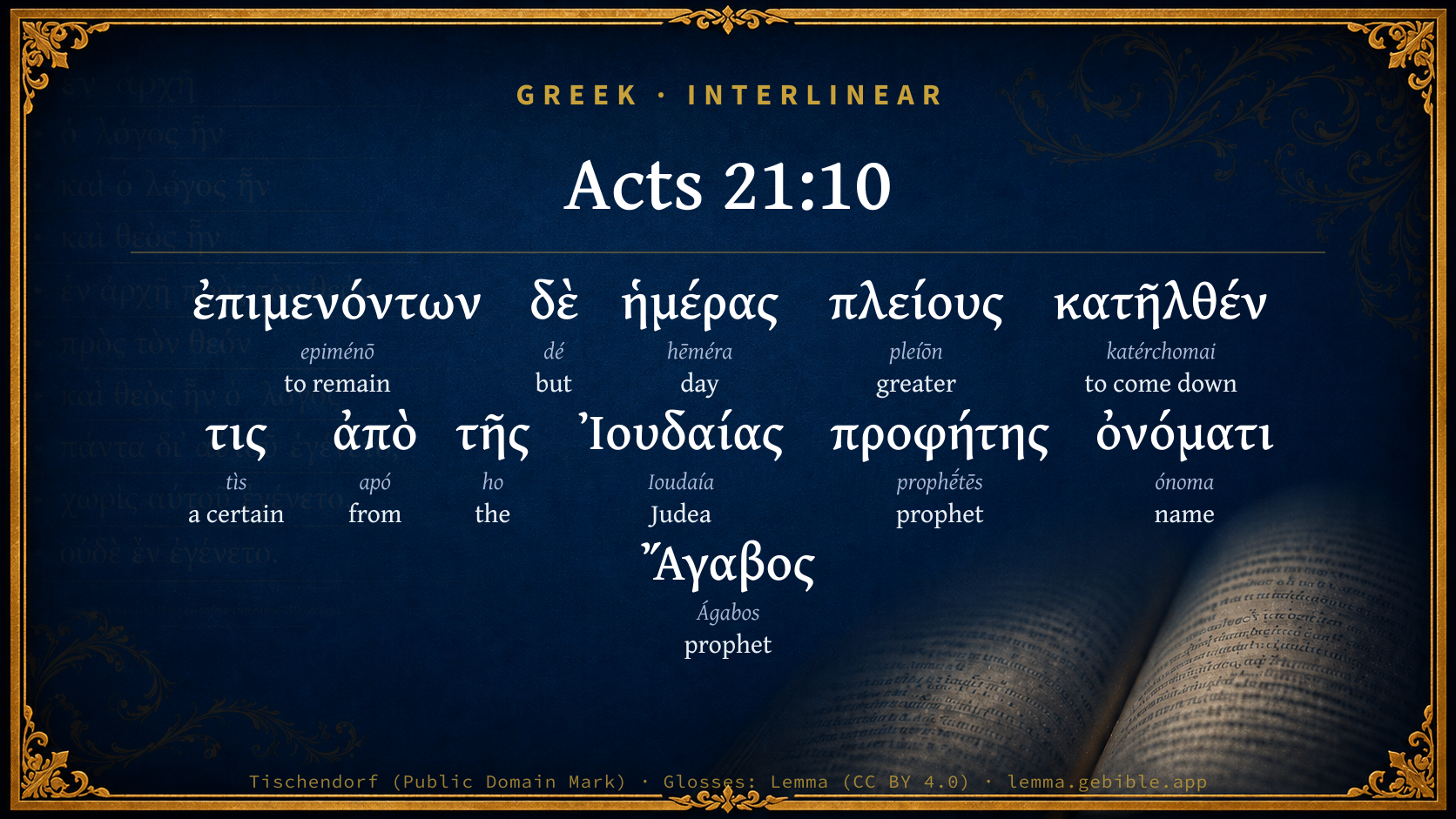
Greek (Tischendorf 8th ed.) Acts 21:10 appears in the Greek New Testament. The text above is from the Tischendorf 8th edition. Each word links to its Strong’s number and a concise gloss. Click any word for its full Thayer’s Greek Lexicon entry.
Download image
Cite this verse

Acts 21:10 (World English Bible). Public Domain. Lemma interlinear Bible study tool, https://lemma.gebible.app/v/acts/21/10.

Show BibTeX & RIS
BibTeX
RIS
English Translation
As we stayed there some days, a certain prophet named Agabus came down from Judea.
World English Bible · Public Domain
Download a study sheet

One document with this verse’s original text, its word-by-word gloss line, the meaning frame, cross-references with their text, attributed commentary, and full source and license credits — printable, and it pastes into notes with its structure intact.

This verse Autodidact and up

Study sheet (.html) Plain text (.txt)

A passage Seminary Student

Up to 50 verses in one chapter. A passage sheet keeps up to 6 commentary sources and 12 cross-references per verse, in the order this page ranks them, and says so on the sheet whenever that leaves anything out. Ask for a single verse and you get the Autodidact verse sheet above.

Everything on this page stays free to read, with no account — the sheet is a download of what is already on screen, not access to it.

Want to remove ads? Support Godless Engineer
Compare translations 3

The same verse in 3 English versions, stacked beneath the original-language interlinear above. Click any original word for its lexicon entry.

Each is an independent rendering of the whole verse — the interlinear is not word-aligned to these translations.

Highlighted words mark where these versions differ — a whole-verse word diff, not a word-by-word alignment.

  • World English Bible Public Domain
    As we stayed there some days, a certain prophet named Agabus came down from Judea.
  • King James Version Public Domain
    And as we tarried there many days, there came down from Judaea a certain prophet, named Agabus.
  • unfoldingWord Literal Text CC BY-SA 4.0
    And as we stayed for many days, a certain prophet, Agabus by name, came down from Judea.

unfoldingWord Literal Text — © unfoldingWord, licensed CC BY-SA 4.0. Word-aligned USFM3 via Door43 (git.door43.org/unfoldingWord/en_ult).

Versions to compare (up to 4)

3 of 4 selected

Show all 19 translations

Every available English version of this verse, each an independent rendering of the whole verse.

  • World English Bible Public Domain
    As we stayed there some days, a certain prophet named Agabus came down from Judea.
  • Berean Standard Bible Public Domain
    After we had been there several days, a prophet named Agabus came down from Judea.
  • Majority Standard Bible Public Domain
    After we had been there several days, a prophet named Agabus came down from Judea.
  • King James Version Public Domain
    And as we tarried there many days, there came down from Judaea a certain prophet, named Agabus.
  • American Standard Version (1901) Public Domain
    And as we tarried there some days, there came down from Judaea a certain prophet, named Agabus.
  • Revised Version (1885) Public Domain
    And as we tarried there many days, there came down from Judaea a certain prophet, named Agabus.
  • Geneva Bible (1599) Public Domain
    And as we taried there many dayes, there came a certaine Prophet from Iudea, named Agabus.
  • Douay-Rheims (1899) Public Domain
    And as we tarried there for some days, there came from Judea a certain prophet, named Agabus.
  • Young's Literal Translation Public Domain
    And we remaining many more days, there came down a certain one from Judea, a prophet, by name Agabus,
  • Literal Standard Version CC BY-SA 4.0
    And we remaining many more days, there came down a certain one from Judea, a prophet, by name Agabus,
  • Unlocked Literal Bible CC BY-SA 4.0
    As we stayed there for some days, there came down from Judea a certain prophet named Agabus.
  • unfoldingWord Literal Text CC BY-SA 4.0
    And as we stayed for many days, a certain prophet, Agabus by name, came down from Judea.
  • Darby Bible Public Domain
    And as we stayed there many days, a certain man, by name Agabus, a prophet, came down from Judaea,
  • World Messianic Bible Public Domain
    As we stayed there some days, a certain prophet named Agabus came down from Judea.
  • Webster's Bible Public Domain
    And as we tarried there many days, there came down from Judea a certain prophet, named Agabus.
  • Free Bible Version CC BY-SA 4.0
    After we'd stayed there for several days, a prophet called Agabus arrived from Judea.
  • Bible in Basic English Public Domain
    And while we were waiting there for some days, a certain prophet, named Agabus, came down from Judaea.
  • Text-Critical English NT CC BY 4.0
    After we had been there for several days, a prophet named Agabus came down from Judea.
  • Tyndale New Testament (1534) Public Domain
    And as we taried there a good many dayes there came a certayne prophete from Iurie named Agabus.

Literal Standard Version (2020), Covenant Press — licensed CC BY-SA 4.0. Text via the HelloAO Bible API (eBible.org). Unlocked Literal Bible (unfoldingWord) — licensed CC BY-SA 4.0. Text via the HelloAO Bible API (eBible.org). unfoldingWord Literal Text — © unfoldingWord, licensed CC BY-SA 4.0. Word-aligned USFM3 via Door43 (git.door43.org/unfoldingWord/en_ult). Free Bible Version, Dr. Jonathan Gallagher — licensed CC BY-SA 4.0. Text via the HelloAO Bible API (eBible.org).

Word by word

More ways to search: Search by grammar → Find every occurrence → Compare this word →

Practice this passage: Drill this verse → Learn its vocabulary →

About this verse

These counts appear in no published source. They are computed here, from the morphology-tagged text and Lemma’s own curated glosses. What Lemma adds →

12
words
12
distinct lemmas
Acts
section

Notable vocabulary

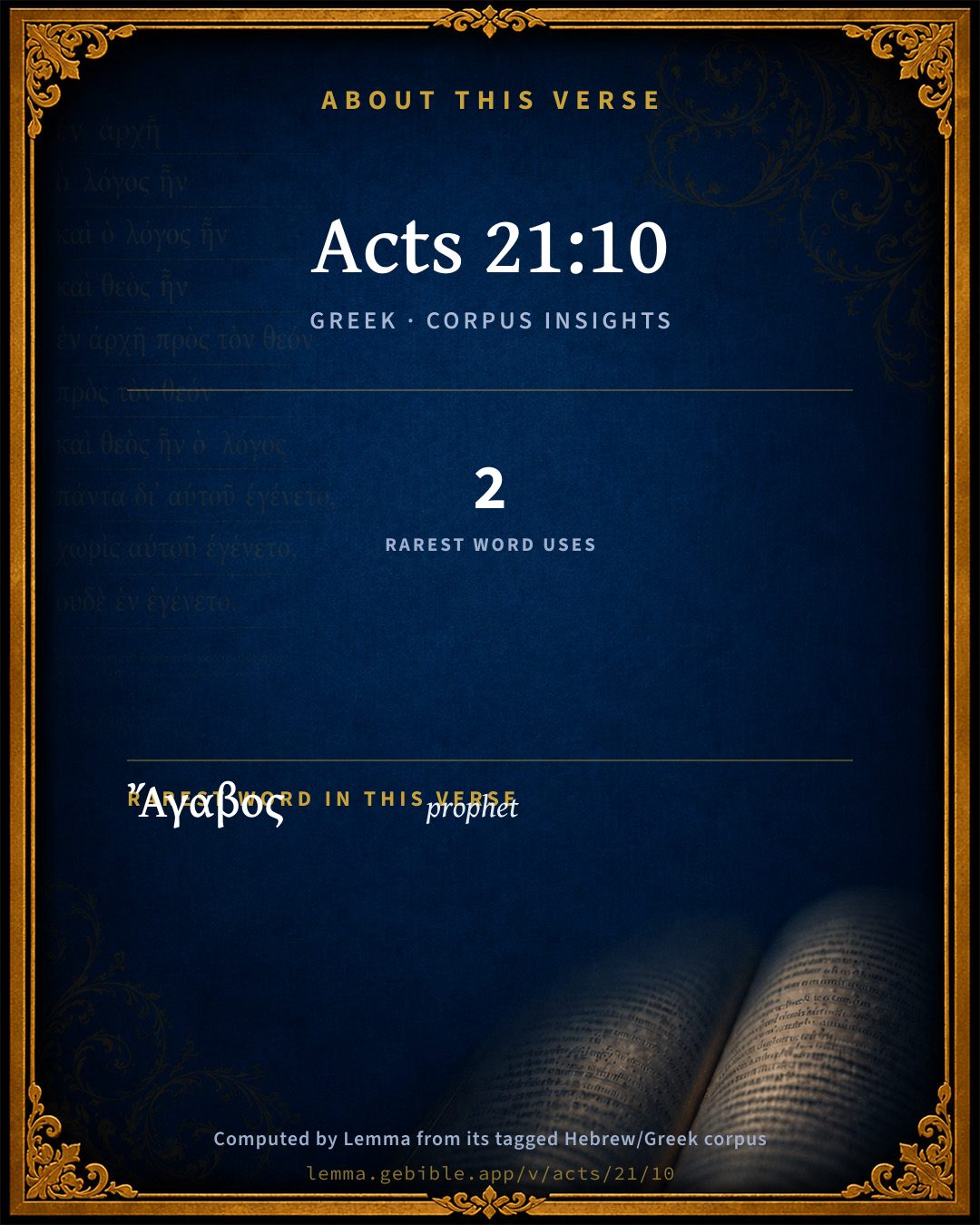
The rarest word here is Ἄγαβος prophet G13 — appearing just 2 times in the whole Greek New Testament.

Shared distinctive vocabulary

Ἄγαβος prophet G13 occurs in 2 verses of the Greek New Testament. Also found in:

Cross-references

3

Topical passages linked to Acts 21:10 in the Treasury of Scripture Knowledge — connected by theme and wording, ordered by reader-vote popularity; previews shown in the World English Bible.

  • Acts 11:28 One of them named Agabus stood up, and indicated by the Spirit that there should be a great famine all over the world, which also happened in the days of Claudius.
  • Acts 21:4 Having found disciples, we stayed there seven days. These said to Paul through the Spirit, that he should not go up to Jerusalem.
  • Acts 20:16 For Paul had determined to sail past Ephesus, that he might not have to spend time in Asia; for he was hastening, if it were possible for him, to be in Jerusalem on the day of Pentecost.

Cross-references courtesy of OpenBible.info (CC BY 4.0).

Where the printed editions differ

1 variant

Places in this verse where the major printed Greek editions disagree on the wording in a way that affects the translation — a comparison of editions, not a manuscript-by-manuscript collation. The editions are the modern critical texts (Nestlé-Aland 28/27, SBL, Westcott-Hort, Tregelles, Tyndale House) and the traditional texts behind the KJV (the Textus Receptus and the Byzantine/Majority text). It is not a claim about which reading is original.

  1. Extra text
    ἡμῶν

    “of us”

    In TRByz Not in NA28NA27TynSBLWHTreg

    ἡμῶν (hēmōn) 'of us' is only in traditional manuscripts (TR+Byz)

Textual data: Translators Amalgamated Greek New Testament (STEPBible TAGNT) · CC BY 4.0.

Commentary

Notes on Acts 21:10 from classic Christian and Jewish commentators (each source and its license shown beneath its notes). The classic Christian expositions comment on the surrounding passage and are grouped to its opening verse, so a note may address several verses; the Jewish commentaries on the Tanakh (Rashi and others) are per-verse, so they appear only where the commentator wrote on this verse.

Lemma curates 59 commentaries, every one of them public domain or Creative Commons licensed, each selected and text-cleaned for this edition rather than reprinted as found. About our sources →

Joseph Benson's Commentary

Act 21:10-14. And as we tarried there many days — There being many disciples in that city, the fruit, as appears, of the ministry and miracles of Philip; there came from Judea a prophet named Agabus — Paul, and some part of his company, had become acquainted with this prophet some years before, at Antioch, where he foretold the famine which afterward happened in the days of Claudius Cesar, Act 11:28. And when he was come unto us — Several of the disciples of Cesarea and Paul’s friends being together; he took Paul’s girdle, and bound his own hands and feet — In the manner that malefactors were wont to be bound when apprehended; and said, Thus saith the Holy Ghost — By whose inspiration I now speak and act; So shall the Jews at Jerusalem bind the man that owneth this girdle — Thus Agabus, like the prophets of old, accompanied his prediction with a significant prophetic symbol: and thus the nearer the event was, the more express and impressive were the predictions intended to prepare Paul for it. When we — Of Paul’s company; and they of that place — The brethren of Cesarea; heard these things — And believed if he went to Jerusalem the prediction would be fulfilled; we besought him not to go — In the most pressing manner, and with many tears of sincere and fervent affection, Act 21:13; being ignorant, it appears, that this and the former prediction were intended, not to hinder him from going to Jerusalem, but to make him the more courageous, by signifying to him beforehand what was to befall him, (Act 20:22-23,) and that he would not be put to death at Jerusalem. Then Paul — Sensibly touched with the concern which they expressed on his account, and yet resolutely bent upon following what he apprehended to be the call of duty, whatever sufferings it might expose him to; answered, What mean ye to weep and break my heart? — By these affectionate salutations? Observe, reader, the admirable mixture of tenderness and firmness of spirit manifested in this answer. I am ready, not to be bound only — And cast into prison; but also to die at Jerusalem — Or wherever else I may be called to it; for the name of the Lord Jesus — For he feared neither sufferings nor death in any form, if he might thereby defend the gospel, and promote the glory of its Author, which were the ends he had chiefly in view in all his labours and sufferings, and which he preferred to all other things whatever. And when he would not be persuaded, we ceased — It was not obstinacy in Paul that hindered his yielding to their persuasions, but true Christian resolution, not to relinquish what he believed to be the line of duty. We should never be persuaded either to do what we know to be evil, or to omit what we believe to be good, when it is in our power: saying, The will of the Lord be done — Which they were satisfied Paul knew.

Joseph Benson's Commentary on the Old and New Testaments (1811–1818) — public domain. Text from a community e-Sword module.

Tyndale Open Study Notes

Tyndale Open Resources

21:10 Luke juxtaposes female prophets (21:9) with a male prophet (see study note on 17:34). Agabus, like the Old Testament prophets, used symbolic actions to proclaim his message (see “Prophetic Sign Acts” Theme Note).

Tyndale Open Study Notes — © Tyndale Open Resources, licensed CC BY-SA 4.0. Text via the HelloAO Bible API.

Meyer's Critical & Exegetical Commentary

Heinrich August Wilhelm Meyer

Act_21:10-11. Ἐπιμενόντων] without a subject (see the critical remarks); Matthiae, § 563; Buttmann, neut. Gr. p. 271 [E. T. 316].

Ἄγαβος] There is no reason against the assumed identity of this person with the one mentioned in Act_11:28. Lukes mode of designating him, which does not take account of the former mention of him, admits of sufficient explanation from the special document giving account of this journey, which, composed by himself before his book, did not involve a reference to earlier matters, and was left by him just as it was; nor did it necessarily require any addition on this point for the purpose of setting the reader right.

ἄρας] he took it up, from the ground, or wherever Paul had laid it.

δήσας … πόδας] as also the old prophets often accompanied their prophecies with symbolic actions; Isaiah 20; Jeremiah 13; Ezekiel 4, al. See Grotius; Ewald, Proph. I. p. 38. On the symbol here, comp. Joh_21:18.

ἑαυτοῦ] his own; for it was not his girdle, but Pauls. This self-binding is to be conceived as consisting of two separate acts.

τὸ πν. τ. ἅγ.] whose utterance I, namely, as His organ express.

Meyer — Critical and Exegetical Commentary on the New Testament — English translation by Peter Christie, edited by Frederick Crombie (T&T Clark, 1880) — public domain. Text from a community e-Sword module.

Expositor's Greek Testament

ed. W. Robertson Nicoll

Act 21:10 . ἡμέρας πλείους : “many days,” R.V., “some” margin; literally “more days,” the phrase is used vaguely with what Ramsay calls Luke’s usual defective sense of time, cf. Act 13:31 , Act 25:14 . The phrase is also found in Act 27:20 , so that it occurs twice in the “We” sections and twice in the rest of Acts, but nowhere else in N.T., see Hawkins, Horæ Synopticæ , p. 151, Klostermann, Vindiciæ Lucanæ , p. 53. Often in LXX. Weiss thinks that the phrase here, cf. Act 21:4 , shows that Paul had given up all idea of reaching Jerusalem for Pentecost; but see on the other hand Ramsay, St. Paul , p. 297, and Salmon, Introd. , p. 300: probably the Apostle had several days to spare when he reached Cæsarea, and he would naturally calculate his time differently when he had made a prosperous voyage, so that there is no contradiction with Act 20:16 . προφ . ὀνόμ . Ἄ .: probably the same who is mentioned in Act 11:25 , since he too came from Jerusalem. It has seemed strange to Blass and to others that St. Luke mentions Agabus here so indefinitely, but in this “We” section it would seem that St. Luke refers to Agabus in this vague way because this was the first time that he had seen the prophet (unless we accept [355] in Act 11:28 ). It is therefore quite unnecessary to regard the mention of his name in Act 11:28 as an interpolation. Agabus is evidently enabled not only to declare the will of God, but also to predict the future.

[355] Codex Claromontanus (sæc. vi.), a Græco-Latin MS. at Paris, edited by Tischendorf in 1852.

The Expositor's Greek Testament, edited by W. Robertson Nicoll (1897–1910) — public domain. Text from a community e-Sword module.

Jamieson, Fausset & Brown

Robert Jamieson, A. R. Fausset & David Brown

tarried there many--"a good many"

days--Finding himself in good time for Pentecost at Jerusalem, he would feel it a refreshing thing to his spirit to hold Christian communion for a few days with such a family.

there came down from Judea--the news of Paul's arrival having spread.

a certain prophet . . . Agabus--no doubt the same as in Act 11:28.

Jamieson, Fausset & Brown — Commentary Critical and Explanatory on the Whole Bible (1871) — public domain (CC PDM 1.0). Text via the HelloAO Bible API.

Adam Clarke's Commentary

Verse 10. Agabus.] See Clarke on Ac 11:28.

Adam Clarke's Commentary on the Bible (1810–1826) — public domain. Text from a community e-Sword/MySword module.

John Calvin's Commentaries

10. A certain prophet. Though Luke doth not plainly express the same, yet do I conjecture that this Agabus was the same of whom mention is made in the eleventh chapter, (Acts 11:28) who foretold that there should be famine under the reign of Claudius Caesar. And when as Luke calleth him a prophet, as of late he called, the four daughters of Philip, he signifieth that it was not a common but a peculiar gift. Now, we must see to what end the persecution which was at hand was now again showed by Agabus. As concerning Paul, he was sufficiently told already. Therefore, I do not doubt but that this confirmation was added for other men’s sake; because the Lord meant every where to make known the bonds of his servant, partly that they might know that he entered the combat willingly, partly that they might perceive that he was appointed of God to be a champion to fight for the gospel. It was surely a profitable example of invincible constancy, seeing that he offered himself willingly and wittingly to the violence of the adversaries; and no less profitable is it for us at this day, that his apostleship should be confirmed with this voluntary and no less constant giving over of his life.

The man who owneth this girdle. It was an usual thing among the prophets to represent those things which they spake by signs; neither did they confirm their prophecies by using signs, through their own motion, but at the commandment of the Spirit, as when Isaias is commanded to go barefoot, (Isaiah 20:2) Jeremiah to put a yoke upon his neck, to sell the possession and to buy it, (Jeremiah 27:2, and Jeremiah 32:7) and Ezekiel to dig through the wall of his house privily, and in the same night to carry forth burthens, (Ezekiel 12:5). These and such like might seem to the common sort to be toys; but the same Spirit, who did apply signs to his words, did inwardly touch the hearts of the godly, as if they had been brought to the very thing itself. So this spectacle, mentioned by Luke, did no less move Paul’s companions, than if they had seen him bound in deed. The false prophets did afterward essay to delude the simple by this policy, as Satan is in a manner God’s ape, and his ministers do envy the servants of God. Zedekias made himself horns, wherewith he promised Syria should be pushed. Ananias, by breaking Jeremiah’s yoke, put the people in a vain hope of deliverance. God hath suffered the reprobate to be deluded with such delusions, that he might punish their unbelief.

But, forasmuch as there was in them no force of the Spirit, their vanity did no whit hurt the faithful. This is also worthy to be noted, that Agabus doth not set before their eyes a dumb spectacle, but he coupleth therewith the word, whereby he may show to the faithful the use and end of the ceremony.

John Calvin's Commentaries (1540-1563) — public domain. Text from the Calvin Translation Society English edition (1840s-50s) via the Christian Classics Ethereal Library (ccel.org). Calvin's coverage is partial (roughly two-thirds of the Bible); uncommented books and verses are honest gaps, never fabricated. The 19th-century editor's footnotes and remarks are omitted so the notes are faithfully Calvin's own voice.

Ellicott's Commentary for English Readers

(10) As we tarried there many days . . .—The adjective is in the comparative degree, and implies, accordingly, a longer time than had been intended. Probably the voyage had been quicker than the travellers had expected, and there was therefore time to remain at Cæsarea, and yet to arrive at Jerusalem, as St. Paul purposed, in time for Pentecost (chap 20:16). There was, at any rate, time for the tidings of his arrival to reach Jerusalem, and for Agabus (see Note on Act_11:28) to come down in consequence.

A Bible Commentary for English Readers, edited by Charles John Ellicott (1878–1897) — public domain. Text from a community e-Sword module.

The Cambridge Bible for Schools and Colleges

gen. ed. J. J. S. Perowne

10. And as we tarried there many days] The word rendered “many” is not the one commonly so translated. It is equal to “some” as Rev. Ver. in margin, and implies that the Apostle made a suitable stay, such as was seemly with a host of such a kind.

there … Agabus] Perhaps the same who (Act_11:28) at Antioch foretold the coming famine. The prophets mentioned on that occasion had also come up from Jerusalem, and the name being somewhat unusual, makes the identity very probable.

The Cambridge Bible for Schools and Colleges (gen. ed. J. J. S. Perowne; Cambridge University Press, 1878–1918) — public domain. Text from a community e-Sword module.

John Gill's Exposition

And as we tarried there many days,.... How many days is not said, it could not be very many, if the apostle got to Jerusalem by Pentecost, as he desired, Act 20:6

there came down from Judea a certain prophet named Agabus; of whom mention is made in Act 11:28 who is there said to come from Jerusalem, to Antioch, and here from Judea to Caesarea; he had been many years going about from place to place prophesying, for between that and this account must be a space of about sixteen or seventeen years.

John Gill's Exposition of the Whole Bible (1746–1763) — public domain (CC PDM 1.0). Text via the HelloAO Bible API.

Trapp's Complete Commentary

John Trapp

10 And as we tarried there many days, there came down from Judaea a certain prophet, named Agabus.

Ver. 10. A certain prophet] So called a procul fando, as some will have it. These New Testament prophets were next to the apostles in office; and are mentioned together with them in laying the foundation of Christianity, Eph 3:5; Eph 2:20.

John Trapp, A Commentary or Exposition upon All the Books of the Old and New Testament (1647–1656) — public domain. Text from a community e-Sword module.

Albert Barnes' Notes on the Bible

There came down - See the notes on Act 15:1.

Named Agabus - See the notes on Act 11:28.

Albert Barnes' Notes on the Bible (1834–1885) — public domain. Text from a community e-Sword/MySword module.

Matthew Poole's English Annotations

Of whom mention is made, Act 11:28; of whose prophecy they could not be ignorant, by reason of the great collection which, on that account, was made for the poor at Jerusalem.

Matthew Poole's English Annotations on the Holy Bible (1683–1685) — public domain. Text from a community e-Sword/MySword module.

Whedon's Commentary on the Bible

Daniel D. Whedon

10. Many days—At Cesarea Paul’s distance from Jerusalem was about seventy-five miles, or three days’ journey. So rapid under propitious gales had been his voyage that he has nine days to spare before Pentecost, which he can spend either at Jerusalem or at Cesarea. From motives of prudence, perhaps, he prefers the latter.

Came down from Judea—Doubtless on having heard of Paul’s arrival at Cesarea, and, belonging to the Pauline section of the Jerusalem Church, anxious to welcome the apostle.

Daniel D. Whedon (gen. ed.), Commentary on the Old and New Testaments (1874–1909) — public domain. Text from a community e-Sword module.

The Pulpit Commentary

Many days (hJmerav pleiouv). In Act_13:31 ouv ejpirav plei is applied to the forty days between the Resurrection and the Ascension. In Act_18:20 ona plei cronon is a longer time longer, viz. than he had intended. In Act_25:6 rav hJme pleiouv h deka is "more than ten days." Here, therefore, it is too strong an expression to say "many days." According to Lewin"s calculation, he was only five days at Caesarea from May 10 to May 15. Howson"s "some days," which is the rendering also in the margin of the R.T., is much better than "many." Renan has "quelques jours." Agabus. (see Act_11:28)

The Pulpit Commentary (1880–1919), ed. H.D.M. Spence-Jones & Joseph S. Exell — public domain. Text from a community e-Sword module.

John Wesley's Explanatory Notes

A certain prophet came - The nearer the event was, the more expressed were the predictions which prepared Paul for it.

John Wesley, Explanatory Notes Upon the Whole Bible (1754–1765) — public domain. Text via the GEBible commentary corpus.

Kretzmann's Popular Commentary

Paul E. Kretzmann

The prophecy of Agabus:

v. 10. And as we tarried there many days, there came down from Judea a certain prophet, named Agabus.

v. 11. And when he was come unto us, he took Paul’s girdle, and bound his own hands and feet, and said, Thus saith the Holy Ghost, So shall the Jews at Jerusalem bind the man that owneth this girdle, and shall deliver him into the hands of the Gentiles.

v. 12. And when we heard these things, both we and they of that place besought him not to go up to Jerusalem.

v. 13. Then Paul answered, What mean ye to weep and to break mine heart? For I am ready not to be bound only, but also to die at Jerusalem for the name of the Lord Jesus.

v. 14. And when he would not be persuaded, we ceased, saying, the will of the Lord be done.

v. 15. And after those days we took up our carriages and want up to Jerusalem.

v. 16. There went with us also certain of the disciples of Caesarea, and brought with them one Mnason of Cyprus, an old disciple, with whom we should lodge.

"Many days," a few days more, they, Paul and his companions, remained in Caesarea. Paul had been singularly fortunate in having a speedy voyage, a fact which now gave him some extra time, at least a few days, a matter of ten or twelve days. But during this time, spent with the hospitable Philip and his family, Paul received the last and, incidentally, the most exact and explicit prophetic warning on this whole journey. For a disciple by the name of Agabus, who had the gift of prophecy, came down to Caesarea from some city in Judea, probably from Jerusalem, chap. 11:28. When this man entered the house of Philip, he proceeded to act in a manner altogether in conformity with that of the prophets of the Old Testament, in a symbolical act emphasizing the words he spoke. He took off the girdle which held the upper garments of Paul in place, bound his own feet and hands, and then explained that the Jews of Jerusalem would bind the owner of that girdle in the same way as he was now bound, and would deliver him into the hands of the Gentiles. This he did not venture as his own private opinion, but expressly stated that the Holy Ghost was making the prophecy, a fact which made all contradiction and doubt impossible. The announcement naturally created the greatest consternation, not only in the circle of Paul’s companions and in the household of Philip, but in the entire congregation at Caesarea, the inhabitants of the city. And they all, including Luke himself, joined in begging Paul not to go up to Jerusalem. But Paul remained firm, not in false seeking of the martyr’s crown, for he had upon other occasions yielded to the entreaties of his friends, but for a reason which he would not divulge. He, in turn, however, earnestly begged them all to desist. He asked them what they meant by weeping, why they insisted upon thus breaking his heart. Their tender care for his welfare deeply moved him, but it could not make him waver in his determination. He declared that he was ready not only to be bound, but also to die in Jerusalem for the sake of the Lord Jesus. The name of his Savior he could and would not deny. He was convinced that his call was taking him to Jerusalem, and that it was not a matter of free choice. The Jewish Christians that were looking upon his missionary labors with suspicion had to be persuaded of their foolishness, and the unity of the Church between Jews and Gentiles had to be definitely established. This was also the purpose of the collection which his companions were bringing to the brethren at Jerusalem. Though Paul did not explain all this at length, the brethren at Caesarea discontinued their efforts to keep him away from the Jewish capital, placing the matter and its outcome entirely in the hands of the Lord, whose will should be done. So after the days had elapsed which Paul had allowed, he and his companions collected all their baggage necessary for the journey and made the trip up to the highlands where Jerusalem was situated, a distance of a little over sixty miles. Their company was enlarged by the addition of some of the disciples of Caesarea, who aided them on their arrival at Jerusalem by conducting them to the house of one Mnason of Cyprus, in whose house they were to lodge for the time of their stay. This man was an old disciple, that is, an original disciple, one of those that had been converted on the great day of Pentecost. Mark that the Christian virtue of hospitality was freely exercised in the early days of the Church, in every city where Paul and his party had time to stop.

Paul E. Kretzmann, Popular Commentary of the Bible (1921–1924) — public domain. Text from a community e-Sword module.

Burkitt's Expository Notes on the New Testament

William Burkitt

Observe here, 1. That during the apostle’s stay at Cesarea, in Philip’s house, a certain prophet named Agabus comes thither, and prophesieth of St. Paul’s bonds at Jerusalem.

Where note, that though Agabus was a prophet, yet by what appeareth of him in scripture, he was always a prophet of evil things, and bad tidings; he foretold the famine before, Act 11:28 and Paul’s bonds now. Such messengers of God. as give warnings of judgments to come, should and ought to be accepted, as well as they that bring us hopes of mercy and deliverance; that message may be true, which yet is displeasing.

Observe, 2. Agabus useth a sign after the manner of the old prophets, who often prophesied by symbols and significant expressions, that they might the better imprint their predictions on the hearts of men. Thus Isaiah went naked and barefoot, to show what the people of Israel should meet with under the king of Assyria, Isaiah 20. And Ezekiel was to pack up his stuff, and remove, to signify the people’s removal into captivity, Eze 12:1-7.

It pleased God to teach his people by visible signs, as well as by word of mouth; that what was received by both senses, seeing and hearing, might make the deeper impression upon their minds. In like manner here Agabus uses a sign; he takes St. Paul’s girdle, and binds his own hands and feet with it, signifying, that after that manner the Jews at Jerusalem would bind the apostle, and deliver him to the Gentiles; first to the Roman Governor of Judea, and afterwards to Nero the Roman emperor.

From whence we may remark, The great goodness and condescension of God, in giving the apostle of many warnings of his bonds; the Holy Ghost first made it known to him, That bonds and afflictions did betide him. Act 20:23

The disciples at Tyre prophesied the same, Act 21:5 And here Agabus, by a sensible sign, makes it known to him; and all this, that he might thoroughly be prepared for a suffering condition.

God doth not love to take his children unprovided; St. Paul therefore was not surprised, but had warning upon warning of his present danger.

If a sudden and unexpected flood of miseries and calamities break in upon us, for afflictions seldom go single, it is not because we want warning, but because we are not so wise as to take warning. When we are well and at ease, we will not think of death and the cross; and therefore, if we be surprised and unprovided, we may thank our own security. Our apostle here being fore-warned, was fore-armed.

William Burkitt's Expository Notes on the New Testament (1700–1703) — public domain. Text from a community e-Sword module.

McGarvey & Pendleton's Commentaries

J. W. McGarvey

10-14. During the interval spent with the family of Philip, another, and the last of the prophetic warnings which Paul encountered on this journey was given, causing a scene of sorrow similar to those at Miletus and Tyre. (10) " And while we were remaining several days, there came down from Jerusalem a certain prophet named Agabus; (11) and he came to us, and took Paul's girdle, and bound his own hands and feet, and said, Thus says the Holy Spirit: So shall the Jews in Jerusalem bind the man who owns this girdle, and shall deliver him into the hands of the Gentiles. (12) And when we heard this, both we and they of that place besought him not to go up to Jerusalem. (13) But Paul answered, What do you mean by weeping and breaking my heart? For I am ready not only to be bound, but also to die in Jerusalem, for the name of the Lord Jesus. (14) And when he would not be persuaded, we held our peace, saying, The will of the Lord be done. "

Agabus was the same prophet who went from Jerusalem to Antioch, and announced the famine which caused the mission of Paul and Barnabas into Judea with a contribution for the poor. It was a singular coincidence that the same man should now meet him, after the lapse of so many years, when entering Judea on a similar mission, and warn him of his own personal danger. The dramatic manner in which his prophesy was delivered gave Paul a more distinct conception of the afflictions which awaited him. If his traveling companions had hitherto been silent when brethren were entreating him to desist from the journey, as is implied in the narrative, their courage now failed them, and they joined in the entreaties of the brethren in Cæsarea. The fearfulness of his prospects was a sufficient trial to his own courage, when he enjoyed at least the silent sympathy of his chosen companions; but when they deserted him, and threw the weight of their influence upon the weight already too heavy for him, the effect was crushing to his heart, though the steadfastness of his purpose was not shaken. The duty imposed upon him by the fearful condition of the Church at large was paramount to all personal considerations, and he felt willing to be bound and to die in his efforts to maintain the honor of the name of the Lord Jesus by preserving the unity of his body. Upon this declaration of his sublime self-devotion, the brethren felt unable to offer another objection, and gave expression to their reluctant resignation by the remark, "The will of the Lord be done."

J. W. McGarvey (with Philip Y. Pendleton), Commentaries on the New Testament (The Fourfold Gospel, 1914; Acts; and the epistles) — public domain. Text from a community e-Sword/MySword module.

unfoldingWord translationNotes

Door43 World Missions Community

Connecting Statement:

This tells about a prophecy made about Paul in Caesarea by the prophet Agabus.

General Information:

Here the words "we" and "us" refers to Luke, Paul, and those with them, but not to the reader. (See: Exclusive and Inclusive "We")

a certain prophet named Agabus

This introduces a new person in the story. (See: Introduction of New and Old Participants)

named Agabus

Agabus was a man from Judea. (See: How to Translate Names)

took Paul's belt

"removed Paul's belt from Paul's waist"

Thus says the Holy Spirit, 'So shall the Jews in Jerusalem tie up ... of the Gentiles.'

This is a quotation within a quotation. The inner quotation can be stated as an indirect quotation. AT: "'The Holy Spirit says that this will be how the Jews in Jerusalem will tie up ... of the Gentiles.' (See: Quotes Within Quotes and Direct and Indirect Quotations)

the Jews

This does not mean all the Jews, but that these were the people who would do that. AT: "the Jewish leaders" or "some of the Jews" (See: Synecdoche)

hand him over

"deliver him"

into the hands of the Gentiles

The word "hands" here represents control. AT: "into the legal custody of the Gentiles" or "to the Gentiles" (See: Metonymy)

the Gentiles

This stands for the authorities among the Gentiles. AT: "the Gentile authorities" (See: Synecdoche)

translationWords

day

Judea

prophet

Paul

Holy Spirit

Jew

Jerusalem

hand

Gentile

unfoldingWord translationNotes — © Distant Shores Media and the Door43 World Missions Community, licensed CC BY-SA 4.0. Source: git.door43.org/Door43/en_tn.

Cambridge Greek Testament for Schools and Colleges

10. ἡμῶν omitted with אBCH.

10. ἐπιμενόντων δὲ ἡμέρας πλείους, and as we tarried there many days. In this phrase πλείους loses its comparative sense, and means only ‘several,’ ‘some,’ ‘many.’ It is frequent in the LXX. Cf. Num 20:15, καὶ παρῳκήσαμεν ἐν Αἰγύπτῳ ἡμέρας πλείονς. Jos 11:18, καὶ ἡμέρας πλείους ἐποίησεν Ἰησοὺς τὸν πόλεμον. See also Num 9:19; Jos 23:1; Jos 24:7, &c. With the omission of ἡμῶν here, leaving the genitive absolute without a subject, ct Luk 12:36, ἐλθόντος καὶ κρούσαντος where αὐτοῦ is similarly omitted.

προφήτης ὀνόματι Ἄγαβος, a prophet named Agabus. Most probably the same who (Act 11:28) foretold the coming famine. The prophets mentioned on that occasion had also come up from Jerusalem. And the name Agabus is not one of common occurrence.

Cambridge Greek Testament for Schools and Colleges (Cambridge University Press, 1896; 21 vols, various authors incl. Carr, Maclear, Plummer, Farrar, Lumby, Moule, M. R. James, Simcox) — public domain. Text from a community e-Sword module.

Alford’s Greek Testament

Henry Alford

10.] This Agabus in all probability is identical with the Agabus of ch. 11:28. That there is no reference to that former mention of him, might be occasioned by different sources of information having furnished the two narratives.

Henry Alford, The Greek Testament (1849–1861) — public domain. Text from a community e-Sword module.

Lesson kit

Teaching starters — assembled from the data on this page, not authored interpretation. Every prompt links to the verse data it draws on. Edit before teaching.

Acts, in the Acts, opens this verse with 12 words (12 distinct Greek lemmas). Its most distinctive word is Ágabos (“prophet”). A historical commentator’s framing appears above. Read the whole chapter for the surrounding context.

Discussion questions

  1. How does “prophet” (Ágabos) shape what this verse is saying?
  2. How does Acts 11:28, which shares the word «prophet», read alongside this verse?
  3. These translations render this verse differently. What is at stake in choosing one wording over another?
  4. Compare how Joseph Benson's Commentary and Tyndale Open Study Notes read this verse. Where do they agree or differ?

Things to notice

Reading settings

Reading text

Shown beneath each verse's original-language words.

Old Testament
Old Testament edition

Read the OT as the Masoretic Hebrew (MT) or the Greek Septuagint (LXX).

English shown for the Greek Septuagint (in the Hebrew ↔ Greek comparison).

Comparing translations? Open the Compare panel on any verse page to stack up to four side by side.