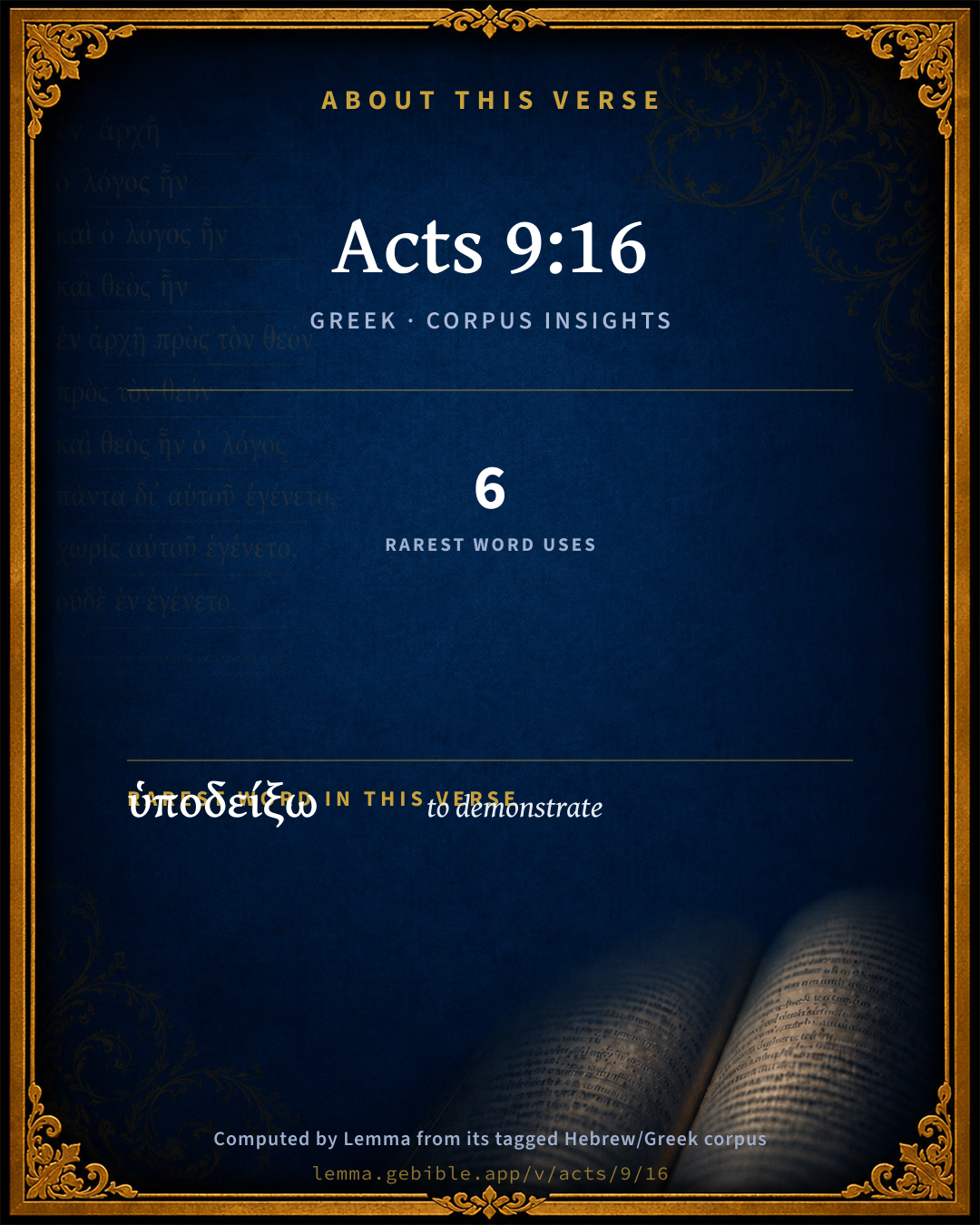
Acts 9:16

Greek (Tischendorf 8th ed.) Acts 9:16 appears in the Greek New Testament. The text above is from the Tischendorf 8th edition. Each word links to its Strong’s number and a concise gloss. Click any word for its full Thayer’s Greek Lexicon entry.

Download image
Cite this verse

Acts 9:16 (World English Bible). Public Domain. Lemma interlinear Bible study tool, https://lemma.gebible.app/v/acts/9/16.

Show BibTeX & RIS
BibTeX
RIS
English Translation
For I will show him how many things he must suffer for my name's sake."
World English Bible · Public Domain
Download a study sheet

One document with this verse’s original text, its word-by-word gloss line, the meaning frame, cross-references with their text, attributed commentary, and full source and license credits — printable, and it pastes into notes with its structure intact.

This verse Autodidact and up

Study sheet (.html) Plain text (.txt)

A passage Seminary Student

Up to 50 verses in one chapter. A passage sheet keeps up to 6 commentary sources and 12 cross-references per verse, in the order this page ranks them, and says so on the sheet whenever that leaves anything out. Ask for a single verse and you get the Autodidact verse sheet above.

Everything on this page stays free to read, with no account — the sheet is a download of what is already on screen, not access to it.

Want to remove ads? Support Godless Engineer
Compare translations 3

The same verse in 3 English versions, stacked beneath the original-language interlinear above. Click any original word for its lexicon entry.

Each is an independent rendering of the whole verse — the interlinear is not word-aligned to these translations.

Highlighted words mark where these versions differ — a whole-verse word diff, not a word-by-word alignment.

  • World English Bible Public Domain
    For I will show him how many things he must suffer for my name's sake."
  • King James Version Public Domain
    For I will shew him how great things he must suffer for my name's sake.
  • unfoldingWord Literal Text CC BY-SA 4.0
    for I will show him how much it is necessary for him to suffer for my name.”

unfoldingWord Literal Text — © unfoldingWord, licensed CC BY-SA 4.0. Word-aligned USFM3 via Door43 (git.door43.org/unfoldingWord/en_ult).

Versions to compare (up to 4)

3 of 4 selected

Show all 19 translations

Every available English version of this verse, each an independent rendering of the whole verse.

  • World English Bible Public Domain
    For I will show him how many things he must suffer for my name's sake."
  • Berean Standard Bible Public Domain
    I will show him how much he must suffer for My name.”
  • Majority Standard Bible Public Domain
    I will show him how much he must suffer for My name.”
  • King James Version Public Domain
    For I will shew him how great things he must suffer for my name's sake.
  • American Standard Version (1901) Public Domain
    for I will show him how many things he must suffer for my name's sake.
  • Revised Version (1885) Public Domain
    for I will shew him how many things he must suffer for my name’s sake.
  • Geneva Bible (1599) Public Domain
    For I will shewe him, howe many things he must suffer for my Names sake.
  • Douay-Rheims (1899) Public Domain
    For I will shew him how great things he must suffer for my name's sake.
  • Young's Literal Translation Public Domain
    for I will shew him how many things it behoveth him for My name to suffer.'
  • Literal Standard Version CC BY-SA 4.0
    for I will show him how many things he must suffer for My Name.”
  • Unlocked Literal Bible CC BY-SA 4.0
    for I will show him how much he must suffer for the cause of my name.”
  • unfoldingWord Literal Text CC BY-SA 4.0
    for I will show him how much it is necessary for him to suffer for my name.”
  • Darby Bible Public Domain
    for *I* will shew to him how much he must suffer for my name.
  • World Messianic Bible Public Domain
    For I will show him how many things he must suffer for my name’s sake.”
  • Webster's Bible Public Domain
    For I will show him how great things he must suffer for my name's sake.
  • Free Bible Version CC BY-SA 4.0
    I will show him what he'll have to suffer for my name's sake.”
  • Bible in Basic English Public Domain
    For I will make clear to him what troubles he will have to undergo for me.
  • Text-Critical English NT CC BY 4.0
    I will show him how much he must suffer for my name's sake.”
  • Tyndale New Testament (1534) Public Domain
    For I will shewe him how great thinges he must suffre for my names sake.

Literal Standard Version (2020), Covenant Press — licensed CC BY-SA 4.0. Text via the HelloAO Bible API (eBible.org). Unlocked Literal Bible (unfoldingWord) — licensed CC BY-SA 4.0. Text via the HelloAO Bible API (eBible.org). unfoldingWord Literal Text — © unfoldingWord, licensed CC BY-SA 4.0. Word-aligned USFM3 via Door43 (git.door43.org/unfoldingWord/en_ult). Free Bible Version, Dr. Jonathan Gallagher — licensed CC BY-SA 4.0. Text via the HelloAO Bible API (eBible.org).

Word by word

More ways to search: Search by grammar → Find every occurrence → Compare this word →

Practice this passage: Drill this verse → Learn its vocabulary →

ὑποδείξω
hypodeíknymi
G5263
“to demonstrate”
Verb, Future, Active, Indicative, 1st person, Singular
Part of Speech
Verb
Tense
Future
Voice
Active
Mood
Indicative
Person
1st person
Number
Singular
Full Thayer's Definition

Origin: from G5259 and G1166

TDNT: None

1. to show by placing under (i.e. before) the eyes 2. to show by words and arguments, i.e. to teach 3. to show by make known future things
  1. ἐγὼ egṓ G1473 “I” Personal pronoun, 1st person, Nominative, Singular
  2. γὰρ gár G1063 “for” Conjunction
  3. αὐτῷ autós G846 “he” Personal pronoun, Dative, Singular, Masculine
  4. ὅσα hósos G3745 “how much” Correlative pronoun, Accusative, Plural, Neuter
  5. δεῖ deî G1163 “it is necessary” Verb, Present, Active, Indicative, 3rd person, Singular
  6. αὐτὸν autós G846 “he” Personal pronoun, Accusative, Singular, Masculine
  7. ὑπὲρ hypér G5228 “over” Preposition
  8. τοῦ ho G3588 “the” Article, Genitive, Singular, Neuter
  9. ὀνόματός ónoma G3686 “name” Noun, Genitive, Singular, Neuter
  10. μου egṓ G1473 “I” Personal pronoun, 1st person, Genitive, Singular
  11. παθεῖν páschō G3958 “to feel” Verb, Aorist, Active, Infinitive

About this verse

These counts appear in no published source. They are computed here, from the morphology-tagged text and Lemma’s own curated glosses. What Lemma adds →

12
words
10
distinct lemmas
Acts
section

Notable vocabulary

The rarest word here is ὑποδείξω to demonstrate G5263 — appearing just 6 times in the whole Greek New Testament.

Shared distinctive vocabulary

ὑποδείξω to demonstrate G5263 occurs in 6 verses of the Greek New Testament. Also found in:

Repetition

Words recur within this verse:

  • ἐγὼ I G1473 ×2
  • αὐτῷ he G846 ×2

Cross-references

19

Topical passages linked to Acts 9:16 in the Treasury of Scripture Knowledge — connected by theme and wording, ordered by reader-vote popularity; previews shown in the World English Bible.

  • 1 Thessalonians 3:3 that no one be moved by these afflictions. For you know that we are appointed to this task.
  • Acts 21:11 Coming to us, and taking Paul's belt, he bound his own feet and hands, and said, "Thus says the Holy Spirit: 'So will the Jews at Jerusalem bind the man who owns this belt, and will deliver him into the hands of the Gentiles.'"
  • 2 Corinthians 6:4 but in everything commending ourselves, as servants of God, in great endurance, in afflictions, in hardships, in distresses,
  • John 15:20 Remember the word that I said to you: 'A servant is not greater than his lord.' If they persecuted me, they will also persecute you. If they kept my word, they will keep yours also.
  • 2 Timothy 1:12 For this cause I suffer also these things. Yet I am not ashamed, for I know him whom I have believed, and I am persuaded that he is able to guard that which I have committed to him against that day.
  • 2 Corinthians 11:23–27 Are they servants of Christ? (I speak as one beside himself) I am more so; in labors more abundantly, in prisons more abundantly, in stripes above measure, in deaths often.
  • 1 Peter 4:14 If you are insulted for the name of Christ, blessed are you; because the Spirit of glory and of God rests on you. On their part he is blasphemed, but on your part he is glorified.
  • Matthew 5:11 "Blessed are you when people reproach you, persecute you, and say all kinds of evil against you falsely, for my sake.
  • 1 Corinthians 4:9–13 For, I think that God has displayed us, the apostles, last of all, like men sentenced to death. For we are made a spectacle to the world, both to angels and men.
  • 2 Timothy 2:9–10 in which I suffer hardship to the point of chains as a criminal. But God's word isn't chained.
  • Matthew 24:9 Then they will deliver you up to oppression, and will kill you. You will be hated by all of the nations for my name's sake.
  • John 16:1–4 "These things have I spoken to you, so that you wouldn't be caused to stumble.
  • 2 Timothy 3:11 persecutions, and sufferings: those things that happened to me at Antioch, Iconium, and Lystra. I endured those persecutions. Out of them all the Lord delivered me.
  • Acts 20:22–23 Now, behold, I go bound by the Spirit to Jerusalem, not knowing what will happen to me there;
  • Matthew 10:21–25 "Brother will deliver up brother to death, and the father his child. Children will rise up against parents, and cause them to be put to death.
  • Acts 21:4 Having found disciples, we stayed there seven days. These said to Paul through the Spirit, that he should not go up to Jerusalem.
  • Isaiah 33:1 Woe to you who destroy, and you weren't destroyed; and deal treacherously, and they didn't deal treacherously with you! When you have ceased to destroy, you shall be destroyed; and when you have made an end of dealing treacherously, they shall deal treacherously with you.
  • Acts 9:14 Here he has authority from the chief priests to bind all who call on your name."
  • Revelation 1:9 I John, your brother and partner with you in oppression, Kingdom, and perseverance in Christ Jesus, was on the isle that is called Patmos because of God's Word and the testimony of Jesus Christ.

Cross-references courtesy of OpenBible.info (CC BY 4.0).

Commentary

Notes on Acts 9:16 from classic Christian and Jewish commentators (each source and its license shown beneath its notes). The classic Christian expositions comment on the surrounding passage and are grouped to its opening verse, so a note may address several verses; the Jewish commentaries on the Tanakh (Rashi and others) are per-verse, so they appear only where the commentator wrote on this verse.

Lemma curates 59 commentaries, every one of them public domain or Creative Commons licensed, each selected and text-cleaned for this edition rather than reprinted as found. About our sources →

The Biblical Illustrator

Joseph S. Exell

Act_9:16

For I will show him how great things he must suffer for My names sake.

The service of suffering

I. Suffering is one of the ways in which we may serve God.

1. The remarkable feature here is, that though it is a part of St. Pauls call to his mission, God does not say, I will show him how great things he must do, but how great things he must suffer. The service of work is subordinated to the service of suffering. And whenever St. Paul makes a retrospect of his own life he always takes the same view. As, for instance, in that catalogue in 2Co_11:1-33, the hardships and sorrows far outstripped the actions--the active being literally only two--journeyings often, the care of all the churches,--the passive at least twenty-seven.

2. And no wonder that St. Paul accounted more of the service of suffering than of the service of work. Was not it so with his Master and ours? What makes the Saviour what He is to us, is not what He wrought, but what He encountered; not what He did for the Father, but what the Father did to Him.

3. And in a world like this it must be so always. Every man being witness, it is a harder thing to suffer than to work. Much greater is the number of them that work well, than of them that suffer well. In the fruits of the Spirit the passive grow the highest. For four thousand years, the service of God was the service of sacrifice; and the service of sacrifice was essentially the service of suffering. And living, as we do, in a dispensation in which still the whole creation groaneth and travaileth in pain together until now, etc., it would be sad indeed if we could not believe that there is a way in which every suffering thing does service to God.

4. Or take the same thought a step higher. What makes any word, or any work, or any thought which man ever offers to God, service? Is not it the Cross of Christ, the gathering point where the suffering of the whole universe meets? Is not, then, all service ultimately the service of suffering? The worship of a world of sin must be, to a very great extent, the service of pain. And we cannot thank God too much that the service of suffering which sin has made may, through Christ, go up the best of all service to Almighty God.

5. But if any man be tempted for a moment to think that his sufferings can add ought to the efficacy of the death of Christ, or that anything he can ever bear will give the slightest degree of merit to the kingdom of heaven, let that man carefully study that account of the saints in Rev_7:1-17.

II. How may we, by Gods grace, make suffering service? Have faith that your suffering, in some way, known or unknown, is service, and by that faith it is. And indeed, if you accept your suffering from Christ, and bear it in and consecrate it to Christ, it will have such a savour of Christ in it, that it cannot help to go up and to be service in heaven. The service of suffering may be divided thus--

1. The direct service of suffering to God is to accept it from a Fathers hand. Ask no questions, but look up trustingly. Say if it be but Amen, and as soon as you can, Hallelujah. Think, This suffering of mine is Christ suffering in me. It makes me more one than I ever was before with Jesus Christ.

2. The service of suffering in sanctification. Whenever you pass into it, let your first prayer be, Lord, for whatever end Thou hast sent this trial, let that end be fulfilled to me, in me, by me, to Thy glory. The purposes of suffering for sanctification are--

(1) Humiliation. To that end you must connect your sorrow with what? Sin? Not most. With the pardon of sin, with the love of God.

(2) Purity. Sorrow, passing through the heart, acts like a moral chemistry--the sin precipitates to the bottom; and so it leaves the water of the cup of life pure. Or rather, it is fire, to destroy the nature and self which, thank God, are consumable; and to leave the gold of grace, which, thank God, is not consumable. The best service which ever goes up to God is His own image. And Gods image is purity.

(3) Consecration. The Christian, passing through suffering, is a servant gone into his Masters presence to receive orders.

3. The service of suffering to man, or more strictly, to God through man.

(1) Intercession. You are sent up to your room, to a lonely place on the mount, to pray for others who fight in the plain. Therefore you cannot work that you may pray.

(2) Testimony. Bear your witness--by silence, by looks, by speech, by a sweeter smile than when all was bright, by a kinder accent to the faithfulness of God, and the sufficiency of His grace. David was very great in the service of testimony. It is good for me that I have been in trouble, In the multitude of the sorrows which I have in my heart, Thy comforts have refreshed my soul.

(3) Sympathy. We never truly sympathise with what we have not felt. Therefore Christ sympathises with all, because He felt all. (J. Vaughan, M. A.)

Suffering for Christs names sake

When Dr. Mason, a missionary in India, asked his converted boatman whether he was willing to go to the Bghais, a neighbouring tribe, to tell them of a Saviours love, he reminded him that, instead of twelve rupees a month, he would receive but four rupees. Can you go to the Bghais for four rupees? asked the missionary. The heathen convert went by himself and thought and prayed, and came hack to Dr. Mason. Well, Chapon, what is your decision? My father, I cannot go to the Bghais for four rupees a month, but I can go for Jesus. And for Jesus he went.

The Biblical Illustrator, edited by Joseph S. Exell (c. 1880s–1900s) — public domain. Text from a community e-Sword module.

Tyndale Open Study Notes

Tyndale Open Resources

9:16 As Jesus predicted, Paul suffered greatly for his faith (see 2 Cor 11:23-27; see Acts 13:45; 14:19; 16:22-27; 21:30-31; 26:21; 2 Tim 1:11-12).

Tyndale Open Study Notes — © Tyndale Open Resources, licensed CC BY-SA 4.0. Text via the HelloAO Bible API.

Bengel's Gnomon

Johann Albrecht Bengel

Act 9:16. Ἐγὼ γὰρ, for I) i.e. do thou diligently, Ananias, what thou art commanded: for I will take care of the rest, that Saul may be Mine, and may remain so.—ὑποδείξω, I will show) by the actual fact, throughout his whole course. This is predicted to Ananias, not to Saul himself: it was Saul’s part to obey.—παθεῖν, to suffer) So far is he from being about to assail others hereafter. See the beginning of his suffering, Act 9:23; Act 9:29.

Bengel's Gnomon of the New Testament — English translation (T&T Clark, Edinburgh, 1860) — public domain. Text from a community e-Sword module.

Expositor's Greek Testament

ed. W. Robertson Nicoll

Act 9:16 . ἐγὼ γὰρ : he is a chosen vessel unto me, and therefore ὑποδ . Wendt disagrees with Meyer, who finds the showing in the experiences of the sufferings (so Hackett and Felten), and refers the word with De Wette, Over-beck, to a revelation or to some directing counsel of Christ, cf. Act 13:2 , Act 16:6 ; Act 16:9 , Act 20:20 , so too Blass cf. 2Co 11:25-28 . Either interpretation seems better than that of Weiss, who refers the γάρ back to πορεύου , as if Christ were assuring Ananias that Saul would not inflict suffering upon others, but I will show him how much he ( αὐτόν , with emphasis) must suffer, etc., cf. also Bengel’s comment.

The Expositor's Greek Testament, edited by W. Robertson Nicoll (1897–1910) — public domain. Text from a community e-Sword module.

Geneva Bible (1599)

Geneva Bible translators

I will show him plainly.

Geneva Bible (1599) marginal notes — public domain. Text via Bolls.life.

Jamieson, Fausset & Brown

Robert Jamieson, A. R. Fausset & David Brown

I will show him--(See Act 20:23-24; Act 21:11).

how great things he must suffer for my name--that is, Much he has done against that Name; but now, when I show him what great things he must suffer for that Name, he shall count it his honor and privilege.

Jamieson, Fausset & Brown — Commentary Critical and Explanatory on the Whole Bible (1871) — public domain (CC PDM 1.0). Text via the HelloAO Bible API.

Adam Clarke's Commentary

Verse 16. How great things he must suffer] Instead of proceeding as a persecutor, and inflicting sufferings on others, I will show him how many things he himself must suffer for preaching that very doctrine which he has been hitherto employed in persecuting. Strange change indeed! And with great show of reason, as with incontrovertible strength of argument, has a noble writer, Lord Lyttleton, adduced the conversion of Saul of Tarsus, and his subsequent conduct, as an irrefragable proof of the truth of Christianity.

Some think that the words, I will show him, c., refer to a visionary representation, which Christ was immediately to give Saul, of the trials and difficulties which he should have to encounter as also of that death by which he should seal his testimony to the truth. If so, what a most thorough conviction must Saul have had of the truth of Christianity, cheerfully and deliberately to give up all worldly honours and profits, and go forward in a work which he knew a violent death was to terminate!

Adam Clarke's Commentary on the Bible (1810–1826) — public domain. Text from a community e-Sword/MySword module.

John Calvin's Commentaries

16. And because. Paul could not do this, and have Satan quiet, and the world to yield to him willingly; therefore Luke addeth, that he shall be also taught to bear the cross. For the meaning of the words is, I will accustom him to suffer troubles: to endure reproaches, and to abide all manner [of] conflicts, that nothing may terrify him, and keep him back from doing his duty. And when Christ maketh himself Paul’s teacher in this matter, he teacheth that the more every man hath profited in his school, the more able is he to bear the cross. For we strive against it, and refuse it as a thing most contrary, until he make our minds more gentle. Also this place teacheth, that no man is fit to preach the gospel, seeing the world is set against it, save only he which is armed to suffer. Therefore if we will show ourselves faithful ministers of Christ, we must not only crave at his hands the spirit of knowledge and wisdom, but also of constancy and strength, that we may never be discouraged by laboring and toiling; which is the estate of the godly.

John Calvin's Commentaries (1540-1563) — public domain. Text from the Calvin Translation Society English edition (1840s-50s) via the Christian Classics Ethereal Library (ccel.org). Calvin's coverage is partial (roughly two-thirds of the Bible); uncommented books and verses are honest gaps, never fabricated. The 19th-century editor's footnotes and remarks are omitted so the notes are faithfully Calvin's own voice.

Ellicott's Commentary for English Readers

(16) For I will shew him how great things he must suffer . . .—The words are spoken as by One who knows “what is in man” (Joh_2:25), their secret motives, and springs of action. With characters of a lower type, the prospect of what they will have to suffer in any enterprise tends to deter them from embarking on it. With such a one as Saul of Tarsus, now repenting of the sufferings he had inflicted on others, that prospect would be welcome as enabling him, so far as that was possible, if not to atone for the past, at least to manifest fruits worthy of his repentance.

A Bible Commentary for English Readers, edited by Charles John Ellicott (1878–1897) — public domain. Text from a community e-Sword module.

The Cambridge Bible for Schools and Colleges

gen. ed. J. J. S. Perowne

16. for I will shew him how great [many] things he must suffer] Cp. Paul’s own words (Act_20:23), “The Holy Ghost witnesseth in every city, saying that bonds and afflictions abide me.” The truth of this is borne out by that long list of the Apostle’s sufferings which he enumerates in his letter to the Corinthians (2Co_11:23-28) and the less detailed list in the same Epistle (Act_6:4-5).

The Cambridge Bible for Schools and Colleges (gen. ed. J. J. S. Perowne; Cambridge University Press, 1878–1918) — public domain. Text from a community e-Sword module.

John Gill's Exposition

For I will show him,.... In vision, and by prophecy, either now, or hereafter; or by facts, as they come upon him:

how great things he must suffer for my name's sake; such as weariness, pain, and watchings, hunger, thirst, fastings, cold, and nakedness, perils on various accounts, and from different quarters, stripes, scourges, imprisonment, shipwreck, stoning, and death, of which he himself gives a detail, Co2 11:23 so that Ananias had no reason to be afraid to go to him, and converse with him, and do unto him as he was directed.

John Gill's Exposition of the Whole Bible (1746–1763) — public domain (CC PDM 1.0). Text via the HelloAO Bible API.

Trapp's Complete Commentary

John Trapp

16 For I will shew him how great things he must suffer for my name’s sake.

Ver. 16. How great things he must suffer] Opposition is (as Calvin wrote to the French king) Evangelii genius, the evil angel that dogs the gospel. And praedicare, said Luther, nihil aliud est quam derivare in se furorem totius mundi: To preach, is to get the evil will of the world.

John Trapp, A Commentary or Exposition upon All the Books of the Old and New Testament (1647–1656) — public domain. Text from a community e-Sword module.

Albert Barnes' Notes on the Bible

For I will show him ... - This seems to be added to encourage Ananias. He had feared Saul. The Lord now informs him that Saul, hitherto his enemy, would ever after be his friend. He would not merely profess repentance, but would manifest the sincerity of it by encountering trials and reproaches for his sake. The prediction here was fully accomplished, Act 20:23; 2Co 11:23-27; 2Ti 1:11-12.

Albert Barnes' Notes on the Bible (1834–1885) — public domain. Text from a community e-Sword/MySword module.

Matthew Poole's English Annotations

He shall suffer as great things as he ever did cause or inflict; the hatred of his own countrymen the Jews, and the fury of the Gentiles: see the catalogue of them, 2Co 11:23-27. And were there ever so many sufferings heaped upon one man? And yet, though all these were foretold unto him, and certainly foreknown by him, he would preach the gospel for all that: much was forgiven him, and he loved much.

Matthew Poole's English Annotations on the Holy Bible (1683–1685) — public domain. Text from a community e-Sword/MySword module.

Whedon's Commentary on the Bible

Daniel D. Whedon

16. I will show him—By the revelations of future experience.

Suffer—As he has inflicted hitherto, rather than suffered.

Daniel D. Whedon (gen. ed.), Commentary on the Old and New Testaments (1874–1909) — public domain. Text from a community e-Sword module.

The Pulpit Commentary

Many for great, A.V. St. Paul"s whole life was the fulfillment of this word of Christ. (see 2Co_11:23-27 2Co_6:4-10)

Jesus" far-seeing compassion appearing in an unexpected way.

That Saul, when now called Paul, did indeed suffer many and great things for Jesus" "Name"s sake," is most true. He knew it when he suffered them; he knew it also by anticipation (Act_20:23 Act_11:11) a kind of knowledge that to many would be of the most harassing and distressing consequence; and he knew it as he looked back, (2Co_11:23-31 2Co_12:10) not indeed to murmur, nor to repent of having exposed himself to it, but, while glorying in the suffering, to testify how real it was. That, therefore, of which Jesus tells Ananias that he will forewarn Saul, did by all the witness of history come to pass. But it is another question why he is forewarned of it, and why Jesus assures Ananias that he shall be so forewarned. Nor can it escape our notice that much significance is intended to lie in the statement as here introduced. Let us consider this announcement of Jesus

I IN ITS APPLICATION TO ANANIAS. It is intended to remove the objection of Ananias, by suggesting to him:

1. That Christ did not overlook, had not overlooked, the specialty of the case.

2. That Christ would be himself answerable for the education of Saul for his work, failing the antecedents that Ananias supposed would have been of more auspicious promise.

3. That that education would not fail to be what, in its character and the severity of its discipline, would both

(1) attest the reality of the change passed upon Saul and

(2) confirm and deepen that change.

4. Possibly Christ may, in the mode of his reply, desire also very condescendingly to still any smallest germ of

(1) personal envy or

(2) forwardness to suspicion lurking in. the character of Ananias. It is very certain that the mischief of these two very things, unacknowledged and covered over with finer words, has amounted to a total result of very great disaster during the career of the Church, ever since the personal intervention of Jesus has been absent. How often did Jesus in the days of his flesh stand by the sorry sinner round whom surged the murmur of the envious multitude! But the half-stifled and cautious envy and suspicion of the wary individual has often proved itself a more cruel enemy to souls, and must be a more offensive obstacle, in the eyes of Jesus, to his work making way in some poor guilty but struggling soul. Certain it is that

our dear Lord in bliss reposed, High above mortal ken," his Church has, times without number, made to pass through severest quarantine heartbroken volunteers for his service. The effects have been all deteriorating and disastrous. They would have been ruinous save for the still steady, if invisible, rule and headship of Jesus Christ. The Church (whether only so named or so in deed and in truth), mistaking duty and right, has failed in such cases to note sufficiently the Divine treatment as here illustrated in the three days" blindness and fasting of Saul, succeeded by the confidence and trust of the great Master, given immediately in the kindliest and most unreserved manner.

II IN ITS APPLICATION TO SAUL HIMSELF. Jesus bids Ananias lose no time, but "go" at once to bear to Saul the message, so far as the way could be prepared for it by human lips; and herein suggests to us to notice certain relations of this language to Saul.

1. Christ, having chosen his servant, apprises him both faithfully and early of what awaits him. No false, nor tempting, nor too favorable gloss is put by him on his own "most worthy" service.

2. He apprises him also of what is expected of him. If Jesus show to any one, whether in the ways of apostolic time or in the ways of time present, "how great things he shall suffer for his Name"s sake," "how great things" life and circumstance and earthly lot are likely to make him "suffer," "how great things" his divinest directest call shall impose upon him to "suffer, it must be that he is addressing a call to him that shall invoke all his heroism. It is very much as though the condescending Jesus did here introduce the Christian hero into the possible ranks of his own blessed Church. All must come of him, all does surely come of him; but if it be possible, something shall be credited to the range of human virtue. Manifestly Saul was a good instance by which to set forth this. He had been conspicuous; he had been a hero of some sort; he had shown lavish energy, which shall no longer be sacrificed to lavish waste. Thus from the first Jesus gives a tone to certain of his servants those, to wit, who are of the sort to answer to it readily and really. Life and labor and the success of real usefulness do often largely own to original impulse and early impression. The high-pitched thought and purpose and feeling of youth and of first effort are rarely lost, when they are genuine to begin with. They tell and count and swell to the echo as year and period pass by. Nor can it be denied that many a true Christian life falls under the condemnation of being a feeble and an unfruitful life, because it was not at the first appealed to with power. It never got the idea of trenchancy. And indecision its watchword was snare and delusion to it.

3. He apprises him of what may be calculated upon, as acting like a certain and safe check to both pride or vanity and self-confidence. How many have fallen upon the very threshold of what would have been a great spiritual career through one or both of these things I And the pride ecclesiastical and the self-confidence that "lords it over the faith" of others are just two of the most pronounced pestilences of human nature. From the fright and the fire and the faintness of the "three days" which Saul had now known, it were well that he should not be brought out at once to the light and "the cheerful sun" and the splendid hopes and prospects of a great career. It is better that an annealing interval find place. It is safer that his thought and heart find tonic in a Savior"s call and in a Master"s demand that he familiarize himself with the outlook of suffering, and great suffering.

4. Though lastly, yet most of all, Jesus will connect everything in Saul"s thought now with himself. How great, how true, how kind was this philosophy! Saul has sinned no end against Christ, and he shall suffer no end for "his Name"s sake." What healing for Saul"s soul that foretelling announcement! Saul has persecuted fiercely those who were dear to Christ unspeakably, and he shall bear the brunt of fiercest persecution for the sake of Christ and in the service of his loved ones. It is the only compensation for his self-respect, it is some anodyne for his inward smart, and, though an undiscerning world would never have thought it, it is the supreme mark of Christ"s sweet forgivingness, of his delicate considerateness, of his tenderest sympathy. "I will show him how great things he must," etc. B.

The Pulpit Commentary (1880–1919), ed. H.D.M. Spence-Jones & Joseph S. Exell — public domain. Text from a community e-Sword module.

John Wesley's Explanatory Notes

For I - Do thou as thou art commanded. I will take care of the rest; will show him - In fact, through the whole course of his ministry. How great things he must suffer - So far will he be now from persecuting others.

John Wesley, Explanatory Notes Upon the Whole Bible (1754–1765) — public domain. Text via the GEBible commentary corpus.

McGarvey & Pendleton's Commentaries

J. W. McGarvey

See notes on verse 13

J. W. McGarvey (with Philip Y. Pendleton), Commentaries on the New Testament (The Fourfold Gospel, 1914; Acts; and the epistles) — public domain. Text from a community e-Sword/MySword module.

Cambridge Greek Testament for Schools and Colleges

16. ὑπὲρ τοῦ ὀνόματός μου παθεῖν, to suffer for My name. It was no light burden which the new convert was to bear. Cf. his own words (Act 20:23), ‘the Holy Ghost witnesseth in every city, saying that bonds and afflictions abide me.’ The truth of this is borne out by that long list of the Apostle’s sufferings which he enumerates in his letter to the Corinthians (2Co 11:23-28), and the less detailed list in the same Epistle (Act 6:4-5).

Cambridge Greek Testament for Schools and Colleges (Cambridge University Press, 1896; 21 vols, various authors incl. Carr, Maclear, Plummer, Farrar, Lumby, Moule, M. R. James, Simcox) — public domain. Text from a community e-Sword module.

Alford’s Greek Testament

Henry Alford

16. ὑποδείξω] The fulfilment of this is testified by Paul himself, ch. 20:23, 25: see also 21:11.

Henry Alford, The Greek Testament (1849–1861) — public domain. Text from a community e-Sword module.

Vincent's Word Studies in the New Testament

Marvin R. Vincent

How great things [οσα] . Rev., more correctly, how many.

Marvin R. Vincent, Word Studies in the New Testament (1887–1900) — public domain. Text from a community e-Sword/MySword module.

Lesson kit

Teaching starters — assembled from the data on this page, not authored interpretation. Every prompt links to the verse data it draws on. Edit before teaching.

Acts, in the Acts, opens this verse with 12 words (10 distinct Greek lemmas). Its most distinctive word is hypodeíknymi (“to demonstrate”). A historical commentator’s framing appears above. Read the whole chapter for the surrounding context.

Discussion questions

  1. What does “to demonstrate” (hypodeíknymi) contribute to the verse as a whole?
  2. How does Matthew 3:7, which shares the word «to demonstrate», read alongside this verse?
  3. What does the repetition of “I” (2× in this one verse) do in this verse?
  4. The translations on this page render this verse differently — a whole-verse word diff, not a word-by-word alignment. What might account for the different wordings?
  5. Compare how The Biblical Illustrator and Tyndale Open Study Notes read this verse. Where do they agree or differ?

Things to notice

Reading settings

Reading text

Shown beneath each verse's original-language words.

Old Testament
Old Testament edition

Read the OT as the Masoretic Hebrew (MT) or the Greek Septuagint (LXX).

English shown for the Greek Septuagint (in the Hebrew ↔ Greek comparison).

Comparing translations? Open the Compare panel on any verse page to stack up to four side by side.