Revelation 8:11

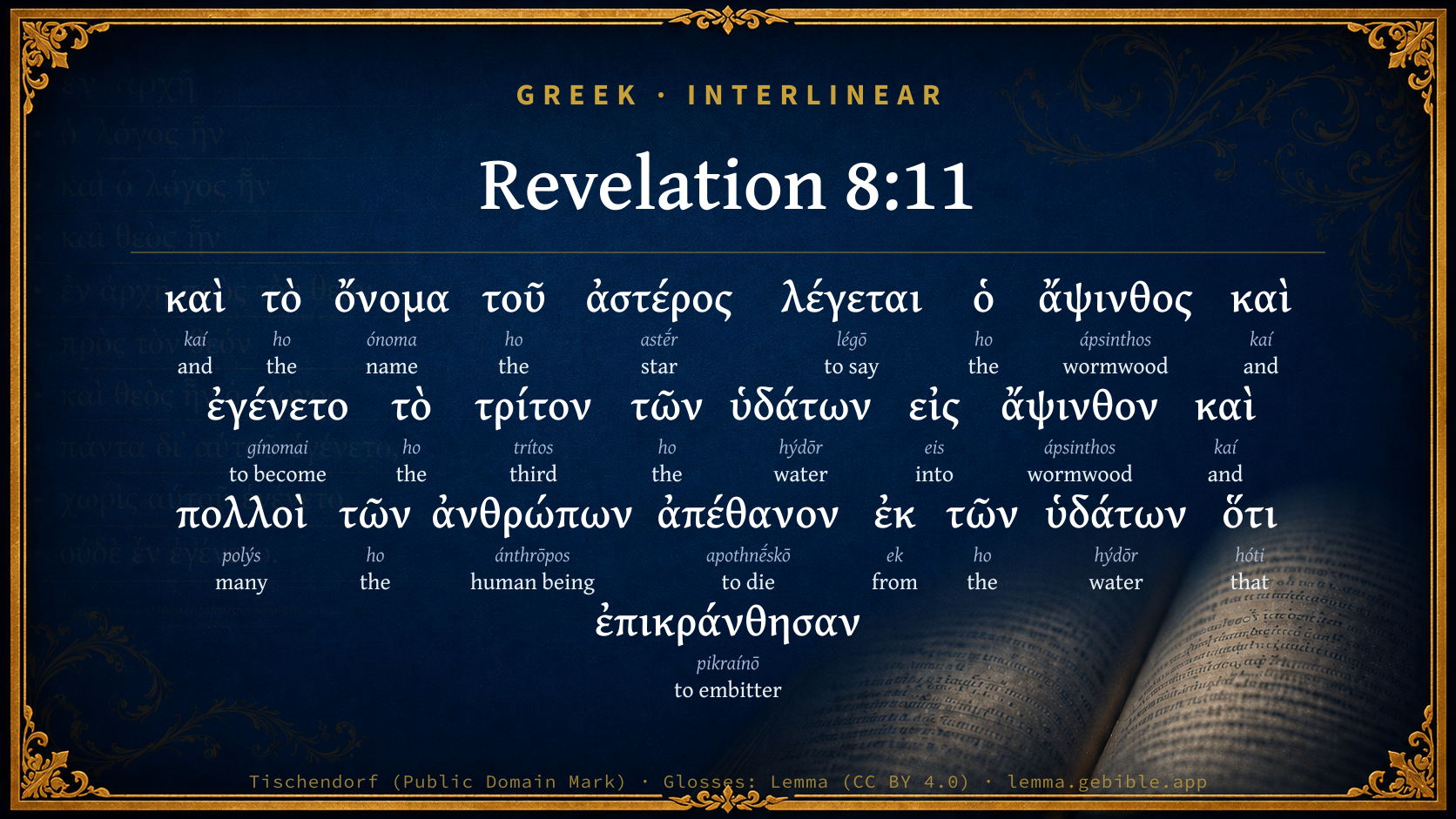
Greek (Tischendorf 8th ed.) Revelation 8:11 appears in the Greek New Testament. The text above is from the Tischendorf 8th edition. Each word links to its Strong’s number and a concise gloss. Click any word for its full Thayer’s Greek Lexicon entry.
Download image
Cite this verse

Revelation 8:11 (World English Bible). Public Domain. Lemma interlinear Bible study tool, https://lemma.gebible.app/v/revelation/8/11.

Show BibTeX & RIS
BibTeX
RIS
English Translation
The name of the star is called "Wormwood." One third of the waters became wormwood. Many people died from the waters, because they were made bitter.
World English Bible · Public Domain
Highlights
  • 1 first appearance in the Greek New Testament
Full analysis ↓
Download a study sheet

One document with this verse’s original text, its word-by-word gloss line, the meaning frame, cross-references with their text, attributed commentary, and full source and license credits — printable, and it pastes into notes with its structure intact.

This verse Autodidact and up

Study sheet (.html) Plain text (.txt)

A passage Seminary Student

Up to 50 verses in one chapter. A passage sheet keeps up to 6 commentary sources and 12 cross-references per verse, in the order this page ranks them, and says so on the sheet whenever that leaves anything out. Ask for a single verse and you get the Autodidact verse sheet above.

Everything on this page stays free to read, with no account — the sheet is a download of what is already on screen, not access to it.

Want to remove ads? Support Godless Engineer
Compare translations 3

The same verse in 3 English versions, stacked beneath the original-language interlinear above. Click any original word for its lexicon entry.

Each is an independent rendering of the whole verse — the interlinear is not word-aligned to these translations.

Highlighted words mark where these versions differ — a whole-verse word diff, not a word-by-word alignment.

  • World English Bible Public Domain
    The name of the star is called "Wormwood." One third of the waters became wormwood. Many people died from the waters, because they were made bitter.
  • King James Version Public Domain
    And the name of the star is called Wormwood: and the third part of the waters became wormwood; and many men died of the waters, because they were made bitter.
  • unfoldingWord Literal Text CC BY-SA 4.0
    And the name of the star is called Wormwood. And a third of the waters became wormwood, and many of the men died from the waters that had been made bitter.

unfoldingWord Literal Text — © unfoldingWord, licensed CC BY-SA 4.0. Word-aligned USFM3 via Door43 (git.door43.org/unfoldingWord/en_ult).

Versions to compare (up to 4)

3 of 4 selected

Show all 19 translations

Every available English version of this verse, each an independent rendering of the whole verse.

  • World English Bible Public Domain
    The name of the star is called "Wormwood." One third of the waters became wormwood. Many people died from the waters, because they were made bitter.
  • Berean Standard Bible Public Domain
    The name of the star is Wormwood. A third of the waters turned bitter like wormwood oil, and many people died from the bitter waters.
  • Majority Standard Bible Public Domain
    The name of the star is Wormwood. A third of the waters turned bitter like wormwood oil, and many people died from the bitter waters.
  • King James Version Public Domain
    And the name of the star is called Wormwood: and the third part of the waters became wormwood; and many men died of the waters, because they were made bitter.
  • American Standard Version (1901) Public Domain
    and the name of the star is called Wormwood: and the third part of the waters became wormwood; and many men died of the waters, because they were made bitter.
  • Revised Version (1885) Public Domain
    and the name of the star is called Wormwood: and the third part of the waters became wormwood; and many men died of the waters, because they were made bitter.
  • Geneva Bible (1599) Public Domain
    And the name of the starre is called wormewood: therefore the thirde part of the waters became wormewood, and many men died of the waters, because they were made bitter.
  • Douay-Rheims (1899) Public Domain
    And the name of the star is called Wormwood. And the third part of the waters became wormwood; and many men died of the waters, because they were made bitter.
  • Young's Literal Translation Public Domain
    and the name of the star is called Wormwood, and the third of the waters doth become wormwood, and many of the men did die of the waters, because they were made bitter.
  • Literal Standard Version CC BY-SA 4.0
    and the name of the star is called Wormwood, and the third of the waters become wormwood, and many of the men died [because] of the waters, because they were made bitter.
  • Unlocked Literal Bible CC BY-SA 4.0
    The name of the star is Wormwood. A third of the waters became wormwood, and many people died from the waters that became bitter.
  • unfoldingWord Literal Text CC BY-SA 4.0
    And the name of the star is called Wormwood. And a third of the waters became wormwood, and many of the men died from the waters that had been made bitter.
  • Darby Bible Public Domain
    And the name of the star is called Wormwood; and the third part of the waters became wormwood, and many of the men died of the waters because they were made bitter.
  • World Messianic Bible Public Domain
    The name of the star is “Wormwood.” One third of the waters became wormwood. Many people died from the waters, because they were made bitter.
  • Webster's Bible Public Domain
    And the name of the star is called Wormwood: and the third part of the waters became wormwood; and many men died by the waters, because they were made bitter.
  • Free Bible Version CC BY-SA 4.0
    The name of the star is Wormwood, and one third of the water turned bitter, and many people died from drinking the water because it had become poisonous.
  • Bible in Basic English Public Domain
    And the name of the star is Wormwood: and a third part of the waters became bitter; and a number of men came to their end because of the waters, for they were made bitter.
  • Text-Critical English NT CC BY 4.0
    The name of the star is Wormwood, and a third of the waters became bitter like wormwood, and many people died from the water, because it had been made bitter.
  • Tyndale New Testament (1534) Public Domain
    and the name of the starre is called wormwod. And the thyrde part was turned to wormwod. And many me dyed of the waters because they were made bytter.

Literal Standard Version (2020), Covenant Press — licensed CC BY-SA 4.0. Text via the HelloAO Bible API (eBible.org). Unlocked Literal Bible (unfoldingWord) — licensed CC BY-SA 4.0. Text via the HelloAO Bible API (eBible.org). unfoldingWord Literal Text — © unfoldingWord, licensed CC BY-SA 4.0. Word-aligned USFM3 via Door43 (git.door43.org/unfoldingWord/en_ult). Free Bible Version, Dr. Jonathan Gallagher — licensed CC BY-SA 4.0. Text via the HelloAO Bible API (eBible.org).

Word by word

More ways to search: Search by grammar → Find every occurrence → Compare this word →

Practice this passage: Drill this verse → Learn its vocabulary →

ἄψινθος
ápsinthos
G894
“wormwood”
Noun, Nominative, Singular, Masculine
Part of Speech
Noun
Case
Nominative
Number
Singular
Gender
Masculine
Full Thayer's Definition

Origin: of uncertain derivation

TDNT: None

1. wormwood 2. the name of a star which fell into the waters and made them bitter
  1. καὶ kaí G2532 “and” Conjunction
  2. τὸ ho G3588 “the” Article, Nominative, Singular, Neuter
  3. ὄνομα ónoma G3686 “name” Noun, Nominative, Singular, Neuter
  4. τοῦ ho G3588 “the” Article, Genitive, Singular, Masculine
  5. ἀστέρος astḗr G792 “star” Noun, Genitive, Singular, Masculine
  6. λέγεται légō G3004 “to say” Verb, Present, Passive, Indicative, 3rd person, Singular
  7. ὁ ho G3588 “the” Article, Nominative, Singular, Masculine
  8. καὶ kaí G2532 “and” Conjunction
  9. ἐγένετο gínomai G1096 “to become” Verb, Aorist, Middle deponent, Indicative, 3rd person, Singular
  10. τὸ ho G3588 “the” Article, Nominative, Singular, Neuter
  11. τρίτον trítos G5154 “third” Adjective, Nominative, Singular, Neuter
  12. τῶν ho G3588 “the” Article, Genitive, Plural, Neuter
  13. ὑδάτων hýdōr G5204 “water” Noun, Genitive, Plural, Neuter
  14. εἰς eis G1519 “into” Preposition
  15. ἄψινθον ápsinthos G894 “wormwood” Noun, Accusative, Singular, Feminine
  16. καὶ kaí G2532 “and” Conjunction
  17. πολλοὶ polýs G4183 “many” Adjective, Nominative, Plural, Masculine
  18. τῶν ho G3588 “the” Article, Genitive, Plural, Masculine
  19. ἀνθρώπων ánthrōpos G444 “human being” Noun, Genitive, Plural, Masculine
  20. ἀπέθανον apothnḗskō G599 “to die” Verb, Aorist, Active, Indicative, 3rd person, Plural
  21. ἐκ ek G1537 “from” Preposition
  22. τῶν ho G3588 “the” Article, Genitive, Plural, Neuter
  23. ὑδάτων hýdōr G5204 “water” Noun, Genitive, Plural, Neuter
  24. ὅτι hóti G3754 “that” Conjunction
  25. ἐπικράνθησαν pikraínō G4087 “to embitter” Verb, Aorist, Passive, Indicative, 3rd person, Plural

About this verse

These counts appear in no published source. They are computed here, from the morphology-tagged text and Lemma’s own curated glosses. What Lemma adds →

26
words
16
distinct lemmas
Revelation
section

Notable vocabulary

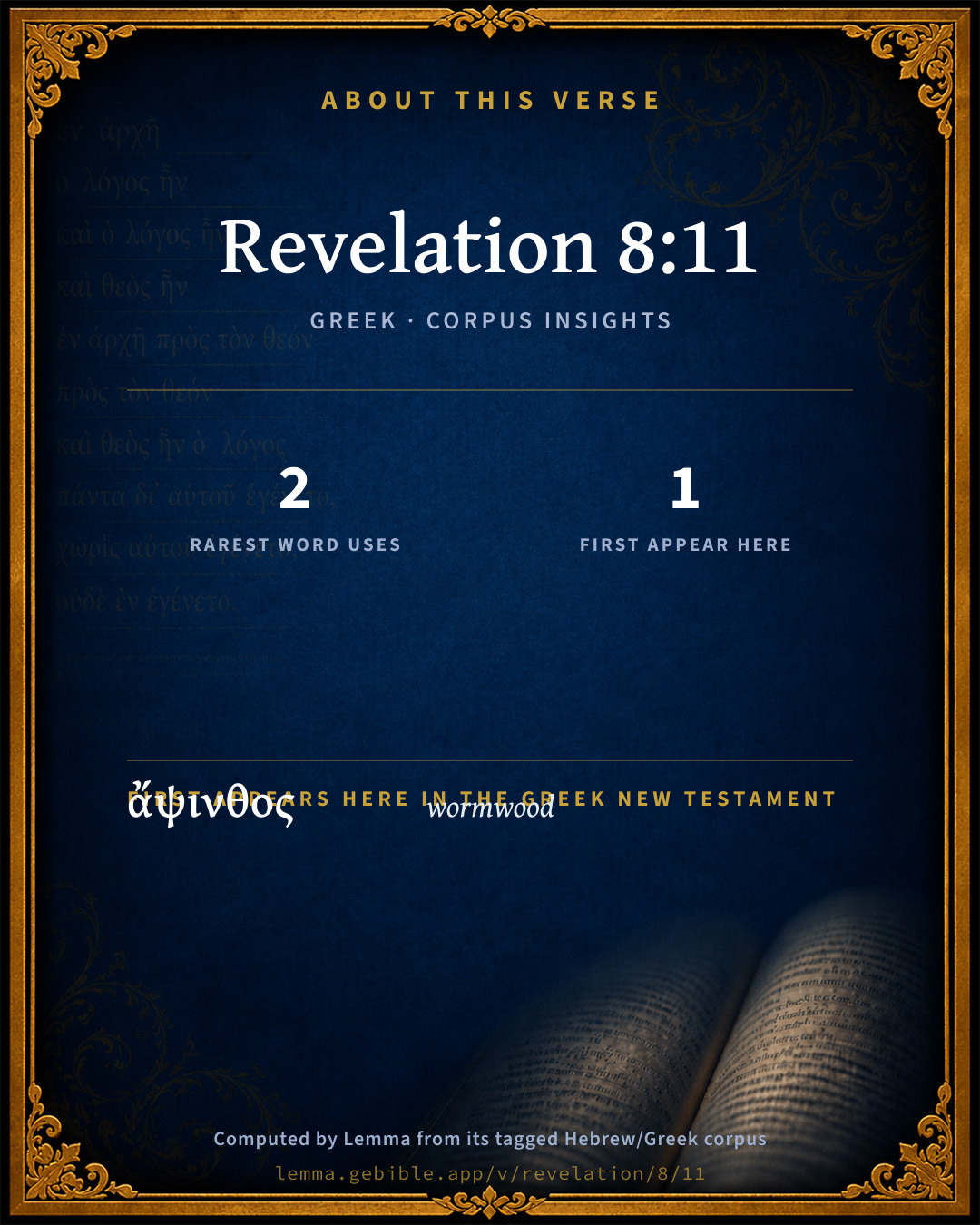
The rarest word here is ἄψινθος wormwood G894 — appearing just 2 times in the whole Greek New Testament.

First appearance in Scripture

This word makes its first canonical appearance in the Greek New Testament here:

  • ἄψινθος wormwood G894

Repetition

Words recur within this verse:

  • ἄψινθος wormwood G894 ×2
  • ὑδάτων water G5204 ×2
  • τὸ the G3588 ×7
  • καὶ and G2532 ×3

Cross-references

12

Topical passages linked to Revelation 8:11 in the Treasury of Scripture Knowledge — connected by theme and wording, ordered by reader-vote popularity; previews shown in the World English Bible.

  • Jeremiah 23:15 Therefore thus says Yahweh of Hosts concerning the prophets: Behold, I will feed them with wormwood, and make them drink the water of gall; for from the prophets of Jerusalem is ungodliness gone forth into all the land.
  • Jeremiah 9:15 therefore thus says Yahweh of Hosts, the God of Israel, Behold, I will feed them, even this people, with wormwood, and give them water of gall to drink.
  • Deuteronomy 29:18 lest there should be among you man, or woman, or family, or tribe, whose heart turns away this day from Yahweh our God, to go to serve the gods of those nations; lest there should be among you a root that bears gall and wormwood;
  • Proverbs 5:4 But in the end she is as bitter as wormwood, And as sharp as a two-edged sword.
  • Lamentations 3:19 Remember my affliction and my misery, the wormwood and the gall.
  • Amos 5:7 You who turn justice to wormwood, And cast down righteousness to the earth:
  • Amos 6:12 Do horses run on the rocky crags? Does one plow there with oxen? But you have turned justice into poison, And the fruit of righteousness into bitterness;
  • Exodus 15:23 When they came to Marah, they couldn't drink from the waters of Marah, for they were bitter. Therefore the name of it was called Marah.
  • Ruth 1:20 She said to them, "Don't call me Naomi, call me Mara; for the Almighty has dealt very bitterly with me.
  • Lamentations 3:5 He has built against me, and compassed me with gall and travail.
  • Hebrews 12:15 looking carefully lest there be any man who falls short of the grace of God; lest any root of bitterness springing up trouble you, and thereby the many be defiled;
  • Revelation 8:7 The first sounded, and there followed hail and fire, mixed with blood, and they were thrown to the earth. One third of the earth was burnt up, and one third of the trees were burnt up, and all green grass was burnt up.

Cross-references courtesy of OpenBible.info (CC BY 4.0).

Commentary

Notes on Revelation 8:11 from classic Christian and Jewish commentators (each source and its license shown beneath its notes). The classic Christian expositions comment on the surrounding passage and are grouped to its opening verse, so a note may address several verses; the Jewish commentaries on the Tanakh (Rashi and others) are per-verse, so they appear only where the commentator wrote on this verse.

Lemma curates 59 commentaries, every one of them public domain or Creative Commons licensed, each selected and text-cleaned for this edition rather than reprinted as found. About our sources →

Bengel's Gnomon

Johann Albrecht Bengel

Rev 8:11. Καὶ τὸ ὄνομα τοῦ ἀστέρος λέγεται ὁ ἄψινθος, and the name of the star is called Wormwood) Arianism, full of bitterness. Theodoret, book ii. H. E. c. 14, respecting the Arians who drove out the bishops under Georgius of Cappadocia, says, οὕτω ΠΙΚΡΩΣ ἤλασαν αὐτοὺς, κ.τ.λ., with such bitterness they drove them out, etc. Victor, book i., respecting the Vandal persecution, thus expresses pity for Augustine, in the siege of Hippo: The sweetness of delight is changed into the BITTERNESS OF WORMWOOD. Ἄψινθος is formed from α privative, and ψίνθος, which is τέρψις in Hesychius. And the Greek word, ἀψίνθιον, appears to have been changed into a word of three syllables from the Hebrew pronunciation אפסינתין or אפסינתא.

Bengel's Gnomon of the New Testament — English translation (T&T Clark, Edinburgh, 1860) — public domain. Text from a community e-Sword module.

Geneva Bible (1599)

Geneva Bible translators

This is spoken by Metaphor of the name of a most bitter herb, and commonly known, unless perhaps a man following those that note the derivation of words had rather expound it adjectively, for that which by reason or bitterness cannot be drunk, or which maketh the liquor into which is poured more bitter than that any man can drink the same.

Geneva Bible (1599) marginal notes — public domain. Text via Bolls.life.

Jamieson, Fausset & Brown

Robert Jamieson, A. R. Fausset & David Brown

The symbolizers interpret the star fallen from heaven as a chief minister (ARIUS, according to BULLINGER, BENGEL, and others; or some future false teacher, if, as is more likely, the event be still future) falling from his high place in the Church, and instead of shining with heavenly light as a star, becoming a torch lit with earthly fire and smouldering with smoke. And "wormwood," though medicinal in some cases, if used as ordinary water would not only be disagreeable to the taste, but also fatal to life: so "heretical wormwood changes the sweet Siloas of Scripture into deadly Marahs" [WORDSWORTH]. Contrast the converse change of bitter Marah water into sweet, Exo 15:23. ALFORD gives as an illustration in a physical point of view, the conversion of water into firewater or ardent spirits, which may yet go on to destroy even as many as a third of the ungodly in the latter days.

Jamieson, Fausset & Brown — Commentary Critical and Explanatory on the Whole Bible (1871) — public domain (CC PDM 1.0). Text via the HelloAO Bible API.

Adam Clarke's Commentary

Verse 11. The star is called Wormwood] So called from the bitter or distressing effects produced by its influence.

Adam Clarke's Commentary on the Bible (1810–1826) — public domain. Text from a community e-Sword/MySword module.

Ellicott's Commentary for English Readers

(11) And the name of the star . . .—Translate, And the name of the star is called Wormwood: and the third part of the waters became wormwood; and many of mankind died from the waters, because they were embittered. The bitter, nauseous plant known as wormwood (apsinthos) is used to represent troubles and calamities. In Jer_9:15 we have an example of this: “Behold, I will feed them, even this people, with wormwood, and give them water of gall to drink.” It is worth noticing that the Israelites are warned against idolatry as “a root that beareth gall and wormwood” (Deu_29:18); and we may recall the symbolical act of Moses, who ground the golden calf to powder, cast the powder in the brook, and made the children of Israel drink (Exo_32:20). Some have thought that this falling star signified some false teacher, whose evil influence poisoned the pure currents of the gospel, and perverted the minds of men of original genius, who are represented here as fountains. The passages cited above favour the thought, and it may be included in the general meaning of the vision; but the main point seems to be to give us hints of those stages which will mark the advance of Christianity. The fall of the great men, the rulers and leaders, will take place, and their fall will bring misery to mankind. Doubtless the appearance of false teachers in the Church is one of the evidences find an unavoidable accompaniment of a progressing faith (Mat_13:26). But all such false lights shall fall before Him who is the true Light and Morning Star, and who will heal all embittered waters of life. (Comp. Exo_15:23, and 2Ki_2:19.)

A Bible Commentary for English Readers, edited by Charles John Ellicott (1878–1897) — public domain. Text from a community e-Sword module.

The Cambridge Bible for Schools and Colleges

gen. ed. J. J. S. Perowne

11. became wormwood] We are perhaps to be reminded, as before, of the plagues in Egypt, so here of the mercy to Israel, Exo_15:25 : here, as those are intensified, so that is reversed.

many men died] Of course such water would be unwholesome for ordinary use, though wormwood is not exactly poisonous. But it may be a question whether St John means the name to indicate the herb now known as wormwood, or another more deadly one: poison seems to be meant in Deu_29:18; Jer_9:15; Jer_23:15. The root of the Hebrew word there rendered “wormwood” seems to mean “noxious.”

The Cambridge Bible for Schools and Colleges (gen. ed. J. J. S. Perowne; Cambridge University Press, 1878–1918) — public domain. Text from a community e-Sword module.

John Gill's Exposition

And the name of the star is called Wormwood,.... Because of the bitter afflictions, sorrows, and distresses which it was the instrument of; just as Naomi called herself Mara, because the Almighty had dealt bitterly with her, Rut 1:20;

and the third part of the waters became wormwood; that is, the inhabitants of the provinces and cities belonging to the Roman empire were afflicted with grievous and bitter afflictions and calamities; so great distresses are called wormwood, and waters of gall given to drink, Jer 9:15;

and many men died of the waters, because they were bitter; through the barbarities and cruelties of these savage people, who afflicted the empire: there seems to be an allusion to Exo 15:23.

John Gill's Exposition of the Whole Bible (1746–1763) — public domain (CC PDM 1.0). Text via the HelloAO Bible API.

Trapp's Complete Commentary

John Trapp

11 And the name of the star is called Wormwood: and the third part of the waters became wormwood; and many men died of the waters, because they were made bitter.

Ver. 11. Was called Wormwood] Because himself was in the gall of bitterness, and did embitter others. See Jer 23:15; Deu 29:18, with Junius’s note there.

John Trapp, A Commentary or Exposition upon All the Books of the Old and New Testament (1647–1656) — public domain. Text from a community e-Sword module.

Albert Barnes' Notes on the Bible

And the name of the star is called Wormwood - Is appropriately so called. The writer does not say that it would be actually so called, but that this name would be properly descriptive of its qualities. Such expressions are common in allegorical writings. The Greek word - ἄψινθος apsinthos - denotes “wormwood,” a well-known bitter herb. That word becomes the proper emblem of bitterness. Compare Jer 9:15; Jer 23:15; Lam 3:15, Lam 3:19.

And the third part of the waters became wormwood - Became bitter as wormwood. This is doubtless an emblem of the calamity which would occur if the waters should be thus made bitter. Of course they would become useless for the purposes to which they are mostly applied, and the destruction of life would be inevitable. To conceive of the extent of such a calamity we have only to imagine a large portion of the wells, and rivers, and fountains of a country made bitter as wormwood. Compare Exo 15:23-24.

And many men died of the waters, because they were made bitter - This effect would naturally follow if any considerable portion of the fountains and streams of a land were changed by an infusion of wormwood. It is not necessary to suppose that this is intended to be literally true; for as, by the use of a symbol, it is not to be supposed that literally a part of the waters would be turned into wormwood by the baleful influence of a falling meteor, so it is not necessary to suppose that there is intended to be represented a literal destruction of human life by the use of waters. Great destruction and devastation are undoubtedly intended to be denoted by this - destruction that would be well represented in a land by the natural effects if a considerable part of the waters were, by their bitterness, made unfit to drink.

In the interpretation and application, therefore, of this passage, we may adopt the following principles and rules:

It may be assumed, in this exposition, that the previous symbols, under the first and second trumpet-blasts, referred respectively to Alaric and his Goths, and to Genseric and his Vandals. That the next great and decisive event in the downfall of the empire is the one that is here referred to. That there would be some chieftain or warrior who might be compared with a blazing meteor; whose course would be singularly brilliant; who would appear suddenly like a blazing star, and then disappear like a star whose light was quenched in the waters. That the desolating course of that meteor would be mainly on those portions of the world that abounded with springs of water and running streams. That an effect would be produced as if those streams and fountains were made bitter; that is, that many persons would perish, and that wide desolations would be caused in the vicinity of those rivers and streams, as if a bitter and baleful star should fall into the waters, and death should spread over the lands adjacent to them, and watered by them.

Whether any events occurred of which this would be the proper emblem is now the question. Among expositors there has been a considerable degree of unanimity in supposing that Attila, the king of the Huns, is referred to; and if the preceding expositions are correct, there can be no doubt on the subject. After Alaric and Genseric, Attila occupies the next place as an important agent in the overthrow of the Roman empire, and the only question is, whether he would be properly symbolized by this baleful star. The following remarks may be made to show the propriety of the symbol:

(1) As already remarked, the place which he occupies in history, as immediately succeeding Alaric and Genseric in the downfall of the empire. This will appear in any chronological table, or in the table of contents of any of the histories of those times. A full detail of the career of Attila may be found in Gibbon, vol. ii. pp. 314-351. His career extended from 433 a.d. to 453 a.d. It is true that he was contemporary with Genseric, king of the Vandals, and that a portion of the operations of Genseric in Africa were subsequent to the death of Attila (455 a.d. to 467 a.d.); but it is also true that Genseric preceded Attila in the career of conquest, and was properly the first in order, being pressed forward in the Roman warfare by the Huns, 428 a.d. See Gibbon, ii. 306ff.

(2) In the manner of his appearance he strongly resembled a brilliant meteor flashing in the sky. He came from the east, gathering his Huns, and poured them down, as we shall see, with the rapidity of a flashing meteor, suddenly on the empire. He regarded himself also as devoted to Mars, the god of war, and was accustomed to array himself in a especially brilliant manner, so that his appearance, in the language of his flatterers, was such as to dazzle the eyes of beholders. One of his followers perceived that a heifer that was grazing had wounded her foot, and curiously followed the track of blood, until he found in the long grass the point of an ancient sword, which he dug out of the ground and presented to Attila. “That magnanimous, or rather that artful prince,” says Mr. Gibbon, “accepted with pious gratitude this celestial favor; and, as the rightful possessor of the sword of Mars, asserted his divine and indefeasible claim to the dominion of the earth. The favorite of Mars soon acquired a sacred character, which rendered his conquests more easy and more permanent; and the barbarian princes confessed, in the language of devotion or flattery, that they could not presume to gaze, with a steady eye, on the divine majesty of the king of the Huns,” ii. 317. How appropriate would it be to represent such a prince by the symbol of a bright and blazing star - or a meteor flashing through the sky!

(3) There may be propriety, as applicable to him, in the expression - “a great star from heaven failing upon the earth.” Attila was regarded as an instrument in the divine hand in inflicting punishment. The common appellation by which he has been known is “the scourge of God.” This title is supposed by the modern Hungarians to have been first given to Attila by a hermit of Gaul, but it was “inserted by Attila among the titles of his royal dignity” (Gibbon, ii. 321, foot-note). To no one could the title be more applicable than to him.

(4) His career as a conqueror, and the effect of his conquests on the downfall of the empire, were such as to be properly symbolized in this manner:

(a) The general effect of the invasion was worthy of an important place in describing the series of events which resulted in the overthrow of the empire. This is thus stated by Mr. Gibbon: “The western world was oppressed by the Goths and Vandals, who fled before the Huns; but the achievements of the Huns themselves were not adequate to their power and prosperity. Their victorious hordes had spread from the Volga to the Danube, but the public force was exhausted by the discord of independent chieftains; their valor was idly consumed in obscure and predatory excursions; and they often degraded their national dignity by condescending, for the hopes of spoil, to enlist under the banners of their fugitive enemies. In the reign of Attila the Huns again became the terror of the world; and I shall now describe the character and actions of that formidable barbarian who alternately invaded and insulted the East and the West, and urged the rapid downfall of the Roman empire, ‘vol. ii. pp. 314, 315.

(b) The parts of the earth affected by the invasion of the Huns were those which would be properly symbolized by the things specified at the blowing of this trumpet. It is said particularly that the effect would be on “the rivers,” and on “the fountains of waters.” If this has a literal application, or if, as was supposed in the case of the second trumpet, the language used was such as had reference to the portion of the empire that would be particularly affected by the hostile invasion, then we may suppose that this refers to those portions of the empire that abounded in rivers and streams, and more particularly those in which the rivers and streams had their origin - for the effect was permanently in the “fountains of waters.” As a matter of fact, the principal operations of Attila were in the regions of the Alps, and on the portions of the empire whence the rivers flow down into Italy. The invasion of Attila is described by Mr. Gibbon in this general language: “The whole breadth of Europe, as it extends above five hundred miles from the Euxine to the Adriatic, was at once invaded, and occupied, and desolated, by the myriads of barbarians whom Attila led into the field,” ii. 319, 320.

After describing the progress and the effects of this invasion (pp. 320-331) he proceeds more particularly to detail the events in the invasion of Gaul and Italy, pp. 331-347. After the terrible battle of Chalons, in which, according to one account, one hundred and sixty-two thousand, and, according to other accounts, three hundred thousand persons were slain, and in which Attila was defeated, he recovered his vigor, collected his forces, and made a descent on Italy. Under pretence of claiming Honoria, the daughter of the Empress of Rome, as his bride, “the indignant lover took the field, passed the Alps, invaded Italy, and besieged Aquileia with an innumerable host of barbarians.” After endeavoring in vain for three months to subdue the city, and when about to abandon the siege, Attila took advantage of the appearance of a stork as a favorable omen to arouse his men to a renewed effort, “a large breach was made in the part of the wall where the stork had taken her flight; the Huns mounted to the assault with irresistible fury; and the succeeding generation could scarcely discover the ruins of Aquileia. After this dreadful chastisement Attila pursued his march; and as he passed, the cities of Altinum, Concordia, and Padua were reduced into heaps of stones and ashes. The inland towns, Vicenza, Verona, and Bergamo, were exposed to the rapacious cruelty of the Huns; Milan and Pavia submitted without resistance to the loss of their wealth, and applauded the unusual clemency which preserved from the flames the public as well as the private buildings, and spared the lives of the captive multitude. The popular traditions of Comum, Turin, or Modena, may be justly suspected, yet they concur with more authentic evidence to prove that Attila spread his ravages over the rich plains of modern Lombardy, which are divided by the Po, and bounded by the Alps and the Apennines,” ii. pp. 343, 344. “It is a saying worthy of the ferocious pride of Attila, that the grass never grew on the spot where his horse had trod” (ibid. p. 345). Anyone has only to look on a map, and to trace the progress of those desolations and the chief seats of his military operations to see with what propriety this symbol would be employed. In these regions the great rivers that water Europe have their origin, and are swelled by numberless streams that flow down from the Alps; and about the fountains whence these streams flow were the principal military operations of the invader.

(c) With equal propriety is he represented in the symbol as affecting “a third” part of these rivers and fountains. At least a third part of the empire was invaded and desolated by him in his savage march, and the effects of his invasion were as disastrous on the empire as if a bitter star had fallen into a third part of those rivers and fountains, and had converted them into wormwood.

(d) There is one other point which shows the propriety of this symbol. It is, that the meteor, or star, seemed to be absorbed in the waters. It fell into the waters; embittered them; and was seen no more. Such would be the case with a meteor that should thus fall upon the earth - flashing along the sky, and then disappearing forever. Now, it was remarkable in regard to the Huns, that their power was concentrated under Attila; that he alone appeared as the leader of this formidable host; and that when he died all the concentrated power of the Huns was dissipated, or became absorbed and lost. “The revolution,” says Mr. Gibbon (ii. 348), “which subverted the empire of the Huns, established the fame of Attila, whose genius alone had sustained the huge and disjointed fabric. After his death the boldest chieftains aspired to the rank of kings; the most powerful kings refused to acknowledge a superior; and the numerous sons, whom so many various mothers bore to the deceased monarch, divided and disputed, like a private inheritance, the sovereign command of the nations of Germany and Scythia.” Soon, however, in the conflicts which succeeded, the empire passed away, and the empire of the Huns ceased. The people that composed it were absorbed in the surrounding nations, and Mr. Gibbon makes this remark, after giving a summary account of these conflicts, which continued but for a few years: “The Igours of the north, issuing from the cold Siberian regions, which produced the most valuable furs, spread themselves over the desert, as far as the Borysthenes and the Caspian gates, and finally extinguished the empire of the Huns.” These facts may, perhaps, show with what propriety Attila would be compared with a bright but beautiful meteor; and that, if the design was to symbolize him as acting an important part in the downfall of the Roman empire, there is a fitness in the symbol here employed.

Albert Barnes' Notes on the Bible (1834–1885) — public domain. Text from a community e-Sword/MySword module.

Matthew Poole's English Annotations

His doctrine was as bitter as wormwood; and he was the ruin of many souls. But if any do rather choose to understand it of a political star, Mr. Mede’s notion bids as fair for the sense as any, because the western empire determined in Augustulus, and he reigned but a very short time; and he was a prince of many sorrows and afflictions, and many perished with him in those sorrows and afflictions which he underwent. Whether we understand it of some eminent political magistrate, (such was Augustulus), or some eminent light in the church, (such was Pelagius), they both fell about this time, the one from his terrene dignity, the other spiritually from the honour he had in the church; and many fell with them, either in a civil or in a spiritual sense.

Matthew Poole's English Annotations on the Holy Bible (1683–1685) — public domain. Text from a community e-Sword/MySword module.

Whedon's Commentary on the Bible

Daniel D. Whedon

11. Name… wormwood—Wormwood, (often associated with gall,) seems to have been either the trouble produced by an apostate, or an emblematic penalty for apostasy. So, in Deu_29:18, the apostate from Jehovah is a “root that beareth gall and wormwood,” producing on Israel the guilt and punishment of apostasy. In Jer_23:15, God threatens against apostate prophets, “I will feed them with wormwood, and make them drink the water of gall.” And as Jeremiah, personating the apostasy and downfall of Israel, says, Lam_3:15, “He hath filled me with bitterness, he hath made me drunken with wormwood.” This explains that “root of bitterness,” of Heb_12:15, where the “root” is the apostate, and the “bitterness” the result of his apostasy. Says Wordsworth, “Wormwood is very bitter, and in certain cases produces convulsions, delirium, epilepsy, and death,” a fit emblem of the ruin of mind and body produced by the primal apostasy and by sin. The symbolism of our seer in this passage represents vividly how, by this means, those springs and streams which should, in the ideal, be the sources of delight, nourishment, health, and buoyant vitality, become a bitterness, a miasm, a death.

Daniel D. Whedon (gen. ed.), Commentary on the Old and New Testaments (1874–1909) — public domain. Text from a community e-Sword module.

The Pulpit Commentary

And the name of the star is called Wormwood. The plant known to us under the name of wormwood is doubtless identical with the Aqinyov of this passage. The present English word is a corruption of wermod (equivalent to ware-mood), which may be rendered "mind-preserver," a name given to the plant by the Saxons, on account of its fancied virtues; for it was believed to be a protection against madness. Such properties were formerly frequently ascribed to plants possessing bitter and nauseous tastes, such as that of the wormwood. Varieties of the plant are common in Palestine, and are widely distributed in the world. Among the ancients it was typical of bitter sorrow. Thus Lam_3:19, "Remembering my misery, the wormwood and the gall;" Jer_9:15, "I will feed them with wormwood." Here, therefore, the name indicates the effect of the star, viz. to cause intense trouble and sorrow. And the third part of the waters became wormwood; that is, became bitter as wormwood, that is, charged with sorrow and disaster. The general effect of the incident is described in the name given to the chief actor, as in the case of the fourth seal. (see Rev_6:8) And many men died of the waters, because they were made bitter; many of the men. Possibly (though not necessarily) of the men dwelling near the waters. For the first time mention is made of the death of men, though, doubtless, it is implied in the preceding judgments. We may notice the contrast in the miracles of Moses, who sweetened the waters of Marah, (Ex 15) and of Elisha. (2Ki_2:22)

The Pulpit Commentary (1880–1919), ed. H.D.M. Spence-Jones & Joseph S. Exell — public domain. Text from a community e-Sword module.

John Wesley's Explanatory Notes

And the name of the star is called Wormwood - The unparalleled bitterness both of Arius himself and of his followers show the exact propriety of his title. And the third part of the waters became wormwood - A very considerable part of Afric was infected with the same bitter doctrine and Spirit. And many men (though not a third part of them) died - By the cruelty of the Arians.

John Wesley, Explanatory Notes Upon the Whole Bible (1754–1765) — public domain. Text via the GEBible commentary corpus.

The People's New Testament

B. W. Johnson

11. And the name of the star is called Wormwood. That is, it is bitterness, because it shall fill the world with bitter sorrow. A star is a symbol of a great leader. Such a star as this, a blazing meteor, is a symbol of a leader who suddenly appears, rapidly does an awfully baleful work, and then disappears. In some way the rivers will be the scenes of his malign influence. They shall become bitterness and shall be scenes of death.

B. W. Johnson's The People's New Testament with Notes (1889–1891) — public domain. Electronic text from the Christian Classics Ethereal Library (CCEL) ThML edition.

Cambridge Greek Testament for Schools and Colleges

11. ἐγένετο … εἰς ἄψινθον. We are perhaps to be reminded, as before, of the plagues in Egypt, so here of the mercy to Israel, Exo 15:25: here, as those are intensified, so that is reversed.

πολλοὶ τῶν ἀνθρώπων ἀπέθανον. Of course such water would be unwholesome for ordinary use, though wormwood is not exactly poisonous. But it may be a question whether St John means the name to indicate the herb now known as wormwood, or another more deadly one: poison seems to be meant in Deu 29:18; Jer 9:15; Jer 23:15. The root of the Hebrew word there rendered “wormwood” seems to mean “noxious.”

Cambridge Greek Testament for Schools and Colleges (Cambridge University Press, 1896; 21 vols, various authors incl. Carr, Maclear, Plummer, Farrar, Lumby, Moule, M. R. James, Simcox) — public domain. Text from a community e-Sword module.

Vincent's Word Studies in the New Testament

Marvin R. Vincent

Wormwood [αψινθος] . Used metaphorically in the Old Testament of the idolatry of Israel (Deu 29:18); of calamity and sorrow (Jer 9:15; Jer 23:15; Lam 3:15, 19); of false judgment (Amo 5:7).

Marvin R. Vincent, Word Studies in the New Testament (1887–1900) — public domain. Text from a community e-Sword/MySword module.

Lesson kit

Teaching starters — assembled from the data on this page, not authored interpretation. Every prompt links to the verse data it draws on. Edit before teaching.

Revelation, in the Revelation, opens this verse with 26 words (16 distinct Greek lemmas). Its most distinctive word is ápsinthos (“wormwood”). A historical commentator’s framing appears above. Read the whole chapter for the surrounding context.

Discussion questions

  1. How does “wormwood” (ápsinthos) shape what this verse is saying?
  2. This is the first place “wormwood” appears in Scripture (first appears here). What does its debut here establish?
  3. How does Jeremiah 23:15, which shares this passage’s theme, read alongside this verse?
  4. What does the repetition of “wormwood” (2× in this one verse) do in this verse?
  5. These translations render this verse differently; the difference is in the English rendering, not the original. What questions does that raise?
  6. Compare how Bengel's Gnomon and Geneva Bible (1599) read this verse. Where do they agree or differ?

Things to notice

  • 1 word makes its first canonical appearance in Scripture here.
  • These translations choose different wording for 7 words in this verse.
  • “wormwood” occurs 2× in this single verse.
  • 16 distinct Greek lemmas span 26 words in this verse.

Reading settings

Reading text

Shown beneath each verse's original-language words.

Old Testament
Old Testament edition

Read the OT as the Masoretic Hebrew (MT) or the Greek Septuagint (LXX).

English shown for the Greek Septuagint (in the Hebrew ↔ Greek comparison).

Comparing translations? Open the Compare panel on any verse page to stack up to four side by side.