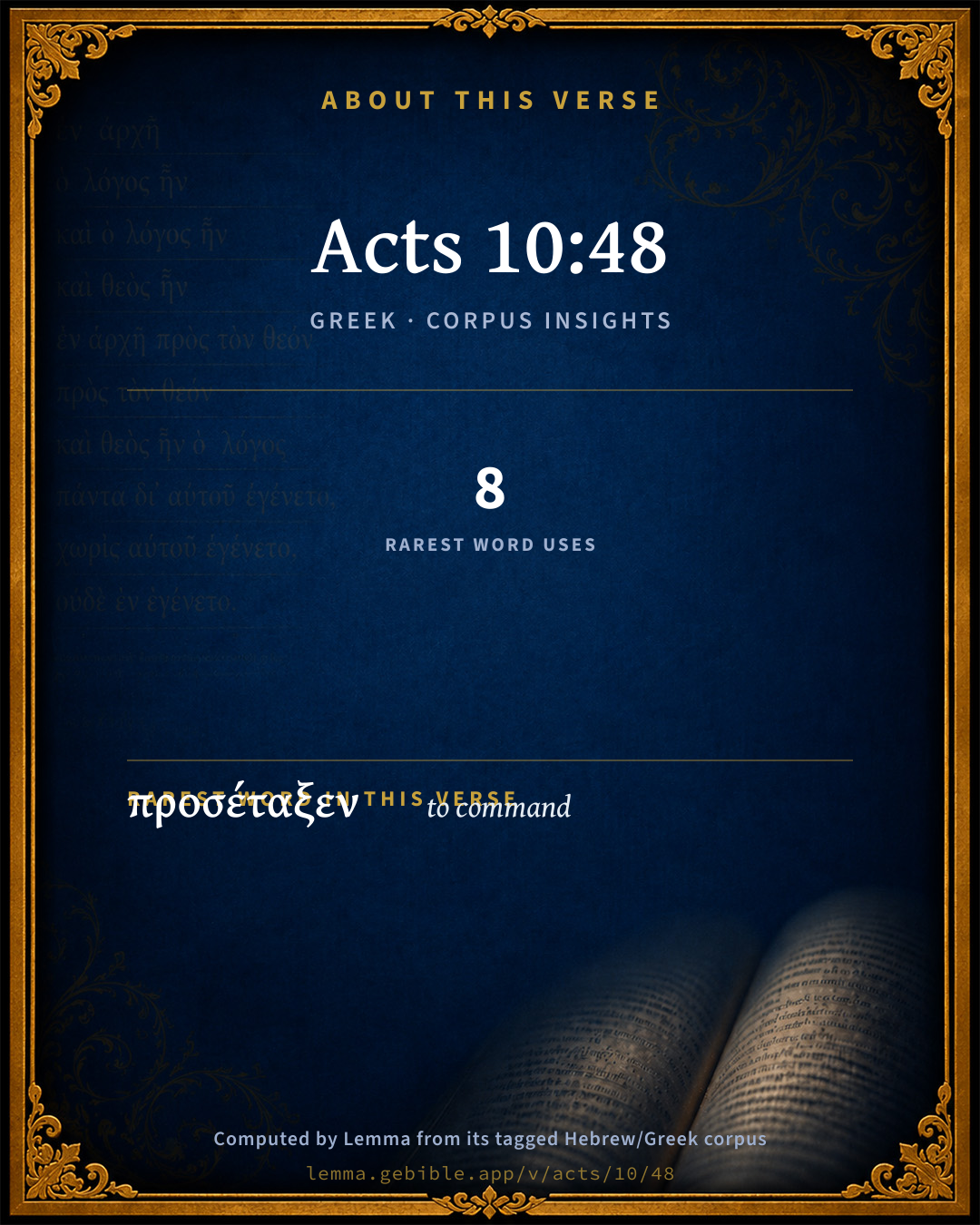
Acts 10:48

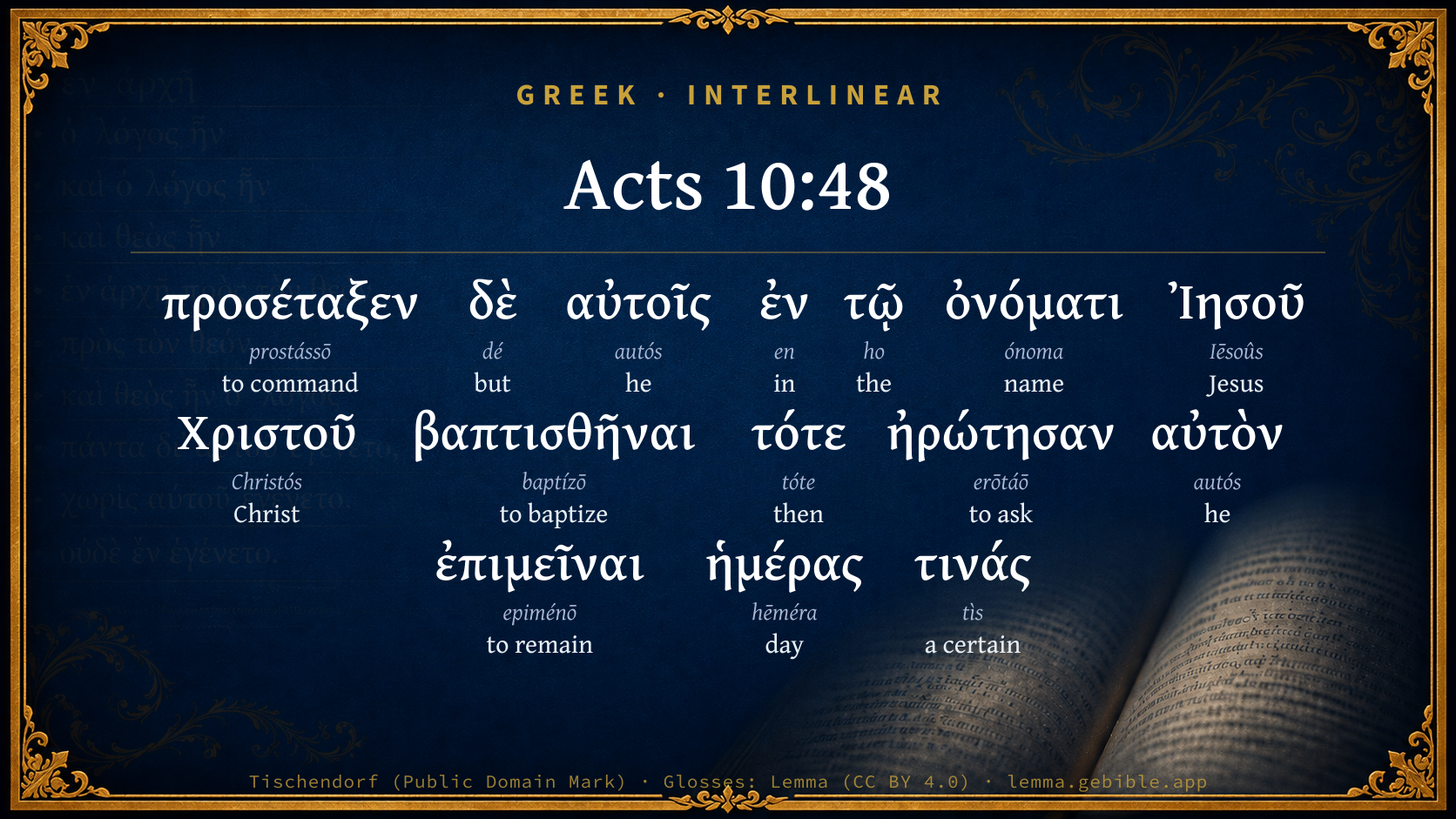
Greek (Tischendorf 8th ed.) Acts 10:48 appears in the Greek New Testament. The text above is from the Tischendorf 8th edition. Each word links to its Strong’s number and a concise gloss. Click any word for its full Thayer’s Greek Lexicon entry.
Download image
Cite this verse

Acts 10:48 (World English Bible). Public Domain. Lemma interlinear Bible study tool, https://lemma.gebible.app/v/acts/10/48.

Show BibTeX & RIS
BibTeX
RIS
English Translation
He commanded them to be baptized in the name of Jesus Christ. Then they asked him to stay some days.
World English Bible · Public Domain
Download a study sheet

One document with this verse’s original text, its word-by-word gloss line, the meaning frame, cross-references with their text, attributed commentary, and full source and license credits — printable, and it pastes into notes with its structure intact.

This verse Autodidact and up

Study sheet (.html) Plain text (.txt)

A passage Seminary Student

Up to 50 verses in one chapter. A passage sheet keeps up to 6 commentary sources and 12 cross-references per verse, in the order this page ranks them, and says so on the sheet whenever that leaves anything out. Ask for a single verse and you get the Autodidact verse sheet above.

Everything on this page stays free to read, with no account — the sheet is a download of what is already on screen, not access to it.

Want to remove ads? Support Godless Engineer
Compare translations 3

The same verse in 3 English versions, stacked beneath the original-language interlinear above. Click any original word for its lexicon entry.

Each is an independent rendering of the whole verse — the interlinear is not word-aligned to these translations.

Highlighted words mark where these versions differ — a whole-verse word diff, not a word-by-word alignment.

  • World English Bible Public Domain
    He commanded them to be baptized in the name of Jesus Christ. Then they asked him to stay some days.
  • King James Version Public Domain
    And he commanded them to be baptized in the name of the Lord. Then prayed they him to tarry certain days.
  • unfoldingWord Literal Text CC BY-SA 4.0
    And he commanded them to be baptized in the name of Jesus Christ. Then they asked him to stay for several days.

unfoldingWord Literal Text — © unfoldingWord, licensed CC BY-SA 4.0. Word-aligned USFM3 via Door43 (git.door43.org/unfoldingWord/en_ult).

Versions to compare (up to 4)

3 of 4 selected

Show all 19 translations

Every available English version of this verse, each an independent rendering of the whole verse.

  • World English Bible Public Domain
    He commanded them to be baptized in the name of Jesus Christ. Then they asked him to stay some days.
  • Berean Standard Bible Public Domain
    So he ordered that they be baptized in the name of Jesus Christ. Then they asked him to stay for a few days.
  • Majority Standard Bible Public Domain
    So he ordered that they be baptized in the name of the Lord. Then they asked him to stay for a few days.
  • King James Version Public Domain
    And he commanded them to be baptized in the name of the Lord. Then prayed they him to tarry certain days.
  • American Standard Version (1901) Public Domain
    And he commanded them to be baptized in the name of Jesus Christ. Then prayed they him to tarry certain days.
  • Revised Version (1885) Public Domain
    And he commanded them to be baptized in the name of Jesus Christ. Then prayed they him to tarry certain days.
  • Geneva Bible (1599) Public Domain
    So he commanded them to be baptized in the Name of the Lord. Then prayed they him to tary certaine dayes.
  • Douay-Rheims (1899) Public Domain
    And he commanded them to be baptized in the name of the Lord Jesus Christ. Then they desired him to tarry with them some days.
  • Young's Literal Translation Public Domain
    he commanded them also to be baptized in the name of the Lord; then they besought him to remain certain days.
  • Literal Standard Version CC BY-SA 4.0
    He commanded them to also be immersed in the Name of the LORD; then they implored him to remain certain days.
  • Unlocked Literal Bible CC BY-SA 4.0
    Then he commanded them to be baptized in the name of Jesus Christ. Then they asked him to stay with them for several days.
  • unfoldingWord Literal Text CC BY-SA 4.0
    And he commanded them to be baptized in the name of Jesus Christ. Then they asked him to stay for several days.
  • Darby Bible Public Domain
    And he commanded them to be baptised in the name of the Lord. Then they begged him to stay some days.
  • World Messianic Bible Public Domain
    He commanded them to be immersed in the name of Yeshua the Messiah. Then they asked him to stay some days.
  • Webster's Bible Public Domain
    And he commanded them to be baptized in the name of the Lord. Then they requested him to tarry certain days.
  • Free Bible Version CC BY-SA 4.0
    He gave orders for them to be baptized in the name of Jesus Christ. Then they pleaded with him to spend some time with them.
  • Bible in Basic English Public Domain
    And he gave orders for them to have baptism in the name of Jesus Christ. Then they kept him with them for some days.
  • Text-Critical English NT CC BY 4.0
    So he gave orders to have them baptized in the name of the Lord. Then they asked him to stay on for a few days.
  • Tyndale New Testament (1534) Public Domain
    And he commaunded them to be baptysed in the name of the Lorde. Then prayde they him to tary a feawe dayes.

Literal Standard Version (2020), Covenant Press — licensed CC BY-SA 4.0. Text via the HelloAO Bible API (eBible.org). Unlocked Literal Bible (unfoldingWord) — licensed CC BY-SA 4.0. Text via the HelloAO Bible API (eBible.org). unfoldingWord Literal Text — © unfoldingWord, licensed CC BY-SA 4.0. Word-aligned USFM3 via Door43 (git.door43.org/unfoldingWord/en_ult). Free Bible Version, Dr. Jonathan Gallagher — licensed CC BY-SA 4.0. Text via the HelloAO Bible API (eBible.org).

Word by word

More ways to search: Search by grammar → Find every occurrence → Compare this word →

Practice this passage: Drill this verse → Learn its vocabulary →

προσέταξεν
prostássō
G4367
“to command”
Verb, Aorist, Active, Indicative, 3rd person, Singular
Part of Speech
Verb
Tense
Aorist
Voice
Active
Mood
Indicative
Person
3rd person
Number
Singular
Full Thayer's Definition

Origin: from G4314 and G5021

TDNT: 08:37,1

1. to assign or ascribe to, join to 2. to enjoin, order, prescribe, command a. to appoint, to define
  1. δὲ dé G1161 “but” Conjunction
  2. αὐτοῖς autós G846 “he” Personal pronoun, Dative, Plural, Masculine
  3. ἐν en G1722 “in” Preposition
  4. τῷ ho G3588 “the” Article, Dative, Singular, Neuter
  5. ὀνόματι ónoma G3686 “name” Noun, Dative, Singular, Neuter
  6. Ἰησοῦ Iēsoûs G2424 “Jesus” Noun, Genitive, Singular, Masculine
  7. Χριστοῦ Christós G5547 “Christ” Noun, Genitive, Singular, Masculine
  8. βαπτισθῆναι baptízō G907 “to baptize” Verb, Aorist, Passive, Infinitive
  9. τότε tóte G5119 “then” Adverb
  10. ἠρώτησαν erōtáō G2065 “to ask” Verb, Aorist, Active, Indicative, 3rd person, Plural
  11. αὐτὸν autós G846 “he” Personal pronoun, Accusative, Singular, Masculine
  12. ἐπιμεῖναι epiménō G1961 “to remain” Verb, Aorist, Active, Infinitive
  13. ἡμέρας hēméra G2250 “day” Noun, Accusative, Plural, Feminine
  14. τινάς tìs G5100 “a certain” Indefinite pronoun, Accusative, Plural, Feminine

About this verse

These counts appear in no published source. They are computed here, from the morphology-tagged text and Lemma’s own curated glosses. What Lemma adds →

15
words
14
distinct lemmas
Acts
section

Notable vocabulary

The rarest word here is προσέταξεν to command G4367 — appearing just 8 times in the whole Greek New Testament.

Shared distinctive vocabulary

προσέταξεν to command G4367 occurs in 8 verses of the Greek New Testament. Also found in:

Repetition

A word recurs within this verse:

  • αὐτοῖς he G846 ×2

Cross-references

9

Topical passages linked to Acts 10:48 in the Treasury of Scripture Knowledge — connected by theme and wording, ordered by reader-vote popularity; previews shown in the World English Bible.

  • Acts 2:38 Peter said to them, "Repent, and be baptized, everyone of you, in the name of Jesus Christ for the forgiveness of sins, and you will receive the gift of the Holy Spirit.
  • Acts 8:16 for as yet he had fallen on none of them. They had only been baptized in the name of Christ Jesus.
  • Galatians 3:27 For as many of you as were baptized into Christ have put on Christ.
  • John 4:2 (although Jesus himself didn't baptize, but his disciples),
  • Acts 8:12 But when they believed Philip preaching good news concerning the Kingdom of God and the name of Jesus Christ, they were baptized, both men and women.
  • Acts 19:5 When they heard this, they were baptized in the name of the Lord Jesus.
  • 1 Corinthians 1:13–17 Is Christ divided? Was Paul crucified for you? Or were you baptized into the name of Paul?
  • John 4:40 So when the Samaritans came to him, they begged him to stay with them. He stayed there two days.
  • Acts 16:15 When she and her household were baptized, she begged us, saying, "If you have judged me to be faithful to the Lord, come into my house, and stay." So she persuaded us.

Cross-references courtesy of OpenBible.info (CC BY 4.0).

Where the printed editions differ

2 variants

Places in this verse where the major printed Greek editions disagree on the wording in a way that affects the translation — a comparison of editions, not a manuscript-by-manuscript collation. The editions are the modern critical texts (Nestlé-Aland 28/27, SBL, Westcott-Hort, Tregelles, Tyndale House) and the traditional texts behind the KJV (the Textus Receptus and the Byzantine/Majority text). It is not a claim about which reading is original.

  1. Extra text
    Ἰησοῦ Χριστοῦ

    “of Jesus Christ”

    In NA28NA27TynSBLWHTreg Not in TRByz

    Ἰησοῦ Χριστοῦ (Iēsou Christou) 'of Jesus Christ' is only in older manuscripts (NA28+NA27+Tyn+SBL+WH+Treg)

  2. Extra text
    τοῦ κυρίου.

    “of the Lord.”

    In TRByz Not in NA28NA27TynSBLWHTreg

    τοῦ κυρίου. (tou kuriou) 'of the Lord.' is only in traditional manuscripts (TR+Byz)

Textual data: Translators Amalgamated Greek New Testament (STEPBible TAGNT) · CC BY 4.0.

Commentary

Notes on Acts 10:48 from classic Christian and Jewish commentators (each source and its license shown beneath its notes). The classic Christian expositions comment on the surrounding passage and are grouped to its opening verse, so a note may address several verses; the Jewish commentaries on the Tanakh (Rashi and others) are per-verse, so they appear only where the commentator wrote on this verse.

Lemma curates 59 commentaries, every one of them public domain or Creative Commons licensed, each selected and text-cleaned for this edition rather than reprinted as found. About our sources →

Tyndale Open Study Notes

Tyndale Open Resources

10:48 Cornelius asked Peter to stay with them for several days, perhaps because of his need for instruction in the Christian way.

Tyndale Open Study Notes — © Tyndale Open Resources, licensed CC BY-SA 4.0. Text via the HelloAO Bible API.

Expositor's Greek Testament

ed. W. Robertson Nicoll

Act 10:48 . προσέταξε , cf. St. Paul’s rule, 1Co 1:17 . If Philip the Evangelist was at Cæsarea at the time, the baptism may have been intrusted to him. ἐπιμεῖναι : diutius commorari , Blass, so manere amplius , Bengel, cf. Act 21:4 ; Act 21:10 , Act 28:12 ; Act 28:14 , and Act 15:34 [243] (Blass); only in Luke and Paul, frequent in Acts, not found in Luke’s Gospel, cf. Joh 8:7 ; only once in LXX, Exo 12:39 , in classics as in text. ἡμέρας τινάς , no doubt spent in further instruction in the faith: aurei dies , Bengel.

[243] R(omana), in Blass, a first rough copy of St. Luke.

The Expositor's Greek Testament, edited by W. Robertson Nicoll (1897–1910) — public domain. Text from a community e-Sword module.

Jamieson, Fausset & Brown

Robert Jamieson, A. R. Fausset & David Brown

he commanded them to be baptized--not doing it with his own hands, as neither did Paul, save on rare occasions (Co1 1:14-17; compare Act 2:38; Joh 4:2).

prayed . . . him to tarry certain days--"golden days" [BENGEL], spent, doubtless, in refreshing Christian fellowship, and in imparting and receiving fuller teaching on the several topics of the apostle's discourse.

Next: Acts Chapter 11

Jamieson, Fausset & Brown — Commentary Critical and Explanatory on the Whole Bible (1871) — public domain (CC PDM 1.0). Text via the HelloAO Bible API.

Adam Clarke's Commentary

Verse 48. To be baptized in the name of the Lord.] That is, in the name of Jesus Christ; which implied their taking upon them the public profession of Christianity, and believing on Christ Jesus as their Saviour and Sovereign; for, as they were baptized in his name, they professed thereby to be his disciples and followers.

Then prayed they him to tarry certain days.] They felt the necessity of farther instruction, and prayed him to continue his ministry a little longer among them; and to this he no doubt consented. This was properly speaking, the commencement of the Christian Church, as composed of Jews and Gentiles, partaking of the same baptism, united under the same Head, made partakers of the same Spirit, and associated in the same aggregate body. Now was the middle wall of partition broken down, and the Gentiles admitted to the same privileges with the Jews.

1. GOD is wonderful in all his works, whether they be works of creation, providence, or grace. Every thing proclaims his power, his wisdom, and his goodness. Every where we learn this truth, which is indispensably necessary for all to know who desire to acknowledge God in all their ways that "there is nothing which concerns their present or eternal welfare in which God does not interest himself." We often, to our great spiritual detriment, lose sight of this truth, because we think that the MAJESTY of God is too great to be occupied with those common occurrences by which we are often much affected, in things which relate, not only to our present, but also to our eternal interests. This is impossible; for God is our father, and, being every where present, he sees our state, and his eye affects his heart.

2. Let the reader examine the chain of Providence (composed indeed of very minute links) brought to light in the conversion of Cornelius, the instruction of Peter, and opening the door of faith to the Gentiles, and he will be convinced that "God has way every where, and that all things serve the purposes of his will." We have already seen how particularly, both by gracious and providential workings, God prepared the mind of Cornelius to receive instruction, and the mind of Peter to give it; so that the receiver and giver were equally ready to be workers together with God. This is a general economy. He who feels his want may rest assured that, even then, God has made the necessary provisions for his supply; and that the very sense of the want is a proof that the provision is already made. Why then should we lose time in deploring wretchedness, for the removal of which God has made the necessary preparations? Mourning over our miseries will never supply the lack of faith in Christ, and very seldom tends even to humble the heart.

3. As the eye of God is ever upon us, he knows our trials as well as our wants; and here, also, he makes the necessary provision for our support. We may be called to suffer, but his grace will be sufficient for us; and, as our troubles increase, so shall the means of our support. And even these trials and temptations will be pressed into our service, for all things work together for good to them that love God, Ro 8:28.

4. We must beware neither to despise outward rites in religion, nor to rest in them. Most people do either the one or the other. God gives us outward helps, because he knows we need them. But do we not sometimes imagine ourselves to be above that which, because of our scantiness of grace, is really above us? We certainly may over-rate ourselves, and under-rate God's bounties. He who is taught by the Spirit of God will be saved from both.

Adam Clarke's Commentary on the Bible (1810–1826) — public domain. Text from a community e-Sword/MySword module.

John Calvin's Commentaries

48. And he commanded them to be baptized. It was not of necessity that baptism should be ministered by Peter’s hand, as Paul doth likewise testify that he baptized few at Corinth, for other ministers might take this charge upon them. Whereas he saith, in the name of the Lord, it must not be restrained unto the form, as we have said in the third chapter; but because Christ is the proper scope of baptism, therefore are we said to be baptized in his name. When as Luke saith, last of all, that Peter was requested by Cornelius and his kinsmen that he would tarry a few days, he commendeth in them their desire to profit. They were, indeed, endued with the Holy Ghost; but they were not so come to the top, but that confirmation was as yet profitable for them. And, according to their example, so often as opportunity to profit offereth itself, we must use it diligently; and let us not swell with pride, which stoppeth the way before doctrine.

John Calvin's Commentaries (1540-1563) — public domain. Text from the Calvin Translation Society English edition (1840s-50s) via the Christian Classics Ethereal Library (ccel.org). Calvin's coverage is partial (roughly two-thirds of the Bible); uncommented books and verses are honest gaps, never fabricated. The 19th-century editor's footnotes and remarks are omitted so the notes are faithfully Calvin's own voice.

Ellicott's Commentary for English Readers

(48) And he commanded them . . .—It would seem from this that St. Peter acted on the same general principle as St. Paul (1Co_1:14-17), and left the actual administration of baptism to other hands than his own. Who administered it in this instance we are not told. Possibly there may have been an ecclesia already organised at Cæsarea, as the result of Philip’s work, and its elders or deacons, or Philip himself, may have acted under Peter’s orders. If those who came with him from Joppa had so acted, it would probably we may believe, have been stated.

Then prayed they him to tarry certain days.—The days so spent must have included at least one “first day of the week,” and both in the solemn breaking of bread, and in the social intercourse of the other days, Peter must have mingled freely with the new converts, eating and drinking with them (Act_11:2), without any fear of being thereby defiled. That visit to Cæsarea, St. Luke dwells on as one of the great turning-points in the Apostle’s life, attesting his essential agreement with St. Paul. We can well understand how he shrank from marring the effect of that attestation by recording the melancholy inconsistency of his subsequent conduct at Antioch (Gal_2:11-12).

A Bible Commentary for English Readers, edited by Charles John Ellicott (1878–1897) — public domain. Text from a community e-Sword module.

The Cambridge Bible for Schools and Colleges

gen. ed. J. J. S. Perowne

48. And he commanded them to be baptized] Peter seems to have refrained from baptizing converts, and we know that St Paul did so, and the latter indicates a reason which may have influenced all the twelve to appoint others to baptize, lest factions should arise, and men sever the Christian unity by calling themselves by the name of some one of the Apostles. Cp. 1Co_1:13-16.

in the name of the Lord] The oldest MSS. have “in the name of Jesus Christ.”

Then prayed they him to tarry certain days] It is probable that Peter consented to stay (see Act_11:3), and thus shewed that he was prepared to act according to the teaching of the vision. We know that afterwards (Gal_2:11-13) he wavered in his determination, and was rebuked by St Paul for so doing; but even the account of that rebuke shews us that Peter had laid aside his Jewish prejudices in a great degree, and had only acted, in the way which was blamed, through the influence of some still strict Jews who had come from Jerusalem to Antioch. St Luke is not to be supposed to be ignorant of that wavering action of St Peter because he does not mention it. For a similar Christian reticence, in a like case, see Act_13:13 and note there.

The Cambridge Bible for Schools and Colleges (gen. ed. J. J. S. Perowne; Cambridge University Press, 1878–1918) — public domain. Text from a community e-Sword module.

John Gill's Exposition

And he commanded them to be baptized,.... By some of the six brethren that came with him from Joppa, who might all of them, at least some of them, be ministers of the Gospel: and this he ordered to be done

in the name of the Lord; that is, of the Lord Jesus Christ, though not to the exclusion of the Father, and of the Spirit: perhaps the phrase, "in the name of the Lord", may stand connected with the word commanded; and the sense be, that in the name of the Lord, and by authority from him, he ordered them to be baptized:

then prayed they him to tarry certain days; partly to express their gratitude to him for the favour they had received through him as an instrument, and partly that they might be more instructed and established by him. And these baptized persons very likely laid the foundation of a Gospel church state in this place, which we find to continue in succeeding ages; in the "second" century Theophilus presided over it; and in the "third" century Origen and Pamphilus, were presbyters of it; and in the same age, succeeding one another, Theoctistus, Domnus, and Theotecnus were bishops of it; and in the beginning of the "fourth" century, Eusebius the famous ecclesiastical historian was bishop of this church, after him Acacius; in the fifth century Gelasius the successor of Eunomius bore the same office in it; and in the "sixth" century the bishop of this place was present in the fifth synod at Constantinople; and in the "seventh" century it appears there was a church in this place: in which century the Arabians, after they had besieged this city seven years, took it, and killed seven thousand persons in it; and since it has been in the hands of the Turks; and this seems to have put an end to the ecclesiastical state of this place, as Christian (s).

(s) Magdeburg. Hist. Eccles. cent. 2. c. 2. p. 2. cent. 3. c. 2. p. 1. c. 7. p. 109. c. 10. p. 153. cent. 4. c. 2. p. 2. cent. 5. c. 2. p. 2. cent. 6. c. 2. p. 3. cent. 7. c. 2. p. 2. c. 3. p. 19.

Next: Acts Chapter 11

John Gill's Exposition of the Whole Bible (1746–1763) — public domain (CC PDM 1.0). Text via the HelloAO Bible API.

Trapp's Complete Commentary

John Trapp

48 And he commanded them to be baptized in the name of the Lord. Then prayed they him to tarry certain days.

Ver. 48. To be baptized] The use of the sacraments is to seal up adoption in infants, and faith in those of riper years.

And he commanded them to be baptized] And so to be incorporated into Christ’s body the Church: that they might be saved by the "washing of regeneration, and the renewing of the Holy Ghost," Tit 3:5. It is a noble question in divinity, seeing regeneration is attributed both to the word and to baptism, how the one worketh it differently from the other? Or, if both work it, why is not one superfluous?

John Trapp, A Commentary or Exposition upon All the Books of the Old and New Testament (1647–1656) — public domain. Text from a community e-Sword module.

Albert Barnes' Notes on the Bible

And he commanded them ... - Why Peter did not himself baptize them is unknown. It might be, perhaps, because he chose to make use of the ministry of the brethren who were with him, to prevent the possibility of future cavil. If they did it themselves, they could not so easily be led by the Jews to find fault with it. It may be added, also, that it seems not to have been the practice of the apostles themselves to baptize very extensively. See 1Co 1:14-17, “Christ sent me not to baptize, but to preach the gospel.”

Albert Barnes' Notes on the Bible (1834–1885) — public domain. Text from a community e-Sword/MySword module.

Matthew Poole's English Annotations

In the name of the Lord; that is, in the name of our Saviour. But this does not imply, but that they were baptized according to our Saviour’s prescription, Mat 28:19; but the Jews by their baptism were become the Lord’s, and had given up their names to Jesus Christ; under which title, the Lord, not only our Saviour, but the Father who anointed him, and the Spirit by whom he was anointed, is to be understood.

Then prayed they; Cornelius and the rest of his friends, which he caused to be present. At their entreaty, Peter, and others that came with him, {as Act 11:12} tarried there, that they might further instruct, confirm, and comfort them; (as the best have ever need to learn, and to grow in grace and knowledge); and by this Peter showed that he looked upon himself and others as not bound to observe those precepts, (of the wise men, as they called them), forbidding them all familiarity with the uncircumcised.

Matthew Poole's English Annotations on the Holy Bible (1683–1685) — public domain. Text from a community e-Sword/MySword module.

Whedon's Commentary on the Bible

Daniel D. Whedon

48. Commanded—He performed not, it seems, the baptism himself, but gave direction that others, namely, the Christians from Joppa, should perform it, as an inferior office seldom performed by apostles. So Jesus baptized not, but his disciples, and Paul seldom himself performed the rite. (1Co_1:17.) The relation of the baptismal consecration, as to Christ, is stated with different prepositions in the Greek. Into the name of Father, Son, etc., Mat_28:19. Into my own name, 1Co_1:15. Into Christ, Act_6:3; Gal_3:27. Here in the name. To be baptized into Christ, or into his name, is to be consecrated, as it were, into his mystical body; to be baptized in his name is to be consecrated by or in his authority.

Tarry certain days—Fully to indoctrinate them in the Gospel history and principles. The ancient tradition is that Mark’s Gospel was really in substance written from Peter’s oral narration of its facts. Had Mark been with Peter at this time he probably could have mainly written his complete Gospel from Peter’s utterance; and very likely written records were made for the Church at this time. We have here, then, a Gentile Church commenced in Cesarea, with its Gospel tradition and documents derived from apostolic lips. (See note on Luk_1:1-2.

Daniel D. Whedon (gen. ed.), Commentary on the Old and New Testaments (1874–1909) — public domain. Text from a community e-Sword module.

The Pulpit Commentary

Jesus Christ for the Lord, A.V. and T.R. No one forbidding or objecting, Peter immediately ordered that they should be baptized. He does not appear to have baptized them himself, any more than St. Paul did his converts. (1Co_1:13-17) They prayed him to tarry with them, no doubt that they might receive fuller instruction in the faith of the Lord Jesus Christ, into which they had been baptized.

The Pulpit Commentary (1880–1919), ed. H.D.M. Spence-Jones & Joseph S. Exell — public domain. Text from a community e-Sword module.

John Wesley's Explanatory Notes

In the name of the Lord - Which implies the Father who anointed him, and the Spirit with which he was anointed to his office. But as the Gentiles had before believed in God the Father, and could not but now believe in the Holy Ghost, under whose powerful influence they were at this very time, there was the less need of taking notice, that they were baptized into the belief and profession of the sacred Three: though doubtless the apostle administered the ordinances in that very form which Christ himself had prescribed.

John Wesley, Explanatory Notes Upon the Whole Bible (1754–1765) — public domain. Text via the GEBible commentary corpus.

Godbey's Commentary on the New Testament

William B. Godbey

48. Peter, of course, proceeds to recognize this Gentile church by administering to them the ordinance of baptism, assuring all present that every quibble is put to quietus since they have received the Holy Ghost. Hence we see that the reception of the gift of the Holy Ghost, i. e., the Holy Ghost Himself, whom Jesus gives when He sanctifies us, is the climax of aspiration and the end of all inquiry. When you receive the baptism of the Holy Ghost no one can question your right to water-baptism, eucharist and every other privilege of the gospel church. You are then eligible to any and every office in the church, pursuant to the administration of the Holy Ghost.

William B. Godbey, Commentary on the New Testament (1896–1900) — public domain. Text from a community e-Sword module.

McGarvey & Pendleton's Commentaries

J. W. McGarvey

Seen notes on verse 47

J. W. McGarvey (with Philip Y. Pendleton), Commentaries on the New Testament (The Fourfold Gospel, 1914; Acts; and the epistles) — public domain. Text from a community e-Sword/MySword module.

The People's New Testament

B. W. Johnson

48. Commanded them to be baptized. All who heard and upon whom the Holy Spirit fell. In the name of the Lord. In acknowledgment of his authority. All the baptisms of Acts are in his name, but into the names of the Father, and the Son, and the Holy Spirit.

B. W. Johnson's The People's New Testament with Notes (1889–1891) — public domain. Electronic text from the Christian Classics Ethereal Library (CCEL) ThML edition.

Cambridge Greek Testament for Schools and Colleges

48. Ἰησοῦ Χριστοῦ for τοῦ κυρίου with אABE. Vulg. has ‘Domini Jesu Christi.’

48. προσέταξεν δὲ κ.τ.λ., and he commanded them to be baptized. Peter seems to have refrained from baptizing converts, and we know that St Paul did so, and the latter indicates a reason which may have influenced all the Twelve to appoint others to baptize, lest factions should arise, and men sever the Christian unity by calling themselves by the name of some one of the Apostles. Cp. 1Co 1:13-16.

ἐν τῷ ὀνόματι Ἰησοῦ Χριστοῦ, in the name of Jesus Christ. The name of Jesus Christ is perhaps specially mentioned with a thought of the danger just alluded to. The converts were to be Christians. But see also Act 2:38 note.

ἐπιμεῖναι ἡμέρας τινάς, to tarry certain days. It is probable that Peter consented to stay and to become the guest of Cornelius and his friends (see Act 11:1-3); and thus shewed that he was prepared to act according to the teaching of the vision. We know that afterwards (Gal 2:11-13) he wavered in his determination, and was rebuked by St Paul for so doing; but even the account of that rebuke shews us that Peter had laid aside his Jewish prejudices in a great degree, and had only acted in the way which was blamed, through the influence of some still strict Jews who had come from Jerusalem to Antioch. St Luke is not to be supposed to be ignorant of that wavering action of St Peter because he does not mention it. For a similar Christian reticence, in a like case, see Act 13:13 and note there.

Cambridge Greek Testament for Schools and Colleges (Cambridge University Press, 1896; 21 vols, various authors incl. Carr, Maclear, Plummer, Farrar, Lumby, Moule, M. R. James, Simcox) — public domain. Text from a community e-Sword module.

Alford’s Greek Testament

Henry Alford

48. προσέταξεν] As the Lord Himself when on earth did not baptize (Joh 4:2), so did not ordinarily the Apostles (see 1Co 1:13-17, and note). Perhaps the same reason may have operated in both cases,—lest those baptized by our Lord, or by the chief Apostles, should arrogate to themselves pre-eminence on that account. Also, which is implied in 1Co 1:17, as compared with Act 6:2, the ministry of the Word was esteemed by them their higher and paramount duty and office, whereas the subordinate ministration of the ordinances was committed to those who διηκόνουν τραπέζαις.

ἐν τῷ ὀν.] = ἐπὶ τῷ ὀν., ch. 2:38, where see note. Wahl compares ἀποκτείνειν ἐν τῇ προφάσει ταύτῃ, Lysias, p. 452.

Henry Alford, The Greek Testament (1849–1861) — public domain. Text from a community e-Sword module.

Lesson kit

Teaching starters — assembled from the data on this page, not authored interpretation. Every prompt links to the verse data it draws on. Edit before teaching.

Acts, in the Acts, opens this verse with 15 words (14 distinct Greek lemmas). Its most distinctive word is prostássō (“to command”). A historical commentator’s framing appears above. Read the whole chapter for the surrounding context.

Discussion questions

  1. How does “to command” (prostássō) shape what this verse is saying?
  2. Matthew 1:24 shares the word «to command» with this verse. How do the two illuminate each other?
  3. “he” occurs 2× in this one verse. What is the effect of the repetition?
  4. These translations render this verse differently. What is at stake in choosing one wording over another?
  5. Reading how Tyndale Open Study Notes and Expositor's Greek Testament read this verse, where do the two commentators agree and where do they part?

Things to notice

Reading settings

Reading text

Shown beneath each verse's original-language words.

Old Testament
Old Testament edition

Read the OT as the Masoretic Hebrew (MT) or the Greek Septuagint (LXX).

English shown for the Greek Septuagint (in the Hebrew ↔ Greek comparison).

Comparing translations? Open the Compare panel on any verse page to stack up to four side by side.