Philippians 2:10

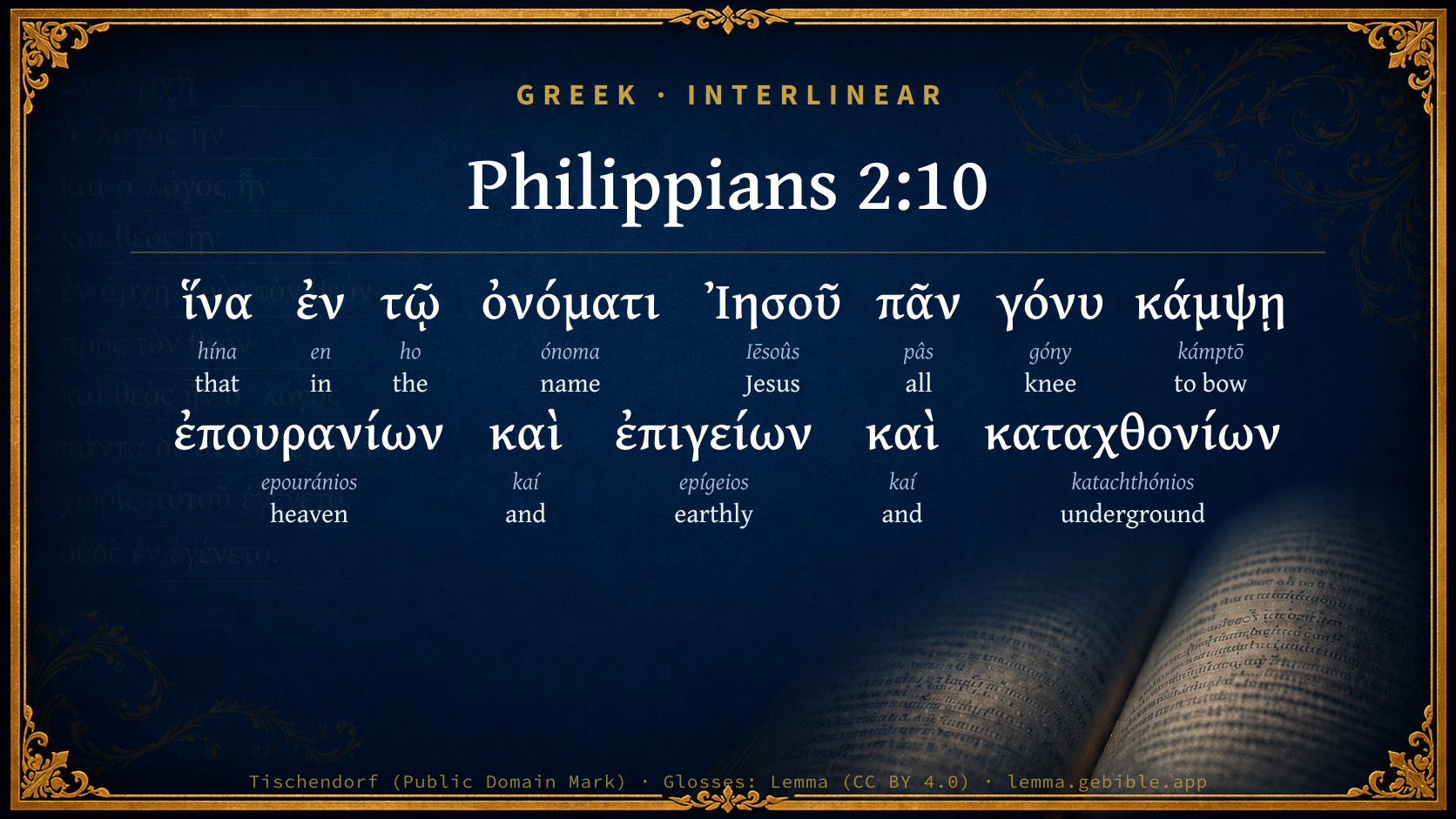
Greek (Tischendorf 8th ed.) Philippians 2:10 appears in the Greek New Testament. The text above is from the Tischendorf 8th edition. Each word links to its Strong’s number and a concise gloss. Click any word for its full Thayer’s Greek Lexicon entry.
Download image
Cite this verse

Philippians 2:10 (World English Bible). Public Domain. Lemma interlinear Bible study tool, https://lemma.gebible.app/v/philippians/2/10.

Show BibTeX & RIS
BibTeX
RIS
English Translation
that at the name of Jesus every knee should bow, of those in heaven, those on earth, and those under the earth,
World English Bible · Public Domain
Highlights
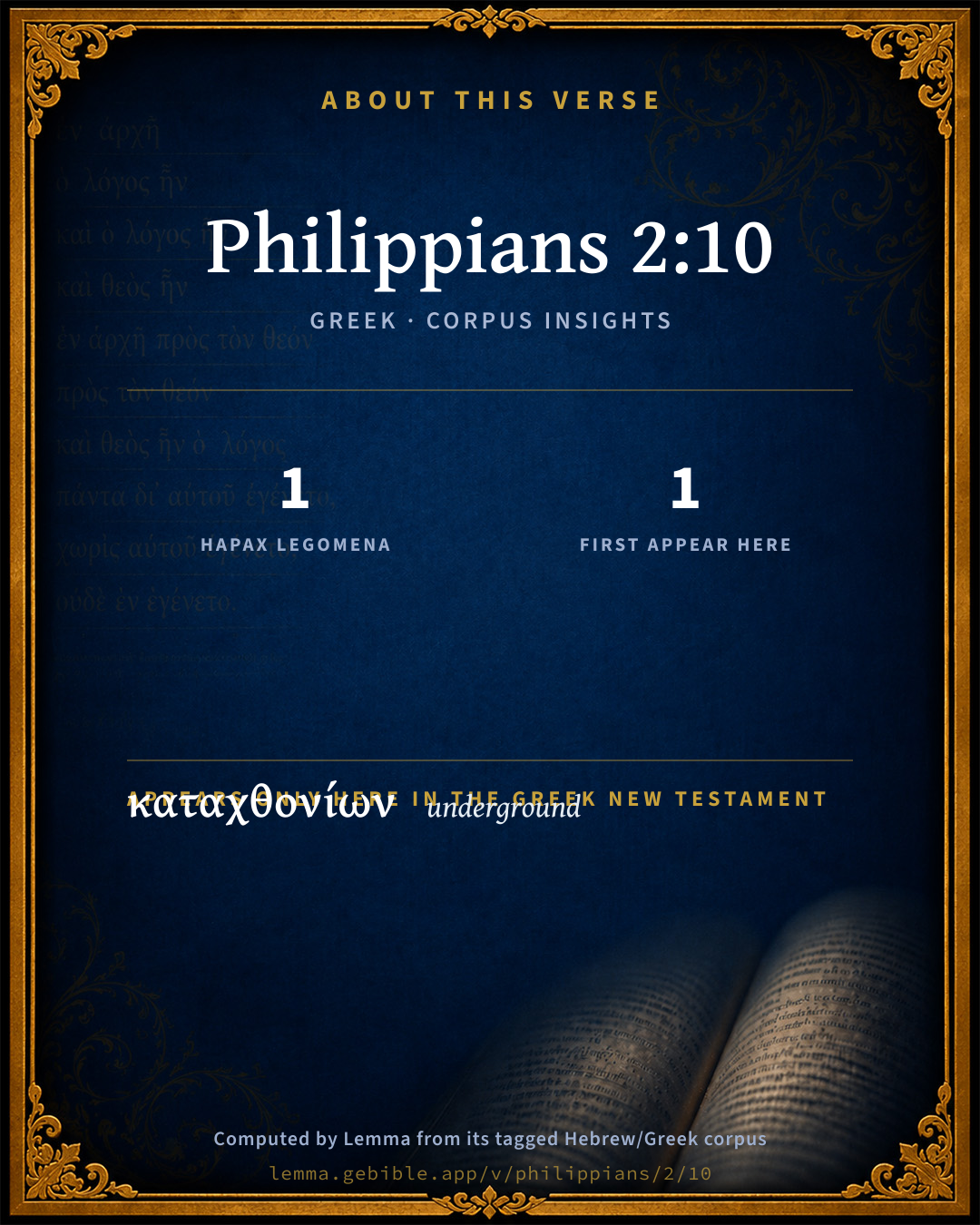
  • 1 hapax legomenon — only here in the Greek New Testament
  • 1 first appearance in the Greek New Testament
Full analysis ↓
Download a study sheet

One document with this verse’s original text, its word-by-word gloss line, the meaning frame, cross-references with their text, attributed commentary, and full source and license credits — printable, and it pastes into notes with its structure intact.

This verse Autodidact and up

Study sheet (.html) Plain text (.txt)

A passage Seminary Student

Up to 50 verses in one chapter. A passage sheet keeps up to 6 commentary sources and 12 cross-references per verse, in the order this page ranks them, and says so on the sheet whenever that leaves anything out. Ask for a single verse and you get the Autodidact verse sheet above.

Everything on this page stays free to read, with no account — the sheet is a download of what is already on screen, not access to it.

Want to remove ads? Support Godless Engineer
Compare translations 3

The same verse in 3 English versions, stacked beneath the original-language interlinear above. Click any original word for its lexicon entry.

Each is an independent rendering of the whole verse — the interlinear is not word-aligned to these translations.

Highlighted words mark where these versions differ — a whole-verse word diff, not a word-by-word alignment.

  • World English Bible Public Domain
    that at the name of Jesus every knee should bow, of those in heaven, those on earth, and those under the earth,
  • King James Version Public Domain
    That at the name of Jesus every knee should bow, of things in heaven, and things in earth, and things under the earth;
  • unfoldingWord Literal Text CC BY-SA 4.0
    so that at the name of Jesus every knee would bend, in heaven and on earth and under the earth,

unfoldingWord Literal Text — © unfoldingWord, licensed CC BY-SA 4.0. Word-aligned USFM3 via Door43 (git.door43.org/unfoldingWord/en_ult).

Versions to compare (up to 4)

3 of 4 selected

Show all 19 translations

Every available English version of this verse, each an independent rendering of the whole verse.

  • World English Bible Public Domain
    that at the name of Jesus every knee should bow, of those in heaven, those on earth, and those under the earth,
  • Berean Standard Bible Public Domain
    that at the name of Jesus every knee should bow, in heaven and on earth and under the earth,
  • Majority Standard Bible Public Domain
    that at the name of Jesus every knee should bow, in heaven and on earth and under the earth,
  • King James Version Public Domain
    That at the name of Jesus every knee should bow, of things in heaven, and things in earth, and things under the earth;
  • American Standard Version (1901) Public Domain
    that in the name of Jesus every knee should bow, of `things' in heaven and `things' on earth and `things' under the earth,
  • Revised Version (1885) Public Domain
    that in the name of Jesus every knee should bow, of things in heaven and things on earth and things under the earth,
  • Geneva Bible (1599) Public Domain
    That at the Name of Iesus shoulde euery knee bowe, both of things in heauen, and things in earth, and things vnder the earth,
  • Douay-Rheims (1899) Public Domain
    That in the name of Jesus every knee should bow, of those that are in heaven, on earth, and under the earth:
  • Young's Literal Translation Public Domain
    that in the name of Jesus every knee may bow -- of heavenlies, and earthlies, and what are under the earth --
  • Literal Standard Version CC BY-SA 4.0
    that in the Name of Jesus every knee may bow—of heavenlies, and earthlies, and what are under the earth—
  • Unlocked Literal Bible CC BY-SA 4.0
    He did this so that in the name of Jesus every knee should bend, the knees of those in heaven and on earth and under the earth.
  • unfoldingWord Literal Text CC BY-SA 4.0
    so that at the name of Jesus every knee would bend, in heaven and on earth and under the earth,
  • Darby Bible Public Domain
    that at the name of Jesus every knee should bow, of heavenly and earthly and infernal [beings],
  • World Messianic Bible Public Domain
    that at the name of Yeshua every knee should bow, of those in heaven, those on earth, and those under the earth,
  • Webster's Bible Public Domain
    That at the name of Jesus every knee should bow, of things in heaven, and things on earth, and things under the earth;
  • Free Bible Version CC BY-SA 4.0
    so that in the name of Jesus everyone should bow in respect, whether in heaven or on earth or under the earth,
  • Bible in Basic English Public Domain
    So that at the name of Jesus every knee may be bent, of those in heaven and those on earth and those in the underworld,
  • Text-Critical English NT CC BY 4.0
    so that at the name of Jesus every knee should bow, in heaven and on earth and under the earth,
  • Tyndale New Testament (1534) Public Domain
    that in the name of Iesus shuld every knee bowe bothe of thinges in heven and thinges in erth and thinges vnder erth

Literal Standard Version (2020), Covenant Press — licensed CC BY-SA 4.0. Text via the HelloAO Bible API (eBible.org). Unlocked Literal Bible (unfoldingWord) — licensed CC BY-SA 4.0. Text via the HelloAO Bible API (eBible.org). unfoldingWord Literal Text — © unfoldingWord, licensed CC BY-SA 4.0. Word-aligned USFM3 via Door43 (git.door43.org/unfoldingWord/en_ult). Free Bible Version, Dr. Jonathan Gallagher — licensed CC BY-SA 4.0. Text via the HelloAO Bible API (eBible.org).

Word by word

More ways to search: Search by grammar → Find every occurrence → Compare this word →

Practice this passage: Drill this verse → Learn its vocabulary →

About this verse

These counts appear in no published source. They are computed here, from the morphology-tagged text and Lemma’s own curated glosses. What Lemma adds →

13
words
12
distinct lemmas
Pauline Epistles
section

Notable vocabulary

1 hapax legomenon — a word that appears only here in the entire Greek New Testament:

  • καταχθονίων underground G2709

First appearance in Scripture

This word makes its first canonical appearance in the Greek New Testament here:

  • καταχθονίων underground G2709

Shared distinctive vocabulary

κάμψῃ to bow G2578 occurs in 4 verses of the Greek New Testament. Also found in:

Repetition

A word recurs within this verse:

Cross-references

14

Topical passages linked to Philippians 2:10 in the Treasury of Scripture Knowledge — connected by theme and wording, ordered by reader-vote popularity; previews shown in the World English Bible.

  • Isaiah 45:23–25 By myself have I sworn, the word is gone forth from my mouth [in] righteousness, and shall not return, that to me every knee shall bow, every tongue shall swear.
  • Matthew 28:18 Jesus came to them and spoke to them, saying, "All authority has been given to me in heaven and on earth.
  • Revelation 5:13–14 I heard every created thing which is in heaven, on the earth, under the earth, on the sea, and everything in them, saying, "To him who sits on the throne, and to the Lamb be the blessing, the honor, the glory, and the dominion, forever and ever! Amen!"
  • Hebrews 1:6 Again, when he brings in the firstborn into the world he says, "Let all the angels of God worship him."
  • Romans 14:10–11 But you, why do you judge your brother? Or you again, why do you despise your brother? For we will all stand before the judgment seat of Christ.
  • Ephesians 3:14 For this cause, I bow my knees to the Father of our Lord Jesus Christ,
  • Revelation 4:10 the twenty-four elders fall down before him who sits on the throne, and worship him who lives forever and ever, and throw their crowns before the throne, saying,
  • Ephesians 1:10 to an administration of the fullness of the times, to sum up all things in Christ, the things in the heavens, and the things on the earth, in him;
  • John 5:28–29 Don't marvel at this, for the hour comes, in which all that are in the tombs will hear his voice,
  • Matthew 27:29 They braided a crown of thorns and put it on his head, and a reed in his right hand; and they kneeled down before him, and mocked him, saying, "Hail, King of the Jews!"
  • Revelation 20:13 The sea gave up the dead who were in it. Death and Hades gave up the dead who were in them. They were judged, each one according to his works.
  • Matthew 12:40 For as Jonah was three days and three nights in the belly of the whale, so will the Son of Man be three days and three nights in the heart of the earth.
  • Romans 11:4 But how does God answer him? "I have reserved for myself seven thousand men, who have not bowed the knee to Baal."
  • Ephesians 4:9 Now this, "He ascended," what is it but that he also first descended into the lower parts of the earth?

Cross-references courtesy of OpenBible.info (CC BY 4.0).

Commentary

Notes on Philippians 2:10 from classic Christian and Jewish commentators (each source and its license shown beneath its notes). The classic Christian expositions comment on the surrounding passage and are grouped to its opening verse, so a note may address several verses; the Jewish commentaries on the Tanakh (Rashi and others) are per-verse, so they appear only where the commentator wrote on this verse.

Lemma curates 59 commentaries, every one of them public domain or Creative Commons licensed, each selected and text-cleaned for this edition rather than reprinted as found. About our sources →

The Cambridge Bible for Schools and Colleges

gen. ed. J. J. S. Perowne

10. at the name of Jesus] Lit., with R.V., in the name of Jesus, or as far as grammatical form goes, “in the name Jesus.” “It is not ‘the name Jesus’ but ‘the name of Jesus’ ” (Lightfoot). This must mean that the context decides it thus; the grammar is ambiguous. But the previous argument (see last note but one), if valid, is decisive for the rendering of the R.V.

“In the name … should bow, &c.” Does this mean, “all should worship Him,” or “all should worship through Him”? Doubtless the latter is Divine truth. But the context is wholly in favour of an immediate reference to His enthronement; and particularly the very next verse speaks distinctly of the recognition of Him as “Lord.” So Lightfoot; and he gives proofs from the LXX. (e.g. Psa_62:5 (Heb. 63:4); 1Ki_8:44) that the phrase “in the name of” may imply, in proper contexts, the adoration of Him who bears the Name. We may thus paraphrase, “that before the revealed Majesty of the glorified Jesus all creation should adore.”—The ancient custom of bowing at the mention of the Name Jesus (see Canon xviii. of the Church of England) derives no direct sanction from this passage.

every knee should bow] An implicit citation of Isa_45:23; and as such a powerful testimony to St Paul’s view of the proper Deity of Jesus Christ.—The context of the passage in the prophet contains the phrases “a just God and a Saviour” (Php_2:21; cp. Rom_3:26); “in the Lord shall all the seed of Israel be justified, and shall glory” (Php_2:25; cp. Rom_8:30). May we not suppose that the Apostle of Justification was thus specially guided to the passage, and to its inner reference to the Son?—The same passage is directly quoted Rom_14:11 (where in Php_2:10 read, “of Christ”).

things in heaven … in earth … under the earth] Created existence, in its heights and depths. Cp. Rev_5:13 for close illustration; words whose whole context is a Divine commentary on this passage. In view of the language there, in a scene where angels have been already mentioned, it is better not to divide the reference here, e.g. between angels, living men, and buried men (Alford), or angels, men, and lost spirits (Chrysostom). Not only animate and conscious but inanimate existence is in view; Creation in its total; the impersonal and unconscious elements being said to “worship,” as owning, after their manner, the fiat of the exalted Jesus.

The Cambridge Bible for Schools and Colleges (gen. ed. J. J. S. Perowne; Cambridge University Press, 1878–1918) — public domain. Text from a community e-Sword module.

Matthew Poole's English Annotations

At the name of Jesus; in the old translation by bishops in Queen Elizabeth’s time, (and some say in the manuscripts of this), it is in the name. However, in ours now, it is not appositively, at the name Jesus; but constructively, of Jesus, intimating, that the power, glory, and majesty of him who hath that name, unto which every knee is bowed, is that name which is above every name; which would not hold true, if the name were taken for the very word

Jesus, that (as before) being common to others in Hebrew, Greek, and Latin, yea, and English. Besides, neither in letters, nor syllables, nor sound, nor time, hath that word any thing above other words.

Every knee should bow: bowing of the knee is meant metonymically, and metaphorically, because some of those hereafter named, from whom the homage is due, have neither knees nor tongues, yet must, either willingly or by constraint, yield subjection and obedience to the sovereign authority of Christ, here and hereafter, Mat 11:27; 28:18; Joh 5:22,23; Ac 3:15; all creatures being made subject to him, Heb 2:8. Some of the papists, searching for their subterraneous, fictitious purgatory, would restrain it to men, but that would straiten and diminish the august glory of Christ, exalted above every name, who had, even here in his humiliation, homage from unclean spirits, Mar 5:6,7,10,12; Lu 8:31; Jam 2:19; how much more when at his tribunal his consummate glory shall be manifest to all! Which the apostle hath ultimately a reference to, according to the evangelist, Mat 16:27; 24:30. Then shall his equality with his Father, and his superlative glory as Mediator, be manifested to all, good and bad, angels as well as men, who shall be subjected to his sovereign Majesty, as the Lord God omnipotent; the good willingly, and the bad by constraint, Isa 45:23; Act 17:31; Rom 2:16; 14:10,11; 2Co 5:10.

Of things in heaven; good angels, from whom he had homage and service here, Psa 97:7; Mat 2:13; 4:11; Luk 1:30,31; 2:13; Heb 1:6 at his resurrection, and ascension, Mat 28:6; Act 1:11 much more in his glory, Mat 24:31; 25:31; Eph 1:21,22; Col 1:16; 2:10; 2Th 1:7 and the spirits of just men made perfect, Heb 12:22,23; Re 4:6, &c.; Rev 5:9,10.

And things in earth; good men willingly, Psa 110:3; Act 10:33; 1Jo 5:3; and bad by force, Psa 2:9; Luk 19:27; Heb 2:14.

And things under the earth; either the dead, who are hid in the earth, and shall be raised by the power of Christ, in, or upon them, Act 24:15; or, devils, and wicked souls; for though devils move in the air by God’s permission, Eph 2:2; yet hell is the place prepared for them, and the wicked, Mat 7:23; 25:41; Luk 8:31; 2Pe 2:4; Jud 1:6. Upon Christ’s exaltation, all things above, and in the world, are subjected to his dominion. If it be said: On the earth, and under it, they rebel; I answer: They are bound to obey, Mat 4:9,10, and will be forced to submit to the penalty for disobedience. Christ doth at present exercise a sovereignty over bad men and devils, in limiting and punishing them as he pleaseth, Job 1:11,12; Lu 4:34,35; Lu 8:32; 19:27; 2Pe 2:6; Rev 2:10.

Matthew Poole's English Annotations on the Holy Bible (1683–1685) — public domain. Text from a community e-Sword/MySword module.

The Biblical Illustrator

Joseph S. Exell

Php_2:10-11

That at the name of Jesus every knee should bow

Bowing at the name of Jesus

I.

To what period does the assertion refer.

1. Not the present, which would not be the fact, and besides the text is a prophecy. Many objects are now worshipped: riches, pleasure, etc.

2. At the judgment, when every usurper will be dethroned, and every rebel crushed.

II. The persons alluded to.

1. His willing and devoted servants.

2. Others will bow unwillingly.

III. The consequences of this event. Jesus will reign with undisputed sway.

1. Sin will be banished from His dominions.

2. There will be no more contention.

3. There will be no more weakness or sorrow.

4. There will be no more fear of death. (W. H. Davison.)

The supremacy of Christ

I. Is universal.

1. In heaven and on earth.

2. In the control of providence and grace.

3. In the administration of mercy and judgment.

II. Must be universally acknowledged.

1. By His enemies as by His friends.

2. To this end He is exalted at the right hand of God.

III. Secures the glory of God.

1. In the accomplishment of His purpose.

2. The revelation of His character.

3. The completion of His kingdom. (J. Lyth, D. D.)

Christs claims

I. The claims of Christ upon our faith; submission; obedience; love.

II. His power to enforce them. He is exalted; as Lord of all.

III. The certainty of their final acknowledgment. Every knee shall bow, etc.; to the glory of God the Father. (J. Lyth, D. D.)

The triumphs of Christ

Before many a Popish shrine on the continent one sees exhibited a great variety of crutches, together with wax models of arms, legs, and other limbs. These are supposed to represent the cures wrought by devotion at that altar; the memorials of the healing power of the saint. Poor miserable superstition all of it, and yet what a reminder to the believer in Jesus as to his duty and his privilege! Having pleaded at the feet of Jesus, we have found salvation; have we remembered to record this wonder of His hand? If we hung up memorials of all His matchless grace, what crutches, and bandages, and trophies of every sort should we pile together! (C. H. Spurgeon.)

The Supreme King

At a missionary meeting on the Island of Raratonga, in the Pacific Ocean, an old man, who wished to join the Church, rose and said, I have lived during the reign of four kings. In the first we were continually at war, and a fearful season it was watching and hiding with fear. During the reign of the second we were overtaken with a severe famine, and all expected to perish; then we ate rats and grass and this wood and that wood. During the third we were conquered, and became the peck and prey of the two other settlements of the island; then if a man went to fish he rarely ever returned, or if a woman went far away to fetch food she was rarely ever seen again. But during the reign of this third king we were visited by another King, a great King, a good King, a peaceful King, a King of love, Jesus, the Lord from heaven. He has gained the victory. He has conquered our hearts; therefore we now have peace and plenty in this world, and hope soon to dwell with Him in heaven. (R. Brewin.)

Christ must be confessed

Victorinus, a teacher of rhetoric at Rome, was in his old age converted to Christianity, and came to Simplicianus, one eminent at that time for his piety, whispering in his ear softly these words, I am a Christian; but this holy man answered, I will not believe it, nor count thee so, till I see thee among the Christians in the church, at which he laughed, saying, Do then those walls make a Christian? cannot I be such except I openly profess it, and let the world know the same? This he said for fear, being yet but a young convert, though an old man; but some time after, when he was more confirmed in the faith, and had seriously considered that if he should continue thus ashamed of Christ, He would be ashamed of him at last, he changed his purpose, and came to Simplicianus, saying, Let us go to the church, I will now in earnest be a Christian. And there he made an open confession, observing that as he had openly professed rhetoric, which was not essential to salvation, he ought not to be afraid to own the Word of God in the congregation of the faithful. (W. H. Baxendale.)

We must speak for Christ

Of one of the statues in the Campanile, Florence, it is said that Donatello, when giving it the last stroke of his chisel, exclaimed, in enthusiastic admiration, Speak! So Christ, when He calls men from their sins and recreates them in His own image, says, Tell what things God hath done for you. (W. H. Baxendale.)

The Biblical Illustrator, edited by Joseph S. Exell (c. 1880s–1900s) — public domain. Text from a community e-Sword module.

Tyndale Open Study Notes

Tyndale Open Resources

2:10-11 The entire creation, including spiritual powers and angels, humans on earth, and those who have died, will one day acknowledge the authority of Jesus Christ as Lord (see Eph 1:9-10, 21; Col 1:20-25; 1 Pet 3:22). • every tongue declare (cp. Isa 45:23; Rom 14:11): This does not imply universal salvation, because not all will confess him as Lord freely out of love and devotion. • Lord, a divine title representing the Old Testament name Yahweh, is frequently applied to Jesus in the New Testament.

Tyndale Open Study Notes — © Tyndale Open Resources, licensed CC BY-SA 4.0. Text via the HelloAO Bible API.

Bengel's Gnomon

Johann Albrecht Bengel

Php 2:10. Πᾶν γόνυ—πᾶσα γλῶσσα, every knee—every tongue) A Synecdoche;[21] i.e. that in every way they may worship and acknowledge Him as Lord; comp. Rev 5:13.—κάμψῃ) may bow, viz. itself, either with [in token of] applause or with trembling.—ἐπουρανίων [supracælestium], of the beings dwelling in the upper heaven) The heavenly inhabitants bow their knees, for Christ the Lord has taken heaven.—ἐπιγείων, of things on earth) For He dwelt upon the earth.—καταχθονίων, of beings under the earth) See Mar 3:11; Job 26:5 [Eph 4:9; Rev 5:13.—V. g.] Afterwards He also presented Himself to them. This division goes further into the height and depth than that, Exo 20:4.

[21] Bowing the knee, the part put for every kind of worship, the whole.—ED.

Bengel's Gnomon of the New Testament — English translation (T&T Clark, Edinburgh, 1860) — public domain. Text from a community e-Sword module.

Meyer's Critical & Exegetical Commentary

Heinrich August Wilhelm Meyer

Php_2:10 f. Ἵνα] This exaltation, Php_2:9, was to have, in accordance with the divine purpose, general adoration and confession as its result,a continuation of the contrast with the previous state of self-renunciation and humiliation. In the mode of expression there may be detected a reminiscence of Isa_45:23 (Rom_14:11).

The ἐν τῷ ὀνόμ. Ἰ., emphatically prefixed, affirms that, in the name of Jesus, i.e. in what is involved in that most glorious name Jesus Christ, and is present to the conception of the subjects as they bend their knees, is to be found the moving ground of this latter action (comp. Psa_63:5; 1Ki_18:24; 1Ch_16:10, al.; 1Co_6:11; Eph_5:20; Col_3:17; 1Pe_4:14; 1Pe_4:16; Jam_5:14). The bowing of the knee represents adoration, of which it is the symbol (Isa_45:23; Rom_14:11; Rom_11:4; Eph_3:14; Ephesians 3 Esdr. 8:73; 3Ma_2:1; and in Greek writers from Homer onward), and the subject to be adored is, according to the context (ἐν τῷ ὀνόμ. Ἰ., and comp. Php_2:11), none other than Jesus, the adoring worship of whom has its warrant in the fellowship of the divine government and of the divine δόξα to which He is exalted (comp. the habitual ἐπικαλεῖσθαι τὸ ὄνομα κυρίου,, Rom_10:12 f.; 1Co_1:2; 2Ti_2:22; Act_7:59; Act_9:14; Act_9:21; Act_22:16), but has also at the same time its peculiar character, not absolute, but relative, i.e. conditioned by the relation of the exalted Son to the Father (see Lücke, de invocat. Jes. Ch. Gott. 1843, p. 7 f.; comp. Ernesti, Urspr. d. Sünde, I. p. 218),a peculiarity which did not escape the observation of Pliny (Ep. x. 97: Christo quasi Deo), and was, although only very casually and imperfectly, expressed by him. This adoration (comp. Php_2:11, εἰς δόξαν Θεοῦ πατρός) does not infringe that strict monotheism, which could ascribe absolute deity to the Father only (Joh_17:3; Eph_4:5; 1Co_12:6; 1Co_8:6; 1Ti_6:15 f.); the Father only is ὁ ὢν ἐπὶ πάντων Θεός, Rom_9:5 (comp. Ignat. Tars. interpol. 5), ὁ Θεός absolutely, God also of Christ (see on Eph_1:17), the Θεὸς ὁ παντοκράτωρ (2Co_6:18; Rev_1:8; Rev_4:8, al.); and the Son, although of like nature, as σύνθρονος and partaker of His δόξα, is subordinate to Him (1Co_11:3; 1Co_15:27 f.), as in turn the Spirit is to the Son (2Co_3:18); the honour which is to be paid to the Son (Rev_5:8 ff.) has its principle (Joh_5:22 f.) and aim (Php_2:11) in the Father, and therefore the former is to be honoured as the Father, and God in Christ fills and moves the consciousness of him who prays to Christ. According to van Hengel, it is not the adoration of Jesus which is here intended, but that of God under application of the name of Jesus; and de Wette also thinks it probable that Paul only intended to state that every prayer should be made in the name of Jesus as the Mediator (κύριος). Comp. also Hofmann: the praying to God, determined in the person praying by the consciousness of his relation to Jesus as regulating his action. Instead of this we should rather say: the praying to Jesus, determined by the consciousness of the relation of Jesus to God (of the Son to the Father), as regulating the action of the person praying. All modes of explaining away the adoration as offered to Jesus Himself are at variance not only with the context generally, which has to do with the honour of Jesus, making Him the object of the adoration, but also with the word ἐπουρανίων which follows, because the mediatorship of Jesus, which is implied in the atonement, does not affect the angels as its objects (comp., on the contrary, Heb_1:4; Heb_1:6). The two sentences may not be separated from one another (in opposition to Hofmann); but, on the contrary, it must be maintained that the personal object, to whom the bowing of the knee as well as the confession with the tongue applies, is Jesus. Linguistically erroneous is the view which makes ἐν τῷ ὀνόμ. equivalent to εἰς τὸ ὄνομα, for the glorification of His dignity (Heinrichs, Flatt, and others), or as a paraphrase for ἐν Ἰησοῦ (Estius; Rheinwald leaves either of the two to be chosen); while others, by the interpretation. quoties auditur nomen,[119] brought out a sense which is altogether without analogy in the N. T. See, in opposition to this, Calvin: quasi vox (the word Jesus) esset magica, quae totam in sono vim haberet inclusam.

ἐπουρανίων κ.τ.λ.] every knee of heavenly beings (those to be found in heaven), and those on earth, and those under the earth, is to bow, none is to remain unbent; that is, every one from these three classes shall bow his knees (plural). ἐπουρ. includes the angels (Eph_1:20 f., Php_3:10; Heb_1:4; Heb_1:6; 1Pe_1:12; 1Pe_3:22); ἐπιγ. the human beings on earth (comp. Plat. Ax. p. 368 B: ἐπίγειος ἄνθρωπος); and καταχθ. the dead in Hades (comp. Hom. Il. ix. 457: Ζεὺς καταχθόνιος, Pluto: καταχθόνιοι δαίμονες, the Manes, Anthol. vii. 333). Comp. Rev_5:13; Ignat. Trall. 9, and the similar classical use of ὑποχθόνιος, ὑπὸ γαῖαν (Eur. Hec. 149, and Pflugk in loc.). The adoration on the part of the latter, which Grotius and Hofmann misinterpret, presupposes the descensus Ch. ad inferos,[120] Eph_4:9, in which He presented Himself to the spirits in Hades as the κύριος. Our passage, however, does not yield any further particulars regarding the so-called descent into hell, which Schweizer has far too rashly condemned as a myth without any foundation in Scripture. Chrysostom, Theophylact, Oecumenius, Erasmus, and many others, including Baumgarten-Crusius and Wiesinger, have incorrectly understood by καταχθ. the Daemones, which is an erroneous view, because Paul does not regard the Daemones as being in Hades (see, on the contrary, at Eph_2:2; Eph_6:12). There is an arbitrary rationalizing in Heinrichs, who takes the words as neuters: omnes rerum creatarum complexus (comp. Nösselt and J. B. Lightfoot), and already in Beza: quaecunque et supra mundum sunt et in mundo. We meet with the right view as early as Theodoret. The Catholics referred καταχθ. to those who are in purgatory; so Bisping still, and Döllinger, Christenth. u. Kirche, p. 262, ed. 2.

As regards the realization of the divine purpose expressed in ἵνα κ.τ.λ., respecting the ἘΠΙΓΕΊΩΝ, it was still in progress of development, but its completion (Rom_11:25) could not but appear to the apostle near at hand, in keeping with his expectation of the near end of the αἰὼν οὗτος. Observe, moreover, how he emphasizes the universality of the divine purpose (ἵνα) with regard to the bowing the knees and confession with the tongue so strongly by ΠᾶΝ ΓΌΝΥ and ΠᾶΣΑ ΓΛῶΣΣΑ, that the arbitrary limitation which makes him mean only those who desire to give God the glory (Hofmann) is out of the question.

[119] Erasmus, Castalio, Beza, Bretschneider, and others, arrived at this interpretation simply by understanding ἐν τῷ ὀνόμ. as ad nomen (comp. Grotius: nuncupato nomine); but Hoelemann, with forced subtilty, by the analysis: quasi circumsonitum appellatione nominis.

[120] To transfer, with Grotius, Hofmann, and Grimm, the genuflexion of the dead to the period after the resurrection, so that, according to Hofmann, the καταχθόνιοι sleep below and await their resurrection and shall then adore and confess, would be entirely erroneous, mixing up with the direct, poetically plastic description of the apostle a remotely suggested reflection. He views the bowing of the knee, as it has been done and is continuously being done, and not as it will be done by an entire class only in the future, after the Parousia. Wiesinger, however, has also placed the realization of the ἵνα πᾶν γόνυ κάμψῃ κ.τ.λ. at the end of the world, when the knees, which hitherto had not willingly bent, would be forced to do so (1Co_15:25 f.). On this point he appeals to Rom_14:11, where, however, the whole text is dealing with the last judgment, which is not the case here. Besides, ἐν τᾦ ὀνόματι is far from leading us to the idea of an adoration partially forced; it rather presupposes the faith, of which the bowing of the knee and the confession which follows are the free living action; comp. Rom_10:9.

Meyer — Critical and Exegetical Commentary on the New Testament — English translation by Peter Christie, edited by Frederick Crombie (T&T Clark, 1880) — public domain. Text from a community e-Sword module.

Expositor's Greek Testament

ed. W. Robertson Nicoll

Phi 2:10 . ἐν τῷ ὀνόμ . Ἰ . Perhaps the best explanation is that of Weiffenb. ( op. cit. , p. 51), “On the ground of this name ( κύριος ),” i.e. , because of what it means for every worshipper. Of course, the worship is rendered to Him as Lord. Abbott ( Notes on St. Paul’s Epistles , p. 93) compares Psa 63:4 , “Thus will I bless Thee while I live: I will lift up my hands in Thy name”. Cf. also Psa 20:5 ; Psa 54:1 . This name , which declares the true character and dignity of Jesus Christ, is both the basis and the object of worship. See the somewhat parallel use of εἰς τὸ ὀν . in Inscrr [1] (Dsm [2] , BS [3] , pp. 144 145). For the history of the phrase and its Semitic basis consult Die biblische “im Namen,” by J. Böhmer (Giessen, 1898). ἐπουρ . κ . ἐπιγ . κ . καταχθ . Aptly Thdrt [4] , ἐπουρανίους καλεῖ τὰς ἀοράτους δυνάμεις , ἐπιγείους δὲ τοὺς ἔτι ζῶντας ἀνθρώπους καὶ καταξθονίους τοὺς τεθνεῶτας . ἐπουρ . The heavenly spirits. “Paul regards the higher world as divided into a series of ascending spheres” (Beysch., N.T. Th. [E.Tr.], ii., 100). καταχθ . It is needless to think of these in connexion with the Descent into Hades, although this subject had an extraordinary place in the minds of the early Christians ( cf. Bruston, La Descente du Christ aux Enfers , Paris, 1897). Here simply = a general term for the dead. Often in sepulchral Inscrr [5] For the division of all beings into three regions Everling compares Ignat. ad Trall. , 9, ἀληθῶς ἐσταυρώθη καὶ ἀπέθανεν , βλεπόντων τῶν ἐπουρανίων καὶ ἐπ γείων καὶ ὑποχθονίων (see his Paulinische Angelologie u. Dämonologie , Gött., 1888, pp. 83 84).

[1]nscrr. Inscriptions.

[2] Deissmann ( BS. = Bibelstudien, NBS. = Neue Bibelstudien ).

[3] Bibelstudien

[4]hdrt. Theodoret.

[5]nscrr. Inscriptions.

The Expositor's Greek Testament, edited by W. Robertson Nicoll (1897–1910) — public domain. Text from a community e-Sword module.

Geneva Bible (1599)

Geneva Bible translators

All creatures shall at length be subject to Christ.

Geneva Bible (1599) marginal notes — public domain. Text via Bolls.life.

Jamieson, Fausset & Brown

Robert Jamieson, A. R. Fausset & David Brown

at the name--rather as Greek, "in the name."

bow--rather, "bend," in token of worship. Referring to Isa 45:23; quoted also in Rom 14:11. To worship "in the name of Jesus," is to worship Jesus Himself (compare Phi 2:11; Pro 18:10), or God in Christ (Joh 16:23; Eph 3:14). Compare "Whosoever shall call upon the name of the Lord (that is, whosoever shall call on the Lord in His revealed character) shall be saved" (Rom 10:13; Co1 1:2); "all that call upon the name of Jesus Christ our Lord" (compare Ti2 2:22); "call on the Lord"; Act 7:59, "calling upon . . . and saying, Lord Jesus" (Act 9:14, Act 9:21; Act 22:16).

of things in heaven--angels. They worship Him not only as God, but as the ascended God-man, "Jesus" (Eph 1:21; Heb 1:6; Pe1 3:22).

in earth--men; among whom He tabernacled for a time.

under the earth--the dead; among whom He was numbered once (Rom 14:9, Rom 14:11; Eph 4:9-10; Rev 5:13). The demons and the lost may be included indirectly, as even they give homage, though one of fear, not love, to Jesus (Mar 3:11; Luk 8:31; Jam 2:19, see on Phi 2:11).

Jamieson, Fausset & Brown — Commentary Critical and Explanatory on the Whole Bible (1871) — public domain (CC PDM 1.0). Text via the HelloAO Bible API.

Adam Clarke's Commentary

Verse 10. That at the name of Jesus every knee should how] That all human beings should consider themselves redeemed unto God by his blood, and look for an application of this redemption price; and that all who are saved from their sin should acknowledge him the author of their salvation. In a word, that παν επουρανιων, all the spirits of just men made perfect, now in a state of blessedness; και επιγειων, all human beings still in their state of probation on earth; και καταχθονιων, and all that are in the shades below, who have, through their own fault, died without having received his salvation; should acknowledge him.

Adam Clarke's Commentary on the Bible (1810–1826) — public domain. Text from a community e-Sword/MySword module.

John Calvin's Commentaries

10 Every knee might bow. Though respect is shewn to men also be means of this rite, there can nevertheless be no doubt that what is here meant is that adoration which belongs exclusively to God, of which the bending of the knee is a token. As to this, it is proper to notice, that God is to be worshipped, not merely with the inward affection of the heart, but also by outward profession, if we would render to him what is his due. Hence, on the other hand, when he would describe his genuine worshippers, he says that they

have not bowed the knee to the image of Baal. (1 Kings 19:18.)

But here a question arises — whether this relates to the divinity of Christ or to his humanity, for either of the two is not without some inconsistency, inasmuch as nothing new could be given to his divinity; and his humanity in itself, viewed separately, has by no means such exaltation belonging to it that it should be adored as God? I answer, that this, like many things else, is affirmed in reference to Christ’s entire person, viewed as God manifested in the flesh. (1 Timothy 3:16.) For he did not abase himself either as to his humanity alone, or as to his divinity alone, but inasmuch as, clothed in our flesh, he concealed himself under its infirmity. So again God exalted his own Son in the same flesh, in which he had lived in the world abject and despised, to the highest rank of honor, that he may sit at his right hand.

Paul, however, appears to be inconsistent with himself; for in Romans 14:11, he quotes this same passage, when he has it in view to prove that Christ will one day be the judge of the living and the dead. Now, it would not be applicable to that subject, if it were already accomplished, as he here declares. I answer, that the kingdom of Christ is on such a footing, that it is every day growing and making improvement, while at the same time perfection is not yet attained, nor will be until the final day of reckoning. Thus both things hold true — that all things are now subject to Christ, and that this subjection will, nevertheless, not be complete until the day of the resurrection, because that which is now only begun will then be completed. Hence, it is not without reason that this prophecy is applied in different ways at different times, as also all the other prophecies, which speak of the reign of Christ, do not restrict it to one particular time, but describe it in its entire course. From this, however, we infer that Christ is that eternal God who spoke by Isaiah.

Things in heaven, things on earth, things under the earth. Since Paul represents all things from heaven to hell as subject to Christ, Papists trifle childishly when they draw purgatory from his words. Their reasoning, however, is this — that devils are so far from bowing the knee to Christ, that they are in every way rebellious against him, and stir up others to rebellion, as if it were not at the same time written that they tremble at the simple mention of God. (James 2:19.) How will it be, then, when they shall come before the tribunal of Christ? I confess, indeed, that they are not, and never will be, subject of their own accord and by cheerful submission; but Paul is not speaking here of voluntary obedience; nay more, we may, on the contrary, turn back upon them an argument, by way of retortion, (αντιστρέφον,) in this manner: — “The fire of purgatory, according to them, is temporary, and will be done away at the day of judgment: hence this passage cannot be understood as to purgatory, because Paul elsewhere declares that this prophecy will not be fulfilled until Christ shall manifest himself for judgment.” Who does not see that they are twice children in respect of these disgusting frivolities?

John Calvin's Commentaries (1540-1563) — public domain. Text from the Calvin Translation Society English edition (1840s-50s) via the Christian Classics Ethereal Library (ccel.org). Calvin's coverage is partial (roughly two-thirds of the Bible); uncommented books and verses are honest gaps, never fabricated. The 19th-century editor's footnotes and remarks are omitted so the notes are faithfully Calvin's own voice.

Ellicott's Commentary for English Readers

(10) At (properly, in) the name of Jesus every knee should bow.—This is an instance of the significant practice, by which passages of the Old Testament speaking of God are, as a matter of course, applied in the New to our Lord Jesus Christ. “In the Name” is the phrase constantly used for worship of God. “I will lift up my hands in Thy Name” (Psa_63:4). It denotes worship to Christ, not through Him.

Of things in heaven, and things in earth, and things under the earth.—For “things” we may better substitute beings, for the reference is properly to personal beings; although in some sense “All the works of the Lord bless the Lord, praise Him and magnify Him for ever.” (Comp. here Rev_5:13, “Every creature which is in heaven, and on the earth, and under the earth . . . heard I saying, Blessing, and honour, and glory, and power be unto Him that sitteth upon the throne, and to the Lamb for ever and ever.” See also Eph_1:20-21, and Notes there.)

A Bible Commentary for English Readers, edited by Charles John Ellicott (1878–1897) — public domain. Text from a community e-Sword module.

John Gill's Exposition

That at the name of Jesus every knee should bow,.... Which is to be understood, not of the outward act of bowing the knee upon hearing the name, and the syllables of the mere name Jesus pronounced; for in the bare name there can be nothing which can command such a peculiar respect; it was a name common with the Jews: Joshua is so called in Heb 4:8; and the name of Elymas the sorcerer was Barjesus: that is, the son of Jesus, Act 13:6; Now, how monstrously ridiculous and stupid would it be, for a man, upon hearing these passages, and upon the pronouncing of this word, to bow the knee? Moreover, the words ought not to be rendered at, but "in the name of Jesus"; that is, in and by reason of the power, authority, and dignity of Jesus, as exalted at God's right hand, every creature is to be subject to him: add to this, that there are several creatures included in the following account, who, in a corporeal sense, have not knees to bow with, as angels, the souls of men departed, and devils; and therefore an external corporeal bowing of the knee cannot be meant. The Jews indeed, upon hearing the name Jehovah pronounced by the high priest, in the holy of holies, used to bow: they say (n),

"that the priests, and the people, that stand in the court, when they hear Shemhamphorash (i.e. the name "Jehovah") pronounced by the high priest, , "bowed", and worshipped, and fell upon their faces, and said, blessed be the name of the glory of his kingdom, for ever and ever:

though it can hardly be thought there is any reference to this here. But inasmuch as this action is a token of reverence, worship; and subjection, it is used for those things themselves; and the sense is, that Christ is exalted as before described, that every creature may give him reverence, worship, and adoration, submit and be subject to him, as all do, and shall, either freely or forcedly. Some really and heartily trust in his name, are baptized in his name, and ascribe honour, and glory, and blessing to him from their whole hearts; and others feignedly, and whether they will or not, are subject to him, and sooner or later shall acknowledge his authority over them: and he shall be owned to be Lord

of things in heaven: the angels there, and the souls of departed saints, with those who are already clothed with their bodies:

and things in earth; both good men, and bad men:

and things under the earth; or "in the abyss", as the Ethiopic version renders it; meaning either the devils in the bottomless pit; or rather the dead bodies of men in the grave, which shall come forth and stand before the judgment seat of Christ,

(n) T. Bab. Yoma, fol. 66. 1. Maimon. Yom Haccippurim, c. 2. sect. 7.

John Gill's Exposition of the Whole Bible (1746–1763) — public domain (CC PDM 1.0). Text via the HelloAO Bible API.

Trapp's Complete Commentary

John Trapp

10 That at the name of Jesus every knee should bow, of things in heaven, and things in earth, and things under the earth;

Ver. 10. That at the name] Gr. In the name. The Papists stiffly defend the ceremony of bowing at the name of Jesus, to countenance the adoration of their deified images, altars, and their host; teaching in their pulpits, that Christ himself on the cross bowed his head on the right side, to reverence his own name, which was written over it. {a} But name is here put for person, bowing of the knee for inward subjection. It is taken out of Isa 45:23.

{a} Sir Edwin Sands in Spec. Europ.

John Trapp, A Commentary or Exposition upon All the Books of the Old and New Testament (1647–1656) — public domain. Text from a community e-Sword module.

Albert Barnes' Notes on the Bible

That at the name of Jesus every knee should bow - The knee should bow, or bend, in token of honor, or worship; that is, all people should adore him. This cannot mean merely that at the mention of the name of Jesses we should bow; nor is there any evidence that God requires this. Why should we bow at the mention of that name, rather than at any of the other titles of the Redeemer? Is there any special sacredness or honor in it above the other names which he bears? And why should we how at his name rather than at the name of the Father! Besides, if any special homage is to be paid to the name of the Saviour under the authority of this passage - and this is the only one on which the authority of this custom is based - it should be by bowing the knee, not the head. But the truth is, this authorizes and requires neither; and the custom of bowing at the name of Jesus, in some churches, has arisen entirely from a misinterpretation of this passage. There is no other place in the Bible to which an appeal is made to authorize the custom; compare Neal’s History of the Puritans, chapter 5. Ninth 5. The meaning here is, not that a special act of respect or adoration should be shown wherever the name “Jesus” occurs in reading the Scriptures, or whenever it is mentioned, but that he was so exalted that it would be proper that all in heaven and on earth should worship him, and that the time would come when he would be thus everywhere acknowledged as Lord. The bowing of the knee properly expresses homage, respect, adoration (compare the notes at Rom 11:4); and it cannot be done to the Saviour by those who are in heaven, unless it be divine.

Of things in heaven - ἐπουρανίων epouraniōn - rather of beings in heaven, the word “things” being improperly supplied by our translators. The word may be in the neuter plural; but it may be also in the masculine plural, and denote beings rather than things. Things do not bow the knee; and the reference here is undoubtedly to angels, and to the “spirits of the just made perfect” in heaven. If Jesus is worshipped there, he is divine; for there is no idolatry eta creature in heaven. In this whole passage there is probably an allusion to Isa 45:23; see it illustrated in the notes at Rom 14:11. In the great divisions here specified - of those in heaven, on the earth, and under the earth - the apostle intends, doubtless, to denote the universe. The same mode of designating the universe occurs in Rev 5:13; Exo 20:4; compare Psa 96:11-12. This mode of expression is equivalent to saying, “all that is above, around, and beneath us,” and arises from what appears to us. The division is natural and obvious - that which is above us in the heavens, that which is on the earth where we dwell, and all that is beneath us.

And things in earth - Rather, “beings on earth,” to wit, people; for they only are capable of rendering homage.

And things under the earth - Beings under the earth. The whole universe shall confess that he is Lord. This embraces, doubtless, those who have departed from this life, and perhaps includes also fallen angels. The meaning is, that riley shall all acknowledge him as universal Lord; all how to his sovereign will; all be subject to his control; all recognize him as divine. The fallen and the lost will do this; for they will be constrained to yield an unwilling homage to him by submitting to the sentence from his lips that shall consign them to woe; and thus the whole universe shall acknowledge the exalted dignity of the Son of God. But this does not mean that they will all be saved, for the guilty and the lost may be compelled to acknowledge his power, and submit to his decree as the sovereign of the universe. There is the free and cheerful homage of the heart which they who worship him in heaven will render; and there is the constrained homage which they must yield who are compelled to acknowledge his authority.

Albert Barnes' Notes on the Bible (1834–1885) — public domain. Text from a community e-Sword/MySword module.

Haydock's Catholic Bible Commentary

If we shew respect when the name of our sovereign is mentioned, may we not express our respect also at the name of Jesus; and if to his name, why not to his cross as well as to the throne of the king?

George Leo Haydock (1774–1849), Haydock's Catholic Family Bible and Commentary, 1859 edition — public domain. Excludes Psalms (Douay-Rheims chapter numbering differs from Protestant) and Deuterocanonical books (Catholic canon only).

Whedon's Commentary on the Bible

Daniel D. Whedon

10. Should bow—The object of this exaltation is, that universal homage should be rendered the God-man, every knee bowing at his name in submission to his authority. Angels in heaven, men on earth, and demons under the earth, are expected soon or late, willingly or unwillingly, to recognise his high position.

Daniel D. Whedon (gen. ed.), Commentary on the Old and New Testaments (1874–1909) — public domain. Text from a community e-Sword module.

The Pulpit Commentary

That at the name of Jesus every knee should bow; translate, in the name, not at. (comp. Isa_45:23, quoted in Rom_14:10, Rom_14:11) The words may mean, either that all prayer must be offered to God in the name of Jesus, through his mediation; or that all creation must offer prayer to him. Both alternatives are true, and perhaps both are covered by the words; but the second seems to be principally intended (comp. Psa_63:4, "I will lift up my hands in thy Name. Comp. also (in the Greek) Psa_43:3 Psa_104:3 1Ki_8:44; also the common Septuagint phrase, (Epikaleisyai en onomati Kuriou). Observe, the words are, not "the name Jesus," but "the name of Jesus;" the name, that is, which God freely gave to him (Ver. 9), It is the name which is above every name, that is, the majesty, the glory of Jesus, which is to be the object of Christian worship. The end of the whole passage being the exaltation of Jesus, it seems more natural to understand this verse of worship paid to Jesus than of worship offered through him to God the Father. Observe also that the words (Isa_45:23) on which this passage is formed are the words of Jehovah: "Unto me every knee shall bow, every tongue shall swear." They could not be used without impiety of any but God. Of things in heaven, and things in earth, and things under the earth. Perhaps the angels, the living, and the dead; or, more probably, (comp. Rev_5:13 and Eph_1:21, Eph_1:22) all creation, animate and inanimate, is represented as uniting in the universal adoration.

Vers. 10, 11. The exaltation of the Son of man.

I CONTRAST THE GLORY WHICH THE SON OF GOD RENOUNCED WITH THE GLORY WHICH HAS BEEN BESTOWED UPON HIM BECAUSE OF THAT RENUNCIATION. Contrast also the position of a servant which he voluntarily took, with the position of Lord which he thereby won. Although exalted to be Lord, he still remains in the likeness of men; for it is as Man that he won his kingship, and as Man that he draws all men to himself.

II THE FEELINGS EXCITED IN US BY THIS REVELATION OF THE EXALTATION OF THE SON OF MAN.

1. Wonder and adoration. Wonder that One in our own nature should be thus exalted, and that prayer may now be addressed to One who is still our fellowman! All creation worships him in whom creation is united to its Creator.

2. Faith. Every tongue is to confess that Jesus is the Lord. This is the essential Christian creed. In it is contained all Christian doctrine and practice. It is Jesus, the loving Son of man, who is exalted to be our Lord. The change in his condition does not change his disposition, which is that revealed to us in the gospel story. All power is now given to him who is all loving. What further revelation of God can we need?

III THE FINAL PURPOSE OF HIS WORK AND OF OUR CONFESSION OF FAITH IN HIM. "The glory of God the Father:" The humiliation and exaltation of the Son, the loving adoration of mankind, have this as their final object. V.W.H.

The Pulpit Commentary (1880–1919), ed. H.D.M. Spence-Jones & Joseph S. Exell — public domain. Text from a community e-Sword module.

John Wesley's Explanatory Notes

That every knee - That divine honour might be paid in every possible manner by every creature. Might bow - Either with love or trembling. Of those in heaven, earth, under the earth - That is, through the whole universe.

John Wesley, Explanatory Notes Upon the Whole Bible (1754–1765) — public domain. Text via the GEBible commentary corpus.

Godbey's Commentary on the New Testament

William B. Godbey

ARGUMENT 5

GENUFLECTION AND CONFESSION

10. “In order that, at the name of Jesus, every knee shall bow, of things in heaven, and things upon earth, and things beneath the earth;

11. “And every tongue shall confess.” While the Bible is a great spiritual book, it has an exceedingly prominent literal signification, which we dare not ignore. “Feeble knees” (Heb 12:14) is paralyzed knee, in the language of the Holy Ghost.

How fearfully Satan’s paralysis disqualified the popular Churches to bend the knees! O how the stiff-kneed, starchy congregations insult God to his face, committing sins enough in their miserable, diabolical, so-called worship, to send them to hell. The angels in heaven not only bow the knee, but fall prostrate before God, not reluctantly, but with the greatest delight. The heathen and Roman Catholics all bow the knee. The Mohammedans pray five times a day, bowing the knee and even the head until it touches the earth. The downright insult and blasphemy of the stiff- kneed, starchy, popular Churches is alarming in the extreme. God Almighty says “Every knee shall bow of things in heaven, in earth, and beneath the earth.” Rest assured, his Word will never fail. Hence, it follows, as an irresistible sequence, that those that do not bow here, will all bow in hell. When I was a sinner, I bowed on my knees in public worship. Penitent sinners are always ready to bow the knee. The trouble with the proud, fashionable Churches is, that they are filled up with impenitent sinners. No wonder they are opposed to holiness! They are equally opposed to all the work of the Holy Ghost. If they would yield to his conviction, whole congregations would be seen bowing the knee to God. Where the Holy Ghost is obeyed, the people bow the knee in prayer, and stand up testifying to the work of God in their hearts. Thus prayer and testimony are the normal differentia of worshipping congregations.

William B. Godbey, Commentary on the New Testament (1896–1900) — public domain. Text from a community e-Sword module.

The People's New Testament

B. W. Johnson

10. That at the name of Jesus. That name, by the exaltation, has become the name of the King of kings. It is supreme. Hence, every knee in all the universe bows to its majesty. Under the earth. In the under-world, hades, the abode of the dead.

B. W. Johnson's The People's New Testament with Notes (1889–1891) — public domain. Electronic text from the Christian Classics Ethereal Library (CCEL) ThML edition.

Cambridge Greek Testament for Schools and Colleges

10. ἐν τῷ ὀνόματι Ἰησοῦ. Here Ἰησοῦ may be either genitive or dative. If dative, we must render “in the name Jesus.” But if the note just previous reasons rightly, we must choose the genitive; “the name of Jesus,” the Name borne by Jesus; the Divine Name, Κύριος, proclaimed as the true name of the once humiliated Jesus. So Lightfoot; and so A.V., R.V.

What is the meaning of ἐν τῷ ὀνόματι κτλ.? That all creation is to bow to Him thus glorified? Or that all creation should worship through Him (cp. e.g. αἰτεῖν ἐν τῷ ὀνόματί μου, Joh 14:13)? The context seems to decide for the former; dealing as it does not with His mediation but with His personal glorification. So Lightfoot; and he gives examples in evidence from the LXX.; e.g. Psa 62:5 (Heb., Psa 63:5), ἐν τῷ ὀνόματί σου ἀρῶ τὰς χεῖράς μου. We may thus paraphrase here, “that before the revealed majesty of the glorified Jesus all creation should bow.”

The ancient custom of bowing at the utterance of the Name Jesus (see Canon xviii. of the Church of England) derives no direct sanction from this passage.

πᾶν γόνυ κάμψῃ. An implicit quotation of Isa 45:24, ἐμοὶ κάμψει πᾶν γόνυ. The prophet (see the whole context) speaks there in the name of the Eternal Himself; thus we have here a profoundly significant index of St Paul’s view of the Nature of the Lord Jesus Christ.

Observe further that in Isa 45:21 we have the words, “a just God and a Saviour,” δίκαιος καὶ σωτήρ (cp. Rom 3:26, δίκαιος καὶ δικαιῶν), and in Php 2:25 occur the words, “all the seed of Israel shall be justified and shall glory,” δικαιωθήσονται … καὶ … ἐνδοξασθήσεται πᾶν τὸ σπέρμα (cp. Rom 8:30, οὔς ἐδικαίωσε τούτους καὶ ἐδόξασε). Was not the Apostle of Justification thus specially led to the passage as relating to the Son of God and His work?—The same place in Isaiah is directly quoted Rom 14:11.

ἐπουρανίων καὶ ἐπιγείων καὶ καταχθονίων. The words evidently mean all created existence, in its heights and depths. Cp. Rev 5:13, πᾶν κτίσμα ὃ ἐν τῷ οὐρανῷ, καὶ ἐπὶ τῆς γῆς, καὶ ὑποκάτω τῆς γῆς, words whose whole context, full of the enthronement of the Lamb, is a Divine commentary here. We need not elaborately divide the reference here, e.g. between angels, living men, buried men (Alford), or angels, men, and lost spirits (Chrysostom). Rather we have Creation in its total before us, animate and inanimate existence alike; the non-personal and unconscious creation being said to “worship,” as obeying, after its manner, the lordship of the exalted Jesus.

Cambridge Greek Testament for Schools and Colleges (Cambridge University Press, 1896; 21 vols, various authors incl. Carr, Maclear, Plummer, Farrar, Lumby, Moule, M. R. James, Simcox) — public domain. Text from a community e-Sword module.

Alford’s Greek Testament

Henry Alford

10.] that (intent of this exaltation) in the name of Jesus (emphatic, as the ground and element of the act which follows) every knee should bend (i.e. all prayer should be made (not, as E. V., ‘at the name of Jesus every knee should bow,’—which surely the words will not bear). But what prayer? to Jesus, or to God through Him? The only way to answer this question is to regard the general aim of the passage. This undoubtedly is, the exaltation of Jesus. The εἰς δόξαν θεοῦ πατρός below is no deduction from this, but rather an additional reason why we should carry on the exaltation of Jesus until this new particular is introduced. This would lead us to infer that the universal prayer is to be to Jesus. And this view is confirmed by the next clause, where every tongue is to confess that Jesus Christ is κύριος, when we remember the common expression, ἐπικαλεῖσθαι τὸ ὄνομα κυρίου, for prayer: Rom 10:12 f.; 1Co 1:2 (2Ti 2:22); Acts (7:59) 9:14, 21; 22:16), of those in heaven (angels. Eph 1:20, Eph 1:21.Heb 1:6Heb 1:6) and those on earth (men) and those under the earth (the dead: so Hom. Il. ι. 457, Ζεὺς καταχθόνιος, Pluto; so Thdrt.: ἐπουρανίους καλεῖ τοὺς ἀοράτους δυνάμεις, ἐπιγείους δὲ τοὺς ἔτι ζῶντας ἀνθρώπους, καὶ καταχθονίους τοὺς τεθνεῶτας. Various erroneous interpretations have been given—e.g. Chr., Thl., Œc., Erasm. understand by καταχθ., the devils—and Chr., Thl. give metaphorical meanings, οἱ δίκαιοι κ. οἱ ἁμαρτωλοί),

Henry Alford, The Greek Testament (1849–1861) — public domain. Text from a community e-Sword module.

International Critical Commentary

10. ἵνα: Denotes the purpose of the exaltation.

ἐν τῷ ὀνόματι Ἰησοῦ: ‘In the name of Jesus’; not ‘at the name.’ Ὄνομα with τοῦ κυρ. ἡμ. ἸΧ, or τ. κυρ. Ι., or κυρ. Ἰ., or αὐτοῦ (Cht.), occurs ten times in Paul. In none of these cases is the word a mere title of address. Paul follows the Hebrew usage, in which the name is used for everything which the name covers, so that the name is equivalent to the person himself. (So Mat 6:9, Mat 10:41.) To baptize into the name of the Father, Son, and Holy Spirit is to put the subject of baptism symbolically into connection and communion with all that those names represent. He who believes on the name of the Lord believes on the Lord himself. Hence, to bow the knee in the name of Jesus is to pay adoration in that sphere of authority, grace, and glory for which the name stands; as being consciously within the kingdom of which he is Lord, as recognising the rightfulness of the titles ‘Jesus,’ ‘Saviour,’ ‘Lord,’ and as loyally accepting the obligations which those titles imply.

πᾶν γόνυ κάμψῇ: Comp. Isa 45:23; Rom 14:11. The meaning can only be that Christ is presented as the object of worship; his claim to that honor being fixed by the previous declarations. Before his incarnation he was on an equality with God. After his incarnation he was exalted to God’s right hand as Messianic sovereign.

ἐπουρανίων καὶ ἐπιγείων καὶ καταχθονίων: The whole body of created intelligent beings in all departments of the universe. (See Rom 8:21; 1Co 15:24; Eph 1:20-22; Heb 2:8; Rev 5:13; and comp. Ign. Trall. 9.; Polyc. Phil. ii.) Ἐπουράνιοι are heavenly beings, angels, archangels, etc. (Eph 1:21, Eph 1:3:10; Heb 1:4-6; Heb_1 Pet. 3:23); Ἐπίγειοι, beings on earth (1Co 15:40).

καταχθονίων: Only here in Bib. and Apocr. In class. of the infernal gods. Chr., Œc., Theoph., and the mediæval expositors explain of the demons, citing Luk 4:34; Jas 2:19. These, however, are not regarded by Paul as in Hades. (See Eph 2:2, Eph 6:12.) Rather the departed in Hades. Nothing definite as to Christ’s descent into Hades can be inferred from this.

Lightf. regards all the genitives as neuter, urging that the whole creation is intended, and that the limitation to intelligent beings detracts from the universality of the homage. This, however, seems to be over-subtilising.

International Critical Commentary — older volumes (1896–1929), various authors — public domain. Text from a community e-Sword module.

Vincent's Word Studies in the New Testament

Marvin R. Vincent

At the name of Jesus [εν τω ονοματι] . Rev., better, in the name. The name means here the personal name; but as including all that is involved in the name. See on Mt 28:19. Hence the salutation is not at the name of Jesus, as by bowing when the name is uttered, but, as Ellicott rightly says : "the spiritual sphere, the holy element as it were, in which every prayer is to be offered and every knee to bow." Compare Eph 5:20.

Things in heaven, etc. Compare Rev 5:13; Eph 1:20, 22. The words may apply either to all intelligent beings or to all things. The latter is in accord with Paul 's treatment of the creation collectively in Rom 8:19 - 22, and with the Old - Testament passages, in which all nature is represented as praising God, as Psalm 148; Rom 65:13.

Marvin R. Vincent, Word Studies in the New Testament (1887–1900) — public domain. Text from a community e-Sword/MySword module.

Lesson kit

Teaching starters — assembled from the data on this page, not authored interpretation. Every prompt links to the verse data it draws on. Edit before teaching.

Philippians, in the Pauline Epistles, opens this verse with 13 words (12 distinct Greek lemmas). Its most distinctive word is katachthónios (“underground”). A historical commentator’s framing appears above. Read the whole chapter for the surrounding context.

Discussion questions

  1. The word katachthónios carries the sense “underground.” How does it shape the verse?
  2. This verse holds 1 word here found nowhere else in the Greek New Testament. What might the rare word draw attention to?
  3. The word “underground” first appears here in Scripture. What is being introduced at this debut?
  4. Romans 11:4 shares the word «to bow» with this verse. How do the two illuminate each other?
  5. “and” occurs 2× in this one verse. What is the effect of the repetition?
  6. The translations on this page render this verse differently — a whole-verse word diff, not a word-by-word alignment. What might account for the different wordings?
  7. Reading how The Cambridge Bible for Schools and Colleges and Matthew Poole's English Annotations read this verse, where do the two commentators agree and where do they part?

Things to notice

  • 1 word in this verse appears nowhere else in the Greek New Testament.
  • 1 word makes its first canonical appearance in Scripture here.
  • These translations choose different wording for 5 words in this verse.
  • “and” occurs 2× in this single verse.
  • 12 distinct Greek lemmas span 13 words in this verse.

Reading settings

Reading text

Shown beneath each verse's original-language words.

Old Testament
Old Testament edition

Read the OT as the Masoretic Hebrew (MT) or the Greek Septuagint (LXX).

English shown for the Greek Septuagint (in the Hebrew ↔ Greek comparison).

Comparing translations? Open the Compare panel on any verse page to stack up to four side by side.