

Revelation 2:3
Greek (Tischendorf 8th ed.) Revelation 2:3 appears in the Greek New Testament. The text above is from the Tischendorf 8th edition. Each word links to its Strong’s number and a concise gloss. Click any word for its full Thayer’s Greek Lexicon entry.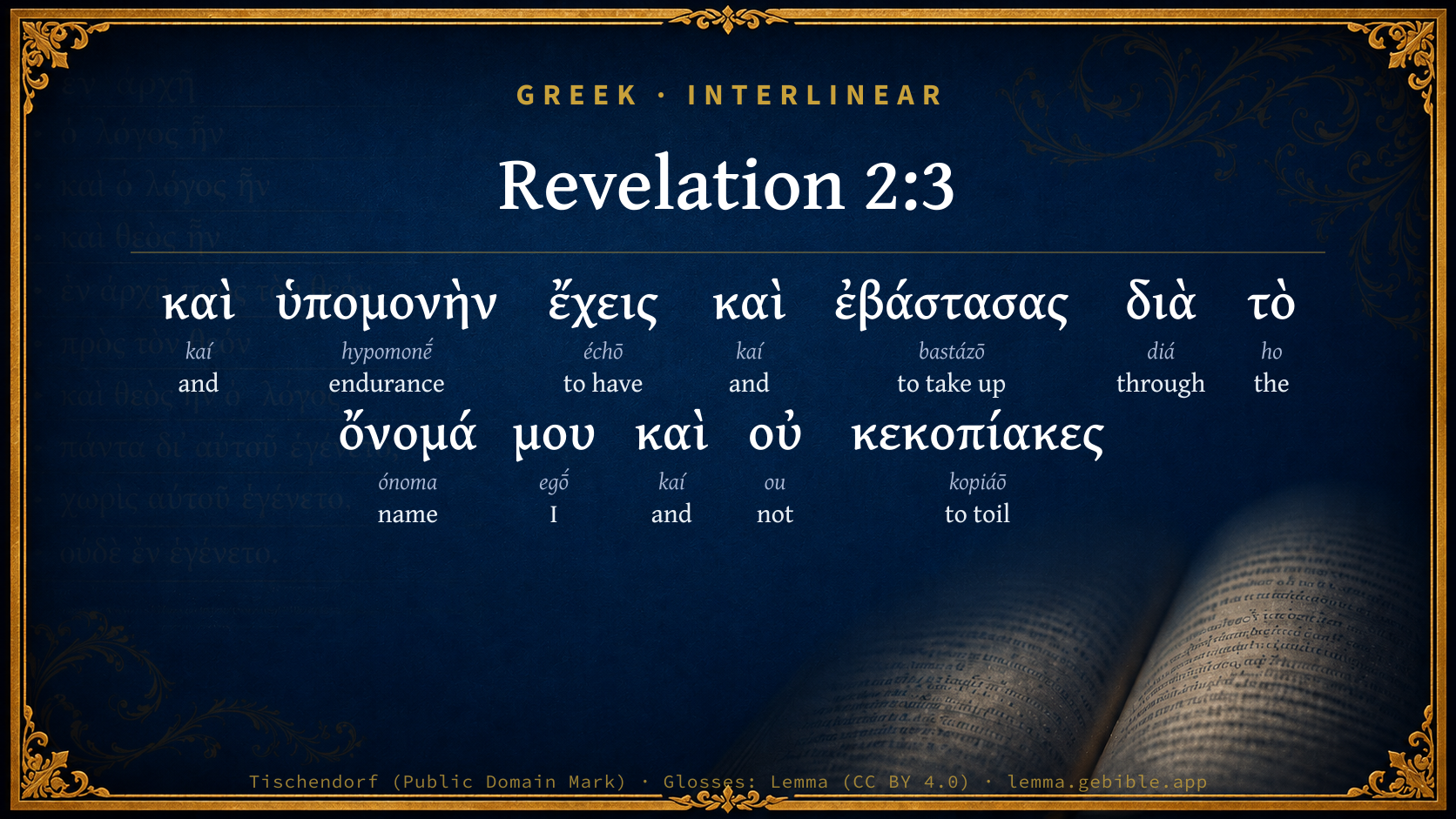
You have perseverance and have endured for my name's sake, and have not grown weary.
Download a study sheet
One document with this verse’s original text, its word-by-word gloss line, the meaning frame, cross-references with their text, attributed commentary, and full source and license credits — printable, and it pastes into notes with its structure intact.
This verse Autodidact and up
A passage Seminary Student
Up to 50 verses in one chapter. A passage sheet keeps up to 6 commentary sources and 12 cross-references per verse, in the order this page ranks them, and says so on the sheet whenever that leaves anything out. Ask for a single verse and you get the Autodidact verse sheet above.
Everything on this page stays free to read, with no account — the sheet is a download of what is already on screen, not access to it.
Compare translations 3
The same verse in 3 English versions, stacked beneath the original-language interlinear above. Click any original word for its lexicon entry.
Each is an independent rendering of the whole verse — the interlinear is not word-aligned to these translations.
Highlighted words mark where these versions differ — a whole-verse word diff, not a word-by-word alignment.
-
World English Bible Public Domain
You have perseverance and have endured for my name's sake, and have not grown weary.
-
King James Version Public Domain
And hast borne, and hast patience, and for my name's sake hast laboured, and hast not fainted.
-
unfoldingWord Literal Text CC BY-SA 4.0
and you have endurance and have suffered because of my name and have not grown weary.
unfoldingWord Literal Text — © unfoldingWord, licensed CC BY-SA 4.0. Word-aligned USFM3 via Door43 (git.door43.org/unfoldingWord/en_ult).
Show all 19 translations
Every available English version of this verse, each an independent rendering of the whole verse.
-
World English Bible Public Domain
You have perseverance and have endured for my name's sake, and have not grown weary.
-
Berean Standard Bible Public Domain
Without growing weary, you have persevered and endured many things for the sake of My name.
-
Majority Standard Bible Public Domain
Without growing weary, you have persevered and endured many things for the sake of My name.
-
King James Version Public Domain
And hast borne, and hast patience, and for my name's sake hast laboured, and hast not fainted.
-
American Standard Version (1901) Public Domain
and thou hast patience and didst bear for my name's sake, and hast not grown weary.
-
Revised Version (1885) Public Domain
and thou hast patience and didst bear for my name’s sake, and hast not grown weary.
-
Geneva Bible (1599) Public Domain
And thou wast burdened, and hast patience, and for my Names sake hast laboured, and hast not fainted.
-
Douay-Rheims (1899) Public Domain
And thou hast patience, and hast endured for my name, and hast not fainted.
-
Young's Literal Translation Public Domain
and thou didst bear, and hast endurance, and because of my name hast toiled, and hast not been weary.
-
Literal Standard Version CC BY-SA 4.0
and you bore, and have endurance, and have toiled because of My Name, and have not been weary.
-
Unlocked Literal Bible CC BY-SA 4.0
I know you have patient endurance, and you have suffered much because of my name, and that you have not grown weary.
-
unfoldingWord Literal Text CC BY-SA 4.0
and you have endurance and have suffered because of my name and have not grown weary.
-
Darby Bible Public Domain
and endurest, and hast borne for my name's sake, and hast not wearied:
-
World Messianic Bible Public Domain
You have perseverance and have endured for my name’s sake, and have not grown weary.
-
Webster's Bible Public Domain
And hast borne, and hast patience, and for my name's sake hast labored, and hast not fainted.
-
Free Bible Version CC BY-SA 4.0
I know about your patience, and what you endured for my sake—and that you didn't give up!
-
Bible in Basic English Public Domain
And you have the power of waiting, and have undergone trouble because of my name, without weariness.
-
Text-Critical English NT CC BY 4.0
Yoʋ have persevered and endured hardships for the sake of my name, and have not grown weary.
-
Tyndale New Testament (1534) Public Domain
and dydest wasshe thy self. And hast pacience: and for my names sake hast labored and hast not faynted.
Literal Standard Version (2020), Covenant Press — licensed CC BY-SA 4.0. Text via the HelloAO Bible API (eBible.org). Unlocked Literal Bible (unfoldingWord) — licensed CC BY-SA 4.0. Text via the HelloAO Bible API (eBible.org). unfoldingWord Literal Text — © unfoldingWord, licensed CC BY-SA 4.0. Word-aligned USFM3 via Door43 (git.door43.org/unfoldingWord/en_ult). Free Bible Version, Dr. Jonathan Gallagher — licensed CC BY-SA 4.0. Text via the HelloAO Bible API (eBible.org).
Word by word
More ways to search: Search by grammar → Find every occurrence → Compare this word →
Practice this passage: Drill this verse → Learn its vocabulary →
- Appears 22× in the Greek New Testament
- First appears at Matthew 6:28
- Part of Speech
- Verb
- Tense
- Perfect
- Voice
- Active
- Mood
- Participle
- Case
- Nominative
- Number
- Plural
- Gender
- Masculine
Full Thayer's Definition
- καὶ kaí G2532 “and” Conjunction
- ὑπομονὴν hypomonḗ G5281 “endurance” Noun, Accusative, Singular, Feminine
- ἔχεις échō G2192 “to have” Verb, Present, Active, Indicative, 2nd person, Singular
- καὶ kaí G2532 “and” Conjunction
- ἐβάστασας bastázō G941 “to take up” Verb, Aorist, Active, Indicative, 2nd person, Singular
- διὰ diá G1223 “through” Preposition
- τὸ ho G3588 “the” Article, Accusative, Singular, Neuter
- ὄνομά ónoma G3686 “name” Noun, Accusative, Singular, Neuter
- μου egṓ G1473 “I” Personal pronoun, 1st person, Genitive, Singular
- καὶ kaí G2532 “and” Conjunction
- οὐ ou G3756 “not” Particle, Negative
- κεκοπίακες kopiáō G2872 “to toil” Verb, Perfect, Active, Participle, Nominative, Plural, Masculine
About this verse
These counts appear in no published source. They are computed here, from the morphology-tagged text and Lemma’s own curated glosses. What Lemma adds →
- 12
- words
- 10
- distinct lemmas
- Revelation
- section
Notable vocabulary
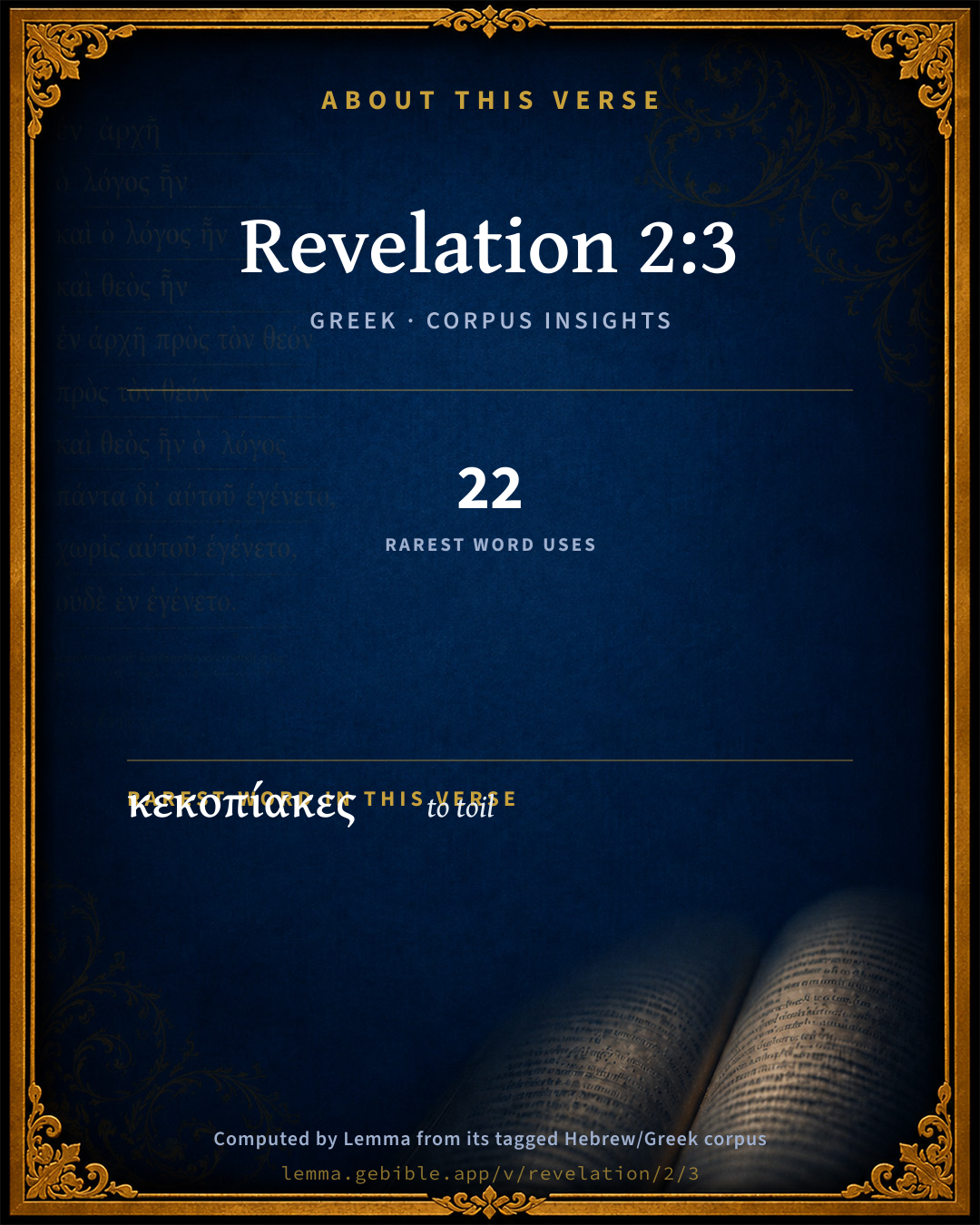
The rarest word here is κεκοπίακες to toil G2872 — appearing just 22 times in the whole Greek New Testament.
Shared distinctive vocabulary
κεκοπίακες to toil G2872 occurs in 20 verses of the Greek New Testament. Also found in:
Repetition
A word recurs within this verse:
- καὶ and G2532 ×3
Cross-references
48Topical passages linked to Revelation 2:3 in the Treasury of Scripture Knowledge — connected by theme and wording, ordered by reader-vote popularity; previews shown in the World English Bible.
- Hebrews 10:36 For you need endurance so that, having done the will of God, you may receive the promise.
- Galatians 6:9 Let us not be weary in doing good, for we will reap in due season, if we don't give up.
- James 5:7–11 Be patient therefore, brothers, until the coming of the Lord. Behold, the farmer waits for the precious fruit of the earth, being patient over it, until it receives the early and late rain.
- Hebrews 12:1 Therefore let us also, seeing we are surrounded by so great a cloud of witnesses, lay aside every weight and the sin which so easily entangles us, and let us run with patience the race that is set before us,
- James 1:3–4 knowing that the testing of your faith produces endurance.
- Colossians 1:11 strengthened with all power, according to the might of his glory, for all endurance and perseverance with joy;
- John 15:21 But all these things will they do to you for my name's sake, because they don't know him who sent me.
- Hebrews 6:12 that you won't be sluggish, but imitators of those who through faith and patience inherited the promises.
- Hebrews 6:15 Thus, having patiently endured, he obtained the promise.
- Psalms 37:7 Rest in Yahweh, and wait patiently for him. Don't fret because of him who prospers in his way, Because of the man who makes wicked plots happen.
- Romans 5:3–4 Not only this, but we also rejoice in our sufferings, knowing that suffering works perseverance;
- Romans 12:12 rejoicing in hope; enduring in troubles; continuing steadfastly in prayer;
- 1 Corinthians 13:7 bears all things, believes all things, hopes all things, endures all things.
- 2 Thessalonians 3:13 But you, brothers, don't be weary in doing well.
- 1 Timothy 4:10 For to this end we both labor and suffer reproach, because we have set our trust in the living God, who is the Savior of all men, especially of those who believe.
- Luke 14:27 Whoever doesn't bear his own cross, and come after me, can't be my disciple.
- Romans 8:25 But if we hope for that which we don't see, we wait for it with patience.
- 2 Corinthians 4:1 Therefore seeing we have this ministry, even as we obtained mercy, we don't faint.
- 2 Corinthians 4:16 Therefore we don't faint, but though our outward man is decaying, yet our inward man is renewed day by day.
- 2 Corinthians 11:23 Are they servants of Christ? (I speak as one beside himself) I am more so; in labors more abundantly, in prisons more abundantly, in stripes above measure, in deaths often.
- Hebrews 6:10 For God is not unrighteous, so as to forget your work and the labor of love which you showed toward his name, in that you served the saints, and still do serve them.
- Hebrews 12:3–5 For consider him who has endured such contradiction of sinners against himself, that you don't grow weary, fainting in your souls.
- 1 Thessalonians 1:3 remembering without ceasing your work of faith and labor of love and patience of hope in our Lord Jesus Christ, before our God and Father.
- 2 Peter 1:6 and in knowledge, self-control; and in self-control patience; and in patience godliness;
- Revelation 1:9 I John, your brother and partner with you in oppression, Kingdom, and perseverance in Christ Jesus, was on the isle that is called Patmos because of God's Word and the testimony of Jesus Christ.
- Revelation 3:10 Because you kept my command to endure, I also will keep you from the hour of testing, which is to come on the whole world, to test those who dwell on the earth.
- Luke 8:15 That in the good ground, these are such as in an honest and good heart, having heard the word, hold it tightly, and bring forth fruit with patience.
- Luke 18:1 He also spoke a parable to them that they must always pray, and not give up,
- Romans 2:7 to those who by patience in well-doing seek for glory and honor and incorruptibility, eternal life;
- Romans 15:4–5 For whatever things were written before were written for our learning, that through patience and through encouragement of the Scriptures we might have hope.
- 2 Corinthians 5:9 Therefore also we make it our aim, whether at home or absent, to be well pleasing to him.
- Psalms 69:7 Because for your sake, I have borne reproach. Shame has covered my face.
- Micah 7:9 I will bear the indignation of Yahweh, Because I have sinned against him, Until he pleads my case, and executes judgment for me. He will bring me forth to the light. I will see his righteousness.
- Mark 15:21 They compelled one passing by, coming from the country, Simon of Cyrene, the father of Alexander and Rufus, to go with them, that he might bear his cross.
- Luke 21:19 By your endurance you will win your lives.
- Romans 16:12 Greet Tryphaena and Tryphosa, who labor in the Lord. Greet Persis, the beloved, who labored much in the Lord.
- 2 Corinthians 6:5 in beatings, in imprisonments, in riots, in labors, in watchings, in fastings;
- 2 Corinthians 10:15 not boasting beyond proper limits in other men's labors, but having hope that as your faith grows, we will be abundantly enlarged by you in our sphere of influence,
- Galatians 6:2 Bear one another's burdens, and so fulfill the law of Christ.
- Philippians 2:16 holding up the word of life; that I may have something to boast in the day of Christ, that I didn't run in vain nor labor in vain.
- Philippians 4:3 Yes, I beg you also, true yoke-fellow, help these women, for they labored with me in the Gospel, with Clement also, and the rest of my fellow workers, whose names are in the book of life.
- 1 Thessalonians 2:9 For you remember, brothers, our labor and travail; for working night and day, that we might not burden any of you, we preached to you the Gospel of God.
- 2 Thessalonians 3:5 May the Lord direct your hearts into the love of God, and into the patience of Christ.
- 2 Thessalonians 3:8 neither did we eat bread from anyone's hand without paying for it, but in labor and travail worked night and day, that we might not burden any of you;
- 1 Timothy 5:17 Let the elders who rule well be counted worthy of double honor, especially those who labor in the word and in teaching.
- Hebrews 13:13 Let us therefore go forth to him outside of the camp, bearing his reproach.
- 1 Corinthians 16:16 that you also be in subjection to such, and to everyone who helps in the work and labors.
- 1 Thessalonians 5:12 But we beg you, brothers, to know those who labor among you, and are over you in the Lord, and admonish you,
Cross-references courtesy of OpenBible.info (CC BY 4.0).
Where the printed editions differ
1 variantPlaces in this verse where the major printed Greek editions disagree on the wording in a way that affects the translation — a comparison of editions, not a manuscript-by-manuscript collation. The editions are the modern critical texts (Nestlé-Aland 28/27, SBL, Westcott-Hort, Tregelles, Tyndale House) and the traditional texts behind the KJV (the Textus Receptus and the Byzantine/Majority text). It is not a claim about which reading is original.
-
Extra text
κεκοπίακας
“have laboured”
In TR Not in NA28NA27TynSBLWHTregByzκεκοπίακας (kekopiakas) 'have laboured' is only in traditional manuscripts (TR)
Textual data: Translators Amalgamated Greek New Testament (STEPBible TAGNT) · CC BY 4.0.
Lesson kit
Teaching starters — assembled from the data on this page, not authored interpretation. Every prompt links to the verse data it draws on. Edit before teaching.
Revelation, in the Revelation, opens this verse with 12 words (10 distinct Greek lemmas). Its most distinctive word is kopiáō (“to toil”). A historical commentator’s framing appears above. Read the whole chapter for the surrounding context.
Discussion questions
- How does “to toil” (kopiáō) shape what this verse is saying?
- Matthew 6:28 shares the word «to toil» with this verse. How do the two illuminate each other?
- “and” occurs 3× in this one verse. What is the effect of the repetition?
- These translations render this verse differently; the difference is in the English rendering, not the original. What questions does that raise?
- Reading how Bengel's Gnomon and Meyer's Critical & Exegetical Commentary read this verse, where do the two commentators agree and where do they part?
Things to notice
- These translations choose different wording for 16 words in this verse.
- “and” occurs 3× in this single verse.
- 10 distinct Greek lemmas span 12 words in this verse.
Commentary
Notes on Revelation 2:3 from classic Christian and Jewish commentators (each source and its license shown beneath its notes). The classic Christian expositions comment on the surrounding passage and are grouped to its opening verse, so a note may address several verses; the Jewish commentaries on the Tanakh (Rashi and others) are per-verse, so they appear only where the commentator wrote on this verse.
Lemma curates 59 commentaries, every one of them public domain or Creative Commons licensed, each selected and text-cleaned for this edition rather than reprinted as found. About our sources →
Bengel's Gnomon
Johann Albrecht Bengel
Bengel's Gnomon of the New Testament — English translation (T&T Clark, Edinburgh, 1860) — public domain. Text from a community e-Sword module.
Meyer's Critical & Exegetical Commentary
Heinrich August Wilhelm Meyer
Meyer — Critical and Exegetical Commentary on the New Testament — English translation by Peter Christie, edited by Frederick Crombie (T&T Clark, 1880) — public domain. Text from a community e-Sword module.
Expositor's Greek Testament
ed. W. Robertson Nicoll
The Expositor's Greek Testament, edited by W. Robertson Nicoll (1897–1910) — public domain. Text from a community e-Sword module.
Jamieson, Fausset & Brown
Robert Jamieson, A. R. Fausset & David Brown
Jamieson, Fausset & Brown — Commentary Critical and Explanatory on the Whole Bible (1871) — public domain (CC PDM 1.0). Text via the HelloAO Bible API.
Adam Clarke's Commentary
Adam Clarke's Commentary on the Bible (1810–1826) — public domain. Text from a community e-Sword/MySword module.
Ellicott's Commentary for English Readers
A Bible Commentary for English Readers, edited by Charles John Ellicott (1878–1897) — public domain. Text from a community e-Sword module.
The Cambridge Bible for Schools and Colleges
gen. ed. J. J. S. Perowne
The Cambridge Bible for Schools and Colleges (gen. ed. J. J. S. Perowne; Cambridge University Press, 1878–1918) — public domain. Text from a community e-Sword module.
John Gill's Exposition
John Gill's Exposition of the Whole Bible (1746–1763) — public domain (CC PDM 1.0). Text via the HelloAO Bible API.
Trapp's Complete Commentary
John Trapp
John Trapp, A Commentary or Exposition upon All the Books of the Old and New Testament (1647–1656) — public domain. Text from a community e-Sword module.
Albert Barnes' Notes on the Bible
Albert Barnes' Notes on the Bible (1834–1885) — public domain. Text from a community e-Sword/MySword module.
Matthew Poole's English Annotations
Matthew Poole's English Annotations on the Holy Bible (1683–1685) — public domain. Text from a community e-Sword/MySword module.
Whedon's Commentary on the Bible
Daniel D. Whedon
Daniel D. Whedon (gen. ed.), Commentary on the Old and New Testaments (1874–1909) — public domain. Text from a community e-Sword module.
The Pulpit Commentary
The Pulpit Commentary (1880–1919), ed. H.D.M. Spence-Jones & Joseph S. Exell — public domain. Text from a community e-Sword module.
The People's New Testament
B. W. Johnson
B. W. Johnson's The People's New Testament with Notes (1889–1891) — public domain. Electronic text from the Christian Classics Ethereal Library (CCEL) ThML edition.
unfoldingWord translationNotes
Door43 World Missions Community
unfoldingWord translationNotes — © Distant Shores Media and the Door43 World Missions Community, licensed CC BY-SA 4.0. Source: git.door43.org/Door43/en_tn.
Cambridge Greek Testament for Schools and Colleges
Cambridge Greek Testament for Schools and Colleges (Cambridge University Press, 1896; 21 vols, various authors incl. Carr, Maclear, Plummer, Farrar, Lumby, Moule, M. R. James, Simcox) — public domain. Text from a community e-Sword module.
Vincent's Word Studies in the New Testament
Marvin R. Vincent
Marvin R. Vincent, Word Studies in the New Testament (1887–1900) — public domain. Text from a community e-Sword/MySword module.