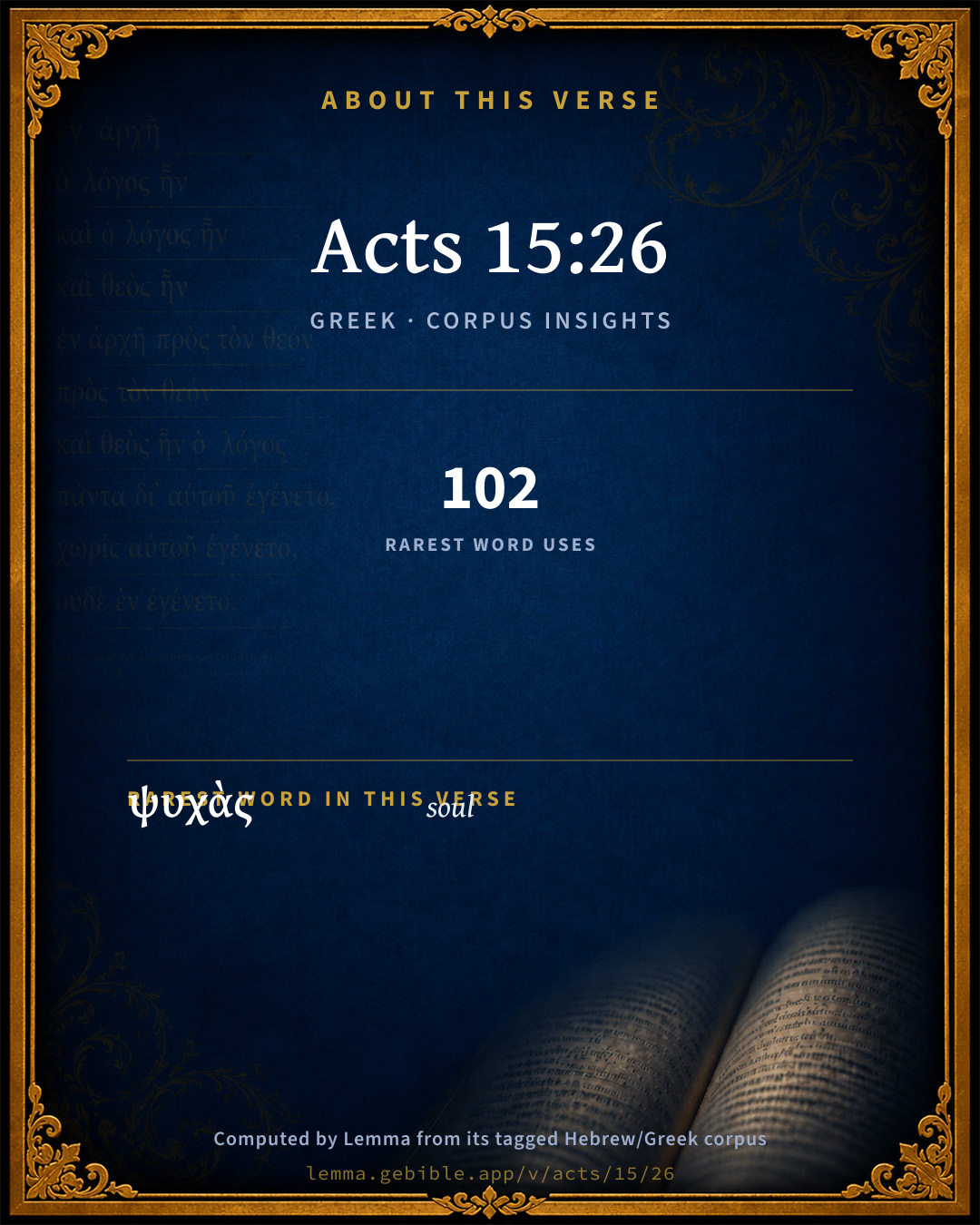
Acts 15:26

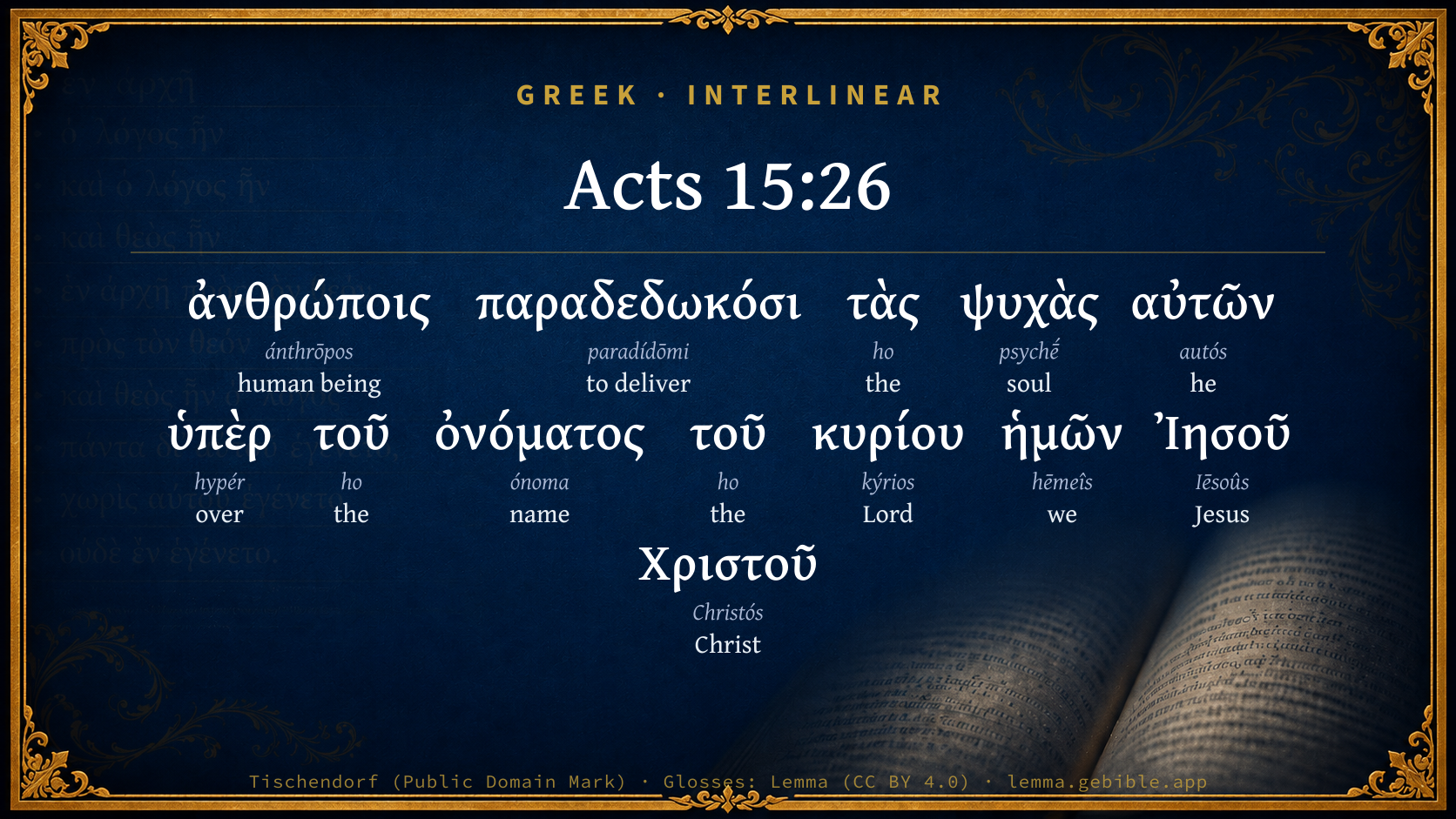
Greek (Tischendorf 8th ed.) Acts 15:26 appears in the Greek New Testament. The text above is from the Tischendorf 8th edition. Each word links to its Strong’s number and a concise gloss. Click any word for its full Thayer’s Greek Lexicon entry.
Download image
Cite this verse

Acts 15:26 (World English Bible). Public Domain. Lemma interlinear Bible study tool, https://lemma.gebible.app/v/acts/15/26.

Show BibTeX & RIS
BibTeX
RIS
English Translation
men who have risked their lives for the name of our Lord Jesus Christ.
World English Bible · Public Domain
Download a study sheet

One document with this verse’s original text, its word-by-word gloss line, the meaning frame, cross-references with their text, attributed commentary, and full source and license credits — printable, and it pastes into notes with its structure intact.

This verse Autodidact and up

Study sheet (.html) Plain text (.txt)

A passage Seminary Student

Up to 50 verses in one chapter. A passage sheet keeps up to 6 commentary sources and 12 cross-references per verse, in the order this page ranks them, and says so on the sheet whenever that leaves anything out. Ask for a single verse and you get the Autodidact verse sheet above.

Everything on this page stays free to read, with no account — the sheet is a download of what is already on screen, not access to it.

Want to remove ads? Support Godless Engineer
Compare translations 3

The same verse in 3 English versions, stacked beneath the original-language interlinear above. Click any original word for its lexicon entry.

Each is an independent rendering of the whole verse — the interlinear is not word-aligned to these translations.

Highlighted words mark where these versions differ — a whole-verse word diff, not a word-by-word alignment.

  • World English Bible Public Domain
    men who have risked their lives for the name of our Lord Jesus Christ.
  • King James Version Public Domain
    Men that have hazarded their lives for the name of our Lord Jesus Christ.
  • unfoldingWord Literal Text CC BY-SA 4.0
    men having handed over their souls for the name of our Lord Jesus Christ.

unfoldingWord Literal Text — © unfoldingWord, licensed CC BY-SA 4.0. Word-aligned USFM3 via Door43 (git.door43.org/unfoldingWord/en_ult).

Versions to compare (up to 4)

3 of 4 selected

Show all 19 translations

Every available English version of this verse, each an independent rendering of the whole verse.

  • World English Bible Public Domain
    men who have risked their lives for the name of our Lord Jesus Christ.
  • Berean Standard Bible Public Domain
    men who have risked their lives for the name of our Lord Jesus Christ.
  • Majority Standard Bible Public Domain
    men who have risked their lives for the name of our Lord Jesus Christ.
  • King James Version Public Domain
    Men that have hazarded their lives for the name of our Lord Jesus Christ.
  • American Standard Version (1901) Public Domain
    men that have hazarded their lives for the name of our Lord Jesus Christ.
  • Revised Version (1885) Public Domain
    men that have hazarded their lives for the name of our Lord Jesus Christ.
  • Geneva Bible (1599) Public Domain
    Men that haue giuen vp their liues for the Name of our Lord Iesus Christ.
  • Douay-Rheims (1899) Public Domain
    Men that have given their lives for the name of our Lord Jesus Christ.
  • Young's Literal Translation Public Domain
    men who have given up their lives for the name of our Lord Jesus Christ --
  • Literal Standard Version CC BY-SA 4.0
    men who have given up their lives for the Name of our Lord Jesus Christ—
  • Unlocked Literal Bible CC BY-SA 4.0
    men who have risked their lives for the name of our Lord Jesus Christ.
  • unfoldingWord Literal Text CC BY-SA 4.0
    men having handed over their souls for the name of our Lord Jesus Christ.
  • Darby Bible Public Domain
    men who have given up their lives for the name of our Lord Jesus Christ.
  • World Messianic Bible Public Domain
    men who have risked their lives for the name of our Lord Yeshua the Messiah.
  • Webster's Bible Public Domain
    Men that have hazarded their lives for the name of our Lord Jesus Christ.
  • Free Bible Version CC BY-SA 4.0
    who have risked their lives for the name of our Lord Jesus Christ.
  • Bible in Basic English Public Domain
    Men who have given up their lives for the name of our Lord Jesus Christ.
  • Text-Critical English NT CC BY 4.0
    who have risked their lives for the name of our Lord Jesus Christ.
  • Tyndale New Testament (1534) Public Domain
    men that have ieoperded their lyves for the name of oure Lorde Iesus Christ.

Literal Standard Version (2020), Covenant Press — licensed CC BY-SA 4.0. Text via the HelloAO Bible API (eBible.org). Unlocked Literal Bible (unfoldingWord) — licensed CC BY-SA 4.0. Text via the HelloAO Bible API (eBible.org). unfoldingWord Literal Text — © unfoldingWord, licensed CC BY-SA 4.0. Word-aligned USFM3 via Door43 (git.door43.org/unfoldingWord/en_ult). Free Bible Version, Dr. Jonathan Gallagher — licensed CC BY-SA 4.0. Text via the HelloAO Bible API (eBible.org).

Word by word

More ways to search: Search by grammar → Find every occurrence → Compare this word →

Practice this passage: Drill this verse → Learn its vocabulary →

ψυχὰς
psychḗ
G5590
“soul”
Noun, Accusative, Plural, Feminine
Part of Speech
Noun
Case
Accusative
Number
Plural
Gender
Feminine
Full Thayer's Definition

Origin: from G5594

TDNT: 19:08,1

1. breath a. the breath of life 1. the vital force which animates the body and shows itself in breathing 1a b. of animals 1a 2. of men a. life b. that in which there is life 1. a living being, a living soul 3. the soul a. the seat of the feelings, desires, affections, aversions (our heart, soul etc.) b. the (human) soul in so far as it is constituted that by the right use of the aids offered it by God it can attain its highest end and secure eternal blessedness, the soul regarded as a moral being designed for everlasting life c. the soul as an essence which differs from the body and is not dissolved by death (distinguished from other parts of the body)
  1. ἀνθρώποις ánthrōpos G444 “human being” Noun, Dative, Plural, Masculine
  2. παραδεδωκόσι paradídōmi G3860 “to deliver” Verb, Perfect, Active, Participle, Dative, Plural, Masculine
  3. τὰς ho G3588 “the” Article, Accusative, Plural, Feminine
  4. αὐτῶν autós G846 “he” Personal pronoun, Genitive, Plural, Masculine
  5. ὑπὲρ hypér G5228 “over” Preposition
  6. τοῦ ho G3588 “the” Article, Genitive, Singular, Neuter
  7. ὀνόματος ónoma G3686 “name” Noun, Genitive, Singular, Neuter
  8. τοῦ ho G3588 “the” Article, Genitive, Singular, Masculine
  9. κυρίου kýrios G2962 “Lord” Noun, Genitive, Singular, Masculine
  10. ἡμῶν hēmeîs G2249 “we” Personal pronoun, 1st person, Genitive, Plural
  11. Ἰησοῦ Iēsoûs G2424 “Jesus” Noun, Genitive, Singular, Masculine
  12. Χριστοῦ Christós G5547 “Christ” Noun, Genitive, Singular, Masculine

About this verse

These counts appear in no published source. They are computed here, from the morphology-tagged text and Lemma’s own curated glosses. What Lemma adds →

13
words
11
distinct lemmas
Acts
section

Repetition

A word recurs within this verse:

Cross-references

7

Topical passages linked to Acts 15:26 in the Treasury of Scripture Knowledge — connected by theme and wording, ordered by reader-vote popularity; previews shown in the World English Bible.

  • Acts 14:19 But some Jews from Antioch and Iconium came there, and having persuaded the multitudes, they stoned Paul, and dragged him out of the city, supposing that he was dead.
  • Acts 9:23–25 When many days were fulfilled, the Jews conspired together to kill him,
  • Philippians 2:29–30 Receive him therefore in the Lord with all joy, and hold such in honor,
  • 1 Corinthians 15:30 Why do we also stand in jeopardy every hour?
  • 2 Corinthians 11:23–27 Are they servants of Christ? (I speak as one beside himself) I am more so; in labors more abundantly, in prisons more abundantly, in stripes above measure, in deaths often.
  • Judges 5:18 Zebulun was a people that jeopardized their lives to the death, Naphtali, on the high places of the field.
  • Acts 13:50 But the Jews stirred up the devout and prominent women and the chief men of the city, and stirred up a persecution against Paul and Barnabas, and threw them out of their borders.

Cross-references courtesy of OpenBible.info (CC BY 4.0).

Commentary

Notes on Acts 15:26 from classic Christian and Jewish commentators (each source and its license shown beneath its notes). The classic Christian expositions comment on the surrounding passage and are grouped to its opening verse, so a note may address several verses; the Jewish commentaries on the Tanakh (Rashi and others) are per-verse, so they appear only where the commentator wrote on this verse.

Lemma curates 59 commentaries, every one of them public domain or Creative Commons licensed, each selected and text-cleaned for this edition rather than reprinted as found. About our sources →

Bengel's Gnomon

Johann Albrecht Bengel

Act 15:26. Παραδεδώκοσι, who have delivered up [hazarded]) and who are therefore most highly approved of men [altogether tried men].

Bengel's Gnomon of the New Testament — English translation (T&T Clark, Edinburgh, 1860) — public domain. Text from a community e-Sword module.

Expositor's Greek Testament

ed. W. Robertson Nicoll

Act 15:26 . παραδεδωκόσι τὰς ψ . α .: “hazarded their lives,” A. and R.V.; so in classical Greek, and in LXX, Dan 3:28 (95). The sufferings of the missionaries aries in their first journey were evidently well known, and appeal was fittingly made to them in recognition of their self-sacrifice, and in proof of their sincerity.

The Expositor's Greek Testament, edited by W. Robertson Nicoll (1897–1910) — public domain. Text from a community e-Sword module.

Geneva Bible (1599)

Geneva Bible translators

Have greatly hazarded their lives.

Geneva Bible (1599) marginal notes — public domain. Text via Bolls.life.

Jamieson, Fausset & Brown

Robert Jamieson, A. R. Fausset & David Brown

Men that have hazarded--literally, "rendered up," as in will they did.

their lives for the name of our Lord Jesus Christ--Noble testimony to those beloved men! It was doubtless prompted more immediately by the narrative they had just listened to from their own lips (Act 15:12), and judiciously inserted in this letter, to give them the highest weight as the bearers of it, along with their own deputies.

Judas and Silas . . . shall tell you the same . . . by mouth--Mark here how considerate and tender it was to send men who would be able to say of Barnabas and Paul what could not be expected to come from themselves.

Jamieson, Fausset & Brown — Commentary Critical and Explanatory on the Whole Bible (1871) — public domain (CC PDM 1.0). Text via the HelloAO Bible API.

Adam Clarke's Commentary

Verse 26. Men that have hazarded their lives] This was a high character of Paul and Barnabas: they had already suffered much in the cause of Christ, and exposed their lives to the most imminent danger, and were intent on the same work, notwithstanding the increasing dangers in the way.

Adam Clarke's Commentary on the Bible (1810–1826) — public domain. Text from a community e-Sword/MySword module.

Ellicott's Commentary for English Readers

(26) Men that have hazarded their lives.—It is clear from this that the narrative of the hairbreadth escapes at the Pisidian Antioch (Act_13:50) and Lystra (Act_14:19) must have been laid before the Church. Prominence is given to the fact as likely to secure reverence for those whom many had hitherto regarded with distrust.

A Bible Commentary for English Readers, edited by Charles John Ellicott (1878–1897) — public domain. Text from a community e-Sword module.

The Cambridge Bible for Schools and Colleges

gen. ed. J. J. S. Perowne

26. Men that have hazarded their lives] What the English sentence leaves uncertain the Greek makes quite plain, viz. that these words refer to Barnabas and Paul and to the many dangers into which their first missionary journey had brought them (cp. Act_13:50, Act_14:2; Act_14:5; Act_14:19).

for the name] Here, as often, name signifies the Messianic dignity and divine authority of Jesus. They have preached everywhere Jesus as the Christ.

The Cambridge Bible for Schools and Colleges (gen. ed. J. J. S. Perowne; Cambridge University Press, 1878–1918) — public domain. Text from a community e-Sword module.

John Gill's Exposition

Men that have hazarded their lives,.... As at Antioch, in Pisidia, where a persecution was raised against them, and they were expelled out of the coasts of that place; and at Lystra, where Paul was stoned, and left for dead, Act 13:50 and this they did, not for any sinister and selfish ends, for any worldly gain, or vain glory, and popular applause, but

for the name of our Lord Jesus Christ; for the sake of his Gospel, and the enlargement of his interest, and kingdom in the world; and therefore were worthy of esteem, and ought to be regarded and attended to, and greatly to be preferred to false teachers; who only sought themselves, their worldly honour, and ease, and would sacrifice nothing, nor hazard anything, for the sake of Christ.

John Gill's Exposition of the Whole Bible (1746–1763) — public domain (CC PDM 1.0). Text via the HelloAO Bible API.

Trapp's Complete Commentary

John Trapp

26 Men that have hazarded their lives for the name of our Lord Jesus Christ.

Ver. 26. Men that hazarded their lives, &c.] One ancient copy adds εις παντα πειρασμον, to all sorts of trials and tribulations. Love, as it is a passion, so it is tried rather by passions than actions.

John Trapp, A Commentary or Exposition upon All the Books of the Old and New Testament (1647–1656) — public domain. Text from a community e-Sword module.

Albert Barnes' Notes on the Bible

Men that have hazarded their lives ... - See Acts 14: This was a noble testimony to the character of Barnabas and Paul. It was a commendation of them to the confidence of the churches, and an implied expression that they wished their authority to be regarded in the establishment and organization of the church.

For the name - In the cause of the Lord Jesus.

Albert Barnes' Notes on the Bible (1834–1885) — public domain. Text from a community e-Sword/MySword module.

Matthew Poole's English Annotations

Because that the false apostles at Antioch had vilified Paul and Barnabas, and opposed their doctrine and practice in admitting of the Gentiles by baptism into the church, the council here at Jerusalem take occasion to vindicate and to commend them, especially for their suffering so much for Christ, of which we read, Act 13:50; 14:19; it being most reasonable to believe, that they had not done or said any thing for their own sakes, who had done and suffered so much for Christ and his truth’s sake.

For the name of our Lord Jesus Christ; for Christ’s honour, and the truth of his gospel.

Matthew Poole's English Annotations on the Holy Bible (1683–1685) — public domain. Text from a community e-Sword/MySword module.

Whedon's Commentary on the Bible

Daniel D. Whedon

26. Hazarded their lives—A courteous reference to the narratives given by the two apostles of their missionary journeys.

Daniel D. Whedon (gen. ed.), Commentary on the Old and New Testaments (1874–1909) — public domain. Text from a community e-Sword module.

The Pulpit Commentary

Self-sacrifice for Christ.

There are two classes of men of whom we are reminded by these words of the Jerusalem Church.

I THOSE WHO ARE READY TO SACRIFICE THEIR LIVES FOR ANYTHING AND EVERYTHING BUT THE BEST AND HIGHEST. The soldier for victory; the sportsman for excitement; the explorer for the gratification of curiosity; the Alpine climber for credit; the artist for fame; the sailor for love of the sea, etc. There is no lack of men who risk life for something. But we have to consider that while

(1) there is a touch of nobility in some of these cases which wins our admiration; yet

(2) often the end is not worth the sacrifice, life and all that life means to its holder and to those who are related to him and dependent on him are too precious to be parted with for a slight object, too valuable to be sacrificed for any but a serious and great end. And

(3) when thus lost, it is often laid down from instinct or passion rather than from principle. There is something essentially unsatisfactory in it; for it is a material loss with no corresponding gain. It brings sadness to the heart, loneliness and misery to the home, and does not bring adequate consolation to the mind.

II THOSE WHO RECOGNIZE THE HIGHEST AND THE BEST BUT SACRIFICE LITTLE OR NOTHING TO IT. We should, perhaps, say to him; for:

1. The highest and best meet in a living One, even Jesus Christ. It is, indeed, to honor his Name (see text), but it is also and chiefly to exalt and extol him and make him very high (Isa_52:13) in the estimation and affection of the world, that his servants strive and suffer.

2. Ourselves and all that we have are his due; therefore our lives, when he asks us to lay them down at his feet.

3. There are those who recognize his claim, but do not comply with his desire. There are those who do; men that have hazarded their lives for Jesus Christ, from Paul and Barnabas down to our own Christian martyrs; men and women who, on various fields of holy, daring, and heroic suffering, have cheerfully sacrificed all to honor him and do his bidding; but there are too many that acknowledge the validity of his claim but do not respond to his call. There are in our congregations and even in our Churches

(1) men who withhold themselves from missionary or ministerial service, because, though well fitted for it, they are not prepared to make the necessary sacrifices;

(2) men that will not step into the breach when some other kind of holy activity is demanded, because they shrink from the burdens or the annoyances it will entail;

(3) men that will not encourage some good work of Christ, because, to do so, they must part with that which the world counts precious. These are far from being numbered with the "good and faithful servants. C.

Spiritual heroism.

"Men that have hazarded their lives," etc.

I THE POWER OF CHRIST"S NAME.

1. Those who were ready to die for him must have accepted him as the fulfillment of all their hopes. The previous position of Paul and Barnabas instructive as showing what the Name of Christ was to them.

2. No mere change of creed so expressed. A personal affection at the root of their heroism. The self-sacrifice not only proved sincerity, but exemplified the transforming and ennobling power of the gospel.

II THE INFLUENCE OF HEROIC EXAMPLES.

1. In strengthening faith.

2. In stimulating feeling. The Christianity of the present time apt to languish for lack of such influence. Times of great danger to the Church times of great testimony. The Effect of missionary zeal in promoting the growth of character.

3. The true leaders of the Church should be foremost in devotion. Apostolic zeal very different from ecclesiastical fanaticism. The world bows before spiritual might. R.

The highest Christian commendation.

Nothing could be said more fitted to ensure the confidence of the Churches in the messengers sent from the conference than this description: "Men that have hazarded their lives for the Name of our Lord Jesus." It may be observed that men have established this test of sincerity, nobility, or belief in any truth: "Could the man stake his life on it?" "Was he willing to die for it?" The heroic traveler is the man who stakes his life on his purpose, as did Livingstone. The heroic soldiers are they who volunteer for the forlorn hope, and die to serve their country. The heroic martyrs are the men who can die for their faith and opinion. No man"s faith has come under the full testing unless, in some form, it is proved whether he will die for it. The sublimest of all illustrations is found in our Lord"s purpose of perfect obedience to his Father"s will. That purpose came under many and various testings, but we could not feel that it was perfect, and indeed the infinite example, if he had not kept it through the trial of that agonizing death, He not only "hazarded," he actually yielded his life in maintaining that obedience. By the same test Barnabas and Paul had been proved, and in their first missionary journey their lives had again and again been in peril; once indeed Paul had been left for dead after the riotous stoning of the populace. (Act_13:50 Act_14:19) From the Christian standpoint the noblest and best men are

I THOSE WHO CAN SACRIFICE SELF. Self-seeking is the marked characteristic of the unrenewed man, toned, however, by amiability, kindness of disposition, generosity, motherhood, etc., as elements of the natural character. Self-denial is the highest conception of purely human virtue, and is the noblest adornment of human character. In a thousand forms "self-denial" is demanded in our common life and relations; and none of the responsible positions in life can be occupied without this virtue being demanded. Self-sacrifice is seldom required; but the man who can meet this demand gains the first place in the world"s esteem. Illustrate by the doctor who dies for his patient; the mother who dies for her child; the rescuer who dies in rescuing; the missionary who yields his life in his mission, The extreme demand may not always be made; it often has to be faced. And we may test our own hold of truth, duty, or hope, by putting to ourselves this question, "Could I die for it?" Show what kind of moral Power the heroic leaders in self-sacrifice gain over their fellows.

1. They declare that duty is before pleasure.

2. They attest the grandeur of a cherished idea.

3. They glorify the conception of right.

4. They uphold faith in God.

5. They affirm the insignificance of this life in view of the life that is to come.

6. They keep up the standard of life for us all; and are, as angel-ministrants, ever beckoning us on to higher and nobler things.

II THOSE WHO CAN SACRIFICE SELF FOR THE SAKE OF CHRIST"S NAME. Taken in two senses:

1. For the sake of upholding the honor of Christ"s Name, seeing that he is ever honored in the conduct of his servants. Men praise him through what they see of him in us. He "laid down his life for us, and we ought to lay down our lives for the brethren.

2. For the sake of making witness for Christ. No witness can have the power of a martyrdom. Illustrate Stephen"s witness in his death.

(1) Self-sacrifice sets Christ up in the view of men, for all gather round the martyr, and wonder over his calmness and victory.

(2) Self-sacrifice proves the truth of doctrine (see Paley"s argument from the persecutions and sufferings of the early teachers).

(3) Self-sacrifice for Christ impresses upon us the extraordinary fascination which the Lord Jesus can exert on men"s souls. How we must love those for whom we are willing to die! None can take our love so that for the sake of it we will yield our life, as does the Lord Jesus Christ. Conclude by showing that passing ages do not change the Divine demands, only change the forms in which they find expression. The heroic life of self-denial in many things, and even of self-sacrifice sometimes, as our witness to Christ, is still demanded, in these indulgent times, of all who name the Name of the Lord Jesus. R.T.

The Pulpit Commentary (1880–1919), ed. H.D.M. Spence-Jones & Joseph S. Exell — public domain. Text from a community e-Sword module.

John Wesley's Explanatory Notes

Men that have hazarded their lives - This is spoken of Paul and Barnabas.

John Wesley, Explanatory Notes Upon the Whole Bible (1754–1765) — public domain. Text via the GEBible commentary corpus.

McGarvey & Pendleton's Commentaries

J. W. McGarvey

See notes on verse 22

J. W. McGarvey (with Philip Y. Pendleton), Commentaries on the New Testament (The Fourfold Gospel, 1914; Acts; and the epistles) — public domain. Text from a community e-Sword/MySword module.

Cambridge Greek Testament for Schools and Colleges

26. ἀνθρώποις παραδεδωκόσι τὰς ψυχὰς αὐτῶν, men that have hazarded their lives. This Paul and Barnabas had done on several occasions. (See Act 13:50, Act 14:2; Act 14:5; Act 14:19.)

ὑπὲρ τοῦ ὀνόματος, for the name. Here, as often, name signifies the Messianic dignity and divine authority of Jesus. They have preached everywhere Jesus as the Christ.

Cambridge Greek Testament for Schools and Colleges (Cambridge University Press, 1896; 21 vols, various authors incl. Carr, Maclear, Plummer, Farrar, Lumby, Moule, M. R. James, Simcox) — public domain. Text from a community e-Sword module.

Alford’s Greek Testament

Henry Alford

26. παραδ. τ. ψ.] See reff. The sacrifice of their lives was made by them: they were martyrs in will, though their lives had not as yet been laid down in point of fact.

This is mentioned to shew that Paul and Barnabas could have no other motive than that of serving the Lord Jesus Christ, and to awaken trust in the minds of the churches. But, although this was so, the Apostles and Elders did not think proper to send only Paul and Barnabas, who were already so deeply committed by their acts to the same side of the question as the letter which they bore,—but as direct authorities from themselves, Judas and Silas also, who might by word confirm the contents of the Epistle. On the present part. (ἀπαγγ.) see reff. and Winer, edn. 6, § 45. 1. One account of it is, that during the mission implied in ἀπεστάλκαμεν they would be ἀπαγγέλλοντες. But a far more probable one, that the pres. part. here, as so often, designates merely, carrying rather a logical than a chronological force: “as announcers of.”

Henry Alford, The Greek Testament (1849–1861) — public domain. Text from a community e-Sword module.

Lesson kit

Teaching starters — assembled from the data on this page, not authored interpretation. Every prompt links to the verse data it draws on. Edit before teaching.

Acts, in the Acts, opens this verse with 13 words (11 distinct Greek lemmas). Its most distinctive word is psychḗ (“soul”). A historical commentator’s framing appears above. Read the whole chapter for the surrounding context.

Discussion questions

  1. How does “soul” (psychḗ) shape what this verse is saying?
  2. How does Acts 14:19, which shares this passage’s theme, read alongside this verse?
  3. What does the repetition of “the” (3× in this one verse) do in this verse?
  4. These translations render this verse differently; the difference is in the English rendering, not the original. What questions does that raise?
  5. Compare how Bengel's Gnomon and Expositor's Greek Testament read this verse. Where do they agree or differ?

Things to notice

Reading settings

Reading text

Shown beneath each verse's original-language words.

Old Testament
Old Testament edition

Read the OT as the Masoretic Hebrew (MT) or the Greek Septuagint (LXX).

English shown for the Greek Septuagint (in the Hebrew ↔ Greek comparison).

Comparing translations? Open the Compare panel on any verse page to stack up to four side by side.