
Genesis 26:33

Hebrew (Westminster Leningrad Codex) Genesis 26:33 appears in the Hebrew Old Testament. The text above is from the Westminster Leningrad Codex. Each word links to its Strong’s number, a concise gloss, and parsing drawn from the Open Scriptures Hebrew Bible morphology. Click any word for its full Brown-Driver-Briggs (BDB) entry.
Download image
Cite this verse

Genesis 26:33 (World English Bible). Public Domain. Lemma interlinear Bible study tool, https://lemma.gebible.app/v/genesis/26/33.

Show BibTeX & RIS
BibTeX
RIS
English Translation
He called it Shibah. Therefore the name of the city is Beersheba to this day.
World English Bible · Public Domain
Highlights
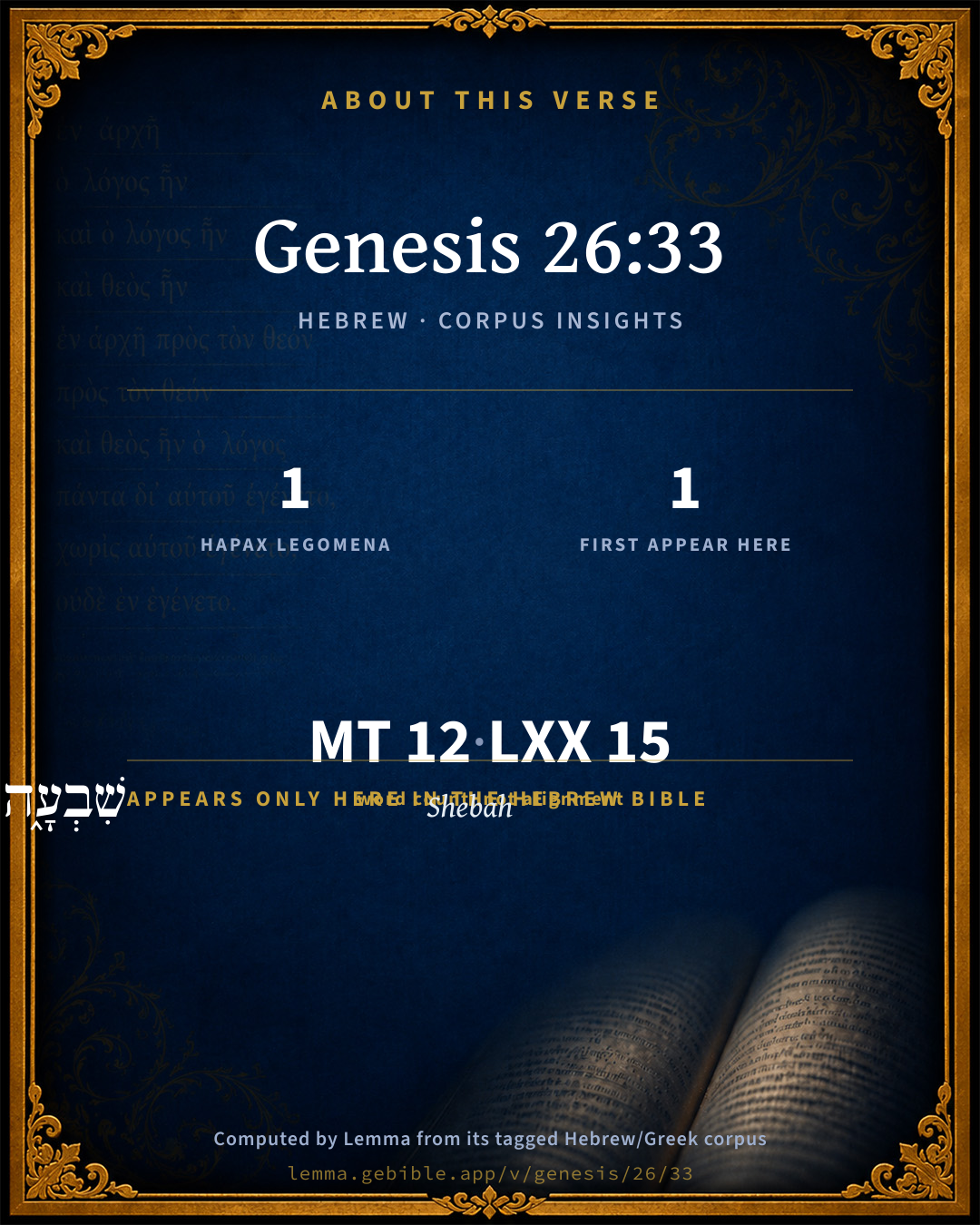
  • 1 hapax legomenon — only here in the Hebrew Bible
  • 1 first appearance in the Hebrew Bible
Full analysis ↓
Download a study sheet

One document with this verse’s original text, its word-by-word gloss line, the meaning frame, cross-references with their text, attributed commentary, and full source and license credits — printable, and it pastes into notes with its structure intact.

This verse Autodidact and up

Study sheet (.html) Plain text (.txt)

A passage Seminary Student

Up to 50 verses in one chapter. A passage sheet keeps up to 6 commentary sources and 12 cross-references per verse, in the order this page ranks them, and says so on the sheet whenever that leaves anything out. Ask for a single verse and you get the Autodidact verse sheet above.

Everything on this page stays free to read, with no account — the sheet is a download of what is already on screen, not access to it.

Want to remove ads? Support Godless Engineer
Compare translations 3

The same verse in 3 English versions, stacked beneath the original-language interlinear above. Click any original word for its lexicon entry.

Each is an independent rendering of the whole verse — the interlinear is not word-aligned to these translations.

Highlighted words mark where these versions differ — a whole-verse word diff, not a word-by-word alignment.

  • World English Bible Public Domain
    He called it Shibah. Therefore the name of the city is Beersheba to this day.
  • King James Version Public Domain
    And he called it Shebah: therefore the name of the city is Beersheba unto this day.
  • unfoldingWord Literal Text CC BY-SA 4.0
    So he called it Shibah. For that the name of the city Beersheba to this day. Esau’s Hittite Wives 26:34-35

unfoldingWord Literal Text — © unfoldingWord, licensed CC BY-SA 4.0. Word-aligned USFM3 via Door43 (git.door43.org/unfoldingWord/en_ult).

Versions to compare (up to 4)

3 of 4 selected

Show all 18 translations

Every available English version of this verse, each an independent rendering of the whole verse.

  • World English Bible Public Domain
    He called it Shibah. Therefore the name of the city is Beersheba to this day.
  • Berean Standard Bible Public Domain
    So he called it Shibah, and to this day the name of the city is Beersheba.
  • Majority Standard Bible Public Domain
    So he called it Shibah, and to this day the name of the city is Beersheba.
  • King James Version Public Domain
    And he called it Shebah: therefore the name of the city is Beersheba unto this day.
  • American Standard Version (1901) Public Domain
    And he called it Shibah. Therefore the name of the city is Beer-sheba unto this day.
  • Revised Version (1885) Public Domain
    And he called it Shibah: therefore the name of the city is Beer-sheba unto this day.
  • Geneva Bible (1599) Public Domain
    So hee called it Shibah: therefore the name of the citie is called Beer-sheba vnto this day.
  • Douay-Rheims (1899) Public Domain
    Whereupon he called it Abundance: and the name of the city was called Bersabee, even to this day.
  • Young's Literal Translation Public Domain
    and he calleth it Shebah, `oath,' therefore the name of the city `is' Beer-Sheba, `well of the oath,' unto this day.
  • Literal Standard Version CC BY-SA 4.0
    and he calls it Shebah, [oath,] therefore the name of the city [is] Beer-Sheba, [Well of the Oath,] to this day.
  • Unlocked Literal Bible CC BY-SA 4.0
    He called the well Shibah, so the name of that city is Beersheba to this day.
  • unfoldingWord Literal Text CC BY-SA 4.0
    So he called it Shibah. For that the name of the city Beersheba to this day. Esau’s Hittite Wives 26:34-35
  • Darby Bible Public Domain
    And he called it Shebah; therefore the name of the city is Beer-sheba to this day.
  • World Messianic Bible Public Domain
    He called it “Shibah”. Therefore the name of the city is “Beersheba” to this day.
  • Webster's Bible Public Domain
    And he called it Shebah: therefore the name of the city is Beer-sheba to this day.
  • Free Bible Version CC BY-SA 4.0
    So Isaac named the well, “Oath,” and that's why the name of the town is “Well of the Oath” (Beersheba) to this day.
  • Bible in Basic English Public Domain
    And he gave it the name of Shibah: so the name of that town is Beer-sheba to this day.
  • JPS Tanakh (1917) Public Domain
    And he called it Shibah. Therefore the name of the city is Beer-sheba unto this day.

Literal Standard Version (2020), Covenant Press — licensed CC BY-SA 4.0. Text via the HelloAO Bible API (eBible.org). Unlocked Literal Bible (unfoldingWord) — licensed CC BY-SA 4.0. Text via the HelloAO Bible API (eBible.org). unfoldingWord Literal Text — © unfoldingWord, licensed CC BY-SA 4.0. Word-aligned USFM3 via Door43 (git.door43.org/unfoldingWord/en_ult). Free Bible Version, Dr. Jonathan Gallagher — licensed CC BY-SA 4.0. Text via the HelloAO Bible API (eBible.org).

Word by word

More ways to search: Search by grammar → Find every occurrence → Compare this word →

Practice this passage: Drill this verse → Learn its vocabulary →

שִׁבְעָ֑ה
Shibʻâh
H7656
“Shebah”
Adjective, Cardinal number, Masculine, Singular, Absolute
Part of Speech
Adjective
Type
Cardinal number
Gender
Masculine
Number
Singular
State
Absolute
Full BDB Definition

Origin: masc. of H7651

TWOT: None

Shebah = "an oath" - the well named by Isaac and near Beersheba
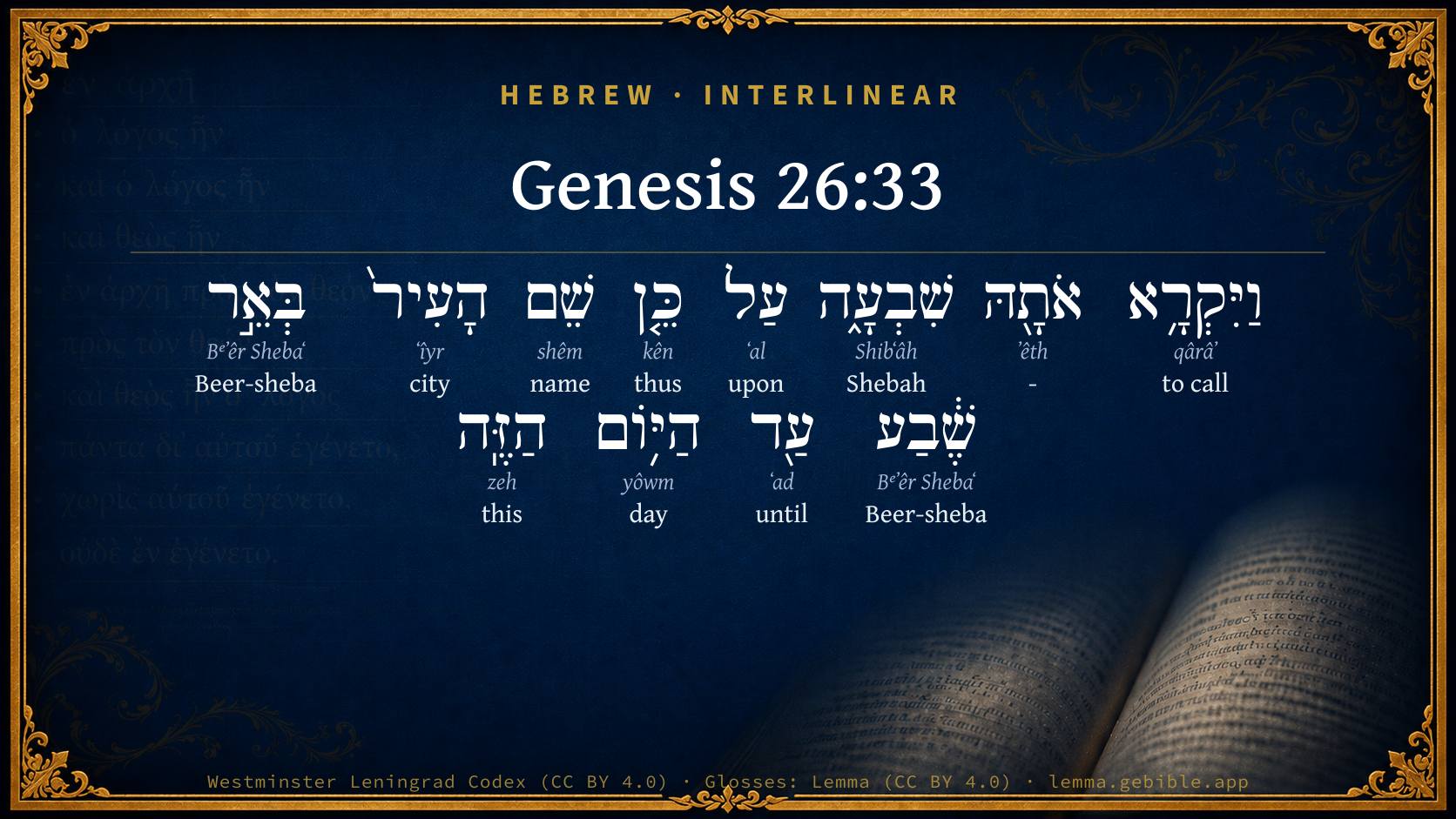
  1. וַיִּקְרָ֥א qârâʼ H7121 “and · to call” Conjunction + Verb, Qal, Sequential Imperfect, 3rd Person, Masculine, Singular
  2. אֹתָ֖הּ ʼêth H853 “- · her” Particle, Direct Object + Suffix, Personal, 3rd Person, Feminine, Singular
  3. עַל ʻal H5921 “upon” Preposition
  4. כֵּ֤ן kên H3651 “thus” Particle, Demonstrative
  5. שֵׁם shêm H8034 “name of” Noun, Common, Masculine, Singular, Construct
  6. הָעִיר֙ ʻîyr H5892 “the · city” Particle, Definite Article + Noun, Common, Feminine, Singular, Absolute
  7. בְּאֵ֣ר Bᵉʼêr Shebaʻ H884 “Beer-sheba” Noun, Proper
  8. שֶׁ֔בַע Bᵉʼêr Shebaʻ H884 “Beer-sheba” Adjective, Cardinal number, Feminine, Singular, Absolute
  9. עַ֖ד ʻad H5704 “until” Preposition
  10. הַיּ֥וֹם yôwm H3117 “the · day” Particle, Definite Article + Noun, Common, Masculine, Singular, Absolute
  11. הַזֶּֽה zeh H2088 “the · this” Particle, Definite Article + Pronoun, Demonstrative, Masculine, Singular

About this verse

These counts appear in no published source. They are computed here, from the morphology-tagged text and Lemma’s own curated glosses. What Lemma adds →

12
words
11
distinct lemmas
Pentateuch
section

Notable vocabulary

1 hapax legomenon — a word that appears only here in the entire Hebrew Bible:

  • שִׁבְעָ֑ה Shebah H7656

First appearance in Scripture

This word makes its first canonical appearance in the Hebrew Bible here:

  • שִׁבְעָ֑ה Shebah H7656

Grammatical profile

  • 1 verb
  • 4 nouns
  • 2 adjectives
  • 1 pronoun
  • 2 prepositions
  • 2 particles

Verb forms

  • וַיִּקְרָ֥א Qal · Sequential Imperfect

Repetition

A word recurs within this verse — often emphatic in Hebrew:

  • בְּאֵ֣ר Beer-sheba H884 ×2

Hebrew & Septuagint length

In English translation the verse runs 15 words from the Hebrew and 20 from the Septuagint (LXX English) — closely comparable.

A rough comparison of the two English renderings, which tokenize alike — not a word-level alignment.

Word counts can differ between the Hebrew and the Greek without any difference in meaning — e.g. the Hebrew direct-object marker אֵת has no separate Greek word, and Greek often adds the article ὁ.

In the original languages it is 12 Hebrew tokens and 15 Greek tokens — but the two are counted differently (Hebrew bundles its prefixes and suffixes into one token; the Greek is in lemma form), so that isn’t a like-for-like length.

Cross-references

2

Topical passages linked to Genesis 26:33 in the Treasury of Scripture Knowledge — connected by theme and wording, ordered by reader-vote popularity; previews shown in the World English Bible.

  • Genesis 21:31 Therefore he called that place Beersheba, because they both swore there.
  • Genesis 26:28 They said, "We saw plainly that Yahweh was with you. We said, 'Let there now be an oath between us, even between us and you, and let us make a covenant with you,

Cross-references courtesy of OpenBible.info (CC BY 4.0).

Hebrew and Greek witnesses Masoretic Hebrew ↔ Greek Septuagint

The same verse in the two great witnesses to the Old Testament, shown verse-for-verse.

These are two independent witnesses, not word-aligned to each other, and the Septuagint is shown in lemma (dictionary) form.

Hebrew Genesis 26:33 Masoretic · Westminster Leningrad Codex

וַיִּקְרָ֥א אֹתָ֖הּ שִׁבְעָ֑ה עַל כֵּ֤ן שֵׁם הָעִיר֙ בְּאֵ֣ר שֶׁ֔בַע עַ֖ד הַיּ֥וֹם הַזֶּֽה

He called it Shibah. Therefore the name of the city is Beersheba to this day.

World English Bible · Public Domain

Greek LXX Genesis 26:33 Septuagint · lemma form

καί καλέω αὐτός ὅρκος διά οὗτος ὄνομα ὁ πόλις φρέαρ ὅρκος ἕως ὁ σήμερον ἡμέρα

And he called it, Oath: therefore he called the name of that city, the Well of Oath, until this day.

LXX2012 (modern English Septuagint) · Public Domain

Hebrew: Westminster Leningrad Codex (CC BY 4.0). Greek: Septuagint (public domain); English from LXX2012 (modern English Septuagint) (Public Domain). How the Septuagint differs from the Hebrew →

Targum (Aramaic paraphrase)

2

The Targum is the ancient Jewish Aramaic paraphrase of the Hebrew Scriptures — an interpretive translation, not the Hebrew text itself. Onkelos (literal) and Pseudo-Jonathan (expansive) render the Torah, and Jonathan the Prophets. Coverage is partial: where no permissively-licensed English translation exists for a verse, only the Aramaic is shown. This is verse-level text, not a word-by-word alignment to the Hebrew.

  1. Targum Onkelos Torah (Genesis–Deuteronomy)
    וּקְרָא יָתַהּ שִׁבְעָה עַל כֵּן שְׁמָא דְקַרְתָּא בְּאֵרָא דְשֶׁבַע (נ''י בְּאֵר שֶׁבַע) עַד יוֹמָא הָדֵין

    (no public-domain English translation for this verse)

    Targum Onkelos — Aramaic: “Onkelos Genesis” (public domain); “Onkelos Exodus” (public domain); “Onkelos Leviticus” (public domain); “Onkelos Numbers” (public domain); “Onkelos Deuteronomy” (public domain). English: “Sefaria Community Translation” (CC0 1.0 (public-domain dedication)); “J.W. Etheridge. The Targums of Onkelos and Jonathan Ben Uzziel on the Pentateuch. London: Longmans, Green, 1862” (public domain). Text via Sefaria.

  2. Targum Pseudo-Jonathan Torah (Genesis–Deuteronomy)
    וּקְרָא יָתֵיהּ שִׁבְעָה בְּגִין כֵּן שְׁמָא דְקַרְתָּא בֵּיר שֶבַע עַד יוֹמָא הָּדֵין

    and he called it Sheba (the Swearing); therefore the name of the city is Beersheba unto this day.

    Targum Pseudo-Jonathan — Aramaic: “Targum Jonathan on Genesis” (public domain); “Targum Jonathan on Exodus” (public domain); “Targum Jonathan on Leviticus” (public domain); “Targum Jonathan on Numbers” (public domain); “Targum Jonathan on Deuteronomy” (public domain). English: “The Targum of Jonathan ben Uzziel, trans. J. W. Etheridge, London, 1862” (public domain). Text via Sefaria.

Commentary

Notes on Genesis 26:33 from classic Christian and Jewish commentators (each source and its license shown beneath its notes). The classic Christian expositions comment on the surrounding passage and are grouped to its opening verse, so a note may address several verses; the Jewish commentaries on the Tanakh (Rashi and others) are per-verse, so they appear only where the commentator wrote on this verse.

Lemma curates 59 commentaries, every one of them public domain or Creative Commons licensed, each selected and text-cleaned for this edition rather than reprinted as found. About our sources →

Trapp's Complete Commentary

John Trapp

Gen 26:33 And he called it Shebah: therefore the name of the city [is] Beersheba unto this day.

Ver. 33. Is Beersheba to this day.] So it was before; but the name was almost worn out, the well being stopped up. Isaac therefore newly names it, and so preserves it for a monument of God’s mercy to his father, and to himself.

John Trapp, A Commentary or Exposition upon All the Books of the Old and New Testament (1647–1656) — public domain. Text from a community e-Sword module.

Tyndale Open Study Notes

Tyndale Open Resources

26:33 Since the earlier treaty was renewed with Isaac, the name of the well was also renewed by the oath.

Tyndale Open Study Notes — © Tyndale Open Resources, licensed CC BY-SA 4.0. Text via the HelloAO Bible API.

Geneva Bible (1599)

Geneva Bible translators

Or, the well of the oath.

Or, oath.

Geneva Bible (1599) marginal notes — public domain. Text via Bolls.life.

Adam Clarke's Commentary

Verse 33. He called it Shebah] This was probably the same well which was called Beersheba in the time of Abraham, which the Philistines had filled up, and which the servants of Isaac had reopened. The same name is therefore given to it which it had before, with the addition of the emphatic letter ה he, by which its signification became extended, so that now it signified not merely an oath or full, but satisfaction and abundance.

The name of the city is Beer-sheba] This name was given to it a hundred years before this time; but as the well from which it had this name originally was closed up by the Philistines, probably the name of the place was abolished with the well; when therefore Isaac reopened the well, he restored the ancient name of the place.

Adam Clarke's Commentary on the Bible (1810–1826) — public domain. Text from a community e-Sword/MySword module.

Ellicott's Commentary for English Readers

(33) Therefore the name of the city is Beer-sheba unto this day.—There was no city at this time at Beer-sheba, but one is mentioned at the conquest of Canaan by Joshua (Jos_15:28). This note, as is the case generally with those which speak of a thing existing “unto this day,” was added by Ezra and the men of the Great Synagogue, after the return from Babylon (comp. Gen_22:14); and its meaning is that, whereas Abraham’s name had been forgotten while the place lay desolate, this remarkable coincidence of the water being again found, just when the covenant had been confirmed by the customary sevenfold sacrifice, so impressed the minds of the people that the title of Beer-sheba never again passed into oblivion.

A Bible Commentary for English Readers, edited by Charles John Ellicott (1878–1897) — public domain. Text from a community e-Sword module.

The Cambridge Bible for Schools and Colleges

gen. ed. J. J. S. Perowne

33. Shibah] This word, denoting “oath-taking” or “swearing,” is here given as the explanation of the name “Beer-sheba.” For another tradition as to the origin of the name, see Gen_21:31. The narrative there is from E; the narrative here from J. Shebûah, of which shib‘ah is a rare variety, is an “oath”; sheba‘ is “seven.” Aquila and Symmachus πλησμονή; Lat. abundantiam; reading sib‘ah.

unto this day] See note on Gen_22:14.

The Cambridge Bible for Schools and Colleges (gen. ed. J. J. S. Perowne; Cambridge University Press, 1878–1918) — public domain. Text from a community e-Sword module.

John Gill's Exposition

Which were a grief of mind unto Isaac, and to Rebekah. The marriage of them itself was a trouble to them, it being contrary to their will that any of their children should marry with the Canaanites, and those the worst sort of them, the Hittites; it having been the care of Abraham, the father of Isaac, that his son should not marry with them, and laid a strict injunction on his servant not to take a wife for his son from among them; and which was an example to be followed in later times, and which Esau very likely was not ignorant of: and besides this, the women themselves he took for wives were very disagreeable on all accounts, partly because of their religion, being idolaters, and partly by reason of their temper and behaviour, being proud, haughty, and disobedient; as all the three Targums intimate.

Next: Genesis Chapter 27

John Gill's Exposition of the Whole Bible (1746–1763) — public domain (CC PDM 1.0). Text via the HelloAO Bible API.

Matthew Poole's English Annotations

This name had been given before, either to this or a neighbouring place, by Abraham, Gen 21:31; but was now buried in oblivion, as his wells were; and the wells being revived, he revives and renews the name, which proved now a lasting name,

unto this day, as here follows, which is not added Gen 21:31, because then the name, though given by Abraham, was soon forgotten and neglected by others.

Matthew Poole's English Annotations on the Holy Bible (1683–1685) — public domain. Text from a community e-Sword/MySword module.

Whedon's Commentary on the Bible

Daniel D. Whedon

33. Called it Shebah — שׁבעה, Shibhah; which means both seven and oath. Compare Gen_21:28-31. “Now the writer was aware that this place had received the same name on a former occasion. But a second well had now been dug in like circumstances in the same locality. This gives occasion for a new application of the name in the memories of the people. This is another illustration of the principle explained at Gen_25:30. Two wells still exist at this place, attesting the correctness of the record.” — Murphy.

Daniel D. Whedon (gen. ed.), Commentary on the Old and New Testaments (1874–1909) — public domain. Text from a community e-Sword module.

The Pulpit Commentary

And he called it Shebah ("Oath;" which he would certainly not have done had it not been a well): therefore the name of the city (which ultimately gathered round the well) is Beershebai.e. the well of the oath. (vide Gen_21:31) Isaac must have perfectly understood that the place had been so named by his father three quarters of a century previous; but either the name had been forgotten by others, or had not come into general use amongst the inhabitants, or, observing the coincidence between his finding a well just at the time of covenanting with Abimelech and the fact that his father"s treaty was also connected with a well, he wished to confirm and perpetuate the early name which had been assigned to the town. It is not certain that this was Abraham s well which had been rediscovered; the probability is that it was another, since at Bir-es-Sheba two wells are still in existence (vide Gen_21:31) unto this day an expression used throughout Genesis to describe events separated from the age of Moses by several centuries. (vide Gen_19:37, 38 22:14 32:32)

The Pulpit Commentary (1880–1919), ed. H.D.M. Spence-Jones & Joseph S. Exell — public domain. Text from a community e-Sword module.

Rashi

Rabbi Shlomo Yitzchaki (Rashi)

שבעה [AND HE CALLED IT] SHIBAH (swearing), in allusion to the Covenant (cf. v.31; “And they swear” etc.).

Rashi on the Tanakh — English translations: “The Judaica Press complete Tanach with Rashi, translated by A. J. Rosenberg” (CC BY 4.0); “Pentateuch with Rashi's commentary by M. Rosenbaum and A.M. Silbermann, 1929-1934” (public domain); “The Metsudah Tanach series, Lakewood, N.J” (CC BY 4.0); and “The Book of Joshua, Metsudah Publications, 1997” (CC BY 4.0). Text via Sefaria.

Radak

Rabbi David Kimhi (Radak)

ויקרא אותה שבעה, on account of the oath that Yitzchok and Avimelech had sworn there. Avraham had done the same. (21,31) Even though he had not named the well itself שבעה, he named the entire region Beer Sheva, both on account of the oath and on account of the seven sheep which had been the physical symbol of that oath. Both Avraham and Yitzchok named the event in the presence of Avimelech.

As to the Torah writing: על כן שם העיר באר שבע, and we know that the place had been known by that name already since the days of Avraham, the Torah informs us that the name Avraham gave it might not have endured, but that this event now ensured that the name would be permanent. When a certain location commemorates two historic events both in the life of the father and that of the son, this will be remembered for far longer as everyone recognises that more than coincidence was the reason why the historic event which produced the name occurred precisely there.

Radak on the Tanakh — English translations: “Sefaria Community Translation” (CC0 1.0 (public-domain dedication)); “Eliyahu Munk, HaChut Hameshulash” (CC BY 4.0); “Rabbi Mike Feuer, Jerusalem Anthology” (CC BY 4.0); and “R. David Kimhi on the first book of Psalms, Translated by R.G. Finch, London, 1919” (public domain). Text via Sefaria.

Lesson kit

Teaching starters — assembled from the data on this page, not authored interpretation. Every prompt links to the verse data it draws on. Edit before teaching.

Genesis, in the Pentateuch, opens this verse with 12 words (11 distinct Hebrew lemmas). Its most distinctive word is Shibʻâh (“Shebah”). A historical commentator’s framing appears above. Read the whole chapter for the surrounding context.

Discussion questions

  1. The word Shibʻâh carries the sense “Shebah.” How does it shape the verse?
  2. This verse holds 1 word here found nowhere else in the Hebrew Bible. What might the rare word draw attention to?
  3. The word “Shebah” first appears here in Scripture. What is being introduced at this debut?
  4. Genesis 21:31 shares this passage’s theme. How do the two illuminate each other?
  5. “Beer-sheba” occurs 2× in this one verse. What is the effect of the repetition?
  6. The translations on this page render this verse differently — a whole-verse word diff, not a word-by-word alignment. What might account for the different wordings?
  7. The verb «וַיִּקְרָ֥א» is Qal Sequential Imperfect. How does its form color the action?
  8. Reading how Trapp's Complete Commentary and Tyndale Open Study Notes read this verse, where do the two commentators agree and where do they part?

Things to notice

  • 1 word in this verse appears nowhere else in the Hebrew Bible.
  • 1 word makes its first canonical appearance in Scripture here.
  • This verse counts 12 Hebrew ↔ 15 Greek words.
  • These translations choose different wording for 7 words in this verse.
  • “Beer-sheba” occurs 2× in this single verse.

Reading settings

Reading text

Shown beneath each verse's original-language words.

Old Testament
Old Testament edition

Read the OT as the Masoretic Hebrew (MT) or the Greek Septuagint (LXX).

English shown for the Greek Septuagint (in the Hebrew ↔ Greek comparison).

Comparing translations? Open the Compare panel on any verse page to stack up to four side by side.