2 Thessalonians 1:12

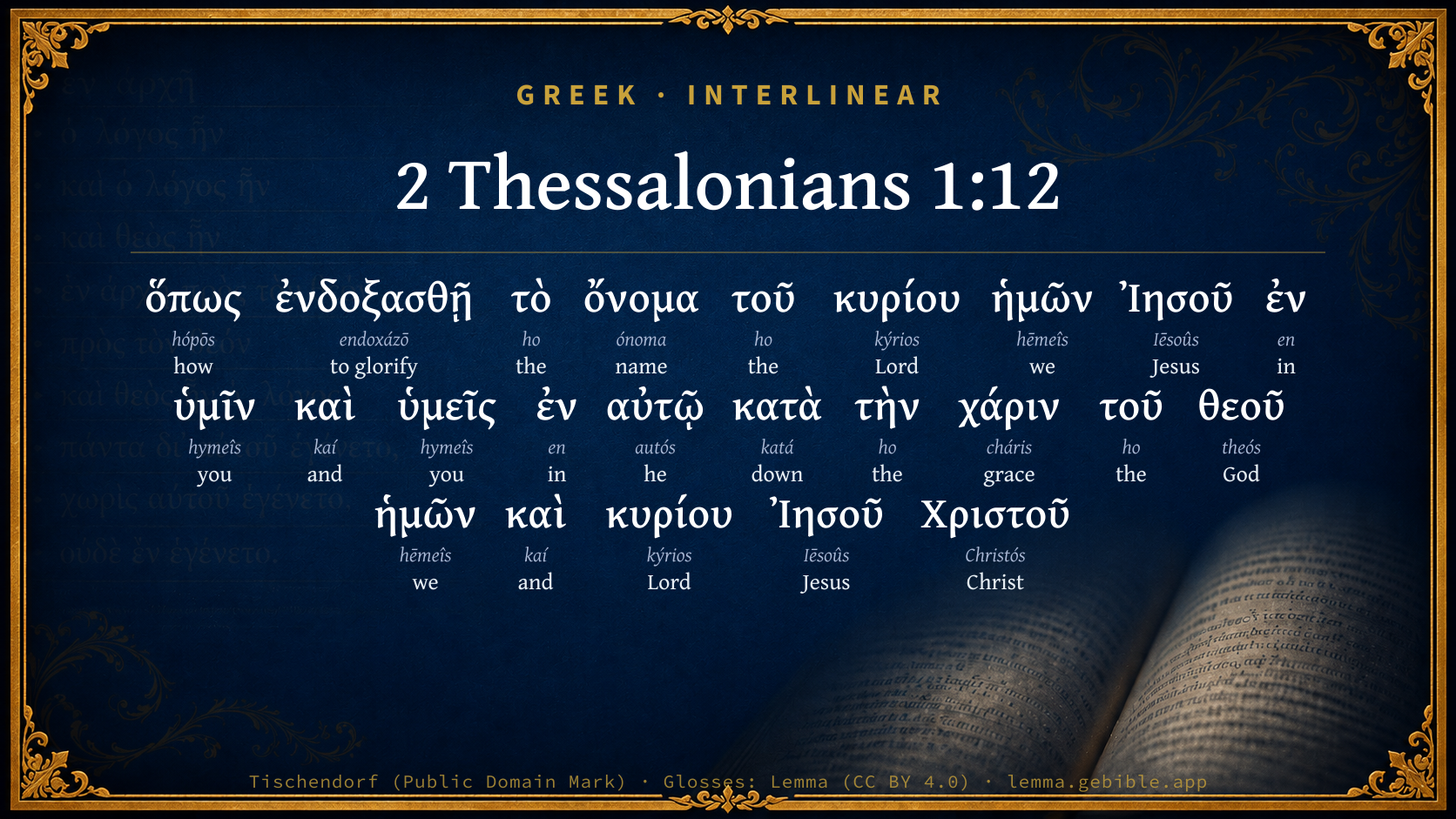
Greek (Tischendorf 8th ed.) 2 Thessalonians 1:12 appears in the Greek New Testament. The text above is from the Tischendorf 8th edition. Each word links to its Strong’s number and a concise gloss. Click any word for its full Thayer’s Greek Lexicon entry.
Download image
Cite this verse

2 Thessalonians 1:12 (World English Bible). Public Domain. Lemma interlinear Bible study tool, https://lemma.gebible.app/v/2-thessalonians/1/12.

Show BibTeX & RIS
BibTeX
RIS
English Translation
that the name of our Lord Jesus may be glorified in you, and you in him, according to the grace of our God and the Lord Jesus Christ.
World English Bible · Public Domain
Download a study sheet

One document with this verse’s original text, its word-by-word gloss line, the meaning frame, cross-references with their text, attributed commentary, and full source and license credits — printable, and it pastes into notes with its structure intact.

This verse Autodidact and up

Study sheet (.html) Plain text (.txt)

A passage Seminary Student

Up to 50 verses in one chapter. A passage sheet keeps up to 6 commentary sources and 12 cross-references per verse, in the order this page ranks them, and says so on the sheet whenever that leaves anything out. Ask for a single verse and you get the Autodidact verse sheet above.

Everything on this page stays free to read, with no account — the sheet is a download of what is already on screen, not access to it.

Want to remove ads? Support Godless Engineer
Compare translations 3

The same verse in 3 English versions, stacked beneath the original-language interlinear above. Click any original word for its lexicon entry.

Each is an independent rendering of the whole verse — the interlinear is not word-aligned to these translations.

Highlighted words mark where these versions differ — a whole-verse word diff, not a word-by-word alignment.

  • World English Bible Public Domain
    that the name of our Lord Jesus may be glorified in you, and you in him, according to the grace of our God and the Lord Jesus Christ.
  • King James Version Public Domain
    That the name of our Lord Jesus Christ may be glorified in you, and ye in him, according to the grace of our God and the Lord Jesus Christ.
  • unfoldingWord Literal Text CC BY-SA 4.0
    so that the name of our Lord Jesus might be glorified in you, and you in him, according to the grace of our God and the Lord Jesus Christ.

unfoldingWord Literal Text — © unfoldingWord, licensed CC BY-SA 4.0. Word-aligned USFM3 via Door43 (git.door43.org/unfoldingWord/en_ult).

Versions to compare (up to 4)

3 of 4 selected

Show all 19 translations

Every available English version of this verse, each an independent rendering of the whole verse.

  • World English Bible Public Domain
    that the name of our Lord Jesus may be glorified in you, and you in him, according to the grace of our God and the Lord Jesus Christ.
  • Berean Standard Bible Public Domain
    so that the name of our Lord Jesus will be glorified in you, and you in Him, according to the grace of our God and of the Lord Jesus Christ.
  • Majority Standard Bible Public Domain
    so that the name of our Lord Jesus will be glorified in you, and you in Him, according to the grace of our God and of the Lord Jesus Christ.
  • King James Version Public Domain
    That the name of our Lord Jesus Christ may be glorified in you, and ye in him, according to the grace of our God and the Lord Jesus Christ.
  • American Standard Version (1901) Public Domain
    that the name of our Lord Jesus may be glorified in you, and ye in him, according to the grace of our God and the Lord Jesus Christ.
  • Revised Version (1885) Public Domain
    that the name of our Lord Jesus may be glorified in you, and ye in him, according to the grace of our God and the Lord Jesus Christ.
  • Geneva Bible (1599) Public Domain
    That the Name of our Lord Iesus Christ may be glorified in you, and ye in him, according to the grace of our God, and of the Lord Iesus Christ.
  • Douay-Rheims (1899) Public Domain
    That the name of our Lord Jesus may be glorified in you, and you in him, according to the grace of our God, and of the Lord Jesus Christ.
  • Young's Literal Translation Public Domain
    that the name of our Lord Jesus Christ may be glorified in you, and ye in him, according to the grace of our God and Lord Jesus Christ.
  • Literal Standard Version CC BY-SA 4.0
    that the Name of our Lord Jesus Christ may be glorified in you, and you in Him, according to the grace of our God and Lord Jesus Christ.
  • Unlocked Literal Bible CC BY-SA 4.0
    We pray these things so that the name of our Lord Jesus may be glorified by you. We pray that you will be glorified by him, because of the grace of our God and the Lord Jesus Christ.
  • unfoldingWord Literal Text CC BY-SA 4.0
    so that the name of our Lord Jesus might be glorified in you, and you in him, according to the grace of our God and the Lord Jesus Christ.
  • Darby Bible Public Domain
    so that the name of our Lord Jesus [Christ] may be glorified in you and *ye* in him, according to the grace of our God, and of [the] Lord Jesus Christ.
  • World Messianic Bible Public Domain
    that the name of our Lord Yeshua may be glorified in you, and you in him, according to the grace of our God and the Lord Yeshua the Messiah.
  • Webster's Bible Public Domain
    That the name of our Lord Jesus Christ may be glorified in you, and ye in him, according to the grace of our God, and of the Lord Jesus Christ.
  • Free Bible Version CC BY-SA 4.0
    so that the name of our Lord Jesus may be honored by what you do—and in turn you are honored by him through the grace of our God and the Lord Jesus Christ.
  • Bible in Basic English Public Domain
    So that glory may be given to the name of our Lord Jesus through you, and you may have glory in him, by the grace of our God and the Lord Jesus Christ.
  • Text-Critical English NT CC BY 4.0
    so that the name of our Lord Jesus will be glorified in you, and you in him, according to the grace of our God and Lord, Jesus Christ.
  • Tyndale New Testament (1534) Public Domain
    that the name of oure lorde Iesus Christ maye be gloryfied in you and ye in him thorowe the grace of oure God and of the lorde Iesus Christ.

Literal Standard Version (2020), Covenant Press — licensed CC BY-SA 4.0. Text via the HelloAO Bible API (eBible.org). Unlocked Literal Bible (unfoldingWord) — licensed CC BY-SA 4.0. Text via the HelloAO Bible API (eBible.org). unfoldingWord Literal Text — © unfoldingWord, licensed CC BY-SA 4.0. Word-aligned USFM3 via Door43 (git.door43.org/unfoldingWord/en_ult). Free Bible Version, Dr. Jonathan Gallagher — licensed CC BY-SA 4.0. Text via the HelloAO Bible API (eBible.org).

Word by word

More ways to search: Search by grammar → Find every occurrence → Compare this word →

Practice this passage: Drill this verse → Learn its vocabulary →

ἐνδοξασθῇ
endoxázō
G1740
“to glorify”
Verb, Aorist, Passive, Subjunctive, 3rd person, Singular
Part of Speech
Verb
Tense
Aorist
Voice
Passive
Mood
Subjunctive
Person
3rd person
Number
Singular
Full Thayer's Definition

Origin: from G1741

TDNT: 06:14,2

1. glorify, adorn with glory
  1. ὅπως hópōs G3704 “how” Adverb
  2. τὸ ho G3588 “the” Article, Nominative, Singular, Neuter
  3. ὄνομα ónoma G3686 “name” Noun, Nominative, Singular, Neuter
  4. τοῦ ho G3588 “the” Article, Genitive, Singular, Masculine
  5. κυρίου kýrios G2962 “Lord” Noun, Genitive, Singular, Masculine
  6. ἡμῶν hēmeîs G2249 “we” Personal pronoun, 1st person, Genitive, Plural
  7. Ἰησοῦ Iēsoûs G2424 “Jesus” Noun, Genitive, Singular, Masculine
  8. ἐν en G1722 “in” Preposition
  9. ὑμῖν hymeîs G5210 “you” Personal pronoun, 2nd person, Dative, Plural
  10. καὶ kaí G2532 “and” Conjunction
  11. ὑμεῖς hymeîs G5210 “you” Personal pronoun, 2nd person, Nominative, Plural
  12. ἐν en G1722 “in” Preposition
  13. αὐτῷ autós G846 “he” Personal pronoun, Dative, Singular, Masculine
  14. κατὰ katá G2596 “down” Preposition
  15. τὴν ho G3588 “the” Article, Accusative, Singular, Feminine
  16. χάριν cháris G5485 “grace” Noun, Accusative, Singular, Feminine
  17. τοῦ ho G3588 “the” Article, Genitive, Singular, Masculine
  18. θεοῦ theós G2316 “God” Noun, Genitive, Singular, Masculine
  19. ἡμῶν hēmeîs G2249 “we” Personal pronoun, 1st person, Genitive, Plural
  20. καὶ kaí G2532 “and” Conjunction
  21. κυρίου kýrios G2962 “Lord” Noun, Genitive, Singular, Masculine
  22. Ἰησοῦ Iēsoûs G2424 “Jesus” Noun, Genitive, Singular, Masculine
  23. Χριστοῦ Christós G5547 “Christ” Noun, Genitive, Singular, Masculine

About this verse

These counts appear in no published source. They are computed here, from the morphology-tagged text and Lemma’s own curated glosses. What Lemma adds →

24
words
15
distinct lemmas
Pauline Epistles
section

Notable vocabulary

The rarest word here is ἐνδοξασθῇ to glorify G1740 — appearing just 2 times in the whole Greek New Testament.

Shared distinctive vocabulary

ἐνδοξασθῇ to glorify G1740 occurs in 2 verses of the Greek New Testament. Also found in:

Repetition

Words recur within this verse:

Cross-references

19

Topical passages linked to 2 Thessalonians 1:12 in the Treasury of Scripture Knowledge — connected by theme and wording, ordered by reader-vote popularity; previews shown in the World English Bible.

  • 2 Thessalonians 1:10 when he comes to be glorified in his saints, and to be admired among all those who have believed (because our testimony to you was believed) in that day.
  • John 17:10 All things that are mine are yours, and yours are mine, and I am glorified in them.
  • 1 Peter 4:14 If you are insulted for the name of Christ, blessed are you; because the Spirit of glory and of God rests on you. On their part he is blasphemed, but on your part he is glorified.
  • 2 Corinthians 13:4 For he was crucified through weakness, yet he lives through the power of God. For we also are weak in him, but we will live with him through the power of God toward you.
  • 1 Corinthians 1:4 I always thank my God concerning you, for the grace of God which was given you in Christ Jesus;
  • 2 Corinthians 8:9 For you know the grace of our Lord Jesus Christ, that, though he was rich, yet for your sakes he became poor, that you through his poverty might become rich.
  • Philippians 2:9–11 Therefore God also highly exalted him, and gave to him the name which is above every name;
  • Colossians 2:9–10 For in him all the fullness of the Godhead dwells bodily,
  • Revelation 1:4 John, to the seven assemblies that are in Asia: Grace to you and peace, from God, who is and who was and who is to come; and from the seven Spirits who are before his throne;
  • Genesis 18:18 seeing that Abraham has surely become a great and mighty nation, and all the nations of the earth will be blessed in him?
  • Psalms 72:17 His name endures forever. His name continues as long as the sun. Men shall be blessed by him. All nations will call him blessed.
  • Isaiah 45:17 [But] Israel shall be saved by Yahweh with an everlasting salvation: you shall not be disappointed nor confounded world without end.
  • Isaiah 66:5 Hear the word of Yahweh, you who tremble at his word: Your brothers who hate you, who cast you out for my name's sake, have said, Let Yahweh be glorified, that we may see your joy; but it is those who shall be disappointed.
  • John 17:21–26 that they may all be one; even as you, Father, are in me, and I in you, that they also may be one in us; that the world may believe that you sent me.
  • Romans 1:7 to all who are in Rome, beloved of God, called to be saints: Grace to you and peace from God our Father and the Lord Jesus Christ.
  • 1 Peter 1:7–8 that the proof of your faith, which is more precious than gold that perishes even though it is tested by fire, may be found to result in praise, glory, and honor at the revelation of Jesus Christ--
  • Philippians 3:9 and be found in him, not having a righteousness of my own, that which is of the law, but that which is through faith in Christ, the righteousness which is from God by faith;
  • Titus 2:11 For the grace of God has appeared, bringing salvation to all men,
  • Isaiah 45:25 In Yahweh shall all the seed of Israel be justified, and shall glory.

Cross-references courtesy of OpenBible.info (CC BY 4.0).

Where the printed editions differ

1 variant

Places in this verse where the major printed Greek editions disagree on the wording in a way that affects the translation — a comparison of editions, not a manuscript-by-manuscript collation. The editions are the modern critical texts (Nestlé-Aland 28/27, SBL, Westcott-Hort, Tregelles, Tyndale House) and the traditional texts behind the KJV (the Textus Receptus and the Byzantine/Majority text). It is not a claim about which reading is original.

  1. Extra text
    Χριστοῦ

    “Christ”

    In TR Not in NA28NA27TynSBLWHTregByz

    Χριστοῦ (Christou) 'Christ' is only in traditional manuscripts (TR)

Textual data: Translators Amalgamated Greek New Testament (STEPBible TAGNT) · CC BY 4.0.

Commentary

Notes on 2 Thessalonians 1:12 from classic Christian and Jewish commentators (each source and its license shown beneath its notes). The classic Christian expositions comment on the surrounding passage and are grouped to its opening verse, so a note may address several verses; the Jewish commentaries on the Tanakh (Rashi and others) are per-verse, so they appear only where the commentator wrote on this verse.

Lemma curates 59 commentaries, every one of them public domain or Creative Commons licensed, each selected and text-cleaned for this edition rather than reprinted as found. About our sources →

The Biblical Illustrator

Joseph S. Exell

2Th_1:12

That the name of our Lord Jesus Christ may be glorified in you

Christ glorified in His servants

I.

When the work of faith is fulfilled with power, Christ is glorified in His servants.

1. Christ is glorified.

(1) Passively in all His creatures, as His glorious excellencies are visibly represented in them. Natural agents (Psa_19:1-2; Psa_145:10). The new creature (Eph h1:12).

(2) Actively, as they conceive and declare His excellency.

(a) In their hearts, by estimation and love (Luk_1:46; Psa_73:25), and trust (Isa_26:3), and delight (Psa_4:6-7; Psa_73:3).

(b) With their tongues (Psa_50:23; Jam_3:10).

(c) In their lives, by fixing his glory as the end (1Co_10:31), and by doing those things as may most suit the end (1Pe_1:15).

2. The work of faith fulfilled with power glorifies Christ. Christ is glorified by--

(1) Our patience under troubles (Joh_21:19; Php_1:21), which is a work of faith.

(2) All holy conversation and godliness (Mat_5:16; 1Pe_2:12).

II. In promoting the glory of Christ we promote the salvation of our souls.

1. God has appointed this order that we should first glorify Him before He glorifies us. It would redound to Gods dishonour if he should glorify those that do not glorify Him, and make no difference between those who break His laws and those who keep them.

2. God has also appointed that we should glorify Him on earth before He glorifies us in heaven. In this we have Christ for an example (Joh_17:4-5).

3. Christ takes special notice of those that glorify Him in the world (Joh_17:10). Christ is glorified--

(1) In His Person, when He is owned as the Son of God (Joh_17:8).

(2) In His office (Joh_14:13).

(3) In His doctrine, when it is believed and practised (Act_13:48)

4. This glory is promised (1Sa_2:30; Joh_12:26; Rom_8:7).

5. The suitableness between His being glorified in us and our being glorified in Him.

(1) Objectively, because this impression of honour upon us redounds to His glory (2Th_1:10).

(2) Actively, because one part of our happiness is, that we love and praise Him. This is our glory, that we behold Christs glory (Joh_17:24).

6. We may expect this glory--

(a) With confidence (2Ti_4:8; 2Th_2:13).

(b) Without danger of presumption, because Christ is the Lord of glory (Jam_2:1;1Co_2:8), and because that grace whereby we glorify Him is given by Him (Joh_17:22).

III. Our complete salvation, from first to last, flows from the grace of God in Christ. (T. Manton, D. D.)

Christ is glorious in the character of His followers in that

I. They give Him the throne, and cheerfully acknowledge His authority over them.

II. Whatever is excellent in their character is but the reflection of His own.

III. They are His witnesses in this ungodly world.

IV. They love to promote His glory and advance the interests of His kingdom. Application:

1. This is full of comfort to Gods people, because they have the greatest security in His guardianship and love.

2. It is full of inducements to holy being.

3. It is full of rebuke to ungodly men, in that there are no indications of the Saviours glory in their characters. (G. Spring, D. D.)

A Christian is the reflex of Christ

It has often been said that the Christian virtues are only impressions of the image of Christ; and that is true and good; but these impressions must find expression in everyday life. We are called of God to make manifest the character of Him that loved us. Once, in a large company of Christian men, the most lively regret was expressed that there is no authentic portrait of Jesus Christ as he lived and walked upon this earth. How gladly, it was said, would Christians often look on the features of that face! But one of Gods aged pilgrims stood up and said, I cannot deplore that at all, because a true Christian is the true likeness of Christ. (Pastor Funcke.)

.

The Biblical Illustrator, edited by Joseph S. Exell (c. 1880s–1900s) — public domain. Text from a community e-Sword module.

Tyndale Open Study Notes

Tyndale Open Resources

1:12 Though the name of our Lord Jesus was rejected by the Thessalonians’ persecutors (1:8), Jesus will ultimately be glorified because of the lives of the believers. Further, they will be honored along with him (2:14; 1 Thes 2:12; cp. Rom 8:17-18; Col 3:4). Cp. Isa 66:5.

Tyndale Open Study Notes — © Tyndale Open Resources, licensed CC BY-SA 4.0. Text via the HelloAO Bible API.

Bengel's Gnomon

Johann Albrecht Bengel

2Th 1:12. Τὸ ὄνομα, the name) We confer nothing on the Lord, whereas the Lord really confers upon us salvation; and hence His name is glorified in us; and we ourselves moreover in Him.—χάριν, grace) with this grace in view, he mentioned ἀγαθωσύνης, of goodness, 2Th 1:11.

—————

Bengel's Gnomon of the New Testament — English translation (T&T Clark, Edinburgh, 1860) — public domain. Text from a community e-Sword module.

Meyer's Critical & Exegetical Commentary

Heinrich August Wilhelm Meyer

2Th_1:12. Τὸ ὄνομα τοῦ κυρίου ἡμ. Ἰησοῦ] The name of our Lord Jesus, i.e. so far as He is the κύριος, the Lord; comp. Php_2:9 ff. Arbitrarily, de Wette: Christ, so far as He is recognised and known. Still more arbitrarily Turretin, Moldenhauer, Koppe, and others: ὄνομα κυρίου is a mere circumlocution for κύριος.

ἐν αὐτῷ] refers not to Ἰησοῦ (so Alford), but to τὸ ὄνομα; and the giving prominence to the mutual reciprocity, ἐν ὑμῖν καὶ ὑμεῖς ἐν αὐτῷ, is an exhaustive representation. Comp. Gal_6:14; 1Co_6:13.

κατὰ τὴν χάριν τοῦ Θεοῦ ἡμῶν καὶ κυρίου Ἰησοῦ] according to the grace of our God and of the (see Winer, p. 113 [E. T. 154]) Lord Jesus. According to Hofmann and Riggenbach, Christ is here named both our God and our Lord,an interpretation which, indeed, grammatically is no less allowable than the interpretation of the doxology, ὁ ὢν ἐπὶ πάντων Θεὸς εὐλογητὸς εἰς τοὺς αἰῶνας, Rom_9:5, as an apposition to ὁ Χριστός, but is equally inadmissible, as it would contain an un-Pauline thought; on account of which also Hilgenfeld, Ztschr. f. d. wiss. Theol., Halle 1862, p. 264, in the interest of the supposed spuriousness of the Epistle, has forthwith appropriated to himself this discovery of Hofmann.

Meyer — Critical and Exegetical Commentary on the New Testament — English translation by Peter Christie, edited by Frederick Crombie (T&T Clark, 1880) — public domain. Text from a community e-Sword module.

Expositor's Greek Testament

ed. W. Robertson Nicoll

2Th 1:12 . Here at any rate it is impossible to take χάριν in a universalistic sense (so Robinson, Ephesians , pp. 225 f.), as though it implied that Christians were put on the same level as O.T. saints. The idea is the merciful favour of God, to the exclusion of human merit. The main topic of the letter is now brought forward; 2Th 2:1-2 gives the occasion for the λόγος παρακλήσεως (2Th 1:3-12 ) which follows.

The Expositor's Greek Testament, edited by W. Robertson Nicoll (1897–1910) — public domain. Text from a community e-Sword module.

Vincent's Word Studies in the New Testament

Marvin R. Vincent

The name [το ονομα] . In no case where it is joined with Jesus, or Christ, or Lord Jesus, does it mean the title or dignity. 33 Paul follows O. T. usage, according to which the name of the Lord is often used for all that the name covers; so that the name of the Lord = the Lord himself.

ADDITIONAL NOTE ON oleqron aijwnion eternal destruction, 2Th 1:9.

Aiwn transliterated eon, is a period of time of longer or shorter duration, having a beginning and an end, and complete in itself. Aristotle (peri oujranou, 1 9, 15) says : "The period which includes the whole time of each one's life is called the eon of each one." Hence it often means the life of a man, as in Homer, where one's life [αιων] is said to leave him or to consume away (Il 5:685; Od. 5 160). It is not, however, limited to human life; it signifies any period in the course of events, as the period or age before Christ; the period of the millenniam; the mytho - logical period before the beginnings of history. The word has not "a stationary and mechanical value" (De Quincey). It does not mean a period of a fixed length for all cases. There are as many eons as entities, the respective durations of which are fixed by the normal conditions of the several entities. There is one eon of a human life, another of the life of a nation, another of a crow's life, another of an oak's life. The length of the eon depends on the subject to which it is attached.

It is sometimes translated world; world representing a period or a series of periods of time. See Mt 12:32; Mt 13:40, 49; Luk 1:70; 1Co 1:20; 1Co 2:6; Eph 1:21. Similarly oiJ aijwnev the worlds, the universe, the aggregate of the ages or periods, and their contents which are included in the duration of the world. 1Co 2:7; 1Co 10:11; Heb 1:2; Heb 9:26; Heb 11:3.

The word always carries the notion of time, and not of eternity. It always means a period of time. Otherwise it would be impossible to account for the plural, or for such qualifying expressions as this age, or the age to come. It does not mean something endless or everlasting. To deduce that meaning from its relation to ajei is absurd; for, apart from the fact that the meaning of a word is not definitely fixed by its derivation, ajei does not signify endless duration. When the writer of the Pastoral Epistles quotes the saying that the Cretans are always [αει] liars (Tit 1:12), he surely does not mean that the Cretans will go on Iying to all eternity. See also Act 7:51; 2Co 4:11; 2Co 6:10; Heb 3:10; 1Pe 3:15. Aei means habitually or continually within the limit of the subject's life. In our colloquial dialect everlastingly is used in the same way. "The boy is everlastingly tormenting me to buy him a drum."

In the New Testament the history of the world is conceived as developed through a succession of eons. A series of such eons precedes the introduction of a new series inaugurated by the Christian dispensation, and the end of the world and the second coming of Christ are to mark the beginning of another series. See Eph 3:11. Paul contemplates eons before and after the Chuistian era. Eph 1:21; Eph 2:7; Eph 3:9, 21; 1Co 10:11; comp. Heb 9:26. He includes the series of eons in one great eon, oJ aijwn twn aijwnwn the eon of the eons (Eph 3:21); and the author of the Epistle to the Hebrews describes the throne of God as enduring unto the eon of the eons (Heb 1:8). The plural is also used, eons of the eons, signifying all the successive periods which make up the sum total of the ages collectively. Rom 16:27; Gal 1:5; Phi 4:20, etc. This plural phrase is applied by Paul to God only. The adjective aijwniov in like manner carries the idea of time. Neither the noun nor the adjective, in themselves, carry the sense of endless or everlasting. They may acquire that sense by their connotation, as, on the other hand, ajidiov, which means everlasting, has its meaning limited to a given point of time in Jude 1:6. Aiwniov means enduring through or pertaining to a period of time. Both the noun and the adjective are applied to limited periods. Thus the phrase eijv ton aijwna, habitually rendered forever, is often used of duration which is limited in the very nature of the case. See, for a few out of many instances, LXX, Exo 21:6; Exo 29:9; xxxii. 13; Jos 14:9; 1Sa 8:13; Lev 25:46; Deu 14:17; 1Ch 28:4. See also Mt 21:19; Joh 13:8; 1Co 8:13. The same is true of aijwniov. Out of 150 instances in LXX, four - fifths imply limited duration. For a few instances see Gen 48:4; Num 10:8; Num 14:15; Pro 22:28; Jon 2:6; Hab 3:6; Isa 61:17. Words which are habitually applied to things temporal or material can not carry in themselves the sense of endlessness. Even when applied to God, we are not forced to render aijwniov everlasting. Of course the life of God is endless; but the question is whether, in describing God as aijwniov,. it was intended to describe the duration of his being, or whether some different and larger idea was not contemplated. That God lives longer than men, and lives on everlastingly, and has lived everlastingly, are, no doubt, great and significant facts; yet they are not the dominant or the most impressive facts in God 's relations to time. God 's eternity does not stand merely or chiefly for a scale of length. It is not primarily a mathematical but a moral fact. The relations of God to time include and imply far more than the bare fact of endless continuance. They carry with them the fact that God transcends time; works on different principles and on a vaster scale than the wisdom of time provides; oversteps the conditions and the motives of time; marshals the successive eons fronn a point outside of time, on lines which run out into his own measureless cycles, and for sublime moral ends which the creature of threescore and ten years cannot grasp and does not even suspect.

There is a word for everlasting if that idea is demanded. That aijwniov occurs rarely in the New Testament and in LXX does not prove that its place was taken by aijwniov. It rather goes to show that less importance was attached to the bare idea of everlastingness than later theological thought has given it. Paul uses the word once, in Rom 1:20, where he speaks of "the everlasting power and divinity of God." In Rom 16:26 he speaks of the eternal God [του αιωνιου θεου] ; but that he does not mean the everlasting God is perfectly clear from the context. He has said that "the mystery" has been kept in silence in times eternal [χρονοις αιωνιοις] , by which he does not mean everlasting times, but the successive eons which elapsed before Christ was proclaimed. God therefore is described as the God of the eons, the God who pervaded and controlled those periods before the incarnation. To the same effect is the title oJ basileuv twn aijwnwn the King of the eons, applied to God in 1Ti 1:17; Rev 14:3; comp. Tob. 13 6, 10. The phrase pro cronwn aijwniwn before eternal times (2Ti 1:9; Tit 1:2), cannot mean before everlasting times. To say that God bestowed grace on men, or promised them eternal life before endless times, would be absurd. The meaning is of old, as Luk 1:70. The grace and the promise were given in time, but far back in the ages, before the times of reckoning the eons. Zwh aijwniov eternal life, which occurs 42 times in N. T., but not in LXX, is not endless life, but life pertaining to a certain age or eon, or continuing during that eon. I repeat, life may be endless. The life in union with Christ is endless, but the fact is not expressed by aijwniov. Kolasiv aijwniov, rendered everlasting punishment (Mt 25:46), is the punishment peculiar to an eon other than that in which Christ is speaking. In some cases zwh aijwniov does not refer specifically to the life beyond time, but rather to the eon or dispensation of Messiah which succeeds the legal dispensation. See Mt 19:16; Joh 5:39. John says that zwh aijwniov is the present possession of those who believe on the Son of God, Joh 3:36; Joh 5:24; Joh 6:47, 64. The Father 's commandment is zwh aijwviov, Joh 12:50; to know the only true God and Jesus Christ is zwh aijwniov, Joh 17:3.

Bishop Westcott very justly says, commenting upon the terms used by John to describe life under different aspects : "In considering these phrases it is necessary to premise that in spiritual things we must guard against all conclusions which rest upen the notions of succession and duration. 'Eternal life ' is that which St. Paul speaks of as hJ ontwv zwh the life which is life indeed, and hJ zwh tou qeou the life of God. It is not an endless duration of being in time, but being of which time is not a measure. We have indeed no powers to grasp the idea except through forms and images of sense. These must be used, but we must not transfer them as realities to another order." 34 Thus, while aijwniov carries the idea of time, though not of endlessness, there belongs to it also, more or less, a sense of quality. Its character is ethical rather than mathematical. The deepest significance of the life beyond time lies, not in endlessness, but in the moral quality of the eon into which the life passes. It is comparatively unimportant whether or not the rich fool, when his soul was required of him (Luk 12:20), entered upon a state that was endless. The principal, the tremendous fact, as Christ unmistakably puts it, was that, in the new eon, the motives, the aims, the conditions, the successes and awards of time counted for nothing. In time, his barns and their contents were everything; the soul was nothing. In the new life the soul was first and everything, and the barns and storehouses nothing. The bliss of the sanctified does not consist primarily in its endlessness, but in the nobler moral conditions of the new eon, - the years of the holy and eternal God. Duration is a secondary idea. When it enters it enters as an accompaniment and outgrowth of moral conditions. In the present passage it is urged that oleqron destruction points to an unchangeable, irremediable, and endless condition. If this be true, if oleqrov is extinction, then the passage teaches the annihilation of the wicked, in which case the adjective aijwniov is superfluous, since extinction is final, and excludes the idea of duration. But oleqrov does not always mean destruction or extinction. Take the kindred verb ajpollumi to destroy, put an end to, or in the middle voice, to be lost, to perish. Peter says, "the world being deluged with water, perished" (ajpolountai 2Pe 3:6); but the world did not become extinct, it was renewed. In Heb 1:11, 12 quoted from Psalm 102, we read concerning the heavens and the earth as compared with the eternity of God, "they shall perish" [απολουνται] . But the perishing is only preparatory to change and renewal. "They shall be changed" [αλλαγησονται] . Comp. Isa 51:6, 16; Isa 65:17; Isa 66:22; 2Pe 3:13; Rev 21:1. Similarly, "the Son of man came to save that which was lost" [απολωλος] , Luk 19:10. Jesus charged his apostles to go to the lost [απολωλοτα] sheep of the house of Israel, Mt 10:6, comp. Mt 14:24. "He that shall lose [απολεση] his life for my sake shall find it," Mt 16:25. Comp. Luk 14:6, 9, 32.

In this passage the word destruction is qualified. It is "destruction from the presence of the Lord and from the glory of his power," at his second coming, in the new eon. In other words, it is the severance, at a given point of time, of those who obey not the gospel from the presence and the glory of Christ. Aiwniov may therefore describe this severance as continuing during the millennial eon between Christ 's coming and the final judgment; as being for the wicked prolonged throughout that eon and characteristic of it, or it may describe the severance as characterizing or enduring through a period or eon succeeding the final judgment, the extent of which period is not defined. In neither case is aijwniov to be interpreted as everlasting or endless.

Marvin R. Vincent, Word Studies in the New Testament (1887–1900) — public domain. Text from a community e-Sword/MySword module.

Jamieson, Fausset & Brown

Robert Jamieson, A. R. Fausset & David Brown

the name of our Lord Jesus--Our Lord Jesus in His manifested personality as the God-man.

in you, and ye in him--reciprocal glorification; compare Isa 28:5, "The Lord of hosts shall be . . . a crown of glory and . . . a diadem of beauty unto . . . His people," with Isa 62:3, "Thou (Zion) shalt be a crown of glory in the hand of the Lord, and a royal diadem," &c. (Joh 21:10; Gal 1:24; Pe1 4:14). The believer's graces redound to Christ's glory, and His glory, as their Head, reflects glory on them as the members.

the grace of our God and the Lord Jesus Christ--There is but one Greek article to both, implying the inseparable unity of God and the Lord Jesus.

Next: 2 Thessalonians Chapter 2

Jamieson, Fausset & Brown — Commentary Critical and Explanatory on the Whole Bible (1871) — public domain (CC PDM 1.0). Text via the HelloAO Bible API.

Adam Clarke's Commentary

Verse 12. That the name of our Lord] This is the great end of your Christian calling, that Jesus who hath died for you may have his passion and death magnified in your life and happiness; that ye may show forth the virtues of him who called you from darkness into his marvellous light.

And ye in him] That his glorious excellence may be seen upon you; that ye may be adorned with the graces of his Spirit, as he is glorified by your salvation from all sin.

According to the grace] That your salvation may be such as God requires, and such as is worthy of his grace to communicate. God saves as becomes God to save; and thus the dignity of his nature is seen in the excellence and glory of his work.

1. It is an awful consideration to the people of the world, that persecutions and afflictions should be the lot of the true Church, and should be the proof of its being such; because this shows more than any thing else the desperate state of mankind, their total enmity to God; they persecute, not because the followers of God have done or can do them hurt, but they persecute because they have not the Spirit of Christ in them! Men may amuse themselves by arguing against the doctrine of original sin, or the total depravity of the soul of man; but while there is religious persecution in the world, there is the most absolute disproof of all their arguments. Nothing but a heart wholly alienated from God could ever devise the persecution or maltreatment of a man, for no other cause but that he has given himself up to glorify God with his body and spirit, which are his.

2. The everlasting destruction of the ungodly is a subject that should be continually placed before the eyes of men by the preachers of the Gospel. How shall a man be induced to take measures to escape a danger of the existence of which he is not convinced? Show him the hell which the justice of God has lighted up for the devil and his angels, and in which all Satan's children and followers must have their eternal portion. All the perfections of God require that he should render to every man his due. And what is the due of a sinner or a persecutor, of one who is a determinate enemy to God, goodness, and good men? Why, everlasting destruction from the presence of the Lord and the glory of his power. And if God did not award this to such persons, he could not be the God of justice.

3. The grand object of God in giving his Gospel to mankind is to save them from their sins, make them like himself, and take them to his eternal glory. He saves according to the measure of his eternal goodness; the scanty salvation contended for and expected by the generality of Christians, it would be dishonourable to God to administer. He saves according to his grace. His own eternal goodness and holiness is the measure of his salvation to man; not the creeds and expectations of any class of Christians. To be saved at all, we must not only be saved in God's way, and upon his own terms, but also according to his own measure. He who is not filled with the fulness of God cannot expect the glory of God.

4. Another proof of the fall and degeneracy of men is, their general enmity to the doctrine of holiness; they cannot bear the thought of being sanctified through body, soul, and spirit, so as to perfect holiness in the fear of God. A spurious kind of Christianity is gaining ground in the world. Weakness, doubtfulness, littleness of faith, consciousness of inward corruptions, and sinful infirmities of different kinds, are by some considered the highest proofs of a gracious state; whereas in the primitive Church they would have been considered as evidences that the persons in question had received just light enough to show them their wretchedness and danger, but not the healing virtue of the blood of Christ.

Adam Clarke's Commentary on the Bible (1810–1826) — public domain. Text from a community e-Sword/MySword module.

John Calvin's Commentaries

12 That the name of our Lord Jesus Christ may be glorified. He calls us back to the chief end of our whole life — that we may promote the Lord’s glory. What he adds, however, is more especially worthy of notice, that those who have advanced the glory of Christ will also in their turn be glorified in him. For in this, first of all, the wonderful goodness of God shines forth — that he will have his glory be conspicuous in us who are covered over with ignominy. This, however, is a twofold miracle, that he afterwards irradiates us with his glory, as though he would do the same to us in return. On this account he adds, according to the grace of God and Christ. For there is nothing here that is ours either in the action itself, or in the effect or fruit, for it is solely by the guidance of the Holy Spirit that our life is made to contribute to the glory of God. And the circumstance that so much fruit arises from this ought to be ascribed to the great mercy of God. In the mean time, if we are not worse than stupid, we must aim with all our might at the advancement of the glory of Christ, which is connected with ours. I deem it unnecessary to explain at present in what sense he represents the glory as belonging to God and Christ in common, as I have explained this elsewhere.

John Calvin's Commentaries (1540-1563) — public domain. Text from the Calvin Translation Society English edition (1840s-50s) via the Christian Classics Ethereal Library (ccel.org). Calvin's coverage is partial (roughly two-thirds of the Bible); uncommented books and verses are honest gaps, never fabricated. The 19th-century editor's footnotes and remarks are omitted so the notes are faithfully Calvin's own voice.

Ellicott's Commentary for English Readers

(12) That the name . . .—This verse gathers up what has been said in 2Th_1:8-10. Seeing the favours bestowed upon the Christians in the last day, all, the lost as well as the saved, will be forced to acknowledge the glory (i.e., the divine perfection) of the Jesus whose Christship had been rejected, and the glory (i.e., the true dignity) of the Christians who had been despised for their allegiance to Him. It stands to reason that Christians must share Christ’s “glory” (i.e., full recognition; comp. Note on 1Th_2:6) in that day, for when the lost recognise what He is, it is ipso facto a recognition that they were right and wise to follow Him. The words “according to the grace” belong only to “and ye in Him:” it is the gracious will (for “grace” here has hardly its strict theological sense) of God, in which Christ concurs, that we should be thus “glorified in Him.”

A Bible Commentary for English Readers, edited by Charles John Ellicott (1878–1897) — public domain. Text from a community e-Sword module.

The Cambridge Bible for Schools and Colleges

gen. ed. J. J. S. Perowne

12. that the name of our Lord Jesus Christ may be glorified in you] Once more read Lord Jesus (R. V.), not Lord Jesus Christ.

For this end, “to be glorified in His saints,” we were told in 2Th_1:10, Christ is coming; the call by which God summoned the Thessalonians in the Gospel has this in view; with the same purpose, therefore, the Apostle prays for the fulfilment of the work of grace in them. There is nothing he desires in his own case so much as “that Christ may be magnified” (Php_1:20); nor anything that he covets more eagerly for his friends.

But now it is the Saviour’s name that is to be glorified; for their salvation, when complete, will set forth with astonishing lustre the Divine-human name of our Lord Jesus. This “name” is “glorified,” when its full import is recognized, and the worship which it requires is paid to Him who bears it. So in Php_2:9-10, we read how the work and sufferings of Christ will have their consummation when “in the name of Jesus every knee shall bow, and every tongue confess that Jesus Christ is Lord!”

and ye in him] This glorification will be mutual. It will be the honour of the Head to have such members, and of the members to have such a Head; of the “Firstborn” to have such and so many younger brethren (Rom_8:29), and theirs to have such an Elder Brother. This is the perfection of love, that each should see its own joy and pride in the other. Comp. 2Co_1:14, “we are your glorying, as you are ours, in the day of our Lord Jesus.” For the glorification of the saints in Christ, its nature and conditions, see farther, Rom_8:17-23; Rom_8:28-30; Col_3:1-4; Php_3:20; 2Ti_2:10-13.

And this joyous and triumphant issue of the faith of the persecuted Thessalonians is according to the grace of our God and the Lord Jesus christ. “Our God” is the fountain, “the Lord Jesus Christ” the channel of this grace.

The “grace of God and of Christ”—now named from one, now from another of its Divine Bestowers, seldom, as here, from both—had from the first this issue of its working in view. And the glorious result is only what we might expect from such grace. It is “the grace of our God,” as it shows Him to be ours and makes Him ours in experience. Our God is a rare expression with St Paul, occurring twice here (2Th_1:11-12), twice in 1Th (2Th_2:2; 2Th_3:9), and only once elsewhere, 1Co_6:11; more frequent is God our Father, or occasionally our God and Father. It is found often in St John’s Apocalypse.

For the meaning of Grace, and its place in St Paul’s vocabulary, see note on 1Th_1:1, adding the following observations.—There is no word in the N.T. more original and characteristic than this. Its usage springs from the nature of the Gospel of Christ, as that expresses the character of God and His relationship towards men. (1) The radical sense of Grace (charis) in common Greek is pleasingness. From the artistic feeling of the Greek mind, this came to be synonymous with loveliness (gracefulness), which was idolized in the three Graces (Charites), embodiments of all that is charming in person and in social life. Such was the connection of this word with religion in classical Greek. (2) It further signified pleasingness of disposition, favour—both in the active sense (a) of obligingness, graciousness; and in the passive sense (b) of acceptableness. In the Greek of the O.T., Psa_45:2, “Grace is poured into thy lips,” supplies an example of (a), similarly Col_4:6; while (b) is exemplified in the familiar phrase, to “find grace in the eyes of” so and so (comp. Luk_2:52). On 2a is based the specific N.T. signification of Grace, so conspicuous in St Paul. It denotes, therefore, (3) the favour of God towards mankind, revealed in Jesus Christ. Hence, on the one hand, it stands in contrast with human sin and ill-desert (“where sin multiplied, grace superabounded,” Rom_5:20); and is the moving cause of man’s salvation, embodied and acting in Jesus Christ, above all in His death upon the Cross (Joh_1:17; Tit_2:11; Gal_2:21; &c.): God’s grace is His redeeming love to sinners. On the other hand, it is the attribute of God’s Fatherhood: “Grace to you … from God the Father” (2Th_1:2, &c.; comp. ch. 2Th_2:16; Joh_1:14). The revelation of the Grace and the Fatherhood of God go together. Grace acts in the way of forgiveness (St Paul’s “forgive” in Eph_4:32; Col_2:13; Col_3:13, is derived from charis, and signifies to “show grace”), and in the free gift of the blessings of salvation (Rom_3:24; Rom_5:17, &c.). Hence, in the Apostle’s teaching, Grace is opposed not only to sin which it conquers and destroys, but to human merit which it sets aside—to “works of law” regarded as means of our salvation, and to everything that would make God’s benefits conferred on us in Christ matters of “debt” on His part: see Rom_3:19-21; Rom_4:4-15; Gal_2:15-21; Eph_2:1-10, for the establishment of this leading principle of St Paul’s doctrine. It is the idea of mercy (not grace) that in the O.T. brings us nearest to this N.T. conception. But while the former expresses God’s pitiful disposition as the Almighty toward man who is weak and wretched, this denotes His loving, forgiving disposition as our Father in Christ toward sinful and lost men.—Two further uses of the word, arising out of this principal use, should be noted. Grace signifies (4) sometimes an act, or bestowment of God’s grace—this or that manifestation of grace (Rom_1:5; Eph_3:8). (5) Sometimes, again, it denotes a state of grace in man,—God’s grace realized and operative in the Christian: “this grace in which we stand,” Rom_5:2 (comp. 2Ti_2:1; 2Pe_3:18; &c.).—(6) Lastly, charis bears in the N.T. and in common Greek the sense of thanks, gratefulness.

The course of the Apostle’s Thanksgiving has carried his readers far away from their present troubles into a region of heavenly rest and triumph; while for a moment, by the way, it lifts the curtain to reveal the judgement hanging over their tormentors. The “vengeance” that awaits the latter, and the “relief” that awaits the former, are in each case a just and inevitable recompense.

The Cambridge Bible for Schools and Colleges (gen. ed. J. J. S. Perowne; Cambridge University Press, 1878–1918) — public domain. Text from a community e-Sword module.

John Gill's Exposition

That the name of the Lord Jesus Christ may be glorified in you,.... This is the end of the apostle's prayer, and which is answered by the fulfilment of the things prayed for; as the name of Christ and his Gospel are dishonoured, by the unbelief, cowardice and the unworthy walk of professors; so they are glorified in and by the saints, by their faith, patience, and good works in this world; which not only themselves adorn the doctrine of God our Saviour, but cause others to glorify him likewise; and Christ will be glorified in them hereafter, by the glory which will be conferred upon them, and which will reflect glory upon him; when all the gracious designs of God are accomplished on them and the work of faith is finished in them; for should not these be completed, Christ would lose the glory of redemption and salvation, which by means of these will be given by the saints to him to all eternity:

and ye in him; that is, that ye may be glorified; the saints are now glorified in him as their head and representative, being raised together and made to sit together in heavenly places in him; and when the work of grace is finished upon their souls, they will be glorified together with him and by him; and in the resurrection morn shall appear in glory with him both in soul and body, and shall be made like him, and everlastingly enjoy him and see him as he is; the Alexandrian copy reads and us "in him"; and all this will be as it is wished for, "according to the grace of our God, and the Lord Jesus Christ"; according to the grace and free favour of God in election, and of Jesus Christ in, redemption, and of the blessed Spirit in sanctification; for election, redemption, calling, justification, pardon, adoption, and the whole of salvation from first to last are of grace and not of works; and according to this, all these things must be prayed for the application of, and must be expected only on such a foot; and to this must all be ascribed, the glory of which is the ultimate end of God, in all he has done, does, or will do for his people.

Next: 2 Thessalonians Chapter 2

John Gill's Exposition of the Whole Bible (1746–1763) — public domain (CC PDM 1.0). Text via the HelloAO Bible API.

Trapp's Complete Commentary

John Trapp

12 That the name of our Lord Jesus Christ may be glorified in you, and ye in him, according to the grace of our God and the Lord Jesus Christ.

Ver. 12. That the name of our Lord] It is much for the honour of the saints that Christ shall account himself glorified in their glory. Neither is it for their honour only, but for their advantage; for this glory of Christ shall redound unto them; therefore it is added by the apostle, "And ye in him."

John Trapp, A Commentary or Exposition upon All the Books of the Old and New Testament (1647–1656) — public domain. Text from a community e-Sword module.

Albert Barnes' Notes on the Bible

That the name of our Lord Jesus Christ - That is, that the Lord Jesus himself may be honored among you; the name often denoting the person. The idea is that the apostle wished that the Lord Jesus might be honored among them by the fair application and development of the principles of his religion.

And ye in him - That you may be regarded and treated as his friends when he shall come to judge the world.

According to the grace of our God and the Lord Jesus Christ - That is, that you may experience all the honor which his grace is fitted to impart.

In view of the exposition given of this chapter, we may remark:

(1) That the wicked will certainly be punished when the Lord Jesus shall come to judgment. Words cannot reveal this truth more plainly than is done in this chapter, and if it is not to be so, then language has no meaning.

(2) The punishment of the wicked will be eternal. It is impossible for language to teach that doctrine more clearly than is done in this chapter. If it were admitted to have been the intention of God to teach the doctrine of eternal punishment, it is impossible to conceive that he could have chosen more plain and positive language to express the doctrine than has been done here. Can it be, then, that he means to trifle with people on so solemn a subject, by using words which have no meaning?

(3) It will greatly aggravate the punishment of the wicked that it will be “a righteous thing” for God thus to punish them. If they were to suffer as martyrs; if in their sufferings they could feel that they were oppressed and crushed beneath mere power; if they could feel that they were right and that God was wrong; if they could get up a party in the universe against God, sympathizing with them as if they were wronged, the case would be changed. A man can endure suffering much more easily when he has a good conscience, and feels that he is right, than he can when he feels that what he endures is deserved. But the sinner in hell can never have this consolation. He will forever feel that God is right and that he is wrong, and that every pang which he endures is deserved.

(4) If it be a “righteous thing” that the wicked shall be punished, then they never can be saved by mere justice. No one will go to heaven because he deserves or merits it. All dependence on human merit, therefore, is taken away in the matter of salvation, and if the sinner is ever saved, it will be by grace, and not by justice.

(5) If it is a “righteous thing” that the sinner should perish, he will perish. God will do right to all.

(6) It is amazing that the mass of men have so little concern about their future condition. God has plainly revealed that he will destroy the wicked forever, and that it will be a righteous thing for him to do it; and yet the mass of mankind are wholly unconcerned, and disregard all the solemn declarations of the Bible on this subject as if they were idle tales. One would suppose that the very possibility of eternal suffering would rouse all the sensibilities of the soul, and lead to the earnest inquiry whether it is not possible to avoid it. Yet the mass of people feel no concern in this inquiry. It is impossible to ever get them to think of it. We cannot get them even to ask the question, seriously, whether they themselves are to be happy or miserable for all eternity. This stupidity and indifference is the most unaccountable fact on earth, and probably distinguishes this world from all others.

(7) It is rational to think of religion; to reflect on eternity; to be serious; to be anxious about the future state. If there is even a possibility that we may be miserable forever, it is proper to be serious about it. And if there is a solemn declaration of God that it will be a “righteous thing” for him to punish the wicked, and that he will “punish them with everlasting destruction,” assuredly the mind should be concerned. Is there anything more worthy the calm and sober attention of the human soul than such solemn declarations of the infinite God?

Albert Barnes' Notes on the Bible (1834–1885) — public domain. Text from a community e-Sword/MySword module.

Haydock's Catholic Bible Commentary

That the name of our Lord, &c. The name of God is glorified by the virtuous lives of Christians, but more especially by that constancy and firmness evinced by the faithful under the hands of the executioner. It is an act of the most perfect charity, to lay down our lives in defence of his truths and the glory of his name, and the most disinterested testimony of our allegiance to him. Nothing appeared more admirable than the constancy of the first Christians, and nothing contributed more to the conversion of the Gentiles than the firmness with which they maintained, even in death, the truths that had been taught them. For, said they, this religion is certainly true, since there is nothing they are not willing to suffer in defence of it. (Calmet) --- And you in him, &c. If Christians are any way instrumental in procuring the glory of God, let them not attribute it to themselves, but to God alone, from whom comes every gift. If they procure his glory before men, he at the day of final retribution will clothe them with never-fading robes of immortality, in the presence of men and Angels. If it be glorious for God to be adored by such faithful servants, it is much more glorious Christians to be rewarded by such a Master: for it is the glory of a servant to be faithful to his master, and the glory of the master to recompense his servant. (Estius, Grotius, Theophylactus, &c.)

George Leo Haydock (1774–1849), Haydock's Catholic Family Bible and Commentary, 1859 edition — public domain. Excludes Psalms (Douay-Rheims chapter numbering differs from Protestant) and Deuterocanonical books (Catholic canon only).

Matthew Poole's English Annotations

That the name of our Lord Jesus Christ may be glorified in you, and ye in him; opwv. All expositors agree that these words contain in them a final cause, as the Greek word imports; and so understand them as the ultimate end of the apostle’s prayer for them; he had prayed for things that did concern their salvation, but he looked further, which was, that thereby the name of the Lord Jesus may be glorified in them. The glory of Christ and the saints’ salvation are wrapt up together; and though they are to look immediately to the latter, yet ultimately to the former. But whether the apostle means the glorifying Christ in this life, or the life to come, is a question. I rather think the words refer to the life to come, when the name of Christ shall be for ever glorified in the salvation of his people, when all the good pleasure of God’s goodness shall be fulfilled upon them, they having been kept in the faith by the power of God unto the end, through Jesus Christ; and then also they shall be glorified not only by him, as we may read the text, but in him, in being received into a participation of the same glory with Jesus Christ, and by their union with him are glorified in him, Joh 17:22; Col 3:4; 1Jo 3:2. And when this is done, then have they received the prize of their calling, then is the whole good pleasure of God’s goodness fulfilled, then is the work of faith accomplished; which things the apostle saith he prayed for in their behalf.

According to the grace of our God and the Lord Jesus Christ: what the apostle before called the good pleasure of God’s goodness, he here calls his grace, and he adds the grace of Christ, because the grace or favour of both are so eminently manifested in these things, whereby not only the name of God, but of Christ also, shall be glorified, as he said before; and that it may be glorified in them according to his grace, that is, greatly glorified; and they glorified in him according to the grace of God and Jesus Christ, that is, greatly glorified, as we may further understand the words; the grace of God being exceeding great towards them in Jesus Christ. And hereby the apostle would exclude all thoughts about their own merit, 2Th 1:11.

Matthew Poole's English Annotations on the Holy Bible (1683–1685) — public domain. Text from a community e-Sword/MySword module.

Whedon's Commentary on the Bible

Daniel D. Whedon

12. Name… glorified in you—By your examples inducing thousands to turn to Christ.

Ye in him—By the beauty of holiness conferred on you here, and glory hereafter.

Daniel D. Whedon (gen. ed.), Commentary on the Old and New Testaments (1874–1909) — public domain. Text from a community e-Sword module.

The Pulpit Commentary

That the name of our Lord Jesus Christ; or simply, of our Lord Jesus, "Christ" not being in the original. The "name of our Lord Jesus" is not a mere periphrasis for the Lord Jesus himself, but the name denotes his nature and character. The second petition of our Lord"s prayer is "Hallowed be thy Name," and this the apostle applies to Christ; he prays that his Name may be hallowed among the Thessalonians an incidental proof of his divinity. May be glorified in you, and you in him; a twofold glorification: Christ is glorified in believers, when by their holiness they promote his cause and reflect his glory; and believers are glorified in Christ, when they receive out of his infinite fulness. According to the grace of our God and the Lord Jesus Christ. Some suppose that the epithet "God" also belongs to Jesus Christ, but the construction hardly bears this meaning.

Glorified.

I THE GREAT END OF THE CHRISTIAN VOCATION IS TO GLORIFY THE NAME OF CHRIST. The blessings for which St. Paul has been praying are to lead up to this great result.

1. The Christian lives for Christ. Christ is the chief Cornerstone of the finished temple as well as the Foundation with which the building is begun. He is the Omega as well as the Alpha. We begin with him; in him, too, we end. Receiving all our grace from Christ, we are to devote our lives to him.

2. The Christian lives for the glory of Christ. We cannot minister to his wants directly as did those women who gave of their substance during his earthly humiliation though we can do so virtually when we give to his brethren. But we can minister to his glory as directly as did those disciples who cast their garments in his path and hailed his entrance into Jerusalem with shouts of praise.

3. The Christian honours Christ by glorifying his Name. The Name is not merely the distinctive appellation, but the descriptive characteristic. To Jesus there is given "the Name which is above every name". (Php_2:9) His Name is what is known of him and praised in him, i.e. his fame. So we speak of cue making a name. We cannot add to the greatness and gloriousness of our Lord. But we can make his fame to be more widely spread and more highly exalted among men.

II WHEN THE NAME OF CHRIST IS GLORIFIED HIS PEOPLE SHARE THE GLORY.

1. There is a prospect of glorification for Christians. The doleful plaint of the despised sufferer is not to be the only song of the Church. Not only will joy follow sorrow, but exaltation will succeed humiliation. The Thessalonian Christians were a despised and persecuted community living

2. among cruel, scornful neighbours. This trying condition was not to be permanent. For their shame they would have double glory in the end.

3. Christian glorification follows the glorification of Christ. The first point is the glorifying of our God"s Name; that of his people comes second. The order is significant.

(1) We must not seek our own glory, but in seeking Christ"s ours will follow unsought.

(2) Until the master is glorified the servants must remain in obscurity. The great glory of the second advent will be followed by the exaltation of the Church.

3. Christian glorification depends on union with Christ. We are to be glorified in him.

(1) All that makes the Christian glorious comes from Christ. Without him we are shamed and dark and dead.

(2) Glory comes to us through our sharing Christ"s glory, as the clouds are glorified in the light of the rising sun.

III THE GLORIFICATION OF CHRIST AND HIS PEOPLE ARISES FROM A WORTHY FULFILMENT OF THE CHRISTIAN CALLING ACCORDING TO DIVINE GRACE.

1. It arises from a worthy fulfilment of the Christian calling. St. Paul prayed that God would count his people worthy of their calling for this express purpose, that they might glorify Christ, etc. (ver. 11). We glorify Christ by our lives. Songs of praise go for little if our conduct dishonours our Lord. The richest anthem of praise rises from the silent living of a pure and useful Christian life. Our own glory is also only possible when our life in Christ has been fruitful.

2. It depends on Divine grace. It is "according to the grace," etc., i.e. the glory corresponds to the grace. The more grace we have the greater will be the glory. Fulness of grace brings fulness of glory. W.F.A.

The Pulpit Commentary (1880–1919), ed. H.D.M. Spence-Jones & Joseph S. Exell — public domain. Text from a community e-Sword module.

John Wesley's Explanatory Notes

That the name - The love and power of our Lord may be glorified - Gloriously displayed in you.

John Wesley, Explanatory Notes Upon the Whole Bible (1754–1765) — public domain. Text via the GEBible commentary corpus.

Burkitt's Expository Notes on the New Testament

William Burkitt

Our apostle declared at 2Th 1:10, how Christ should be glorified in his saints hereafter; now he prays that the name of Christ may be glorified in them here.

Where note, That sanctifying grace maketh Christians a glory to the name of Christ, not by adding any glory to him, which before he had not, but by setting forth that glory which he already hath.

Note also, That as the name of Christ is glorified in the saints now, so they shall be glorified in him then, and glorified with him, and by him. The same glory, for kind, shall be put upon the head and members; grace is the only way to glory, and glory will be the certain reward of grace.

William Burkitt's Expository Notes on the New Testament (1700–1703) — public domain. Text from a community e-Sword module.

McGarvey & Pendleton's Commentaries

J. W. McGarvey

that the name of our Lord Jesus may be glorified in you, and ye in him, according to the grace of our God and the Lord Jesus Christ . [Paul prays that the Thessalonians may be counted worthy of the gospel invitation, so that they may receive, according to the fullness of God's limitless power, all the blessings to which they have been invited; viz.: all the graces and glories that ever the goodness of God desired to bestow, and every aspiration or heavenly ideal for which their own faith prompted them to strive; that thus their lives might glorify Christ, and be glorified by Christ, according to the gracious purposes of God in Christ. Jesus is glorified in his saints by their reflection, and the saints are glorified in Jesus by his impartation of his divine excellencies.]

J. W. McGarvey (with Philip Y. Pendleton), Commentaries on the New Testament (The Fourfold Gospel, 1914; Acts; and the epistles) — public domain. Text from a community e-Sword/MySword module.

The People's New Testament

B. W. Johnson

12. That the name of our Lord … glorified. Holy lives glorify the Lord.

B. W. Johnson's The People's New Testament with Notes (1889–1891) — public domain. Electronic text from the Christian Classics Ethereal Library (CCEL) ThML edition.

Cambridge Greek Testament for Schools and Colleges

12. AGP 17 &c., add Χριστου to the first Ιησου. Cf. 2Th 1:8 above.

12. ὅπως ἐνδοξάσθῃ τὀ ὄνομα τοῦ κυρίου ἡμῶν Ἰησοῦ ἐν ὑμῖν, so that the name of our Lord Jesus may be glorified in you: the purpose of the prayer just uttered; ὅπως κ.τ.λ. (avoiding the repetition of ἵνα: cf. 1Co 1:28 ff.; 2Co 8:14) expounds the εἰς ὅ of 2Th 1:11 (see note). “The glory of our Lord Jesus” was the aim of the Father in the entire dispensation of the Gospel (see Php 2:9-11; Php 2:14 below), and is therefore the governing object of the Apostle’s prayer and work (Php 1:20). For ἐνδοξάζω, see note on 2Th 1:10.

To “glorify the name of the Lord Jesus” is to exalt Him to the height of His character and attributes, or, more definitely, to show that “Jesus is Lord,” giving Him τὸ ὄνομα τὸ ὑπὲρ πᾶν ὄνομα (Php 2:9 ff.). In the final revelation (2Th 1:7), His redeemed people will supply the best reason for calling Jesus “Lord”: cf. 1Pe 1:7; Rev 1:5 f., Rev 5:9 f., &c. The general description of the ground of Christ’s Advent glory in 2Th 1:10—ἐν τοῖς ἁγίοις αὐτοῦ, ἐν πᾶσιν τοῖς πιστεύσασιν—is now translated into the specific and consoling ἐν ὑμῖν (cf. 1Pe 1:4 f.). The Thessalonian Church was to supply its missionaries with their δόξα καὶ χαρά (1Th 2:20)—nay, it will supply this to the Lord Jesus Himself; all beholders will praise Him, on seeing His completed work “in you”!

καὶ ὑμεῖς ἐν αὐτῷ is added, since the glory accruing to the name of Jesus in the Thessalonians will shine in their own character, now that they are “presented perfect” in Him (see Col 1:22; Col 1:28; Eph 5:26 ff.; Rom 8:29 f., τούτους καὶ ἐδόξασεν), so that His highest glory carries with it theirs. They will be not merely “glorified with Him” (cf. 1Th 5:11; 2Ti 2:11 f.; Rom 8:17), but “in Him” (see note on ἐν Χριστῷ, 1Th 1:1; 1Th 4:16; and cf. 1Co 1:30, Gal 1:20): this implies the intrinsic union of Christ and His own, set forth by St Paul in his next Epistle under the figure of the body and its members (1Co 12:12-27)—a union brought to its consummation in the Second Advent (1Co 15:23; 1Co 15:45-49; Col 3:1-4; Php 3:21), which the Apocalypse represents under the emblem of “the marriage of the Lamb” (Rev 19:7; cf. Joh 14:3; Joh 17:24).

Ὅπως ἐνδοξασθῇ τὸ ὄνομα τοῦ κυρίου … ἐν ὑμῖν is part of the web of O.T. prophetic sayings woven into this section. The writer of Isa 66:5 (as in the LXX; cf. the references under 2Th 1:8 above, and Introd. pp. lx f.) comforts the persecuted and fearful remnant of Israel with the anticipation, ἵνα τὸ ὄνομα κυρίου δοξασθῇ καὶ ὀφθῇ ἐν τῇ εὐφροσύνῃ αὐτῶν. See, besides, Isa 49:3, Eze 28:22; Eze 38:23; Eze 39:21,—in which last passage ἐν ὑμῖν appears, and the verb ἐνδοξάζομαι (with God, the Lord, for subject) in the other three. That the δόξα κυρίου is to be manifested to the whole world in Israel’s redemption from her oppressors, was the grand consolation of exilic prophecy.

The adjunct κατὰ τὴν χάριν κ.τ.λ. belongs to the entire qualified predicate, ἐνδοξασθῇ … ἐν αὐτῷ; it is in accordance with the grace of our God (ours, as thus caring for us) and the Lord Jesus Christ, that the glorification of Christ and Christians in each other should come about. That Christ should find His glory in men, and share His glory with them, is the greatest conceivable favour (χάρις)—a favour on God’s part to begin with, since “He gave up His own Son” (Rom 4:24 f., Rom 8:32; Joh 3:16; 1Jn 4:9, &c.) for this end: for ἡ χάρις τοῦ θεοῦ in this connexion, see particularly 2Th 2:16 below; Rom 3:24 f., Rom 5:15-21; Eph 1:6-14; Eph 2:4-10; 2Ti 1:9; Tit 2:11; Tit 3:7; Heb 2:9 f.; 1Pe 1:13. As to ἡ χάρις τοῦ κυρίου, see 2Co 8:9: “You know the grace of our Lord Jesus Christ, how that on your account He became poor when He was rich, that you through His poverty might become rich.” In His grace our Lord prayed to the Father’s grace for His disciples, “that they may be with me where I am, that they may behold my glory” (Joh 17:23 f.). To ask this was the highest possible mark of regard that our Lord could pay to His servants.

Grammatically, ἡμῶν and κυρίου Ἰησοῦ Χριστοῦ might be parallel complements to τοῦ θεοῦ,—God of us and of the Lord, &c.; but Pauline usage forbids this construction (cf. 2Th 1:1 f., 1Th 1:1, &c.). The grand expression “our Lord Jesus Christ” (in full style and title) heightens the emphasis of χάρις. More plausible, in view of the anarthrous κυρίου and the rule prescribing the reference of two coordinate nouns prefaced by a single article to the same subject (A. Buttmann’s Gram. of N.T. Greek, pp. 97–101), is the rendering (grace) of our God and Lord, Jesus Christ, adopted by Hofmann (cf. 2Pe 1:1; 2Pe 1:11; Tit 2:13). The Apostle Paul appears to call Jesus Christ explicitly θεός in Rom 9:5 and Tit 2:13 (cf. Joh 20:28), as he does implicitly in Col 1:15 ff; Col 2:9, Php 2:6, &c.; but his habitual discrimination between “the Father” as θεός and “Jesus Christ” as κύριος (2Th 1:11-12 a, 2Th 2:16, &c.; also 1Co 8:6; Eph 4:5; Php 2:11) makes the identification improbable in point of usage; the context in no way suggests it. The absence of the article is accounted for by St Paul’s frequent use of κύριος as a proper name of Jesus Christ (Winer-Moulton, p. 154).

For χάρις, see note on 1Th 1:1, to which the following observations are added:—(1) The radical sense of χάρις is pleasingness. From the artistic feeling of the Greek nature, this came to be synonymous with loveliness, gracefulness, which was variously personified in the three Χάριτες, divinities idealizing all that is charming in person and in social intercourse. Such was the connexion of the term with religion in classical Greek. (2) Ethically applied, χάρις denoted pleasingness of disposition, favour—both (a) in the active sense of obligingness, graciousness; and (b) in the passive sense of acceptableness: Psa 44:3 (LXX) illustrates the former use, similarly Col 4:6; while (b) is exemplified in the familiar phrase, to “find grace in the eyes of” so and so (cf. Luk 2:52). On (2) (a) is based the specific N.T. signification of χάρις, so conspicuous in St Paul. It denotes, therefore, (3) the favour of God towards mankind revealed in Jesus Christ, which stands in contrast with human ill-desert, and seeks to overcome and displace sin (see Rom 5:20 f., &c.). It proceeds from the fatherly nature of God Himself (2Th 1:2, 2Th 2:16; Joh 1:14, &c.); His grace is His redeeming love to sinners. Mercy (not grace) is the nearest O.T. counterpart to the N.T. χάρις: the former expresses God’s pitiful disposition towards man as weak and wretched; the latter, His loving, forgiving disposition toward man as guilty and lost. χάρις acts in the way of forgiveness (cf. the use of χαρίζομαι in Eph 4:32, &c.), and makes a free gift of the blessings of salvation (Rom 3:24; Rom 5:17, &c.). Hence it is opposed, in Pauline teaching, not only to sin which it abolishes, but to human merit which it sets aside—to “works of law” regarded as means of salvation, and to everything that would make God’s benefits, conferred in Christ on mankind, matter of “debt” on His part: see Rom 3:19-21; Rom 4:4-15; Gal 2:15-21; Eph 2:1-10. (4) Χάρις may signify a specific act or bestowment of Divine bounty, “grace” in some concrete form (Rom 1:5; Eph 3:8, &c.); with this application is connected the use of χάρισμα for a specific endowment, or function, imparted in the order of Divine grace (1Co 7:7; 1Co 12:4 ff., &c.). (5) Sometimes, again, χάρις denotes a state of grace in man,—God’s grace realized and operative in the Christian, as in Rom 5:2; 2Ti 2:1; 2Pe 3:18. (6) Lastly, χάρις bears in the N.T., as in common Greek, the sense of thanks, gratefulness; so in 2Ti 1:3.

Cambridge Greek Testament for Schools and Colleges (Cambridge University Press, 1896; 21 vols, various authors incl. Carr, Maclear, Plummer, Farrar, Lumby, Moule, M. R. James, Simcox) — public domain. Text from a community e-Sword module.

International Critical Commentary

12. ὅπως ἐνδοξασθῇ κτλ. The clause with ὅπω (dependent on ἵν v. 11) states the ultimate purpose of the prayer in language reminiscent of Isa 66:5, and similar to but more specific than (not ἐν τοῖς ἁγίοις αὐτου but ἐν ὑμῖ) that of v. 10: “that the name of our Lord Jesus may be glorified in you,” that is, in virtue of (ἐ of ground as in v. 10) what you are at the last day, blameless in holiness. Following the usage of the O. T., ὄνομ signifies what is involved in the Christian estimate of Jesus, namely, his Lordship and Messiahship (κύριο and Χριστό, Act 2:36, Php 2:9 ff.). Here, however (contrast Php 2:11, 1Co 1:2, 1Co 1:10, 1Co 1:6:11, Eph 5:20), only the Lordship is mentioned (AGP, et al., add Χριστου); the name is not simply Jesus, but “our Lord Jesus” (1Co 5:4; cf. Col 3:17). The idea underlying the clause with ὅπω seems to be that at the last judgment, at the beginning of the eternal fellowship with Christ, the name “our Lord Jesus” is named with loud acclaims (perhaps by the attendant angelic hosts), in virtue of the goodness and love of the Thessalonians perfected by God through the Spirit. What was in God’s purpose, “that they be deemed worthy of the kingdom of God” (v. 5), will then be realised.

καὶ ὑμεῖς ἐν αὐτῷ. Advancing beyond v. 10, Paul here states explicitly that the relation in glory between the Lord Jesus and his servants is reciprocal; they too are accorded honour and glory in virtue of what the name of our Lord Jesus has done for them: “and that you may be glorified in (ἐ of ground) it,” that is, the name.

κατὰ τὴν χάριν κτλ. The glorification for which prayer is made is in accordance with the divine favour (I 1:1) of “our God” (v. 11) and the Lord Jesus Christ, just as it is with the purpose of God (v. 5). The statement is put positively; a contrast with human effort is not here indicated (contrast with Lft. Rom 4:16, Rom 11:5 f, Eph 2:5, Eph 2:8).

In view of v. 10 and of ὅπω after ἵν, it is all but certain that the reference here is not to the present (Dob.) but to the future glorification (so most). In Paul, ὅπω is much less frequent than ἵν; for the sequence here, cf. 1Co 1:27 ff. 2Co 8:13 f.—On ὄνομ, cf. Psa 85:9, Psa 85:12, Isa 24:15, Isa 42:10, Mal 1:11, Dan 3:26, and see Deiss. BS 35 ff. 143 ff., NBS. 24 ff., and TLZ 1904, 199 ff. The parallelism makes probable that αὐτῷ refers to ὄνομ (Hofmann, Lün., Schmiedel, Wohl., Dob.); the meaning would be the same were the reference to “our Lord Jesus.” Neither here nor in v. 10 is there a clear hint of δόξ entering into the believer.—GF omit καὶ ὑμεῖ … Χριστου—In the salutations ἀπὸ θεοῦ πατρὸς (ἡμῶν) καὶ κυρίου Ἰησοῦ Χριστου, the article is omitted as the formulae are fixed. The presence of του here before θεου has led some scholars to think that one person alone is meant, “Jesus Christ, our God and Lord.” Hofmann, Riggenbach, and Wohl. find the justification for Christ as God in Rom 9:5 (cf. Tit 2:13, Joh 20:28, 2Pe 1:1, 2Pe 1:11); Dob. would delete καὶ κυρίου Ἰ. Χ as a gloss; Hilgenfeld sees in the phrase an evidence of the spuriousness of II. Inasmuch, however, as ὁ θεὸς ἡμῶ (not θεὸς ἡμῶ) is characteristic of our letters (see I 2:2), and κύριος Ἰησοῦς Χριστό, without the article, is a fixed formula, it is probable that we should, with most interpreters, distinguish between “our God” and “the Lord Jesus Christ.” K omits του; the Latins naturally do not help.

אԠא (e a p r). Cod. Sinaiticus, saec. iv, now at St. Petersburg. Edited by Tischendorf, its discoverer, in 1862. Photographic reproduction by H. and K. Lake, Oxford, 1911. Contains I and II complete.

A A (e a p r). Cod. Alexandrinus, saec. v, now in the British Museum. Edited by Woide in 1786. Facsimile by E. M. Thompson, 1879. Contains I and II complete.

B B (e a p r). Cod. Vaticanus, saec. iv, now in the Vatican Library. Photographic reproduction by Cozza-Luzi, Rome, 1889, and by the Milan firm of Hoepli, 1904. Contains I and II complete.

D D (p). Cod. Claromontanus, saec. vi, Graeco-Latin, now in the National library at Paris. Edited by Tischendorf in 1852. Contains I and II complete.

Bl F. Blass, Grammatik des neutestamentlichen Griechisch (1896, 19022).

Th. Theodore of Mopsuestia, in epistolas Pauli commentarii (ed. H. B. Swete, 1880-82).

Wohl Wohlenberg.

Born Bornemann.

Dob Ernst von Dobschütz,

Lün Lünemann.

Chrys Chrysostom.

Grot Hugo de Groot (Grotius).

G G (p). Cod. Boernerianus, saec. ix, now in the Royal Library at Dresden. “It is closely related to F, according to some the archetype of F” (Souter). Edited by Matthaei, 1791. Im Lichtdruck nachgebildet, Leipzig (Hiersemann), 1909. Contains I and II complete.

F F (p). Cod. Augiensis, saec. ix, Graeco-Latin, now in the Library of Trinity College, Cambridge. An exact transcript by Scrivener, 1859. Contains I and II complete.

K K (a p). Cod. Mosquensis, saec. ix, now at Moscow. Collated by Matthaei, 1782. Contains I and II complete.

L L (a p). Cod. Angelicus, saec. ix, now in the Angelican Library at Rome. Collated among others by Tischendorf (1843) and Tregelles (1845). Contains I and II complete.

P P (a p r). Cod. Porphyrianus, saec. ix, now at St. Petersburg. Edited by Tischendorf (1865). Contains I and II except I 3:5 μηκετι—ημεις οι 4:17.

E E Cod. Sangermanensis, saec. ix, now at St. Petersburg. A copy of D.

Ephr Ephraem Syrus.

Lft Lightfoot.

Mill George Milligan.

Weiss B. Weiss in TU. XIV, 3 (1896).

Zim F. Zimmer, Der Text der Thessalonicherbriefe (1893).

Calv Calvin.

De De Wette.

Lillie John Lillie, Epistles of Paul to the Thessalonians, Translated from the Greek, with Notes (1856).

Ell Ellicott.

g g Latin of the bilingual G

Vulg Vulgate.

Ambst Ambrosiaster.

Arm Armenian version.

C C (e a p r). Cod. Ephraemi Rescriptus, saec. v, now in the National Library at Paris. The N. T. fragments were edited by Tischendorf in 1843. Contains I 1:2 ευχαριστουμεν—2:8 εγενηθητε.

Vincent M. R. Vincent, Word Studies in the N. T., vol. IV, 1900.

BMT E. D. Burton, Syntax of the Moods and Tenses in N. T. Greek (18983).

Lxx The Old Testament in Greek (ed. H. B. Swete, 1887-94).

SH Comm. on Romans in ICC. by W. Sanday an A. C. Headlam.

EB The Encyclopædia Biblica (London, 1899-1903; ed. J. S. Black and T. K. Cheyne).

Find G. G. Findlay.

Moff James Moffatt.

Meyer Kritisch-exegetischer Komm. über das N. T.

Pesh Syriac Vulgate.

Bousset, W. Bousset, Die Religion des Judentums im neutestamentlichen Zeitalter (19062).

BDB Brown, Driver, Briggs, Heb.-Eng. Lexicon.

Volz, Paul Volz, Jüdische Eschatologie von Daniel bis Akiba (1903).

Kennedy, H. A. A. Kennedy, St. Paul’s Conceptions of the Last Things (1904).

Kennedy, Sources of N. T. Greek (1895).

Deiss. A. Deissmann, Bibelstudien (1895).

TLZ Theologische Literaturzeitung.

International Critical Commentary — older volumes (1896–1929), various authors — public domain. Text from a community e-Sword module.

Lesson kit

Teaching starters — assembled from the data on this page, not authored interpretation. Every prompt links to the verse data it draws on. Edit before teaching.

2 Thessalonians, in the Pauline Epistles, opens this verse with 24 words (15 distinct Greek lemmas). Its most distinctive word is endoxázō (“to glorify”). A historical commentator’s framing appears above. Read the whole chapter for the surrounding context.

Discussion questions

  1. The word endoxázō carries the sense “to glorify.” How does it shape the verse?
  2. 2 Thessalonians 1:10 shares the word «to glorify» with this verse. How do the two illuminate each other?
  3. “Lord” occurs 2× in this one verse. What is the effect of the repetition?
  4. These translations render this verse differently. What is at stake in choosing one wording over another?
  5. Reading how The Biblical Illustrator and Tyndale Open Study Notes read this verse, where do the two commentators agree and where do they part?

Things to notice

  • These translations choose different wording for 2 words in this verse.
  • “Lord” occurs 2× in this single verse.
  • 15 distinct Greek lemmas span 24 words in this verse.

Reading settings

Reading text

Shown beneath each verse's original-language words.

Old Testament
Old Testament edition

Read the OT as the Masoretic Hebrew (MT) or the Greek Septuagint (LXX).

English shown for the Greek Septuagint (in the Hebrew ↔ Greek comparison).

Comparing translations? Open the Compare panel on any verse page to stack up to four side by side.