1 Corinthians 1:13

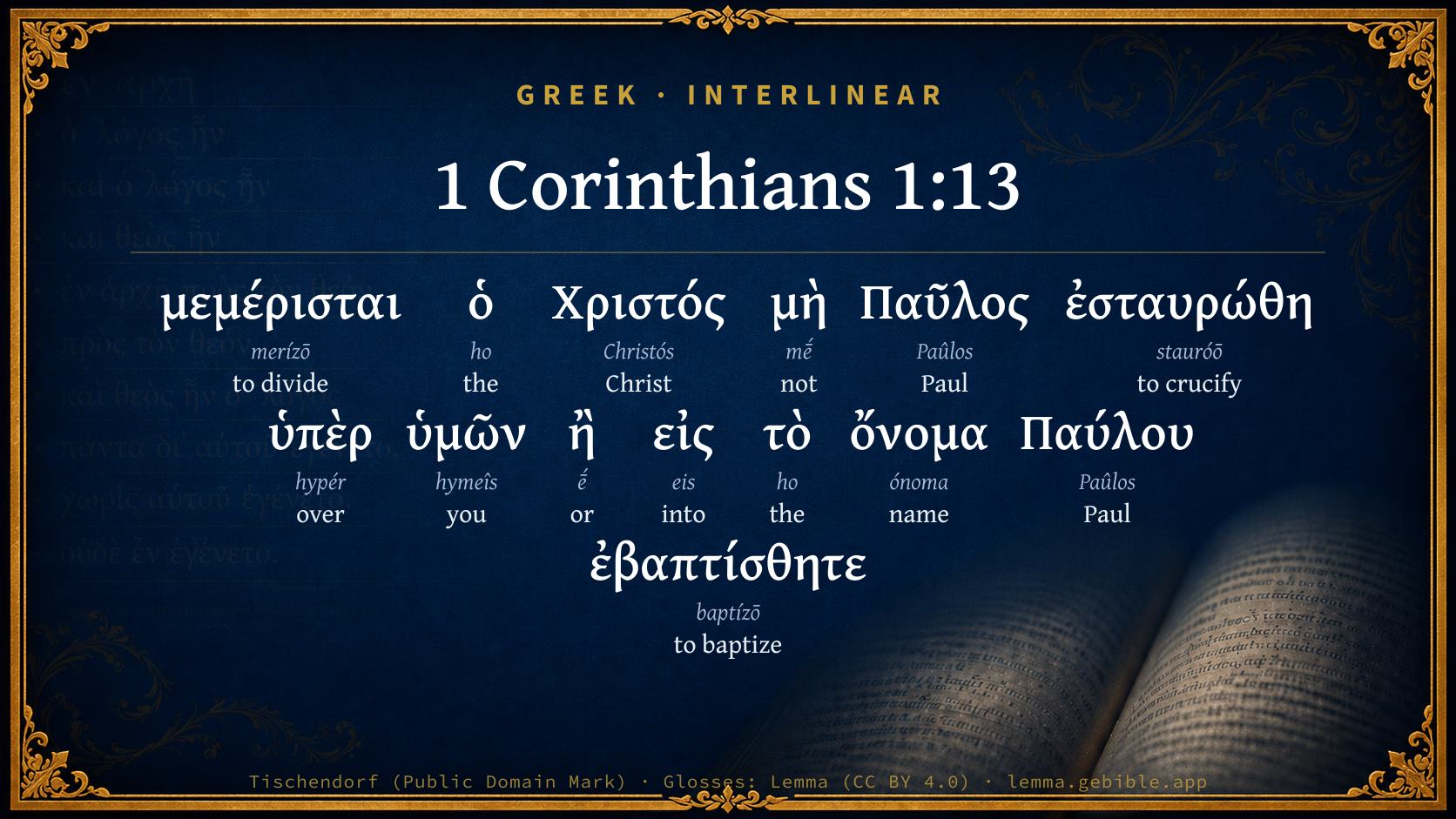
Greek (Tischendorf 8th ed.) 1 Corinthians 1:13 appears in the Greek New Testament. The text above is from the Tischendorf 8th edition. Each word links to its Strong’s number and a concise gloss. Click any word for its full Thayer’s Greek Lexicon entry.
Download image
Cite this verse

1 Corinthians 1:13 (World English Bible). Public Domain. Lemma interlinear Bible study tool, https://lemma.gebible.app/v/1-corinthians/1/13.

Show BibTeX & RIS
BibTeX
RIS
English Translation
Is Christ divided? Was Paul crucified for you? Or were you baptized into the name of Paul?
World English Bible · Public Domain
Download a study sheet

One document with this verse’s original text, its word-by-word gloss line, the meaning frame, cross-references with their text, attributed commentary, and full source and license credits — printable, and it pastes into notes with its structure intact.

This verse Autodidact and up

Study sheet (.html) Plain text (.txt)

A passage Seminary Student

Up to 50 verses in one chapter. A passage sheet keeps up to 6 commentary sources and 12 cross-references per verse, in the order this page ranks them, and says so on the sheet whenever that leaves anything out. Ask for a single verse and you get the Autodidact verse sheet above.

Everything on this page stays free to read, with no account — the sheet is a download of what is already on screen, not access to it.

Want to remove ads? Support Godless Engineer
Compare translations 3

The same verse in 3 English versions, stacked beneath the original-language interlinear above. Click any original word for its lexicon entry.

Each is an independent rendering of the whole verse — the interlinear is not word-aligned to these translations.

Highlighted words mark where these versions differ — a whole-verse word diff, not a word-by-word alignment.

  • World English Bible Public Domain
    Is Christ divided? Was Paul crucified for you? Or were you baptized into the name of Paul?
  • King James Version Public Domain
    Is Christ divided? was Paul crucified for you? or were ye baptized in the name of Paul?
  • unfoldingWord Literal Text CC BY-SA 4.0
    Has Christ been divided? Paul was not crucified for you, was he? Or were you baptized in the name of Paul?

unfoldingWord Literal Text — © unfoldingWord, licensed CC BY-SA 4.0. Word-aligned USFM3 via Door43 (git.door43.org/unfoldingWord/en_ult).

Versions to compare (up to 4)

3 of 4 selected

Show all 19 translations

Every available English version of this verse, each an independent rendering of the whole verse.

  • World English Bible Public Domain
    Is Christ divided? Was Paul crucified for you? Or were you baptized into the name of Paul?
  • Berean Standard Bible Public Domain
    Is Christ divided? Was Paul crucified for you? Were you baptized into the name of Paul?
  • Majority Standard Bible Public Domain
    Is Christ divided? Was Paul crucified for you? Were you baptized into the name of Paul?
  • King James Version Public Domain
    Is Christ divided? was Paul crucified for you? or were ye baptized in the name of Paul?
  • American Standard Version (1901) Public Domain
    Is Christ divided? was Paul crucified for you? or were ye baptized into the name of Paul?
  • Revised Version (1885) Public Domain
    Is Christ divided? was Paul crucified for you? or were ye baptized into the name of Paul?
  • Geneva Bible (1599) Public Domain
    Is Christ deuided? was Paul crucified for you? either were ye baptized into the name of Paul?
  • Douay-Rheims (1899) Public Domain
    Is Christ divided? Was Paul then crucified for you? or were you baptized in the name of Paul?
  • Young's Literal Translation Public Domain
    Hath the Christ been divided? was Paul crucified for you? or to the name of Paul were ye baptized;
  • Literal Standard Version CC BY-SA 4.0
    Has the Christ been divided? Was Paul crucified for you? Or were you immersed into the name of Paul?
  • Unlocked Literal Bible CC BY-SA 4.0
    Is Christ divided? Was Paul crucified for you? Were you baptized in the name of Paul?
  • unfoldingWord Literal Text CC BY-SA 4.0
    Has Christ been divided? Paul was not crucified for you, was he? Or were you baptized in the name of Paul?
  • Darby Bible Public Domain
    Is the Christ divided? has Paul been crucified for you? or have ye been baptised unto the name of Paul?
  • World Messianic Bible Public Domain
    Is Messiah divided? Was Paul crucified for you? Or were you immersed into the name of Paul?
  • Webster's Bible Public Domain
    Is Christ divided? was Paul crucified for you? or were ye baptized in the name of Paul?
  • Free Bible Version CC BY-SA 4.0
    Is Christ divided? Did Paul die on a cross for you? Was it in the name of Paul that you were baptized?
  • Bible in Basic English Public Domain
    Is there a division in Christ? was Paul nailed to the cross for you? or were you given baptism in the name of Paul?
  • Text-Critical English NT CC BY 4.0
    Has Christ been divided? Was Paul crucified for you, or were you baptized into the name of Paul?
  • Tyndale New Testament (1534) Public Domain
    Ys Christ devided? was Paul crucified for you? ether were ye baptised in the name of Paul?

Literal Standard Version (2020), Covenant Press — licensed CC BY-SA 4.0. Text via the HelloAO Bible API (eBible.org). Unlocked Literal Bible (unfoldingWord) — licensed CC BY-SA 4.0. Text via the HelloAO Bible API (eBible.org). unfoldingWord Literal Text — © unfoldingWord, licensed CC BY-SA 4.0. Word-aligned USFM3 via Door43 (git.door43.org/unfoldingWord/en_ult). Free Bible Version, Dr. Jonathan Gallagher — licensed CC BY-SA 4.0. Text via the HelloAO Bible API (eBible.org).

Word by word

More ways to search: Search by grammar → Find every occurrence → Compare this word →

Practice this passage: Drill this verse → Learn its vocabulary →

μεμέρισται
merízō
G3307
“to divide”
Verb, Perfect, Passive, Indicative, 3rd person, Singular
Part of Speech
Verb
Tense
Perfect
Voice
Passive
Mood
Indicative
Person
3rd person
Number
Singular
Full Thayer's Definition

Origin: from G3313

TDNT: None

1. to divide a. to separate into parts, cut into pieces 1. to divide into parties, i.e. be split into factions b. to distribute 1. a thing among people 2. bestow, impart
  1. ὁ ho G3588 “the” Article, Nominative, Singular, Masculine
  2. Χριστός Christós G5547 “Christ” Noun, Nominative, Singular, Masculine
  3. μὴ mḗ G3361 “not” Particle, Negative
  4. Παῦλος Paûlos G3972 “Paul” Noun, Nominative, Singular, Masculine
  5. ἐσταυρώθη stauróō G4717 “to crucify” Verb, Aorist, Passive, Indicative, 3rd person, Singular
  6. ὑπὲρ hypér G5228 “over” Preposition
  7. ὑμῶν hymeîs G5210 “you” Personal pronoun, 2nd person, Genitive, Plural
  8. ἢ ḗ G2228 “or” Particle
  9. εἰς eis G1519 “into” Preposition
  10. τὸ ho G3588 “the” Article, Accusative, Singular, Neuter
  11. ὄνομα ónoma G3686 “name” Noun, Accusative, Singular, Neuter
  12. Παύλου Paûlos G3972 “Paul” Noun, Genitive, Singular, Masculine
  13. ἐβαπτίσθητε baptízō G907 “to baptize” Verb, Aorist, Passive, Indicative, 2nd person, Plural

About this verse

These counts appear in no published source. They are computed here, from the morphology-tagged text and Lemma’s own curated glosses. What Lemma adds →

14
words
12
distinct lemmas
Pauline Epistles
section

Notable vocabulary

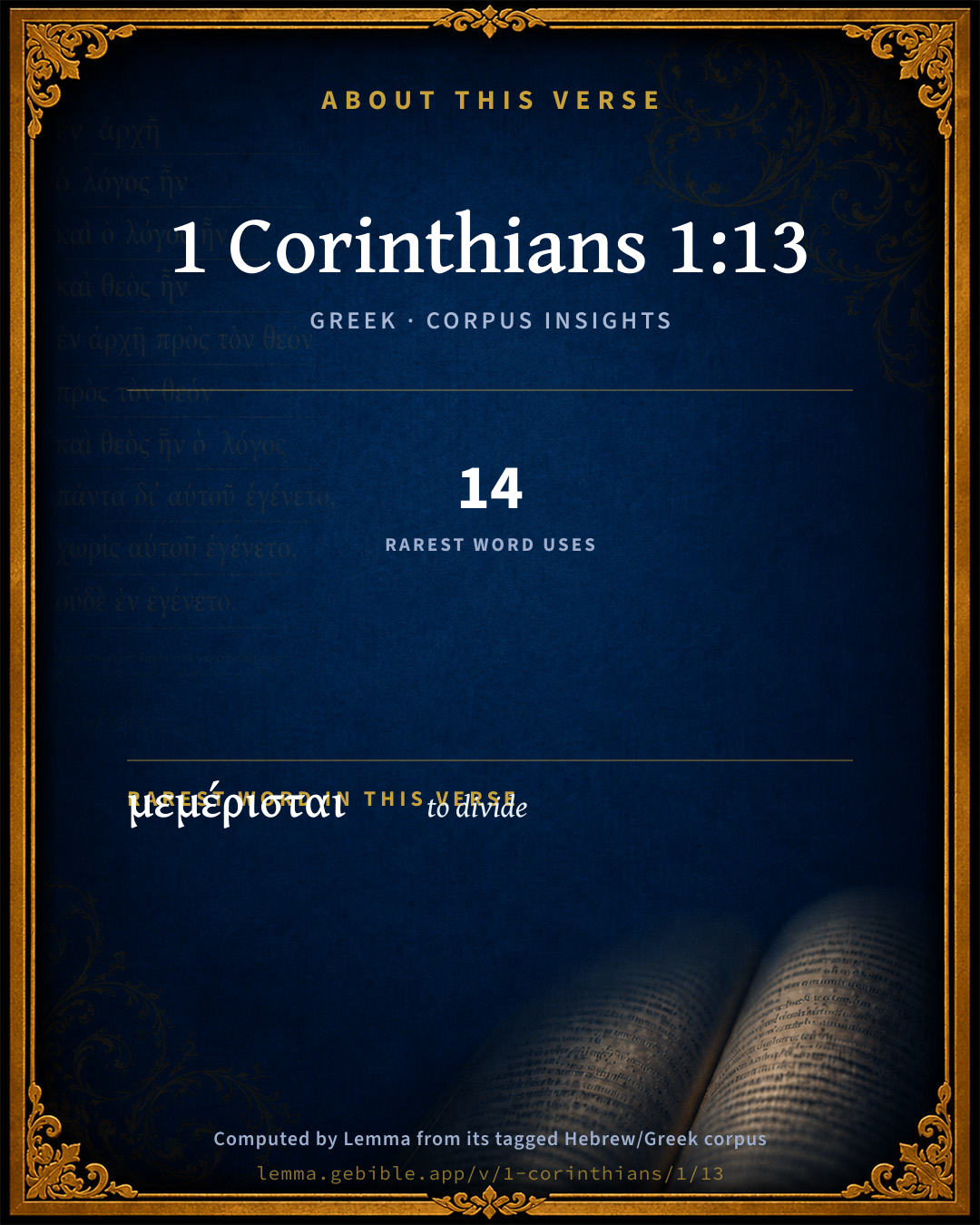
The rarest word here is μεμέρισται to divide G3307 — appearing just 14 times in the whole Greek New Testament.

Shared distinctive vocabulary

μεμέρισται to divide G3307 occurs in 13 verses of the Greek New Testament. Also found in:

Repetition

Words recur within this verse:

Cross-references

14

Topical passages linked to 1 Corinthians 1:13 in the Treasury of Scripture Knowledge — connected by theme and wording, ordered by reader-vote popularity; previews shown in the World English Bible.

  • Ephesians 4:5 one Lord, one faith, one baptism,
  • 2 Corinthians 11:4 For if he who comes preaches another Jesus, whom we did not preach, or if you receive a different spirit, which you did not receive, or a different gospel, which you did not accept, you put up with that well enough.
  • Acts 2:38 Peter said to them, "Repent, and be baptized, everyone of you, in the name of Jesus Christ for the forgiveness of sins, and you will receive the gift of the Holy Spirit.
  • Acts 10:48 He commanded them to be baptized in the name of Jesus Christ. Then they asked him to stay some days.
  • Acts 19:5 When they heard this, they were baptized in the name of the Lord Jesus.
  • 1 Corinthians 10:2 and were all baptized into Moses in the cloud and in the sea;
  • 2 Corinthians 5:14–15 For the love of Christ constrains us; because we judge thus, that one died for all, therefore all died.
  • Matthew 28:19 Therefore go, and make disciples of all nations, baptizing them in the name of the Father and of the Son and of the Holy Spirit,
  • Galatians 1:7 and there isn't another gospel. Only there are some who trouble you, and want to pervert the Gospel of Christ.
  • Acts 8:16 for as yet he had fallen on none of them. They had only been baptized in the name of Christ Jesus.
  • Romans 14:9 For to this end Christ died, rose, and lived again, that he might be Lord of both the dead and the living.
  • 1 Corinthians 1:15 so that no one should say that I had baptized you into my own name.
  • 1 Corinthians 6:19–20 Or don't you know that your body is a temple of the Holy Spirit which is in you, which you have from God? You are not your own,
  • Titus 2:14 who gave himself for us, that he might redeem us from all iniquity, and purify for himself a people for his own possession, zealous for good works.

Cross-references courtesy of OpenBible.info (CC BY 4.0).

Commentary

Notes on 1 Corinthians 1:13 from classic Christian and Jewish commentators (each source and its license shown beneath its notes). The classic Christian expositions comment on the surrounding passage and are grouped to its opening verse, so a note may address several verses; the Jewish commentaries on the Tanakh (Rashi and others) are per-verse, so they appear only where the commentator wrote on this verse.

Lemma curates 59 commentaries, every one of them public domain or Creative Commons licensed, each selected and text-cleaned for this edition rather than reprinted as found. About our sources →

Joseph Benson's Commentary

1Co 1:13-16. Why do you not all say the same thing, namely, I am of Christ, 1Co 3:23. Is Christ divided? — Did one Christ send Paul, and another Apollos, to preach the gospel to you? Is not one and the same Christ preached to you by us all? or is his body divided? See 2Co 11:4. Was Paul — Or any other but Christ Jesus; crucified for you — That you should be baptized into his death, as Christians are into the death of Christ? that is, engaged by baptism to be conformed to his death, by dying to sin and to the world. As if he had said, Are your obligations to me, or to any other apostle or Christian minister, equal or comparable to those which you are under to our common Master? to him who died for us upon the cross? He mentions himself, as it was least invidious to do so; though the application was equally just as to every other instance. The apostle’s question here implies, that the sufferings of Christ have an influence in saving the world, which the sufferings of no other man have, or can have. Or were ye baptized in the name of Paul —

By his authority, and dedicated to his service? To be baptized in or into the name of any person is, as Locke observes, “to enter himself a disciple of him into whose name he is baptized, with profession to receive his doctrine and rules, and submit to his authority: a very good argument here, why they should be called by no one’s name but Christ’s.” In this sense the Israelites are said, 1Co 10:2, to have been baptized into Moses, in the cloud, and in the sea. I thank God — Who so ordered it in the course of his providence: it is a pious phrase for the common one, I rejoice: that I baptized none of you, but Crispus and Gaius — Crispus was the ruler of the synagogue at Corinth, and among the first of the Corinthians who were converted by Paul, Act 18:8 : Gaius, or Caius, was the person with whom the apostle lodged when he wrote his epistle to the Romans, Rom 15:23. Both of them were persons of eminence. The other Corinthians may have been baptized by the apostle’s assistants, Silas, Titus, and Timothy. Lest any should say I had baptized in my own name — In order to attach the persons baptized to myself, and cause them to acknowledge me for their head. Also the household of Stephanas — Who, according to Theophylact, was a person of note among the Corinthians; and his family seem all to have been adults when they were baptized, being said, 1Co 16:15, to have addicted themselves to the ministry of the saints. I know not — That is, it does not at present occur to my memory; whether I baptized any other — “Here the apostle intimates that he is not speaking by inspiration, but from memory. He did not remember whether he baptized any more of the Corinthians. The Spirit was given to the apostles indeed to lead them into all truth; but it was truth relative to the plan of man’s salvation, which was thus made known to them, and not truth, like the fact here mentioned, the certain knowledge of which was of no use whatever to the world.”

Joseph Benson's Commentary on the Old and New Testaments (1811–1818) — public domain. Text from a community e-Sword module.

Tyndale Open Study Notes

Tyndale Open Resources

1:13 Paul asks three rhetorical questions, all expecting the obvious answer, “no.” Christian devotion is to be given to Christ, not to his messengers.

Tyndale Open Study Notes — © Tyndale Open Resources, licensed CC BY-SA 4.0. Text via the HelloAO Bible API.

Bengel's Gnomon

Johann Albrecht Bengel

1Co 1:13. Μεμέρισται, has [Christ] been divided?) Are then all the members not now any longer under one Head? And yet, since He alone was crucified for you, is it not in the name of Him alone that ye have been baptized? The glory of Christ is not to be divided with His servants; nor is the unity of His body to be cut into pieces, as if Christ were to cease to be one.—μὴ) Lat. num:[4] it is often put in the second clause of an interrogation; ch. 1Co 10:22; 2Co 3:1.—ἘΣΤΑΥΡΏΘΗ—ἘΒΑΠΤΊΣΘΗΤΕ, was crucified—ye were baptized) The cross and baptism claim us for Christ. The correlatives are, redemption, and self-dedication.

[4] It expects a negative answer. “Was it Paul (surely you will not say so) that was crucified for you.” This illustrates the subjective force of μὴ (i.e. referring to something in the mind of the subject); whilst οὐκ is objective.—ED.

Bengel's Gnomon of the New Testament — English translation (T&T Clark, Edinburgh, 1860) — public domain. Text from a community e-Sword module.

Meyer's Critical & Exegetical Commentary

Heinrich August Wilhelm Meyer

1Co_1:13. Μεμέρισται ὁ Χριστός] affirmative (with Lachmann and Kniewel; so τινές as early as Theodoret), not interrogatory (as commonly taken), setting forth the tragical result of the aforesaid state of party-division, 1Co_1:12, and that with arresting emphasis from the absence of any connective particle: Christ is divided! i.e. in place of being whole and undivided, the One common Christ of all, He is broken up into different party-Christs! Such, that is to say, is the actual appearance of things when, of several parties mutually exclusive of one another, each seems to have its own separate Christ.[194] The reproach here conveyed suits the Christ-party also (against Räbiger), just as forming a party, but not them alone (Hofmann). The interrogatory rendering, common since Chrysostom: Is Christ divided? taken as a question of surprise, has nothing against it linguistically (see esp. Valckenaer, II. p. 71 f.), but it is liable to the objection that it is only with the following μή that the text gives us to recognise the beginning of the interrogative address. Had Paul intended μεμέρ. ὁ Χ. as a question, it would have been most natural for him in the flow of his discourse to carry on the same form of interrogation, and say: ἢ Παῦλος ἐστ. ὑπ. ὑμ. The text, I may add, gives no warrant for interpreting Χριστός of the corpus Chr. mysticum, i.e. the church (Estius, Olshausen, and others; τινές in Theodoret), or even of the doctrina Chr., which is not varia et multiplex (Grotius, Mosheim, Semler, Morus, Rosenmüller).

μὴ Παῦλος κ.τ.λ[195]] Paul surely was not, etc. From this point on to 1Co_1:16 the incongruous nature of the first party-confession of faith is specially exposed. Bengel aptly remarks: Crux et baptismus nos Christo asserit; relata: redimere, se addicere. The two questions correspond to the mutual connection between believing and being baptized.

ὑπέρ] on behalf of, in the sense of atonement.[196] Comp on Gal_1:4; Eph_5:2.

ΕἸς ΤῸ ὌΝΟΜΑ] in reference to the name, as the name of him who is to be henceforth the object of the faith and confession of the individual baptized. Comp on Mat_28:19 and Rom_6:3.

There was no need of a single word more regarding the first of these two questions; the answer to it was so self-evident. But as to the second, the apostle has some remarks to make, 1Co_1:14-16.

[194] The conception is not that Christ is broken up into parts or fragments, so that the one party should possess this, the other that, part (see Baur, de Wette, Rückert, Calvin, etc., with Chrysostom and Theophylact); for each party gave itself out as the possessor of the whole Christ, not simply of a part, He standing to it in the relation of its Lord and Head. To this conception corresponds, too, the ἐγὼ δὲ Χριστοῦ, instead of which it would not have been necessary that it should run, ἐμοῦ ὁ Χριστός, as Hofmann objects.

[195] .τ.λ. καὶ τὰ λοιπά.

[196] Lachm. reads περὶ ὑμῶν, instead of ὑπὲρ ὑμῶν, following only B D*; too weakly attested, and deserving of rejection also on this ground, that Paul always uses ὑπέρ (even in 1Th_5:10) where the death of Christ is placed in relation to persons, for whom He died. Comp. on 1Co_15:3, which is the only certain passage in Pauls writings where ὁπέρ (occurs with an abstract term. See also Wieseler on Gal_1:4.

Meyer — Critical and Exegetical Commentary on the New Testament — English translation by Peter Christie, edited by Frederick Crombie (T&T Clark, 1880) — public domain. Text from a community e-Sword module.

Expositor's Greek Testament

ed. W. Robertson Nicoll

1Co 1:13 . In his expostulation P. uses, with telling contrast, the first and last only of the party names: “Is the Christ divided? Was Paul crucified on your behalf? or into the name of Paul were you baptised?” Lachmann, W.H [176] , Mr [177] , Bt [178] , read μεμέρισται ὁ Χ . as an exclamation: “The Christ (then) has been divided!” torn in pieces by your strife. But μερίζω (here in pf. of resultful fact) denotes distribution , not dismemberment (see parls.): the Christian who asserts “I am Christ’s” in distinction from others, claims an exclusive part in Him, whereas the one and whole Christ belongs to every limb of His manifold body (see 1Co 12:12 ; also 1Co 11:3 , Rom 10:12 ; Rom 14:7-9 , Eph 4:3 ff., Col 2:19 ). A divided Church means a Christ parcelled out , appropriated κατὰ μέρος . ὁ Χριστὸς is the Christ , in the fulness of all that His title signifies (see 1Co 12:12 , etc.). While μεμέρισται ὁ Χ .; is Paul’s abrupt and indignant question to himself, μὴ Παῦλος ἐσταυρώθη ; (aor [179] of historical event) interrogates the readers “Is it Paul that was crucified for you?” From the cross the Ap. draws his first reproof, the point of which 1Co 6:20 makes clear, “You were bought at a price”: the Cor [180] therefore were not Paul’s or Kephas’, nor some of them Christ’s and some of them Paul’s men, but only Christ’s and all Christ’s alike.

[176] Westcott and Hort’s The New Testament in Greek: Critical Text and Notes.

[177] Meyer’s Critical and Exegetical Commentary (Eng. Trans.).

[178] J. A. Beet’s St. Paul’s Epp. to the Corinthians (1882).

[179] aorist tense.

[180] Corinth, Corinthian or Corinthians.

The cross was the ground of κοινωνία Χριστοῦ (1Co 1:9 , 1Co 10:16 ); baptism , signalising personal union with Him by faith, its attestation (Rom 6:3 ); to this P. appeals asking, ἢ εἰς τὸ ὄνομα Παύλου ἐβαπτίσθητε ; His converts will remember how Christ’s name was then sealed upon them, and Paul’s ignored. What was true of his practice, he tacitly assumes for the other chiefs. The readers had been baptised as Christians , not Pauline, Apollonian, or Petrine Christians. Paul’s horror at the thought of baptising in his name shows how truly Christ’s was to him “the name above every name’ (Phi 2:9 ; cf. 2Co 4:5 ).

The Expositor's Greek Testament, edited by W. Robertson Nicoll (1897–1910) — public domain. Text from a community e-Sword module.

Hodge's Commentary on Romans, Ephesians & First Corinthians

Charles Hodge

1Co_1:13

Is Christ divided? was Paul crucified for you? or were ye baptized in the name of Paul?

The grounds of our allegiance to Christ, are, first, that he is the Christ, the Son of the living God; second, that he hath redeemed us; third, that we are consecrated to him in baptism. All these grounds are peculiar to Christ. To no other being in the universe do believers stand in the relation which they all sustain to their common Lord. As, therefore, there is but one Christ, but one redeemer, but one baptism, Christians cannot be divided without violating the bond which binds them to Christ and to one another.

Is Christ divided? Of course the answer must be in the negative. As Christ is incapable of division, as there can be but one Christ, the church cannot be divided. It is contrary to its nature to be split into hostile parties, just as it is contrary to the nature of a family to be thus divided. As the head is one, so are the members.

Was Paul crucified for you? Did Paul redeem you? Were you purchased by his blood, so as to belong to him? If not, then you are not his, and it is wrong to say, We are Pauls. Believers bear no such relation even to inspired teachers, as to justify their being called by their names. They are called Christians, because they are the worshippers of Christ, because they belong to him, and because they are consecrated to him.

Or were ye baptized in the name of Paul? (εἰς τὸ ὄνομα), literally, unto the name, i.e. in reference to Paul, so that he should be the object of your faith and the one whose name you were to confess. By baptism we are brought into the number of the disciples and followers of him into whose name, or in reference to whom, we are baptized. As, therefore, all Christians are baptized unto Christ, and not unto the apostles, much less any uninspired teacher, it is Christ whom they should confess, and by his name they should be called.

Charles Hodge — Commentary on Romans (1835), First Corinthians (1857), and Ephesians (1856) — public domain. Text from a community e-Sword module.

Geneva Bible (1599)

Geneva Bible translators

Another reason: Because they cannot without great injury to God so hang of men as of Christ: which thing no doubt they do, which allow whatsoever some man speaketh, even for his person’s sake: as these men allowed one selfsame Gospel being uttered of one man, and did loathe it being uttered of another man. So that these factions were called by the names of their teachers. Now Paul setteth down his own name not only to grieve no man, but also to showeth it he pleadeth not his own cause.

The third reason taken of the form and end of Baptism, wherein we make a promise to Christ, calling on also the Name of the Father and the holy Ghost. Therefore although a man does not fall from the doctrine of Christ, yet if he hang upon some certain teachers, and despise others, he forsaketh Christ: for if he hold Christ his only master, he would hear him, teaching by whomsoever.

The first reason why schisms ought to be eschewed: because Christ formeth by that means, to be divided and torn in pieces, who cannot be the head of two divers and disagreeing bodies, being himself one.

Geneva Bible (1599) marginal notes — public domain. Text via Bolls.life.

Jamieson, Fausset & Brown

Robert Jamieson, A. R. Fausset & David Brown

Is Christ divided?--into various parts (one under one leader, another under another) [ALFORD]. The unity of His body is not to be cut in pieces, as if all did not belong to Him, the One Head.

was Paul crucified for you?--In the Greek the interrogation implies that a strong negative answer is expected: "Was it Paul (surely you will not say so) that was crucified for you?" In the former question the majesty of "CHRIST" (the Anointed One of God) implies the impossibility of His being "divided." in the latter, Paul's insignificance implies the impossibility of his being the head of redemption, "crucified for" them, and giving his name to the redeemed. This, which is true of Paul the founder of the Church of Corinth, holds equally good of Cephas and Apollos, who had not such a claim as Paul in the Corinthian Church.

crucified . . . baptized--The cross claims us for Christ, as redeemed by Him; baptism, as dedicated to Him.

in the name--rather, "into the name" (Gal 3:27), implying the incorporation involved in the idea of baptism.

Jamieson, Fausset & Brown — Commentary Critical and Explanatory on the Whole Bible (1871) — public domain (CC PDM 1.0). Text via the HelloAO Bible API.

Adam Clarke's Commentary

Verse 13. Is Christ divided?] Can he be split into different sects and parties? Has he different and opposing systems? Or, is the Messiah to appear under different persons?

Was Paul crucified for you?] As the Gospel proclaims salvation through the crucified only, has Paul poured out his blood as an atonement for you? This is impossible, and therefore your being called by my name is absurd; for his disciples you should be, alone, who has bought you by his blood.

Were ye baptized in the name of Paul?] To be baptized in, or into the name of one, implied that the baptized was to be the disciple of him into whose name, religion, c., he was baptized. As if he said: Did I ever attempt to set up a new religion, one founded on my own authority, and coming from myself? On the contrary, have I not preached Christ crucified for the sin of the world and called upon all mankind, both Jews and Gentiles, to believe on Him?

Adam Clarke's Commentary on the Bible (1810–1826) — public domain. Text from a community e-Sword/MySword module.

John Calvin's Commentaries

13. Is Christ divided? This intolerable evil was consequent upon the divisions that prevailed among the Corinthians: for Christ alone must reign in the Church. And as the object of the gospel is, that we be reconciled to God through him, it is necessary, in the first place, that we should all be bound together in him. As, however, only a very few of the Corinthians, who were in a sounder condition than the others, retained Christ as their Master, (while all made it their boast that they were Christians,) Christ was by this means torn asunder. For we must be one body, if we would be kept together under him as our head. If, on the other hand, we are split asunder into different bodies, we start aside from him also. Hence to glory in his name amidst strifes and parties is to tear him in pieces: which indeed is impossible, for never will he depart from unity and concord, because “He cannot deny himself” (2 Timothy 2:13.) Paul, therefore, by setting before them this absurdity, designs to lead the Corinthians to perceive that they are estranged from Christ, inasmuch as they are divided, for then only does he reign in us, when we have him as the bond of an inviolably sacred unity.

Was Paul crucified for you? By two powerful considerations, he shows how base a thing it is to rob Christ of the honor of being the sole Head of the Church — the sole Teacher — the sole Master; or to draw away from him any part of that honor, with the view of transferring it to men. The first is, that we have been redeemed by Christ on this footing, that we are not our own masters. This very argument Paul makes use of in his Epistle to the Romans (Romans 14:9,) when he says,

“For this end Christ died and rose again, that he might be Lord both of the living and the dead.”

To him, therefore, let us live and die, because we are always his. Also in this same Epistle (1 Corinthians 7:23,)

“Ye are bought with a price: be not ye the servants of men.”

As the Corinthians, therefore, had been purchased with the blood of Christ, they in a manner renounced the benefit of redemption, when they attached themselves to other leaders. Here is a doctrine that is deserving of special notice — that we are not at liberty to put ourselves under bondage to men, because we are the Lord’s heritage. Here, therefore, he accuses the Corinthians of the basest ingratitude, in estranging themselves from that Leader, by whose blood they had been redeemed, however they might have done so unwittingly.

Farther, this passage militates against the wicked contrivance of Papists, by which they attempt to bolster up their system of indulgences. For it is from the blood of Christ and the martyrs that they make up that imaginary treasure of the Church, which they tell us is dealt out by means of indulgences. Thus they pretend that the martyrs by their death merited something for us in the sight of God, that we may seek help from this source for obtaining the pardon of our sins. They will deny, indeed, that they are on that account our redeemers; but nothing is more manifest than that the one thing follows from the other. The question is as to the reconciling of sinners to God; the question is as to the obtaining of forgiveness; the question is as to the appeasing of the Lord’s anger; the question is as to redemption from our iniquities. This they boast is accomplished partly by the blood of Christ, and partly by that of the martyrs. They make, therefore, the martyrs partners with Christ in procuring our salvation. Here, however, Paul in strong terms denies that any one but Christ has been crucified for us. The martyrs, it is true, died for our benefit, but (as Leo observes) it was to furnish an example of perseverance, not to procure for us the gift of righteousness.

Or were ye baptized in the name of Paul? Here we have a second argument, which is taken from the profession of baptism; for we enlist ourselves under the banners of him in whose name we are baptized. We are, accordingly, bound to Christ, in whose name our baptism is celebrated. Hence it follows that the Corinthians are chargeable with perfidy and apostasy, if they place themselves under subjection to men. Observe here that the nature of baptism resembles a contract of mutual obligation; for as the Lord by that symbol receives us into his household, and introduces us among his people, so we pledge our fidelity to him, that we will never afterwards have any other spiritual Lord. Hence as it is on God’s part a covenant of grace that he contracts with us, in which he promises forgiveness of sins and a new life, so on our part it is an oath of spiritual warfare, in which we promise perpetual subjection to him. The former department Paul does not here touch upon, because the subject did not admit of it; but in treating of baptism it ought not to be omitted. Nor does Paul charge the Corinthians with apostasy simply on the ground of their forsaking Christ and betaking themselves to men; but he declares that if they do not adhere to Christ alone — that very thing would make them covenant-breakers.

It is asked, what it is to be baptized in the name of Christ? I answer that by this expression it is not simply intimated that baptism is founded on the authority of Christ, but depends also on his influence, and does in a manner consist in it; and, in fine, that the whole effect of it depends on this — that the name of Christ is therein invoked. It is asked farther, why it is that Paul says that the Corinthians were baptized in the name of Christ, while Christ himself commanded (Matthew 28:19) the Apostles to baptize in the name of the Father, and of the Son, and of the Holy Spirit. I answer, that in baptism the first thing to be considered is, that God the Father, by planting us in his Church in unmerited goodness, receives us by adoption into the number of his sons. Secondly, as we cannot have any connection with him except by means of reconciliation, we have need of Christ to restore us to the Father’s favor by his blood. Thirdly, as we are by baptism consecrated to God, we need also the interposition of the Holy Spirit, whose office it is to make us new creatures. Nay farther, our being washed in the blood of Christ is peculiarly his work; but as we do not obtain the mercy of the Father, or the grace of the Spirit, otherwise than through Christ alone, it is on good grounds that we speak of him as the peculiar object in view in baptism, and more particularly inscribe his name upon baptism. At the same time this does not by any means exclude the name of the Father and of the Spirit; for when we wish to sum up in short compass the efficacy of baptism, we make mention of Christ alone; but when we are disposed to speak with greater minuteness, the name of the Father and that of the Spirit require to be expressly introduced.

John Calvin's Commentaries (1540-1563) — public domain. Text from the Calvin Translation Society English edition (1840s-50s) via the Christian Classics Ethereal Library (ccel.org). Calvin's coverage is partial (roughly two-thirds of the Bible); uncommented books and verses are honest gaps, never fabricated. The 19th-century editor's footnotes and remarks are omitted so the notes are faithfully Calvin's own voice.

Ellicott's Commentary for English Readers

(13) Is Christ divided?—Better, Christ is divided. Christ, in the communion of the Church, is rent, torn in fragments by you. The mention of the sacred name as a party-cry makes the Apostle burst into that impassioned exclamation. Then there is a momentary pause, and the Apostle goes back from his sudden denunciation of the “Christ” party, to those whom he had originally selected for typical treatment, viz., those who bore his own name, the two streams of thought, as it were, mingling and rushing together; and he asks (with a mind still full of the burning indignation aroused by the mention of the name of union as a symbol of disunion), “Was Paul crucified for you?” “Was your baptism in the name of Paul?” To each of which the answer must of necessity be “No.”

Paul being the founder of the Church, these questions apply more forcibly to the others also.

A Bible Commentary for English Readers, edited by Charles John Ellicott (1878–1897) — public domain. Text from a community e-Sword module.

The Cambridge Bible for Schools and Colleges

gen. ed. J. J. S. Perowne

13. Is Christ divided?] Some editors read this affirmatively, “Christ is divided,” instead of interrogatively as in the text. But the latter is preferable. St Paul would ask if Christ, into Whose Name the whole Church has been baptized, and Whose Body (Eph_1:23) the whole Church is, can thus be split up into portions, and each portion appropriated by one of the parties he has mentioned.

was Paul crucified for you? or were ye baptized in the name of Paul?] Rather, into the name of Paul. To baptize ‘into’ a name signifies something more than to baptize in a name. Had St Paul used the latter phrase here, he would have been rebuking those Christians who called themselves disciples of any other but Christ. But he is also reminding them that the ‘Name’ of Christ, standing as it does for Himself, is the only way of salvation, that Christ is the only Head of the Church, and he disclaims any attempt to claim for himself that close connection with the inner life of all who profess belief in Christ, which is the prerogative of Christ alone. Cf. St Mat_28:19; Act_3:16; Act_4:12.

The Cambridge Bible for Schools and Colleges (gen. ed. J. J. S. Perowne; Cambridge University Press, 1878–1918) — public domain. Text from a community e-Sword module.

John Gill's Exposition

Is Christ divided?.... Some read the words as an assertion, "Christ is divided"; that is, his body, the church, is divided by such factions and parties; though in some copies the note of interrogation, is put before the clause, and so to be rendered, "is Christ divided?" no; his human body was not to be divided; a bone of him was not to be broken, Joh 19:36; the seamless garment he wore was not to be rent asunder, Joh 19:23; nor is his mystical body, the church, to be torn in pieces by schisms and divisions; nor is anyone part of his Gospel different from, or opposite to another part of it; his doctrine is the same as preached by one minister and another, and is all of a piece, uniform and harmonious. Christ is not divided from his Father, not in nature; though he is to be distinguished from him, yet not to be divided; he is one in nature with him, though he is a distinct person from him; nor is he, nor can he, or will be ever separated from him; nor is he to be divided from him in his works and actions, with whom he was jointly concerned in creation, providence, and grace; and such are to be blamed as dividers of Christ from the Father, who talk of Christ to the exclusion of the Father, or to the dropping and neglect of any of his acts of grace; as his everlasting love to his chosen ones, the eternal election of them in Christ, the covenant of grace made with him, and the instance of his grace in the gift and mission of his Son: nor is Christ divided from himself, not in his nature and person; the two natures, human and divine, are united in one person; they are to be distinguished, and not to be confounded, yet not to be separated as to wake two distinct persons: nor in his offices; a whole Christ is to be received; Christ in his kingly as well as in his priestly office; to claim him as a Saviour and disown him as a King, is dishonourable to him; it is to make one end of his death void, as much as in such lies, which is, that he may be Lord of dead and living; and argues a carnal selfish spirit, and that faith in him is not right: such are to be blamed for being for Christ, and as dividers of him, who talk of being saved by him, and yet would not have him to rule over them. Nor is he divided from his Spirit, not from the person of the Spirit; he is to be distinguished from him as a person, but is one in nature with him; nor from his gifts and graces, which he has as man and Mediator without measure; nor from the work of the Spirit; for it is his grace the Spirit of God implants in the hearts of men: it comes from him, it centres in him, it makes men like him, and glorifies him; such who cry up Christ, and cry down the work of his Spirit upon the soul, are to be blamed for being for Christ, and to be reckoned dividers of them as much as in them lies: nor is Christ divided from his church and people; there is a close union between them, and he dwells in them, and among them; and they are to be blamed that talk of Christ, and never meet with his saints in public service and worship: nor is he divided from his ministers, word, and ordinances; Christ is the sum of the ministry of the word; the ordinances are instituted by him; he submitted to them himself, and is the substance of them, and has promised his presence in them to the end of the world: and what God has put together, let no man put asunder,

Was Paul crucified for you? no; he had taught them another doctrine; namely, that Christ was crucified for them, that he died for their sins, and had bought them with the price of his own blood; and therefore they were not to be the servants of men, or to call any man master, or to be called by his name, or any other man's, only by Christ's, who had redeemed them by his blood; so that they were not their own, nor any other's, but his, and ought to glorify him with their souls and bodies, which were his,

Or were ye baptized in the name of Paul; no; but in the name of the Father, of the Son, and of the Holy Ghost. The apostle did not pretend to be the author of a new revelation, or the propagator of a new religion, but was a preacher of the Gospel, and an administrator of the ordinances of Christ; wherefore he baptized not in his own name, but in the name of Christ: to whose worship and service such as are baptized are devoted, and not to the service of men, and therefore not to be called after their names.

John Gill's Exposition of the Whole Bible (1746–1763) — public domain (CC PDM 1.0). Text via the HelloAO Bible API.

Trapp's Complete Commentary

John Trapp

13 Is Christ divided? was Paul crucified for you? or were ye baptized in the name of Paul?

Ver. 13. Baptized in the name] Gr. "Into the name," so as to be called by my name. Those then that will needs be called Franciscans, Lutherans, &c., do after a sort disclaim their baptism, and become renegades from Christ.

John Trapp, A Commentary or Exposition upon All the Books of the Old and New Testament (1647–1656) — public domain. Text from a community e-Sword module.

Albert Barnes' Notes on the Bible

Is Christ divided? - Paul, in this verse, proceeds to show the impropriety of their divisions and strifes. His general argument is, that Christ alone ought to be regarded as their head and leader, and that his claims, arising from his crucifixion, and acknowledged by their baptism, were so pre-eminent that they could not be divided, and the honors due to him should not be rendered to any other. The apostle, therefore, asks, with strong emphasis, whether Christ was to be regarded as divided? Whether this single Supreme Head and Leader of the church, had become the head of different contending factions? The strong absurdity of supposing that, showed the impropriety of their ranging themselves under different banners and leaders.

Was Paul crucified for you? - This question implies that the crucifixion of Christ had an influence in saving them which the sufferings of no other one could have, and that those sufferings were in fact the speciality which distinguished the work of Christ, and rendered it of so much value. The atonement was the grand, crowning work of the Lord Jesus. It was through this that all the Corinthian Christians had been renewed and pardoned. That work was so pre-eminent that it could not have been performed by another. And as they had all been saved by that alone; as they were alike dependent on his merits for salvation, it was improper that they should be torn into contending factions, and ranged under different leaders. If there is anything that will recall Christians of different names and of contending sects from the heat of strife, it is the recollection of the fact that they have been purchased by the same blood, and that the same Saviour died to redeem them all. If this fact could be kept before their minds, it would put an end to angry strife everywhere in the church, and produce universal Christian love.

Or were ye baptized in the name of Paul - Or, “into,” or “unto” the name of Paul; see the note at Mat 28:19. To be baptized “into,” or “unto” anyone is to be devoted to him, to receive and acknowledge him as a teacher, professing to receive his rules, and to be governed by his authority - Locke. Paul here solemnly reminds them that their baptism was an argument why they should not range themselves under different leaders. By that, they had been solemnly and entirely devoted to the service of the only Saviour. “Did I ever,” was the implied language of Paul, “baptize in my own name? Did I ever pretend to organize a sect, announcing myself as a leader? Have not I always directed you to that Saviour into whose name and service you have been baptized?” It is remarkable here, that Paul refers to himself, and not to Apollos or Peter. He does not insinuate that the claims of Apollos or Peter were to be disparaged, or their talents and influence to be undervalued, as a jealous rival would have done; but he numbers himself first, and alone, as having no claims to be regarded as a religious leader among them, or the founder of a sect. Even he, the founder of the church, and their spiritual father, had never desired or intended that they should call themselves by his name; and he thus showed the impropriety of their adopting the name of any man as the leader of a sect.

Albert Barnes' Notes on the Bible (1834–1885) — public domain. Text from a community e-Sword/MySword module.

Haydock's Catholic Bible Commentary

Was Paul crucified for you? Though says St. Augustine brothers may die for brothers, yet the blood of no martyr is shed for the remission of a brother’s sin. See also St. Leo the Great, serm. xii. de pass. Dom.

George Leo Haydock (1774–1849), Haydock's Catholic Family Bible and Commentary, 1859 edition — public domain. Excludes Psalms (Douay-Rheims chapter numbering differs from Protestant) and Deuterocanonical books (Catholic canon only).

Matthew Poole's English Annotations

How came these parties? There is but one Christ, but one that was crucified for you, but one into whose name, into a faith in whom, and a profession of whom, you were baptized. Peter baptized you into the name of Christ, so did I; I did not list those whom I baptized under any banner of my own, but under Christ’s banner. The Head is but one, and the body ought not to be divided.

Matthew Poole's English Annotations on the Holy Bible (1683–1685) — public domain. Text from a community e-Sword/MySword module.

Whedon's Commentary on the Bible

Daniel D. Whedon

13. Christ divided—The Christ here is the Christ of 1Co_1:30, the embodiment of an entire redemption and all connected blessings. Is, then, this Christ whole and one, and the one on whom the Corinthians can be of one mind, (1Co_1:10,) or is he torn in pieces; each party having a part, or slice, of their own?

Paul crucified—Your true Lord and Master was crucified for you; can Paul show his cross as a claim on your allegiance?

For you—This clearly implies that Christ suffered for us as no saint or martyr ever suffers for us. He suffered, then, not merely as an example, or simply for our benefit, but in a far higher sense.

Baptized in the name— Rather, into the name or authority of Paul, so as to be rightly called by his name. Baptized here expresses the import of the rite, consecrated. Note, Rom_6:3.

Daniel D. Whedon (gen. ed.), Commentary on the Old and New Testaments (1874–1909) — public domain. Text from a community e-Sword module.

The Pulpit Commentary

Is Christ divided? Has Christ been parcelled into fragments? "Is there a Pauline, a Petrine, an Apollonian, a Christian Christ?" Whether you call yourselves Liberals, or Intellectualists, or Catholics, or Bible Christians, your party spirit is a sin, and all the worse a sin because it pranks itself out in the guise of pure religious zeal. This is more forcible than to take the clause affirmatively:" Christ has been parcelled into fragments." In either ease we see" the tragic result of party spirit." Was Paul crucified for you? Again he rebukes the partisanship which attached itself to his own name. This showed a splendid courage and honesty. The introduction of the question by the negative mh expresses astonished indignation: "Can you possibly make a watchword of the name of a mere man, as though he had been crucified for you?" This outburst of feeling is very important, as proving the immeasurable distance which, in Paul"s own view, separated him from his Lord. It is also instructive to see how St. Paul at once denounces the spirit of party without deigning to enter into the question as to which party of these wrangling "theologians" was most or least in the right. He did not choose to pander to their sectarian spirit by deciding between their various forms of aggressive orthodoxy. Into the name. (comp Mat_28:19)

Divisions.

The "contentions in the Church at Corinth, the report of which had reached St. Paul, and which he here rebukes,.were probably not the outgrowth of definite party divisions, but were individual differences as to who among the great Christian leaders should receive superior honour. They were individual strifes, however, that might develop into very serious divisions schisms (scismata) that would utterly rend asunder the fellowship of the Church. It must have been deeply painful to the apostles that they should thus be set in rivalry with one another, as if they were seeking the ends of their own vain ambition, and still more that their names should be permitted in any way to obscure the glory of the Name of their Divine Master. "Is Christ divided?" The question suggests

I THE ESSENTIAL UNITY OF CHRIST. Consider different aspects of this unity. As it regards:

1. His own person. In him we see the blending of the Divine and human in one glorious personality, the balance and harmony of all conceivable forms of moral excellence. No discord in his being, no flaw in his character, no failure in his life; he stands before us in every light, on every side, a complete, symmetrical, and perfect whole.

2. His redeeming purpose and the means by which he effects it. He comes to deliver men from the power of evil, to turn them from their iniquities, to restore them to fellowship with God. The end he seeks is the same for all. "There is no distinction; for all have sinned," etc.. (Rom_3:22-24) And as all human distinctions are lost in the common need of salvation, so in Christ the same possibility of good is placed within the reach of all: "As through one trespass the judgment came unto all men," etc.. (Rom_5:18) There is but one gospel message, and it is the power of God unto salvation to every one that believeth.

3. The life with which he inspires those who receive him. In whomsoever it dwells this life is always one one in its affections and energies, in the laws of its development, in the fruit it bears, in the ends to which it leads. The inspiration of a common spirit life is the grand uniting principle amid endless individual diversities. "By one Spirit we are all baptized into one body," etc.. (1Co_12:13)

4. His authority as the sole Head of the Church. There can be no divided authority. In the very nature of things, Christ can own no rival. The body can have but one living head, the source of informing, guiding, and controlling power. Its own unity lies mainly in the recognition of this: "One Lord, one faith, one baptism," etc. (Eph_4:5, Eph_4:6; 1Co_8:6 1Co_12:5)

II THE EVIL OF EVERYTHING THAT VIOLATES THIS UNITY. The divisions of the Church of Corinth were deprecated by the apostle as an offence against the fundamental principles and laws of the Christian fellowship. All such divisions have certain marked features of evil.

1. They exalt that which is subordinate and accidental at the expense of the vital and supreme. The form of truth is placed above the spirit, doctrine above life, the instrument above the power, appearances above realities, the shadow above the substance creeds, systems, men, above Christ. (1Co_3:4, 1Co_3:5) Examine them closely, and you find that all "contentions" in the Church mean this.

2. They engender mutual animosities which are destructive of the fellowship of a common life. Here lies the heart and core of the evil. Mere outward diversities are not so much to be dreaded. Schism is a thing of the spirit. It lies not in the formal separations that conscience may dictate, but in the fierce antagonisms that may unhappily, but not necessarily, grow out of them. Sectarianism consists not in the frank outspoken assertion of individual convictions, but in the bitterness and uncharitableness with which one conscience may assert itself against all other consciences. So that the very spirit of schism may inspire that passion for uniformity which would suppress individual liberty of thought and speech and action. The true schismatics are these who by their intolerance create divisions. Whatever tends to check the flow of spiritual fellowship violates the law of Christ. We do well carefully to watch against the estrangement of heart that difference of religious opinion and ecclesiastical practice too often generates, "giving diligence to keep the unity of the Spirit in the bond of peace". (Eph_4:3)

3. They bring public dishonour on the Name of Christ. That Name is the symbol of a Divine reconciliation the reconciliation of man to man, as well as man to God. But in this case it is made the cause of separations. Christ came to bind men together in a true brotherhood; but thus he is made a "divider." "Where jealousy and faction are there is confusion and every evil work". (Jam_3:16) And thus the very essential principle and purpose of the Saviour"s mission is falsified, and occasion is given to the enemy to blaspheme. Few things have a more disastrous effect in discrediting the Christian cause than the bitterness of contending parties in that Church which is "the pillar and ground of the truth.

4. They squander and dissipate energies that ought rather to be devoted to active service in the Lord"s kingdom. Think of the waste of spiritual force these divisions involve! If half the enthusiasm mere partisanship has engendered had been expended on some real substantial work for the good of humanity and the glory of God, how blessed the results might have been! In one sense, of course, all zeal for truth, however subordinate the position of the particular truth may be, is for the good of humanity and the glory of God; but to be contending for the maintenance of comparatively trivial points of difference in violation of the spirit that ought to harmonize all differences, and of the grand responsibilities of the Christian calling, is to be guilty of "tithing the mint and the anise and the cummin, to the neglect of the weightier matters of the Law.

III THE CURE FOR THESE EVILS. There is but one cure to keep Christ in all the glory of his being and the supremacy of his claims habitually before our minds, and to open our hearts freely to the inspiration of his Spirit. This will raise us above the littleness and meanness of party strife. A lofty object of contemplation and a high moral purpose must needs have an elevating and ennobling influence on the whole man. It will subdue within us all base affections, will rebuke our personal vanity, will enlarge our sympathies, will chasten our lesser enthusiasms. We shall not be in much danger of helping by our influence to violate the unity of the great household of faith, when our souls are filled with the full orbed glory of the undivided Christ. The expansive Spirit he gives will teach us to say, "Grace be with all them that love our Lord Jesus Christ in sincerity. W.

The unique relation of Christ to the Church.

This is set forth because there was a manifest disposition at Corinth to make Christ a mere party leader. Some said, "I of Christ;" as if Christ stood on the same plane as Paul, Apollos, or Cephas. Bring out, with varied illustration, two points.

I THE AGREEMENTS BETWEEN A TEACHER"S RELATION TO THE CHURCH AND CHRIST"S RELATION TO IT. Christ"s teaching is original, man"s is derived. Christ"s authority is supreme, man"s is only delegated. Christ is the Church"s Foundation, the human teacher is but a workman engaged in the superstructure. Both teach, both bear authority, both are builder"s. The glory of the human teacher is that he can be a "coworker together with Christ." In some sense human teachers may think of themselves as filling the vacant earth sphere of the great Teacher, and carrying on his gracious mission. See Paul"s plea," Now then we are ambassadors for Christ." So far as they bear the Master"s spirit, speak the Master"s truth, and carry out the Master"s will, we give them all honour, attention, and obedience for their Master"s sake. We are "followers of them so far as they follow Christ.

II THE DIFFERENCES BETWEEN A TEACHER"S RELATION TO THE CHURCH AND CHRIST"S RELATION TO IT. There are important distinctions and differences in the things in which both agree. And there are positive distinctions, things in which Christ stands absolutely alone. No other was "crucified for us." Into no other "name" were we "baptized." The relative positions of Christ and the ministry are indicated by the figures of the Shepherd and the under shepherds. The careful and constant preservation of Christ"s unique position in the Church, and relation to it, is the secret of the maintenance of all Church order, unity, and peace. R.T.

The Pulpit Commentary (1880–1919), ed. H.D.M. Spence-Jones & Joseph S. Exell — public domain. Text from a community e-Sword module.

John Wesley's Explanatory Notes

Is Christ divided - Are not all the members still under one head? Was not he alone crucified for you all; and were ye not all baptized in his name? The glory of Christ then is not to be divided between him and his servants; neither is the unity of the body to be torn asunder, seeing Christ is one still.

John Wesley, Explanatory Notes Upon the Whole Bible (1754–1765) — public domain. Text via the GEBible commentary corpus.

McGarvey & Pendleton's Commentaries

J. W. McGarvey

Is Christ divided? [the church is called the "body of Christ" ( 1Co_12:12-13 ; 1Co_12:27 ), and Paul asks if that body can be cut in pieces and parceled out to human leaders] was Paul crucified for you? or were ye baptized into the name of Paul? [Paul shows the disinterestedness of his rebuke by centering it more especially upon those who had honored him as their leader, thus showing, as Bengel says, that "he disliked Paulinists as much as he did Petrinists." Jesus became the Author of our salvation, and the head of the church through suffering upon the cross ( Heb_2:10 ), and Paul, in order to be his rival, should not only have been crucified for his followers, but his sacrifice should have been as efficacious for the cleansing of sin and the procuring of salvation as was Christ's. This was, of course, preposterous. Again, if Paul was incompetent as the head of a religious body, his followers also had not properly qualified themselves as his disciples, for they had not been baptized into Paul's name, but being baptized into Christ they had put on Christ ( Gal_3:27 ), and, becoming thus members of Christ, how could they belong to Paul? What Paul thus spoke of himself could be said with equal force of either Apollos or Cephas.]

J. W. McGarvey (with Philip Y. Pendleton), Commentaries on the New Testament (The Fourfold Gospel, 1914; Acts; and the epistles) — public domain. Text from a community e-Sword/MySword module.

The People's New Testament

B. W. Johnson

13. Is Christ divided? The church is “the Body of Christ” (12:12, 13). Can that body be cut into parts, and these assigned to human leaders? Was Paul crucified for you? The cross binds us to Christ alone. By baptism we are baptized in Christ's name, into his death, and into Christ (Rom. 6:3).

B. W. Johnson's The People's New Testament with Notes (1889–1891) — public domain. Electronic text from the Christian Classics Ethereal Library (CCEL) ThML edition.

Cambridge Greek Testament for Schools and Colleges

13. μεμέρισται ὁ Χριστός; Some editors (e.g. Westcott and Hort) have read this affirmatively, ‘Christ is divided.’ But can Christ be divided? It seems better to render ‘Hath Christ (then) been divided?’ Dean Colet says in his Commentary on this chapter: ‘Quum itaque ejusmodi quiddam unum compositum ex Deo et hominibus constans divina mens Pauli cogitat, qui ex quamplurimis “unctis unus est Christus.” ’ And he especially cites ch. 1Co 12:12. ‘This Divine whole,’ the Apostle would say, ‘cannot be separated into portions. If you break the unity of the Church, you sever yourself from Christ into Whom all have been baptized, and Whose Body (ch. 1Co 12:12) they are.’ Moreover, it is the Apostle’s wont, when strongly affected, to break into interrogations. See for instance 1Co 1:20, 1Co 3:16, 1Co 6:1, &c.

ἢ εἰς τὸ ὄνομα Παύλου ἐβαπτίσθητε. To baptize ‘into’ a name means more than to baptize ‘in’ a name. Had St Paul used ἐν, he would simply have disclaimed the desire to make proselytes to any doctrine of his own. But εἰς implies more than this. Since the name stands for the person named, to baptize ‘into’ a name means to bring the person baptized into a close inward connection with the person in whose name he is baptized. This close inward connection with the soul of the believer is the prerogative of Christ alone, and St Paul disclaims any desire to arrogate to himself any such position. Cf. Mat 28:19; Act 3:16; Act 4:10; Act 4:12.

Cambridge Greek Testament for Schools and Colleges (Cambridge University Press, 1896; 21 vols, various authors incl. Carr, Maclear, Plummer, Farrar, Lumby, Moule, M. R. James, Simcox) — public domain. Text from a community e-Sword module.

Alford’s Greek Testament

Henry Alford

13.] Some (Lachmann has so printed it) take μεμέρισται ὁ χρ. as an assertion,—‘Christ has been divided (by you),’—or, as Chrys. mentions, διενείματο πρὸς ἀνθρώπους κ. ἐμερίσατο τὴν ἐκκλησίαν. But it is far better to take it, as commonly, interrogatively: Is Christ (the Person of Christ, as the centre and bond of Christian unity—not, the Gospel of Christ (Grot., al.),—nor the Church of Christ (Estius, Olsh.): nor the power of Christ (Theodoret), i.e. his right over all) divided (not in the primary sense (Meyer, Exo_1), against Himself, as Mar 3:24, Mar 3:25, where we have ἐφʼ ἑαυτήν, but ‘into various parts, one under one leader, another under another,—which in fact would amount, after all, to a division against Himself)? The question applies to all addressed, not to the ἐγὼ χριστοῦ only, as Meyer, Exo_1. In that case μεμέρισται ῥ χρ. would mean ‘Has Christ become the property of one part only?’ as indeed Dr. Burton renders it.

Meyer urges against the interrogative rendering, that the questions begin immediately after, with μή. But we may fairly set against this argument, that the μή introduces a new form of interrogation respecting a new individual, viz. Paul: and that it was natural, for solemnity’s sake, to express the other question differently. In μεμέρισται ὁ χριστός, the Majesty of Christ’s Person is set against the unworthy insinuation conveyed by μεμέρισται,—in μὴ Παῦλος ἐσταυρώθη ὑπὲρ ὑμ.,—the meanness of the individual, Paul, is set against the triumph of divine Love implied in ἐστ. ὑπ. ὑμῶν. Two such contrasts could hardly but be differently expressed.

μὴ Π. ἐστ. κ.τ.λ.] Surely Paul was not crucified for you? By repudiating all possibility of himself being the Head and ἐπώνυμος of their church, he does so à fortiori for Cephas and Apollos: for he founded the Church at Corinth. On εἰς τὸ ὄν. ἐβαπτ. see Mat 28:19.

Henry Alford, The Greek Testament (1849–1861) — public domain. Text from a community e-Sword module.

International Critical Commentary

13. μεμέρισται. The clauses are all interrogative, and are meant for the refutation of all. ‘Does Christ belong to a section? Is Paul your saviour? Was it in his name that you were admitted into the Church?’ The probable meaning of μεμέρισται is ‘has been apportioned,’ i.e. given to some one as his separate share (7:17; Rom 12:3; Heb 7:2). This suggestion has been brilliantly supported by Evans. To say, ‘Is Christ divided?’ implying a negative answer, gives very little point. Lightfoot suggests that an affirmative answer is implied; ‘Christ has been and is divided only too truly.’ But this impairs the spring and homogeneity of the three questions, giving the first an affirmative, and the other two a negative answer. It amounts to making the first clause a plain statement; ‘In that case the Body of Christ has been divided.’ Dividitur corpus, cum membra dissentiunt (Primasius). Si membra divisa sunt, et totum corpus (Atto Vercellensis). This meaning is hardly so good as the other.

μὴ Παῦλος ἐσταυρώθη κ.τ.λ. To say ἐγὼ Παύλου would imply this. To be a slave is ἄλλου εἶναι, another person’s property (Arist. Pol. I.). A Christian belongs to Christ (3:23), and he therefore may call himself δοῦλος Ἰησοῦ Χριστοῦ, as St Paul often does (Rom 1:1, etc.): but he may not be the δοῦλος of any human leader (7:23; cf. 3:21; 2Co 11:20). St Paul shows his characteristic tact in taking himself, rather than Apollos or Kephas, to illustrate the Corinthian error. Cf. 9:8, 9, 12:29, 30.

εἰς τὸ ὄνομα. He takes the strongest of the three expressions: the εἰς (Mat 28:19; Act 8:16, Act 19:5) is stronger than ἐπί (Act 2:38, v.l.) or ἐν (Act 10:48). ‘Into the name’ implies entrance into fellowship and allegiance, such as exists between the Redeemer and the redeemed. Cf. the figure in 10:2, and see note there. St Paul deeply resents modes of expression which seem to make him the rival of Christ. Non vult a sponsa amari pro sponso (Herv.). At the Crucifixion we were bought by Christ; in baptism we accepted Him as Lord and Master: crux et baptismus nos Christo asserit (Beng.). “The guilt of these partizans did not lie in holding views differing from each other: it was not so much in saying ‘this is the truth,’ as it was in saying ‘this is not the truth.’ The guilt of schism is when each party, instead of expressing fully his own truth, attacks others, and denies that others are in the Truth at all” (F. W. Robertson). See Deissmann, Bible Studies, pp. 146, 196; Light from the Anc. East, p. 123.

It is difficult to decide between ὑπὲρ ὑμῶν (א A C D2 E F G L P, provobis Vulg.) and περὶ ὑμῶν (B D*). The former would be more likely to be substituted for the latter, as most usual, than vice versa. But περί is quite in place, in view of its sacrifical associations. See note on Rom 8:3.

International Critical Commentary — older volumes (1896–1929), various authors — public domain. Text from a community e-Sword module.

Vincent's Word Studies in the New Testament

Marvin R. Vincent

Is Christ divided? [μεμερισται ο χριστος] . Some of the best expositors render as an assertion. Christ has been divided by your controversies. He is broken up into different party Christs. This gives a perfectly good and forcible sense, and is favored by the absence of the interrogative particle mh, which introduces the next clause. 78 Divided : so portioned up that one party may claim Him more than another. Christ has the article. See on Mt 1:1.

Was Paul crucified for you? [μη παυλος εσταυρωθη υπερ υμων] . A negative answer is implied. Paul surely was not, etc. For is uJper on behalf of, not peri on account of, as some texts.

In the name [εις το ονομα] . Rev., correctly, Into the name. See on Mt 28:19. Of Paul as the name of him whom you were to confess. The order of the original is : Was it into the name of Paul that ye were baptized ?

Marvin R. Vincent, Word Studies in the New Testament (1887–1900) — public domain. Text from a community e-Sword/MySword module.

Godet's Commentaries

Frédéric Louis Godet

Vv. 13. “Is the Christ divided? was Paul crucified for you, or were ye baptized in the name of Paul?” Several editors (Lachmann, Westcott, and Hort) and commentators (Meyer, Beet) make the first proposition an indignant affirmation: “Christ then among you is rent, lacerated!” But the transition to the following questions does not in that case seem very natural. It is more simple to see here a question parallel to the two following, these being intended to show the impossibility of the supposition expressed by the first. The term the Christ denotes the Messiah in the abstract sense, that is to say, the Messianic function, rather than the person who filled the office. The latter would certainly be designated by the name of Jesus or by the word Christ without article. How, besides, could we suppose the person of Christ divided into four? Paul means,—is the function of Christ, of Saviour, and founder of the kingdom of God divided between several individuals, so that one possesses one piece of it, another, another? Taken in this sense, the question does not refer only to the fourth party, but to the other three. “Are things then such that the work of salvation is distributed among several agents, of whom Jesus is one, I another?” and so on. Edwards explains thus: “Is not that which is manifested of the Christ in Paul at one with that which is manifested of Him in Apollos, etc....? Do not these elements form all one and the same Christ?” The meaning is good, but one does not see how in this case the censure applies to the fourth party, which the question, thus understood, seems on the contrary to justify. It is evident the word, Christ, cannot be applied with Olshausen to the Church, nor with Grotius to the doctrine of Christ.

The form of the first question admitted of a reply in the affirmative or negative; that of the two following (with μή) anticipates a negative answer, serving as a proof to the understood negative answer which is evidently given to the first: “Paul was not, however, crucified for you, was he, as would be the case if a part belonged to him in the work of salvation?” He might have put the same question in regard to Apollos and Cephas; but by thus designating himself he naturally disarms the other parties.

The first question relates to the function of Saviour, the second to that of Lord, which flows from it. Edwards well indicates the relation between the two. The cross has made Christ the head of the body. By baptism every believer becomes a member of that body. The reading of the Vatic., περὶ ὑμῶν, cannot be preferred to that of all the other documents: ὑπὲρ ὑμῶν. This ὑπέρ signifies in behalf of. The idea, in the place of, which would be expressed by ἄντι, is included in it only indirectly. It is by substitution that the benefit expressed by ὑπέρ has been realized. To be baptized in the name of...signifies: to be plunged in water while engaging henceforth to belong to Him in whose name the external rite is performed. In the name there is summed up all that is revealed regarding him who bears it, consequently all the titles of his legitimate authority. Baptism is therefore a taking possession of the baptized on the part of the person whose name is invoked over him. Never did Paul dream for an instant of arrogating to himself such a position in relation to those who were converted by his preaching. Yet this would be implied by such a saying as, I am of Paul.

And not only could it not be so in fact, but the apostle is conscious of not having done anything which could have given rise to such a supposition.

Frédéric Louis Godet — Commentaries on Luke, John, Romans, and 1 Corinthians — English translation (T&T Clark, Edinburgh, 1870s–1890s) — public domain. Text from a community e-Sword module.

Lesson kit

Teaching starters — assembled from the data on this page, not authored interpretation. Every prompt links to the verse data it draws on. Edit before teaching.

1 Corinthians, in the Pauline Epistles, opens this verse with 14 words (12 distinct Greek lemmas). Its most distinctive word is merízō (“to divide”). A historical commentator’s framing appears above. Read the whole chapter for the surrounding context.

Discussion questions

  1. What does “to divide” (merízō) contribute to the verse as a whole?
  2. Matthew 12:25 shares the word «to divide» with this verse. How do the two illuminate each other?
  3. “Paul” occurs 2× in this one verse. What is the effect of the repetition?
  4. These translations render this verse differently; the difference is in the English rendering, not the original. What questions does that raise?
  5. Reading how Joseph Benson's Commentary and Tyndale Open Study Notes read this verse, where do the two commentators agree and where do they part?

Things to notice

  • These translations choose different wording for 3 words in this verse.
  • “Paul” occurs 2× in this single verse.
  • 12 distinct Greek lemmas span 14 words in this verse.

Reading settings

Reading text

Shown beneath each verse's original-language words.

Old Testament
Old Testament edition

Read the OT as the Masoretic Hebrew (MT) or the Greek Septuagint (LXX).

English shown for the Greek Septuagint (in the Hebrew ↔ Greek comparison).

Comparing translations? Open the Compare panel on any verse page to stack up to four side by side.