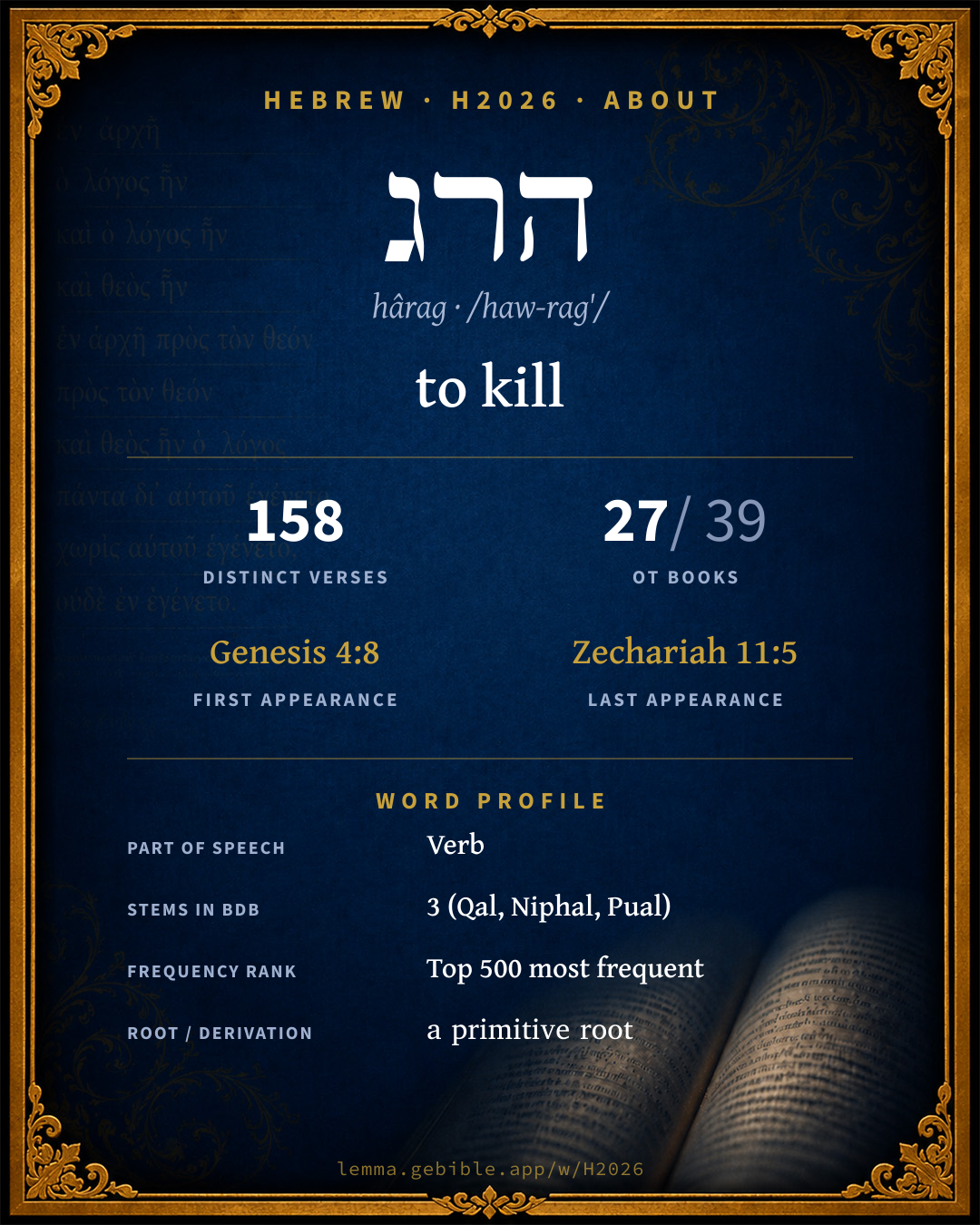
הָרַג
to kill
also: slay, murder, destroy, murderer fuller range ↓
Full lexicon entry — Brown-Driver-Briggs (BDB)
From Brown-Driver-Briggs (BDB)
Where this word appears
See every Qal verb in the Hebrew Bible →
Grammar key — what these labels mean
Part of speech
- Verb
- An action or state-of-being word.
Stem
- Qal
- The basic, simple active stem — the plain form of the verb (“he wrote”). Here: ‘kill’
- Niphal
- Usually the simple passive or reflexive of the Qal (“he was written”). Here: ‘of Qal 1 a’
- Pual
- The passive counterpart of the Piel.
- Qal Passive
- An archaic passive of the Qal, preserved in a few forms.
Form
- Perfect
- A completed action or state — Hebrew marks aspect (completeness) more than strict tense (“he wrote”).
- Sequential Imperfect
- An imperfect with prefixed waw — the standard past-narrative form (waw-consecutive imperfect).
- Infinitive Construct
- A bound verbal noun, frequently with prepositions (“to write / in writing”).
- Imperfect
- An incomplete, ongoing, or future action (“he will / would write”).
- Participle Active
- A verbal adjective expressing ongoing or characteristic action (“writing / one who writes”).
- Sequential Perfect
- A perfect with prefixed waw continuing a preceding imperfect or command (waw-consecutive perfect).
- Infinitive Absolute
- An unbound verbal noun, often intensifying or standing in for a finite verb.
- Imperative
- A direct command (“write!”).
- Participle Passive
- A verbal adjective expressing action received (“written”).
- Cohortative
- A first-person volitional form expressing wish or resolve (“let me / let us write”).
- Jussive
- A third- or second-person volitional form expressing wish or command (“let him write”).
State
- Absolute
- The independent form of a noun, not bound to a following word.
- Construct
- A noun bound to a following noun in a possessive / “of” relationship (the construct chain).
Person
- 3rd Person
- The one spoken about (“he / she / it / they”).
- 2nd Person
- The one addressed (“you”).
- 1st Person
- The speaker (“I / we”).
Gender
- Common
- Either gender — not distinguished for this form.
- Masculine
- Grammatically masculine.
- Feminine
- Grammatically feminine.
Number
- Plural
- More than one (in Hebrew, generally three or more).
- Singular
- One.
Grammatical forms 41 distinct
- Verb, Qal, Perfect, 3rd Person, Common, Plural 21 times (13%)
- Verb, Qal, Sequential Imperfect, 3rd Person, Masculine, Singular 21 times (13%)
- Verb, Qal, Infinitive Construct 21 times (13%)
- Verb, Qal, Perfect, 3rd Person, Masculine, Singular 10 times (6%)
- Verb, Qal, Imperfect, 3rd Person, Masculine, Singular 7 times (4%)
- Verb, Qal, Perfect, 2nd Person, Masculine, Singular 7 times (4%)
- Verb, Qal, Perfect, 1st Person, Common, Singular 7 times (4%)
- Verb, Qal, Sequential Imperfect, 3rd Person, Masculine, Plural 6 times (4%)
+33 more forms (67 occurrences)
Parsed forms decoded from the imported morphology (morphhb / Westminster Leningrad Codex — WLC text public domain, morphhb tagging CC BY 4.0), counted across 167 parsed occurrences — not distinct verses.
Every verse where H2026 appears — 158 distinct verses across 27 books. Click any verse to open its interlinear word-by-word view. Verse text shown in the World English Bible for context — . Each verse’s Hebrew form is shown with its reference; the English is not keyword-highlighted, since the data carries no word-level English alignment. Use “Compare translations” on any verse to read it across multiple English versions. This concordance covers the Hebrew Bible; Septuagint (Greek Old Testament) occurrences are not indexed here.
Genesis 16 verses
- Genesis 4:8 וַ/יַּהַרְגֵֽ/הוּ conj + Qal wimpf 3ms + sfx pers 3ms Cain said to Abel, his brother, "Let's go into the field." It happened, when they were in the field, that Cain rose up against Abel, his brother, and killed him.
- Genesis 4:14 יַֽהַרְגֵֽ/נִי Qal impf 3ms + sfx pers 1cs Behold, you have driven me out this day from the surface of the ground. I will be hidden from your face, and I will be a fugitive and a wanderer in the earth. It will happen that whoever finds me will kill me."
- Genesis 4:15 הֹרֵ֣ג Qal ptcp.act ms cs Yahweh said to him, "Therefore whoever slays Cain, vengeance will be taken on him sevenfold." Yahweh appointed a sign for Cain, lest any finding him should strike him.
- Genesis 4:23 הָרַ֨גְתִּי֙ Qal pf 1cs Lamech said to his wives, "Adah and Zillah, Hear my voice, You wives of Lamech, listen to my speech, For I have slain a man for wounding me, A young man for bruising me.
- Genesis 4:25 הֲרָג֖/וֹ Qal pf 3ms + sfx pers 3ms Adam knew his wife again. She gave birth to a son, and named him Seth. For, she said, "God has appointed me another child instead of Abel, for Cain killed him."
- Genesis 12:12 וְ/הָרְג֥וּ conj + Qal pf 3cp It will happen, when the Egyptians will see you, that they will say, 'This is his wife.' They will kill me, but they will save you alive.
- Genesis 20:4 תַּהֲרֹֽג Qal impf 2ms Now Abimelech had not come near her. He said, "Lord, will you kill even a righteous nation?
- Genesis 20:11 וַ/הֲרָג֖וּ/נִי conj + Qal wpf 3cp + sfx pers 1cs Abraham said, "Because I thought, 'Surely the fear of God is not in this place. They will kill me for my wife's sake.'
- Genesis 26:7 יַֽהַרְגֻ֜/נִי Qal impf 3mp + sfx pers 1cs The men of the place asked him about his wife. He said, "She is my sister," for he was afraid to say, "My wife," lest, he thought, the men of the place might kill me for Rebekah, because she was beautiful to look on.
- Genesis 27:41 וְ/אַֽהַרְגָ֖ה conj + Qal coh 1cs Esau hated Jacob because of the blessing with which his father blessed him. Esau said in his heart, "The days of mourning for my father are at hand. Then I will kill my brother Jacob."
- Genesis 27:42 לְ/הָרְגֶֽ/ךָ prep + Qal inf.cs + sfx pers 2ms The words of Esau, her elder son, were told to Rebekah. She sent and called Jacob her younger son, and said to him, "Behold, your brother Esau comforts himself about you by planning to kill you.
- Genesis 34:25 וַ/יַּֽהַרְג֖וּ conj + Qal wimpf 3mp It happened on the third day, when they were sore, that two of Jacob's sons, Simeon and Levi, Dinah's brothers, each took his sword, came upon the unsuspecting city, and killed all the males.
- Genesis 34:26 הָרְג֖וּ Qal pf 3cp They killed Hamor and Shechem, his son, with the edge of the sword, and took Dinah out of Shechem's house, and went away.
- Genesis 37:20 וְ/נַֽהַרְגֵ֗/הוּ conj + Qal coh 1cp + sfx pers 3ms Come now therefore, and let's kill him, and cast him into one of the pits, and we will say, 'An evil animal has devoured him.' We will see what will become of his dreams."
- Genesis 37:26 נַהֲרֹג֙ Qal impf 1cp Judah said to his brothers, "What profit is it if we kill our brother and conceal his blood?
- Genesis 49:6 הָ֣רְגוּ Qal pf 3cp My soul, don't come into their council; My glory, don't be united to their assembly; For in their anger they killed a man, In their self-will they hamstrung an ox.
Exodus 10 verses
- Exodus 2:14 הַ/לְ/הָרְגֵ֨/נִי֙ הָרַ֖גְתָּ ptcl inter + prep + Qal inf.cs + sfx pers 1cs Qal pf 2ms He said, "Who made you a prince and a judge over us? Do you plan to kill me, as you killed the Egyptian?" Moses was afraid, and said, "Surely this thing is known."
- Exodus 2:15 לַ/הֲרֹ֣ג prep + Qal inf.cs Now when Pharaoh heard this thing, he sought to kill Moses. But Moses fled from the face of Pharaoh, and lived in the land of Midian, and he sat down by a well.
- Exodus 4:23 הֹרֵ֔ג Qal ptcp.act ms and I have said to you, "Let my son go, that he may serve me;" and you have refused to let him go. Behold, I will kill your son, your firstborn.'"
- Exodus 5:21 לְ/הָרְגֵֽ/נוּ prep + Qal inf.cs + sfx pers 1cp and they said to them, "May Yahweh look at you, and judge, because you have made us a stench to be abhorred in the eyes of Pharaoh, and in the eyes of his servants, to put a sword in their hand to kill us."
- Exodus 13:15 וַ/יַּהֲרֹ֨ג conj + Qal wimpf 3ms and it happened, when Pharaoh would hardly let us go, that Yahweh killed all the firstborn in the land of Egypt, both the firstborn of man, and the firstborn of animal. Therefore I sacrifice to Yahweh all that opens the womb, being males; but all the firstborn of my sons I redeem.'
- Exodus 21:14 לְ/הָרְג֣/וֹ prep + Qal inf.cs + sfx pers 3ms If a man schemes and comes presumptuously on his neighbor to kill him, you shall take him from my altar, that he may die.
- Exodus 22:24 וְ/הָרַגְתִּ֥י conj + Qal wpf 1cs and my wrath will grow hot, and I will kill you with the sword; and your wives shall be widows, and your children fatherless.
- Exodus 23:7 תַּהֲרֹ֔ג Qal juss 2ms "Keep far from a false charge, and don't kill the innocent and righteous: for I will not justify the wicked.
- Exodus 32:12 לַ/הֲרֹ֤ג prep + Qal inf.cs Why should the Egyptians speak, saying, 'He brought them forth for evil, to kill them in the mountains, and to consume them from the surface of the earth?' Turn from your fierce wrath, and repent of this evil against your people.
- Exodus 32:27 וְ/הִרְג֧וּ conj + Qal impv 2mp He said to them, "Thus says Yahweh, the God of Israel, 'Every man put his sword on his thigh, and go back and forth from gate to gate throughout the camp, and every man kill his brother, and every man his companion, and every man his neighbor."
Leviticus 2 verses
- Leviticus 20:15 תַּהֲרֹֽגוּ Qal impf 2mp "'If a man lies with an animal, he shall surely be put to death; and you shall kill the animal.
- Leviticus 20:16 וְ/הָרַגְתָּ֥ conj + Qal wpf 2ms "'If a woman approaches any animal, and lies down with it, you shall kill the woman, and the animal: they shall surely be put to death; their blood shall be upon them.
Numbers 8 verses
- Numbers 11:15 הָרְגֵ֤/נִי הָרֹ֔ג Qal impv 2ms + sfx pers 1cs Qal inf.abs If you deal thus with me, please kill me out of hand, if I have found favor in your sight; and let me not see my wretchedness.
- Numbers 22:29 הֲרַגְתִּֽי/ךְ Qal pf 1cs + sfx pers 2fs Balaam said to the donkey, Because you have mocked me, I would there were a sword in my hand, for now I had killed you.
- Numbers 22:33 הָרַ֖גְתִּי Qal pf 1cs and the donkey saw me, and turned aside before me these three times: unless she had turned aside from me, surely now I had even slain you, and saved her alive.
- Numbers 25:5 הִרְגוּ֙ Qal impv 2mp Moses said to the judges of Israel, Kill you everyone his men who have joined themselves to Baal Peor.
- Numbers 31:7 וַ/יַּֽהַרְג֖וּ conj + Qal wimpf 3mp They warred against Midian, as Yahweh commanded Moses; and they killed every male.
- Numbers 31:8 הָרְג֣וּ הָרְג֖וּ Qal pf 3cp Qal pf 3cp They killed the kings of Midian with the rest of their slain: Evi, and Rekem, and Zur, and Hur, and Reba, the five kings of Midian: Balaam also the son of Beor they killed with the sword.
- Numbers 31:17 הִרְג֥וּ הֲרֹֽגוּ Qal impv 2mp Qal impv 2mp Now therefore kill every male among the little ones, and kill every woman who has known man by lying with him.
- Numbers 31:19 הֹרֵ֨ג Qal ptcp.act ms Encamp you outside of the camp seven days: whoever has killed any person, and whoever has touched any slain, purify yourselves on the third day and on the seventh day, you and your captives.
Deuteronomy 1 verse
Joshua 4 verses
- Joshua 8:24 לַ/הֲרֹג֩ prep + Qal inf.cs It happened, when Israel had made an end of killing all the inhabitants of Ai in the field, in the wilderness in which they pursued them, and they were all fallen by the edge of the sword, until they were consumed, that all Israel returned to Ai, and struck it with the edge of the sword.
- Joshua 9:26 הֲרָגֽוּ/ם Qal pf 3cp + sfx pers 3mp So did he to them, and delivered them out of the hand of the children of Israel, that they didn't kill them.
- Joshua 10:11 הָרְג֛וּ Qal pf 3cp It happened, as they fled from before Israel, while they were at the descent of Beth Horon, that Yahweh cast down great stones from the sky on them to Azekah, and they died: they were more who died with the hailstones than they whom the children of Israel killed with the sword.
- Joshua 13:22 הָרְג֧וּ Qal pf 3cp Balaam also the son of Beor, the soothsayer, did the children of Israel kill with the sword among the rest of their slain.
Judges 14 verses
- Judges 7:25 וַ/יַּהַרְג֨וּ הָרְג֣וּ conj + Qal wimpf 3mp Qal pf 3cp They took the two princes of Midian, Oreb and Zeeb; and they killed Oreb at the rock of Oreb, and Zeeb they killed at the winepress of Zeeb, and pursued Midian: and they brought the heads of Oreb and Zeeb to Gideon beyond the Jordan.
- Judges 8:17 וַֽ/יַּהֲרֹ֖ג conj + Qal wimpf 3ms He broke down the tower of Penuel, and killed the men of the city.
- Judges 8:18 הֲרַגְתֶּ֖ם Qal pf 2mp Then said he to Zebah and Zalmunna, What manner of men were they whom you killed at Tabor? They answered, As you are, so were they; each one resembled the children of a king.
- Judges 8:19 הָרַ֖גְתִּי Qal pf 1cs He said, They were my brothers, the sons of my mother: as Yahweh lives, if you had saved them alive, I would not kill you.
- Judges 8:20 הֲרֹ֣ג Qal impv 2ms He said to Jether his firstborn, Up, and kill them. But the youth didn't draw his sword; for he feared, because he was yet a youth.
- Judges 8:21 וַֽ/יַּהֲרֹג֙ conj + Qal wimpf 3ms Then Zebah and Zalmunna said, Rise you, and fall on us; for as the man is, so is his strength. Gideon arose, and killed Zebah and Zalmunna, and took the crescents that were on their camels' necks.
- Judges 9:5 וַֽ/יַּהֲרֹ֞ג conj + Qal wimpf 3ms He went to his father's house at Ophrah, and killed his brothers the sons of Jerubbaal, being seventy persons, on one stone: but Jotham the youngest son of Jerubbaal was left; for he hid himself.
- Judges 9:18 וַ/תַּהַרְג֧וּ conj + Qal wimpf 2mp and you are risen up against my father's house this day, and have slain his sons, seventy persons, on one stone, and have made Abimelech, the son of his maid-servant, king over the men of Shechem, because he is your brother);
- Judges 9:24 הָרַ֣ג לַ/הֲרֹ֥ג Qal pf 3ms prep + Qal inf.cs that the violence done to the seventy sons of Jerubbaal might come, and that their blood might be laid on Abimelech their brother, who killed them, and on the men of Shechem, who strengthened his hands to kill his brothers.
- Judges 9:45 הָרָ֑ג Qal pf 3ms Abimelech fought against the city all that day; and he took the city, and killed the people who were therein: and he beat down the city, and sowed it with salt.
- Judges 9:54 הֲרָגָ֑תְ/הוּ Qal pf 3fs + sfx pers 3ms Then he called hastily to the young man his armor bearer, and said to him, Draw your sword, and kill me, that men not say of me, A woman killed him. His young man thrust him through, and he died.
- Judges 9:56 לַ/הֲרֹ֖ג prep + Qal inf.cs Thus God requited the wickedness of Abimelech, which he did to his father, in killing his seventy brothers;
- Judges 16:2 וַ/הֲרְגְנֻֽ/הוּ conj + Qal pf 1cp + sfx pers 3ms [It was told] the Gazites, saying, Samson is come here. They compassed him in, and laid wait for him all night in the gate of the city, and were quiet all the night, saying, [Let be] until morning light, then we will kill him.
- Judges 20:5 לַ/הֲרֹ֔ג prep + Qal inf.cs The men of Gibeah rose against me, and beset the house round about me by night; me they thought to have slain, and my concubine they forced, and she is dead.
1 Samuel 5 verses
- 1 Samuel 16:2 וַ/הֲרָגָ֑/נִי conj + Qal wpf 3ms + sfx pers 1cs Samuel said, How can I go? if Saul hear it, he will kill me. Yahweh said, Take a heifer with you, and say, I am come to sacrifice to Yahweh.
- 1 Samuel 22:21 הָרַ֣ג Qal pf 3ms Abiathar told David that Saul had slain Yahweh's priests.
- 1 Samuel 24:10 לַ/הֲרָגֲ/ךָ֖ prep + Qal inf.cs + sfx pers 2ms Behold, this day your eyes have seen how that Yahweh had delivered you today into my hand in the cave: and some bade me kill you; but [my eye] spared you; and I said, I will not put forth my hand against my lord; for he is Yahweh's anointed.
- 1 Samuel 24:11 הֲרַגְתִּ֗י/ךָ Qal pf 1cs + sfx pers 2ms Moreover, my father, behold, yes, see the skirt of your robe in my hand; for in that I cut off the skirt of your robe, and didn't kill you, know you and see that there is neither evil nor disobedience in my hand, and I have not sinned against you, though you hunt after my life to take it.
- 1 Samuel 24:18 הֲרַגְתָּֽ/נִי Qal pf 2ms + sfx pers 1cs You have declared this day how that you have dealt well with me, because when Yahweh had delivered me up into your hand, you didn't kill me.
2 Samuel 8 verses
- 2 Samuel 3:30 הָרְג֖וּ Qal pf 3cp So Joab and Abishai his brother killed Abner, because he had killed their brother Asahel at Gibeon in the battle.
- 2 Samuel 4:10 וָ/אֶהְרְגֵ֖/הוּ conj + Qal wimpf 1cs + sfx pers 3ms when one told me, saying, Behold, Saul is dead, thinking to have brought good news, I took hold of him, and killed him in Ziklag, which was the reward I gave him for his news.
- 2 Samuel 4:11 הָרְג֧וּ Qal pf 3cp How much more, when wicked men have slain a righteous person in his own house on his bed, shall I not now require his blood of your hand, and take you away from the earth?
- 2 Samuel 4:12 וַ/יַּהַרְג֗וּ/ם conj + Qal wimpf 3mp + sfx pers 3mp David commanded his young men, and they killed them, and cut off their hands and their feet, and hanged them up beside the pool in Hebron. But they took the head of Ish-bosheth, and buried it in the grave of Abner in Hebron.
- 2 Samuel 10:18 וַ/יַּהֲרֹ֨ג conj + Qal wimpf 3ms The Syrians fled before Israel; and David killed of the Syrians [the men of] seven hundred chariots, and forty thousand horsemen, and struck Shobach the captain of their host, so that he died there.
- 2 Samuel 12:9 הָרַ֔גְתָּ Qal pf 2ms Why have you despised the word of Yahweh, to do that which is evil in his sight? You have struck Uriah the Hittite with the sword, and have taken his wife to be your wife, and have slain him with the sword of the children of Ammon.
- 2 Samuel 14:7 הָרָ֔ג Qal pf 3ms Behold, the whole family is risen against your handmaid, and they say, Deliver him who struck his brother, that we may kill him for the life of his brother whom he killed, and so destroy the heir also. Thus will they quench my coal which is left, and will leave to my husband neither name nor remainder on the surface of the earth.
- 2 Samuel 23:21 וַ/יַּהַרְגֵ֖/הוּ conj + Qal wimpf 3ms + sfx pers 3ms He killed an Egyptian, a goodly man: and the Egyptian had a spear in his hand; but he went down to him with a staff, and plucked the spear out of the Egyptian's hand, and killed him with his own spear.
1 Kings 11 verses
- 1 Kings 2:5 וַ/יַּ֣הַרְגֵ֔/ם conj + Qal wimpf 3ms + sfx pers 3mp Moreover you know also what Joab the son of Zeruiah did to me, even what he did to the two captains of the hosts of Israel, to Abner the son of Ner, and to Amasa the son of Jether, whom he killed, and shed the blood of war in peace, and put the blood of war on his sash that was about his loins, and in his shoes that were on his feet.
- 1 Kings 2:32 וַ/יַּהַרְגֵ֣/ם conj + Qal wimpf 3ms + sfx pers 3mp Yahweh will return his blood on his own head, because he fell on two men more righteous and better than he, and killed them with the sword, and my father David didn't know it, [to wit], Abner the son of Ner, captain of the host of Israel, and Amasa the son of Jether, captain of the host of Judah.
- 1 Kings 9:16 הָרָ֑ג Qal pf 3ms Pharaoh king of Egypt had gone up, and taken Gezer, and burnt it with fire, and slain the Canaanites who lived in the city, and given it for a portion to his daughter, Solomon's wife.
- 1 Kings 11:24 בַּ/הֲרֹ֥ג prep + Qal inf.cs He gathered men to him, and became captain over a troop, when David killed them [of Zobah]: and they went to Damascus, and lived therein, and reigned in Damascus.
- 1 Kings 12:27 וַ/הֲרָגֻ֕/נִי conj + Qal wpf 3cp + sfx pers 1cs if this people go up to offer sacrifices in the house of Yahweh at Jerusalem, then will the heart of this people turn again to their lord, even to Rehoboam king of Judah; and they will kill me, and return to Rehoboam king of Judah.
- 1 Kings 18:12 וַ/הֲרָגָ֑/נִי conj + Qal wpf 3ms + sfx pers 1cs It will happen, as soon as I am gone from you, that the Spirit of Yahweh will carry you I don't know where; and so when I come and tell Ahab, and he can't find you, he will kill me: but I your servant fear Yahweh from my youth.
- 1 Kings 18:13 בַּ/הֲרֹ֣ג prep + Qal inf.cs Wasn't it told my lord what I did when Jezebel killed the prophets of Yahweh, how I hid one hundred men of Yahweh's prophets by fifty in a cave, and fed them with bread and water?
- 1 Kings 18:14 וַ/הֲרָגָֽ/נִי conj + Qal wpf 3ms + sfx pers 1cs Now you say, Go, tell your lord, Behold, Elijah [is here]; and he will kill me.
- 1 Kings 19:1 הָרַ֛ג Qal pf 3ms Ahab told Jezebel all that Elijah had done, and withal how he had slain all the prophets with the sword.
- 1 Kings 19:10 הָרְג֣וּ Qal pf 3cp He said, I have been very jealous for Yahweh, the God of hosts; for the children of Israel have forsaken your covenant, thrown down your altars, and slain your prophets with the sword: and I, even I only, am left; and they seek my life, to take it away.
- 1 Kings 19:14 הָרְג֣וּ Qal pf 3cp He said, I have been very jealous for Yahweh, the God of hosts; for the children of Israel have forsaken your covenant, thrown down your altars, and slain your prophets with the sword; and I, even I only, am left; and they seek my life, to take it away.
2 Kings 5 verses
- 2 Kings 8:12 תַּהֲרֹ֔ג Qal impf 2ms Hazael said, Why weeps my lord? He answered, Because I know the evil that you will do to the children of Israel: their strongholds will you set on fire, and their young men will you kill with the sword, and will dash in pieces their little ones, and rip up their women with child.
- 2 Kings 9:31 הֹרֵ֥ג Qal ptcp.act ms cs As Jehu entered in at the gate, she said, Is it peace, you Zimri, your master's murderer?
- 2 Kings 10:9 וָ/אֶהְרְגֵ֔/הוּ conj + Qal wimpf 1cs + sfx pers 3ms It happened in the morning, that he went out, and stood, and said to all the people, You are righteous: behold, I conspired against my master, and killed him; but who struck all these?
- 2 Kings 11:18 הָרְג֖וּ Qal pf 3cp All the people of the land went to the house of Baal, and broke it down; his altars and his images broke they in pieces thoroughly, and killed Mattan the priest of Baal before the altars. The priest appointed officers over the house of Yahweh.
- 2 Kings 17:25 הֹרְגִ֖ים Qal ptcp.act mp So it was, at the beginning of their dwelling there, that they didn't fear Yahweh: therefore Yahweh sent lions among them, which killed some of them.
1 Chronicles 3 verses
- 1 Chronicles 7:21 וַ/הֲרָג֗וּ/ם conj + Qal pf 3cp + sfx pers 3mp and Zabad his son, and Shuthelah his son, and Ezer, and Elead, whom the men of Gath who were born in the land killed, because they came down to take away their cattle.
- 1 Chronicles 11:23 וַ/יַּהַרְגֵ֖/הוּ conj + Qal wimpf 3ms + sfx pers 3ms He killed an Egyptian, a man of great stature, five cubits high; and in the Egyptian's hand was a spear like a weaver's beam; and he went down to him with a staff, and plucked the spear out of the Egyptian's hand, and killed him with his own spear.
- 1 Chronicles 19:18 וַ/יַּהֲרֹ֨ג conj + Qal wimpf 3ms The Syrians fled before Israel; and David killed of the Syrians [the men of] seven thousand chariots, and forty thousand footmen, and killed Shophach the captain of the host.
2 Chronicles 12 verses
- 2 Chronicles 21:4 וַ/יַּהֲרֹ֥ג conj + Qal wimpf 3ms Now when Jehoram was risen up over the kingdom of his father, and had strengthened himself, he killed all his brothers with the sword, and various also of the princes of Israel.
- 2 Chronicles 21:13 הָרָֽגְתָּ Qal pf 2ms but have walked in the way of the kings of Israel, and have made Judah and the inhabitants of Jerusalem to play the prostitute, like as the house of Ahab did, and also have slain your brothers of your father's house, who were better than yourself:
- 2 Chronicles 22:1 הָרַ֣ג Qal pf 3ms The inhabitants of Jerusalem made Ahaziah his youngest son king in his place; for the band of men who came with the Arabians to the camp had slain all the eldest. So Ahaziah the son of Jehoram king of Judah reigned.
- 2 Chronicles 22:8 וַ/יַּהַרְגֵֽ/ם conj + Qal wimpf 3ms + sfx pers 3mp It happened, when Jehu was executing judgment on the house of Ahab, that he found the princes of Judah, and the sons of the brothers of Ahaziah, ministering to Ahaziah, and killed them.
- 2 Chronicles 23:17 הָרְג֖וּ Qal pf 3cp All the people went to the house of Baal, and broke it down, and broke his altars and his images in pieces, and killed Mattan the priest of Baal before the altars.
- 2 Chronicles 24:22 וַֽ/יַּהֲרֹ֖ג conj + Qal wimpf 3ms Thus Joash the king didn't remember the kindness which Jehoiada his father had done to him, but killed his son. When he died, he said, Yahweh look on it, and require it.
- 2 Chronicles 24:25 וַ/יַּֽהַרְגֻ֥/הוּ conj + Qal wimpf 3mp + sfx pers 3ms When they were departed for him (for they left him very sick), his own servants conspired against him for the blood of the sons of Jehoiada the priest, and killed him on his bed, and he died; and they buried him in the city of David, but they didn't bury him in the tombs of the kings.
- 2 Chronicles 25:3 וַֽ/יַּהֲרֹג֙ conj + Qal wimpf 3ms Now it happened, when the kingdom was established to him, that he killed his servants who had killed the king his father.
- 2 Chronicles 28:6 וַ/יַּהֲרֹג֩ conj + Qal wimpf 3ms For Pekah the son of Remaliah killed in Judah one hundred twenty thousand in one day, all of them valiant men; because they had forsaken Yahweh, the God of their fathers.
- 2 Chronicles 28:7 וַֽ/יַּהֲרֹ֞ג conj + Qal wimpf 3ms Zichri, a mighty man of Ephraim, killed Maaseiah the king's son, and Azrikam the ruler of the house, and Elkanah who was next to the king.
- 2 Chronicles 28:9 וַ/תַּֽהַרְגוּ conj + Qal wimpf 2mp But a prophet of Yahweh was there, whose name was Oded: and he went out to meet the host that came to Samaria, and said to them, Behold, because Yahweh, the God of your fathers, was angry with Judah, he has delivered them into your hand, and you have slain them in a rage which has reached up to heaven.
- 2 Chronicles 36:17 וַ/יַּהֲרֹ֨ג conj + Qal wimpf 3ms Therefore he brought on them the king of the Chaldeans, who killed their young men with the sword in the house of their sanctuary, and had no compassion on young man or virgin, old man or gray-headed: he gave them all into his hand.
Nehemiah 3 verses
- Nehemiah 4:11 וַ/הֲרַגְנ֑וּ/ם conj + Qal wpf 1cp + sfx pers 3mp Our adversaries said, They shall not know, neither see, until we come into the midst of them, and kill them, and cause the work to cease.
- Nehemiah 6:10 לְ/הָרְגֶ֔/ךָ לְ/הָרְגֶֽ/ךָ prep + Qal inf.cs + sfx pers 2ms prep + Qal inf.cs + sfx pers 2ms I went to the house of Shemaiah the son of Delaiah the son of Mehetabel, who was shut up; and he said, Let us meet together in the house of God, within the temple, and let us shut the doors of the temple: for they will come to kill you; yes, in the night will they come to kill you.
- Nehemiah 9:26 הָרָ֔גוּ Qal pf 3cp Nevertheless they were disobedient, and rebelled against you, and cast your law behind their back, and killed your prophets that testified against them to turn them again to you, and they committed awful blasphemies.
Esther 9 verses
- Esther 3:13 לַ/הֲרֹ֣ג prep + Qal inf.cs Letters were sent by posts into all the king's provinces, to destroy, to kill, and to cause to perish, all Jews, both young and old, little children and women, in one day, even on the thirteenth [day] of the twelfth month, which is the month Adar, and to take the spoil of them for a prey.
- Esther 7:4 לַ/הֲר֣וֹג prep + Qal inf.cs for we are sold, I and my people, to be destroyed, to be slain, and to perish. But if we had been sold for bondservants and bondmaids, I had held my peace, although the adversary could not have compensated for the king's damage.
- Esther 8:11 וְ/לַ/הֲרֹ֨ג conj + prep + Qal inf.cs in which the king granted the Jews who were in every city to gather themselves together, and to stand for their life, to destroy, to kill, and to cause to perish, all the power of the people and province that would assault them, [their] little ones and women, and to take the spoil of them for a prey,
- Esther 9:6 הָרְג֤וּ Qal pf 3cp In Shushan the palace the Jews killed and destroyed five hundred men.
- Esther 9:10 הָרָ֑גוּ Qal pf 3cp the ten sons of Haman the son of Hammedatha, the Jew's enemy, killed they; but they didn't lay their hand on the spoil.
- Esther 9:11 הַֽ/הֲרוּגִ֛ים ptcl def.art + Qal ptcp.pass mp On that day the number of those who were slain in Shushan the palace was brought before the king.
- Esther 9:12 הָרְגוּ֩ Qal pf 3cp The king said to Esther the queen, The Jews have slain and destroyed five hundred men in Shushan the palace, and the ten sons of Haman; what then have they done in the rest of the king's provinces! Now what is your petition? and it shall be granted you: or what is your request further? and it shall be done.
- Esther 9:15 וַ/יַּֽהַרְג֣וּ conj + Qal wimpf 3mp The Jews who were in Shushan gathered themselves together on the fourteenth day also of the month Adar, and killed three hundred men in Shushan; but they didn't lay their hand on the spoil.
- Esther 9:16 וְ/הָרֹג֙ conj + Qal inf.abs The other Jews who were in the king's provinces gathered themselves together, and stood for their lives, and had rest from their enemies, and killed of those who hated them seventy-five thousand; but they didn't lay their hand on the spoil.
Job 2 verses
Psalms 9 verses
- Psalms 10:8 יַהֲרֹ֣ג Qal impf 3ms He lies in wait near the villages. From ambushes, he murders the innocent. His eyes are secretly set against the helpless.
- Psalms 44:22 הֹרַ֣גְנוּ Qal Passive pf 1cp Yes, for your sake we are killed all day long. We are regarded as sheep for the slaughter.
- Psalms 59:11 תַּהַרְגֵ֤/ם Qal juss 2ms + sfx pers 3mp Don't kill them, or my people may forget. Scatter them by your power, and bring them down, Lord our shield.
- Psalms 78:31 וַֽ֭/יַּהֲרֹג conj + Qal wimpf 3ms When the anger of God went up against them, Killed some of the fattest of them, And struck down the young men of Israel.
- Psalms 78:34 הֲרָגָ֥/ם Qal pf 3ms + sfx pers 3mp When he killed them, then they inquired after him. They returned and sought God earnestly.
- Psalms 78:47 יַהֲרֹ֣ג Qal impf 3ms He destroyed their vines with hail, Their sycamore-fig trees with frost.
- Psalms 94:6 יַהֲרֹ֑גוּ Qal impf 3mp They kill the widow and the alien, And murder the fatherless.
- Psalms 135:10 וְ֝/הָרַ֗ג conj + Qal pf 3ms Who struck many nations, And killed mighty kings,
- Psalms 136:18 וַֽ֭/יַּהֲרֹג conj + Qal wimpf 3ms And killed mighty kings; For his loving kindness endures forever:
Proverbs 2 verses
Ecclesiastes 1 verse
Isaiah 8 verses
- Isaiah 10:4 הֲרוּגִ֖ים Qal ptcp.pass mp They shall only bow down under the prisoners, and shall fall under the slain. For all this his anger is not turned away, but his hand is stretched out still.
- Isaiah 14:19 הֲרֻגִ֖ים Qal ptcp.pass mp But you are cast forth away from your tomb like an abominable branch, clothed with the slain, who are thrust through with the sword, who go down to the stones of the pit; as a dead body trodden under foot.
- Isaiah 14:20 הָרָ֑גְתָּ Qal pf 2ms You shall not be joined with them in burial, because you have destroyed your land, you have killed your people; the seed of evil-doers shall not be named forever.
- Isaiah 14:30 יַהֲרֹֽג Qal impf 3ms The firstborn of the poor shall feed, and the needy shall lie down in safety; and I will kill your root with famine, and your remnant shall be killed.
- Isaiah 22:13 הָרֹ֤ג Qal inf.abs and behold, joy and gladness, killing oxen and killing sheep, eating flesh and drinking wine: let us eat and drink, for tomorrow we shall die.
- Isaiah 26:21 הֲרוּגֶֽי/הָ Qal ptcp.pass mp cs + sfx pers 3fs For, behold, Yahweh comes forth out of his place to punish the inhabitants of the earth for their iniquity: the earth also shall disclose her blood, and shall no more cover her slain.
- Isaiah 27:1 וְ/הָרַ֥ג conj + Qal wpf 3ms In that day Yahweh with his hard and great and strong sword will punish leviathan the swift serpent, and leviathan the crooked serpent; and he will kill the monster that is in the sea.
- Isaiah 27:7 הֲרֻגָ֖י/ו הֹרָֽג Qal ptcp.pass mp cs + sfx pers 3ms Pual pf 3ms Has he struck them as he struck those who struck them? or are they slain according to the slaughter of those who were slain by them?
Jeremiah 3 verses
- Jeremiah 4:31 לְ/הֹרְגִֽים prep + Qal ptcp.act mp For I have heard a voice as of a woman in travail, the anguish as of her who brings forth her first child, the voice of the daughter of Zion, who gasps for breath, who spreads her hands, [saying], Woe is me now! for my soul faints before the murderers.
- Jeremiah 15:3 לַֽ/הֲרֹ֔ג prep + Qal inf.cs I will appoint over them four kinds, says Yahweh: the sword to kill, and the dogs to tear, and the birds of the sky, and the animals of the earth, to devour and to destroy.
- Jeremiah 18:21 הֲרֻ֣גֵי Qal ptcp.pass mp cs Therefore deliver up their children to the famine, and give them over to the power of the sword; and let their wives become childless, and widows; and let their men be slain of death, [and] their young men struck of the sword in battle.
Lamentations 4 verses
- Lamentations 2:4 וַֽ/יַּהֲרֹ֔ג conj + Qal wimpf 3ms He has bent his bow like an enemy, he has stood with his right hand as an adversary, Has killed all that were pleasant to the eye: In the tent of the daughter of Zion he has poured out his wrath like fire.
- Lamentations 2:20 יֵהָרֵ֛ג Niphal impf 3ms Look, Yahweh, and see to whom you have done thus! Shall the women eat their fruit, the children that are dandled in the hands? Shall the priest and the prophet be killed in the sanctuary of the Lord?
- Lamentations 2:21 הָרַ֨גְתָּ֙ Qal pf 2ms The youth and the old man lie on the ground in the streets; My virgins and my young men are fallen by the sword: You have killed them in the day of your anger; you have slaughtered, [and] not pitied.
- Lamentations 3:43 הָרַ֖גְתָּ Qal pf 2ms You have covered with anger and pursued us; you have killed, you have not pitied.
Ezekiel 10 verses
- Ezekiel 9:6 תַּהַרְג֣וּ Qal impf 2mp kill utterly the old man, the young man and the virgin, and little children and women; but don't come near any man on whom is the mark: and begin at my sanctuary. Then they began at the old men that were before the house.
- Ezekiel 21:11 הוֹרֵֽג Qal ptcp.act ms It is given to be furbished, that it may be handled: the sword, it is sharpened, yes, it is furbished, to give it into the hand of the killer.
- Ezekiel 23:10 הָרָ֑גוּ Qal pf 3cp These uncovered her nakedness; they took her sons and her daughters; and her they killed with the sword: and she became a byword among women; for they executed judgments on her.
- Ezekiel 23:47 יַהֲרֹ֔גוּ Qal impf 3mp The company shall stone them with stones, and dispatch them with their swords; they shall kill their sons and their daughters, and burn up their houses with fire.
- Ezekiel 26:6 תֵּהָרַ֑גְנָה Niphal impf 3fp Her daughters who are in the field shall be slain with the sword: and they shall know that I am Yahweh.
- Ezekiel 26:8 יַהֲרֹ֑ג Qal impf 3ms He shall kill with the sword your daughters in the field; and he shall make forts against you, and cast up a mound against you, and raise up the buckler against you.
- Ezekiel 26:11 יַהֲרֹ֔ג Qal impf 3ms With the hoofs of his horses shall he tread down all your streets; he shall kill your people with the sword; and the pillars of your strength shall go down to the ground.
- Ezekiel 26:15 בֵּ/הָ֤רֵֽג prep + Niphal inf.cs Thus says the Lord Yahweh to Tyre: shall not the isles shake at the sound of your fall, when the wounded groan, when the slaughter is made in the midst of you?
- Ezekiel 28:9 הֹֽרְגֶ֑/ךָ Qal ptcp.act mp cs + sfx pers 2ms Will you yet say before him who kills you, I am God? but you are man, and not God, in the hand of him who wounds you.
- Ezekiel 37:9 בַּ/הֲרוּגִ֥ים prep det + Qal ptcp.pass mp Then said he to me, Prophesy to the wind, prophesy, son of man, and tell the wind, Thus says the Lord Yahweh: Come from the four winds, breath, and breathe on these slain, that they may live.
Hosea 2 verses
- Hosea 6:5 הֲרַגְתִּ֖י/ם Qal pf 1cs + sfx pers 3mp Therefore I have cut them to pieces with the prophets; I killed them with the words of my mouth. Your judgments are like a flash of lightning.
- Hosea 9:13 הֹרֵ֖ג Qal ptcp.act ms Ephraim, like I have seen Tyre, is planted in a pleasant place; But Ephraim will bring out his children to the killer.
Amos 4 verses
- Amos 2:3 אֶהֱר֥וֹג Qal impf 1cs And I will cut off the judge from their midst, And will kill all its princes with him," says Yahweh.
- Amos 4:10 הָרַ֤גְתִּי Qal pf 1cs I sent plagues among you like I did Egypt. I have slain your young men with the sword, And have carried away your horses; And I filled your nostrils with the stench of your camp Yet you haven't returned to me," says Yahweh.
- Amos 9:1 אֶהֱרֹ֑ג Qal impf 1cs I saw the Lord standing beside the altar, and he said, "Strike the tops of the pillars, that the thresholds may shake; and break them in pieces on the head of all of them; and I will kill the last of them with the sword: there shall not one of them flee away, and there shall not one of them escape.
- Amos 9:4 וַ/הֲרָגָ֑תַ/ם conj + Qal pf 3fs + sfx pers 3mp Though they go into captivity before their enemies, there I will command the sword, and it will kill them. I will set my eyes on them for evil, and not for good.
Habakkuk 1 verse
Zechariah 1 verse
About this entry
At a glance — auto-summarized from this page’s data, not written by a person. Every figure links to its source below. This summary describes the numbers; it doesn’t interpret them.
At its core, הרג (hârag) means “to kill.” The King James Version usually renders it “slew,” while modern versions prefer “killed” (Berean Standard Bible) — see the renderings breakdown. Spanning 158 verses in 27 books, it ranks among the common words of the Hebrew Bible. Scripture first uses it in Genesis 4:8. Different stems carry different senses — BDB groups them under 3 stems, among them Qal and Niphal. Dig into 158-verse concordance and the renderings breakdown below.
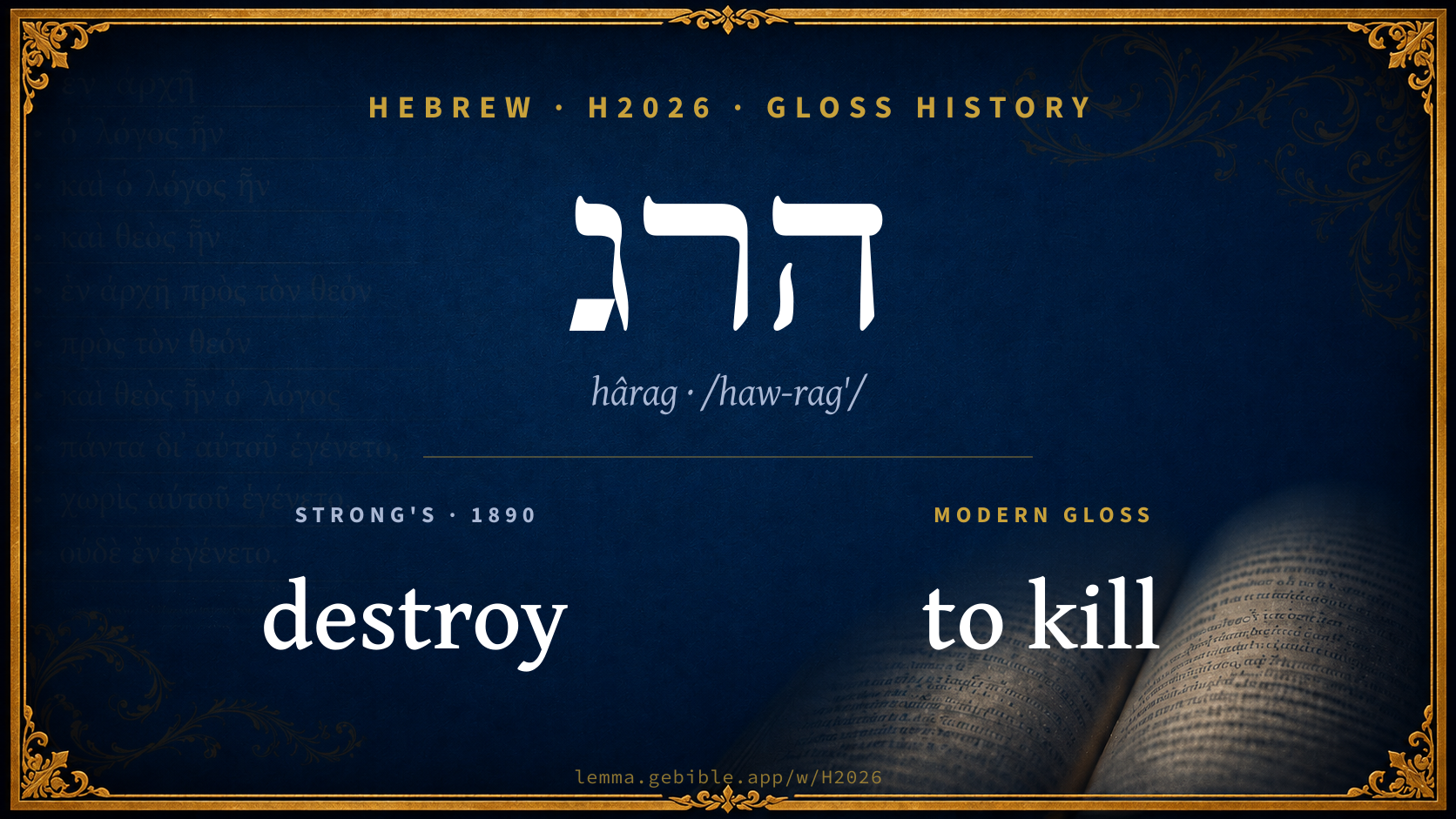
Gloss history
Strong's 1890 vs modern scholarship
About this word
Strong's H2026 catalogs a Hebrew word from the Hebrew Old Testament.
These counts are not copied from any lexicon or concordance. They are computed here, from the morphology-tagged Hebrew Old Testament. What Lemma adds →
- 158
- distinct verses
- The word appears in 158 distinct verses.
- 27 / 39
- OT books
- The word appears in 27 of 39 Old Testament books.
- #273
- by frequency
- Top 500 most frequent Hebrew words (rank 273 of 8,640 Hebrew words by occurrence).
View all 158 occurrences in the concordance →
Most concentrated in
- Genesis 16 verses 10%
- Judges 14 verses 9%
- 2 Chronicles 12 verses 8%
By section of the Old Testament
By traditional corpus
Conventional, traditional groupings — biblical authorship is debated, so this is a traditional corpus grouping, not an authorship claim. Each share is this word’s portion of its verses in that division of the Hebrew canon. Each figure is a share of the word’s 158 distinct verses.
- Prophets (Nevi'im) 76 verses · 48%
- Writings (Ketuvim) 45 verses · 28%
- Torah (Pentateuch) 37 verses · 23%
How translations render this word
Counts come from each version’s own published word-to-Strong’s tagging or interlinear alignment — an approximate guide to how each version renders this word, not a word-level alignment the data otherwise carries. Because each total is that version’s own tagged count, the per-version totals vary from one another and need not match the appearance or distinct-verse counts above. These counts may also differ from a printed concordance because Lemma counts each distinctly tagged rendering and does not collapse phrase taggings into a single head-word total. This is a fixed set of word-tagged versions (KJV, ASV, BSB, ULT) and does not change with the reading translation you choose elsewhere. Each version’s license is shown beside its name below (and on Sources).
- King James Version: Slew 37×, Slay 18×, They slew 9×
- American Standard Version: Slew 30×, Slay 14×, They slew 9×
- Berean Standard Bible: Killed 20×, Kill 13×, They killed 8×
- unfoldingWord Literal Text: Killed 12×, Kill 10×, He killed 8×
King James Version Public Domain
Renders H2026 across 167 tagged occurrences — most commonly:
Plus other, less common renderings. Plus 55 renderings that appear only once — usually multi-word phrases or single function words the recovered tagging swept in, not distinct renderings.
American Standard Version Public Domain
Renders H2026 across 165 tagged occurrences — most commonly:
Plus other, less common renderings. Plus 64 renderings that appear only once — usually multi-word phrases or single function words the recovered tagging swept in, not distinct renderings.
Berean Standard Bible Public Domain
Renders H2026 across 159 tagged occurrences — most commonly:
Plus other, less common renderings. Plus 62 renderings that appear only once — usually multi-word phrases or single function words the recovered tagging swept in, not distinct renderings. Not rendered by a distinct English word in 8 further occurrences.
unfoldingWord Literal Text CC BY-SA 4.0
Renders H2026 across 182 tagged occurrences — most commonly:
Plus other, less common renderings. Plus 62 renderings that appear only once — usually multi-word phrases or single function words the recovered tagging swept in, not distinct renderings.
13 senses and sub-senses in the full BDB
Hebrew verbs can shift meaning by stem (binyan): Qal is the basic action, Niphal is often passive or reflexive, Piel often intensifies or makes it factitive, and Hiphil is typically causative. The senses below are grouped under the stem BDB assigns to each. This entry also uses Pual (the passive of Piel).
What do BDB’s symbols mean?
BDB uses these scholarly abbreviations:
| Symbol | Meaning |
|---|---|
| 𝔊 | the Septuagint (the ancient Greek translation, LXX) |
| 𝔙 | the Vulgate (the Latin translation) |
| 𝔖 | the Syriac version (the Peshitta) |
| 𝔗 | the Targum (the Aramaic translation) |
| ψ | the Psalms |
| √ | root (the underlying root or stem) |
| ‖ | parallel passage (a synonymous or contrasted parallel) |
| † | the dagger: every passage where the word occurs is cited |
The 13 senses and sub-senses the full Brown-Driver-Briggs lexicon distinguishes for this word, in lexicon order (not ranked by frequency), with BDB’s own verbatim wording and sub-sense lettering. Shown in Hebrew script with BDB’s own scholarly abbreviations. The condensed entry is in the Lexicon Entry tab. See also the Forms in the corpus table below.
Qal
- Pf. 3 ms. ה׳ Ju 9:24 + 4 times, הָרָ֑ג 2 S 14:7 + 2 times, וְהָרַג consec. Is 27:1; sf. וַהֲרָגָ֑נִי consec. 1 S 16:2 + 2 times; הֲרָגוֹ Gn 4:25; etc.; Impf. יַהֲרֹג ψ 10:8 + 4 times; יַהֲרָג־ Jb 5:2; וַיַּהֲרֹג Ex 13:15 + 14 times; sf. יַהַרְגֵנִי Gn 4:14; 1 s. אַהֱרוֹג Am 2:3, אֶהֱרֹג Am 9:1; cohort. וְאַהַרְגָה Gn 27:41; sf. וָאֶהֶרְגֵהוּ 2 S 4:10 2 K 10:9; 3 mpl. יַהֲרֹ֑גוּ ψ 94:6 Ez 23:47; וַיַּהַרְגוּ Gn 34:25 + 4 times; sf. יַהַרְגֻנִי Gn 26:7, etc.; Imv. הֲרֹג Ju 8:20; sf. הָרְגֵנִי Nu 11:15; pl. הִרְגוּ Nu 25:5 + 2 times; הֲרֹ֑גוּ Nu 31:17; Inf. abs. הָרֹג Nu 11:15 + 2 times; הָרוֹג Est 9:16; cstr. הֲרֹג Ex 2:15 + 11 times; הֲרוֹג Ec 3:3 Est 7:4; sf. הָרְגֵנִי Ex 2:14; הָרְגֵנוּ Ex 5:21; הֲרָגְךָ 1 S 24:11; הָרְגֶ֑ךָ Gn 27:42 + 2 times; הָרְגוֹ Ex 21:14; Pt. act. הֹרֵג Gn 4:15 + 4 times; הוֹרֵג Ez 21:16; הֹרֱג֑ךָ Ez 28:9; הֹרְגִים Je 4:31 2 K 17:25; pass. הֲרוּגִים Is 10:4 + 2 times; הֲרֻגִים Is 14:19; cstr. הֲרֻגֵי Je 18:21; הֲרוּגָיו Is 27:7; הֲרוּגֶיהָ Is 26:21; הֲרֻגֶיהָ Pr 7:26;— e.g. Judges 9:24
- 1.
- a. kill, slay, implying ruthless violence, especially private violence Gn 4:8, 14, 15, 23, 25; 12:12 (all J), 20:11 (E) 26:7; 27:41, 42; 34:25, 26; 37:20, 26 (all J), 49:6 (poem in J), Ex 2:14(×2), 15 (E), 5:21 (J) 21:14; 23:7 (both JE), Nu 31:19 (P) Ju 9:5, 18, 24(×2), 56; 16:2; 20:5 1 S 16:2; 22:21; 24:11, 12, 18 2 S 3:30; 4:10, 11, 12; 12:9; 14:7; 23:21 1 K 2:5, 32; 18:12, 13, 14; 19:1, 10, 14 2 K 9:31; 10:9 1 Ch 7:21; 11:23 2 Ch 21:4, 13; 22:8; 24:23, 25; 25:3 Ne 4:5; 6:10(×2) Zc 11:5 ψ 10:8; 94:6 (‖ רִצֵּתַ); cf. Ju 8:18, 19, 20, 21; 9:54 1 K 12:27 Is 14:20 2 Ch 22:1 Ne 9:26; so of massacre of Jews planned by Haman Est 3:13; 7:4 (both לְהַשְׁמִיד לַהֲרֹג וּלְאַבֵּד), and of slaughter of Jews’ enemies in defence and revenge Est 8:11 (same combin.) 9:6, 10, 12, 15, 16 cf. v 11 (pt. pass. the slain). e.g. Genesis 4:8
- b. hence of wholesale slaughter after battle Nu 31:7, 8(×2) 17(×2) (all P), Jos 8:24; 10:11 (both JE), 13:22 (P), Ju 7:25(×2); 8:17; 9:45 2 S 10:18 1 K 9:16; 11:24 2 K 8:12 1 Ch 19:18 2 Ch 28:6, 7, 9; 36:17 Ez 26:8, 11, cf. Ju 9:26; pt. pass. the slain Is 10:4; 14:19 cf. Ez 23:10, 47; 37:9, Je 18:21 הֲרֻגֵי מָוֶת (‖ מֻכֵּי־חֶרֶב); further Ho 9:13 Hb 1:17 Je 4:31 Ez 21:16; 28:9; also of slaughter in a revolt 2 K 11:8 = 2 Ch 23:17. e.g. Numbers 31:7
- 2. of God’s slaying in judgment (stern and inscrutable), Gn 20:4 (E), Ex 4:23; 13:15; 22:23 (all JE), Am 2:3; 4:10; 9:1, 4 La 2:4, 21; 3:43 ψ 59:12; 78:31, 34; 135:10; 136:18 cf. Nu 11:15(×2) (JE), 22:23 (J), Is 14:30, 26;21 (pass. the slain, so 27:7), Je 15:3; fig. הֲרַגְתִּים בְּאִמְרֵי־פִ֑י Ho 6:5 (‖ חָצַבְתִּי בַּנְּבִיאִים). e.g. Genesis 20:4
- 3. rarely of judicial killing by men (at God’s command), Ex 32:27 (JE), Lv 20:15, 16 (H), Nu 25:5 (JE), Dt 13:10(×2) cf. Ez 9:6 תַּהַרְגוּ לְמַשְׁחִית. e.g. Exodus 32:27
- 4. of killing beasts, Nu 22:29 (J; Balaam’s ass), Lv 20:15 cf. supr., Is 22:13 (oxen; ‖ שָׁחֹט), הַתַּנִּין אֲשֶׁר בַּיָּ֑ם Is 27:1; also of killing vines, by hail ψ 78:47. e.g. Numbers 22:29
- 5. of killing by beasts: lions 2 K 17:25, viper Jb 20:16. e.g. 2 Kings 17:25
- 6. quite general is עֵת לַהֲרוֹג וְעֵת לִרְפּוֹא Ec 3:3. e.g. Ecclesiastes 3:3
- 7. destroy, ruin לֶאֱוִיל יַהֲרָג־כָּ֑עַשׂ וּפֹתֶה תָּמִית קִנְאָה Jb 5:2; מְשׁוּבַת פְּתָיִם תַּהַרְגֵם וְשַׁלְוַת כְּסִילִים תְּאַבְּדֵם Pr 1:32; also of those ruined by shameless woman Pr 7:26.—Regular construction is c. acc.; obj. sometimes om., as La 2:21; used abs. Ho 9:13 Je 4:31; 15:3 La 3:43 Ez 21:16 Ec 3:3; sq. בְּ slay among, i.e. some of, 2 K 17:25 2 Ch 28:6, 9 ψ 78:31; sq. מִן (part of), + acc., 1 Ch 19:18; sq. dir. obj. c. לְ †2 S 3:30 Jb 5:2 ψ 135:11 = 136:19, 20 (but in last 3 first obj. is acc.). e.g. Job 5:2
Niphal
- Impf.
- 1. pass. of Qal 1 a, יֵהָרֵג La 2:20 shall priest and prophet be slain in the sanctuary? e.g. Lamentations 2:20
- 2. pass. of Qal 1 b, 3 fpl. תֵּהָרַגְנָה Ez 26:6; also Ez 26:15 בֶּחָהרֵגּ הֶרֶג (= בְּהֵהָרֵג), but 𝔊 Co בַּהֲרֹג חֶרֶב. e.g. Ezekiel 26:6
Pual
- Pf. 3 ms. הֹרָ֑ג Is 27:7 be slain (pass. of Qal 1 b); cf. 1 pl. הֹרַגְנוּ ψ 44:23 (‖ נֶחְשַׁבְנוּ כְּעֹאן טִבְחָה). e.g. Isaiah 27:7
Senses from the full Brown-Driver-Briggs lexicon (Brown, Driver, Briggs; Oxford 1906 — public domain), digitized via Sefaria, supplemented by the OpenScriptures HebrewLexicon (CC BY 4.0). Full attribution on Sources.
Word origin
vb. kill, slay (NH id., ואהרג MI (1 s. Impf. consec.); Arabic هَرَجَ fall into war, conflict, disorder, slaughter; Sab. הרג fight Os4, 1, 17, kill Sab Denkm24, 25)—
— Brown-Driver-Briggs (Oxford 1906, public domain), digitized via Sefaria, supplemented by the OpenScriptures HebrewLexicon (CC BY 4.0). See Sources.
Origin: a primitive root
Jastrow Dictionary
A second Hebrew/Aramaic lexicon for comparison, covering Aramaic and post-biblical (Talmudic, Targumic, Midrashic) usage that the biblical-Hebrew BDB does not. Matched by lemma rather than by Strong’s number, so a lemma may carry more than one Jastrow headword (shown separately below), and the entries cover usage well beyond the Bible.
הָרַג
- (b. h.) [to cut, v. הֶרֶג,] to kill, put to death. Num. R. s. 21, beg. בא לַהֲרָגְךָ השכם להָרְגֹּו if one comes to kill thee, be the first to kill him; Ber. 58ᵃ; Snh. 72ᵃ להוֹרְגְּךָ … להוֹרְגוֹ. Gitt. 56ᵇ כסבור ה׳ את עצמו he (Titus) thought he had killed himself (euphem. for the Lord); a. v. fr.—Part. pass. הָרוּג. Tosef. Gitt. V (III), 1 הֲרוּגִין שנהרגו לפני מלחמה ובשעת מלחמה (ed. Zuck. בשעת) those executed (by the Roman government) before and during the Vespasian war; Y. Gitt. V, 47ᵇ top [read:] הֲרוּגֵי המלחמה ולפני וכ׳. Y. Ber. I, 3ᵈ, v. בִּיתֵּר. Pes. 50ᵃ; B. Bath. 10ᵇ, a. e. הרוגי מלכות martyrs under the Roman government (R. Akiba and his fellow-martyrs), v. לוּד; a. fr.
- to be killed, executed. Taan. 18ᵇ נֶהֶרְגוּ were put to death (by the Roman government). Gitt. 56ᵃ יֵהָרֵג is to be put to death. Snh. 74ᵃ עבור ואל תֵּהָרֵג transgress or thou wilt be killed; a. fr.
הָרָג
- (preced.) murderer, highway-man, contrad. to חרם the oppressor who does not threaten to kill. Y. B. Mets. IV, end, 9ᵈ.—Pl. הָרָגִין. Ned. III, 4, v. נָדַר.
הֶרֶג
- preced. wds.) execution by decapitation with a sword. Snh. VII, 1; a. fr.
A Dictionary of the Targumim, the Talmud Babli and Yerushalmi, and the Midrashic Literature (Marcus Jastrow; London, Luzac, 1903) — Public Domain. Digitized via Sefaria. Digitized via Sefaria. Full attribution on Sources.
Forms in the corpus
The 139 distinct written forms H2026 takes in the Hebrew Bible, most frequent first — each parse links to that stem’s occurrences in the concordance. Hebrew forms include their vowel points and cantillation, so a single lemma takes many written forms.
The 60 most common forms are shown; 79 rarer forms follow in the full concordance.
Same root — word family
Other BDB entries built from the same root as H2026, grouped by Strong’s listed origin. These share a root / origin per the lexicon — not necessarily a shared meaning. Each links to that word’s own entry.
Derived from this word
Compare all same-root words → They share a root, not necessarily a meaning.
Septuagint verse parallels
This word appears in 148 verses that also exist in the Greek Old Testament (Septuagint), out of the 158 Hebrew verses it occurs in. You can read those verses in Greek by switching the Old Testament edition to the Septuagint.
Read these verses in the Septuagint
- Genesis 4:8
- Exodus 2:14
- Leviticus 20:15
- Numbers 11:15
- Deuteronomy 13:9
- Joshua 8:24
- Judges 7:25
- 1 Samuel 16:2
- 2 Samuel 3:30
- 1 Kings 2:5
- 2 Kings 8:12
- 1 Chronicles 7:21
This is a verse-level parallel only — the same verses exist in both the Hebrew and Greek Old Testaments. No word-level Hebrew↔Greek correspondence is claimed: the data carries no such alignment, so no Greek word is shown as this Hebrew word’s translation. Coverage is not total — the Septuagint omits the deuterocanon and renumbers the Psalms, so some Hebrew verses have no direct Greek parallel.