
Judges 8:21

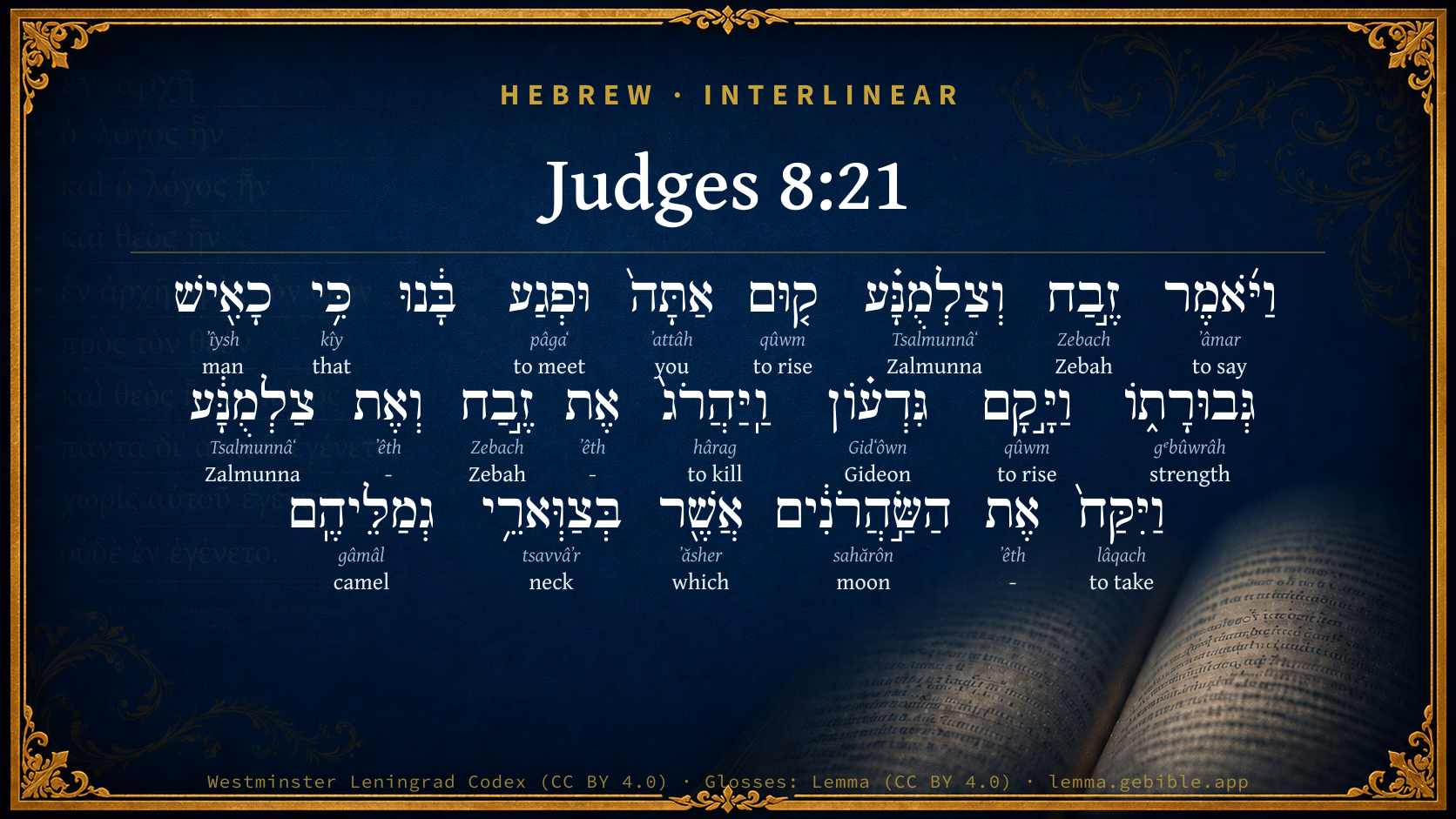
Hebrew (Westminster Leningrad Codex) Judges 8:21 appears in the Hebrew Old Testament. The text above is from the Westminster Leningrad Codex. Each word links to its Strong’s number, a concise gloss, and parsing drawn from the Open Scriptures Hebrew Bible morphology. Click any word for its full Brown-Driver-Briggs (BDB) entry.
Download image
Cite this verse

Judges 8:21 (World English Bible). Public Domain. Lemma interlinear Bible study tool, https://lemma.gebible.app/v/judges/8/21.

Show BibTeX & RIS
BibTeX
RIS
English Translation
Then Zebah and Zalmunna said, Rise you, and fall on us; for as the man is, so is his strength. Gideon arose, and killed Zebah and Zalmunna, and took the crescents that were on their camels' necks.
World English Bible · Public Domain
Highlights
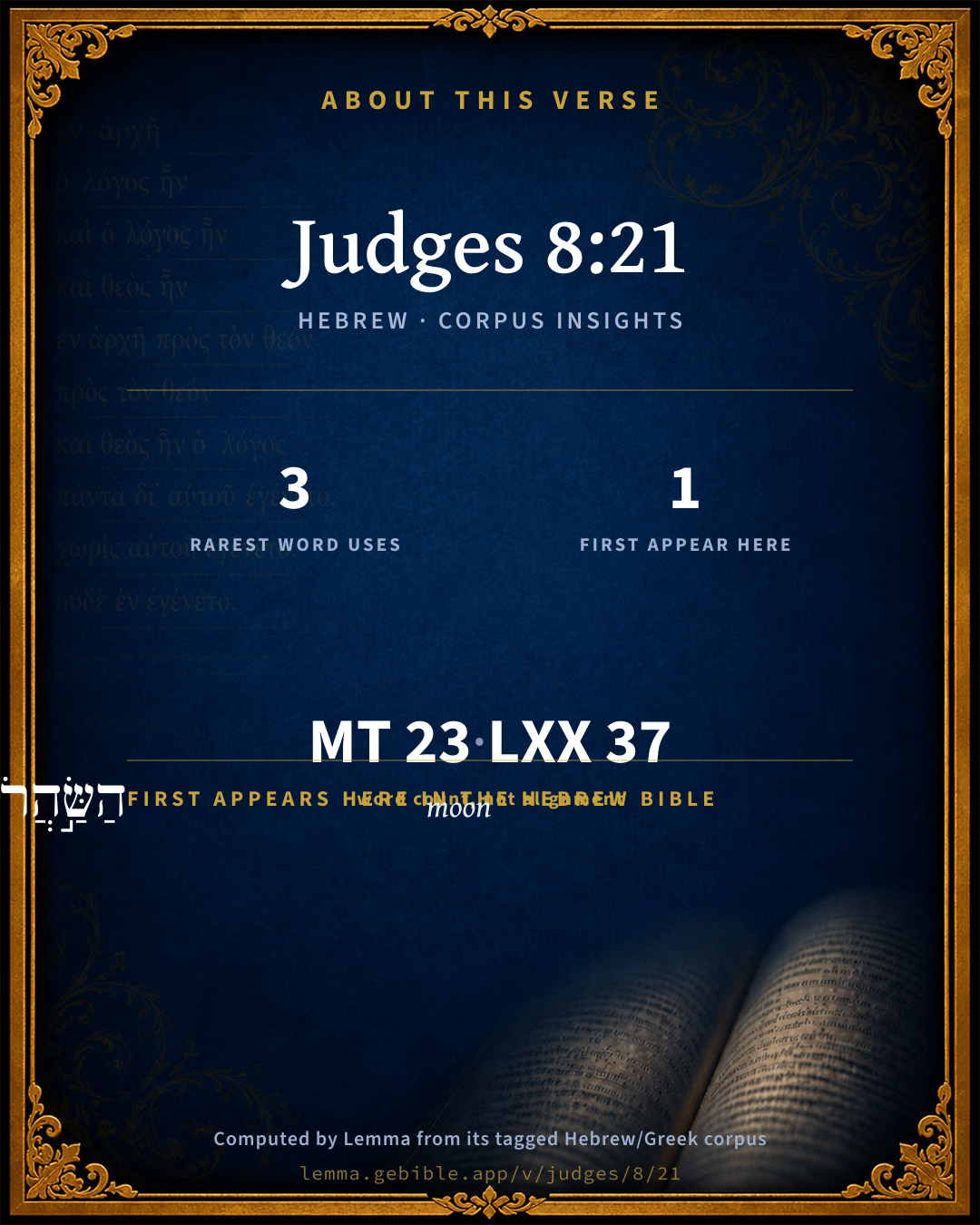
  • 1 first appearance in the Hebrew Bible
Full analysis ↓
Download a study sheet

One document with this verse’s original text, its word-by-word gloss line, the meaning frame, cross-references with their text, attributed commentary, and full source and license credits — printable, and it pastes into notes with its structure intact.

This verse Autodidact and up

Study sheet (.html) Plain text (.txt)

A passage Seminary Student

Up to 50 verses in one chapter. A passage sheet keeps up to 6 commentary sources and 12 cross-references per verse, in the order this page ranks them, and says so on the sheet whenever that leaves anything out. Ask for a single verse and you get the Autodidact verse sheet above.

Everything on this page stays free to read, with no account — the sheet is a download of what is already on screen, not access to it.

Want to remove ads? Support Godless Engineer
Compare translations 3

The same verse in 3 English versions, stacked beneath the original-language interlinear above. Click any original word for its lexicon entry.

Each is an independent rendering of the whole verse — the interlinear is not word-aligned to these translations.

Highlighted words mark where these versions differ — a whole-verse word diff, not a word-by-word alignment.

  • World English Bible Public Domain
    Then Zebah and Zalmunna said, Rise you, and fall on us; for as the man is, so is his strength. Gideon arose, and killed Zebah and Zalmunna, and took the crescents that were on their camels' necks.
  • King James Version Public Domain
    Then Zebah and Zalmunna said, Rise thou, and fall upon us: for as the man is, so is his strength. And Gideon arose, and slew Zebah and Zalmunna, and took away the ornaments that were on their camels' necks.
  • unfoldingWord Literal Text CC BY-SA 4.0
    Then Zebah and Zalmunna said, “Arise yourself and strike us! For like a man his strength.” So Gideon arose and killed Zebah and Zalmunna, and he took the ornaments that on the necks of their camels.

unfoldingWord Literal Text — © unfoldingWord, licensed CC BY-SA 4.0. Word-aligned USFM3 via Door43 (git.door43.org/unfoldingWord/en_ult).

Versions to compare (up to 4)

3 of 4 selected

Show all 18 translations

Every available English version of this verse, each an independent rendering of the whole verse.

  • World English Bible Public Domain
    Then Zebah and Zalmunna said, Rise you, and fall on us; for as the man is, so is his strength. Gideon arose, and killed Zebah and Zalmunna, and took the crescents that were on their camels' necks.
  • Berean Standard Bible Public Domain
    Then Zebah and Zalmunna said, “Get up and kill us yourself, for as the man is, so is his strength.” So Gideon got up and killed Zebah and Zalmunna, and he took the crescent ornaments from the necks of their camels.
  • Majority Standard Bible Public Domain
    Then Zebah and Zalmunna said, “Get up and kill us yourself, for as the man is, so is his strength.” So Gideon got up and killed Zebah and Zalmunna, and he took the crescent ornaments from the necks of their camels.
  • King James Version Public Domain
    Then Zebah and Zalmunna said, Rise thou, and fall upon us: for as the man is, so is his strength. And Gideon arose, and slew Zebah and Zalmunna, and took away the ornaments that were on their camels' necks.
  • American Standard Version (1901) Public Domain
    Then Zebah and Zalmunna said, Rise thou, and fall upon us; for as the man is, so is his strength. And Gideon arose, and slew Zebah and Zalmunna, and took the crescents that were on their camels' necks.
  • Revised Version (1885) Public Domain
    Then Zebah and Zalmunna said, Rise thou, and fall upon us: for as the man is, so is his strength. And Gideon arose, and slew Zebah and Zalmunna, and took the crescents that were on their camels’ necks.
  • Geneva Bible (1599) Public Domain
    Then Zebah and Zalmunna sayd, Rise thou, and fall vpon vs: for as the man is, so is his strength. And Gideon arose and slew Zebah and Zalmunna, and tooke away the ornamentes, that were on their camels neckes.
  • Douay-Rheims (1899) Public Domain
    And Zebee and Salmana said: Do thou rise, and run upon us: because the strength of a man is according to his age: Gedeon rose up and slew Zebee and Salmana: and he took the ornaments and bosses, with which the necks of the camels of kings are wont to be adorned.
  • Young's Literal Translation Public Domain
    And Zebah saith -- also Zalmunna -- `Rise thou, and fall upon us; for as the man -- his might;' and Gideon riseth, and slayeth Zebah and Zalmunna, and taketh their round ornaments which `are' on the necks of their camels.
  • Literal Standard Version CC BY-SA 4.0
    And Zebah and Zalmunna say, “Rise and fall on us; for as the man—his might”; and Gideon rises, and slays Zebah and Zalmunna, and takes the crescents which [are] on the necks of their camels.
  • Unlocked Literal Bible CC BY-SA 4.0
    Then Zebah and Zalmunna said, “Get up yourself and kill us! For as the man is, so is his strength.” Gideon rose and killed Zebah and Zalmunna. He also took off the crescent-shaped ornaments that were on their camels' necks.
  • unfoldingWord Literal Text CC BY-SA 4.0
    Then Zebah and Zalmunna said, “Arise yourself and strike us! For like a man his strength.” So Gideon arose and killed Zebah and Zalmunna, and he took the ornaments that on the necks of their camels.
  • Darby Bible Public Domain
    Then Zebah and Zalmun'na said, "Rise yourself, and fall upon us; for as the man is, so is his strength." And Gideon arose and slew Zebah and Zalmun'na; and he took the crescents that were on the necks of their camels.
  • World Messianic Bible Public Domain
    Then Zebah and Zalmunna said, “You rise and fall on us; for as the man is, so is his strength.” Gideon arose, and killed Zebah and Zalmunna, and took the crescents that were on their camels’ necks.
  • Webster's Bible Public Domain
    Then Zebah and Zalmunna said, Rise thou, and fall upon us: for as the man is, so is his strength. And Gideon arose, and slew Zebah and Zalmunna, and took away the ornaments that were on their camels' necks.
  • Free Bible Version CC BY-SA 4.0
    Zebah and Zalmunna said to Gideon, “Come on, you do it! Show yourself a man and kill us!” So Gideon went over and killed Zebah and Zalmunna, and he took the crescent-shaped ornaments from the necks of their camels.
  • Bible in Basic English Public Domain
    Then Zebah and Zalmunna said, Up! Put an end to us yourself: for you have a man's strength. Then Gideon got up and put Zebah and Zalmunna to death and took the ornaments which were on their camels' necks.
  • JPS Tanakh (1917) Public Domain
    Then Zebah and Zalmunna said: 'Rise thou, and fall upon us; for as the man is, so is his strength.' And Gideon arose, and slew Zebah and Zalmunna, and took the crescents that were on their camels' necks.

Literal Standard Version (2020), Covenant Press — licensed CC BY-SA 4.0. Text via the HelloAO Bible API (eBible.org). Unlocked Literal Bible (unfoldingWord) — licensed CC BY-SA 4.0. Text via the HelloAO Bible API (eBible.org). unfoldingWord Literal Text — © unfoldingWord, licensed CC BY-SA 4.0. Word-aligned USFM3 via Door43 (git.door43.org/unfoldingWord/en_ult). Free Bible Version, Dr. Jonathan Gallagher — licensed CC BY-SA 4.0. Text via the HelloAO Bible API (eBible.org).

Word by word

More ways to search: Search by grammar → Find every occurrence → Compare this word →

Practice this passage: Drill this verse → Learn its vocabulary →

הַשַּׂ֣הֲרֹנִ֔ים
sahărôn
H7720
“the · crescents”
Particle, Definite Article + Noun, Common, Masculine, Plural, Absolute
Part of Speech
Particle + Noun
Type
Common
Gender
Masculine
Number
Plural
State
Absolute
Full BDB Definition

Origin: from the same as H5469

TWOT: 2239a

moon, crescent - as ornament
  1. וַיֹּ֜אמֶר ʼâmar H559 “and · to say” Conjunction + Verb, Qal, Sequential Imperfect, 3rd Person, Masculine, Singular
  2. זֶ֣בַח Zebach H2078 “Zebah” Noun, Proper
  3. וְצַלְמֻנָּ֗ע Tsalmunnâʻ H6759 “and · Zalmunna” Conjunction + Noun, Proper
  4. ק֤וּם qûwm H6965 “rise” Verb, Qal, Imperative, 2nd Person, Masculine, Singular
  5. אַתָּה֙ ʼattâh H859 “you” Pronoun, Personal, 2nd Person, Masculine, Singular
  6. וּפְגַע pâgaʻ H6293 “and · meet” Conjunction + Verb, Qal, Imperative, 2nd Person, Masculine, Singular
  7. כִּ֥י kîy H3588 “that” Conjunction
  8. כָאִ֖ישׁ ʼîysh H376 “like/as the · man” Preposition, Determined + Noun, Common, Masculine, Singular, Absolute
  9. גְּבוּרָת֑וֹ gᵉbûwrâh H1369 “strength · his” Noun, Common, Feminine, Singular, Construct + Suffix, Personal, 3rd Person, Masculine, Singular
  10. וַיָּ֣קָם qûwm H6965 “and · to rise” Conjunction + Verb, Qal, Sequential Imperfect, 3rd Person, Masculine, Singular
  11. גִּדְע֗וֹן Gidʻôwn H1439 “Gideon” Noun, Proper
  12. וַֽיַּהֲרֹג֙ hârag H2026 “and · to kill” Conjunction + Verb, Qal, Sequential Imperfect, 3rd Person, Masculine, Singular
  13. אֶת ʼêth H853 “-” Particle, Direct Object
  14. זֶ֣בַח Zebach H2078 “Zebah” Noun, Proper
  15. וְאֶת ʼêth H853 “and · -” Conjunction + Particle, Direct Object
  16. צַלְמֻנָּ֔ע Tsalmunnâʻ H6759 “Zalmunna” Noun, Proper
  17. וַיִּקַּח֙ lâqach H3947 “and · to take” Conjunction + Verb, Qal, Sequential Imperfect, 3rd Person, Masculine, Singular
  18. אֶת ʼêth H853 “-” Particle, Direct Object
  19. אֲשֶׁ֖ר ʼăsher H834 “which” Particle, Relative
  20. בְּצַוְּארֵ֥י tsavvâʼr H6677 “in/at · necks of” Preposition + Noun, Common, Masculine, Plural, Construct
  21. גְמַלֵּיהֶֽם gâmâl H1581 “camels · their” Noun, Common, Masculine, Plural, Construct + Suffix, Personal, 3rd Person, Masculine, Plural

About this verse

These counts appear in no published source. They are computed here, from the morphology-tagged text and Lemma’s own curated glosses. What Lemma adds →

23
words
17
distinct lemmas
Historical
section

Notable vocabulary

The rarest word here is הַשַּׂ֣הֲרֹנִ֔ים moon H7720 — appearing just 3 times in the whole Hebrew Bible.

First appearance in Scripture

This word makes its first canonical appearance in the Hebrew Bible here:

  • הַשַּׂ֣הֲרֹנִ֔ים moon H7720

Shared distinctive vocabulary

הַשַּׂ֣הֲרֹנִ֔ים moon H7720 occurs in 3 verses of the Hebrew Bible. Also found in:

Grammatical profile

  • 6 verbs
  • 10 nouns
  • 1 pronoun
  • 1 preposition
  • 1 conjunction
  • 4 particles

Verb forms

  • וַיֹּ֜אמֶר Qal · Sequential Imperfect
  • ק֤וּם Qal · Imperative
  • וּפְגַע Qal · Imperative
  • וַיָּ֣קָם Qal · Sequential Imperfect
  • וַֽיַּהֲרֹג֙ Qal · Sequential Imperfect
  • וַיִּקַּח֙ Qal · Sequential Imperfect

Repetition

Words recur within this verse — often emphatic in Hebrew:

  • זֶ֣בַח Zebah H2078 ×2
  • וְצַלְמֻנָּ֗ע Zalmunna H6759 ×2
  • ק֤וּם to rise H6965 ×2

Hebrew & Septuagint length

In English translation the verse runs 37 words from the Hebrew and 42 from the Septuagint (LXX English) — closely comparable.

A rough comparison of the two English renderings, which tokenize alike — not a word-level alignment.

Word counts can differ between the Hebrew and the Greek without any difference in meaning — e.g. the Hebrew direct-object marker אֵת has no separate Greek word, and Greek often adds the article ὁ.

In the original languages it is 23 Hebrew tokens and 37 Greek tokens — but the two are counted differently (Hebrew bundles its prefixes and suffixes into one token; the Greek is in lemma form), so that isn’t a like-for-like length.

Cross-references

8

Topical passages linked to Judges 8:21 in the Treasury of Scripture Knowledge — connected by theme and wording, ordered by reader-vote popularity; previews shown in the World English Bible.

  • Psalms 83:11 Make their nobles like Oreb and Zeeb; Yes, all their princes like Zebah and Zalmunna;
  • Judges 8:26 The weight of the golden ear-rings that he requested was one thousand and seven hundred [shekels] of gold, besides the crescents, and the pendants, and the purple clothing that was on the kings of Midian, and besides the chains that were about their camels' necks.
  • Isaiah 3:18 In that day the Lord will take away the beauty of their anklets, the headbands, the crescent necklaces,
  • Judges 9:54 Then he called hastily to the young man his armor bearer, and said to him, Draw your sword, and kill me, that men not say of me, A woman killed him. His young man thrust him through, and he died.
  • 1 Samuel 31:3 The battle went sore against Saul, and the archers overtook him; and he was greatly distressed by reason of the archers.
  • 1 Samuel 31:5 When his armor bearer saw that Saul was dead, he likewise fell on his sword, and died with him.
  • Psalms 83:1 God, don't keep silent. Don't keep silent, And don't be still, God.
  • Revelation 9:6 In those days people will seek death, and will in no way find it. They will desire to die, and death will flee from them.

Cross-references courtesy of OpenBible.info (CC BY 4.0).

Hebrew and Greek witnesses Masoretic Hebrew ↔ Greek Septuagint

The same verse in the two great witnesses to the Old Testament, shown verse-for-verse.

These are two independent witnesses, not word-aligned to each other, and the Septuagint is shown in lemma (dictionary) form.

Hebrew Judges 8:21 Masoretic · Westminster Leningrad Codex

וַיֹּ֜אמֶר זֶ֣בַח וְצַלְמֻנָּ֗ע ק֤וּם אַתָּה֙ וּפְגַע בָּ֔נוּ כִּ֥י כָאִ֖ישׁ גְּבוּרָת֑וֹ וַיָּ֣קָם גִּדְע֗וֹן וַֽיַּהֲרֹג֙ אֶת זֶ֣בַח וְאֶת צַלְמֻנָּ֔ע וַיִּקַּח֙ אֶת הַשַּׂ֣הֲרֹנִ֔ים אֲשֶׁ֖ר בְּצַוְּארֵ֥י גְמַלֵּיהֶֽם

Then Zebah and Zalmunna said, Rise you, and fall on us; for as the man is, so is his strength. Gideon arose, and killed Zebah and Zalmunna, and took the crescents that were on their camels' necks.

World English Bible · Public Domain

Greek LXX Judges 8:21 Septuagint · lemma form

καί εἶπον ζεβεε καί σελμανα ἀναἵστημι σύ καί συνἀντάω ἐγώ ὅτι ὡς ἀνήρ ὁ δύναμις σύ καί ἀναἵστημι γεδεων καί ἀποκτείνω ὁ ζεβεε καί ὁ σελμανα καί λαμβάνω ὁ μηνίσκος ὁ ἐν ὁ τράχηλος ὁ κάμηλος αὐτός

And Zebee and Salmana said, Rise you and fall upon us, for your power is as that of a man; and Gedeon arose, and killed Zebee and Salmana: and he took the round ornaments that were on the necks of their camels.

LXX2012 (modern English Septuagint) · Public Domain

On this verse, Adam Clarke's Commentary discusses the Septuagint’s reading. Read the note in Commentary ↓

Hebrew: Westminster Leningrad Codex (CC BY 4.0). Greek: Septuagint (public domain); English from LXX2012 (modern English Septuagint) (Public Domain). How the Septuagint differs from the Hebrew →

Targum (Aramaic paraphrase)

1

The Targum is the ancient Jewish Aramaic paraphrase of the Hebrew Scriptures — an interpretive translation, not the Hebrew text itself. Onkelos (literal) and Pseudo-Jonathan (expansive) render the Torah, and Jonathan the Prophets. Coverage is partial: where no permissively-licensed English translation exists for a verse, only the Aramaic is shown. This is verse-level text, not a word-by-word alignment to the Hebrew.

  1. Targum Jonathan Prophets (Joshua–Malachi)
    וַאֲמַר זֶבַח וְצַלְמֻנָע קוּם אַתְּ וּשְׁלַט בָּנָא אֲרֵי כְגַבְרָא כֵּן גְבוּרְתֵּיהּ וְקָם גִדְעוֹן וּקְטַל יַת זֶבַח וְיַת צַלְמֻנָע וּנְסִיב יַת עִנְקַיָא דִי בְצַוְארֵי גְמַלֵיהוֹן:

    (no public-domain English translation for this verse)

    Targum Jonathan — Aramaic: “Mikraot Gedolot” (public domain). English: “Sefaria Community Translation” (CC0 1.0 (public-domain dedication)); “London "Chaldee Paraphrase," 1871” (public domain). Text via Sefaria.

Commentary

Notes on Judges 8:21 from classic Christian and Jewish commentators (each source and its license shown beneath its notes). The classic Christian expositions comment on the surrounding passage and are grouped to its opening verse, so a note may address several verses; the Jewish commentaries on the Tanakh (Rashi and others) are per-verse, so they appear only where the commentator wrote on this verse.

Lemma curates 59 commentaries, every one of them public domain or Creative Commons licensed, each selected and text-cleaned for this edition rather than reprinted as found. About our sources →

Trapp's Complete Commentary

John Trapp

Jdg 8:21 Then Zebah and Zalmunna said, Rise thou, and fall upon us: for as the man [is, so is] his strength. And Gideon arose, and slew Zebah and Zalmunna, and took away the ornaments that [were] on their camels’ necks.

Ver. 21. Rise thou, and fall upon us.] For thou wilt quickly despatch us; and we will die with honour.

“ Hoc tamen infaelix miseram solabere mortem,

Aeneae magni dextra cadis. ” - Virg. Aeneid., lib. x.

For as the man is, so is his strength.] This they speak with an undaunted spirit, as it may seem, which is not always a sign of a good cause, but sometimes of a dedolent and desperate disposition, as we may see in many of Satan’s martyrs.

John Trapp, A Commentary or Exposition upon All the Books of the Old and New Testament (1647–1656) — public domain. Text from a community e-Sword module.

Joseph Benson's Commentary

Jdg 8:21. Rise thou, and fall upon us — They thought it better to die by the hand of Gideon, who was as eminent for his strength as his dignity, and would despatch them with more speed than a stripling could.

Joseph Benson's Commentary on the Old and New Testaments (1811–1818) — public domain. Text from a community e-Sword module.

Geneva Bible (1599)

Geneva Bible translators

Meaning, that they would be rid out of their pain at once, or else to have a valiant man to put them to death.

Or, collars.

Geneva Bible (1599) marginal notes — public domain. Text via Bolls.life.

Adam Clarke's Commentary

Verse 21. Then Zebah and Zalmunna said, Rise, thou, and fall upon us] It was disgraceful to fall by the hands of a child; and the death occasioned by the blows of such a person must be much more lingering and tormenting. Some have even employed children to despatch captives. Civilis, a Roman knight, headed a revolt of the Gauls against Rome, in the year of the city 824. Of him Tacitus says, Hist. lib. iv., c. 61: Ferebatur parvulo filio quosdam captivorum sagittis jaculisque puerilibus figendos obtulisse: "He is said to have given to his little son some prisoners, as butts to be shot at with little darts and arrows." This was for their greater torment and dishonour; and to inure his child to blood! Could any thing like this have been the design of Gideon?

The ornaments that were on their camels' necks.] The heads, necks, bodies, and legs of camels, horses, and elephants, are highly ornamented in the eastern countries, and indeed this was common, from the remotest antiquity, in all countries. Virgil refers to it as a thing long before his time, and thus describes the horses given by King Latinus to the ambassadors of AEneas. - AEn. lib. vii., ver. 274.

Haec effatus equos numero pater eligit omni.

Stabant tercentum nitidi in praesepibus altis:

Omnibus extemplo Teucris jubet ordine duci

Instratos ostro alipedes pictisque tapetis.

Aurea pectoribus demissa monilia pendent:

Tecti auro fulvum mandunt sub dentibus aurum.

"He said, and order'd steeds to mount the band:

In lofty stalls three hundred coursers stand;

Their shining sides with crimson cover'd o'er;

The sprightly steeds embroider'd trappings wore,

With golden chains, refulgent to behold:

Gold were their bridles, and they champ'd on gold."

PITT.

Instead of ornaments, the Septuagint translate τουςμηνισκους, the crescents or half-moons; and this is followed by the Syriac and Arabic. The worship of the moon was very ancient; and, with that of the sun, constituted the earliest idolatry of mankind. We learn from Jdg 8:24 that the Ishmaelites, or Arabs, as they are termed by the Targum, Syriac, and Arabic, had golden ear-rings, and probably a crescent in each; for it is well known that the Ishmaelites, and the Arabs who descended from them, were addicted very early to the worship of the moon; and so attached were they to this superstition, that although Mohammed destroyed the idolatrous use of the crescent, yet it was universally borne in their ensigns, and on the tops of their mosques, as well as in various ornaments.

Adam Clarke's Commentary on the Bible (1810–1826) — public domain. Text from a community e-Sword/MySword module.

Ellicott's Commentary for English Readers

(21) Rise thou, and fall upon us.—They deprecated the pain and shame of falling by the irresolute hands of a boy.

For as the man . . . his strength.—Deu_33:25. “As thy days, so shall thy strength be.”

Ornaments.—Saharonim, “little moons,” crescent-shaped ornaments of gold and silver, still in common use to decorate animals. Isa_3:18, “round tires like the moon.” “Niveo lunata monilia dente” (Stat. Theb. ix. 689). After one of his battles Mohammed found a slain camel adorned with these lunulœ and with strings of emeralds. The Roman senators (for another reason) wore silver crescents on their shoes.

A Bible Commentary for English Readers, edited by Charles John Ellicott (1878–1897) — public domain. Text from a community e-Sword module.

The Cambridge Bible for Schools and Colleges

gen. ed. J. J. S. Perowne

21. The chiefs reply with undaunted spirit like true sons of the desert: as the man is, so is his strength, i.e. a man has a man’s strength (Moore); but the word so is not expressed in the terse Hebrew.

crescents] lit. moons, metal ornaments worn not only by the kings but by their camels, Jdg_8:26, and by the women of Jerusalem, Isa_3:18. The name is not Israelite, nor is it the ordinary word for ‘moon’; it is related to the old Aramaic name of the moon-god (sahar).

The Cambridge Bible for Schools and Colleges (gen. ed. J. J. S. Perowne; Cambridge University Press, 1878–1918) — public domain. Text from a community e-Sword module.

John Gill's Exposition

Then Zebah and Zalmunna said, rise thou and fall upon us,.... Since they must die, they chose rather to die by the hand of so great a man and valiant a commander as Gideon, which was more honourable than to die by the hand of a youth:

for as the man is, so is his strength; signifying, that as he was a stout able man, he had strength sufficient to dispatch them at once, which his son had not, and therefore they must have died a lingering and painful death: wherefore as they consulted their honour, so their ease, in desiring to die by the hand of Gideon:

and Gideon arose, and slew Zebah and Zalmunna; nor was it unusual in those early times for great personages, as judges and generals, to be executioners of others, as were Samuel and Benaiah, Sa1 15:33.

and took away the ornaments that were on their camels' necks; the Targum calls them chains, as in Jdg 8:26 no doubt of gold; so the horses of King Latinus (b) had golden poitrels or collars hanging down their breasts. They were, according to Jarchi, Kimchi, and Ben Gersom, in the form of the moon; see Isa 3:18 some have thought that these were worn in honour of Astarte, or the moon, the goddess of the Phoenicians, from whom these people had borrowed that idolatry.

(b) Virg. Aeneid. l. 7. v. 278.

John Gill's Exposition of the Whole Bible (1746–1763) — public domain (CC PDM 1.0). Text via the HelloAO Bible API.

Albert Barnes' Notes on the Bible

The ornaments - See marg. and compare Isa 3:18. The custom of adorning the necks of their camels with gold chains and ornaments prevailed among the Arabs so late as the time of Mahomet.

Albert Barnes' Notes on the Bible (1834–1885) — public domain. Text from a community e-Sword/MySword module.

Haydock's Catholic Bible Commentary

Age. They beg that they may die in a more speedy and noble manner. Tacitus (Hist. iv.) observes, "it was reported that Civilis exposed some of the Roman captives to his little son, in order that he might fix his arrows and javelins in their bodies." --- Ornaments. Most interpreters understand "crescents." The veneration of the Arabs for the moon, the celestial Venus, or Alilat, is well known. The Turks still make use of this sign, as Christians employ the cross on their standards, temples, &c. Men and women anciently wore on their necks or forehead ornaments of the same nature, as these camels did, Isaias iii. 18. Latinus adorned his horses in the most splendid manner. Virgil, Æneid vii: Aurea pectoribus demissa monilia pendent. Caligula decorated with extravagance his famous horse Incitatus, on which he designed to confer the consulate. (Suetonius) --- In Egypt the camels are sometimes painted yellow, and hung with a variety of little bells. (Vaneb.)

George Leo Haydock (1774–1849), Haydock's Catholic Family Bible and Commentary, 1859 edition — public domain. Excludes Psalms (Douay-Rheims chapter numbering differs from Protestant) and Deuterocanonical books (Catholic canon only).

Matthew Poole's English Annotations

As the man is, so is his strength: thou excellest him, as in age and stature, so in strength; and it is more honourable, as well as easy, to dig by the hands of a valiant man.

Matthew Poole's English Annotations on the Holy Bible (1683–1685) — public domain. Text from a community e-Sword/MySword module.

Whedon's Commentary on the Bible

Daniel D. Whedon

21. As the man… his strength — As the boy is not a man, so he has not the strength to execute this order.

Ornaments — Or, little moons; crescent-shaped ornaments, hung often, as here, upon the necks of camels, and also (compare Jdg_8:26; Isa_3:18) upon the necks of men and women.

Daniel D. Whedon (gen. ed.), Commentary on the Old and New Testaments (1874–1909) — public domain. Text from a community e-Sword module.

The Pulpit Commentary

The ornaments. Literally, little moons, crescent-shaped ornaments of gold and silver, which as well as "chains" (ver. 26) were hung as ornaments on their camels" necks. (cf. Jud_1:5:30) It would seem from ver. 26 that the kings themselves also wore these ornaments; and in Isa_3:18 they are enumerated among the articles of female attire round tires like the moon, A.V

The Pulpit Commentary (1880–1919), ed. H.D.M. Spence-Jones & Joseph S. Exell — public domain. Text from a community e-Sword module.

John Wesley's Explanatory Notes

So is his strength - Thou excellest him, as in age and stature, so in strength; and it is more honourable to die by the hands of a valiant man.

John Wesley, Explanatory Notes Upon the Whole Bible (1754–1765) — public domain. Text via the GEBible commentary corpus.

Rashi

Rabbi Shlomo Yitzchaki (Rashi)

Crescent chains. Lunettes in old French, moonshaped, made of gold.

Rashi on the Tanakh — English translations: “The Judaica Press complete Tanach with Rashi, translated by A. J. Rosenberg” (CC BY 4.0); “Pentateuch with Rashi's commentary by M. Rosenbaum and A.M. Silbermann, 1929-1934” (public domain); “The Metsudah Tanach series, Lakewood, N.J” (CC BY 4.0); and “The Book of Joshua, Metsudah Publications, 1997” (CC BY 4.0). Text via Sefaria.

Lesson kit

Teaching starters — assembled from the data on this page, not authored interpretation. Every prompt links to the verse data it draws on. Edit before teaching.

Judges, in the Historical, opens this verse with 23 words (17 distinct Hebrew lemmas). Its most distinctive word is sahărôn (“moon”). A historical commentator’s framing appears above. Read the whole chapter for the surrounding context.

Discussion questions

  1. What does “moon” (sahărôn) contribute to the verse as a whole?
  2. This is the first place “moon” appears in Scripture (first appears here). What does its debut here establish?
  3. How does Judges 8:26, which shares the word «moon», read alongside this verse?
  4. What does the repetition of “Zebah” (2× in this one verse) do in this verse?
  5. These translations render this verse differently; the difference is in the English rendering, not the original. What questions does that raise?
  6. «וַיֹּ֜אמֶר» is a Qal Sequential Imperfect verb. How does that grammatical form shape the action described?
  7. Compare how Trapp's Complete Commentary and Joseph Benson's Commentary read this verse. Where do they agree or differ?

Things to notice

Reading settings

Reading text

Shown beneath each verse's original-language words.

Old Testament
Old Testament edition

Read the OT as the Masoretic Hebrew (MT) or the Greek Septuagint (LXX).

English shown for the Greek Septuagint (in the Hebrew ↔ Greek comparison).

Comparing translations? Open the Compare panel on any verse page to stack up to four side by side.