
Judges 9:45

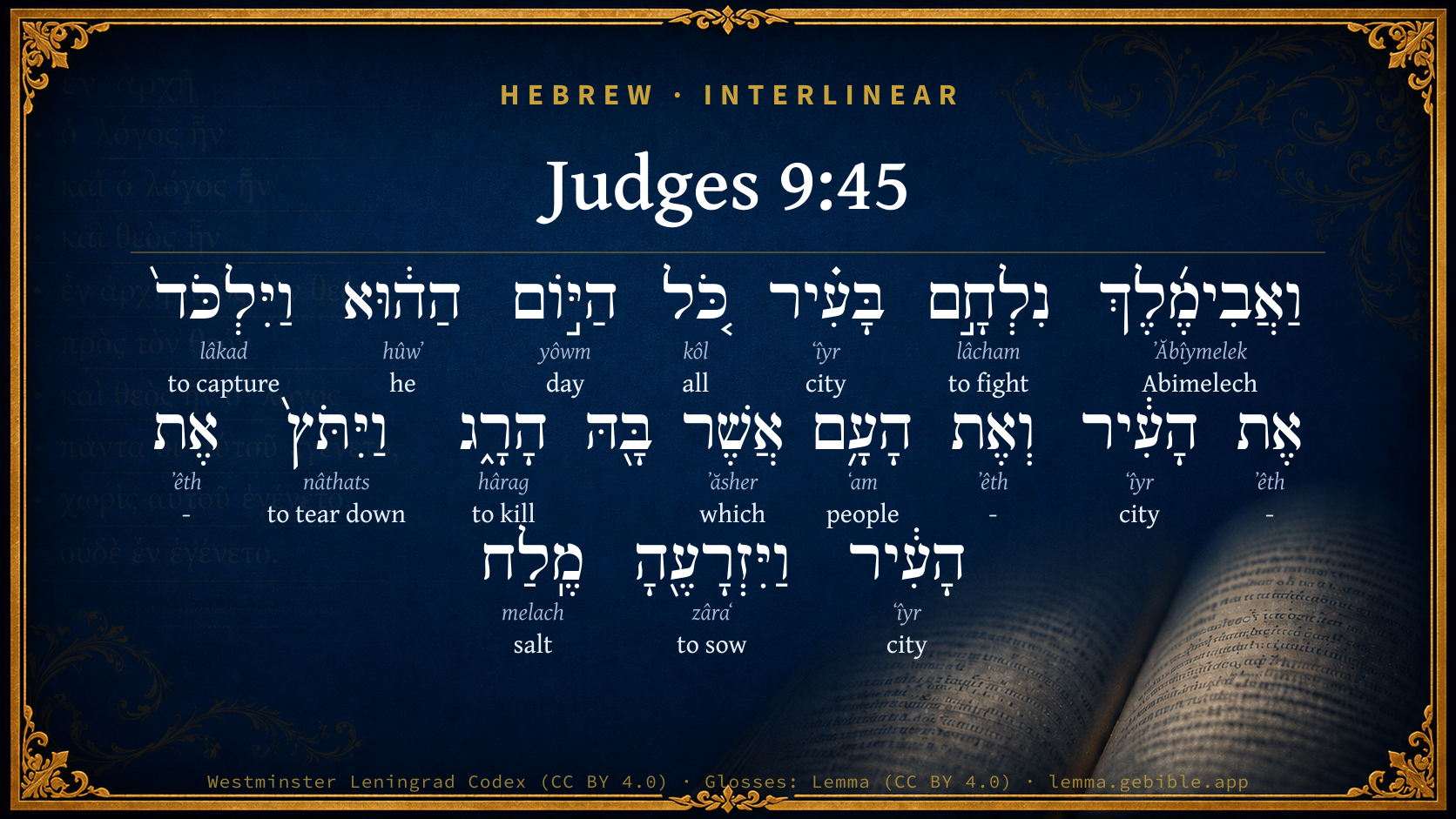
Hebrew (Westminster Leningrad Codex) Judges 9:45 appears in the Hebrew Old Testament. The text above is from the Westminster Leningrad Codex. Each word links to its Strong’s number, a concise gloss, and parsing drawn from the Open Scriptures Hebrew Bible morphology. Click any word for its full Brown-Driver-Briggs (BDB) entry.
Download image
Cite this verse

Judges 9:45 (World English Bible). Public Domain. Lemma interlinear Bible study tool, https://lemma.gebible.app/v/judges/9/45.

Show BibTeX & RIS
BibTeX
RIS
English Translation
Abimelech fought against the city all that day; and he took the city, and killed the people who were therein: and he beat down the city, and sowed it with salt.
World English Bible · Public Domain
Download a study sheet

One document with this verse’s original text, its word-by-word gloss line, the meaning frame, cross-references with their text, attributed commentary, and full source and license credits — printable, and it pastes into notes with its structure intact.

This verse Autodidact and up

Study sheet (.html) Plain text (.txt)

A passage Seminary Student

Up to 50 verses in one chapter. A passage sheet keeps up to 6 commentary sources and 12 cross-references per verse, in the order this page ranks them, and says so on the sheet whenever that leaves anything out. Ask for a single verse and you get the Autodidact verse sheet above.

Everything on this page stays free to read, with no account — the sheet is a download of what is already on screen, not access to it.

Want to remove ads? Support Godless Engineer
Compare translations 3

The same verse in 3 English versions, stacked beneath the original-language interlinear above. Click any original word for its lexicon entry.

Each is an independent rendering of the whole verse — the interlinear is not word-aligned to these translations.

Highlighted words mark where these versions differ — a whole-verse word diff, not a word-by-word alignment.

  • World English Bible Public Domain
    Abimelech fought against the city all that day; and he took the city, and killed the people who were therein: and he beat down the city, and sowed it with salt.
  • King James Version Public Domain
    And Abimelech fought against the city all that day; and he took the city, and slew the people that was therein, and beat down the city, and sowed it with salt.
  • unfoldingWord Literal Text CC BY-SA 4.0
    And Abimelech fought with the city all of that day. And he captured the city, and he killed the people who in it. Then he tore down the city and sowed it salt.

unfoldingWord Literal Text — © unfoldingWord, licensed CC BY-SA 4.0. Word-aligned USFM3 via Door43 (git.door43.org/unfoldingWord/en_ult).

Versions to compare (up to 4)

3 of 4 selected

Show all 18 translations

Every available English version of this verse, each an independent rendering of the whole verse.

  • World English Bible Public Domain
    Abimelech fought against the city all that day; and he took the city, and killed the people who were therein: and he beat down the city, and sowed it with salt.
  • Berean Standard Bible Public Domain
    And all that day Abimelech fought against the city until he had captured it and killed its people. Then he demolished the city and sowed it with salt.
  • Majority Standard Bible Public Domain
    And all that day Abimelech fought against the city until he had captured it and killed its people. Then he demolished the city and sowed it with salt.
  • King James Version Public Domain
    And Abimelech fought against the city all that day; and he took the city, and slew the people that was therein, and beat down the city, and sowed it with salt.
  • American Standard Version (1901) Public Domain
    And Abimelech fought against the city all that day; and he took the city, and slew the people that were therein: and he beat down the city, and sowed it with salt.
  • Revised Version (1885) Public Domain
    And Abimelech fought against the city all that day; and he took the city, and slew the people that was therein: and he beat down the city, and sowed it with salt.
  • Geneva Bible (1599) Public Domain
    And when Abimelech had fought against the citie all that day, he tooke the citie, and slewe the people that was therein, and destroyed the citie and sowed salt in it.
  • Douay-Rheims (1899) Public Domain
    And Abimelech assaulted the city all that day: and took it, and killed the inhabitants thereof, and demolished it, so that he sowed salt in it.
  • Young's Literal Translation Public Domain
    and Abimelech hath fought against the city all that day, and captureth the city, and the people who `are' in it he hath slain, and he breaketh down the city, and soweth it `with' salt.
  • Literal Standard Version CC BY-SA 4.0
    and Abimelech has fought against the city all that day, and captures the city, and has slain the people who [are] in it, and he breaks down the city, and sows it [with] salt.
  • Unlocked Literal Bible CC BY-SA 4.0
    Abimelech fought against the city all that day. He captured the city, and killed the people who were in it. He tore down the city walls and spread salt over it.
  • unfoldingWord Literal Text CC BY-SA 4.0
    And Abimelech fought with the city all of that day. And he captured the city, and he killed the people who in it. Then he tore down the city and sowed it salt.
  • Darby Bible Public Domain
    And Abim'elech fought against the city all that day; he took the city, and killed the people that were in it; and he razed the city and sowed it with salt.
  • World Messianic Bible Public Domain
    Abimelech fought against the city all that day; and he took the city and killed the people in it. He beat down the city and sowed it with salt.
  • Webster's Bible Public Domain
    And Abimelech fought against the city all that day; and he took the city, and slew the people that were in it, and beat down the city, and sowed it with salt.
  • Free Bible Version CC BY-SA 4.0
    The battle for the town lasted all day but eventually Abimelech captured it. He killed the people, demolished the town, and scattered salt over the ground.
  • Bible in Basic English Public Domain
    And all that day Abimelech was fighting against the town; and he took it, and put to death the people who were in it, and had the town pulled down and covered with salt.
  • JPS Tanakh (1917) Public Domain
    And Abimelech fought against the city all that day; and he took the city, and slew the people that were therein; and he beat down the city, and sowed it with salt.

Literal Standard Version (2020), Covenant Press — licensed CC BY-SA 4.0. Text via the HelloAO Bible API (eBible.org). Unlocked Literal Bible (unfoldingWord) — licensed CC BY-SA 4.0. Text via the HelloAO Bible API (eBible.org). unfoldingWord Literal Text — © unfoldingWord, licensed CC BY-SA 4.0. Word-aligned USFM3 via Door43 (git.door43.org/unfoldingWord/en_ult). Free Bible Version, Dr. Jonathan Gallagher — licensed CC BY-SA 4.0. Text via the HelloAO Bible API (eBible.org).

Word by word

More ways to search: Search by grammar → Find every occurrence → Compare this word →

Practice this passage: Drill this verse → Learn its vocabulary →

מֶֽלַח
melach
H4417
“salt”
Noun, Common, Masculine, Singular, Absolute
Part of Speech
Noun
Type
Common
Gender
Masculine
Number
Singular
State
Absolute
Full BDB Definition

Origin: from H4414

TWOT: 1197a

salt
  1. וַאֲבִימֶ֜לֶךְ ʼĂbîymelek H40 “and · Abimelech” Conjunction + Noun, Proper
  2. נִלְחָ֣ם lâcham H3898 “fighting” Verb, Niphal, Participle Active, Masculine, Singular, Absolute
  3. בָּעִ֗יר ʻîyr H5892 “in/at the · city” Preposition, Determined + Noun, Common, Feminine, Singular, Absolute
  4. כֹּ֚ל kôl H3605 “all of” Noun, Common, Masculine, Singular, Construct
  5. הַיּ֣וֹם yôwm H3117 “the · day” Particle, Definite Article + Noun, Common, Masculine, Singular, Absolute
  6. הַה֔וּא hûwʼ H1931 “the · he” Particle, Definite Article + Pronoun, Personal, 3rd Person, Masculine, Singular
  7. וַיִּלְכֹּד֙ lâkad H3920 “and · to capture” Conjunction + Verb, Qal, Sequential Imperfect, 3rd Person, Masculine, Singular
  8. אֶת ʼêth H853 “-” Particle, Direct Object
  9. הָעִ֔יר ʻîyr H5892 “the · city” Particle, Definite Article + Noun, Common, Feminine, Singular, Absolute
  10. וְאֶת ʼêth H853 “and · -” Conjunction + Particle, Direct Object
  11. הָעָ֥ם ʻam H5971 “the · people” Particle, Definite Article + Noun, Common, Masculine, Singular, Absolute
  12. אֲשֶׁר ʼăsher H834 “which” Particle, Relative
  13. הָרָ֑ג hârag H2026 “to kill” Verb, Qal, Perfect, 3rd Person, Masculine, Singular
  14. וַיִּתֹּץ֙ nâthats H5422 “and · to tear down” Conjunction + Verb, Qal, Sequential Imperfect, 3rd Person, Masculine, Singular
  15. אֶת ʼêth H853 “-” Particle, Direct Object
  16. הָעִ֔יר ʻîyr H5892 “the · city” Particle, Definite Article + Noun, Common, Feminine, Singular, Absolute
  17. וַיִּזְרָעֶ֖הָ zâraʻ H2232 “and · to sow · her” Conjunction + Verb, Qal, Sequential Imperfect, 3rd Person, Masculine, Singular + Suffix, Personal, 3rd Person, Feminine, Singular

About this verse

These counts appear in no published source. They are computed here, from the morphology-tagged text and Lemma’s own curated glosses. What Lemma adds →

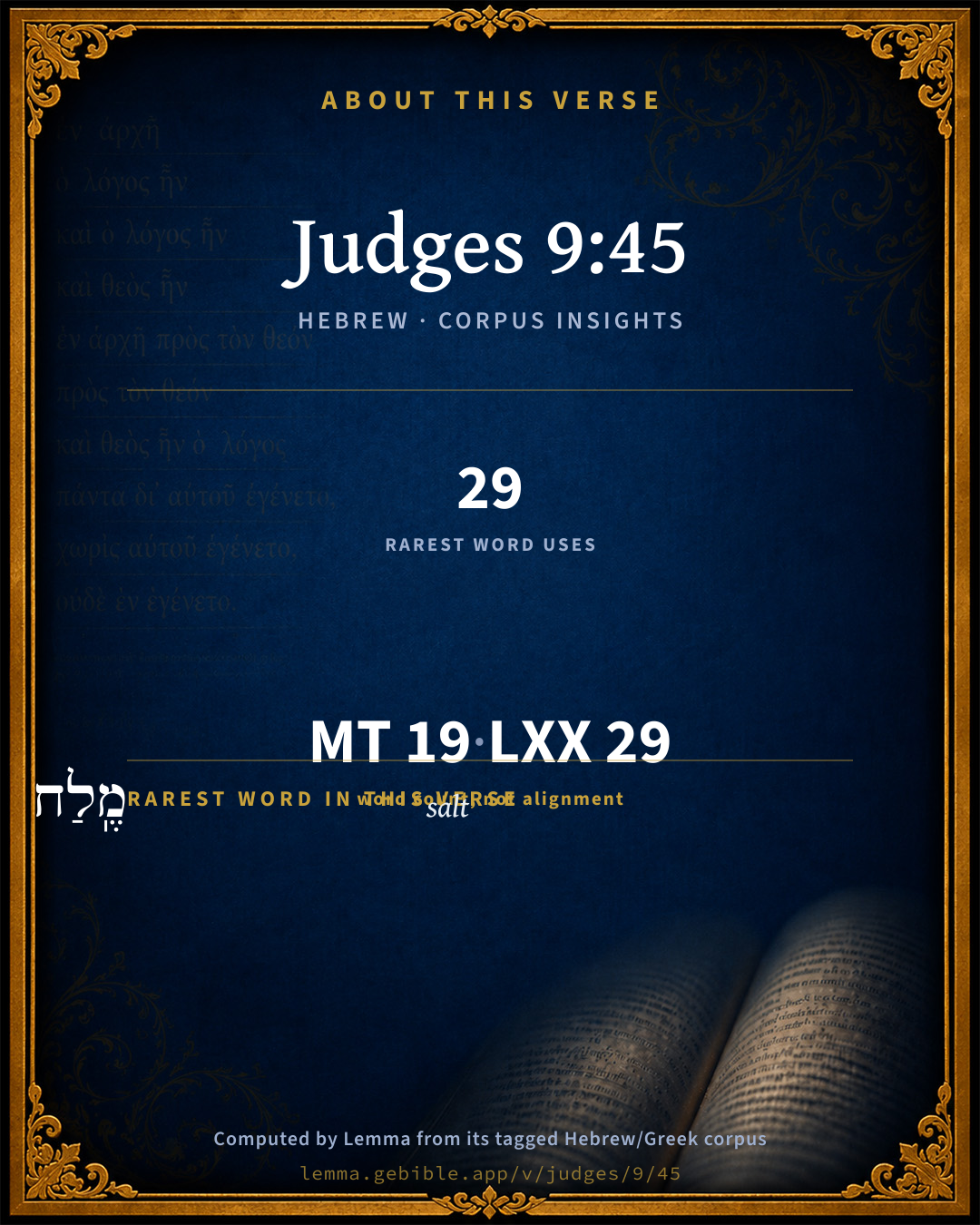
19
words
14
distinct lemmas
Historical
section

Shared distinctive vocabulary

מֶֽלַח salt H4417 occurs in 26 verses of the Hebrew Bible. Also found in:

Grammatical profile

  • 5 verbs
  • 8 nouns
  • 1 pronoun
  • 1 preposition
  • 4 particles

Verb forms

  • נִלְחָ֣ם Niphal · Participle Active
  • וַיִּלְכֹּד֙ Qal · Sequential Imperfect
  • הָרָ֑ג Qal · Perfect
  • וַיִּתֹּץ֙ Qal · Sequential Imperfect
  • וַיִּזְרָעֶ֖הָ Qal · Sequential Imperfect

Repetition

A word recurs within this verse — often emphatic in Hebrew:

  • בָּעִ֗יר city H5892 ×3

Hebrew & Septuagint length

In English translation the verse runs 31 words from the Hebrew and 30 from the Septuagint (LXX English) — closely comparable.

A rough comparison of the two English renderings, which tokenize alike — not a word-level alignment.

Word counts can differ between the Hebrew and the Greek without any difference in meaning — e.g. the Hebrew direct-object marker אֵת has no separate Greek word, and Greek often adds the article ὁ.

In the original languages it is 19 Hebrew tokens and 29 Greek tokens — but the two are counted differently (Hebrew bundles its prefixes and suffixes into one token; the Greek is in lemma form), so that isn’t a like-for-like length.

Cross-references

7

Topical passages linked to Judges 9:45 in the Treasury of Scripture Knowledge — connected by theme and wording, ordered by reader-vote popularity; previews shown in the World English Bible.

  • Deuteronomy 29:23 [and that] the whole land of it is sulfur, and salt, [and] a burning, [that] it is not sown, nor bears, nor any grass grows therein, like the overthrow of Sodom and Gomorrah, Admah and Zeboiim, which Yahweh overthrew in his anger, and in his wrath:
  • 2 Kings 3:25 They beat down the cities; and on every good piece of land they cast every man his stone, and filled it; and they stopped all the springs of water, and felled all the good trees, until in Kir Hareseth [only] they left the stones of it; however the men armed with slings went about it, and struck it.
  • 1 Kings 12:25 Then Jeroboam built Shechem in the hill-country of Ephraim, and lived therein; and he went out from there, and built Penuel.
  • Psalms 107:34 And a fruitful land into a salt waste, For the wickedness of those who dwell in it.
  • Ezekiel 47:11 But the miry places of it, and the marshes of it, shall not be healed; they shall be given up to salt.
  • Zephaniah 2:9 Therefore as I live, says Yahweh of Hosts, the God of Israel, surely Moab will be as Sodom, and the children of Ammon as Gomorrah, a possession of nettles, and salt pits, and a perpetual desolation. The remnant of my people will plunder them, and the survivors of my nation will inherit them.
  • James 2:13 For judgment is without mercy to him who has shown no mercy. Mercy triumphs over judgment.

Cross-references courtesy of OpenBible.info (CC BY 4.0).

Hebrew and Greek witnesses Masoretic Hebrew ↔ Greek Septuagint

The same verse in the two great witnesses to the Old Testament, shown verse-for-verse.

These are two independent witnesses, not word-aligned to each other, and the Septuagint is shown in lemma (dictionary) form.

Hebrew Judges 9:45 Masoretic · Westminster Leningrad Codex

וַאֲבִימֶ֜לֶךְ נִלְחָ֣ם בָּעִ֗יר כֹּ֚ל הַיּ֣וֹם הַה֔וּא וַיִּלְכֹּד֙ אֶת הָעִ֔יר וְאֶת הָעָ֥ם אֲשֶׁר בָּ֖הּ הָרָ֑ג וַיִּתֹּץ֙ אֶת הָעִ֔יר וַיִּזְרָעֶ֖הָ מֶֽלַח

Abimelech fought against the city all that day; and he took the city, and killed the people who were therein: and he beat down the city, and sowed it with salt.

World English Bible · Public Domain

Greek LXX Judges 9:45 Septuagint · lemma form

καί αβιμελεχ παρατάσσω ἐν ὁ πόλις ὅλος ὁ ἡμέρα ἐκεῖνος καί καταλαμβάνω ὁ πόλις καί ὁ λαός ὁ ἐν αὐτός ἀποκτείνω καί κατααἱρέω ὁ πόλις καί σπείρω εἰς ἅλς

And Abimelech fought against the city all that day, and took the city, and killed the people that were in it, and destroyed the city, and sowed it with salt.

LXX2012 (modern English Septuagint) · Public Domain

Hebrew: Westminster Leningrad Codex (CC BY 4.0). Greek: Septuagint (public domain); English from LXX2012 (modern English Septuagint) (Public Domain). How the Septuagint differs from the Hebrew →

Targum (Aramaic paraphrase)

1

The Targum is the ancient Jewish Aramaic paraphrase of the Hebrew Scriptures — an interpretive translation, not the Hebrew text itself. Onkelos (literal) and Pseudo-Jonathan (expansive) render the Torah, and Jonathan the Prophets. Coverage is partial: where no permissively-licensed English translation exists for a verse, only the Aramaic is shown. This is verse-level text, not a word-by-word alignment to the Hebrew.

  1. Targum Jonathan Prophets (Joshua–Malachi)
    וַאֲבִימֶלֶךְ אַגִיחַ קְרָבָא בְקַרְתָּא כָּל יוֹמָא הַהוּא וּכְבַשׁ יַת קַרְתָּא וְיַת עַמָא דִי בָהּ קְטַל וּתְרַע יַת קַרְתָּא וְזַרְעָה מִלְחָא:

    (no public-domain English translation for this verse)

    Targum Jonathan — Aramaic: “Mikraot Gedolot” (public domain). English: “Sefaria Community Translation” (CC0 1.0 (public-domain dedication)); “London "Chaldee Paraphrase," 1871” (public domain). Text via Sefaria.

Commentary

Notes on Judges 9:45 from classic Christian and Jewish commentators (each source and its license shown beneath its notes). The classic Christian expositions comment on the surrounding passage and are grouped to its opening verse, so a note may address several verses; the Jewish commentaries on the Tanakh (Rashi and others) are per-verse, so they appear only where the commentator wrote on this verse.

Lemma curates 59 commentaries, every one of them public domain or Creative Commons licensed, each selected and text-cleaned for this edition rather than reprinted as found. About our sources →

Trapp's Complete Commentary

John Trapp

Jdg 9:45 And Abimelech fought against the city all that day; and he took the city, and slew the people that [was] therein, and beat down the city, and sowed it with salt.

Ver. 45. He took the city, and slew the people.] There was, as at Athens when taken by Sulla, ανελεης σφαγη, a merciless massacre, the streets running down with blood. {a}

And beat down the city, and sowed it with salt.] Milan was so served by the Emperor Frederick Barbarossa, A.D. 1162, but rebuilt not long after, {b} as was likewise Shechem by Jeroboam. {1Ki 12:25} But here the bramble, or thistle, made good his motto, Nemo me impune lacessit. He dealt most barbarously with his native country, turning the place of his birth into a place of "nettles and saltpits, and a perpetual desolation," {Zep 2:9} as far as in him lay.

{a} Appian.

{b} Sigon. Naucler.

John Trapp, A Commentary or Exposition upon All the Books of the Old and New Testament (1647–1656) — public domain. Text from a community e-Sword module.

Joseph Benson's Commentary

Jdg 9:45. And sowed it with salt — In token of his desire of their utter and irrecoverable destruction. For places situated in a salt soil being barren by nature, the sowing of salt upon a place was a symbolical custom among the eastern people, at that time, to express great hatred and anger against any place, being as much as to express a desire that it should never be inhabited again, or produce its usual products, but become barren like a salt soil. For we cannot imagine that sowing of salt could render any soil barren ever after, but rather in some time more fruitful.

Joseph Benson's Commentary on the Old and New Testaments (1811–1818) — public domain. Text from a community e-Sword module.

Geneva Bible (1599)

Geneva Bible translators

That it should be unfruitful, and never serve to any use.

Geneva Bible (1599) marginal notes — public domain. Text via Bolls.life.

Adam Clarke's Commentary

Verse 45. And sowed it with salt.] Intending that the destruction of this city should be a perpetual memorial of his achievements. The salt was not designed to render it barren, as some have imagined; for who would think of cultivating a city? but as salt is an emblem of incorruption and perpetuity, it was no doubt designed to perpetuate the memorial of this transaction, and as a token that he wished this desolation to be eternal. This sowing a place with salt was a custom in different nations to express permanent desolation and abhorrence. Sigonius observes that when the city of Milan was taken, in A.D. 1162, the walls were razed, and it was sown with salt. And Brantome informs us that it was ancient custom in France to sow the house of a man with salt, who had been declared a traitor to his king. Charles IX., king of France, the most base and perfidious of human beings, caused the house of the Admiral Coligni (whom he and the Duke of Guise caused to be murdered, with thousands more of Protestants, on the eve of St. Bartholomew, 1572) to be sown with salt! How many houses have been since sown with salt in France by the just judgments of God, in revenge for the massacre of the Protestants on the eve of St. Bartholomew! Yet for all this God's wrath is not turned away, but his hand is stretched out still.

Adam Clarke's Commentary on the Bible (1810–1826) — public domain. Text from a community e-Sword/MySword module.

Ellicott's Commentary for English Readers

(45) Beat down the city.—Comp. 2Sa_17:13; Mic_3:12.

Sowed it with salt.—Nothing can better show his deadly execration against the populace to whom he owed his elevation, and who had been the instrument of his crimes. By this symbolic act he devoted the city to barrenness and desolation. (See Psa_107:34; Deu_29:23; Job_39:6, and marg.) “When Milan was taken, in A.D. 1162, it was sown with salt, and the house of Admiral Coligny, A.D. 1572, was sown with salt by the command of Charles IX., king of France” (Wordsworth).

A Bible Commentary for English Readers, edited by Charles John Ellicott (1878–1897) — public domain. Text from a community e-Sword module.

The Cambridge Bible for Schools and Colleges

gen. ed. J. J. S. Perowne

45. sowed it with salt] Usually explained as a symbolic act shewing that A. had reduced the city to a salt, uninhabitable desert; cf. Deu_29:23, Jer_17:6, Psa_107:34, Job_39:6. More probably the strewing of salt had a religious significance (cf. Eze_43:24) and denoted the sacrificial consecration of the city which, to judge from its utter destruction, had been put under the ban to Jehovah (see on Jdg_1:17); Rel. of Sem., p. 435 n. The custom is mentioned only here in the O.T.; but it is referred to in the great historical inscriptions of Tiglath-Pileser I (circ. 1100 b.c.) and Ashurbanipal (668–626 b.c.); Keilinschr. Biblioth. i. p. 37 and ii. p. 2071[42]. There is a tradition that Attila treated Padua, and Frederick Barbarossa treated Milan, in this way. Early in 1828 Ibrahim Pasha, after blowing up and burning Tripolitza, sprinkled salt over the ruins1[43].

[42] The transl. ‘stones’ and ‘dry sand’ given here is to be corrected to ‘salt’; Zimmern in Gunkel. Genesis, p. 193.

[43] K. Mendelssohn Bartholdy, Gesch. Griechenlands, ii. p. 99. This reference is due to Prof. J. E. B. Mayor.

The Cambridge Bible for Schools and Colleges (gen. ed. J. J. S. Perowne; Cambridge University Press, 1878–1918) — public domain. Text from a community e-Sword module.

John Gill's Exposition

And when all the men of the tower of Shechem heard that,.... That the city of Shechem was taken, the inhabitants of it slain, the city beaten down, and sowed with salt; by which it appears that this tower was not within the city, for then the men of it would have seen what was done, and not be said only to hear it; though it was not far from it, and possessed by Shechemites, and whither some of the principal inhabitants had now fled for safety; perhaps it is the same with the house of Millo, and so that part of Jotham's curse, which respected that, had now its accomplishment, otherwise no account is given of it:

they entered into an hold of the house of the god Berith; not thinking themselves safe enough in the tower, they betook themselves to the temple of Baalberith their god, see Jdg 9:4 which was a strong fortified place, as temples often were; or however had a strong hold belonging to it, and hither they fled, either because of the greater strength of the place, or because of the sanctity of it, and imagining Abimelech would not destroy it on that account; and the rather, because of the supply he had from it, which enabled him to raise himself to the government of Israel.

John Gill's Exposition of the Whole Bible (1746–1763) — public domain (CC PDM 1.0). Text via the HelloAO Bible API.

Albert Barnes' Notes on the Bible

Sowed it with salt - Expressing by this action his hatred, and his wish, that when utterly destroyed as a city, it might not even be a fruitful field. Salt is the emblem of barrenness (see the marginal references).

Albert Barnes' Notes on the Bible (1834–1885) — public domain. Text from a community e-Sword/MySword module.

Haydock's Catholic Bible Commentary

Sowed salt. To make the ground barren, and fit for nothing; (Challoner) and to testify his eternal hatred towards the place, as salt is the symbol of duration. See Deuteronomy xxix. 23., Sophonias ii. 9., and Jeremias xvii. 6. --- Salsa autem tellus & quæ perhibetur amara---Frugibus infelix. (Virgil, Georg. ii.) Notwithstanding the fury of Abimelech, Sichem was afterwards rebuilt, and became as fertile as before. The city of Milan was destroyed and sowed with salt in 1162. (Sigon.) --- The houses of traitors were formerly treated in this manner in France, (Brantome) as was that of the admiral ed Chatillon. (Calmet) --- See on this custom Bochart, animal. iii. 16. --- Some think it denoted that the ground might henceforth be cultivated, and grow corn where houses had stood. Salt is the source of fertility, if there be not too much of it. (Haydock)

George Leo Haydock (1774–1849), Haydock's Catholic Family Bible and Commentary, 1859 edition — public domain. Excludes Psalms (Douay-Rheims chapter numbering differs from Protestant) and Deuterocanonical books (Catholic canon only).

Matthew Poole's English Annotations

Not to make the place barren, as salt will do, for then he would have sowed the fields, not the city; but in token of his detestation and desire of their utter and irrecoverable destruction; for salt is the symbol or sign of perpetuity: compare Num 18:19; Deu 29:23; 2Ch 13:5; Zep 2:9.

Matthew Poole's English Annotations on the Holy Bible (1683–1685) — public domain. Text from a community e-Sword/MySword module.

Whedon's Commentary on the Bible

Daniel D. Whedon

45. Sowed it with salt — A symbolical act denoting the utter desolation of the city, as if henceforth it were to become a barren desert. Note on Mat_5:13. This terrible massacre of the people and destruction of the city was one part of the fulfilment of Jotham’s prophecy. Jdg_9:20. By it Abimelech sought to punish the rebellious tendencies which were becoming so manifest among some of his subjects, doubtless in the hope of deterring others.

Daniel D. Whedon (gen. ed.), Commentary on the Old and New Testaments (1874–1909) — public domain. Text from a community e-Sword module.

The Pulpit Commentary

Abimelech fought against the city, etc. When all the Shechemites in the field were smitten or dispersed, Abimelech stormed the city, weakened as it was by the previous loss of so many of its defenders. The city made an obstinate defence notwithstanding, but was taken before night, and all the inhabitants were put to the sword. The walls were then razed to the ground, and the site was sown with salt to express the wish that it might be barren and uninhabited for ever. (cf. Psa_107:34,jer Psa_17:6) This action of sowing with salt is not elsewhere mentioned; but it is well known that salt destroys vegetation, and is used by gardeners for this very purpose. Pliny (quoted by Rosenmuller) says, Omnis locus in quo reperitur sal sterilis est.

The Pulpit Commentary (1880–1919), ed. H.D.M. Spence-Jones & Joseph S. Exell — public domain. Text from a community e-Sword module.

John Wesley's Explanatory Notes

With salt - In token of his desire of their utter and irrecoverable destruction.

John Wesley, Explanatory Notes Upon the Whole Bible (1754–1765) — public domain. Text via the GEBible commentary corpus.

Keil & Delitzsch

C. F. Keil & F. Delitzsch

Thus Abimelech fought all that day against the city and took it; and having slain all the people therein, he destroyed the city and strewed salt upon it. Strewing the ruined city with salt, which only occurs here, was a symbolical act, signifying that the city was to be turned for ever into a barren salt desert. Salt ground is a barren desert (see Job 39:6; Psa 107:34).

Keil & Delitzsch — Biblical Commentary on the Old Testament (1861–1891) — public domain (CC PDM 1.0). Text via the HelloAO Bible API. (Old Testament only.)

Lesson kit

Teaching starters — assembled from the data on this page, not authored interpretation. Every prompt links to the verse data it draws on. Edit before teaching.

Judges, in the Historical, opens this verse with 19 words (14 distinct Hebrew lemmas). Its most distinctive word is melach (“salt”). A historical commentator’s framing appears above. Read the whole chapter for the surrounding context.

Discussion questions

  1. What does “salt” (melach) contribute to the verse as a whole?
  2. Genesis 14:3 shares the word «salt» with this verse. How do the two illuminate each other?
  3. “city” occurs 3× in this one verse. What is the effect of the repetition?
  4. These translations render this verse differently; the difference is in the English rendering, not the original. What questions does that raise?
  5. The verb «נִלְחָ֣ם» is Niphal Participle Active. How does its form color the action?
  6. Reading how Trapp's Complete Commentary and Joseph Benson's Commentary read this verse, where do the two commentators agree and where do they part?

Things to notice

Reading settings

Reading text

Shown beneath each verse's original-language words.

Old Testament
Old Testament edition

Read the OT as the Masoretic Hebrew (MT) or the Greek Septuagint (LXX).

English shown for the Greek Septuagint (in the Hebrew ↔ Greek comparison).

Comparing translations? Open the Compare panel on any verse page to stack up to four side by side.