
1 Samuel 16:2

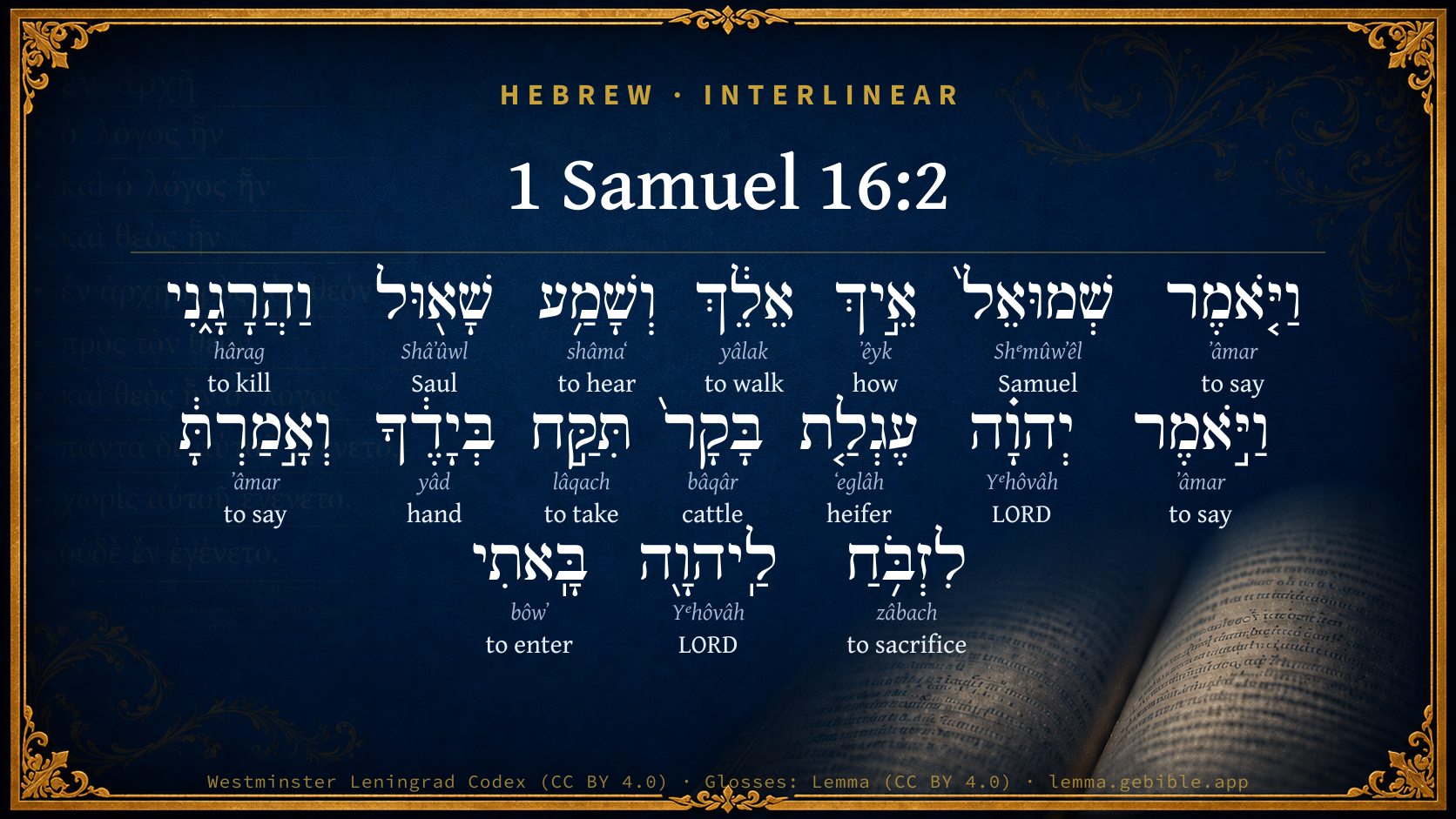
Hebrew (Westminster Leningrad Codex) 1 Samuel 16:2 appears in the Hebrew Old Testament. The text above is from the Westminster Leningrad Codex. Each word links to its Strong’s number, a concise gloss, and parsing drawn from the Open Scriptures Hebrew Bible morphology. Click any word for its full Brown-Driver-Briggs (BDB) entry.
Download image
Cite this verse

1 Samuel 16:2 (World English Bible). Public Domain. Lemma interlinear Bible study tool, https://lemma.gebible.app/v/1-samuel/16/2.

Show BibTeX & RIS
BibTeX
RIS
English Translation
Samuel said, How can I go? if Saul hear it, he will kill me. Yahweh said, Take a heifer with you, and say, I am come to sacrifice to Yahweh.
World English Bible · Public Domain
Download a study sheet

One document with this verse’s original text, its word-by-word gloss line, the meaning frame, cross-references with their text, attributed commentary, and full source and license credits — printable, and it pastes into notes with its structure intact.

This verse Autodidact and up

Study sheet (.html) Plain text (.txt)

A passage Seminary Student

Up to 50 verses in one chapter. A passage sheet keeps up to 6 commentary sources and 12 cross-references per verse, in the order this page ranks them, and says so on the sheet whenever that leaves anything out. Ask for a single verse and you get the Autodidact verse sheet above.

Everything on this page stays free to read, with no account — the sheet is a download of what is already on screen, not access to it.

Want to remove ads? Support Godless Engineer
Compare translations 3

The same verse in 3 English versions, stacked beneath the original-language interlinear above. Click any original word for its lexicon entry.

Each is an independent rendering of the whole verse — the interlinear is not word-aligned to these translations.

Highlighted words mark where these versions differ — a whole-verse word diff, not a word-by-word alignment.

  • World English Bible Public Domain
    Samuel said, How can I go? if Saul hear it, he will kill me. Yahweh said, Take a heifer with you, and say, I am come to sacrifice to Yahweh.
  • King James Version Public Domain
    And Samuel said, How can I go? if Saul hear it, he will kill me. And the LORD said, Take an heifer with thee, and say, I am come to sacrifice to the LORD.
  • unfoldingWord Literal Text CC BY-SA 4.0
    But Samuel said, “How shall I go? If Saul hears, then he will kill me.” So Yahweh said, “Take a heifer of cattle in your hand and say, ‘I have come to sacrifice to Yahweh.’

unfoldingWord Literal Text — © unfoldingWord, licensed CC BY-SA 4.0. Word-aligned USFM3 via Door43 (git.door43.org/unfoldingWord/en_ult).

Versions to compare (up to 4)

3 of 4 selected

Show all 18 translations

Every available English version of this verse, each an independent rendering of the whole verse.

  • World English Bible Public Domain
    Samuel said, How can I go? if Saul hear it, he will kill me. Yahweh said, Take a heifer with you, and say, I am come to sacrifice to Yahweh.
  • Berean Standard Bible Public Domain
    “How can I go?” Samuel asked. “Saul will hear of it and kill me!” The LORD answered, “Take a heifer with you and say, ‘I have come to sacrifice to the LORD.’
  • Majority Standard Bible Public Domain
    “How can I go?” Samuel asked. “Saul will hear of it and kill me!” The LORD answered, “Take a heifer with you and say, ‘I have come to sacrifice to the LORD.’
  • King James Version Public Domain
    And Samuel said, How can I go? if Saul hear it, he will kill me. And the LORD said, Take an heifer with thee, and say, I am come to sacrifice to the LORD.
  • American Standard Version (1901) Public Domain
    And Samuel said, How can I go? if Saul hear it, he will kill me. And Jehovah said, Take a heifer with thee, and say, I am come to sacrifice to Jehovah.
  • Revised Version (1885) Public Domain
    And Samuel said, How can I go? if Saul hear it, he will kill me. And the LORD said, Take an heifer with thee, and say, I am come to sacrifice to the LORD.
  • Geneva Bible (1599) Public Domain
    And Samuel sayde, Howe can I goe? for if Saul shall heare it, he will kill me. Then the Lord answered, Take an heifer with thee, and say, I am come to doe sacrifice to the Lord.
  • Douay-Rheims (1899) Public Domain
    And Samuel said: How shall I go? for Saul will hear of it, and he will kill me. And the Lord said: Thou shalt take with thee a calf of the herd, and thou shalt say: I am come to sacrifice to the Lord.
  • Young's Literal Translation Public Domain
    And Samuel saith, `How do I go? when Saul hath heard, then he hath slain me.' And Jehovah saith, `A heifer of the herd thou dost take in thy hand, and hast said, To sacrifice to Jehovah I have come;
  • Literal Standard Version CC BY-SA 4.0
    And Samuel says, “How do I go? When Saul has heard, then he has slain me.” And YHWH says, “You take a heifer of the herd in your hand, and have said, I have come to sacrifice to YHWH;
  • Unlocked Literal Bible CC BY-SA 4.0
    Samuel said, “How can I go? If Saul hears of it, he will kill me.” Yahweh said, “Take a heifer with you and say, 'I have come to sacrifice to Yahweh.'
  • unfoldingWord Literal Text CC BY-SA 4.0
    But Samuel said, “How shall I go? If Saul hears, then he will kill me.” So Yahweh said, “Take a heifer of cattle in your hand and say, ‘I have come to sacrifice to Yahweh.’
  • Darby Bible Public Domain
    And Samuel said, How shall I go? if Saul hear [it], he will kill me. And Jehovah said, Take a heifer with thee, and say, I am come to sacrifice to Jehovah.
  • World Messianic Bible Public Domain
    Samuel said, “How can I go? If Saul hears it, he will kill me.” The LORD said, “Take a heifer with you, and say, ‘I have come to sacrifice to the LORD.’
  • Webster's Bible Public Domain
    And Samuel said, How can I go? if Saul shall hear it, he will kill me. And the LORD said, Take a heifer with thee, and say, I have come to sacrifice to the LORD.
  • Free Bible Version CC BY-SA 4.0
    “How can I go and do that?” Samuel asked. “Saul will hear about it and kill me!” The Lord answered, “Take a young cow with you and say, ‘I've come to sacrifice to the Lord.’
  • Bible in Basic English Public Domain
    And Samuel said, How is it possible for me to go? If Saul gets news of it he will put me to death. And the Lord said, Take a young cow with you and say, I have come to make an offering to the Lord.
  • JPS Tanakh (1917) Public Domain
    And Samuel said: 'How can I go? if Saul hear it, he will kill me.' And the LORD said: 'Take a heifer with thee, and say: I am come to sacrifice to the LORD.

Literal Standard Version (2020), Covenant Press — licensed CC BY-SA 4.0. Text via the HelloAO Bible API (eBible.org). Unlocked Literal Bible (unfoldingWord) — licensed CC BY-SA 4.0. Text via the HelloAO Bible API (eBible.org). unfoldingWord Literal Text — © unfoldingWord, licensed CC BY-SA 4.0. Word-aligned USFM3 via Door43 (git.door43.org/unfoldingWord/en_ult). Free Bible Version, Dr. Jonathan Gallagher — licensed CC BY-SA 4.0. Text via the HelloAO Bible API (eBible.org).

Word by word

More ways to search: Search by grammar → Find every occurrence → Compare this word →

Practice this passage: Drill this verse → Learn its vocabulary →

עֶגְלַ֤ת
ʻeglâh
H5697
“heifer of”
Noun, Common, Feminine, Singular, Construct
Part of Speech
Noun
Type
Common
Gender
Feminine
Number
Singular
State
Construct
Full BDB Definition

Origin: from H5695

TWOT: 1560b

heifer
  1. וַיֹּ֤אמֶר ʼâmar H559 “and · to say” Conjunction + Verb, Qal, Sequential Imperfect, 3rd Person, Masculine, Singular
  2. שְׁמוּאֵל֙ Shᵉmûwʼêl H8050 “Samuel” Noun, Proper
  3. אֵ֣יךְ ʼêyk H349 “how” Particle, Interrogative
  4. אֵלֵ֔ךְ yâlak H3212 “to walk” Verb, Qal, Imperfect, 1st Person, Common, Singular
  5. וְשָׁמַ֥ע shâmaʻ H8085 “and · to hear” Conjunction + Verb, Qal, Sequential Perfect, 3rd Person, Masculine, Singular
  6. שָׁא֖וּל Shâʼûwl H7586 “Saul” Noun, Proper
  7. וַהֲרָגָ֑נִי hârag H2026 “and · to kill · me” Conjunction + Verb, Qal, Sequential Perfect, 3rd Person, Masculine, Singular + Suffix, Personal, 1st Person, Common, Singular
  8. וַיֹּ֣אמֶר ʼâmar H559 “and · to say” Conjunction + Verb, Qal, Sequential Imperfect, 3rd Person, Masculine, Singular
  9. יְהוָ֗ה Yᵉhôvâh H3068 “LORD” Noun, Proper
  10. בָּקָר֙ bâqâr H1241 “cattle” Noun, Common, Both, Singular, Absolute
  11. תִּקַּ֣ח lâqach H3947 “to take” Verb, Qal, Imperfect, 2nd Person, Masculine, Singular
  12. בְּיָדֶ֔ךָ yâd H3027 “in/at · hand · your” Preposition + Noun, Common, Both, Singular, Construct + Suffix, Personal, 2nd Person, Masculine, Singular
  13. וְאָ֣מַרְתָּ֔ ʼâmar H559 “and · to say” Conjunction + Verb, Qal, Sequential Perfect, 2nd Person, Masculine, Singular
  14. לִזְבֹּ֥חַ zâbach H2076 “to sacrifice” Preposition + Verb, Qal, Infinitive Construct
  15. לַֽיהוָ֖ה Yᵉhôvâh H3068 “to/for · LORD” Preposition + Noun, Proper
  16. בָּֽאתִי bôwʼ H935 “to enter” Verb, Qal, Perfect, 1st Person, Common, Singular

About this verse

These counts appear in no published source. They are computed here, from the morphology-tagged text and Lemma’s own curated glosses. What Lemma adds →

17
words
14
distinct lemmas
Historical
section

Notable vocabulary

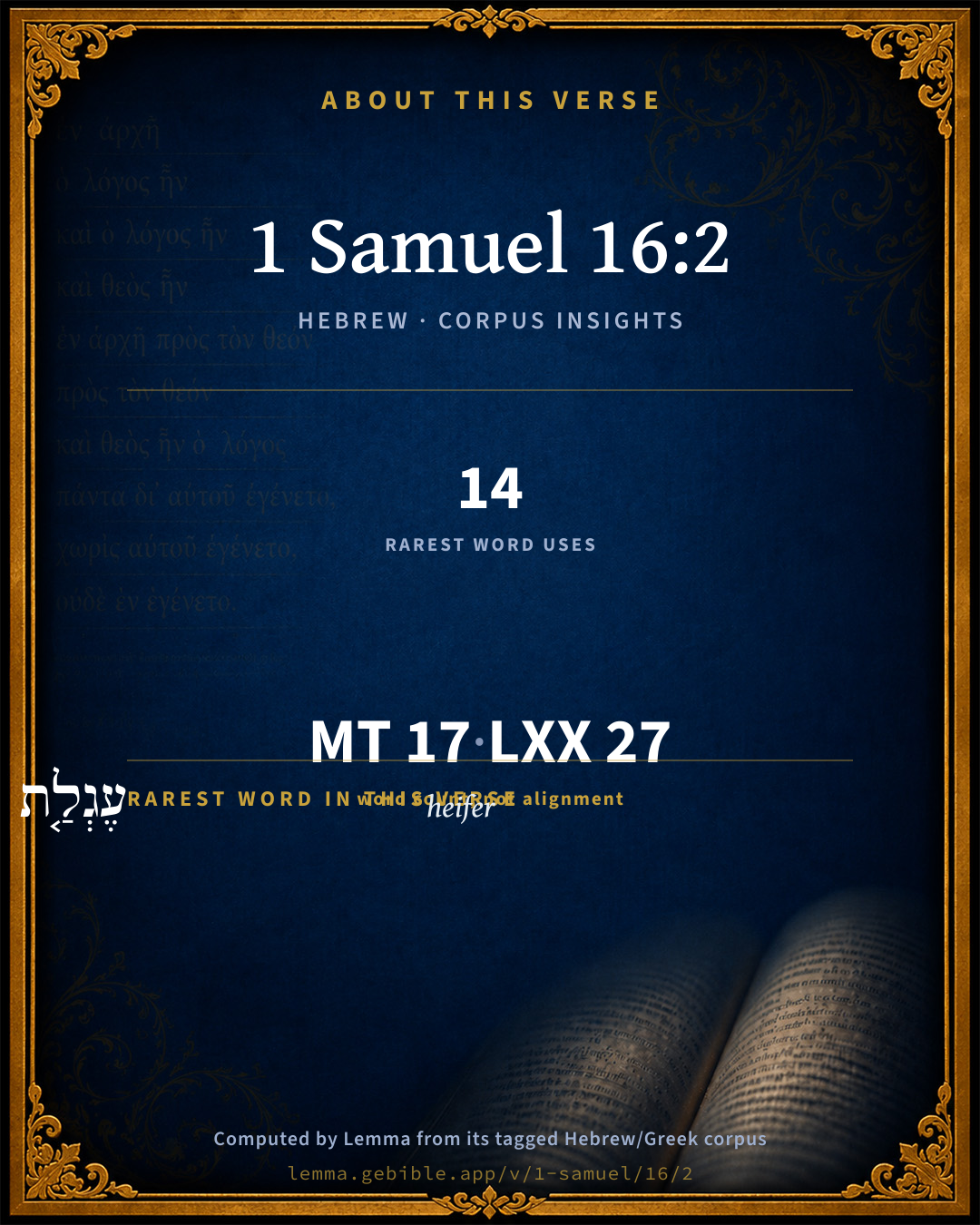
The rarest word here is עֶגְלַ֤ת heifer H5697 — appearing just 14 times in the whole Hebrew Bible.

Shared distinctive vocabulary

עֶגְלַ֤ת heifer H5697 occurs in 13 verses of the Hebrew Bible. Also found in:

Grammatical profile

  • 9 verbs
  • 7 nouns
  • 1 particle

Verb forms

  • וַיֹּ֤אמֶר Qal · Sequential Imperfect
  • אֵלֵ֔ךְ Qal · Imperfect
  • וְשָׁמַ֥ע Qal · Sequential Perfect
  • וַהֲרָגָ֑נִי Qal · Sequential Perfect
  • וַיֹּ֣אמֶר Qal · Sequential Imperfect
  • תִּקַּ֣ח Qal · Imperfect
  • וְאָ֣מַרְתָּ֔ Qal · Sequential Perfect
  • לִזְבֹּ֥חַ Qal · Infinitive Construct
  • בָּֽאתִי Qal · Perfect

Repetition

Words recur within this verse — often emphatic in Hebrew:

  • וַיֹּ֤אמֶר to say H559 ×3
  • יְהוָ֗ה LORD H3068 ×2

Hebrew & Septuagint length

In English translation the verse runs 30 words from the Hebrew and 38 from the Septuagint (LXX English) — closely comparable.

A rough comparison of the two English renderings, which tokenize alike — not a word-level alignment.

Word counts can differ between the Hebrew and the Greek without any difference in meaning — e.g. the Hebrew direct-object marker אֵת has no separate Greek word, and Greek often adds the article ὁ.

In the original languages it is 17 Hebrew tokens and 27 Greek tokens — but the two are counted differently (Hebrew bundles its prefixes and suffixes into one token; the Greek is in lemma form), so that isn’t a like-for-like length.

Cross-references

7

Topical passages linked to 1 Samuel 16:2 in the Treasury of Scripture Knowledge — connected by theme and wording, ordered by reader-vote popularity; previews shown in the World English Bible.

  • 1 Samuel 9:12 They answered them, and said, He is; behold, [he is] before you: make haste now, for he is come today into the city; for the people have a sacrifice today in the high place:
  • 1 Samuel 20:29 and he said, Please let me go, for our family has a sacrifice in the city; and my brother, he has commanded me [to be there]: and now, if I have found favor in your eyes, let me get away, I pray you, and see my brothers. Therefore he is not come to the king's table.
  • Matthew 10:16 "Behold, I send you out as sheep in the midst of wolves. Therefore be wise as serpents, and harmless as doves.
  • Exodus 3:11 Moses said to God, "Who am I, that I should go to Pharaoh, and that I should bring forth the children of Israel out of Egypt?"
  • 1 Kings 18:9–14 He said, Wherein have I sinned, that you would deliver your servant into the hand of Ahab, to kill me?
  • Jeremiah 38:26–27 then you shall tell them, I presented my supplication before the king, that he would not cause me to return to Jonathan's house, to die there.
  • Luke 1:34 Mary said to the angel, "How can this be, seeing I am a virgin?"

Cross-references courtesy of OpenBible.info (CC BY 4.0).

Hebrew and Greek witnesses Masoretic Hebrew ↔ Greek Septuagint

The same verse in the two great witnesses to the Old Testament, shown verse-for-verse.

These are two independent witnesses, not word-aligned to each other, and the Septuagint is shown in lemma (dictionary) form.

Hebrew 1 Samuel 16:2 Masoretic · Westminster Leningrad Codex

וַיֹּ֤אמֶר שְׁמוּאֵל֙ אֵ֣יךְ אֵלֵ֔ךְ וְשָׁמַ֥ע שָׁא֖וּל וַהֲרָגָ֑נִי וַיֹּ֣אמֶר יְהוָ֗ה עֶגְלַ֤ת בָּקָר֙ תִּקַּ֣ח בְּיָדֶ֔ךָ וְאָ֣מַרְתָּ֔ לִזְבֹּ֥חַ לַֽיהוָ֖ה בָּֽאתִי

Samuel said, How can I go? if Saul hear it, he will kill me. Yahweh said, Take a heifer with you, and say, I am come to sacrifice to Yahweh.

World English Bible · Public Domain

Greek LXX 1 Samuel 16:2 Septuagint · lemma form

καί εἶπον σαμουηλ πῶς πορεύομαι καί ἀκούω σαούλ καί ἀποκτείνω ἐγώ καί εἶπον κύριος δάμαλις βοῦς λαμβάνω ἐν ὁ χείρ σύ καί εἶπον θύω ὁ κύριος ἥκω

And Samuel said, How can I go? whereas Saul will hear of it, and kill me: and the Lord said, Take a heifer in your hand and you shall say, I am come to sacrifice to the Lord.

LXX2012 (modern English Septuagint) · Public Domain

Hebrew: Westminster Leningrad Codex (CC BY 4.0). Greek: Septuagint (public domain); English from LXX2012 (modern English Septuagint) (Public Domain). How the Septuagint differs from the Hebrew →

Targum (Aramaic paraphrase)

1

The Targum is the ancient Jewish Aramaic paraphrase of the Hebrew Scriptures — an interpretive translation, not the Hebrew text itself. Onkelos (literal) and Pseudo-Jonathan (expansive) render the Torah, and Jonathan the Prophets. Coverage is partial: where no permissively-licensed English translation exists for a verse, only the Aramaic is shown. This is verse-level text, not a word-by-word alignment to the Hebrew.

  1. Targum Jonathan Prophets (Joshua–Malachi)
    וַאֲמַר שְׁמוּאֵל אֵיכְדֵין אֵיזֵל וְאִם יִשְׁמַע שָׁאוּל וְיִקְטְלִינַנִי וַאֲמַר יְיָ עֶגְלַת תּוֹרִין תִּסַב בִּידָךְ וְתֵימַר לְדַבָּחָא קֳדָם יְיָ אָתֵיתִי:

    (no public-domain English translation for this verse)

    Targum Jonathan — Aramaic: “Mikraot Gedolot” (public domain). English: “Sefaria Community Translation” (CC0 1.0 (public-domain dedication)); “London "Chaldee Paraphrase," 1871” (public domain). Text via Sefaria.

Commentary

Notes on 1 Samuel 16:2 from classic Christian and Jewish commentators (each source and its license shown beneath its notes). The classic Christian expositions comment on the surrounding passage and are grouped to its opening verse, so a note may address several verses; the Jewish commentaries on the Tanakh (Rashi and others) are per-verse, so they appear only where the commentator wrote on this verse.

Lemma curates 59 commentaries, every one of them public domain or Creative Commons licensed, each selected and text-cleaned for this edition rather than reprinted as found. About our sources →

Trapp's Complete Commentary

John Trapp

1Sa 16:2 And Samuel said, How can I go? if Saul hear [it], he will kill me. And the LORD said, Take an heifer with thee, and say, I am come to sacrifice to the LORD.

Ver. 2. And Samuel said, How can I go?] This he might ask, not so much out of diffidence - for he was old and experienced; and if Solon could say, I fear not to oppose Pisistratus the tyrant, because I am old and must shortly die howsoever, much better might Samuel - as out of a desire to be directed, as Luk 1:34.

And say, I am come to sacrifice.] This a prophet might do at any time, and in any place. "In everything give thanks." But when a king was to be anointed, there was a kind of necessity in this service. Neither was Samuel bound to tell all that he came about. Some part of a truth may lawfully be concealed out of civil prudence. See the like done, Jer 38:27.

John Trapp, A Commentary or Exposition upon All the Books of the Old and New Testament (1647–1656) — public domain. Text from a community e-Sword module.

Joseph Benson's Commentary

1Sa 16:2. How can I go? — That is, with safety. Say, I am come to sacrifice to the Lord — Which he, being a prophet, might do anywhere, all the ritual laws being subject to the prophets. What the Lord commanded him to say was a truth, though not the whole truth.

Joseph Benson's Commentary on the Old and New Testaments (1811–1818) — public domain. Text from a community e-Sword module.

Tyndale Open Study Notes

Tyndale Open Resources

16:2 say that you have come to make a sacrifice: God sometimes leads his servants into dangerous situations. He protects his own—sometimes by miracle, sometimes by strategy (cp. Exod 3:18-22). In Samuel’s role as a priestly judge, he would not have raised any suspicions by offering a sacrifice (see 1 Sam 10:8).

Tyndale Open Study Notes — © Tyndale Open Resources, licensed CC BY-SA 4.0. Text via the HelloAO Bible API.

Geneva Bible (1599)

Geneva Bible translators

Hebrew, in thine hand.

That is, to make a peace offering, which might be done though the Ark was not there.

Geneva Bible (1599) marginal notes — public domain. Text via Bolls.life.

Jamieson, Fausset & Brown

Robert Jamieson, A. R. Fausset & David Brown

How can I go?--This is another instance of human infirmity in Samuel. Since God had sent him on this mission, He would protect him in the execution.

I am come to sacrifice--It seems to have been customary with Samuel to do this in the different circuits to which he went, that he might encourage the worship of God.

Jamieson, Fausset & Brown — Commentary Critical and Explanatory on the Whole Bible (1871) — public domain (CC PDM 1.0). Text via the HelloAO Bible API.

Adam Clarke's Commentary

Verse 2. Take a heifer with thee, and say, I am come to sacrifice] This was strictly true; Samuel did offer a sacrifice; and it does not appear that he could have done the work which God designed, unless he had offered this sacrifice, and called the elders of the people together, and thus collected Jesse's sons. But he did not tell the principal design of his coming; had he done so, it would have produced evil and no good: and though no man, in any circumstances, should ever tell a lie, yet in all circumstances he is not obliged to tell the whole truth, though in every circumstance he must tell nothing but the truth, and in every case so tell the truth that the hearer shall not believe a lie by it.

Adam Clarke's Commentary on the Bible (1810–1826) — public domain. Text from a community e-Sword/MySword module.

Ellicott's Commentary for English Readers

(2) He will kill me.—The unhappy mental malady of Saul must have made rapid progress. The jealous king was indeed changed from the Saul who even, in his self-willed rebellion against the Lord, was careful to pay honour to Samuel. But now the aged prophet felt that if he crossed the king’s path in any way, even in carrying out the commands of the invisible King of Israel, his life would be forfeited to the fierce anger of Saul.

Take an heifer with thee.—And the Divine voice instructed Samuel how he should proceed. There was to be as yet no public anointing of the successor to Saul, only the future king must be sought out, and quietly, but solemnly, set apart for service before the Lord, and then watched over and carefully trained for his high office.

A Bible Commentary for English Readers, edited by Charles John Ellicott (1878–1897) — public domain. Text from a community e-Sword module.

The Cambridge Bible for Schools and Colleges

gen. ed. J. J. S. Perowne

2. Take an heifer with thee, &c.] For David’s safety no less than his own it was necessary that the purpose of Samuel’s errand should not be known. “Concealment of a good purpose for a good purpose is clearly justifiable.” It was perfectly legitimate for Samuel to conceal the primary intention and mention only the secondary object of his visit.

It may be inferred from the command, that Samuel was in the habit of holding religious gatherings in different provincial towns from time to time.

The Cambridge Bible for Schools and Colleges (gen. ed. J. J. S. Perowne; Cambridge University Press, 1878–1918) — public domain. Text from a community e-Sword module.

John Gill's Exposition

And Samuel said, how can I go?.... Which argues weakness of faith in Samuel, and fear of man, and a diffidence in and distrust of divine power; for otherwise he that sent him on such an errand could protect him:

if Saul hear it, he will kill me; should hear that Samuel went and anointed another king, it would so enrage him, that he would either immediately lay hands on him, and put him to death, or order him to be put to death; and indeed were it not that this was done by the command of God, he would deserve to die; it being an overt act of treason to anoint another king:

and the Lord said, take an heifer with thee, and say, I am come to sacrifice to the Lord; a peace offering, which might be done any where in those unsettled times, the ark being at one place, and the tabernacle at another; and might be offered upon a private altar, and by a private person; and as it seems Samuel used to sacrifice at different places; see Sa1 7:9. Ben Gersom relates it as the sense of one of their Rabbins in his age, that there was a person slain in those parts, not known by whom he was slain; and so Samuel is ordered to take an heifer to fulfil the law in Deu 21:1 and therefore Saul would make no inquiry into his reason of going thither with an heifer, and this is commended both by him and Abarbinel.

John Gill's Exposition of the Whole Bible (1746–1763) — public domain (CC PDM 1.0). Text via the HelloAO Bible API.

Albert Barnes' Notes on the Bible

It was the purpose of God that David should be anointed at this time as Saul’s successor, and as the ancestor and the type of His Christ. It was not the purpose of God that Samuel should stir up a civil war, by setting up David as Saul’s rival. Secrecy, therefore, was a necessary part of the transaction. But secrecy and concealment are not the same as duplicity and falsehood. Concealment of a good purpose, for a good purpose, is clearly justifiable. There is therefore nothing in the least inconsistent with truth in the occurrence here related. Compare Exo 7:16; Exo 8:1; Exo 9:13.

Albert Barnes' Notes on the Bible (1834–1885) — public domain. Text from a community e-Sword/MySword module.

Haydock's Catholic Bible Commentary

Of the herd. Hebrew, "a heifer in thy hand." (Haydock) --- Females might be employed as peace-offerings, Leviticus iii. 1. --- Lord. This was one, though not the principal reason. No one doubted but that he might lawfully offer sacrifice, at a distance from the tabernacle, as he was guided by God. The Jews allow that prophets have this privilege, and may dispense with the ceremonial law, (Grotius) when they act by God’s authority, as we ought to believe they do, as long as there is no proof to the contrary. (Haydock)

George Leo Haydock (1774–1849), Haydock's Catholic Family Bible and Commentary, 1859 edition — public domain. Excludes Psalms (Douay-Rheims chapter numbering differs from Protestant) and Deuterocanonical books (Catholic canon only).

Matthew Poole's English Annotations

How can I go, to wit, safely? a question which seems to savour of human frailty; for he should have strongly believed that God, who had set him upon the work, would carry him through it.

I am come to sacrifice to the Lord; which he used oft to do, sometimes in one place, and sometimes in another, that so he might encourage and keep up the worship of God in all of them. This was one cause, though not the only cause, of his coming; nor was he obliged to declare all the causes of it.

Matthew Poole's English Annotations on the Holy Bible (1683–1685) — public domain. Text from a community e-Sword/MySword module.

Whedon's Commentary on the Bible

Daniel D. Whedon

2. If Saul hear it, he will kill me — The prophet seems to have known that Saul was now given over to the power of an evil spirit, (1Sa_16:14,) and, urged on by Satanic impulse, he might be as quick to imbrue his hands in the blood of his spiritual father as he was at a later period to slay the priests of Nob. 1Sa_22:18.

Take a heifer with thee, and say, I am come to sacrifice — Samuel was under no obligation to publish the whole object of his mission to Beth-lehem, and therefore, by the counsel of the Lord himself, he prudently conceals his chief design. In this there was no falsehood, no deception.

Daniel D. Whedon (gen. ed.), Commentary on the Old and New Testaments (1874–1909) — public domain. Text from a community e-Sword module.

The Pulpit Commentary

And Samuel said, How can I go? if Saul hear it, he will kill me. Saul was actually king, and the anointing of another in his stead would be regarded as an act of open treason, and the stirring up of civil war. This was not indeed intended. The anointing of David was a prophetic indication of the man whom God, in his own way and at his own time, would place upon Saul"s throne, without either scheming or action thereto on the part either of Samuel or of David. Its value would chiefly lie in the careful training he would receive from Samuel; but when David was king, it would also greatly strengthen his position; for it would be known that from his boyhood he had been marked out for his high office. Never did man mount a throne with purer hands than David; and if Saul would have permitted it, he would have been a faithful and loyal servant to the last. It was Saul really who thrust the kingdom upon David. As regards Samuel"s fears, headstrong as Saul was, he owed too much to the prophet to have put]aim to death; but he would have visited the act upon Jesse and his family with revengeful violence, and Samuel would henceforward have lost all freedom of action, even if he were not cast into prison, or banished from the land. God therefore commands him to take a heifer with him, and say, I am come to sacrifice to Jehovah. The question has been asked, Was there in this any duplicity? In answer we may ask another question: Is it always necessary, or even right, to tell in all cases the whole truth? If so, quarrels and ill-feeling would be multiplied to such an extent that social life would be unendurable. All charitable, well disposed persons suppress much, and keep a guard over their lips, lest they should stir up strife and hatred. Now here there was to be no treason, no inciting to civil war. David, still a child, was to be set apart for a high destiny, possibly without at the time fully knowing what the anointing meant, and certainly with the obligation to take no step whatsoever towards winning the crown that was to descend upon his head. This was his probation, and he bore the trial nobly. And what right would Samuel have had, not merely to compel David to be a traitor, but to place Jesse and his family in a position of danger and difficulty? To have anointed David publicly would have forced Jesse to an open rupture with the king, and he must have sought safety either by fighting for his life, or by breaking up his home, and fleeing into a foreign land. David in course of time had thus to seek an asylum for his parents, (1Sa_22:3, 1Sa_22:4) but it was through no fault of his own, for he always remained true to his allegiance. Even when David was being hunted for his life, he made no appeal to Samuel"s anointing, but it remained, what it was ever intended to be, a secret sign and declaration to him of God"s preordained purpose, but of one as to which he was to take no step to bring about its fulfilment. It was a pledge to David, and nothing but misery would have resulted from its being prematurely made known to those who had no right to know it. God wraps up the flower, which is in due time to open and bear fruit, within many a covering; and to rend these open prematurely is to destroy the flower and the fruit that is to spring from it. And so to have anointed David openly, and to have made him understand the meaning of the act, would have been to destroy David and frustrate the Divine purpose.

The Pulpit Commentary (1880–1919), ed. H.D.M. Spence-Jones & Joseph S. Exell — public domain. Text from a community e-Sword module.

unfoldingWord translationNotes

Door43 World Missions Community

How can I go?

Samuel uses a question to emphasize that he is worried about going to Bethlehem. AT: "I cannot go!" or "I am afraid to go." (See: Rhetorical Question)

with you and say

You can state the understood information. AT: "with you to Bethlehem and say to the people there" (See: Ellipsis)

say, 'I have come to sacrifice to Yahweh.'

This has a quotation within a quotation. The direct quotation can be stated as an indirect quotation. AT: "say to the people there that you have come to sacrifice to Yahweh." (See: Quotes Within Quotes and Direct and Indirect Quotations)

translationWords

Samuel

Saul (OT)

Yahweh

cow

sacrifice

call

Jesse

anoint

unfoldingWord translationNotes — © Distant Shores Media and the Door43 World Missions Community, licensed CC BY-SA 4.0. Source: git.door43.org/Door43/en_tn.

Lesson kit

Teaching starters — assembled from the data on this page, not authored interpretation. Every prompt links to the verse data it draws on. Edit before teaching.

1 Samuel, in the Historical, opens this verse with 17 words (14 distinct Hebrew lemmas). Its most distinctive word is ʻeglâh (“heifer”). A historical commentator’s framing appears above. Read the whole chapter for the surrounding context.

Discussion questions

  1. The word ʻeglâh carries the sense “heifer.” How does it shape the verse?
  2. How does Genesis 15:9, which shares the word «heifer», read alongside this verse?
  3. What does the repetition of “to say” (3× in this one verse) do in this verse?
  4. These translations render this verse differently. What is at stake in choosing one wording over another?
  5. «וַיֹּ֤אמֶר» is a Qal Sequential Imperfect verb. How does that grammatical form shape the action described?
  6. Compare how Trapp's Complete Commentary and Joseph Benson's Commentary read this verse. Where do they agree or differ?

Things to notice

Reading settings

Reading text

Shown beneath each verse's original-language words.

Old Testament
Old Testament edition

Read the OT as the Masoretic Hebrew (MT) or the Greek Septuagint (LXX).

English shown for the Greek Septuagint (in the Hebrew ↔ Greek comparison).

Comparing translations? Open the Compare panel on any verse page to stack up to four side by side.