
Proverbs 7:26

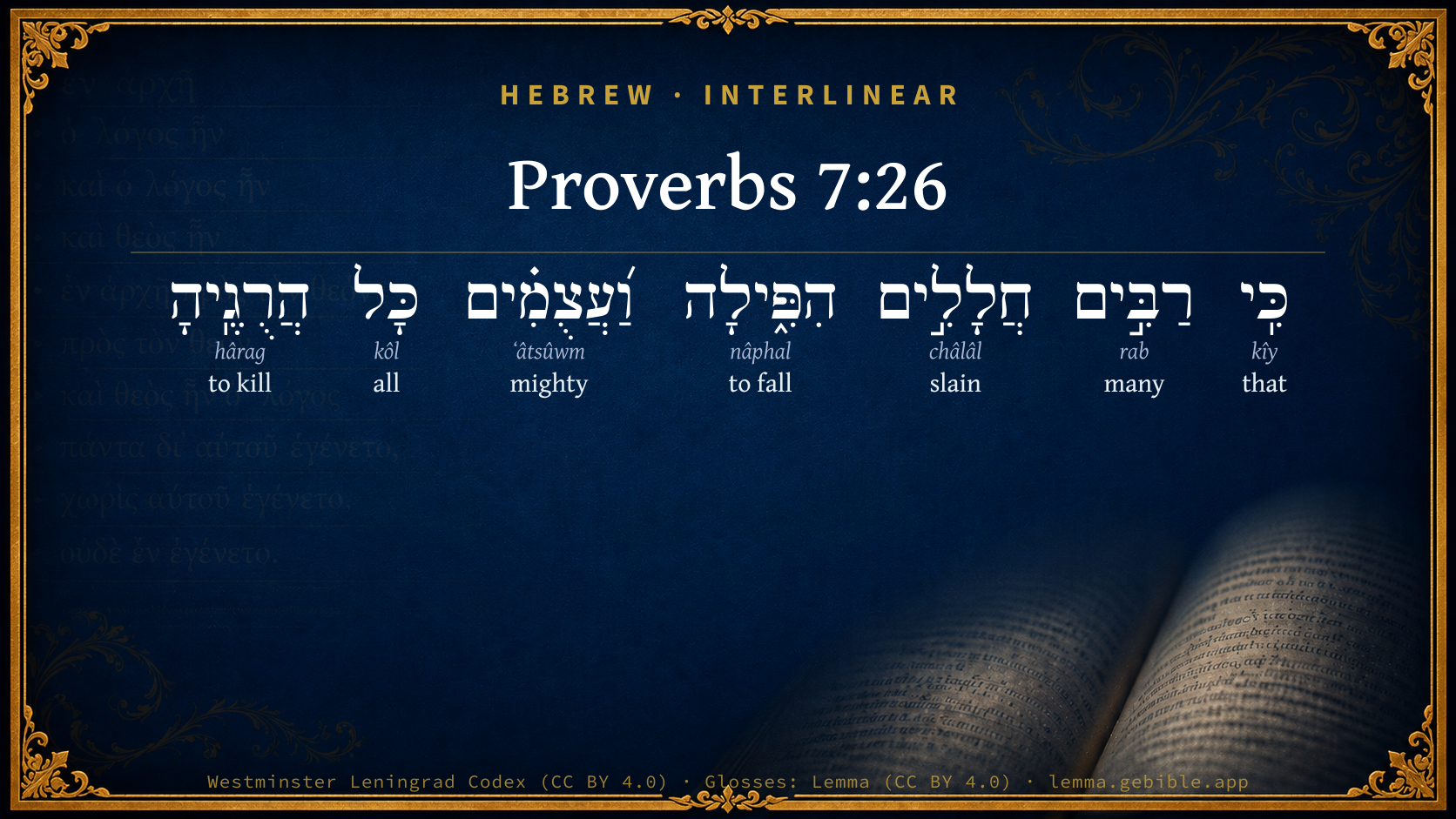
Hebrew (Westminster Leningrad Codex) Proverbs 7:26 appears in the Hebrew Old Testament. The text above is from the Westminster Leningrad Codex. Each word links to its Strong’s number, a concise gloss, and parsing drawn from the Open Scriptures Hebrew Bible morphology. Click any word for its full Brown-Driver-Briggs (BDB) entry.
Download image
Cite this verse

Proverbs 7:26 (World English Bible). Public Domain. Lemma interlinear Bible study tool, https://lemma.gebible.app/v/proverbs/7/26.

Show BibTeX & RIS
BibTeX
RIS
English Translation
For she has thrown down many wounded. Yes, all her slain are a mighty host.
World English Bible · Public Domain
Download a study sheet

One document with this verse’s original text, its word-by-word gloss line, the meaning frame, cross-references with their text, attributed commentary, and full source and license credits — printable, and it pastes into notes with its structure intact.

This verse Autodidact and up

Study sheet (.html) Plain text (.txt)

A passage Seminary Student

Up to 50 verses in one chapter. A passage sheet keeps up to 6 commentary sources and 12 cross-references per verse, in the order this page ranks them, and says so on the sheet whenever that leaves anything out. Ask for a single verse and you get the Autodidact verse sheet above.

Everything on this page stays free to read, with no account — the sheet is a download of what is already on screen, not access to it.

Want to remove ads? Support Godless Engineer
Compare translations 3

The same verse in 3 English versions, stacked beneath the original-language interlinear above. Click any original word for its lexicon entry.

Each is an independent rendering of the whole verse — the interlinear is not word-aligned to these translations.

Highlighted words mark where these versions differ — a whole-verse word diff, not a word-by-word alignment.

  • World English Bible Public Domain
    For she has thrown down many wounded. Yes, all her slain are a mighty host.
  • King James Version Public Domain
    For she hath cast down many wounded: yea, many strong men have been slain by her.
  • unfoldingWord Literal Text CC BY-SA 4.0
    For she has caused many pierced ones to fall, and numerous all her slain ones.

unfoldingWord Literal Text — © unfoldingWord, licensed CC BY-SA 4.0. Word-aligned USFM3 via Door43 (git.door43.org/unfoldingWord/en_ult).

Versions to compare (up to 4)

3 of 4 selected

Show all 18 translations

Every available English version of this verse, each an independent rendering of the whole verse.

  • World English Bible Public Domain
    For she has thrown down many wounded. Yes, all her slain are a mighty host.
  • Berean Standard Bible Public Domain
    For she has brought many down to death; her slain are many in number.
  • Majority Standard Bible Public Domain
    For she has brought many down to death; her slain are many in number.
  • King James Version Public Domain
    For she hath cast down many wounded: yea, many strong men have been slain by her.
  • American Standard Version (1901) Public Domain
    For she hath cast down many wounded: Yea, all her slain are a mighty host.
  • Revised Version (1885) Public Domain
    For she hath cast down many wounded: yea, all her slain are a mighty host.
  • Geneva Bible (1599) Public Domain
    For shee hath caused many to fall downe wounded, and the strong men are all slaine by her.
  • Douay-Rheims (1899) Public Domain
    For she hath cast down many wounded, and the strongest have been slain by her.
  • Young's Literal Translation Public Domain
    For many `are' the wounded she caused to fall, And mighty `are' all her slain ones.
  • Literal Standard Version CC BY-SA 4.0
    For many [are] the wounded she caused to fall, || And mighty [are] all her slain ones.
  • Unlocked Literal Bible CC BY-SA 4.0
    She has caused many people to fall down pierced; her dead victims are very many.
  • unfoldingWord Literal Text CC BY-SA 4.0
    For she has caused many pierced ones to fall, and numerous all her slain ones.
  • Darby Bible Public Domain
    for she hath cast down many wounded, and all slain by her were strong.
  • World Messianic Bible Public Domain
    for she has thrown down many wounded. Yes, all her slain are a mighty army.
  • Webster's Bible Public Domain
    For she hath cast down many wounded: yes, many strong men have been slain by her.
  • Free Bible Version CC BY-SA 4.0
    For she has brought down and destroyed a lot of men; she's killed so many.
  • Bible in Basic English Public Domain
    For those wounded and made low by her are great in number; and all those who have come to their death through her are a great army.
  • JPS Tanakh (1917) Public Domain
    For she hath cast down many wounded; yea, a mighty host are all her slain.

Literal Standard Version (2020), Covenant Press — licensed CC BY-SA 4.0. Text via the HelloAO Bible API (eBible.org). Unlocked Literal Bible (unfoldingWord) — licensed CC BY-SA 4.0. Text via the HelloAO Bible API (eBible.org). unfoldingWord Literal Text — © unfoldingWord, licensed CC BY-SA 4.0. Word-aligned USFM3 via Door43 (git.door43.org/unfoldingWord/en_ult). Free Bible Version, Dr. Jonathan Gallagher — licensed CC BY-SA 4.0. Text via the HelloAO Bible API (eBible.org).

Word by word

More ways to search: Search by grammar → Find every occurrence → Compare this word →

Practice this passage: Drill this verse → Learn its vocabulary →

About this verse

These counts appear in no published source. They are computed here, from the morphology-tagged text and Lemma’s own curated glosses. What Lemma adds →

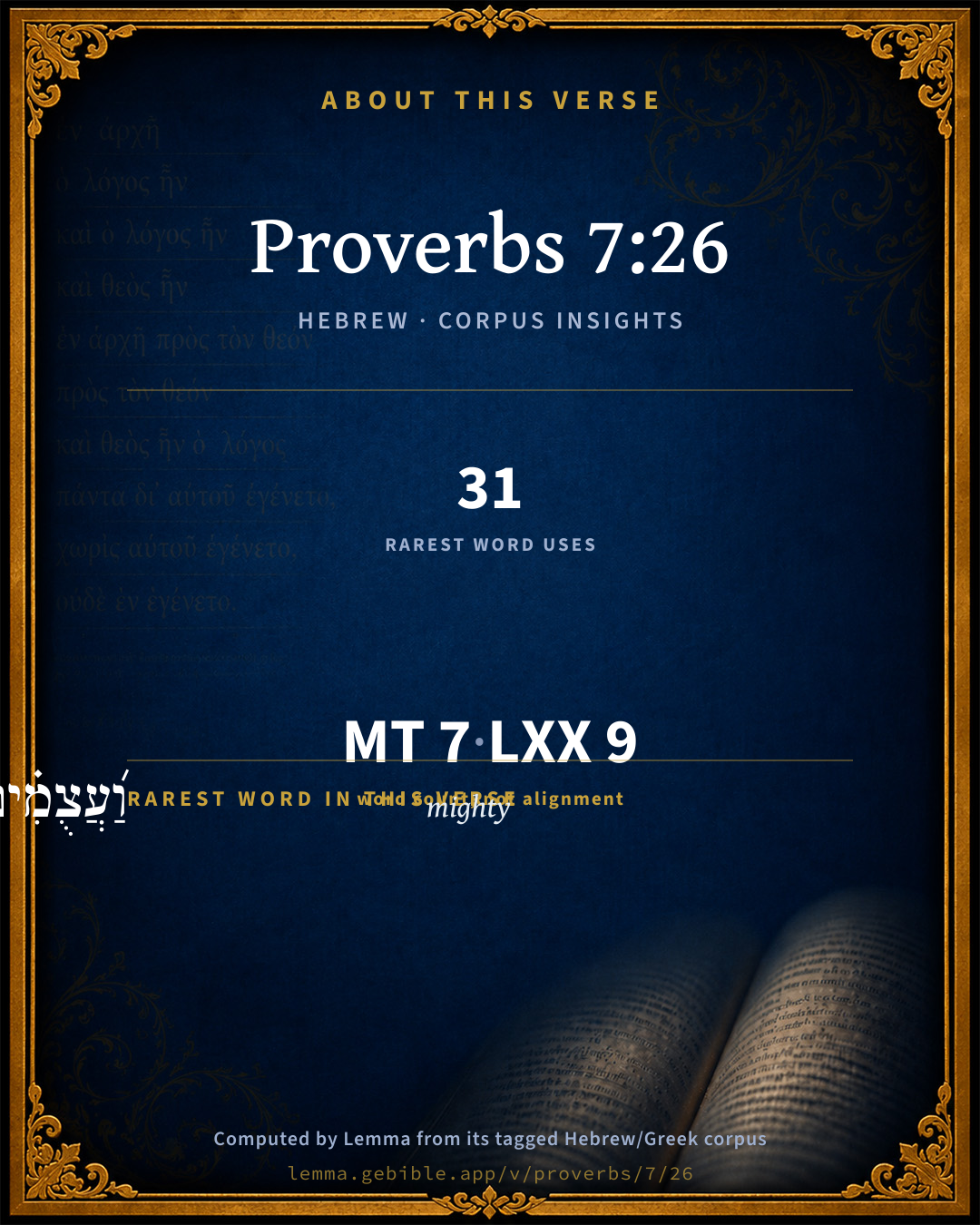
7
words
7
distinct lemmas
Wisdom
section

Shared distinctive vocabulary

וַ֝עֲצֻמִ֗ים mighty H6099 occurs in 31 verses of the Hebrew Bible. Also found in:

Grammatical profile

  • 2 verbs
  • 1 noun
  • 3 adjectives
  • 1 conjunction

Verb forms

  • הִפִּ֑ילָה Hiphil · Perfect
  • הֲרֻגֶֽיהָ Qal · Participle Passive

Hebrew & Septuagint length

In English translation the verse runs 15 words from the Hebrew and 16 from the Septuagint (LXX English) — closely comparable.

A rough comparison of the two English renderings, which tokenize alike — not a word-level alignment.

Word counts can differ between the Hebrew and the Greek without any difference in meaning — e.g. the Hebrew direct-object marker אֵת has no separate Greek word, and Greek often adds the article ὁ.

In the original languages it is 7 Hebrew tokens and 9 Greek tokens — but the two are counted differently (Hebrew bundles its prefixes and suffixes into one token; the Greek is in lemma form), so that isn’t a like-for-like length.

Cross-references

10

Topical passages linked to Proverbs 7:26 in the Treasury of Scripture Knowledge — connected by theme and wording, ordered by reader-vote popularity; previews shown in the World English Bible.

  • Nehemiah 13:26 Did not Solomon king of Israel sin by these things? yet among many nations was there no king like him, and he was beloved of his God, and God made him king over all Israel: nevertheless even him did foreign women cause to sin.
  • 1 Peter 2:11 Beloved, I beg you as foreigners and pilgrims, to abstain from fleshly lusts, which war against the soul;
  • 1 Kings 11:1–2 Now king Solomon loved many foreign women, together with the daughter of Pharaoh, women of the Moabites, Ammonites, Edomites, Sidonians, and Hittites;
  • Proverbs 6:33 He will get wounds and dishonor. His reproach will not be wiped away.
  • 1 Corinthians 10:8 Neither let us commit sexual immorality, as some of them committed, and in one day twenty-three thousand fell.
  • Judges 16:21 The Philistines laid hold on him, and put out his eyes; and they brought him down to Gaza, and bound him with fetters of brass; and he did grind in the prison-house.
  • 2 Samuel 3:6–8 It happened, while there was war between the house of Saul and the house of David, that Abner made himself strong in the house of Saul.
  • 2 Samuel 3:27 When Abner was returned to Hebron, Joab took him aside into the midst of the gate to speak with him quietly, and struck him there in the body, so that he died, for the blood of Asahel his brother.
  • 2 Samuel 12:9–11 Why have you despised the word of Yahweh, to do that which is evil in his sight? You have struck Uriah the Hittite with the sword, and have taken his wife to be your wife, and have slain him with the sword of the children of Ammon.
  • 2 Corinthians 12:21 that again when I come my God would humble me before you, and I would mourn for many of those who have sinned before now, and not repented of the uncleanness and sexual immorality and lustfulness which they committed.

Cross-references courtesy of OpenBible.info (CC BY 4.0).

Hebrew and Greek witnesses Masoretic Hebrew ↔ Greek Septuagint

The same verse in the two great witnesses to the Old Testament, shown verse-for-verse.

These are two independent witnesses, not word-aligned to each other, and the Septuagint is shown in lemma (dictionary) form.

Hebrew Proverbs 7:26 Masoretic · Westminster Leningrad Codex

כִּֽי רַבִּ֣ים חֲלָלִ֣ים הִפִּ֑ילָה וַ֝עֲצֻמִ֗ים כָּל הֲרֻגֶֽיהָ

For she has thrown down many wounded. Yes, all her slain are a mighty host.

World English Bible · Public Domain

Greek LXX Proverbs 7:26 Septuagint · lemma form

πολύς γάρ τιτρώσκω καταβάλλω καί ἀναρίθμητος εἰμί ὅς φονεύω

for she has wounded and cast down many, and those whom she has slain are innumerable.

LXX2012 (modern English Septuagint) · Public Domain

On this verse, The Cambridge Bible for Schools and Colleges discusses the Septuagint’s reading. Read the note in Commentary ↓

Hebrew: Westminster Leningrad Codex (CC BY 4.0). Greek: Septuagint (public domain); English from LXX2012 (modern English Septuagint) (Public Domain). How the Septuagint differs from the Hebrew →

Commentary

Notes on Proverbs 7:26 from classic Christian and Jewish commentators (each source and its license shown beneath its notes). The classic Christian expositions comment on the surrounding passage and are grouped to its opening verse, so a note may address several verses; the Jewish commentaries on the Tanakh (Rashi and others) are per-verse, so they appear only where the commentator wrote on this verse.

Lemma curates 59 commentaries, every one of them public domain or Creative Commons licensed, each selected and text-cleaned for this edition rather than reprinted as found. About our sources →

Trapp's Complete Commentary

John Trapp

Pro 7:26 For she hath cast down many wounded: yea, many strong [men] have been slain by her.

Ver. 26. For she hath cast down many.] That have let in death at those windows of wickedness, those loop holes of lust; that have died of the wound in the eye. Aliorum perditio tua sit cautio - Seest thou another man shipwrecked, look well to thy tacklings.

Yea, many strong men have been slain by her.] The valour of man hath oft been slaved by the wiles of a woman. Witness many of your greatest martialists, who conquered countries, and were vanquished of vices, being captivarum suarum captivi. The Persian kings commanded the whole world, and were commanded by their concubines. So was Alexander, Samson, Hercules, whom some make to be the same as Samson.

“ Lenam non potuit, potuit superare leaenam:

Quem fera non potuit vincere, vicit hera. ”

John Trapp, A Commentary or Exposition upon All the Books of the Old and New Testament (1647–1656) — public domain. Text from a community e-Sword module.

Geneva Bible (1599)

Geneva Bible translators

Neither wit nor strength can deliver them that fall into the hands of the harlot.

Geneva Bible (1599) marginal notes — public domain. Text via Bolls.life.

Jamieson, Fausset & Brown

Robert Jamieson, A. R. Fausset & David Brown

Even the mightiest fail to resist her deathly allurements.

Next: Proverbs Chapter 8

Jamieson, Fausset & Brown — Commentary Critical and Explanatory on the Whole Bible (1871) — public domain (CC PDM 1.0). Text via the HelloAO Bible API.

Adam Clarke's Commentary

Verse 26. For she hath cast down many wounded: yea, many strong men have been slain by her.] That is, such like women have been the ruin of many. חללים chalalim, which we render wounded, also signifies soldiers or men of war; and עצמים atsumim, which we render strong men, may be translated heroes. Many of those who have distinguished themselves in the field and in the cabinet have been overcome and destroyed by their mistresses. History is full of such examples.

Adam Clarke's Commentary on the Bible (1810–1826) — public domain. Text from a community e-Sword/MySword module.

The Cambridge Bible for Schools and Colleges

gen. ed. J. J. S. Perowne

26. many strong] This is the rendering of a single Heb. word, which may mean mighty, as it usually does, or (comp. the use of the verb in Psa_40:5; Psa_40:12 [Hebrews 6, 13]) many. Lit. mighty ones, or numerous ones, are all her slain, i.e. the whole number of those slain by her amount to a mighty host, as it is happily rendered in R.V. The thought is not so much of the individual strength of her victims as of their great number, as the parallelism indicates: ἀναρίθμητοί εἰσιν οὒς πεφόνευκε, “numberless are they whom she has slain,” LXX.

The Cambridge Bible for Schools and Colleges (gen. ed. J. J. S. Perowne; Cambridge University Press, 1878–1918) — public domain. Text from a community e-Sword module.

John Gill's Exposition

Her house is the way to hell,.... Or "ways" (p); the broad highway to it; either to the grave, as "sheol" often signifies; or to hell itself, the place of the damned: to go into her house, and commit wickedness with her, is to take a step to destruction, a large stride towards hell; and, if grace prevent not, will bring a man thither. Who would go into such a house, and much less dwell there, which is the very suburbs of hell?

going down to the chambers of death; to enter her chamber, to step into her bed, howsoever decked and adorned, entertaining and inviting it is, not only leads to the chambers of the grave, as the Targum; but to the lowest and innermost parts of hell; the apartments of the second death, the lot of all unclean and idolatrous persons, without repentance and faith. The Phoenicians called Pluto, the god of hell, by the name of Moth (q), a word similar to this used here; and so those chambers are no other than the chambers of hell. Plautus (r) also calls the gate of a whore's house the gate of hell; which agrees with the first clause of the verse.

(p) "viae", Pagninus, Montanus, Junius & Tremellius, Piscator, &c. (q) Sanchoniatho apud Euseb. Praepar. Evangel. l. 1. p. 38. (r) "Januam hane orci", Bacchides, Act. 3. Sc. 1. v. 1.

Next: Proverbs Chapter 8

John Gill's Exposition of the Whole Bible (1746–1763) — public domain (CC PDM 1.0). Text via the HelloAO Bible API.

Albert Barnes' Notes on the Bible

The house of the harlot is now likened to a field of battle strewn with the corpses of the many slain.

Albert Barnes' Notes on the Bible (1834–1885) — public domain. Text from a community e-Sword/MySword module.

Haydock's Catholic Bible Commentary

Her. Solomon gave a melancholy proof of this, as well as David, and Amnon. (Calmet)

George Leo Haydock (1774–1849), Haydock's Catholic Family Bible and Commentary, 1859 edition — public domain. Excludes Psalms (Douay-Rheims chapter numbering differs from Protestant) and Deuterocanonical books (Catholic canon only).

Matthew Poole's English Annotations

Strong men; men that excel others, either,

1. In bodily strength, upon which they presume, which yet is wasted, and by degrees ruined, by these courses. Or,

2. In wisdom, and fortitude, and resolution; whereby he implies how much more necessary it is for a weak and foolish young man to use all possible care and diligence to avoid this mischief.

Matthew Poole's English Annotations on the Holy Bible (1683–1685) — public domain. Text from a community e-Sword/MySword module.

Whedon's Commentary on the Bible

Daniel D. Whedon

26. For she — That is, such women. She is taken representatively. The sentiment is: Innumerable mighty men, or mighty hosts, have thus been brought to ruin. If the strong are slain, how can you escape, if enticed into the snare? Miller, “For mighty men, when polluted, she has hurled down,” etc. “The most valiant heroes, the most puissant soldiers, that never yielded, but stood undaunted against all other assaults, have generally been vanquished, and frequently destroyed, by the allurements of women.” — Hammond. The fall of Hannibal’s army in Italy is an example in point. Compare Num_22:5, etc.; Pro_25:1, etc.

Daniel D. Whedon (gen. ed.), Commentary on the Old and New Testaments (1874–1909) — public domain. Text from a community e-Sword module.

The Pulpit Commentary

For she hath east down many wounded. Delitzsch, "For many are the slain whom she hath caused to fall." The harlot marks her course with ruined souls, as a ruthless conqueror leaves a field of battle strewn with corpses. Yea, many strong (atsum) men have been slain by her. One thinks of Samson and David and Solomon, the victims of illicit love, and suffering for it. Vulgate, et fortissimi quique interfecti sunt ab ea. But the Septuagint and many moderns take atsum in the sense of "numerous," as Psa_35:18; anariymhtoi , "innumerable are her slain," The former interpretation seems preferable, and avoids tautology.

The Pulpit Commentary (1880–1919), ed. H.D.M. Spence-Jones & Joseph S. Exell — public domain. Text from a community e-Sword module.

Keil & Delitzsch

C. F. Keil & F. Delitzsch

The admonition, having its motive in that which goes before, is now founded on the emphatic finale:

26 For many are the slain whom she hath caused to fall,

And many are her slain.

27 A multiplicity of ways to help is her house,

Going down to the chambers of death.

The translation "for many slain has she laid low" (Syr., Targ., Jerome, Luther) is also syntactically possible; for רבּים can be placed before its substantive after the manner of the demonstratives and numerals (e.g., Neh 9:28, cf. אחד, Sol 4:9), and the accentuation which requires two servants (the usual two Munachs) to the Athnach appears indeed thus to construe it. It is otherwise if רבים here meant magni (thus e.g., Ralbag, and recently Bertheau), and not multi; but רבים and עצמים stand elsewhere in connection with each other in the signification many and numerous, Psa 35:18; Joe 2:2; Mic 4:3. "Her slain" are those slain by her; the part. pass. is connected with the genitive of the actor, e.g., Pro 9:18; cf. (Arab.) ḳatyl âlmḥabbt, of one whom love kills (Fl.). With Pro 7:27 cf. Pro 2:18; Pro 9:18. In 27a, בּיתהּ is not equivalent to בביתה after Pro 8:2, also not elliptical and equivalent to דרכי ביתה; the former is unnecessary, the latter is in no case established by Psa 45:7; Ezr 10:13, nor by Deu 8:15; Kg2 23:17 (see, on the other hand, Philippi's Status Constructus, pp. 87-93). Rightly Hitzig has: her house forms a multiplicity of ways to hell, in so far as adultery leads by a diversity of ways to hell. Similarly the subject and the predicate vary in number, Pro 16:25; Psa 110:3; Job 26:13; Dan 9:23, and frequently. If one is once in her house, he may go in this or in that way, but surely his path is to destruction: it consists of many steps to hell, such as lead down (דרך, fem. Isa 37:34, masc. Isa 30:21) to the extreme depths of death (cf. Job 9:9, "chambers of the south" = its remotest regions veiling themselves in the invisible); for חדר (Arab. khiddr) is the part of the tent or the house removed farthest back, and the most private (Fl.). These חדרי־מות, cf. עמקי שׁאול, Pro 9:18, approach to the conception of גּיהנּם, which is afterwards distinguished from שאול.

Keil & Delitzsch — Biblical Commentary on the Old Testament (1861–1891) — public domain (CC PDM 1.0). Text via the HelloAO Bible API. (Old Testament only.)

unfoldingWord translationNotes

Door43 World Missions Community

She has caused many people to fall down pierced

Being pierced by spears or arrows represents being killed. AT: "She has caused many people to fall dead" (See: Metonymy)

Her house is on the paths to Sheol ... they go down

Here "paths" represents the kinds of behavior that foolish people participate in. Sheol was the name for the world of the dead.

on the paths to Sheol ... down to the dark bedrooms of death

These two phrases basically mean the same thing and are repeated to emphasize that the woman's victims will be destroyed. (See: Parallelism)

the dark bedrooms of death

This expression pictures the dead as sleeping in many different rooms in Sheol. (See: Metaphor)

translationWords

Hades

die

unfoldingWord translationNotes — © Distant Shores Media and the Door43 World Missions Community, licensed CC BY-SA 4.0. Source: git.door43.org/Door43/en_tn.

Lesson kit

Teaching starters — assembled from the data on this page, not authored interpretation. Every prompt links to the verse data it draws on. Edit before teaching.

Proverbs, in the Wisdom, opens this verse with 7 words (7 distinct Hebrew lemmas). Its most distinctive word is ʻâtsûwm (“mighty”). A historical commentator’s framing appears above. Read the whole chapter for the surrounding context.

Discussion questions

  1. How does “mighty” (ʻâtsûwm) shape what this verse is saying?
  2. Genesis 18:18 shares the word «mighty» with this verse. How do the two illuminate each other?
  3. The translations on this page render this verse differently — a whole-verse word diff, not a word-by-word alignment. What might account for the different wordings?
  4. The verb «הִפִּ֑ילָה» is Hiphil Perfect. How does its form color the action?
  5. Reading how Trapp's Complete Commentary and Geneva Bible (1599) read this verse, where do the two commentators agree and where do they part?

Things to notice

Reading settings

Reading text

Shown beneath each verse's original-language words.

Old Testament
Old Testament edition

Read the OT as the Masoretic Hebrew (MT) or the Greek Septuagint (LXX).

English shown for the Greek Septuagint (in the Hebrew ↔ Greek comparison).

Comparing translations? Open the Compare panel on any verse page to stack up to four side by side.