
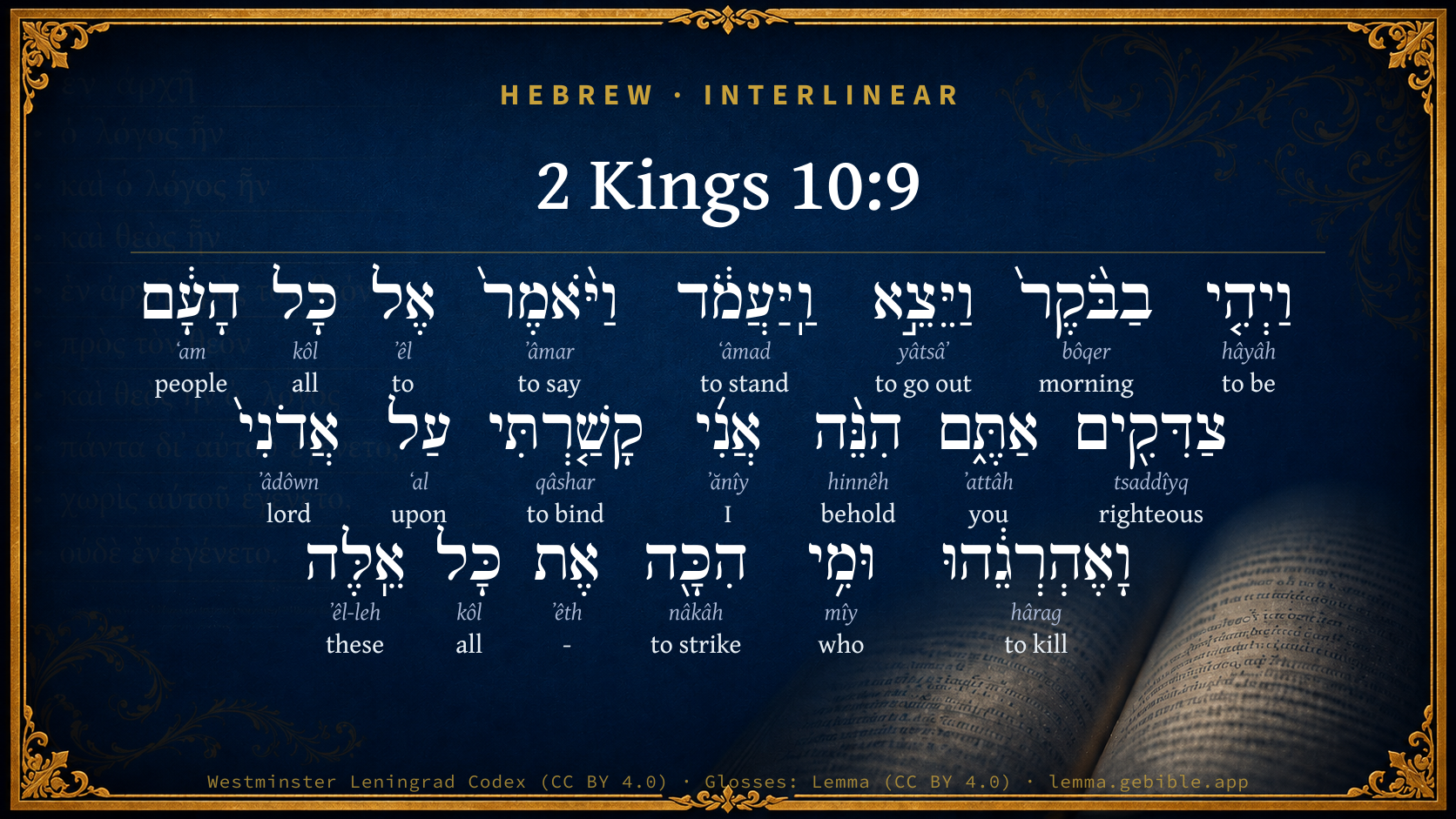
2 Kings 10:9

Hebrew (Westminster Leningrad Codex) 2 Kings 10:9 appears in the Hebrew Old Testament. The text above is from the Westminster Leningrad Codex. Each word links to its Strong’s number, a concise gloss, and parsing drawn from the Open Scriptures Hebrew Bible morphology. Click any word for its full Brown-Driver-Briggs (BDB) entry.
Download image
Cite this verse

2 Kings 10:9 (World English Bible). Public Domain. Lemma interlinear Bible study tool, https://lemma.gebible.app/v/2-kings/10/9.

Show BibTeX & RIS
BibTeX
RIS
English Translation
It happened in the morning, that he went out, and stood, and said to all the people, You are righteous: behold, I conspired against my master, and killed him; but who struck all these?
World English Bible · Public Domain
Download a study sheet

One document with this verse’s original text, its word-by-word gloss line, the meaning frame, cross-references with their text, attributed commentary, and full source and license credits — printable, and it pastes into notes with its structure intact.

This verse Autodidact and up

Study sheet (.html) Plain text (.txt)

A passage Seminary Student

Up to 50 verses in one chapter. A passage sheet keeps up to 6 commentary sources and 12 cross-references per verse, in the order this page ranks them, and says so on the sheet whenever that leaves anything out. Ask for a single verse and you get the Autodidact verse sheet above.

Everything on this page stays free to read, with no account — the sheet is a download of what is already on screen, not access to it.

Want to remove ads? Support Godless Engineer
Compare translations 3

The same verse in 3 English versions, stacked beneath the original-language interlinear above. Click any original word for its lexicon entry.

Each is an independent rendering of the whole verse — the interlinear is not word-aligned to these translations.

Highlighted words mark where these versions differ — a whole-verse word diff, not a word-by-word alignment.

  • World English Bible Public Domain
    It happened in the morning, that he went out, and stood, and said to all the people, You are righteous: behold, I conspired against my master, and killed him; but who struck all these?
  • King James Version Public Domain
    And it came to pass in the morning, that he went out, and stood, and said to all the people, Ye be righteous: behold, I conspired against my master, and slew him: but who slew all these?
  • unfoldingWord Literal Text CC BY-SA 4.0
    And it happened in the morning that he went out and stood, and he said to all of the people, “You righteous. Behold, I, I conspired against my master and killed him. But who struck all of these?

unfoldingWord Literal Text — © unfoldingWord, licensed CC BY-SA 4.0. Word-aligned USFM3 via Door43 (git.door43.org/unfoldingWord/en_ult).

Versions to compare (up to 4)

3 of 4 selected

Show all 18 translations

Every available English version of this verse, each an independent rendering of the whole verse.

  • World English Bible Public Domain
    It happened in the morning, that he went out, and stood, and said to all the people, You are righteous: behold, I conspired against my master, and killed him; but who struck all these?
  • Berean Standard Bible Public Domain
    The next morning, Jehu went out and stood before all the people and said, “You are innocent. It was I who conspired against my master and killed him. But who killed all these?
  • Majority Standard Bible Public Domain
    The next morning, Jehu went out and stood before all the people and said, “You are innocent. It was I who conspired against my master and killed him. But who killed all these?
  • King James Version Public Domain
    And it came to pass in the morning, that he went out, and stood, and said to all the people, Ye be righteous: behold, I conspired against my master, and slew him: but who slew all these?
  • American Standard Version (1901) Public Domain
    And it came to pass in the morning, that he went out, and stood, and said to all the people, Ye are righteous: behold, I conspired against my master, and slew him; but who smote all these?
  • Revised Version (1885) Public Domain
    And it came to pass in the morning, that he went out, and stood, and said to all the people, Ye be righteous: behold, I conspired against my master, and slew him: but who smote all these?
  • Geneva Bible (1599) Public Domain
    And when it was day, he went out, and stood and sayd to all the people, Ye be righteous: behold, I conspired against my master, and slew him: but who slew all these?
  • Douay-Rheims (1899) Public Domain
    And when it was light, he went out, and standing said to all the people: You are just: if I conspired against my master, and slew him, who hath slain all these?
  • Young's Literal Translation Public Domain
    And it cometh to pass in the morning, that he goeth out, and standeth, and saith unto all the people, `Righteous are ye; lo, I have conspired against my lord, and slay him -- and who smote all these?
  • Literal Standard Version CC BY-SA 4.0
    And it comes to pass in the morning, that he goes out, and stands, and says to all the people, “You are righteous; behold, I have conspired against my lord, and slay him—and who struck all these?
  • Unlocked Literal Bible CC BY-SA 4.0
    In the morning Jehu went out and stood, and said to all the people, “You are innocent. See, I plotted against my master and killed him, but who killed all these?
  • unfoldingWord Literal Text CC BY-SA 4.0
    And it happened in the morning that he went out and stood, and he said to all of the people, “You righteous. Behold, I, I conspired against my master and killed him. But who struck all of these?
  • Darby Bible Public Domain
    And it came to pass in the morning that he went out; and he stood, and said to all the people, Ye are righteous! behold, I conspired against my master and killed him; but who smote all these?
  • World Messianic Bible Public Domain
    In the morning, he went out and stood, and said to all the people, “You are righteous. Behold, I conspired against my master and killed him, but who killed all these?
  • Webster's Bible Public Domain
    And it came to pass in the morning, that he went out, and stood, and said to all the people, Ye are righteous: behold, I conspired against my master, and slew him: but who slew all these?
  • Free Bible Version CC BY-SA 4.0
    In the morning Jehu went out to speak to the people who had gathered. “You haven't done anything wrong,” he told them. “I was the one who plotted against my master and killed him. But who killed all these?
  • Bible in Basic English Public Domain
    And in the morning he went out and, stopping, said to all the people there, You are upright men: it is true that I made designs against my master, and put him to death; but who is responsible for the death of all these?
  • JPS Tanakh (1917) Public Domain
    And it came to pass in the morning, that he went out, and stood, and said to all the people: 'Ye are righteous; behold, I conspired against my master, and slew him; but who smote all these?

Literal Standard Version (2020), Covenant Press — licensed CC BY-SA 4.0. Text via the HelloAO Bible API (eBible.org). Unlocked Literal Bible (unfoldingWord) — licensed CC BY-SA 4.0. Text via the HelloAO Bible API (eBible.org). unfoldingWord Literal Text — © unfoldingWord, licensed CC BY-SA 4.0. Word-aligned USFM3 via Door43 (git.door43.org/unfoldingWord/en_ult). Free Bible Version, Dr. Jonathan Gallagher — licensed CC BY-SA 4.0. Text via the HelloAO Bible API (eBible.org).

Word by word

More ways to search: Search by grammar → Find every occurrence → Compare this word →

Practice this passage: Drill this verse → Learn its vocabulary →

קָשַׁ֤רְתִּי
qâshar
H7194
“to bind”
Verb, Qal, Perfect, 1st Person, Common, Singular
Part of Speech
Verb
Stem
Qal
Form
Perfect
Person
1st Person
Gender
Common
Number
Singular
Full BDB Definition

Origin: a primitive root: to tie, physically (gird, confine, compact) or mentally (in love, league)

TWOT: 2090

to bind, tie, bind together, league together, conspire - (Qal) - to bind, confine - to league together, conspire - (Niphal) to be bound, be bound up - (Piel) - to bind on - to bind fast - to bind, tie - to bind to oneself - (Pual) robust, vigorous (participle) - (Hithpael) to conspire
  1. וַיְהִ֤י hâyâh H1961 “and · to be” Conjunction + Verb, Qal, Sequential Imperfect, 3rd Person, Masculine, Singular
  2. בַבֹּ֨קֶר֙ bôqer H1242 “in/at the · morning” Preposition, Determined + Noun, Common, Masculine, Singular, Absolute
  3. וַיֵּצֵ֣א yâtsâʼ H3318 “and · to go out” Conjunction + Verb, Qal, Sequential Imperfect, 3rd Person, Masculine, Singular
  4. וַֽיַּעֲמֹ֔ד ʻâmad H5975 “and · to stand” Conjunction + Verb, Qal, Sequential Imperfect, 3rd Person, Masculine, Singular
  5. וַיֹּ֨אמֶר֙ ʼâmar H559 “and · to say” Conjunction + Verb, Qal, Sequential Imperfect, 3rd Person, Masculine, Singular
  6. אֶל ʼêl H413 “to” Preposition
  7. כָּל kôl H3605 “all of” Noun, Common, Masculine, Singular, Construct
  8. הָעָ֔ם ʻam H5971 “the · people” Particle, Definite Article + Noun, Common, Masculine, Singular, Absolute
  9. צַדִּקִ֖ים tsaddîyq H6662 “righteous” Adjective, Adjective, Masculine, Plural, Absolute
  10. אַתֶּ֑ם ʼattâh H859 “you” Pronoun, Personal, 2nd Person, Masculine, Plural
  11. הִנֵּ֨ה hinnêh H2009 “behold” Particle, Demonstrative
  12. אֲנִ֜י ʼănîy H589 “I” Pronoun, Personal, 1st Person, Common, Singular
  13. עַל ʻal H5921 “upon” Preposition
  14. אֲדֹנִי֙ ʼâdôwn H113 “lord · my” Noun, Common, Masculine, Singular, Construct + Suffix, Personal, 1st Person, Common, Singular
  15. וָאֶהְרְגֵ֔הוּ hârag H2026 “and · to kill · him” Conjunction + Verb, Qal, Sequential Imperfect, 1st Person, Common, Singular + Suffix, Personal, 3rd Person, Masculine, Singular
  16. וּמִ֥י mîy H4310 “and · who” Conjunction + Particle, Interrogative
  17. הִכָּ֖ה nâkâh H5221 “to strike” Verb, Hiphil, Perfect, 3rd Person, Masculine, Singular
  18. אֶת ʼêth H853 “-” Particle, Direct Object
  19. כָּל kôl H3605 “all of” Noun, Common, Masculine, Singular, Construct
  20. אֵֽלֶּה ʼêl-leh H428 “these” Pronoun, Demonstrative, Common, Plural

About this verse

These counts appear in no published source. They are computed here, from the morphology-tagged text and Lemma’s own curated glosses. What Lemma adds →

21
words
20
distinct lemmas
Historical
section

Shared distinctive vocabulary

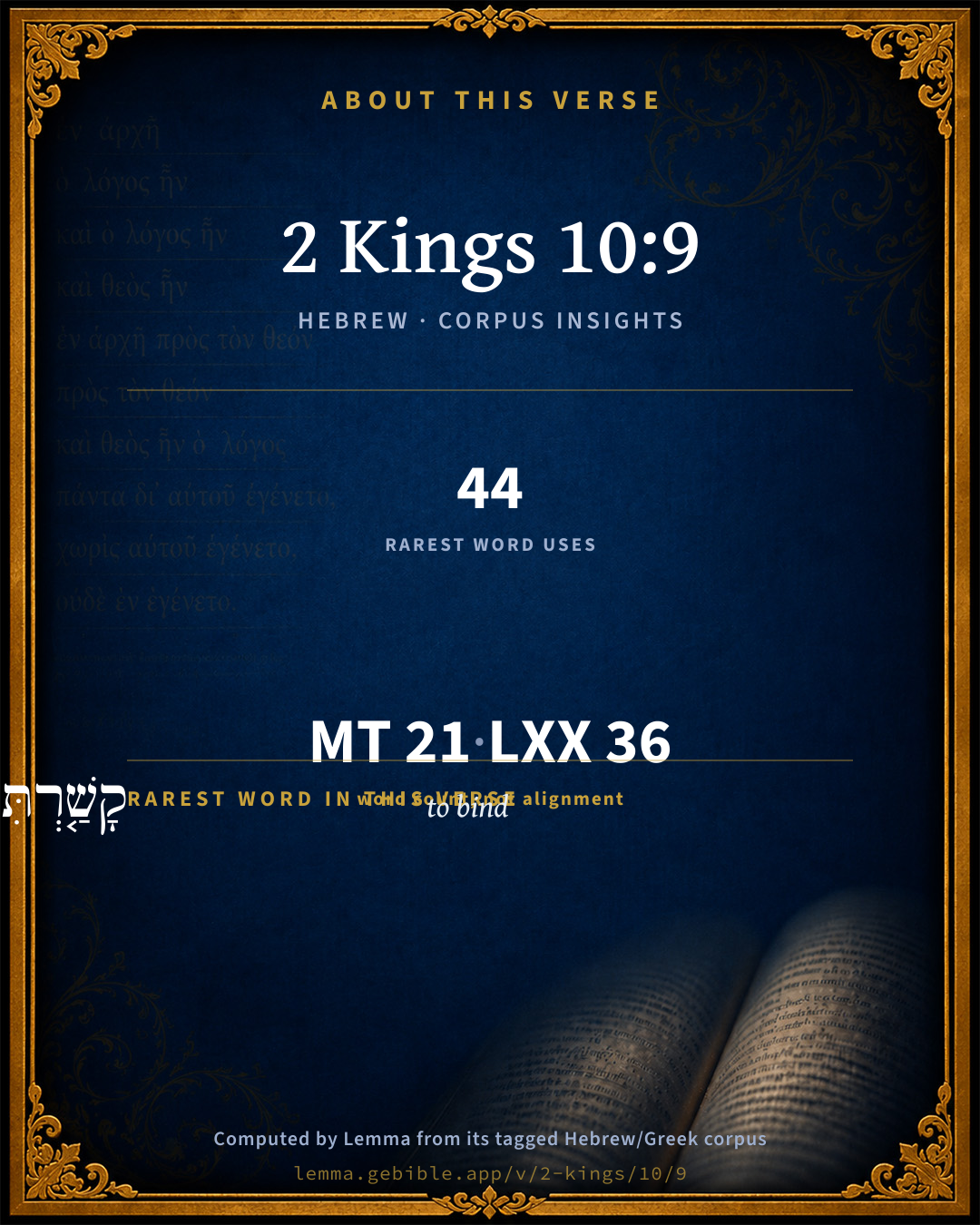
קָשַׁ֤רְתִּי to bind H7194 occurs in 44 verses of the Hebrew Bible. Also found in:

Grammatical profile

  • 7 verbs
  • 5 nouns
  • 1 adjective
  • 3 pronouns
  • 2 prepositions
  • 3 particles

Verb forms

  • וַיְהִ֤י Qal · Sequential Imperfect
  • וַיֵּצֵ֣א Qal · Sequential Imperfect
  • וַֽיַּעֲמֹ֔ד Qal · Sequential Imperfect
  • וַיֹּ֨אמֶר֙ Qal · Sequential Imperfect
  • קָשַׁ֤רְתִּי Qal · Perfect
  • וָאֶהְרְגֵ֔הוּ Qal · Sequential Imperfect
  • הִכָּ֖ה Hiphil · Perfect

Repetition

A word recurs within this verse — often emphatic in Hebrew:

Hebrew & Septuagint length

In English translation the verse runs 34 words from the Hebrew and 33 from the Septuagint (LXX English) — closely comparable.

A rough comparison of the two English renderings, which tokenize alike — not a word-level alignment.

Word counts can differ between the Hebrew and the Greek without any difference in meaning — e.g. the Hebrew direct-object marker אֵת has no separate Greek word, and Greek often adds the article ὁ.

In the original languages it is 21 Hebrew tokens and 36 Greek tokens — but the two are counted differently (Hebrew bundles its prefixes and suffixes into one token; the Greek is in lemma form), so that isn’t a like-for-like length.

Cross-references

4

Topical passages linked to 2 Kings 10:9 in the Treasury of Scripture Knowledge — connected by theme and wording, ordered by reader-vote popularity; previews shown in the World English Bible.

  • 2 Kings 9:14–24 So Jehu the son of Jehoshaphat the son of Nimshi conspired against Joram. (Now Joram was keeping Ramoth-gilead, he and all Israel, because of Hazael king of Syria;
  • 1 Samuel 12:3 Here I am: witness against me before Yahweh, and before his anointed: whose ox have I taken? or whose donkey have I taken? or whom have I defrauded? whom have I oppressed? or of whose hand have I taken a ransom to blind my eyes therewith? and I will restore it you.
  • Isaiah 5:3 "Now, inhabitants of Jerusalem and men of Judah, Please judge between me and my vineyard.
  • Hosea 1:4 Yahweh said to him, "Call his name Jezreel; for yet a little while, and I will avenge the blood of Jezreel on the house of Jehu, and will cause the kingdom of the house of Israel to cease.

Cross-references courtesy of OpenBible.info (CC BY 4.0).

Hebrew and Greek witnesses Masoretic Hebrew ↔ Greek Septuagint

The same verse in the two great witnesses to the Old Testament, shown verse-for-verse.

These are two independent witnesses, not word-aligned to each other, and the Septuagint is shown in lemma (dictionary) form.

Hebrew 2 Kings 10:9 Masoretic · Westminster Leningrad Codex

וַיְהִ֤י בַבֹּ֨קֶר֙ וַיֵּצֵ֣א וַֽיַּעֲמֹ֔ד וַיֹּ֨אמֶר֙ אֶל כָּל הָעָ֔ם צַדִּקִ֖ים אַתֶּ֑ם הִנֵּ֨ה אֲנִ֜י קָשַׁ֤רְתִּי עַל אֲדֹנִי֙ וָאֶהְרְגֵ֔הוּ וּמִ֥י הִכָּ֖ה אֶת כָּל אֵֽלֶּה

It happened in the morning, that he went out, and stood, and said to all the people, You are righteous: behold, I conspired against my master, and killed him; but who struck all these?

World English Bible · Public Domain

Greek LXX 2 Kings 10:9 Septuagint · lemma form

καί γίγνομαι πρωΐ καί ἐκἔρχομαι καί ἵστημι ἐν ὁ πυλών ὁ πόλις καί εἶπον πρός πᾶς ὁ λαός δίκαιος σύ ἰδού ἐγώ εἰμί συνστρέφω ἐπί ὁ κύριος ἐγώ καί ἀποκτείνω αὐτός καί τίς πατάσσω πᾶς οὗτος

And the morning came, and he went forth, and stood, and said to all the people, You⌃ are righteous: behold, I conspired against my master, and killed him: but who killed all these?

LXX2012 (modern English Septuagint) · Public Domain

Hebrew: Westminster Leningrad Codex (CC BY 4.0). Greek: Septuagint (public domain); English from LXX2012 (modern English Septuagint) (Public Domain). How the Septuagint differs from the Hebrew →

Targum (Aramaic paraphrase)

1

The Targum is the ancient Jewish Aramaic paraphrase of the Hebrew Scriptures — an interpretive translation, not the Hebrew text itself. Onkelos (literal) and Pseudo-Jonathan (expansive) render the Torah, and Jonathan the Prophets. Coverage is partial: where no permissively-licensed English translation exists for a verse, only the Aramaic is shown. This is verse-level text, not a word-by-word alignment to the Hebrew.

  1. Targum Jonathan Prophets (Joshua–Malachi)
    וַהֲוָה בְּצַפְרָא וּנְפַק וְקָם וַאֲמַר לְכָל עַמָא זַכָּאִין אַתּוּן הָא אֲנָא מְרָדִית עַל רִבּוֹנִי וּקְטַלְתֵּיהּ וּמַן קְטַל יַת כָּל אִלֵין:

    (no public-domain English translation for this verse)

    Targum Jonathan — Aramaic: “Mikraot Gedolot” (public domain). English: “Sefaria Community Translation” (CC0 1.0 (public-domain dedication)); “London "Chaldee Paraphrase," 1871” (public domain). Text via Sefaria.

Commentary

Notes on 2 Kings 10:9 from classic Christian and Jewish commentators (each source and its license shown beneath its notes). The classic Christian expositions comment on the surrounding passage and are grouped to its opening verse, so a note may address several verses; the Jewish commentaries on the Tanakh (Rashi and others) are per-verse, so they appear only where the commentator wrote on this verse.

Lemma curates 59 commentaries, every one of them public domain or Creative Commons licensed, each selected and text-cleaned for this edition rather than reprinted as found. About our sources →

Trapp's Complete Commentary

John Trapp

2Ki 10:9 And it came to pass in the morning, that he went out, and stood, and said to all the people, Ye [be] righteous: behold, I conspired against my master, and slew him: but who slew all these?

Ver. 9. And said to all the people.] Who were got together to see this rueful spectacle; he therefore taketh that opportunity to make his apology; alleging for his defenee the prophecy of Elijah, which he had now fulfilled, and God’s decree, which he had executed. He justifieth also hereby those that had slain the seventy young princes at his command, upon the same account; and freeth the rest of the people from their fears, when he saith, Ye be righteous; that is, I pronounce you innocent; think not that I intend any harm to you, &c., for they, seeing his severity against Ahab’s family and familiars, might fear, as the Romans did concerning Sulla, that there would be των φονων ουτ αριθμος, ουθ ορος; no end or measure of his bloodshed. {a}

{a} Plutarch.

John Trapp, A Commentary or Exposition upon All the Books of the Old and New Testament (1647–1656) — public domain. Text from a community e-Sword module.

The Biblical Illustrator

Joseph S. Exell

2Ki_10:9

Who slew all these?

The wholesale slaughter

I see a long row of baskets coming up towards the palace of king Jehu. I am somewhat inquisitive to find out what is in the baskets. I look in and I find the gory heads of seventy slain princes. As the baskets arrive at the gate of the palace, the heads are thrown into two heaps, one on either side the gate. In the morning, the king comes out, and he looks upon the bleeding, ghastly heads of the massacred princes. Looking on either side the gate, he cries out with a ringing emphasis: Who slew all these? There is no use of my taking up your time in trying to give you statistics about the devastation, and the ruin, and the death which strong drink has wrought in this country. When I look upon the desolation I am almost frantic with the scene, while I cry out: Who slew all these? I can answer that question in half a minute. The ministers of Christ who have given no warning; the courts of law that have offered the licensure; the women who give strong drink on New Years Day; the fathers and mothers who have rum on the sideboard; the hundreds of thousands of Christian men and women in the land who are staled in their indifference on this subject--they slew all these! I am now going to tell you what I think are the sorrows and the doom of the drunkard, so that you to whom I speak may not come to the place of torment.

1. The first suffering of the drunkard is in the loss of his good name. God has so arranged it, that no man ever loses his good name except through his own act. All the hatred of men and all the assaults of devils cannot destroy a mans good name, if he really maintains his integrity. If a man is honest, and pure, and Christian, God looks after him.

2. Another loss which the inebriate suffers is that of self-respect. Just as soon as a man wakes up and finds that he is the captive of strong drink, he feels bemoaned.

3. I go further, and say that the inebriate suffers from the loss of his usefulness. Do you not recognise the fact that many of those who are now captives of strong drink, only a little while ago were foremost in the churches and in reformatory institutions?

4. I go on, and say that the inebriate suffers from the loss of physical health.

5. Again: the inebriate suffers through the loss of his home. I do not care how much he loves his wife and children, if this passion for strong drink has mastered him, he will do the most outrageous things, and if he could not get drink in any other way, he would sell his family into eternal bondage. How many homes in our city have been broken up in that way, no one but God knows.

6. But my subject takes a deeper tone, and that is, that the inebriate suffers from the loss of the soul. (T. De Witt Talmage, D. D.)

The Biblical Illustrator, edited by Joseph S. Exell (c. 1880s–1900s) — public domain. Text from a community e-Sword module.

Joseph Benson's Commentary

2Ki 10:9-10. He said to all the people, Ye be righteous — This is spoken ironically: as much as to say, You may look upon me as a very wicked man, for rebelling against my master and killing him: but look here; see, your chief men, the confidants and favourites of Joram, have slain seventy of his sons committed to their custody! Know now, &c. — As if he had said, The truth is, neither I nor they are to be blamed, nor you, that assisted and encouraged me herein; for this is not man’s work, but God’s, and done at his command. The Lord hath done that which he spake by his servant Elijah — Whom he mentions rather than Elisha; partly because Elijah was now dead, and therefore his name and memory were more sacred than Elisha’s, who was yet alive; it being the general practice and folly of mankind, to value and honour, after their death, those whom they contemned while they lived; and partly because Elijah’s prophecy was known and famous, while Elisha’s was delivered in a corner, and that not from his own mouth, but by one of the sons of the prophets.

Joseph Benson's Commentary on the Old and New Testaments (1811–1818) — public domain. Text from a community e-Sword module.

Tyndale Open Study Notes

Tyndale Open Resources

10:9-10 But who killed all these? Jehu claimed that the gruesome deaths were the Lord’s will that had been communicated through Elijah (1 Kgs 19:16-17; 21:21-24).

Tyndale Open Study Notes — © Tyndale Open Resources, licensed CC BY-SA 4.0. Text via the HelloAO Bible API.

Geneva Bible (1599)

Geneva Bible translators

Ye cannot justly condemn me for the king’s death, seeing ye have done the like to his posterity: for the Lord commanded me, and moved you to execute this his judgment.

Geneva Bible (1599) marginal notes — public domain. Text via Bolls.life.

Jamieson, Fausset & Brown

Robert Jamieson, A. R. Fausset & David Brown

said to all the people, Ye be righteous, &c.--A great concourse was assembled to gaze on this novel and ghastly spectacle. The speech which Jehu addressed to the spectators was artfully framed to impress their minds with the idea that so wholesale a massacre was the result of the divine judgments denounced on the house of Ahab; and the effect of it was to prepare the public mind for hearing, without horror, of a similar revolting tragedy which was soon after perpetrated, namely, the extinction of all the influential friends and supporters of the dynasty of Ahab, including those of the royal house of Judah.

Jamieson, Fausset & Brown — Commentary Critical and Explanatory on the Whole Bible (1871) — public domain (CC PDM 1.0). Text via the HelloAO Bible API.

Adam Clarke's Commentary

Verse 9. Ye be righteous] Another irony, intended partly to excuse himself, and to involve them in the odium of this massacre, and at the same time to justify the conduct of both, by showing that all was done according to the commandment of the Lord.

Adam Clarke's Commentary on the Bible (1810–1826) — public domain. Text from a community e-Sword/MySword module.

Ellicott's Commentary for English Readers

(9) And stood.—Or, took his place—i.e. (according to Reuss), sat as judge in the palace gateway, according to royal custom, and gave audience to the people.

The citizens would naturally be struck with consternation at the sight of the two ghastly pyramids in front of the palace, and would crowd together in expectancy at the gates. Jehu goes forth to justify himself, and calm their fears.

Ye be righteous—i.e., guiltless in respect of the deaths of these men, and therefore have nothing to dread. Thenius explains: “Ye are just, and therefore will judge justly.” Others render: “Are ye righteous?” implying that Jehu wished to make the people guilty of the massacre of the princes, while owning his own murder of the king.

I.—Emphatic: I on my part; or, I indeed.

But who slew all these?—Slew should be smote. Jehu professes astonishment, by way of self-exculpation. He hints that as Jehovah had foretold the destruction of the house of Ahab, He must have brought it to pass; and therefore nobody is to blame. (See next verse.)

A Bible Commentary for English Readers, edited by Charles John Ellicott (1878–1897) — public domain. Text from a community e-Sword module.

The Cambridge Bible for Schools and Colleges

gen. ed. J. J. S. Perowne

9. he went out, and stood] At the gate, the place of concourse, where the people usually gathered, and whither recent events would bring them in full number. Jehu in this way began to play the king.

Ye be righteous] He is about to make an appeal to the people. He therefore puts them first of all in a good frame of mind towards himself, by acknowledging them to be fit to be arbiters in the case which he is going to put before them. He admits at once that he is as Jezebel had called him ‘the murderer of his master’ (2Ki_9:31), but before them they see the heads of the whole of Ahab’s sons, slain by the rulers of Samaria. ‘Who smote all these?’ he asks, feeling confident that his act will fade into insignificance before the enormity of their greater butchery. And he was not disappointed.

who slew [R.V. smote] all these?] The verb is not the same as in the previous clause, and the same change is needed in verses 11 and 17.

The Cambridge Bible for Schools and Colleges (gen. ed. J. J. S. Perowne; Cambridge University Press, 1878–1918) — public domain. Text from a community e-Sword module.

John Gill's Exposition

And it came to pass in the morning, that he went out, and stood, and said to all the people,.... Who were gathered together to this shocking sight, or on the above accounts:

ye be righteous; having had no concern in taking off the heads of those men:

behold, I conspired against my master, and slew him; I own it, and some may blame me for it, and charge me with treason and murder:

but who slew all these? not he, but the chief men of Samaria, and therefore must be more guilty than he, having shed the blood of so many persons, who had not offended against God and man to so great a degree as Joram; this he said to lessen his own sin, and wipe off the reproach of it, that his character might appear fairer in the eyes of the people, concealing, at the same time, his orders for the slaying of them.

John Gill's Exposition of the Whole Bible (1746–1763) — public domain (CC PDM 1.0). Text via the HelloAO Bible API.

Albert Barnes' Notes on the Bible

Ye be righteous - i. e., “Ye are just, and can judge aright.” Jehu unfairly keeps back the fact that he had commanded the execution.

Albert Barnes' Notes on the Bible (1834–1885) — public domain. Text from a community e-Sword/MySword module.

Haydock's Catholic Bible Commentary

Just executioners of the divine wrath. (Du Hamel) --- You know what is right. (Menochius) --- You are now in the same predicament with myself. (Haydock) --- All the chief men had thus rendered themselves odious to the people, who could not choose them for leaders. He captiously infers, from his astonishing success, (Calmet) that his conduct is pleasing to God. (Menochius) --- All the people seeing that so many had armed (Tirinus) against the house of Achab, might conclude that what they did was just. (Haydock)

George Leo Haydock (1774–1849), Haydock's Catholic Family Bible and Commentary, 1859 edition — public domain. Excludes Psalms (Douay-Rheims chapter numbering differs from Protestant) and Deuterocanonical books (Catholic canon only).

Matthew Poole's English Annotations

To all the people; either, first, To the promiscuous multitude met there to gaze upon this sad and strange spectacle. So the sense is, Be not ye troubled nor affrighted with these unusual and dismal occurrences: if any thing be amiss in these actions, I do here publicly and solemnly acquit you as righteous and innocent; do not you therefore fear any vengeance from God or men for it: if there be any guilt, it is in me, and in those who cut off these heads. Or, secondly, To those who cut off and brought the heads; for the same persons did both, and were here present, as Jehu commanded them, 2Ki 10:6; to them he speaks in the audience of all the people; or by all the people may be meant all those who brought the heads, and were there waiting for Jehu, according to his order. So the speech is in part ironical, to this purpose,

You are righteous in your own eves, and you look upon me as a traitor, and rebel, and murderer, because I have risen against and slain my master, which I acknowledge I have done. But if I am guilty, you are not innocent, and therefore cannot accuse me; for I have killed one, but you a great number. This explication seems probable; only the Hebrew word ham being generally used of the common people, may seem not so fitly to agree to these rulers and great men, who had brought the heads; and that expression, to all the people, implies that Jehu did not direct his speech to some particular persons, but to the whole body of the people then present, whom he clears from all blame, and to whom he appeals as witnesses between him and these persons.

Matthew Poole's English Annotations on the Holy Bible (1683–1685) — public domain. Text from a community e-Sword/MySword module.

Whedon's Commentary on the Bible

Daniel D. Whedon

9. Ye be righteous — That is, ye are not guilty of the blood of the house of Ahab. So far as these massacres have gone I know that ye are innocent.

I conspired — I confess and cannot deny that I conspired against Joram, and slew him.

But who slew all these — I did not, and I know that ye did not; who, then, is guilty in this case? He wished the people to understand that in this work of blood there were other ministers of Divine judgment besides himself. Most commentators explain these words, like the letter of Jehu above, as the language of sarcasm or irony, and suppose that Jehu either intended to involve them in the odium and guilt of this slaughter, or at least to keep them in ignorance of the fact that he had himself given orders for their slaughter. But this is altogether unnecessary, and unauthorized by any thing that appears in the text. Doubtless what Jehu had done towards this massacre was well known to all the people of Jezreel. He had, indeed, in a certain sense, ordered it, (2Ki_10:6,) but yet in such a way as to involve the nobles and elders and guardians in the guilt as much as himself. Their ready and prompt obedience, in beheading these seventy persons, was, perhaps, hardly expected by Jehu; and when he saw it, he at once began to feel that he was comparatively guiltless of their blood.

Daniel D. Whedon (gen. ed.), Commentary on the Old and New Testaments (1874–1909) — public domain. Text from a community e-Sword module.

The Pulpit Commentary

And it came to pass in the morning, that he went out, and stood, and said to all the people, Ye be righteous. Not an ironical reproach to those who had brought the heads consider yourselves righteous, yet this bloodshed rests upon you;" much less a serious declaration (Gerlach) that now at last the sins of idolatrous Israel were atoned for; but an argument ad captandum, addressed to the crowd of spectators whom the unwonted spectacle had brought together, "Ye are just persons, and capable of pronouncing a just judgment; judge, then, if I am the wicked person which men generally consider me." Behold, I conspired against my master, and slew him: but who slew all these? I confess to one murder; but here are seventy murders. And who is guilty of them? Not I, or my party, but the trusted adherents of the Ahabite dynasty, the rulers placed by them over the capital, and the governors to whom they had entrusted the royal children. Does not this show that all parties are weary of the Ahabites and of their system? Does it not clear me of any private or selfish motive, and indicate the desire of the whole nation for a change, civil and religions a change which shall entirely subvert the new religion introduced by Jezebel, and fall back upon the lines of that maintained by Elijah and Elisha?

The Pulpit Commentary (1880–1919), ed. H.D.M. Spence-Jones & Joseph S. Exell — public domain. Text from a community e-Sword module.

Rashi

Rabbi Shlomo Yitzchaki (Rashi)

“You are righteous.” In your eyes you are all righteous, and you consider me as being wicked because I killed the king. But look, now I revolted against my master and killed him. But who killed all these? I did not kill them. But from these you will know then that it is a decree of the King upon them, and whoever kills them is righteous and fulfills the commandment of the Omnipresent.

Rashi on the Tanakh — English translations: “The Judaica Press complete Tanach with Rashi, translated by A. J. Rosenberg” (CC BY 4.0); “Pentateuch with Rashi's commentary by M. Rosenbaum and A.M. Silbermann, 1929-1934” (public domain); “The Metsudah Tanach series, Lakewood, N.J” (CC BY 4.0); and “The Book of Joshua, Metsudah Publications, 1997” (CC BY 4.0). Text via Sefaria.

Lesson kit

Teaching starters — assembled from the data on this page, not authored interpretation. Every prompt links to the verse data it draws on. Edit before teaching.

2 Kings, in the Historical, opens this verse with 21 words (20 distinct Hebrew lemmas). Its most distinctive word is qâshar (“to bind”). A historical commentator’s framing appears above. Read the whole chapter for the surrounding context.

Discussion questions

  1. What does “to bind” (qâshar) contribute to the verse as a whole?
  2. Genesis 30:41 shares the word «to bind» with this verse. How do the two illuminate each other?
  3. “all” occurs 2× in this one verse. What is the effect of the repetition?
  4. These translations render this verse differently. What is at stake in choosing one wording over another?
  5. The verb «וַיְהִ֤י» is Qal Sequential Imperfect. How does its form color the action?
  6. Reading how Trapp's Complete Commentary and The Biblical Illustrator read this verse, where do the two commentators agree and where do they part?

Things to notice

Reading settings

Reading text

Shown beneath each verse's original-language words.

Old Testament
Old Testament edition

Read the OT as the Masoretic Hebrew (MT) or the Greek Septuagint (LXX).

English shown for the Greek Septuagint (in the Hebrew ↔ Greek comparison).

Comparing translations? Open the Compare panel on any verse page to stack up to four side by side.