
Judges 7:25

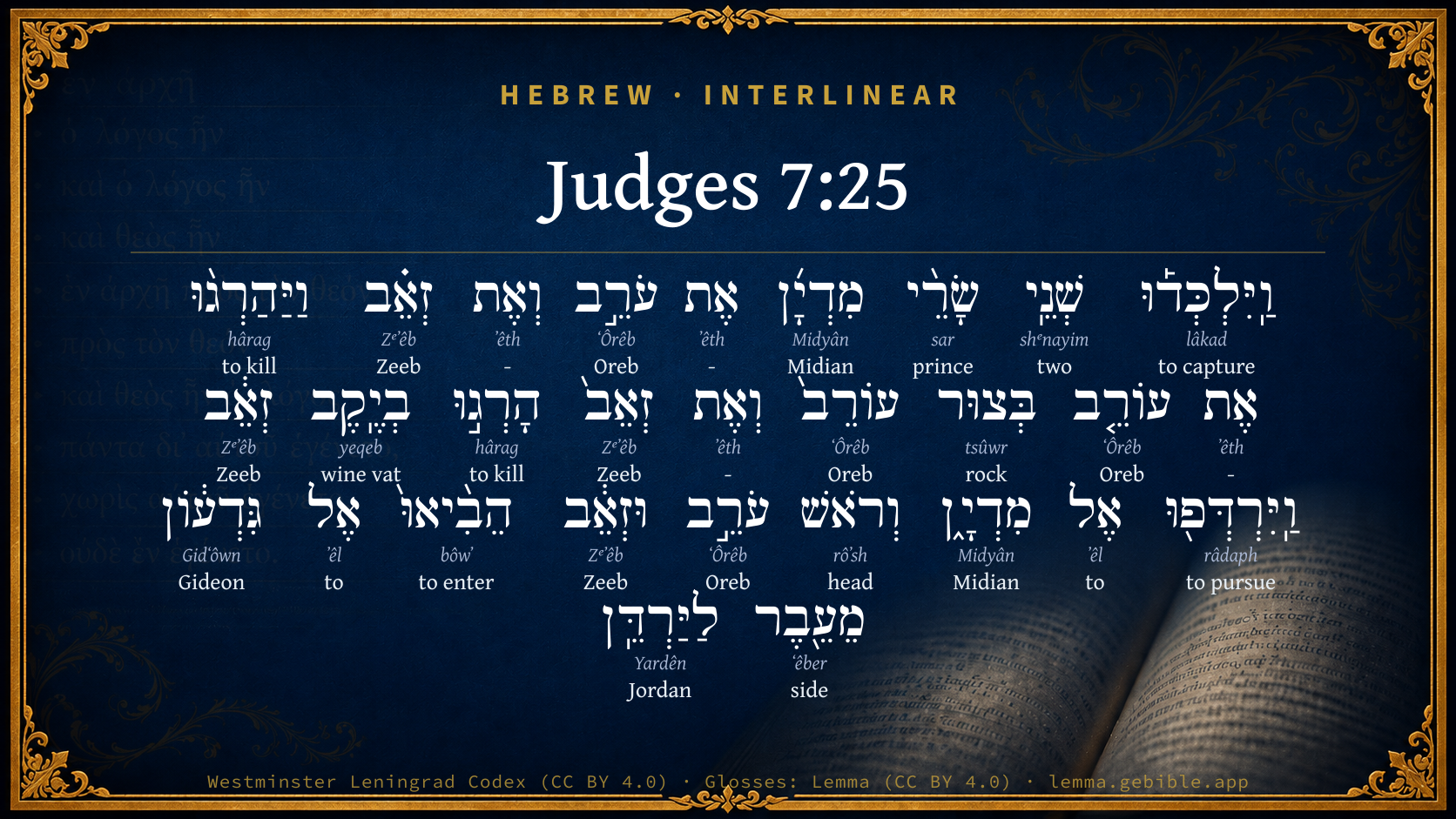
Hebrew (Westminster Leningrad Codex) Judges 7:25 appears in the Hebrew Old Testament. The text above is from the Westminster Leningrad Codex. Each word links to its Strong’s number, a concise gloss, and parsing drawn from the Open Scriptures Hebrew Bible morphology. Click any word for its full Brown-Driver-Briggs (BDB) entry.
Download image
Cite this verse

Judges 7:25 (World English Bible). Public Domain. Lemma interlinear Bible study tool, https://lemma.gebible.app/v/judges/7/25.

Show BibTeX & RIS
BibTeX
RIS
English Translation
They took the two princes of Midian, Oreb and Zeeb; and they killed Oreb at the rock of Oreb, and Zeeb they killed at the winepress of Zeeb, and pursued Midian: and they brought the heads of Oreb and Zeeb to Gideon beyond the Jordan.
World English Bible · Public Domain
Highlights
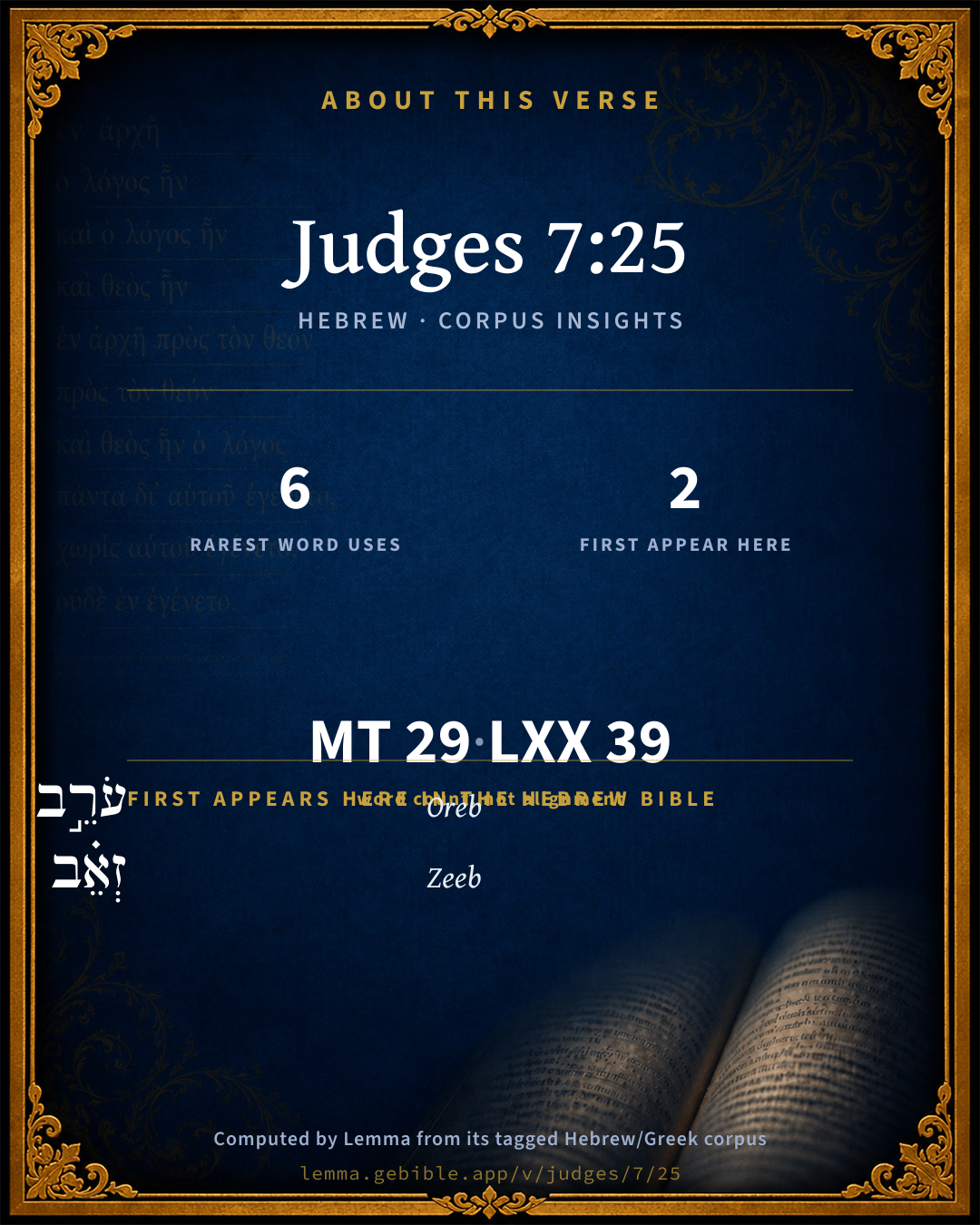
  • 2 first appearances in the Hebrew Bible
Full analysis ↓
Download a study sheet

One document with this verse’s original text, its word-by-word gloss line, the meaning frame, cross-references with their text, attributed commentary, and full source and license credits — printable, and it pastes into notes with its structure intact.

This verse Autodidact and up

Study sheet (.html) Plain text (.txt)

A passage Seminary Student

Up to 50 verses in one chapter. A passage sheet keeps up to 6 commentary sources and 12 cross-references per verse, in the order this page ranks them, and says so on the sheet whenever that leaves anything out. Ask for a single verse and you get the Autodidact verse sheet above.

Everything on this page stays free to read, with no account — the sheet is a download of what is already on screen, not access to it.

Want to remove ads? Support Godless Engineer
Compare translations 3

The same verse in 3 English versions, stacked beneath the original-language interlinear above. Click any original word for its lexicon entry.

Each is an independent rendering of the whole verse — the interlinear is not word-aligned to these translations.

Highlighted words mark where these versions differ — a whole-verse word diff, not a word-by-word alignment.

  • World English Bible Public Domain
    They took the two princes of Midian, Oreb and Zeeb; and they killed Oreb at the rock of Oreb, and Zeeb they killed at the winepress of Zeeb, and pursued Midian: and they brought the heads of Oreb and Zeeb to Gideon beyond the Jordan.
  • King James Version Public Domain
    And they took two princes of the Midianites, Oreb and Zeeb; and they slew Oreb upon the rock Oreb, and Zeeb they slew at the winepress of Zeeb, and pursued Midian, and brought the heads of Oreb and Zeeb to Gideon on the other side Jordan.
  • unfoldingWord Literal Text CC BY-SA 4.0
    And they captured the two commanders of Midian, Oreb and Zeeb. And they killed Oreb at the rock of Oreb, and they killed Zeeb at the winepress of Zeeb. And they chased after Midian, and they brought the head of Oreb and Zeeb to Gideon, from across the Jordan.

unfoldingWord Literal Text — © unfoldingWord, licensed CC BY-SA 4.0. Word-aligned USFM3 via Door43 (git.door43.org/unfoldingWord/en_ult).

Versions to compare (up to 4)

3 of 4 selected

Show all 18 translations

Every available English version of this verse, each an independent rendering of the whole verse.

  • World English Bible Public Domain
    They took the two princes of Midian, Oreb and Zeeb; and they killed Oreb at the rock of Oreb, and Zeeb they killed at the winepress of Zeeb, and pursued Midian: and they brought the heads of Oreb and Zeeb to Gideon beyond the Jordan.
  • Berean Standard Bible Public Domain
    They also captured Oreb and Zeeb, the two princes of Midian; and they killed Oreb at the rock of Oreb and Zeeb at the winepress of Zeeb. So they pursued the Midianites and brought the heads of Oreb and Zeeb to Gideon on the other side of the Jordan.
  • Majority Standard Bible Public Domain
    They also captured Oreb and Zeeb, the two princes of Midian; and they killed Oreb at the rock of Oreb and Zeeb at the winepress of Zeeb. So they pursued the Midianites and brought the heads of Oreb and Zeeb to Gideon on the other side of the Jordan.
  • King James Version Public Domain
    And they took two princes of the Midianites, Oreb and Zeeb; and they slew Oreb upon the rock Oreb, and Zeeb they slew at the winepress of Zeeb, and pursued Midian, and brought the heads of Oreb and Zeeb to Gideon on the other side Jordan.
  • American Standard Version (1901) Public Domain
    And they took the two princes of Midian, Oreb and Zeeb; and they slew Oreb at the rock of Oreb, and Zeeb they slew at the winepress of Zeeb, and pursued Midian: and they brought the heads of Oreb and Zeeb to Gideon beyond the Jordan.
  • Revised Version (1885) Public Domain
    And they took the two princes of Midian, Oreb and Zeeb; and they slew Oreb at the rock of Oreb, and Zeeb they slew at the winepress of Zeeb, and pursued Midian: and they brought the heads of Oreb and Zeeb to Gideon beyond Jordan.
  • Geneva Bible (1599) Public Domain
    And they tooke two princes of the Midianites, Oreb and Zeeb, and slew Oreb vpon the rocke Oreb, and slewe Zeeb at the winepresse of Zeeb, and pursued the Midianites, and brought the heads of Oreb and Zeeb to Gideon beyonde Iorden.
  • Douay-Rheims (1899) Public Domain
    And having taken two men of Madian, Oreb and Zeb: Oreb they slew in the rock of Oreb, and Zeb in the winepress of Zeb. And they pursued Madian, carrying the heads of Oreb and Zeb to Gedeon beyond the waters of the Jordan.
  • Young's Literal Translation Public Domain
    and they capture two of the heads of Midian, Oreb, and Zeeb, and slay Oreb at the rock of Oreb, and Zeeb they have slain at the wine-vat of Zeeb, and they pursue unto Midian; and the heads of Oreb and Zeeb they have brought in unto Gideon beyond the Jordan.
  • Literal Standard Version CC BY-SA 4.0
    and they capture two of the heads of Midian, Oreb and Zeeb, and slay Oreb at the rock of Oreb, and they have slain Zeeb at the wine-vat of Zeeb, and they pursue into Midian; and they have brought the heads of Oreb and Zeeb to Gideon beyond the Jordan.
  • Unlocked Literal Bible CC BY-SA 4.0
    They captured the two princes of Midian, Oreb and Zeeb. They killed Oreb at the rock of Oreb, and they killed Zeeb at the winepress of Zeeb. They went after the Midianites, and they brought the heads of Oreb and Zeeb to Gideon, who was on the other side of the Jordan.
  • unfoldingWord Literal Text CC BY-SA 4.0
    And they captured the two commanders of Midian, Oreb and Zeeb. And they killed Oreb at the rock of Oreb, and they killed Zeeb at the winepress of Zeeb. And they chased after Midian, and they brought the head of Oreb and Zeeb to Gideon, from across the Jordan.
  • Darby Bible Public Domain
    And they took the two princes of Mid'ian, Oreb and Zeeb; they killed Oreb at the rock of Oreb, and Zeeb they killed at the wine press of Zeeb, as they pursued Mid'ian; and they brought the heads of Oreb and Zeeb to Gideon beyond the Jordan.
  • World Messianic Bible Public Domain
    They took the two princes of Midian, Oreb and Zeeb. They killed Oreb at Oreb’s rock, and Zeeb they killed at Zeeb’s wine press, as they pursued Midian. Then they brought the heads of Oreb and Zeeb to Gideon beyond the Jordan.
  • Webster's Bible Public Domain
    And they took two princes of the Midianites, Oreb and Zeeb; and they slew Oreb upon the rock Oreb, and Zeeb they slew at the wine-press of Zeeb, and pursued Midian, and brought the heads of Oreb and Zeeb to Gideon on the other side of Jordan.
  • Free Bible Version CC BY-SA 4.0
    They also captured Oreb and Zeeb, two of the Midianite commanders. They killed Oreb at the rock of Oreb, and Zeeb at the winepress of Zeeb. They continued chasing down the Midianites and brought the heads of Oreb and Zeeb back to Gideon who was on the other side of the Jordan.
  • Bible in Basic English Public Domain
    And they took the two chiefs of Midian, Oreb and Zeeb; and they put Oreb to death at the rock of Oreb, and Zeeb they put to death at the place of the grape-crushing in Zeeb, and they went after Midian; but the heads of Oreb and Zeeb they took across Jordan to Gideon.
  • JPS Tanakh (1917) Public Domain
    And they took the two princes of Midian, Oreb and Zeeb; and they slew Oreb at the Rock of Oreb, and Zeeb they slew at the Winepress of Zeeb, and pursued Midian; and they brought the heads of Oreb and Zeeb to Gideon beyond the Jordan.

Literal Standard Version (2020), Covenant Press — licensed CC BY-SA 4.0. Text via the HelloAO Bible API (eBible.org). Unlocked Literal Bible (unfoldingWord) — licensed CC BY-SA 4.0. Text via the HelloAO Bible API (eBible.org). unfoldingWord Literal Text — © unfoldingWord, licensed CC BY-SA 4.0. Word-aligned USFM3 via Door43 (git.door43.org/unfoldingWord/en_ult). Free Bible Version, Dr. Jonathan Gallagher — licensed CC BY-SA 4.0. Text via the HelloAO Bible API (eBible.org).

Word by word

More ways to search: Search by grammar → Find every occurrence → Compare this word →

Practice this passage: Drill this verse → Learn its vocabulary →

זְאֵ֗ב
Zᵉʼêb
H2062
“Zeeb”
Noun, Proper
Part of Speech
Noun
Type
Proper
Full BDB Definition

Origin: the same as H2061

TWOT: None

Zeeb = "wolf" - one of the two princes of Midian mentioned in the conquest; brought to bay in a winepress
  1. וַֽיִּלְכְּד֡וּ lâkad H3920 “and · to capture” Conjunction + Verb, Qal, Sequential Imperfect, 3rd Person, Masculine, Plural
  2. שְׁנֵֽי shᵉnayim H8147 “two” Adjective, Cardinal number, Masculine, Dual, Construct
  3. שָׂרֵ֨י sar H8269 “princes of” Noun, Common, Masculine, Plural, Construct
  4. מִדְיָ֜ן Midyân H4080 “Midian” Noun, Proper
  5. אֶת ʼêth H853 “-” Particle, Direct Object
  6. עֹרֵ֣ב ʻÔrêb H6159 “Oreb” Noun, Proper
  7. וְאֶת ʼêth H853 “and · -” Conjunction + Particle, Direct Object
  8. וַיַּהַרְג֨וּ hârag H2026 “and · to kill” Conjunction + Verb, Qal, Sequential Imperfect, 3rd Person, Masculine, Plural
  9. אֶת ʼêth H853 “-” Particle, Direct Object
  10. עוֹרֵ֤ב ʻÔrêb H6159 “Oreb” Noun, Proper
  11. בְּצוּר tsûwr H6697 “in/at · rock of” Preposition + Noun, Common, Masculine, Singular, Construct
  12. עוֹרֵב֙ ʻÔrêb H6159 “Oreb” Noun, Proper
  13. וְאֶת ʼêth H853 “and · -” Conjunction + Particle, Direct Object
  14. זְאֵב֙ Zᵉʼêb H2062 “Zeeb” Noun, Proper
  15. הָרְג֣וּ hârag H2026 “to kill” Verb, Qal, Perfect, 3rd Person, Common, Plural
  16. בְיֶֽקֶב yeqeb H3342 “in/at · wine vat of” Preposition + Noun, Common, Masculine, Singular, Construct
  17. זְאֵ֔ב Zᵉʼêb H2062 “Zeeb” Noun, Proper
  18. וַֽיִּרְדְּפ֖וּ râdaph H7291 “and · to pursue” Conjunction + Verb, Qal, Sequential Imperfect, 3rd Person, Masculine, Plural
  19. אֶל ʼêl H413 “to” Preposition
  20. מִדְיָ֑ן Midyân H4080 “Midian” Noun, Proper
  21. וְרֹאשׁ rôʼsh H7218 “and · head of” Conjunction + Noun, Common, Masculine, Singular, Construct
  22. עֹרֵ֣ב ʻÔrêb H6159 “Oreb” Noun, Proper
  23. וּזְאֵ֔ב Zᵉʼêb H2062 “and · Zeeb” Conjunction + Noun, Proper
  24. הֵבִ֨יאוּ֙ bôwʼ H935 “to enter” Verb, Hiphil, Perfect, 3rd Person, Common, Plural
  25. אֶל ʼêl H413 “to” Preposition
  26. גִּדְע֔וֹן Gidʻôwn H1439 “Gideon” Noun, Proper
  27. מֵעֵ֖בֶר ʻêber H5676 “from · side” Preposition + Noun, Common, Masculine, Singular, Absolute
  28. לַיַּרְדֵּֽן Yardên H3383 “to/for the · Jordan” Preposition, Determined + Noun, Proper

About this verse

These counts appear in no published source. They are computed here, from the morphology-tagged text and Lemma’s own curated glosses. What Lemma adds →

29
words
17
distinct lemmas
Historical
section

Notable vocabulary

The rarest word here is זְאֵ֗ב Zeeb H2062 — appearing just 6 times in the whole Hebrew Bible.

First appearance in Scripture

These words make their first canonical appearance in the Hebrew Bible here:

Shared distinctive vocabulary

זְאֵ֗ב Zeeb H2062 occurs in 3 verses of the Hebrew Bible. Also found in:

Grammatical profile

  • 5 verbs
  • 17 nouns
  • 1 adjective
  • 2 prepositions
  • 4 particles

Verb forms

  • וַֽיִּלְכְּד֡וּ Qal · Sequential Imperfect
  • וַיַּהַרְג֨וּ Qal · Sequential Imperfect
  • הָרְג֣וּ Qal · Perfect
  • וַֽיִּרְדְּפ֖וּ Qal · Sequential Imperfect
  • הֵבִ֨יאוּ֙ Hiphil · Perfect

Repetition

Words recur within this verse — often emphatic in Hebrew:

  • עֹרֵ֣ב Oreb H6159 ×4
  • זְאֵ֗ב Zeeb H2062 ×4
  • מִדְיָ֜ן Midian H4080 ×2
  • וַיַּהַרְג֨וּ to kill H2026 ×2
  • אֶל to H413 ×2

Hebrew & Septuagint length

In English translation the verse runs 45 words from the Hebrew and 41 from the Septuagint (LXX English) — closely comparable.

A rough comparison of the two English renderings, which tokenize alike — not a word-level alignment.

Word counts can differ between the Hebrew and the Greek without any difference in meaning — e.g. the Hebrew direct-object marker אֵת has no separate Greek word, and Greek often adds the article ὁ.

In the original languages it is 29 Hebrew tokens and 39 Greek tokens — but the two are counted differently (Hebrew bundles its prefixes and suffixes into one token; the Greek is in lemma form), so that isn’t a like-for-like length.

Cross-references

4

Topical passages linked to Judges 7:25 in the Treasury of Scripture Knowledge — connected by theme and wording, ordered by reader-vote popularity; previews shown in the World English Bible.

  • Isaiah 10:26 Yahweh of Hosts will stir up against him a scourge, as in the slaughter of Midian at the rock of Oreb: and his rod will be over the sea, and he will lift it up after the manner of Egypt.
  • Judges 8:3–4 God has delivered into your hand the princes of Midian, Oreb and Zeeb: and what was I able to do in comparison with you? Then their anger was abated toward him, when he had said that.
  • Psalms 83:11–12 Make their nobles like Oreb and Zeeb; Yes, all their princes like Zebah and Zalmunna;
  • Joshua 7:26 They raised over him a great heap of stones, to this day; and Yahweh turned from the fierceness of his anger. Therefore the name of that place was called "The valley of Achor" to this day.

Cross-references courtesy of OpenBible.info (CC BY 4.0).

Hebrew and Greek witnesses Masoretic Hebrew ↔ Greek Septuagint

The same verse in the two great witnesses to the Old Testament, shown verse-for-verse.

These are two independent witnesses, not word-aligned to each other, and the Septuagint is shown in lemma (dictionary) form.

Hebrew Judges 7:25 Masoretic · Westminster Leningrad Codex

וַֽיִּלְכְּד֡וּ שְׁנֵֽי שָׂרֵ֨י מִדְיָ֜ן אֶת עֹרֵ֣ב וְאֶת זְאֵ֗ב וַיַּהַרְג֨וּ אֶת עוֹרֵ֤ב בְּצוּר עוֹרֵב֙ וְאֶת זְאֵב֙ הָרְג֣וּ בְיֶֽקֶב זְאֵ֔ב וַֽיִּרְדְּפ֖וּ אֶל מִדְיָ֑ן וְרֹאשׁ עֹרֵ֣ב וּזְאֵ֔ב הֵבִ֨יאוּ֙ אֶל גִּדְע֔וֹן מֵעֵ֖בֶר לַיַּרְדֵּֽן

They took the two princes of Midian, Oreb and Zeeb; and they killed Oreb at the rock of Oreb, and Zeeb they killed at the winepress of Zeeb, and pursued Midian: and they brought the heads of Oreb and Zeeb to Gideon beyond the Jordan.

World English Bible · Public Domain

Greek LXX Judges 7:25 Septuagint · lemma form

καί συνλαμβάνω ὁ ἄρχων μαδιαμ καί ὁ ωρηβ καί ὁ ζηβ καί ἀποκτείνω ὁ ωρηβ ἐν σουρ καί ὁ ζηβ ἀποκτείνω ἐν ιακεφζηφ καί καταδιώκω μαδιαμ καί ὁ κεφαλή ωρηβ καί ζηβ φέρω πρός γεδεων ἀπό πέραν ὁ ἰορδάνης

And they took the princes of Madiam, even Oreb and Zeb; and they killed Oreb in Sur Oreb, and they killed Zeb in Jakephzeph; and they pursued Madiam, and brought the heads of Oreb and Zeb to Gedeon from beyond Jordan.

LXX2012 (modern English Septuagint) · Public Domain

On this verse, Ellicott's Commentary for English Readers discusses the Septuagint’s reading. Read the note in Commentary ↓

Hebrew: Westminster Leningrad Codex (CC BY 4.0). Greek: Septuagint (public domain); English from LXX2012 (modern English Septuagint) (Public Domain). How the Septuagint differs from the Hebrew →

Targum (Aramaic paraphrase)

1

The Targum is the ancient Jewish Aramaic paraphrase of the Hebrew Scriptures — an interpretive translation, not the Hebrew text itself. Onkelos (literal) and Pseudo-Jonathan (expansive) render the Torah, and Jonathan the Prophets. Coverage is partial: where no permissively-licensed English translation exists for a verse, only the Aramaic is shown. This is verse-level text, not a word-by-word alignment to the Hebrew.

  1. Targum Jonathan Prophets (Joshua–Malachi)
    וַאֲחָדוּ תְּרֵין רַבְרְבֵי מִדְיָן יַת עוֹרֵב וְיַת זְאֵב וּקְטָלוּ יַת עוֹרֵב בִּשְׁקִיף עוֹרֵב וְיַת זְאֵב קְטָלוּ בְּמֵישַׁר זְאֵב וּרְדָפוּ בָּתַר מִדְיָנָאֵי וְרֵישׁ עוֹרֵב וּזְאֵב אַיְתִיאוּ לְוַת גִדְעוֹן מֵעִבְרָא לְיַרְדְנָא:

    (no public-domain English translation for this verse)

    Targum Jonathan — Aramaic: “Mikraot Gedolot” (public domain). English: “Sefaria Community Translation” (CC0 1.0 (public-domain dedication)); “London "Chaldee Paraphrase," 1871” (public domain). Text via Sefaria.

Commentary

Notes on Judges 7:25 from classic Christian and Jewish commentators (each source and its license shown beneath its notes). The classic Christian expositions comment on the surrounding passage and are grouped to its opening verse, so a note may address several verses; the Jewish commentaries on the Tanakh (Rashi and others) are per-verse, so they appear only where the commentator wrote on this verse.

Lemma curates 59 commentaries, every one of them public domain or Creative Commons licensed, each selected and text-cleaned for this edition rather than reprinted as found. About our sources →

Trapp's Complete Commentary

John Trapp

Jdg 7:25 And they took two princes of the Midianites, Oreb and Zeeb; and they slew Oreb upon the rock Oreb, and Zeeb they slew at the winepress of Zeeb, and pursued Midian, and brought the heads of Oreb and Zeeb to Gideon on the other side Jordan.

Ver. 25. Oreb and Zeeb.] Oreb signifieth a raven. Zeeb, a wolf.

“ Conveniunb rebus nomina saepe suis. ”

Upon the rock Oreb, … at the wine press of Zeeb.] So these places were called, on this occasion: and God was just in it. These princes had forced Israel to hide in the rocks, and had robbed them of their provisions, and therefore fitly became examples of that rule,

“ Per quod quis peccat, per idem punitur ipse. ”

John Trapp, A Commentary or Exposition upon All the Books of the Old and New Testament (1647–1656) — public domain. Text from a community e-Sword module.

Joseph Benson's Commentary

Jdg 7:25. To Gideon on the other side of Jordan — For Gideon, in the pursuit, had passed over Jordan. Oreb and Zeeb had probably taken shelter, the one in a rock, the other by a wine-press. But the places of their shelter were made the places of their slaughter, and the memory of it preserved in the names of the places.

Joseph Benson's Commentary on the Old and New Testaments (1811–1818) — public domain. Text from a community e-Sword module.

Geneva Bible (1599)

Geneva Bible translators

These places had their names of the acts that were done there.

Geneva Bible (1599) marginal notes — public domain. Text via Bolls.life.

Adam Clarke's Commentary

Verse 25. They slew Oreb upon the rock Oreb] These two generals had taken shelter, one in the cavern of the rock, the other in the vat of a winepress; both of which places were from this circumstance, afterwards called by their names.

Brought the heads of Oreb and Zeeb to Gideon] OREB signifies a raven and ZEEB a wolf. In all ancient nations we find generals and princes taking their names from both birds and beasts; the Romans had their Gracchi, jackdaws; Corvini, crows; Aquilini, eagles, c. We have the same in our Crows, Wolfs, Lyons, Hawkes, Bulls, Kidds, c. Among barbarous nations the head of the conquered chief was often brought to the conqueror. Pompey's head was brought to Caesar Cicero's head, to Mark Antony the heads of Ahab's children, to Jehu, c. These barbarities are not often practiced now, except among the Mohammedans or the savages of Africa and America and for the credit of human nature it is a pity that such barbarous atrocities had ever been committed.

Adam Clarke's Commentary on the Bible (1810–1826) — public domain. Text from a community e-Sword/MySword module.

Ellicott's Commentary for English Readers

(25) Oreb and Zeeb.—The names mean “raven” and “wolf”: but these are common names for warriors among rude tribes, and there is no reason to look on them as names given in scorn by the Israelites. Such names are common among nomads. The capture of these two powerful sheykhs was the result of the second part of the battle, and was not accomplished without a terrible slaughter. See Psa_73:9-12, where the word rendered “houses” of God should be “pastures” of God. It is remarkable that in this passage there seems to be almost an identification of the victories of Barak and Gideon, as though they were the result of one great combined movement. In the phrase “became as the dung of the earth” we see that tradition preserved a memory of the fertilisation of the ground by the dead bodies (see Note on Jdg_4:16; Jdg_5:21). The completeness of the victory is also ailuded to in Isa_60:4 : “Thou hast broken the yoke of his burden . . . as in the day of Midian”; and Isa_10:26. The brief narrative of Judges perhaps hardly enables us to realise the three acts of this great tragedy of Midianite slaughter—at Gilboa, the Fords, and Karkor.

Upon the rock Oreb.—Rather, at the raven’s rock. Only again mentioned in Isa_10:26 : “according to the slaughter of Midian at the rock of Oreb.” Reland identifies it with Orbo, near Bethshean.

To Gideon on the other side Jordan.—i.e., beyond the Jordan (“trans fluenta Jordani,” Vulg.). This notice is given by anticipation, for Gideon’s crossing the Jordan is not mentioned till Jdg_8:4. The words literally mean “from beyond the Jordan,” as the LXX. render them (apo peran), but this is idiomatic for “from one place to another,” as in Jos_13:22, &c-

A Bible Commentary for English Readers, edited by Charles John Ellicott (1878–1897) — public domain. Text from a community e-Sword module.

The Cambridge Bible for Schools and Colleges

gen. ed. J. J. S. Perowne

25. Oreb and Zeeb] The Midianite princes bear Hebrew (or Hebraized) names = ‘Raven’ and ‘Wolf.’ The sheikh of the powerful tribe of the Banû ‘Adwân, who range the country S.E. of the Jordan, still receives the hereditary title of Dhi’âb, i.e. Zeeb. Animal names of this kind were borne both by clans and individuals, more frequently by the former, as the O.T. shews; they may be explained as survivals from a totem stage of society. See Gray, Hebr. Pr. Names, 112–114. Instead of the two princes Oreb and Zeeb, the other narrative, Jdg_8:4-21, mentions the two kings Zebah and Zalmunna. Cf. Psa_83:11.

the rock of Oreb … the winepress of Zeeb] It is implied that the spots were named after the chiefs who fell there. Possibly the names of two conical hills N. and N.W. of Jericho, ‘Uðð el ghurâb (‘raven’s nest’) Ṭuwçl edh-dhi’âb (‘ridge of the wolf’), have preserved a memory of the event; Buhl, Geogr., p. 115. Isa_10:16 interprets this episode in a wider sense; cf. also Isa_9:4.

and pursued Midian … beyond Jordan] The present narrative, Jdg_7:22 to Jdg_8:3, tells how Gideon chased the Midianites down to the Jordan fords and into the arms of the Ephraimites, who brought to him the heads of the two chieftains. Nothing is said of Gideon having crossed the Jordan. These words were probably added by a later editor who wished to bring Jdg_7:22 to Jdg_8:3 into harmony with Jdg_8:4 ff.

The Cambridge Bible for Schools and Colleges (gen. ed. J. J. S. Perowne; Cambridge University Press, 1878–1918) — public domain. Text from a community e-Sword module.

John Gill's Exposition

And they took two princes of the Midianites, Oreb and Zeeb,.... The one signifies a "raven", and the other a "wolf"; which were either nicknames given them because of their voraciousness and cruelty, or which they took themselves, or their ancestors before them, to make themselves terrible to others; so the Romans had the families of the Corvini, &c.

and they slew Oreb upon the rock Oreb; perhaps they found him in a cave of the rock, and dragging him out slew him, from whence the rock afterwards had its name. So we read of the rock Corax in Homer (p), which was in Ithaca, and another high mountain of the same name in Aetolia, mentioned by Livy (q) and which signifies the same as Oreb. This is a different rock or mountain from Horeb, the same with Sinai, from whence the law was given; which always ought to be written with an "H" or "Ch", to distinguish it from this; though that is written Oreb by Lactantius (r), and so by Milton (s), contrary to the propriety of the language:

and Zeeb they slew at the winepress of Zeeb; the Targum is, the plain of Zeeb, which, as Kimchi and Ben Gersom suppose, was in the form of a winepress, having high lips or hills around it, and which afterwards took its name from this prince being slain in it:

and pursued Midian; the rest of the Midianites, even beyond Jordan, those that got over it:

and brought the heads of Oreb and Zeeb to Gideon on the other side Jordan; that is, when he had passed over it the next morning, as Jarchi remarks; for after this we read of Gideon's going over Jordan, Jdg 8:4 unless this is said by way of anticipation; though the phrase will bear to be rendered, "on this side Jordan", for it signifies both. It seems they cut off the heads of those two princes, and presented them to Gideon, as it has been usual to bring the heads of enemies to kings and conquerors; see Sa1 17:54.

(p) Odyss. 13. "prope finem". (q) Hist. l. 36. c. 30. (r) De vera Sap. l. 4. c. 17. (s) Paradise Lost, l. 1. ver. 7.

Next: Judges Chapter 8

John Gill's Exposition of the Whole Bible (1746–1763) — public domain (CC PDM 1.0). Text via the HelloAO Bible API.

Haydock's Catholic Bible Commentary

Two men. That is, two of their chiefs. (Challoner) --- Press. Hebrew yekeb, denotes a cistern fit to contain wine, Isaias v. 2., and Proverbs iii. 10. --- Zeb had concealed himself in it. --- Jordan. They afterwards took occasion from this exploit to extol their own valour, and to quarrel with Gedeon. (Calmet)

George Leo Haydock (1774–1849), Haydock's Catholic Family Bible and Commentary, 1859 edition — public domain. Excludes Psalms (Douay-Rheims chapter numbering differs from Protestant) and Deuterocanonical books (Catholic canon only).

Matthew Poole's English Annotations

For Gideon in the pursuit had passed over Jordan, as we read, Jdg 8:4, which, though mentioned after this, may seem to have been done before it, such transpositions being frequent in sacred story. Or, on this side Jordan, for the Hebrew word is indifferent to both sides: see Gen 1:10. And so this is opposed to what follows of his passing over Jordan, Jdg 8:4. And then there is no anticipation here.

Matthew Poole's English Annotations on the Holy Bible (1683–1685) — public domain. Text from a community e-Sword/MySword module.

Whedon's Commentary on the Bible

Daniel D. Whedon

25. Oreb and Zeeb — These names mean respectively the raven and the wolf, and were, perhaps, descriptive of the fierce character of these Midianitish chieftains. They remind us of names common among chiefs of the American Indians.

Rock Oreb… winepress of Zeeb — These places, now unknown, received their names from the slaughter of these two princes. The historian, writing some time after the places had received these names, very naturally speaks of them in this way.

Pursued Midian — After beheading Oreb and Zeeb, the Ephraimites continued their pursuit and followed the Midianites. who had, in spite of them, forced their way to the other side of the Jordan.

Brought the heads… to Gideon on the other side Jordan — That is, after Gideon had also crossed over to the other, or east, side of Jordan, they brought to him the heads of the slaughtered chiefs. Thus, as Bertheau and Keil show, the writer anticipates Gideon’s crossing of the Jordan in order to say what was done with the heads, and to mention in the same connexion the anger of the Ephraimites. Accordingly, Gideon’s crossing the Jordan, which is mentioned Jdg_8:4, took place before these heads were brought to him, and before that war of words occurred which the writer next proceeds to record. Jdg_8:1-3.

Daniel D. Whedon (gen. ed.), Commentary on the Old and New Testaments (1874–1909) — public domain. Text from a community e-Sword module.

The Pulpit Commentary

Oreb, a raven, and Zeeb, a wolf. The rock known afterwards as the rock of Oreb, (Isa_10:26) and the wine-press (see Jud_1:6:11) known as the wine-press of Zeeb , were so called from being the places where these two princes were taken and slain by the Eph-raimites. In like manner the well of Harod is called by the name it afterwards received (ver. 1), and the palm tree of Deborah in like manner, (Jud_1:2:5) and Lehi. (Jud_1:15:9) These are valuable indications (to which many more might be added) of a living tradition older than the written history. The capture of Oreb and Zeeb is celebrated in Psa_83:11 and Isa_10:26. On the other side Jordan, i.e. the east side of the river, which Gideon had now crossed, as is related in Jud_1:8:4. The narrative runs on here to complete the history of the doings of the men of Ephraim, and goes back at Jud_1:8:4 to take up the thread of the history of Gideon. (see Jud 2:1-6, note)

The Pulpit Commentary (1880–1919), ed. H.D.M. Spence-Jones & Joseph S. Exell — public domain. Text from a community e-Sword module.

John Wesley's Explanatory Notes

The other side of Jordan - For Gideon in the pursuit had passed over Jordan. Oreb and Zeeb had probably taken shelter, the one in a rock, the other by a wine-press. But the places of their shelter were made the places of their slaughter, and the memory of it preserved in the names of the places.

John Wesley, Explanatory Notes Upon the Whole Bible (1754–1765) — public domain. Text via the GEBible commentary corpus.

Rashi

Rabbi Shlomo Yitzchaki (Rashi)

They brought to Gidon, across the Yardein. In the morning, when Gidon crossed the Yardein pursuing Zevach and Tzalmona.

Rashi on the Tanakh — English translations: “The Judaica Press complete Tanach with Rashi, translated by A. J. Rosenberg” (CC BY 4.0); “Pentateuch with Rashi's commentary by M. Rosenbaum and A.M. Silbermann, 1929-1934” (public domain); “The Metsudah Tanach series, Lakewood, N.J” (CC BY 4.0); and “The Book of Joshua, Metsudah Publications, 1997” (CC BY 4.0). Text via Sefaria.

Lesson kit

Teaching starters — assembled from the data on this page, not authored interpretation. Every prompt links to the verse data it draws on. Edit before teaching.

Judges, in the Historical, opens this verse with 29 words (17 distinct Hebrew lemmas). Its most distinctive word is Zᵉʼêb (“Zeeb”). A historical commentator’s framing appears above. Read the whole chapter for the surrounding context.

Discussion questions

  1. What does “Zeeb” (Zᵉʼêb) contribute to the verse as a whole?
  2. 2 words here appear for the first time in Scripture. What is being introduced at this debut?
  3. Judges 8:3 shares the word «Zeeb» with this verse. How do the two illuminate each other?
  4. “Oreb” occurs 4× in this one verse. What is the effect of the repetition?
  5. These translations render this verse differently. What is at stake in choosing one wording over another?
  6. The verb «וַֽיִּלְכְּד֡וּ» is Qal Sequential Imperfect. How does its form color the action?
  7. Reading how Trapp's Complete Commentary and Joseph Benson's Commentary read this verse, where do the two commentators agree and where do they part?

Things to notice

Reading settings

Reading text

Shown beneath each verse's original-language words.

Old Testament
Old Testament edition

Read the OT as the Masoretic Hebrew (MT) or the Greek Septuagint (LXX).

English shown for the Greek Septuagint (in the Hebrew ↔ Greek comparison).

Comparing translations? Open the Compare panel on any verse page to stack up to four side by side.