
Lamentations 2:4

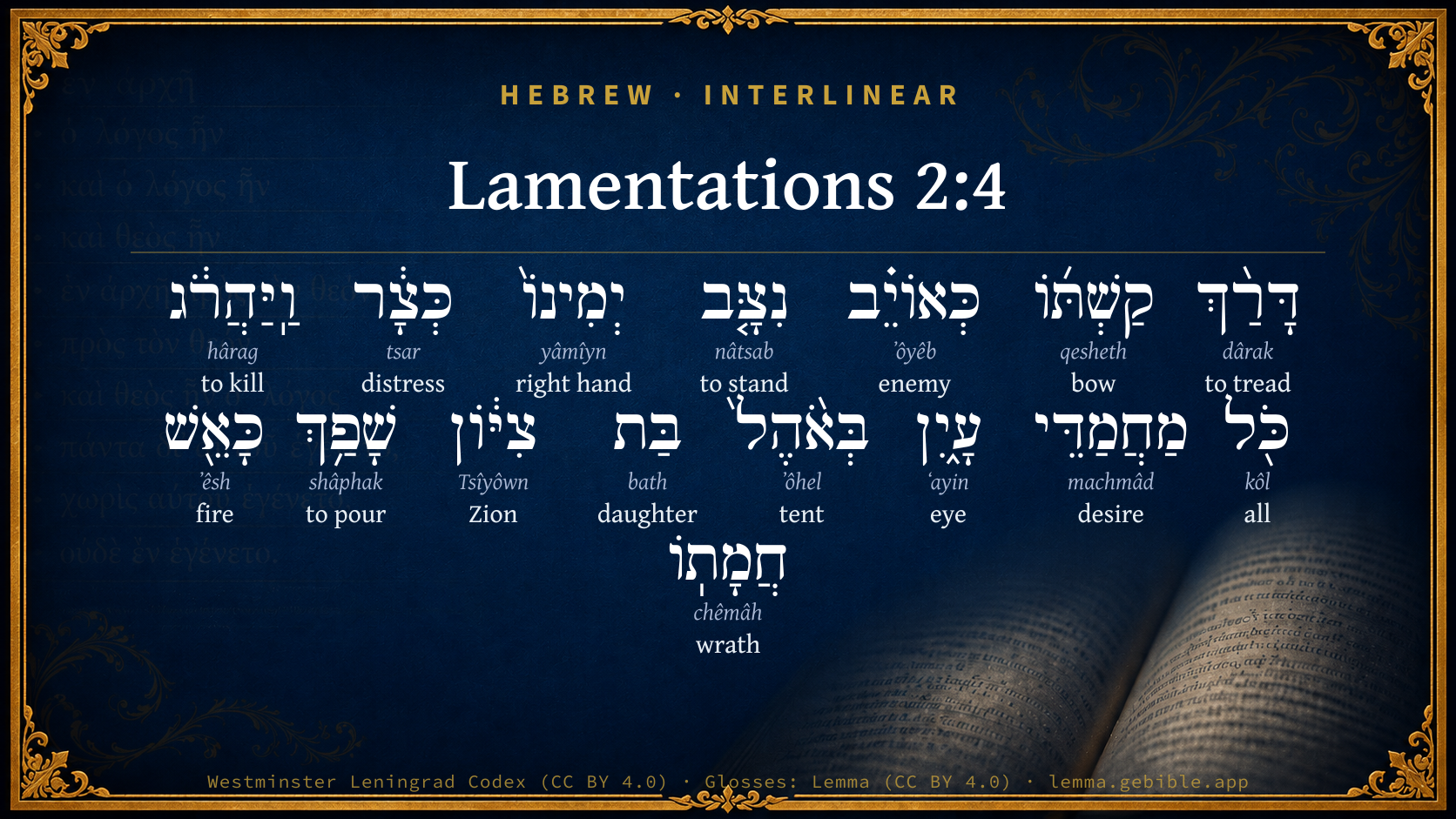
Hebrew (Westminster Leningrad Codex) Lamentations 2:4 appears in the Hebrew Old Testament. The text above is from the Westminster Leningrad Codex. Each word links to its Strong’s number, a concise gloss, and parsing drawn from the Open Scriptures Hebrew Bible morphology. Click any word for its full Brown-Driver-Briggs (BDB) entry.
Download image
Cite this verse

Lamentations 2:4 (World English Bible). Public Domain. Lemma interlinear Bible study tool, https://lemma.gebible.app/v/lamentations/2/4.

Show BibTeX & RIS
BibTeX
RIS
English Translation
He has bent his bow like an enemy, he has stood with his right hand as an adversary, Has killed all that were pleasant to the eye: In the tent of the daughter of Zion he has poured out his wrath like fire.
World English Bible · Public Domain
Download a study sheet

One document with this verse’s original text, its word-by-word gloss line, the meaning frame, cross-references with their text, attributed commentary, and full source and license credits — printable, and it pastes into notes with its structure intact.

This verse Autodidact and up

Study sheet (.html) Plain text (.txt)

A passage Seminary Student

Up to 50 verses in one chapter. A passage sheet keeps up to 6 commentary sources and 12 cross-references per verse, in the order this page ranks them, and says so on the sheet whenever that leaves anything out. Ask for a single verse and you get the Autodidact verse sheet above.

Everything on this page stays free to read, with no account — the sheet is a download of what is already on screen, not access to it.

Want to remove ads? Support Godless Engineer
Compare translations 3

The same verse in 3 English versions, stacked beneath the original-language interlinear above. Click any original word for its lexicon entry.

Each is an independent rendering of the whole verse — the interlinear is not word-aligned to these translations.

Highlighted words mark where these versions differ — a whole-verse word diff, not a word-by-word alignment.

  • World English Bible Public Domain
    He has bent his bow like an enemy, he has stood with his right hand as an adversary, Has killed all that were pleasant to the eye: In the tent of the daughter of Zion he has poured out his wrath like fire.
  • King James Version Public Domain
    He hath bent his bow like an enemy: he stood with his right hand as an adversary, and slew all that were pleasant to the eye in the tabernacle of the daughter of Zion: he poured out his fury like fire.
  • unfoldingWord Literal Text CC BY-SA 4.0
    He has bent his bow like an enemy; his right hand is stationed like an adversary, and he has slain all the delights of the eye. In the tent of the daughter of Zion, he has poured out his anger like fire. HE

unfoldingWord Literal Text — © unfoldingWord, licensed CC BY-SA 4.0. Word-aligned USFM3 via Door43 (git.door43.org/unfoldingWord/en_ult).

Versions to compare (up to 4)

3 of 4 selected

Show all 18 translations

Every available English version of this verse, each an independent rendering of the whole verse.

  • World English Bible Public Domain
    He has bent his bow like an enemy, he has stood with his right hand as an adversary, Has killed all that were pleasant to the eye: In the tent of the daughter of Zion he has poured out his wrath like fire.
  • Berean Standard Bible Public Domain
    He has bent His bow like an enemy; His right hand is positioned. Like a foe He has killed all who were pleasing to the eye; He has poured out His wrath like fire on the tent of the Daughter of Zion.
  • Majority Standard Bible Public Domain
    He has bent His bow like an enemy; His right hand is positioned. Like a foe He has killed all who were pleasing to the eye; He has poured out His wrath like fire on the tent of the Daughter of Zion.
  • King James Version Public Domain
    He hath bent his bow like an enemy: he stood with his right hand as an adversary, and slew all that were pleasant to the eye in the tabernacle of the daughter of Zion: he poured out his fury like fire.
  • American Standard Version (1901) Public Domain
    He hath bent his bow like an enemy, he hath stood with his right hand as an adversary, And hath slain all that were pleasant to the eye: In the tent of the daughter of Zion he hath poured out his wrath like fire.
  • Revised Version (1885) Public Domain
    He hath bent his bow like an enemy, he hath stood with his right hand as an adversary, and hath slain all that were pleasant to the eye: in the tent of the daughter of Zion he hath poured out his fury like fire.
  • Geneva Bible (1599) Public Domain
    He hath bent his bowe like an enemie: his right hand was stretched vp as an aduersarie, and slewe al that was pleasant to the eye in the tabernacle of the daughter of Zion: he powred out his wrath like fire.
  • Douay-Rheims (1899) Public Domain
    Daleth. He hath bent his bow as an enemy, he hath fixed his right hand as an adversary: and he hath killed all that was fair to behold in the tabernacle of the daughter of Sion, he hath poured out his indignation like fire.
  • Young's Literal Translation Public Domain
    He hath trodden His bow as an enemy, Stood hath His right hand as an adversary, And He slayeth all the desirable ones of the eye, In the tent of the daughter of Zion, He hath poured out as fire His fury.
  • Literal Standard Version CC BY-SA 4.0
    He has bent His bow as an enemy, || His right hand has stood as an adversary, || And He slays all the desirable ones of the eye, || In the tent of the daughter of Zion, || He has poured out as fire His fury.
  • Unlocked Literal Bible CC BY-SA 4.0
    Like an enemy he has bent his bow toward us, with his right is ready to shoot. He has slaughtered all who had been so pleasing to him in the tent of the daughter of Zion; he has poured out his wrath like fire.
  • unfoldingWord Literal Text CC BY-SA 4.0
    He has bent his bow like an enemy; his right hand is stationed like an adversary, and he has slain all the delights of the eye. In the tent of the daughter of Zion, he has poured out his anger like fire. HE
  • Darby Bible Public Domain
    He hath bent his bow like an enemy; he stood with his right hand as an adversary, and hath slain all that was pleasant to the eye: in the tent of the daughter of Zion, he hath poured out his fury like fire.
  • World Messianic Bible Public Domain
    He has bent his bow like an enemy. He has stood with his right hand as an adversary. He has killed all that were pleasant to the eye. In the tent of the daughter of Zion, he has poured out his wrath like fire.
  • Webster's Bible Public Domain
    He hath bent his bow like an enemy: he stood with his right hand as an adversary, and slew all that were pleasant to the eye in the tabernacle of the daughter of Zion: he poured out his fury like fire.
  • Free Bible Version CC BY-SA 4.0
    He has fired arrows from his bow as if he were their enemy; he has used his power against them like an attacker. He has killed all the beloved children; he has poured out his anger like fire on the tent of the Daughter of Zion.
  • Bible in Basic English Public Domain
    His bow has been bent for the attack, he has taken his place with his hand ready, in his hate he has put to death all who were pleasing to the eye: on the tent of the daughter of Zion he has let loose his passion like fire.
  • JPS Tanakh (1917) Public Domain
    He hath bent His bow like an enemy, standing with His right hand as an adversary, and hath slain all that were pleasant to the eye; in the tent of the daughter of Zion He hath poured out His fury like fire.

Literal Standard Version (2020), Covenant Press — licensed CC BY-SA 4.0. Text via the HelloAO Bible API (eBible.org). Unlocked Literal Bible (unfoldingWord) — licensed CC BY-SA 4.0. Text via the HelloAO Bible API (eBible.org). unfoldingWord Literal Text — © unfoldingWord, licensed CC BY-SA 4.0. Word-aligned USFM3 via Door43 (git.door43.org/unfoldingWord/en_ult). Free Bible Version, Dr. Jonathan Gallagher — licensed CC BY-SA 4.0. Text via the HelloAO Bible API (eBible.org).

Word by word

More ways to search: Search by grammar → Find every occurrence → Compare this word →

Practice this passage: Drill this verse → Learn its vocabulary →

מַחֲמַדֵּי
machmâd
H4261
“desires of”
Noun, Common, Masculine, Plural, Construct
Part of Speech
Noun
Type
Common
Gender
Masculine
Number
Plural
State
Construct
Full BDB Definition

Origin: from H2530

TWOT: 673d , 673e

desire, desirable thing, pleasant thing
  1. דָּרַ֨ךְ dârak H1869 “to tread” Verb, Qal, Perfect, 3rd Person, Masculine, Singular
  2. קַשְׁתּ֜וֹ qesheth H7198 “bow · his” Noun, Common, Feminine, Singular, Construct + Suffix, Personal, 3rd Person, Masculine, Singular
  3. כְּאוֹיֵ֗ב ʼôyêb H341 “like/as · enemy” Preposition + Verb, Qal, Participle Active, Masculine, Singular, Absolute
  4. נִצָּ֤ב nâtsab H5324 “standing” Verb, Niphal, Participle Active, Masculine, Singular, Absolute
  5. יְמִינוֹ֙ yâmîyn H3225 “right hand · his” Noun, Common, Feminine, Singular, Construct + Suffix, Personal, 3rd Person, Masculine, Singular
  6. כְּצָ֔ר tsar H6862 “like/as · distress” Preposition + Noun, Common, Masculine, Singular, Absolute
  7. וַֽיַּהֲרֹ֔ג hârag H2026 “and · to kill” Conjunction + Verb, Qal, Sequential Imperfect, 3rd Person, Masculine, Singular
  8. כֹּ֖ל kôl H3605 “all of” Noun, Common, Masculine, Singular, Construct
  9. עָ֑יִן ʻayin H5869 “eye” Noun, Common, Both, Singular, Absolute
  10. בְּאֹ֨הֶל֙ ʼôhel H168 “in/at · tent of” Preposition + Noun, Common, Masculine, Singular, Construct
  11. בַּת bath H1323 “daughter of” Noun, Common, Feminine, Singular, Construct
  12. צִיּ֔וֹן Tsîyôwn H6726 “Zion” Noun, Proper
  13. שָׁפַ֥ךְ shâphak H8210 “to pour” Verb, Qal, Perfect, 3rd Person, Masculine, Singular
  14. כָּאֵ֖שׁ ʼêsh H784 “like/as the · fire” Preposition, Determined + Noun, Common, Both, Singular, Absolute
  15. חֲמָתֽוֹ chêmâh H2534 “wrath · his” Noun, Common, Feminine, Singular, Construct + Suffix, Personal, 3rd Person, Masculine, Singular

About this verse

These counts appear in no published source. They are computed here, from the morphology-tagged text and Lemma’s own curated glosses. What Lemma adds →

16
words
16
distinct lemmas
Prophets
section

Notable vocabulary

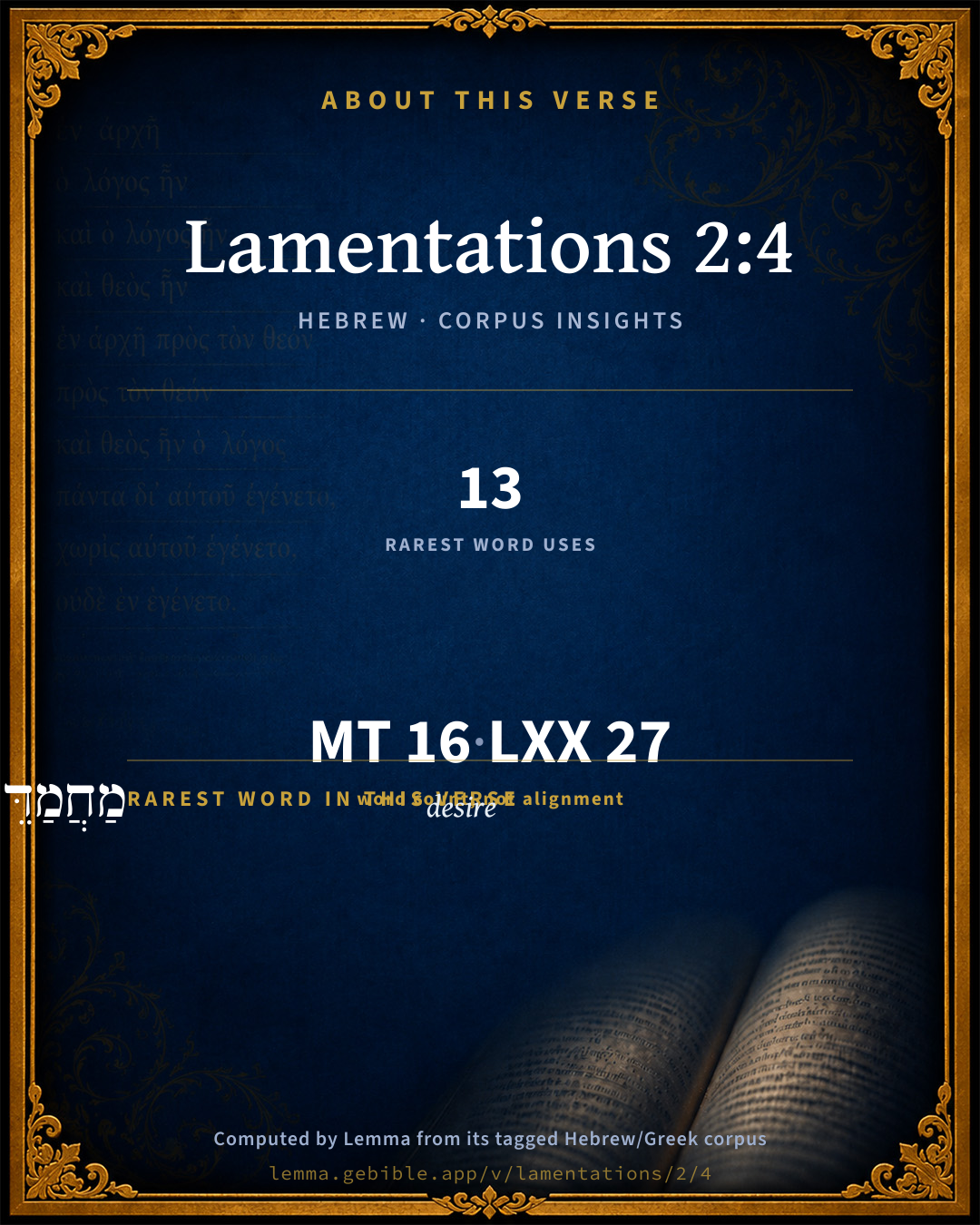
The rarest word here is מַחֲמַדֵּי desire H4261 — appearing just 13 times in the whole Hebrew Bible.

Shared distinctive vocabulary

מַחֲמַדֵּי desire H4261 occurs in 13 verses of the Hebrew Bible. Also found in:

Grammatical profile

  • 5 verbs
  • 11 nouns

Verb forms

  • דָּרַ֨ךְ Qal · Perfect
  • כְּאוֹיֵ֗ב Qal · Participle Active
  • נִצָּ֤ב Niphal · Participle Active
  • וַֽיַּהֲרֹ֔ג Qal · Sequential Imperfect
  • שָׁפַ֥ךְ Qal · Perfect

Hebrew & Septuagint length

In English translation the verse runs 43 words from the Hebrew and 45 from the Septuagint (LXX English) — closely comparable.

A rough comparison of the two English renderings, which tokenize alike — not a word-level alignment.

Word counts can differ between the Hebrew and the Greek without any difference in meaning — e.g. the Hebrew direct-object marker אֵת has no separate Greek word, and Greek often adds the article ὁ.

In the original languages it is 16 Hebrew tokens and 27 Greek tokens — but the two are counted differently (Hebrew bundles its prefixes and suffixes into one token; the Greek is in lemma form), so that isn’t a like-for-like length.

Cross-references

25

Topical passages linked to Lamentations 2:4 in the Treasury of Scripture Knowledge — connected by theme and wording, ordered by reader-vote popularity; previews shown in the World English Bible.

  • Jeremiah 7:20 Therefore thus says the Lord Yahweh: Behold, my anger and my wrath shall be poured out on this place, on man, and on animal, and on the trees of the field, and on the fruit of the ground; and it shall burn, and shall not be quenched.
  • Job 6:4 For the arrows of the Almighty are within me, My spirit drinks up their poison. The terrors of God set themselves in array against me.
  • Isaiah 42:25 Therefore he poured on him the fierceness of his anger, and the strength of battle; and it set him on fire round about, yet he didn't know; and it burned him, yet he didn't lay it to heart.
  • Jeremiah 21:5 I myself will fight against you with an outstretched hand and with a strong arm, even in anger, and in wrath, and in great indignation.
  • Lamentations 3:12–13 He has bent his bow, and set me as a mark for the arrow.
  • Ezekiel 24:25 You, son of man, shall it not be in the day when I take from them their strength, the joy of their glory, the desire of their eyes, and that whereupon they set their heart, their sons and their daughters,
  • Jeremiah 30:14 All your lovers have forgotten you; they don't seek you: for I have wounded you with the wound of an enemy, with the chastisement of a cruel one, for the greatness of your iniquity, because your sins were increased.
  • Nahum 1:6 Who can stand before his indignation? Who can endure the fierceness of his anger? His wrath is poured out like fire, and the rocks are broken apart by him.
  • 2 Chronicles 34:21 Go you, inquire of Yahweh for me, and for those who are left in Israel and in Judah, concerning the words of the book that is found; for great is the wrath of Yahweh that is poured out on us, because our fathers have not kept the word of Yahweh, to do according to all that is written in this book.
  • 2 Chronicles 34:25 Because they have forsaken me, and have burned incense to other gods, that they might provoke me to anger with all the works of their hands; therefore is my wrath poured out on this place, and it shall not be quenched.
  • Job 16:12–14 I was at ease, and he broke me apart. Yes, he has taken me by the neck, and dashed me to pieces. He has also set me up for his target.
  • Isaiah 51:17–20 Awake, awake, stand up, Jerusalem, that have drunk at the hand of Yahweh the cup of his wrath; you have drunken the bowl of the cup of staggering, and drained it.
  • Isaiah 63:6 I trod down the peoples in my anger, and made them drunk in my wrath, and I poured out their lifeblood on the earth.
  • Isaiah 63:10 But they rebelled, and grieved his holy Spirit: therefore he was turned to be their enemy, [and] himself fought against them.
  • Jeremiah 4:4 Circumcise yourselves to Yahweh, and take away the foreskins of your heart, you men of Judah and inhabitants of Jerusalem; lest my wrath go forth like fire, and burn so that none can quench it, because of the evil of your doings.
  • Jeremiah 21:12 House of David, thus says Yahweh, Execute justice in the morning, and deliver him who is robbed out of the hand of the oppressor, lest my wrath go forth like fire, and burn so that none can quench it, because of the evil of your doings.
  • Jeremiah 36:7 It may be they will present their supplication before Yahweh, and will return everyone from his evil way; for great is the anger and the wrath that Yahweh has pronounced against this people.
  • Lamentations 2:5 The Lord is become as an enemy, he has swallowed up Israel; He has swallowed up all her palaces, he has destroyed his strongholds; He has multiplied in the daughter of Judah mourning and lamentation.
  • Lamentations 3:3 Surely against me he turns his hand again and again all the day.
  • Lamentations 4:1 How is the gold become dim! [how] is the most pure gold changed! The stones of the sanctuary are poured out at the head of every street.
  • Ezekiel 5:13 Thus shall my anger be accomplished, and I will cause my wrath toward them to rest, and I shall be comforted; and they shall know that I, Yahweh, have spoken in my zeal, when I have accomplished my wrath on them.
  • Ezekiel 6:12 He who is far off shall die of the pestilence; and he who is near shall fall by the sword; and he who remains and is besieged shall die by the famine: thus will I accomplish my wrath on them.
  • Ezekiel 22:22 As silver is melted in the midst of the furnace, so shall you be melted in the midst of it; and you shall know that I, Yahweh, have poured out my wrath on you.
  • Ezekiel 36:18 Therefore I poured out my wrath on them for the blood which they had poured out on the land, and because they had defiled it with their idols;
  • Nahum 1:2 Yahweh is a jealous God and avenges. Yahweh avenges and is full of wrath. Yahweh takes vengeance on his adversaries, and he maintains wrath against his enemies.

Cross-references courtesy of OpenBible.info (CC BY 4.0).

Hebrew and Greek witnesses Masoretic Hebrew ↔ Greek Septuagint

The same verse in the two great witnesses to the Old Testament, shown verse-for-verse.

These are two independent witnesses, not word-aligned to each other, and the Septuagint is shown in lemma (dictionary) form.

Hebrew Lamentations 2:4 Masoretic · Westminster Leningrad Codex

דָּרַ֨ךְ קַשְׁתּ֜וֹ כְּאוֹיֵ֗ב נִצָּ֤ב יְמִינוֹ֙ כְּצָ֔ר וַֽיַּהֲרֹ֔ג כֹּ֖ל מַחֲמַדֵּי עָ֑יִן בְּאֹ֨הֶל֙ בַּת צִיּ֔וֹן שָׁפַ֥ךְ כָּאֵ֖שׁ חֲמָתֽוֹ

He has bent his bow like an enemy, he has stood with his right hand as an adversary, Has killed all that were pleasant to the eye: In the tent of the daughter of Zion he has poured out his wrath like fire.

World English Bible · Public Domain

Greek LXX Lamentations 2:4 Septuagint · lemma form

ἐντείνω τόξον αὐτός ὡς ἐχθρός στερεόω δεξιός αὐτός ὡς ὑπεναντίος καί ἀποκτείνω πᾶς ὁ ἐπιθύμημα ὀφθαλμός ἐγώ ἐν σκηνή θυγάτηρ σιων ἐκχέω ὡς πῦρ ὁ θυμός αὐτός

DALETH. He has bent his bow as an opposing enemy: he has strengthened his right hand as an adversary, and has destroyed all the desirable things of my eyes in the tabernacle of the daughter of Sion: he has poured forth his anger as fire.

LXX2012 (modern English Septuagint) · Public Domain

On this verse, The Pulpit Commentary discusses the Septuagint’s reading. Read the note in Commentary ↓

Hebrew: Westminster Leningrad Codex (CC BY 4.0). Greek: Septuagint (public domain); English from LXX2012 (modern English Septuagint) (Public Domain). How the Septuagint differs from the Hebrew →

Commentary

Notes on Lamentations 2:4 from classic Christian and Jewish commentators (each source and its license shown beneath its notes). The classic Christian expositions comment on the surrounding passage and are grouped to its opening verse, so a note may address several verses; the Jewish commentaries on the Tanakh (Rashi and others) are per-verse, so they appear only where the commentator wrote on this verse.

Lemma curates 59 commentaries, every one of them public domain or Creative Commons licensed, each selected and text-cleaned for this edition rather than reprinted as found. About our sources →

Trapp's Complete Commentary

John Trapp

Lam 2:4 He hath bent his bow like an enemy: he stood with his right hand as an adversary, and slew all [that were] pleasant to the eye in the tabernacle of the daughter of Zion: he poured out his fury like fire.

Ver. 4. He hath bent his bow like an enemy.] He doth not only help the enemies, but himself fighteth against us with his own bare hand. He hath bent his bow, id est, vim suam ultricem, saith Origen; that is, his avenging force. So the poet feigneth that Apollo shot his deadly shafts into the camp of the Grecians.

He stood with his right hand.] Heb., He was set. Vulgate, Firmavit dextram suam; he held his right hand steadily, that he might hit what he shot at.

In the tabernacle of the daughter of Zion.] In Jerusalem, that was sweetly situated, as a tabernacle pitched in a pleasant plain, but now a field of blood.

He hath poured out his wrath like fire,] i.e., Abundantly and most vehemently, perinde ac Aetna, Hecla, &c.

John Trapp, A Commentary or Exposition upon All the Books of the Old and New Testament (1647–1656) — public domain. Text from a community e-Sword module.

The Biblical Illustrator

Joseph S. Exell

Lam_2:4-5

He hath bent His bow like an enemy.

God as an enemy

If God is tormenting His people in fierce anger, it must be because He is their enemy--so the sad-hearted patriot reasons. First, we have the earthly side of the process. The daughter of Zion is covered with a cloud--a metaphor more striking in the brilliant East than in our habitually sombre climate. There it would suggest unwonted gloom--the loss of the customary light of heaven, rare distress, and excessive melancholy. But there is more than gloom. A mere cloud may lift, and discover everything unaltered by the passing shadow. The distress that has fallen on Jerusalem is not thus superficial and transient. She herself has suffered a fatal fall. The Language is now varied; instead of the daughter of Zion we have the beauty of Israel. The use of the larger title, Israel, is not a little significant. It shows that the elegist is alive to the idea of the fundamental unity of his race, a unity which could not be destroyed by centuries of intertribal warfare. It has been suggested with probability that by the expression the beauty of Israel the elegist intended to indicate the temple. This magnificent pile of buildings, crowning one of the hills of Jerusalem, and shining with gold in barbaric splendour, was the central object of beauty among all the people who revered the worship it enshrined. Its situation would naturally suggest the language here employed. Still keeping in mind the temple, the poet tells us that God has forgotten His footstool. He seems to be thinking of the mercy seat over the ark, the spot at which God was thought to show Himself propitious to Israel on the great day of atonement, and which was looked upon as the very centre of the Divine presence. No miracle intervenes to punish the heathen for their sacrilege. Yes, surely God must have forgotten His footstool! So it seems to the sorrowful Jew, perplexed at the impunity with which this crime has been committed. But the mischief is not confined to the central shrine. It has extended to remote country regions and simple rustic folk. The shepherds hut has shared the fate of the temple of the Lord. All the habitations of Jacob--a phrase which in the original points to country cottages--have been swallowed up. The holiest is not spared on account of its sanctity, neither is the lowliest on account of its obscurity. The calamity extends to all districts, to all things, to all classes. If the shepherds cot is contrasted with the temple and the ark because of its simplicity, the fortress may be contrasted with this defenceless hut because of its strength. Yet even the strongholds have been thrown down. More than this, the action of the Jews army has been paralysed by the God who had been its strength and support in the glorious olden time. It is as though the right hand of the warrior had been seized from behind and drawn back at the moment when it was raised to strike a blow for deliverance. The consequence is that the flower of the army, all that were pleasant to the eye, are slain. Israel herself is swallowed up, while her palaces and fortresses are demolished. The climax of this mystery of Divine destruction is reached when God destroys His own temple. The elegist returns to the dreadful subject as though fascinated by the terror of it. According to the strict translation of the original, God is mid to have violently taken away His tabernacle as a garden. At the siege of a city the fruit gardens that encircle it are the first victims of the destroyers axe. Lying out beyond the walls they are entirely unprotected, while the impediments they offer to the movements of troops and instruments of war induce the commander to order their early demolition. Thus Titus had the trees cleared from the Mount of Olives, so that one of the first incidents in the Roman siege of Jerusalem must have been the destruction of the Garden of Gethsemane. Now the poet compares the ease with which the great, massive temple--itself a powerful fortress, and enclosed within the city wails--was demolished, with the simple process of scouring the outlying gardens. The deeper thought that God rejects His sanctuary because His people have first rejected Him is not brought forward just now. Yet this solution of the mystery is prepared by a contemplation of the utter failure of the old ritual of atonement. Evidently that is not always effective, for here it has broken down entirely; then can it ever be inherently efficacious? It cannot be enough to trust to a sanctuary and ceremonies which God Himself destroys. The first thing to be noticed in this unhestitating ascription to God of positive enmity is the striking evidence it contains of faith in the Divine power, presence, and activity. The victorious army of the Babylonians filled the field as completely in the old time as that of the Germans in the modern event. Yet the poet simply ignores its existence. He passes it with sublime indifference, his mind filled with the thought of the unseen Power behind. He knows that the action of the true God is supreme in everything that happens, whether the event be favourable or unfavourable to His people. Perhaps it is only owing to the dreary materialism of current thought that we should be less likely to discover an indication of the enmity of God in some huge national calamity. Still, although this idea of the elegist is a fruit of his unshaken faith in the universal sway of God, it startles and shocks us, and we shrink from it almost as though it contained some blasphemous suggestion. Is the elegist only expressing his own feelings? Have we a right to affirm that there can be no objective truth in the awful idea of the enmity of God? In the first place, we have no warrant for asserting that God will never act in direct and intentional opposition to any of His creatures. There is one obvious occasion when He certainly does this. The man who resists the laws of nature finds those laws working against him. The laws of nature are, as Kingsley said, but the ways of God. If they are opposing a man, God is opposing that man. But God does not confine His action to the realm of physical processes. His providence works through the whole course of events in the worlds history. What we see evidently operating in nature we may infer to be equally active in less visible regions. Then, if we believe in a God who rules and works in the world, we cannot suppose that His activity is confined to aiding what is good. It is unreasonable to imagine that He stands aside in passive negligence of evil. And if He concerns Himself to thwart evil, what is this but manifesting Himself as the enemy of the evil-doer? It may be contended, on the other side, that there is a world of difference between antagonistic actions and unfriendly feelings, and that the former by no means imply the latter. Still, for the time being, the opposition is a reality, and a reality which to all intents and purposes is one of enmity, since it resists, frustrates, hurts. Nor is this all. We have no reason to deny that God can have real anger. We must believe that Jesus Christ was as truly revealing the Father when He was moved with indignation as when He was moved with compassion. His mission was a war against all evil, and therefore, though not waged with carnal weapons, a war against evil men. The Jewish authorities were perfectly right in perceiving this fact. They persecuted Him as their enemy; and He was their enemy. This statement is no contradiction to the gracious truth that He desired to save all men, and therefore even these men. If Gods enmity to any soul were eternal, it would conflict with His love. But if He is at the present time actively opposing a man, and if He is doing this in anger, in the wrath of righteousness against sin, it is only quibbling with words to deny that for the time being He is a very real enemy to that man. (W. P. Adeney, M. A.)

The Divine anger

1. Where God is angry, there is nothing to be looked for but destruction and ill success in all things.

2. God punisheth sin in His children in this world as severely as ii they were reprobates.

(1) To declare that He is not partial, but hateth sin in those whom He most of all loveth.

(2) That it may appear what great wrath remaineth for the ungodly (1Pe_4:17).

3. Though God show all outward signs of enmity against His Church, yet is His love everlasting thereunto.

4. Gods anger is never in vain, but effecteth punishment upon them with whom He is angry.

5. God regardeth not the most precious things that are amongst the sons of men, in respect of declaring His justice against sin. (J. Udall.)

The Lord was as an enemy.

Divine displeasure

I. This oft repeating of one thing teacheth that it is hard to persuade Gods people rightly to judge of and he afflicted with the afflictions that are upon them.

(1) The ways of God are high beyond the reach of the sons of men.

(2) We axe naturally of a blind and dull disposition, with much ado brought unto any good thing.

2. God hath no need of any people, but all have need of Him.

3. God will increase His plagues upon His children, where sin without repentance is increased.

4. God giveth many causes of sorrow when He punisheth His people.

(1) He giveth a token that He is displeased, which is cause of greatest grief unto His children.

(2) His punishments do usually cross our affections in the things that they are much set upon.

(a) Labour with ourselves that we may be affected with the crosses that are upon us.

(b) Seek to Him alone for succour in the time of our sorrow. (J. Udall.)

The Biblical Illustrator, edited by Joseph S. Exell (c. 1880s–1900s) — public domain. Text from a community e-Sword module.

Geneva Bible (1599)

Geneva Bible translators

Showing that there is no remedy but destruction, where God is the enemy.

Geneva Bible (1599) marginal notes — public domain. Text via Bolls.life.

Jamieson, Fausset & Brown

Robert Jamieson, A. R. Fausset & David Brown

(Isa 63:10).

stood with . . . right hand--He took His stand so as to use His right hand as an adversary. HENDERSON makes the image to be that of an archer steadying his right hand to take aim. Not only did He withdraw His help, but also took arms against Israel.

all . . . pleasant to . . . eye-- (Eze 24:25). All that were conspicuous for youth, beauty, and rank.

in . . . tabernacle--the dwellings of Jerusalem.

Jamieson, Fausset & Brown — Commentary Critical and Explanatory on the Whole Bible (1871) — public domain (CC PDM 1.0). Text via the HelloAO Bible API.

Adam Clarke's Commentary

Verse 4. He hath bent his bow - he stood with his right hand] This is the attitude of the archer. He first bends his bow; then sets his arrow upon the string; and, lastly, placing his right hand on the lower end of the arrow, in connexion with the string, takes his aim, and prepares to let fly.

Adam Clarke's Commentary on the Bible (1810–1826) — public domain. Text from a community e-Sword/MySword module.

John Calvin's Commentaries

He employs now another metaphor, that God, who was wont to defend his people, now took up arms against them; for stating a part for the whole, he includes in the bow every other weapon. When, therefore, he says that God had bent his bow, it is the same as though he said that he was fully armed. The bow, then, as we have before seen, means every kind of weapon. He then adds, that his right hand stood as an adversary. Here he more plainly describes what he had before touched upon, even that God had not only given up his people to the will of their enemies, but that he himself had held up a banner to their enemies, and went before them with an armed hand. Nor is there a doubt but that by the right hand of God he means all their enemies; for it was necessary carefully to impress this fact on the minds of the people, that the war had not been brought by the Chaldeans, but that God had resolved thereby to punish the wickedness of the people, and especially their desperate obstinacy, for he had omitted nothing to restore the people to the right way.

Whenever, then, there is mention made here of God, let us know that the people are reminded, as I have already said, that they had to do with God, lest. they should forget this, or think that it was adverse fortune, or dream of some other causes of evils, as men are wont in this respect to be very ingenious in deceiving themselves. And we shall see this more clearly hereafter, where it is said, that God had thought to destroy the wall of Jerusalem; but this thought was the same as his decree. Then the Prophet explains there more fully what is yet here substantially found, even that God was brought forward thus before the people, that they might learn to humble themselves under his mighty hand. The hand of God was not indeed visible, but the Prophet shews that the Chaldeans were not alone to be regarded, but rather that the hidden hand of God, by which they were guided, ought to have been seen by the eyes of faith. It was, then, this hand of God that stood against the people.

It then follows, He slew all the chosen men; some read, “all things desirable;” but it seems more suitable to consider men as intended, as though he had said, that the flower of the people perished by the hand of God in the tabernacle of the daughter of Sion; though the last clause would unite better with the end of the verse, that on the tabernacle of the daughter of Sion God had poured forth his wrath, or his anger, as fire

He repeats the metaphor which he had used in the last verse; and this is what we ought carefully to notice; for God threatens by Isaiah that he would be a fire to devour his enemies:

“The light of Israel shall be a fire, and his Holy One a flame of fire, and it shall devour all briers and all kinds of wood.” (Isaiah 10:7.)

There God threatened the Chaldeans, as though he had said that his vengeance would be dreadful, when as a patron and defender of his people he would contend with the Chaldeans. He there calls himself the light of Israel and the Holy One; and hence he said that he would be a fire and a flame as to the Chaldeans. But what does he say here? even that God had poured forth lt is wrath as fire, that its flame had devoured all around whatever was fair to be seen in Israel. We hence see that the people had provoked against themselves the vengeance of God, which would have been otherwise poured forth on their enemies; and thus the sin of the people was doubled. It follows, —

John Calvin's Commentaries (1540-1563) — public domain. Text from the Calvin Translation Society English edition (1840s-50s) via the Christian Classics Ethereal Library (ccel.org). Calvin's coverage is partial (roughly two-thirds of the Bible); uncommented books and verses are honest gaps, never fabricated. The 19th-century editor's footnotes and remarks are omitted so the notes are faithfully Calvin's own voice.

Ellicott's Commentary for English Readers

(4) He stood with his right hand . . .—The point of the phrase is that the “right hand,” the natural symbol of divine power, which had been of old stretched forth to protect, was now seen shooting the arrows and wielding the sword of vengeance.

Slew all that were pleasant . . .—Better, “Destroyed ail that was pleasant,” the destruction including not only warriors and youths, but everything dear and precious.

The tabernacle . . .—Not the Temple, but the city itself as the habitation of the people, who are collectively represented as “the daughter of Zion.”

A Bible Commentary for English Readers, edited by Charles John Ellicott (1878–1897) — public domain. Text from a community e-Sword module.

The Cambridge Bible for Schools and Colleges

gen. ed. J. J. S. Perowne

4. Jehovah is likened to an archer (cp. Job_16:13), aiming His bow with deadly effect against the goodliest of the people. The metre is incomplete, a part of the third line having apparently been lost. We should (with Löhr) read as the second line, “And hath slain … daughter of Zion.”

with his right hand] that which has hitherto been the symbol of His help.

The Cambridge Bible for Schools and Colleges (gen. ed. J. J. S. Perowne; Cambridge University Press, 1878–1918) — public domain. Text from a community e-Sword module.

John Gill's Exposition

He hath bent his bow like an enemy,.... God sometimes appears as if he was an enemy to his people, when he is not, by his conduct and behaviour; by the dispensations of his providence they take him to be so, as Job did, Job 16:9; he bends his bow, or treads it, for the bending or stretching the bow was done by the foot; and as the Targum,

"and threw his arrows at me:''

he stood with his right hand as an adversary; with arrows in it, to put into his bow or with his sword drawn, as an adversary does. The Targum is,

"he stood at the right hand of Nebuchadnezzar and helped him, when he distressed his people Israel:''

and slew all that were pleasant to the eye; princes and priests, husbands and wives, parents and children, young men and maids; desirable to their friends and relations, and to the commonwealth:

in the tabernacle of the daughter of Zion he poured out his fury like fire; that is, either in the temple, or in the city of Jerusalem, or both, which were burnt with fire, as the effect of divine wrath and fury; and which itself is comparable to fire; like a burning lamp of fire, as the Targum; or rather like a burning furnace or mountain; see Nah 1:6.

John Gill's Exposition of the Whole Bible (1746–1763) — public domain (CC PDM 1.0). Text via the HelloAO Bible API.

Albert Barnes' Notes on the Bible

He stood with his right hand ... - i. e. that right hand so often stretched out to help now grasped a weapon ready for Judah’s destruction.

Were pleasant - Or, was “pleasant.” Put full stop after “eye.” Begin the third distich thus:

In the tabernacle - (or, tent) of the daughter of Zion.

Albert Barnes' Notes on the Bible (1834–1885) — public domain. Text from a community e-Sword/MySword module.

Matthew Poole's English Annotations

That is, God (whom by their sins they had provoked and made their enemy) behaved himself as an enemy, bending his bow, and stretching out his right hand, and slew their young men and maidens, who were pleasant to look upon; and had brought judgments upon them like fire, which devours without any discrimination.

Matthew Poole's English Annotations on the Holy Bible (1683–1685) — public domain. Text from a community e-Sword/MySword module.

Whedon's Commentary on the Bible

Daniel D. Whedon

4. His right hand as an adversary — That same “hand” which had been to them an instrument of help, and which is mentioned in the previous verse as withdrawn from their protection. In the tabernacle, etc. — This phrase belongs to the sentence following. The colon after “Zion” should be moved back to stand after “eye.” Fearful, indeed, is the contrast when, instead of the down-shining of the Lord’s favour and glory, he pours out upon the tabernacle of Zion his fury like fire.

Daniel D. Whedon (gen. ed.), Commentary on the Old and New Testaments (1874–1909) — public domain. Text from a community e-Sword module.

The Pulpit Commentary

The beginning of the verse seems slightly out of order (see the Septuagint). And slew all that were pleasant, etc. The correct rendering is, And slew all that was pleasant to the eye: in the tent of the daughter of Zion he poured out his fury like fire. The Authorized Version (following the Targum) seems to have thought that the youth of the population alone was intended. But, though Ewald also adopts this view, it seems to limit unduly the meaning of the poet. By "tent" we should probably understand "dwelling," as Jer_4:5, and often; Isa_16:5, "the tent of David;" Psa_78:67, "the tent of Joseph.

Vers. 4, 5. The Lord as an enemy.

I THE LORD MAY BECOME TO US AS AN ENEMY. We must not suppose the relations of God to those who forsake him to be purely negative. He cannot simply leave them to their own devices. He is a King who must needs maintain order and restrain and punish rebellion, a Judge who cannot permit law to be trampled underfoot with impunity, a Father who cannot abandon his children, but must chastise them in their wrong doing just because he is so closely related to them. Let it be well understood, then, that, in opposing ourselves to God, we run counter to a power, a will, an active authority. We provoke the anger of God. We do not simply strike ourselves against the stone, we cause the stone to fall upon us and grind us to powder.

II NOTHING CAN BE MORE TERRIBLE THAN FOR THE LORD TO BECOME TO US AS AN ENEMY. The very thought of God as an enemy should strike terror into one who finds it is a fact.

1. God is almighty. It is at once apparent that the war must end in defeat for the rebel

2. God is just. Then he must be in the right with the great controversy. We must be fighting on the wrong side when we are fighting against God.

3. God is gracious. How fearful must be the wrong doing that provokes so kind a God to enmity!

4. God is our Father. Our Father become as our enemy! The unnatural situation proclaims its own horror. The nearness of God and his love to us make the fire of his wrath the more fierce. The wrath of the "Lamb" is more awful than the raging of him who goes about as a roaring lion seeking whom he may devour.

III GOD DOES NOT BECOME TO US AS AN ENEMY UNTIL WE HAVE PROVED OURSELVES TO BE ENEMIES TO HIM. He has no wish to quarrel with us. He is changeless in his constancy of righteousness and love. It is we who break the peace. The declaration of war between heaven and earth is always issued by the lower world. It is not necessary, however, that our enmity should be overt in order that God may be seen as an enemy. Secret alienation of heart, quiet neglect of God"s will, self-willed indifference to God, will constitute enmity. The fact that the enmity begins on our side will take away all excuse suggested by our feebleness in comparison with the greatness of God.

IV THOUGH GOD MAY BECOME TO US AS AN ENEMY, HE WILL NOT REALLY BE AN ENEMY. He may act like an enemy, but he will not act in enmity. He will never hate the creature that he has made. His apparent enmity is very fearful because it results in actions of anger and punishment. Still behind all is the pitying heart of Divine love. God pities most when he strikes hardest.

V THROUGH THE ATONEMENT OF CHRIST GOD CEASES TO BE TO US AS AN ENEMY. Christ is our Propitiation. By the sacrifice of himself he makes peace. And he does not simply influence our hearts in reconciling us to God. There is a Godward aspect of the atonement. This is not to induce God to love us, since the love of God precedes and originates the very mission of Christ. But in the mysterious counsels of Divine wisdom the atonement of Christ is rendered necessary for the cessation of God"s inimical action. (1Jn_2:1, 1Jn_2:2)

The Pulpit Commentary (1880–1919), ed. H.D.M. Spence-Jones & Joseph S. Exell — public domain. Text from a community e-Sword module.

John Wesley's Explanatory Notes

He - That is, God, (whom by their sins they had provoked and made their enemy) behaved himself as an enemy. And slew - All their young men, and maidens who were pleasant to look upon.

John Wesley, Explanatory Notes Upon the Whole Bible (1754–1765) — public domain. Text via the GEBible commentary corpus.

Rashi

Rabbi Shlomo Yitzchaki (Rashi)

He has bent His bow Heb. דרך lit. trod. Since this is the procedure of those who bend the bow, who are strong, to place their foot upon them when he bends them; it is therefore worded as an expression of treading.

He has poured out His fury like fire The arrangement of the words is as follows: He poured out His anger, which is like fire, for we do not find pouring of fire, except in conjunction with anger, as it is written (Ps. 79:6): “Pour out Your wrath upon the nations.”

Rashi on the Tanakh — English translations: “The Judaica Press complete Tanach with Rashi, translated by A. J. Rosenberg” (CC BY 4.0); “Pentateuch with Rashi's commentary by M. Rosenbaum and A.M. Silbermann, 1929-1934” (public domain); “The Metsudah Tanach series, Lakewood, N.J” (CC BY 4.0); and “The Book of Joshua, Metsudah Publications, 1997” (CC BY 4.0). Text via Sefaria.

Lesson kit

Teaching starters — assembled from the data on this page, not authored interpretation. Every prompt links to the verse data it draws on. Edit before teaching.

Lamentations, in the Prophets, opens this verse with 16 words (16 distinct Hebrew lemmas). Its most distinctive word is machmâd (“desire”). A historical commentator’s framing appears above. Read the whole chapter for the surrounding context.

Discussion questions

  1. How does “desire” (machmâd) shape what this verse is saying?
  2. How does 1 Kings 20:6, which shares the word «desire», read alongside this verse?
  3. These translations render this verse differently; the difference is in the English rendering, not the original. What questions does that raise?
  4. «דָּרַ֨ךְ» is a Qal Perfect verb. How does that grammatical form shape the action described?
  5. Compare how Trapp's Complete Commentary and The Biblical Illustrator read this verse. Where do they agree or differ?

Things to notice

Reading settings

Reading text

Shown beneath each verse's original-language words.

Old Testament
Old Testament edition

Read the OT as the Masoretic Hebrew (MT) or the Greek Septuagint (LXX).

English shown for the Greek Septuagint (in the Hebrew ↔ Greek comparison).

Comparing translations? Open the Compare panel on any verse page to stack up to four side by side.