Isaiah 14:30

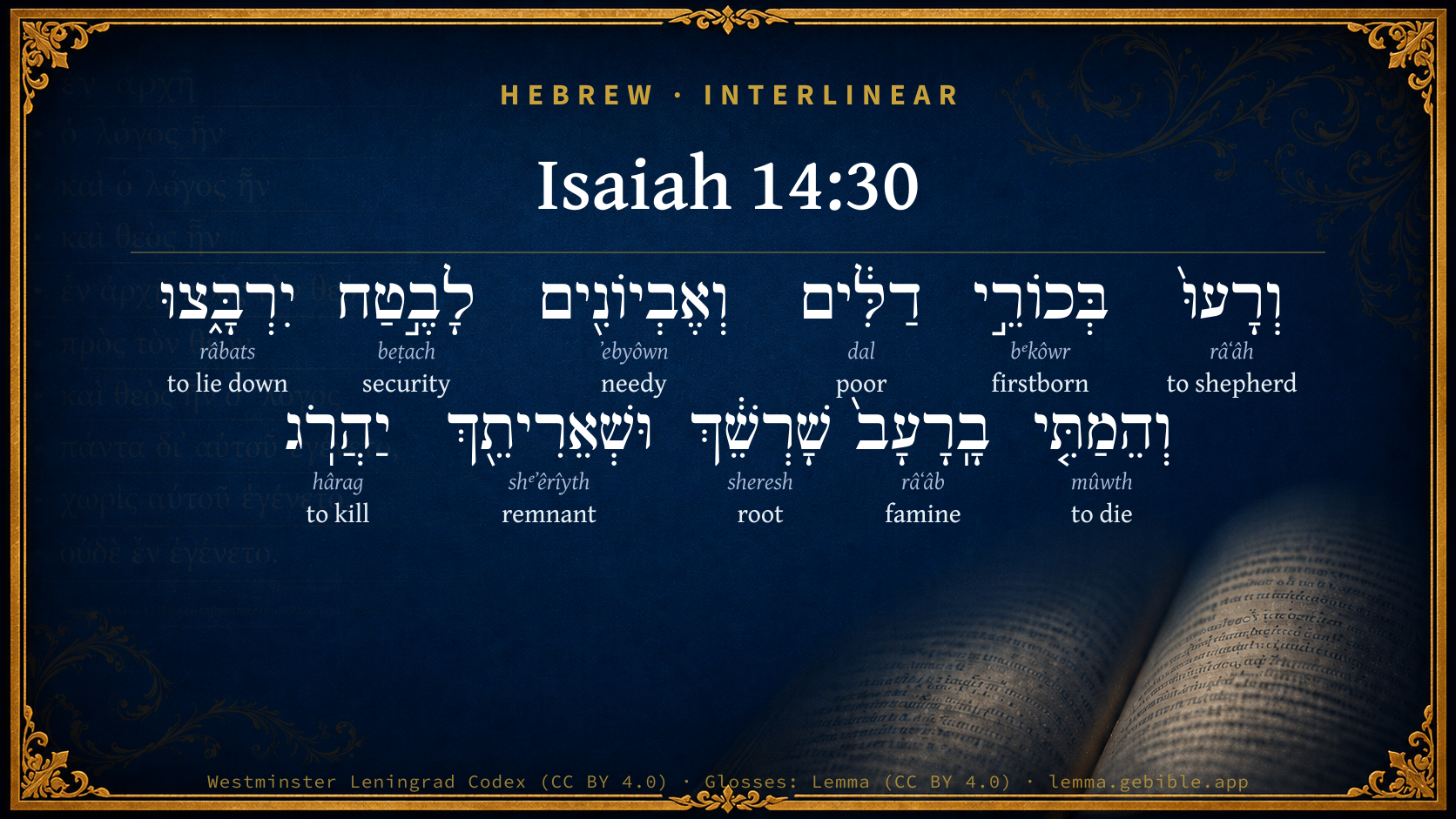
Hebrew (Westminster Leningrad Codex) Isaiah 14:30 appears in the Hebrew Old Testament. The text above is from the Westminster Leningrad Codex. Each word links to its Strong’s number, a concise gloss, and parsing drawn from the Open Scriptures Hebrew Bible morphology. Click any word for its full Brown-Driver-Briggs (BDB) entry.
Download image
Cite this verse

Isaiah 14:30 (World English Bible). Public Domain. Lemma interlinear Bible study tool, https://lemma.gebible.app/v/isaiah/14/30.

Show BibTeX & RIS
BibTeX
RIS
English Translation
The firstborn of the poor shall feed, and the needy shall lie down in safety; and I will kill your root with famine, and your remnant shall be killed.
World English Bible · Public Domain
Download a study sheet

One document with this verse’s original text, its word-by-word gloss line, the meaning frame, cross-references with their text, attributed commentary, and full source and license credits — printable, and it pastes into notes with its structure intact.

This verse Autodidact and up

Study sheet (.html) Plain text (.txt)

A passage Seminary Student

Up to 50 verses in one chapter. A passage sheet keeps up to 6 commentary sources and 12 cross-references per verse, in the order this page ranks them, and says so on the sheet whenever that leaves anything out. Ask for a single verse and you get the Autodidact verse sheet above.

Everything on this page stays free to read, with no account — the sheet is a download of what is already on screen, not access to it.

Want to remove ads? Support Godless Engineer
Compare translations 3

The same verse in 3 English versions, stacked beneath the original-language interlinear above. Click any original word for its lexicon entry.

Each is an independent rendering of the whole verse — the interlinear is not word-aligned to these translations.

Highlighted words mark where these versions differ — a whole-verse word diff, not a word-by-word alignment.

  • World English Bible Public Domain
    The firstborn of the poor shall feed, and the needy shall lie down in safety; and I will kill your root with famine, and your remnant shall be killed.
  • King James Version Public Domain
    And the firstborn of the poor shall feed, and the needy shall lie down in safety: and I will kill thy root with famine, and he shall slay thy remnant.
  • unfoldingWord Literal Text CC BY-SA 4.0
    And the firstborn of the poor will graze, and the needy will lie down in safety. But I will kill your root with famine, and it will slay your remnant.

unfoldingWord Literal Text — © unfoldingWord, licensed CC BY-SA 4.0. Word-aligned USFM3 via Door43 (git.door43.org/unfoldingWord/en_ult).

Versions to compare (up to 4)

3 of 4 selected

Show all 18 translations

Every available English version of this verse, each an independent rendering of the whole verse.

  • World English Bible Public Domain
    The firstborn of the poor shall feed, and the needy shall lie down in safety; and I will kill your root with famine, and your remnant shall be killed.
  • Berean Standard Bible Public Domain
    Then the firstborn of the poor will find pasture, and the needy will lie down in safety, but I will kill your root by famine, and your remnant will be slain.
  • Majority Standard Bible Public Domain
    Then the firstborn of the poor will find pasture, and the needy will lie down in safety, but I will kill your root by famine, and your remnant will be slain.
  • King James Version Public Domain
    And the firstborn of the poor shall feed, and the needy shall lie down in safety: and I will kill thy root with famine, and he shall slay thy remnant.
  • American Standard Version (1901) Public Domain
    And the first-born of the poor shall feed, and the needy shall lie down in safety; and I will kill thy root with famine, and thy remnant shall be slain.
  • Revised Version (1885) Public Domain
    And the firstborn of the poor shall feed, and the needy shall lie down in safety: and I will kill thy root with famine, and thy remnant shall be slain.
  • Geneva Bible (1599) Public Domain
    For the first borne of the poore shall be fed, and the needie shall lie downe in safetie: and I will kill thy roote with famine, and it shall slay thy remnant.
  • Douay-Rheims (1899) Public Domain
    And the firstborn of the poor shall be fed, and the poor shall rest with confidence: and I will make thy root perish with famine, and I will kill thy remnant.
  • Young's Literal Translation Public Domain
    And delighted have the first-born of the poor, And the needy in confidence lie down, And I have put to death with famine thy root, And thy remnant it slayeth.
  • Literal Standard Version CC BY-SA 4.0
    And the firstborn of the poor have delighted, || And the needy lie down in confidence, || And I have put to death your root with famine, || And it slays your remnant.
  • Unlocked Literal Bible CC BY-SA 4.0
    The firstborn of the poor will graze their sheep in my pastures, and the needy will lie down in safety. I will kill your root with famine that will put to death all your survivors.
  • unfoldingWord Literal Text CC BY-SA 4.0
    And the firstborn of the poor will graze, and the needy will lie down in safety. But I will kill your root with famine, and it will slay your remnant.
  • Darby Bible Public Domain
    And the firstborn of the poor shall feed, and the needy shall lie down in safety; but I will kill thy root with famine, and thy remnant shall be slain.
  • World Messianic Bible Public Domain
    The firstborn of the poor will eat, and the needy will lie down in safety; and I will kill your root with famine, and your remnant will be killed.
  • Webster's Bible Public Domain
    And the first-born of the poor shall feed, and the needy shall lie down in safety: and I will kill thy root with famine, and he shall slay thy remnant.
  • Free Bible Version CC BY-SA 4.0
    The poor will have food, and the needy will live in safety, but you Philistines will die in a famine, and I will kill those who survive.
  • Bible in Basic English Public Domain
    And the poorest of the land will have food, and those in need will be given a safe resting-place: but your seed will come to an end for need of food, and the rest of you will be put to the sword.
  • JPS Tanakh (1917) Public Domain
    And the first-born of the poor shall feed, and the needy shall lie down in safety; and I will kill thy root with famine, and thy remnant shall be slain.

Literal Standard Version (2020), Covenant Press — licensed CC BY-SA 4.0. Text via the HelloAO Bible API (eBible.org). Unlocked Literal Bible (unfoldingWord) — licensed CC BY-SA 4.0. Text via the HelloAO Bible API (eBible.org). unfoldingWord Literal Text — © unfoldingWord, licensed CC BY-SA 4.0. Word-aligned USFM3 via Door43 (git.door43.org/unfoldingWord/en_ult). Free Bible Version, Dr. Jonathan Gallagher — licensed CC BY-SA 4.0. Text via the HelloAO Bible API (eBible.org).

Word by word

More ways to search: Search by grammar → Find every occurrence → Compare this word →

Practice this passage: Drill this verse → Learn its vocabulary →

יִרְבָּ֑צוּ
râbats
H7257
“to lie down”
Verb, Qal, Imperfect, 3rd Person, Masculine, Plural
Part of Speech
Verb
Stem
Qal
Form
Imperfect
Person
3rd Person
Gender
Masculine
Number
Plural
Full BDB Definition

Origin: a primitive root

TWOT: 2109

to stretch oneself out, lie down, lie stretched out - (Qal) to lie down, lie - (Hiphil) to cause to lie down - laying (stones)
  1. וְרָעוּ֙ râʻâh H7462 “and · to shepherd” Conjunction + Verb, Qal, Sequential Perfect, 3rd Person, Common, Plural
  2. בְּכוֹרֵ֣י bᵉkôwr H1060 “firstborn of” Noun, Common, Masculine, Plural, Construct
  3. דַלִּ֔ים dal H1800 “poor” Adjective, Adjective, Masculine, Plural, Absolute
  4. וְאֶבְיוֹנִ֖ים ʼebyôwn H34 “and · needy” Conjunction + Adjective, Adjective, Masculine, Plural, Absolute
  5. לָבֶ֣טַח beṭach H983 “to/for · security” Preposition + Noun, Common, Masculine, Singular, Absolute
  6. וְהֵמַתִּ֤י mûwth H4191 “and · to die” Conjunction + Verb, Hiphil, Sequential Perfect, 1st Person, Common, Singular
  7. בָֽרָעָב֙ râʻâb H7458 “in/at the · famine” Preposition, Determined + Noun, Common, Masculine, Singular, Absolute
  8. שָׁרְשֵׁ֔ךְ sheresh H8328 “root · your” Noun, Common, Masculine, Singular, Construct + Suffix, Personal, 2nd Person, Feminine, Singular
  9. וּשְׁאֵרִיתֵ֖ךְ shᵉʼêrîyth H7611 “and · remnant · your” Conjunction + Noun, Common, Feminine, Singular, Construct + Suffix, Personal, 2nd Person, Feminine, Singular
  10. יַהֲרֹֽג hârag H2026 “to kill” Verb, Qal, Imperfect, 3rd Person, Masculine, Singular

About this verse

These counts appear in no published source. They are computed here, from the morphology-tagged text and Lemma’s own curated glosses. What Lemma adds →

11
words
11
distinct lemmas
Prophets
section

Shared distinctive vocabulary

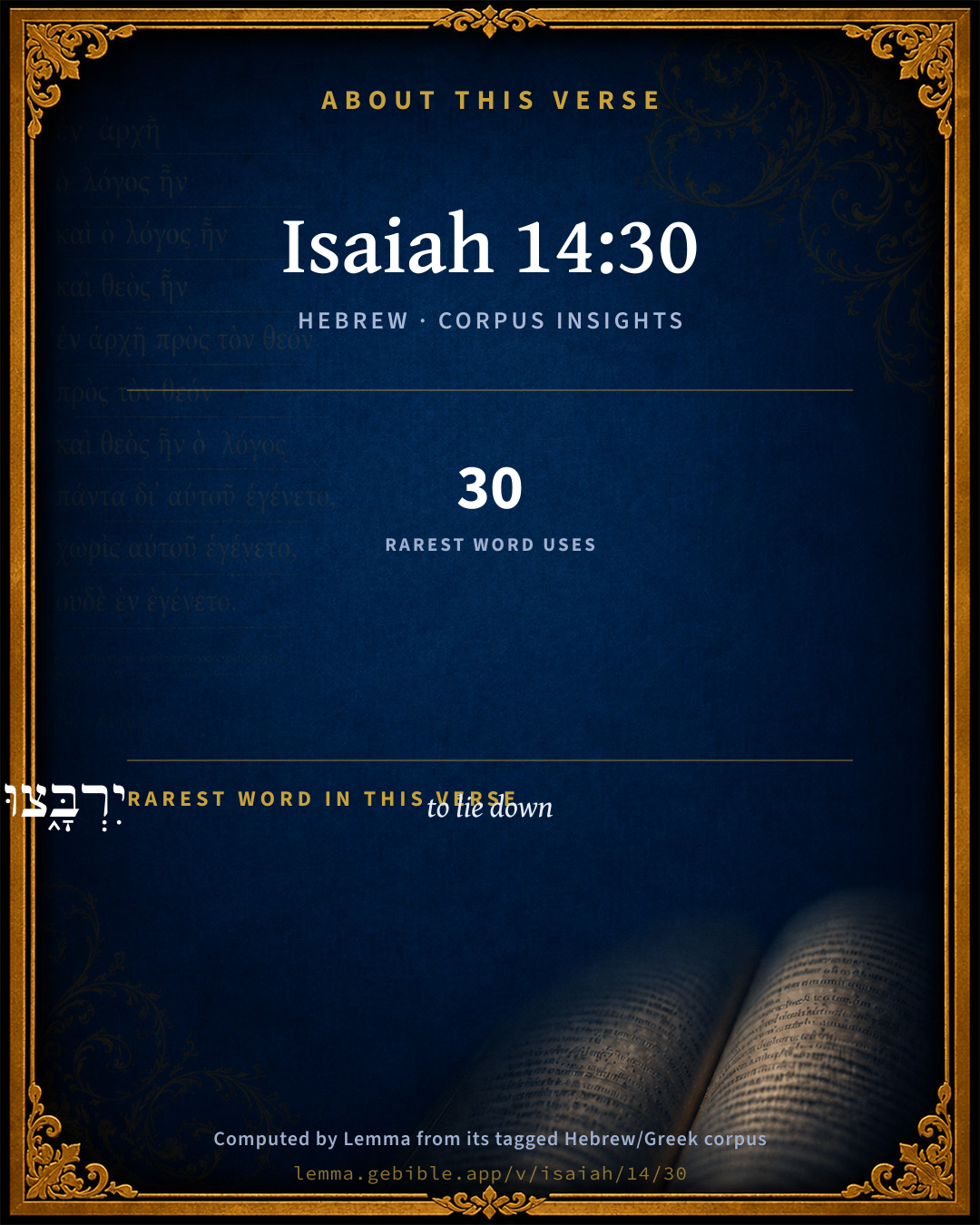
יִרְבָּ֑צוּ to lie down H7257 occurs in 30 verses of the Hebrew Bible. Also found in:

Grammatical profile

  • 4 verbs
  • 5 nouns
  • 2 adjectives

Verb forms

  • וְרָעוּ֙ Qal · Sequential Perfect
  • יִרְבָּ֑צוּ Qal · Imperfect
  • וְהֵמַתִּ֤י Hiphil · Sequential Perfect
  • יַהֲרֹֽג Qal · Imperfect

Hebrew & Septuagint length

In English translation the verse runs 29 words from the Hebrew and 28 from the Septuagint (LXX English) — closely comparable.

A rough comparison of the two English renderings, which tokenize alike — not a word-level alignment.

Word counts can differ between the Hebrew and the Greek without any difference in meaning — e.g. the Hebrew direct-object marker אֵת has no separate Greek word, and Greek often adds the article ὁ.

Cross-references

17

Topical passages linked to Isaiah 14:30 in the Treasury of Scripture Knowledge — connected by theme and wording, ordered by reader-vote popularity; previews shown in the World English Bible.

  • Isaiah 7:21–22 It shall happen in that day that a man shall keep alive a young cow, and two sheep;
  • Zephaniah 2:4–7 For Gaza will be forsaken, and Ashkelon a desolation. They will drive out Ashdod at noonday, and Ekron will be rooted up.
  • Job 18:13 The members of his body shall be devoured, The firstborn of death shall devour his members.
  • Isaiah 3:15 What do you mean that you crush my people, And grind the face of the poor?" says the Lord, Yahweh of Hosts.
  • Isaiah 5:17 Then the lambs will graze as in their pasture, And strangers will eat the ruins of the rich.
  • Isaiah 8:21 They shall pass through it, sore distressed and hungry; and it shall happen that when they shall be hungry, they shall fret themselves, and curse by their king and by their God, and turn their faces upward:
  • Isaiah 9:20 One shall snatch on the right hand, and be hungry; and he shall eat on the left hand, and they shall not be satisfied: they shall eat every man the flesh of his own arm:
  • Isaiah 30:23–24 He will give the rain for your seed, with which you shall sow the ground; and bread of the increase of the ground, and it shall be fat and plenteous. In that day shall your cattle feed in large pastures;
  • Isaiah 33:16 He shall dwell on high; his place of defense shall be the munitions of rocks; his bread shall be given [him]; his waters shall be sure.
  • Isaiah 37:30 This shall be the sign to you: you shall eat this year that which grows of itself, and in the second year that which springs of the same; and in the third year sow you, and reap, and plant vineyards, and eat the fruit of it.
  • Isaiah 51:19 These two things have happened to you. Who will bemoan you? Desolation and destruction, and the famine and the sword; how shall I comfort you?
  • Isaiah 65:13–14 Therefore thus says the Lord Yahweh, Behold, my servants shall eat, but you shall be hungry; behold, my servants shall drink, but you shall be thirsty; behold, my servants shall rejoice, but you shall be disappointed;
  • Jeremiah 47:1–7 The word of Yahweh that came to Jeremiah the prophet concerning the Philistines, before that Pharaoh struck Gaza.
  • Ezekiel 25:15–17 Thus says the Lord Yahweh: Because the Philistines have dealt by revenge, and have taken vengeance with despite of soul to destroy with perpetual enmity;
  • Joel 3:4–8 "Yes, and what are you to me, Tyre, and Sidon, And all the regions of Philistia? Will you repay me? And if you repay me, I will swiftly and speedily return your repayment on your own head.
  • Amos 1:6–8 Thus says Yahweh: "For three transgressions of Gaza, yes, for four, I will not turn away its punishment; Because they carried away captive the whole community, To deliver them up to Edom;
  • Zechariah 9:5–7 Ashkelon will see it, and fear; Gaza also, and will writhe in agony; As will Ekron, for her expectation will be disappointed; And the king will perish from Gaza, And Ashkelon will not be inhabited.

Cross-references courtesy of OpenBible.info (CC BY 4.0).

Hebrew and Greek witnesses Masoretic Hebrew ↔ Greek Septuagint

The same verse in the two great witnesses to the Old Testament, shown verse-for-verse.

These are two independent witnesses, not word-aligned to each other, and the Septuagint is shown in lemma (dictionary) form.

Hebrew Isaiah 14:30 Masoretic · Westminster Leningrad Codex

וְרָעוּ֙ בְּכוֹרֵ֣י דַלִּ֔ים וְאֶבְיוֹנִ֖ים לָבֶ֣טַח יִרְבָּ֑צוּ וְהֵמַתִּ֤י בָֽרָעָב֙ שָׁרְשֵׁ֔ךְ וּשְׁאֵרִיתֵ֖ךְ יַהֲרֹֽג

The firstborn of the poor shall feed, and the needy shall lie down in safety; and I will kill your root with famine, and your remnant shall be killed.

World English Bible · Public Domain

Greek LXX Isaiah 14:30 Septuagint · lemma form

καί βόσκω πτωχός διά αὐτός πτωχός δέ ἀνήρ ἐπί εἰρήνη ἀναπαύω ἀνααἱρέω δέ λιμός ὁ σπέρμα σύ καί ὁ καταλείμμα σύ ἀνααἱρέω

And the poor shall be fed by him, and poor men shall rest in peace: but he shall destroy your seed with hunger, and shall destroy your remnant.

LXX2012 (modern English Septuagint) · Public Domain

On this verse, Adam Clarke's Commentary discusses the Septuagint’s reading. Read the note in Commentary ↓

Hebrew: Westminster Leningrad Codex (CC BY 4.0). Greek: Septuagint (public domain); English from LXX2012 (modern English Septuagint) (Public Domain). How the Septuagint differs from the Hebrew →

Targum (Aramaic paraphrase)

1

The Targum is the ancient Jewish Aramaic paraphrase of the Hebrew Scriptures — an interpretive translation, not the Hebrew text itself. Onkelos (literal) and Pseudo-Jonathan (expansive) render the Torah, and Jonathan the Prophets. Coverage is partial: where no permissively-licensed English translation exists for a verse, only the Aramaic is shown. This is verse-level text, not a word-by-word alignment to the Hebrew.

  1. Targum Jonathan Prophets (Joshua–Malachi)
    וְיִתְפַּרְנְסוּן חֲשֵׁיכֵי עַמָא וְעִנְוְתָנַיָא בְּיוֹמוֹהִי לְרוֹחֲצָן יִשְׁרוֹן וְיֵמִית בְּכַפְנָא בְּנֵךְ וּשְׁאַר עַמִיךְ יִקְטוֹל:

    And the poor of my people shall be fed, and the meek in his days shall dwell in safety; and he shall slay with famine thy children, and the remnant of thy people he shall kill.

    Targum Jonathan — Aramaic: “Mikraot Gedolot” (public domain). English: “Sefaria Community Translation” (CC0 1.0 (public-domain dedication)); “London "Chaldee Paraphrase," 1871” (public domain). Text via Sefaria.

Commentary

Notes on Isaiah 14:30 from classic Christian and Jewish commentators (each source and its license shown beneath its notes). The classic Christian expositions comment on the surrounding passage and are grouped to its opening verse, so a note may address several verses; the Jewish commentaries on the Tanakh (Rashi and others) are per-verse, so they appear only where the commentator wrote on this verse.

Lemma curates 59 commentaries, every one of them public domain or Creative Commons licensed, each selected and text-cleaned for this edition rather than reprinted as found. About our sources →

Trapp's Complete Commentary

John Trapp

Isa 14:30 And the firstborn of the poor shall feed, and the needy shall lie down in safety: and I will kill thy root with famine, and he shall slay thy remnant.

Ver. 30. And the firstborn of the poor shall feed,] i.e., God’s poor people shall; who though never so poor - as they were at a very low ebb under Ahaz - were God’s "firstborn," and, in that respect, "higher than the kings of the earth." {Psa 89:27}

And I will kill thy root.] See Zep 2:4. {See Trapp on "Zep 2:4"}

John Trapp, A Commentary or Exposition upon All the Books of the Old and New Testament (1647–1656) — public domain. Text from a community e-Sword module.

Joseph Benson's Commentary

Isa 14:30. And the firstborn of the poor — Those who are most remarkably poor; shall feed — Shall have plenty of provisions, in spite of all thy attempts against them. The same Hezekiah, who shall be such a scourge to thee, Palestina, shall be a mild and gracious governor to his own subjects; he shall take care of them as a shepherd does of his flock, and relieve those who were oppressed in his father’s time. It is probable, that the inhabitants of the southern parts of Judea, who were particularly exposed to the incursions of the Philistines, the Idumeans, and the Arabs, are chiefly meant here by the firstborn of the poor: and concerning these the prophet foretels, that under Hezekiah’s government they should have food and security for themselves and flocks. And I will kill thy root, &c. — When the root is killed, the plant or tree is wholly destroyed. The meaning therefore is, I will utterly destroy thee, both root and branch, so that there shall be no remnant of thy people reserved, as it follows. This utter extirpation of the Philistines, here threatened, was begun by Hezekiah, and was completed by famine and various calamities, which came upon them afterward.

Joseph Benson's Commentary on the Old and New Testaments (1811–1818) — public domain. Text from a community e-Sword module.

Keil & Delitzsch

C. F. Keil & F. Delitzsch

The coming Davidic king is peace for Israel, but for Philistia death. "And the poorest of the poor will feed, and needy ones lie down in peace; and I kill thy root through hunger, and he slays thy remnant." "The poorest of the poor:" becōrē dallim is an intensified expression for benē dallim, the latter signifying such as belong to the family of the poor, the former (cf., Job 18:13, mors dirissima) such as hold the foremost rank in such a family - a description of Israel, which, although at present deeply, very deeply, repressed and threatened on every side, would then enjoy its land in quietness and peace (Zep 3:12-13). In this sense ורעוּ is used absolutely; and there is no necessity for Hupfeld's conjecture (Ps. ii. 258), that we should read בכרי (in my pastures). Israel rises again, but Philistia perishes even to a root and remnant; and the latter again falls a victim on the one hand to the judgment of God (famine), and on the other to the punishment inflicted by the house of David. The change of persons in Isa 14:30 is no synallage; but the subject to yaharōg (slays) is the basilisk, the father of the flying dragon. The first strophe of the massah terminates here. It consists of eight lines, each of the two Masoretic Isa 14:29, Isa 14:30 containing four clauses.

Keil & Delitzsch — Biblical Commentary on the Old Testament (1861–1891) — public domain (CC PDM 1.0). Text via the HelloAO Bible API. (Old Testament only.)

Geneva Bible (1599)

Geneva Bible translators

To wit, my people.

The Israelites, which were brought to most extreme misery.

Geneva Bible (1599) marginal notes — public domain. Text via Bolls.life.

Jamieson, Fausset & Brown

Robert Jamieson, A. R. Fausset & David Brown

first-born of . . . poor--Hebraism, for the most abject poor; the first-born being the foremost of the family. Compare "first-born of death" (Job 18:13), for the most fatal death. The Jews, heretofore exposed to Philistine invasions and alarms, shall be in safety. Compare Psa 72:4, "Children of the needy," expressing those "needy in condition."

feed--image from a flock feeding in safety.

root--radical destruction.

He shall slay--Jehovah shall. The change of person, "He" after "I," is a common Hebraism.

Jamieson, Fausset & Brown — Commentary Critical and Explanatory on the Whole Bible (1871) — public domain (CC PDM 1.0). Text via the HelloAO Bible API.

Adam Clarke's Commentary

Verse 30. And the first-born of the poor, c.] The Targum goes on applying all to the Messiah. "And the poor of the people shall he feed, and the humble shall dwell securely in his days: and he shall kill thy children with famine, and the remnant of thy people shall he slay."

I will kill - "He will slay"] The Septuagint reads המית hemith, in the third person, ανελει and so the Chaldee. The Vulgate remedies the confusion of persons in the present text, by reading both the verbs in the first person.

Adam Clarke's Commentary on the Bible (1810–1826) — public domain. Text from a community e-Sword/MySword module.

Ellicott's Commentary for English Readers

(30) And the firstborn of the poor shall feed.—As the “children of the needy” in Psa_72:4 are simply the poor as a class, so the “firstborn” are those who, as it were, inherit the double portion, not of riches, but of poverty. (Comp. “the firstborn of death” in Job_18:13.) The people spoken of are those of Judah, which in the days of Ahaz had been “brought very low” (2Ch_28:19). For these the prophet foretells a time of plenty; not so for Philistia. Either through the sieges of their towns or the devastation of their fields, they would be reduced to the last extremities of famine. With them there should be no “remnant” to return.

A Bible Commentary for English Readers, edited by Charles John Ellicott (1878–1897) — public domain. Text from a community e-Sword module.

The Cambridge Bible for Schools and Colleges

gen. ed. J. J. S. Perowne

30. While Philistia is utterly destroyed, Israel enjoys perfect security under Jehovah’s protection (see Isa_14:32).

the firstborn of the poor] must be explained as a superlative—“the poorest of the poor.” But many commentators prefer, by slightly altering the word for “firstborn,” to read “in my meadow the poor shall feed” (cf. Isa_30:23).

he shall slay] In spite of the change of person, the subject is still Jehovah, not the Assyrian. Or the verb might be equivalent to a passive, as in R.V. (“shall be slain”).

The Cambridge Bible for Schools and Colleges (gen. ed. J. J. S. Perowne; Cambridge University Press, 1878–1918) — public domain. Text from a community e-Sword module.

John Gill's Exposition

Howl, O gate,.... Or gates of the cities of Palestine; the magistrates that sat there to execute judgment, or the people that passed through there; or because now obliged to open to their enemies; wherefore, instead of rejoicing, they are called to howling:

cry, O city; or cities, the several cities of the land, as well as their chief, because of the destruction coming upon them. The Targum is,

"howl over thy gates, and cry over thy cities;''

or concerning them:

thou, whole Palestina, art dissolved; or "melted"; through fear of enemies coming upon them; or it may design the entire overthrow and dissolution of their state;

for there shall come from the north a smoke; a numerous army, raising a dust like smoke as they move along, and coming with great "swiftness", and very annoying. Some understand this of the Chaldean army under Nebuchadnezzar coming from Babylon, which lay north of Judea; so Aben Ezra; to which agrees Jer 47:1 but most interpret it of Hezekiah's army, which came from Judea: which, Kimchi says, lay north to the land of the Philistines. Cocceius is of opinion that the Roman army is here meant, which came from the north against Judea, called whole Palestine; which country came into the hands of the Jews after the taking of Tyre and Gaza by the Greeks, and therefore the sanhedrim, which sat in the gate, and the city of Jerusalem, are called upon to howl and cry. But the first of these senses seems best, since the utter destruction of Palestine was by the Chaldean army under Nebuchadnezzar; and so the prophecy from the time of Hezekiah, with which it begins, is carried on unto the entire dissolution of this country by the Babylonians.

And none shall be alone in his appointed times; when the times appointed are come, for the gathering, mustering, and marching of the army, whether Hezekiah's or the Chaldean, none shall stay at home; all will voluntarily and cheerfully flock unto it, and enlist themselves; nor will they separate or stray from it, but march on unanimously, and courageously engage the enemy, till the victory is obtained. Aben Ezra understands this of the Philistines, that they should not be able to abide alone in their palaces and houses, because of the smoke that should come in unto them.

John Gill's Exposition of the Whole Bible (1746–1763) — public domain (CC PDM 1.0). Text via the HelloAO Bible API.

Albert Barnes' Notes on the Bible

And the first-born of the poor shall feed - That is, there shall be safety to those parts of Judah which have long been exposed to the invasions of the Philistines. Philistia bordered on Judea, and was constantly making wars upon it, so that there was no safety felt. Isaiah now says, that Hezekiah would so effectually and completely subdue them that there should be no danger from their invasion. The phrase ‘the first-born of the poor’ is an Hebraism, a strong, emphatic expression, denoting those who are the most poor; the most abject sons of poverty; those who have an eminence or a double portion of need, as the first-born among the Hebrews were entitled to special distinctions and privileges. The idea is, that even the most poor and defenseless would be safe.

Shall feed - That is, they shall be supplied with food; they shall feed safely as a flock does that is guarded from wild beasts. They shall be no longer alarmed, but shall dwell in security, peace, and plenty.

And I will kill thy root - The word rendered ‘root’ denotes properly the root of a plant, which being dried up or killed, the plant of course withers and dies. So God says that he would effectually and entirely destroy the power of the Philistines.

Slay thy remnant - That is, shall slay all that pertains to thee. Or, he shall dry up the root, and the branches shall wither and die also. The whole power of the nation shall be withered and destroyed.

Albert Barnes' Notes on the Bible (1834–1885) — public domain. Text from a community e-Sword/MySword module.

Matthew Poole's English Annotations

The first-born of the poor; the people of the Jews, who are brought to extreme poverty by the cruelty and the malice of other enemies. The first-born were the chief of all the children. Hence the title of first-born is given to persons or things which are most eminent in their kinds, as to the people of Israel, Exo 4:22, to David, Psa 89:27, to a grievous death, Job 18:13, and here to persons eminently poor.

Shall feed; shall have plenty of provisions, in spite of all thine attempts against them.

I will kill thy root; I will utterly destroy thee both root and branch, so that there shall not be a remnant of thy people reserved, as it follows. It is a metaphor from a tree, which for want of nourishment is dried up by the roots.

Matthew Poole's English Annotations on the Holy Bible (1683–1685) — public domain. Text from a community e-Sword/MySword module.

Whedon's Commentary on the Bible

Daniel D. Whedon

30. Firstborn of the poor — Or, sons of the poor,

God’s own — the lowly; here, his true people in Judah.

Feed… lie down — The figures are from a flock of sheep — shall feed quietly, undisturbed by Philistine skirmishes.

Thy root — Compare Amo_2:9.

Slay thy remnant — Make a radical destruction of thee.

Daniel D. Whedon (gen. ed.), Commentary on the Old and New Testaments (1874–1909) — public domain. Text from a community e-Sword module.

The Pulpit Commentary

The firstborn of the poor shall feed. The "firstborn of the poor" are the very poor (Jarchi, Rosenm The refer-once is to the poor Israelites, who will "feed" and "lie down in safety" when Philistia is held in subjection. I will kill thy root with famine, and he shall slay thy remnant. God kills with famine, man with the sword. (see 2Sa_24:13, 2Sa_24:14) When the Philistines had resisted behind their strong walls till hunger had done its work by thinning their ranks, the Assyrian conqueror would storm their strongholds and slaughter "the remnant."

The Pulpit Commentary (1880–1919), ed. H.D.M. Spence-Jones & Joseph S. Exell — public domain. Text from a community e-Sword module.

John Wesley's Explanatory Notes

The poor - The people of the Jews, who are brought to extreme poverty. The title of first-born is given to persons or things which are most eminent in their kinds, as to the people of Israel, Exod. iv, 22, to David, Psalm lxxxix, 27 Job xviii, 13, and here to persons eminently poor. Feed - Shall have plenty of provisions. Kill - I will utterly destroy thee both root and branch.

John Wesley, Explanatory Notes Upon the Whole Bible (1754–1765) — public domain. Text via the GEBible commentary corpus.

J. A. Alexander on Isaiah

Joseph Addison Alexander

“And the first-born of the poor shall feed, and the needy in security lie down, and I will kill thy root with famine, and thy remnant it shall slay.” The future condition of the Jews is here contrasted with that of the Philistines. The figures in the first clause are borrowed from a flock, in the second from a tree, but with obvious allusion to a human subject. The first-born of the poor is a superlative expression for the poorest and most wretched. An allusion to the next generation leaves the promise too remote and the expression first-born unexplained. The figurative part of the last clause is borrowed from a tree, here divided into two parts, the root and the rest or remainder. What is first mentioned as an instrument in God’s hand, reappears in the last member of the sentence as an agent,

Joseph Addison Alexander, The Prophecies of Isaiah (1846–1847; New York: Scribner, 1870–1878) — public domain. Text from a community e-Sword module.

Rashi

Rabbi Shlomo Yitzchaki (Rashi)

And the first born of the poor shall graze In his days, the princes of Israel, who are now poor because of you, shall graze. “Firstborn,” is an expression of princes. Comp. (Ps. 89:28) “Also, I will appoint him My firstborn.”

Rashi on the Tanakh — English translations: “The Judaica Press complete Tanach with Rashi, translated by A. J. Rosenberg” (CC BY 4.0); “Pentateuch with Rashi's commentary by M. Rosenbaum and A.M. Silbermann, 1929-1934” (public domain); “The Metsudah Tanach series, Lakewood, N.J” (CC BY 4.0); and “The Book of Joshua, Metsudah Publications, 1997” (CC BY 4.0). Text via Sefaria.

Ibn Ezra

Rabbi Abraham ibn Ezra

בכורי דלים The firstborn of the poor. Israel, who had become impoverished sooner than any other nation,—Israel shall enjoy abundance and safety; the opposite fate shall befall the Philistines.

Thy root. The fathers.

ואחריתך And thy remnant Thy children; comp. לאחריתו to his posterity (Dan. 11:4)

Ibn Ezra on the Tanakh — English translations: “Sefaria Community Translation” (CC0 1.0 (public-domain dedication)); “Yalkut, Sifsei Chachomim Chumash, Metsudah Publications, 2009” (CC BY 4.0); and “Commentary of Ibn Ezra on Isaiah - trans. by M. Friedlander, 1873” (public domain). Text via Sefaria.

Lesson kit

Teaching starters — assembled from the data on this page, not authored interpretation. Every prompt links to the verse data it draws on. Edit before teaching.

Isaiah, in the Prophets, opens this verse with 11 words (11 distinct Hebrew lemmas). Its most distinctive word is râbats (“to lie down”). A historical commentator’s framing appears above. Read the whole chapter for the surrounding context.

Discussion questions

  1. How does “to lie down” (râbats) shape what this verse is saying?
  2. How does Genesis 4:7, which shares the word «to lie down», read alongside this verse?
  3. These translations render this verse differently; the difference is in the English rendering, not the original. What questions does that raise?
  4. «וְרָעוּ֙» is a Qal Sequential Perfect verb. How does that grammatical form shape the action described?
  5. Compare how Trapp's Complete Commentary and Joseph Benson's Commentary read this verse. Where do they agree or differ?

Things to notice

Reading settings

Reading text

Shown beneath each verse's original-language words.

Old Testament
Old Testament edition

Read the OT as the Masoretic Hebrew (MT) or the Greek Septuagint (LXX).

English shown for the Greek Septuagint (in the Hebrew ↔ Greek comparison).

Comparing translations? Open the Compare panel on any verse page to stack up to four side by side.