Numbers 31:17

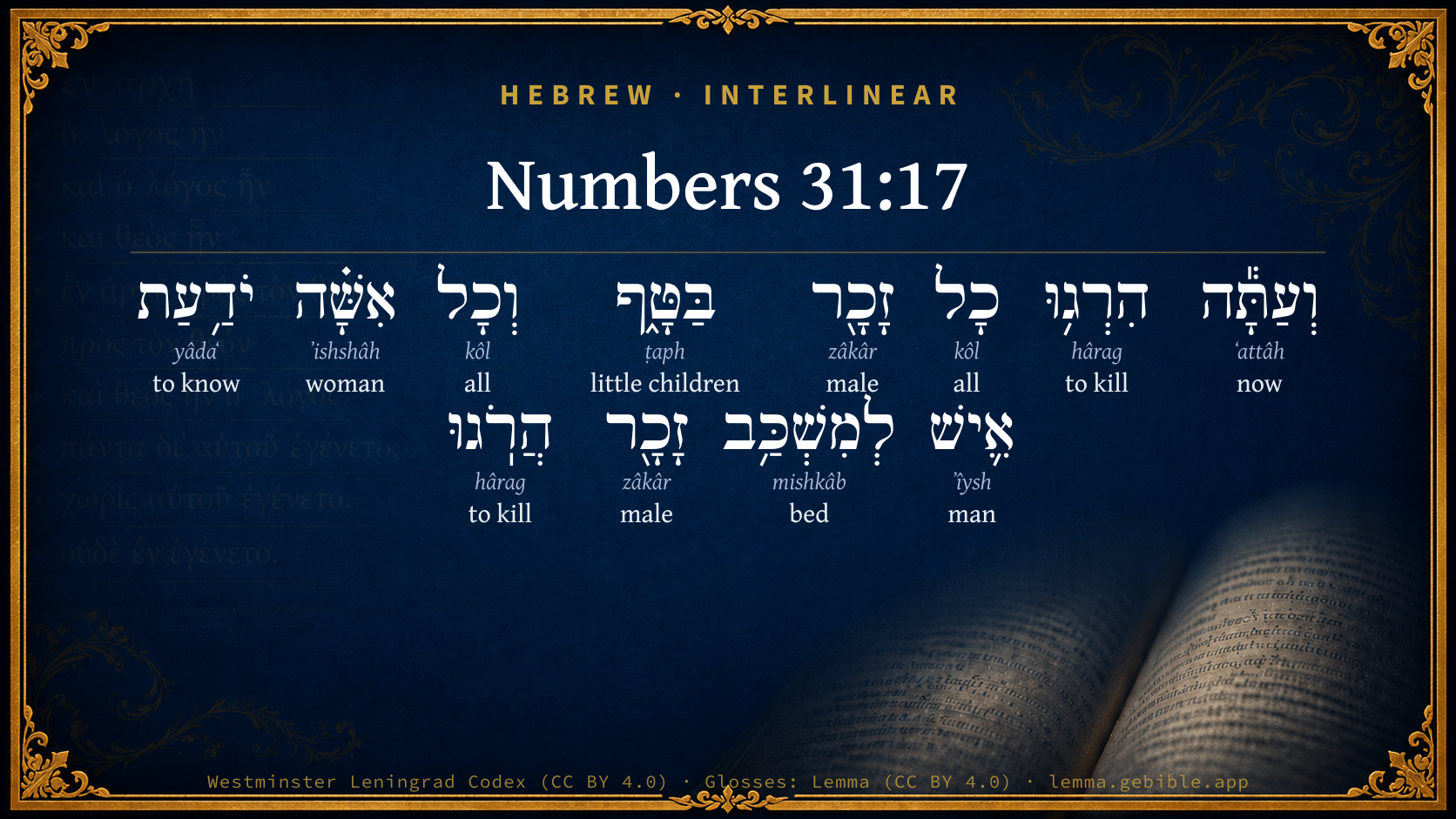
Hebrew (Westminster Leningrad Codex) Numbers 31:17 appears in the Hebrew Old Testament. The text above is from the Westminster Leningrad Codex. Each word links to its Strong’s number, a concise gloss, and parsing drawn from the Open Scriptures Hebrew Bible morphology. Click any word for its full Brown-Driver-Briggs (BDB) entry.
Download image
Cite this verse

Numbers 31:17 (World English Bible). Public Domain. Lemma interlinear Bible study tool, https://lemma.gebible.app/v/numbers/31/17.

Show BibTeX & RIS
BibTeX
RIS
English Translation
Now therefore kill every male among the little ones, and kill every woman who has known man by lying with him.
World English Bible · Public Domain
Download a study sheet

One document with this verse’s original text, its word-by-word gloss line, the meaning frame, cross-references with their text, attributed commentary, and full source and license credits — printable, and it pastes into notes with its structure intact.

This verse Autodidact and up

Study sheet (.html) Plain text (.txt)

A passage Seminary Student

Up to 50 verses in one chapter. A passage sheet keeps up to 6 commentary sources and 12 cross-references per verse, in the order this page ranks them, and says so on the sheet whenever that leaves anything out. Ask for a single verse and you get the Autodidact verse sheet above.

Everything on this page stays free to read, with no account — the sheet is a download of what is already on screen, not access to it.

Want to remove ads? Support Godless Engineer
Compare translations 3

The same verse in 3 English versions, stacked beneath the original-language interlinear above. Click any original word for its lexicon entry.

Each is an independent rendering of the whole verse — the interlinear is not word-aligned to these translations.

Highlighted words mark where these versions differ — a whole-verse word diff, not a word-by-word alignment.

  • World English Bible Public Domain
    Now therefore kill every male among the little ones, and kill every woman who has known man by lying with him.
  • King James Version Public Domain
    Now therefore kill every male among the little ones, and kill every woman that hath known man by lying with him.
  • unfoldingWord Literal Text CC BY-SA 4.0
    And now, slay every male among the children and slay every woman who has known a man by the bed of a male.

unfoldingWord Literal Text — © unfoldingWord, licensed CC BY-SA 4.0. Word-aligned USFM3 via Door43 (git.door43.org/unfoldingWord/en_ult).

Versions to compare (up to 4)

3 of 4 selected

Show all 18 translations

Every available English version of this verse, each an independent rendering of the whole verse.

  • World English Bible Public Domain
    Now therefore kill every male among the little ones, and kill every woman who has known man by lying with him.
  • Berean Standard Bible Public Domain
    So now, kill all the boys, as well as every woman who has had relations with a man,
  • Majority Standard Bible Public Domain
    So now, kill all the boys, as well as every woman who has had relations with a man,
  • King James Version Public Domain
    Now therefore kill every male among the little ones, and kill every woman that hath known man by lying with him.
  • American Standard Version (1901) Public Domain
    Now therefore kill every male among the little ones, and kill every woman that hath known man by lying with him.
  • Revised Version (1885) Public Domain
    Now therefore kill every male among the little ones, and kill every woman that hath known man by lying with him.
  • Geneva Bible (1599) Public Domain
    Now therefore, slay all the males among the children, and kill all the women that haue knowen man by carnall copulation.
  • Douay-Rheims (1899) Public Domain
    Therefore kill all that are of the male sex, even of the children: and put to death the women, that have carnally known men.
  • Young's Literal Translation Public Domain
    `And now, slay ye every male among the infants, yea, every woman known of man by the lying of a male ye have slain;
  • Literal Standard Version CC BY-SA 4.0
    And now, slay every male among the infants, indeed, slay every woman knowing a man by the lying of a male;
  • Unlocked Literal Bible CC BY-SA 4.0
    Now then, kill every male among the little ones, and kill every woman who has ever slept with a man.
  • unfoldingWord Literal Text CC BY-SA 4.0
    And now, slay every male among the children and slay every woman who has known a man by the bed of a male.
  • Darby Bible Public Domain
    And now slay every male among the little ones, and slay every woman that hath known man by lying with him,
  • World Messianic Bible Public Domain
    Now therefore kill every male among the little ones, and kill every woman who has known man by lying with him.
  • Webster's Bible Public Domain
    Now therefore kill every male among the little ones, and kill every woman that hath known man by lying with him.
  • Free Bible Version CC BY-SA 4.0
    So go and kill all the boys, and every woman who has slept with a man.
  • Bible in Basic English Public Domain
    So now put every male child to death, and every woman who has had sex relations with a man.
  • JPS Tanakh (1917) Public Domain
    Now therefore kill every male among the little ones, and kill every woman that hath known man by lying with him.

Literal Standard Version (2020), Covenant Press — licensed CC BY-SA 4.0. Text via the HelloAO Bible API (eBible.org). Unlocked Literal Bible (unfoldingWord) — licensed CC BY-SA 4.0. Text via the HelloAO Bible API (eBible.org). unfoldingWord Literal Text — © unfoldingWord, licensed CC BY-SA 4.0. Word-aligned USFM3 via Door43 (git.door43.org/unfoldingWord/en_ult). Free Bible Version, Dr. Jonathan Gallagher — licensed CC BY-SA 4.0. Text via the HelloAO Bible API (eBible.org).

Word by word

More ways to search: Search by grammar → Find every occurrence → Compare this word →

Practice this passage: Drill this verse → Learn its vocabulary →

בַּטָּ֑ף
ṭaph
H2945
“in/at the · little children”
Preposition, Determined + Noun, Common, Masculine, Singular, Absolute
Part of Speech
Preposition + Noun
Type
Common
Gender
Masculine
Number
Singular
State
Absolute
Full BDB Definition

Origin: from H2952 (perhaps referring to the tripping gait of children)

TWOT: 821a

children, little children, little ones
  1. וְעַתָּ֕ה ʻattâh H6258 “and · now” Conjunction + Adverb
  2. הִרְג֥וּ hârag H2026 “kill” Verb, Qal, Imperative, 2nd Person, Masculine, Plural
  3. כָל kôl H3605 “all of” Noun, Common, Masculine, Singular, Construct
  4. זָכָ֖ר zâkâr H2145 “male” Adjective, Adjective, Masculine, Singular, Absolute
  5. וְכָל kôl H3605 “and · all of” Conjunction + Noun, Common, Masculine, Singular, Construct
  6. אִשָּׁ֗ה ʼishshâh H802 “woman” Noun, Common, Feminine, Singular, Absolute
  7. יֹדַ֥עַת yâdaʻ H3045 “knowing” Verb, Qal, Participle Active, Feminine, Singular, Absolute
  8. אִ֛ישׁ ʼîysh H376 “man” Noun, Common, Masculine, Singular, Absolute
  9. לְמִשְׁכַּ֥ב mishkâb H4904 “to/for · bed of” Preposition + Noun, Common, Masculine, Singular, Construct
  10. זָכָ֖ר zâkâr H2145 “male” Adjective, Adjective, Masculine, Singular, Absolute
  11. הֲרֹֽגוּ hârag H2026 “kill” Verb, Qal, Imperative, 2nd Person, Masculine, Plural

About this verse

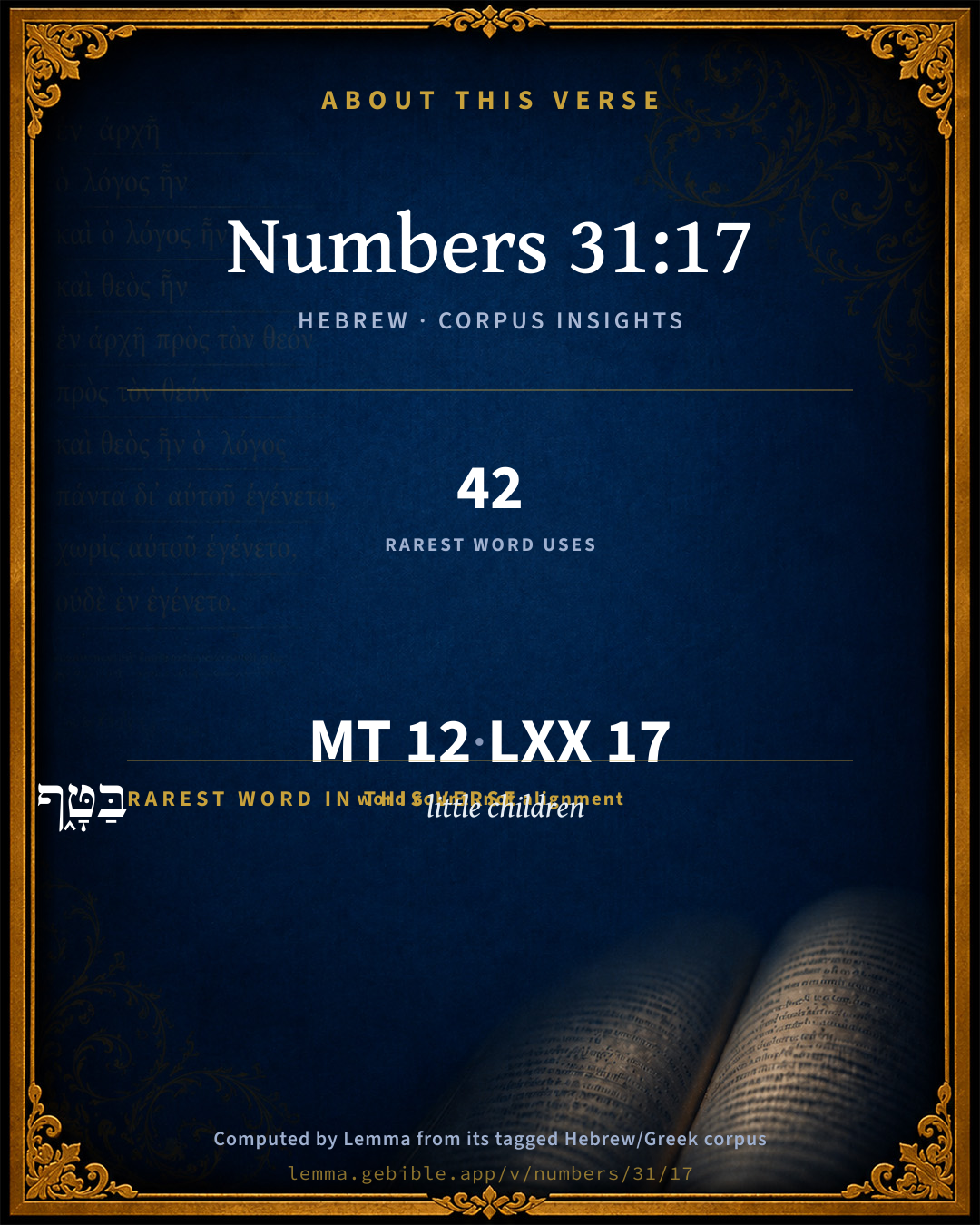
These counts appear in no published source. They are computed here, from the morphology-tagged text and Lemma’s own curated glosses. What Lemma adds →

12
words
9
distinct lemmas
Pentateuch
section

Shared distinctive vocabulary

בַּטָּ֑ף little children H2945 occurs in 42 verses of the Hebrew Bible. Also found in:

Grammatical profile

  • 3 verbs
  • 6 nouns
  • 2 adjectives
  • 1 adverb

Verb forms

  • הִרְג֥וּ Qal · Imperative
  • יֹדַ֥עַת Qal · Participle Active
  • הֲרֹֽגוּ Qal · Imperative

Repetition

Words recur within this verse — often emphatic in Hebrew:

  • הִרְג֥וּ to kill H2026 ×2
  • כָל all H3605 ×2
  • זָכָ֖ר male H2145 ×2

Hebrew & Septuagint length

In English translation the verse runs 21 words from the Hebrew and 19 from the Septuagint (LXX English) — closely comparable.

A rough comparison of the two English renderings, which tokenize alike — not a word-level alignment.

Word counts can differ between the Hebrew and the Greek without any difference in meaning — e.g. the Hebrew direct-object marker אֵת has no separate Greek word, and Greek often adds the article ὁ.

In the original languages it is 12 Hebrew tokens and 17 Greek tokens — but the two are counted differently (Hebrew bundles its prefixes and suffixes into one token; the Greek is in lemma form), so that isn’t a like-for-like length.

Cross-references

3

Topical passages linked to Numbers 31:17 in the Treasury of Scripture Knowledge — connected by theme and wording, ordered by reader-vote popularity; previews shown in the World English Bible.

  • Deuteronomy 7:2 and when Yahweh your God shall deliver them up before you, and you shall strike them; then you shall utterly destroy them: you shall make no covenant with them, nor show mercy to them;
  • Deuteronomy 20:16–18 But of the cities of these peoples, that Yahweh your God gives you for an inheritance, you shall save alive nothing that breathes;
  • Judges 21:11–12 This is the thing that you shall do: you shall utterly destroy every male, and every woman who has lain by man.

Cross-references courtesy of OpenBible.info (CC BY 4.0).

Hebrew and Greek witnesses Masoretic Hebrew ↔ Greek Septuagint

The same verse in the two great witnesses to the Old Testament, shown verse-for-verse.

These are two independent witnesses, not word-aligned to each other, and the Septuagint is shown in lemma (dictionary) form.

Hebrew Numbers 31:17 Masoretic · Westminster Leningrad Codex

וְעַתָּ֕ה הִרְג֥וּ כָל זָכָ֖ר בַּטָּ֑ף וְכָל אִשָּׁ֗ה יֹדַ֥עַת אִ֛ישׁ לְמִשְׁכַּ֥ב זָכָ֖ר הֲרֹֽגוּ

Now therefore kill every male among the little ones, and kill every woman who has known man by lying with him.

World English Bible · Public Domain

Greek LXX Numbers 31:17 Septuagint · lemma form

καί νῦν ἀποκτείνω πᾶς ἀρσενικός ἐν πᾶς ὁ ἀπαρτία καί πᾶς γυνή ὅστις γιγνώσκω κοίτη ἄρσην ἀποκτείνω

Now then kill every male in all the spoil, kill every woman, who has known the lying with man.

LXX2012 (modern English Septuagint) · Public Domain

Hebrew: Westminster Leningrad Codex (CC BY 4.0). Greek: Septuagint (public domain); English from LXX2012 (modern English Septuagint) (Public Domain). How the Septuagint differs from the Hebrew →

Targum (Aramaic paraphrase)

2

The Targum is the ancient Jewish Aramaic paraphrase of the Hebrew Scriptures — an interpretive translation, not the Hebrew text itself. Onkelos (literal) and Pseudo-Jonathan (expansive) render the Torah, and Jonathan the Prophets. Coverage is partial: where no permissively-licensed English translation exists for a verse, only the Aramaic is shown. This is verse-level text, not a word-by-word alignment to the Hebrew.

  1. Targum Onkelos Torah (Genesis–Deuteronomy)
    וּכְעַן קְטוּלוּ כָּל דְכוּרָא בְּטַפְלָא וְכָל אִתְּתָא דִידַעַת גְבַר לְמִשְׁכַּב דְכוּרָא קְטּוּלוּ

    (no public-domain English translation for this verse)

    Targum Onkelos — Aramaic: “Onkelos Genesis” (public domain); “Onkelos Exodus” (public domain); “Onkelos Leviticus” (public domain); “Onkelos Numbers” (public domain); “Onkelos Deuteronomy” (public domain). English: “Sefaria Community Translation” (CC0 1.0 (public-domain dedication)); “J.W. Etheridge. The Targums of Onkelos and Jonathan Ben Uzziel on the Pentateuch. London: Longmans, Green, 1862” (public domain). Text via Sefaria.

  2. Targum Pseudo-Jonathan Torah (Genesis–Deuteronomy)
    וּכְדוּן קְטוּלוּ כָּל דְכוּרָא בְּטַפְלַיָא וְכָל אִתְּתָא דְיָדְעַת גְבַר לְמִשְׁכְּבֵי דְכוּרָא קְטוּלוּ

    Now, therefore, slay every male among the children, and every woman who hath known a man;

    Targum Pseudo-Jonathan — Aramaic: “Targum Jonathan on Genesis” (public domain); “Targum Jonathan on Exodus” (public domain); “Targum Jonathan on Leviticus” (public domain); “Targum Jonathan on Numbers” (public domain); “Targum Jonathan on Deuteronomy” (public domain). English: “The Targum of Jonathan ben Uzziel, trans. J. W. Etheridge, London, 1862” (public domain). Text via Sefaria.

Commentary

Notes on Numbers 31:17 from classic Christian and Jewish commentators (each source and its license shown beneath its notes). The classic Christian expositions comment on the surrounding passage and are grouped to its opening verse, so a note may address several verses; the Jewish commentaries on the Tanakh (Rashi and others) are per-verse, so they appear only where the commentator wrote on this verse.

Lemma curates 59 commentaries, every one of them public domain or Creative Commons licensed, each selected and text-cleaned for this edition rather than reprinted as found. About our sources →

Joseph Benson's Commentary

Num 31:17. Kill every male among the little ones — Which they were forbidden to do to other people, (Deu 20:14,) except the Canaanites, to whom this people had equalled themselves by their horrid crimes; and therefore it is not strange, nor unjust, that God, the supreme Lord of all men’s lives, who, as he gives them, so may take them away when he pleaseth, did equal them in the punishment. Kill every woman, &c.— Partly for punishment, as having, in general, either prostituted themselves to the Israelites, or some way been accessary in enticing them to idolatry, in which they were so confirmed that there was no hope of reclaiming them; and partly for prevention of the like mischief in future; for had they been saved alive, they would probably have continued to lead the Israelites into the sin of fornication, and have poisoned their minds by their superstitions. The female children were to be spared, because, being young, there was some hope they might be reformed from idolatry, and become proselytes to the true religion. These they might have as servants, or might marry them.

Joseph Benson's Commentary on the Old and New Testaments (1811–1818) — public domain. Text from a community e-Sword module.

Tyndale Open Study Notes

Tyndale Open Resources

31:17-18 Only young virgin women were to be spared, since they had not participated in the incident at Baal-peor.

Tyndale Open Study Notes — © Tyndale Open Resources, licensed CC BY-SA 4.0. Text via the HelloAO Bible API.

Geneva Bible (1599)

Geneva Bible translators

That is, all the men-children.

Geneva Bible (1599) marginal notes — public domain. Text via Bolls.life.

Adam Clarke's Commentary

Verse 17. Kill every male among the little ones] For this action I account simply on the principle that God, who is the author and supporter of life, has a right to dispose of it when and how he thinks proper; and the Judge of all the earth can do nothing but what is right. Of the women killed on this occasion it may be safely said, their lives were forfeited by their personal transgressions; and yet even in this case there can be little doubt that God showed mercy to their souls. The little ones were safely lodged; they were taken to heaven and saved from the evil to come.

Adam Clarke's Commentary on the Bible (1810–1826) — public domain. Text from a community e-Sword/MySword module.

John Gill's Exposition

And do ye abide without the camp seven days..... Which was the time that anyone that touched a dead body remained unclean, Num 19:11,

whosoever hath killed any person; as most of them if not all must have done; all the males of Midian that fell into their hands being slain by them, that were men grown:

and whosoever hath touched any slain; as they must to strip them of their garments, and take their spoil from them:

purify both yourselves and your captives, on the third and on the seventh day; which were the days appointed for the purification of such that were polluted by touching dead bodies, Num 19:11 and their captives, which were the female little ones; (for as for the women, and males among the little ones, they were ordered to be slain;) though they were Heathens, yet inasmuch as they were to be for the service of the Israelites, and to be brought up in their religion, they were to be purified also; to which purpose is the note of Jarchi;"not that the Gentiles receive uncleanness and need sprinkling, but as ye are the children of the covenant, so your captives, when they come into the covenant, and are defiled, need sprinkling.''

John Gill's Exposition of the Whole Bible (1746–1763) — public domain (CC PDM 1.0). Text via the HelloAO Bible API.

Haydock's Catholic Bible Commentary

Of children. Women and children, ordinarily speaking, were not to be killed in war, Deuteronomy xx. 14. But the great lord of life and death was pleased to order it otherwise in the present case, in detestation of the wickedness of this people, who by the counsel of Balaam, had sent their women amongst the Israelites on purpose to draw them from God. (Challoner) --- Only those who were under twelve would be thus reserved; and as their tender minds might yet receive the impressions of virtue, by a proper education, they might, one day, be married by some of the Hebrews. The boys were all slain, either because they might be inclined to resent the injury done to their relations, or because they were all consecrated to Beelphegor; the first-born to be his priests, the rest to be victims, if necessary, to avert any evil. For "the heathens in cold blood," says Paine, "offered their children in sacrifice to Baalpeor." It was on this account, that the killing of all the first-born in Egypt, was felt so terribly, as the people could not lawfully approach their gods. (Forbes) --- Moses did not reserve the girls for the purpose of debauchery, as Paine ignorantly pretends; for that was contrary to his own laws, nor did he wantonly kill the innocent, which he also strictly forbade, and which he would have been still more afraid to do, if he had been an impostor. But he preserved the lives of those girls who might be presumed innocent, and who might live to do good, while he took the revenge of the Lord (ver. 3,) upon the rest. (Haydock)

George Leo Haydock (1774–1849), Haydock's Catholic Family Bible and Commentary, 1859 edition — public domain. Excludes Psalms (Douay-Rheims chapter numbering differs from Protestant) and Deuterocanonical books (Catholic canon only).

Matthew Poole's English Annotations

Among the little ones, which they were forbidden to do to other people, Deu 20:14, except the Canaanites, to whom this people had equalled themselves by their horrid crimes; and therefore it is not strange, nor unjust, that God, the supreme Lord of all men’s lives, who as he gives them, so may take them away when he pleaseth, did equal them in the punishment.

Every woman that hath known man; partly for punishment, because the guilt was general, and though some of them only did prostitute themselves to the Israelites, yet the rest made themselves accessory by their consent, or concurrence, or approbation; and partly for prevention of the like mischief from such an adulterous generation.

Matthew Poole's English Annotations on the Holy Bible (1683–1685) — public domain. Text from a community e-Sword/MySword module.

Whedon's Commentary on the Bible

Daniel D. Whedon

17. The little ones — The object of the command to kill every male was to exterminate the whole nation, the cup of whose iniquity was full. For the righteousness of the mode see Jos_6:21, note. Every woman who might possibly have been engaged in the licentious worship of Peor was to share the fate of the male children, to preserve Israel from all taint of that abomination. The pure maidens could be incorporated into Israel without peril to the national religion. Jos_6:23-25, notes. They could not be treated as concubines, since the law against fornication was in full force, (Deu_22:25-29,) but they could be lawfully married to their captors. Deu_21:10-14.

Daniel D. Whedon (gen. ed.), Commentary on the Old and New Testaments (1874–1909) — public domain. Text from a community e-Sword module.

John Wesley's Explanatory Notes

The little ones - Which they were forbidden to do to other people, Deut. xx, 14, except the Canaanites, to whom this people had equaled themselves by their horrid crimes, and therefore it is not strange, nor unjust, that God, the supreme Lord of all mens lives, who as he gives them, so may take them away when he pleaseth, did equal them in the punishment. Every woman -Partly for punishment, because the guilt was general, and though some of them only did prostitute themselves to the Israelites, yet the rest made themselves accessary by their consent or approbation; and partly, for prevention of the like mischief from such an adulterous generation.

John Wesley, Explanatory Notes Upon the Whole Bible (1754–1765) — public domain. Text via the GEBible commentary corpus.

Rashi

Rabbi Shlomo Yitzchaki (Rashi)

וכל אשה ידעת איש AND EVERY WOMAN WHO KNOWS MAN — i.e., who is fitted for cohabitation, even though she has never experienced it (Sifrei Bamidbar 157:6). As a test they made them (the women) pass in front of the Golden Plate, and if anyone was fitted for cohabitation her face turned green (Yevamot 60b).

הרגו [AND EVERY WOMAN THAT MAY KNOW MAN] … KILL — Why does it say this word again after having used it in the first half of the sentence? It is to show where the pause comes in the paragraph. So is the opinion of R. Ishmael (Sifrei Bamidbar 157:6). For if I read (omitting the word הֲרֹגוּ‎),‎ הרגו כל זכר בטף וכל אשה ידעת איש‎... וכל הטף בנשים וגו׳ ‎ “Now therefore kill every male among the little ones … and every woman … and all the little ones among the women … keep alive”, I would not know whether they were to kill “every woman” together with the “males among the little ones” or were to keep them alive together with the “little ones among the women’. On this account הרגו is stated (added) at the end of the verse.

Rashi on the Tanakh — English translations: “The Judaica Press complete Tanach with Rashi, translated by A. J. Rosenberg” (CC BY 4.0); “Pentateuch with Rashi's commentary by M. Rosenbaum and A.M. Silbermann, 1929-1934” (public domain); “The Metsudah Tanach series, Lakewood, N.J” (CC BY 4.0); and “The Book of Joshua, Metsudah Publications, 1997” (CC BY 4.0). Text via Sefaria.

Lesson kit

Teaching starters — assembled from the data on this page, not authored interpretation. Every prompt links to the verse data it draws on. Edit before teaching.

Numbers, in the Pentateuch, opens this verse with 12 words (9 distinct Hebrew lemmas). Its most distinctive word is ṭaph (“little children”). A historical commentator’s framing appears above. Read the whole chapter for the surrounding context.

Discussion questions

  1. The word ṭaph carries the sense “little children.” How does it shape the verse?
  2. Genesis 34:29 shares the word «little children» with this verse. How do the two illuminate each other?
  3. “to kill” occurs 2× in this one verse. What is the effect of the repetition?
  4. The translations on this page render this verse differently — a whole-verse word diff, not a word-by-word alignment. What might account for the different wordings?
  5. The verb «הִרְג֥וּ» is Qal Imperative. How does its form color the action?
  6. Reading how Joseph Benson's Commentary and Tyndale Open Study Notes read this verse, where do the two commentators agree and where do they part?

Things to notice

Reading settings

Reading text

Shown beneath each verse's original-language words.

Old Testament
Old Testament edition

Read the OT as the Masoretic Hebrew (MT) or the Greek Septuagint (LXX).

English shown for the Greek Septuagint (in the Hebrew ↔ Greek comparison).

Comparing translations? Open the Compare panel on any verse page to stack up to four side by side.