
1 Chronicles 7:21

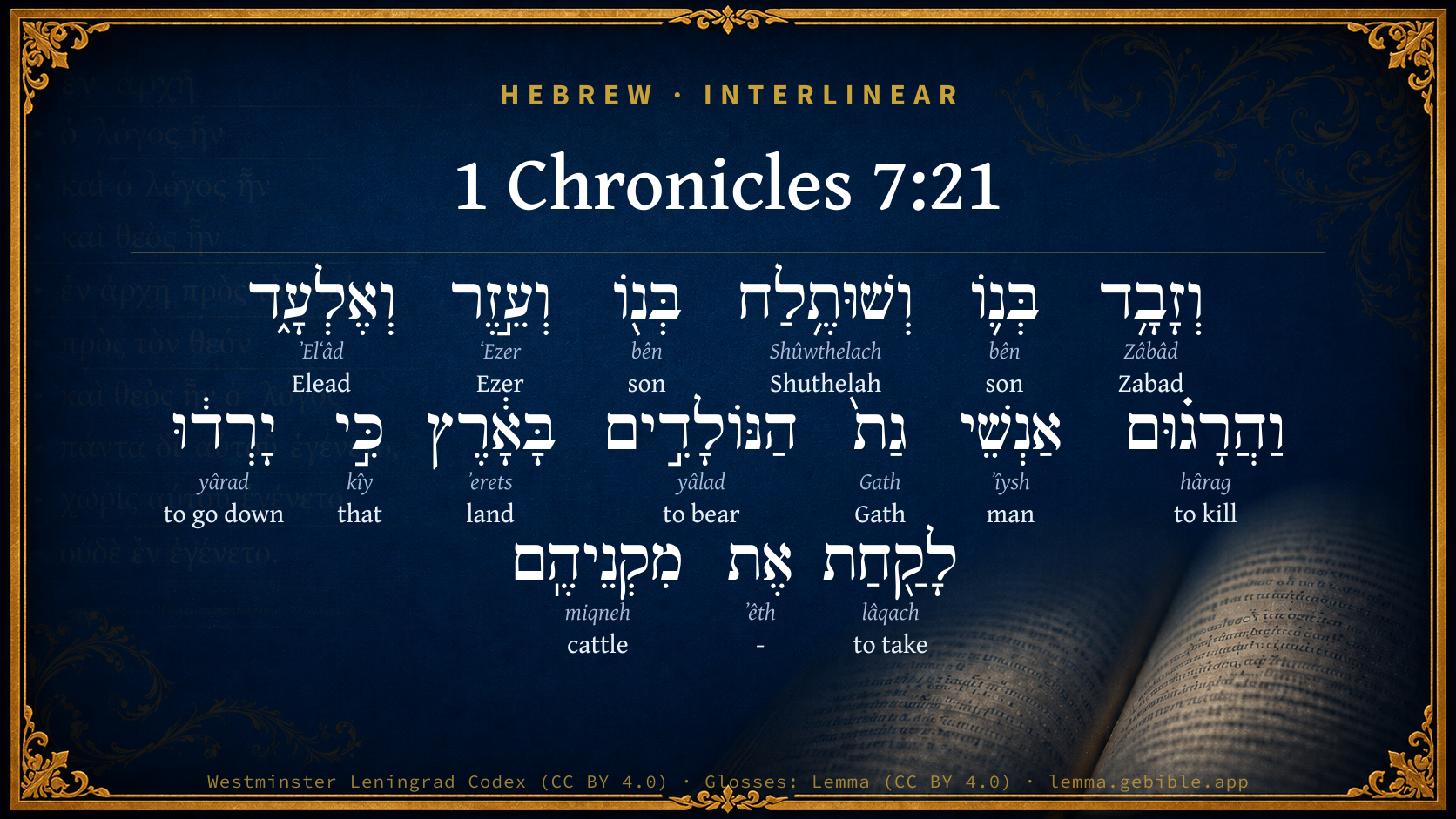
Hebrew (Westminster Leningrad Codex) 1 Chronicles 7:21 appears in the Hebrew Old Testament. The text above is from the Westminster Leningrad Codex. Each word links to its Strong’s number, a concise gloss, and parsing drawn from the Open Scriptures Hebrew Bible morphology. Click any word for its full Brown-Driver-Briggs (BDB) entry.
Download image
Cite this verse

1 Chronicles 7:21 (World English Bible). Public Domain. Lemma interlinear Bible study tool, https://lemma.gebible.app/v/1-chronicles/7/21.

Show BibTeX & RIS
BibTeX
RIS
English Translation
and Zabad his son, and Shuthelah his son, and Ezer, and Elead, whom the men of Gath who were born in the land killed, because they came down to take away their cattle.
World English Bible · Public Domain
Highlights
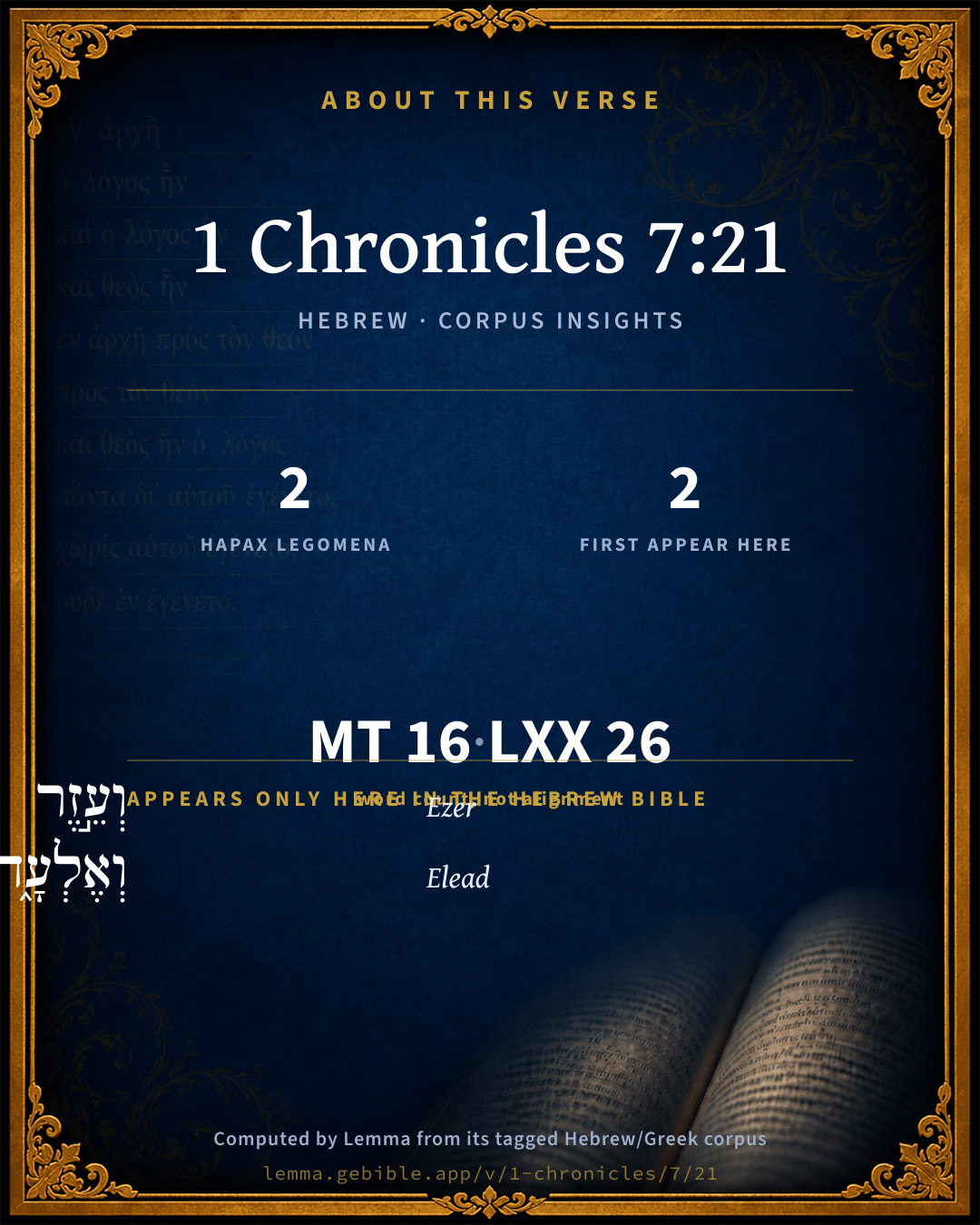
  • 2 hapax legomena — only here in the Hebrew Bible
  • 2 first appearances in the Hebrew Bible
Full analysis ↓
Download a study sheet

One document with this verse’s original text, its word-by-word gloss line, the meaning frame, cross-references with their text, attributed commentary, and full source and license credits — printable, and it pastes into notes with its structure intact.

This verse Autodidact and up

Study sheet (.html) Plain text (.txt)

A passage Seminary Student

Up to 50 verses in one chapter. A passage sheet keeps up to 6 commentary sources and 12 cross-references per verse, in the order this page ranks them, and says so on the sheet whenever that leaves anything out. Ask for a single verse and you get the Autodidact verse sheet above.

Everything on this page stays free to read, with no account — the sheet is a download of what is already on screen, not access to it.

Want to remove ads? Support Godless Engineer
Compare translations 3

The same verse in 3 English versions, stacked beneath the original-language interlinear above. Click any original word for its lexicon entry.

Each is an independent rendering of the whole verse — the interlinear is not word-aligned to these translations.

Highlighted words mark where these versions differ — a whole-verse word diff, not a word-by-word alignment.

  • World English Bible Public Domain
    and Zabad his son, and Shuthelah his son, and Ezer, and Elead, whom the men of Gath who were born in the land killed, because they came down to take away their cattle.
  • King James Version Public Domain
    And Zabad his son, and Shuthelah his son, and Ezer, and Elead, whom the men of Gath that were born in that land slew, because they came down to take away their cattle.
  • unfoldingWord Literal Text CC BY-SA 4.0
    and Zabad, his son, and Shuthelah, his son, and Ezer and Elead. But the men of Gath born in the land killed them because they came down to take their livestock.

unfoldingWord Literal Text — © unfoldingWord, licensed CC BY-SA 4.0. Word-aligned USFM3 via Door43 (git.door43.org/unfoldingWord/en_ult).

Versions to compare (up to 4)

3 of 4 selected

Show all 18 translations

Every available English version of this verse, each an independent rendering of the whole verse.

  • World English Bible Public Domain
    and Zabad his son, and Shuthelah his son, and Ezer, and Elead, whom the men of Gath who were born in the land killed, because they came down to take away their cattle.
  • Berean Standard Bible Public Domain
    Zabad his son, and Shuthelah his son. Ezer and Elead were killed by the natives of Gath, because they went down to steal their livestock.
  • Majority Standard Bible Public Domain
    Zabad his son, and Shuthelah his son. Ezer and Elead were killed by the natives of Gath, because they went down to steal their livestock.
  • King James Version Public Domain
    And Zabad his son, and Shuthelah his son, and Ezer, and Elead, whom the men of Gath that were born in that land slew, because they came down to take away their cattle.
  • American Standard Version (1901) Public Domain
    and Zabad his son, and Shuthelah his son, and Ezer, and Elead, whom the men of Gath that were born in the land slew, because they came down to take away their cattle.
  • Revised Version (1885) Public Domain
    and Zabad his son, and Shuthelah his son, and Ezer, and Elead, whom the men of Gath that were born in the land slew, because they came down to take away their cattle.
  • Geneva Bible (1599) Public Domain
    And Zabad his sonne, and Shuthelah his sonne, and Ezer, and Elead: and the men of Gath that were borne in the land, slewe them, because they came downe to take away their cattel.
  • Douay-Rheims (1899) Public Domain
    And his son Suthala, and his son Ezer, and Elad: and the men of Geth born in the land slew them, because they came down to invade their possessions.
  • Young's Literal Translation Public Domain
    and Zabad his son, and Shuthelah his son, and Ezer, and Elead; and slain them have men of Gath who are born in the land, because they came down to take their cattle.
  • Literal Standard Version CC BY-SA 4.0
    and Zabad his son, and Shuthelah his son, and Ezer, and Elead; and men of Gath who are born in the land have slain them because they came down to take their livestock.
  • Unlocked Literal Bible CC BY-SA 4.0
    Tahath's son was Zabad. Zabad's son was Shuthelah. (Ezer and Elead were killed by men of Gath, natives in the land, when they went to steal their cattle.
  • unfoldingWord Literal Text CC BY-SA 4.0
    and Zabad, his son, and Shuthelah, his son, and Ezer and Elead. But the men of Gath born in the land killed them because they came down to take their livestock.
  • Darby Bible Public Domain
    and Zabad his son, and Shuthelah his son, and Ezer, and Elad. And the men of Gath born in the land slew them, because they came down to take their cattle.
  • World Messianic Bible Public Domain
    Zabad his son, Shuthelah his son, Ezer, and Elead, whom the men of Gath who were born in the land killed, because they came down to take away their livestock.
  • Webster's Bible Public Domain
    And Zabad his son, and Shuthelah his son, and Ezer, and Elead, whom the men of Gath that were born in that land slew, because they came down to take away their cattle.
  • Free Bible Version CC BY-SA 4.0
    Zabad his son, and Shuthelah his son. Ezer and Elead were killed by the men who were living in Gath when they went there to try and steal their livestock.
  • Bible in Basic English Public Domain
    And Zabad his son, and Shuthelah his son, and Ezer and Elead, whom the men of Gath, who had been living in the land from their birth, put to death, because they came down to take away their cattle.
  • JPS Tanakh (1917) Public Domain
    and Zabad his son, and Shuthelah his son — and Ezer, and Elead, whom the men of Gath that were born in the land slew, because they came down to take away their cattle.

Literal Standard Version (2020), Covenant Press — licensed CC BY-SA 4.0. Text via the HelloAO Bible API (eBible.org). Unlocked Literal Bible (unfoldingWord) — licensed CC BY-SA 4.0. Text via the HelloAO Bible API (eBible.org). unfoldingWord Literal Text — © unfoldingWord, licensed CC BY-SA 4.0. Word-aligned USFM3 via Door43 (git.door43.org/unfoldingWord/en_ult). Free Bible Version, Dr. Jonathan Gallagher — licensed CC BY-SA 4.0. Text via the HelloAO Bible API (eBible.org).

Word by word

More ways to search: Search by grammar → Find every occurrence → Compare this word →

Practice this passage: Drill this verse → Learn its vocabulary →

וְעֵ֣זֶר
ʻEzer
H5827
“and · Ezer”
Conjunction + Noun, Proper
Part of Speech
Conjunction + Noun
Type
Proper
Full BDB Definition

Origin: from H5826

TWOT: None

Ezer = "treasure" - son of Ephraim who was slain by inhabitants of Gath - a priest who helped at the dedication of the walls of Jerusalem under Nehemiah
  1. וְזָבָ֥ד Zâbâd H2066 “and · Zabad” Conjunction + Noun, Proper
  2. בְּנ֛וֹ bên H1121 “son · his” Noun, Common, Masculine, Singular, Construct + Suffix, Personal, 3rd Person, Masculine, Singular
  3. וְשׁוּתֶ֥לַח Shûwthelach H7803 “and · Shuthelah” Conjunction + Noun, Proper
  4. בְּנ֖וֹ bên H1121 “son · his” Noun, Common, Masculine, Singular, Construct + Suffix, Personal, 3rd Person, Masculine, Singular
  5. וְאֶלְעָ֑ד ʼElʻâd H496 “and · Elead” Conjunction + Noun, Proper
  6. וַהֲרָג֗וּם hârag H2026 “and · to kill · them” Conjunction + Verb, Qal, Perfect, 3rd Person, Common, Plural + Suffix, Personal, 3rd Person, Masculine, Plural
  7. אַנְשֵׁי ʼîysh H376 “men of” Noun, Common, Masculine, Plural, Construct
  8. גַת֙ Gath H1661 “Gath” Noun, Proper
  9. הַנּוֹלָדִ֣ים yâlad H3205 “the · bearing” Particle, Definite Article + Verb, Niphal, Participle Active, Masculine, Plural, Absolute
  10. בָּאָ֔רֶץ ʼerets H776 “in/at the · land” Preposition, Determined + Noun, Common, Both, Singular, Absolute
  11. כִּ֣י kîy H3588 “that” Conjunction
  12. יָרְד֔וּ yârad H3381 “to go down” Verb, Qal, Perfect, 3rd Person, Common, Plural
  13. לָקַ֖חַת lâqach H3947 “to take” Preposition + Verb, Qal, Infinitive Construct
  14. אֶת ʼêth H853 “-” Particle, Direct Object
  15. מִקְנֵיהֶֽם miqneh H4735 “cattle · their” Noun, Common, Masculine, Singular, Construct + Suffix, Personal, 3rd Person, Masculine, Plural

About this verse

These counts appear in no published source. They are computed here, from the morphology-tagged text and Lemma’s own curated glosses. What Lemma adds →

16
words
15
distinct lemmas
Historical
section

Notable vocabulary

2 hapax legomena — words that appear only here in the entire Hebrew Bible:

  • וְעֵ֣זֶר Ezer H5827
  • וְאֶלְעָ֑ד Elead H496

First appearance in Scripture

These words make their first canonical appearance in the Hebrew Bible here:

  • וְעֵ֣זֶר Ezer H5827
  • וְאֶלְעָ֑ד Elead H496

Shared distinctive vocabulary

וְשׁוּתֶ֥לַח Shuthelah H7803 occurs in 4 verses of the Hebrew Bible. Also found in:

Grammatical profile

  • 4 verbs
  • 10 nouns
  • 1 conjunction
  • 1 particle

Verb forms

  • וַהֲרָג֗וּם Qal · Perfect
  • הַנּוֹלָדִ֣ים Niphal · Participle Active
  • יָרְד֔וּ Qal · Perfect
  • לָקַ֖חַת Qal · Infinitive Construct

Repetition

A word recurs within this verse — often emphatic in Hebrew:

  • בְּנ֛וֹ son H1121 ×2

Hebrew & Septuagint length

In English translation the verse runs 33 words from the Hebrew and 32 from the Septuagint (LXX English) — closely comparable.

A rough comparison of the two English renderings, which tokenize alike — not a word-level alignment.

Word counts can differ between the Hebrew and the Greek without any difference in meaning — e.g. the Hebrew direct-object marker אֵת has no separate Greek word, and Greek often adds the article ὁ.

In the original languages it is 16 Hebrew tokens and 26 Greek tokens — but the two are counted differently (Hebrew bundles its prefixes and suffixes into one token; the Greek is in lemma form), so that isn’t a like-for-like length.

Hebrew and Greek witnesses Masoretic Hebrew ↔ Greek Septuagint

The same verse in the two great witnesses to the Old Testament, shown verse-for-verse.

These are two independent witnesses, not word-aligned to each other, and the Septuagint is shown in lemma (dictionary) form.

Hebrew 1 Chronicles 7:21 Masoretic · Westminster Leningrad Codex

וְזָבָ֥ד בְּנ֛וֹ וְשׁוּתֶ֥לַח בְּנ֖וֹ וְעֵ֣זֶר וְאֶלְעָ֑ד וַהֲרָג֗וּם אַנְשֵׁי גַת֙ הַנּוֹלָדִ֣ים בָּאָ֔רֶץ כִּ֣י יָרְד֔וּ לָקַ֖חַת אֶת מִקְנֵיהֶֽם

and Zabad his son, and Shuthelah his son, and Ezer, and Elead, whom the men of Gath who were born in the land killed, because they came down to take away their cattle.

World English Bible · Public Domain

Greek LXX 1 Chronicles 7:21 Septuagint · lemma form

ζαβεδ υἱός αὐτός σωθελε υἱός αὐτός καί εζερ καί ελεαδ καί ἀποκτείνω αὐτός ἀνήρ γεθ ὁ τίκτω ἐν ὁ γῆ ὅτι καταβαίνω λαμβάνω ὁ κτῆνος αὐτός

and Zabad his son, Sothele his son, and Azer, and Elead: and the men of Geth who were born in the land killed them, because they went down to take their cattle.

LXX2012 (modern English Septuagint) · Public Domain

On this verse, Haydock's Catholic Bible Commentary discusses the Septuagint’s reading. Read the note in Commentary ↓

Hebrew: Westminster Leningrad Codex (CC BY 4.0). Greek: Septuagint (public domain); English from LXX2012 (modern English Septuagint) (Public Domain). How the Septuagint differs from the Hebrew →

Commentary

Notes on 1 Chronicles 7:21 from classic Christian and Jewish commentators (each source and its license shown beneath its notes). The classic Christian expositions comment on the surrounding passage and are grouped to its opening verse, so a note may address several verses; the Jewish commentaries on the Tanakh (Rashi and others) are per-verse, so they appear only where the commentator wrote on this verse.

Lemma curates 59 commentaries, every one of them public domain or Creative Commons licensed, each selected and text-cleaned for this edition rather than reprinted as found. About our sources →

Ellicott's Commentary for English Readers

THE TRIBE OF EPHRAIM (1Ch_7:20-29).

Shuthelah (Numbers 26, 35) was head of the first of the four Ephraimitic clans (mishpehôth). The names of six successive chieftains of his line appear to be given in 1Ch_7:20-21, ending with his namesake Shuthelah. It is likely, however, that these names really represent clans, as in other similar cases. (Comp. Num_26:29-33.) “Bered” (Gen_16:14) is a local name, a place in the desert of Shûr. But Bered may be a mistake for Becher. So “Tahath” (Num_33:26) was a desert station of Israel. But Tahath may well be a corruption of Tahan, son of Ephraim (1Ch_7:25, and Num_26:35).

(21) Ezer and Elead.—Apparently these names are coordinated with the Shuthelah of 1Ch_7:20, as sons of Ephraim. Elead is a masculine form of Eleadah.

Whom the men of Gath. . . .—Literally, and the men of Gath who were born in the land slew them; for they had come down to take their cattle.

Born in the land—That is, aborigines of Canaan as contrasted with the Ephraimites, who were foreign invaders. Others think the real aborigines of Philistia, the Avim of Deu_2:23, are meant. In 1Ch_7:21-22 we have a brief memorial of an ancient raid of two Ephraimite clans upon the territory of Gath, for the purpose of lifting cattle, much as the Highland freebooters used to drive off the herds of their Lowland neighbours.

They came down.—The reference of the pronoun is not quite clear. Conceivably the Gittites were the aggressors. The expression “carne down” is often used of going from Canaan to Egypt, but not vice versa. It can hardly, therefore, apply to an invasion of Gath by Ephraimites from Egypt. And the phrase “born in the land” excludes an expedition of Gittites to Goshen. It seems, then, that the descent was made upon Philistia from the hill country of Ephraim, in the early days of the settlement of the tribe in Canaan.

A Bible Commentary for English Readers, edited by Charles John Ellicott (1878–1897) — public domain. Text from a community e-Sword module.

Trapp's Complete Commentary

John Trapp

1Ch 7:21 And Zabad his son, and Shuthelah his son, and Ezer, and Elead, whom the men of Gath [that were] born in [that] land slew, because they came down to take away their cattle.

Ver. 21. Whom the men of Gath … slew.] And no marvel; because, belike, being weary of the Egyptian servitude, and remembering that Palestina was promised to their forefathers for an inheritance, they would needs take possession thereof before the time, which rash adventure of these sons of Ephraim cost them their lives, and perhaps occasioned that cruel decree of Pharaoh, king of Egypt, against the Israelites. {Exo 1:9-11} See to this purpose, Psa 78:9. This happened about the birth of Aaron. It is not safe to break God’s prison.

John Trapp, A Commentary or Exposition upon All the Books of the Old and New Testament (1647–1656) — public domain. Text from a community e-Sword module.

The Biblical Illustrator

Joseph S. Exell

1Ch_7:21-22

Whom the men of Gath that wore born in that land slew.

The massacre of Ephraims children

In the mines of Peru, there are veins of peculiar richness; but the very rubbish is valuable. In the Bible there are passages of peculiar importance, but there is nothing trifling, nothing useless. To be able to extract from the more barren portions of Scripture the instructions they were intended to communicate is a talent which every Christian should cultivate. This passage teaches us--

I. That there is no individual or society secure from sudden and severe misfortune. Oh! it is natural for us, when we are happy, to cherish the thought that we shall continue to be happy. And we may be placed in circumstances in which such an anticipation seems not only natural but reasonable. Our worldly substance may be abundant; our bodily constitution may be sound and strong, promising us a long and healthy life; our children may be growing up around us, with every appearance of being the support and comfort of our declining years. We may enjoy the affection of our friends. Very few persons have ever been so prosperous, or had equal ground to presume on the permanence of their prosperity as Ephraim. We have reason to hope that Ephraim was a good man. He was certainly the son of a very good man. We cannot doubt that his father Joseph gave him a religious education. We know that Ephraim was a wealthy man. It was, indeed, his great wealth that excited the cupidity of these Philistine robbers. It is obvious that he had reached a good old age, and he had gathered around him children and childrens children, and the children of childrens children. You can easily suppose the good old man retiring to rest happy in his possessions, and happier still in his anticipations, for he had reason to anticipate coming prosperity. God had spoken good of all the descendants of Israel, but of none had He spoken so much good as of Ephraim. In his numerous descendants he probably pleased himself with the thought, that he saw the begun accomplishment of the promise that his seed should become a multitude of nations. But what a fearful and sudden reverse was he destined to experience! This affecting incident reads a lesson to us all. It tells those who are afflicted, in patience to possess their souls; and it bids those who are happy, join trembling with their mirth. It tells those who are in affliction to give God thanks that they have not been afflicted as Ephraim was. We may have been bereaved of much, it may be, but where is any of us that can for a moment compare his bereavements with those of Ephraim?

II. That the dispensations of Divine providence are often apparently in direct opposition to the declarations of the Divine promise. It is difficult to conceive a more striking illustration of this general principle than that furnished by the remarkable incident recorded in the passage before us. Ephraim, as a descendant of Abraham, Isaac, and Jacob, had an interest in all the promises made to his illustrious ancestors. I will make thy seed as the dust of the earth, said Jehovah to Abraham; as the number of the stars, so shall thy seed be. Ephraim was one of the sons of Joseph, and of course Ephraim had his share in the remarkable blessing that was pronounced on his father. Joseph is a fruitful bough, even a fruitful bough by a well, whose branches run over the wall. Nor was this all; Ephraim had a share in that blessing which Jacob pronounced on himself, and on his brother Manasseh. When Joseph heard that his father was sick, apparently to death, he went to visit him, and he took along with him his two sons, Manasseh and Ephraim. Jacob having been told that his son Joseph was coming to see him, strengthened himself, and sat upon his bed. And Jacob said unto Joseph, God Almighty appeared unto me at Luz, in the land of Canaan, and blessed me, and said unto me, Behold I will make thee fruitful, and multiply thee, and I will make of thee a multitude of people, etc. There was more even than this. There was a great peculiarity in the manner in which Jacob pronounced this blessing. He crossed his hands, and laid his right hand on Ephraim, the youngest, and his left hand on Manasseh, the eldest; and when Joseph attempted to alter the position of the old mans hands, he replied, I know it, my son, I know it, etc. Such was the promise; and in the narrative before us, you see the providence. Can two things be more apparently in direct opposition? Here is a promise that Ephraim shall be more prosperous than all his brethren; and here is a providence that deprives Ephraim at once of all his property, and, as it would seem, of all his children also. Nor is this at all an unparalleled or even an uncommon case, so far as apparent contrariety between the providence and promise of God is concerned. Was it like a fulfilment of a promise made to Israel that Jehovah would give them a good and large land, flowing with milk and honey, to lead them directly into the depths of the Arabian wilderness and keep them wandering there for forty years? Was it like a fulfilment of the promise which God had made to David, that he would make him the ruler of his people, when he drove him from the court of Saul, and exposed him to imminent hazard of his life on the mountains of Israel from the persecutions of his infuriated enemy? I can appeal to the experience of every Christian. Is it not distinctly stated in Gods Word that no evil shall happen to the righteous? Is it not distinctly said, what is good God will give His people? Now, I put it to every Christian, if he has not in the course of his life met with much which at the time he could not help thinking evil for him? The reason of this apparent inconsistency of the providence with the promises of God, is by no means that there is a real opposition between them. It is the same God who speaks in His Word that works in His providence--and He is the same yesterday, to-day, and for ever. His Word and His work are really perfectly harmonious; and in many eases those dispensations, which are apparently frustrating the promise are, in reality, fulfilling it. The reason why the promise and the providence of God often seem to us to be at variance, is our ignorance of the extent and of the particular design of the Divine dispensations. If we could see the commencement, and progress, and issue of all Gods dispensations, we would gladly say, He is doing all things well, as we shall by and by be constrained to say, He has done all things well. But in the present state this must be a matter of faith, not of sense. It is the Divine appointment, that here we must walk by faith.

III. That the dissolution of those connections that bind us together in a variety of relations in human life, occasions to all rightly constituted minds severe suffering and permanent sorrow. It would be a miserable world--at least I am sure it would not be a happy one--if there were no husbands and wives, parents and children, and brothers and sisters, relative and friends. That man must be deplorably selfish, who, on reflecting on the various sources of his happiness, does not find social relation and affection one of the most copious. In proportion to the happiness springing from these relations, is the pain that is occasioned when they are dissolved, especially when they are unexpectedly and violently dissolved. Not merely are our friends the proper objects of a much stronger kind of affection than any other species of property; but their loss is of all other earthly losses the most irreparable. Our property, our reputation, our health, may be lost and regained. But a friend whom we have lost by death, we never can bring back again from the grove. (J. Brown, D. D.)

Family sorrow

I. The Cause Of Sorrow.

II. The Sympathy In The Sorrow.

III. The Remembrance Of The Sorrow.

1. Perpetuated in joy.

2. Perpetuated in sorrow. (J. Wolfendale.)

The Biblical Illustrator, edited by Joseph S. Exell (c. 1880s–1900s) — public domain. Text from a community e-Sword module.

Joseph Benson's Commentary

1Ch 7:21. Whom the men of Gath slew — This history is not recorded elsewhere in Scripture, but it is in the ancient Hebrew writers. The Philistines (one of whose cities Gath was) and the Egyptians were next neighbours; and in those ancient times it was usual for such to make inroads one into another’s country, and to carry thence what prey they could take. And as the Philistines had probably made such inroads formerly into Egypt, and particularly into the land of Goshen, which was the utmost part of Egypt bordering upon the Philistines’ land; so the Israelites might requite them in the like kind: and particularly the children of Ephraim, to their own loss. And this seems to have happened a little before the Egyptian persecution, and before the reign of that new king mentioned Exo 1:8. And this clause, that were born in the land, may be added emphatically, as the motive which made them more resolute in their fight with the Ephraimites, because they fought in and for their own land, wherein all their wealth and concerns lay.

Joseph Benson's Commentary on the Old and New Testaments (1811–1818) — public domain. Text from a community e-Sword module.

Geneva Bible (1599)

Geneva Bible translators

Which was one of the five principal cities of the Philistines, slew the Ephraimites.

Geneva Bible (1599) marginal notes — public domain. Text via Bolls.life.

Jamieson, Fausset & Brown

Robert Jamieson, A. R. Fausset & David Brown

whom the men of Gath . . . slew, &c.--This interesting little episode gives us a glimpse of the state of Hebrew society in Egypt; for the occurrence narrated seems to have taken place before the Israelites left that country. The patriarch Ephraim was then alive, though he must have arrived at a very advanced age; and the Hebrew people, at all events those of them who were his descendants, still retained their pastoral character. It was in perfect consistency with the ideas and habits of Oriental shepherds that they should have made a raid on the neighboring tribe of the Philistines for the purpose of plundering their flocks. For nothing is more common among them than hostile incursions on the inhabitants of towns, or on other nomad tribes with whom they have no league of amity. But a different view of the incident is brought out, if, instead of "because," we render the Hebrew particle "when" they came down to take their cattle, for the tenor of the context leads rather to the conclusion that "the men of Gath" were the aggressors, who, making a sudden foray on the Ephraimite flocks, killed the shepherds including several of the sons of Ephraim. The calamity spread a deep gloom around the tent of their aged father, and was the occasion of his receiving visits of condolence from his distant relatives, according to the custom of the East, which is remarkably exemplified in the history of Job (Job 2:11; compare Joh 11:19).

Next: 1 Chronicles Chapter 8

Jamieson, Fausset & Brown — Commentary Critical and Explanatory on the Whole Bible (1871) — public domain (CC PDM 1.0). Text via the HelloAO Bible API.

Adam Clarke's Commentary

Verse 21. Whom the men of Gath - slew] We know nothing of this circumstance but what is related here. The Targum paraphrases the whole thus: "These were the leaders of the house of Ephraim; and they computed their period [or boundary, כיצא kitsa] from the time in which the Word of the Lord of the universe spake with Abraham between the divisions, [i.e., the separated parts of the covenant sacrifice; see Ge 15:9-21,] but they erred, for they should have counted from the time in which Isaac was born; they went out of Egypt therefore thirty years before the period: for, thirty years before the birth of Isaac the Word of the Lord of the universe spake with Abraham between the divisions. And when they went out of Egypt, there were with them two hundred thousand warriors of the tribe of Ephraim, whom the men of Gath, the natives of the land of the Philistines, slew, because they came down that they might carry away their cattle. 22. - And Ephraim their father mourned for them many days, and all his brethren came to comfort him. 23. - And he went in to his wife, and she conceived and bare a son, and called his name Beriah, (בריעה in evil,) because he was born in the time in which this evil happened to his house."

Adam Clarke's Commentary on the Bible (1810–1826) — public domain. Text from a community e-Sword/MySword module.

The Cambridge Bible for Schools and Colleges

gen. ed. J. J. S. Perowne

21. they came down] This phrase suits a descent from the hills of Ephraim, but not an invasion from Goshen. It therefore occurred probably after Israel was settled in Canaan, i.e. long after Ephraim was dead, and the conduct ascribed to Ephraim in 1Ch_7:22-23 must be understood of the tribe personified in its ancestor. The clan Beriah became prominent after disaster had befallen the clans Ezer and Elead.

The Cambridge Bible for Schools and Colleges (gen. ed. J. J. S. Perowne; Cambridge University Press, 1878–1918) — public domain. Text from a community e-Sword module.

John Gill's Exposition

And by the borders of the children of Manasseh,.... Of the half tribe of Manasseh on this side Jordan: near to them the Ephraimites dwelt, even near to

Bethshean and her towns, Taanach and her towns, Megiddo and her towns, Dor and her towns; of all which places see Jos 17:11,

in these dwelt the children of Joseph the son of Israel; the Ephraimites, in those mentioned in Ch1 7:28, and the Manassites, in those that are here mentioned; who were both the children or posterity of Joseph, the beloved son of Israel.

John Gill's Exposition of the Whole Bible (1746–1763) — public domain (CC PDM 1.0). Text via the HelloAO Bible API.

Haydock's Catholic Bible Commentary

Son, Ezer. Hebrew, "and Ezer and Elad." His son, after each, seems to be twice omitted, as these were in the same degree as the rest. Septuagint agree with the Vulgate. (Haydock) --- Because they, the sons of Ephraim, (Calmet, &c.) or the men of Geth. (Syriac and Arabic) (Du Hamel) (Menochius) (Tirinus) --- The text is ambiguous, but the former supposition seems more rational, (Haydock) and more generally received. (Calmet)

George Leo Haydock (1774–1849), Haydock's Catholic Family Bible and Commentary, 1859 edition — public domain. Excludes Psalms (Douay-Rheims chapter numbering differs from Protestant) and Deuterocanonical books (Catholic canon only).

Matthew Poole's English Annotations

This history is not recorded elsewhere in Scripture, but it is in the ancient Hebrew writers, though mixed with many fables. The Philistines (one of whose cities this Gath was) and the Egyptians were next neighbours; and in those ancient times it was usual for such to make inroads one into another’s country, and to carry thence what prey they could take, as we find both in Scripture and in profane writers. And as the Philistines had probably made such inroads formerly into Egypt, and particularly into the land of Goshen, which was the utmost part of Egypt bordering upon the Philistines’ land; so the Israelites might requite them in the like kind: and particularly the children of Ephraim, either presuming upon their numbers and strength, or having possibly received the greatest injury from the Philistines in their last invasion, might make an attempt upon the Philistines to their own great loss, as is here related. And this seems to have happened a little before the Egyptian persecution, and before the reign of that new king mentioned Exo 1:8. The Philistines are here called

the men of Gath, either because they were subject to the king of Gath, as afterwards that people were, or because they lived about Gath. And this clause,

that were born in that land, may be added emphatically, as the motive which made them more resolute and furious in their fight with the Ephraimites, because they fought in and for their own land, wherein all their wealth and concerns lay, and against those that unjustly endeavoured to turn them out of their native country.

Matthew Poole's English Annotations on the Holy Bible (1683–1685) — public domain. Text from a community e-Sword/MySword module.

The Pulpit Commentary

Because they i.e, the men of Ephraimcame down to take away their cattle. This certainly may be translated, when they (i.e. the men of Gath) came down (i.e. into Goshen) to plunder their cattle (i.e. the cattle of Ephraim).

Vers. 21, 22.

Common family sorrows.

In these verses is given a very touching episode, and yet it is a very commonplace incident that is narrated. A father gains the news that his sons have been attacked by foes and killed, and, as the poor father sits stricken with the great sorrow, his brethren, his relatives, come to mourn with him and to comfort him. Children are an anxiety and care, all through our relations with them, when "about us" in the frailties of their childhood, and when away from us in the wilfulnesses of their young manhood. Sick-scenes and death-scenes are familiar to most parents, and few human homes last long unbroken. Nor is the comforting of loving friends other than a commonplace and yet most gracious fact of our modern life. Still, the thrill of hand and tear-filled eye and sympathetic word bring relief and rest to burdened and bereaved hearts. Life repeats itself over and over again, and tells its tale of grief and loss concerning one family after another. So it was in the olden times. Ephraim mourns the loss of his children, and his brethren come to comfort him; and thus it is seen that family life becomes a moral training for us all; and as the experiences of sickness, sorrow, and loss go round to one after another, we all come under the great Father"s sanctifying, and find out how "good it is even to be afflicted.

I THE LOSS OF CHILDREN. Here especially the greater loss of their death rather than the toss by removal, which never quite quenches hope. Such loss comes at various stages, and we never know at which of their ages the stroke falls lightest. It comes in various ways, slowly or suddenly, and we never can tell which way seemed to crush us most. The reaper cuts the "bearded grain" and the "flowers;" beautiful infants fly away, bright childhood fades, and blooming youth is smitten; and all we can say about it we say after Jacob, "If I am bereaved of my children, I am bereaved." On this we may dwell somewhat more fully.

II THE PARENTAL GRIEF AT THE LOSS OF CHILDREN. "Ephraim mourned many days." Such grief is well illustrated in David"s wailing over Absalom, Elijah"s friend"s grief over her dead child, and the poor Nain widow going out to bury her only son. The Eastern thought about the children helps to explain the intensity of their grief. Easterns conceived of their own earthly existence as continued in their children they had a kind of immortality in their children, and they pleased themselves with the idea that their descendants would reach higher dignity and place than they had done. So for their children to die was a plucking down of lofty imaginations, an uprooting of carefully raised hopes. And so it is in measure for us, as may be most tenderly illustrated in the case of the talented young Hallam, whose early death Tennyson deplores in his "In Memoriam.

III THE FAMILY BONDS SANCTIFIED IN THE LOSS OF CHILDREN. Such points as these may be unfolded and illustrated. If rightly, piously borne, the death of children may be used:

1. To the producing of a hallowing tenderness of feeling on all the members.

2. To a solemnizing estimate of the relative interests of this brief life and the coming eternal one.

3. To the self-denying efforts of each member to comfort the others, often involving most precious lessons in self-restraint.

4. To the reknitting of the family bonds. One member of a home realized as being away in the heavenly brings wondrously near and makes affectingly real all that belongs to the "unseen and eternal." And in family griefs we are "comforted, in order that we may be able to comfort them that are in any affliction, through the comfort wherewith we ourselves are comforted of God. R.T.

The Pulpit Commentary (1880–1919), ed. H.D.M. Spence-Jones & Joseph S. Exell — public domain. Text from a community e-Sword module.

John Wesley's Explanatory Notes

Slew - This history is not recorded else where in scripture, but it is in the ancient Hebrew writers. The Philistines (one of whose cities Gath was) and the Egyptians were next neighbours; and in those ancient times it was usual for such to make inroads one into another's country, and to carry thence what prey they could take. And as the Philistines had probably made such inroads formerly into Egypt, and particularly into the land of Goshen, which was the utmost part of Egypt bordering upon the Philistines land; so the Israelites might requite them in the like kind: and particularly the children of Ephraim, to their own loss. And this seems to have happened a little before the Egyptian persecution, and before the reign of that new king mentioned Exod. i, 8. And this clause, that were born in that land, may be added emphatically, as the motive which made them more resolute in their fight with the Ephraimites, because they fought in, and for their own land, wherein all their wealth and concerns lay.

John Wesley, Explanatory Notes Upon the Whole Bible (1754–1765) — public domain. Text via the GEBible commentary corpus.

Keil & Delitzsch

C. F. Keil & F. Delitzsch

And by the borders of the children of Manasseh,.... Of the half tribe of Manasseh on this side Jordan: near to them the Ephraimites dwelt, even near to

Bethshean and her towns, Taanach and her towns, Megiddo and her towns, Dor and her towns; of all which places see Jos 17:11,

in these dwelt the children of Joseph the son of Israel; the Ephraimites, in those mentioned in Ch1 7:28, and the Manassites, in those that are here mentioned; who were both the children or posterity of Joseph, the beloved son of Israel.

Keil & Delitzsch — Biblical Commentary on the Old Testament (1861–1891) — public domain (CC PDM 1.0). Text via the HelloAO Bible API. (Old Testament only.)

Rashi

Rabbi Shlomo Yitzchaki (Rashi)

and the men of Gath, etc. slew them because they came down to take their cattle They were unfamiliar with the ways of the roads and the ways out of the land, and the men of Gath, the natives of the land, slew them because they were familiar with that land.

Rashi on the Tanakh — English translations: “The Judaica Press complete Tanach with Rashi, translated by A. J. Rosenberg” (CC BY 4.0); “Pentateuch with Rashi's commentary by M. Rosenbaum and A.M. Silbermann, 1929-1934” (public domain); “The Metsudah Tanach series, Lakewood, N.J” (CC BY 4.0); and “The Book of Joshua, Metsudah Publications, 1997” (CC BY 4.0). Text via Sefaria.

Lesson kit

Teaching starters — assembled from the data on this page, not authored interpretation. Every prompt links to the verse data it draws on. Edit before teaching.

1 Chronicles, in the Historical, opens this verse with 16 words (15 distinct Hebrew lemmas). Its most distinctive word is ʻEzer (“Ezer”). A historical commentator’s framing appears above. Read the whole chapter for the surrounding context.

Discussion questions

  1. What does “Ezer” (ʻEzer) contribute to the verse as a whole?
  2. 2 words here appear nowhere else in the Hebrew Bible. Why might the author reach for such rare wording?
  3. 2 words make their first appearance in Scripture here. What does this debut establish?
  4. How does Numbers 26:35, which shares the word «Shuthelah», read alongside this verse?
  5. What does the repetition of “son” (2× in this one verse) do in this verse?
  6. The translations on this page render this verse differently — a whole-verse word diff, not a word-by-word alignment. What might account for the different wordings?
  7. «וַהֲרָג֗וּם» is a Qal Perfect verb. How does that grammatical form shape the action described?
  8. Compare how Ellicott's Commentary for English Readers and Trapp's Complete Commentary read this verse. Where do they agree or differ?

Things to notice

  • 2 words in this verse appear nowhere else in the Hebrew Bible.
  • 2 words make their first canonical appearance in Scripture here.
  • This verse counts 16 Hebrew ↔ 26 Greek words.
  • These translations choose different wording for 7 words in this verse.
  • “son” occurs 2× in this single verse.

Reading settings

Reading text

Shown beneath each verse's original-language words.

Old Testament
Old Testament edition

Read the OT as the Masoretic Hebrew (MT) or the Greek Septuagint (LXX).

English shown for the Greek Septuagint (in the Hebrew ↔ Greek comparison).

Comparing translations? Open the Compare panel on any verse page to stack up to four side by side.