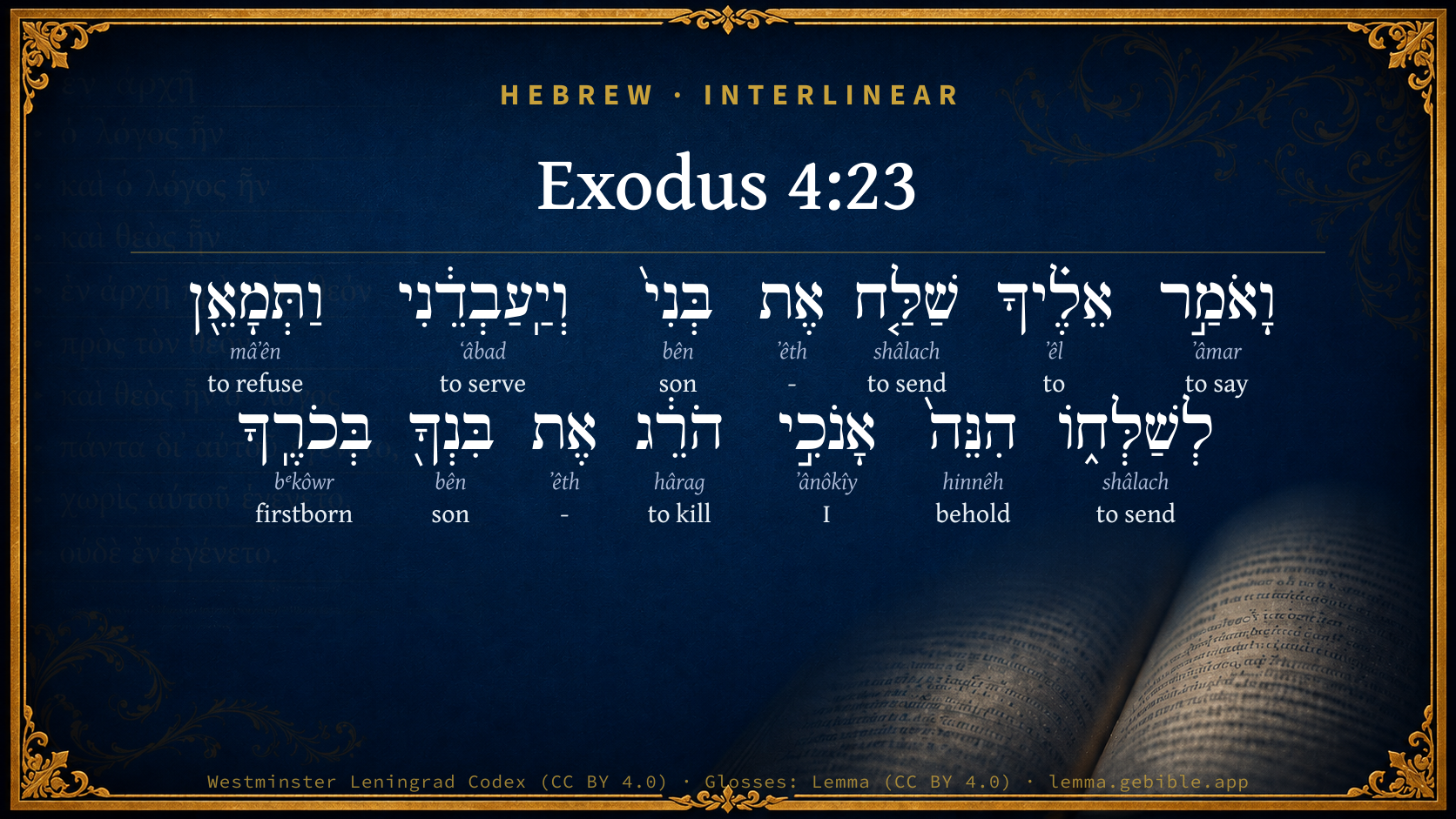
Exodus 4:23

Hebrew (Westminster Leningrad Codex) Exodus 4:23 appears in the Hebrew Old Testament. The text above is from the Westminster Leningrad Codex. Each word links to its Strong’s number, a concise gloss, and parsing drawn from the Open Scriptures Hebrew Bible morphology. Click any word for its full Brown-Driver-Briggs (BDB) entry.
Download image
Cite this verse

Exodus 4:23 (World English Bible). Public Domain. Lemma interlinear Bible study tool, https://lemma.gebible.app/v/exodus/4/23.

Show BibTeX & RIS
BibTeX
RIS
English Translation
and I have said to you, "Let my son go, that he may serve me;" and you have refused to let him go. Behold, I will kill your son, your firstborn.'"
World English Bible · Public Domain
Download a study sheet

One document with this verse’s original text, its word-by-word gloss line, the meaning frame, cross-references with their text, attributed commentary, and full source and license credits — printable, and it pastes into notes with its structure intact.

This verse Autodidact and up

Study sheet (.html) Plain text (.txt)

A passage Seminary Student

Up to 50 verses in one chapter. A passage sheet keeps up to 6 commentary sources and 12 cross-references per verse, in the order this page ranks them, and says so on the sheet whenever that leaves anything out. Ask for a single verse and you get the Autodidact verse sheet above.

Everything on this page stays free to read, with no account — the sheet is a download of what is already on screen, not access to it.

Want to remove ads? Support Godless Engineer
Compare translations 3

The same verse in 3 English versions, stacked beneath the original-language interlinear above. Click any original word for its lexicon entry.

Each is an independent rendering of the whole verse — the interlinear is not word-aligned to these translations.

Highlighted words mark where these versions differ — a whole-verse word diff, not a word-by-word alignment.

  • World English Bible Public Domain
    and I have said to you, "Let my son go, that he may serve me;" and you have refused to let him go. Behold, I will kill your son, your firstborn.'"
  • King James Version Public Domain
    And I say unto thee, Let my son go, that he may serve me: and if thou refuse to let him go, behold, I will slay thy son, even thy firstborn.
  • unfoldingWord Literal Text CC BY-SA 4.0
    and I said to you, ‘Let my son go that he may serve me.’ But you have refused to let him go. Behold, I shall kill your son, your firstborn.”’”

unfoldingWord Literal Text — © unfoldingWord, licensed CC BY-SA 4.0. Word-aligned USFM3 via Door43 (git.door43.org/unfoldingWord/en_ult).

Versions to compare (up to 4)

3 of 4 selected

Show all 18 translations

Every available English version of this verse, each an independent rendering of the whole verse.

  • World English Bible Public Domain
    and I have said to you, "Let my son go, that he may serve me;" and you have refused to let him go. Behold, I will kill your son, your firstborn.'"
  • Berean Standard Bible Public Domain
    and I told you to let My son go so that he may worship Me. But since you have refused to let him go, behold, I will kill your firstborn son!’”
  • Majority Standard Bible Public Domain
    and I told you to let My son go so that he may worship Me. But since you have refused to let him go, behold, I will kill your firstborn son!’”
  • King James Version Public Domain
    And I say unto thee, Let my son go, that he may serve me: and if thou refuse to let him go, behold, I will slay thy son, even thy firstborn.
  • American Standard Version (1901) Public Domain
    and I have said unto thee, Let my son go, that he may serve me; and thou hast refused to let him go: behold, I will slay thy son, thy first-born.
  • Revised Version (1885) Public Domain
    and I have said unto thee, Let my son go, that he may serve me; and thou hast refused to let him go: behold, I will slay thy son, thy firstborn.
  • Geneva Bible (1599) Public Domain
    Wherefore I say to thee, Let my sonne go, that he may serue me: if thou refuse to let him goe, beholde, I will slay thy sonne, euen thy first borne.
  • Douay-Rheims (1899) Public Domain
    I have said to thee: Let my son go, that he may serve me, and thou wouldst not let him go: behold I will kill thy son, thy firstborn.
  • Young's Literal Translation Public Domain
    and I say unto thee, Send away My son, and he doth serve Me; and -- thou dost refuse to send him away -- lo, I am slaying thy son, thy first-born.'
  • Literal Standard Version CC BY-SA 4.0
    and I say to you, send My son away, and he serves Me; and [if] you refuse to send him away, behold, I am slaying your son, your firstborn.”
  • Unlocked Literal Bible CC BY-SA 4.0
    and I say to you, “Let my son go, so he may worship me.” But since you have refused to let him go, I will certainly kill your son, your firstborn.'”
  • unfoldingWord Literal Text CC BY-SA 4.0
    and I said to you, ‘Let my son go that he may serve me.’ But you have refused to let him go. Behold, I shall kill your son, your firstborn.”’”
  • Darby Bible Public Domain
    And I say to thee, Let my son go, that he may serve me. And if thou refuse to let him go, behold, I will kill thy son, thy firstborn.
  • World Messianic Bible Public Domain
    and I have said to you, “Let my son go, that he may serve me;” and you have refused to let him go. Behold, I will kill your firstborn son.’”
  • Webster's Bible Public Domain
    And I say to thee, Let my son go, that he may serve me: and if thou shalt refuse to let him go, behold, I will slay thy son, even thy first-born.
  • Free Bible Version CC BY-SA 4.0
    I ordered you to let my son go so he can worship me. But you refused to release him, so I will now kill your firstborn son.’”
  • Bible in Basic English Public Domain
    And I said to you, Let my son go, so that he may give me worship; and you did not let him go: so now I will put the first of your sons to death.
  • JPS Tanakh (1917) Public Domain
    And I have said unto thee: Let My son go, that he may serve Me; and thou hast refused to let him go. Behold, I will slay thy son, thy first-born.' —

Literal Standard Version (2020), Covenant Press — licensed CC BY-SA 4.0. Text via the HelloAO Bible API (eBible.org). Unlocked Literal Bible (unfoldingWord) — licensed CC BY-SA 4.0. Text via the HelloAO Bible API (eBible.org). unfoldingWord Literal Text — © unfoldingWord, licensed CC BY-SA 4.0. Word-aligned USFM3 via Door43 (git.door43.org/unfoldingWord/en_ult). Free Bible Version, Dr. Jonathan Gallagher — licensed CC BY-SA 4.0. Text via the HelloAO Bible API (eBible.org).

Word by word

More ways to search: Search by grammar → Find every occurrence → Compare this word →

Practice this passage: Drill this verse → Learn its vocabulary →

וַתְּמָאֵ֖ן
mâʼên
H3985
“and · to refuse”
Conjunction + Verb, Piel, Sequential Imperfect, 2nd Person, Masculine, Singular
Part of Speech
Conjunction + Verb
Stem
Piel
Form
Sequential Imperfect
Person
2nd Person
Gender
Masculine
Number
Singular
Full BDB Definition

Origin: a primitive root

TWOT: 1138

(Piel) to refuse
  1. וָאֹמַ֣ר ʼâmar H559 “and · to say” Conjunction + Verb, Qal, Sequential Imperfect, 1st Person, Common, Singular
  2. אֵלֶ֗יךָ ʼêl H413 “to · you” Preposition + Suffix, Personal, 2nd Person, Masculine, Singular
  3. שַׁלַּ֤ח shâlach H7971 “send” Verb, Piel, Imperative, 2nd Person, Masculine, Singular
  4. אֶת ʼêth H853 “-” Particle, Direct Object
  5. בְּנִי֙ bên H1121 “son · my” Noun, Common, Masculine, Singular, Construct + Suffix, Personal, 1st Person, Common, Singular
  6. וְיַֽעַבְדֵ֔נִי ʻâbad H5647 “and · to serve · us” Conjunction + Verb, Qal, Jussive, 3rd Person, Masculine, Singular + Suffix, Personal, 1st Person, Common, Plural
  7. לְשַׁלְּח֑וֹ shâlach H7971 “to send · him” Preposition + Verb, Piel, Infinitive Construct + Suffix, Personal, 3rd Person, Masculine, Singular
  8. הִנֵּה֙ hinnêh H2009 “behold” Particle, Demonstrative
  9. אָנֹכִ֣י ʼânôkîy H595 “I” Pronoun, Personal, 1st Person, Common, Singular
  10. הֹרֵ֔ג hârag H2026 “killing” Verb, Qal, Participle Active, Masculine, Singular, Absolute
  11. אֶת ʼêth H853 “-” Particle, Direct Object
  12. בִּנְךָ֖ bên H1121 “son · your” Noun, Common, Masculine, Singular, Construct + Suffix, Personal, 2nd Person, Masculine, Singular
  13. בְּכֹרֶֽךָ bᵉkôwr H1060 “firstborn · your” Noun, Common, Masculine, Singular, Construct + Suffix, Personal, 2nd Person, Masculine, Singular

About this verse

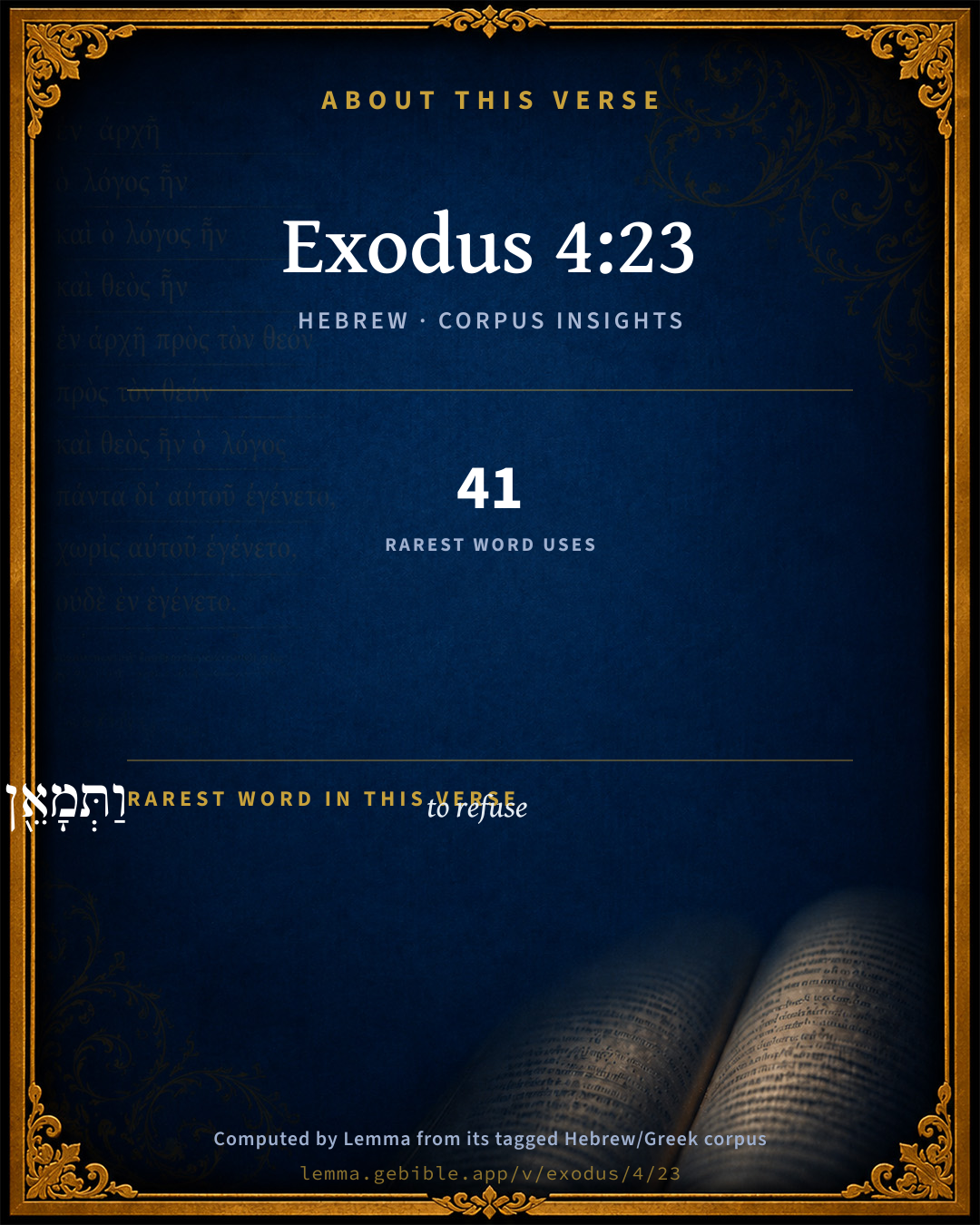
These counts appear in no published source. They are computed here, from the morphology-tagged text and Lemma’s own curated glosses. What Lemma adds →

14
words
11
distinct lemmas
Pentateuch
section

Shared distinctive vocabulary

וַתְּמָאֵ֖ן to refuse H3985 occurs in 39 verses of the Hebrew Bible. Also found in:

Grammatical profile

  • 6 verbs
  • 3 nouns
  • 1 pronoun
  • 1 preposition
  • 3 particles

Verb forms

  • וָאֹמַ֣ר Qal · Sequential Imperfect
  • שַׁלַּ֤ח Piel · Imperative
  • וְיַֽעַבְדֵ֔נִי Qal · Jussive
  • וַתְּמָאֵ֖ן Piel · Sequential Imperfect
  • לְשַׁלְּח֑וֹ Piel · Infinitive Construct
  • הֹרֵ֔ג Qal · Participle Active

Repetition

Words recur within this verse — often emphatic in Hebrew:

  • שַׁלַּ֤ח to send H7971 ×2
  • בְּנִי֙ son H1121 ×2

Hebrew & Septuagint length

In English translation the verse runs 31 words from the Hebrew and 29 from the Septuagint (LXX English) — closely comparable.

A rough comparison of the two English renderings, which tokenize alike — not a word-level alignment.

Word counts can differ between the Hebrew and the Greek without any difference in meaning — e.g. the Hebrew direct-object marker אֵת has no separate Greek word, and Greek often adds the article ὁ.

Cross-references

7

Topical passages linked to Exodus 4:23 in the Treasury of Scripture Knowledge — connected by theme and wording, ordered by reader-vote popularity; previews shown in the World English Bible.

  • Exodus 11:5 and all the firstborn in the land of Egypt shall die, from the firstborn of Pharaoh who sits on his throne, even to the firstborn of the maid-servant who is behind the mill; and all the firstborn of cattle.
  • Exodus 12:29 It happened at midnight, that Yahweh struck all the firstborn in the land of Egypt, from the firstborn of Pharaoh who sat on his throne to the firstborn of the captive who was in the dungeon; and all the firstborn of cattle.
  • Psalms 105:36 He struck also all the firstborn in their land, The first fruits of all their manhood.
  • Psalms 135:8 Who struck the firstborn of Egypt, Both of man and animal;
  • Exodus 5:1 Afterward Moses and Aaron came, and said to Pharaoh, "This is what Yahweh, the God of Israel, says, 'Let my people go, that they may hold a feast to me in the wilderness.'"
  • Exodus 7:16 You shall tell him, 'Yahweh, the God of the Hebrews, has sent me to you, saying, "Let my people go, that they may serve me in the wilderness:" and, behold, until now you haven't listened.
  • Psalms 78:51 And struck all the firstborn in Egypt, The chief of their strength in the tents of Ham.

Cross-references courtesy of OpenBible.info (CC BY 4.0).

Hebrew and Greek witnesses Masoretic Hebrew ↔ Greek Septuagint

The same verse in the two great witnesses to the Old Testament, shown verse-for-verse.

These are two independent witnesses, not word-aligned to each other, and the Septuagint is shown in lemma (dictionary) form.

Hebrew Exodus 4:23 Masoretic · Westminster Leningrad Codex

וָאֹמַ֣ר אֵלֶ֗יךָ שַׁלַּ֤ח אֶת בְּנִי֙ וְיַֽעַבְדֵ֔נִי וַתְּמָאֵ֖ן לְשַׁלְּח֑וֹ הִנֵּה֙ אָנֹכִ֣י הֹרֵ֔ג אֶת בִּנְךָ֖ בְּכֹרֶֽךָ

and I have said to you, "Let my son go, that he may serve me;" and you have refused to let him go. Behold, I will kill your son, your firstborn.'"

World English Bible · Public Domain

Greek LXX Exodus 4:23 Septuagint · lemma form

εἶπον δέ σύ ἐκ ἀποστέλλω ὁ λαός ἐγώ ἵνα ἐγώ λατρεύω εἰ μέν οὖν μή βούλομαι ἐκ ἀποστέλλω αὐτός ὁράω οὖν ἐγώ ἀποκτείνω ὁ υἱός σύ ὁ πρωτότοκος

And I said to you, Send away my people, that they may serve me: now if you will not send them away, see, I will kill your firstborn son.

LXX2012 (modern English Septuagint) · Public Domain

Hebrew: Westminster Leningrad Codex (CC BY 4.0). Greek: Septuagint (public domain); English from LXX2012 (modern English Septuagint) (Public Domain). How the Septuagint differs from the Hebrew →

Targum (Aramaic paraphrase)

2

The Targum is the ancient Jewish Aramaic paraphrase of the Hebrew Scriptures — an interpretive translation, not the Hebrew text itself. Onkelos (literal) and Pseudo-Jonathan (expansive) render the Torah, and Jonathan the Prophets. Coverage is partial: where no permissively-licensed English translation exists for a verse, only the Aramaic is shown. This is verse-level text, not a word-by-word alignment to the Hebrew.

  1. Targum Onkelos Torah (Genesis–Deuteronomy)
    וַאֲמָרִית לָךְ שַׁלַח יָת בְּרִי וְיִפְלַח קֳדָמַי וְאִם סָרִיב אַתְּ לְשַׁלָחוּתֵהּ הָא אֲנָא קָטִיל יָת בְּרָךְ בּוּכְרָךְ:

    (no public-domain English translation for this verse)

    Targum Onkelos — Aramaic: “Onkelos Genesis” (public domain); “Onkelos Exodus” (public domain); “Onkelos Leviticus” (public domain); “Onkelos Numbers” (public domain); “Onkelos Deuteronomy” (public domain). English: “Sefaria Community Translation” (CC0 1.0 (public-domain dedication)); “J.W. Etheridge. The Targums of Onkelos and Jonathan Ben Uzziel on the Pentateuch. London: Longmans, Green, 1862” (public domain). Text via Sefaria.

  2. Targum Pseudo-Jonathan Torah (Genesis–Deuteronomy)
    וַאֲמָרִית לָךְ פְּטוֹר יַת בְּרִי וְיִפְלַח קֳדָמַי וּמְסָרֵב אַנְתְּ לְמִפְטְרֵיהּ הָא אֲנָא קָטֵיל יַת בְּרָךְ בּוּכְרָךְ

    and to thee I say, Let My son go free, that he may worship before Me; and if thou refuse to let him go, behold, I will slay thy first-born son.

    Targum Pseudo-Jonathan — Aramaic: “Targum Jonathan on Genesis” (public domain); “Targum Jonathan on Exodus” (public domain); “Targum Jonathan on Leviticus” (public domain); “Targum Jonathan on Numbers” (public domain); “Targum Jonathan on Deuteronomy” (public domain). English: “The Targum of Jonathan ben Uzziel, trans. J. W. Etheridge, London, 1862” (public domain). Text via Sefaria.

Commentary

Notes on Exodus 4:23 from classic Christian and Jewish commentators (each source and its license shown beneath its notes). The classic Christian expositions comment on the surrounding passage and are grouped to its opening verse, so a note may address several verses; the Jewish commentaries on the Tanakh (Rashi and others) are per-verse, so they appear only where the commentator wrote on this verse.

Lemma curates 59 commentaries, every one of them public domain or Creative Commons licensed, each selected and text-cleaned for this edition rather than reprinted as found. About our sources →

Trapp's Complete Commentary

John Trapp

Exo 4:23 And I say unto thee, Let my son go, that he may serve me: and if thou refuse to let him go, behold, I will slay thy son, [even] thy firstborn.

Ver. 23. Let my son go.] God commanding Pharaoh to let go his people, and yet hardening his heart that he would not let them go, is not contrary to himself. For by so commanding him, he requireth his obedience; and by so hardening him, he punisheth his disobedience.

John Trapp, A Commentary or Exposition upon All the Books of the Old and New Testament (1647–1656) — public domain. Text from a community e-Sword module.

Adam Clarke's Commentary

Verse 23. Let my son go, that he may serve me] Which they could not do in Goshen, consistently with the policy and religious worship of the Egyptians; because the most essential part of an Israelite's worship consisted in sacrifice, and the animals which they offered to God were sacred among the Egyptians. Moses gives Pharaoh this reason Ex 8:26.

I will slay thy son, even thy first-born.] Which, on Pharaoh's utter refusal to let the people go, was accordingly done; see Ex 12:29.

Adam Clarke's Commentary on the Bible (1810–1826) — public domain. Text from a community e-Sword/MySword module.

Ellicott's Commentary for English Readers

(23) I will slay thy son, even thy first-born.—The threat was not made until immediately before the tenth plague (Exo_11:5). It is not recorded in the words which Moses is here directed to use; but the speech of Moses in Exodus 11 is no doubt much abbreviated.

A Bible Commentary for English Readers, edited by Charles John Ellicott (1878–1897) — public domain. Text from a community e-Sword module.

The Cambridge Bible for Schools and Colleges

gen. ed. J. J. S. Perowne

23. that he may serve me] i.e. hold a religious service (‘serve,’ as in Exo_3:12 and frequently), viz. in the wilderness: cf. (also in J) Exo_7:16, Exo_8:1; Exo_8:20, Exo_9:1; Exo_9:13, Exo_10:3.

The Cambridge Bible for Schools and Colleges (gen. ed. J. J. S. Perowne; Cambridge University Press, 1878–1918) — public domain. Text from a community e-Sword module.

John Gill's Exposition

And I say unto thee, let my son go, that he may serve me,.... Worship God according to his will in the place he had designed for him, and where he might be safe and free; and which service was due from him as a son, and to be performed not in a servile way, but in a filial manner, and therefore as a servant he could demand his dismission, and much more as his son; and this is required in an authoritative way, for saying is here commanding, insisting on it as a point of right to be done:

and if thou refuse to let him go, behold, I will slay thy son, even thy firstborn; meaning, not only in a strict and literal sense Pharaoh's firstborn son, and heir to his crown, but the firstborn of all his subjects, which in a civil sense were his. This was not to be said to Pharaoh at the first opening of his commission to him, but after all methods had been tried, and the several other plagues designed were inflicted on him to no purpose, he was to be told this, which was the last plague, and succeeded; but this is told to Moses before hand, that when other messages he should be sent with to him, and all that should be done by him would prove ineffectual, this, when sent with and performed, would have the desired effect.

John Gill's Exposition of the Whole Bible (1746–1763) — public domain (CC PDM 1.0). Text via the HelloAO Bible API.

Haydock's Catholic Bible Commentary

Thy son. This was the tenth and last scourge, which forced the king to relent. (Menochius)

George Leo Haydock (1774–1849), Haydock's Catholic Family Bible and Commentary, 1859 edition — public domain. Excludes Psalms (Douay-Rheims chapter numbering differs from Protestant) and Deuterocanonical books (Catholic canon only).

Matthew Poole's English Annotations

I say unto thee; I command thee; for saying is put for commanding, Luk 4:3; 9:54; and in 1Ch 21:19, compared with 2Sa 24:19.

I will slay thy son; by which plague, coming after the rest, thou wilt be enforced to do what I advise thee now to do upon cheaper terms.

Matthew Poole's English Annotations on the Holy Bible (1683–1685) — public domain. Text from a community e-Sword/MySword module.

The Pulpit Commentary

I will slay thy son, even thy firstborn. For the fulfilment of the threat, see Exo_12:29. Moses did not utter it till all other arguments were exhausted, and he knew that he was having his last interview with the monarch. (Exo_10:29 Exo_11:4, Exo_11:5) In this reserve and in the whole series of his dealings with the Egyptian king, we must regard him as simply carrying out the special directions which, after his return to Egypt, he continually received from the Almighty. (see Exo_6:11 Exo_7:9, 15 19:8:1, 5, 16, 20, etc.)

The Pulpit Commentary (1880–1919), ed. H.D.M. Spence-Jones & Joseph S. Exell — public domain. Text from a community e-Sword module.

John Wesley's Explanatory Notes

Let my son go - Not only my servant whom thou hast no right to detain, but my son whose liberty and honour I am jealous for. If thou refuse, I will slay thy son, even thy first-born - As men deal with God's people, let them expect to be themselves dealt with.

John Wesley, Explanatory Notes Upon the Whole Bible (1754–1765) — public domain. Text via the GEBible commentary corpus.

Rashi

Rabbi Shlomo Yitzchaki (Rashi)

ואמר אליך AND I HAVE SAID UNTO THEE, as a messenger of the Omnipresent God, שלח את בני LET MY SON GO,

הנה אנכי הרג וגו׳ BEHOLD I WILL SLAY etc. — This, it is true, was the last of the plagues, but it was by mention of it that God gave him the first warning regarding the plagues that would come upon him, because this was the severest of them all. This is what Scripture means by, (Job 36:22) “Behold God is mighty in His power”, therefore “Who is a teacher like unto Him?” — This signifies: A human being who intends to avenge himself upon his fellow keeps his plans secret in order that he may not seek means of escape. But the Holy One, blessed be He, is so mighty in His power that there is no possibility of escape from His hand except by returning to Him in penitence. Just on this account He teaches him (informs him what punishment will befall him) and so warns him to return to Him (Exodus Rabbah 9:9).

Rashi on the Tanakh — English translations: “The Judaica Press complete Tanach with Rashi, translated by A. J. Rosenberg” (CC BY 4.0); “Pentateuch with Rashi's commentary by M. Rosenbaum and A.M. Silbermann, 1929-1934” (public domain); “The Metsudah Tanach series, Lakewood, N.J” (CC BY 4.0); and “The Book of Joshua, Metsudah Publications, 1997” (CC BY 4.0). Text via Sefaria.

Lesson kit

Teaching starters — assembled from the data on this page, not authored interpretation. Every prompt links to the verse data it draws on. Edit before teaching.

Exodus, in the Pentateuch, opens this verse with 14 words (11 distinct Hebrew lemmas). Its most distinctive word is mâʼên (“to refuse”). A historical commentator’s framing appears above. Read the whole chapter for the surrounding context.

Discussion questions

  1. How does “to refuse” (mâʼên) shape what this verse is saying?
  2. How does Genesis 37:35, which shares the word «to refuse», read alongside this verse?
  3. What does the repetition of “to send” (2× in this one verse) do in this verse?
  4. These translations render this verse differently; the difference is in the English rendering, not the original. What questions does that raise?
  5. «וָאֹמַ֣ר» is a Qal Sequential Imperfect verb. How does that grammatical form shape the action described?
  6. Compare how Trapp's Complete Commentary and Adam Clarke's Commentary read this verse. Where do they agree or differ?

Things to notice

Reading settings

Reading text

Shown beneath each verse's original-language words.

Old Testament
Old Testament edition

Read the OT as the Masoretic Hebrew (MT) or the Greek Septuagint (LXX).

English shown for the Greek Septuagint (in the Hebrew ↔ Greek comparison).

Comparing translations? Open the Compare panel on any verse page to stack up to four side by side.