
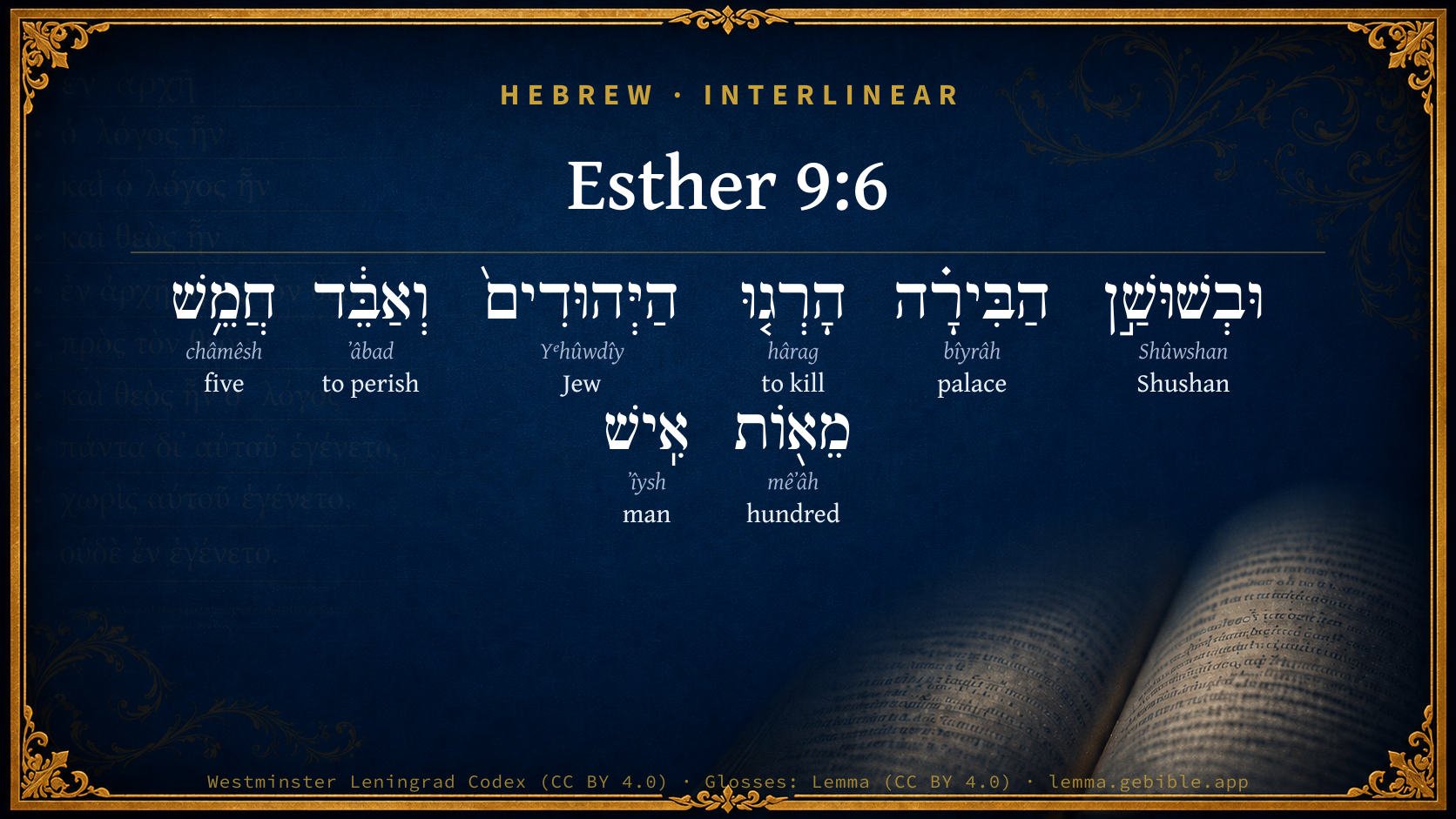
Esther 9:6

Hebrew (Westminster Leningrad Codex) Esther 9:6 appears in the Hebrew Old Testament. The text above is from the Westminster Leningrad Codex. Each word links to its Strong’s number, a concise gloss, and parsing drawn from the Open Scriptures Hebrew Bible morphology. Click any word for its full Brown-Driver-Briggs (BDB) entry.
Download image
Cite this verse

Esther 9:6 (World English Bible). Public Domain. Lemma interlinear Bible study tool, https://lemma.gebible.app/v/esther/9/6.

Show BibTeX & RIS
BibTeX
RIS
English Translation
In Shushan the palace the Jews killed and destroyed five hundred men.
World English Bible · Public Domain
Download a study sheet

One document with this verse’s original text, its word-by-word gloss line, the meaning frame, cross-references with their text, attributed commentary, and full source and license credits — printable, and it pastes into notes with its structure intact.

This verse Autodidact and up

Study sheet (.html) Plain text (.txt)

A passage Seminary Student

Up to 50 verses in one chapter. A passage sheet keeps up to 6 commentary sources and 12 cross-references per verse, in the order this page ranks them, and says so on the sheet whenever that leaves anything out. Ask for a single verse and you get the Autodidact verse sheet above.

Everything on this page stays free to read, with no account — the sheet is a download of what is already on screen, not access to it.

Want to remove ads? Support Godless Engineer
Compare translations 3

The same verse in 3 English versions, stacked beneath the original-language interlinear above. Click any original word for its lexicon entry.

Each is an independent rendering of the whole verse — the interlinear is not word-aligned to these translations.

Highlighted words mark where these versions differ — a whole-verse word diff, not a word-by-word alignment.

  • World English Bible Public Domain
    In Shushan the palace the Jews killed and destroyed five hundred men.
  • King James Version Public Domain
    And in Shushan the palace the Jews slew and destroyed five hundred men.
  • unfoldingWord Literal Text CC BY-SA 4.0
    And in Susa the citadel the Jews slaughtered and destroyed 500 men.

unfoldingWord Literal Text — © unfoldingWord, licensed CC BY-SA 4.0. Word-aligned USFM3 via Door43 (git.door43.org/unfoldingWord/en_ult).

Versions to compare (up to 4)

3 of 4 selected

Show all 18 translations

Every available English version of this verse, each an independent rendering of the whole verse.

  • World English Bible Public Domain
    In Shushan the palace the Jews killed and destroyed five hundred men.
  • Berean Standard Bible Public Domain
    In the citadel of Susa, the Jews killed and destroyed five hundred men,
  • Majority Standard Bible Public Domain
    In the citadel of Susa, the Jews killed and destroyed five hundred men,
  • King James Version Public Domain
    And in Shushan the palace the Jews slew and destroyed five hundred men.
  • American Standard Version (1901) Public Domain
    And in Shushan the palace the Jews slew and destroyed five hundred men.
  • Revised Version (1885) Public Domain
    And in Shushan the palace the Jews slew and destroyed five hundred men.
  • Geneva Bible (1599) Public Domain
    And at Shushan the palace slewe the Iewes and destroyed fiue hundreth men,
  • Douay-Rheims (1899) Public Domain
    Insomuch that even in Susan they killed five hundred men, besides the ten sons of Aman the Agagite, the enemy of the Jews: whose names are these:
  • Young's Literal Translation Public Domain
    and in Shushan the palace have the Jews slain and destroyed five hundred men;
  • Literal Standard Version CC BY-SA 4.0
    and in Shushan the palace the Jews have slain and destroyed five hundred men;
  • Unlocked Literal Bible CC BY-SA 4.0
    In the fortress of Susa itself the Jews killed and destroyed five hundred men.
  • unfoldingWord Literal Text CC BY-SA 4.0
    And in Susa the citadel the Jews slaughtered and destroyed 500 men.
  • Darby Bible Public Domain
    And in Shushan the fortress the Jews slew and destroyed five hundred men.
  • World Messianic Bible Public Domain
    In the citadel of Susa, the Jews killed and destroyed five hundred men.
  • Webster's Bible Public Domain
    And in Shushan the palace the Jews slew and destroyed five hundred men.
  • Free Bible Version CC BY-SA 4.0
    In the fortress of Susa, the Jews killed and destroyed five hundred men.
  • Bible in Basic English Public Domain
    And in Shushan the Jews put to death five hundred men.
  • JPS Tanakh (1917) Public Domain
    And in Shushan the castle the Jews slew and destroyed five hundred men.

Literal Standard Version (2020), Covenant Press — licensed CC BY-SA 4.0. Text via the HelloAO Bible API (eBible.org). Unlocked Literal Bible (unfoldingWord) — licensed CC BY-SA 4.0. Text via the HelloAO Bible API (eBible.org). unfoldingWord Literal Text — © unfoldingWord, licensed CC BY-SA 4.0. Word-aligned USFM3 via Door43 (git.door43.org/unfoldingWord/en_ult). Free Bible Version, Dr. Jonathan Gallagher — licensed CC BY-SA 4.0. Text via the HelloAO Bible API (eBible.org).

Word by word

More ways to search: Search by grammar → Find every occurrence → Compare this word →

Practice this passage: Drill this verse → Learn its vocabulary →

About this verse

These counts appear in no published source. They are computed here, from the morphology-tagged text and Lemma’s own curated glosses. What Lemma adds →

8
words
8
distinct lemmas
Historical
section

Notable vocabulary

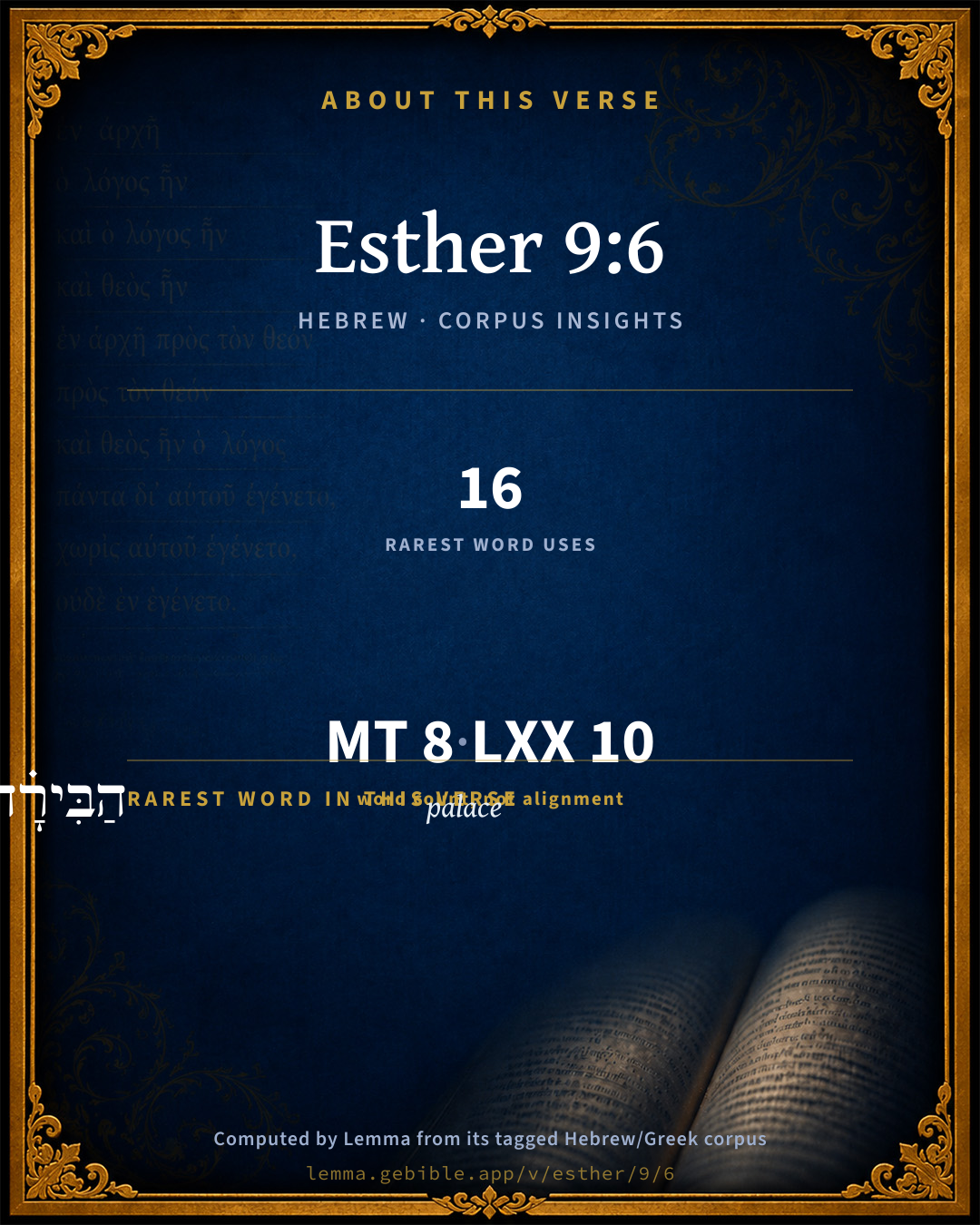
The rarest word here is הַבִּירָ֗ה palace H1002 — appearing just 16 times in the whole Hebrew Bible.

Shared distinctive vocabulary

הַבִּירָ֗ה palace H1002 occurs in 16 verses of the Hebrew Bible. Also found in:

Grammatical profile

  • 2 verbs
  • 4 nouns
  • 2 adjectives

Verb forms

  • הָרְג֤וּ Qal · Perfect
  • וְאַבֵּ֔ד Piel · Infinitive Absolute

Hebrew & Septuagint length

In English translation the verse runs 12 words from the Hebrew and 11 from the Septuagint (LXX English) — closely comparable.

A rough comparison of the two English renderings, which tokenize alike — not a word-level alignment.

Word counts can differ between the Hebrew and the Greek without any difference in meaning — e.g. the Hebrew direct-object marker אֵת has no separate Greek word, and Greek often adds the article ὁ.

In the original languages it is 8 Hebrew tokens and 10 Greek tokens — but the two are counted differently (Hebrew bundles its prefixes and suffixes into one token; the Greek is in lemma form), so that isn’t a like-for-like length.

Cross-references

1

Topical passages linked to Esther 9:6 in the Treasury of Scripture Knowledge — connected by theme and wording, ordered by reader-vote popularity; previews shown in the World English Bible.

  • Esther 3:15 The posts went forth in haste by the king's commandment, and the decree was given out in Shushan the palace. The king and Haman sat down to drink; but the city of Shushan was perplexed.

Cross-references courtesy of OpenBible.info (CC BY 4.0).

Hebrew and Greek witnesses Masoretic Hebrew ↔ Greek Septuagint

The same verse in the two great witnesses to the Old Testament, shown verse-for-verse.

These are two independent witnesses, not word-aligned to each other, and the Septuagint is shown in lemma (dictionary) form.

Hebrew Esther 9:6 Masoretic · Westminster Leningrad Codex

וּבְשׁוּשַׁ֣ן הַבִּירָ֗ה הָרְג֤וּ הַיְּהוּדִים֙ וְאַבֵּ֔ד חֲמֵ֥שׁ מֵא֖וֹת אִֽישׁ

In Shushan the palace the Jews killed and destroyed five hundred men.

World English Bible · Public Domain

Greek LXX Esther 9:6 Septuagint · lemma form

καί ἐν σουσά ὁ πόλις ἀποκτείνω ὁ ἰουδαῖος ἀνήρ πεντακόσιοι

And in the city Susa the Jews killed five hundred men:

LXX2012 (modern English Septuagint) · Public Domain

Hebrew: Westminster Leningrad Codex (CC BY 4.0). Greek: Septuagint (public domain); English from LXX2012 (modern English Septuagint) (Public Domain). How the Septuagint differs from the Hebrew →

Commentary

Notes on Esther 9:6 from classic Christian and Jewish commentators (each source and its license shown beneath its notes). The classic Christian expositions comment on the surrounding passage and are grouped to its opening verse, so a note may address several verses; the Jewish commentaries on the Tanakh (Rashi and others) are per-verse, so they appear only where the commentator wrote on this verse.

Lemma curates 59 commentaries, every one of them public domain or Creative Commons licensed, each selected and text-cleaned for this edition rather than reprinted as found. About our sources →

Trapp's Complete Commentary

John Trapp

Est 9:6 And in Shushan the palace the Jews slew and destroyed five hundred men.

Ver. 6. And in Shushan the palace] One would wonder that any here should offer to stir against the Jews, so much favoured by the king, patronized by Mordecai, and well appointed to withstand them. But they were mad with malice against God’s people, and ambitious of their own destruction. Haman’s death still sticks in their stomachs, and they resolve to be revenged, whatever it stands them in. With like stoutness of stomach it was that Jezebel painted her face, and tired her head, when Jehu was come to Jezreel, and looking out at a window, said, Had Zimri peace, &c. Herein certainly she showed her great stoutness, as if she would daunt Jehu, and out brave him in the midst of his pomp and triumph, 2Ki 9:30-31. Divine vengeance suffereth not wicked people to rest, and to keep in their malice and mischief; but that they must break out and run headlong, like wild beasts into the hunter’s toil, or upon the spear’s point, whereby they perish.

John Trapp, A Commentary or Exposition upon All the Books of the Old and New Testament (1647–1656) — public domain. Text from a community e-Sword module.

Joseph Benson's Commentary

Est 9:6. In Shushan the palace — That is, in the city where the palace was; it not being probable, either that they would make such a slaughter in the palace itself, or that they would be permitted so to do; the Jews slew and destroyed five hundred men — These, and the rest killed in other places, either were men who did not conceal their wicked inclinations, but openly assaulted the Jews, and whom therefore the king’s edict gave them power to destroy; or, they were persons whom the Jews knew to be their avowed enemies, and such as would watch all opportunities to assault and destroy them.

Joseph Benson's Commentary on the Old and New Testaments (1811–1818) — public domain. Text from a community e-Sword module.

Tyndale Open Study Notes

Tyndale Open Resources

9:6 Although most people in the fortress of Susa itself supported Mordecai, the Jews killed 500 men, a mini-revolt that probably consisted of killing Haman’s relatives and close supporters.

Tyndale Open Study Notes — © Tyndale Open Resources, licensed CC BY-SA 4.0. Text via the HelloAO Bible API.

Geneva Bible (1599)

Geneva Bible translators

Besides those three hundred, that they slew the second day, as verse 15.

Geneva Bible (1599) marginal notes — public domain. Text via Bolls.life.

Adam Clarke's Commentary

Verse 6. And in Shushan] It is strange that in this city, where the king's mind must have been so well known, there should be found five hundred persons to rise up in hostility against those whom they knew the king befriended!

Adam Clarke's Commentary on the Bible (1810–1826) — public domain. Text from a community e-Sword/MySword module.

Ellicott's Commentary for English Readers

(6) The palace.—Doubtless the whole royal city, rather than the palace strictly so called. It is obvious that even Xerxes would hardly have allowed bloodshed, otherwise than by his direct orders, within the precincts of the palace.

A Bible Commentary for English Readers, edited by Charles John Ellicott (1878–1897) — public domain. Text from a community e-Sword module.

The Cambridge Bible for Schools and Colleges

gen. ed. J. J. S. Perowne

6. in Shushan the palace] The word seems to have a somewhat wider sense here than earlier in the Book (see note on Est_1:2), meaning perhaps royal city. Bloodshed within the palace proper would not have been permitted, and even in the fortress connected with it this number would scarcely have been reached.

The Cambridge Bible for Schools and Colleges (gen. ed. J. J. S. Perowne; Cambridge University Press, 1878–1918) — public domain. Text from a community e-Sword module.

John Gill's Exposition

And in Shushan the palace the Jews slew and destroyed five hundred men. Not in the royal palace, where it cannot be thought the Jews had so many enemies, or such a bloody slaughter of them should be made there; but in the city, where the palace was: and this may seem somewhat wonderful, that there should so many rise there against the Jews, so near the court, now altogether in the interest of the Jews; but these were men no doubt of Haman's faction, and enraged at his disgrace and death, and headed by his ten sons, who took the advantage of the decree to avenge his death; the Targum says, these were princes of the house of Amalek.

And in Shushan the palace the Jews slew and destroyed five hundred men. Not in the royal palace, where it cannot be thought the Jews had so many enemies, or such a bloody slaughter of them should be made there; but in the city, where the palace was: and this may seem somewhat wonderful, that there should so many rise there against the Jews, so near the court, now altogether in the interest of the Jews; but these were men no doubt of Haman's faction, and enraged at his disgrace and death, and headed by his ten sons, who took the advantage of the decree to avenge his death; the Targum says, these were princes of the house of Amalek.

Esther 9:7

est 9:7

est 9:7

est 9:7And Parshandatha, and Dalphon, and Aspatha, and Poratha, and Adalia, and Aridatha, and Parmashta, and Arisai, and Aridai, and Vajezatha, the ten sons of Haman the son of Hammedatha, the enemy of the Jews, slew they,.... Along with the five hundred men, at the head of which they were:

but on the spoil laid they not their hands; though they were allowed by the edict to do it, Est 8:11, but this they did not, that it might appear that they did not take away their lives from a covetous desire of their estates, but purely in self-defence; and they might do this, the more to ingratiate themselves to the king, to whom the goods and estates of those men would be confiscated.

John Gill's Exposition of the Whole Bible (1746–1763) — public domain (CC PDM 1.0). Text via the HelloAO Bible API.

Albert Barnes' Notes on the Bible

By “Shushan the palace (or the fort),” is probably meant the whole of the upper town, which occupied an area of more than 100 acres, and contained many residences besides the actual palace. The Jews would not have ventured to shed blood within the palace-precincts.

Albert Barnes' Notes on the Bible (1834–1885) — public domain. Text from a community e-Sword/MySword module.

Haydock's Catholic Bible Commentary

Sons. It seems as if they had been slain with their father, ver. 10. See chap. vii. 9. (Calmet) --- Yet, as the contrary would appear from chap. xvi. 18, we may suppose that they were at least (Haydock) imprisoned till this time, for a more exemplary punishment, while all the rest of the family perished with Aman. (Serarius) (Salien) (Menochius) --- These are the kindred, specified nine months before, chap. xvi. (Tirinus) --- Some Masorets childishly (Haydock) write these ten names one over another, and with greater and lesser letters, to shew that they were hung one above another, and that the guilt of all was not the same, but the youngest son was the most malicious. (Kennicott)

George Leo Haydock (1774–1849), Haydock's Catholic Family Bible and Commentary, 1859 edition — public domain. Excludes Psalms (Douay-Rheims chapter numbering differs from Protestant) and Deuterocanonical books (Catholic canon only).

Matthew Poole's English Annotations

In Shushan the palace, i.e. in the city so called, as was noted before, Est 1:2; it not being probable either that they would make such a slaughter in the king’s palace, or that they would be suffered so to do.

Five hundred men; whom by long experience they knew to be their constant and inveterate enemies, and such as would watch all opportunities to destroy them; which also they might possibly now attempt to do. Part of them also might be friends and allies of Haman, and therefore the avowed enemies of Mordecai.

Matthew Poole's English Annotations on the Holy Bible (1683–1685) — public domain. Text from a community e-Sword/MySword module.

Whedon's Commentary on the Bible

Daniel D. Whedon

6. In Shushan the palace the Jews slew… five hundred — Shushan the palace is here evidently to be taken in the sense of the place or city of the palace, equivalent to in or at Shushan, as in Est_9:15. It is not to be supposed that the work of slaughter was carried on within the palace itself.

Daniel D. Whedon (gen. ed.), Commentary on the Old and New Testaments (1874–1909) — public domain. Text from a community e-Sword module.

The Pulpit Commentary

In Shushan the palace. i.e. the upper city, where the palace was. The area of the hill is above a hundred acres, and there are many remains of residences on it besides the palace. It was probably densely peopled.

The Pulpit Commentary (1880–1919), ed. H.D.M. Spence-Jones & Joseph S. Exell — public domain. Text from a community e-Sword module.

John Wesley's Explanatory Notes

Shushan - In the city so called. Slew - Whom they knew to be such as would watch all opportunities to destroy them; which also they might possibly now attempt to do.

John Wesley, Explanatory Notes Upon the Whole Bible (1754–1765) — public domain. Text via the GEBible commentary corpus.

unfoldingWord translationNotes

Door43 World Missions Community

the fortress

This refers to a castle, stronghold or fortified city. See how you translated this in Esther 1:2.

Susa

This was a royal city of Persian kings. See how you translated this in Esther 1:2. (See: How to Translate Names)

five hundred men

"500 men" (See: Numbers)

Parshandatha, Dalphon, Aspatha, Poratha, Adalia, Aridatha, Parmashta, Arisai, Aridai, Vaizatha

These are the names of men. (See: How to Translate Names)

ten sons

"10 sons" (See: Numbers)

Haman

This is the name and description of Haman, one of the king's officials. See how you translated this in Esther 3:1. (See: How to Translate Names)

Hammedatha

See how you translated this man's name in Esther 3:1. (See: How to Translate Names)

the enemy of the Jews

This phrase tells us about Haman.

translationWords

Jew

unfoldingWord translationNotes — © Distant Shores Media and the Door43 World Missions Community, licensed CC BY-SA 4.0. Source: git.door43.org/Door43/en_tn.

Lesson kit

Teaching starters — assembled from the data on this page, not authored interpretation. Every prompt links to the verse data it draws on. Edit before teaching.

Esther, in the Historical, opens this verse with 8 words (8 distinct Hebrew lemmas). Its most distinctive word is bîyrâh (“palace”). A historical commentator’s framing appears above. Read the whole chapter for the surrounding context.

Discussion questions

  1. What does “palace” (bîyrâh) contribute to the verse as a whole?
  2. 1 Chronicles 29:1 shares the word «palace» with this verse. How do the two illuminate each other?
  3. These translations render this verse differently. What is at stake in choosing one wording over another?
  4. The verb «הָרְג֤וּ» is Qal Perfect. How does its form color the action?
  5. Reading how Trapp's Complete Commentary and Joseph Benson's Commentary read this verse, where do the two commentators agree and where do they part?

Things to notice

Reading settings

Reading text

Shown beneath each verse's original-language words.

Old Testament
Old Testament edition

Read the OT as the Masoretic Hebrew (MT) or the Greek Septuagint (LXX).

English shown for the Greek Septuagint (in the Hebrew ↔ Greek comparison).

Comparing translations? Open the Compare panel on any verse page to stack up to four side by side.