
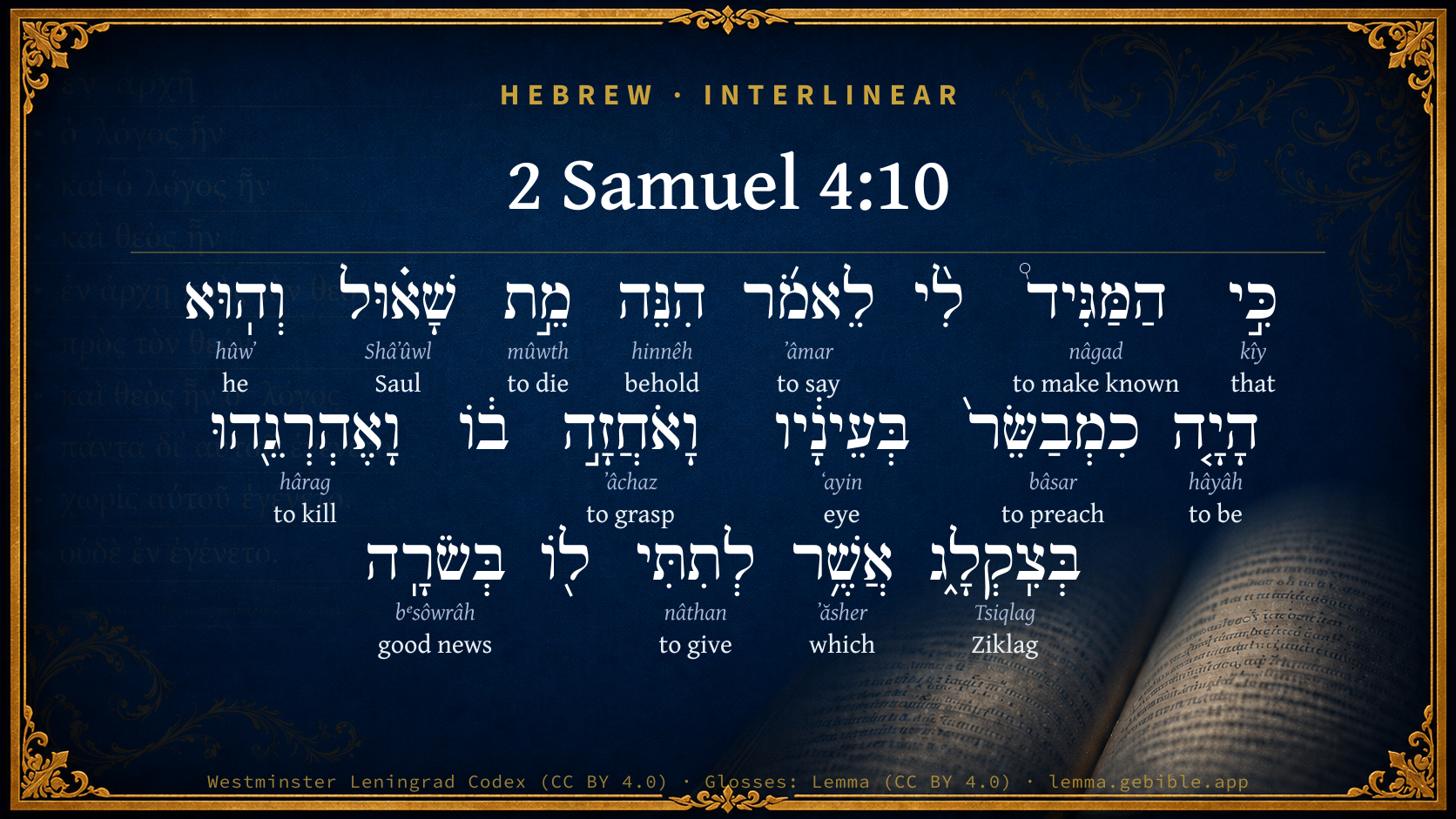
2 Samuel 4:10

Hebrew (Westminster Leningrad Codex) 2 Samuel 4:10 appears in the Hebrew Old Testament. The text above is from the Westminster Leningrad Codex. Each word links to its Strong’s number, a concise gloss, and parsing drawn from the Open Scriptures Hebrew Bible morphology. Click any word for its full Brown-Driver-Briggs (BDB) entry.
Download image
Cite this verse

2 Samuel 4:10 (World English Bible). Public Domain. Lemma interlinear Bible study tool, https://lemma.gebible.app/v/2-samuel/4/10.

Show BibTeX & RIS
BibTeX
RIS
English Translation
when one told me, saying, Behold, Saul is dead, thinking to have brought good news, I took hold of him, and killed him in Ziklag, which was the reward I gave him for his news.
World English Bible · Public Domain
Highlights
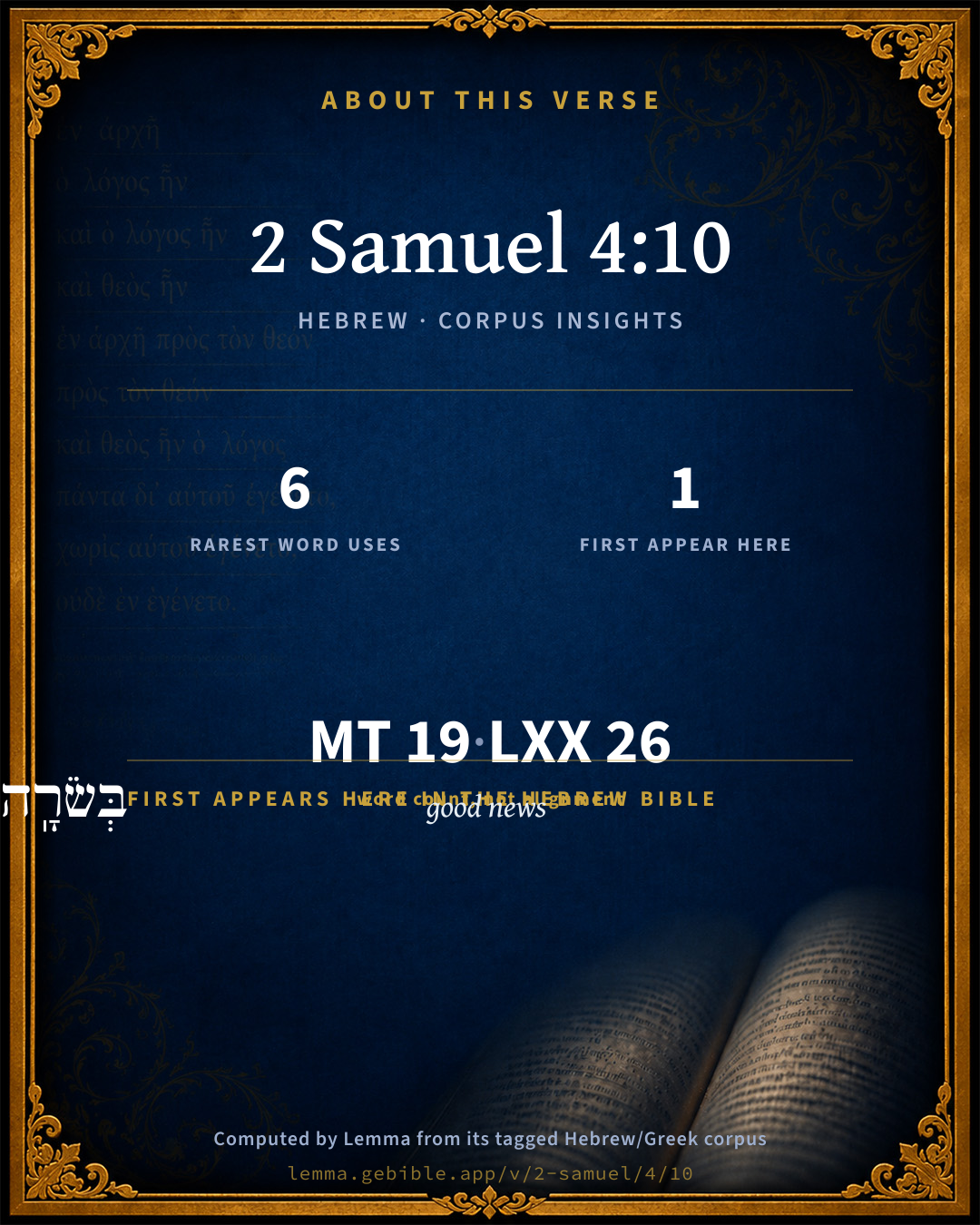
  • 1 first appearance in the Hebrew Bible
Full analysis ↓
Download a study sheet

One document with this verse’s original text, its word-by-word gloss line, the meaning frame, cross-references with their text, attributed commentary, and full source and license credits — printable, and it pastes into notes with its structure intact.

This verse Autodidact and up

Study sheet (.html) Plain text (.txt)

A passage Seminary Student

Up to 50 verses in one chapter. A passage sheet keeps up to 6 commentary sources and 12 cross-references per verse, in the order this page ranks them, and says so on the sheet whenever that leaves anything out. Ask for a single verse and you get the Autodidact verse sheet above.

Everything on this page stays free to read, with no account — the sheet is a download of what is already on screen, not access to it.

Want to remove ads? Support Godless Engineer
Compare translations 3

The same verse in 3 English versions, stacked beneath the original-language interlinear above. Click any original word for its lexicon entry.

Each is an independent rendering of the whole verse — the interlinear is not word-aligned to these translations.

Highlighted words mark where these versions differ — a whole-verse word diff, not a word-by-word alignment.

  • World English Bible Public Domain
    when one told me, saying, Behold, Saul is dead, thinking to have brought good news, I took hold of him, and killed him in Ziklag, which was the reward I gave him for his news.
  • King James Version Public Domain
    When one told me, saying, Behold, Saul is dead, thinking to have brought good tidings, I took hold of him, and slew him in Ziklag, who thought that I would have given him a reward for his tidings:
  • unfoldingWord Literal Text CC BY-SA 4.0
    that the one declaring to me, saying, ‘Behold, Saul is dead,’ and in his eyes he was like a bringer of news, that I seized him, and I killed him at Ziklag, which me giving him a reward for good news.

unfoldingWord Literal Text — © unfoldingWord, licensed CC BY-SA 4.0. Word-aligned USFM3 via Door43 (git.door43.org/unfoldingWord/en_ult).

Versions to compare (up to 4)

3 of 4 selected

Show all 18 translations

Every available English version of this verse, each an independent rendering of the whole verse.

  • World English Bible Public Domain
    when one told me, saying, Behold, Saul is dead, thinking to have brought good news, I took hold of him, and killed him in Ziklag, which was the reward I gave him for his news.
  • Berean Standard Bible Public Domain
    when someone told me, ‘Look, Saul is dead,’ and thought he was a bearer of good news, I seized him and put him to death at Ziklag. That was his reward for his news!
  • Majority Standard Bible Public Domain
    when someone told me, ‘Look, Saul is dead,’ and thought he was a bearer of good news, I seized him and put him to death at Ziklag. That was his reward for his news!
  • King James Version Public Domain
    When one told me, saying, Behold, Saul is dead, thinking to have brought good tidings, I took hold of him, and slew him in Ziklag, who thought that I would have given him a reward for his tidings:
  • American Standard Version (1901) Public Domain
    when one told me, saying, Behold, Saul is dead, thinking to have brought good tidings, I took hold of him, and slew him in Ziklag, which was the reward I gave him for his tidings.
  • Revised Version (1885) Public Domain
    when one told me, saying, Behold, Saul is dead, thinking to have brought good tidings, I took hold of him, and slew him in Ziklag, which was the reward I gave him for his tidings.
  • Geneva Bible (1599) Public Domain
    When one tolde me, and sayde that Saul was dead, (thinking to haue brought good tydings) I tooke him and slewe him in Ziklag, who thought that I woulde haue giuen him a rewarde for his tidings:
  • Douay-Rheims (1899) Public Domain
    The man that told me, and said: Saul is dead, who thought he brought good tidings, I apprehended, and slew him in Siceleg, who should have been rewarded for his news.
  • Young's Literal Translation Public Domain
    when one is declaring to me, saying, Lo, Saul is dead, and he was as a bearer of tidings in his own eyes, then I take hold on him, and slay him in Ziklag, instead of my giving to him `for' the tidings.
  • Literal Standard Version CC BY-SA 4.0
    when one is declaring to me, saying, Behold, Saul is dead, and he was as a bearer of tidings in his own eyes, then I take hold on him, and slay him in Ziklag, instead of my giving to him [for] the tidings.
  • Unlocked Literal Bible CC BY-SA 4.0
    when someone told me, 'Look, Saul is dead,' thinking he was bringing good news, I seized him and killed him at Ziklag. That was the reward I gave him for his news.
  • unfoldingWord Literal Text CC BY-SA 4.0
    that the one declaring to me, saying, ‘Behold, Saul is dead,’ and in his eyes he was like a bringer of news, that I seized him, and I killed him at Ziklag, which me giving him a reward for good news.
  • Darby Bible Public Domain
    when one told me, saying, Behold, Saul is dead! and he was in his own sight a messenger of good, I took hold of him, and slew him in Ziklag -- to whom forsooth I should give a reward for his good tidings:
  • World Messianic Bible Public Domain
    when someone told me, ‘Behold, Saul is dead,’ thinking that he brought good news, I seized him and killed him in Ziklag, which was the reward I gave him for his news.
  • Webster's Bible Public Domain
    When one told me, saying, Behold, Saul is dead, (thinking to have brought good tidings,) I took hold of him, and slew him in Ziklag, who thought that I would have given him a reward for his tidings:
  • Free Bible Version CC BY-SA 4.0
    when someone told me, ‘Look, Saul is dead’ and he thought he was bringing me good news, I grabbed him and had him put him to death at Ziklag. That was what he got for bringing me his news!
  • Bible in Basic English Public Domain
    When one came to me with the news of Saul's death, in the belief that it would be good news, I took him and put him to death in Ziklag, which was the reward I gave him for his news:
  • JPS Tanakh (1917) Public Domain
    when one told me, saying: Behold, Saul is dead, and he was in his own eyes as though he brought good tidings, I took hold of him, and slew him in Ziklag, instead of giving a reward for his tidings.

Literal Standard Version (2020), Covenant Press — licensed CC BY-SA 4.0. Text via the HelloAO Bible API (eBible.org). Unlocked Literal Bible (unfoldingWord) — licensed CC BY-SA 4.0. Text via the HelloAO Bible API (eBible.org). unfoldingWord Literal Text — © unfoldingWord, licensed CC BY-SA 4.0. Word-aligned USFM3 via Door43 (git.door43.org/unfoldingWord/en_ult). Free Bible Version, Dr. Jonathan Gallagher — licensed CC BY-SA 4.0. Text via the HelloAO Bible API (eBible.org).

Word by word

More ways to search: Search by grammar → Find every occurrence → Compare this word →

Practice this passage: Drill this verse → Learn its vocabulary →

בְּשֹׂרָֽה
bᵉsôwrâh
H1309
“good news”
Noun, Common, Feminine, Singular, Absolute
Part of Speech
Noun
Type
Common
Gender
Feminine
Number
Singular
State
Absolute
Full BDB Definition

Origin: from H1319

TWOT: 291b

news, good news, tidings, reward for good news - good tidings - tidings, news - reward for good tidings
  1. כִּ֣י kîy H3588 “that” Conjunction
  2. הַמַּגִּיד֩ nâgad H5046 “the · making known” Particle, Definite Article + Verb, Hiphil, Participle Active, Masculine, Singular, Absolute
  3. לֵאמֹ֜ר ʼâmar H559 “to say” Preposition + Verb, Qal, Infinitive Construct
  4. הִנֵּה hinnêh H2009 “behold” Particle, Demonstrative
  5. מֵ֣ת mûwth H4191 “to die” Verb, Qal, Perfect, 3rd Person, Masculine, Singular
  6. שָׁא֗וּל Shâʼûwl H7586 “Saul” Noun, Proper
  7. וְהֽוּא hûwʼ H1931 “and · he” Conjunction + Pronoun, Personal, 3rd Person, Masculine, Singular
  8. הָיָ֤ה hâyâh H1961 “to be” Verb, Qal, Perfect, 3rd Person, Masculine, Singular
  9. כִמְבַשֵּׂר֙ bâsar H1319 “like/as · preaching” Preposition + Verb, Piel, Participle Active, Masculine, Singular, Absolute
  10. בְּעֵינָ֔יו ʻayin H5869 “in/at · eyes · his” Preposition + Noun, Common, Both, Dual, Construct + Suffix, Personal, 3rd Person, Masculine, Singular
  11. וָאֹחֲזָ֣ה ʼâchaz H270 “and · to grasp” Conjunction + Verb, Qal, Sequential Imperfect, 1st Person, Common, Singular + Suffix, h
  12. וָאֶהְרְגֵ֖הוּ hârag H2026 “and · to kill · him” Conjunction + Verb, Qal, Sequential Imperfect, 1st Person, Common, Singular + Suffix, Personal, 3rd Person, Masculine, Singular
  13. בְּצִֽקְלָ֑ג Tsiqlag H6860 “in/at · Ziklag” Preposition + Noun, Proper
  14. אֲשֶׁ֥ר ʼăsher H834 “which” Particle, Relative
  15. לְתִתִּי nâthan H5414 “to give · me” Preposition + Verb, Qal, Infinitive Construct + Suffix, Personal, 1st Person, Common, Singular

About this verse

These counts appear in no published source. They are computed here, from the morphology-tagged text and Lemma’s own curated glosses. What Lemma adds →

19
words
16
distinct lemmas
Historical
section

Notable vocabulary

The rarest word here is בְּשֹׂרָֽה good news H1309 — appearing just 6 times in the whole Hebrew Bible.

First appearance in Scripture

This word makes its first canonical appearance in the Hebrew Bible here:

  • בְּשֹׂרָֽה good news H1309

Shared distinctive vocabulary

בְּשֹׂרָֽה good news H1309 occurs in 6 verses of the Hebrew Bible. Also found in:

Grammatical profile

  • 8 verbs
  • 4 nouns
  • 1 pronoun
  • 3 prepositions
  • 1 conjunction
  • 2 particles

Verb forms

  • הַמַּגִּיד֩ Hiphil · Participle Active
  • לֵאמֹ֜ר Qal · Infinitive Construct
  • מֵ֣ת Qal · Perfect
  • הָיָ֤ה Qal · Perfect
  • כִמְבַשֵּׂר֙ Piel · Participle Active
  • וָאֹחֲזָ֣ה Qal · Sequential Imperfect
  • וָאֶהְרְגֵ֖הוּ Qal · Sequential Imperfect
  • לְתִתִּי Qal · Infinitive Construct

Hebrew & Septuagint length

In English translation the verse runs 35 words from the Hebrew and 43 from the Septuagint (LXX English) — closely comparable.

A rough comparison of the two English renderings, which tokenize alike — not a word-level alignment.

Word counts can differ between the Hebrew and the Greek without any difference in meaning — e.g. the Hebrew direct-object marker אֵת has no separate Greek word, and Greek often adds the article ὁ.

In the original languages it is 19 Hebrew tokens and 26 Greek tokens — but the two are counted differently (Hebrew bundles its prefixes and suffixes into one token; the Greek is in lemma form), so that isn’t a like-for-like length.

Cross-references

1

Topical passages linked to 2 Samuel 4:10 in the Treasury of Scripture Knowledge — connected by theme and wording, ordered by reader-vote popularity; previews shown in the World English Bible.

  • 2 Samuel 1:2–16 it happened on the third day, that behold, a man came out of the camp from Saul, with his clothes torn, and earth on his head: and so it was, when he came to David, that he fell to the earth, and did obeisance.

Cross-references courtesy of OpenBible.info (CC BY 4.0).

Hebrew and Greek witnesses Masoretic Hebrew ↔ Greek Septuagint

The same verse in the two great witnesses to the Old Testament, shown verse-for-verse.

These are two independent witnesses, not word-aligned to each other, and the Septuagint is shown in lemma (dictionary) form.

Hebrew 2 Samuel 4:10 Masoretic · Westminster Leningrad Codex

כִּ֣י הַמַּגִּיד֩ לִ֨י לֵאמֹ֜ר הִנֵּה מֵ֣ת שָׁא֗וּל וְהֽוּא הָיָ֤ה כִמְבַשֵּׂר֙ בְּעֵינָ֔יו וָאֹחֲזָ֣ה ב֔וֹ וָאֶהְרְגֵ֖הוּ בְּצִֽקְלָ֑ג אֲשֶׁ֥ר לְתִתִּי ל֖וֹ בְּשֹׂרָֽה

when one told me, saying, Behold, Saul is dead, thinking to have brought good news, I took hold of him, and killed him in Ziklag, which was the reward I gave him for his news.

World English Bible · Public Domain

Greek LXX 2 Samuel 4:10 Septuagint · lemma form

ὅτι ὁ ἀποἀγγέλλω ἐγώ ὅτι θνήσκω σαούλ καί αὐτός εἰμί ὡς εὐαγγελίζω ἐνώπιόν ἐγώ καί καταἔχω αὐτός καί ἀποκτείνω ἐν σεκελακ ὅς δέω ἐγώ δίδωμι εὐαγγέλιον

he that reported to me that Saul was dead, even he was as one bringing glad tidings before me: but I seized him and killed him in Sekelac, to whom I ought, as he thought, to have given a reward for his tidings.

LXX2012 (modern English Septuagint) · Public Domain

On this verse, Adam Clarke's Commentary discusses the Septuagint’s reading. Read the note in Commentary ↓

Hebrew: Westminster Leningrad Codex (CC BY 4.0). Greek: Septuagint (public domain); English from LXX2012 (modern English Septuagint) (Public Domain). How the Septuagint differs from the Hebrew →

Targum (Aramaic paraphrase)

1

The Targum is the ancient Jewish Aramaic paraphrase of the Hebrew Scriptures — an interpretive translation, not the Hebrew text itself. Onkelos (literal) and Pseudo-Jonathan (expansive) render the Torah, and Jonathan the Prophets. Coverage is partial: where no permissively-licensed English translation exists for a verse, only the Aramaic is shown. This is verse-level text, not a word-by-word alignment to the Hebrew.

  1. Targum Jonathan Prophets (Joshua–Malachi)
    אֲרֵי דְחַוֵי לִי לְמֵימַר הָא מִית שָׁאוּל וְהוּא הֲוָה כִּמְבַשֵׂר בְּעֵינֵי נַפְשֵׁיהּ וַאֲחָדִית בֵּיהּ וּקְטַלְתֵּיהּ בְּצִקְלָג דַהֲוָה מְדַמִי לְמִתַּן לֵיהּ מַתְּנַת בְּסוֹרָתֵיהּ:

    (no public-domain English translation for this verse)

    Targum Jonathan — Aramaic: “Mikraot Gedolot” (public domain). English: “Sefaria Community Translation” (CC0 1.0 (public-domain dedication)); “London "Chaldee Paraphrase," 1871” (public domain). Text via Sefaria.

Commentary

Notes on 2 Samuel 4:10 from classic Christian and Jewish commentators (each source and its license shown beneath its notes). The classic Christian expositions comment on the surrounding passage and are grouped to its opening verse, so a note may address several verses; the Jewish commentaries on the Tanakh (Rashi and others) are per-verse, so they appear only where the commentator wrote on this verse.

Lemma curates 59 commentaries, every one of them public domain or Creative Commons licensed, each selected and text-cleaned for this edition rather than reprinted as found. About our sources →

Trapp's Complete Commentary

John Trapp

2Sa 4:10 When one told me, saying, Behold, Saul is dead, thinking to have brought good tidings, I took hold of him, and slew him in Ziklag, who [thought] that I would have given him a reward for his tidings:

Ver. 10. I took hold of him, and slew him.] So did Caesar serve him who brought him Pompey’s head, looking for a great reward. And when Hamen the false Jew, a physician, had poisoned Bajazet the great Turk, and coming to Constantinople, expected some great reward for his foul treason, by the commandment of Selymus, who succeeded in the throne, he had his head struck off, with this exprobration of his treachery, that opportunity serving, he would not stick to do the like for reward against Selymus himself. {a}

{a} Turk. Hist., 496.

John Trapp, A Commentary or Exposition upon All the Books of the Old and New Testament (1647–1656) — public domain. Text from a community e-Sword module.

Adam Clarke's Commentary

Verse 10. A reward for his tidings] Ὡ εδει με δουναι ευαγγελια, Septuagint. Here is a proof that ευαγγελιον, evangelium or gospel, signifies the reward which the bringer of good tidings is entitled to receive. See my preface to St. Matthew's Gospel. See Clarke on Mt 1:1.

Adam Clarke's Commentary on the Bible (1810–1826) — public domain. Text from a community e-Sword/MySword module.

Ellicott's Commentary for English Readers

(10) Who thought that I would have given him.—The words thought that I would are not in the original, and the literal translation of the margin is better: “which was the reward I gave him.” This shows very plainly David’s view of the motive which prompted the Amalekite to his lie recorded in 2Sa_1:10.

A Bible Commentary for English Readers, edited by Charles John Ellicott (1878–1897) — public domain. Text from a community e-Sword module.

The Cambridge Bible for Schools and Colleges

gen. ed. J. J. S. Perowne

10. when one told me, &c.] The Amalekite who pretended to have slain Saul (ch. 2Sa_1:2 ff.).

slew him … who thought that I would have given him] Or, slew him … to give him a reward, &c. In this case the expression is bitterly ironical. ‘He expected a reward, and I gave it him; but it was the reward of death.’

The Cambridge Bible for Schools and Colleges (gen. ed. J. J. S. Perowne; Cambridge University Press, 1878–1918) — public domain. Text from a community e-Sword module.

John Gill's Exposition

How much more, when wicked men have slain a righteous person,.... As Ishbosheth was in comparison of the wicked men that slew him; though not with respect to David, if he knew of his divine designation to the throne; nor with respect to Mephibosheth his eldest brother's son, whose right to the throne was prior to his, which he must know; though with respect to his conduct towards David, in assuming the throne of Israel, it might not be owing to any bad principles of malice and injustice, but to his ignorance of David's having a right to the throne upon his father's death, and by the advice of his friends he took it: the sin of these men in murdering him is aggravated, in that they slew him

in his own palace, upon his bed? in cold blood, and not in the field of battle, not being engaged in war with him; in his own palace, where he might justly think himself in safety; on his bed asleep, and so at an unawares, when insensible of danger, and not in a posture of defence; and now David argues from the lesser to the greater, that if the man that brought him the tidings of Saul's death had no reward given him for bringing what he thought would be reckoned good tidings, then much less would any be given them who had actually slain their master, and that in such a base and barbarous way; and if the above person, who only was a bringer of tidings, was taken and slain, then how much more did they deserve to die, who had been guilty of such a cruel and barbarous murder?

shall I not therefore now require his blood of your hands, and take you away from the earth? avenge his blood on them, by putting them to death, out of the world, and from the land of the living, as men that deserved to live no longer on it.

John Gill's Exposition of the Whole Bible (1746–1763) — public domain (CC PDM 1.0). Text via the HelloAO Bible API.

Rashi

Rabbi Shlomo Yitzchaki (Rashi)

He thought I would reward him for his good tidings. He thought he was making me happy in order that I should reward him for his good tidings.

Rashi on the Tanakh — English translations: “The Judaica Press complete Tanach with Rashi, translated by A. J. Rosenberg” (CC BY 4.0); “Pentateuch with Rashi's commentary by M. Rosenbaum and A.M. Silbermann, 1929-1934” (public domain); “The Metsudah Tanach series, Lakewood, N.J” (CC BY 4.0); and “The Book of Joshua, Metsudah Publications, 1997” (CC BY 4.0). Text via Sefaria.

Lesson kit

Teaching starters — assembled from the data on this page, not authored interpretation. Every prompt links to the verse data it draws on. Edit before teaching.

2 Samuel, in the Historical, opens this verse with 19 words (16 distinct Hebrew lemmas). Its most distinctive word is bᵉsôwrâh (“good news”). A historical commentator’s framing appears above. Read the whole chapter for the surrounding context.

Discussion questions

  1. What does “good news” (bᵉsôwrâh) contribute to the verse as a whole?
  2. The word “good news” first appears here in Scripture. What is being introduced at this debut?
  3. 2 Samuel 18:20 shares the word «good news» with this verse. How do the two illuminate each other?
  4. These translations render this verse differently; the difference is in the English rendering, not the original. What questions does that raise?
  5. The verb «הַמַּגִּיד֩» is Hiphil Participle Active. How does its form color the action?
  6. Reading how Trapp's Complete Commentary and Adam Clarke's Commentary read this verse, where do the two commentators agree and where do they part?

Things to notice

Reading settings

Reading text

Shown beneath each verse's original-language words.

Old Testament
Old Testament edition

Read the OT as the Masoretic Hebrew (MT) or the Greek Septuagint (LXX).

English shown for the Greek Septuagint (in the Hebrew ↔ Greek comparison).

Comparing translations? Open the Compare panel on any verse page to stack up to four side by side.