Psalms 78:31

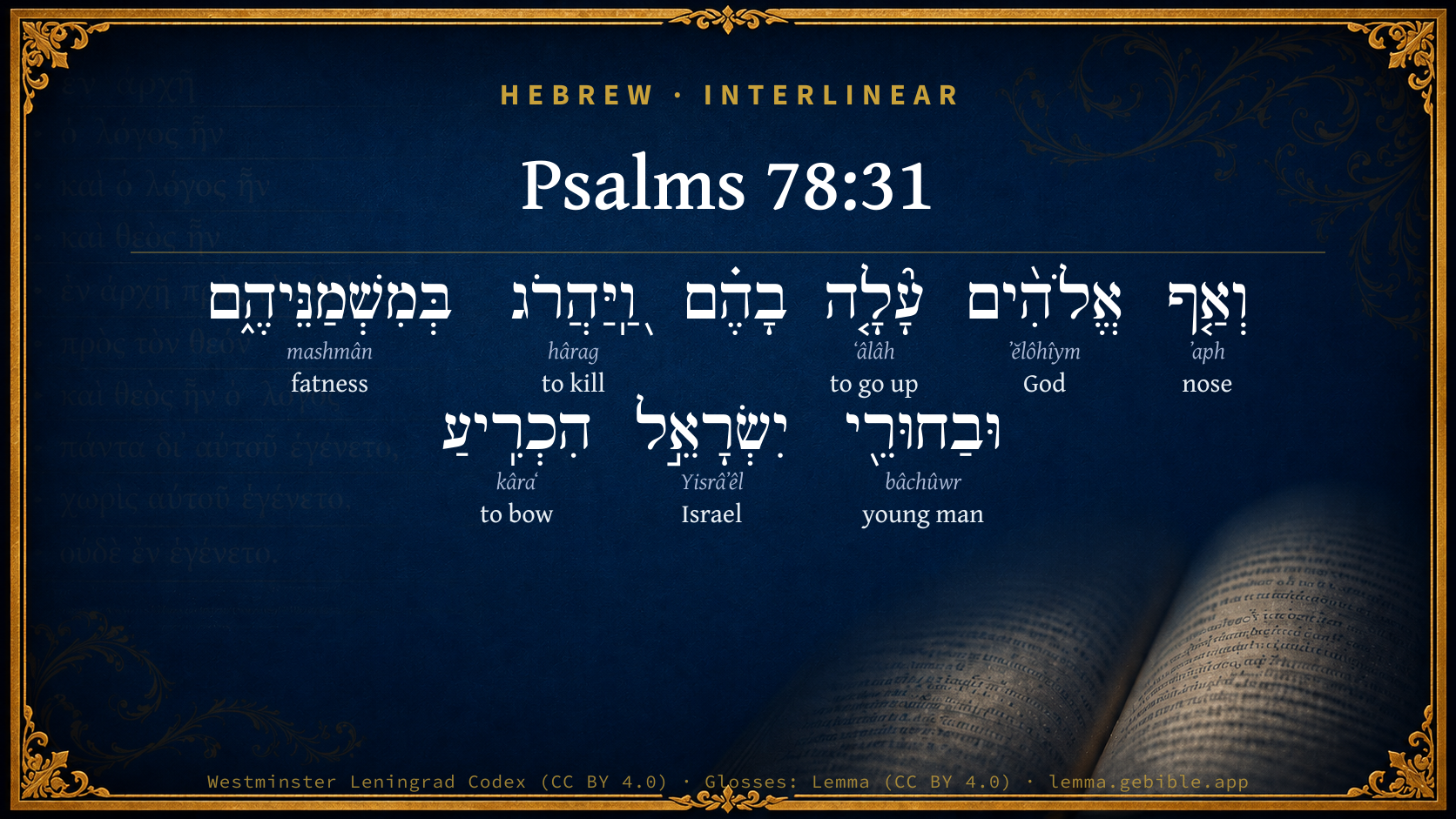
Hebrew (Westminster Leningrad Codex) Psalms 78:31 appears in the Hebrew Old Testament. The text above is from the Westminster Leningrad Codex. Each word links to its Strong’s number, a concise gloss, and parsing drawn from the Open Scriptures Hebrew Bible morphology. Click any word for its full Brown-Driver-Briggs (BDB) entry.
Download image
Cite this verse

Psalms 78:31 (World English Bible). Public Domain. Lemma interlinear Bible study tool, https://lemma.gebible.app/v/psalms/78/31.

Show BibTeX & RIS
BibTeX
RIS
English Translation
When the anger of God went up against them, Killed some of the fattest of them, And struck down the young men of Israel.
World English Bible · Public Domain
Download a study sheet

One document with this verse’s original text, its word-by-word gloss line, the meaning frame, cross-references with their text, attributed commentary, and full source and license credits — printable, and it pastes into notes with its structure intact.

This verse Autodidact and up

Study sheet (.html) Plain text (.txt)

A passage Seminary Student

Up to 50 verses in one chapter. A passage sheet keeps up to 6 commentary sources and 12 cross-references per verse, in the order this page ranks them, and says so on the sheet whenever that leaves anything out. Ask for a single verse and you get the Autodidact verse sheet above.

Everything on this page stays free to read, with no account — the sheet is a download of what is already on screen, not access to it.

Want to remove ads? Support Godless Engineer
Compare translations 3

The same verse in 3 English versions, stacked beneath the original-language interlinear above. Click any original word for its lexicon entry.

Each is an independent rendering of the whole verse — the interlinear is not word-aligned to these translations.

Highlighted words mark where these versions differ — a whole-verse word diff, not a word-by-word alignment.

  • World English Bible Public Domain
    When the anger of God went up against them, Killed some of the fattest of them, And struck down the young men of Israel.
  • King James Version Public Domain
    The wrath of God came upon them, and slew the fattest of them, and smote down the chosen men of Israel.
  • unfoldingWord Literal Text CC BY-SA 4.0
    and the nose of God went up in them and he killed some of their stoutest people, and he caused the young men of Israel to bow down.

unfoldingWord Literal Text — © unfoldingWord, licensed CC BY-SA 4.0. Word-aligned USFM3 via Door43 (git.door43.org/unfoldingWord/en_ult).

Versions to compare (up to 4)

3 of 4 selected

Show all 18 translations

Every available English version of this verse, each an independent rendering of the whole verse.

  • World English Bible Public Domain
    When the anger of God went up against them, Killed some of the fattest of them, And struck down the young men of Israel.
  • Berean Standard Bible Public Domain
    God’s anger flared against them, and He put to death their strongest and subdued the young men of Israel.
  • Majority Standard Bible Public Domain
    God’s anger flared against them, and He put to death their strongest and subdued the young men of Israel.
  • King James Version Public Domain
    The wrath of God came upon them, and slew the fattest of them, and smote down the chosen men of Israel.
  • American Standard Version (1901) Public Domain
    When the anger of God went up against them, And slew of the fattest of them, And smote down the young men of Israel.
  • Revised Version (1885) Public Domain
    When the anger of God went up against them, and slew of the fattest of them, and smote down the young men of Israel.
  • Geneva Bible (1599) Public Domain
    When the wrath of God came euen vpon them, and slew the strongest of them, and smote downe the chosen men in Israel.
  • Douay-Rheims (1899) Public Domain
    and the wrath of God came upon them. And he slew the fat ones amongst them, and brought down the chosen men of Israel.
  • Young's Literal Translation Public Domain
    And the anger of God hath gone up against them, And He slayeth among their fat ones, And youths of Israel He caused to bend.
  • Literal Standard Version CC BY-SA 4.0
    And the anger of God has gone up against them, || And He slays among their fat ones, || And He caused youths of Israel to bend.
  • Unlocked Literal Bible CC BY-SA 4.0
    Then God's anger attacked them and killed the strongest of them. He brought down the young men of Israel.
  • unfoldingWord Literal Text CC BY-SA 4.0
    and the nose of God went up in them and he killed some of their stoutest people, and he caused the young men of Israel to bow down.
  • Darby Bible Public Domain
    When the anger of God went up against them; and he slew the fattest of them, and smote down the chosen men of Israel.
  • World Messianic Bible Public Domain
    when the anger of God went up against them, killed some of their strongest, and struck down the young men of Israel.
  • Webster's Bible Public Domain
    The wrath of God came upon them, and slew the fattest of them, and smote down the chosen men of Israel.
  • Free Bible Version CC BY-SA 4.0
    God became angry with them and he killed their strongest men, striking them down in the prime of life.
  • Bible in Basic English Public Domain
    The wrath of God came on them, and put to death the fattest of them, and put an end to the young men of Israel.
  • JPS Tanakh (1917) Public Domain
    When the anger of God went up against them, and slew of the lustieth among them, and smote down the young men of Israel.

Literal Standard Version (2020), Covenant Press — licensed CC BY-SA 4.0. Text via the HelloAO Bible API (eBible.org). Unlocked Literal Bible (unfoldingWord) — licensed CC BY-SA 4.0. Text via the HelloAO Bible API (eBible.org). unfoldingWord Literal Text — © unfoldingWord, licensed CC BY-SA 4.0. Word-aligned USFM3 via Door43 (git.door43.org/unfoldingWord/en_ult). Free Bible Version, Dr. Jonathan Gallagher — licensed CC BY-SA 4.0. Text via the HelloAO Bible API (eBible.org).

Word by word

More ways to search: Search by grammar → Find every occurrence → Compare this word →

Practice this passage: Drill this verse → Learn its vocabulary →

בְּמִשְׁמַנֵּיהֶ֑ם
mashmân
H4924
“in/at · fat pieces · their”
Preposition + Noun, Common, Masculine, Plural, Construct + Suffix, Personal, 3rd Person, Masculine, Plural
Part of Speech
Preposition + Noun
Type
Common
Gender
Masculine
Number
Plural
State
Construct
Full BDB Definition

Origin: from H8080

TWOT: 2410e , 2410f

fatness, fat piece, fertile place, richly prepared food - fat, fatness, fat pieces - oil, olive oil - fatness - stout, vigorous - fertile spots or places
  1. וְאַ֤ף ʼaph H639 “and · nose of” Conjunction + Noun, Common, Masculine, Singular, Construct
  2. אֱלֹהִ֨ים ʼĕlôhîym H430 “God(s)” Noun, Common, Masculine, Plural, Absolute
  3. עָ֘לָ֤ה ʻâlâh H5927 “to go up” Verb, Qal, Perfect, 3rd Person, Masculine, Singular
  4. וַֽ֭יַּהֲרֹג hârag H2026 “and · to kill” Conjunction + Verb, Qal, Sequential Imperfect, 3rd Person, Masculine, Singular
  5. וּבַחוּרֵ֖י bâchûwr H970 “and · young men of” Conjunction + Noun, Common, Masculine, Plural, Construct
  6. יִשְׂרָאֵ֣ל Yisrâʼêl H3478 “Israel” Noun, Proper
  7. הִכְרִֽיעַ kâraʻ H3766 “to bow” Verb, Hiphil, Perfect, 3rd Person, Masculine, Singular

About this verse

These counts appear in no published source. They are computed here, from the morphology-tagged text and Lemma’s own curated glosses. What Lemma adds →

9
words
8
distinct lemmas
Wisdom
section

Notable vocabulary

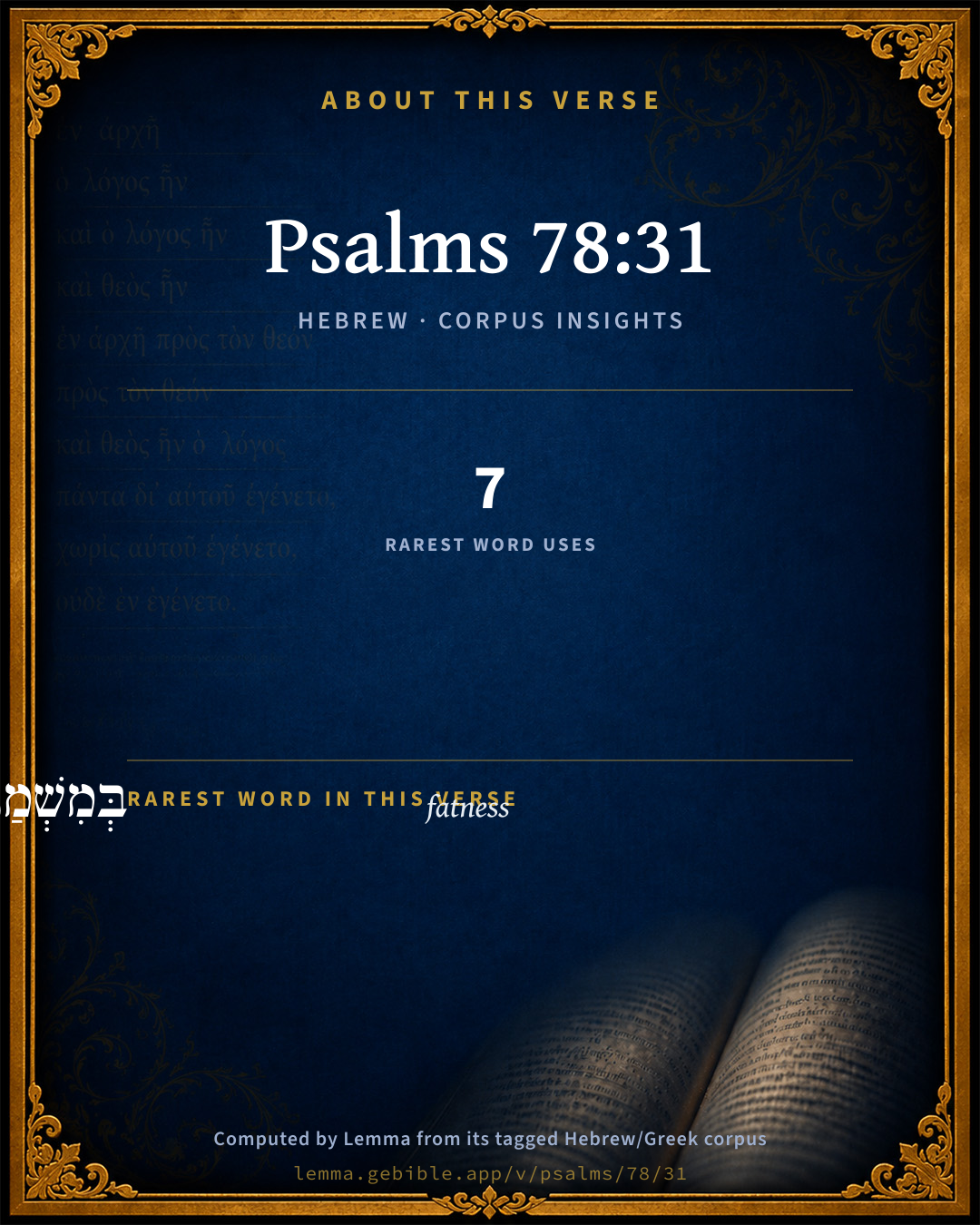
The rarest word here is בְּמִשְׁמַנֵּיהֶ֑ם fatness H4924 — appearing just 7 times in the whole Hebrew Bible.

Shared distinctive vocabulary

בְּמִשְׁמַנֵּיהֶ֑ם fatness H4924 occurs in 7 verses of the Hebrew Bible. Also found in:

Grammatical profile

  • 3 verbs
  • 5 nouns
  • 1 preposition

Verb forms

  • עָ֘לָ֤ה Qal · Perfect
  • וַֽ֭יַּהֲרֹג Qal · Sequential Imperfect
  • הִכְרִֽיעַ Hiphil · Perfect

Hebrew & Septuagint length

In English translation the verse runs 24 words from the Hebrew and 22 from the Septuagint (LXX English) — closely comparable.

A rough comparison of the two English renderings, which tokenize alike — not a word-level alignment.

Word counts can differ between the Hebrew and the Greek without any difference in meaning — e.g. the Hebrew direct-object marker אֵת has no separate Greek word, and Greek often adds the article ὁ.

Hebrew and Greek witnesses Masoretic Hebrew ↔ Greek Septuagint

The same verse in the two great witnesses to the Old Testament, shown verse-for-verse.

You’re reading Greek Psalm 77 (Hebrew Psalm 78). The Septuagint counts the superscription, so verse numbers can differ from the Hebrew — chapter-level alignment, not verse-by-verse. Numbering follows Rahlfs.

These are two independent witnesses, not word-aligned to each other, and the Septuagint is shown in lemma (dictionary) form.

Hebrew Psalms 78:31 Masoretic · Westminster Leningrad Codex

וְאַ֤ף אֱלֹהִ֨ים עָ֘לָ֤ה בָהֶ֗ם וַֽ֭יַּהֲרֹג בְּמִשְׁמַנֵּיהֶ֑ם וּבַחוּרֵ֖י יִשְׂרָאֵ֣ל הִכְרִֽיעַ

When the anger of God went up against them, Killed some of the fattest of them, And struck down the young men of Israel.

World English Bible · Public Domain

Greek LXX Greek Psalm 77:31 Septuagint · lemma form

καί ὀργή ὁ θεός ἀναβαίνω ἐπί αὐτός καί ἀποκτείνω ἐν ὁ πίνω αὐτός καί ὁ ἐκλεκτός ὁ ἰσραήλ συνποδίζω

then the indignation of God rose up against them, and killed the fattest of them, and overthrew the choice men of Israel.

LXX2012 (modern English Septuagint) · Public Domain

Hebrew: Westminster Leningrad Codex (CC BY 4.0). Greek: Septuagint (public domain); English from LXX2012 (modern English Septuagint) (Public Domain). How the Septuagint differs from the Hebrew →

Commentary

Notes on Psalms 78:31 from classic Christian and Jewish commentators (each source and its license shown beneath its notes). The classic Christian expositions comment on the surrounding passage and are grouped to its opening verse, so a note may address several verses; the Jewish commentaries on the Tanakh (Rashi and others) are per-verse, so they appear only where the commentator wrote on this verse.

Lemma curates 59 commentaries, every one of them public domain or Creative Commons licensed, each selected and text-cleaned for this edition rather than reprinted as found. About our sources →

Trapp's Complete Commentary

John Trapp

Psa 78:31 The wrath of God came upon them, and slew the fattest of them, and smote down the chosen [men] of Israel.

Ver. 31. The wrath of God came upon them] Heb. ascended, as a flame, which the bigger it groweth the higher it getteth.

And slew the fattest of them] Those that had glutted and stuffed themselves like a woolpack, being nitida et bene curata cute pingues, fat and fair-liking.

And smote down the chosen men of Israel] Or, The young men, who by a hasty testament bequeathed that new name, Kibroth-hattaavah, that is, the graves of lust, to the place they lay buried In.

John Trapp, A Commentary or Exposition upon All the Books of the Old and New Testament (1647–1656) — public domain. Text from a community e-Sword module.

The Treasury of David

Charles H. Spurgeon

Ver. 31. The wrath of God came upon them, and slew the fattest of them. Two things are here worthy of notice. 1. One, Why he gave them abundance and sufficiency of quails, and afterward punished the murmuring and unbelieving. If he had punished them before, he would have appeared to have had greater ability to destroy them, than to give them flesh. Therefore, that he might first declare his power, and so make the unbelief of the people the more plain, and show how deserving they were of punishment, he first showed he could give, because they believed he could not, and then punished them for their unbelief... 2. The other, that he destroyed the fat and the chosen men among the people, although they all are said to have murmured. Without a doubt, they were first in the crime, and therefore they are specially mentioned in the punishment. Musculus.

Ver. 31. Slew the fattest of them. They were fed as sheep for the slaughter. The butcher takes the fattest first. We may suppose there were some pious and contented Israelites that did eat moderately of the quails, and were never the worse; for it was not the meat that poisoned them, but their own lust, Let epicures and sensualists here read their doom; they who make "a god of their belly, their end is destruction, "Php 3:19. Matthew Henry.

Ver. 31-34. The Christian has more true pleasure from the creature than the wicked, as it comes more refined to him than to the other. The unholy wretch sucks dregs and all, dregs of sin and dregs of wrath, whereas the Christian's cup is not thus spiced. First, dregs of sin; the more he hath of the creature's delights given him, the more he sins with them. Oh, it is sad to think what work they make in his naughty heart! they are but fuel for his lust to kindle upon; away they run with their enjoyments, as the prodigal with his bags, or like hogs in shaking time; no sight is to be had of them, or thought of their return as long as they can get anything abroad, among the delights of the world. None so prodigiously wicked as those who are fed high with carnal pleasures. They are to the ungodly as the dung and ordure is to the swine which grows fat by lying in it; so their hearts grow gross and fat; their consciences more stupid and senseless in sin by them; whereas the comforts and delights that God gives unto a holy soul by the creature, turn to spiritual nourishment to his graces, and draw these forth into exercise, as they do others' lusts. Secondly, dregs of wrath. The Israelites had little pleasure from their dainties, when the wrath of God fell upon them, before they could get them down their throats. The sinner's feast is no sooner served in but divine justice is preparing to send up a reckoning after it, and the fearful expectation of this cannot but spoil the taste of the other. William Gurnall.

Ver. 31-34. See Psalms on "Ps 78:31" for further information.

Ver. 31-34. See Psalms on "Ps 78:31" for further information.

Ver. 31-34. The Christian has more true pleasure from the creature than the wicked, as it comes more refined to him than to the other. The unholy wretch sucks dregs and all, dregs of sin and dregs of wrath, whereas the Christian's cup is not thus spiced. First, dregs of sin; the more he hath of the creature's delights given him, the more he sins with them. Oh, it is sad to think what work they make in his naughty heart! they are but fuel for his lust to kindle upon; away they run with their enjoyments, as the prodigal with his bags, or like hogs in shaking time; no sight is to be had of them, or thought of their return as long as they can get anything abroad, among the delights of the world. None so prodigiously wicked as those who are fed high with carnal pleasures. They are to the ungodly as the dung and ordure is to the swine which grows fat by lying in it; so their hearts grow gross and fat; their consciences more stupid and senseless in sin by them; whereas the comforts and delights that God gives unto a holy soul by the creature, turn to spiritual nourishment to his graces, and draw these forth into exercise, as they do others' lusts. Secondly, dregs of wrath. The Israelites had little pleasure from their dainties, when the wrath of God fell upon them, before they could get them down their throats. The sinner's feast is no sooner served in but divine justice is preparing to send up a reckoning after it, and the fearful expectation of this cannot but spoil the taste of the other. William Gurnall.

Charles H. Spurgeon's The Treasury of David (1869–1885) — public domain. Psalms only. Text from a community e-Sword/MySword module.

J. A. Alexander on Psalms

Joseph Addison Alexander

31. (Psa 78:31) And the wrath of God came up among them (or against them), and slew among their fat ones, and the chosen, (youths) of Israel brought low. The form of expression in the first clause is the same as in Psa 78:21 above. Among their fat ones, i.e. killed some or many of them. The parallel term, according to its etymology, means picked or chosen men, but its usage is applied to young men in their full strength and the flower of their age, and therefore fit for military service. Thus the youngest and strongest are de- scribed as unable to resist the exhibition of God's wrath against his people.

Joseph Addison Alexander, The Psalms Translated and Explained (1850) — public domain. Text from a community e-Sword module.

unfoldingWord translationNotes

Door43 World Missions Community

Then

while the food was still in their mouths (Psalms 78:31)

God's anger attacked them

"God was angry and attacked them." See how "his anger attacked Israel" is translated in Psalms 78:21. (See: Personification)

brought down

This is a euphemism that means he caused them to die. AT: "killed" (See: Euphemism)

did not believe his wonderful deeds

The word "deeds" is a metonym for God, who did the deeds. What they did not believe can be stated clearly. AT: "did not believe that he would take care of them even though he had done such wonderful deeds" (See: Metonymy and Assumed Knowledge and Implicit Information)

translationWords

God

anger

Israel

sin

believe

works

unfoldingWord translationNotes — © Distant Shores Media and the Door43 World Missions Community, licensed CC BY-SA 4.0. Source: git.door43.org/Door43/en_tn.

Geneva Bible (1599)

Geneva Bible translators

Though others were not spared, yet chiefly they suffered, which trusted in their strength against God.

Geneva Bible (1599) marginal notes — public domain. Text via Bolls.life.

Ellicott's Commentary for English Readers

(31) Slew the fattest.—This may mean either the strongest or the noblest.

A Bible Commentary for English Readers, edited by Charles John Ellicott (1878–1897) — public domain. Text from a community e-Sword module.

The Cambridge Bible for Schools and Colleges

gen. ed. J. J. S. Perowne

31. When the anger of God went up against them,

And slew of the lustiest of them,

And laid low the young men of Israel.

Even before they had been surfeited with the quails—an allusion to Num_11:20—the judgement fell upon them (Num_11:33), and the plague broke out. God punishes men by answering their prayers, a truth which even heathen moralists recognised.

The Cambridge Bible for Schools and Colleges (gen. ed. J. J. S. Perowne; Cambridge University Press, 1878–1918) — public domain. Text from a community e-Sword module.

John Gill's Exposition

For all this they sinned still,.... Those that survived, not being brought to repentance by mercies, nor by judgments; not by mercies, such as before mentioned, though they were great and many, and some of them continued, and of which they were very unworthy; the goodness of God should, but it does not always, lead persons to repentance; mercies, unless they are sanctified, often prove snares and temptations to sin yet more and more; nothing short of the grace of God will bring persons to repentance for sin, or keep them from it: nor by judgments, which were last mentioned, and seem chiefly designed; these have no more effect than the other, unless the power of divine grace goes along with them; see Amo 4:6 it could not be thought, nor was it expected, that they should, after all these mercies and judgments, have lived without sin, which no man does, or can do; but then they went on in a course of sin, and were continually repeating their transgressions, and were guilty of sins of a very heinous nature, many of which are on record; as Aaron and Miriam, by speaking against Moses, the faithful servant of the Lord, which brought upon the latter the plague of leprosy; the spies which were sent to search the land, and brought an evil report of it, which set the people a murmuring, and put them on thoughts of returning to Egypt; those that were concerned in the business of Korah, Dathan, and Abiram, who were swallowed up in the earth, or burnt with fire from heaven; the whole congregation which murmured at Kadesh, whom Moses called rebels, and who afterwards expressed their loathing of the manna, for which fiery serpents were sent among them, Num 12:1, Num 20:2 but their prevailing sin was unbelief, as follows:

and believed not for his wondrous works: not "in" them, though the words will bear to be so rendered; for they did believe in them when they were wrought, and that they were wrought by the Lord; though they soon forgot them, and fell into distrust and unbelief; but "by" them (r), or by means of them; though such wonderful things were done for them in providence, as before related, which should have engaged their faith and trust in the Lord; yet, notwithstanding these, they called in question his providence, power, and goodness.

(r) "per miracula ejus", Schmidt; so some in Gejerus.

John Gill's Exposition of the Whole Bible (1746–1763) — public domain (CC PDM 1.0). Text via the HelloAO Bible API.

Albert Barnes' Notes on the Bible

The wrath of God came upon them - See Num 11:33.

And slew the fattest of them - literally, “slew among their fat ones.” That is, The most vigorous among them were cut down; the people most eminent for rank, for influence, for strength, for valor. How far this was the natural effect of indulgence in eating, and how far it was a direct miracle, cannot now be ascertained. In either case it would equally show the divine displeasure.

And smote down - Margin, as in Hebrew, “made to bow.” That is, they were made to bow in death.

The chosen men of Israel - Margin, “Young men.” The idea is that of select men; men that would be chosen from among the others; men distinguished for vigor or influence. Not the aged or the feeble particularly, not those who might be naturally expected to fall, but men of strength who might be supposed to be capable of resisting the ordinary attacks of disease. God showed in this way that the judgment came directly from his hand.

Albert Barnes' Notes on the Bible (1834–1885) — public domain. Text from a community e-Sword/MySword module.

Matthew Poole's English Annotations

The fattest of them; the most healthy and strong, who probably were most desirous of this food, and fed most eagerly upon it, and grew fatter by it, and least suspected their own danger.

Matthew Poole's English Annotations on the Holy Bible (1683–1685) — public domain. Text from a community e-Sword/MySword module.

Whedon's Commentary on the Bible

Daniel D. Whedon

31. The wrath of God—It does not appear that the plague and mortality which broke out were wholly a natural result of their intemperance, but a direct judgment of God, which made their feasting a loathsomeness and terror.

Fattest of them—Not only the healthiest and most robust, but the chiefs, or, as in next line, the chosen… of Israel, which shows how strong and deep had been the disaffection.

Daniel D. Whedon (gen. ed.), Commentary on the Old and New Testaments (1874–1909) — public domain. Text from a community e-Sword module.

The Pulpit Commentary

The wrath of God came upon them, and slew the fattest of them. (comp. Num_11:33, "While the flesh was yet between their teeth, ere it was chewed, the wrath of the Lord was kindled against the people, and the Lord smote the people with a very great plague By "the fattest of them," we are to understand the strongest and healthiest. And smote down the chosen men of Israel; rather, the young men, as in the margin, "the ripened youths" (Cheyne). Here, again, the author adds touches which he has not obtained from the Pentateuch.

The Pulpit Commentary (1880–1919), ed. H.D.M. Spence-Jones & Joseph S. Exell — public domain. Text from a community e-Sword module.

John Wesley's Explanatory Notes

Mightiest - The most healthy and strong, who probably were most desirous of this food, and fed most eagerly upon it.

John Wesley, Explanatory Notes Upon the Whole Bible (1754–1765) — public domain. Text via the GEBible commentary corpus.

Rashi

Rabbi Shlomo Yitzchaki (Rashi)

and...the chosen of Israel The chosen of them and the men of the assembly, הָאסַפסוּף (Num. 11:4). They are the elders, as it is said (Num. 11:16): “Assemble (אספו) to Me, etc.”

Rashi on the Tanakh — English translations: “The Judaica Press complete Tanach with Rashi, translated by A. J. Rosenberg” (CC BY 4.0); “Pentateuch with Rashi's commentary by M. Rosenbaum and A.M. Silbermann, 1929-1934” (public domain); “The Metsudah Tanach series, Lakewood, N.J” (CC BY 4.0); and “The Book of Joshua, Metsudah Publications, 1997” (CC BY 4.0). Text via Sefaria.

Lesson kit

Teaching starters — assembled from the data on this page, not authored interpretation. Every prompt links to the verse data it draws on. Edit before teaching.

Psalms, in the Wisdom, opens this verse with 9 words (8 distinct Hebrew lemmas). Its most distinctive word is mashmân (“fatness”). A historical commentator’s framing appears above. Read the whole chapter for the surrounding context.

Discussion questions

  1. What does “fatness” (mashmân) contribute to the verse as a whole?
  2. How does Genesis 27:28, which shares the word «fatness», read alongside this verse?
  3. The translations on this page render this verse differently — a whole-verse word diff, not a word-by-word alignment. What might account for the different wordings?
  4. «עָ֘לָ֤ה» is a Qal Perfect verb. How does that grammatical form shape the action described?
  5. Compare how Trapp's Complete Commentary and The Treasury of David read this verse. Where do they agree or differ?

Things to notice

Reading settings

Reading text

Shown beneath each verse's original-language words.

Old Testament
Old Testament edition

Read the OT as the Masoretic Hebrew (MT) or the Greek Septuagint (LXX).

English shown for the Greek Septuagint (in the Hebrew ↔ Greek comparison).

Comparing translations? Open the Compare panel on any verse page to stack up to four side by side.