
Hosea 6:5

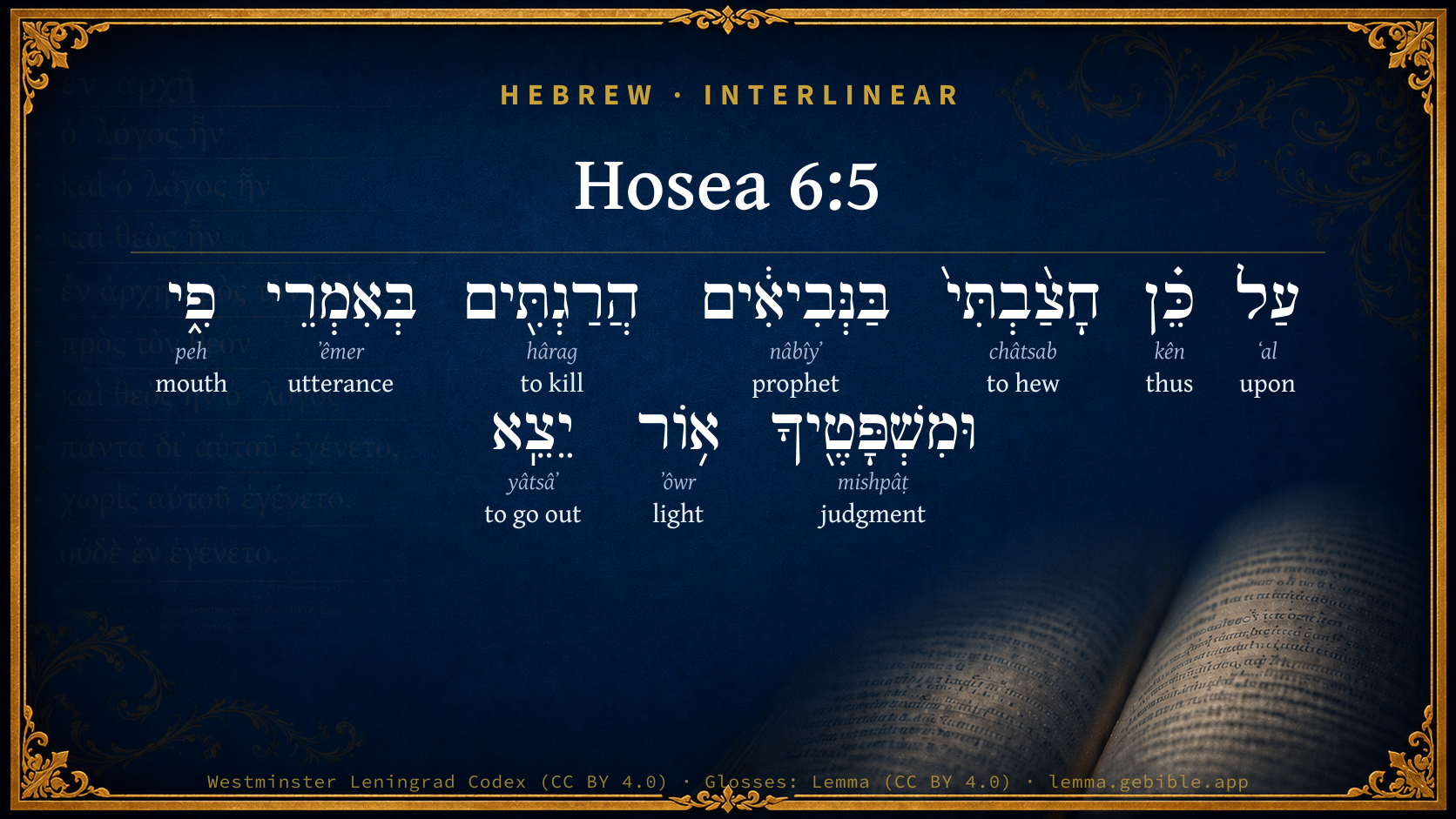
Hebrew (Westminster Leningrad Codex) Hosea 6:5 appears in the Hebrew Old Testament. The text above is from the Westminster Leningrad Codex. Each word links to its Strong’s number, a concise gloss, and parsing drawn from the Open Scriptures Hebrew Bible morphology. Click any word for its full Brown-Driver-Briggs (BDB) entry.
Download image
Cite this verse

Hosea 6:5 (World English Bible). Public Domain. Lemma interlinear Bible study tool, https://lemma.gebible.app/v/hosea/6/5.

Show BibTeX & RIS
BibTeX
RIS
English Translation
Therefore I have cut them to pieces with the prophets; I killed them with the words of my mouth. Your judgments are like a flash of lightning.
World English Bible · Public Domain
Download a study sheet

One document with this verse’s original text, its word-by-word gloss line, the meaning frame, cross-references with their text, attributed commentary, and full source and license credits — printable, and it pastes into notes with its structure intact.

This verse Autodidact and up

Study sheet (.html) Plain text (.txt)

A passage Seminary Student

Up to 50 verses in one chapter. A passage sheet keeps up to 6 commentary sources and 12 cross-references per verse, in the order this page ranks them, and says so on the sheet whenever that leaves anything out. Ask for a single verse and you get the Autodidact verse sheet above.

Everything on this page stays free to read, with no account — the sheet is a download of what is already on screen, not access to it.

Want to remove ads? Support Godless Engineer
Compare translations 3

The same verse in 3 English versions, stacked beneath the original-language interlinear above. Click any original word for its lexicon entry.

Each is an independent rendering of the whole verse — the interlinear is not word-aligned to these translations.

Highlighted words mark where these versions differ — a whole-verse word diff, not a word-by-word alignment.

  • World English Bible Public Domain
    Therefore I have cut them to pieces with the prophets; I killed them with the words of my mouth. Your judgments are like a flash of lightning.
  • King James Version Public Domain
    Therefore have I hewed them by the prophets; I have slain them by the words of my mouth: and thy judgments are as the light that goeth forth.
  • unfoldingWord Literal Text CC BY-SA 4.0
    Therefore I have hewn by the prophets; I have killed them by the words of my mouth, and your judgments light goes forth.

unfoldingWord Literal Text — © unfoldingWord, licensed CC BY-SA 4.0. Word-aligned USFM3 via Door43 (git.door43.org/unfoldingWord/en_ult).

Versions to compare (up to 4)

3 of 4 selected

Show all 18 translations

Every available English version of this verse, each an independent rendering of the whole verse.

  • World English Bible Public Domain
    Therefore I have cut them to pieces with the prophets; I killed them with the words of my mouth. Your judgments are like a flash of lightning.
  • Berean Standard Bible Public Domain
    Therefore I have hewn them by the prophets; I have slain them by the words of My mouth, and My judgments go forth like lightning.
  • Majority Standard Bible Public Domain
    Therefore I have hewn them by the prophets; I have slain them by the words of My mouth, and My judgments go forth like lightning.
  • King James Version Public Domain
    Therefore have I hewed them by the prophets; I have slain them by the words of my mouth: and thy judgments are as the light that goeth forth.
  • American Standard Version (1901) Public Domain
    Therefore have I hewed them by the prophets; I have slain them by the words of my mouth: and thy judgments are `as' the light that goeth forth.
  • Revised Version (1885) Public Domain
    Therefore have I hewed them by the prophets; I have slain them by the words of my mouth: and thy judgments are as the light that goeth forth.
  • Geneva Bible (1599) Public Domain
    Therefore haue I cut downe by the Prophets: I haue slaine them by the wordes of my mouth, and thy iudgements were as the light that goeth forth.
  • Douay-Rheims (1899) Public Domain
    For this reason have I hewed them by the prophets, I have slain them by the words of my mouth: and thy judgments shall go forth as the light.
  • Young's Literal Translation Public Domain
    Therefore I have hewed by prophets, I have slain them by sayings of My mouth, And My judgments to the light goeth forth.
  • Literal Standard Version CC BY-SA 4.0
    Therefore I have hewed by prophets, || I have slain them by sayings of My mouth, || And My judgments go forth to the light.
  • Unlocked Literal Bible CC BY-SA 4.0
    So I have cut them to pieces by the prophets, I have killed them with the words of my mouth. Your decrees are like the light that shines out.
  • unfoldingWord Literal Text CC BY-SA 4.0
    Therefore I have hewn by the prophets; I have killed them by the words of my mouth, and your judgments light goes forth.
  • Darby Bible Public Domain
    Therefore have I hewed [them] by the prophets; I have slain them by the words of my mouth: and my judgment goeth forth as the light.
  • World Messianic Bible Public Domain
    Therefore I have cut them to pieces with the prophets; I killed them with the words of my mouth. Your judgments are like a flash of lightning.
  • Webster's Bible Public Domain
    Therefore have I hewed them by the prophets; I have slain them by the words of my mouth: and thy judgments are as the light that goeth forth.
  • Free Bible Version CC BY-SA 4.0
    So I cut you down through the prophets; I killed you with my words. My judgment shines out like a light.
  • Bible in Basic English Public Domain
    So I have had it cut in stones; I gave them teaching by the words of my mouth;
  • JPS Tanakh (1917) Public Domain
    Therefore have I hewed them by the prophets, I have slain them by the words of My mouth; and thy judgment goeth forth as the light.

Literal Standard Version (2020), Covenant Press — licensed CC BY-SA 4.0. Text via the HelloAO Bible API (eBible.org). Unlocked Literal Bible (unfoldingWord) — licensed CC BY-SA 4.0. Text via the HelloAO Bible API (eBible.org). unfoldingWord Literal Text — © unfoldingWord, licensed CC BY-SA 4.0. Word-aligned USFM3 via Door43 (git.door43.org/unfoldingWord/en_ult). Free Bible Version, Dr. Jonathan Gallagher — licensed CC BY-SA 4.0. Text via the HelloAO Bible API (eBible.org).

Word by word

More ways to search: Search by grammar → Find every occurrence → Compare this word →

Practice this passage: Drill this verse → Learn its vocabulary →

חָצַ֨בְתִּי֙
châtsab
H2672
“to hew”
Verb, Qal, Perfect, 1st Person, Common, Singular
Part of Speech
Verb
Stem
Qal
Form
Perfect
Person
1st Person
Gender
Common
Number
Singular
Full BDB Definition

Origin: a primitive root

TWOT: 718

to dig, cleave, divide, hew, make, cut out, dig out, cut down, quarry, hewer, mason - (Qal) - to hew out, dig - to hew - stone - wood - to hew in pieces (metaphorically) - to divide, cleave - (Niphal) to be cut, be hewn, be engraved - (Hiphil) to hew into pieces, cut up into pieces - (Pual) to be cut from, be hewn from
  1. עַל ʻal H5921 “upon” Preposition
  2. כֵּ֗ן kên H3651 “thus” Particle, Demonstrative
  3. בַּנְּבִיאִ֔ים nâbîyʼ H5030 “in/at the · prophets” Preposition, Determined + Noun, Common, Masculine, Plural, Absolute
  4. הֲרַגְתִּ֖ים hârag H2026 “to kill · them” Verb, Qal, Perfect, 1st Person, Common, Singular + Suffix, Personal, 3rd Person, Masculine, Plural
  5. בְּאִמְרֵי ʼêmer H561 “in/at · utterances of” Preposition + Noun, Common, Masculine, Plural, Construct
  6. פִ֑י peh H6310 “mouth · my” Noun, Common, Masculine, Singular, Construct + Suffix, Personal, 1st Person, Common, Singular
  7. וּמִשְׁפָּטֶ֖יךָ mishpâṭ H4941 “and · judgments · your” Conjunction + Noun, Common, Masculine, Plural, Construct + Suffix, Personal, 2nd Person, Masculine, Singular
  8. א֥וֹר ʼôwr H216 “light” Noun, Common, Both, Singular, Absolute
  9. יֵצֵֽא yâtsâʼ H3318 “to go out” Verb, Qal, Imperfect, 3rd Person, Masculine, Singular

About this verse

These counts appear in no published source. They are computed here, from the morphology-tagged text and Lemma’s own curated glosses. What Lemma adds →

10
words
10
distinct lemmas
Prophets
section

Notable vocabulary

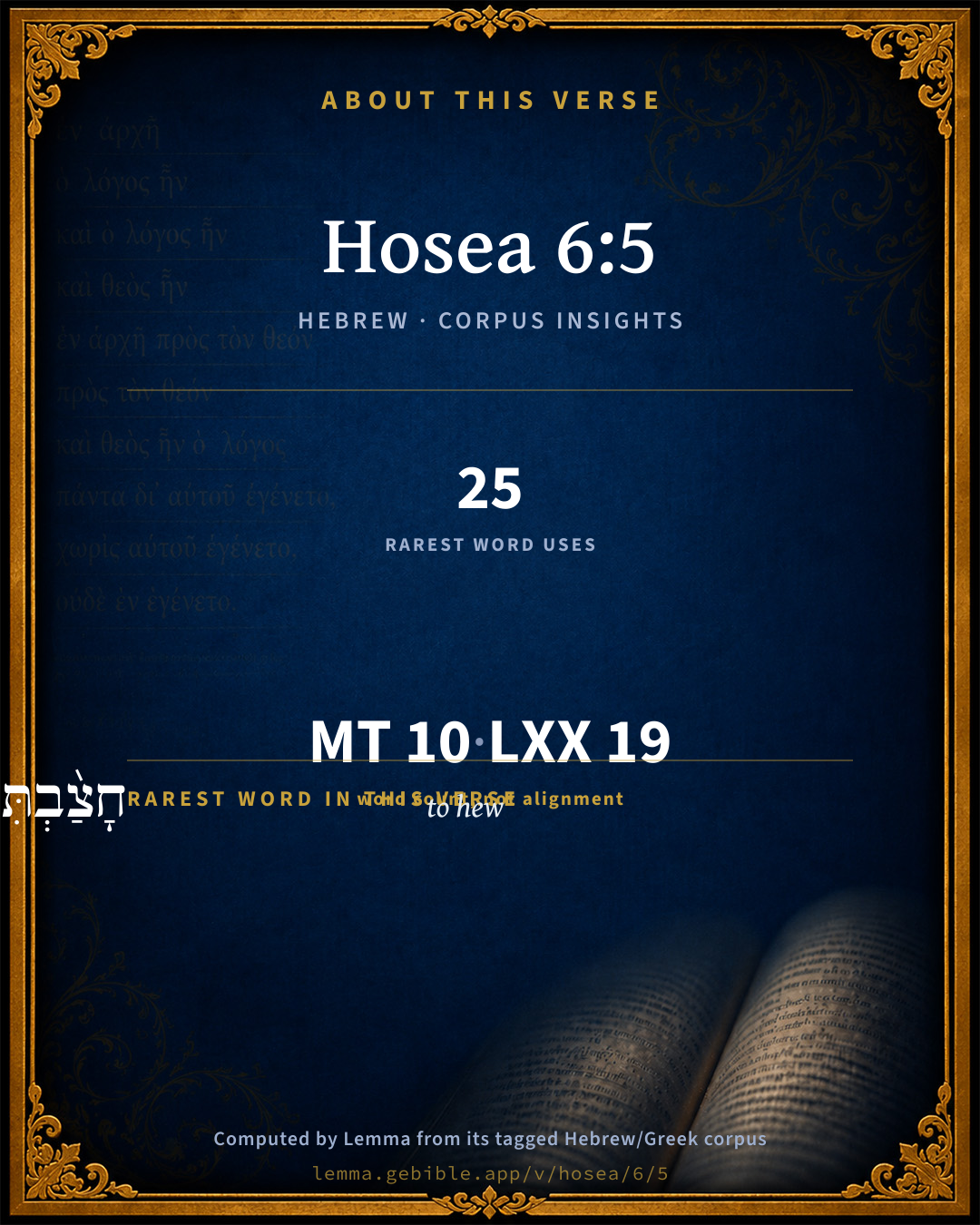
The rarest word here is חָצַ֨בְתִּי֙ to hew H2672 — appearing just 25 times in the whole Hebrew Bible.

Shared distinctive vocabulary

חָצַ֨בְתִּי֙ to hew H2672 occurs in 22 verses of the Hebrew Bible. Also found in:

Grammatical profile

  • 3 verbs
  • 5 nouns
  • 1 preposition
  • 1 particle

Verb forms

  • חָצַ֨בְתִּי֙ Qal · Perfect
  • הֲרַגְתִּ֖ים Qal · Perfect
  • יֵצֵֽא Qal · Imperfect

Hebrew & Septuagint length

In English translation the verse runs 27 words from the Hebrew and 30 from the Septuagint (LXX English) — closely comparable.

A rough comparison of the two English renderings, which tokenize alike — not a word-level alignment.

Word counts can differ between the Hebrew and the Greek without any difference in meaning — e.g. the Hebrew direct-object marker אֵת has no separate Greek word, and Greek often adds the article ὁ.

In the original languages it is 10 Hebrew tokens and 19 Greek tokens — but the two are counted differently (Hebrew bundles its prefixes and suffixes into one token; the Greek is in lemma form), so that isn’t a like-for-like length.

Cross-references

29

Topical passages linked to Hosea 6:5 in the Treasury of Scripture Knowledge — connected by theme and wording, ordered by reader-vote popularity; previews shown in the World English Bible.

  • Jeremiah 23:29 Isn't my word like fire? says Yahweh; and like a hammer that breaks the rock in pieces?
  • Jeremiah 1:10 behold, I have this day set you over the nations and over the kingdoms, to pluck up and to break down and to destroy and to overthrow, to build and to plant.
  • Jeremiah 5:14 Therefore thus says Yahweh, the God of hosts, Because you speak this word, behold, I will make my words in your mouth fire, and this people wood, and it shall devour them.
  • Hebrews 4:12 For the word of God is living, and active, and sharper than any two-edged sword, and piercing even to the dividing of soul and spirit, of both joints and marrow, and is able to discern the thoughts and intentions of the heart.
  • Psalms 119:120 My flesh trembles for fear of you. I am afraid of your judgments.
  • Isaiah 11:4 but with righteousness shall he judge the poor, and decide with equity for the humble of the earth; and he shall strike the earth with the rod of his mouth; and with the breath of his lips shall he kill the wicked.
  • Romans 2:5 But according to your hardness and unrepentant heart you are treasuring up for yourself wrath in the day of wrath, revelation, and of the righteous judgment of God;
  • Revelation 2:16 Repent therefore, or else I am coming to you quickly, and I will make war against them with the sword of my mouth.
  • Genesis 18:25 Be it far from you to do things like that, to kill the righteous with the wicked, that so the righteous should be as the wicked. May that be far from you. Shouldn't the Judge of all the earth do right?"
  • 1 Samuel 13:13 Samuel said to Saul, You have done foolishly; you have not kept the commandment of Yahweh your God, which he commanded you: for now would Yahweh have established your kingdom on Israel forever.
  • 1 Samuel 15:22 Samuel said, Has Yahweh as great delight in burnt offerings and sacrifices, as in obeying the voice of Yahweh? Behold, to obey is better than sacrifice, and to listen than the fat of rams.
  • 1 Kings 14:6 It was so, when Ahijah heard the sound of her feet, as she came in at the door, that he said, Come in, you wife of Jeroboam; why feign you yourself to be another? for I am sent to you with heavy news.
  • 1 Kings 17:1 Elijah the Tishbite, who was of the foreigners of Gilead, said to Ahab, As Yahweh, the God of Israel, lives, before whom I stand, there shall not be dew nor rain these years, but according to my word.
  • 1 Kings 18:17 It happened, when Ahab saw Elijah, that Ahab said to him, Is it you, you troubler of Israel?
  • 1 Kings 19:17 It shall happen, that he who escapes from the sword of Hazael shall Jehu kill; and he who escapes from the sword of Jehu shall Elisha kill.
  • 2 Kings 1:16 He said to him, Thus says Yahweh, Because you have sent messengers to inquire of Baal Zebub, the god of Ekron, is it because there is no God in Israel to inquire of his word? therefore you shall not come down from the bed where you are gone up, but shall surely die.
  • 2 Chronicles 21:12 There came a writing to him from Elijah the prophet, saying, Thus says Yahweh, the God of David your father, Because you have not walked in the ways of Jehoshaphat your father, nor in the ways of Asa king of Judah,
  • Job 34:10 "Therefore listen to me, you men of understanding: Far be it from God, that he should do wickedness, From the Almighty, that he should commit iniquity.
  • Psalms 37:6 He will make your righteousness go forth as the light, And your justice as the noon day sun.
  • Isaiah 58:1 Cry aloud, don't spare, lift up your voice like a trumpet, and declare to my people their disobedience, and to the house of Jacob their sins.
  • Jeremiah 1:18 For, behold, I have made you this day a fortified city, and an iron pillar, and brazen walls, against the whole land, against the kings of Judah, against the princes of it, against the priests of it, and against the people of the land.
  • Jeremiah 13:13 Then shall you tell them, Thus says Yahweh, Behold, I will fill all the inhabitants of this land, even the kings who sit on David's throne, and the priests, and the prophets, and all the inhabitants of Jerusalem, with drunkenness.
  • Ezekiel 3:9 As an adamant harder than flint have I made your forehead: don't be afraid of them, neither be dismayed at their looks, though they are a rebellious house.
  • Ezekiel 43:3 It was according to the appearance of the vision which I saw, even according to the vision that I saw when I came to destroy the city; and the visions were like the vision that I saw by the river Chebar; and I fell on my face.
  • Zephaniah 3:5 Yahweh, in the midst of her, is righteous. He will do no wrong. Every morning he brings his justice to light. He doesn't fail, but the unjust know no shame.
  • Acts 7:31 When Moses saw it, he wondered at the sight. As he came close to see, a voice of the Lord came to him,
  • Revelation 1:16 He had seven stars in his right hand. Out of his mouth proceeded a sharp two-edged sword. His face was like the sun shining at its brightest.
  • Revelation 9:15 The four angels were freed who had been prepared for that hour and day and month and year, so that they might kill one third of mankind.
  • Revelation 9:21 They didn't repent of their murders, nor of their sorceries, nor of their sexual immorality, nor of their thefts.

Cross-references courtesy of OpenBible.info (CC BY 4.0).

Hebrew and Greek witnesses Masoretic Hebrew ↔ Greek Septuagint

The same verse in the two great witnesses to the Old Testament, shown verse-for-verse.

These are two independent witnesses, not word-aligned to each other, and the Septuagint is shown in lemma (dictionary) form.

Hebrew Hosea 6:5 Masoretic · Westminster Leningrad Codex

עַל כֵּ֗ן חָצַ֨בְתִּי֙ בַּנְּבִיאִ֔ים הֲרַגְתִּ֖ים בְּאִמְרֵי פִ֑י וּמִשְׁפָּטֶ֖יךָ א֥וֹר יֵצֵֽא

Therefore I have cut them to pieces with the prophets; I killed them with the words of my mouth. Your judgments are like a flash of lightning.

World English Bible · Public Domain

Greek LXX Hosea 6:5 Septuagint · lemma form

διά οὗτος ἀποθερίζω ὁ προφήτης σύ ἀποκτείνω αὐτός ἐν ῥῆμα στόμα ἐγώ καί ὁ κρίμα ἐγώ ὡς φῶς ἐκἔρχομαι

What shall I do to you, Ephraim? What shall I do to you, Juda? whereas your mercy is as a morning cloud, and as the early dew that goes away.

LXX2012 (modern English Septuagint) · Public Domain

On this verse, Ellicott's Commentary for English Readers discusses the Septuagint’s reading. Read the note in Commentary ↓

Hebrew: Westminster Leningrad Codex (CC BY 4.0). Greek: Septuagint (public domain); English from LXX2012 (modern English Septuagint) (Public Domain). How the Septuagint differs from the Hebrew →

Targum (Aramaic paraphrase)

1

The Targum is the ancient Jewish Aramaic paraphrase of the Hebrew Scriptures — an interpretive translation, not the Hebrew text itself. Onkelos (literal) and Pseudo-Jonathan (expansive) render the Torah, and Jonathan the Prophets. Coverage is partial: where no permissively-licensed English translation exists for a verse, only the Aramaic is shown. This is verse-level text, not a word-by-word alignment to the Hebrew.

  1. Targum Jonathan Prophets (Joshua–Malachi)
    עַל כֵּן דְאַזְהַרְתִּינוּן בִּשְׁלִיחוּת נְבִיֵי וְלָא תָבוּ אַיְתֵיתִי עֲלֵיכוֹן קָטוֹלִין עַל דַעֲבָרוּ עַל מֵימַר רְעוּתִי וְדִינִי כִּנְהוֹר נָפַק:

    (no public-domain English translation for this verse)

    Targum Jonathan — Aramaic: “Mikraot Gedolot” (public domain). English: “Sefaria Community Translation” (CC0 1.0 (public-domain dedication)); “London "Chaldee Paraphrase," 1871” (public domain). Text via Sefaria.

Commentary

Notes on Hosea 6:5 from classic Christian and Jewish commentators (each source and its license shown beneath its notes). The classic Christian expositions comment on the surrounding passage and are grouped to its opening verse, so a note may address several verses; the Jewish commentaries on the Tanakh (Rashi and others) are per-verse, so they appear only where the commentator wrote on this verse.

Lemma curates 59 commentaries, every one of them public domain or Creative Commons licensed, each selected and text-cleaned for this edition rather than reprinted as found. About our sources →

Trapp's Complete Commentary

John Trapp

Hos 6:5 Therefore have I hewed [them] by the prophets; I have slain them by the words of my mouth: and thy judgments [are as] the light [that] goeth forth.

Ver. 5. Therefore have I hewed them by my prophets] Therefore? wherefore? because there is so little stability and solidity in them; because they are so off and on, so light and false-hearted; therefore I have spared for no pains (though all to small purpose), but have sharply rebuked them that they might be sound in the faith, Rev 2:16 yea, I have fought against them with the sword of my mouth, and slain them by powerful convictions of conscience; so that they are self-condemned, and the judgments are written as it were with a beam of the sun, they are so clear to themselves and others. This is the coherence, and the reason of the illative particle "therefore." It is the sad complaint of a late reverend writer, when we have spent all our wind on our people their hearts will be still apt to be carried away with every wind of doctrine. They are won, saith another, with an apple, and lost with a nut; no man knows where to find them in one mind for a month’s time; such a generation of moon calves never appeared in the world before. Our giddy hearers (saith a third), after all our pains taken with them, have no mould but what the next teacher casteth them into; being blown, like glasses, into this or that shape at the pleasure of his breath.

I have hewed them by the prophets] Who are here compared to masons or stone hewers, 2Ki 12:12 1Ch 22:2 Job 19:24 Isa 51:1; to carpenters, 1Ki 5:15 Pro 9:1 Isa 5:2; to day labourers, who dig pits and cisterns, Deu 6:11; Deu 8:9 2Ch 26:10 Neh 9:25 Jer 2:13. A minister’s life is no idle man’s occupation; they meet with many rough stones, knotty pieces, hard quarries, tough work. Some are stones crumbling all to crattle as soon as we begin to hammer them, and as timber falling to splinters when we fall to the hewing of them; and other such sons of Belial there are that a man cannot speak to them, 1Sa 25:17; they are "thorns that cannot be taken with hands, but the man that shall touch them must be fenced with iron and with the staff of a spear." These shall be thrust away as thorns, and utterly burnt with fire, 2Sa 23:6-7. And for the better sort, those lively stones, 1Pe 2:5, and smoother pieces that are to be set into God’s building, being made by his grace more malleable and tractable, there must be a great deal of pains taken with them, that they may be as the polished corners of the temple; they must be humbled and hammered, Jer 23:29, pared and planed here in the mount; for there may neither hammer, nor axe, nor any tool of iron be heard in the heavenly house, for which they are fitting, 1Ki 6:7. And herein we are "labourers together with God: ye are God’s husbandry, ye are God’s building," 1Co 3:9. In which laborious kind of life, "I endure all things for the elect’s sake, that they may be saved," saith Paul, 2Ti 2:10. And I dare be bold to say, saith Luther, that faithful ministers do labour and sweat more in a day than husbandmen do in a month. And for mine own part, saith he, si mihi esset integram vocationem deserere, if it were lawful for me to leave my calling, I could with less pains and more pleasure dig and do day work than labour as I now do in the work of the ministry. Pareus thinks that the next words,

I have killed them with the words of my mouth] are spoken by God of the prophets: q.d. I have set them so heavy a task and put them so hard to it, that it hath been the death of them; such crabbed and rugged spirits they have met with, such stubborn and tough timber, that had long lain soaking in the waters of wickedness; these tools of mine are even worn out with working. But though this be a pious interpretation, and not altogether improbable, because of the change of person here, viz. them for you; yet because such a change is ordinary in Scripture and emphatic also, namely, when God seemeth deeply displeased with any one, and therefore leaveth talking to him, and turns himself suddenly to another, {see Hos 4:14; Hos 5:8; Hos 5:4} I conceive it may very well be so in this place. Occidi istos, I have slain these refractories and rebels with the words of my mouth ( sic enim contemptim loquimur), I have beaten so hard upon their consciences, that they have had no joy of their lives. I have marked them out for destruction, by threatening it, as Jer 18:7-8, and Hos 1:10. Elisha hath his sword as well as Jehu and Hazael, 1Ki 19:17; and when Elisha unsheatheth and brandisheth his sword, it is a fair warning that the sword of Jehu and Hazael are at hand. See Eze 11:13, "And it came to pass that when I prophesied Pelatiah, the son of Benaiah, died." So did Ananias and Sapphira, Act 5:5; Act 5:10. So do many despisers today, though it appear not by them. A man may have his bane about him, though he fall not down dead in the place. If any man harm Christ’s two witnesses, fire (though not felt) "proceedeth out of their mouths, and devoureth their enemies," Rev 11:5.

And thy judgments are as the light that goeth forth] i.e. I have clearly denounced them, and will as openly execute them in the sight of this sun. "The righteous shall see it and shall say, Lo, this is the man," &c., Psa 52:6-7; Psa 119:137. Thou, by thine hypocrisy and external services, as Hos 6:6, hast cast a mist before men’s eyes, that they cannot think thee to be so near a judgment: but I will dispel that mist, and make my works a comment upon my word; and having sent unto thee a powerful ministry, but to no purpose, I will make thee, who wouldst not hear the word, "to hear the rod, and who hath appointed it," Mic 7:9.

John Trapp, A Commentary or Exposition upon All the Books of the Old and New Testament (1647–1656) — public domain. Text from a community e-Sword module.

Joseph Benson's Commentary

Hos 6:5. Therefore have I hewed them by the prophets — Severely reproved and threatened them; or cut them off, as the word, חצבתי, may be properly rendered: that is, I have denounced against them great destruction. The prophets, and God by the prophets, are said to do those things which they foretel, or denounce: see notes on Jer 1:10; Jer 5:14. I have slain them by the words of my mouth — that is, I have declared, or denounced, the slaughter of them. God’s word is described as sharper than a two-edged sword, because his judgments, denounced by his messengers, are like the sentence of a judge, which shall certainly be followed with execution. And thy judgments are as the light when it goeth forth — These may be considered as the words of the prophet addressing God, and signifying that his judgments against the people were, though gradually, yet as certainly approaching as the morning light; and that the justice of them would appear as clear as the light of the rising sun. Or they may be considered as addressed to Israel, and then the meaning of them must be, The punishment which shall come upon thee, O Israel, will clearly appear to be perfectly just; nor shall any thing happen to thee, but what thou hast been fully and repeatedly warned of. Bishop Horsley, however, connecting these words with the following, gives them a different sense. Taking the word משׁפשׂיךְ, here rendered thy judgments, to signify thy precepts, he renders the clause, And the precepts given thee (namely, given to the people) were as the onward-going light, &c., “that is, as light, of which it is the nature and property to go forth, to propagate itself infinitely, and in all directions; a most expressive image of the clearness of the practical lessons of the prophets.” The word, adds he, in his Critical Notes, “signifies a fixed principle, or rule, in any thing, to which principle and rule can be applied. Here I take it for the practical rules of a moral and godly life, as delivered by the prophets; and so Calvin expounds it: ‘Judicia tua, hoc est, ratio piè vivendi,’ Thy judgments, that is, the method of living piously. Significat hic Deus se regulam piè et sancte vivendi monstrâsse Israelitis, God here signifies that he had shown to the Israelites the rule of a pious and holy life.”

Joseph Benson's Commentary on the Old and New Testaments (1811–1818) — public domain. Text from a community e-Sword module.

Geneva Bible (1599)

Geneva Bible translators

My doctrine which I taught thee, was most evident.

I have still labored by my prophets, and as it were framed you to bring you to amendment, but all was in vain: for my word was not food to feed them, but a sword to slay them.

Geneva Bible (1599) marginal notes — public domain. Text via Bolls.life.

Jamieson, Fausset & Brown

Robert Jamieson, A. R. Fausset & David Brown

I hewed them by the prophets--that is, I announced by the prophets that they should be hewn asunder, like trees of the forest. God identifies His act with that of His prophets; the word being His instrument for executing His will (Jer 1:10; Eze 43:3).

by . . . words of my mouth-- (Isa 11:4; Jer 23:29; Heb 4:12).

thy judgments--the judgments which I will inflict on thee, Ephraim and Judah (Hos 6:4). So "thy judgments," that is, those inflicted on thee (Zep 3:15).

are as the light, &c.--like the light, palpable to the eyes of all, as coming from God, the punisher of sin. HENDERSON translates, "lightning" (compare Job 37:3, Margin; Job 35:15).

Jamieson, Fausset & Brown — Commentary Critical and Explanatory on the Whole Bible (1871) — public domain (CC PDM 1.0). Text via the HelloAO Bible API.

Adam Clarke's Commentary

Verse 5. Therefore have I hewed them by the prophets] I have sent my prophets to testify against their fickleness. They have smitten them with the most solemn and awful threatenings; they have, as it were, slain them by the words of my mouth. But to what purpose?

Thy judgments are as the light that goeth forth] Instead of ומשפטיך אור יצא umispateycha or yetse, "and thy judgments a light that goeth forth," the versions in general have read ומשפטי כאור umishpati keor, "and my judgment is as the light." The final כ caph in the common reading has by mistake been taken from אור aur, and joined to משפטי mishpati; and thus turned it from the singular to the plural number, with the postfix כ cha. The proper reading is, most probably, "And my judgment is as the light going forth." It shall be both evident and swift; alluding both to the velocity and splendour of light.

Adam Clarke's Commentary on the Bible (1810–1826) — public domain. Text from a community e-Sword/MySword module.

John Calvin's Commentaries

God shows here, by his Prophet, that he was constrained by urgent necessity to deal sharply and roughly with the people. Nothing, we know, is more pleasing to God than to treat us kindly; for there is not found a father in the world who cherishes his children as tenderly: but we, being perverse, suffer him not to follow the inclination of his nature. He is therefore constrained to put on, as it were, a new character, and to chide us severely, according to the way in which he here says, he had treated the Israelites; I have cut them, he says, by my prophets, and killed them by the words of my mouth

Some render the words otherwise, as though God had killed the Prophets, meaning thereby the impostors, who corrupted the pure worship of God by their errors. But this view seems not to me in any way suitable; and we know that it was a common mode of speaking among the Hebrews, to express the same thing in two ways. So the Prophet speaks here, I have cut or hewed them by my Prophets, I have killed them by the cords of my mouth. In the second clause he repeats, I doubt not, what we have already briefly explained, namely, that God had cut or hewed them by his Prophets.

But we must see for what purpose God declares here that he had commanded his Prophets to treat the people roughly. Hypocrites we indeed know, however much in various ways they mock God, are yet tender, and cannot bear any rebuke. Their sins are gross, except when they disguise themselves; but at the same time, when God begins to reprove, they expostulate and say, “What does this mean? God everywhere declares that he is kind and merciful; but he fulminates now against us: this seems not consistent with his nature.” Thus then hypocrites would have God to be their batterer. He now answers, that he had been constrained, not only for a just cause, but also necessarily, to kill them, and to make his word by the Prophets like a hammer or an ax. This is the reason, he says, why my Prophets have not endeavored mildly and gently to allure the people. For God kindly and sweetly draws or invites to himself those whom he sees to be teachable; but when he sees so great a perverseness in men, that he cannot bend them by his goodness, he then begins, as we have said, to put on a new character. We now then under stand God’s design: that hypocrites might not complain that they had been otherwise treated than what is consistent with God’s nature, the Prophet here answers in God’s name, “Ye have forced me to this severity; for there was need of a hard wedge, as they say, for a hard knot: I have therefore hewed you by my Prophets, I have hewed you by the words of my mouth; that is, I have used my word as an ax: for ye were like knotty and tough wood; it was therefore necessary that my word should be to you like an ax: and I have killed you by the words of my mouth; that is my word has not been sweet food to you, as it is wont to be to meek men; but it has been like a two-edged sword; it was therefore necessary to slay you, as ye would not bear me to be a Father to you.”

It then follows Thy judgments are light that goes forth Some understand by “judgments” prosperity as if God were here reproaching the Israelites, that it was not his fault that he did not win them: “I have not neglected to treat you kindly, and under my protection to defend you; but ye are ungrateful.” But this is a strained exposition. The greater part of interpreters explain the passage thus, “That thy judgments might be a light going forth.” But I do not see why we should change any thing in the Prophet’s words. God then simply intimates here, that he had made known to the Israelites the rule of a religious and holy life, so that they could not pretend ignorance; for the Hebrews often understand “judgments” in the sense of rectitude. I refer this to the instruction given them: Thy judgments then, that is, the way of living religiously, was like light; which means this, “I have so warned you, that you have sinned knowingly and willfully. Hence, that you have been so disobedient to me, must be imputed to your perverseness; for when ye were pliant, I certainly did not conceal from you what was right: for as the sun daily shines on the earth, so my teaching, has been to you as the light, to show to you the way of salvation; but it has been with no profit.” We now then understand what the Prophet meant by these words. It follows —

John Calvin's Commentaries (1540-1563) — public domain. Text from the Calvin Translation Society English edition (1840s-50s) via the Christian Classics Ethereal Library (ccel.org). Calvin's coverage is partial (roughly two-thirds of the Bible); uncommented books and verses are honest gaps, never fabricated. The 19th-century editor's footnotes and remarks are omitted so the notes are faithfully Calvin's own voice.

Ellicott's Commentary for English Readers

(5) The LXX. render, Therefore I have mowed down their prophets; but this would destroy the parallelism, in which “prophets” correspond to “words of my mouth.” The sense is, I have slain them by the announcement of deserved doom.

Thy judgments . . .—An error has crept here into the Masoretic text from which the LXX. and other ancient versions are free. The mistake consists in misplacing an initial letter as a final one. Translate, My judgment shall go forth as the light, clear, victorious, and beneficent. (Comp. the language of Psa_37:6 and Isa_62:1-2.)

A Bible Commentary for English Readers, edited by Charles John Ellicott (1878–1897) — public domain. Text from a community e-Sword module.

The Cambridge Bible for Schools and Colleges

gen. ed. J. J. S. Perowne

5. Similar fitful repentances have already forced Jehovah to interpose, like a severe but kind physician who will cut out the diseased part rather than suffer the evil to spread.

hewed them by the prophets] i.e. warned them of the fatal consequences of their conduct. The divine or prophetic word has a destroying power ascribed to it (Isa_11:4; Isa_49:2; Jer_1:10; Jer_5:14; 1Ki_19:17).

thy judgments are as the light that goeth forth] ‘Thy judgments,’ i.e. those pronounced upon thee. According to this reading we have to supply ‘as,’ and suppose a sudden change of pronoun. The Septuagint, however, with the Peshito, and even the Targum, reads differently—my judgment shall go forth as the light (this simply involves a slightly different grouping of the letters). ‘My judgment’, viz. that upon Israel; ‘shall go forth’, for we are no longer in the imagined future (as in Hos_6:1-3); ‘as the light’, that all may see it and tremble.

The Cambridge Bible for Schools and Colleges (gen. ed. J. J. S. Perowne; Cambridge University Press, 1878–1918) — public domain. Text from a community e-Sword module.

John Gill's Exposition

Therefore have I hewed them by the prophets; I have slain them by the words of my mouth,.... Sharply reproved them for their sins by the prophets, who were as lapidaries that cut stone, or us hewers of timber that cut off the knotty parts; so these by preaching the terrors of the law, which is a killing letter, and by delivering out the threatenings of the Lord, and denouncing his judgments upon them for their sins, cut them to the heart, and killed them; for their foretelling and prophesying of their being slain, ruined, and destroyed, was a slaying of them; see Jer 1:10. The Targum is,

"because I admonished them by the message of my prophets, and they returned not, I will bring upon them those that slay, because they have transgressed the word of my will.''

But the Septuagint, Syriac, and Arabic versions, and so Aben Ezra and Joseph Kimchi, understand these words, not of hewing, and cutting, and slaying of the people by the prophets, but of the cutting and slaying the prophets themselves, and read the words, "therefore have I cut off the prophets, and slain them &c.", either the false prophets, some of them that caused the people to err, that they might not repent, as Aben Ezra; as the prophets of Baal in the times of Elijah, and the Scribes and Pharisees in Christ's time, who were in the way of the people's repentance, reformation, and reception of Christ; these he cut off, and their doctrine, and condemned by his own, and the doctrine of his apostles, the words of the Lord's mouth; see Zac 11:8; and this he did for the good of his people, in answer to the question put by himself in Hos 6:4; so Schmidt interprets it: or else the true prophets of God, who were exposed to death, to be cut off and slain, for the messages they were sent with: or those messages were such as were killing to them to carry them, and deliver them; and they were so constantly employed, early and late, in such service, that for the work of the Lord they were often nigh unto death: but our version, and the sense agreeable to it, scent best;

and thy judgments are as the light that goeth forth; that is, their judgments, the people's, a sudden change of person: meaning either the statutes and judgments prescribed them by the Lord, and to be observed by them; which were clear and plain as the light at noon day, and therefore could not plead any excuse of ignorance of them, that they did not observe them: or the judgments of God upon them for their sins; which were open and manifest to all, and increasing like the light, more and more, and no more to be resisted than that; and the righteousness of God in them was very conspicuous; his judgments were manifest, and the justice of them. Some understand this of the judgments or righteousnesses of the saints, both imputed and inherent, Rom 5:16; which appear light and clear, the darkness of pharisaism being removed by Christ. The Targum is,

"my judgment goes forth as the light.''

John Gill's Exposition of the Whole Bible (1746–1763) — public domain (CC PDM 1.0). Text via the HelloAO Bible API.

Albert Barnes' Notes on the Bible

Therefore have I hewed them by the prophets - Since they despised God’s gentler warnings and measures, He used severer. “He hewed” them, He says, as men hew stones out of the quarry, and with hard blows and sharp instruments overcome the hardness of the stone which they have to work. Their piety and goodness were light and unsubstantial as a summer cloud; their stony hearts were harder than the material stone. The stone takes the shape which man would give it; God hews man in vain; he will not receive the image of God, for which and in which he was framed.

God, elsewhere also, likens the force and vehemence of His word to “a hammer which breaketh the rocks in pieces” Jer 23:29; “a sword which pierceth even to the dividing asunder of soul and spirit” Heb 4:12. : He “continually hammered, beat upon, disquieted them, and so vexed them (as they thought) even unto death, not allowing them to rest in their sins, not suffering them to enjoy themselves in them, but forcing them (as it were) to part with things which they loved as their lives, and would as soon part with their souls as with them.”

And thy judgments are as the light that goeth forth - The “judgments” here are the acts of justice executed upon a man; the “judgment upon him,” as we say. God had done all which could be done, to lay aside the severity of His own judgments. All had failed. Then His judgments, when they came, would be manifestly just; their justice clear “as the light which goeth forth” out of the darkness of night, or out of the thick clouds. God’s past loving-kindness, His pains, (so to speak,) His solicitations, the drawings of His grace, the tender mercies of His austere chastisements, will, in the Day of Judgment, stand out clear as the light, and leave the sinner confounded, without excuse. In this life, also, God’s final “judgments are as a light which goeth forth,” enlightening, not the sinner who perishes, but others, heretofore in the darkness of ignorance, on whom they burst with a sudden blaze of light, and who reverence them, owning that “the judgments of the Lord are true and righteous altogether” Psa 19:9.

And so, since they would not be reformed, what should have been for their wealth, was for their destruction. “I slew them by the words of My mouth.” God spake yet more terribly to them. He slew them in word, that He might not slay them in deed; He threatened them with death; since they repented not, it came. The stone, which will not take the form which should have been imparted to it, is destroyed by the strokes which should have moulded it. By a like image Jeremiah compared the Jews to ore which is consumed in the fire which should refine it; since there was no good in it. “They are brass and iron; they are all corrupted; the bellows are burned, the lead is consumed of the fire; the founder melteth in vain, for the wicked are not plucked away. Reprobate silver shall men call them, because the Lord hath rejected them” Jer 6:28-30.

Albert Barnes' Notes on the Bible (1834–1885) — public domain. Text from a community e-Sword/MySword module.

Haydock's Catholic Bible Commentary

Mouth. I have ordered my prophets to denounce death unto them, and to treat them roughly, like a piece of marble designed for a statue. Septuagint, &c., "I have slain thy prophets," &c., by Elias, Jehu, &c. The former sense is preferable. --- Thy judgments, or condemnation. (Calmet) --- Hebrew, "and thy judgments light shall go forth." (Haydock) --- Pocock labours hard, but in vain, to explain this; as all the old versions, except the Vulgate have, "my judgments as the light," &c. Hebrew letters may probably have been ill joined, (Kennicott) as Meibomius suspects they have been also, Jeremias xxiii. 33. Here umospoti caur, "my judgments as the light," &c., is exchanged for umishpatec or. This would be very easy when words were written undivided, as in ancient manuscripts. (Haydock) --- "Some transcriber upon hearing umishpatecaor, from the person dictating to him, writ umishpateca or instead of umishpate caor. (Kennicott, Diss. 1.)

George Leo Haydock (1774–1849), Haydock's Catholic Family Bible and Commentary, 1859 edition — public domain. Excludes Psalms (Douay-Rheims chapter numbering differs from Protestant) and Deuterocanonical books (Catholic canon only).

Matthew Poole's English Annotations

Therefore; because I would do for you whatever might be done, because I would cure you of your obstinacy and hypocrisy, and make you upright and constant. I have hewed them; I have severely, continually, and unweariedly by the prophets reproved, warned, and threatened. Your hearts have been like knotty trees, or hardest stones: I have made my prophets like labourers, and, my words like axes or hammers to cut off the knots, and to hew off the roughness which make unfit for use; but all to no purpose, the desired effect hath not been attained.

By the prophets; some that were before Hosea. Jeroboam the First was by a prophet reproved and threatened for this idolatry, in which Israel persisted, and to which Judah did too often fall; and through the space of two hundred years, from Jeroboam the First to Hosea’s time, many other prophets were sent, whose names, and some memoirs of them, we have, as Ahijah, Jehu, Hanani, Elijah, and Elisha. These and such like were the prophets that did hew crooked and knotty Israel.

I have slain them: some say the false prophets are the persons meant here, whom God did slay for their sin, seducing Israel to, and confirming them in, idolatry; indeed Elijah’s sincere zeal did cut off so many, 1Ki 18:22,40, and Jehu’s counterfeit zeal cut off so many, 2Ki 10:21,25, that it could never be forgotten among that people. So the thing is true, many false prophets were slain for this sin; yet the persons in our text were not these false prophets, but they were the people of Israel and Judah, the idolatrous, refractory hypocrites among them, whom God threatened with death, and that by the sword of enemies.

By the words of my mouth; as he did by his word foretell, so he did effect too in due time.

Thy judgments are as the light that goeth forth, i.e. the punishments threatened, the miseries foretold, which fell upon this people, did so fully answer the prediction, that every one might see them clear as the light, and as constantly executed as the morning. So Zep 3:5.

Matthew Poole's English Annotations on the Holy Bible (1683–1685) — public domain. Text from a community e-Sword/MySword module.

The Pulpit Commentary

Vers. 5, 6. The consequence of Israel"s unsteadiness and inconstancy is here stated. Because of the fluctuating and formal nature of their religiousness, God cut them down (instead of rearing them up) through his prophets by fierce denunciations, and slew them (instead of reviving them) by the Divine word. The judgment of Jehovah went forth as the lightning-fish, or was as clear and conspicuous for justice as the light of day. Neither could outward services expiate their sins, when the proper feelings and meet fruits were absent. I have hewed them by the prophets; I have slain them by the words of my mouth. The language is figurative the first clause seems borrowed from hewing hard wood and shaping it so as to assume the required form; so God dealt with Israel to bring them into shape morally symmetrical, and make them correspond to the character of a holy people. The slaying is metaphorical, and consisted in the denunciation of death and destruction to the impenitent; in this way he killed, but did not make alive. A different rendering of the clause is given by the LXX and also by Aben Ezra; the former has, "Therefore have I mown down your prophets; I have slain them with the word of my mouth;" the latter has, "The sense is that he slew some of the prophets who misled the people so that they did not turn (repent)." But be does not imply his hewing in among the prophets; it is instrumental. And thy judgments are as the light that goeth forth. The judgments here spoken of are the Divine judgments denounced against, or inflicted on, the people. Another reading has the pronominal suffix of the first person: "My judgment goeth forth as the light;" to which the Septuagint corresponds: krima mou , equivalent to "my judgment." I desired mercy (or, mercy I delight in)... and the knowledge of God more than burnt offerings. The former is the right state of the life, the latter the correct condition of the heart; the former manifests itself in practice, the latter embraces the proper feelings and affections; the former is seen in works of charity and benevolence, the latter consists in right motives and the right relation of the soul to God. The Hebrew form of speech here used denotes inferior importance, not the negation of importance. A similar sentiment occurs in 1Sa_15:22, "Hath the Lord as great delight in burnt offerings and sacrifices, as in obeying the voice of the Lord? Behold, to obey is better than sacrifice, and to hearken than the fat of rams." Parallel statements are found in Isa_1:11-17 Psa_40:7-9 and Ps 1; also in Mic_6:8. Our Lord cites the first clause of ver. 6 twice once against Pharisaic ceremonialism, (Mat_9:13) and again against rigorous sabbatarianism; (Mat_12:7) while there is an allusion to it in Mar_12:33, where love to God and to one"s neighbor is declared to be better, or "more than, whole burnt offerings and sacrifices." Sacrifices in themselves, and when offered at the proper time and place, and as the expressions of penitent hearts and pure hands, were acceptable, and could not be otherwise, for God himself had appointed them. But soulless sacrifices offered by men steeped in sin were an abomination to the Lord; it was of such he said, "I cannot away with" them. It is to such that the prophet refers here, as is plain from the following verse.

The Pulpit Commentary (1880–1919), ed. H.D.M. Spence-Jones & Joseph S. Exell — public domain. Text from a community e-Sword module.

John Wesley's Explanatory Notes

Therefore - Because I would do for you whatever might be done. Hewed them - I have severely, and unweariedly reproved, and threatened them. By thy words - As I did by word foretel, so I did effect in due time. Thy judgments - The punishments threatened, which fell upon this people, did so fully answer the prediction that every one might see them clear as the light, and as constantly executed as the morning.

John Wesley, Explanatory Notes Upon the Whole Bible (1754–1765) — public domain. Text via the GEBible commentary corpus.

Keil & Delitzsch

C. F. Keil & F. Delitzsch

"Therefore have I hewn by the prophets, slain them by the words of my mouth: and my judgment goeth forth as light." ‛Al-kēn, therefore, because your love vanishes again and again, God must perpetually punish. חצב ב does not mean to strike in among the prophets (Hitzig, after the lxx, Syr., and others); but ב is instrumental, as in Isa 10:15, and châtsabh signifies to hew, not merely to hew off, but to hew out or carve. The nebhı̄'ı̄m cannot be false prophets, on account of the parallel "by the words of my mouth," but must be the true prophets. Through them God had hewed or carved the nation, or, as Jerome and Luther render it, dolavi, i.e., worked it like a piece of hard wood, in other words, had tried to improve it, and shape it into a holy nation, answering to its true calling. "Slain by the words of my mouth," which the prophets had spoken; i.e., not merely caused death and destruction to be proclaimed to them, but suspended judgment and death over them - as, for example, by Elijah - since there dwells in the word of God the power to kill and to make alive (compare Isa 11:4; Isa 49:2). The last clause, according to the Masoretic pointing and division of the words, does not yield any appropriate meaning. משׁפּטיך could only be the judgments inflicted upon the nation; but neither the singular suffix ך for כם (Isa 10:4), nor אור יצא, with the singular verb under the כ simil. omitted before אור, suits this explanation. For אור יצא cannot mean "to go forth to the light;" nor can אור stand for לאור. We must therefore regard the reading expressed by the ancient versions,

(Note: The Vulgate in some of the ancient mss has also judicium meum, instead of the judicia tua of the Sixtina. See Kennicott, Diss. gener. ed. Bruns. p. 55ff.)

viz., משׁפּטי כאור ציצא, "my judgment goeth forth like light," as the original one. My penal judgment went forth like the light (the sun); i.e., the judgment inflicted upon the sinners was so obvious, so conspicuous (clear as the sun), that every one ought to have observed it and laid it to heart (cf. Zep 3:5). The Masoretic division of the words probably arose simply from an unsuitable reminiscence of Psa 37:6.

Keil & Delitzsch — Biblical Commentary on the Old Testament (1861–1891) — public domain (CC PDM 1.0). Text via the HelloAO Bible API. (Old Testament only.)

Rashi

Rabbi Shlomo Yitzchaki (Rashi)

Because I have hewed by the prophets Heb. עַל-כֵּן. Because I hewed My words upon them through the prophets, but they did not take heed, therefore... I have put them to death because of the words of My mouth Because of the words of My mouth. So did Jonathan translate it.

Because Heb. עַל-כֵּן. Like עַל אֲשֶׁר, because of that which. Comp. (Gen. 33:10) “Because (כִּי עַל-כֵּן) I saw your face”; (ibid. 27:36) “because (כִּי עַל-כֵּן) I did not give her to Shelah my son.”

now will your verdicts come out to the light? This is a question. Now how will I be able to show you favoritism before the Divine Standard of Justice? This is a continuation of “What shall I do for you?”

Rashi on the Tanakh — English translations: “The Judaica Press complete Tanach with Rashi, translated by A. J. Rosenberg” (CC BY 4.0); “Pentateuch with Rashi's commentary by M. Rosenbaum and A.M. Silbermann, 1929-1934” (public domain); “The Metsudah Tanach series, Lakewood, N.J” (CC BY 4.0); and “The Book of Joshua, Metsudah Publications, 1997” (CC BY 4.0). Text via Sefaria.

Lesson kit

Teaching starters — assembled from the data on this page, not authored interpretation. Every prompt links to the verse data it draws on. Edit before teaching.

Hosea, in the Prophets, opens this verse with 10 words (10 distinct Hebrew lemmas). Its most distinctive word is châtsab (“to hew”). A historical commentator’s framing appears above. Read the whole chapter for the surrounding context.

Discussion questions

  1. What does “to hew” (châtsab) contribute to the verse as a whole?
  2. How does Deuteronomy 6:11, which shares the word «to hew», read alongside this verse?
  3. These translations render this verse differently; the difference is in the English rendering, not the original. What questions does that raise?
  4. «חָצַ֨בְתִּי֙» is a Qal Perfect verb. How does that grammatical form shape the action described?
  5. Compare how Trapp's Complete Commentary and Joseph Benson's Commentary read this verse. Where do they agree or differ?

Things to notice

Reading settings

Reading text

Shown beneath each verse's original-language words.

Old Testament
Old Testament edition

Read the OT as the Masoretic Hebrew (MT) or the Greek Septuagint (LXX).

English shown for the Greek Septuagint (in the Hebrew ↔ Greek comparison).

Comparing translations? Open the Compare panel on any verse page to stack up to four side by side.