
2 Samuel 23:21

Hebrew (Westminster Leningrad Codex) 2 Samuel 23:21 appears in the Hebrew Old Testament. The text above is from the Westminster Leningrad Codex. Each word links to its Strong’s number, a concise gloss, and parsing drawn from the Open Scriptures Hebrew Bible morphology. Click any word for its full Brown-Driver-Briggs (BDB) entry.
Download image
Cite this verse

2 Samuel 23:21 (World English Bible). Public Domain. Lemma interlinear Bible study tool, https://lemma.gebible.app/v/2-samuel/23/21.

Show BibTeX & RIS
BibTeX
RIS
English Translation
He killed an Egyptian, a goodly man: and the Egyptian had a spear in his hand; but he went down to him with a staff, and plucked the spear out of the Egyptian's hand, and killed him with his own spear.
World English Bible · Public Domain
Download a study sheet

One document with this verse’s original text, its word-by-word gloss line, the meaning frame, cross-references with their text, attributed commentary, and full source and license credits — printable, and it pastes into notes with its structure intact.

This verse Autodidact and up

Study sheet (.html) Plain text (.txt)

A passage Seminary Student

Up to 50 verses in one chapter. A passage sheet keeps up to 6 commentary sources and 12 cross-references per verse, in the order this page ranks them, and says so on the sheet whenever that leaves anything out. Ask for a single verse and you get the Autodidact verse sheet above.

Everything on this page stays free to read, with no account — the sheet is a download of what is already on screen, not access to it.

Want to remove ads? Support Godless Engineer
Compare translations 3

The same verse in 3 English versions, stacked beneath the original-language interlinear above. Click any original word for its lexicon entry.

Each is an independent rendering of the whole verse — the interlinear is not word-aligned to these translations.

Highlighted words mark where these versions differ — a whole-verse word diff, not a word-by-word alignment.

  • World English Bible Public Domain
    He killed an Egyptian, a goodly man: and the Egyptian had a spear in his hand; but he went down to him with a staff, and plucked the spear out of the Egyptian's hand, and killed him with his own spear.
  • King James Version Public Domain
    And he slew an Egyptian, a goodly man: and the Egyptian had a spear in his hand; but he went down to him with a staff, and plucked the spear out of the Egyptian's hand, and slew him with his own spear.
  • unfoldingWord Literal Text CC BY-SA 4.0
    And he himself struck a man of Egypt, a man of appearance. Now in the hand of the Egyptian a spear, and he went down against him with a staff. But he seized the spear from the hand of the Egyptian, and he killed him with his spear.

unfoldingWord Literal Text — © unfoldingWord, licensed CC BY-SA 4.0. Word-aligned USFM3 via Door43 (git.door43.org/unfoldingWord/en_ult).

Versions to compare (up to 4)

3 of 4 selected

Show all 18 translations

Every available English version of this verse, each an independent rendering of the whole verse.

  • World English Bible Public Domain
    He killed an Egyptian, a goodly man: and the Egyptian had a spear in his hand; but he went down to him with a staff, and plucked the spear out of the Egyptian's hand, and killed him with his own spear.
  • Berean Standard Bible Public Domain
    He also killed an Egyptian, a huge man. Although the Egyptian had a spear in his hand, Benaiah went against him with a club, snatched the spear from his hand, and killed the Egyptian with his own spear.
  • Majority Standard Bible Public Domain
    He also struck down an Egyptian, a huge man. Although the Egyptian had a spear in his hand, Benaiah went against him with a club, snatched the spear from his hand, and killed the Egyptian with his own spear.
  • King James Version Public Domain
    And he slew an Egyptian, a goodly man: and the Egyptian had a spear in his hand; but he went down to him with a staff, and plucked the spear out of the Egyptian's hand, and slew him with his own spear.
  • American Standard Version (1901) Public Domain
    And he slew an Egyptian, a goodly man: and the Egyptian had a spear in his hand; but he went down to him with a staff, and plucked the spear out of the Egyptian's hand, and slew him with his own spear.
  • Revised Version (1885) Public Domain
    And he slew an Egyptian, a goodly man: and the Egyptian had a spear in his hand; but he went down to him with a staff, and plucked the spear out of the Egyptian’s hand, and slew him with his own spear.
  • Geneva Bible (1599) Public Domain
    And he slewe an Egyptian a man of great stature, and the Egyptian had a speare in his hande: but he went downe to him with a staffe, and plucked the speare out of the Egyptians hand, and slewe him with his owne speare.
  • Douay-Rheims (1899) Public Domain
    He also slew an Egyptian, a man worthy to be a sight, having a spear in his hand: but he went down to him with a rod, and forced the spear out of the hand of the Egyptian, and slew him with his own spear.
  • Young's Literal Translation Public Domain
    And he hath smitten the Egyptian man, a man of appearance, and in the hand of the Egyptian `is' a spear, and he goeth down unto him with a rod, and taketh violently away the spear out of the hand of the Egyptian, and slayeth him with his own spear.
  • Literal Standard Version CC BY-SA 4.0
    And he has struck the Egyptian man, a man of appearance, and a spear [is] in the hand of the Egyptian, and he goes down to him with a rod, and takes the spear violently away out of the hand of the Egyptian, and slays him with his own spear.
  • Unlocked Literal Bible CC BY-SA 4.0
    Then he killed a very large Egyptian man. The Egyptian had a spear in his hand, but Benaiah fought against him with only a staff. He seized the spear out of the Egyptian's hand and then killed him with his own spear.
  • unfoldingWord Literal Text CC BY-SA 4.0
    And he himself struck a man of Egypt, a man of appearance. Now in the hand of the Egyptian a spear, and he went down against him with a staff. But he seized the spear from the hand of the Egyptian, and he killed him with his spear.
  • Darby Bible Public Domain
    He also smote the Egyptian, an imposing man: and the Egyptian had a spear in his hand; and he went down to him with a staff, and plucked the spear out of the Egyptian's hand, and slew him with his own spear.
  • World Messianic Bible Public Domain
    He killed a huge Egyptian, and the Egyptian had a spear in his hand; but he went down to him with a staff and plucked the spear out of the Egyptian’s hand, and killed him with his own spear.
  • Webster's Bible Public Domain
    And he slew an Egyptian, a goodly man: and the Egyptian had a spear in his hand; but he went down to him with a staff, and plucked the spear out of the Egyptian's hand, and slew him with his own spear.
  • Free Bible Version CC BY-SA 4.0
    Another time he killed a huge Egyptian. The Egyptian had a spear in his hand but Benaiah attacked him with just a club. He grabbed the spear from the Egyptian's hand, and killed him with his own spear.
  • Bible in Basic English Public Domain
    And he made an attack on an Egyptian, a tall man: and the Egyptian had a spear in his hand; but he went down to him with a stick, and pulling the spear out of the hands of the Egyptian, put him to death with that same spear.
  • JPS Tanakh (1917) Public Domain
    and he slew an Egyptian, a goodly man; and the Egyptian had a spear in his hand; but he went down to him with a staff, and plucked the spear out of the Egyptian's hand, and slew him with his own spear.

Literal Standard Version (2020), Covenant Press — licensed CC BY-SA 4.0. Text via the HelloAO Bible API (eBible.org). Unlocked Literal Bible (unfoldingWord) — licensed CC BY-SA 4.0. Text via the HelloAO Bible API (eBible.org). unfoldingWord Literal Text — © unfoldingWord, licensed CC BY-SA 4.0. Word-aligned USFM3 via Door43 (git.door43.org/unfoldingWord/en_ult). Free Bible Version, Dr. Jonathan Gallagher — licensed CC BY-SA 4.0. Text via the HelloAO Bible API (eBible.org).

Word by word

More ways to search: Search by grammar → Find every occurrence → Compare this word →

Practice this passage: Drill this verse → Learn its vocabulary →

וַיִּגְזֹ֤ל
gâzal
H1497
“and · to plunder”
Conjunction + Verb, Qal, Sequential Imperfect, 3rd Person, Masculine, Singular
Part of Speech
Conjunction + Verb
Stem
Qal
Form
Sequential Imperfect
Person
3rd Person
Gender
Masculine
Number
Singular
Full BDB Definition

Origin: a primitive root

TWOT: 337

to tear away, seize, plunder, tear off, pull off, rob, take away by force - (Qal) - to tear away, rob - to seize, plunder (with acc cognate) - (Niphal) - to be robbed - to be taken away
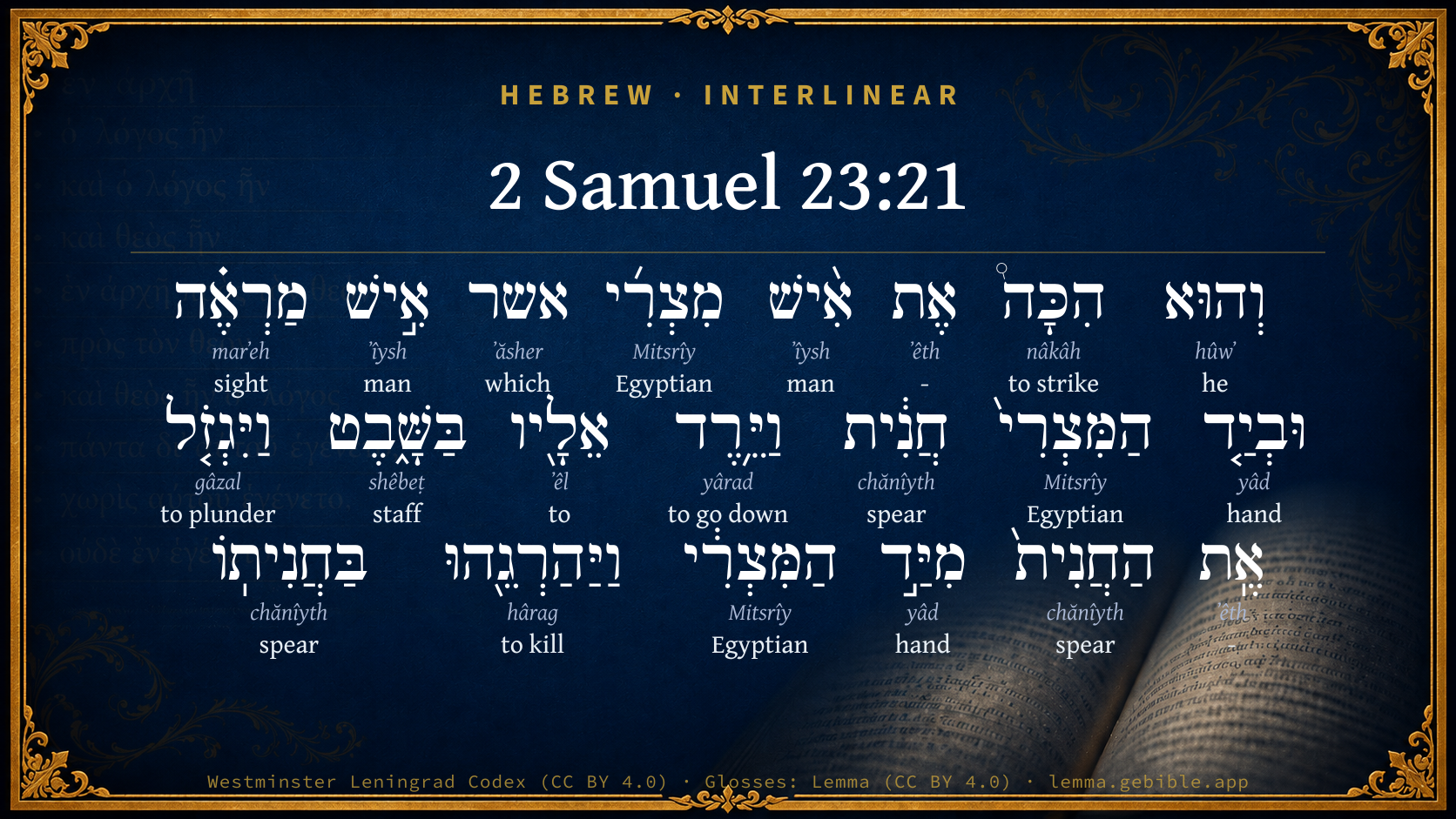
  1. וְהוּא hûwʼ H1931 “and · he” Conjunction + Pronoun, Personal, 3rd Person, Masculine, Singular
  2. הִכָּה֩ nâkâh H5221 “to strike” Verb, Hiphil, Perfect, 3rd Person, Masculine, Singular
  3. אֶת ʼêth H853 “-” Particle, Direct Object
  4. אִ֨ישׁ ʼîysh H376 “man” Noun, Common, Masculine, Singular, Absolute
  5. מִצְרִ֜י Mitsrîy H4713 “Egyptian” Noun, Gentilic, Masculine, Singular, Absolute
  6. אשר ʼăsher H834 “which” Particle, Relative
  7. אִ֣ישׁ ʼîysh H376 “man of” Noun, Common, Masculine, Singular, Construct
  8. מַרְאֶ֗ה marʼeh H4758 “sight” Noun, Common, Masculine, Singular, Absolute
  9. וּבְיַ֤ד yâd H3027 “and · in/at · hand of” Conjunction + Preposition + Noun, Common, Both, Singular, Construct
  10. הַמִּצְרִי֙ Mitsrîy H4713 “the · Egyptian” Particle, Definite Article + Noun, Gentilic, Masculine, Singular, Absolute
  11. חֲנִ֔ית chănîyth H2595 “spear” Noun, Common, Feminine, Singular, Absolute
  12. וַיֵּ֥רֶד yârad H3381 “and · to go down” Conjunction + Verb, Qal, Sequential Imperfect, 3rd Person, Masculine, Singular
  13. אֵלָ֖יו ʼêl H413 “to · him” Preposition + Suffix, Personal, 3rd Person, Masculine, Singular
  14. בַּשָּׁ֑בֶט shêbeṭ H7626 “in/at the · staff” Preposition, Determined + Noun, Common, Masculine, Singular, Absolute
  15. אֶֽת ʼêth H853 “-” Particle, Direct Object
  16. הַחֲנִית֙ chănîyth H2595 “the · spear” Particle, Definite Article + Noun, Common, Feminine, Singular, Absolute
  17. מִיַּ֣ד yâd H3027 “from · hand of” Preposition + Noun, Common, Both, Singular, Construct
  18. הַמִּצְרִ֔י Mitsrîy H4713 “the · Egyptian” Particle, Definite Article + Noun, Gentilic, Masculine, Singular, Absolute
  19. וַיַּהַרְגֵ֖הוּ hârag H2026 “and · to kill · him” Conjunction + Verb, Qal, Sequential Imperfect, 3rd Person, Masculine, Singular + Suffix, Personal, 3rd Person, Masculine, Singular
  20. בַּחֲנִיתֽוֹ chănîyth H2595 “in/at · spear · his” Preposition + Noun, Common, Feminine, Singular, Construct + Suffix, Personal, 3rd Person, Masculine, Singular

About this verse

These counts appear in no published source. They are computed here, from the morphology-tagged text and Lemma’s own curated glosses. What Lemma adds →

21
words
14
distinct lemmas
Historical
section

Shared distinctive vocabulary

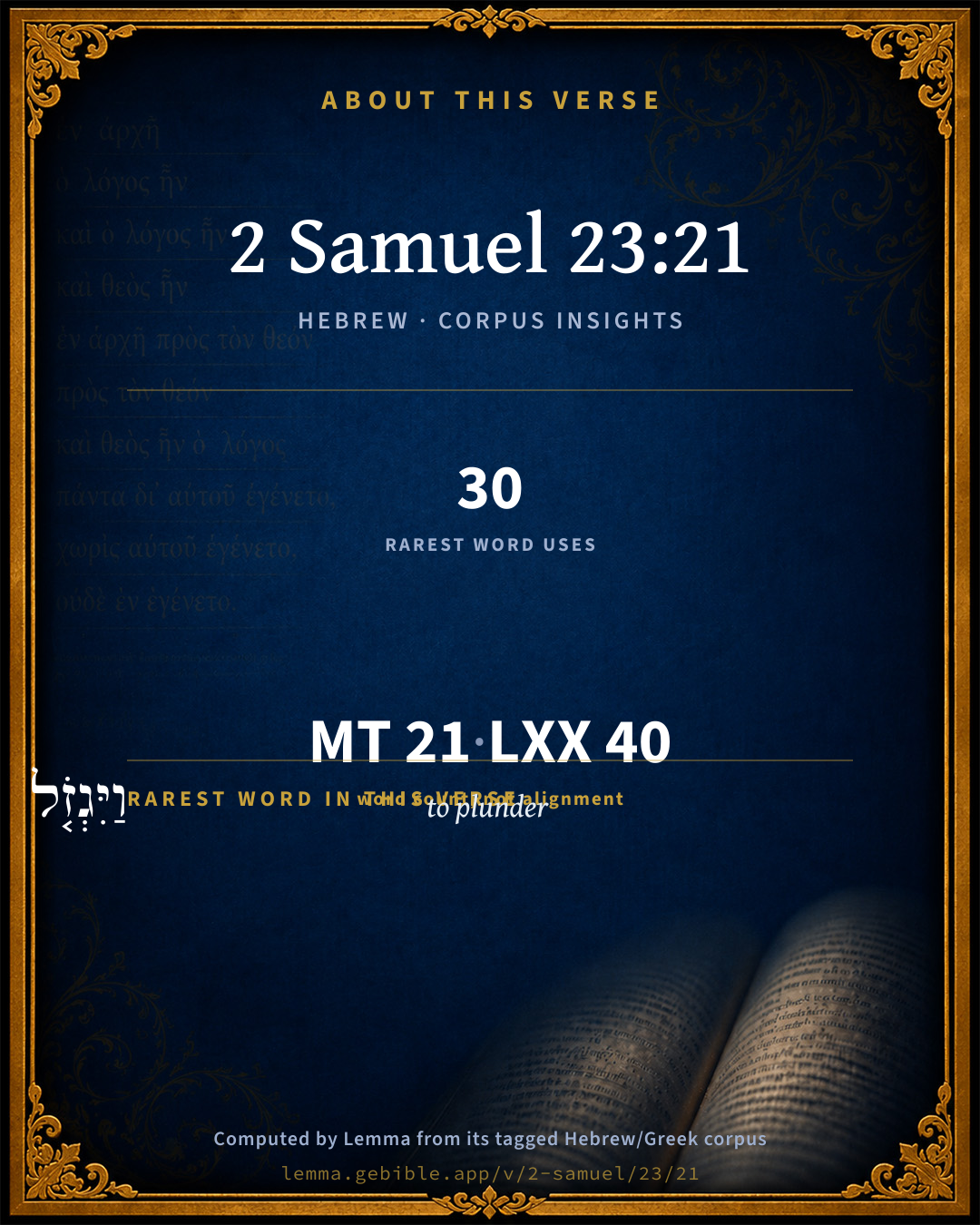
וַיִּגְזֹ֤ל to plunder H1497 occurs in 30 verses of the Hebrew Bible. Also found in:

Grammatical profile

  • 4 verbs
  • 12 nouns
  • 1 pronoun
  • 1 preposition
  • 3 particles

Verb forms

  • הִכָּה֩ Hiphil · Perfect
  • וַיֵּ֥רֶד Qal · Sequential Imperfect
  • וַיִּגְזֹ֤ל Qal · Sequential Imperfect
  • וַיַּהַרְגֵ֖הוּ Qal · Sequential Imperfect

Repetition

Words recur within this verse — often emphatic in Hebrew:

  • מִצְרִ֜י Egyptian H4713 ×3
  • חֲנִ֔ית spear H2595 ×3
  • אִ֨ישׁ man H376 ×2
  • וּבְיַ֤ד hand H3027 ×2

Hebrew & Septuagint length

In English translation the verse runs 41 words from the Hebrew and 47 from the Septuagint (LXX English) — closely comparable.

A rough comparison of the two English renderings, which tokenize alike — not a word-level alignment.

Word counts can differ between the Hebrew and the Greek without any difference in meaning — e.g. the Hebrew direct-object marker אֵת has no separate Greek word, and Greek often adds the article ὁ.

In the original languages it is 21 Hebrew tokens and 40 Greek tokens — but the two are counted differently (Hebrew bundles its prefixes and suffixes into one token; the Greek is in lemma form), so that isn’t a like-for-like length.

Cross-references

3

Topical passages linked to 2 Samuel 23:21 in the Treasury of Scripture Knowledge — connected by theme and wording, ordered by reader-vote popularity; previews shown in the World English Bible.

  • 1 Samuel 17:51 Then David ran, and stood over the Philistine, and took his sword, and drew it out of the sheath of it, and killed him, and cut off his head therewith. When the Philistines saw that their champion was dead, they fled.
  • 1 Chronicles 11:23 He killed an Egyptian, a man of great stature, five cubits high; and in the Egyptian's hand was a spear like a weaver's beam; and he went down to him with a staff, and plucked the spear out of the Egyptian's hand, and killed him with his own spear.
  • Colossians 2:15 having stripped the principalities and the powers, he made a show of them openly, triumphing over them in it.

Cross-references courtesy of OpenBible.info (CC BY 4.0).

Hebrew and Greek witnesses Masoretic Hebrew ↔ Greek Septuagint

The same verse in the two great witnesses to the Old Testament, shown verse-for-verse.

These are two independent witnesses, not word-aligned to each other, and the Septuagint is shown in lemma (dictionary) form.

Hebrew 2 Samuel 23:21 Masoretic · Westminster Leningrad Codex

וְהוּא הִכָּה֩ אֶת אִ֨ישׁ מִצְרִ֜י אשר אִ֣ישׁ מַרְאֶ֗ה וּבְיַ֤ד הַמִּצְרִי֙ חֲנִ֔ית וַיֵּ֥רֶד אֵלָ֖יו בַּשָּׁ֑בֶט וַיִּגְזֹ֤ל אֶֽת הַחֲנִית֙ מִיַּ֣ד הַמִּצְרִ֔י וַיַּהַרְגֵ֖הוּ בַּחֲנִיתֽוֹ

He killed an Egyptian, a goodly man: and the Egyptian had a spear in his hand; but he went down to him with a staff, and plucked the spear out of the Egyptian's hand, and killed him with his own spear.

World English Bible · Public Domain

Greek LXX 2 Samuel 23:21 Septuagint · lemma form

αὐτός πατάσσω ὁ ἀνήρ ὁ αἰγύπτιος ἀνήρ ὁρατός ἐν δέ ὁ χείρ ὁ αἰγύπτιος δόρυ ὡς ξύλον διαβάθρα καί καταβαίνω πρός αὐτός ἐν ῥάβδος καί ἁρπάζω ὁ δόρυ ἐκ ὁ χείρ ὁ αἰγύπτιος καί ἀποκτείνω αὐτός ἐν ὁ δόρυ αὐτός

He struck an Egyptian, a wonderful man, and in the hand of the Egyptian was a spear as the side of a ladder; and he went down to him with a staff, and snatched the spear from the Egyptian's hand, and killed him with his own spear.

LXX2012 (modern English Septuagint) · Public Domain

On this verse, Haydock's Catholic Bible Commentary discusses the Septuagint’s reading. Read the note in Commentary ↓

Hebrew: Westminster Leningrad Codex (CC BY 4.0). Greek: Septuagint (public domain); English from LXX2012 (modern English Septuagint) (Public Domain). How the Septuagint differs from the Hebrew →

Targum (Aramaic paraphrase)

1

The Targum is the ancient Jewish Aramaic paraphrase of the Hebrew Scriptures — an interpretive translation, not the Hebrew text itself. Onkelos (literal) and Pseudo-Jonathan (expansive) render the Torah, and Jonathan the Prophets. Coverage is partial: where no permissively-licensed English translation exists for a verse, only the Aramaic is shown. This is verse-level text, not a word-by-word alignment to the Hebrew.

  1. Targum Jonathan Prophets (Joshua–Malachi)
    וְהוּא קְטַל יַת גַבְרָא מִצְרָאָה גְבַר דְחֶזְוָא וּבִידָא דְמִצְרָאָה מוּרְנִיתָא וּנְחַת עֲלוֹהִי בְּחוּטְרָא וַאֲנֵיס יַת מוּרְנִיתָא מִידָא דְמִצְרָאָה וְקַטְלֵיהּ בְּמוּרְנִיתֵיהּ:

    (no public-domain English translation for this verse)

    Targum Jonathan — Aramaic: “Mikraot Gedolot” (public domain). English: “Sefaria Community Translation” (CC0 1.0 (public-domain dedication)); “London "Chaldee Paraphrase," 1871” (public domain). Text via Sefaria.

Commentary

Notes on 2 Samuel 23:21 from classic Christian and Jewish commentators (each source and its license shown beneath its notes). The classic Christian expositions comment on the surrounding passage and are grouped to its opening verse, so a note may address several verses; the Jewish commentaries on the Tanakh (Rashi and others) are per-verse, so they appear only where the commentator wrote on this verse.

Lemma curates 59 commentaries, every one of them public domain or Creative Commons licensed, each selected and text-cleaned for this edition rather than reprinted as found. About our sources →

Trapp's Complete Commentary

John Trapp

2Sa 23:21 And he slew an Egyptian, a goodly man: and the Egyptian had a spear in his hand; but he went down to him with a staff, and plucked the spear out of the Egyptian’s hand, and slew him with his own spear.

Ver. 21. A goodly man.] A man of great stature. {1Ch 11:23}

John Trapp, A Commentary or Exposition upon All the Books of the Old and New Testament (1647–1656) — public domain. Text from a community e-Sword module.

Geneva Bible (1599)

Geneva Bible translators

Or, a comely man.

Which was as big as a weaver’s beam, 1 Chron. 11:23.

Geneva Bible (1599) marginal notes — public domain. Text via Bolls.life.

Adam Clarke's Commentary

Verse 21. He slew an Egyptian] This man in 1Ch 11:23 is stated to have been five cubits high, about seven feet six inches.

He went down to him with a staff] I have known men who, with a staff only for their defence, could render the sword of the best practised soldier of no use to him. I have seen even a parallel instance of a man with his staff being attacked by a soldier with his hanger; he soon beat the weapon out of the soldier's hand, and could easily have slain him with his own sword.

We have a good elucidation of this in a duel between Dioxippus the Athenian and Horratas a Macedonian, before Alexander: "The Macedonian, proud of his military skill, treated the naked Athenian with contempt, and then challenged him to fight with him the ensuing day. The Macedonian came armed cap-a-pie to the place; on his left arm he had a brazen shield, and in the same hand a spear called sarissa; he had a javelin in his right hand, and a sword girded on his side; in short, he appeared armed as though he were going to contend with a host. Dioxippus came into the field with a chaplet on his head, a purple sash on his left arm, his body naked, smeared over with oil, and in his right hand a strong knotty club, (dextra validum nodosumque stipitem praeferebat.) Horratas, supposing he could easily kill his antagonist while at a distance, threw his javelin, which Dioxippus, suddenly stooping, dexterously avoided, and, before Horratas could transfer the spear from his left to his right hand, sprang forward, and with one blow of his club, broke it in two. The Macedonian being deprived of both his spears, began to draw his sword; but before he could draw it out Dioxippus seized him, tripped up his heels, and threw him with great violence on the ground, (pedibus repente subductis arietavit in terram.) He then put his foot on his neck, drew out his sword, and lifting up his club, was about to dash out the brains of the overthrown champion, had he not been prevented by the king." - Q. Curt. lib. ix., cap. 7.

How similar are the two cases! He went down to him with a staff, and plucked the spear out of the Egyptian's hands, and slew him with his own spear. Benaiah appears to have been just such another clubsman as Dioxippus.

Adam Clarke's Commentary on the Bible (1810–1826) — public domain. Text from a community e-Sword/MySword module.

Ellicott's Commentary for English Readers

(21) A goodly man.—The meaning is explained in the parallel place in Chronicles, where he is called “a man of stature,” and it is added “five cubits high.” Benaiah’s exploit, therefore, consisted in coming, armed only with a staff, to this giant Egyptian, wresting his spear from him, and then slaying him with it.

A Bible Commentary for English Readers, edited by Charles John Ellicott (1878–1897) — public domain. Text from a community e-Sword module.

The Cambridge Bible for Schools and Colleges

gen. ed. J. J. S. Perowne

21. a goodly man] Lit. a man of appearance, a notable man; which is explained in 1Ch_11:23 to mean “a man of great stature,” with the addition, “five cubits high.”

a spear] The Sept. adds, like the beam of a bridge (or, of a ladder): Chron. like a weaver’s beam, as in ch. 2Sa_21:19.

with a staff] Cp. (though the word is different) 1Sa_17:40; 1Sa_17:43.

The Cambridge Bible for Schools and Colleges (gen. ed. J. J. S. Perowne; Cambridge University Press, 1878–1918) — public domain. Text from a community e-Sword module.

John Gill's Exposition

And he slew an Egyptian, a goodly man,.... A person of good countenance and shape, very large and tall; in Ch1 11:28, he is said to be a man of great stature, and five cubits high, and so wanted a cubit and a span of the height of Goliath, Sa1 17:4,

and the Egyptian had a spear in his hand; as large as Goliath's; for in Ch1 11:23, it is said to be like a weaver's beam, as Goliath's was; see Gill on Sa1 17:7,

and he went down to him with a staff; with a walking staff only, having no other weapon:

and plucked the spear out of the Egyptian's hand; and therefore must be a man very nimble and dexterous, as well as bold and courageous:

and slew him with his own spear; as David cut off Goliath's head with his own sword. This is supposed (l) to be Shimei, the son of Gera, Kg1 2:46.

(l) Hieron. Trad. Heb. ut supra. (in. 2 Reg. fol. 80. C.)

John Gill's Exposition of the Whole Bible (1746–1763) — public domain (CC PDM 1.0). Text via the HelloAO Bible API.

Haydock's Catholic Bible Commentary

Sight, for size. (Josephus) --- Hebrew, "a man of great aspect," which 1 Paralipomenon properly explains "five cubits high." --- Hand. Septuagint supply what seems to be omitted, "like a weaver’s beam," (Kennicott) as it is found in Paralipomenon. --- Rod, or rather "a staff," like David’s, 1 Kings xvii. 43., and xl. 43. (Haydock) --- Some men, with a stick or codgel, will not fear to encounter a man armed; (Calmet) as we see exemplified in Q. Curtius, (ix. 7,) where Dioxippus, the Athenian wrestler, overcame Horratas of Macedon, who had challenged him out in a fit of drunkenness. (Haydock)

George Leo Haydock (1774–1849), Haydock's Catholic Family Bible and Commentary, 1859 edition — public domain. Excludes Psalms (Douay-Rheims chapter numbering differs from Protestant) and Deuterocanonical books (Catholic canon only).

Matthew Poole's English Annotations

A goodly man; for stature, as it is expressed, 1Ch 11:23.

With a staff; without a sword, or any warlike weapon.

Matthew Poole's English Annotations on the Holy Bible (1683–1685) — public domain. Text from a community e-Sword/MySword module.

Joseph Benson's Commentary

2Sa 21:21-22. An Egyptian, a goodly man — A person of great stature, 1Ch 11:23. He plucked the spear out of the Egyptian’s hand — This shows him to have been both fearless, and a person of great skill and dexterity in managing a combat, either with man or beast. And had the name among three mighty men — That is, among the three in the second rank, for it is said in the following verse that he did not attain or come up to the first three. Who the third was of this second rank of mighty men is not mentioned.

Joseph Benson's Commentary on the Old and New Testaments (1811–1818) — public domain. Text from a community e-Sword module.

Whedon's Commentary on the Bible

Daniel D. Whedon

21. A goodly man — A man of commanding aspect. Chronicles says: “A man of great stature, five cubits high.”

Went down to him with a staff — By the dexterous use of which he made the Egyptian’s sword of no avail to him. “I have seen,” says Clarke, “a parallel instance of a man with his staff being attacked by a soldier with his hanger; he soon beat the weapon out of the soldier’s hand, and could easily have slain him with his own sword.”

Daniel D. Whedon (gen. ed.), Commentary on the Old and New Testaments (1874–1909) — public domain. Text from a community e-Sword module.

The Pulpit Commentary

A goodly man. The Hebrew text has "who a sight," for which the Massorites read, "a man of sight," that is, handsome, and worth looking at. In Chronicles 11:23 we find what, no doubt, is the right reading, "a man of measure equivalent to "a tall man", five cubits high." The height of Goliath was six cubits and a span. (1Sa_17:4)

The Pulpit Commentary (1880–1919), ed. H.D.M. Spence-Jones & Joseph S. Exell — public domain. Text from a community e-Sword module.

John Wesley's Explanatory Notes

Pit - Where he put himself under a necessity, either of killing, or being killed. Of snow - When lions are most fierce, both from the sharpness of their appetite in cold seasons, and from want of provisions.

John Wesley, Explanatory Notes Upon the Whole Bible (1754–1765) — public domain. Text via the GEBible commentary corpus.

Lesson kit

Teaching starters — assembled from the data on this page, not authored interpretation. Every prompt links to the verse data it draws on. Edit before teaching.

2 Samuel, in the Historical, opens this verse with 21 words (14 distinct Hebrew lemmas). Its most distinctive word is gâzal (“to plunder”). A historical commentator’s framing appears above. Read the whole chapter for the surrounding context.

Discussion questions

  1. What does “to plunder” (gâzal) contribute to the verse as a whole?
  2. How does Genesis 21:25, which shares the word «to plunder», read alongside this verse?
  3. What does the repetition of “Egyptian” (3× in this one verse) do in this verse?
  4. These translations render this verse differently; the difference is in the English rendering, not the original. What questions does that raise?
  5. «הִכָּה֩» is a Hiphil Perfect verb. How does that grammatical form shape the action described?
  6. Compare how Trapp's Complete Commentary and Geneva Bible (1599) read this verse. Where do they agree or differ?

Things to notice

Reading settings

Reading text

Shown beneath each verse's original-language words.

Old Testament
Old Testament edition

Read the OT as the Masoretic Hebrew (MT) or the Greek Septuagint (LXX).

English shown for the Greek Septuagint (in the Hebrew ↔ Greek comparison).

Comparing translations? Open the Compare panel on any verse page to stack up to four side by side.