
2 Chronicles 24:22

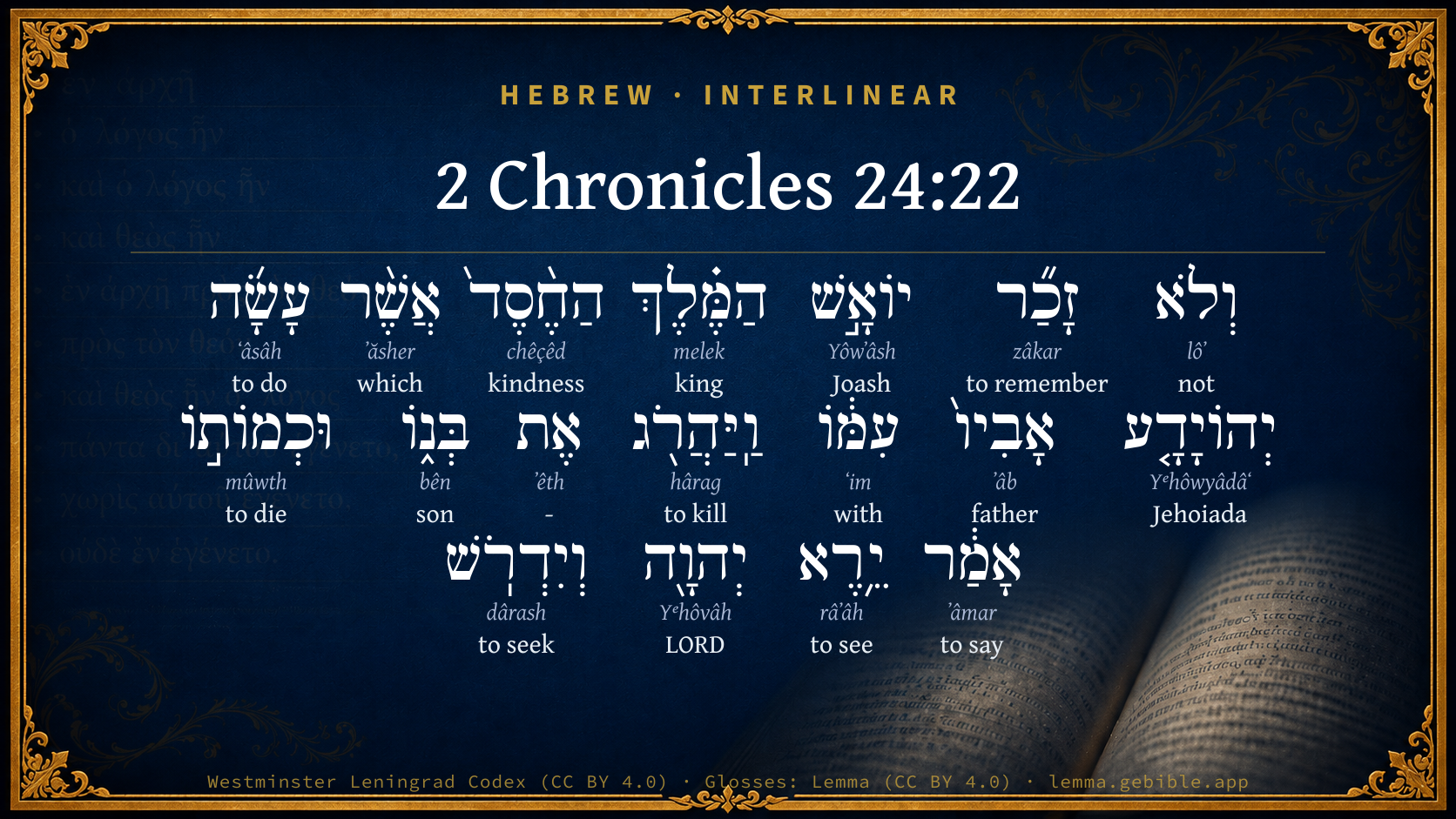
Hebrew (Westminster Leningrad Codex) 2 Chronicles 24:22 appears in the Hebrew Old Testament. The text above is from the Westminster Leningrad Codex. Each word links to its Strong’s number, a concise gloss, and parsing drawn from the Open Scriptures Hebrew Bible morphology. Click any word for its full Brown-Driver-Briggs (BDB) entry.
Download image
Cite this verse

2 Chronicles 24:22 (World English Bible). Public Domain. Lemma interlinear Bible study tool, https://lemma.gebible.app/v/2-chronicles/24/22.

Show BibTeX & RIS
BibTeX
RIS
English Translation
Thus Joash the king didn't remember the kindness which Jehoiada his father had done to him, but killed his son. When he died, he said, Yahweh look on it, and require it.
World English Bible · Public Domain
Download a study sheet

One document with this verse’s original text, its word-by-word gloss line, the meaning frame, cross-references with their text, attributed commentary, and full source and license credits — printable, and it pastes into notes with its structure intact.

This verse Autodidact and up

Study sheet (.html) Plain text (.txt)

A passage Seminary Student

Up to 50 verses in one chapter. A passage sheet keeps up to 6 commentary sources and 12 cross-references per verse, in the order this page ranks them, and says so on the sheet whenever that leaves anything out. Ask for a single verse and you get the Autodidact verse sheet above.

Everything on this page stays free to read, with no account — the sheet is a download of what is already on screen, not access to it.

Want to remove ads? Support Godless Engineer
Compare translations 3

The same verse in 3 English versions, stacked beneath the original-language interlinear above. Click any original word for its lexicon entry.

Each is an independent rendering of the whole verse — the interlinear is not word-aligned to these translations.

Highlighted words mark where these versions differ — a whole-verse word diff, not a word-by-word alignment.

  • World English Bible Public Domain
    Thus Joash the king didn't remember the kindness which Jehoiada his father had done to him, but killed his son. When he died, he said, Yahweh look on it, and require it.
  • King James Version Public Domain
    Thus Joash the king remembered not the kindness which Jehoiada his father had done to him, but slew his son. And when he died, he said, The LORD look upon it, and require it.
  • unfoldingWord Literal Text CC BY-SA 4.0
    And King Joash did not remember the covenant faithfulness that Jehoiada, his father did with him, and he killed his son. And when he died, he said, “May Yahweh see and seek.”

unfoldingWord Literal Text — © unfoldingWord, licensed CC BY-SA 4.0. Word-aligned USFM3 via Door43 (git.door43.org/unfoldingWord/en_ult).

Versions to compare (up to 4)

3 of 4 selected

Show all 18 translations

Every available English version of this verse, each an independent rendering of the whole verse.

  • World English Bible Public Domain
    Thus Joash the king didn't remember the kindness which Jehoiada his father had done to him, but killed his son. When he died, he said, Yahweh look on it, and require it.
  • Berean Standard Bible Public Domain
    Thus King Joash failed to remember the kindness that Zechariah’s father Jehoiada had extended to him. Instead, Joash killed Jehoiada’s son. As he lay dying, Zechariah said, “May the LORD see this and call you to account.”
  • Majority Standard Bible Public Domain
    Thus King Joash failed to remember the kindness that Zechariah’s father Jehoiada had extended to him. Instead, Joash killed Jehoiada’s son. As he lay dying, Zechariah said, “May the LORD see this and call you to account.”
  • King James Version Public Domain
    Thus Joash the king remembered not the kindness which Jehoiada his father had done to him, but slew his son. And when he died, he said, The LORD look upon it, and require it.
  • American Standard Version (1901) Public Domain
    Thus Joash the king remembered not the kindness which Jehoiada his father had done to him, but slew his son. And when he died, he said, Jehovah look upon it, and require it.
  • Revised Version (1885) Public Domain
    Thus Joash the king remembered not the kindness which Jehoiada his father had done to him, but slew his son. And when he died, he said, The LORD look upon it, and require it.
  • Geneva Bible (1599) Public Domain
    Thus Ioash the King remembred not the kindnesse which Iehoiada his father had done to him, but slewe his sonne. And when he dyed, he sayd, The Lord looke vpon it, and require it.
  • Douay-Rheims (1899) Public Domain
    And king Joas did not remember the kindness that Joiada his father had done to him, but killed his son. And when he died, he said: The Lord see, and require it.
  • Young's Literal Translation Public Domain
    and Joash the king hath not remembered the kindness that Jehoiada his father did with him, and slayeth his son, and in his death he said, `Jehovah doth see, and require.'
  • Literal Standard Version CC BY-SA 4.0
    and Joash the king has not remembered the kindness that his father Jehoiada did with him, and slays his son, and in his death he said, “YHWH sees and requires.”
  • Unlocked Literal Bible CC BY-SA 4.0
    In this manner, Joash, the king, ignored the kindness that Jehoiada, Zechariah's father, had done to him. Instead, he killed Jehoiada's son. When Zechariah was dying, he said, “May Yahweh see this and call you to account.”
  • unfoldingWord Literal Text CC BY-SA 4.0
    And King Joash did not remember the covenant faithfulness that Jehoiada, his father did with him, and he killed his son. And when he died, he said, “May Yahweh see and seek.”
  • Darby Bible Public Domain
    And king Joash remembered not the kindness which Jehoiada his father had done to him, but slew his son. And when he died, he said, Jehovah see and require [it]!
  • World Messianic Bible Public Domain
    Thus Joash the king didn’t remember the kindness which Jehoiada his father had done to him, but killed his son. When he died, he said, “May the LORD look at it, and repay it.”
  • Webster's Bible Public Domain
    Thus Joash the king remembered not the kindness which Jehoiada his father had done to him, but slew his son. And when he died, he said, The LORD look upon it, and require it.
  • Free Bible Version CC BY-SA 4.0
    King Joash showed he had forgotten all about the loyalty and love shown to him by Jehoiada, Zechariah's father, by killing his son. As he died, Zechariah cried out, “May the Lord see what you've done and pay you back!”
  • Bible in Basic English Public Domain
    So King Joash did not keep in mind how good Jehoiada his father had been to him, but put his son to death. And in the hour of his death he said, May the Lord see it and take payment!
  • JPS Tanakh (1917) Public Domain
    Thus Joash the king remembered not the kindness which Jehoiada his father had done to him, but slew his son. And when he died, he said: 'The LORD look upon it, and require it.'

Literal Standard Version (2020), Covenant Press — licensed CC BY-SA 4.0. Text via the HelloAO Bible API (eBible.org). Unlocked Literal Bible (unfoldingWord) — licensed CC BY-SA 4.0. Text via the HelloAO Bible API (eBible.org). unfoldingWord Literal Text — © unfoldingWord, licensed CC BY-SA 4.0. Word-aligned USFM3 via Door43 (git.door43.org/unfoldingWord/en_ult). Free Bible Version, Dr. Jonathan Gallagher — licensed CC BY-SA 4.0. Text via the HelloAO Bible API (eBible.org).

Word by word

More ways to search: Search by grammar → Find every occurrence → Compare this word →

Practice this passage: Drill this verse → Learn its vocabulary →

יוֹאָ֣שׁ
Yôwʼâsh
H3101
“Joash”
Noun, Proper
Part of Speech
Noun
Type
Proper
Full BDB Definition

Origin: a form of H3060

TWOT: None

Joash = "given by the Lord" - son of king Ahaziah and the 8th king of Judah - son of king Jehoahaz and the 12th king of the northern kingdom of Israel - father of Gideon - a son of king Ahab - a descendant of Shelah the son of Judah; either the son of Shelah or the son of Jokim - son of Shemaah of Gibeah who resorted to David at Ziklag
  1. וְלֹא lôʼ H3808 “and · not” Conjunction + Particle, Negative
  2. זָכַ֞ר zâkar H2142 “to remember” Verb, Qal, Perfect, 3rd Person, Masculine, Singular
  3. הַמֶּ֗לֶךְ melek H4428 “the · king” Particle, Definite Article + Noun, Common, Masculine, Singular, Absolute
  4. הַחֶ֨סֶד֙ chêçêd H2617 “the · kindness” Particle, Definite Article + Noun, Common, Masculine, Singular, Absolute
  5. אֲשֶׁ֨ר ʼăsher H834 “which” Particle, Relative
  6. עָשָׂ֜ה ʻâsâh H6213 “to do” Verb, Qal, Perfect, 3rd Person, Masculine, Singular
  7. יְהוֹיָדָ֤ע Yᵉhôwyâdâʻ H3077 “Jehoiada” Noun, Proper
  8. אָבִיו֙ ʼâb H1 “father · his” Noun, Common, Masculine, Singular, Construct + Suffix, Personal, 3rd Person, Masculine, Singular
  9. עִמּ֔וֹ ʻim H5973 “with · him” Preposition + Suffix, Personal, 3rd Person, Masculine, Singular
  10. וַֽיַּהֲרֹ֖ג hârag H2026 “and · to kill” Conjunction + Verb, Qal, Sequential Imperfect, 3rd Person, Masculine, Singular
  11. אֶת ʼêth H853 “-” Particle, Direct Object
  12. בְּנ֑וֹ bên H1121 “son · his” Noun, Common, Masculine, Singular, Construct + Suffix, Personal, 3rd Person, Masculine, Singular
  13. וּכְמוֹת֣וֹ mûwth H4191 “and · like/as · to die · him” Conjunction + Preposition + Verb, Qal, Infinitive Construct + Suffix, Personal, 3rd Person, Masculine, Singular
  14. אָמַ֔ר ʼâmar H559 “to say” Verb, Qal, Perfect, 3rd Person, Masculine, Singular
  15. יֵ֥רֶא râʼâh H7200 “to see” Verb, Qal, Jussive, 3rd Person, Masculine, Singular
  16. יְהוָ֖ה Yᵉhôvâh H3068 “LORD” Noun, Proper
  17. וְיִדְרֹֽשׁ dârash H1875 “and · to seek” Conjunction + Verb, Qal, Imperfect, 3rd Person, Masculine, Singular

About this verse

These counts appear in no published source. They are computed here, from the morphology-tagged text and Lemma’s own curated glosses. What Lemma adds →

18
words
18
distinct lemmas
Historical
section

Shared distinctive vocabulary

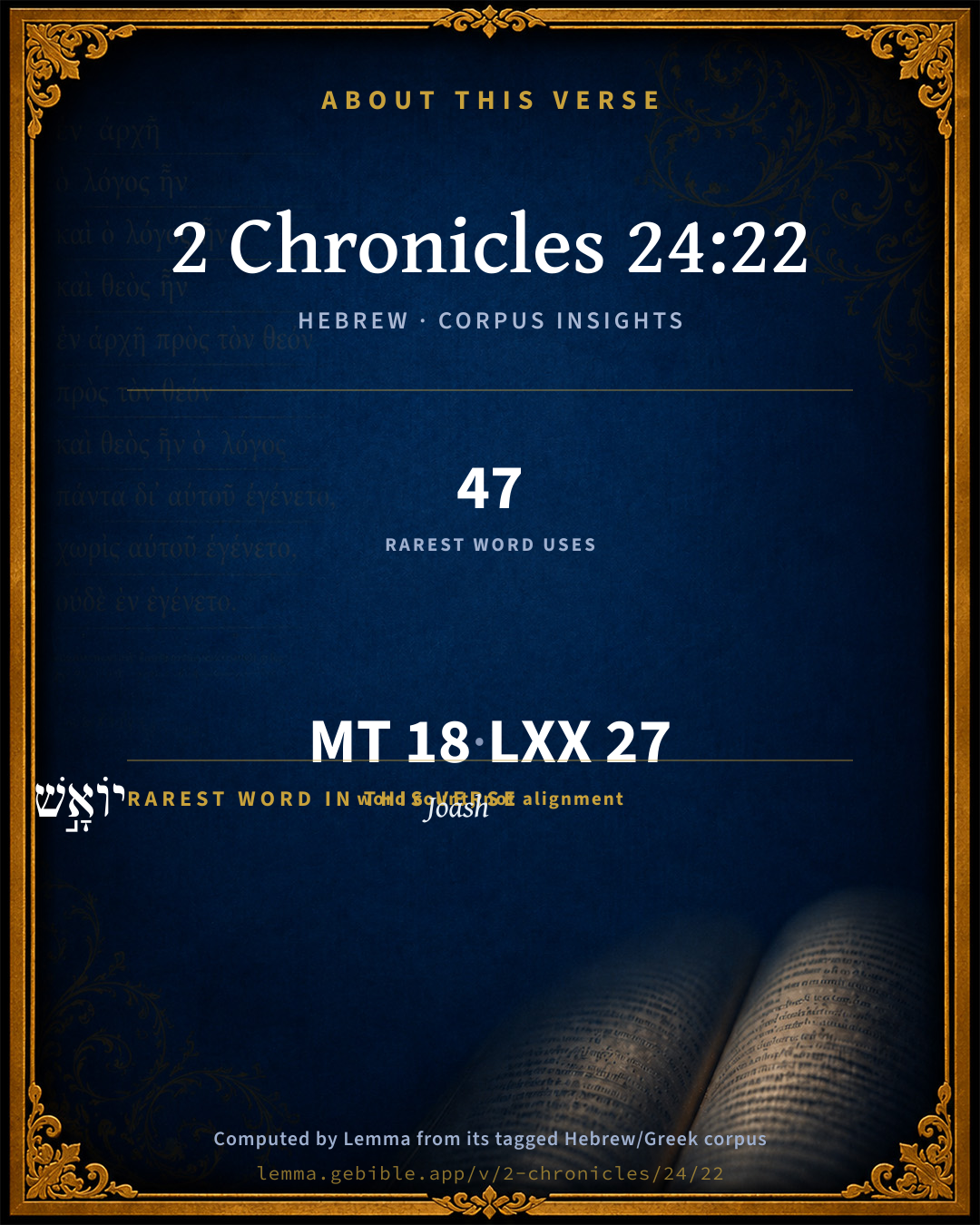
יוֹאָ֣שׁ Joash H3101 occurs in 41 verses of the Hebrew Bible. Also found in:

Grammatical profile

  • 7 verbs
  • 7 nouns
  • 1 preposition
  • 3 particles

Verb forms

  • זָכַ֞ר Qal · Perfect
  • עָשָׂ֜ה Qal · Perfect
  • וַֽיַּהֲרֹ֖ג Qal · Sequential Imperfect
  • וּכְמוֹת֣וֹ Qal · Infinitive Construct
  • אָמַ֔ר Qal · Perfect
  • יֵ֥רֶא Qal · Jussive
  • וְיִדְרֹֽשׁ Qal · Imperfect

Hebrew & Septuagint length

In English translation the verse runs 32 words from the Hebrew and 31 from the Septuagint (LXX English) — closely comparable.

A rough comparison of the two English renderings, which tokenize alike — not a word-level alignment.

Word counts can differ between the Hebrew and the Greek without any difference in meaning — e.g. the Hebrew direct-object marker אֵת has no separate Greek word, and Greek often adds the article ὁ.

In the original languages it is 18 Hebrew tokens and 27 Greek tokens — but the two are counted differently (Hebrew bundles its prefixes and suffixes into one token; the Greek is in lemma form), so that isn’t a like-for-like length.

Cross-references

15

Topical passages linked to 2 Chronicles 24:22 in the Treasury of Scripture Knowledge — connected by theme and wording, ordered by reader-vote popularity; previews shown in the World English Bible.

  • Genesis 9:5 I will surely require your blood of your lives. At the hand of every animal I will require it. At the hand of man, even at the hand of every man's brother, I will require the life of man.
  • Luke 11:51 from the blood of Abel to the blood of Zachariah, who perished between the altar and the sanctuary.' Yes, I tell you, it will be required of this generation.
  • John 10:32 Jesus answered them, "I have shown you many good works from my Father. For which of those works do you stone me?"
  • Revelation 6:9–11 When he opened the fifth seal, I saw underneath the altar the souls of those who had been killed for the Word of God, and for the testimony of the Lamb which they had.
  • Revelation 19:2 for true and righteous are his judgments. For he has judged the great prostitute, who corrupted the earth with her sexual immorality, and he has avenged the blood of his servants at her hand."
  • Psalms 10:14 But you do see trouble and grief; You consider it to take it into your hand. You help the victim and the fatherless.
  • Psalms 109:4 In return for my love, they are my adversaries; But I am in prayer.
  • Proverbs 17:13 Whoever rewards evil for good, Evil shall not depart from his house.
  • Jeremiah 11:20 But, Yahweh of Hosts, who judge righteously, who try the heart and the mind, I shall see your vengeance on them; for to you have I revealed my cause.
  • Jeremiah 26:14–15 But as for me, behold, I am in your hand: do with me as is good and right in your eyes.
  • Jeremiah 51:56 for the destroyer is come on her, even on Babylon, and her mighty men are taken, their bows are broken in pieces; for Yahweh is a God of recompenses, he will surely requite.
  • Luke 17:15–18 One of them, when he saw that he was healed, turned back, glorifying God with a loud voice.
  • 2 Timothy 4:14 Alexander, the coppersmith, did much evil to me. The Lord will repay him according to his works,
  • 2 Timothy 4:16 At my first defense, no one came to help me, but all left me. May it not be held against them.
  • Revelation 18:20 Rejoice over her, O heaven, you saints, apostles, and prophets; for God has judged your judgment on her."

Cross-references courtesy of OpenBible.info (CC BY 4.0).

Hebrew and Greek witnesses Masoretic Hebrew ↔ Greek Septuagint

The same verse in the two great witnesses to the Old Testament, shown verse-for-verse.

These are two independent witnesses, not word-aligned to each other, and the Septuagint is shown in lemma (dictionary) form.

Hebrew 2 Chronicles 24:22 Masoretic · Westminster Leningrad Codex

וְלֹא זָכַ֞ר יוֹאָ֣שׁ הַמֶּ֗לֶךְ הַחֶ֨סֶד֙ אֲשֶׁ֨ר עָשָׂ֜ה יְהוֹיָדָ֤ע אָבִיו֙ עִמּ֔וֹ וַֽיַּהֲרֹ֖ג אֶת בְּנ֑וֹ וּכְמוֹת֣וֹ אָמַ֔ר יֵ֥רֶא יְהוָ֖ה וְיִדְרֹֽשׁ

Thus Joash the king didn't remember the kindness which Jehoiada his father had done to him, but killed his son. When he died, he said, Yahweh look on it, and require it.

World English Bible · Public Domain

Greek LXX 2 Chronicles 24:22 Septuagint · lemma form

καί οὐ μιμνήσκω ιωας ὁ ἔλεος ὅς ποιέω μετά αὐτός ιωδαε ὁ πατήρ αὐτός καί θανατόω ὁ υἱός αὐτός καί ὡς ἀποθνήσκω εἶπον ὁράω κύριος καί κρίνω

So Joas remembered not the kindness which his father Jodae had exercised towards him, but killed his son. And as he died, he said, The Lord look upon it, and judge.

LXX2012 (modern English Septuagint) · Public Domain

Hebrew: Westminster Leningrad Codex (CC BY 4.0). Greek: Septuagint (public domain); English from LXX2012 (modern English Septuagint) (Public Domain). How the Septuagint differs from the Hebrew →

Commentary

Notes on 2 Chronicles 24:22 from classic Christian and Jewish commentators (each source and its license shown beneath its notes). The classic Christian expositions comment on the surrounding passage and are grouped to its opening verse, so a note may address several verses; the Jewish commentaries on the Tanakh (Rashi and others) are per-verse, so they appear only where the commentator wrote on this verse.

Lemma curates 59 commentaries, every one of them public domain or Creative Commons licensed, each selected and text-cleaned for this edition rather than reprinted as found. About our sources →

Trapp's Complete Commentary

John Trapp

2Ch 24:22 Thus Joash the king remembered not the kindness which Jehoiada his father had done to him, but slew his son. And when he died, he said, The LORD look upon [it], and require [it].

Ver. 22. Thus Joash the king remembered not the kindness.] This was monstrous ingratitude, such as was that also of Hercules, who, for a sharp word, knocked on the head his tutor Linus: Hoc ictu ceu didactro accepto Linus mortuus est. Johannes Scotus and Cassianus Brixiensis, two famous schoolmasters, were stabbed to death by their unruly scholars with their penknives; Seneca was suffocated in a bath by the command of his pupil Nero. {a} παλαια μεν ευδει χαρις: αμναμονες δε ανθρωποι, saith Pindarus: Good turns are as soon forgotten by men, as eaten bread is by children. Do them nineteen kindnesses, and if ye fail them in the twentieth - which yet, perhaps, would prove no kindness to them - all is lost.

“ Sunt homines humeris quos siquis gestat ad urbem

Ausoniam, domiti quae caput orbis erat;

Nec tamen ad portam placide deponat eosdem,

Gratia praeteriti nulla laboris eris. ” - Ausonius.

Pythias royally entertained and feasted Xerxes and all his huge army, proffering him also a great sum of gold toward the charges of the war, after which, Xerxes having pressed his five sons for the war, Pythias went to him entreating him to release his eldest son, to be a comfort and support to his old age; but Xerxes, being angry at his request, most ungratefully caused his son to be cut into two pieces, and laid in the way for his army to march over. {b}

The Lord look upon it.] Or, The Lord will look upon it and require it. He did so, and that forthwith, {2Ch 24:23-26} for "precious in the sight of the Lord is the death of his saints," his suffering saints especially. Epiphanius {c} saith that from the death of this high priest, God answered the Jews no more by Urim and Thummim.

{a} Cicero was beheaded by Papilius Laenas, a soldier whose life he had saved.

{b} Herodot.

{c} In Vit. Zacha.

John Trapp, A Commentary or Exposition upon All the Books of the Old and New Testament (1647–1656) — public domain. Text from a community e-Sword module.

The Biblical Illustrator

Joseph S. Exell

2Ch_24:22

But slew his son.

Joash and Jehoiada

The picture here drawn of the failure of the best of tutors and governors is unfortunately only too typical. Julian the Apostate was educated by a distinguished Christian prelate, Eusebius of Nicomedia, and was trained in a strict routine of religious observances; yet he repudiated Christianity at the earliest safe opportunity. His apostasy, like that of Joash, was probably characterised by base ingratitude. At Constantines death the troops in Constantinople massacred nearly all the princes of the imperial family, and Julian, then only six years old, is said to have been saved and concealed in a church by Mark, Bishop of Arethusa. When Julian became emperor, he repaid this obligation by subjecting his benefactor to cruel tortures because he had destroyed a heathen temple and refused to make any compensation. (W. H. Bennett, M.A.)

The Biblical Illustrator, edited by Joseph S. Exell (c. 1880s–1900s) — public domain. Text from a community e-Sword module.

Joseph Benson's Commentary

2Ch 24:22. When he died, he said, The Lord look upon it, and require it — That is, make inquisition for my innocent blood. But the words may as well be rendered, The Lord will look upon it, and require it — He will examine this action, and require satisfaction from you for it: a prophetic sentence, which, as appears from what follows, was speedily executed.

Joseph Benson's Commentary on the Old and New Testaments (1811–1818) — public domain. Text from a community e-Sword module.

Geneva Bible (1599)

Geneva Bible translators

Revenge my death and require my blood at your hands: or he speaketh this by prophecy, because he knew that God would do it. This Zechariah is also called the son of Berechiah, Matt. 23:35, because his progenitors were Iddo, Berechiah, Jehoiada, etc.

Geneva Bible (1599) marginal notes — public domain. Text via Bolls.life.

Jamieson, Fausset & Brown

Robert Jamieson, A. R. Fausset & David Brown

when he died, he said, The Lord look upon it and require it--These dying words, if they implied a vindictive imprecation, exhibit a striking contrast to the spirit of the first Christian martyr (Act 7:60). But, instead of being the expression of a personal wish, they might be the utterance of a prophetic doom.

Jamieson, Fausset & Brown — Commentary Critical and Explanatory on the Whole Bible (1871) — public domain (CC PDM 1.0). Text via the HelloAO Bible API.

Adam Clarke's Commentary

Verse 22. The Lord look upon it, and require it.] And so he did; for, at the end of that year, the Syrians came against Judah, destroyed all the princes of the people, sent their spoils to Damascus; and Joash, the murderer of the prophet, the son of his benefactor, was himself murdered by his own servants. Here was a most signal display of the Divine retribution.

On the subject of the death of this prophet the reader is requested to refer to the note on Mt 23:34-35.

Adam Clarke's Commentary on the Bible (1810–1826) — public domain. Text from a community e-Sword/MySword module.

Ellicott's Commentary for English Readers

(22) The Lord look upon it, and require it.—Jehovah behold, and avenge! literally, seek, scil., vengeance for the crime (Gen_9:5; Psa_10:4). This dying imprecation is in harmony with the spirit of the older dispensation, which exacted blood for blood. Contrast the prayer of St. Stephen, the first of Christian martyrs (Act_7:50). The prayer of Zechariah was also a prophecy destined to speedy fulfilment. (See 2Ch_24:23, seq.)

A Bible Commentary for English Readers, edited by Charles John Ellicott (1878–1897) — public domain. Text from a community e-Sword module.

The Cambridge Bible for Schools and Colleges

gen. ed. J. J. S. Perowne

22. The Lord look upon it, and require it] Cp. 2Ma_14:45-46, and contrast Act_7:60.

The Cambridge Bible for Schools and Colleges (gen. ed. J. J. S. Perowne; Cambridge University Press, 1878–1918) — public domain. Text from a community e-Sword module.

John Gill's Exposition

For the army of the Syrians came with a small company of men,.... It consisted but of few:

and the Lord delivered a very great host into their hand; which the king of Judah and his princes had got together to oppose them:

because they had forsaken the Lord God of their fathers; therefore the Lord forsook them, and gave them up into the hand of their enemies:

so they executed judgment against Joash; were the instruments God made use of to execute his vengeance on him for his idolatry and murder.

John Gill's Exposition of the Whole Bible (1746–1763) — public domain (CC PDM 1.0). Text via the HelloAO Bible API.

Albert Barnes' Notes on the Bible

The Lord look upon it and require it - Compare Gen 9:5; Gen 42:22; and contrast the words of Christ Luk 23:34, and of Stephen Act 7:60. Zechariah’s prayer was prophetic (see 2Ch 24:23, 2Ch 24:25; Luk 11:51).

Albert Barnes' Notes on the Bible (1834–1885) — public domain. Text from a community e-Sword/MySword module.

Haydock's Catholic Bible Commentary

Require it. I commit my cause into his hands. M. --- The vengeance of the Lord was not slack. H. Raro antecedentem scelestum

Deseruit pede pœna claudo. Horace)

George Leo Haydock (1774–1849), Haydock's Catholic Family Bible and Commentary, 1859 edition — public domain. Excludes Psalms (Douay-Rheims chapter numbering differs from Protestant) and Deuterocanonical books (Catholic canon only).

Matthew Poole's English Annotations

i.e. Make inquisition for my innocent blood; which he did not wish from any desire of private revenge, with which so wise and good a man would never be willing to die; but partly from a zeal to public justice, and the punishment of such gross wickedness; and partly to deter them, if possible, from completing their murderous intentions. But these words may as well be rendered indicatively as optatively,

The Lord will look upon it, and

require it, i. e. he will examine this action, and require satisfaction from you for it.

Matthew Poole's English Annotations on the Holy Bible (1683–1685) — public domain. Text from a community e-Sword/MySword module.

The Pulpit Commentary

Remembered not the kindness. (Gen_40:23) The Lord look upon it, and require it. So, too, the Revised Version, which also, according to its custom, removes the italic type from the two neuter pronouns "it." But probabaly a better and correcter rendering is, "The Lord will see and will require" (for it is not necessary to regard this as a prayer of Zechariah); and thus bring it into comparison with those divinest prayers of the Saviour and of St. Stephen. The words on dying Zechariah"s lips were perhaps rather the vivid reminiscence of his own well-versed knowledge of the Law, or "the Scriptures". (Gen_9:5 Gen_42:22) The sentence of the dying priest and prophet in one, is, by the writer of Chronicles at any rate, directed in its fall with fearful straightness to the door of Joash the king himself. Remarkable as is the absence of the matter of this and the five preceding verses from the parallel, it will not escape notice how it is implied in vers. 17, 18 there, while the inclusion of it here is again in patent harmony with the great object of the writer.

The Pulpit Commentary (1880–1919), ed. H.D.M. Spence-Jones & Joseph S. Exell — public domain. Text from a community e-Sword module.

John Wesley's Explanatory Notes

Require it - Make inquisition for innocent blood. But the words may be rendered, The Lord will look upon it, and require it, will require satisfaction from you for it.

John Wesley, Explanatory Notes Upon the Whole Bible (1754–1765) — public domain. Text via the GEBible commentary corpus.

Rashi

Rabbi Shlomo Yitzchaki (Rashi)

and upon his death, he said, “May the Lord see and requite.” For they have slain me only because I spoke as the Omnipresent’s medium, and since I have been slain for His sake, it is proper and fitting that He requite my blood. And so it was: his blood was immediately requited, for “it came to pass at the turn of the year, etc.”

Rashi on the Tanakh — English translations: “The Judaica Press complete Tanach with Rashi, translated by A. J. Rosenberg” (CC BY 4.0); “Pentateuch with Rashi's commentary by M. Rosenbaum and A.M. Silbermann, 1929-1934” (public domain); “The Metsudah Tanach series, Lakewood, N.J” (CC BY 4.0); and “The Book of Joshua, Metsudah Publications, 1997” (CC BY 4.0). Text via Sefaria.

Lesson kit

Teaching starters — assembled from the data on this page, not authored interpretation. Every prompt links to the verse data it draws on. Edit before teaching.

2 Chronicles, in the Historical, opens this verse with 18 words (18 distinct Hebrew lemmas). Its most distinctive word is Yôwʼâsh (“Joash”). A historical commentator’s framing appears above. Read the whole chapter for the surrounding context.

Discussion questions

  1. The word Yôwʼâsh carries the sense “Joash.” How does it shape the verse?
  2. Judges 6:11 shares the word «Joash» with this verse. How do the two illuminate each other?
  3. The translations on this page render this verse differently — a whole-verse word diff, not a word-by-word alignment. What might account for the different wordings?
  4. The verb «זָכַ֞ר» is Qal Perfect. How does its form color the action?
  5. Reading how Trapp's Complete Commentary and The Biblical Illustrator read this verse, where do the two commentators agree and where do they part?

Things to notice

Reading settings

Reading text

Shown beneath each verse's original-language words.

Old Testament
Old Testament edition

Read the OT as the Masoretic Hebrew (MT) or the Greek Septuagint (LXX).

English shown for the Greek Septuagint (in the Hebrew ↔ Greek comparison).

Comparing translations? Open the Compare panel on any verse page to stack up to four side by side.