
Nehemiah 6:10

Hebrew (Westminster Leningrad Codex) Nehemiah 6:10 appears in the Hebrew Old Testament. The text above is from the Westminster Leningrad Codex. Each word links to its Strong’s number, a concise gloss, and parsing drawn from the Open Scriptures Hebrew Bible morphology. Click any word for its full Brown-Driver-Briggs (BDB) entry.
Download image
Cite this verse

Nehemiah 6:10 (World English Bible). Public Domain. Lemma interlinear Bible study tool, https://lemma.gebible.app/v/nehemiah/6/10.

Show BibTeX & RIS
BibTeX
RIS
English Translation
I went to the house of Shemaiah the son of Delaiah the son of Mehetabel, who was shut up; and he said, Let us meet together in the house of God, within the temple, and let us shut the doors of the temple: for they will come to kill you; yes, in the night will they come to kill you.
World English Bible · Public Domain
Download a study sheet

One document with this verse’s original text, its word-by-word gloss line, the meaning frame, cross-references with their text, attributed commentary, and full source and license credits — printable, and it pastes into notes with its structure intact.

This verse Autodidact and up

Study sheet (.html) Plain text (.txt)

A passage Seminary Student

Up to 50 verses in one chapter. A passage sheet keeps up to 6 commentary sources and 12 cross-references per verse, in the order this page ranks them, and says so on the sheet whenever that leaves anything out. Ask for a single verse and you get the Autodidact verse sheet above.

Everything on this page stays free to read, with no account — the sheet is a download of what is already on screen, not access to it.

Want to remove ads? Support Godless Engineer
Compare translations 3

The same verse in 3 English versions, stacked beneath the original-language interlinear above. Click any original word for its lexicon entry.

Each is an independent rendering of the whole verse — the interlinear is not word-aligned to these translations.

Highlighted words mark where these versions differ — a whole-verse word diff, not a word-by-word alignment.

  • World English Bible Public Domain
    I went to the house of Shemaiah the son of Delaiah the son of Mehetabel, who was shut up; and he said, Let us meet together in the house of God, within the temple, and let us shut the doors of the temple: for they will come to kill you; yes, in the night will they come to kill you.
  • King James Version Public Domain
    Afterward I came unto the house of Shemaiah the son of Delaiah the son of Mehetabeel, who was shut up; and he said, Let us meet together in the house of God, within the temple, and let us shut the doors of the temple: for they will come to slay thee; yea, in the night will they come to slay thee.
  • unfoldingWord Literal Text CC BY-SA 4.0
    Now as for me, I entered the house of Shemaiah, the son of Delaiah, the son of Mehetabel, and he was confined. And he said, “Let us appoint a time to meet in the house of God, in the midst of the temple. And let us shut the doors of the temple, for they are coming to kill you. Yes, at night they are coming to kill you.”

unfoldingWord Literal Text — © unfoldingWord, licensed CC BY-SA 4.0. Word-aligned USFM3 via Door43 (git.door43.org/unfoldingWord/en_ult).

Versions to compare (up to 4)

3 of 4 selected

Show all 18 translations

Every available English version of this verse, each an independent rendering of the whole verse.

  • World English Bible Public Domain
    I went to the house of Shemaiah the son of Delaiah the son of Mehetabel, who was shut up; and he said, Let us meet together in the house of God, within the temple, and let us shut the doors of the temple: for they will come to kill you; yes, in the night will they come to kill you.
  • Berean Standard Bible Public Domain
    Later, I went to the house of Shemaiah son of Delaiah, the son of Mehetabel, who was confined to his house. He said: “Let us meet at the house of God inside the temple. Let us shut the temple doors because they are coming to kill you—by night they are coming to kill you!”
  • Majority Standard Bible Public Domain
    Later, I went to the house of Shemaiah son of Delaiah, the son of Mehetabel, who was confined to his house. He said: “Let us meet at the house of God inside the temple. Let us shut the temple doors because they are coming to kill you—by night they are coming to kill you!”
  • King James Version Public Domain
    Afterward I came unto the house of Shemaiah the son of Delaiah the son of Mehetabeel, who was shut up; and he said, Let us meet together in the house of God, within the temple, and let us shut the doors of the temple: for they will come to slay thee; yea, in the night will they come to slay thee.
  • American Standard Version (1901) Public Domain
    And I went unto the house of Shemaiah the son of Delaiah the son of Mehetabel, who was shut up; and he said, Let us meet together in the house of God, within the temple, and let us shut the doors of the temple: for they will come to slay thee; yea, in the night will they come to slay thee.
  • Revised Version (1885) Public Domain
    And I went unto the house of Shemaiah the son of Delaiah the son of Mehetabel, who was shut up; and he said, Let us meet together in the house of God, within the temple, and let us shut the doors of the temple: for they will come to slay thee; yea, in the night will they come to slay thee.
  • Geneva Bible (1599) Public Domain
    And I came to the house of Shemaiah the sonne of Delaiah the sonne of Mehetabeel, and he was shut vp, and he said, Let vs come together into the house of God in the middes of the Temple, and shut the doores of the Temple: for they will come to slay thee: yea, in the night will they come to kill thee.
  • Douay-Rheims (1899) Public Domain
    And I went into the house of Samaia the son of Delaia, the son of Metabeel privately. And he said: Let us consult together in the house of God in the midst of the temple: and let us shut the doors of the temple, for they will come to kill thee, and in the night they will come to slay thee.
  • Young's Literal Translation Public Domain
    And I have entered the house of Shemaiah son of Delaiah, son of Mehetabeel -- and he is restrained -- and he saith, `Let us meet at the house of God, at the inside of the temple, and we shut the doors of the temple, for they are coming in to slay thee -- yea, by night they are coming in to slay thee.'
  • Literal Standard Version CC BY-SA 4.0
    And I have entered the house of Shemaiah son of Delaiah, son of Mehetabeel—and he is restrained—and he says, “Let us meet at the house of God, at the inside of the temple, and we shut the doors of the temple, for they are coming to slay you—indeed, by night they are coming to slay you.”
  • Unlocked Literal Bible CC BY-SA 4.0
    I went to the house of Shemaiah son of Delaiah son of Mehetabel, who was confined in his home. He said, “Let us meet together in the house of God, inside the temple, and let us close the doors of the temple, for they are coming to kill you. At night they are coming to kill you.”
  • unfoldingWord Literal Text CC BY-SA 4.0
    Now as for me, I entered the house of Shemaiah, the son of Delaiah, the son of Mehetabel, and he was confined. And he said, “Let us appoint a time to meet in the house of God, in the midst of the temple. And let us shut the doors of the temple, for they are coming to kill you. Yes, at night they are coming to kill you.”
  • Darby Bible Public Domain
    And I came to the house of Shemaiah the son of Delaiah, the son of Mehetabeel, who had shut himself up. And he said, Let us meet together in the house of God, within the temple, and let us shut the doors of the temple; for they are coming to kill thee; even in the night are they coming to kill thee.
  • World Messianic Bible Public Domain
    I went to the house of Shemaiah the son of Delaiah the son of Mehetabel, who was shut in at his home; and he said, “Let us meet together in God’s house, within the temple, and let’s shut the doors of the temple; for they will come to kill you. Yes, in the night they will come to kill you.”
  • Webster's Bible Public Domain
    Afterward I came to the house of Shemaiah the son of Delaiah the son of Mehetabeel, who was shut up; and he said, Let us meet together in the house of God, within the temple, and let us shut the doors of the temple: for they will come to slay thee; yea, in the night will they come to slay thee.
  • Free Bible Version CC BY-SA 4.0
    Later on, I went to Shemaiah's house (he was the son of Delaiah, son of Mehetabel) who had shut himself in his house. He said: “Come and meet me at the house of God inside the Temple. Then we can bolt the Temple doors shut because they are coming to kill you! They're coming to kill you tonight!”
  • Bible in Basic English Public Domain
    And I went to the house of Shemaiah, the son of Delaiah, the son of Mehetabel, who was shut up; and he said, Let us have a meeting in the house of God, inside the Temple, and let the doors be shut: for they will come to put you to death; truly, in the night they will come to put you to death.
  • JPS Tanakh (1917) Public Domain
    And as for me, I went unto the house of Shemaiah the son of Delaiah the son of Mehetabel, who was shut up; and he said: 'Let us meet together in the house of God, within the temple, and let us shut the doors of the temple; for they will come to slay thee; yea, in the night will they come to slay thee.'

Literal Standard Version (2020), Covenant Press — licensed CC BY-SA 4.0. Text via the HelloAO Bible API (eBible.org). Unlocked Literal Bible (unfoldingWord) — licensed CC BY-SA 4.0. Text via the HelloAO Bible API (eBible.org). unfoldingWord Literal Text — © unfoldingWord, licensed CC BY-SA 4.0. Word-aligned USFM3 via Door43 (git.door43.org/unfoldingWord/en_ult). Free Bible Version, Dr. Jonathan Gallagher — licensed CC BY-SA 4.0. Text via the HelloAO Bible API (eBible.org).

Word by word

More ways to search: Search by grammar → Find every occurrence → Compare this word →

Practice this passage: Drill this verse → Learn its vocabulary →

מְהֵֽיטַבְאֵ֖ל
Mᵉhêyṭabʼêl
H4105
“Mehetabel”
Noun, Proper
Part of Speech
Noun
Type
Proper
Full BDB Definition

Origin: from H3190 (augmented) and H410

TWOT: None

Mehetabeel or Mehetabel = "favoured of God" - the ancestor of Shemaiah, the false prophet who was hired against Nehemiah by Tobiah and Sanballat (noun proper masculine) - the daughter of Matred and wife of king Hadad of Edom (noun proper feminine)
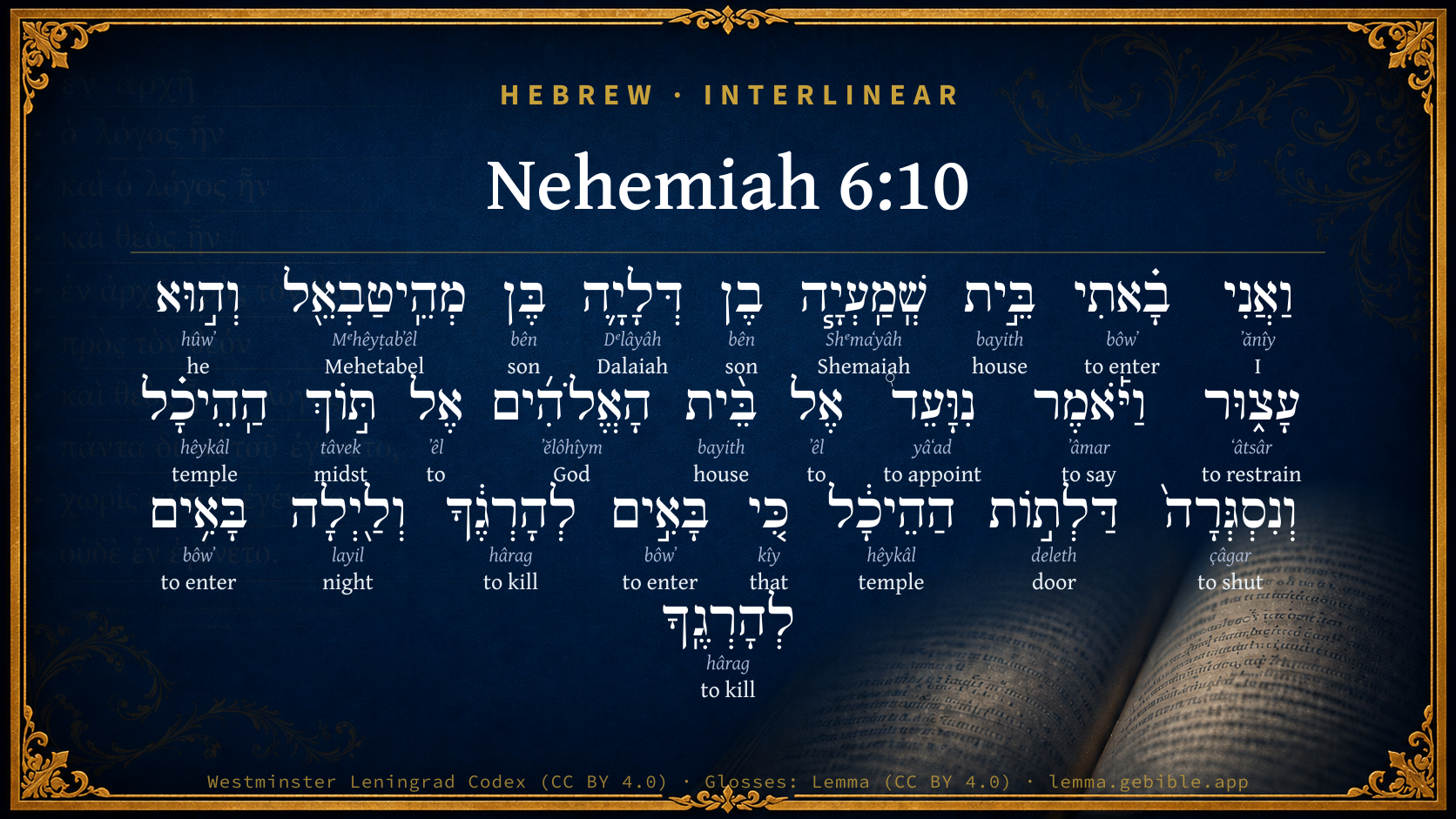
  1. וַאֲנִי ʼănîy H589 “and · I” Conjunction + Pronoun, Personal, 1st Person, Common, Singular
  2. בָ֗אתִי bôwʼ H935 “to enter” Verb, Qal, Perfect, 1st Person, Common, Singular
  3. בֵּ֣ית bayith H1004 “house of” Noun, Common, Masculine, Singular, Construct
  4. שְֽׁמַֽעְיָ֧ה Shᵉmaʻyâh H8098 “Shemaiah” Noun, Proper
  5. בֶן bên H1121 “son of” Noun, Common, Masculine, Singular, Construct
  6. דְּלָיָ֛ה Dᵉlâyâh H1806 “Dalaiah” Noun, Proper
  7. בֶּן bên H1121 “son of” Noun, Common, Masculine, Singular, Construct
  8. וְה֣וּא hûwʼ H1931 “and · he” Conjunction + Pronoun, Personal, 3rd Person, Masculine, Singular
  9. עָצ֑וּר ʻâtsâr H6113 “restrained” Verb, Qal, Participle Passive, Masculine, Singular, Absolute
  10. וַיֹּ֡אמֶר ʼâmar H559 “and · to say” Conjunction + Verb, Qal, Sequential Imperfect, 3rd Person, Masculine, Singular
  11. נִוָּעֵד֩ yâʻad H3259 “to appoint” Verb, Niphal, Imperfect, 1st Person, Common, Plural
  12. אֶל ʼêl H413 “to” Preposition
  13. בֵּ֨ית bayith H1004 “house of” Noun, Common, Masculine, Singular, Construct
  14. הָאֱלֹהִ֜ים ʼĕlôhîym H430 “the · God(s)” Particle, Definite Article + Noun, Common, Masculine, Plural, Absolute
  15. אֶל ʼêl H413 “to” Preposition
  16. תּ֣וֹךְ tâvek H8432 “midst of” Noun, Common, Masculine, Singular, Construct
  17. הַֽהֵיכָ֗ל hêykâl H1964 “the · temple” Particle, Definite Article + Noun, Common, Masculine, Singular, Absolute
  18. וְנִסְגְּרָה֙ çâgar H5462 “and · to shut” Conjunction + Verb, Qal, Cohortative, 1st Person, Common, Plural
  19. דַּלְת֣וֹת deleth H1817 “doors of” Noun, Common, Feminine, Plural, Construct
  20. הַהֵיכָ֔ל hêykâl H1964 “the · temple” Particle, Definite Article + Noun, Common, Masculine, Singular, Absolute
  21. כִּ֚י kîy H3588 “that” Conjunction
  22. בָּאִ֣ים bôwʼ H935 “entering” Verb, Qal, Participle Active, Masculine, Plural, Absolute
  23. לְהָרְגֶ֔ךָ hârag H2026 “to kill · you” Preposition + Verb, Qal, Infinitive Construct + Suffix, Personal, 2nd Person, Masculine, Singular
  24. וְלַ֖יְלָה layil H3915 “and · night” Conjunction + Noun, Common, Masculine, Singular, Absolute
  25. בָּאִ֥ים bôwʼ H935 “entering” Verb, Qal, Participle Active, Masculine, Plural, Absolute
  26. לְהָרְגֶֽךָ hârag H2026 “to kill · you” Preposition + Verb, Qal, Infinitive Construct + Suffix, Personal, 2nd Person, Masculine, Singular

About this verse

These counts appear in no published source. They are computed here, from the morphology-tagged text and Lemma’s own curated glosses. What Lemma adds →

27
words
20
distinct lemmas
Historical
section

Notable vocabulary

The rarest word here is מְהֵֽיטַבְאֵ֖ל Mehetabel H4105 — appearing just 3 times in the whole Hebrew Bible.

Shared distinctive vocabulary

מְהֵֽיטַבְאֵ֖ל Mehetabel H4105 occurs in 3 verses of the Hebrew Bible. Also found in:

Grammatical profile

  • 9 verbs
  • 13 nouns
  • 2 pronouns
  • 2 prepositions
  • 1 conjunction

Verb forms

  • בָ֗אתִי Qal · Perfect
  • עָצ֑וּר Qal · Participle Passive
  • וַיֹּ֡אמֶר Qal · Sequential Imperfect
  • נִוָּעֵד֩ Niphal · Imperfect
  • וְנִסְגְּרָה֙ Qal · Cohortative
  • בָּאִ֣ים Qal · Participle Active
  • לְהָרְגֶ֔ךָ Qal · Infinitive Construct
  • בָּאִ֥ים Qal · Participle Active
  • לְהָרְגֶֽךָ Qal · Infinitive Construct

Repetition

Words recur within this verse — often emphatic in Hebrew:

  • בָ֗אתִי to enter H935 ×3
  • בֵּ֣ית house H1004 ×2
  • בֶן son H1121 ×2
  • הַֽהֵיכָ֗ל temple H1964 ×2
  • לְהָרְגֶ֔ךָ to kill H2026 ×2
  • אֶל to H413 ×2

Cross-references

20

Topical passages linked to Nehemiah 6:10 in the Treasury of Scripture Knowledge — connected by theme and wording, ordered by reader-vote popularity; previews shown in the World English Bible.

  • Jeremiah 36:5 Jeremiah commanded Baruch, saying, I am shut up; I can't go into the house of Yahweh:
  • Psalms 37:12 The wicked plots against the just, And gnashes at him with his teeth.
  • Matthew 7:15 "Beware of false prophets, who come to you in sheep's clothing, but inwardly are ravening wolves.
  • 1 Kings 6:5 Against the wall of the house he built stories round about, against the walls of the house round about, both of the temple and of the oracle; and he made side-chambers round about.
  • 2 Kings 9:8 For the whole house of Ahab shall perish; and I will cut off from Ahab every man-child, and him who is shut up and him who is left at large in Israel.
  • 2 Kings 11:3 He was with her hid in the house of Yahweh six years. Athaliah reigned over the land.
  • 2 Chronicles 28:24 Ahaz gathered together the vessels of the house of God, and cut in pieces the vessels of the house of God, and shut up the doors of the house of Yahweh; and he made him altars in every corner of Jerusalem.
  • 2 Chronicles 29:3 He in the first year of his reign, in the first month, opened the doors of the house of Yahweh, and repaired them.
  • 2 Chronicles 29:7 Also they have shut up the doors of the porch, and put out the lamps, and have not burned incense nor offered burnt offerings in the holy place to the God of Israel.
  • Ezra 8:16 Then sent I for Eliezer, for Ariel, for Shemaiah, and for Elnathan, and for Jarib, and for Elnathan, and for Nathan, and for Zechariah, and for Meshullam, chief men; also for Joiarib, and for Elnathan, who were teachers.
  • Ezra 10:31 [of] the sons of Harim: Eliezer, Isshijah, Malchijah, Shemaiah, Shimeon,
  • Nehemiah 6:12 I discerned, and, behold, God had not sent him; but he pronounced this prophecy against me: and Tobiah and Sanballat had hired him.
  • Job 24:13–17 "These are of those who rebel against the light; They don't know the ways of it, Nor abide in the paths of it.
  • Psalms 12:2 Everyone lies to his neighbor. They speak with flattering lips, and with a double heart.
  • Psalms 120:2–3 Deliver my soul, Yahweh, from lying lips, From a deceitful tongue.
  • Proverbs 11:9 With his mouth the godless man destroys his neighbor, But the righteous will be delivered through knowledge.
  • Ezekiel 3:24 Then the Spirit entered into me, and set me on my feet; and he spoke with me, and said to me, Go, shut yourself within your house.
  • Malachi 1:10 "Oh that there were one among you who would shut the doors, that you might not kindle fire on my altar in vain! I have no pleasure in you," says Yahweh of hosts, "neither will I accept an offering at your hand.
  • John 3:20 For everyone who does evil hates the light, and doesn't come to the light, lest his works would be exposed.
  • Acts 21:30 All the city was moved, and the people ran together. They seized Paul and dragged him out of the temple. Immediately the doors were shut.

Cross-references courtesy of OpenBible.info (CC BY 4.0).

Hebrew and Greek witnesses Masoretic Hebrew ↔ Greek Septuagint

The same verse in the two great witnesses to the Old Testament, shown verse-for-verse.

These are two independent witnesses, not word-aligned to each other, and the Septuagint is shown in lemma (dictionary) form.

Hebrew Nehemiah 6:10 Masoretic · Westminster Leningrad Codex

וַאֲנִי בָ֗אתִי בֵּ֣ית שְֽׁמַֽעְיָ֧ה בֶן דְּלָיָ֛ה בֶּן מְהֵֽיטַבְאֵ֖ל וְה֣וּא עָצ֑וּר וַיֹּ֡אמֶר נִוָּעֵד֩ אֶל בֵּ֨ית הָאֱלֹהִ֜ים אֶל תּ֣וֹךְ הַֽהֵיכָ֗ל וְנִסְגְּרָה֙ דַּלְת֣וֹת הַהֵיכָ֔ל כִּ֚י בָּאִ֣ים לְהָרְגֶ֔ךָ וְלַ֖יְלָה בָּאִ֥ים לְהָרְגֶֽךָ

I went to the house of Shemaiah the son of Delaiah the son of Mehetabel, who was shut up; and he said, Let us meet together in the house of God, within the temple, and let us shut the doors of the temple: for they will come to kill you; yes, in the night will they come to kill you.

World English Bible · Public Domain

Greek LXX Structure differs

The Septuagint has no separate book of Nehemiah. Its Greek text is the second half of Esdras B (2 Esdras), chapters 11–23; Ezra is the first half (1–10).

A verse-for-verse comparison isn’t shown here because the chapters and verses don’t line up. Switch to the LXX edition with the MT / LXX toggle above to read the Greek directly.

On this verse, The Cambridge Bible for Schools and Colleges discusses the Septuagint’s reading. Read the note in Commentary ↓

Hebrew: Westminster Leningrad Codex (CC BY 4.0). Greek: Septuagint (public domain); English from a public-domain English Septuagint. How the Septuagint differs from the Hebrew →

Commentary

Notes on Nehemiah 6:10 from classic Christian and Jewish commentators (each source and its license shown beneath its notes). The classic Christian expositions comment on the surrounding passage and are grouped to its opening verse, so a note may address several verses; the Jewish commentaries on the Tanakh (Rashi and others) are per-verse, so they appear only where the commentator wrote on this verse.

Lemma curates 59 commentaries, every one of them public domain or Creative Commons licensed, each selected and text-cleaned for this edition rather than reprinted as found. About our sources →

Matthew Henry's Commentary

The Jews' enemies leave no stone unturned, no way untried, to take Nehemiah off from building the wall about Jerusalem. In order to this they had tried to fetch him into the country to them, but in vain; now they try to drive him into the temple for his own safety; let him be any where but at his work. Observing him to be a cautious man, they will endeavour to gain their point by making him cowardly. Observe,

I. How basely the enemies managed this temptation.

1. That which they designed was to bring Nehemiah to do a foolish thing, that they might laugh at him, and insult over him for doing it, and so lessen his interest and influence (Neh 6:13): That I should be afraid, and so they might have matter for an evil report, and might reproach me. This was indeed doing the devil's work, who is men's tempter that he may be their accuser, draws men to sin that he may glory in their shame. The greatest mischief our enemies can do us is to frighten us from our duty and bring us to do what is sinful.

2. The tools they made use of were a pretended prophet and prophetess, whom they hired to persuade Nehemiah to quit his work and retire for his own safety. The pretended prophet was Shemaiah, of whom it is said that he was shut up in his own house, either under pretence of retirement for meditation and to consult the mind of God or to give Nehemiah a sign in like manner to make himself a recluse. It should seem, Nehemiah had a value for him, for he went to his house to consult him, Neh 6:10. Other prophets there were, and one prophetess, Noadiah (Neh 6:14), that were in the interest of the Jews' enemies, pensioners to them and traitors to their country. Whether they pretended to inspiration does not appear; they do not say, Thus saith the Lord, as the false prophets of old did; if not so, yet they would be thought to excel in divine knowledge, and human prudence, and to have uncommon measures of insight and foresight, and were therefore consulted in difficult cases, as prophets had been. These the enemies feed to be of counsel for them. Let us hence take occasion to lament, (1.) The wickedness of such bad men as these prophets, that ever any should be so perfidious as to betray the cause of God and their country even under the pretence of communion with God and concern for their country. (2.) The unhappiness of such good men as Nehemiah, who are in danger of being imposed upon by such cheats, and to whom no temptation comes with more force than that which comes under a colour of religion, of revelation and devotion, and is brought by the hand of prophets.

3. The pretence was plausible. These prophets suggested to Nehemiah that the enemies would come and slay him, in the night they would slay him, which he had reason enough to believe was true; they would, if they could, if they durst. They pretended to be much concerned for his safety. The people would be all undone if any harm should come to him; and therefore they very gravely advised him to hide himself in the temple till the danger was over; that was a strong and sacred place, where he would be under the special protection of Heaven, Psa 27:5. If Nehemiah had been prevailed upon to do this, immediately the people would both have left off their work and thrown down their arms, and every one would have shifted for his own safety; and then the enemies might easily, and without opposition, have demolished the works, broken down the wall again, and so gained their point. Though self-preservation is a fundamental principle of the law of nature, yet that is not always the best and wisest counsel which pretends to go upon that principle.

II. See how bravely Nehemiah vanquished this temptation, and came off a conqueror.

1. He immediately resolved not to yield to it, Neh 6:11. See here, (1.) What his reasonings are: "Should such a man as I flee? Shall I desert God's work, or discourage my own workmen whom I have employed and encouraged? Shall I be over-credulous of report, and over-solicitous about my own life? I that am the governor, on whom so many eyes are, both of friends and foes? Another might flee, but not I. Who is there that being as I am, in my post of honour, and power, and trust, would go into the temple, and lurk there, when business is to be done, yea, though it were to save his life?" Note, When we are tempted to sin we should remember who and what we are, that we may not do any thing unbecoming us, and the profession we make. It is not for kings, O Lemuel! Pro 31:4. (2.) What was the result of his reasonings. He is at a point: "I will not go in. I will rather die at my work than live in an inglorious retreat from it." Note, Holy courage and magnanimity will engage us, whatever it cost us, never to decline a good work, nor ever to do a bad one.

2. He was immediately aware of what was the rise of it (Neh 6:12): "I perceived that God had not sent him, that he gave this advice, not by any divine direction, ordinary or extraordinary, but with a design against me." The wickedness of such mercenary wretches will sooner or later be brought to light. Two things Nehemiah says he dreaded in that which he was advised to: - (1.) Offending God: That I should be afraid, and do so, and sin. Note, Sin is that which above any thing we should dread; and a good preservative it is against sin to be afraid of nothing but sin. (2.) Shaming himself: That they might reproach me. Note, Next to the sinfulness of sin we should dread the scandalousness of it.

3. He humbly begs of God to reckon with them for their base designs upon him (Neh 6:14): My God, think thou upon Tobiah, and the rest of them, according to their works. As, when he had mentioned his own good services, he did not covetously or ambitiously prescribe to God what reward he should give him, but modestly prayed, Think upon me, my God (Neh 5:19), so here he does not revengefully imprecate any particular judgment upon his enemies, but refers the matter to God. "Thou knowest their hearts, and art the avenger of falsehood and wrong; take cognizance of this cause; judge between me and them, and take what way and time thou mayest please to call them to an account for it." Note, Whatever injuries are done us we must not avenge ourselves, but commit our cause to him that judgeth righteously.

Matthew Henry's Commentary on the Whole Bible (1708–1710) — public domain (CC PDM 1.0). Text via the HelloAO Bible API.

The Cambridge Bible for Schools and Colleges

gen. ed. J. J. S. Perowne

Dangers from within: False Prophets (Neh_6:10-14)

10. Afterward I came] R.V. And I went. There is no note of time expressed.

Shemaiah the son of Delaiah] Not otherwise known; apparently a priest and a prophet. The name Delaiah occurs in 1Ch_24:18 as that of the three-and-twentieth priestly house.

Mehetabeel] R.V. Mehetabel.

who was shut up] Concerning the meaning of this obscure phrase there is much variety of opinion. (LXX. καὶ αὐτὸς συνεχόμενος. Vulg. secreto.)

(a) According to one view, he was ‘shut up’ in the sense that he was prevented by ceremonial pollution from mixing in the society of his countrymen or from approaching the Temple. Cf. Jer_33:1; Jer_36:5. Accepting this interpretation, we see in his proposal to Nehemiah the extremity of his alarms real or feigned.

(b) According to another view, the expression is metaphorical, and denotes that he was a ‘prisoner,’ in the sense of being ‘possessed by’ the prophetic spirit.

(c) According to a third view, he had shut himself up in his house in order to show by a symbolical action that Nehemiah was prophetically warned to take refuge in some hiding-place. Cf. 1Ki_22:11; Jer_28:10; Act_21:11.

within the temple … doors of the temple] Shemaiah’s proposal is that Nehemiah should hide himself in sacred precincts, where only priests could go. He implies that this advice which he gives as a prophet is sufficient sanction to absolve the act of profanation. The safety of the governor, he seems to say, is of more importance than a detail of ceremonial.

yea, in the night, &c.] The repetition of the clauses has all the ring of poetic parallelism.

‘They will come.’ The indefiniteness of the oracular utterance does not state who the assassins are.

11 And I said] Nehemiah refuses to listen to Shemaiah. (1) He has his duty and position as governor to remember; it is not for him to show the white feather. (2) The proposal to take refuge in the Temple is monstrous; it was forbidden by the Law, which he served, and to trespass upon the domain of the priests was impious in the extreme. (Cf. 2Ch_26:16-20.)

Should such a man as I] The governor and the leader of the national movement.

being as I am] R.V. being such as I, i.e. not a Priest, cf. Neh_1:1, Neh_2:3, but the Governor responsible for the protection of his countrymen.

would go into the temple to save his life] R.V. marg. ‘Or, could go into the temple and live’. According to the A.V. and R.V. text the words ‘and live’ are made to depend upon the verb ‘go,’ and denote the purpose of the action ‘to save his life.’ According to the rendering of the R.V. marg., which is more probable, the words ‘and live’ (cf. Deu_5:24) are coordinate with ‘go,’ and represent the main thought of astonished enquiry. The Law declared that the stranger, i.e. ‘the layman that cometh nigh shall be put to death,’ Num_18:7. Nehemiah’s words point to this prohibition, binding against the governor as much as against the poorest of the Israelites. He does not quote a written statute, but appeals to what was generally known and recognised as law.

The Cambridge Bible for Schools and Colleges (gen. ed. J. J. S. Perowne; Cambridge University Press, 1878–1918) — public domain. Text from a community e-Sword module.

Trapp's Complete Commentary

John Trapp

Neh 6:10 Afterward I came unto the house of Shemaiah the son of Delaiah the son of Mehetabeel, who [was] shut up; and he said, Let us meet together in the house of God, within the temple, and let us shut the doors of the temple: for they will come to slay thee; yea, in the night will they come to slay thee.

Ver. 10. Afterward I came unto the house of Shemaiah] Perhaps the same that is mentioned Ezr 8:16, but now fallen, as a star from heaven. Blazing stars were never but meteors. Demas not only forsook Paul, but became a priest in an idol’s temple at Thessalonica, if Dorotheus may be believed. A priest Shemaiah was, and would seem to be a prophet; but he proved not right, 1Ch 24:6. All is not gold that glitters. It was Tobiah’s gold that made him a prophet, as Philip’s gold made the oracle of Apollo give what answer he pleased. A house he had in the temple; and there he had reclused and shut up himself, that he might seem some singular devotee, expecting a revelation from heaven; or as one who sequestered himself from the company of others, with a stand further off; come not near, for I am holier than thou; or, lastly, to persuade people that there was a necessity of securing themselves from the night inroads of the enemy. Whatever it was that he was thus, anchoret-like, pent-up, or locked-up, or detained (as Junius rendereth it; see the like said of Doeg, that bloody Edomite, 1Sa 21:7), Nehemiah went to his house to know what was the matter; supposing him to be a friend but finding him bribed by the enemy.

Let us meet together in the house of God] Famous for sanctity and safety: being within God’s precincts, we shall surely be under his protection.

And let us shut the doors of the temple] Immure ourselves, and keep out the enemy. But this had been the ready way to invite them, seeing his cowardice; for maximum his periculum qui maxime timent the danger which they fear the most, (saith Sallust), nothing betrays a man sooner than his causeless fear. God helpeth the valiant. Besides, Shemaiah and his false complices, having got Nehemiah to them from his friends and followers, might have done what they pleased with him, as the Romans did by Caesar, in the Senate house.

For they will come to slay thee] And Nehemiah must be made believe that Shemaiah, as a special friend, wished no long life, and was zealous for it; whence he so doubleth his prediction of the danger. O deep dissimulation!

John Trapp, A Commentary or Exposition upon All the Books of the Old and New Testament (1647–1656) — public domain. Text from a community e-Sword module.

The Biblical Illustrator

Joseph S. Exell

Neh_6:10-13

Should such a man as I flee?

Panic

I. PANIC. Unreasoning, helpless fright.

1. National panic.

2. Business panic.

3. Personal panic.

4. Spiritual panic,

II. The effect of panic. All of these forms are commonly groundless; the wave is not so high as it seems to the retreating bather who hears its hiss behind him. It gathers all the selfishness of man to a focus. It substitutes a brief madness for calm thoughtfulness and decision. It makes a man behave unworthily--

1. Of himself.

2. Toward his fellows.

3. Of his God.

III. The correctives of panic. Remembrance of--

1. A mans own dignity.

2. Others

3. God. (Homiletic Commentary.)

Christian firmness

I. The subtlety with which our great adversary will assault us.

1. To neglect our social duties to further our spiritual welfare.

2. To conform to the world with a view to conciliate their regard.

3. To use undue means with a view to obtain some desirable end.

II. The firmness with which we should resist him. We should set the Lord ever before us, bearing in mind--

1. Our relation to Him.

2. Our obligations to Him.

3. Our expectations from Him.

4. The interest which God Himself has in the whole of our conduct. (C. Simeon.)

Courage

1. In the prosecution of this work, whilst building the spiritual wall of Zion, there are many artifices to be resisted. Our enemies will seek to draw us away from our work. We shall be invited to enter into friendly conformity with the world, and we shall be told that conciliation on our side will be met by concessions on theirs; but this is a mistake, for the world will take all and give none.

2. Our spiritual enemies will resort to intimidation. If they cannot draw they will drive. What fair offers were made of seeming friendship to the noble army of martyrs, and when these failed, intimidation followed. The offence of the Cross has not ceased. It is through much tribulation we must enter the kingdom, and the Christian will be threatened with the loss of caste or of business if he determine to maintain his consistency. Evil motives will be ascribed to him, wicked reports will be propagated concerning him. Ridicule and reproach are weapons of great severity. Should such a man as I flee? and who is there, that, being as I am, would go into the temple to save his life? I will not go in.

Let the earnest Christian resist the solicitations of evil in a similar manner.

1. Consider your relation to God. Say to yourself, I am a child of God, a disciple of Christ, a temple of the Holy Ghost, and should such a man as I flee, give way to temptation, dishonour my high calling, disobey my blessed Captain, and grieve the Spirit of grace?

2. Consider your obligations to redeeming mercy. Say to your heart, O Christian, I have been loved with an everlasting love, called by sovereign grace, washed in the blood of Jesus, and comforted by innumerable tokens of goodness and mercy, and should such a man as I flee?

3. Consider your expectations. You are a candidate for eternity. Say to yourself, O Christian, life is short and uncertain; death may be near; my Lord Himself may come in His glory. In that day of His boundless mercy He will call me His brother, His own, and He will bestow upon me an inheritance of surpassing lustre; and should such a man as I flee? shall I be guilty of base cowardice or perfidious ingratitude? (J. M. Randall.)

Faith, courage, and prudence

We may consider this blending of faith, courage, and prudence in Nehemiah as worthy of admiration and imitation.

1. Sometimes we find a brave man who lacks both faith and prudence. In this case his courage is very apt to degenerate into a foolish bravado; and possibly he may do more harm than good by his unwise daring.

2. When prudence is the marked feature of a character it is apt to degenerate into selfish cunning and calculating cowardice.

3. Even when courage and prudence are found united, the character is still sadly defective if there be no spiritual faith--it is apt to fall into an unbecoming and dangerous self-sufficiency.

4. On the other hand, faith without prudence may degenerate into fanaticism, or into a quietism which cultivates the passive to the neglect of the active virtues. (I. Campbell Finlayson.)

Fortitude in duty

Holy courage is not that natural bravery which belongs to some men constitutionally--this is little more than strength of nerve and robustness of animal spirits, and in thousands of instances is found to exist apart from Christian principle; it is rather the bravery of the lion than the bravery of the mind and the man. Some of the most valorous have been the most depraved; and some who dragged their enemies at their chariot-wheels have themselves been dragged through the mire of pollution by their own appetites and passions. As water cannot rise higher than its level, neither can a moral quality rise higher than its principle. Holy courage springs from the fear of God, from seeing Him who is invisible. Hence the soldier of Christ is fearless to do right, fearful to do wrong--afraid to sin, but not afraid to suffer. In considering the scope for this virtue, notice--

I. He that will be a follower of God must take up arms against himself. It was finely said by Richard Cecil that a humble Christian, battling against the world, the flesh, and the devil, is a greater hero than Alexander the Great.

II. It requires a courageous spirit to have respect to all Gods commandments.

III. It requires great courage to overcome the world. (Hugh Stowell, M. A.)

The higher self-appeal

When I lived in the country years ago, I remember one of our friends was a great smoker, and used to smoke morning, noon, and night, and his friends used to say it was a very bad practice, and inconvenient and expensive, and all those arguments with which we are familiar. He always used to smile one of those tranquil smiles which come from parties of that kind. That man could not give up his pipe, and declared that he could not, and that he would smoke till he died. One day there was a mouth trouble. He went to a distinguished physician, and he told him that he was afraid the excessive smoking was inducing cancer. That put his pipe out. It did; he dropped it that very day. It was marvellous; he had done with that. It is one thing when it touches your shillings; one thing when it is a question of convenience and inconvenience; it is another thing when it touches you. And I say to you, when the day of darkness, the day of temptation, when all the sorcery and besetment of evil is around you, dont say, Iniquity will mar my health or cloud my reputation or shorten my days; say with Nehemiah, Should such a man as I do this evil--such a man as I, with reason and conscience, the heir of the ages, the master of the planet, redeemed with the blood of the Son of God, called to a great destiny--should such a man as I do this mean thing, this base thing? Appeal in the sight of God to your own greatness, and He shall strengthen you in the day when the worst comes to the worst. (W. L. Watkinson.)

Valour is sometimes the soul of discretion

We are constantly being reminded that discretion is the better part of valour; but there are occasions, and those not a few, when valour is the very soul of discretion, when at all hazards we must stand our ground and face the foe, that the work be not stopped. (W. P. Lockhart.)

The Biblical Illustrator, edited by Joseph S. Exell (c. 1880s–1900s) — public domain. Text from a community e-Sword module.

Joseph Benson's Commentary

Neh 6:10. I came into the house of Shemaiah — Who was a pretended prophet, as appears from Neh 6:12, and taken by Nehemiah for his friend, who therefore went to advise and consult with him at his house. Who was shut up — In his chamber adjoining to the temple, either upon pretence of singular devotion and communion with God, or rather of having received certain knowledge, by the Spirit of God, of their approaching danger, from which they could be safe nowhere but in the temple. He probably intended also by this action to give Nehemiah to understand what he himself ought to do for his own security; for it was the manner of the prophets to instruct the people by actions and signs, as well as by words. Let us meet together within the temple — For the danger is so near that we cannot safely tarry here so long as to consult what to do in this juncture. For they will come to slay thee; yea, in the night, &c. — Even this very night will they fall upon thee; therefore consult thy safety by fleeing hither. Thus he hoped to intimidate Nehemiah, and thereby to strike a dread into all the people, and put a speedy and full stop to the work; which effect would indeed have been produced if Nehemiah had taken his advice, and through fear shut himself up: for then the people would have left their work, and every one have shifted for his own safety. He probably hoped also by this means to render Nehemiah contemptible among the people, by manifesting such cowardice as to desert his post and take refuge in the temple in time of danger; and by all these things to prepare the way for the enemies to assault and take the city.

Joseph Benson's Commentary on the Old and New Testaments (1811–1818) — public domain. Text from a community e-Sword module.

Keil & Delitzsch

C. F. Keil & F. Delitzsch

A false prophet, hired by Tobiah and Sanballat, also sought, by prophesying that the enemies of Nehemiah would kill him in the night, to cause him to flee with him into the holy place of the temple, and to protect his life from the machinations of his enemies by closing the temple doors. His purpose was, as Nehemiah subsequently learned, to seduce him into taking an illegal step, and so give occasion for speaking evil of him.

Neh 6:10

"And I came into the house of Shemaiah the son of Delaiah, the son of Mehetabeel, who was shut up." Nothing further is known of this prophet Shemaiah. From what is here related we learn, that he was one of the lying prophets employed by Sanballat and Tobiah to ruin Nehemiah. We are not told what induced or caused Nehemiah to go into the house of Shemaiah; he merely recounts what the latter was hired by his enemies to effect. From the accessory clause, "and he was shut up," we may perhaps infer that Shemaiah in some way or other, perhaps by announcing that he had something of importance to communicate, persuaded Nehemiah to visit him at his house. עצוּר והוּא does not, however, involved the meaning which Bertheau gives it, viz., that Nehemiah went to Shemaiah's house, because the latter as עצוּר could not come to him. The phrase says only, that when Nehemiah entered Shemaiah's house, he found him עצוּר, which simply means shut up, shut in his house, not imprisoned, and still less in a state of ceremonial uncleanness (Ewald), or overpowered by the hand of Jahve - laid hold on by a higher power (Bertheau). It is evident from his proposal to Nehemiah, "Let us go together to the house of God," etc., that he was neither imprisoned in his house, nor prevented by any physical cause from leaving home. Hence it follows that he had shut himself in his house, to intimate to Nehemiah that also he felt his life in danger through the machinations of his enemies, and that he was thus dissimulating in order the more easily to induce him to agree to his proposal, that they should together escape the snares laid for them by fleeing to the temple. In this case, it may be uncertain whether Shemaiah had shut himself up, feigning that the enemies of Judah were seeking his life also, as the prophet of Jahve; or whether by this action he was symbolically announcing what God charged him to make known to Nehemiah. Either view is possible; while the circumstance that Nehemiah in Neh 6:12 calls his advice to flee into the temple a נבוּאה against him, and that it was quite in character with the proceedings of such false prophets to enforce their words by symbolical signs (comp. Kg1 22:11), favours the former. The going into the house of God is more closely defined by ההיכל אל־תּוך, within the holy place; for they (the enemies) will come to slay thee, and indeed this night will they come to slay thee." He seeks to corroborate his warning as a special revelation from God, by making it appear that God had not only made known to him the design of the enemies, but also the precise time at which they intended to carry it into execution.

Neh 6:11

Nehemiah, however, was not to be alarmed thereby, but exclaimed: Should such a man as I flee? and what man like me could go into the holy place and live? I will not go in. וחי is the perf. with Vav consecutive: that he may live. This word is ambiguous; it may mean: to save his life, or: and save his life, not, expiate such a transgression of the law with his life. Probably Nehemiah used it in the latter sense, having in mind the command, Num 18:7, that the stranger that cometh nigh shall be put to death.

Neh 6:12

And I perceived, - viz. from the conduct of Shemaiah on my refusal to follow his advice, - and, lo, not God had sent him (i.e., had not commissioned or inspired him to speak these words; לא emphatically precedes אלהים: not God, but himself), but that he pronounced this prophecy against me, because Tobiah and Sanballat had hired him. The verb שׂכרו (sing.) agrees only with the latter word, although in fact it refers to both these individuals.

Neh 6:13-14

"On this account was he hired that I might be afraid, and do so; and if I had sinned (by entering the holy place), it (my sin) would have been to them for an evil report, that they might defame me." The use of למאן before two sentences, the second of which expresses the purpose of the first, is peculiar: for this purpose, that I might fear, etc., was he hired. To enter and to shut himself within the holy place would have been a grave desecration of the house of God, which would have given occasion to his enemies to cast suspicion upon Nehemiah as a despiser of God's commands, and so to undermine his authority with the people. - In Neh 6:14 Nehemiah concludes his account of the stratagems of his enemies, with the wish that God would think upon them according to their works. In expressing it, he names, besides Tobiah and Sanballat, the prophetess Noadiah and the rest of the prophets who, like Shemaiah, would have put him in fear: whence we perceive, 1st, that the case related (Neh 6:10-13) is given as only one of the chief events of the kind (מיראים, like Neh 6:9, Neh 6:19); and 2nd, that false prophets were again busy in the congregation, as in the period preceding the captivity, and seeking to seduce the people from hearkening to the voice of the true prophets of God, who preached repentance and conversation as the conditions of prosperity.

Keil & Delitzsch — Biblical Commentary on the Old Testament (1861–1891) — public domain (CC PDM 1.0). Text via the HelloAO Bible API. (Old Testament only.)

Geneva Bible (1599)

Geneva Bible translators

As though he would be secret, to the intent that he might pray unto God with greater liberty, and receive some revelation, which in him was but hypocrisy.

Geneva Bible (1599) marginal notes — public domain. Text via Bolls.life.

Jamieson, Fausset & Brown

Robert Jamieson, A. R. Fausset & David Brown

Afterward I came unto the house of Shemaiah, &c.--This man was the son of a priest, who was an intimate and confidential friend of Nehemiah. The young man claimed to be endowed with the gift of prophecy. Having been secretly bribed by Sanballat, he, in his pretended capacity of prophet, told Nehemiah that his enemies were that night to make an attempt upon his life. He advised him, at the same time, to consult his safety by concealing himself in the sanctuary, a crypt which, from its sanctity, was strong and secure. But the noble-minded governor determined at all hazards to remain at his post, and not bring discredit on the cause of God and religion by his unworthy cowardice in leaving the temple and city unprotected. This plot, together with a secret collusion between the enemy and the nobles of Judah who were favorably disposed towards the bad Samaritan in consequence of his Jewish connections (Neh 6:18), the undaunted courage and vigilance of Nehemiah were enabled, with the blessing of God, to defeat, and the erection of the walls thus built in troublous times (Dan 9:25) was happily completed (Neh 6:15) in the brief space of fifty-two days. So rapid execution, even supposing some parts of the old wall standing, cannot be sufficiently accounted for, except by the consideration that the builders labored with the ardor of religious zeal, as men employed in the work of God.

Next: Nehemiah Chapter 7

Jamieson, Fausset & Brown — Commentary Critical and Explanatory on the Whole Bible (1871) — public domain (CC PDM 1.0). Text via the HelloAO Bible API.

Adam Clarke's Commentary

Verse 10. Who was shut up] Lived in a sequestered, solitary state; pretending to sanctity, and to close intercourse with God.

Let us meet together in the house of God] The meaning is, "Shut yourself up in the temple; appear to have taken sanctuary there, for in it alone can you find safety." This he said to discourage and disgrace him, and to ruin the people; for, had Nehemiah taken his advice, the people would have been without a leader, their enemies would have come upon them at once, and they would have been an easy prey. Besides, had Nehemiah done this, he would have been shut up in the temple, his government would have been declared at an end, and Sanballat would have assumed the reins.

Adam Clarke's Commentary on the Bible (1810–1826) — public domain. Text from a community e-Sword/MySword module.

Ellicott's Commentary for English Readers

(10) I came unto the house.—As a specimen of another kind of attack, through false prophets, Shemaiah’s plot is mentioned. This man—probably a priest—Nehemiah found shut up in his house; probably he sent for the governor, and represented himself as being in danger from the common enemy. He predicted that on the night ensuing an attempt would be made on Nehemiah’s life, and proposed that they should meet “within the Temple”—that is, in the holy place, between the Holiest and the outer court—for security.

A Bible Commentary for English Readers, edited by Charles John Ellicott (1878–1897) — public domain. Text from a community e-Sword module.

John Gill's Exposition

Afterward I came unto the house of Shemaiah the son of Delaiah, the son of Mehetabeel, who was shut up,.... Either in his own house, or in a chamber in the temple, as if he had given himself up to meditation, fasting, and prayer; or, as he might suggest to Nehemiah, for his safety, and so designed it as an example to him; this man might be a priest of the course of Delaiah, Ch1 24:18 or however he was a person Nehemiah had a good opinion of, and came to him on the letters sent to him by his enemies, to consult with him, and the rest, since they had suggested that he had appointed prophets to speak of him as a king:

and he said let us meet together in the house of God, within the temple, and let us shut the doors of the temple; this looks as if he was in his own house, or if in a chamber of the temple, that he thought that was not secret and safe enough, and therefore proposed going within the temple, into the holy place, where none but priests might go:

for they will come to slay thee; meaning his enemies, Sanballat and his companions:

yea, in the night they will come to slay thee; that very night, and therefore no time should be lost in providing for his safety.

John Gill's Exposition of the Whole Bible (1746–1763) — public domain (CC PDM 1.0). Text via the HelloAO Bible API.

Albert Barnes' Notes on the Bible

Who was shut up - On account, probably, of some legal uncleaness. Compare Jer 36:5.

Albert Barnes' Notes on the Bible (1834–1885) — public domain. Text from a community e-Sword/MySword module.

Haydock's Catholic Bible Commentary

Went, being invited. (Tirinus) --- Semaia, of the twenty-third course of priests, 1 Paralipomenon xxiv. 18. (Menochius) --- Privately. Hebrew, "who was shut up," like a recluse, (Haydock) to deceive the people, by the appearance of superior sanctity, and by an imitation of the true prophets. (Calmet) --- Some translate hatsur, "bound by vow," (1 Kings xxi. 7.) to protect the governor; (Malvenda) but this seems too far-fetched. (Calmet)

George Leo Haydock (1774–1849), Haydock's Catholic Family Bible and Commentary, 1859 edition — public domain. Excludes Psalms (Douay-Rheims chapter numbering differs from Protestant) and Deuterocanonical books (Catholic canon only).

Matthew Poole's English Annotations

Shemaiah the son of Delaiah; probably one of the chief of the priests, 1Ch 24:26.

Who was shut up in his chamber adjoining to the temple, upon pretence of singular devotion, sequestration from the world, and special acquaintance and much communion with God in his retirements, after the manner of the prophets; and withal upon pretence of certain knowledge, which he had by the Spirit of God and of prophecy, concerning their approaching danger, from which they could be safe no where but in the temple, which the very heathens owned for a sanctuary, which they might not violate.

Let us meet together in the house of God, within the temple; for the danger is so near, that we cannot safely tarry here so long as to consult what to do in this juncture. His design herein was, partly, to discourage and disgrace Nehemiah, and thereby to strike a dread into all the people, and give a speedy and full stop to the work; partly, to prepare the way for the enemies to assault and take the city, whilst Nehemiah was shut up, and unable to give them any opposition; partly, to justify their accusation of Nehemiah to the king by his flight upon it; and partly, that there, by the help of other priests, who were conscious of his plot, he might either destroy him, or secure his person, till the city by some of his accomplices were betrayed into the enemy’s hands.

Matthew Poole's English Annotations on the Holy Bible (1683–1685) — public domain. Text from a community e-Sword/MySword module.

Whedon's Commentary on the Bible

Daniel D. Whedon

10. Shemaiah — This man seems to have been professedly a prophet of God. Compare Neh_6:12.

Who was shut up — He feigned to be in fear of Sanballat and the other enemies, and seems to have imprisoned himself in his own house to show how much he was afraid. It afterward came out, however, that Tobiah and Sanballat had bribed him to do all this. Neh_6:12.

Let us meet together in the house of God — Let us at an appointed time enter and shut ourselves up in the temple. His object evidently was to frighten Nehemiah, and lead him into an act which would ruin his influence with the people. Such a flight into the temple would have laid him open to the charge of cowardice, and perhaps, also, of sacrilege, in rushing into the holy places of the house of God. See Neh_6:13.

Daniel D. Whedon (gen. ed.), Commentary on the Old and New Testaments (1874–1909) — public domain. Text from a community e-Sword module.

The Pulpit Commentary

A Shemaiah appears in the list of priests who afterwards signed the covenant; (Neh_10:8) but the names in that list do not appear to be personal. There is a Shemaiah also among the priests who took part in the dedication of the wall; (Neh_12:42) he is not said, however, to be "the son of Delaiah." Shut up. Prevented, i.e. , by some legal impurity from taking part in the temple service, or even entering the temple. In the house of God, within the temple. Rather, "within the sanctuary. " The heykal was the same as the holy place, and meant that part of the temple building which intervened between the porch and the holy of holies. It corresponded, as Gesenius observes, to the body or nave of modern cathedrals. Let us shut the doors. Folding doors of fir wood separated the holy place from the porch in the temple of Solomon; (1Ki_6:34) and these had no doubt their counterpart in the restored temple. Shemaiah suggested the shutting of these doors for greater security

Vers. 10-19. Enemies within.

I FALSE PROPHETS. Who prostituted their office by hiring themselves to the enemies without. For they "loved the wages of unrighteousness.

1. One tempted him to break the law by fleeing into the holy place, and shutting himself up there, where no one but a priest or Levite might enter. This he did on the pretence that Nehemiah"s life was in danger (ver. 10); and he hoped that the governor, consenting to the proposal, would bring himself into disgrace with the people, and so lose his influence with them (ver. 13). Nehemiah was preserved from this peril at once by his magnanimity and his reverence for the law (ver. 11). And if not immediately, he afterwards perceived the true source and motives of the proposal (vers. 12, 13).

2. Others, by other unrecorded means, endeavoured to excite his fears (ver. 14). Perhaps by pretended messages from heaven.

II TREACHEROUS NOBLES (vers. 17-19). These, some of whom were allied to Tobiah by marriages, maintained an active correspondence with him, and sought to influence Nehemiah in his favour. They had many confederates. Probably Nehemiah"s reforming zeal, which had already restrained their avarice, and was likely to proceed to other measures distasteful to them, fostered their disaffection.

III THE RAPID COMPLETION OF THE FORTIFICATIONS, NOTWITHSTANDING ALL OPPOSITION (ver. 15).

IV THE IMPRESSION WHICH THIS MADE ON THE EXTERNAL FOES, AND OTHER PEOPLES AROUND (ver. 16).

1. Great mortification. Disappointment, envy, despair of the success of further opposition.

2. Perception of God"s hand.

From this paragraph we learn

1. The peculiar danger to any community of internal disaffection and division.

2. The baseness of treachery.

3. The heinous wickedness of those who from worldly motives prostitute sacred functions.

4. The duty and wisdom of private judgment. (see 1Jn_4:1) Spiritual teachers, not only through love of money, but from other motives and influences, or from incapacity, may give counsel which our own sense of truth and right may pronounce evil. In such case we must follow our own convictions, although they may possibly be mistaken. (see Jer_5:30, Jer_5:31; Jer_23:31, 32 Mic_3:11)

5. The insight and safety against temptation of a devout, pure, and manly heart.

6. The evil influence of close alliances between God"s people and his enemies.

7. The propriety of due regard for our reputation. Our character is not only precious to ourselves, but an invaluable element of usefulness. Injury to the reputation of a Christian is injury to the Church. Care for our good name is a help against temptation.

8. The active providence and grace of God. Preserving his servants from evil, and giving success to their pious endeavours. Finally, we are reminded by this chapter of the conflicts and victories of a greater than Nehemiah, in whose conquests as our Leader we are more nearly interested.

HOMILIES BY W. CLARKSON Vers. 10-19. Trial and victory.

Defeated again, the enemy has recourse to other schemes. It would be interesting to know what were the expectations with which Nehemiah set out from Susa to enter upon the work before him. If we could tell what was then in his mind, we should probably find there anticipations very unlike indeed to his actual experiences. Probably, if he could have foreseen his difficulties, he might have shrunk from the task. Happily we do not foresee the perplexities of Christian toil; seen as by a prophetic glance, they would overwhelm us; but coining upon us one by one, they can be met bravely, and conquered successfully. We look now at

I THE TRIAL OF FAITH IN THE WORK OF GOD.

1. Their former plots failing, another yet more subtle is tried. Sanballat and Tobiah induce a prophet, Shemaiah (ver. 10), and a prophetess, Noadiah (ver. 14), to urge Nehemiah to take refuge from assassination in the temple; to hide himself unlawfully, lest he should be smitten at his post of duty; in fact, "to be afraid, and sin," and thus give occasion for "an evil report, that they might reproach" him (ver. 13). The insidiousness of the temptation may be gathered from the words of indignation in which Nehemiah invokes the Divine reprobation on the guilty tempters (ver. 14). But,

2. Nehemiah is yet further tried. His own people are keeping up a correspondence with the enemy. Nobles of Judah are writing to and hearing from Tobiah (ver. 17). A dangerous alliance led to intimacy, to perversion, to conspiracy (ver. 18). These men who should have been the first and the strongest to help are those who come to hinder; praising the man who was doing his utmost to overturn and ruin everything (ver. 19), and carrying back to the enemy the words of the governor (ver. 19). When we are doing our best to serve our Master and our fellows, and are naturally looking to those who are bound in the same holy bonds with ourselves, more especially to those who are as "prophets" or "prophetesses" in our ranks, or to those who are as "nobles" amongst us, to stand by our side and aid us in our toil, and when, instead of succour, we find them undermining our influence, we are tempted to despair, so keen is the trial of our faith. Yet we may win

II THE VICTORY OF THE BRAVE AND TRUE (vers. 11, 15, 16). Here we have

1. The fact of success. The wall was built: it was "finished in fifty and two days" (ver. 15). Neither open threats nor secret plots weakened the strength or lessened the labour of the busy workmen, and the good work was accomplished.

2. A powerful incentive leading to victory. Nehemiah made an excellent appeal to himself. He considered who he was, and what was worthy and unworthy of the post he held. Should such a man as I flee?" (ver. 11).

3. The fruits of victory (ver. 16). The enemy and all the heathen "were much cast down in their own eyes," and they "perceived that this work was wrought of our God." Their humiliation was an excellent thing for them, and the name of God being glorified was a source of joy and gratulation to the good. There is victory to be won under the fiercest temptation if we only be true to all we know. Let us, in the dark hour of the trial of faith

4. Consider what is worthy of the position we hold. Should such as we are missionaries, ministers, evangelists, teachers, leaders, members of the Church of Christ flee from the post of duty or danger? "Put on the gospel armour, and, watching unto prayer, Where duty calls, or danger, be never wanting there. The "guard" in his army "dies, but does not surrender.

5. Consider what will redound to the glory of Christ. If only we hold on, "faint yet pursuing," fighting till the day is won, the enemy will be humiliated, and his holy name be honoured. Our once crucified Saviour shall be "exalted and extolled, and be very high". C. (Isa_52:13)

The Pulpit Commentary (1880–1919), ed. H.D.M. Spence-Jones & Joseph S. Exell — public domain. Text from a community e-Sword module.

John Wesley's Explanatory Notes

Shut up - In his chamber adjoining to the temple, upon pretense of singular devotion, and communion with God, and withal upon pretense of certain knowledge, by the Spirit of God concerning their approaching danger, from which thy could be safe nowhere but in the temple. For if Nehemiah had done this, the people would have left their work, and every one have shifted for his own safety.

John Wesley, Explanatory Notes Upon the Whole Bible (1754–1765) — public domain. Text via the GEBible commentary corpus.

Kretzmann's Popular Commentary

Paul E. Kretzmann

Shemaiah, The False Prophet

v. 10. Afterward I came unto the house of Shemaiah, the son of Delaiah, the son of Mehetabeel, a man who claimed the gift of prophecy for himself, who was shut up, probably in performance of a vow; and he said, Let us meet together in the house of God, within the Temple, in the Sanctuary proper, and let us shut the doors of the Temple, the inference being that Shemaiah had been granted a Revelation according to which men had planned an attempt on the life of Nehemiah in the near future; for they will come to slay thee; yea, in the night will they come to slay thee. The purpose of this scheme was either to bring discredit upon Nehemiah in making him appear guilty, or to make him seem a coward, who preferred his personal safety to that of the city which it was his duty to protect.

v. 11. And I said, Should such a man as I flee? the governor entrusted with the defense of the city? And who is there that, being as I am, would go into the Temple to save his life? This may mean either that he refused to hide in a cowardly fashion, or that he did not want to risk death by violating the sanctity of the Temple, Num 18:7. I will not go in.

v. 12. And, lo, I perceived that God had not sent him, but that he pronounced this prophecy against me, without any divine authority; for Toblah and Sanballat had hired him, he was acting under the influence of a secret bribe.

v. 13. Therefore was he hired that I should be afraid, and do so, and sin, both by neglecting his duty as governor and by entering into the Sanctuary of the Temple, which was open only to the priests, and that they might have matter for an evil report, to discredit him in the one or the other way, as shown above, that they might reproach me. Nehemiah therefore adds a prayer concerning this spiteful attempt at intimidating and discrediting him.

v. 14. My God, think Thou upon Tobiah and Sanballat according to these their works, to execute His vengeance upon them, and on the prophetess Noadiah, another of the false prophets who had been bribed to hinder the work of building the walls, and the rest of the prophets that would have put me in fear, all of them hired with Sanballat’s money. Thus there are teachers in the very midst of Christianity who with open lies and deceitful words try to hinder the work of the Lord, endeavoring to lead the true servants of God into disobedience.

Paul E. Kretzmann, Popular Commentary of the Bible (1921–1924) — public domain. Text from a community e-Sword module.

unfoldingWord translationNotes

Door43 World Missions Community

Shemaiah ... Delaiah ... Mehetabel

These are men's names. (See: How to Translate Names)

who was confined in his home

The writer does not give the reason for him being confined, so it is best to say that he was staying at home using the most general words possible. AT: "who could not leave his house" or "whom the authorities had ordered to stay in his house" (See: Active or Passive)

Would a man like me run away? Would a man like me go into the temple just so he could save his own life?

Nehemiah uses these rhetorical questions to emphasize that he will not do what Shemaiah has suggested. These questions may be written as statements. AT: "A man like me would not run away. A man like me would not go into the temple just to hide to stay alive." (See: Rhetorical Question)

translationWords

house

house of God

temple

life

unfoldingWord translationNotes — © Distant Shores Media and the Door43 World Missions Community, licensed CC BY-SA 4.0. Source: git.door43.org/Door43/en_tn.

Rashi

Rabbi Shlomo Yitzchaki (Rashi)

and he was confined for he found him at home.

and he said, “Let us meet Shemaiah was a false prophet who had received a bribe from Sanballat and his colleagues to frighten Nehemiah in order to stop the work.

for they are coming to assassinate you for Sanballat and his colleagues will come to assassinate you.

and tonight they are coming Therefore, he warned him to enter the Temple and to close the doors about himself, because the doors of the gates of the city had not been made, as it says at the beginning of the chapter (verse 1): “Also that until that time, I had not erected doors in the gates.”

Rashi on the Tanakh — English translations: “The Judaica Press complete Tanach with Rashi, translated by A. J. Rosenberg” (CC BY 4.0); “Pentateuch with Rashi's commentary by M. Rosenbaum and A.M. Silbermann, 1929-1934” (public domain); “The Metsudah Tanach series, Lakewood, N.J” (CC BY 4.0); and “The Book of Joshua, Metsudah Publications, 1997” (CC BY 4.0). Text via Sefaria.

Lesson kit

Teaching starters — assembled from the data on this page, not authored interpretation. Every prompt links to the verse data it draws on. Edit before teaching.

Nehemiah, in the Historical, opens this verse with 27 words (20 distinct Hebrew lemmas). Its most distinctive word is Mᵉhêyṭabʼêl (“Mehetabel”). A historical commentator’s framing appears above. Read the whole chapter for the surrounding context.

Discussion questions

  1. What does “Mehetabel” (Mᵉhêyṭabʼêl) contribute to the verse as a whole?
  2. Genesis 36:39 shares the word «Mehetabel» with this verse. How do the two illuminate each other?
  3. “to enter” occurs 3× in this one verse. What is the effect of the repetition?
  4. The translations on this page render this verse differently — a whole-verse word diff, not a word-by-word alignment. What might account for the different wordings?
  5. The verb «בָ֗אתִי» is Qal Perfect. How does its form color the action?
  6. Reading how Matthew Henry's Commentary and The Cambridge Bible for Schools and Colleges read this verse, where do the two commentators agree and where do they part?

Things to notice

Reading settings

Reading text

Shown beneath each verse's original-language words.

Old Testament
Old Testament edition

Read the OT as the Masoretic Hebrew (MT) or the Greek Septuagint (LXX).

English shown for the Greek Septuagint (in the Hebrew ↔ Greek comparison).

Comparing translations? Open the Compare panel on any verse page to stack up to four side by side.