

Psalms 78:34

Hebrew (Westminster Leningrad Codex) Psalms 78:34 appears in the Hebrew Old Testament. The text above is from the Westminster Leningrad Codex. Each word links to its Strong’s number, a concise gloss, and parsing drawn from the Open Scriptures Hebrew Bible morphology. Click any word for its full Brown-Driver-Briggs (BDB) entry.
Download image
Cite this verse

Psalms 78:34 (World English Bible). Public Domain. Lemma interlinear Bible study tool, https://lemma.gebible.app/v/psalms/78/34.

Show BibTeX & RIS
BibTeX
RIS
English Translation
When he killed them, then they inquired after him. They returned and sought God earnestly.
World English Bible · Public Domain
Download a study sheet

One document with this verse’s original text, its word-by-word gloss line, the meaning frame, cross-references with their text, attributed commentary, and full source and license credits — printable, and it pastes into notes with its structure intact.

This verse Autodidact and up

Study sheet (.html) Plain text (.txt)

A passage Seminary Student

Up to 50 verses in one chapter. A passage sheet keeps up to 6 commentary sources and 12 cross-references per verse, in the order this page ranks them, and says so on the sheet whenever that leaves anything out. Ask for a single verse and you get the Autodidact verse sheet above.

Everything on this page stays free to read, with no account — the sheet is a download of what is already on screen, not access to it.

Want to remove ads? Support Godless Engineer
Compare translations 3

The same verse in 3 English versions, stacked beneath the original-language interlinear above. Click any original word for its lexicon entry.

Each is an independent rendering of the whole verse — the interlinear is not word-aligned to these translations.

Highlighted words mark where these versions differ — a whole-verse word diff, not a word-by-word alignment.

  • World English Bible Public Domain
    When he killed them, then they inquired after him. They returned and sought God earnestly.
  • King James Version Public Domain
    When he slew them, then they sought him: and they returned and enquired early after God.
  • unfoldingWord Literal Text CC BY-SA 4.0
    When he killed them, then they would seek him, and they would return and look earnestly for God.

unfoldingWord Literal Text — © unfoldingWord, licensed CC BY-SA 4.0. Word-aligned USFM3 via Door43 (git.door43.org/unfoldingWord/en_ult).

Versions to compare (up to 4)

3 of 4 selected

Show all 18 translations

Every available English version of this verse, each an independent rendering of the whole verse.

  • World English Bible Public Domain
    When he killed them, then they inquired after him. They returned and sought God earnestly.
  • Berean Standard Bible Public Domain
    When He slew them, they would seek Him; they repented and searched for God.
  • Majority Standard Bible Public Domain
    When He slew them, they would seek Him; they repented and searched for God.
  • King James Version Public Domain
    When he slew them, then they sought him: and they returned and enquired early after God.
  • American Standard Version (1901) Public Domain
    When he slew them, then they inquired after him; And they returned and sought God earnestly.
  • Revised Version (1885) Public Domain
    When he slew them, then they inquired after him: and they returned and sought God early.
  • Geneva Bible (1599) Public Domain
    And when hee slewe them, they sought him and they returned, and sought God earely.
  • Douay-Rheims (1899) Public Domain
    When he slew them, then they sought him: and they returned, and came to him early in the morning.
  • Young's Literal Translation Public Domain
    If He slew them, then they sought Him, And turned back, and sought God earnestly,
  • Literal Standard Version CC BY-SA 4.0
    If He slew them, then they sought Him, || And turned back, and earnestly sought God,
  • Unlocked Literal Bible CC BY-SA 4.0
    Whenever God afflicted them, they would start to seek him, and they would return and look earnestly for him.
  • unfoldingWord Literal Text CC BY-SA 4.0
    When he killed them, then they would seek him, and they would return and look earnestly for God.
  • Darby Bible Public Domain
    When he slew them, then they sought him, and returned and sought early after ùGod;
  • World Messianic Bible Public Domain
    When he killed them, then they inquired after him. They returned and sought God earnestly.
  • Webster's Bible Public Domain
    When he slew them, then they sought him: and they returned and inquired early after God.
  • Free Bible Version CC BY-SA 4.0
    When he began killing them, the rest came back to God in repentance, praying to him.
  • Bible in Basic English Public Domain
    When he sent death on them, then they made search for him; turning to him and looking for him with care;
  • JPS Tanakh (1917) Public Domain
    When He slew them, then they would inquire after Him, and turn back and seek God earnestly.

Literal Standard Version (2020), Covenant Press — licensed CC BY-SA 4.0. Text via the HelloAO Bible API (eBible.org). Unlocked Literal Bible (unfoldingWord) — licensed CC BY-SA 4.0. Text via the HelloAO Bible API (eBible.org). unfoldingWord Literal Text — © unfoldingWord, licensed CC BY-SA 4.0. Word-aligned USFM3 via Door43 (git.door43.org/unfoldingWord/en_ult). Free Bible Version, Dr. Jonathan Gallagher — licensed CC BY-SA 4.0. Text via the HelloAO Bible API (eBible.org).

Word by word

More ways to search: Search by grammar → Find every occurrence → Compare this word →

Practice this passage: Drill this verse → Learn its vocabulary →

About this verse

These counts appear in no published source. They are computed here, from the morphology-tagged text and Lemma’s own curated glosses. What Lemma adds →

6
words
6
distinct lemmas
Wisdom
section

Notable vocabulary

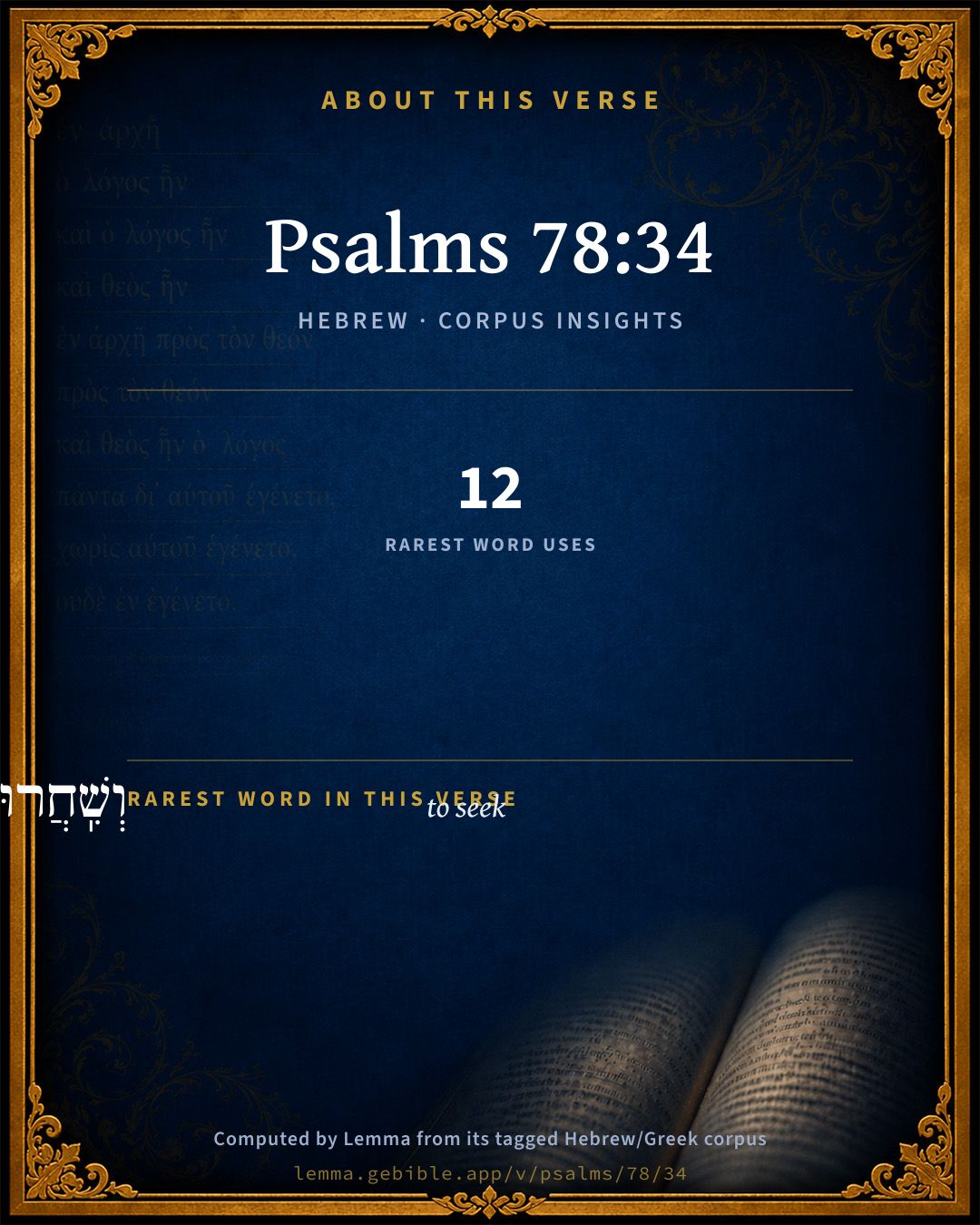
The rarest word here is וְשִֽׁחֲרוּ to seek H7836 — appearing just 12 times in the whole Hebrew Bible.

Shared distinctive vocabulary

וְשִֽׁחֲרוּ to seek H7836 occurs in 12 verses of the Hebrew Bible. Also found in:

Grammatical profile

  • 4 verbs
  • 1 noun
  • 1 conjunction

Verb forms

  • הֲרָגָ֥ם Qal · Perfect
  • וּדְרָשׁ֑וּהוּ Qal · Sequential Perfect
  • וְ֝שָׁ֗בוּ Qal · Sequential Perfect
  • וְשִֽׁחֲרוּ Piel · Sequential Perfect

Hebrew & Septuagint length

In English translation the verse runs 15 words from the Hebrew and 15 from the Septuagint (LXX English) — the same length.

A rough comparison of the two English renderings, which tokenize alike — not a word-level alignment.

Word counts can differ between the Hebrew and the Greek without any difference in meaning — e.g. the Hebrew direct-object marker אֵת has no separate Greek word, and Greek often adds the article ὁ.

Cross-references

9

Topical passages linked to Psalms 78:34 in the Treasury of Scripture Knowledge — connected by theme and wording, ordered by reader-vote popularity; previews shown in the World English Bible.

  • Hosea 5:15 I will go and return to my place, until they acknowledge their offense, And seek my face. In their affliction they will seek me earnestly."
  • Numbers 21:7 The people came to Moses, and said, We have sinned, because we have spoken against Yahweh, and against you; pray to Yahweh, that he take away the serpents from us. Moses prayed for the people.
  • Judges 3:12–15 The children of Israel again did that which was evil in the sight of Yahweh: and Yahweh strengthened Eglon the king of Moab against Israel, because they had done that which was evil in the sight of Yahweh.
  • Judges 3:8–9 Therefore the anger of Yahweh was kindled against Israel, and he sold them into the hand of Cushan Rishathaim king of Mesopotamia: and the children of Israel served Cushan Rishathaim eight years.
  • Judges 4:3 The children of Israel cried to Yahweh: for he had nine hundred chariots of iron; and twenty years he mightily oppressed the children of Israel.
  • Judges 10:7–10 The anger of Yahweh was kindled against Israel, and he sold them into the hand of the Philistines, and into the hand of the children of Ammon.
  • Isaiah 26:6 The foot shall tread it down; even the feet of the poor, and the steps of the needy.
  • Jeremiah 22:23 Inhabitant of Lebanon, who makes your nest in the cedars, how greatly to be pitied shall you be when pangs come on you, the pain as of a woman in travail!
  • Hosea 7:14 They haven't cried to me with their heart, But they howl on their beds. They assemble themselves for grain and new wine. They turn away from me.

Cross-references courtesy of OpenBible.info (CC BY 4.0).

Hebrew and Greek witnesses Masoretic Hebrew ↔ Greek Septuagint

The same verse in the two great witnesses to the Old Testament, shown verse-for-verse.

You’re reading Greek Psalm 77 (Hebrew Psalm 78). The Septuagint counts the superscription, so verse numbers can differ from the Hebrew — chapter-level alignment, not verse-by-verse. Numbering follows Rahlfs.

These are two independent witnesses, not word-aligned to each other, and the Septuagint is shown in lemma (dictionary) form.

Hebrew Psalms 78:34 Masoretic · Westminster Leningrad Codex

אִם הֲרָגָ֥ם וּדְרָשׁ֑וּהוּ וְ֝שָׁ֗בוּ וְשִֽׁחֲרוּ אֵֽל

When he killed them, then they inquired after him. They returned and sought God earnestly.

World English Bible · Public Domain

Greek LXX Greek Psalm 77:34 Septuagint · lemma form

ὅταν ἀποκτείνω αὐτός ἐκζητέω αὐτός καί ἐπιστρέφω καί ὀρθρίζω πρός ὁ θεός

When he killed them, they sought him: and they returned and called betimes upon God.

LXX2012 (modern English Septuagint) · Public Domain

Hebrew: Westminster Leningrad Codex (CC BY 4.0). Greek: Septuagint (public domain); English from LXX2012 (modern English Septuagint) (Public Domain). How the Septuagint differs from the Hebrew →

Commentary

Notes on Psalms 78:34 from classic Christian and Jewish commentators (each source and its license shown beneath its notes). The classic Christian expositions comment on the surrounding passage and are grouped to its opening verse, so a note may address several verses; the Jewish commentaries on the Tanakh (Rashi and others) are per-verse, so they appear only where the commentator wrote on this verse.

Lemma curates 59 commentaries, every one of them public domain or Creative Commons licensed, each selected and text-cleaned for this edition rather than reprinted as found. About our sources →

Trapp's Complete Commentary

John Trapp

Psa 78:34 When he slew them, then they sought him: and they returned and enquired early after God.

Ver. 34. When he slew them, then they sought him] Fictis scilicet, quibusdam et fucatis pollicitationabus, with a few dissembled devotions. So many now, when deadly, sick, will be wondrous good. Nuper me amici cuiusdam languor admonuit, optimos esse nos dum infirmi sumus (Plin. eph 26, 1. 7). As iron is very soft and malleable while in the fire, but soon after returneth to its former hardness; so many, while afflicted, seem very well affected, but afterwards soon show what they are. William Rufus, in a fit of sickness at Gloucester, vowed upon his recovery to see all vacancies in the Church furnished; which he did, but with so great ado as showed that, having escaped the danger, he would willingly have deceived the saint, saith the chronicler. In the sweating sickness here in England, so long as the ferventness of the plague lasted there was crying, Peccavi, peccavi, I have sinned, I have sinned, the ministers were sought for in every corner, You must come to my lord, you must come to my lady, &c.; but this lasted with many little longer than the disease; so deceitful is man’s heart, and desperately wicked. Most men are nailed to the earth (saith one well), as Sisera was by Jael; and will not so much as lift up their eyes to heaven, unless it be as hogs do, who go noddling down and rooting in the earth all their life, and never look upward till, being ready to be killed, they are laid flat upon their backs and forced; so these, till wrestling with the pangs of death, they are fastened to their sick-beds, &c.

And they returned] But they gave but the half turn, they turned not even unto God with all their heart, as Joe 2:12.

And inquired early after God] Heb. Manicabant sive aurorizabant Deum, aurora velut anticipata; they were up and at it by peep of day.

John Trapp, A Commentary or Exposition upon All the Books of the Old and New Testament (1647–1656) — public domain. Text from a community e-Sword module.

The Biblical Illustrator

Joseph S. Exell

Psa_78:34-37

When He slew them, then they sought Him: and they returned and inquired early after God.

Israels hypocritical repentance

I. The acts of repentance which they performed.

1. Seeking God.

2. Returning.

3. Inquiring.

4. Remembering (Psa_78:35).

5. Renewing their covenant with God (Psa_78:37).

II. The defects of their repentance.

1. It was untimely; a fore-slowed, and delayed repentance: that is implied in this word, when; not till such a time; then, not till then.

2. It was enforced repentance, not ingenuous and voluntarily undertaken; it was extorted by plagues. They repented when they were under the rod; nay, under the sword.

3. It was an unsound repentance; not true and sincere, but feigned and acted only: it was a flattering and lying repentance.

4. It was a momentary, transitory, unsettled, unconstant repentance, not firm and lasting. And these four are usually linked together, one draws on the other. These four twists make up Esays cart-rope of sin. What, then, is wanting? The main of all is, that the heart must be changed. A true convert, hath an inward principle of repentance planted into him; grace is a second nature, and works constantly, as Nature doth; but an hypocrite in his actions of reformation and repentance is moved not by an inward principle of God, but by some outward motive. When that ceases his conversion fails. The motions of piety in a good Christian are like natural motions; the motions of an hypocrite are as artificial motions. The motions of the sun and the motions of a clock keep time alike; and for a time, we will say, the clock goes as true as the sun. Aye, but heres the difference, the one moves out of an inward principle naturally; the other, the clock, is moved by an outward principle; the weight and plummet makes it go; and when that is down the clock stands still. Or, as in waters, a natural stream flows always, it is fed with a spring; but a sudden land-flood, though it runs strongly for a while, yet it will dry up; it hath no spring or fountain to feed it. (Bishop Browning:)

The Biblical Illustrator, edited by Joseph S. Exell (c. 1880s–1900s) — public domain. Text from a community e-Sword module.

The Treasury of David

Charles H. Spurgeon

Ver. 34. When he slew them, then they sought him. Like whipped curs, they licked their Master's feet. They obeyed only so long as they felt the whip about their loins. Hard are the hearts which only death can move. While thousands died around them, the people of Israel became suddenly religious, and repaired to the tabernacle door, like sheep who run in a mass while the black dog drives them, but scatter and wander when the shepherd whistles him off.

And they returned and enquired early after God. They could not be too zealous, they were in hot haste to prove their loyalty to their divine King. "The devil was sick and the devil a monk would be." Who would not be pious while the plague is abroad? Doors, which were never so sanctified before, put on the white cross then. Even reprobates send for the minister when they lie a dying. Thus sinners pay involuntary homage to the power of right and the supremacy of God, but their hypocritical homage is of small value in the sight of the Great Judge.

Ver. 34-36. There are some if they come under afflictions, or if they fall in sickness, or a fever, and God shake death over their head; or if they be at some solemn ordinances, they will be at resolving and purposing, and readily bringing vows upon themselves, of personal covenanting with God; but as they are easily gotten, so they easily vanish: When he slew them, they sought him: and they returned and inquired early after God. Several times our afflictions are like a gutter; when there is a great shower we will be running over with purposes after God. Nevertheless they did flatter him with their mouth, and they lied unto him with their tongues. For their heart was not right with him, neither were they steadfast in his covenant: and yet when he slew them, they sought after him, and they early enquired after him: so that in deliberate actions and covenanting with God, as they are hastily begotten, they no less suddenly vanish; the action ought then to be deliberate when we indenture with the Cautioner, and oblige ourselves to more watchfulness, and more tenderness, or else it will soon vanish. Alexander Wedderburn, in "David's Testament, opened up in Forty Sermons." 1701.

Ver. 34-37. In these words you see plainly that these people are very early and earnest in seeking God to take off his hand, to remove judgments that were upon them, but not that God would cure them of those sins that provoked him to draw his sword, and to make it drunk with their blood; for, notwithstanding the sad slaughters that divine justice had made among them, they did but flatter and lie, and play the hypocrites with God; they would fain be rid of their sufferings, but did not care to be rid of their sins. Ah! but a gracious soul cries out, Lord, do but take away my sins, and it will satisfy me and cheer me, though thou shouldest never take off thy heavy hand. A true Nathanael sighs it out under his greatest affliction, as that good man did, A me, me salva, Domine, (Augustine) deliver me, O Lord, from that evil man myself. No burden to the burden of sin. Lord! says the believing soul; deliver me from my inward burden, and lay upon me what outward burden you please. Thomas Brooks.

Ver. 34-37. There are a sort of men that lie in the enmity of their natures, and in an unreconciled state, living in the visible church, who are not only much restrained, and bite their enmity in, but who, by means of an inferior work of the word and Spirit of God upon their hearts, are brought to seek unto God for friendship, yea, and do much for him in outward actions, and side and take part with his friends; and yet their hearts being unchanged, the cursed enmity of their nature remaining alive and not taken away, they lie still in the gall of bitterness. For instance, look to these in Ps 78:34-37. It is said that they `sought the Lord early as their Redeemer, 'whilst he was slaying of them; yet they did but flatter him with their mouths, etc. A flatterer, you know, differs from a friend, in that he pretends much kindness, yet wants inward good will, doing it for his own ends. And so do many seek God, that yet he accounts as enemies; for they seek him whilst they are themselves in his lurch. Now, it is hard to discover these, because they pretend much friendship, and externally (it may be) do as many outward kindnesses as the true friends; as flatterers will abound in outward kindnesses as much as true friends, nay, often exceed them, because they may not be discovered. Now, if none of the former signs reach to them, nor touch them, then there is no better way left than to search unto the grounds of all they do, and to examine whether it proceeds from true, inward, pure, and constant good will, yea or no, or self respects? As now, when we see an ape do many things that a man doth, how do we therefore distinguish those actions in the one and in the other? Why, by the inward principles from whence they spring, by saying that they proceed from reason in the one, but not so in the other. If, therefore, it can be evinced, that all that any man seems to do for God, comes not from good will to him, it is enough to convince them to be persons unreconciled; for whereas all outward kindnesses and expressions of friendship proceed not from friend like dispositions and pure good will, but altogether from self respects, it is but feigned flattery, even among men; and when discovered once, it breeds double hatred. And there is much more reason it should do so with God, because he being a God that knows the heart, to flatter him is the greatest mockery; for that is it which chiefly provoketh men to hate such as dissemble friendship, because there is mockery joined with it. Now, that God accounts every one that doth not turn to him out of pure goodwill a flatterer is plain by these words in Ps 78:36-37: Notwithstanding, they did but flatter him, and dealt falsely in his covenant. If men's hearts be not inwardly for God, and with him, as a friend would be to a friend, in their actions he esteems them against him. "Thy heart, "says Peter to Simon Magus, "is not right before the Lord, "Ac 8:22, and therefore he tells him he was "still in the gall of bitterness." Thomas Goodwin.

Ver. 34-37. The hypocrite's feet, Ps 78:34. The hypocrite's memory, Ps 78:35. The hypocrite's tongue, Ps 78:36. The hypocrite's heart, Ps 78:37. Or, the hypocrite's cloak and the hypocrite's heart. C. D.

Psalms 78:35*

Ver. 34-36. See Psalms on "Ps 78:34" for further information.

Ver. 34-37. See Psalms on "Ps 78:34" for further information.

Ver. 34-37. See Psalms on "Ps 78:34" for further information.

Ver. 34-37. The hypocrite's feet, Ps 78:34. The hypocrite's memory, Ps 78:35. The hypocrite's tongue, Ps 78:36. The hypocrite's heart, Ps 78:37. Or, the hypocrite's cloak and the hypocrite's heart. C. D.

Psalms 78:37*

Ver. 34-37. See Psalms on "Ps 78:34" for further information.

Ver. 34-37. See Psalms on "Ps 78:34" for further information.

Ver. 34-37. The hypocrite's feet, Ps 78:34. The hypocrite's memory, Ps 78:35. The hypocrite's tongue, Ps 78:36. The hypocrite's heart, Ps 78:37. Or, the hypocrite's cloak and the hypocrite's heart. C. D.

Psalms 78:38*

Charles H. Spurgeon's The Treasury of David (1869–1885) — public domain. Psalms only. Text from a community e-Sword/MySword module.

Joseph Benson's Commentary

Psa 78:34-35. When he slew them — Or condemned them to be slain; then they sought him — Confessed their sin, begged pardon, and prayed to him to deliver them from the threatened destruction. When some were slain, others, in a fright, cried for mercy, and promised to be obedient in future: And they returned — Namely, from their idols, unto the outward worship of God: or, being moved with fear, they ceased, for the present, from their grossly wicked courses, but stopped short of true repentance, and a thorough conversion to God. And inquired early after God — Speedily and earnestly sought to him for deliverance from their temporal calamities and troubles, and for safety and comfort, as even wicked men, in such cases, frequently do. And they remembered that God was their rock — Their support and defence, and therefore, as they now found they needed him, they would flee for help to him; and the high God their Redeemer — Who had brought them out of Egypt, and wrought out many deliverances for them, and to whom therefore they might still apply for aid in their distresses. They considered that he, and he alone, had preserved them in all their former exigences, and that he only could now help them, and not those idols, nor the creatures which they had preferred before him: and therefore, being driven by absolute necessity, they fled to him for relief.

Joseph Benson's Commentary on the Old and New Testaments (1811–1818) — public domain. Text from a community e-Sword module.

Whedon's Commentary on the Bible

Daniel D. Whedon

34. When he slew them, then—The “when” and “then” are emphatic words. If we give a more uniform rendering to ו, (ve,) “then,” “and” “but,” in the English version, so as to preserve its relation to the contingent particle, אמ, (eem,) when, if, we get a clearer contrast between the character of God and that of his people as given Psa_78:34-39. Thus:— When he slew them, then they sought him, Then they turned and early sought God, Then they remembered that God is their rock, Then [they remembered] God Most High, their redeemer, Then they enticed him with their mouth; Then with their tongue they did lie unto him; Then their heart was not established with him; Then they were not steadfast in his covenant: But he, being merciful, purged their iniquity, And destroyed them not, And many a time he turned his anger away, And did not stir up all his wrath, And he remembered that they were flesh, A wind going that will not return.

Their repentance, being extorted by the pressure of their judgments, and not by conviction and godly sorrow for sin, was insincere, fickle, and false, and wrought out no reformation of life or true obedience. God, therefore, could govern them only with the rod and with terror.

Daniel D. Whedon (gen. ed.), Commentary on the Old and New Testaments (1874–1909) — public domain. Text from a community e-Sword module.

J. A. Alexander on Psalms

Joseph Addison Alexander

34. (Psa 78:34) If he slew them, then they sought him, and returned and inquired early after God. Whenever, during this long interval, he punished them with more than usual severity, a temporary and apparent reformation was the immediate consequence. The verb in the last clause denotes eager and importunate solicitation. See above, on Psa 43:1.

Joseph Addison Alexander, The Psalms Translated and Explained (1850) — public domain. Text from a community e-Sword module.

Tyndale Open Study Notes

Tyndale Open Resources

78:34-39 Israel’s continued existence, in spite of the people’s rebellion and unbelief (78:7-8), was due to God’s compassion.

78:34 They repented: This demonstration of zeal was not sincere.

Tyndale Open Study Notes — © Tyndale Open Resources, licensed CC BY-SA 4.0. Text via the HelloAO Bible API.

Geneva Bible (1599)

Geneva Bible translators

Such was their hypocrisy, that they sought unto God for fear of punishment, though in their heart they loved him not.

Geneva Bible (1599) marginal notes — public domain. Text via Bolls.life.

Adam Clarke's Commentary

Verse 34. When he slew them] While his judgments were upon them, then they began to humble themselves, and deprecate his wrath. When they saw some fall, the rest began to tremble.

Adam Clarke's Commentary on the Bible (1810–1826) — public domain. Text from a community e-Sword/MySword module.

John Calvin's Commentaries

34. When he slew them, then they sought him. By the circumstance here recorded, it is intended to aggravate their guilt. When under a conviction of their wickedness they acknowledged that they were justly punished, and yet did not with sincerity of heart humble themselves before God, but rather mocked him, intending to put him off with false pretences, their impiety was the less excusable. If a man who has lost his judgment does not feel his own calamities, he is excusable because he is insensible; but he who is forced to acknowledge that he is culpable, and yet always continues the same, or after having lightly sought pardon, in fair but deceitful words, suddenly returns to his former state of mind, manifestly shows by such hollowness of heart that his disease is incurable. It is here tacitly intimated, that the punishments, by which a people so obstinate were constrained to seek God, were of no common or ordinary kind; and we are informed, (verse 35, ) not only that they were convinced of wickedness, but also that they were affected with a sense and a remembrance of the redemption from which they were fallen. By this means they are the more effectually deprived of all excuse on the ground of ignorance. The language implies that they were not carried away inadvertently, or deceived through ignorance, but that they had provoked the wrath of God, by dealing treacherously, as it were with deliberate purpose. And, indeed, God opened their eyes with the view of more openly discovering their desperate wickedness, as if, shaking off their hypocrisy and flatteries, he drew them from their lurking-places into the light.

John Calvin's Commentaries (1540-1563) — public domain. Text from the Calvin Translation Society English edition (1840s-50s) via the Christian Classics Ethereal Library (ccel.org). Calvin's coverage is partial (roughly two-thirds of the Bible); uncommented books and verses are honest gaps, never fabricated. The 19th-century editor's footnotes and remarks are omitted so the notes are faithfully Calvin's own voice.

The Cambridge Bible for Schools and Colleges

gen. ed. J. J. S. Perowne

34. When he slew them, then they would inquire after him:

And return and seek God earnestly.

The tenses denote the repeated alternations of punishment and repentance. Cp. Jdg_2:11 ff.

The Cambridge Bible for Schools and Colleges (gen. ed. J. J. S. Perowne; Cambridge University Press, 1878–1918) — public domain. Text from a community e-Sword module.

John Gill's Exposition

And they remembered that God was their Rock,.... Who had delivered them out of the hands of their enemies, had strengthened them against them, and supported and protected them, as well as supplied them with all good things, of whom they had been greatly unmindful; but affliction was a means of refreshing their memory; see Deu 32:15,

and the high God their Redeemer; who had redeemed them out of Egypt, out of the house of bondage, with a high hand and a mighty arm, and thereby showed himself to be the most high God: between this and the following verse the Masorah puts this note,

"half of the book,''

i.e. half of the book of Psalms ends here.

John Gill's Exposition of the Whole Bible (1746–1763) — public domain (CC PDM 1.0). Text via the HelloAO Bible API.

Albert Barnes' Notes on the Bible

When he slew them - When he came forth in his wrath and cut them down by the plague, by fiery serpents, or by their enemies.

Then they sought him - Their calamities had the effect of producing temporary reformation. They became professedly penitent; they manifested a wish to know God, and expressed a purpose to serve him. It was, however, a temporary and hollow, not a deep and real reformation. This often occurs. In times of affliction, in sickness, in bereavement, in the loss of property, people become serious, and express a purpose to repent and turn to God. A deep impression seems to be produced on their minds, to last, alas! only as long as the hand of God rests upon them. Resolutions of repentance are formed only to be forgotten when the affliction is removed, and when the days of prosperity again return.

And they returned and inquired early after God - The word rendered “inquired early” has reference to the first rays of the morning - the aurora - the dawn. Then it comes to denote the beginning of anything; or, the first thing. Thus employed, it may refer to the act of seeking God as the first thing; in youth; in the morning; at the commencement of any enterprise or undertaking. See Pro 8:17; Pro 1:28. Here it means that, in their affliction, they did not delay to seek God, but expressed an early intention of serving him. They evinced a prompt purpose to break off their sins, and to return to him.

Albert Barnes' Notes on the Bible (1834–1885) — public domain. Text from a community e-Sword/MySword module.

Matthew Poole's English Annotations

They sought him; they prayed to him to deliver them from their deadly dangers; which even Pharaoh frequently did.

They returned, to wit, from their idols, unto the outward worship of God; or being moved with fear, they ceased for the present from their grossly wicked courses, which they might easily do without a dram of true repentance or hearty conversion to God.

Inquired early after God; speedily and earnestly sought to God for ease, and safety, and comfort, as wicked men in such cases frequently do.

Matthew Poole's English Annotations on the Holy Bible (1683–1685) — public domain. Text from a community e-Sword/MySword module.

The Pulpit Commentary

When he slew them, then they sought him. (comp. Exo_32:28, 35 33:4, 10 Num_11:33 Num_16:48, Num_16:49, etc.) The repentance is not always noticed in the Mosaic narrative, being, as it was, short-lived, if not even feigned (ver. 36). But, no doubt, after each outpouring of the Divine vengeance, there was at least some show of repentance, as noted in Exo_33:4. And they returnedi.e. turned back from their evil coursesand inquired early after God; rather, earnestly (Cheyne, Canon Cook).

Mercy remembered in wrath.

"When he slew them," etc. Sin is not all wilfulness; it is also infirmity our calamity as well as our crime. Perhaps, otherwise, repentance and pardon would be impossible. God takes account of men"s weakness as well as of their guilt. He alone can hold the balance. This psalm lays a heavy indictment of disobedience, lust, and unbelief against God"s chosen people. Yet there is no more touching, beautiful description of Divine compassion than vers. 38, 39. In wrath he remembers mercy. The punishment of sin is not only consistent with God"s mercy, it is an exercise of mercy; because both its effect and purpose are to bring men to acknowledge their sin and return to God. If it fail, hardening instead of softening, this is through impenitence and unbelief.

I First lesson. EXPERIENCE SHOWS THAT TROUBLE LEADS MEN TO SEEK GOD WHEN NOTHING ELSE WILL. "When he slew them". (cf. Psa_119:67, Psa_119:71)

1. Trouble scourges conscience awake; brings sin to mind. (1Ki_17:18) Joseph"s brethren carried their sin on their consciences unconfessed two and twenty years; covered the sore with opium plaster of silence, indifference, forgetfulness. But with Simeon bound before their eyes, accused of being spies, families at home gnawed with hunger, conscience woke. (Gen_42:21, Gen_42:22) In many cases trouble actually springs from sin: conscience dull, indeed, if not touched! Of course, this does not apply to all troubles. No greater mistake than for Christians to torment themselves with the notion that every trial is punishment for some special sin. Probably the hardest trials in life arise from sins of others; e.g. good wife has bad husband, good husband bad wife, godly parents undutiful, vicious children; honest man deceived by those he trusts. Even carelessness, ignorance of others, may overwhelm brightest life with calamity; e.g. whole family swept away through poisoned milk or ill-laid drains. Yet, even so, the sufferer may hear a voice none else can hear. Very solemn, touching glimpse of inner working of conscience. (Job_13:23-26)

2. Trouble breaks up the illusions of life. Life"s chariot wheels would drive heavily if we had no illusions. Hardly even young people would have courage to face the future if we saw things just as they are. A token man was meant for bliss an heir of life, not death that trouble commonly seems so strange, joy so natural. Faith can lift above sorrow, but no experience (our own or others") makes us at home with it. As misfortune tests a man"s friends perhaps few out of many, and not those he counted on so when trouble singles us out, sets us apart on that beach of God"s school, we learn the difference between dreams and realities, pleasure and profit, show and substance. Well for you if then the anchor holds; great eternal realities emerge. Terrible if the surface breaks up, shadows dissolve, and no reality, no refuge, rest, certainty, remain! The lesson of Psalm 46. is a hard one; but those who have learned it count it worth while: "God is our Refuge "(vers. 1-3).

3. In trouble men learn to pray. The sense of our weakness and dependence on God, and of his nearness and readiness to help, may slumber, like sense of sin; and need heavy blow to waken it. Even earnest Christian can hardly pray when all goes smoothly, as when the storm bursts. Jonah, no doubt, a man of prayer; but never prayed before as when weeds wrapt about his head. (Jon 2) Disciples. (Mar_4:38) Even heathen sailors. (Jon_1:6) The anchor of prayer which, perhaps, has swung idly through half the voyage of life, is let down then. (See Mrs. Browning"s "Cry of the Children.") Let us correct our views of life. We are often amazed faith is tried by the enormous mass of human sorrow and suffering, and that life is so unstably balanced on brink of death. How would it be if trouble banished, and life secure, healthful, joyous, for centuriesmen still being sinners? Would not God be more fearfully forgotten, sin regarded as a trifle, shows of life taken for substance, voice of prayer fall silent? World would become not better, but incalculably worse. In mercy, as well as judgment, man was shut out of Eden (Gen_3:22) lest immortality became a curse.

II AS EXPERIENCE SHOWS THIS RESULT OF TROUBLE, GOD"S WORD REVEALS THIS DESIGN OF TROUBLE. "Then they sought him." God meant they should. What we have spoken of may be called the natural effect of trouble, if accepted as God"s chastening to awaken conscience, dispel illusions, lead us to pray; not necessary result taken amiss, it may harden. "Natural result" is only another name for Divine purpose (except so far as sin has perverted our nature). But God"s Word gives far higher, more inward, view of lifea distinct Divine plan and purpose, at least for every life yielded and trusted to God. No view of life so noble as this. (Psa_138:8) Scripture abounds with illustrations: Abraham, Joseph, David, Saul of Tarsus. Exceptions? Yes, in this sense, that high place and conspicuous service are for the few. But, after all, chief aim in God"s training is character, not service; not what we are to do, but to be. Tens of thousands in lowliest walks God is training, as surely as Joseph not for high place here, but glory, honour, immortality. Now, if one thing is plain, it is that character is perfected by discipline. Gold needs the furnace. (Heb_12:5) To go above all mere human examples. Our Saviour"s whole life was obedience prayer fellowship with his Father. But see Heb_5:7-9 Heb_2:10 Joh_16:32. Those lessons, therefore, we have spoken of, do not belong merely to conversion, or early stages of Christian experience. Christian who has long rejoiced in forgiveness may need deepened sense of sin. If he has kept his head steady in prosperity, he may yet need the bracing air and cool twilight of adversity. Holiest Christian may be brought nearer to God to the Saviour. It would be a narrow view to think all this exhausts the design of trouble. In the case of our blessed Lord we should not have dared to think of this end at all, if not so plainly taught. Main end supreme purpose give his life a ransom." He "bare our sins." Even with us, his humble imperfect disciples, suffering is largely "vicarious for the sake of others. Calls forth as nothing else could, sympathy, love, mutual help. Softens and enriches the soil of life. St. Paul. (Col_1:24)

The determined sinner"s regular round.

There are regions to which so many tourists go, and the notable places in which they usually visit in an almost fixed order, that the way they take has come to be known as and called "the regular round." This psalm and this verse seem to set forth another regular round which sin-hardened souls do perpetually take. We will

I NOTE ITS STAGES.

1. They start with sin, and on and on they go, with occasional misgivings, which, however, soon grow less along the broad, attractive, much-frequented road.

2. But next they come to where the punishment of God has to be met and endured. This is a dreary place, and they cry out in their pain. But they cannot avoid this stage. However slowly they may seem to travel, they reach it one day, and a dark day that is. They had no business along the road at all, and God will have them know that; and hence this punishment stage is placed right across it, that men may either be deterred from going by the road at all, or else turn speedily back. But if they will still go on in it, they are certain to come to this terrible place.

3. They are in a great hurry to get away, and so they alter their course. They seem to repent of their previous journey altogether. "When he slew them, then they sought him." "The devil was sick, the devil a monk would be." How often Pharaoh, when he had got to this miserable stage, made as if he would amend his way! And it very often seems as if such as he really had done so. The sham repentance is, to our poor bleared eyes, so much like the real, that we are quite deceived, and we help the sinner to deceive himself.

4. Then next is the stage of the hardened heart. The will unsubdued, the mind determined on its own way. Hidden away, deep down underneath the decorous disguise of a temporarily altered conduct, there is the stone-like heart, the will resolute in its own way. It is not going to change, though it may be prudent to seem for a time as if it were. "The heart is deceitful above all things, and desperately wicked.

5. Then there is reached, not long after, the first stage whence the wretched round began. The soul is back at its sin again.

II THE POINT WHERE THE SOUL MAY BREAK AWAY. It is at the repentance stage. Some one has said that what we call the ten plagues might rather be called Pharaoh"s ten opportunities of turning from his sin to God. And undoubtedly they were such. The pang of repentance which he felt might have led right away from God"s judgments. "There is a tide in the affairs of men, Which, taken at the flood, leads on to fortune.

And in the affairs of the soul that tide at flood is the hour when God shows us the wretchedness of our sin, and bids us turn to him.

III HOW TO DO THIS.

1. It is evidently possible, The road branches where you are: one way leads to God the way along which God"s voice is surely calling you; the other leads to the hardened heart, it is the way along which you have come.

2. Now call upon God for help to answer his call.

3. Break away in actual conduct. Books, companions, amusements, all that is to you occasion of and temptation to sin; break away resolutely and at once from them; have done with them altogether.

4. All the while keep calling upon God. He has promised to save you. Put in the cheque of his promise, and claim payment of it. Trust him, expect him to make good his word and he will. Credo experto. S.C.

The Pulpit Commentary (1880–1919), ed. H.D.M. Spence-Jones & Joseph S. Exell — public domain. Text from a community e-Sword module.

John Wesley's Explanatory Notes

Returned - From their idols. Inquired - Speedily sought to God for ease and safety.

John Wesley, Explanatory Notes Upon the Whole Bible (1754–1765) — public domain. Text via the GEBible commentary corpus.

Rashi

Rabbi Shlomo Yitzchaki (Rashi)

When He slew them, etc. Yet all this was not in truth, but with guile in their mouth and by lying with their tongue.

Rashi on the Tanakh — English translations: “The Judaica Press complete Tanach with Rashi, translated by A. J. Rosenberg” (CC BY 4.0); “Pentateuch with Rashi's commentary by M. Rosenbaum and A.M. Silbermann, 1929-1934” (public domain); “The Metsudah Tanach series, Lakewood, N.J” (CC BY 4.0); and “The Book of Joshua, Metsudah Publications, 1997” (CC BY 4.0). Text via Sefaria.

Lesson kit

Teaching starters — assembled from the data on this page, not authored interpretation. Every prompt links to the verse data it draws on. Edit before teaching.

Psalms, in the Wisdom, opens this verse with 6 words (6 distinct Hebrew lemmas). Its most distinctive word is shâchar (“to seek”). A historical commentator’s framing appears above. Read the whole chapter for the surrounding context.

Discussion questions

  1. What does “to seek” (shâchar) contribute to the verse as a whole?
  2. Job 7:21 shares the word «to seek» with this verse. How do the two illuminate each other?
  3. These translations render this verse differently. What is at stake in choosing one wording over another?
  4. The verb «הֲרָגָ֥ם» is Qal Perfect. How does its form color the action?
  5. Reading how Trapp's Complete Commentary and The Biblical Illustrator read this verse, where do the two commentators agree and where do they part?

Things to notice

Reading settings

Reading text

Shown beneath each verse's original-language words.

Old Testament
Old Testament edition

Read the OT as the Masoretic Hebrew (MT) or the Greek Septuagint (LXX).

English shown for the Greek Septuagint (in the Hebrew ↔ Greek comparison).

Comparing translations? Open the Compare panel on any verse page to stack up to four side by side.