
1 Samuel 24:10

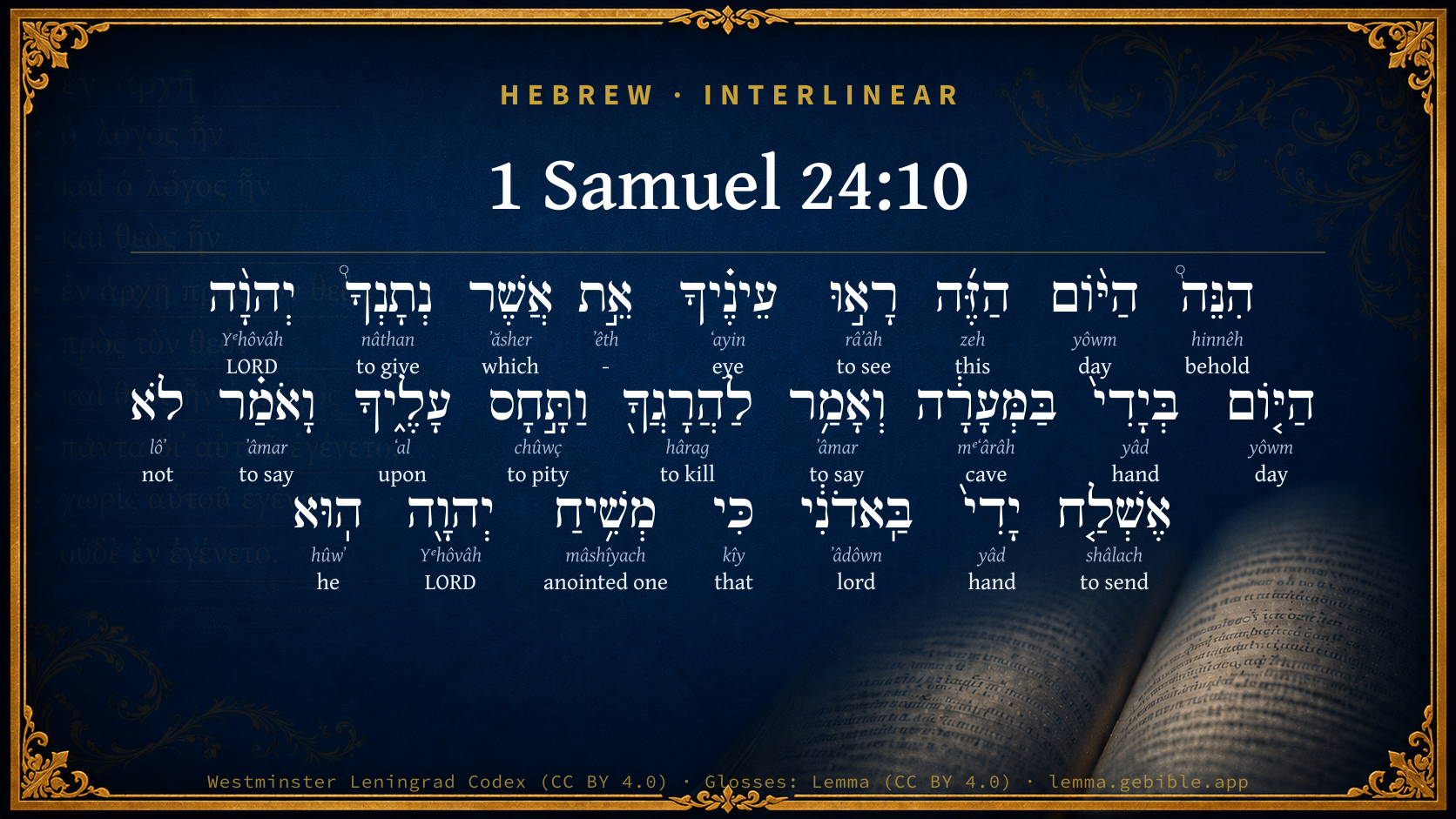
Hebrew (Westminster Leningrad Codex) 1 Samuel 24:10 appears in the Hebrew Old Testament. The text above is from the Westminster Leningrad Codex. Each word links to its Strong’s number, a concise gloss, and parsing drawn from the Open Scriptures Hebrew Bible morphology. Click any word for its full Brown-Driver-Briggs (BDB) entry.
Download image
Cite this verse

1 Samuel 24:10 (World English Bible). Public Domain. Lemma interlinear Bible study tool, https://lemma.gebible.app/v/1-samuel/24/10.

Show BibTeX & RIS
BibTeX
RIS
English Translation
Behold, this day your eyes have seen how that Yahweh had delivered you today into my hand in the cave: and some bade me kill you; but [my eye] spared you; and I said, I will not put forth my hand against my lord; for he is Yahweh's anointed.
World English Bible · Public Domain
Download a study sheet

One document with this verse’s original text, its word-by-word gloss line, the meaning frame, cross-references with their text, attributed commentary, and full source and license credits — printable, and it pastes into notes with its structure intact.

This verse Autodidact and up

Study sheet (.html) Plain text (.txt)

A passage Seminary Student

Up to 50 verses in one chapter. A passage sheet keeps up to 6 commentary sources and 12 cross-references per verse, in the order this page ranks them, and says so on the sheet whenever that leaves anything out. Ask for a single verse and you get the Autodidact verse sheet above.

Everything on this page stays free to read, with no account — the sheet is a download of what is already on screen, not access to it.

Want to remove ads? Support Godless Engineer
Compare translations 3

The same verse in 3 English versions, stacked beneath the original-language interlinear above. Click any original word for its lexicon entry.

Each is an independent rendering of the whole verse — the interlinear is not word-aligned to these translations.

Highlighted words mark where these versions differ — a whole-verse word diff, not a word-by-word alignment.

  • World English Bible Public Domain
    Behold, this day your eyes have seen how that Yahweh had delivered you today into my hand in the cave: and some bade me kill you; but [my eye] spared you; and I said, I will not put forth my hand against my lord; for he is Yahweh's anointed.
  • King James Version Public Domain
    Behold, this day thine eyes have seen how that the LORD had delivered thee to day into mine hand in the cave: and some bade me kill thee: but mine eye spared thee; and I said, I will not put forth mine hand against my lord; for he is the LORD's anointed.
  • unfoldingWord Literal Text CC BY-SA 4.0
    Behold, your eyes have seen this day that Yahweh gave you into my hand today in the cave. And one said to slay you, but it had compassion on you. And I said, ‘I will not stretch out my hand against my master, for he the anointed one of Yahweh.’

unfoldingWord Literal Text — © unfoldingWord, licensed CC BY-SA 4.0. Word-aligned USFM3 via Door43 (git.door43.org/unfoldingWord/en_ult).

Versions to compare (up to 4)

3 of 4 selected

Show all 18 translations

Every available English version of this verse, each an independent rendering of the whole verse.

  • World English Bible Public Domain
    Behold, this day your eyes have seen how that Yahweh had delivered you today into my hand in the cave: and some bade me kill you; but [my eye] spared you; and I said, I will not put forth my hand against my lord; for he is Yahweh's anointed.
  • Berean Standard Bible Public Domain
    Behold, this day you have seen with your own eyes that the LORD delivered you into my hand in the cave. I was told to kill you, but I spared you and said, ‘I will not lift my hand against my lord, since he is the LORD’s anointed.’
  • Majority Standard Bible Public Domain
    Behold, this day you have seen with your own eyes that the LORD delivered you into my hand in the cave. I was told to kill you, but I spared you and said, ‘I will not lift my hand against my lord, since he is the LORD’s anointed.’
  • King James Version Public Domain
    Behold, this day thine eyes have seen how that the LORD had delivered thee to day into mine hand in the cave: and some bade me kill thee: but mine eye spared thee; and I said, I will not put forth mine hand against my lord; for he is the LORD's anointed.
  • American Standard Version (1901) Public Domain
    Behold, this day thine eyes have seen how that Jehovah had delivered thee to-day into my hand in the cave: and some bade me kill thee; but `mine eye' spared thee; and I said, I will not put forth my hand against my lord; for he is Jehovah's anointed.
  • Revised Version (1885) Public Domain
    Behold, this day thine eyes have seen how that the LORD had delivered thee today into mine hand in the cave: and some bade me kill thee: but mine eye spared thee; and I said, I will not put forth mine hand against my lord; for he is the LORD’S anointed.
  • Geneva Bible (1599) Public Domain
    And Dauid saide to Saul, Wherefore giuest thou an eare to mens words, that say, Behold, Dauid seeketh euill against thee?
  • Douay-Rheims (1899) Public Domain
    And said to Saul: Why dost thou hear the words of men that say David seeketh thy hurt?
  • Young's Literal Translation Public Domain
    Lo, this day have thine eyes seen how that Jehovah hath given thee to-day into my hand in the cave; and `one' said to slay thee, and `mine eye' hath pity on thee, and I say, I do not put forth my hand against my lord, for the anointed of Jehovah he `is'.
  • Literal Standard Version CC BY-SA 4.0
    Behold, this day your eyes have seen how that YHWH has given you into my hand today in the cave; and [one] said to slay you, and [my eye] has pity on you, and I say, I do not put forth my hand against my lord, for he [is] the anointed of YHWH.
  • Unlocked Literal Bible CC BY-SA 4.0
    Today your eyes have seen how Yahweh put you into my hand when we were in the cave. Some told me to kill you, but I spared you. I said, 'I will not put out my hand against my master; for he is Yahweh's anointed.'
  • unfoldingWord Literal Text CC BY-SA 4.0
    Behold, your eyes have seen this day that Yahweh gave you into my hand today in the cave. And one said to slay you, but it had compassion on you. And I said, ‘I will not stretch out my hand against my master, for he the anointed one of Yahweh.’
  • Darby Bible Public Domain
    Behold, this day thine eyes have seen how that Jehovah had given thee this day into my hand in the cave; and they bade me kill thee; but [mine eye] spared thee; and I said, I will not put forth my hand against my lord, for he is the anointed of Jehovah.
  • World Messianic Bible Public Domain
    Behold, today your eyes have seen how the LORD had delivered you today into my hand in the cave. Some urged me to kill you, but I spared you. I said, ‘I will not stretch out my hand against my lord, for he is the LORD’s anointed.’
  • Webster's Bible Public Domain
    \\24:9\\And David said to Saul, Why hearest thou men's words, saying, Behold, David seeketh thy hurt?
  • Free Bible Version CC BY-SA 4.0
    “Just look! You've seen with your own eyes today that the Lord handed you over to me in the cave. Some urged me to kill you, but I showed you compassion, and said, ‘I refuse to attack my master, for he is the Lord's anointed one.’
  • Bible in Basic English Public Domain
    And David said to Saul, Why do you give any attention to those who say that it is my desire to do you wrong?
  • JPS Tanakh (1917) Public Domain
    (24-11) Behold, this day thine eyes have seen how that the LORD had delivered thee to-day into my hand in the cave; and some bade me kill thee; but mine eye spared thee; and I said: I will not put forth my hand against my lord; for he is the LORD'S anointed.

Literal Standard Version (2020), Covenant Press — licensed CC BY-SA 4.0. Text via the HelloAO Bible API (eBible.org). Unlocked Literal Bible (unfoldingWord) — licensed CC BY-SA 4.0. Text via the HelloAO Bible API (eBible.org). unfoldingWord Literal Text — © unfoldingWord, licensed CC BY-SA 4.0. Word-aligned USFM3 via Door43 (git.door43.org/unfoldingWord/en_ult). Free Bible Version, Dr. Jonathan Gallagher — licensed CC BY-SA 4.0. Text via the HelloAO Bible API (eBible.org).

Word by word

More ways to search: Search by grammar → Find every occurrence → Compare this word →

Practice this passage: Drill this verse → Learn its vocabulary →

וַתָּ֣חָס
chûwç
H2347
“and · to pity”
Conjunction + Verb, Qal, Sequential Imperfect, 3rd Person, Feminine, Singular
Part of Speech
Conjunction + Verb
Stem
Qal
Form
Sequential Imperfect
Person
3rd Person
Gender
Feminine
Number
Singular
Full BDB Definition

Origin: a primitive root

TWOT: 626

(Qal) to pity, have compassion, spare, look upon with compassion
  1. הִנֵּה֩ hinnêh H2009 “behold” Particle, Demonstrative
  2. הַיּ֨וֹם yôwm H3117 “the · day” Particle, Definite Article + Noun, Common, Masculine, Singular, Absolute
  3. הַזֶּ֜ה zeh H2088 “the · this” Particle, Definite Article + Pronoun, Demonstrative, Masculine, Singular
  4. רָא֣וּ râʼâh H7200 “to see” Verb, Qal, Perfect, 3rd Person, Common, Plural
  5. עֵינֶ֗יךָ ʻayin H5869 “eyes · your” Noun, Common, Both, Dual, Construct + Suffix, Personal, 2nd Person, Masculine, Singular
  6. אֵ֣ת ʼêth H853 “-” Particle, Direct Object
  7. אֲשֶׁר ʼăsher H834 “which” Particle, Relative
  8. נְתָנְךָ֩ nâthan H5414 “to give · you” Verb, Qal, Perfect, 3rd Person, Masculine, Singular + Suffix, Personal, 2nd Person, Masculine, Singular
  9. יְהוָ֨ה Yᵉhôvâh H3068 “LORD” Noun, Proper
  10. הַיּ֤וֹם yôwm H3117 “the · day” Particle, Definite Article + Noun, Common, Masculine, Singular, Absolute
  11. בְּיָדִי֙ yâd H3027 “in/at · hand · my” Preposition + Noun, Common, Both, Singular, Construct + Suffix, Personal, 1st Person, Common, Singular
  12. בַּמְּעָרָ֔ה mᵉʻârâh H4631 “in/at the · cave” Preposition, Determined + Noun, Common, Feminine, Singular, Absolute
  13. וְאָמַ֥ר ʼâmar H559 “and · to say” Conjunction + Verb, Qal, Sequential Perfect, 3rd Person, Masculine, Singular
  14. לַהֲרָגֲךָ֖ hârag H2026 “to kill · you” Preposition + Verb, Qal, Infinitive Construct + Suffix, Personal, 2nd Person, Masculine, Singular
  15. עָלֶ֑יךָ ʻal H5921 “upon · you” Preposition + Suffix, Personal, 2nd Person, Masculine, Singular
  16. וָאֹמַ֗ר ʼâmar H559 “and · to say” Conjunction + Verb, Qal, Sequential Imperfect, 1st Person, Common, Singular
  17. לֹא lôʼ H3808 “not” Particle, Negative
  18. אֶשְׁלַ֤ח shâlach H7971 “to send” Verb, Qal, Imperfect, 1st Person, Common, Singular
  19. יָדִי֙ yâd H3027 “hand · my” Noun, Common, Both, Singular, Construct + Suffix, Personal, 1st Person, Common, Singular
  20. בַּֽאדֹנִ֔י ʼâdôwn H113 “in/at · lord · my” Preposition + Noun, Common, Masculine, Singular, Construct + Suffix, Personal, 1st Person, Common, Singular
  21. כִּי kîy H3588 “that” Conjunction
  22. מְשִׁ֥יחַ mâshîyach H4899 “anointed one of” Noun, Common, Masculine, Singular, Construct
  23. יְהוָ֖ה Yᵉhôvâh H3068 “LORD” Noun, Proper
  24. הֽוּא hûwʼ H1931 “he” Pronoun, Personal, 3rd Person, Masculine, Singular

About this verse

These counts appear in no published source. They are computed here, from the morphology-tagged text and Lemma’s own curated glosses. What Lemma adds →

25
words
21
distinct lemmas
Historical
section

Notable vocabulary

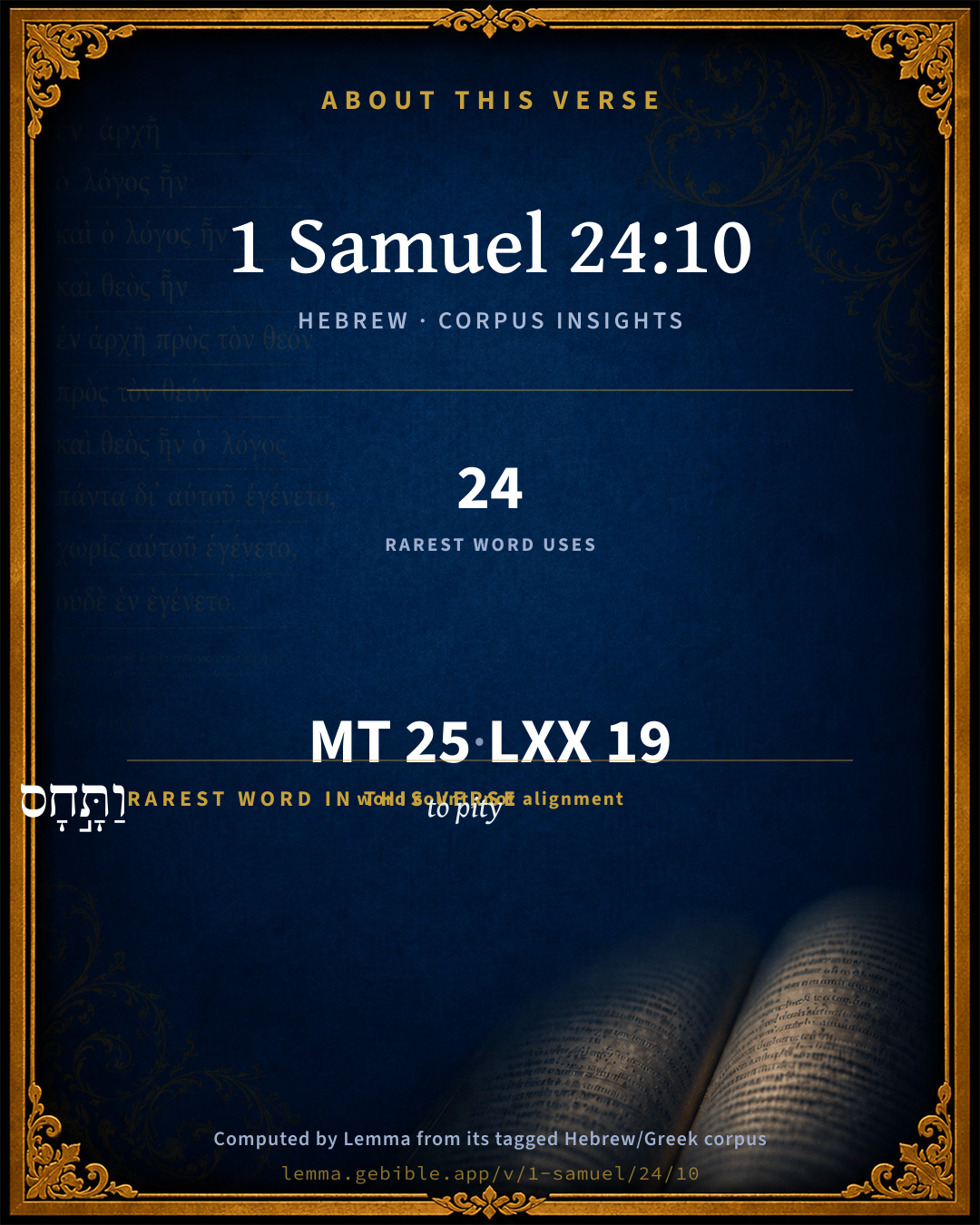
The rarest word here is וַתָּ֣חָס to pity H2347 — appearing just 24 times in the whole Hebrew Bible.

Shared distinctive vocabulary

וַתָּ֣חָס to pity H2347 occurs in 24 verses of the Hebrew Bible. Also found in:

Grammatical profile

  • 7 verbs
  • 10 nouns
  • 2 pronouns
  • 1 preposition
  • 1 conjunction
  • 4 particles

Verb forms

  • רָא֣וּ Qal · Perfect
  • נְתָנְךָ֩ Qal · Perfect
  • וְאָמַ֥ר Qal · Sequential Perfect
  • לַהֲרָגֲךָ֖ Qal · Infinitive Construct
  • וַתָּ֣חָס Qal · Sequential Imperfect
  • וָאֹמַ֗ר Qal · Sequential Imperfect
  • אֶשְׁלַ֤ח Qal · Imperfect

Repetition

Words recur within this verse — often emphatic in Hebrew:

  • הַיּ֨וֹם day H3117 ×2
  • יְהוָ֨ה LORD H3068 ×2
  • בְּיָדִי֙ hand H3027 ×2
  • וְאָמַ֥ר to say H559 ×2

Hebrew & Septuagint length

In English translation the verse runs 49 words from the Hebrew and 21 from the Septuagint (LXX English) — the Septuagint runs noticeably shorter here. See the side-by-side →

A rough comparison of the two English renderings, which tokenize alike — not a word-level alignment.

Word counts can differ between the Hebrew and the Greek without any difference in meaning — e.g. the Hebrew direct-object marker אֵת has no separate Greek word, and Greek often adds the article ὁ.

In the original languages it is 25 Hebrew tokens and 19 Greek tokens — but the two are counted differently (Hebrew bundles its prefixes and suffixes into one token; the Greek is in lemma form), so that isn’t a like-for-like length.

Cross-references

3

Topical passages linked to 1 Samuel 24:10 in the Treasury of Scripture Knowledge — connected by theme and wording, ordered by reader-vote popularity; previews shown in the World English Bible.

  • 1 Samuel 24:4 The men of David said to him, Behold, the day of which Yahweh said to you, Behold, I will deliver your enemy into your hand, and you shall do to him as it shall seem good to you. Then David arose, and cut off the skirt of Saul's robe secretly.
  • Psalms 105:15 "Don't touch my anointed ones! Do my prophets no harm!"
  • 1 Samuel 26:8–9 Then said Abishai to David, God has delivered up your enemy into your hand this day: now therefore please let me strike him with the spear to the earth at one stroke, and I will not strike him the second time.

Cross-references courtesy of OpenBible.info (CC BY 4.0).

Hebrew and Greek witnesses Masoretic Hebrew ↔ Greek Septuagint

The same verse in the two great witnesses to the Old Testament, shown verse-for-verse.

Here the Septuagint runs noticeably shorter than the Hebrew — LXX2012 (modern English Septuagint) 21 words vs World English Bible 49. A rough length comparison of the two English translations, not a word-level alignment — read both below.

These are two independent witnesses, not word-aligned to each other, and the Septuagint is shown in lemma (dictionary) form.

Hebrew 1 Samuel 24:10 Masoretic · Westminster Leningrad Codex

הִנֵּה֩ הַיּ֨וֹם הַזֶּ֜ה רָא֣וּ עֵינֶ֗יךָ אֵ֣ת אֲשֶׁר נְתָנְךָ֩ יְהוָ֨ה הַיּ֤וֹם בְּיָדִי֙ בַּמְּעָרָ֔ה וְאָמַ֥ר לַהֲרָגֲךָ֖ וַתָּ֣חָס עָלֶ֑יךָ וָאֹמַ֗ר לֹא אֶשְׁלַ֤ח יָדִי֙ בַּֽאדֹנִ֔י כִּי מְשִׁ֥יחַ יְהוָ֖ה הֽוּא

Behold, this day your eyes have seen how that Yahweh had delivered you today into my hand in the cave: and some bade me kill you; but [my eye] spared you; and I said, I will not put forth my hand against my lord; for he is Yahweh's anointed.

World English Bible · Public Domain

Greek LXX 1 Samuel 24:10 Septuagint · lemma form

καί εἶπον δαυίδ πρός σαούλ ὕνα τίς ἀκούω ὁ λόγος ὁ λαός λέγω ἰδού δαυίδ ζητέω ὁ ψυχή σύ

And David said to Saul, Why do you listen to the words of the people, saying, Behold, David seeks your life?

LXX2012 (modern English Septuagint) · Public Domain

Hebrew: Westminster Leningrad Codex (CC BY 4.0). Greek: Septuagint (public domain); English from LXX2012 (modern English Septuagint) (Public Domain). How the Septuagint differs from the Hebrew →

Targum (Aramaic paraphrase)

1

The Targum is the ancient Jewish Aramaic paraphrase of the Hebrew Scriptures — an interpretive translation, not the Hebrew text itself. Onkelos (literal) and Pseudo-Jonathan (expansive) render the Torah, and Jonathan the Prophets. Coverage is partial: where no permissively-licensed English translation exists for a verse, only the Aramaic is shown. This is verse-level text, not a word-by-word alignment to the Hebrew.

  1. Targum Jonathan Prophets (Joshua–Malachi)
    וַאֲמַר דָוִד לְשָׁאוּל לְמָא אַתְּ שָׁמַע יַת פִּתְגָמֵי בְנֵי אֱנָשָׁא דְאָמְרִין הָא דָוִד כָּמֵין בִּישְׁתָּךְ:

    (no public-domain English translation for this verse)

    Targum Jonathan — Aramaic: “Mikraot Gedolot” (public domain). English: “Sefaria Community Translation” (CC0 1.0 (public-domain dedication)); “London "Chaldee Paraphrase," 1871” (public domain). Text via Sefaria.

Commentary

Notes on 1 Samuel 24:10 from classic Christian and Jewish commentators (each source and its license shown beneath its notes). The classic Christian expositions comment on the surrounding passage and are grouped to its opening verse, so a note may address several verses; the Jewish commentaries on the Tanakh (Rashi and others) are per-verse, so they appear only where the commentator wrote on this verse.

Lemma curates 59 commentaries, every one of them public domain or Creative Commons licensed, each selected and text-cleaned for this edition rather than reprinted as found. About our sources →

Trapp's Complete Commentary

John Trapp

1Sa 24:10 Behold, this day thine eyes have seen how that the LORD had delivered thee to day into mine hand in the cave: and [some] bade [me] kill thee: but [mine eye] spared thee; and I said, I will not put forth mine hand against my lord; for he [is] the LORD’S anointed.

Ver. 10. Behold, this day thine eyes have seen.] This is David’s defence; wherein each word hath its weight, each syllable its substance. We may lawfully, when wronged, clear our own innocence, so we do it, as here, with meekness and wisdom. Sed o quam hoc non est omnium.

John Trapp, A Commentary or Exposition upon All the Books of the Old and New Testament (1647–1656) — public domain. Text from a community e-Sword module.

Joseph Benson's Commentary

1Sa 24:10-12. Mine eye spared thee — A phrase signifying the taking pity on those whom we have it in our power to hurt. The eye is said to spare, because it affects the heart, and induces a person to spare. Moreover, my father — Such he was through David’s marriage of his daughter. The Lord avenge me of thee — Rather, will avenge me; that is, vindicate and deliver me from thy violent and unjust persecution. For he does not, in these words, pray God to punish Saul for the injuries he had done him, but to justify, clear, and protect himself. But my hand shall not be upon thee — He was resolved not to return evil for evil, or to avenge himself, but to leave it to God to do him right.

Joseph Benson's Commentary on the Old and New Testaments (1811–1818) — public domain. Text from a community e-Sword module.

Geneva Bible (1599)

Geneva Bible translators

Contrary to the false report of them that said, David was Saul’s enemy, he proveth himself to be his friend.

Geneva Bible (1599) marginal notes — public domain. Text via Bolls.life.

Ellicott's Commentary for English Readers

(10) Thine eyes have seen.—David and a crowd of armed men around him were standing at the entrance of the cave which King Saul had just left; thus the king’s eye had seen—nay, was seeing that very moment—that his life had been in his enemy David’s hand.

And some bade me kill thee.—The literal translation here would be Jehovah delivered thee to-day into mine hand in the cave, and bade [me] kill thee. And this rendering has been explained by assuming that God’s allowing Saul to choose the very cavern for his midday slumber where David and his company were lodging was tantamount to directing David to slay his bitter foe, thus given over helpless into his hands; but this is contrary to the spirit of the whole narrative. The English Version has followed the Syriac and Chaldee Versions here, and by supplying “some”—better, perhaps, one—before “bade me kill thee,” has given us the sense in which the Hebrews have always understood the passage. The Vulg. here, with a very slight change in the vowel points, renders “I thought to kill thee.”

But mine eye spared thee.—The English Version supplies an obvious subject in “mine eye.” Clericus suggests more happily, “my soul,” or “my hand,” before “spared thee.”

A Bible Commentary for English Readers, edited by Charles John Ellicott (1878–1897) — public domain. Text from a community e-Sword module.

John Gill's Exposition

Behold, this day thine eyes have seen,.... Or may see; there is full proof and evidence of it, and which will be presently shown:

how that the Lord had delivered thee today into mine hand in the cave; from whence they were both just come:

and some bade me kill thee; some of the men that were with David, some of his officers or principal friends put him upon it, having a fair opportunity, and thinking it no evil, since he was his enemy, and sought his life; or "it said, kill thee"; my heart prompted me to it, that said so at first, as Ben Gersom interprets it; some refer it to God, who in his providence said so, or so it might be understood by David, as if Providence directed him to it, by giving film such an opportunity of doing it:

but mine eye spared thee; had pity on him, and notwithstanding the suggestions of friends, and of his own heart at first, or the seeming direction of Providence, yet he had mercy on him, and forbore slaying him:

and I said, I will not put forth my hand against my lord; and king, whose subject I am:

for he is the Lord's anointed; the Lord has raised him to this dignity; invested him with the office of a king, and as such I regard him, and therefore have refrained mine hand from him, from hurting him,

John Gill's Exposition of the Whole Bible (1746–1763) — public domain (CC PDM 1.0). Text via the HelloAO Bible API.

Matthew Poole's English Annotations

Mine eye; which words are easily understood both from the nature of the thing, and from the use of this phrase in other scriptures, as Deu 7:16; 13:8. The eye is said to spare, because it affects the heart with pity, and moves a man to spare.

Matthew Poole's English Annotations on the Holy Bible (1683–1685) — public domain. Text from a community e-Sword/MySword module.

John Wesley's Explanatory Notes

Mine eye - The eye is said to spare, because it affects the heart with pity, and moves a man to spare.

John Wesley, Explanatory Notes Upon the Whole Bible (1754–1765) — public domain. Text via the GEBible commentary corpus.

unfoldingWord translationNotes

Door43 World Missions Community

your eyes have seen

Here "your eyes" represent King Saul. AT: "you have seen with your own eyes" (See: Synecdoche)

put you into my hand

The word "hand" is a metonym for control. AT: "put you where I could kill you or allow you to live" (See: Metonymy)

my father

Saul was not David's real father. David calls him "father" to show that he respects Saul.

there is no evil or treason in my hand

David speaks as if evil and treason were physical objects he could hold in his hand. Here "hand" represents a person acting or doing something. AT: "I have done no evil deed against you, nor have I rebelled against you" (See: Metaphor and Metonymy)

translationWords

Yahweh

hand

Yahweh

ancestor

robe

evil

sin

life

unfoldingWord translationNotes — © Distant Shores Media and the Door43 World Missions Community, licensed CC BY-SA 4.0. Source: git.door43.org/Door43/en_tn.

Rashi

Rabbi Shlomo Yitzchaki (Rashi)

Why do you listen. Why do you accept Do'eg's slander concerning me?

Rashi on the Tanakh — English translations: “The Judaica Press complete Tanach with Rashi, translated by A. J. Rosenberg” (CC BY 4.0); “Pentateuch with Rashi's commentary by M. Rosenbaum and A.M. Silbermann, 1929-1934” (public domain); “The Metsudah Tanach series, Lakewood, N.J” (CC BY 4.0); and “The Book of Joshua, Metsudah Publications, 1997” (CC BY 4.0). Text via Sefaria.

Lesson kit

Teaching starters — assembled from the data on this page, not authored interpretation. Every prompt links to the verse data it draws on. Edit before teaching.

1 Samuel, in the Historical, opens this verse with 25 words (21 distinct Hebrew lemmas). Its most distinctive word is chûwç (“to pity”). The Greek Septuagint runs shorter here. A historical commentator’s framing appears above. Read the whole chapter for the surrounding context.

Discussion questions

  1. How does “to pity” (chûwç) shape what this verse is saying?
  2. How does Genesis 45:20, which shares the word «to pity», read alongside this verse?
  3. What does the repetition of “day” (2× in this one verse) do in this verse?
  4. The Septuagint runs shorter here than the Hebrew. What might account for the difference?
  5. These translations render this verse differently. What is at stake in choosing one wording over another?
  6. «רָא֣וּ» is a Qal Perfect verb. How does that grammatical form shape the action described?
  7. Compare how Trapp's Complete Commentary and Joseph Benson's Commentary read this verse. Where do they agree or differ?

Things to notice

Reading settings

Reading text

Shown beneath each verse's original-language words.

Old Testament
Old Testament edition

Read the OT as the Masoretic Hebrew (MT) or the Greek Septuagint (LXX).

English shown for the Greek Septuagint (in the Hebrew ↔ Greek comparison).

Comparing translations? Open the Compare panel on any verse page to stack up to four side by side.